
South East Asia Photonics Market Size, Share, Trends and Forecast by Type, Application, End User, and Country, 2026-2034
South East Asia Photonics Market Size, Share, Trends & Forecast (2026-2034)
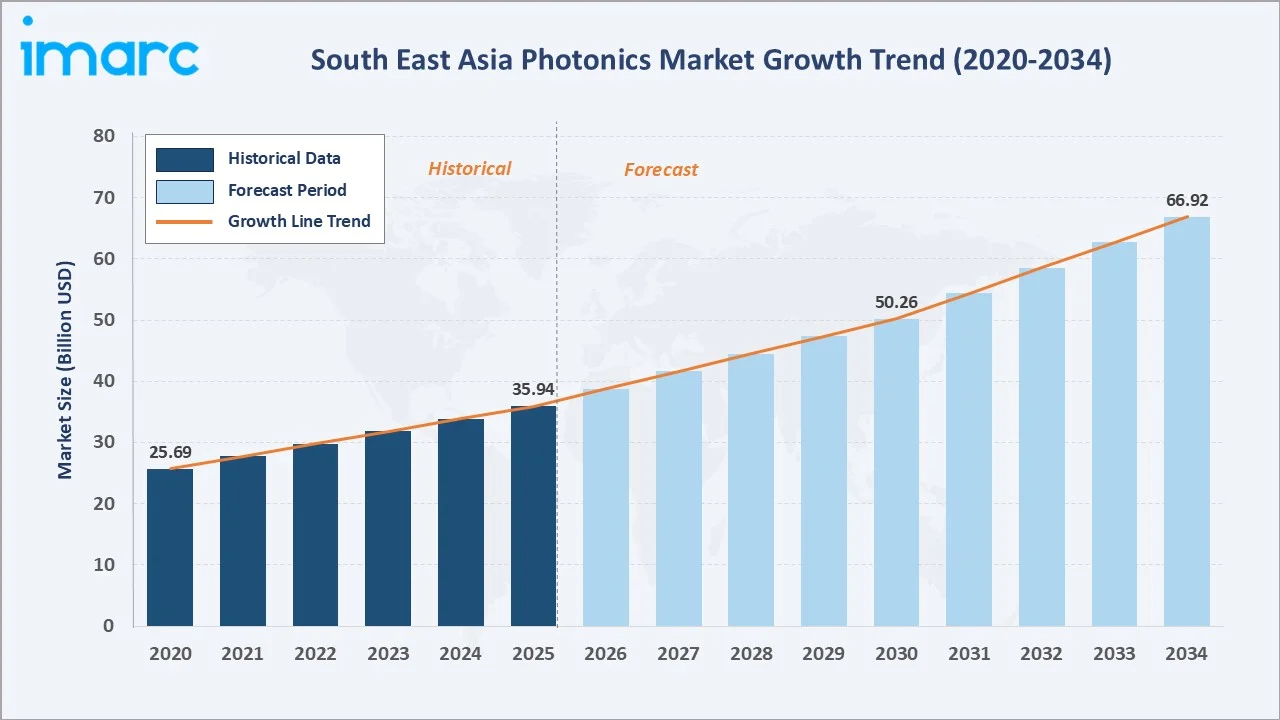
The South East Asia photonics market reached USD 35.94 Billion in 2025 and is projected to reach USD 66.92 Billion by 2034, growing at a CAGR of 6.94% during 2026-2034. The market is driven by rising demand for precise and efficient solutions in manufacturing processes, growing utilization of renewable energy sources such as solar power, and a thriving regional manufacturing sector. Lasers, Detectors, Sensors and Imaging Devices dominate the type segment at 36.8%, while Media, Broadcasting and Telecommunication leads the end user segment at 28.4%. Singapore commands 29.8% of the country market share, supported by its advanced technology hub status and strong electronics manufacturing base.
Market Snapshot
|
Metric |
Value |
|
Market Size (2025) |
USD 35.94 Billion |
|
Forecast Market Size (2034) |
USD 66.92 Billion |
|
CAGR (2026-2034) |
6.94% |
|
Base Year |
2025 |
|
Historical Period |
2020-2025 |
|
Forecast Period |
2026-2034 |
|
Dominant Type |
Lasers, Detectors, Sensors and Imaging Devices (36.8%, 2025) |
|
Dominant End User |
Media, Broadcasting and Telecommunication (28.4%, 2025) |
|
Leading Country |
Singapore (29.8%, 2025) |
The market expanded from USD 25.69 Billion in 2020 to USD 35.94 Billion in 2025, anchored at USD 50.26 Billion in 2030 and forecast to reach USD 66.92 Billion by 2034. The region's rapid infusion of photonics-based innovations across telecommunications, manufacturing, and healthcare applications, combined with expanding renewable energy investment, is sustaining consistent growth across the historical and forecast periods, with no material disruption to the underlying demand trajectory.
To get more information on this market, Request Sample
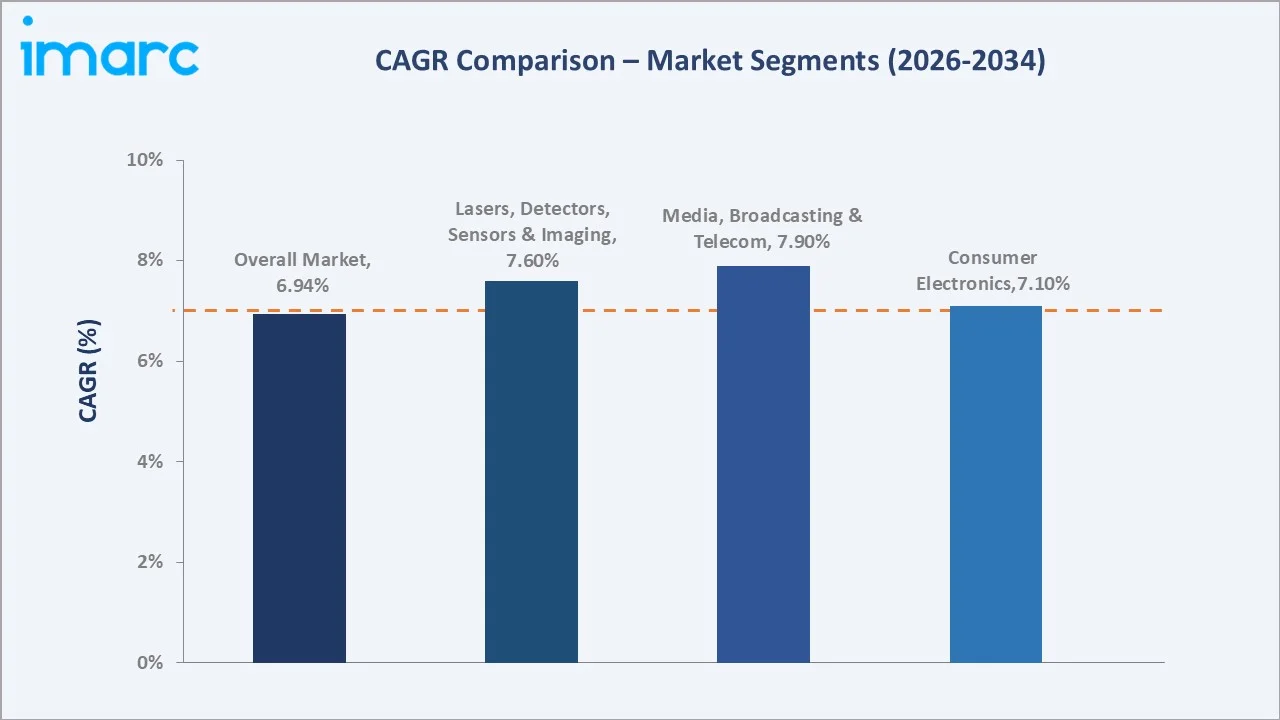
Media, Broadcasting and Telecommunication grows fastest at approximately 7.9% CAGR as expanding 5G and fiber network rollouts across the region continue to elevate optical component procurement. Lasers, Detectors, Sensors and Imaging Devices grow at approximately 7.6% CAGR as precision manufacturing and medical imaging applications scale in tandem with the region's industrial and healthcare modernization.
Executive Summary
The South East Asia photonics market reached USD 35.94 Billion in 2025, reflecting the region's accelerating adoption of light-based technologies across telecommunications, manufacturing, healthcare, and renewable energy applications. Photonics enables high-speed data transmission, precision manufacturing, and advanced medical diagnostics, positioning it as a foundational technology for the region's digital and industrial transformation. The market is projected to reach USD 66.92 Billion by 2034.
Lasers, Detectors, Sensors and Imaging Devices at 36.8% dominate the type segment through widespread use in manufacturing precision and industrial automation. Media, Broadcasting and Telecommunication at 28.4% leads the end user segment as expanding network infrastructure drives sustained optical component demand. Singapore at 29.8% leads regionally through its advanced technology hub status, strong semiconductor and electronics manufacturing ecosystem, and robust government-backed innovation funding.
Key Market Insights
|
Insight |
Data |
|
Dominant Type |
Lasers, Detectors, Sensors and Imaging Devices - 36.8% share (2025) |
|
Dominant End User |
Media, Broadcasting and Telecommunication - 28.4% market share (2025) |
|
Leading Country |
Singapore - 29.8% market share (2025) |
|
Market Opportunity |
Silicon photonics integration; solar photonics efficiency solutions; medical imaging diagnostics; smart city infrastructure; quantum photonics research |
Key Analytical Observations Supporting the Above Data:
- Lasers, Detectors, Sensors and Imaging Devices at 36.8%: The segment dominates by offering precise, efficient solutions across manufacturing, medical imaging, and surveying applications. Its widespread use in laser cutting, welding, and optical coherence tomography strengthens sustained demand across the region's manufacturing and healthcare sectors.
- Media, Broadcasting and Telecommunication at 28.4%: The segment leads through rising reliance on smartphones, internet connectivity, and data-driven services. Expanding telecommunications infrastructure across South East Asia is directly boosting demand for optical fibers and laser-based network components.
- Singapore at 29.8%: Singapore dominates through its position as a regional technology and innovation hub, strong semiconductor manufacturing base, and government-backed research investments that continue to attract photonics-focused enterprises and R&D activity.
South East Asia Photonics Market Overview
The South East Asia photonics market encompasses the science and technology of generating, manipulating, and detecting photons across applications spanning telecommunications, manufacturing, healthcare, environmental monitoring, and renewable energy. Photonics enables high-speed data transmission for internet, telephony, and video conferencing, while supporting medical diagnostics through techniques such as optical coherence tomography and fluorescence imaging.
The ecosystem integrates LED and laser component manufacturers, optical sensor and imaging device producers, optical communication systems suppliers, telecommunications network operators, industrial manufacturing equipment providers, and regulatory bodies overseeing photonics product standards. Macroeconomic factors include expanding manufacturing sectors, rising renewable energy adoption, growing telecommunications infrastructure investment, and increasing government support for technology innovation across the region.
Market Dynamics
To evaluate market opportunities, Request Sample
Market Drivers
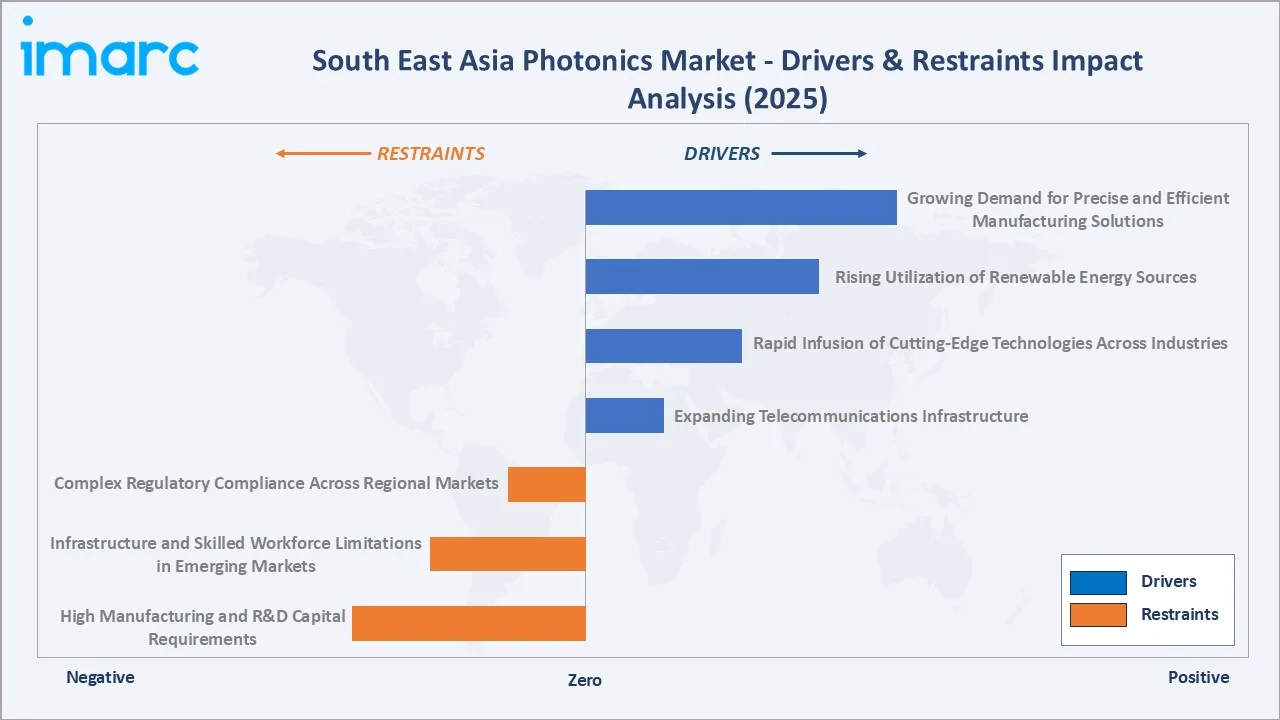
- Growing Demand for Precise and Efficient Manufacturing Solutions: The region's thriving manufacturing and electronics production base is driving adoption of photonics-based solutions such as laser cutting, welding, and 3D printing. These techniques offer superior precision and efficiency compared to conventional methods, encouraging manufacturers across automotive, electronics, and industrial sectors to integrate photonics technologies into production processes. Rising automation investment and quality-control requirements across regional factories are further reinforcing the shift toward photonics-enabled precision manufacturing equipment and inspection systems.
- Rising Utilization of Renewable Energy Sources: Rising utilization of renewable energy sources, particularly solar power, is boosting demand for photonics research and innovation. Photonics-based advancements are enhancing the efficiency and affordability of solar energy systems, supporting the region's renewable energy transition and creating sustained demand for photonics components across the solar value chain. Government-backed clean energy targets across Indonesia, Vietnam, and the Philippines are accelerating solar capacity additions, indirectly expanding the addressable market for photonics-enabled energy efficiency solutions.
- Rapid Infusion of Cutting-Edge Technologies Across Industries: Rapid infusion of cutting-edge technologies across telecommunications, manufacturing, and healthcare industries is accelerating photonics adoption. As South East Asian industries embrace photonics-based innovations for network performance, diagnostics, and industrial automation, demand across the value chain continues to expand. Cross-sector collaboration between technology providers and manufacturers is shortening the adoption cycle for new photonics applications, particularly in smart manufacturing and connected healthcare deployments.
- Expanding Telecommunications Infrastructure: Expanding telecommunications infrastructure, driven by rising smartphone penetration and internet-based services, is catalyzing demand for high-speed and reliable networks. Photonics-based technologies, including optical fibers and laser systems, are essential for enhancing network performance across the region's growing digital economy. Continued fiberization of last-mile connectivity and metro network upgrades across Singapore, Malaysia, and Vietnam are reinforcing sustained procurement of optical communication components.
Market Restraints
- High Manufacturing and R&D Capital Requirements: Photonics component manufacturing requires precision engineering, specialized materials, and advanced fabrication equipment, resulting in elevated production and R&D costs. These capital requirements can restrict entry for smaller regional players and slow the pace of capacity expansion across the value chain. Smaller domestic manufacturers often face difficulty securing financing for cleanroom facilities and precision fabrication tools, limiting their ability to compete with established global suppliers.
- Infrastructure and Skilled Workforce Limitations in Emerging Markets: Certain South East Asian markets face gaps in advanced manufacturing infrastructure and skilled technical workforce availability, which can constrain the pace of photonics technology adoption. This can limit large-scale production capacity in emerging regional markets and slow the diffusion of advanced photonics manufacturing techniques. Talent shortages in optical engineering and photonics-specific technical disciplines are prompting regional governments and industry bodies to expand vocational training programs.
- Complex Regulatory Compliance Across Regional Markets: Photonics products are subject to evolving quality, safety, and environmental regulations across different South East Asian jurisdictions. Navigating varied and sometimes stringent compliance requirements can increase operational complexity and costs for manufacturers operating across multiple regional markets. Divergent product certification standards between ASEAN member states continue to add administrative overhead for suppliers seeking simultaneous market entry across the region.
Market Opportunities
- Silicon Photonics Integration for Digital Infrastructure: Silicon photonics integration for data center and 5G interconnects enables more compact, power-efficient optical components. As regional cloud and telecommunications providers scale infrastructure, wider adoption of integrated photonic circuits can open new growth avenues for component manufacturers.
- Solar Photonics Efficiency Solutions: Photonics-based solar efficiency solutions reduce the levelized cost of solar electricity generation. As South East Asian nations expand renewable energy capacity, demand for photonics research and innovation supporting solar panel performance is expected to rise, creating growth opportunities for advanced photonics manufacturers.
Market Challenges
- Regional Manufacturer Competition Creating Pricing Pressure on Global Suppliers: Global photonics leaders face increasing competitive pressure from regional electronics manufacturers offering cost-competitive components and faster customization. Local suppliers' closer partnerships with regional OEMs can reduce market share and profit margins for global photonics component manufacturers operating across South East Asia.
- Rapid Technology Obsolescence Requiring Sustained R&D Investment: Rapid technology cycles in photonics component design require continuous R&D investment to maintain performance leadership. Manufacturers that fail to keep pace with evolving performance, miniaturization, and efficiency standards risk losing competitive position across the region's fast-evolving photonics applications.
Emerging Market Trends
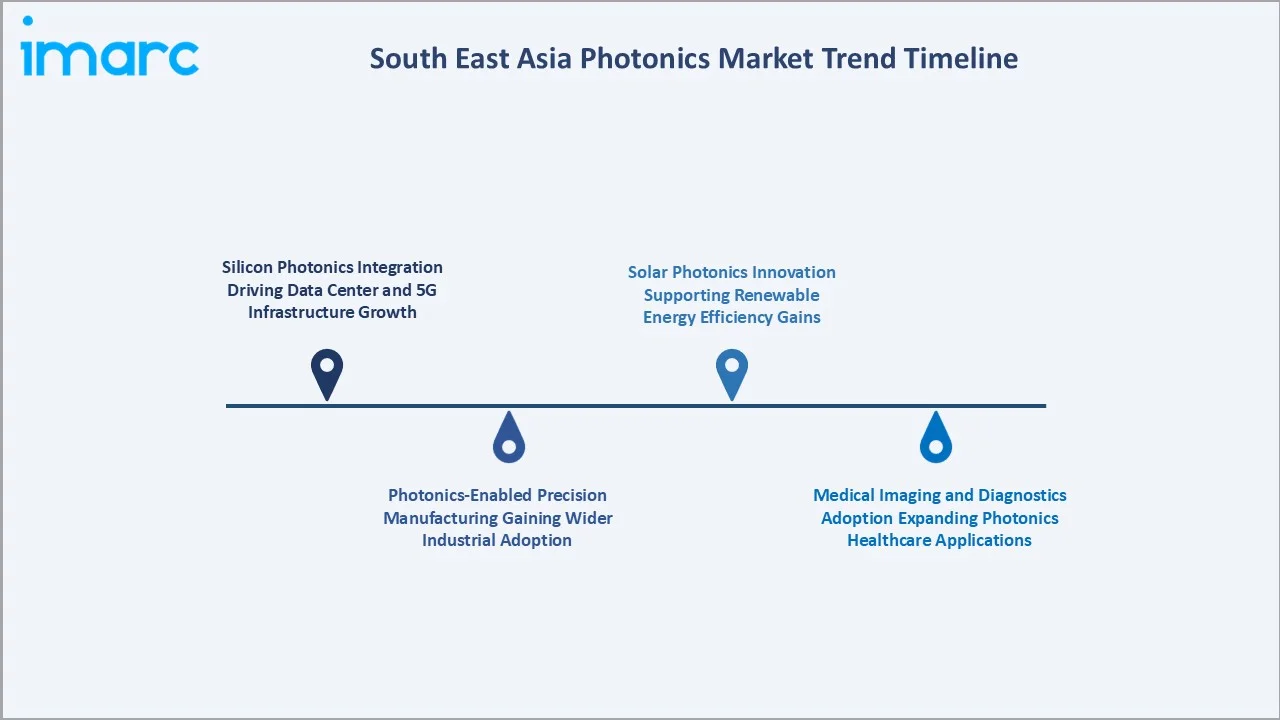
1. Silicon Photonics Integration Driving Data Center and 5G Infrastructure Growth
Silicon photonics integration is emerging as a key enabler of high-speed, energy-efficient data transmission for data centers and 5G network infrastructure. As the region's cloud computing and telecommunications providers scale operations, demand for compact, low-power optical interconnects is accelerating. This trend is supporting wider adoption of integrated photonic circuits across regional data infrastructure investments.
2. Photonics-Enabled Precision Manufacturing Gaining Wider Industrial Adoption
Photonics-enabled precision manufacturing techniques, including laser cutting, welding, and 3D printing, are gaining wider adoption across the region's automotive, electronics, and industrial equipment sectors. These techniques improve manufacturing accuracy, reduce material waste, and support faster production cycles, encouraging manufacturers to expand their photonics-based production capabilities.
3. Solar Photonics Innovation Supporting Renewable Energy Efficiency Gains
Solar photonics innovation is enhancing the efficiency and affordability of solar energy systems across South East Asia's expanding renewable energy sector. As governments prioritize clean energy targets, photonics research is playing an increasingly central role in improving solar panel performance and reducing the levelized cost of solar electricity generation.
4. Medical Imaging and Diagnostics Adoption Expanding Photonics Healthcare Applications
Medical imaging and diagnostics applications, including optical coherence tomography and fluorescence imaging, are expanding photonics adoption across the region's healthcare sector. These technologies are improving diagnostic accuracy for conditions such as eye diseases and cancer, driving sustained demand for photonics-based medical equipment across South East Asian hospitals and diagnostic centers.
Industry Value Chain Analysis
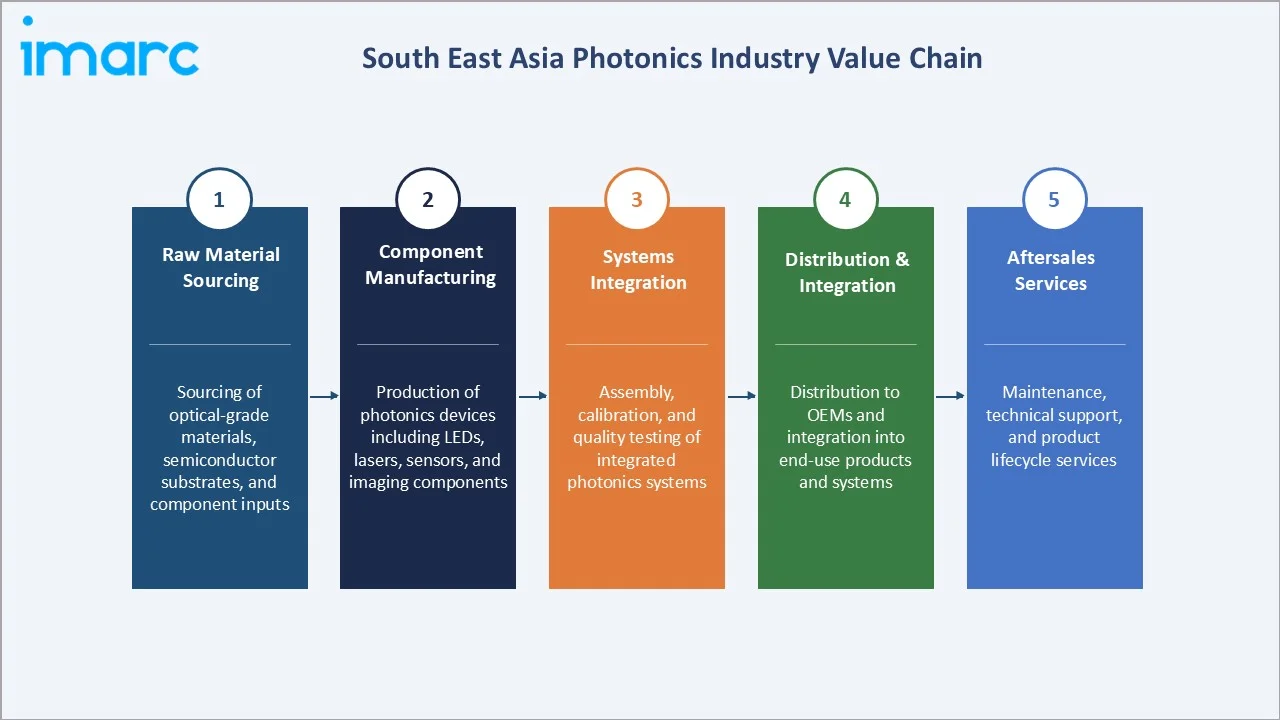
The South East Asia photonics value chain integrates raw material and optical component sourcing, photonics device manufacturing and assembly, systems integration and quality testing, distribution and OEM integration, and aftersales and maintenance services. The value chain's commercial architecture continues to consolidate as regional manufacturers expand integrated production capabilities to serve growing domestic and export demand.
|
Stage |
Key Activities |
|
Raw Material Sourcing |
Sourcing of optical-grade materials, semiconductor substrates, and component inputs |
|
Component Manufacturing |
Production of photonics devices including LEDs, lasers, sensors, and imaging components |
|
Systems Integration |
Assembly, calibration, and quality testing of integrated photonics systems |
|
Distribution & Integration |
Distribution to OEMs and integration into end-use products and systems |
|
Aftersales Services |
Maintenance, technical support, and product lifecycle services |
The component manufacturing stage represents the value chain's most technically intensive tier, requiring precision fabrication capabilities and sustained capital investment. The distribution and OEM integration stage is experiencing steady expansion as regional electronics and telecommunications manufacturers increasingly source photonics components locally to reduce supply chain lead times.
Technology Landscape in the South East Asia Photonics Industry
Silicon Photonics Technology
Silicon photonics technology integrates optical and electronic functions on a single chip, offering high-speed data transmission, compact form factors, and improved energy efficiency, making it the preferred technology for next-generation optical communication systems across the region's growing digital infrastructure sector.
Laser and Optical Sensor Technology
Laser and optical sensor technology offers high precision, strong durability, and reliable performance across manufacturing, medical, and industrial applications, providing accurate detection, cutting, and imaging capabilities suited to precision manufacturing and industrial automation.
LED and Solid-State Lighting Technology
LED and solid-state lighting technology offers energy efficiency, long operational life, and compact design, supporting applications across consumer electronics, display, and lighting segments, reinforced by continued cost reductions across South East Asia's expanding manufacturing base.
Market Segmentation Analysis
The report covers the following segments:
|
Segment Category |
Leading Segment |
Market Share |
Year |
|
Type |
Lasers, Detectors, Sensors and Imaging Devices |
36.8% |
2025 |
|
Application |
🔒 |
🔒 |
2025 |
|
End User |
Media, Broadcasting and Telecommunication |
28.4% |
2025 |
|
Country |
Singapore |
29.8% |
2025 |

By Type
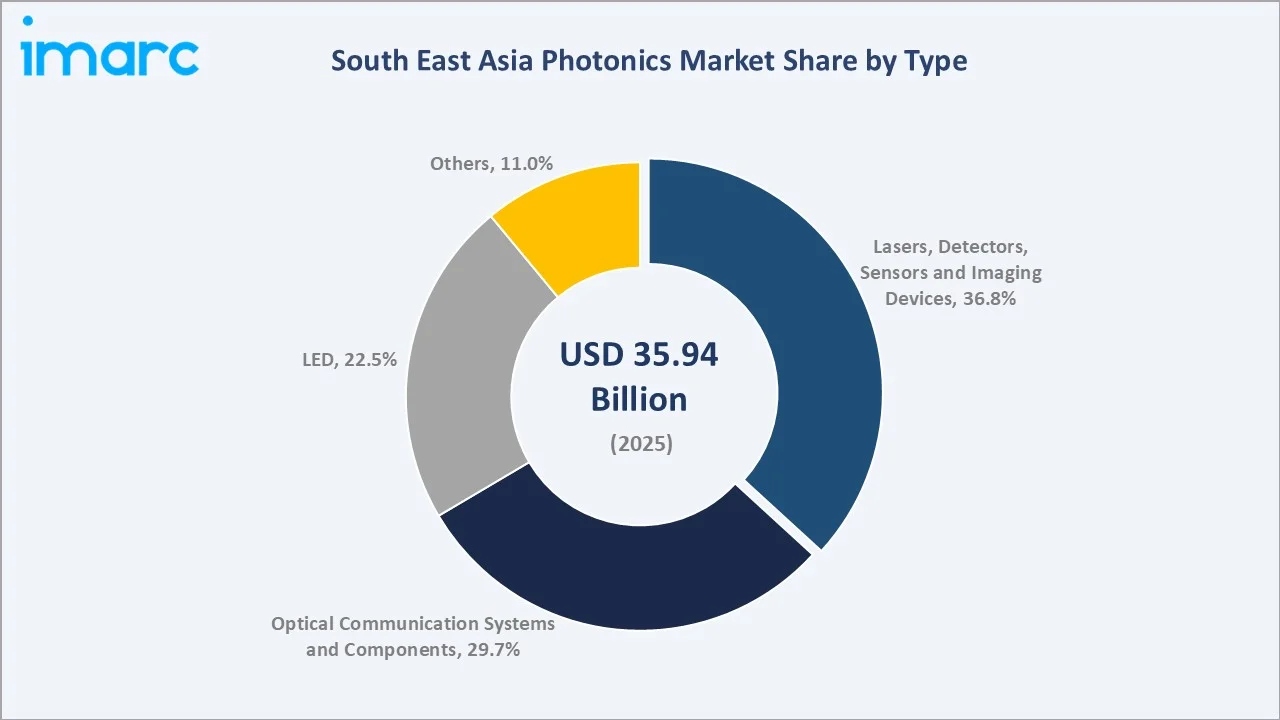
Lasers, Detectors, Sensors and Imaging Devices lead the type segment at 36.8% in 2025, driven by widespread application across manufacturing precision, medical imaging, and industrial automation. Optical Communication Systems and Components follow at 29.7%, supported by expanding telecommunications network infrastructure investment across the region.
To access detailed market analysis, Request Sample
LED at 22.5% captures strong demand from lighting, display, and consumer electronics applications, supported by the region's growing consumer electronics manufacturing base. The Others category at 11.0% comprises niche photonics applications including quantum photonics research and specialized optical component technologies gaining early-stage regional traction.
By End User
Media, Broadcasting and Telecommunication leads end user demand at 28.4%, reflecting the region's expanding network infrastructure and rising data consumption. Consumer Electronics follows at 22.7%, driven by strong regional electronics manufacturing and rising demand for photonics-enabled devices.
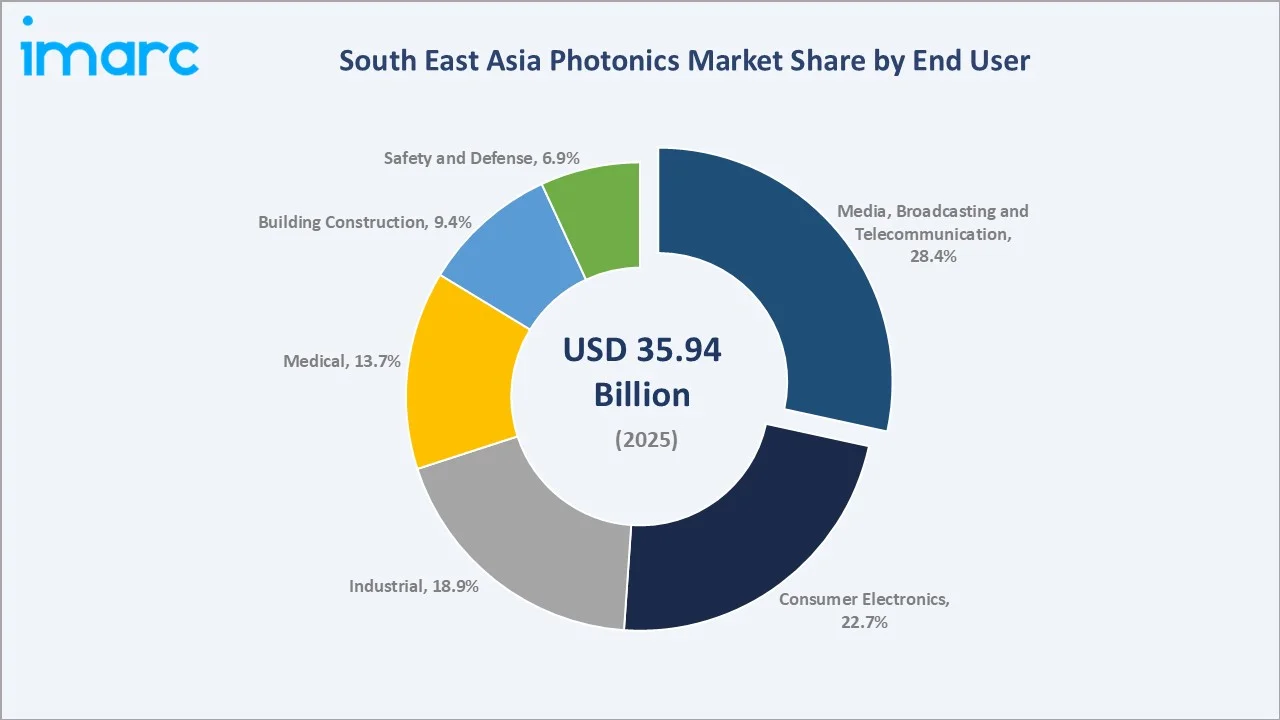
Industrial at 18.9% reflects sustained demand for precision manufacturing applications including laser cutting and welding. Medical at 13.7% is supported by growing adoption of photonics-based diagnostic and imaging technologies. Building Construction at 9.4% and Safety and Defense at 6.9% represent smaller but steadily expanding end user categories across the region.
Regional Market Insights
|
Country |
Share (2025) |
Key Characteristics |
|
Singapore |
29.8% |
Technology hub with strong manufacturing base and government-backed research funding |
|
Indonesia |
22.6% |
Expanding manufacturing sector with growing infrastructure and energy investment |
|
Malaysia |
14.7% |
Growing electronics manufacturing capacity and semiconductor industry presence |
|
Vietnam |
12.5% |
Strong electronics export growth and rising foreign direct investment |
|
Thailand |
9.6% |
Established manufacturing infrastructure and expanding telecommunications networks |
|
Philippines |
6.8% |
Growing business process and electronics manufacturing sectors |
|
Others |
4.0% |
Emerging markets supported by expanding industrial activity, infrastructure development, and increasing technology investment |
Singapore, at 29.8%, leads through its role as South East Asia's premier technology and innovation hub, underpinned by a mature semiconductor and electronics manufacturing ecosystem and sustained government investment in advanced research infrastructure. Indonesia, at 22.6%, reflects the region's largest manufacturing base and expanding renewable energy and telecommunications investment.
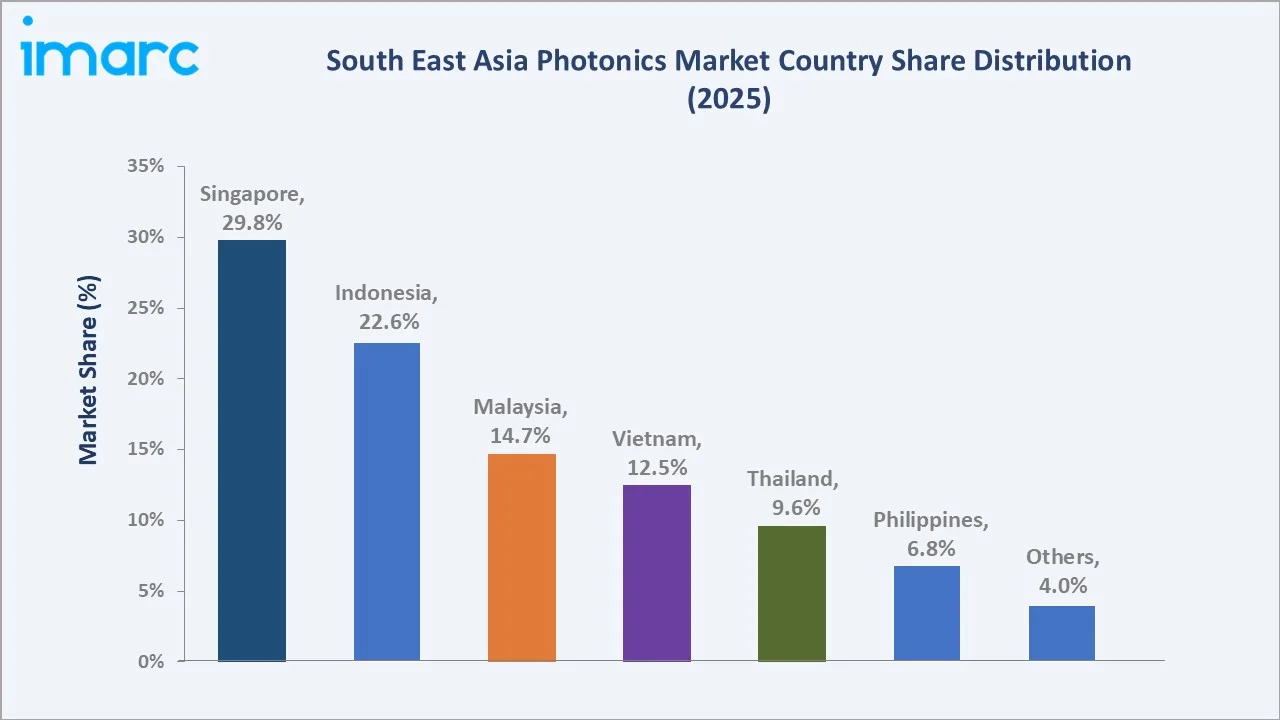
Malaysia, at 14.7%, and Vietnam, at 12.5%, represent the region's fast-growing electronics manufacturing and export hubs, attracting sustained foreign investment in photonics component production. Thailand, at 9.6%, and the Philippines, at 6.8%, along with the Others category at 4.0%, continue to expand through growing manufacturing capacity and telecommunications infrastructure development.
Competitive Landscape
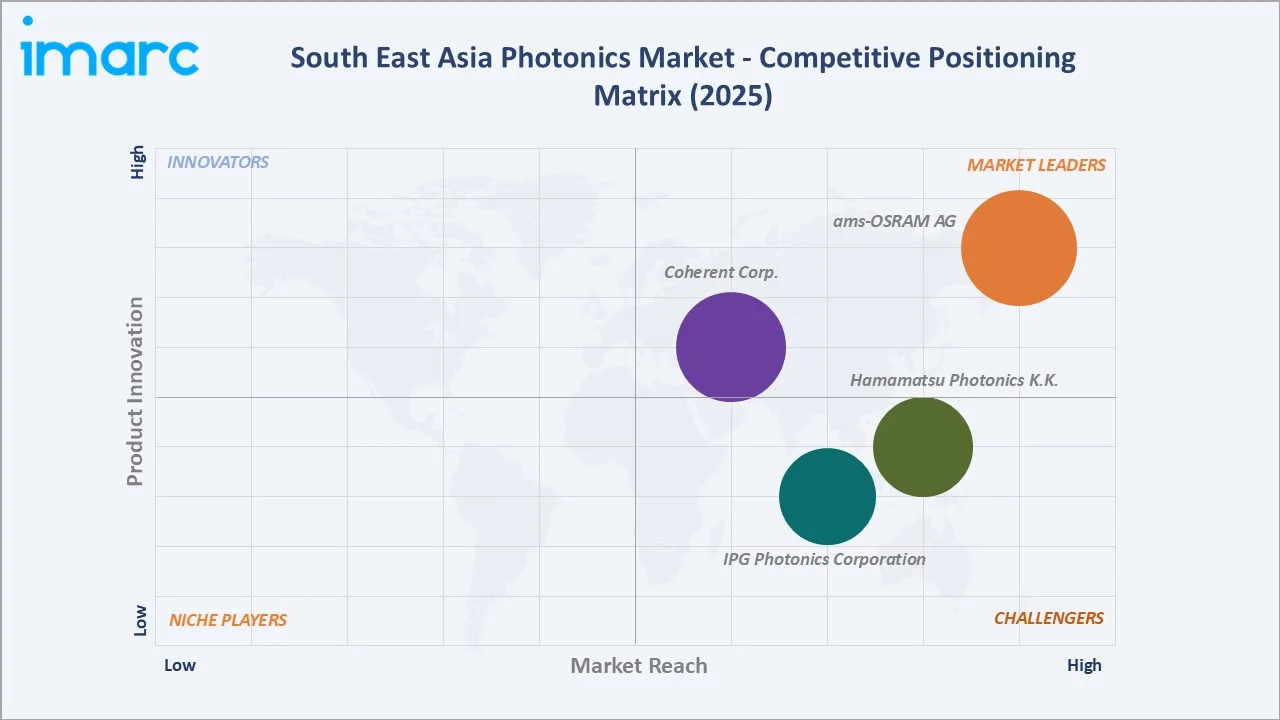
The South East Asia photonics market competitive landscape is moderately fragmented, comprising global photonics technology leaders, specialty optical component manufacturers, and regional electronics producers competing across the type and end user spectrum.
|
Company Name |
Key Products |
Market Position |
Core Strength |
|
ams-OSRAM AG |
LED and Optical Sensor Solutions |
Market Leader |
ams-OSRAM AG specializes in the development and mass production of LED and optical sensing solutions for consumer electronics and industrial applications. |
|
Coherent Corp. |
Laser and Photonic Components |
Market Leader |
Coherent is a leading photonics technology supplier with a broad laser and optical component portfolio serving industrial and communication markets. |
|
Hamamatsu Photonics K.K. |
Optical Sensors and Imaging Devices |
Strong Challenger |
Hamamatsu Photonics K.K. specializes in the development and production of high-precision optical sensors and imaging devices for medical and industrial use. |
|
IPG Photonics Corporation |
Fiber Laser Systems |
Strong Challenger |
IPG Photonics Corporation specializes in the design and manufacturing of high-performance fiber laser systems for industrial cutting and welding. |
Key players include ams-OSRAM AG, Coherent Corp., Hamamatsu Photonics K.K., IPG Photonics Corporation, and others.
Key Company Profiles
ams-OSRAM AG
ams-OSRAM AG is a global sensor and photonics solutions provider with a strong presence in the South East Asia photonics market through its LED, optical sensor, and lighting technology portfolio.
- Key Products: LED and optical sensor solutions.
- Strategic Focus: Strengthening optical semiconductor and photonics sensor offerings for consumer electronics, automotive, and industrial applications across the region. The company is prioritizing miniaturized sensor architectures to support compact device designs demanded by regional consumer electronics manufacturers. Continued investment in regional application engineering support is aimed at deepening relationships with South East Asian OEM customers across automotive and industrial segments.
Coherent Corp.
Coherent Corp. is a global photonics technology company with a strong presence in the South East Asia photonics market through its laser and optical component portfolio.
- Key Products: Laser systems and photonic components for industrial and communication applications.
- Strategic Focus: Expanding laser and optical communication component supply to support the region's manufacturing and telecommunications infrastructure growth. Coherent is scaling regional manufacturing partnerships to shorten delivery timelines for high-volume industrial laser component orders. The company is also expanding its technical service network across key South East Asian markets to support growing data communication infrastructure deployments.
Market Concentration Analysis
The South East Asia photonics market is moderately fragmented at the component supplier level, with the key players collectively accounting for a meaningful share of regional photonics component revenue. Regional electronics manufacturers account for a growing share of cost-competitive photonics device production, particularly across Vietnam, Malaysia, and Indonesia.
Market concentration is expected to ease further over the forecast period as regional manufacturers gain quality certification for mainstream applications, while global leaders retain a technology advantage in high-precision silicon photonics and advanced laser systems.
Investment & Growth Opportunities
Highest Growth Segments
Lasers, Detectors, Sensors and Imaging Devices and Media, Broadcasting and Telecommunication represent the highest-growth investment vectors through 2034, supported by sustained manufacturing precision demand and expanding regional telecommunications infrastructure investment.
Emerging Investment Opportunities
Solar photonics efficiency solutions represent an emerging high-value opportunity as South East Asian nations expand renewable energy capacity, with photonics-based innovations directly enhancing solar energy system efficiency and affordability across the region's growing clean energy sector.
Investment Themes
- Regional Manufacturing Capacity Expansion: Investment in local photonics component manufacturing capacity offers a structural cost advantage as regional electronics and telecommunications demand continues to scale.
- Medical Imaging and Diagnostics Technology: Photonics-enabled medical diagnostics represent a high-value opportunity as regional healthcare infrastructure investment accelerates across South East Asia's expanding middle-class population base.
Future Market Outlook (2026-2034)
The South East Asia photonics market is projected to grow from USD 35.94 Billion in 2025 to USD 66.92 Billion by 2034, delivering a 6.94% CAGR over the forecast period. The market's anchor value of USD 50.26 Billion in 2030 reflects sustained mid-cycle growth momentum. Continued telecommunications infrastructure expansion, rising renewable energy adoption, and the region's thriving manufacturing sector are expected to sustain robust demand across the forecast period, with Singapore, Indonesia, and Malaysia continuing to anchor regional market growth.
Research Methodology
Primary Research
Primary research comprised structured interviews with industry stakeholders across South East Asia, including photonics component manufacturers, telecommunications infrastructure providers, industrial equipment suppliers, and regional distribution partners.
Secondary Research
Secondary research encompassed company annual reports, regional telecommunications regulatory filings, manufacturing sector investment data, renewable energy policy documents, and industry association publications covering the South East Asia photonics ecosystem.
Forecasting Models
Market revenue forecasts were developed using a bottom-up model incorporating regional manufacturing output, telecommunications infrastructure investment trends, renewable energy capacity additions, and healthcare technology adoption rates across South East Asian markets.
South East Asia Photonics Market Report Coverage:
| Report Features | Details |
|---|---|
| Base Year of the Analysis | 2025 |
| Historical Period | 2020-2025 |
| Forecast Period | 2026-2034 |
| Units | Billion USD |
| Scope of the Report | Exploration of Historical and Forecast Trends, Industry Catalysts and Challenges, Segment-Wise Historical and Predictive Market Assessment:
|
| Types Covered | LED, Lasers, Detectors, Sensors and Imaging Devices, Optical Communication Systems and Components, Others |
| Applications Covered | Surveying and Detection, Production Technology, Data Communication, Image Capture and Display, Medical Technology, Lighting, Others |
| End Users Covered | Building Construction, Media, Broadcasting and Telecommunication, Consumer Electronics, Medical, Safety and Defense, Industrial |
| Countries Covered | Indonesia, Thailand, Singapore, Philippines, Vietnam, Malaysia, Others |
| Companies Covered | ams-OSRAM AG, Coherent Corp., Hamamatsu Photonics K.K., IPG Photonics Corporation, etc. |
| Customization Scope | 10% Free Customization |
| Post-Sale Analyst Support | 10-12 Weeks |
| Delivery Format | PDF and Excel through Email (We can also provide the editable version of the report in PPT/Word format on special request) |
Key Benefits for Stakeholders:
- IMARC’s industry report offers a comprehensive quantitative analysis of various market segments, historical and current market trends, market forecasts, and dynamics of the South East Asia photonics market from 2020-2034.
- The research report provides the latest information on the market drivers, challenges, and opportunities in the South East Asia photonics market.
- Porter's five forces analysis assist stakeholders in assessing the impact of new entrants, competitive rivalry, supplier power, buyer power, and the threat of substitution. It helps stakeholders to analyze the level of competition within the South East Asia photonics industry and its attractiveness.
- Competitive landscape allows stakeholders to understand their competitive environment and provides an insight into the current positions of key players in the market.
Frequently Asked Questions About the South East Asia Photonics Market Report
The South East Asia photonics market reached USD 35.94 Billion in 2025, growing from USD 25.69 Billion in 2020. It is projected to reach USD 50.26 Billion by 2030 and USD 66.92 Billion by 2034, growing at a CAGR of 6.94% during 2026-2034, driven by manufacturing precision demand, renewable energy adoption, and expanding telecommunications infrastructure.
The market experienced temporary supply chain disruptions during the pandemic period but recovered steadily as manufacturing activity normalized and demand for telecommunications and digital infrastructure accelerated across the region.
Based on type, the market is segmented into Lasers, Detectors, Sensors and Imaging Devices (36.8%), Optical Communication Systems and Components (29.7%), LED (22.5%), and Others (11.0%), with Lasers, Detectors, Sensors and Imaging Devices leading in 2025.
Based on end user, the market is segmented into Media, Broadcasting and Telecommunication (28.4%), Consumer Electronics (22.7%), Industrial (18.9%), Medical (13.7%), Building Construction (9.4%), and Safety and Defense (6.9%), with Media, Broadcasting and Telecommunication leading in 2025.
The value chain comprises raw material and optical component sourcing, photonics device manufacturing and assembly, systems integration and quality testing, distribution and OEM integration, and aftersales and maintenance services.
Key drivers include growing demand for precise manufacturing solutions, rising renewable energy utilization, rapid technology infusion across industries, and expanding telecommunications infrastructure. Key restraints include high manufacturing and R&D capital requirements, infrastructure and workforce limitations in emerging markets, and complex regulatory compliance across regional jurisdictions.
The key players include ams-OSRAM AG, Coherent Corp., Hamamatsu Photonics K.K., IPG Photonics Corporation, and others.
The market exhibits moderate competitive intensity, with global photonics technology leaders competing alongside specialty optical component manufacturers and regional electronics producers across the type and end user spectrum.
Need more help?
- Speak to our experienced analysts for insights on the current market scenarios.
- Include additional segments and countries to customize the report as per your requirement.
- Gain an unparalleled competitive advantage in your domain by understanding how to utilize the report and positively impacting your operations and revenue.
- For further assistance, please connect with our analysts.
 Request Customization
 Speak to an Analyst
 Request Brochure
 Inquire Before Buying
Benefits of Customization
- Personalize this research
- Triangulate with your data
- Get data as per your format and definition
- Gain a deeper dive into a specific application, geography, customer, or competitor
- Any level of personalization
Get in Touch With Us
UNITED STATES
Phone: +1-201-971-6302
INDIA
Phone: +91-120-433-0800
UNITED KINGDOM
Phone: +44-753-714-6104
Email: [email protected]
Client Testimonials




.webp)




.webp)













Related Reports

Choose your plan
*Please note that the prices mentioned below are starting prices for each bundle type. Kindly contact our team for further details.*
Single User License
- 1 User License, Access on 2 Devices
- PDF Report + Excel Dataset (Password Protected)
- Lifetime Access
- No Printing Rights
- 10% Free Report Customization
- 10–12 Weeks of Analyst Support
Five User License
- Access for 5 Users, 2 Devices per User
- PDF Report + Excel Dataset (Password Protected)
- Lifetime Access
- Dedicated Account Manager
- 12–14 Weeks of Analyst Support
- No Printing Rights
- 15% Free Report Customization
- 25% Discount on Your Next Purchase
Corporate User License
- Unlimited User Access (Within Your Organization)
- PDF Report + Excel Dataset
- Lifetime Access
- Dedicated Account Manager
- 14–20 Weeks of Analyst Support
- No Printing Rights
- 20% Free Report Customization
- 30% Discount on Your Next Purchase
Essential Insights
What's included:
3 reports
- Lifetime Access
- PDF Reports
- Excel Datasets
- 2 Weeks of Free Analyst Support
- 2 User Licenses
- Access on 2 Devices
- Printing Rights
- Complimentary PowerPoint (PPT) Version
- Complimentary License Upgrade
Professional Access
What's included:
5 reports
- Lifetime Access
- PDF Reports
- Excel Datasets
- 8 Weeks of Free Analyst Support
- 2 User Licenses
- Access on 2 Devices
- Printing Rights
- Complimentary PowerPoint (PPT) Version
- Complimentary License Upgrade
Business Advantage
What's included:
8 reports
- Lifetime Access
- PDF Reports
- Excel Datasets
- 14 Weeks of Free Analyst Support
- 2 User Licenses
- Access on 2 Devices
- Printing Rights
- Complimentary PowerPoint (PPT) Version
- Complimentary License Upgrade
Enterprise Intelligence
What's included:
10 reports
- Lifetime Access
- PDF Reports
- Excel Datasets
- 20 Weeks of Free Analyst Support
- 2 User Licenses
- Access on 2 Devices
- Printing Rights
- Complimentary PowerPoint (PPT) Version
- Complimentary License Upgrade