
South Korea Football Market Size, Share, Trends and Forecast by Type, Size, Distribution Channel, and Region, 2026-2034
South Korea Football Market Summary:
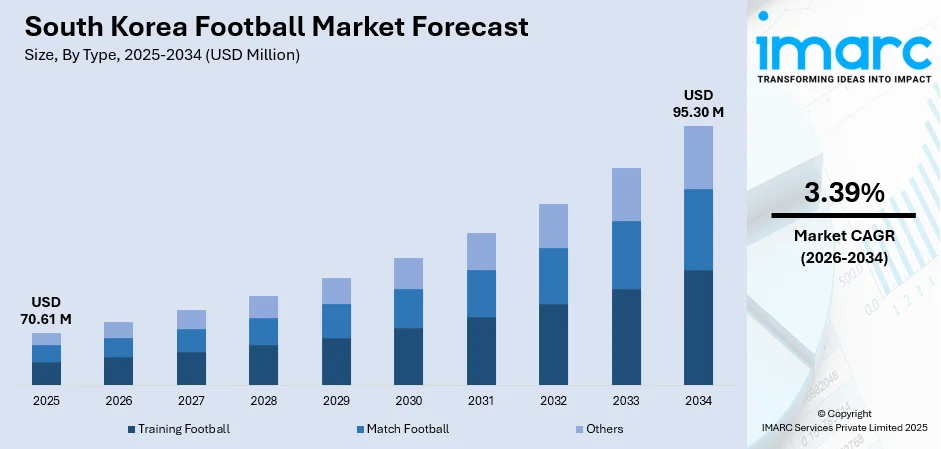
The South Korea football market was valued at USD 70.61 Million in 2025 and is projected to reach USD 95.30 Million by 2034, growing at a compound annual growth rate of 3.39% from 2026-2034.
The South Korea football market's expansion is driven by the country's deeply entrenched football culture, bolstered by the global prominence of Korean players competing in elite European leagues. The growing health consciousness among the population, combined with increasing participation in recreational and organized football across all age demographics, is propelling the demand for quality footballs. Enhanced government support for sports infrastructure development, the proliferation of youth football academies, and the rise of grassroots programs further stimulate the market growth.
Key Takeaways and Insights:
- By Type: Match football dominates the market with a share of 47% in 2025, driven by the growing demand from professional K League clubs, amateur leagues, and competitive school football programs requiring high-performance balls that meet official match specifications and deliver superior flight characteristics.
- By Size: Size 5 leads the market with a share of 45% in 2025, reflecting the standard adult-sized ball's widespread usage across professional matches, amateur competitions, and recreational play among the country's active adult football population.
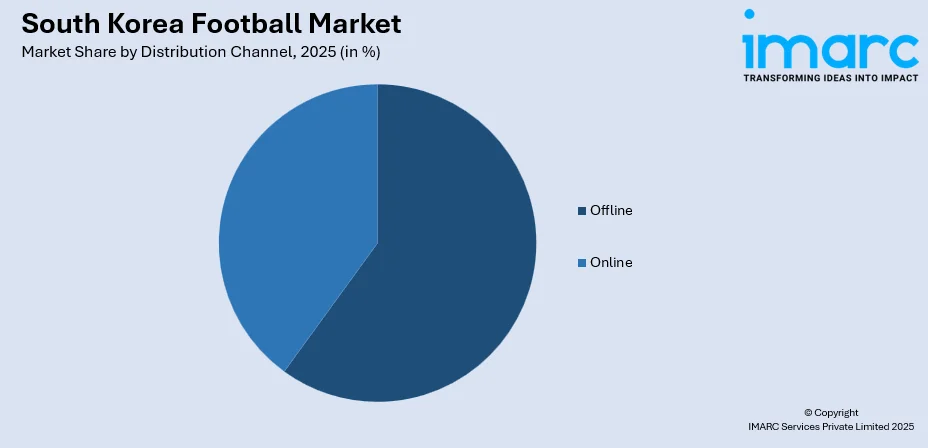
- By Distribution Channel: Offline represents the largest segment with a market share of 58% in 2025, supported by consumer preferences for hands-on product evaluation before purchase, extensive specialty sports retail networks, and the experiential shopping culture prevalent in South Korea.
- Key Players: The South Korea football market features moderate competitive intensity with established multinational sporting goods corporations competing alongside regional manufacturers and specialized football equipment distributors across various price segments.
To get more information on this market Request Sample
The South Korea football market benefits from one of Asia's most passionate football communities, with the K League setting record attendance figures exceeding 3 Million spectators in consecutive years. The K League announced that the 2024 season saw new revenue records on account of an increase in ticket sales, with total revenue reaching 42.556 Billion KRW. Merchandise sales are rising, driven by player popularity and national team performances. Investments in stadium facilities and training infrastructure are improving matchday experience and player development. Esports football titles and fantasy leagues are also strengthening fan involvement beyond live matches. With government and private sector support for sports development, football in South Korea is becoming more commercialized, data-driven, and globally connected, indicating a positive and expanding market outlook.
South Korea Football Market Trends:
Growing Integration of Digital Platforms in Football Engagement
The South Korean football ecosystem is experiencing a digital transformation that extends beyond media consumption to influence equipment purchasing behavior. Sportradar extended its partnership with K League through 2027 as exclusive data and audio-visual (AV) rights distribution partner, collecting and distributing data from over 1,900 matches while developing an enhanced K League TV platform with improved user experience and interface. This digitalization expands fan engagement beyond stadiums, creating multiple touchpoints that amplify merchandise and equipment purchasing opportunities, particularly among younger demographics who increasingly discover products through online content.
European Football Academies Expanding Korean Footprint
International football institutions are establishing permanent development infrastructure in South Korea, driving the demand for standardized training equipment. In November 2025, Borussia Dortmund opened its first full-time international academy in Suwon, adjacent to the World Cup Stadium, delivered in partnership with former Dortmund fullback Park Joo-ho, offering daily sessions built around the club's development blueprint. Such investments accelerate professionalisation of youth football, elevating equipment standards across training facilities and increasing consumption of quality footballs across all size categories.
Increasing social media engagement
Increasing social media interaction is driving the market expansion in South Korea. Fans receive immediate updates, behind-the-scenes material, and live interaction with their preferred teams and athletes via social media platforms. This ongoing stream of material keeps supporters emotionally engaged and thrilled about football throughout the year, not only in the season. Clubs utilize social media to advertise games, sell products, and foster robust online communities. Athletes also develop their personal brands and draw in followers, contributing to the league’s appeal. The increasing number of social media users in South Korea is enhancing the influence of digital interaction on the football industry. According to industry reports, by February 2025, South Korea had 48.9 Million social media users, representing a rise of 1.2% compared to 2024.
Market Outlook 2026-2034:
Key growth catalysts include the continued professionalization of youth football programs, K League's expanding fan engagement initiatives, and South Korea's preparation for regional and international football competitions. The market generated a revenue of USD 70.61 Million in 2025 and is projected to reach a revenue of USD 95.30 Million by 2034, growing at a compound annual growth rate of 3.39% from 2026-2034. The market will benefit from ongoing infrastructure investments, including academy development and facility upgrades across metropolitan and regional areas, increasing football participation rates among female demographics, and technological innovations in football designs. Enhanced digital retail penetration will underpin consistent demand expansion.
South Korea Football Market Report Segmentation:
| Segment Category | Leading Segment | Market Share |
|---|---|---|
| Type | Match Football | 47% |
| Size | Size 5 | 45% |
| Distribution Channel | Offline | 58% |
Type Insights:
- Training Football
- Match Football
- Others
Match football dominates with a market share of 47% of the total South Korea football market in 2025.
Match footballs command the largest market share owing to their essential role in official competitions, league matches, and organized tournaments across amateur and professional levels. Revenue from ticket sales, broadcasting, and sponsorship is concentrated around live games, making matches the most valuable and visible segment within the football industry.
Match football drives spending across multiple channels, including stadium attendance, food and beverage (F&B) sales, merchandise, and digital subscriptions. Broadcasters invest heavily in live match rights, increasing league revenues. Sponsors prefer match-day exposure because it guarantees large and engaged audiences through television and social media. High-profile matches build regional rivalries and national pride, further raising demand. Clubs use match events to strengthen fan communities and loyalty programs. Compared to training or amateur formats, match football delivers immediate financial returns and mass engagement, making it the dominant revenue generator within South Korea’s football market ecosystem.
Size Insights:
- Size 1
- Size 2
- Size 3
- Size 4
- Size 5
Size 5 leads with a share of 45% of the total South Korea football market in 2025.
Size 5 is the official ball size for professional leagues, tournaments, and adult competitions. Most clubs, academies, and schools use size 5 footballs for training and matches, making this size the most widely purchased category.
Professional teams standardize training with size 5 balls to match real competition conditions, creating continuous institutional demand. Retail consumers also prefer owning the same size used by national and league players, strengthening sales. Brands focus innovation, design, and marketing on size 5 products, improving product availability and visibility. Sponsorships often feature official match balls, further increasing consumer preference. Compared to smaller sizes meant for children or casual play, size 5 serves the largest group of teenage and adult players. This broad usage ensures frequent replacement purchases, team bulk orders, and strong retail turnover, securing market leadership.
Distribution Channel Insights:
Access the Comprehensive Market Breakdown Request Sample
- Online
- Offline
Offline exhibit a clear dominance with a 58% share of the total South Korea football market in 2025.
Offline distribution channels lead the market because fans prefer purchasing jerseys, equipment, and tickets through physical stores and stadium outlets. In-store experience, immediate product availability, and merchandise authenticity verification encourage buyers to visit sports shops and club stores rather than relying only on online platforms.
Physical retail stores allow customers to check quality, size, and comfort before buying, which is important for sportswear and footwear. Stadium stores benefit from match-day crowds, generating high impulse sales. Exclusive in-store collections and limited edition merchandise attract loyal fans. In September 2025, Seoul E-Land FC launched a clothing photo series created in partnership with fashion platform Musinsa. Seoul E-Land and Musinsa revealed collaborative items, comprising windbreakers, piste jackets, football T-shirts, and baseball jerseys, amounting to four varieties. Multiple advantages could be found at the pop-up store. The initial 600 buyers would get a special edition photo collection poster from the partnership between Seoul E-Land and Musinsa. Sports retailers also provide expert advice, helping customers choose suitable gear based on skill level. Offline ticket counters and official outlets build trust, especially among older consumers. Brand showrooms create strong emotional connection through player images and club branding.
Regional Insights:
- Seoul Capital Area
- Yeongnam (Southeastern Region)
- Honam (Southwestern Region)
- Hoseo (Central Region)
- Others
Seoul Capital Area holds prominence due to large population, media presence, and major clubs. Strong fan culture, sponsorship activity, and stadium infrastructure boost match attendance and merchandise sales. Digital engagement and youth programs further strengthen long-term market growth.
Yeongnam (Southeastern Region) is known for its passionate football following and competitive clubs. Local rivalries increase ticket demand. Industrial development supports sponsorship opportunities, while youth talent programs improve team performance and fan engagement.
In Honam (Southwestern Region), the market is driven by community support and regional pride. Clubs rely on local fan bases and school programs to maintain interest. Development of stadium facilities helps improve attendance and match experiences.
Hoseo (Central Region) is an emerging football region, supported by educational institutions and the growing urbanization. Youth tournaments and training academies improve participation, while regional leagues boost entertainment value. Infrastructure investments continue to raise the region’s football profile.
Market Dynamics:
Growth Drivers:
Why is the South Korea Football Market Growing?
Expanding Youth Football Development Infrastructure
South Korea's systematic investment in youth football development represents a fundamental growth catalyst for the football market. In November 2024, FIFA selected South Korea as one of five pilot countries for its Academy System Pilot Project, hosting a seminar in Seoul, with the Korean Football Association (KFA) aimed at strengthening the connection between national teams and domestic elite academies. Through the collaboration of FIFA and the KFA, this program sought to enhance Korean football by offering young athletes a definitive route to professional and global achievement. Youth leagues and competitions build fan loyalty early, creating lifelong followers of clubs and national teams. This expanding base of players and supporters fuels merchandise sales, viewership, and sponsorship interest, making youth infrastructure a key growth engine for the South Korea football market.
International Competition Exposure and Global Recognition
South Korea's continued prominence in international football competitions enhances domestic market growth by elevating national football prestige and inspiring increased participation across all demographic segments. Ulsan HD's participation in the FIFA Club World Cup 2025 represented significant international exposure for Korean football. Ulsan HD was drawn into FIFA Club World Cup Group F alongside Fluminense (Brazil), Borussia Dortmund (Germany), and Mamelodi Sundowns (South Africa), with the tournament held in the USA from June 15 to July 13, 2025, featuring 32 teams competing every four years similar to the FIFA World Cup format. Such high-profile international engagements generate substantial media coverage, inspire youth participation, and create high demand associated with successful national football programs.
Record Professional League Engagement
Record professional league engagement is accelerating the growth of the football market in South Korea by increasing fan loyalty, commercial activity, and media attention. Higher attendance at matches and stronger television and streaming viewership improve club revenues through ticket sales and broadcasting rights. Fans become more emotionally connected to teams, driving merchandise purchases and social media interaction. Sponsorship interest grows as brands see football as an effective channel to reach large and passionate audiences. Clubs also invest more in player development and facilities to maintain competitive performance, improving match quality. Star players and competitive league formats attract younger viewers and international attention. Community events and fan clubs further strengthen the football culture. As engagement rises, football transforms beyond sport into entertainment and lifestyle, creating sustainable growth opportunities across media, retail, and sports marketing sectors.
Market Restraints:
What Challenges the South Korea Football Market is Facing?
Intense Competition and Price Pressure
Intense competition and price pressure affect the South Korea football market by squeezing club revenues and profitability. Teams must spend heavily on player contracts, training, and marketing to stay competitive, while ticket prices remain limited by fan affordability. Sponsors also negotiate aggressively, reducing margins. Smaller clubs struggle to compete with well-funded teams, creating financial imbalance. Price sensitivity among fans restricts revenue growth from merchandise and match tickets, forcing clubs to rely more on sponsorships and media deals for sustainability.
Fluctuating Raw Material Costs
Football equipment manufacturers face ongoing challenges related to volatile raw material prices, particularly for synthetic materials, polyurethane compounds, and specialized foam components essential for quality football production. These input cost fluctuations create planning difficulties for manufacturers seeking to maintain consistent pricing while preserving product quality standards expected by discerning Korean consumers who prioritize performance characteristics over price considerations.
Counterfeit Products and Quality Inconsistency
The proliferation of counterfeit and substandard football products through unauthorized channels poses ongoing challenges for legitimate manufacturers and distributors seeking to protect brand integrity and consumer trust. Korean consumers, while generally discerning regarding product authenticity, may inadvertently purchase inferior products through online marketplaces or unauthorized sellers, potentially dampening repeat purchase intentions and undermining market growth potential.
Competitive Landscape:
The South Korea football market exhibits a moderately concentrated competitive structure, characterized by the dominance of established multinational sporting goods corporations alongside specialized football equipment manufacturers and regional distributors. Leading global brands maintain substantial market presence through extensive retail networks, brand recognition built over decades, and continuous product innovation addressing evolving consumer preferences. These market leaders leverage substantial research and development (R&D) capabilities to introduce technologically advanced products featuring smart sensors, sustainable materials, and enhanced performance characteristics. Regional manufacturers compete through localized distribution strategies, competitive pricing, and product specifications tailored to Korean consumer preferences. The competitive environment continues to evolve with brands investing in flagship retail experiences, digital engagement platforms, and partnership arrangements with professional clubs and development academies.
Recent Developments:
- In June 2025, the Korea Football Association (KFA) revealed the squads for its men’s and women’s teams, each comprising 23 players, for the East Asian Football Federation (EAFF) E-1 Football Championship, scheduled to take place from July 7-16. South Korea was set to compete against China at Suwon World Cup Stadium in Suwon, which is around 30 kilometers south of Seoul, to kick off the women's tournament at 8 p.m. on July 9.
- In June 2025, following a 26-year ban, South Korean football teams could sign foreign goalkeepers. The K League United site noted that the league's board found that the 'constraints on a specific role led to an uneven rise in salaries'. It forced them to remove the prohibition to ensure equal pay.
South Korea Football Market Report Coverage:
| Report Features | Details |
|---|---|
| Base Year of the Analysis | 2025 |
| Historical Period | 2020-2025 |
| Forecast Period | 2026-2034 |
| Units | Million USD |
| Scope of the Report |
Exploration of Historical Trends and Market Outlook, Industry Catalysts and Challenges, Segment-Wise Historical and Future Market Assessment:
|
| Types Covered | Training Football, Match Football, Others |
| Sizes Covered | Size 1, Size 2, Size 3, Size 4, Size 5 |
| Distribution Channels Covered | Online, Offline |
| Regions Covered | Seoul Capital Area, Yeongnam (Southeastern Region), Honam (Southwestern Region), Hoseo (Central Region), Others |
| Customization Scope | 10% Free Customization |
| Post-Sale Analyst Support | 10-12 Weeks |
| Delivery Format | PDF and Excel through Email (We can also provide the editable version of the report in PPT/Word format on special request) |
Key Questions Answered in This Report
The South Korea football market size was valued at USD 70.61 Million in 2025.
The South Korea football market is expected to grow at a compound annual growth rate of 3.39% from 2026-2034 to reach USD 95.30 Million by 2034.
Match football dominates the market with 47% share, driven by the growing demand from professional leagues, amateur competitions, and recreational players seeking high-performance balls that deliver superior touch, flight accuracy, and durability characteristics required for competitive play.
Key factors driving the South Korea football market include expanding youth football development programs, supported by FIFA and KFA initiatives, record-breaking K League attendance and commercial performance, increasing health consciousness driving sports participation, and technological innovations in football equipment design.
Major challenges include intense competition among established multinational brands creating pricing pressure, fluctuating raw material costs affecting manufacturing margins, counterfeit product proliferation undermining brand integrity, market maturity limiting expansion potential, and seasonal demand fluctuations tied to competition calendars.
Need more help?
- Speak to our experienced analysts for insights on the current market scenarios.
- Include additional segments and countries to customize the report as per your requirement.
- Gain an unparalleled competitive advantage in your domain by understanding how to utilize the report and positively impacting your operations and revenue.
- For further assistance, please connect with our analysts.
 Request Customization
 Speak to an Analyst
 Request Brochure
 Inquire Before Buying
Benefits of Customization
- Personalize this research
- Triangulate with your data
- Get data as per your format and definition
- Gain a deeper dive into a specific application, geography, customer, or competitor
- Any level of personalization
Get in Touch With Us
UNITED STATES
Phone: +1-201-971-6302
INDIA
Phone: +91-120-433-0800
UNITED KINGDOM
Phone: +44-753-714-6104
Email: sales@imarcgroup.com
Client Testimonials




.webp)




.webp)












