
Thailand Lingerie Market Size, Share, Trends and Forecast by Product Type, Material, Price Range, Distribution Channel, and Region, 2026-2034
Thailand Lingerie Market Summary:
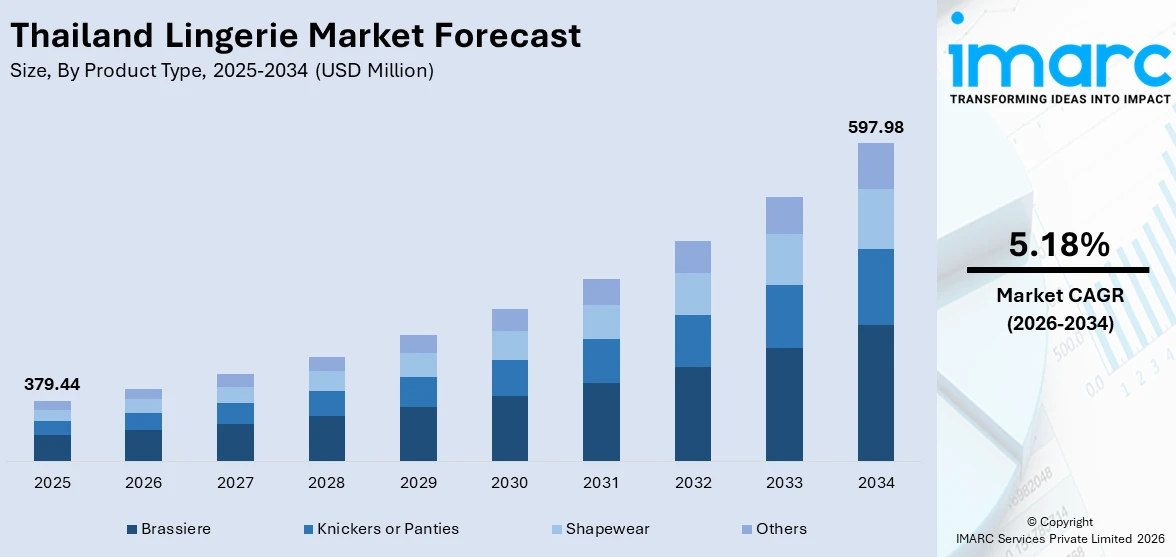
The Thailand lingerie market size was valued at USD 379.44 Million in 2025 and is projected to reach USD 597.98 Million by 2034, growing at a compound annual growth rate of 5.18% from 2026-2034.
The Thailand lingerie market is experiencing steady expansion driven by evolving consumer preferences toward comfort-oriented and fashion-forward intimate apparel. Rising digital adoption, growing female workforce participation, and increasing brand awareness among younger demographics are reshaping purchasing behaviors. Expanding retail infrastructure, shifting lifestyle patterns, and heightened demand for diverse product offerings across urban and regional centers are further strengthening the Thailand lingerie market share.
Key Takeaways and Insights:
- By Product Type: Brassiere dominates the market with a share of 45% in 2025, owing to its essential role in everyday wear, wide availability in diverse styles and fabrics, and growing consumer preference for innovative comfort-driven designs across Thailand.
- By Material: Cotton leads the market with a share of 39% in 2025, driven by consumer preference for breathable, skin-friendly, and hypoallergenic fabrics that offer superior comfort in tropical climatic conditions across the country.
- By Price Range: Economy represents the largest segment with a market share of 60% in 2025, reflecting widespread consumer sensitivity to pricing and a strong preference for affordable yet quality intimate apparel options among the broader population.
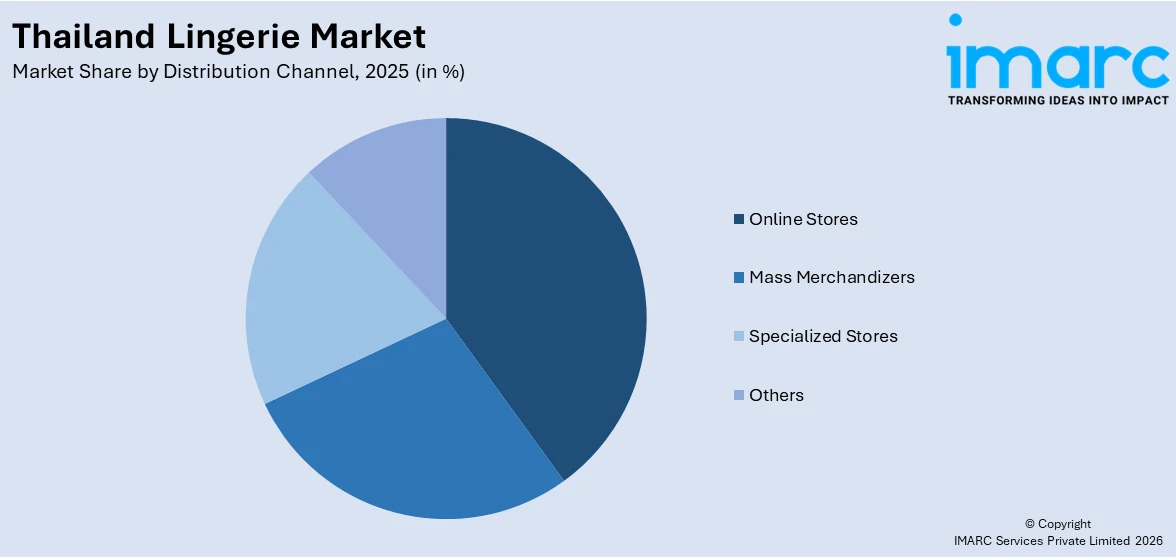
- By Distribution Channel: Online stores represent the leading segment with a share of 34% in 2025, driven by the rapid expansion of e-commerce platforms, mobile-first shopping behavior, and widespread adoption of digital payment solutions across Thailand.
- By Region: Bangkok dominates the market with a share of 40% in 2025, owing to its position as the primary commercial and retail hub, concentration of affluent consumers, extensive shopping infrastructure, and high international tourist footfall.
- Key Players: Key players drive the Thailand lingerie market by expanding product portfolios, investing in comfort-focused technologies, strengthening omnichannel distribution, and leveraging digital marketing strategies to enhance brand visibility, consumer engagement, and market penetration across diverse demographic segments.
To get more information on this market Request Sample
The Thailand lingerie market is advancing as consumers, retailers, and brands adapt to evolving fashion sensibilities and digital retail ecosystems. A major driver shaping this progress is the growing integration of e-commerce and social commerce platforms, which provide consumers with convenient access to a broad array of intimate apparel options. For instance, Thai Wacoal Public Company Limited launched Wacoal Yaowarat Space in early 2025, transforming a historic building in Bangkok’s Chinatown into a four-story multi-purpose venue combining lingerie retail. Rising awareness of body positivity, the influence of social media on fashion choices, and increasing consumer willingness to explore new lingerie categories are creating favorable conditions for market expansion. Additionally, the growing urban population, expanding middle-income consumer base, and enhanced logistics infrastructure supporting nationwide delivery networks are contributing to a more dynamic and competitive lingerie retail landscape across Thailand.
Thailand Lingerie Market Trends:
Rapid Expansion of E-Commerce and Social Commerce
Thailand's digital retail ecosystem is experiencing significant expansion, with e-commerce platforms becoming a primary channel for intimate apparel purchases. The growing adoption of mobile-first shopping behavior, live-stream selling, and social media-driven product discovery is reshaping how consumers browse and buy lingerie online. Leading marketplace platforms are enabling brands to reach broader consumer segments through promotional campaigns, influencer collaborations, and integrated digital payment options. The increasing convenience, competitive pricing, and personalized shopping experiences offered by online channels are collectively supporting Thailand lingerie market growth.
Growing Consumer Preference for Comfort-Focused Intimate Apparel
Consumer demand in Thailand is shifting toward lingerie that prioritizes comfort, wireless support, and lightweight fabrics suited for tropical climates. For instance, in March 2024, Sabina, a Thai lingerie brand with over 30 years of expertise, partnered with SOUR Bangkok to launch its Sabina Braless wireless comfort line, featuring celebrity Baifern Pimchanok. The campaign garnered over 3 Million views within two days, highlighting strong consumer interest in comfort-driven lingerie innovation.
Experiential Retail and Omnichannel Integration
Lingerie brands in Thailand are increasingly embracing experiential retail concepts that blend physical shopping with lifestyle and digital engagement. Manufacturers and retailers are transforming traditional stores into immersive destinations that combine product offerings with cultural experiences, interactive spaces, and hospitality elements. This approach reflects the broader industry trend of creating multi-purpose retail environments that strengthen brand loyalty and attract diverse consumer demographics beyond traditional intimate apparel shoppers. The integration of offline and online touchpoints is further enhancing customer engagement and driving sustained foot traffic across retail locations.
Market Outlook 2026-2034:
Thailand’s lingerie market is positioned for sustained growth, supported by rising consumer spending, expanding digital retail infrastructure, and evolving fashion preferences among younger demographics. The market generated a revenue of USD 379.44 Million in 2025 and is projected to reach a revenue of USD 597.98 Million by 2034, growing at a compound annual growth rate of 5.18% from 2026-2034. The ongoing expansion of e-commerce platforms, increasing adoption of mobile-first shopping behaviors, and growing demand for comfort-oriented and innovative lingerie products are expected to drive higher revenue streams. Additionally, the strengthening of omnichannel distribution strategies, tourism-driven retail demand in Bangkok, and rising brand investments in experiential retail concepts are anticipated to foster a more competitive and mature lingerie market landscape across the country.
Thailand Lingerie Market Report Segmentation:
|
Segment Category |
Leading Segment |
Market Share |
|
Product Type |
Brassiere |
45% |
|
Material |
Cotton |
39% |
|
Price Range |
Economy |
60% |
|
Distribution Channel |
Online Stores |
34% |
|
Region |
Bangkok |
40% |
Product Type Insights:
- Brassiere
- Knickers or Panties
- Shapewear
- Others
Brassiere dominates with a market share of 45% of the total Thailand lingerie market in 2025.
The brassiere segment commands the largest share of Thailand's lingerie market, driven by its essential role as a daily-wear garment and the expanding range of styles, fabrics, and technologies catering to diverse consumer preferences. Modern consumers are increasingly seeking brassieres that combine functionality with fashion, fueling demand for wireless, seamless, and padded variants. Manufacturers are responding with innovative designs that prioritize comfort without compromising aesthetic appeal, incorporating advanced features such as moisture-wicking fabrics, adaptive fit systems, and lightweight construction. This continuous product evolution is attracting new consumer demographics and encouraging more frequent purchases across all age groups.
The growth of the brassiere segment is further reinforced by the expansion of both physical retail networks and online distribution channels across Thailand. Brands are investing in omnichannel strategies to reach a broader consumer base, including younger demographics influenced by social media and digital marketing campaigns. The development of experiential retail concepts, where lingerie shopping is combined with lifestyle and cultural experiences, reflects the evolving approach to brassiere merchandising and brand engagement. Additionally, the growing emphasis on inclusive sizing and body-positive messaging is encouraging wider consumer adoption and strengthening brand loyalty across the country.
Material Insights:
- Cotton
- Silk
- Satin
- Nylon
- Others
Cotton leads the market with a share of 39% of the total Thailand lingerie market in 2025.
Because of its hypoallergenic qualities, softness, and breathability, all of which are especially well-suited to Thailand's tropical climate, cotton continues to be the most popular material in the lingerie industry there. Cotton-based intimate clothing is preferred by consumers for daily usage because it absorbs moisture better and is more comfortable for extended periods of use. Cotton's dominant position in the intimate clothing market is being further strengthened by the growing congruence between customer demand for natural materials and sustainable manufacturing techniques. To satisfy growing customer demands for ecologically friendly products, manufacturers are progressively implementing eco-friendly production techniques, such as the usage of organic cotton varieties and ethical sourcing methods.
The sustained dominance of cotton in Thailand's lingerie market is also supported by the country's well-established textile manufacturing infrastructure, which enables efficient production of cotton-based garments at competitive price points. Thailand's strategic role in the regional textile supply chain further reinforces material availability for domestic lingerie manufacturers. Access to high-quality cotton resources through international sourcing partnerships supports the development of premium cotton lingerie products that meet both domestic consumer expectations and international quality standards. The versatility of cotton in blending with other fibers also enables manufacturers to create diverse product offerings catering to varied comfort and performance requirements.
Price Range Insights:
- Economy
- Premium
Economy is the largest segment, accounting for 60% of the total Thailand lingerie market in 2025.
Due to significant consumer price sensitivity and a strong affinity for reasonably priced yet high-quality intimate clothing across a wide range of demographics, the economy sector now dominates Thailand's lingerie industry. The ongoing need for reasonably priced lingerie alternatives is supported by value-conscious shopping behavior, especially among middle-class households. Purchase decisions in this market are heavily influenced by promotional price tactics, such as coupon-based incentives, seasonal discounts, and package deals. The availability of reasonably cost underwear in both traditional retail locations and online guarantees that the vast majority of customers will continue to choose economy-priced goods.
The growth of mass retail channels, internet marketplaces, and multi-brand stores that provide widely accessible, reasonably priced lingerie items further supports the economy segment's performance. The need for reasonably priced intimate clothing is increased by e-commerce platforms, which also make it possible for customers to evaluate choices before making a purchase. Economy-segment lingerie sales through digital channels are further encouraged by cost-reducing delivery incentives and flexible payment alternatives, where value proposition and convenience continue to be important purchasing motivators. In urban and semi-urban marketplaces across the country, manufacturers' capacity to sustain competitive pricing through effective manufacturing procedures and expanded distribution networks guarantees ongoing customer participation.
Distribution Channel Insights:
Access the comprehensive market breakdown Request Sample
- Mass Merchandizers
- Specialized Stores
- Online Stores
- Others
Online stores hold the largest share at 34% of the total Thailand lingerie market in 2025.
Due to the country's rapidly increasing e-commerce adoption and mobile-first buying habits, online retailers have become Thailand's top lingerie distribution channel. Digital platforms encourage online sales of intimate clothing by providing customers with ease, a wide range of products, and access to special offers. A sizable and technologically savvy customer base has been produced by the pervasiveness of internet access and smartphone use, making it easier for them to browse and buy intimate clothing online. Consumer trust in online lingerie purchases has been further reinforced by the introduction of safe digital payment methods, such as cash-on-delivery services and mobile wallets.
Online lingerie sales in Thailand have increased even more as a result of the introduction of social commerce and live-selling capabilities on popular marketplace platforms. Through integrated payment systems, interactive content, and marketing campaigns, these platforms allow firms to communicate directly with customers. Lingerie businesses may grow their online presence and increase sales conversions thanks to the nation's large digital consumer base, which is distinguished by strong social media engagement and active involvement in online shopping events. Online platforms are becoming an essential part of lingerie distribution plans across the country as influencer partnerships, affiliate marketing initiatives, and tailored product recommendations continue to influence consumer purchases.
Regional Insights:
- Bangkok
- Eastern
- Northeastern
- Southern
- Northern
- Others
Bangkok dominates the Thailand lingerie market with a 40% share in 2025.
Bangkok, which serves as Thailand's main economic, retail, and tourism center, dominates the lingerie sector in the nation. Customers have unrivaled access to both local and foreign lingerie brands because to the capital's vast network of upscale shopping malls, department shops, and specialist boutiques. Premium lingerie distribution is supported by the ongoing development of high-end retail infrastructure, which includes the construction of new flagship stores and the refurbishment of old buildings. This further solidifies Bangkok's standing as the nation's top retail destination. Product availability and customer interaction are further enhanced by the concentration of marketing activities and brand headquarters in the city.
The region's concentration of wealthy local customers and large number of foreign visitors, which together create strong demand for a wide range of lingerie options across all price points, further solidify its supremacy. Bangkok's robust mass transit system and sophisticated digital infrastructure maximize customer flows throughout the city's main shopping areas. Lingerie shops have strategic options to increase their visibility and reach throughout the city thanks to the ongoing construction of contemporary retail space in downtown locations. Bangkok is unquestionably the hub of Thailand's intimate clothing sector due to the combination of superior physical retail, digital commerce, and a sizable consumer base that values fashion.
Market Dynamics:
Growth Drivers:
Why is the Thailand Lingerie Market Growing?
Rising Disposable Income and Evolving Consumer Spending Patterns
Thailand's lingerie sector is benefiting from rising disposable income levels and changing customer buying preferences. Consumers are spending a larger percentage of their money on fashion and personal care products, such as intimate clothing, as family earnings grow. Demand for a variety of lingerie alternatives that strike a balance between quality, comfort, and affordability is being driven by the growing middle-class customer group, especially among metropolitan women. The rising percentage of women in the workforce and their growing financial independence in Thailand's main cities both lend credence to this trend. Consumers with more earning potential are able to investigate high-end and mid-range lingerie items, shifting from purely practical purchases to choices that are brand-focused and fashion-conscious. A larger audience can now afford high-quality intimate clothing goods thanks to the growing availability of consumer financing alternatives and flexible payment services on e-commerce platforms. This is also boosting the lingerie market's general development pace.
Proliferation of Digital Retail Platforms and Social Commerce
The way Thai customers find, assess, and buy lingerie goods is being drastically changed by the explosive growth of e-commerce and social commerce platforms. Live-selling features, integrated digital payment methods, and mobile-first buying habits have made intimate clothing accessible and interesting to buy. During promotional events that prominently promote fashion and lingerie categories, leading marketplace platforms are achieving record levels of customer interaction. In Thailand, social media channels are becoming essential for lingerie brand positioning and customer interaction. Influencer collaborations, short-form video content, and interactive live-streaming are used by companies to highlight product attributes and foster customer confidence. Thai customers' strong social media adoption rate and receptiveness to suggestions from creators are helping lingerie manufacturers expand their market share quickly and fortify their direct-to-consumer connections. In online lingerie retail channels, customer acquisition and retention are still fueled by breakthroughs in digital marketing, focused promotional tactics, and customized shopping experiences.
Tourism-Driven Retail Expansion and Luxury Market Growth
Thailand's thriving tourism industry is contributing significantly to the expansion of the lingerie business, especially through foreign tourists' retail expenditures in major shopping hubs. A increasing number of wealthy travelers have been drawn in by the recovery of international travel and advantageous visa regulations, which has increased demand for both luxury and budget underwear. Retail activity in major shopping districts is being bolstered by brand-conscious foreign visitors who have strong purchasing tendencies on fashion and personal clothing goods. As mall developers and retail operators invest in creating world-class shopping environments that draw both domestic affluent consumers and foreign visitors, the expansion of luxury and premium retail infrastructure throughout Bangkok and other major tourist destinations further supports market growth. A sustainable demand pipeline for lingerie products across various consumer segments and price points in the nation is being established, and additional revenue opportunities for market participants are being created by the integration of luxury lingerie brands within premium retail complexes and improved tourism-linked shopping incentives.

Market Restraints:
What Challenges the Thailand Lingerie Market is Facing?
Economic Uncertainty and Consumer Spending Constraints
In Thailand, consumer discretionary expenditure on fashion and intimate clothing is being impacted by macroeconomic unpredictability and inflationary pressures. Consumers are prioritizing necessities above non-essential purchases, such as high-end lingerie, as a result of rising living and household expenses. The potential for development in the lingerie industry, especially in the mid-range and premium product categories, is moderated by high household debt levels, which also limit borrowing capacity and lower disposable income available for fashion-related expenses.
Intense Competition and Counterfeit Product Proliferation
Low-cost producers in nearby nations like China, Vietnam, and Bangladesh are putting a lot of pressure on Thailand's lingerie sector by providing goods at significantly lower price points. Furthermore, consumers' trust in the quality of items is damaged and brand integrity is compromised by the widespread use of fake and replica underwear. Established local and foreign brands face price difficulties as a result of these competitive dynamics, which restricts their capacity to preserve margins and make investments in new product and brand development.
Supply Chain Constraints and Rising Production Costs
Rising labor costs, supply chain interruptions, and the cost of raw materials are all issues facing Thailand's textile and lingerie manufacturing industry, which has an impact on production efficiency and profitability. Shorter lead times and increased supplier cost constraints put producers under pressure, while changes in the price of cotton throughout the world cause volatility in input prices. Furthermore, lingerie manufacturers must pay more for operations due to changing sustainability compliance standards and environmental laws, which may have an impact on product price and competition in both local and international markets.
Competitive Landscape:
With well-known domestic and foreign businesses fighting for market share through product innovation, brand differentiation, and distribution network growth, the Thai lingerie market has a competitive structure that is fairly concentrated. To increase customer engagement, major players are making investments in wireless and seamless product lines, comfort-driven technology, and immersive retail formats. As e-commerce platforms make it easier for smaller companies and direct-to-consumer labels to compete with established ones, competition is getting more fierce. Competitive positioning is still defined by strategic emphasis on omnichannel distribution, sustainability initiatives, digital marketing, and celebrity partnerships. Leading companies use their vast retail networks and brand heritage to maintain their dominance in the nation across product types, price points, and geographic areas.
Thailand Lingerie Market Report Coverage:
| Report Features | Details |
|---|---|
| Base Year of the Analysis | 2025 |
| Historical Period | 2020-2025 |
| Forecast Period | 2026-2034 |
| Units | Million USD |
| Scope of the Report |
Exploration of Historical Trends and Market Outlook, Industry Catalysts and Challenges, Segment-Wise Historical and Future Market Assessment:
|
| Product Types Covered | Brassiere, Knickers or Panties, Shapewear, Others |
| Materials Covered | Cotton, Silk, Satin, Nylon, Others |
| Price Ranges Covered | Economy, Premium |
| Distribution Channels Covered | Mass Merchandizers, Specialized Stores, Online Stores, Others |
| Regions Covered | Bangkok, Eastern, Northeastern, Southern, Northern, Others |
| Customization Scope | 10% Free Customization |
| Post-Sale Analyst Support | 10-12 Weeks |
| Delivery Format | PDF and Excel through Email (We can also provide the editable version of the report in PPT/Word format on special request) |
Frequently Asked Questions About the Thailand Lingerie Market Report
The Thailand lingerie market size was valued at USD 379.44 Million in 2025.
The Thailand lingerie market is expected to grow at a compound annual growth rate of 5.18% from 2026-2034 to reach USD 597.98 Million by 2034.
Brassiere, holding the largest revenue share of 45%, remains the dominant product category in Thailand’s lingerie market, driven by its essential role in everyday wear, diverse style availability, growing comfort-focused innovations, and expanding distribution across physical and digital retail channels.
Key factors driving the Thailand lingerie market include rising disposable incomes, expanding e-commerce and social commerce platforms, growing tourism-driven retail demand, evolving consumer preference for comfort-oriented intimate apparel, and strengthening omnichannel distribution strategies across the country.
Major challenges include macroeconomic uncertainty constraining discretionary spending, intense competition from low-cost manufacturers in neighboring countries, counterfeit product proliferation, rising raw material and production costs, and supply chain disruptions affecting manufacturing efficiency.
Need more help?
- Speak to our experienced analysts for insights on the current market scenarios.
- Include additional segments and countries to customize the report as per your requirement.
- Gain an unparalleled competitive advantage in your domain by understanding how to utilize the report and positively impacting your operations and revenue.
- For further assistance, please connect with our analysts.
 Request Customization
 Speak to an Analyst
 Request Brochure
 Inquire Before Buying
Benefits of Customization
- Personalize this research
- Triangulate with your data
- Get data as per your format and definition
- Gain a deeper dive into a specific application, geography, customer, or competitor
- Any level of personalization
Get in Touch With Us
UNITED STATES
Phone: +1-201-971-6302
INDIA
Phone: +91-120-433-0800
UNITED KINGDOM
Phone: +44-753-714-6104
Email: [email protected]
Client Testimonials




.webp)




.webp)













Related Reports

Choose your plan
*Please note that the prices mentioned below are starting prices for each bundle type. Kindly contact our team for further details.*
Single User License
- 1 User License, Access on 2 Devices
- PDF Report + Excel Dataset (Password Protected)
- Lifetime Access
- No Printing Rights
- 10% Free Report Customization
- 10–12 Weeks of Analyst Support
Five User License
- Access for 5 Users, 2 Devices per User
- PDF Report + Excel Dataset (Password Protected)
- Lifetime Access
- Dedicated Account Manager
- 12–14 Weeks of Analyst Support
- No Printing Rights
- 15% Free Report Customization
- 25% Discount on Your Next Purchase
Corporate User License
- Unlimited User Access (Within Your Organization)
- PDF Report + Excel Dataset
- Lifetime Access
- Dedicated Account Manager
- 14–20 Weeks of Analyst Support
- No Printing Rights
- 20% Free Report Customization
- 30% Discount on Your Next Purchase
Essential Insights
What's included:
3 reports
- Lifetime Access
- PDF Reports
- Excel Datasets
- 2 Weeks of Free Analyst Support
- 2 User Licenses
- Access on 2 Devices
- Printing Rights
- Complimentary PowerPoint (PPT) Version
- Complimentary License Upgrade
Professional Access
What's included:
5 reports
- Lifetime Access
- PDF Reports
- Excel Datasets
- 8 Weeks of Free Analyst Support
- 2 User Licenses
- Access on 2 Devices
- Printing Rights
- Complimentary PowerPoint (PPT) Version
- Complimentary License Upgrade
Business Advantage
What's included:
8 reports
- Lifetime Access
- PDF Reports
- Excel Datasets
- 14 Weeks of Free Analyst Support
- 2 User Licenses
- Access on 2 Devices
- Printing Rights
- Complimentary PowerPoint (PPT) Version
- Complimentary License Upgrade
Enterprise Intelligence
What's included:
10 reports
- Lifetime Access
- PDF Reports
- Excel Datasets
- 20 Weeks of Free Analyst Support
- 2 User Licenses
- Access on 2 Devices
- Printing Rights
- Complimentary PowerPoint (PPT) Version
- Complimentary License Upgrade