
Thailand Online Education Market Size, Share, Trends and Forecast by Type, Provider, Technology, End-User, and Region, 2026-2034
Thailand Online Education Market Size, Share, Trends & Forecast (2026-2034)
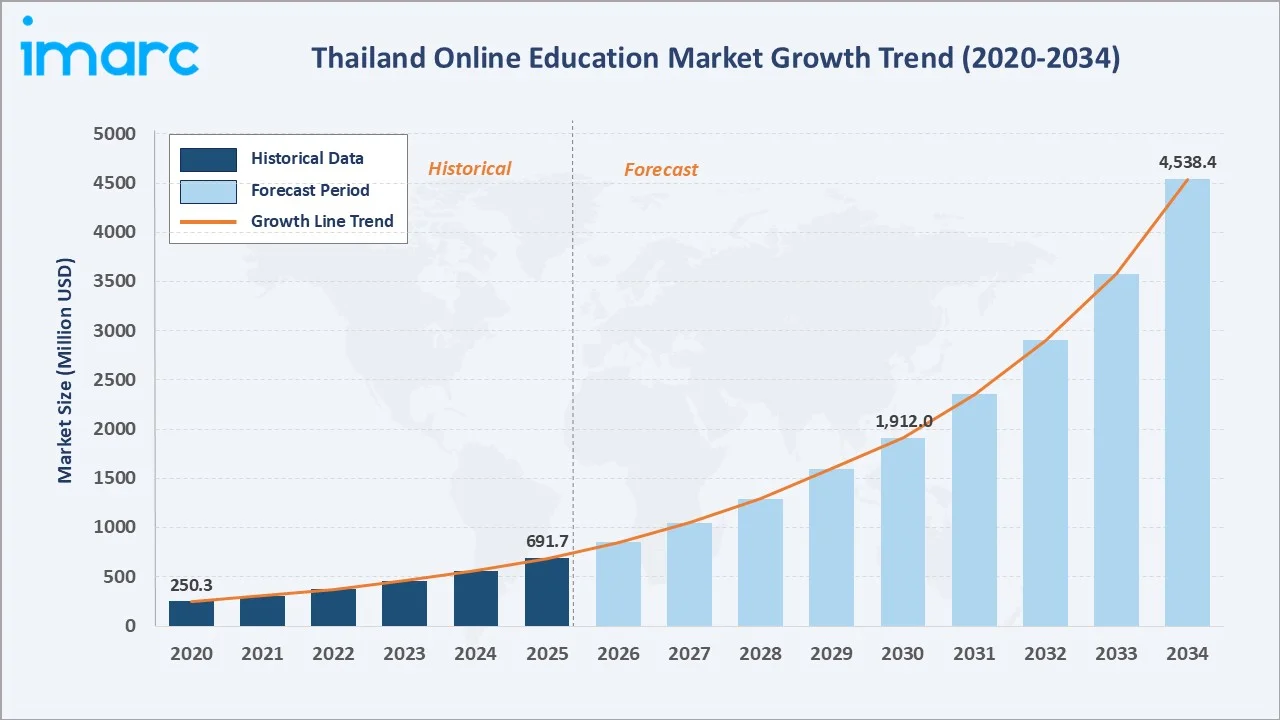
The Thailand online education market reached USD 691.7 Million in 2025 and is projected to reach USD 4,538.4 Million by 2034, exhibiting an exceptional CAGR of 22.55% during 2026-2034. The market is driven by increasing internet and smartphone penetration, growing adoption of digital learning platforms, and rising demand for flexible, skill-based education. Government digitalization initiatives, expanding EdTech solutions, and greater use of AI-enabled and personalized learning tools are further supporting market growth. At the beginning of 2024, Thailand recorded 63.21 million internet users, representing an internet penetration rate of 88.0%. The country also had around 97.81 million active mobile connections, equivalent to 136.1% of the total population. This high level of digital and mobile connectivity is supporting the Thailand online education market by expanding access to virtual classrooms, e-learning platforms, mobile learning applications, and digital course content. Academic type leads at 52.8%, content provider leads at 62.4%, and Bangkok accounts for the largest regional share at 34.8%.
Market Snapshot
|
Metric |
Value |
|
Market Size (2025) |
USD 691.7 Million |
|
Forecast Market Size (2034) |
USD 4,538.4 Million |
|
CAGR (2026-2034) |
22.55% |
|
Base Year |
2025 |
|
Historical Period |
2020-2025 |
|
Forecast Period |
2026-2034 |
|
Dominant Type |
Academic – 52.8% (2025) |
|
Dominant Provider |
Content – 62.4% (2025) |
|
Leading Region |
Bangkok – 34.8% (2025) |
The Thailand online education market grew from USD 250.3 Million in 2020 to USD 691.7 Million in 2025, driven by COVID-19’s forced transition to emergency remote learning that permanently shifted Thai student and professional attitudes toward digital education. Thailand’s e-learning industry benefits from 4G/5G network investments enabling seamless mobile video learning across the country. The market is projected to reach USD 1,912.0 Million by 2030 and USD 4,538.4 Million by 2034.
To get more information on this market, Request Sample
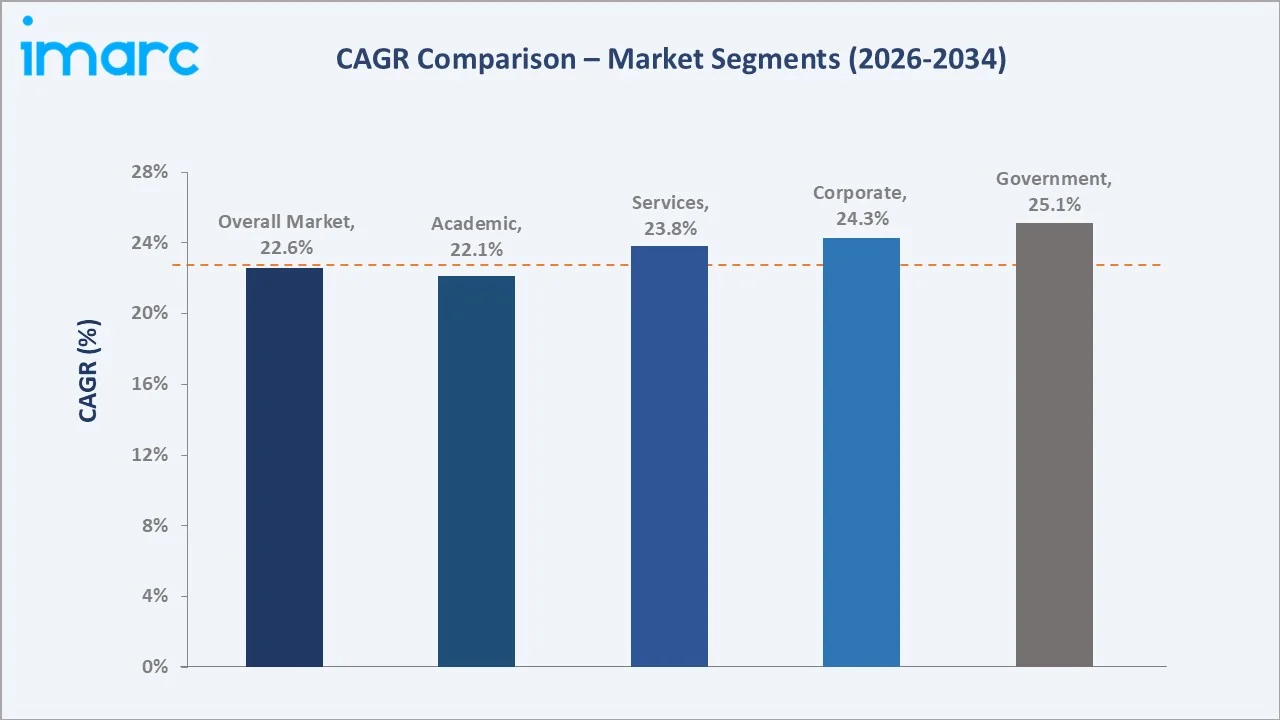
Government type grows fastest at ~25.10% CAGR through Civil Service Commission digital upskilling mandates and e-government capacity building. Corporate type grows at ~24.30% CAGR through EEC industrial skills demand and remote workforce training normalization. Services grow at ~23.80% CAGR through LMS implementation, tutoring, and managed learning service demand. Academic type grows at ~22.10% CAGR sustained by university online degree expansion and K-12 EdTech adoption.
Executive Summary
Thailand online education market represents one of Southeast Asia’s most compelling EdTech investment opportunities, combining regional population with youth proportion, a government committed to digital education transformation backed by investments in education technology budget allocations, and an increasingly sophisticated learner base that has progressed from pandemic-forced emergency online learning to voluntary, subscription-based skills acquisition through global and domestic platforms.
Academic types’ 52.8% market share reflects Thailand’s public and private universities progressively adopting hybrid and fully online degree programs and the emergence of vocational training online platforms serving Thailand’s vocational education students. Content providers’ 62.4% share reflects Thai learners’ primary willingness to pay for quality digital content over supplementary service layers. Bangkok’s 34.8% regional dominance reflects the capital’s concentration of Thailand’s universities, corporate headquarters, and technology-literate professional population.
Key Market Insights
|
Insight |
Data |
|
Dominant Type |
Academic – 52.8% share (2025) |
|
Dominant Provider |
Content – 62.4% share (2025) |
|
Leading Region |
Bangkok – 34.8% share (2025) |
|
Market Opportunity |
Thai-language AI tutor development for provincial learner access; EEC industry-aligned vocational certification programs; government civil service online training mandates; Thailand Creative Economy Agency digital arts and design education programs |
Key Analytical Observations:
- Academic Type at 52.8% (2025): Thailand’s academic online education segment encompasses three distinct sub-markets: higher education (university-level online and hybrid degree programs serving enrolled Thai university students), vocational training (online practical skills education for Thailand’s vocational students), and K-12 education (school-integrated digital learning tools for Thailand’s primary and secondary school students).
- Content Provider at 62.4% (2025): Thailand’s online education content provider category encompasses digital course materials, recorded video lectures, interactive learning modules, AI-generated practice questions, and structured curriculum packages. Thai learners’ primary online education purchase decision centers on content quality, Thai-language availability, and credential recognition, making content the dominant value driver in provider spend allocation.
- Bangkok at 34.8% (2025): Bangkok leads due to its high concentration of universities, schools, corporate offices, EdTech companies, and digitally connected learners. Strong internet infrastructure, higher disposable incomes, and greater adoption of online professional and academic courses further support its market dominance.
Thailand Online Education Market Overview
The Thailand online education market encompasses digital learning platforms, virtual classrooms, online tutoring, test preparation, higher education programs, and professional skill-development courses. It serves students, working professionals, educational institutions, and corporate learners through web-based and mobile learning solutions. The market also includes AI-enabled learning, video-based instruction, learning management systems, and certification programs delivered through digital channels. Macroeconomic factors include Thailand’s GDP growth, household income levels, inflation, employment conditions, digital infrastructure investment, and government spending on education and technology.
Market Dynamics
To evaluate market opportunities, Request Sample
Market Drivers
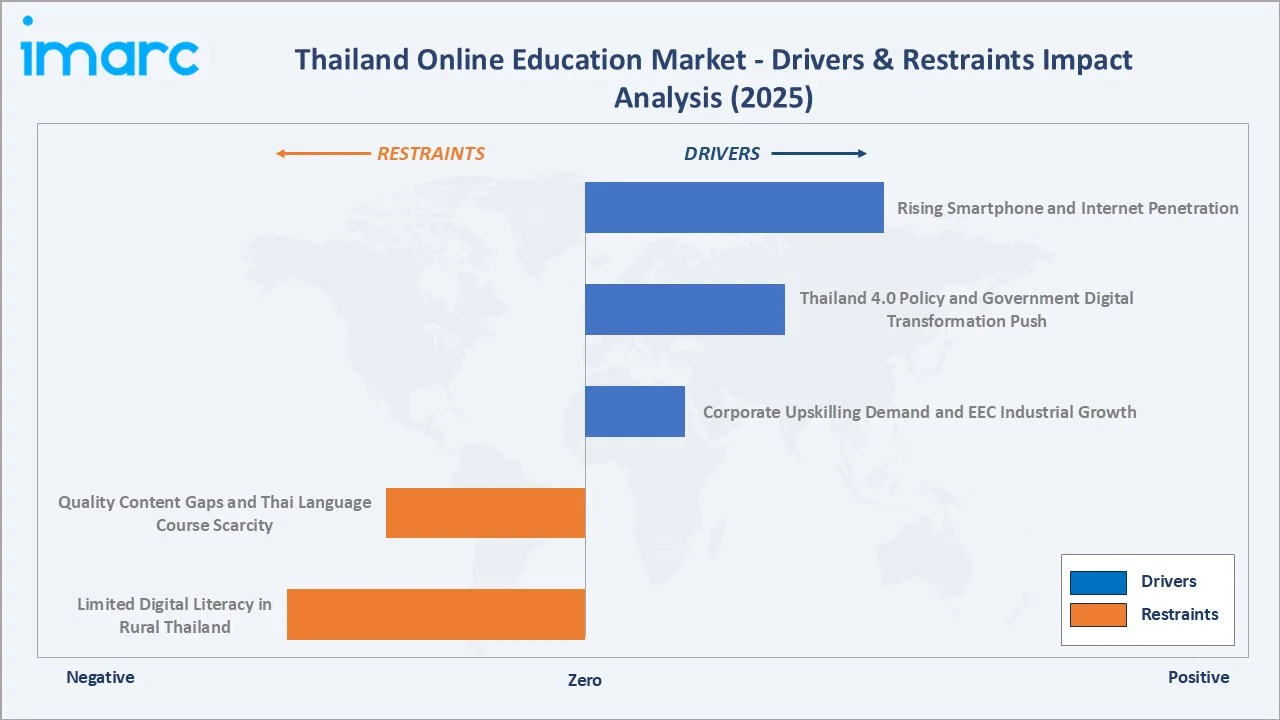
- Rising Smartphone and Internet Penetration: At the beginning of 2025, Thailand had approximately 99.5 million active cellular mobile connections, equivalent to about 139% of the total population. The country also recorded around 65.4 million internet users, with internet penetration reaching 91.2%. Increasing smartphone ownership and widespread internet access are expanding the reach of online education across Thailand. High digital connectivity enables students and professionals to access virtual classrooms, mobile learning apps, recorded courses, and skill-development programs conveniently from any location.
- Thailand 4.0 Policy and Government Digital Transformation Push: Thailand 4.0 is accelerating the adoption of digital technologies across education, public services, and workforce development, creating stronger demand for online learning platforms. Government efforts to improve digital skills, connectivity, and technology-enabled education are supporting the expansion of e-learning, virtual classrooms, and professional upskilling programs.
- Corporate Upskilling Demand and EEC Industrial Growth: Expanding industrial activity in Thailand’s Eastern Economic Corridor (EEC) is increasing demand for workers with digital, technical, engineering, and advanced manufacturing skills. Companies are increasingly using online training and certification platforms to upskill employees quickly and cost-effectively, supporting growth in the Thailand online education market.
Market Restraints
- Limited Digital Literacy in Rural Thailand: Lower digital literacy levels in rural areas can restrict the adoption of online learning platforms, particularly among older learners and communities with limited exposure to digital tools. Difficulties in navigating e-learning systems and using online educational resources may slow market penetration beyond major urban centers.
- Quality Content Gaps and Thai Language Course Scarcity: Limited availability of high-quality, localized Thai-language digital courses can reduce engagement among learners who are less comfortable with English-based content. Gaps in curriculum relevance, instructor quality, and locally tailored learning materials may also restrict adoption, particularly outside major urban and professional segments.
Market Opportunities
- AI-Powered Adaptive Learning: AI-powered adaptive learning enables platforms to personalize course content, assessments, and learning pathways based on individual learner performance. In April 2026, Advanced Info Service (AIS) broadened its digital skills initiative by introducing artificial intelligence (AI) training to support workforce development in Thailand. Free online courses are available through Thai MOOC, AIS LearnDi, and the AIS Aunjai Cyber app, covering AI fundamentals, practical applications, and responsible usage. The initiative positions AI as a tool that complements human capabilities while highlighting growing collaboration among the government, universities, and private sector to prepare Thailand’s workforce for future digital transformation. Online education providers can also use these technologies to serve diverse student and professional learning needs at scale across Thailand.
- EEC Vocational Upskilling Certification Programs: The expansion of industries within Thailand’s Eastern Economic Corridor creates opportunities for online education providers to deliver job-focused vocational and certification programs. Courses in automation, robotics, digital technologies, logistics, engineering, and advanced manufacturing can help address industry skill gaps. Partnerships with employers and training institutions can further strengthen course relevance and improve workforce employability.
Market Challenges
- Digital Divide Between Urban and Rural Areas: Despite high national internet penetration, differences in connectivity quality, device availability, and digital readiness persist across regions. Learners in rural and remote areas may experience unstable connections or limited access to suitable devices. This restricts participation in video-intensive and interactive learning programs and creates uneven adoption across the country.
- Maintaining Learner Engagement and Course Completion: Online education platforms often face difficulties maintaining learner motivation without direct classroom interaction. Self-paced courses can experience lower completion rates due to limited supervision and competing personal or professional commitments. Providers need interactive content, gamification, assessments, and personalized support to sustain engagement.
Emerging Market Trends
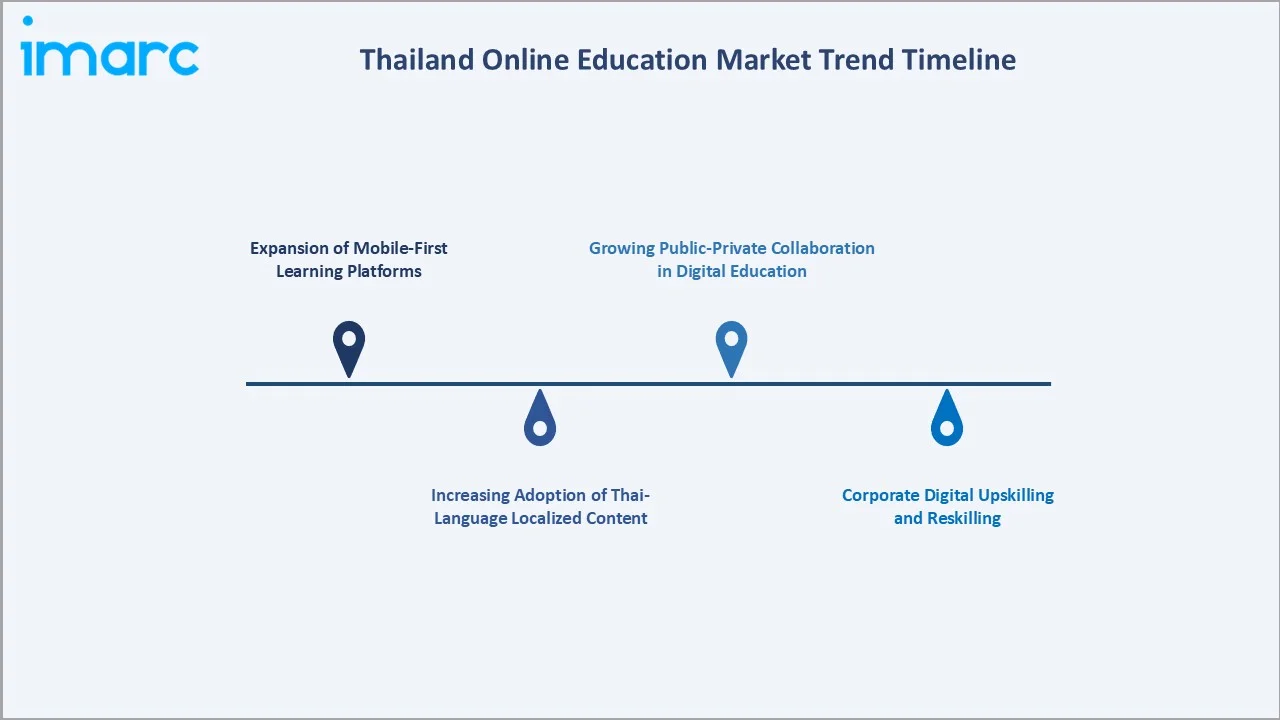
1. Expansion of Mobile-First Learning Platforms
Thailand’s high smartphone penetration is encouraging education providers to develop mobile-optimized learning experiences. Mobile platforms enable learners to access video lessons, assessments, learning materials, and certifications from virtually any location. Short-form and bite-sized content is becoming increasingly suitable for mobile consumption. Flexible learning schedules particularly benefit working professionals and younger learners. Mobile-first delivery is also helping platforms extend their reach beyond major cities.
2. Increasing Adoption of Thai-Language Localized Content
Online education platforms are expanding Thai-language courses to improve accessibility and learner engagement. Localized content can incorporate domestic curriculum requirements, cultural context, and Thailand-specific professional skills. Providers are also adapting international courses through translation and localization. Greater availability of Thai-language digital content can attract learners with limited English proficiency. This trend supports broader online education adoption across demographic groups.
3. Growing Public-Private Collaboration in Digital Education
Partnerships among government agencies, universities, technology companies, and education providers are becoming more prominent in Thailand’s digital learning ecosystem. In July 2026, True Corporation, in partnership with Sripatum University, is expanding the nationwide “AI for All Thais” initiative through the “True x Google Presents: AI for All Thais, Gemini Academy at Sripatum University” program. The initiative is designed to provide students with practical and accessible AI training that builds skills relevant to future employment. It reflects collaboration among True, Google, the Ministry of Higher Education, Science, Research and Innovation (MHESI), and universities across Thailand to translate national AI ambitions into hands-on learning. These initiatives also support national digital transformation objectives. Such partnerships are expected to accelerate digital skill development across Thailand.
4. Corporate Digital Upskilling and Reskilling
Businesses are increasingly using online platforms to develop employee capabilities in AI, automation, data analytics, cybersecurity, and other digital technologies. Flexible digital training allows companies to educate large workforces while minimizing disruption to operations. Industrial development, including activity within the EEC, is strengthening demand for technical and vocational training. Partnerships between employers and education providers are supporting customized learning programs. Corporate learning is therefore becoming an important growth segment.
Industry Value Chain Analysis
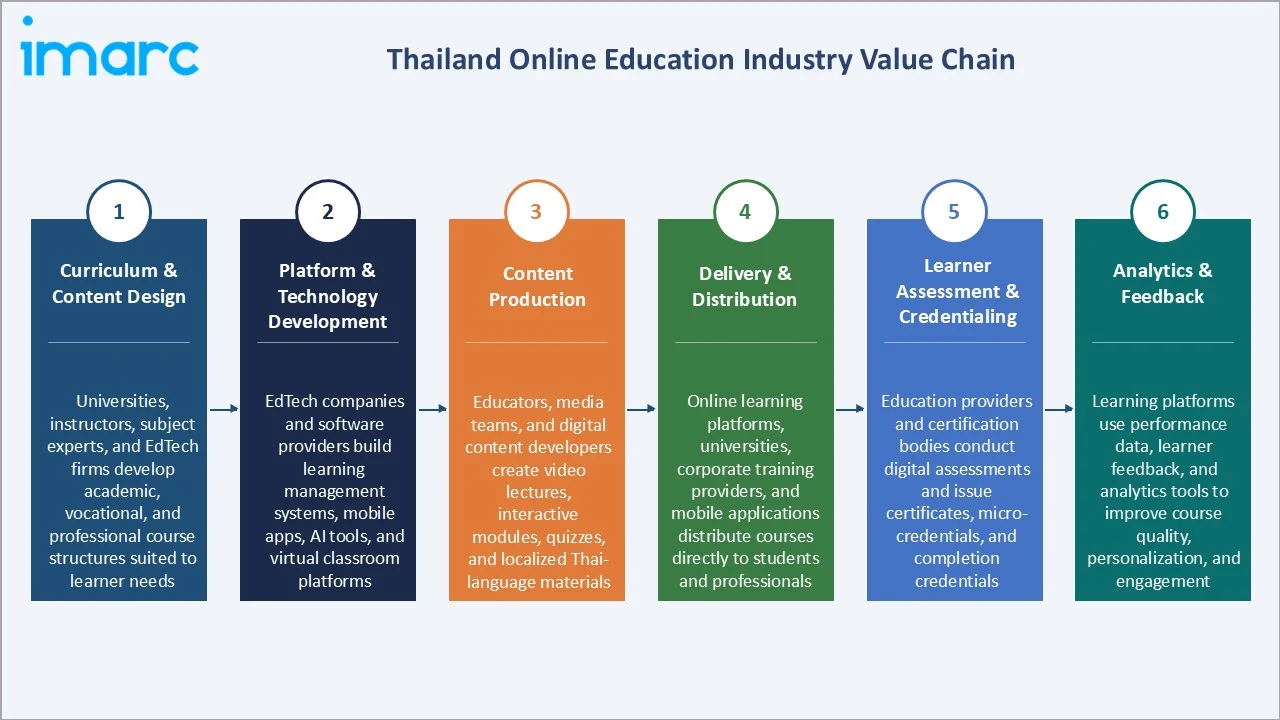
Thailand’s online education value chain integrates curriculum & content design, platform & technology development, content production, delivery & distribution, learner assessment & credentialing, and analytics & feedback.
|
Stage |
Key Participants |
|
Curriculum & Content Design |
Universities, instructors, subject experts, and EdTech firms develop academic, vocational, and professional course structures suited to learner needs. |
|
Platform & Technology Development |
EdTech companies and software providers build learning management systems, mobile apps, AI tools, and virtual classroom platforms. |
|
Content Production |
Educators, media teams, and digital content developers create video lectures, interactive modules, quizzes, and localized Thai-language materials. |
|
Delivery & Distribution |
Online learning platforms, universities, corporate training providers, and mobile applications distribute courses directly to students and professionals. |
|
Learner Assessment & Credentialing |
Education providers and certification bodies conduct digital assessments and issue certificates, micro-credentials, and completion credentials. |
|
Analytics & Feedback |
Learning platforms use performance data, learner feedback, and analytics tools to improve course quality, personalization, and engagement. |
Platform & technology development is the most value-added stage, as it provides the digital infrastructure that enables scalable course delivery, personalized learning, and learner engagement. Integration of AI, learning analytics, adaptive learning, and mobile technologies further enhances platform differentiation and commercial value.
Technology Landscape in the Thailand Online Education Industry
Learning Management Systems (LMS)
Cloud-based LMS platforms enable educational institutions and companies to manage courses, assessments, learner progress, and digital content through centralized systems. They support both self-paced and instructor-led learning formats. Integrated dashboards provide educators with visibility into learner performance. LMS platforms can also support certifications and corporate training programs. Their scalability makes them important for large-scale online education delivery.
Learning Analytics and Big Data Technology
Learning analytics platforms collect and analyze information on course participation, assessment results, engagement, and learner progression. Institutions can use these insights to identify learning difficulties and improve course design. Predictive analytics can help identify students at risk of disengagement or non-completion. Data-driven insights also support personalized learning recommendations. The technology enables continuous improvement in digital education delivery.
Cloud-Based Virtual Classroom Technology
Cloud technologies enable live classes, recorded lectures, collaborative assignments, digital assessments, and learning resources to be delivered at scale. Virtual classroom platforms integrate video conferencing, screen sharing, digital whiteboards, and interactive communication tools. Cloud infrastructure reduces the need for extensive on-premises IT systems. It also enables institutions to rapidly expand digital learning capacity. This technology supports flexible hybrid and fully online education models.
Market Segmentation Analysis
The report covers the following segments:
|
Segment Category |
Leading Segment |
Market Share |
Year |
|
Type |
Academic |
52.8% |
2025 |
|
Provider |
Content |
62.4% |
2025 |
|
Technology |
🔒 |
🔒 |
2025 |
|
End-User |
🔒 |
🔒 |
2025 |
|
Region |
Bangkok |
34.8% |
2025 |

By Type
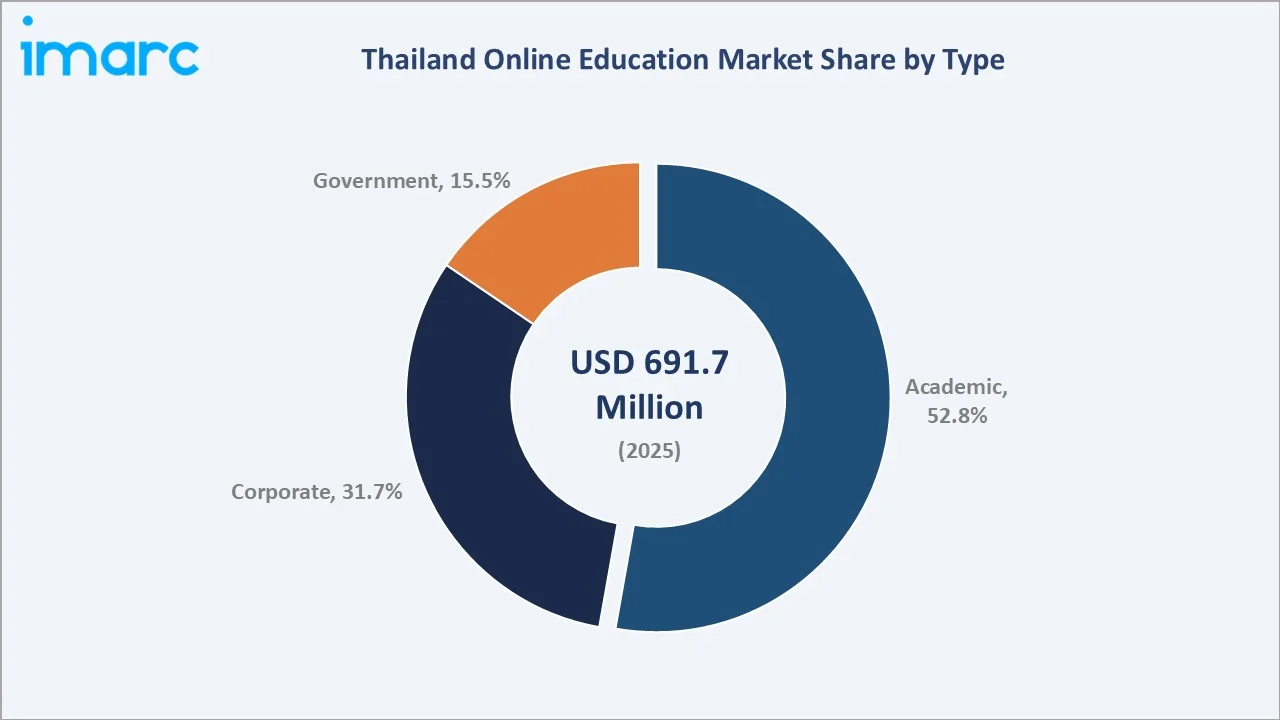
Academic leads at 52.8% (2025) through university online program expansion, K-12 digital learning tool adoption, and vocational training online migration.
To access detailed market analysis, Request Sample
Corporate at 31.7%, growing at ~24.30% CAGR through EEC industrial upskilling demand and corporate compliance training requirements. Government at 15.5%, growing fastest at ~25.10% CAGR, through civil servant mandatory e-learning policies and e-government capacity building programs.
By Provider
Content leads at 62.4% (2025), reflecting Thai learners' primary expenditure on digital course materials, structured video instruction, and curriculum packages.
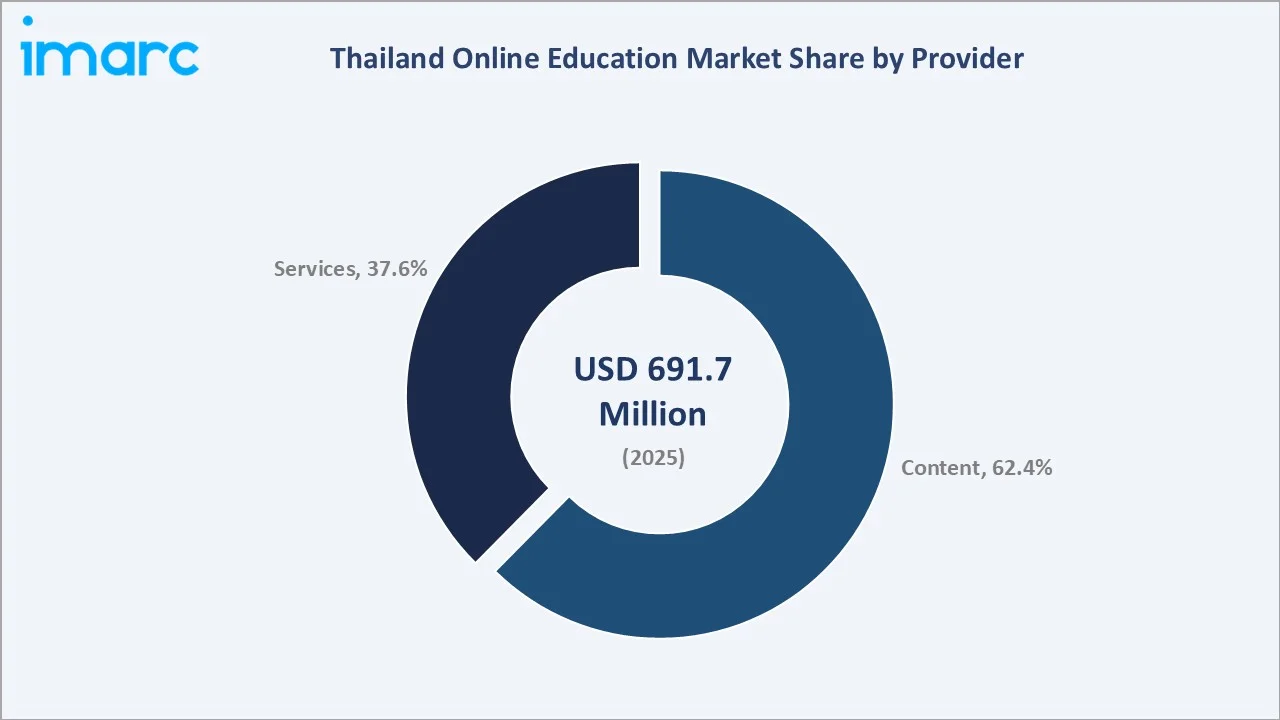
Services at 37.6%, growing at ~23.80% CAGR through LMS implementation, online tutoring, system integration, and managed learning operations services demand as institutional online education deployments scale in complexity.
Regional Market Insights
|
Region |
Share (2025) |
Key Online Education Market Drivers & Characteristics |
|
Bangkok |
34.8% |
High digital connectivity, concentration of universities and corporations, and strong adoption of EdTech and professional learning platforms. |
|
Eastern |
18.7% |
EEC industrial development and growing demand for technical, vocational, and workforce upskilling programs support adoption. |
|
Southern |
15.9% |
Expanding internet access and increasing use of flexible online academic and professional education support market growth. |
|
Northern |
12.6% |
The presence of educational institutions and improving digital infrastructure encourage adoption of remote and blended learning. |
|
Northeastern |
10.8% |
Growing smartphone penetration and demand for accessible education and skill-development programs support online learning. |
|
Others |
7.2% |
Improving connectivity and expanding availability of mobile-based and localized digital learning platforms drive gradual adoption. |
Bangkok leads with a 34.8% share in 2025, supported by strong digital infrastructure, a high concentration of universities, corporate offices, and EdTech users. The Eastern region accounts for 18.7%, driven by EEC industrial activity and rising demand for technical and workforce upskilling programs. The Southern region holds 15.9%, supported by expanding internet access and increasing adoption of flexible digital learning.
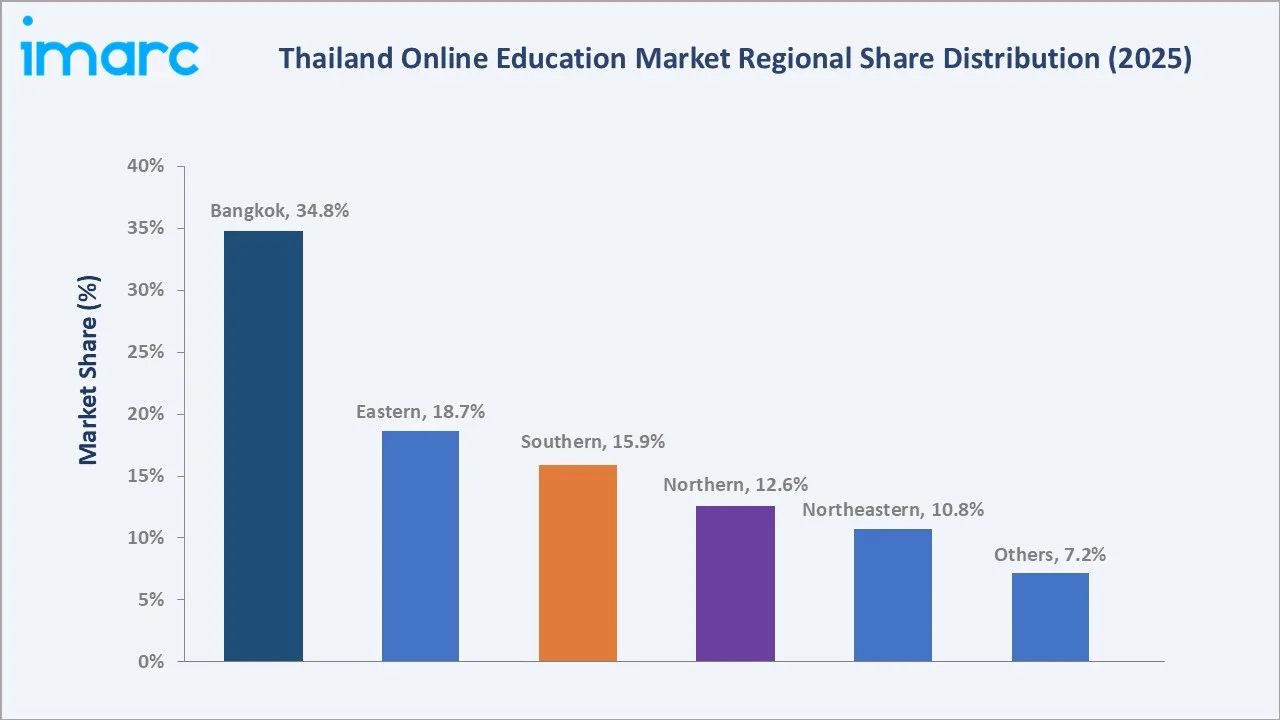
The Northern region represents 12.6%, benefiting from the presence of educational institutions and improving connectivity. The Northeastern region accounts for 10.8%, where smartphone-based learning and demand for accessible education are supporting adoption. Other regions collectively hold 7.2%, reflecting gradual penetration of online education beyond major urban centers.
Competitive Landscape
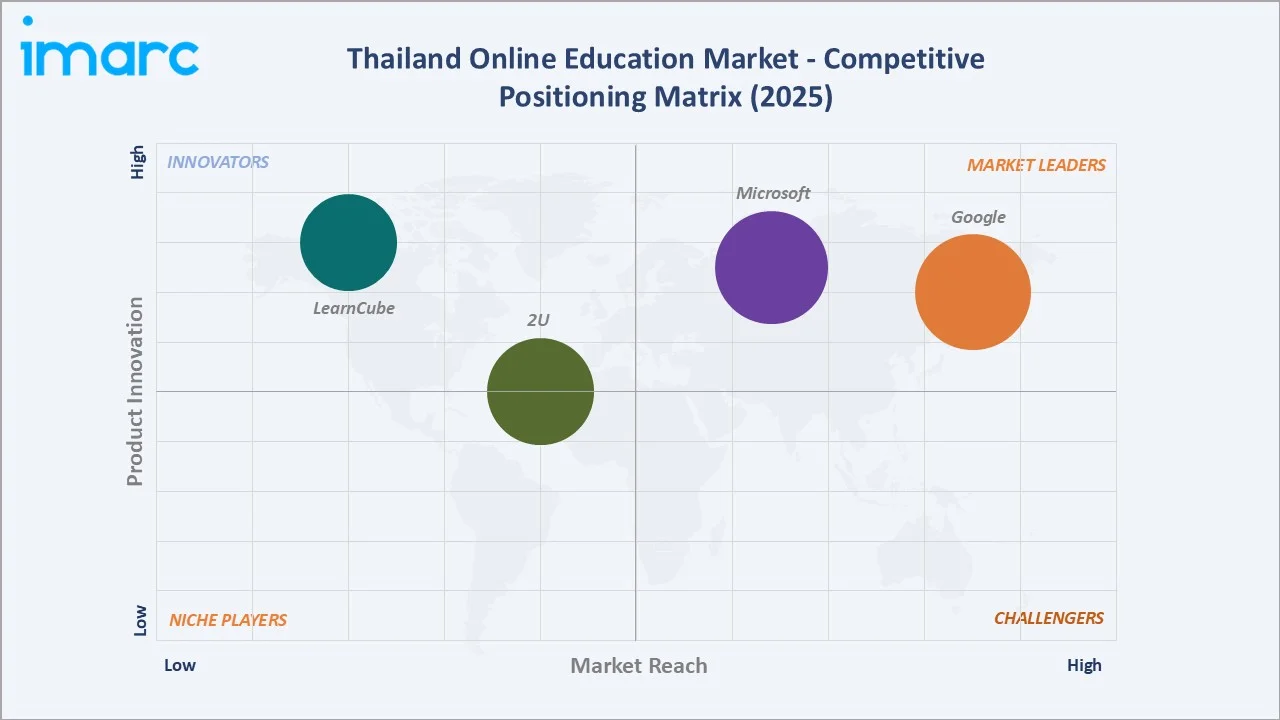
The Thailand online education market is moderately concentrated, with competition among domestic EdTech companies, universities, international learning platforms, and corporate training providers. Market participants compete through AI-enabled personalization, Thai-language content, course affordability, recognized certifications, mobile accessibility, and partnerships with educational institutions and employers.
|
Company |
Key Offerings |
Market Position |
Core Strength |
|
2U |
edX |
Established Player |
By connecting global universities with local learners through its edX marketplace, 2U provides the technology, marketing, and instructional design needed to scale higher education and professional bootcamps across Thailand. |
|
|
Google for Education, Google Workspace for Education |
Market Leader |
Google plays a foundational role in Thailand's online education ecosystem by providing the digital infrastructure, cloud services, and AI-driven platforms. |
|
Microsoft |
Microsoft Learn, Microsoft 365 Education |
Market Leader |
Microsoft is a primary digital partner for Thailand’s online education and national upskilling. |
|
LearnCube |
Virtual Classroom Software, Online School Software, Language School Software |
Innovator |
LearnCube serves as vital education technology infrastructure for language schools and tutoring companies teaching students in Thailand. |
Thailand online education competitive landscape is distinguished by the coexistence of global English-language platform leaders serving Bangkok’s internationally oriented professional and academic communities, and domestic Thai-language platforms serving provincial learners, K-12 students, and government employees who require Thai-language instruction, creating a bifurcated market where language is the primary segmentation dimension.
Key Company Profiles
Google is an important technology participant in the Thailand online education market, providing digital learning and collaboration solutions through Google for Education, Workspace, and AI-enabled tools. The company also supports digital and AI skill development through programs. Google reported that its digital-skilling initiatives had trained many people in Thailand, including students and educators.
- Key Offerings: Google for Education, Google Workspace for Education.
- Strategic Focus: Expanding AI literacy, digital skills development, and AI-enabled education across Thailand. The company is strengthening partnerships with government agencies, universities, and local organizations to broaden access to digital learning and train students, educators, and workers.
Microsoft
Microsoft is a technology company with a significant presence in the Thailand online education market through its education, cloud, collaboration, and digital-skilling solutions. Its education portfolio supports virtual learning, collaboration, and skills development. The company serves students, educators, educational institutions, and professionals through digital learning resources and certification pathways. Microsoft has also collaborated with Thailand’s Ministry of Education on digital education initiatives, strengthening its role in expanding technology-enabled learning and digital skills development.
- Key Offerings: Microsoft Learn, Microsoft 365 Education.
- Strategic Focus: Focused on expanding AI literacy, digital skills, and technology-enabled learning across Thailand through partnerships with government agencies, educational institutions, and workforce organizations. Its initiatives emphasize AI training for students and educators, Thai-language online courses, micro-credentials, and integration of AI tools into national digital learning platforms.
Market Concentration Analysis
The Thailand online education market is moderately concentrated, with competition among major technology companies, established EdTech platforms, universities, and specialized training providers. Leading participants benefit from strong brand recognition, advanced digital infrastructure, broad course portfolios, and institutional partnerships. Competition is increasingly centered on AI-powered learning, Thai-language content, mobile accessibility, and industry-recognized certifications. Local providers differentiate through localized curricula, affordable pricing, and vocational programs aligned with domestic workforce needs. Entry barriers remain moderate due to technology investment, content quality requirements, and the need to build learner trust. Overall, continued EdTech innovation and growing demand for specialized skills are gradually increasing competitive intensity.
Investment & Growth Opportunities
Highest Growth Segments
Government type (~25.10% CAGR) and corporate type (~24.30% CAGR) represent Thailand’s online education market’s highest-growth investment vectors through 2034, driven by mandatory civil servant digital learning policies and EEC industrial workforce upskilling demand, respectively.
Investment Themes
- Thai-Language AI Tutor Development: Investment opportunities are emerging in AI-powered tutoring platforms that deliver personalized instruction, real-time feedback, and conversational learning in the Thai language. Localized AI tutors can improve accessibility and engagement while serving students across academic, vocational, and professional education segments.
- EEC Industry-Aligned Certification Programs: The Eastern Economic Corridor creates opportunities for investment in online certification programs aligned with employer requirements in automation, robotics, AI, logistics, electronics, and advanced manufacturing. Partnerships with EEC companies and educational institutions can strengthen credential recognition and improve workforce readiness.
Future Market Outlook (2026-2034)
The Thailand online education market is projected to grow from USD 691.7 Million in 2025 to USD 4,538.4 Million by 2034, delivering an exceptional 22.55% CAGR that makes Thailand one of Southeast Asia’s fastest-growing EdTech markets, reflecting the alignment of a population increasingly demanding digital skills, a government actively creating structural online learning demand, and technology infrastructure progressively enabling ubiquitous learning access across Thailand’s provinces. The milestone of USD 1,912.0 Million in 2030 confirms the structural momentum of a market, establishing Thailand’s online education market as one of the most consistent high-CAGR EdTech markets in the ASEAN region.
First, Thailand’s demographic and economic development trajectory creates irreversible structural demand for online education through the coming decade. Thailand’s working-age population faces a skills gap that traditional education cannot close at the speed required by technological change. Second, government policy creates structural demand acceleration that commercial market forces alone could not generate. Third, AI-powered personalization is creating a structural shift in Thailand’s online education market from broadcast content delivery (where all learners receive identical course content regardless of prior knowledge and learning pace) toward adaptive learning systems that personalize instruction to each learner’s specific knowledge gaps, learning style, and optimal challenge level.
Research Methodology
Primary Research
Primary research comprised in-depth interviews with online education platform leadership, Thai university e-learning center directors, corporate L&D managers at EEC-registered companies, government education officials, and learner experience interviews.
Secondary Research
Secondary research encompassed a review of government education policies, digital transformation programs, industry reports, company publications, academic sources, and credible databases related to Thailand’s online education sector. The analysis focused on market trends, EdTech adoption, digital infrastructure, AI-enabled learning, workforce upskilling, competitive developments, and regional demand patterns.
Forecasting Models
Forecasting models developed using historical Thailand online education market data (2020-2025), Thailand GDP growth projection, Thai government education technology budget trajectory, EEC industrial investment and workforce demand projection, internet and smartphone penetration trajectory, AI technology cost curve impact on online education engagement and completion rates, corporate e-learning spend per employee trajectory, and competitive platform pricing dynamics projection under increasing market entry by domestic Thai EdTech startups.
Thailand Online Education Market Report Coverage:
| Report Features | Details |
|---|---|
| Base Year of the Analysis | 2025 |
| Historical Period | 2020-2025 |
| Forecast Period | 2026-2034 |
| Units | Million USD |
| Scope of the Report |
Exploration of Historical Trends and Market Outlook, Industry Catalysts and Challenges, Segment-Wise Historical and Future Market Assessment:
|
| Types Covered |
|
| Providers Covered | Content, Services |
| Technologies Covered | Mobile E-Learning, Rapid E-Learning, Virtual Classroom, Others |
| End-Users Covered | Higher Education Institutions, K-12 Schools |
| Regions Covered | Bangkok, Eastern, Northeastern, Southern, Northern, Others |
| Companies Covered | 2U, Google, Microsoft, LearnCube, etc. |
| Customization Scope | 10% Free Customization |
| Post-Sale Analyst Support | 10-12 Weeks |
| Delivery Format | PDF and Excel through Email (We can also provide the editable version of the report in PPT/Word format on special request) |
Key Benefits for Stakeholders:
- IMARC’s industry report offers a comprehensive quantitative analysis of various market segments, historical and current market trends, market forecasts, and dynamics of the Thailand online education market from 2020-2034.
- The research report provides the latest information on the market drivers, challenges, and opportunities in the Thailand online education market.
- Porter's Five Forces analysis assists stakeholders in assessing the impact of new entrants, competitive rivalry, supplier power, buyer power, and the threat of substitution. It helps stakeholders to analyze the level of competition within the Thailand online education industry and its attractiveness.
- Competitive landscape allows stakeholders to understand their competitive environment and provides an insight into the current positions of key players in the market.
Frequently Asked Questions About the Thailand Online Education Market Report
The Thailand online education market reached USD 691.7 Million in 2025, driven by rising internet and smartphone penetration, growing adoption of AI-enabled learning platforms, government-led digital education initiatives, and increasing demand for workforce upskilling and flexible certification programs.
The market grows at 22.55% CAGR, reaching USD 4,538.4 Million by 2034, driven by rapid digitalization, AI-enabled learning adoption, rising workforce upskilling demand, and continued expansion of mobile and cloud-based education platforms.
Academic leads at 52.8% (2025) through Thai students across K-12, vocational, and higher education levels as the largest learner base, combined with regulatory facilitation of fully online university degrees.
Content leads at 62.4% (2025), as Thai learners’ primary willingness-to-pay centers on quality digital course materials, structured video instruction, and curriculum packages rather than supplementary service layers.
Bangkok leads at 34.8% through Thailand’s educational, corporate, and government institution concentration in the capital.
Leading companies include 2U, Google, Microsoft, and LearnCube, among others.
The market is projected to reach USD 1,912.0 Million by 2030, driven by expanding digital infrastructure, rising adoption of AI-powered learning, growing corporate upskilling demand, and increased availability of mobile-based and localized online courses.
Top investment opportunities include Thai-language AI tutoring development, EEC industry-aligned online vocational certification, government civil servant online training platform, K-12 supplementary learning subscription, corporate compliance training platform, and Thai content studio for MOOC production.
Need more help?
- Speak to our experienced analysts for insights on the current market scenarios.
- Include additional segments and countries to customize the report as per your requirement.
- Gain an unparalleled competitive advantage in your domain by understanding how to utilize the report and positively impacting your operations and revenue.
- For further assistance, please connect with our analysts.
 Request Customization
 Speak to an Analyst
 Request Brochure
 Inquire Before Buying
Benefits of Customization
- Personalize this research
- Triangulate with your data
- Get data as per your format and definition
- Gain a deeper dive into a specific application, geography, customer, or competitor
- Any level of personalization
Get in Touch With Us
UNITED STATES
Phone: +1-201-971-6302
INDIA
Phone: +91-120-433-0800
UNITED KINGDOM
Phone: +44-753-714-6104
Email: [email protected]
Client Testimonials




.webp)




.webp)













Related Reports

Choose your plan
*Please note that the prices mentioned below are starting prices for each bundle type. Kindly contact our team for further details.*
Single User License
- 1 User License, Access on 2 Devices
- PDF Report + Excel Dataset (Password Protected)
- Lifetime Access
- No Printing Rights
- 10% Free Report Customization
- 10–12 Weeks of Analyst Support
Five User License
- Access for 5 Users, 2 Devices per User
- PDF Report + Excel Dataset (Password Protected)
- Lifetime Access
- Dedicated Account Manager
- 12–14 Weeks of Analyst Support
- No Printing Rights
- 15% Free Report Customization
- 25% Discount on Your Next Purchase
Corporate User License
- Unlimited User Access (Within Your Organization)
- PDF Report + Excel Dataset
- Lifetime Access
- Dedicated Account Manager
- 14–20 Weeks of Analyst Support
- No Printing Rights
- 20% Free Report Customization
- 30% Discount on Your Next Purchase
Essential Insights
What's included:
3 reports
- Lifetime Access
- PDF Reports
- Excel Datasets
- 2 Weeks of Free Analyst Support
- 2 User Licenses
- Access on 2 Devices
- Printing Rights
- Complimentary PowerPoint (PPT) Version
- Complimentary License Upgrade
Professional Access
What's included:
5 reports
- Lifetime Access
- PDF Reports
- Excel Datasets
- 8 Weeks of Free Analyst Support
- 2 User Licenses
- Access on 2 Devices
- Printing Rights
- Complimentary PowerPoint (PPT) Version
- Complimentary License Upgrade
Business Advantage
What's included:
8 reports
- Lifetime Access
- PDF Reports
- Excel Datasets
- 14 Weeks of Free Analyst Support
- 2 User Licenses
- Access on 2 Devices
- Printing Rights
- Complimentary PowerPoint (PPT) Version
- Complimentary License Upgrade
Enterprise Intelligence
What's included:
10 reports
- Lifetime Access
- PDF Reports
- Excel Datasets
- 20 Weeks of Free Analyst Support
- 2 User Licenses
- Access on 2 Devices
- Printing Rights
- Complimentary PowerPoint (PPT) Version
- Complimentary License Upgrade