
Thailand Toys Market Size, Share, Trends and Forecast by Product Type, Age Group, Sales Channel, and Region, 2026-2034
Thailand Toys Market Size, Share, Trends & Forecast (2026-2034)
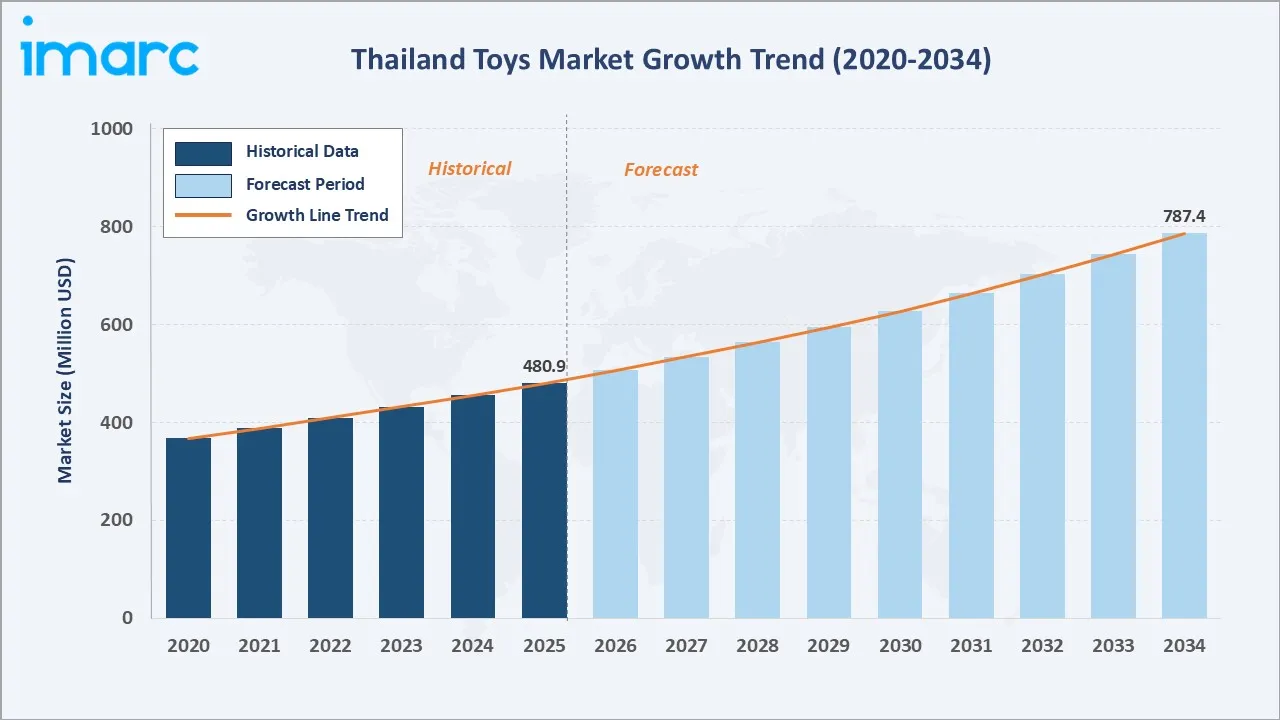
The Thailand toys market grew from USD 480.9 Million in 2025 to USD 507.2 Million in 2026 and is projected to reach USD 787.4 Million by 2034, growing at a CAGR of 5.46% during 2026-2034. Demand is widening as families, collectors and gift buyers spend more on creative, educational and character-led play. Rising output and import volumes, backed by stronger distributors and retail capacity, keep products available across modern trade and online channels. Supporting growth factors include rising household spending on child development, expanding e-commerce reach and growing licensed merchandise. Dolls dominate at 20.0%. 5 to 10 years leads at 40.0%. Bangkok commands 35.0% of the regional market share.
Market Snapshot
|
Metric |
Value |
|
Base Year Market Size (2025) |
USD 480.9 Million |
|
Market Size (2026) |
USD 507.2 Million |
|
Forecast Market Size (2034) |
USD 787.4 Million |
|
CAGR (2026-2034) |
5.46% |
|
Base Year |
2025 |
|
Historical Period |
2020-2025 |
|
Forecast Period |
2026-2034 |
|
Dominant Product Type |
Dolls (20.0%, 2025) |
|
Dominant Age Group |
5 to 10 Years (40.0%, 2025) |
|
Leading Region |
Bangkok (35.0%, 2025) |
The market size increased from USD 368.6 Million in 2020 to USD 480.9 Million in 2025 and is estimated to reach USD 507.2 Million in 2026. The market is further expected to grow to USD 627.4 Million by 2030 and USD 787.4 Million by 2034.
To get more information on this market, Request Sample
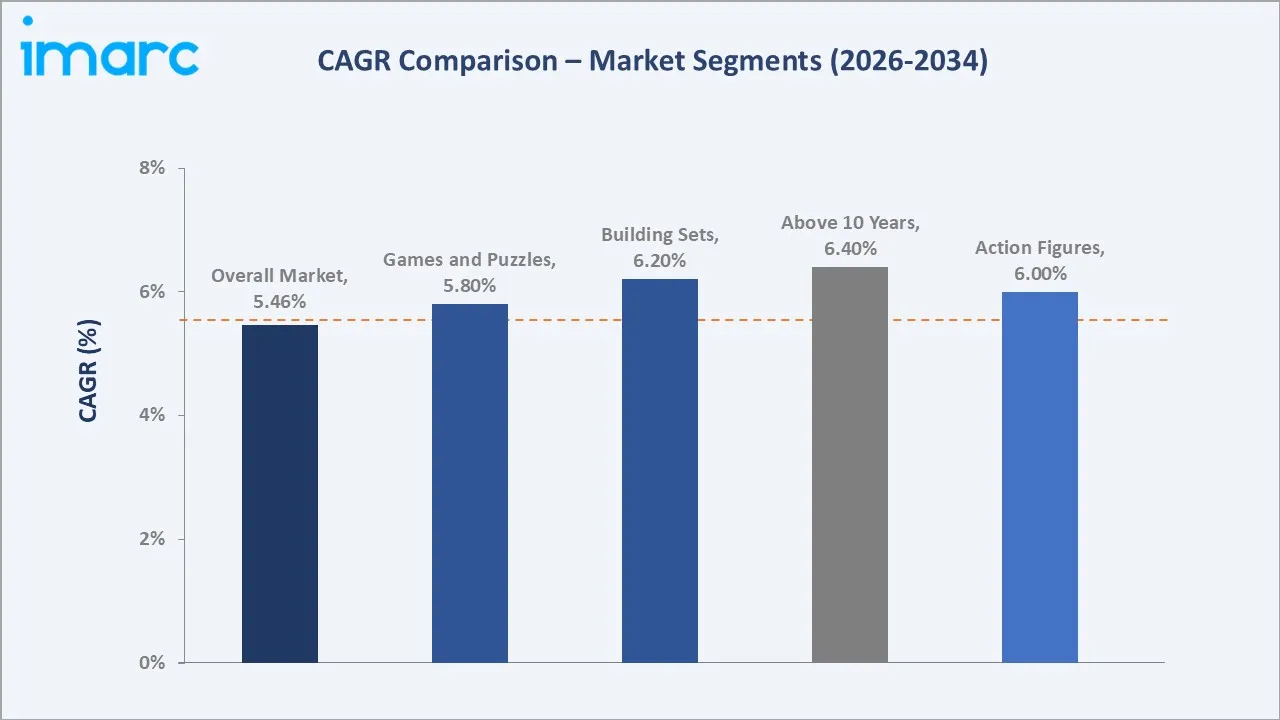
Building sets at ~6.2% CAGR and action figures at ~6.0% CAGR are the fastest-growing product types, supported by construction play with learning value and by franchise-led collecting. Both benefit from the wider toys market in Thailand shifting toward higher-priced, repeat-purchase ranges.
Executive Summary
The market expanded from USD 480.9 Million in 2025 to an estimated USD 507.2 Million in 2026, with demand anchored in gifting occasions, school-age play and a steady flow of character-led launches. Families treat toys as part of child development, so construction, puzzle and creative categories hold a firm base, while dolls and plush keep broad appeal across income groups.
The fastest developing areas are building sets, collectible figures and games that suit older children and adults, each outpacing the market because they carry higher price points and repeat purchases. Specialty retail, online marketplaces and livestream commerce are widening access and speeding up new product discovery. The market is projected to reach USD 787.4 Million by 2034. Dolls lead at 20.0% through broad appeal and wide price ranges. 5 to 10 years at 40.0% reflects peak play and gifting demand. Bangkok leads regionally at 35.0%.
Key Market Insights
|
Insight |
Data |
|
Dominant Product Type |
Dolls - 20.0% share (2025) |
|
Dominant Age Group |
5 to 10 Years - 40.0% market share (2025) |
|
Leading Region |
Bangkok - 35.0% share (2025) |
|
Market Opportunity |
Collectible and designer toys, educational construction play, omnichannel and livestream retail, adult-focused hobby products. |
Key Analytical Observations Supporting the Above Data:
- Dolls at 20.0%: Fashion dolls, baby dolls and character figures sit at accessible price points and attract repeat gifting, which keeps the category the largest single product type in the market.
- 5 to 10 Years at 40.0%: Children in this range play actively, follow screen franchises and influence purchase choices, so brands concentrate launches, licensing and promotions on this group.
- Bangkok at 35.0%: Dense department stores and specialty retail, higher household spending and strong online delivery coverage make the capital the main launch and sales hub for new products.
Thailand Toys Market Overview
The Thailand toys market covers dolls, building sets, action figures, games and puzzles, sports and outdoor toys, plush and other play products sold to families, gift buyers and collectors. Global brand owners supply most branded lines through subsidiaries and distributors, while local importers, assemblers and small makers serve value and regional tastes. Retail runs through department stores, hypermarkets, specialty shops, brand stores, vending formats and fast-growing online marketplaces.
Licensing from films, animation and games shapes much of the assortment, and seasonal peaks follow school holidays, festivals and year-end gifting. Safety standards and product certification guide what reaches shelves, and parents increasingly look for learning value alongside fun. The toys market in Thailand is therefore shaped by brand strength, licensing access, distributor reach and the ability to refresh ranges quickly as trends shift.
Market Dynamics
To evaluate market opportunities, Request Sample
Market Drivers
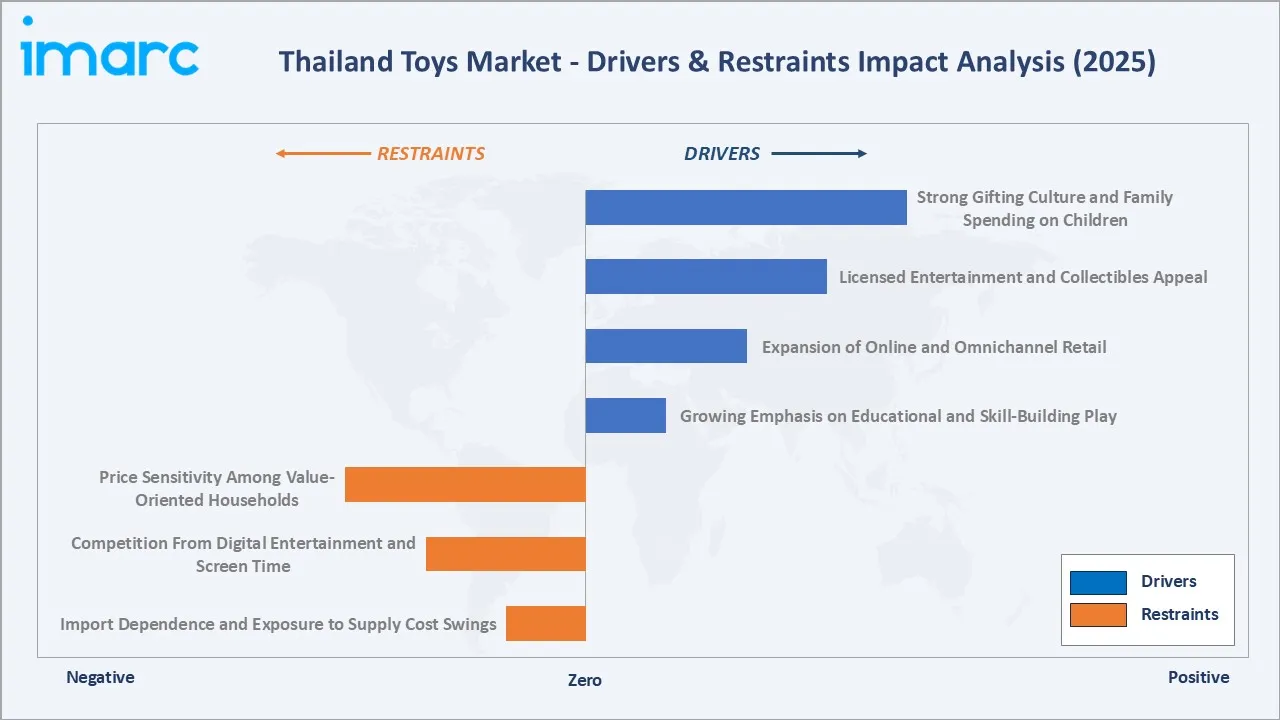
- Strong Gifting Culture and Family Spending on Children: Toys are a common choice for birthdays, festivals, school achievements and year-end celebrations, and extended families often contribute to purchases. Parents see play products as part of learning and development, so they are willing to buy construction sets, puzzles and creative kits alongside traditional dolls and figures. This keeps demand resilient across seasons and supports steady unit sales.
- Licensed Entertainment and Collectibles Appeal: Films, animation, streaming series, games and social media personalities create constant demand for character products. Collectible figures, blind box ranges and limited editions turn buying into a hobby with repeat purchases, drawing teenagers and adults into the category. Brands time launches with entertainment releases and run store events that build queues and online buzz.
- Expansion of Online and Omnichannel Retail: Marketplaces, brand websites, social commerce and livestream selling give buyers quick access to wide ranges and new releases. Convenient payment options and delivery coverage help shoppers outside major retail clusters reach products once sold only in large stores. Brands use digital channels to test products, gather reviews and build communities, while physical stores serve as showcases and experience points.
- Growing Emphasis on Educational and Skill-Building Play: Parents and schools increasingly value play that builds problem-solving, motor skills, creativity and early science knowledge. Building sets, puzzles, board games and activity kits benefit directly, and many brands now position products around learning outcomes.
Market Restraints
- Price Sensitivity Among Value-Oriented Households: Many households compare prices closely, and branded toys can be expensive relative to unbranded alternatives. Parents often limit purchases to key occasions or trade down when budgets tighten. Discount events and online promotions condition buyers to wait for deals, which pressures margins for brands and retailers.
- Competition From Digital Entertainment and Screen Time: Mobile games, streaming video and social media compete for children's time and for the family entertainment budget. As children grow older, interest in physical play can fade sooner, especially for traditional categories. Toy makers must connect physical products with digital content to stay relevant, which adds development cost.
- Import Dependence and Exposure to Supply Cost Swings: Most branded toys sold in the country are imported or made from imported components, so freight rates, currency movements and port delays affect landed costs. Brands and distributors must manage inventory carefully across seasonal peaks. Price increases can be hard to pass through to cost-conscious buyers, squeezing margins.
Market Opportunities
- Collectibles, Designer Toys and Adult Fandom: Blind boxes, limited editions and artist-led figures have created a hobby economy in which buyers return often to complete sets and trade items. Specialty stores, vending formats and brand events build community and urgency. Adults with disposable income buy for themselves, widening the market beyond child gifting.
- Educational and STEM-Linked Play Products: Demand is rising for construction kits, coding toys, science sets and puzzles that develop skills while keeping children engaged. Schools, learning centers and parents form a broad and receptive audience. Localized instructions, Thai-language content and teacher-friendly packaging can make these products easier to adopt.
- Omnichannel Retail and Livestream Commerce: Combining physical stores, marketplaces and live selling lets brands reach buyers wherever they browse. Live demonstrations of building sets, unboxing of collectibles and community events create excitement and quick conversion. Regional buyers gain access to products that were once available only in major retail clusters.
Market Challenges
- Counterfeit and Imitation Products: Lookalike toys and unauthorized copies of popular characters circulate through marketplaces and informal outlets, undercutting authorized sellers on price. Buyers may struggle to tell genuine items from fakes, and safety standards are not always met.
- Short Trend Cycles and Inventory Risk: Franchise popularity can rise and fall quickly, leaving retailers with unsold stock when a character fades. Accurate forecasting is difficult because social media can shift demand within weeks.
- Product Safety and Compliance Requirements: Toys must meet safety rules on materials, small parts, labeling and testing, and requirements can change over time. Compliance adds testing costs and lengthens time to market, especially for small importers and new brands.
Emerging Market Trends
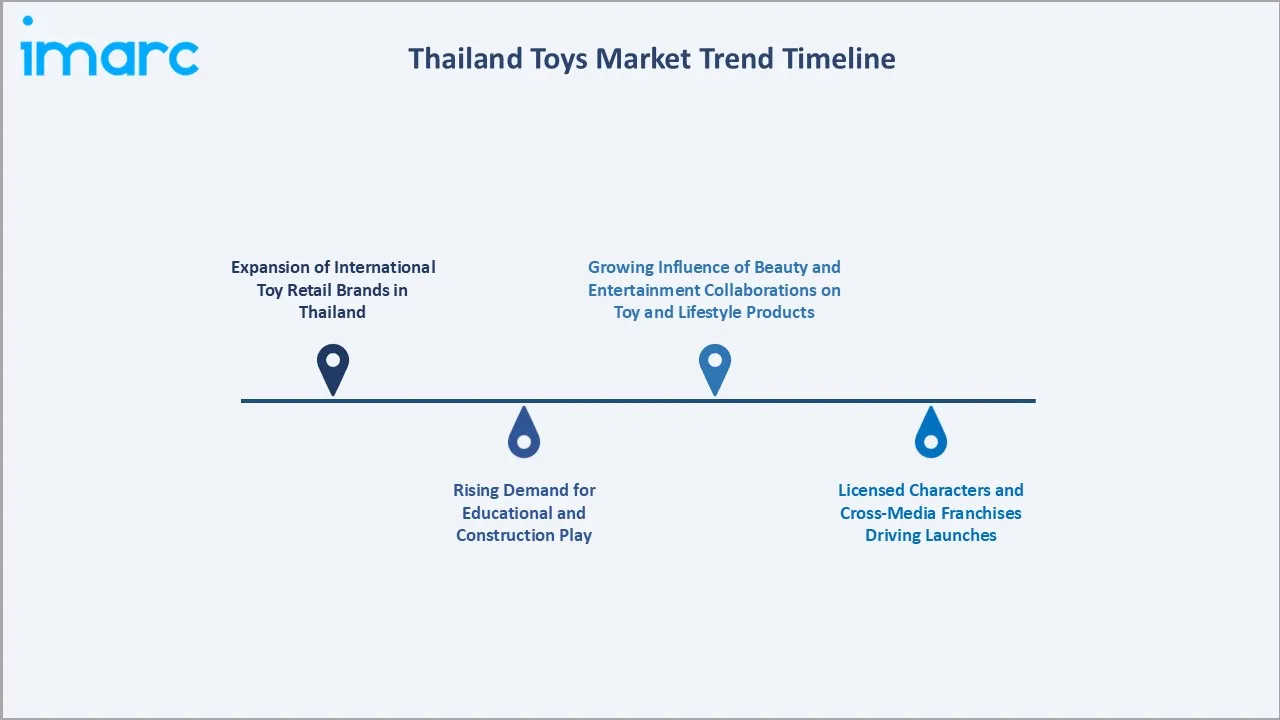
1. Expansion of International Toy Retail Brands in Thailand
In October 2024, TOPTOY opened its first store in Thailand, at The Mall Lifestore Bangkapi, marking a key milestone in its expansion across Southeast Asia's trendy toy market. This trend is expected to strengthen product variety, increase consumer access to trendy and collectible toys, and support the growth of organized toy retailing.
2. Rising Demand for Educational and Construction Play
Parents increasingly favor products that develop creativity, logic and fine motor skills, and building sets are a clear beneficiary. Brands add themed ranges, larger display models and sets that suit both children and adult builders, extending the age span of the category. Retailers group products by learning outcome, and schools and activity centers use construction play in workshops. Interest in screen-free family activities supports the trend. Suppliers that localize instructions, partner with educators, and present clear age guidance can convert curiosity into repeat purchases and higher basket values.
3. Growing Influence of Beauty and Entertainment Collaborations on Toy and Lifestyle Products
In October 2025, Thai beauty brand Cathy Doll launched the Cathy Doll x Maeng Collection through an exclusive event in Bangkok, marking a collaboration with renowned Korean makeup artist Maeng. Such partnerships can strengthen demand for character-based merchandise, collectible toys, and licensed lifestyle products, creating new opportunities for differentiation in Thailand's toys market.
4. Licensed Characters and Cross-Media Franchises Driving Launches
Toy ranges are increasingly planned around films, animation, games and streaming series, with products released to coincide with entertainment debuts. Licensed figures, dolls, building sets and plush benefit from built-in recognition, supporting higher prices and faster sell-through. Local characters and regional pop culture also gain room, as brands seek content that resonates with Thai audiences. Cross-media tie-ins with restaurants, convenience stores and theme venues extend reach. Suppliers with strong licensing portfolios can maintain steady launch calendars, though they must manage the risk of short franchise life cycles.
Industry Value Chain Analysis
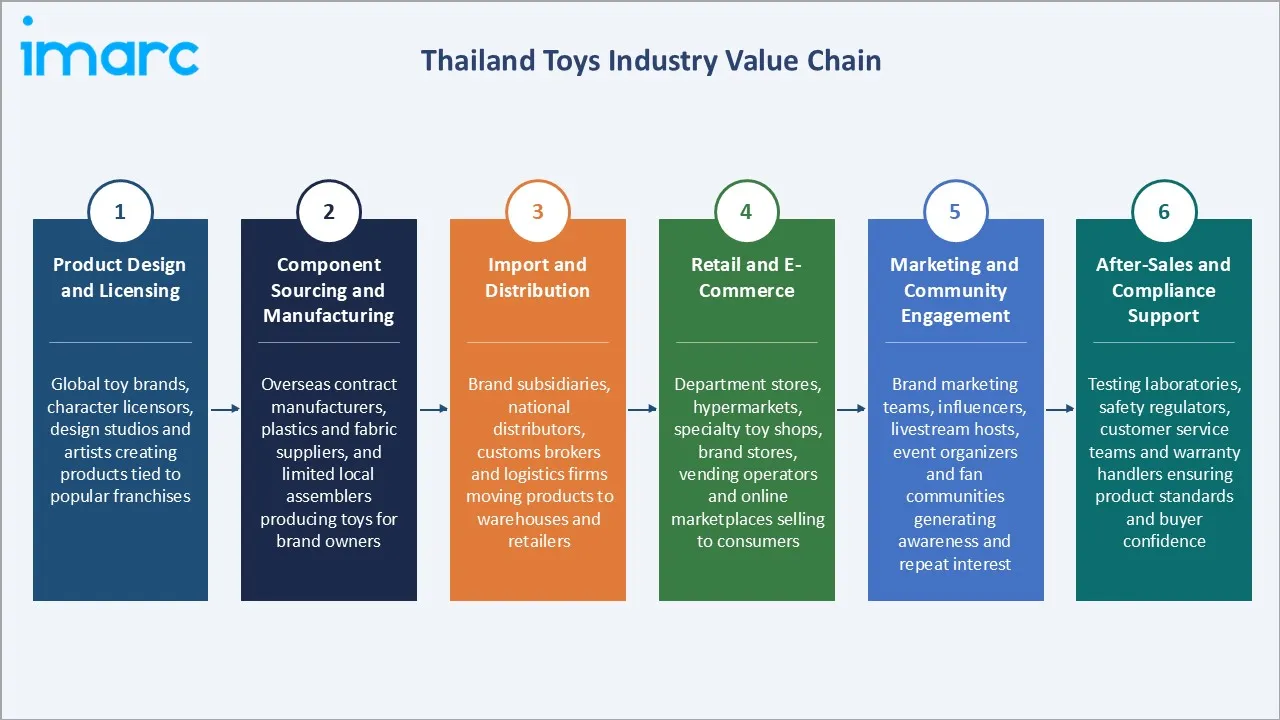
The industry value chain spans product design and licensing, component sourcing and manufacturing, import and distribution, retail and e-commerce, marketing and community engagement, and after-sales and compliance support. Value builds as designs and licensed characters are turned into safe, appealing products that reach buyers through suitable channels at the right moment.
| Stage | Key Participants |
|---|---|
| Product Design and Licensing | Global toy brands, character licensors, design studios and artists creating products tied to popular franchises. |
| Component Sourcing and Manufacturing | Overseas contract manufacturers, plastics and fabric suppliers, and limited local assemblers producing toys for brand owners. |
| Import and Distribution | Brand subsidiaries, national distributors, customs brokers and logistics firms moving products to warehouses and retailers. |
| Retail and E-Commerce | Department stores, hypermarkets, specialty toy shops, brand stores, vending operators and online marketplaces selling to consumers. |
| Marketing and Community Engagement | Brand marketing teams, influencers, livestream hosts, event organizers and fan communities generating awareness and repeat interest. |
| After-Sales and Compliance Support | Testing laboratories, safety regulators, customer service teams and warranty handlers ensuring product standards and buyer confidence. |
Retail and e-commerce is the most commercially critical stage, because shelf access, display quality and online visibility decide which products reach buyers during short seasonal peaks. Brands that control presentation and fulfillment convert demand into sales most efficiently.
Technology Landscape in the Thailand Toys Industry
Injection Molding and Precision Manufacturing
Injection molding underpins building sets, action figures, dolls and many plastic play products, delivering tight tolerances so pieces fit together consistently. Modern tooling, automated molding cells and quality inspection keep defect rates low and support large production runs at stable cost. Most advanced tooling sits with overseas manufacturers serving global brands, while local firms apply molding and assembly to value and niche ranges.
Smart and Connected Toys
Connected toys combine sensors, apps and voice or motion features to add interactive play to physical products. Coding robots, app-linked building kits and talking companions are examples, aiming to extend engagement beyond initial novelty. Adoption in Thailand depends on pricing, language support and parent comfort with data handling. Brands increasingly offer Thai-language interfaces and simple setup to widen appeal.
E-Commerce, Livestream and Retail Analytics Platforms
Online marketplaces, social commerce tools and retail analytics platforms are changing how toys are sold and planned. Livestream features let hosts demonstrate products and release limited stock, while recommendation engines surface items based on browsing and past orders. Retailers use sales data to adjust ranges, set promotions and manage inventory across stores and warehouses. Brand websites integrate loyalty programs and pre-order systems for collectibles.
Augmented Reality and Digital Content Integration
Augmented reality features and companion apps layer digital stories, games and challenges onto physical toys, linking play with the screen content children already enjoy. Building sets that unlock app-based experiences and collectible figures with scannable codes are growing examples. The approach increases engagement time and supports repeat use of existing products. Costs have fallen as smartphone ownership has widened, making basic features feasible at mainstream price points.
Market Segmentation Analysis
The report covers the following segments:
|
Segment Category |
Leading Segment |
Market Share |
Year |
|
Product Type |
Dolls |
20.0% |
2025 |
|
Age Group |
5 to 10 Years |
40.0% |
2025 |
|
Sales Channel |
🔒 |
🔒 |
2025 |
|
Region |
Bangkok |
35.0% |
2025 |

By Product Type
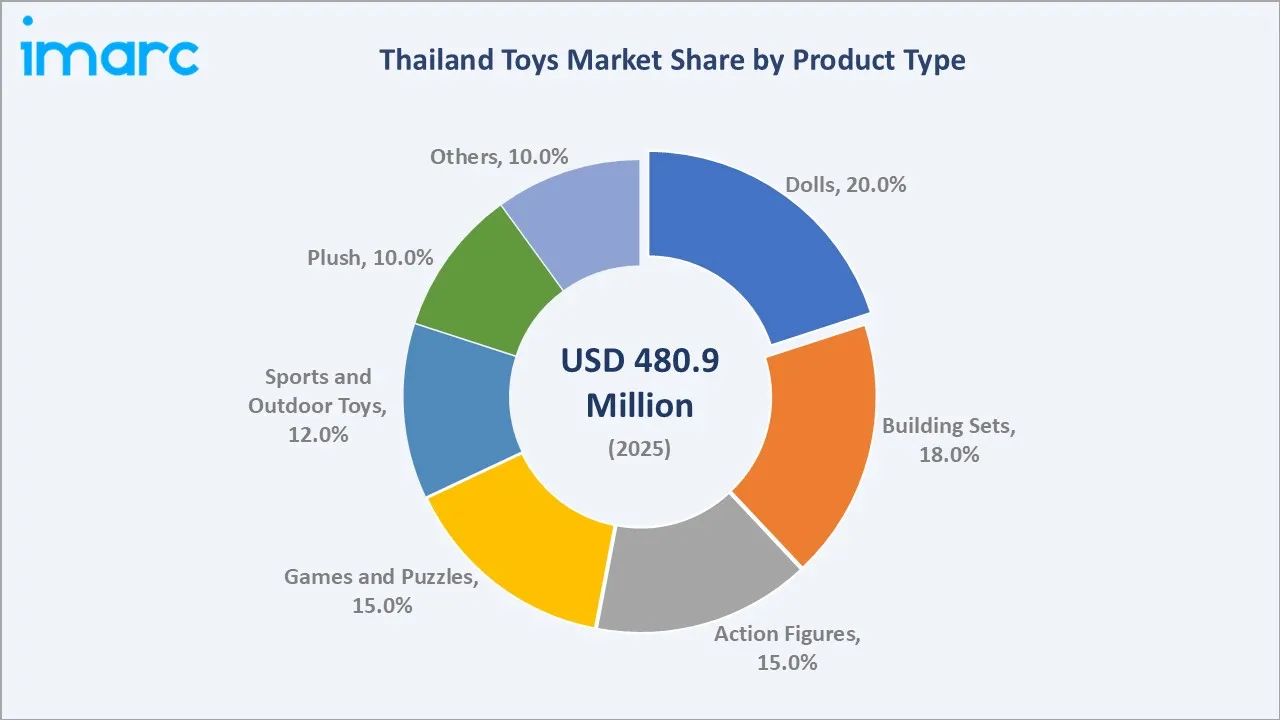
Dolls lead at 20.0% (2025). The category spans fashion dolls, baby dolls and character figures, offering a wide price ladder and strong appeal for gifting. Familiar brands, frequent new characters and accessory add-ons encourage repeat purchases across age groups and income levels.
To access detailed market analysis, Request Sample
Building sets account for 18.0% and are the fastest-growing product type at ~6.2% CAGR. Parents value construction play for its learning benefits, while adult builders and display collectors expand the buyer base. Larger themed sets and licensed ranges raise average transaction values, and repeat series purchases keep demand steady. Action figures at 15.0%, games and puzzles at 15.0%, sports and outdoor toys at 12.0%, plush at 10.0%, and others at 10.0%.
By Age Group
5 to 10 years leads at 40.0% (2025). Children in this range play actively, follow entertainment franchises and ask for specific products, while parents buy for school milestones and celebrations. Brands concentrate launches and promotions here because purchase frequency and range breadth are highest.
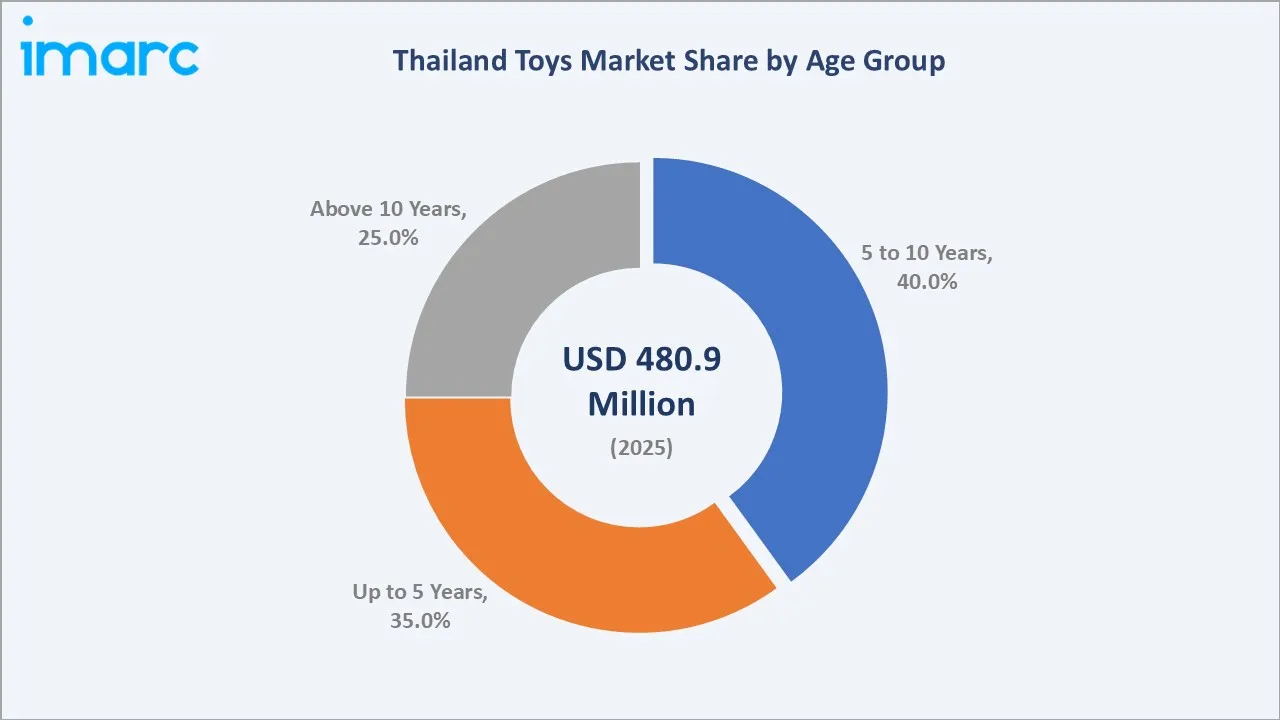
Up to 5 years accounts for 35.0%. Above 10 years is at 25% and is the fastest-growing age group at ~6.4% CAGR. Older children, teenagers and adult hobbyists buy collectibles, advanced building sets, strategy games and figures. Higher personal spending power, community-driven buying and premium pricing explain faster growth than younger age groups.
Regional Market Insights
|
Region |
Share (2025) |
Key Drivers & Characteristics |
|
Bangkok |
35.0% |
Dense department stores, specialty retail and online delivery coverage, plus higher household spending and frequent product launches. |
|
Eastern |
20.0% |
Industrial and tourism-linked economy, rising household incomes and growing mall retail. |
|
Northeastern |
15.0% |
Large population base, expanding provincial malls and growing online marketplace reach. |
|
Northern |
13.0% |
Retail, tourism spending and steady family gifting demand across provincial centers. |
|
Southern |
12.0% |
Tourism-linked retail, with demand tied to family spending and holiday periods. |
|
Others |
5.0% |
Smaller central and western provinces served mainly through online channels and regional retailers. |
Bangkok holds 35.0% of the Thailand toys market, supported by concentrated department stores, brand stores and specialty shops that serve as launch points for new ranges and collectibles. Eastern region accounts for 20.0%, driven by higher incomes tied to industry and tourism and by growing mall retail that broadens access to branded toys in the toys market in Thailand.
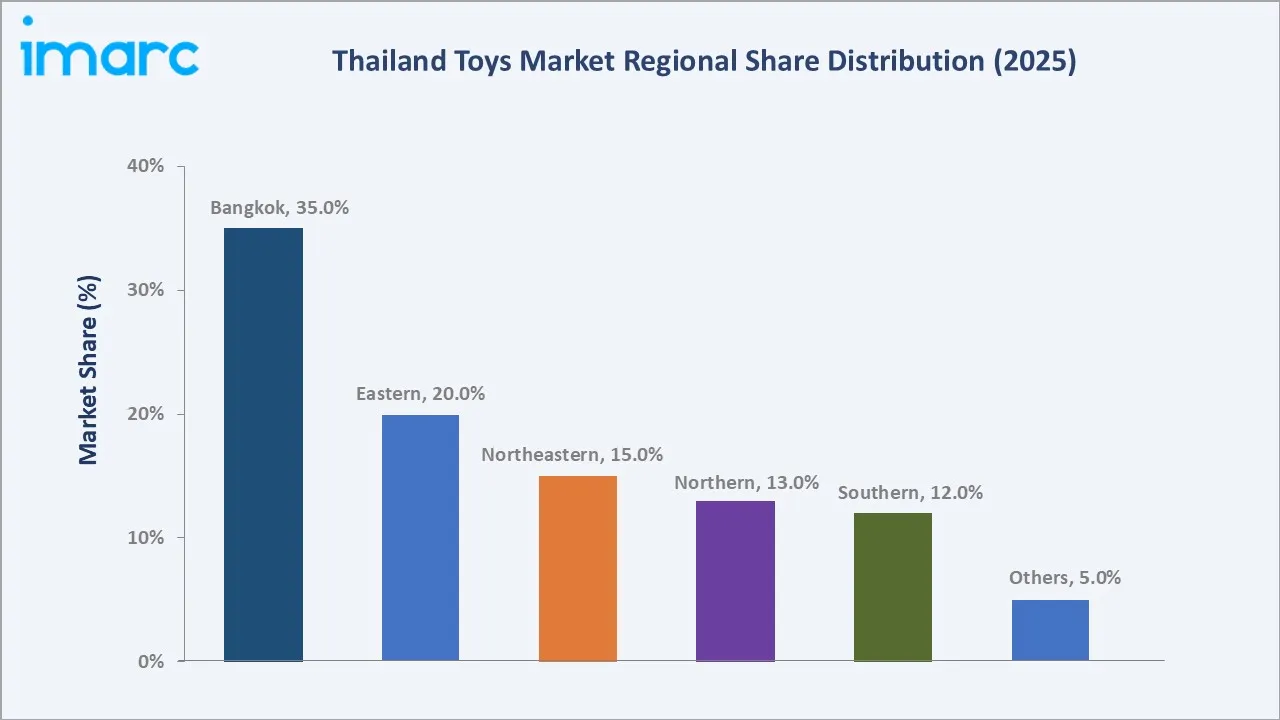
Northeastern region contributes 15.0% through its large population and expanding online reach. Northern region holds 13.0%, shaped by retail and steady gifting demand. Southern region accounts for 12.0%, supported by tourism-linked retail and family spending. Others hold 5.0%, served largely through online marketplaces.
Competitive Landscape
The competitive landscape is fragmented, combining global toy brand owners, collectible specialists, licensed character suppliers and local importers. Brands compete on franchise licenses, product novelty, price ladders and retail partnerships, while distributors compete on shelf access and speed to market. Online marketplaces add price transparency and push brands to defend value through exclusives and community engagement.
| Company | Key Brands | Market Position | Core Strength |
|---|---|---|---|
| The LEGO Group | LEGO | Market Leader | The LEGO Group holds a leading and rapidly expanding position in Thailand's toy and educational play market. |
| Mattel | Barbie, Hot Wheels, Fisher-Price, UNO | Strong Challenger | Mattel’s role in Thailand centers around major manufacturing, global supply chain operations, and high-volume toy production. |
| POP MART | Labubu (THE MONSTERS), Molly, SKULLPANDA, Crybaby | Innovator | POP MART transformed the toy and collectible landscape in Thailand, shifting the market from traditional playthings to designer art toys and blind box culture. |
| Bandai Namco | Pretty Pixels, Dragon Ball, Tamagotchi, Godzilla, Anime Heroes | Established Player | Bandai Namco plays a major dual role in Thailand's toy industry, operating both as a key manufacturing hub and a direct retail/entertainment presence. |
| Takara Tomy | Tomica, Beyblade X, Licca, Pokemon toys | Niche Player | Takara Tomy operates in Thailand through regional corporate entities, manufacturing facilities, and major retail partnerships. |
Established players defend share through licensed lines, store formats and regular new releases across price points, while collectible brands win with scarcity, artist-led design and social media buzz that draw buyers into repeat purchases. Online marketplaces and livestream selling intensify competition by giving smaller brands quick access to buyers, and large players respond by investing in brand stores, exclusives and direct engagement.
Key Company Profiles
The LEGO Group
The LEGO Group is a toy maker whose construction systems are among the most recognized in the world. In Thailand, it sells through department stores, specialty retailers, online platforms and brand-operated outlets, and it holds a leading position in construction play with appeal across children, teenagers and adult builders.
- Key Brands: LEGO
- Strategic Focus: Expanding its brand store and online presence, widening adult-focused ranges, and layering interactive features onto its core bricks. It continues to balance licensed themes with original series to sustain repeat purchases across age groups.
Mattel
Mattel is a toy and family entertainment company with some of the best-known dolls, vehicle and preschool brands. It supplies the Thai market through local distribution and major retailers, and it holds a strong challenger position, particularly in dolls and die-cast vehicles.
- Key Brands: Barbie, Hot Wheels, Fisher-Price, UNO.
- Strategic Focus: Prioritizing franchise management, expansion of its entertainment and licensing activity, and growth in collectible and adult-oriented lines. It also leans on its strong doll and vehicle brands to maintain broad retail distribution, while exploring technology-enabled play.
Market Concentration Analysis
The Thailand toys market is fragmented. No single supplier controls a dominant share, and the leading construction toy brand holds an estimated 8% to 14% of overall market value, while global brand owners, collectible specialists, local importers and numerous small sellers share the remainder. Differences in product type, age group and price tier limit direct competition across the full market.
Two opposing forces are reshaping concentration. Established brand owners are consolidating positions through licensing portfolios, dedicated brand stores and strong distributor relationships that secure premium shelf space. Meanwhile, collectible specialists, online-first labels and social commerce sellers are winning attention with limited releases and community-driven demand, keeping the competitive field open and diverse.
Investment & Growth Opportunities
Highest Growth Segments
Above 10 Years at ~6.4% CAGR, building sets at ~6.2%, action figures at ~6.0%, games and puzzles at ~5.8%, 5 to 10 Years at ~5.4%, sports and outdoor toys at ~5.2% and dolls at ~5.0% are the primary investment vectors through 2034, followed by others at ~4.9%, up to 5 years at ~4.9% and plush at ~4.6%. These segments grow fastest because demand pull is shifting toward higher-value, repeat-purchase products that suit older children and adult buyers.
Emerging Investment Opportunities
The most dynamic emerging opportunity is collectible and designer toys sold through blind boxes, vending formats and livestream events. It scales where young adult buyers, active fan communities and strong social media reach come together, rewarding suppliers with distinctive characters and reliable allocation.
Investment Themes
- Licensed and collectible portfolios: Securing franchise rights and artist partnerships supports premium pricing, repeat purchases and resilience against commodity competition in the toys market.
- Omnichannel and livestream retail: Combining brand stores, marketplaces and live selling widens reach, speeds discovery and lowers the cost of serving dispersed buyers.
- Educational and construction play: Learning-oriented ranges with local content and school partnerships build lasting demand and support higher average transaction values.
Future Market Outlook (2026-2034)
The Thailand toys market is projected to grow from USD 480.9 Million in 2025 to USD 507.2 Million in 2026, reaching USD 787.4 Million by 2034, registering a CAGR of 5.46% during 2026-2034. The market's anchor value of USD 627.4 Million in 2030 reflects steady gifting demand and the rise of collectibles, with Bangkok and Eastern sustaining leadership as retail depth and household spending expand. Three structural forces define market growth through 2034: expanding collector and adult buyer participation; deeper omnichannel and livestream retail reach; and rising parental preference for educational and construction-based play.
Research Methodology
Primary Research
Primary research included discussions with toy brand representatives, distributors, department store and specialty retail buyers, e-commerce sellers and collectors in Thailand, covering assortment trends, pricing behavior, channel dynamics, and consumer purchasing patterns across product types and age groups.
Secondary Research
Secondary research drew on company annual reports and investor presentations, trade association publications, customs and trade statistics, government and regulatory databases, industry journals, and reputable news sources to establish historical market size, segment structure and competitive positioning.
Forecasting Models
Market size was built using a combination of top-down and bottom-up approaches, reconciling supply-side data on production, imports and distributor sales with demand-side indicators such as household spending, retail sales and channel penetration. Forecasts were developed through scenario-based modeling and validated against expert input.
Thailand Toys Market Report Coverage:
| Report Features | Details |
|---|---|
| Base Year of the Analysis | 2025 |
| Historical Period | 2020-2025 |
| Forecast Period | 2026-2034 |
| Units | Million USD |
| Scope of the Report |
Exploration of Historical Trends and Market Outlook, Industry Catalysts and Challenges, Segment-Wise Historical and Future Market Assessment:
|
| Product Types Covered | Action Figures, Building Sets, Dolls, Games and Puzzles, Sports and Outdoor Toys, Plush, Others |
| Age Groups Covered | Up to 5 Years, 5 to 10 Years, Above 10 Years |
| Sales Channels Covered | Supermarkets and Hypermarkets, Specialty Stores, Department Stores, Online Stores, Others |
| Regions Covered | Bangkok, Eastern, Northeastern, Southern, Northern, Others |
| Companies Covered | The LEGO Group, Mattel, POP MART, Bandai Namco, Takara Tomy, etc. |
| Customization Scope | 10% Free Customization |
| Post-Sale Analyst Support | 10-12 Weeks |
| Delivery Format | PDF and Excel through Email (We can also provide the editable version of the report in PPT/Word format on special request) |
Key Benefits for Stakeholders:
- IMARC’s industry report offers a comprehensive quantitative analysis of various market segments, historical and current market trends, market forecasts, and dynamics of the Thailand toys market from 2020-2034.
- The research report provides the latest information on the market drivers, challenges, and opportunities in the Thailand toys market.
- Porter's five forces analysis assist stakeholders in assessing the impact of new entrants, competitive rivalry, supplier power, buyer power, and the threat of substitution. It helps stakeholders to analyze the level of competition within the Thailand toys industry and its attractiveness.
- Competitive landscape allows stakeholders to understand their competitive environment and provides an insight into the current positions of key players in the market.
Frequently Asked Questions About the Thailand Toys Market Report
The Thailand toys market reached USD 507.2 Million in 2026, supported by household spending on play and learning products, licensed character merchandise, collector demand and expanding online toy retailing.
The market is expected to register a CAGR of 5.46% during 2026-2034, rising from USD 507.2 Million in 2026 to reach USD 787.4 Million by 2034 on collector demand and retail modernization.
Dolls lead the product type segment with a 20.0% share in 2025, reflecting wide price coverage, strong gifting appeal and continuous character and accessory refreshes that drive repeat purchases across income groups.
The 5 to 10 years segment leads with a 40.0% share in 2025, the period when children move into structured play such as building sets and games and when parents and relatives buy most frequently.
Bangkok leads with a 35.0% regional share in 2025, supported by the deepest mall and hobby retail network, the highest household incomes and strong tourist-linked gifting demand in the country.
Leading companies include The LEGO Group, Mattel, POP MART, Bandai Namco, and Takara Tomy, among others.
The market is projected to reach USD 627.4 Million by 2030, driven by spending on licensed and collector products, growth in games and puzzles, and wider distribution through marketplace and live commerce channels.
Above 10 Years at ~6.4% CAGR, building sets at ~6.2%, and games and puzzles at ~5.8% are the fastest-growing segments, alongside sustainable wooden toys and live commerce distribution.
Need more help?
- Speak to our experienced analysts for insights on the current market scenarios.
- Include additional segments and countries to customize the report as per your requirement.
- Gain an unparalleled competitive advantage in your domain by understanding how to utilize the report and positively impacting your operations and revenue.
- For further assistance, please connect with our analysts.
 Request Customization
 Speak to an Analyst
 Request Brochure
 Inquire Before Buying
Benefits of Customization
- Personalize this research
- Triangulate with your data
- Get data as per your format and definition
- Gain a deeper dive into a specific application, geography, customer, or competitor
- Any level of personalization
Get in Touch With Us
UNITED STATES
Phone: +1-201-971-6302
INDIA
Phone: +91-120-433-0800
UNITED KINGDOM
Phone: +44-753-714-6104
Email: [email protected]
Client Testimonials






















Related Reports

Choose your plan
*Please note that the prices mentioned below are starting prices for each bundle type. Kindly contact our team for further details.*
Single User License
- 1 User License, Access on 2 Devices
- PDF Report + Excel Dataset (Password Protected)
- Lifetime Access
- No Printing Rights
- 10% Free Report Customization
- 10–12 Weeks of Analyst Support
Five User License
- Access for 5 Users, 2 Devices per User
- PDF Report + Excel Dataset (Password Protected)
- Lifetime Access
- Dedicated Account Manager
- 12–14 Weeks of Analyst Support
- No Printing Rights
- 15% Free Report Customization
- 25% Discount on Your Next Purchase
Corporate User License
- Unlimited User Access (Within Your Organization)
- PDF Report + Excel Dataset
- Lifetime Access
- Dedicated Account Manager
- 14–20 Weeks of Analyst Support
- No Printing Rights
- 20% Free Report Customization
- 30% Discount on Your Next Purchase
Essential Insights
What's included:
3 reports
- Lifetime Access
- PDF Reports
- Excel Datasets
- 2 Weeks of Free Analyst Support
- 2 User Licenses
- Access on 2 Devices
- Printing Rights
- Complimentary PowerPoint (PPT) Version
- Complimentary License Upgrade
Professional Access
What's included:
5 reports
- Lifetime Access
- PDF Reports
- Excel Datasets
- 8 Weeks of Free Analyst Support
- 2 User Licenses
- Access on 2 Devices
- Printing Rights
- Complimentary PowerPoint (PPT) Version
- Complimentary License Upgrade
Business Advantage
What's included:
8 reports
- Lifetime Access
- PDF Reports
- Excel Datasets
- 14 Weeks of Free Analyst Support
- 2 User Licenses
- Access on 2 Devices
- Printing Rights
- Complimentary PowerPoint (PPT) Version
- Complimentary License Upgrade
Enterprise Intelligence
What's included:
10 reports
- Lifetime Access
- PDF Reports
- Excel Datasets
- 20 Weeks of Free Analyst Support
- 2 User Licenses
- Access on 2 Devices
- Printing Rights
- Complimentary PowerPoint (PPT) Version
- Complimentary License Upgrade