
Tree Trimmer Market Size, Share, Trends and Forecast by Equipment, Power, Application, and Region, 2026-2034
Tree Trimmer Market Size, Share, Trends & Forecast (2026-2034)
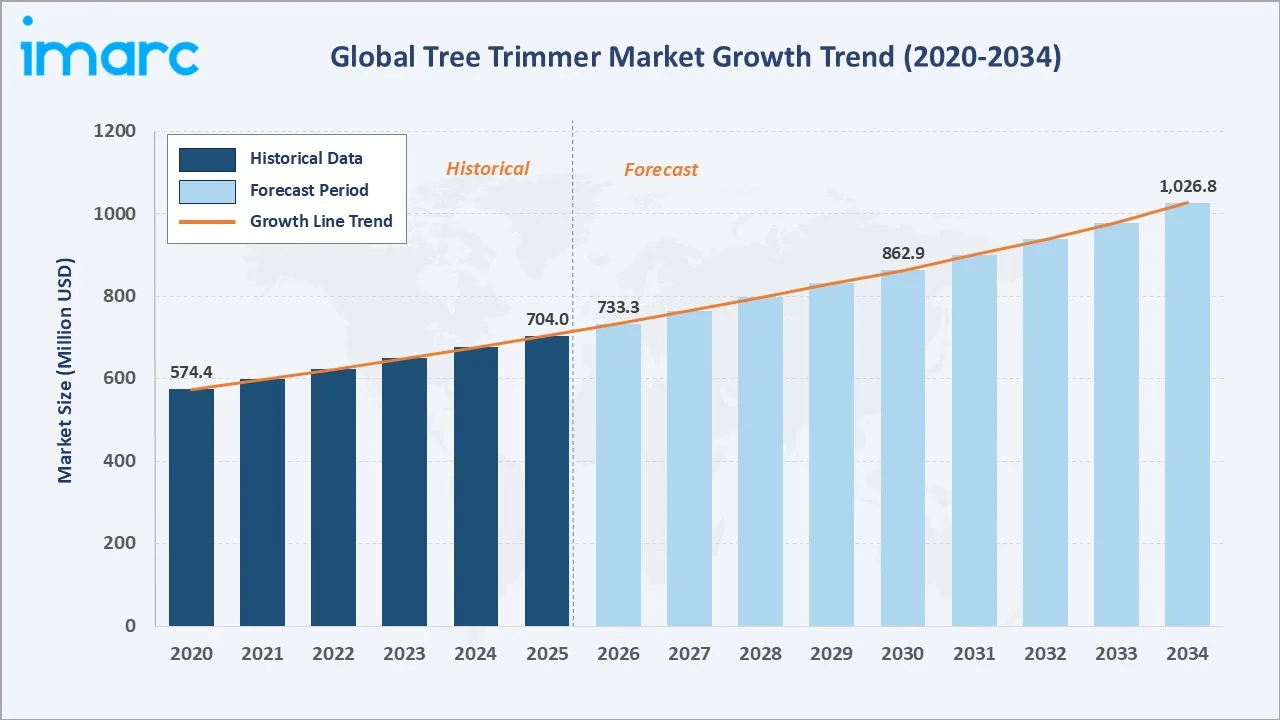
The tree trimmer market grew from USD 704.0 Million in 2025 to USD 733.3 Million in 2026 and is projected to reach USD 1,026.8 Million by 2034, growing at a CAGR of 4.15% during 2026-2034. The United States has approximately 19,929 businesses operating in the tree trimming services industry. The large presence of professional tree-care service providers is driving demand for tree trimmers and related equipment, as companies require efficient tools for routine pruning, vegetation management, storm cleanup, and maintenance of residential and commercial landscapes. Chain saw leads equipment type at 49.3%, residential commands the largest application share at 57.6%, and North America holds the leading regional position at 35.7%.
Market Snapshot
|
Metric |
Value |
|
Base Year Market Size (2025) |
USD 704.0 Million |
|
Market Size (2026) |
USD 733.3 Million |
|
Forecast Market Size (2034) |
USD 1,026.8 Million |
|
CAGR (2026-2034) |
4.15% |
|
Base Year |
2025 |
|
Historical Period |
2020-2025 |
|
Forecast Period |
2026-2034 |
|
Dominant Equipment |
Chain Saw (49.3%, 2025) |
|
Dominant Application |
Residential (57.6%, 2025) |
|
Leading Region |
North America (35.7%, 2025) |
The tree trimmer market grew from USD 574.4 Million in 2020 to USD 704.0 Million by 2025 and is estimated to reach USD 733.3 Million in 2026. The market is projected to reach USD 862.9 Million by 2030 and USD 1,026.8 Million by 2034.
To get more information on this market, Request Sample
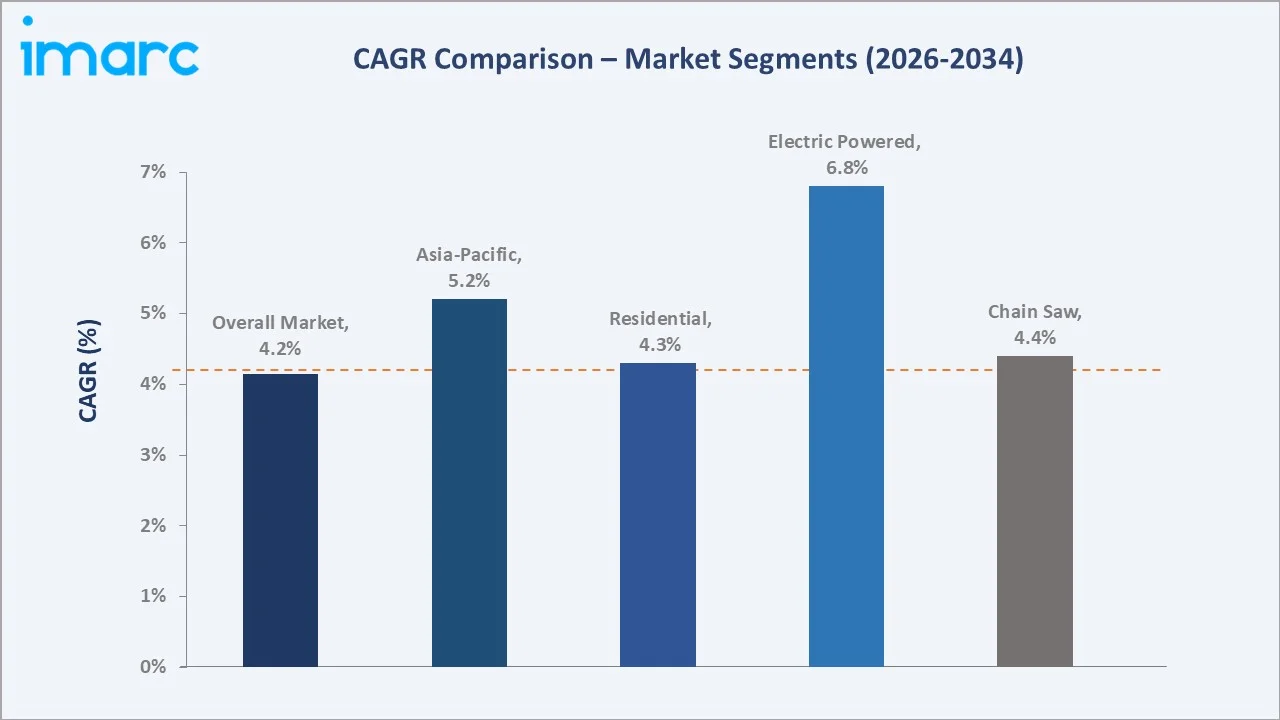
Chain saw equipment grows at ~4.4% CAGR through expanding residential and commercial tree care activity. Electric-powered equipment grows fastest at ~6.8% CAGR through battery technology advancement and noise/emissions regulation compliance. Asia-Pacific grows at ~5.2% CAGR through urbanization and expanding horticultural services markets.
Executive Summary
The tree trimmer market is experiencing steady growth driven by rising residential landscaping spending, expanding professional tree care services, and the accelerating transition to battery-electric outdoor power equipment. The market is supported by urbanization-driven tree maintenance demand, increasing storm damage remediation requirements, and utility vegetation management spending.
Chain saw equipment dominates at 49.3% through its versatility across residential pruning and commercial tree removal applications. Residential application leads at 57.6% through DIY landscaping growth and homeowner tree maintenance spending. North America commands 35.7% market share anchored by the United States' large-scale tree care services industry and high per-capita OPE spending.
Key Market Insights
|
Insight |
Data |
|
Dominant Equipment |
Chain Saw - 49.3% share (2025) |
|
Dominant Application |
Residential - 57.6% share (2025) |
|
Leading Region |
North America - 35.7% (2025) |
|
Key Market Opportunity |
Expanding battery-electric OPE adoption, replacing gas-powered equipment, represents an incremental revenue opportunity by 2030 for manufacturers investing in high-voltage brushless motor platforms. |
Key Analytical Observations Supporting the Above Data:
- Chain Saw at 49.3%: Chainsaws are the most versatile and widely deployed tree trimming tool, serving applications from residential limb removal and storm cleanup to professional tree felling and commercial logging operations. The broad application spectrum generates the highest sales volume and revenue share among tree trimmer equipment categories across all global markets.
- Residential at 57.6%: Residential demand is anchored by the single-family and multi-family dwelling stock requiring regular tree and shrub maintenance. Rising homeownership rates, suburban expansion, and elevated home improvement spending sustained by COVID-era remote work adoption are driving DIY tree trimming equipment purchases at major home improvement retailers and outdoor power equipment dealers.
- North America at 35.7%: North America leads due to the widespread presence of professional landscaping and arboriculture services, extensive residential green spaces, and regular tree maintenance activities. High adoption of advanced battery-powered and professional-grade trimming equipment, coupled with strong spending on vegetation management and urban forestry, further supports regional market growth.
Tree Trimmer Market Overview
The tree trimmer market encompasses professional and consumer-grade equipment used for cutting, pruning, chipping, and grinding trees across residential properties, commercial landscapes, utility rights-of-way, parks, and forests. The market includes chainsaws, woodchippers, stump grinders, pole saws, pruning saws, and battery-powered hedge trimmers across both gas-powered and electric power platforms.
The market serves professional arborists, commercial landscaping contractors, utility line clearance crews, municipal parks departments, and residential homeowners across North America, Europe, Asia-Pacific, Latin America, and the Middle East and Africa. Key market dynamics include the rapid electrification of outdoor power equipment driven by improving battery technology, tightening urban emissions and noise regulations, and consumer demand for quieter and lower-maintenance equipment alternatives to traditional gas-powered tools.
Market Dynamics
To evaluate market opportunities, Request Sample
Market Drivers
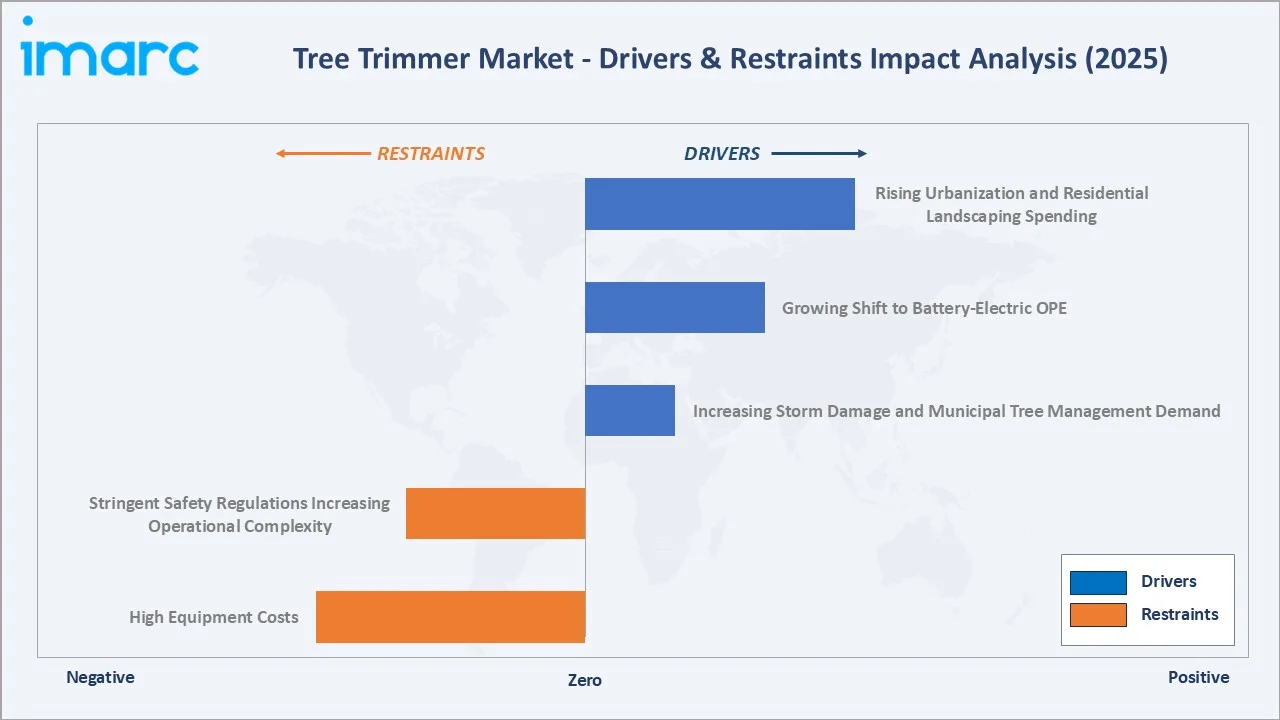
- Rising Urbanization and Residential Landscaping Spending: By 2030, the number of megacities worldwide with populations exceeding 10 million is projected to reach 43, with most located in developing regions. Approximately 68% of the global population is projected to reside in urban areas by 2050. Rising home values incentivizing property appearance investment, suburban expansion creating new tree-maintenance requirements for newly planted trees, and increased storm frequency requiring emergency tree removal are collectively sustaining residential equipment demand at above-historical-average levels through the forecast period.
- Growing Shift to Battery-Electric OPE: Battery-electric outdoor power equipment is disrupting the traditional gas-powered market, with major brands reporting battery-electric chainsaw revenue growth. Brushless motor technology, high-density lithium-ion batteries delivering 60V-82V platforms, and rapid charging infrastructure are enabling battery-electric chainsaws to match gas-powered performance for residential and light commercial applications, accelerating platform migration.
- Increasing Storm Damage and Municipal Tree Management Demand: Climate change increases the frequency and intensity of storm events, hurricanes, ice storms, and high-wind events that generate acute demand for emergency tree removal equipment and debris chipping. Disaster relief funding for storm-related debris removal sustained equipment rental and procurement demand following major weather events, with Hurricane-related tree cleanup generating significant periodic equipment demand spikes.
Market Restraints
- High Equipment Costs: Professional-grade woodchippers, stump grinders, and commercial chainsaws represent significant capital investments for small independent tree care contractors and owner-operator arborists. Equipment financing availability, interest rate sensitivity, and seasonal revenue fluctuations in the tree care industry create adoption barriers for smaller market participants despite clear productivity benefits from professional-grade equipment.
- Stringent Safety Regulations Increasing Operational Complexity: Stringent safety regulations are increasing operational complexity by requiring manufacturers and professional users to comply with strict equipment, worker protection, and operating standards. Compliance often involves additional safety features, employee training, inspections, and protective equipment, raising overall costs. These requirements can particularly burden smaller service providers and potentially slow the adoption of new tree-trimming equipment.
Market Opportunities
- Robotic and Autonomous Tree Trimming Technology: Emerging robotic tree pruning platforms, including drone-based limb assessment and automated pole-mounted cutting systems, represent the next frontier of tree trimmer technology innovation. Companies, including startups and university research programs, are developing autonomous tree-care systems targeting utility corridor maintenance and commercial orchard pruning, creating a new high-value equipment category projected to generate significant market value by 2030.
- Rental Market Expansion and Equipment-as-a-Service Models: The equipment rental industry is expanding tree trimmer availability at major national rental chains, providing professional-grade access to residential customers and small contractors without capital purchase requirements. Equipment-as-a-service subscription models from major OEM manufacturers are emerging, creating recurring revenue streams and expanding the addressable market to budget-constrained segments.
Market Challenges
- Supply Chain Disruption and Component Availability: Global supply chain disruptions, particularly in steel, small engine components, and lithium-ion battery cells, have created lead time extensions for professional-grade equipment, affecting contractor equipment procurement planning and potentially delaying market growth during high-demand periods. Battery cell supply constraints from competition with electric vehicle manufacturers for lithium-ion supply may create pricing pressure for battery-electric OPE manufacturers.
- Seasonal Demand Variability Affecting Revenue Stability: Tree trimmer equipment demand follows strong seasonal patterns in temperate markets, peaking in spring and fall, creating revenue concentration challenges for manufacturers and dealers managing inventory, production planning, and working capital requirements. Year-round demand from professional contractors partially offsets seasonal residential peaks but does not fully smooth the cyclicality inherent in markets dominated by outdoor seasonal usage patterns.
Emerging Market Trends
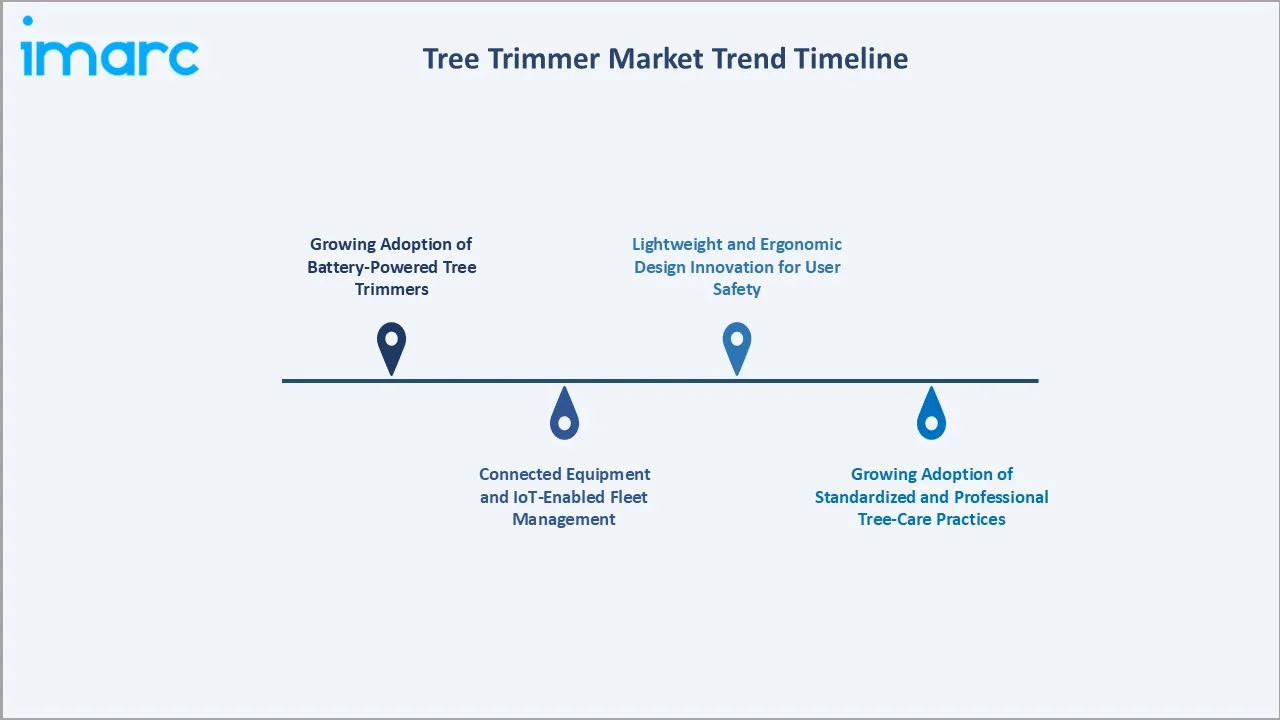
1. Growing Adoption of Battery-Powered Tree Trimmers
In June 2026, TGSPDCL deployed advanced battery-powered professional tree pruners to improve the safety, speed, and environmental sustainability of tree-trimming operations around power lines. The deployment of battery-powered professional tree pruners by TGSPDCL highlights the shift toward cordless, low-emission trimming equipment. These solutions offer improved mobility, reduced noise and emissions, and enhanced operational efficiency, particularly for utility vegetation management.
2. Connected Equipment and IoT-Enabled Fleet Management
Major OEM manufacturers are integrating connectivity features into professional-grade tree trimming equipment, enabling real-time equipment tracking, maintenance scheduling, theft prevention, and operational data collection for fleet managers. A connected equipment ecosystem and tool tracking capabilities are creating digital workflow integration between field crews and office operations for commercial tree care companies, generating new service revenue streams and improving equipment utilization rates.
3. Lightweight and Ergonomic Design Innovation for User Safety
Weight reduction and ergonomic design are becoming primary competitive differentiators as the workforce demographics shift in the professional tree care industry. Battery-electric chainsaws weighing less than gas equivalents are being adopted for overhead and climbing work where fatigue-related injury risk is highest. Anti-vibration system improvements, top-handle chainsaw designs optimized for arborist climbing work, and adjustable-angle pole saws reducing shoulder strain are commanding premium pricing from safety-conscious commercial contractors and creating new residential accessible-use design categories.
4. Growing Adoption of Standardized and Professional Tree-Care Practices
In June 2026, Singapore introduced its first national tree management standard, SS 724, establishing standardized guidelines and best practices for tree pruning and maintenance across roads, parks, and public and private properties. National Parks Board (NParks) will require compliance with the standard for new tree-care contracts from the second half of 2026, supporting safer practices and improved long-term urban tree health. This highlights increasing emphasis on regulated pruning and professional tree maintenance. This is encouraging demand for advanced, safety-compliant tree-trimming equipment that supports efficient and standardized operations.
Industry Value Chain Analysis
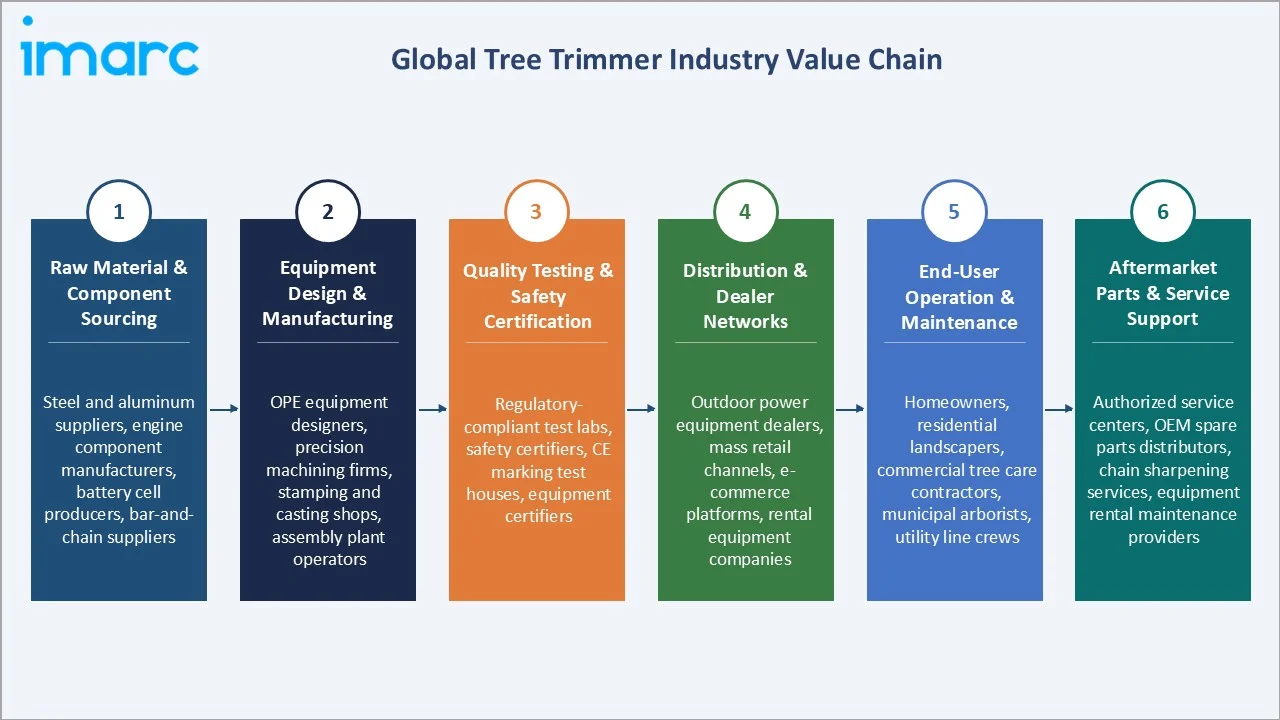
The tree trimmer market value chain spans raw material and component sourcing, equipment manufacturing and assembly, quality and safety certification, distribution and dealer networks, end-user deployment, and aftermarket service and parts support.
|
Stage |
Key Players |
|
Raw Material & Component Sourcing |
Steel and aluminum suppliers, engine component manufacturers, battery cell producers, bar-and-chain suppliers. |
|
Equipment Design & Manufacturing |
OPE equipment designers, precision machining firms, stamping and casting shops, assembly plant operators. |
|
Quality Testing & Safety Certification |
Regulatory-compliant test labs, safety certifiers, CE marking test houses, equipment certifiers. |
|
Distribution & Dealer Networks |
Outdoor power equipment dealers, mass retail channels, e-commerce platforms, rental equipment companies. |
|
End-User Operation & Maintenance |
Homeowners, residential landscapers, commercial tree care contractors, municipal arborists, utility line crews. |
|
Aftermarket Parts & Service Support |
Authorized service centers, OEM spare parts distributors, chain sharpening services, equipment rental maintenance providers. |
Distribution and dealer networks represent a critical competitive advantage stage in the tree trimmer value chain, where established OPE dealers with trained technicians, demonstration capability, and local service relationships provide significant value beyond pure product transaction.
Technology Landscape in the Tree Trimmer Industry
High-Voltage Brushless Motor Technology
The transition from brushed to brushless electric motors, combined with high-voltage lithium-ion battery platforms, is enabling battery-electric chainsaws to match or exceed the performance of gas-powered equivalents for residential and light commercial applications. Brushless motors deliver higher energy efficiency versus brushed motors, significantly extending runtime per battery charge and reducing heat generation that previously limited battery chainsaw cutting endurance. Variable-speed electronic controllers on premium battery chainsaws enable adaptive power delivery that optimizes chain speed for cutting conditions, improving both cutting performance and battery runtime simultaneously.
Integrated Chain Sharpening Systems
Integrated chain sharpening systems are reducing downtime and skill requirements for residential chainsaw maintenance. Diamond-coated carbide chains offering 3-5x longer service life versus conventional chains, low-kickback safety chain designs, and self-lubricating bar technology are reducing maintenance frequency and improving chainsaw safety across both residential and professional applications, supporting broader adoption among less technically experienced residential users.
Safety and Operator Protection Technology
Chain brake systems preventing kickback injuries, vibration damping systems reducing vibration-induced white finger disease risk, and PPE integration standards are advancing tree trimmer safety significantly. Operator presence controls and automatic chain-stop systems triggered by abnormal acceleration are being integrated into both gas and battery-electric platforms. Wearable chainsaw protective technology is increasingly mandated by regulatory-compliant commercial operators, expanding the total protective equipment market adjacent to the core trimmer equipment market.
Market Segmentation Analysis
The report covers the following segments:
|
Segment Category |
Leading Segment |
Market Share |
Year |
|
Equipment |
Chain Saw |
49.3% |
2025 |
|
Power |
🔒 |
🔒 |
2025 |
|
Application |
Residential |
57.6% |
2025 |
|
Region |
North America |
35.7% |
2025 |

By Equipment
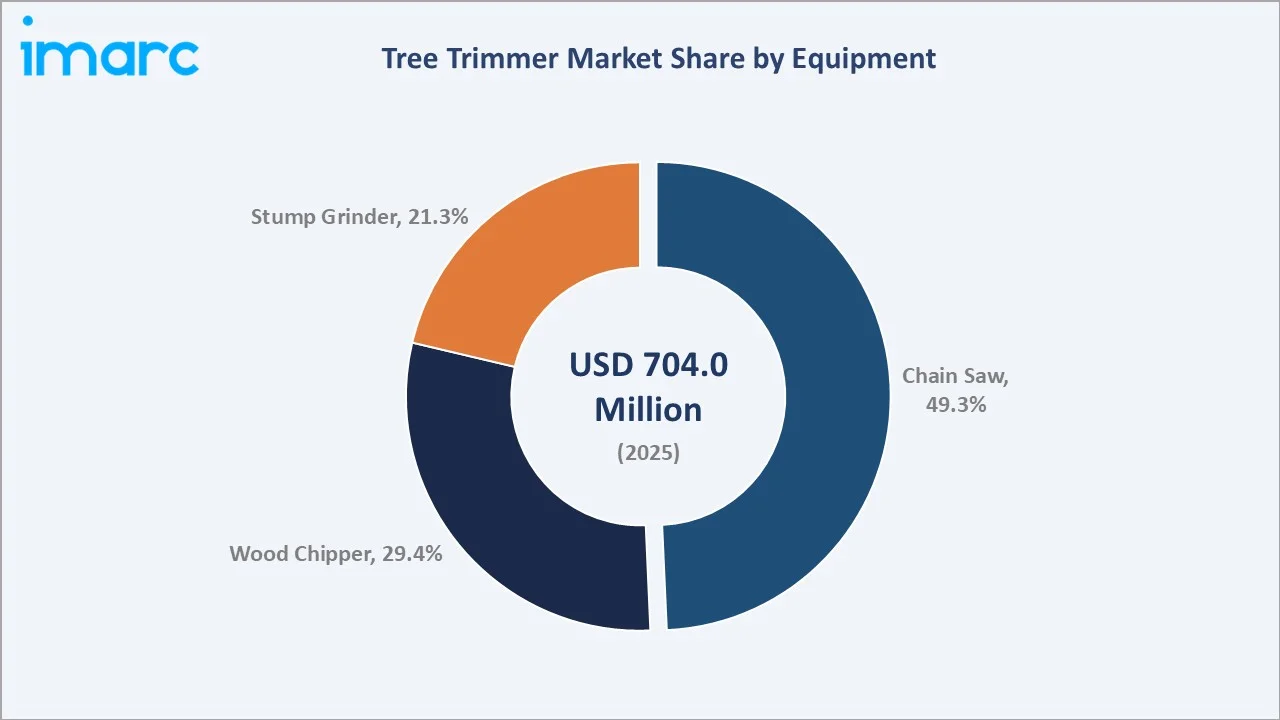
Chain saw commands 49.3%, serving the broadest application spectrum from residential pruning and storm cleanup to commercial tree removal and utility right-of-way maintenance. The chainsaw market spans a wide price range, with each segment serving distinct user requirements.
To access detailed market analysis, Request Sample
Wood chipper at 29.4% serves commercial tree care contractors, municipal public works departments, and utility vegetation management crews requiring on-site processing of branches and small-diameter wood waste. Stump grinders at 21.3% address the completion stage of tree removal operations, with walk-behind models serving residential and small commercial applications and track-mounted grinders tackling large commercial stump removal projects.
By Application
Residential dominates at 57.6% in 2025, reflecting the large consumer base of homeowners managing tree maintenance across single-family and multi-family residential properties in North America and Europe. DIY chainsaw purchases from major home improvement retailers, combined with professional residential tree service procurement, generate the largest demand pool. Post-COVID elevated home improvement spending has sustained residential tree trimmer demand above pre-pandemic trend levels.
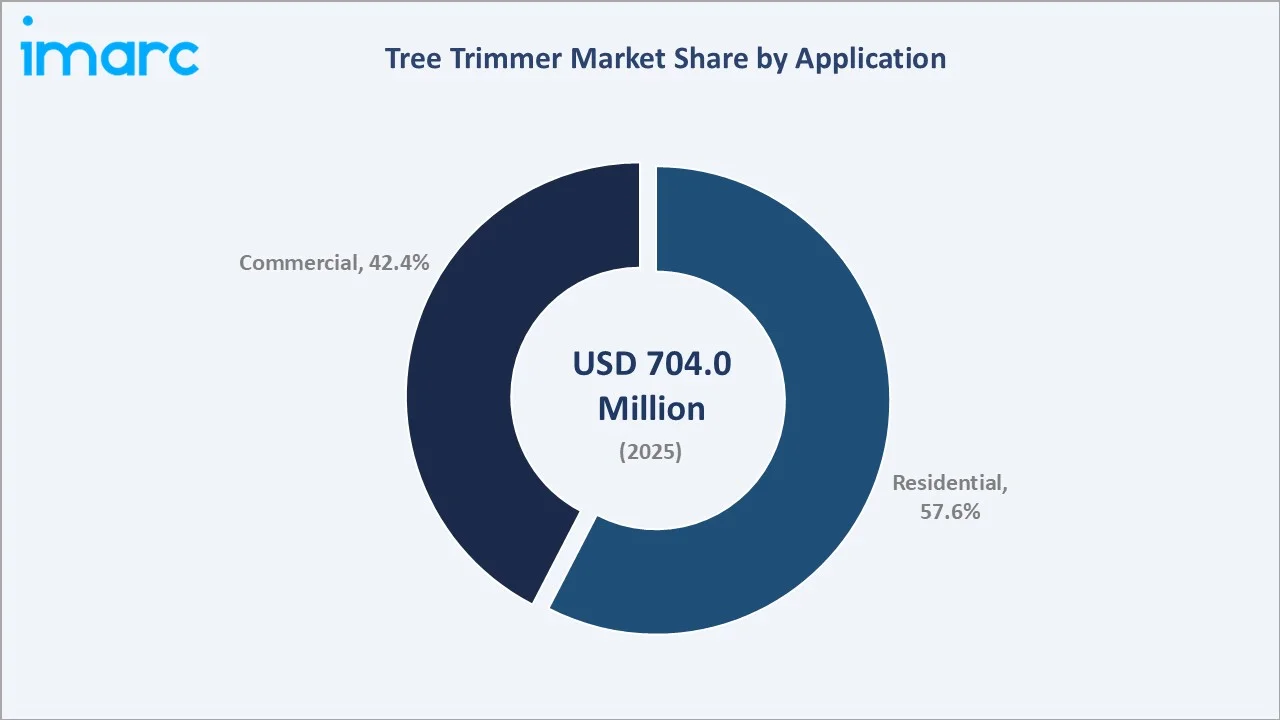
Commercial at 42.4% encompasses professional tree care companies, municipal arborists, utility line clearance crews, golf course maintenance operations, and commercial landscape contractors requiring professional-grade equipment with higher duty cycles, longer service intervals, and greater cutting capacities than residential equipment.
Regional Market Insights
|
Region |
Share (2025) |
Key Tree Trimmer Market Drivers & Characteristics |
|
North America |
35.7% |
Reflecting the United States' large residential landscaping, high tree-care service industry penetration, and utility vegetation management requirements. |
|
Europe |
26.1% |
Reflecting strong garden equipment culture, strict noise and emissions regulations driving battery-electric adoption, organized tree-care certification programs, and high per-capita outdoor power equipment spending. |
|
Asia-Pacific |
24.2% |
Reflecting advanced precision garden tools, growing residential landscaping sector, expanding export manufacturing base for OPE equipment, and emerging tree-care services market across urban horticultural development. |
|
Latin America |
8.1% |
Reflecting extensive tropical tree management requirements, growing urban landscaping services sector, and the region's increasing adoption of professional tree-care equipment for commercial and municipal arboriculture applications. |
|
Middle East & Africa |
5.9% |
Reflecting significant urban landscaping and palm tree maintenance demand, an established commercial arboriculture sector, and growing government investment in urban forestry and green space maintenance programs. |
North America's 35.7% market share reflects the United States' position as the largest outdoor power equipment market, with the premium residential landscaping industry. Canada's extensive forested residential communities and significant storm-related tree maintenance requirements add to the regional demand base. Europe's 26.1% is driven by the large garden tools market, extensive private forest management sector, and the well-developed professional arboriculture industry with certified arborist standards mandating professional-grade equipment.
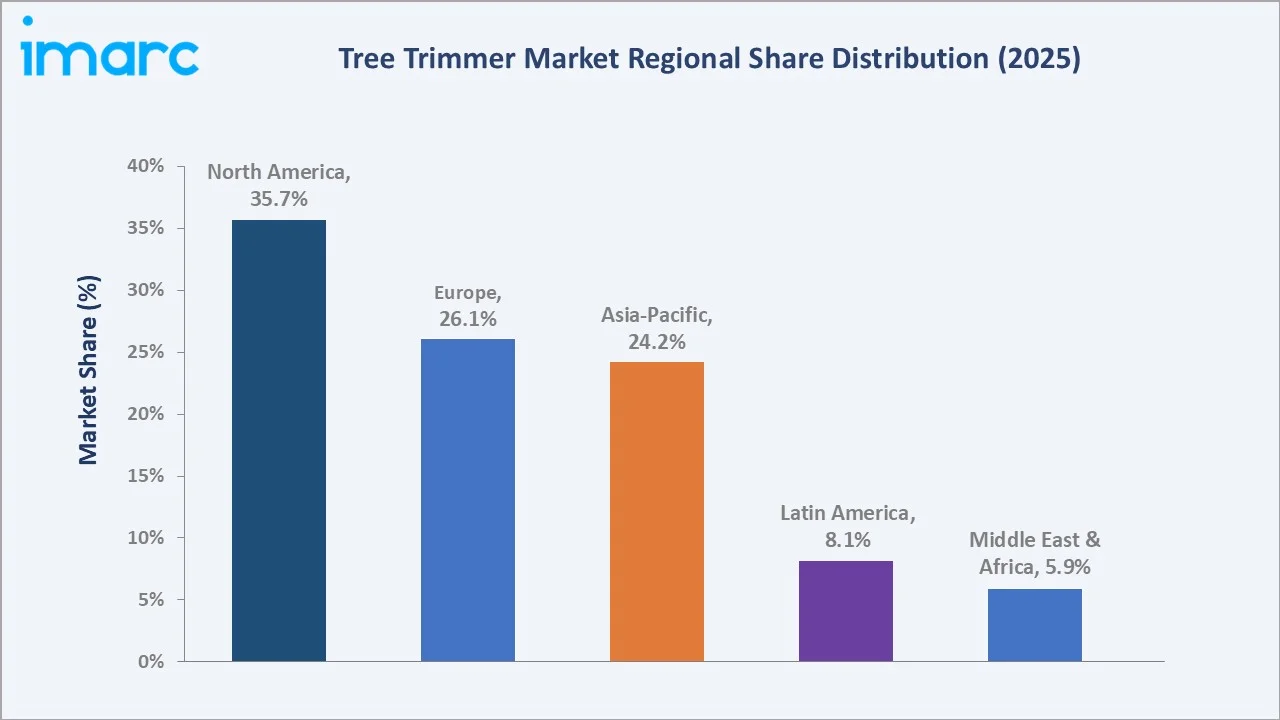
Asia-Pacific at 24.2% is growing fastest at ~5.2% CAGR through Japan's premium lightweight electric OPE adoption, Australia's expanding suburban residential landscape services market, and China's growing domestic OPE manufacturing and consumption base. Latin America at 8.1% reflects growing urban tree management programs. The Middle East and Africa at 5.9% is driven by GCC countries' significant date palm and ornamental tree maintenance demand and South Africa's established commercial arboriculture sector.
Competitive Landscape
The tree trimmer market features a competitive landscape dominated by established outdoor power equipment manufacturers alongside emerging battery-electric specialists and established specialty brands. Market leadership is contested through product performance, battery platform ecosystem breadth, distribution network quality, dealer service capability, and brand trust among professional arborists and commercial operators.
|
Company |
Key Products |
Market Position |
Core Strength |
|
Husqvarna AB |
Professional Chainsaws, Petrol Chainsaws, Tree Care Chainsaws, Hedge Trimmers |
Market Leader |
Husqvarna AB is one of the leaders in professional handheld outdoor power equipment, including chainsaws, brushcutters, trimmers, and others. |
|
ANDREAS STIHL AG & Co. KG |
Chainsaws, Hedge trimmers and long-reach hedge trimmers, Pole pruner |
Market Leader |
Andreas Stihl AG & Co. KG specialized player in chainsaws and outdoor power equipment that revolutionized tree trimming and forestry work. |
|
Makita Corporation |
Brushcutter, Chain Saw, Hedge Trimmer |
Established Player |
Makita Corporation is a key innovator in the tree trimmer and outdoor power equipment (OPE) market |
|
American Honda Motor Co., Inc. |
Honda VersAttach System |
Established Player |
American Honda Motor Co., Inc. manufactures and supplies reliable four-stroke engines and handheld outdoor power equipment, including trimmers |
The competitive landscape is rapidly bifurcating between traditional gas-powered OPE leaders defending premium positioning through professional-grade performance credentials and battery-electric challengers capturing residential market share through innovation, lower noise profiles, and zero-maintenance convenience. Companies successfully spanning both platforms with integrated battery ecosystems are best positioned to navigate the transition of technology without losing market share to specialized entrants.
Key Company Profiles
Husqvarna AB
Husqvarna AB is a global provider of outdoor power equipment with a broad presence in the tree trimmer market, serving professional arborists, landscapers, and residential users. The company offers battery-powered and conventional tree-care equipment, including pole saws, pruning tools, and related accessories. Its portfolio emphasizes cutting performance, ergonomics, durability, and operational efficiency for tree pruning and vegetation management applications.
- Key Products: Professional Chainsaws, Petrol Chainsaws, Tree Care Chainsaws, Hedge Trimmers.
- Strategic Focus: Expanding its battery-powered and professional tree-care equipment portfolio to address growing demand for efficient, low-emission, and user-friendly trimming solutions. The company emphasizes product innovation, ergonomics, connectivity, and performance to strengthen its position across professional landscaping, arboriculture, and residential applications.
ANDREAS STIHL AG & Co. KG
ANDREAS STIHL AG & Co. KG is a global manufacturer of outdoor power equipment with a strong presence in the tree trimmer market. The company offers a broad portfolio of pruning tools, pole pruners, hedge trimmers, and battery-powered equipment for professional arborists, landscapers, and residential users. Its products emphasize cutting performance, durability, ergonomics, and operational efficiency across tree-care and vegetation-management applications.
- Key Products: Chainsaws, Hedge trimmers and long-reach hedge trimmers, Pole pruner.
- Strategic Focus: Expanding its battery-powered and professional tree-care portfolio through continuous product innovation and technology development. The company emphasizes improved cutting performance, ergonomics, safety, and reduced emissions to address evolving requirements across arboriculture, landscaping, and vegetation management applications.
Market Concentration Analysis
The tree trimmer market is moderately concentrated, with Husqvarna AB and ANDREAS STIHL AG & Co. KG collectively accounting for an estimated 35-40% of global professional-grade chainsaw revenue through their premium dealer-exclusive distribution models. The mass-market and battery-electric segments are significantly fragmented, with numerous private-label brands competing aggressively on price and feature innovation through mass retail and e-commerce channels.
Market consolidation is likely in the mid-tier battery-electric segment as battery platform standardization and high R&D investment requirements create barriers favoring well-capitalized brands over smaller regional players. The ongoing transition from gas to battery-electric is simultaneously creating disruptive opportunities for battery-specialist entrants and threatening the market share of gas-platform-dependent brands unable to invest in competitive battery ecosystem development.
Investment & Growth Opportunities
Highest Growth Segments
Battery-electric equipment at ~6.8% CAGR, Asia-Pacific regional expansion at ~5.2% CAGR, commercial wood chipper fleet procurement, municipal arboriculture equipment contracts, and connected equipment and fleet management service platforms represent the highest-return investment vectors in the tree trimmer market through 2034.
Investment Themes
- High-Voltage Battery Platform Development: Investment in high-voltage brushless motor chainsaw platforms matching professional gas-powered performance unlocks the largest addressable market segment, professional arborists and commercial contractors, currently underserved by lower-voltage battery platforms. Companies achieving professional-grade performance at battery-electric price premiums will capture significant market share during the platform transition decade.
- Equipment Rental and Asset-as-a-Service Models: Developing subscription-based equipment access programs, where commercial contractors pay monthly fees for maintained, insured, and upgraded equipment fleets rather than capital purchases, creates recurring revenue streams with lower churn than one-time equipment sales. Major OEM rental partnerships provide fleet procurement scale supporting new connected equipment service revenue layers.
Future Market Outlook (2026-2034)
The tree trimmer market is projected to grow from USD 704.0 Million in 2025 to USD 733.3 Million in 2026, reaching USD 1,026.8 Million by 2034, exhibiting a CAGR of 4.15% during 2026-2034. The market is projected to reach an anchor value of USD 862.9 Million by 2030, representing the mid-period milestone at which battery-electric platforms achieve parity with gas-powered equivalents for the majority of residential and light commercial applications, establishing the new default technology choice for tree trimmer equipment procurement in North America and Europe.
Three structural forces will define the tree trimmer market through 2034. First, the electrification of outdoor power equipment is the dominant technology transformation reshaping competitive dynamics. Second, the growing professionalization of tree care services is sustaining commercial-grade equipment demand at above-market growth rates, rewarding manufacturers with credible professional-grade product lineups and strong dealer service networks. Third, the integration of connectivity, digital fleet management, and predictive maintenance into professional tree trimmer equipment is transforming equipment from a commodity transaction into a managed service relationship, creating recurring revenue opportunities and customer retention advantages for manufacturers investing in connected equipment platforms alongside hardware innovation.
Research Methodology
Primary Research
Primary research comprised in-depth interviews with professional arborists, commercial tree care company owners, outdoor power equipment dealer principals, utility vegetation management procurement managers, and municipal arboriculture department directors. These discussions validated market size estimates, equipment type demand dynamics, application segment adoption, and technology transition trajectories for the 2026-2034 forecast period.
Secondary Research
Secondary research encompassed urban forestry reports, tree trimming fatality and injury statistics, arborist safety standards publications, shipment data, IMARC Group proprietary outdoor equipment industry databases, annual reports of key market participants, and industry publications covering the global outdoor power equipment and professional arboriculture market through 2025.
Forecasting Models
Forecasting models incorporated historical equipment shipment correlations with residential construction, landscaping service industry revenue, and storm event frequency data; battery-electric adoption curves calibrated against EV and cordless power tool precedents, regional urbanization and tree canopy management investment trajectories, and macroeconomic indicators. Both bottom-up equipment unit and average selling price modeling and top-down total market revenue approaches were cross-validated for consistency across all segments and regions.
Report Scope:
| Report Features | Details |
|---|---|
| Base Year of the Analysis | 2025 |
| Historical Period | 2020-2025 |
| Forecast Period | 2026-2034 |
| Units | Million USD |
| Scope of the Report | Exploration of Historical Trends and Market Outlook, Industry Catalysts and Challenges, Segment-Wise Historical and Future Market Assessment:
|
| Equipments Covered | Stump Grinder, Chain Saw, Wood Chipper |
| Powers Covered | Gas Powered, Electric Powered |
| Applications Covered | Commercial, Residential |
| Regions Covered | Asia Pacific, Europe, North America, Latin America, Middle East and Africa |
| Countries Covered | United States, Canada, Germany, France, United Kingdom, Italy, Spain, Russia, China, Japan, India, South Korea, Australia, Indonesia, Brazil, Mexico |
| Companies Covered | Husqvarna AB, ANDREAS STIHL AG & Co. KG, Makita Corporation, American Honda Motor Co., Inc., etc. |
| Customization Scope | 10% Free Customization |
| Post-Sale Analyst Support | 10-12 Weeks |
| Delivery Format | PDF and Excel through Email (We can also provide the editable version of the report in PPT/Word format on special request) |
Key Benefits for Stakeholders:
- IMARC’s report offers a comprehensive quantitative analysis of various market segments, historical and current market trends, market forecasts, and dynamics of the tree trimmer market from 2020-2034.
- The research study provides the latest information on the market drivers, challenges, and opportunities in the global tree trimmer market.
- The study maps the leading, as well as the fastest-growing, regional markets. It further enables stakeholders to identify the key country-level markets within each region.
- Porter's five forces analysis assist stakeholders in assessing the impact of new entrants, competitive rivalry, supplier power, buyer power, and the threat of substitution. It helps stakeholders to analyze the level of competition within the tree trimmer industry and its attractiveness.
- Competitive landscape allows stakeholders to understand their competitive environment and provides an insight into the current positions of key players in the market.
Frequently Asked Questions About the Tree Trimmer Market Report
The tree trimmer market reached USD 733.3 Million in 2026, driven by rising residential landscaping spending, expanding commercial tree care services, utility vegetation management demand, and accelerating battery-electric chainsaw adoption.
The tree trimmer market is projected to grow at a CAGR of 4.15% during 2026-2034, driven by the battery-electric platform transition, residential landscaping market expansion, commercial tree care services industry growth, and Asia-Pacific urbanization creating new equipment demand across the forecast period.
The market is projected to reach USD 862.9 Million by 2030, representing the mid-period milestone at which battery-electric chainsaw revenues exceed gas-powered in consumer segments and connected equipment platforms begin generating recurring commercial service revenue for leading manufacturers.
Chain saw leads with a 49.3% share in 2025, driven by its versatility across residential pruning, commercial tree removal, and utility corridor maintenance applications spanning a wide price range from consumer-grade electric models to professional gas-powered and battery-electric platforms.
Residential leads with a 57.6% share in 2025, through large homeowner demand for DIY tree and shrub maintenance equipment, storm cleanup chainsaws, and property appearance investment driven by elevated home values and suburban expansion across North America and Europe.
North America leads with a 35.7% share in 2025, anchored by the United States' residential landscaping industry, professional tree care establishments, utility vegetation management programs, and high per-capita outdoor power equipment spending by homeowners and contractors.
Key players include Husqvarna AB, ANDREAS STIHL AG & Co. KG, Makita Corporation, and American Honda Motor Co., Inc., among others.
The tree trimmer market is projected to reach USD 1,026.8 Million by 2034, driven by battery-electric platform maturation, professional tree care industry growth, municipal urban forestry investment expansion, Asia-Pacific market development, and connected equipment service revenue generation.
Key opportunities include high-voltage battery platform development for professional arborist applications, equipment rental and asset-as-a-service subscription models, Asia-Pacific distribution network investment, connected fleet management service platforms, municipal arboriculture contract vehicles, and autonomous/robotic tree trimming technology development.
Need more help?
- Speak to our experienced analysts for insights on the current market scenarios.
- Include additional segments and countries to customize the report as per your requirement.
- Gain an unparalleled competitive advantage in your domain by understanding how to utilize the report and positively impacting your operations and revenue.
- For further assistance, please connect with our analysts.
 Request Customization
 Speak to an Analyst
 Request Brochure
 Inquire Before Buying
Benefits of Customization
- Personalize this research
- Triangulate with your data
- Get data as per your format and definition
- Gain a deeper dive into a specific application, geography, customer, or competitor
- Any level of personalization
Get in Touch With Us
UNITED STATES
Phone: +1-201-971-6302
INDIA
Phone: +91-120-433-0800
UNITED KINGDOM
Phone: +44-753-714-6104
Email: [email protected]
Client Testimonials




.webp)




.webp)













Related Reports

Choose your plan
*Please note that the prices mentioned below are starting prices for each bundle type. Kindly contact our team for further details.*
Single User License
- 1 User License, Access on 2 Devices
- PDF Report + Excel Dataset (Password Protected)
- Lifetime Access
- No Printing Rights
- 10% Free Report Customization
- 10–12 Weeks of Analyst Support
Five User License
- Access for 5 Users, 2 Devices per User
- PDF Report + Excel Dataset (Password Protected)
- Lifetime Access
- Dedicated Account Manager
- 12–14 Weeks of Analyst Support
- No Printing Rights
- 15% Free Report Customization
- 25% Discount on Your Next Purchase
Corporate User License
- Unlimited User Access (Within Your Organization)
- PDF Report + Excel Dataset
- Lifetime Access
- Dedicated Account Manager
- 14–20 Weeks of Analyst Support
- No Printing Rights
- 20% Free Report Customization
- 30% Discount on Your Next Purchase
Essential Insights
What's included:
3 reports
- Lifetime Access
- PDF Reports
- Excel Datasets
- 2 Weeks of Free Analyst Support
- 2 User Licenses
- Access on 2 Devices
- Printing Rights
- Complimentary PowerPoint (PPT) Version
- Complimentary License Upgrade
Professional Access
What's included:
5 reports
- Lifetime Access
- PDF Reports
- Excel Datasets
- 8 Weeks of Free Analyst Support
- 2 User Licenses
- Access on 2 Devices
- Printing Rights
- Complimentary PowerPoint (PPT) Version
- Complimentary License Upgrade
Business Advantage
What's included:
8 reports
- Lifetime Access
- PDF Reports
- Excel Datasets
- 14 Weeks of Free Analyst Support
- 2 User Licenses
- Access on 2 Devices
- Printing Rights
- Complimentary PowerPoint (PPT) Version
- Complimentary License Upgrade
Enterprise Intelligence
What's included:
10 reports
- Lifetime Access
- PDF Reports
- Excel Datasets
- 20 Weeks of Free Analyst Support
- 2 User Licenses
- Access on 2 Devices
- Printing Rights
- Complimentary PowerPoint (PPT) Version
- Complimentary License Upgrade