
UK Furniture Market Size, Share, Trends and Forecast by Product, Material, End Use, and Region, 2026-2034
UK Furniture Market Size, Share, Trends & Forecast (2026-2034)
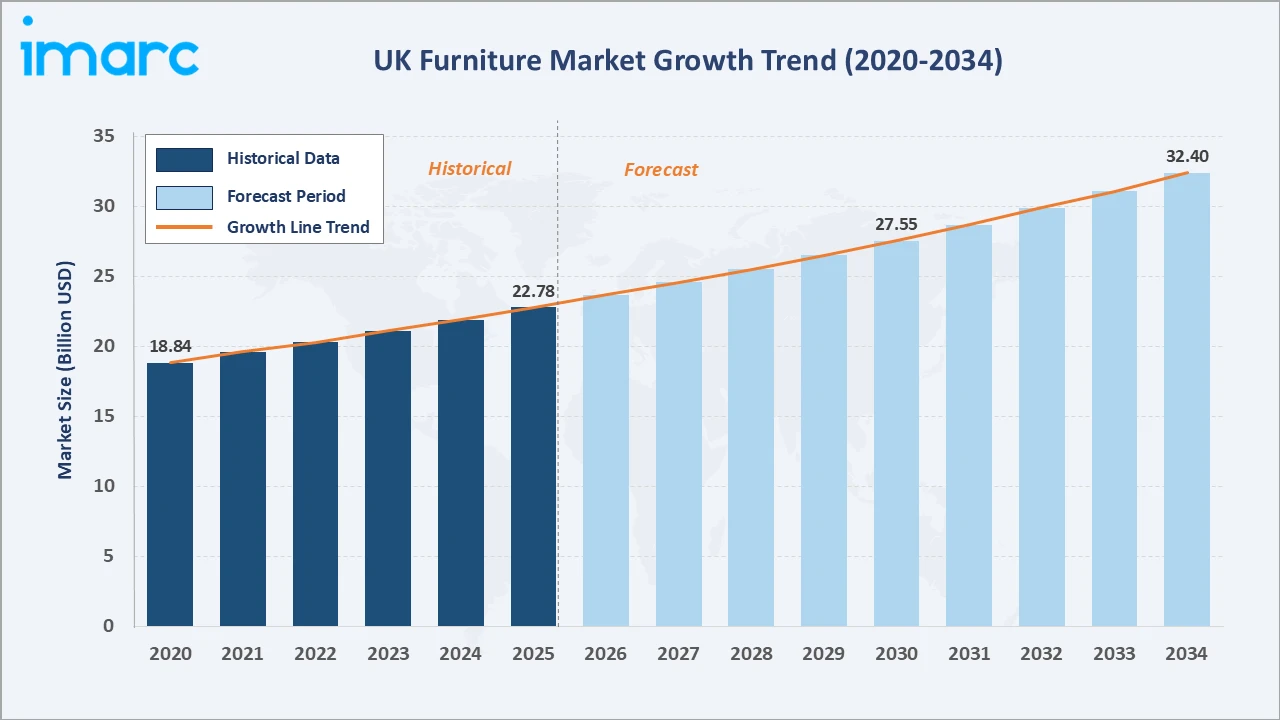
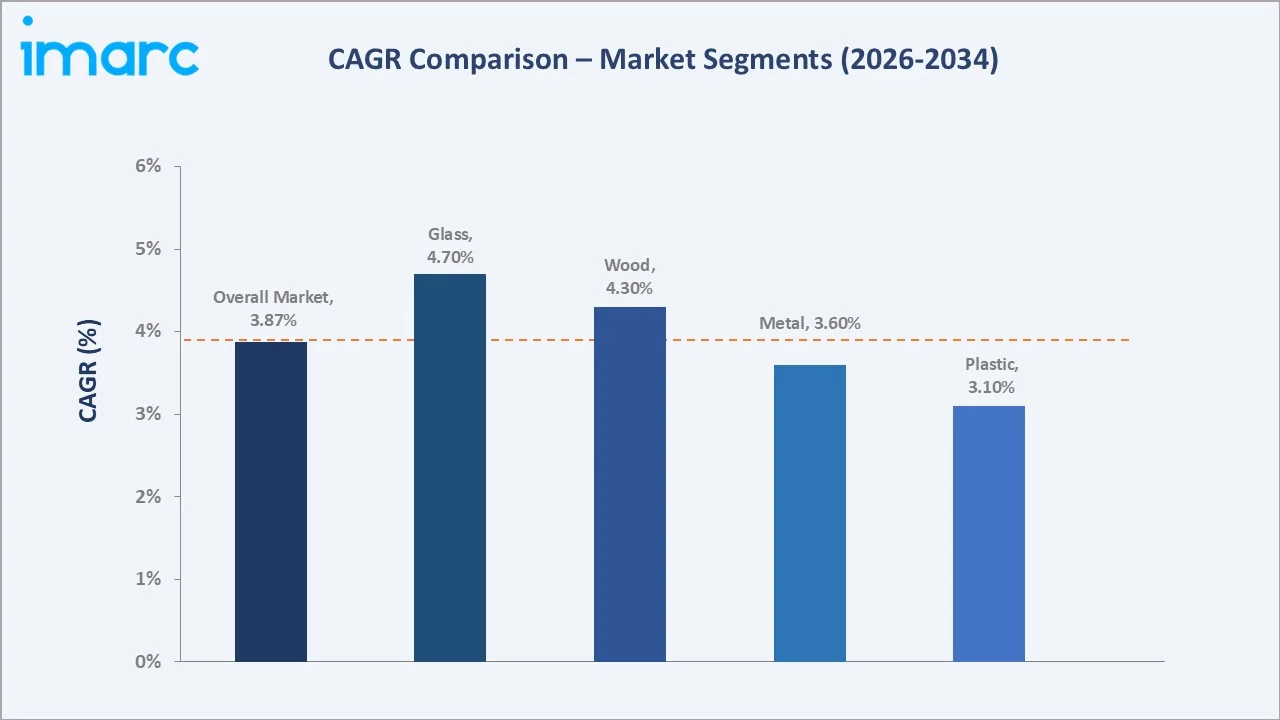
The UK furniture market size increased from USD 22.78 Billion in 2025 to USD 23.91 Billion in 2026 and is projected to reach USD 32.40 Billion by 2034, expanding at a CAGR of 3.87% during 2026-2034. Rising home renovation and redecoration activity, growing e-commerce and online furniture retail adoption, and expanding commercial and hospitality sector development are the primary growth catalysts.
Market Snapshot
|
Metric |
Value |
|
Base Year Market Size (2025) |
USD 22.78 Billion |
| Market Size (2026) | USD 23.91 Billion |
|
Forecast Market Size (2034) |
USD 32.40 Billion |
|
CAGR (2026-2034) |
3.87% |
|
Base Year |
2025 |
|
Historical Period |
2020-2025 |
|
Forecast Period |
2026-2034 |
London leads the national furniture consumption landscape, holding a 20.8% share in 2025, anchored by the region's concentration of retail showrooms and dense urban residential demand. Wood commands the largest share of the material segment at 47.8%, reflecting sustained consumer preference for traditional and durable furniture construction across the domestic furniture economy.
To get more information on this market, Request Sample
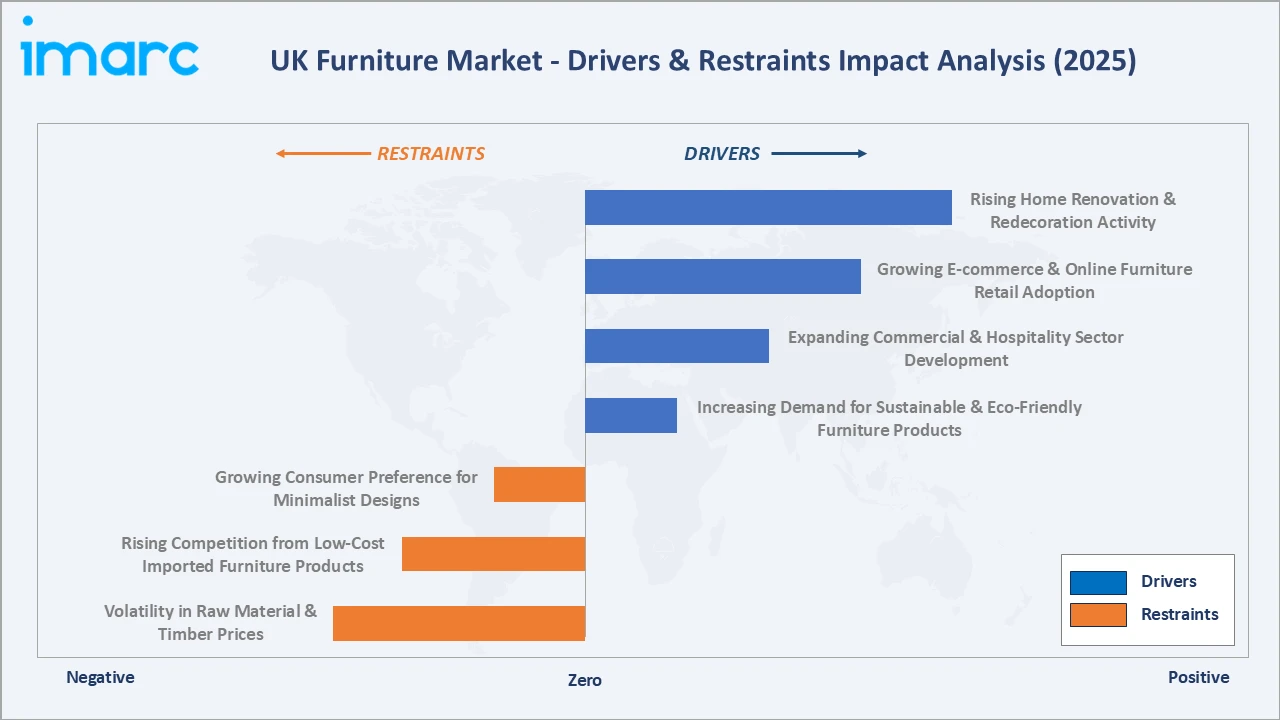
The UK furniture market is underpinned by three structural forces: rising home renovation and redecoration activity across the UK, growing e-commerce and online furniture retail adoption, and expanding commercial and hospitality sector development. Each force independently reinforces category growth, sustaining steady CAGR expansion through 2034 despite volatility in raw material and timber prices.
Executive Summary
The UK furniture market, which increased from USD 22.78 Billion in 2025 to an estimated USD 23.91 Billion in 2026 and is forecast to reach USD 32.40 Billion by 2034, growing at a CAGR of 3.87%. The market is experiencing steady expansion, driven by rising home renovation activity, growing e-commerce furniture retail adoption, and increasing commercial and hospitality sector development.
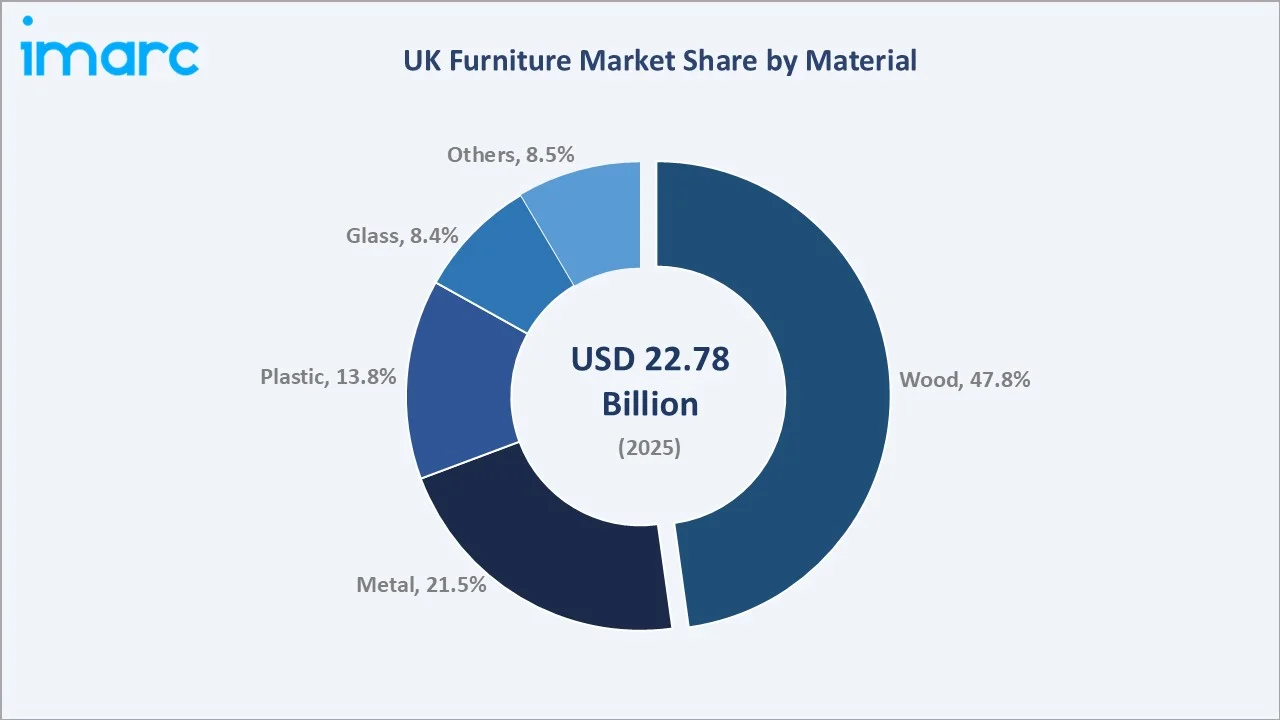
Wood dominates the material segment with a 47.8% share in 2025, encompassing traditional and durable furniture construction across residential and commercial applications, while metal accounts for 21.5%, plastic for 13.8%, glass for 8.4%, and others for 8.5%, reflecting the market's broad application diversity across furniture product and support requirements.
Residential leads the end use segment at a 66.4% share, supported by expanding home renovation and redecoration activity, while commercial accounts for 18.2%, hospitality for 7.6%, healthcare for 4.3%, and others for 3.5%. London leads regionally at 20.8%, anchored by the region's concentration of retail showrooms and dense urban residential demand.
Key Market Insights
|
Insight |
Data |
|
Largest Material Segment |
Wood – 47.8% share (2025) |
|
Fastest Growing Material Segment |
Glass – ~4.7% CAGR (2026-2034) |
|
Largest End Use Segment |
Residential – 66.4% share (2025) |
|
Leading Region |
London – 20.8% share (2025) |
|
Top Companies |
Inter IKEA Systems B.V., Dunelm Group plc, The Senator Group, NEXT plc, Oak Furnitureland |
Key Analytical Observations Supporting the Above Data:
- Wood accounts for 47.8% of the UK furniture market in 2025. This dominance reflects sustained consumer preference for traditional and durable furniture construction across residential and commercial applications.
- Residential remains the leading end use category at 66.4% share (2025), supported by expanding home renovation and redecoration activity across the country.
- Commercial is expanding steadily at 18.2% share (2025), as growing office and retail space development continues to drive category growth.
- London's 20.8% share (2025) reflects its concentration of retail showrooms and dense urban residential demand.
- Rising convergence of residential redecoration demand with sustainable material sourcing and e-commerce retail formats is broadening the addressable market across wood, metal, and glass furniture applications.
UK Furniture Market Overview
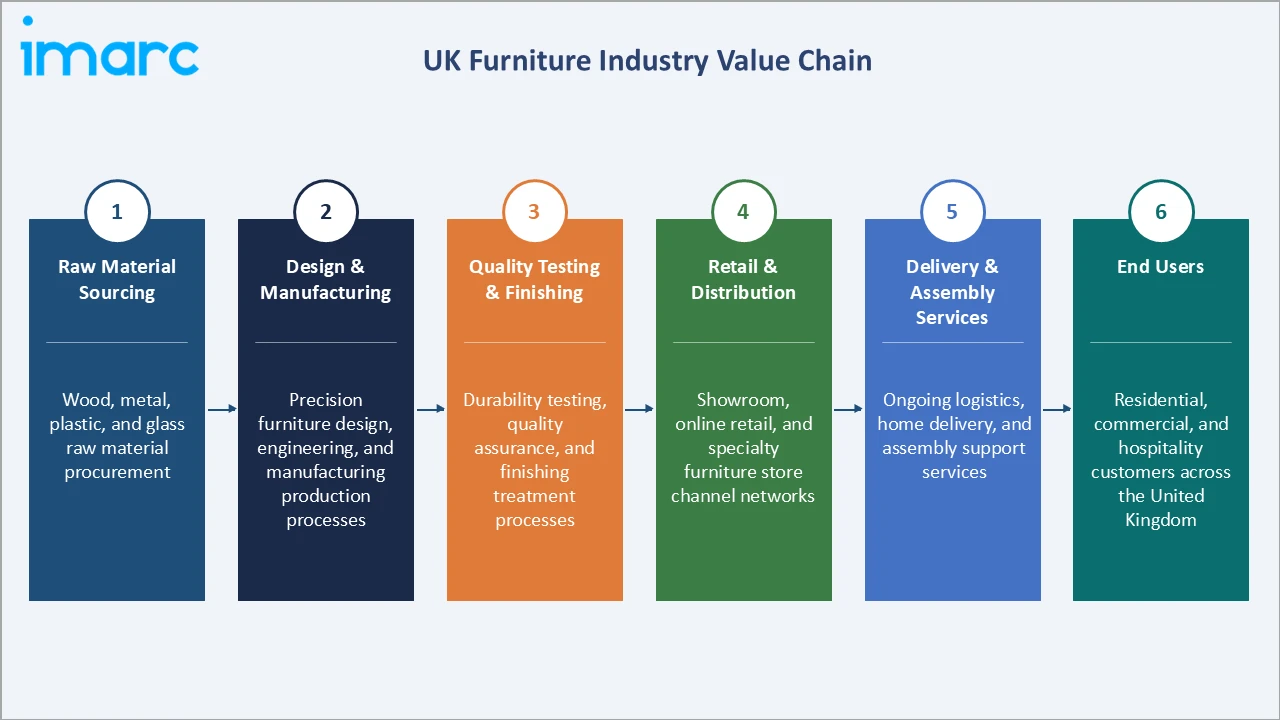
The UK furniture industry analysis encompasses wood, metal, plastic, glass, and other material categories delivered across residential, commercial, hospitality, healthcare, and other end use segments, offering diverse furniture products for a wide range of household and institutional applications. The furniture ecosystem spans raw material sourcing providers, design and manufacturing firms, and an expanding network of retail, delivery, and assembly service providers.
Macroeconomic drivers include rising home renovation and redecoration activity across the UK, growing e-commerce and online furniture retail adoption, and expanding commercial and hospitality sector development. Suppliers are simultaneously investing in modular furniture design innovation, expanding retail and distribution networks, and delivery and assembly service capabilities to improve customer experience, positioning the UK furniture sector for continued steady growth through 2034 despite volatility in raw material and timber prices.
Market Dynamics
To evaluate market opportunities, Request Sample
Market Drivers
- Rising Home Renovation & Redecoration Activity: Nearly seven million UK homeowners are planning home renovation projects by 2027, with an average planned expenditure of approximately GBP 14,000 per household. Increasing consumer investment in home renovation and redecoration projects is driving sustained demand for wood and metal furniture capacity across the country.
- Growing E-commerce & Online Furniture Retail Adoption: Rising adoption of online furniture shopping platforms is accelerating investment in digital retail and direct-to-consumer distribution channels. Habitat is a UK home furnishings retailer offering a broad range of furniture, sofas, lighting, bedding, storage, kitchenware, and home accessories across multiple living spaces.
- Expanding Commercial & Hospitality Sector Development: The UK hospitality sector comprised 176,685 businesses in 2025, up significantly from approximately 130,000 in 2010 and around 175,000 in 2022, reflecting sustained expansion in the industry. Growing commercial office and hospitality sector expansion is broadening the addressable market for institutional and contract furniture applications.
- Increasing Demand for Sustainable & Eco-Friendly Furniture Products: Growing consumer preference for sustainably sourced furniture is improving supplier reputation and expanding the addressable market for eco-certified products.
Market Restraints
- Volatility in Raw Material & Timber Prices: Significant fluctuation in raw material and timber costs can constrain smaller manufacturers and limit pricing stability. In April 2026, Norra Timber highlighted a global raw material shortage and fragile UK timber market, with low inventories and changing trade patterns increasing risks around availability, delivery reliability, and pricing.
- Rising Competition from Low-Cost Imported Furniture Products: Growing import competition from lower-cost international manufacturers can pressure domestic pricing and limit margin growth.
- Growing Consumer Preference for Minimalist Designs: Rising demand for minimalist and space-saving furniture designs can shift consumption patterns and require ongoing product portfolio adaptation.
Market Opportunities
- Sustainable Material Sourcing Certification Growth: Rising demand for ethically sourced furniture offers opportunities for suppliers investing in sustainability certification and traceability technology. 73% of Gen Z consumers are willing to spend more on eco-friendly products, encouraging furniture companies to adopt FSC/PEFC-certified materials and more sustainable production methods.
- Smart Furniture Technology Development: Growing demand for connected and multi-functional furniture presents opportunities for suppliers expanding smart furniture product capabilities.
- Modular & Space-Saving Product Innovation: Growing demand for adaptable living spaces creates opportunities for suppliers expanding modular furniture application diversity.
Market Challenges
- Balancing Cost and Quality for Price-Sensitive Consumers: Suppliers must balance premium material investment with the need to maintain cost-competitive and accessible product offerings.
- Addressing Supply Chain Resilience for Raw Material Sourcing: Ensuring consistent, geographically diversified raw material sourcing requires ongoing supply chain investment and supplier partnership development.
Emerging Market Trends
1. Commercial & Hospitality Sector Development Expansion
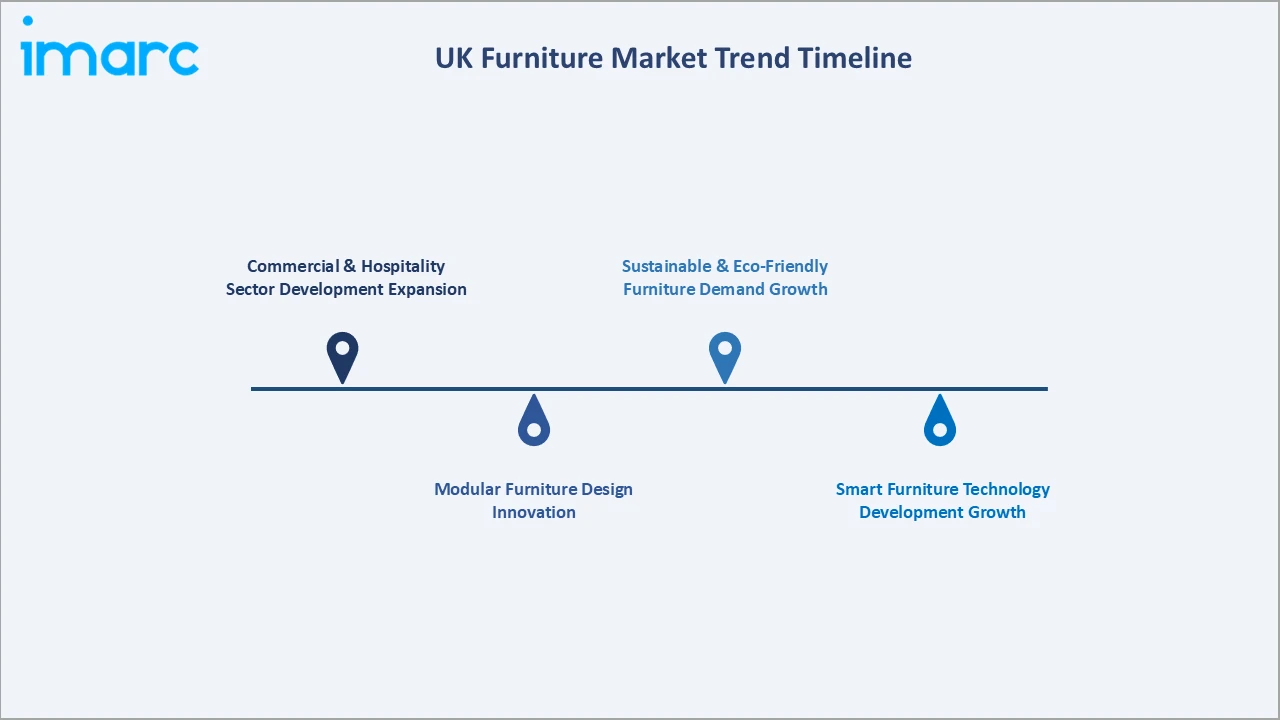
Suppliers are increasingly investing in commercial and hospitality sector development and contract furniture capabilities, driving improved institutional infrastructure participation across the country. For instance, in March 2026, Marriott announced the European launch of Series by Marriott through 11 signed projects, including five hotels in the UK with Splendid Hospitality Group.
2. Modular Furniture Design Innovation
Growing investment in modular furniture design innovation is expanding space-saving product experiences and driving increased application across residential and commercial segments. In October 2025, Utopia launched HeyU, its largest and most versatile modular bathroom furniture collection. The range offers 4 design styles and 14 finishes, alongside multiple basin, worktop, storage, and handle configurations to support greater bathroom personalization.
3. Sustainable & Eco-Friendly Furniture Demand Growth
Asnew’s sustainable furniture range uses 100% natural and biodegradable materials, eliminating foam and synthetic fibers while incorporating FSC-certified wood, UK-sourced wool, rubberized coir, and natural latex. Launched in 2024, the system emphasizes durable, repairable, and reupholsterable furniture to reduce waste and extend product lifespans.
4. Smart Furniture Technology Development Growth
Made Smarter is supporting UK furniture and joinery SMEs in adopting automation, CNC machinery, digital design, CGI, AR/VR, and 3D printing to improve productivity and competitiveness. Examples include Saxon Furniture’s GBP 125,250 digital investment and Glyngary Joinery’s GBP 200,000 machinery upgrade.
Industry Value Chain Analysis
The UK furniture value chain spans raw material sourcing through end-user delivery, with each stage occupied by specialized design and manufacturing providers, quality testing firms, and retail, delivery, and assembly service providers whose performance directly influences product quality, operational efficiency, and cost effectiveness.
|
Stage |
Key Activities |
|
Raw Material Sourcing |
Wood, metal, plastic, and glass raw material procurement |
|
Design & Manufacturing |
Precision furniture design, engineering, and manufacturing production processes |
|
Quality Testing & Finishing |
Durability testing, quality assurance, and finishing treatment processes |
|
Retail & Distribution |
Showroom, online retail, and specialty furniture store channel networks |
|
Delivery & Assembly Services |
Ongoing logistics, home delivery, and assembly support services |
|
End Users |
Residential, commercial, and hospitality customers across the United Kingdom |
Technology Landscape in the UK Furniture Industry
Sustainable Material Sourcing Integration
Suppliers are advancing sustainable material sourcing integration to improve traceability and eco-certification accuracy, supporting broader adoption among residential and commercial furniture applications.
Modular & Space-Saving Design Development
Growing investment in modular and space-saving design is expanding adaptable living solution capacity, addressing rising demand for flexible, efficient furniture configurations. Rising urban living in space-constrained UK cities is further accelerating demand for multi-purpose and reconfigurable furniture pieces.
AI-Powered Furniture Discovery and E-Commerce Integration
In February 2026, Furniture.com launched an AI-powered platform enabling consumers to discover, compare, and purchase furniture across multiple retailers through conversational search and a single-cart checkout. The platform includes more than 77 participating retailers, while company research indicates shoppers spend over 15 hours researching a single furniture purchase.
Digital Retail Ecosystem Integration
Expanding investment in digital retail ecosystem integration is strengthening furniture value chain reliability, supporting premium positioning across leading national e-commerce and showroom programs. Growing adoption of augmented reality visualization tools is further improving customer confidence in online furniture purchasing decisions.
Market Segmentation Analysis
The report covers the following segments:
|
Segment Category |
Leading Segment |
Market Share |
Year |
|
Material |
Wood |
47.8% |
2025 |
|
End Use |
Residential |
66.4% |
2025 |
|
Product |
🔒 |
🔒 |
2025 |
|
Region |
London |
20.8% |
2025 |

By Material
Wood dominates with a 47.8% share in 2025. This segment encompasses traditional and durable furniture construction across residential and commercial applications, supported by sustained demand across the national furniture economy.
To access detailed market analysis, Request Sample
Metal represents 21.5% of the market (2025), followed by plastic at 13.8%, glass at 8.4%, and others at 8.5%, reflecting the market's broad application diversity across furniture infrastructure and support requirements.
By End Use
Residential leads the end use segment at 66.4% share (2025), supported by expanding home renovation and redecoration activity across the country.
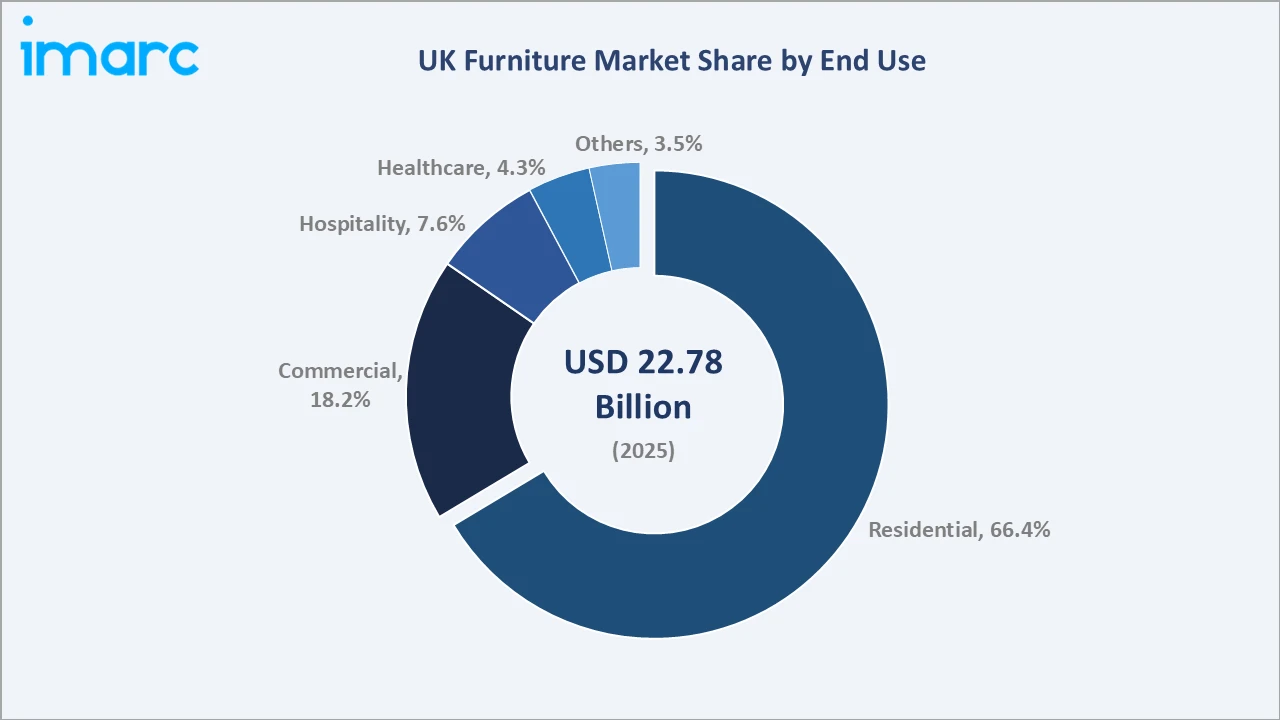
Commercial accounts for 18.2% of the market (2025), followed by hospitality at 7.6%, healthcare at 4.3%, and others at 3.5%, continuing to broaden the market's end use diversity as institutional demand expands across sectors.
Regional Market Insights
London's market leadership (20.8%, 2025) reflects the region's concentration of retail showrooms and dense urban residential demand. Growing sustainable material sourcing support and expanding e-commerce investment combine to sustain its dominant position through 2034.
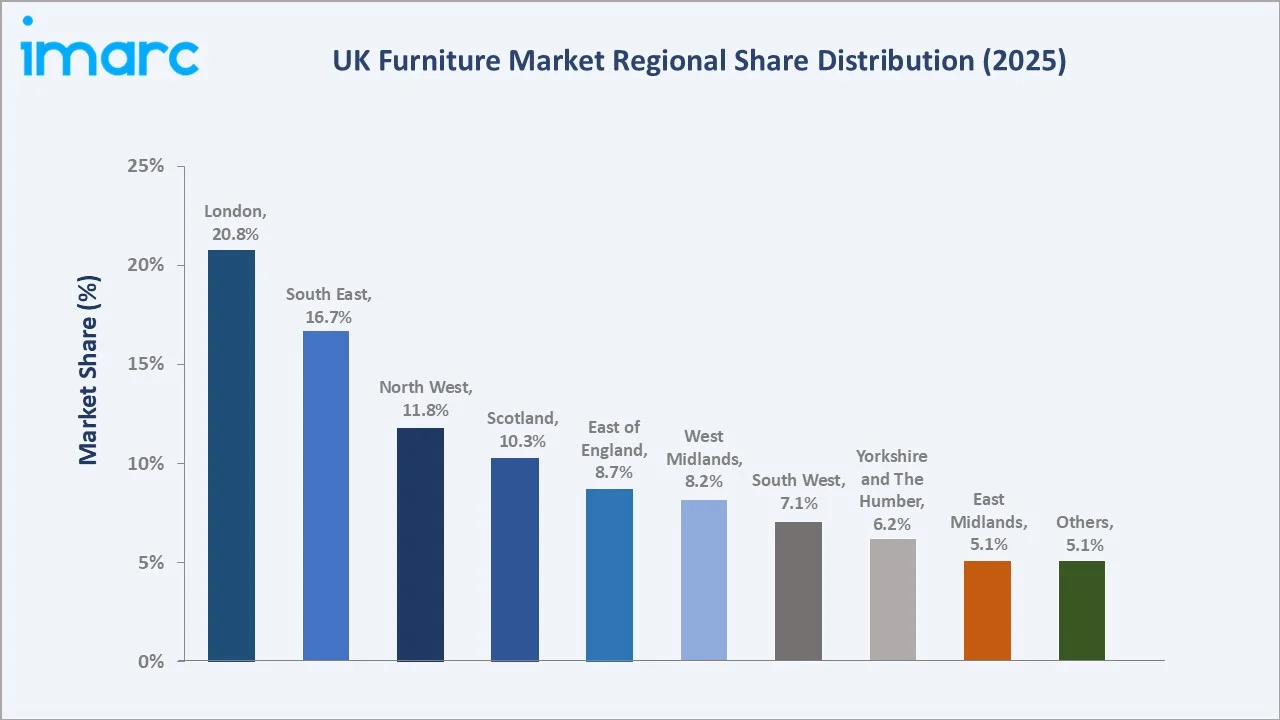
South East at 16.7% (2025) represents the second-largest UK furniture market regionally. Growing home renovation activity and expanding regional retail infrastructure are sustaining steady growth, positioning the region as a key contributor alongside London through the forecast period.
|
Region |
Share (2025) |
Key Growth Drivers |
|
London |
20.8% |
Concentration of retail showrooms and dense urban residential demand |
|
South East |
16.7% |
Growing home renovation activity and expanding regional retail infrastructure |
|
North West |
11.8% |
Rising e-commerce furniture adoption and expanding retail facility demand |
|
Scotland |
10.3% |
Emerging sustainable furniture development and growing urban consumption |
|
East of England |
8.7% |
Developing residential furniture infrastructure adoption and investment |
|
West Midlands |
8.2% |
Gradual commercial furniture category expansion across regional markets |
|
South West |
7.1% |
Emerging regional retail program development |
|
Yorkshire and The Humber |
6.2% |
Growing residential redecoration adoption and facility expansion |
|
East Midlands |
5.1% |
Developing regional furniture infrastructure investment |
|
Others |
5.1% |
Gradual furniture infrastructure expansion across smaller-scale regions |
Competitive Landscape
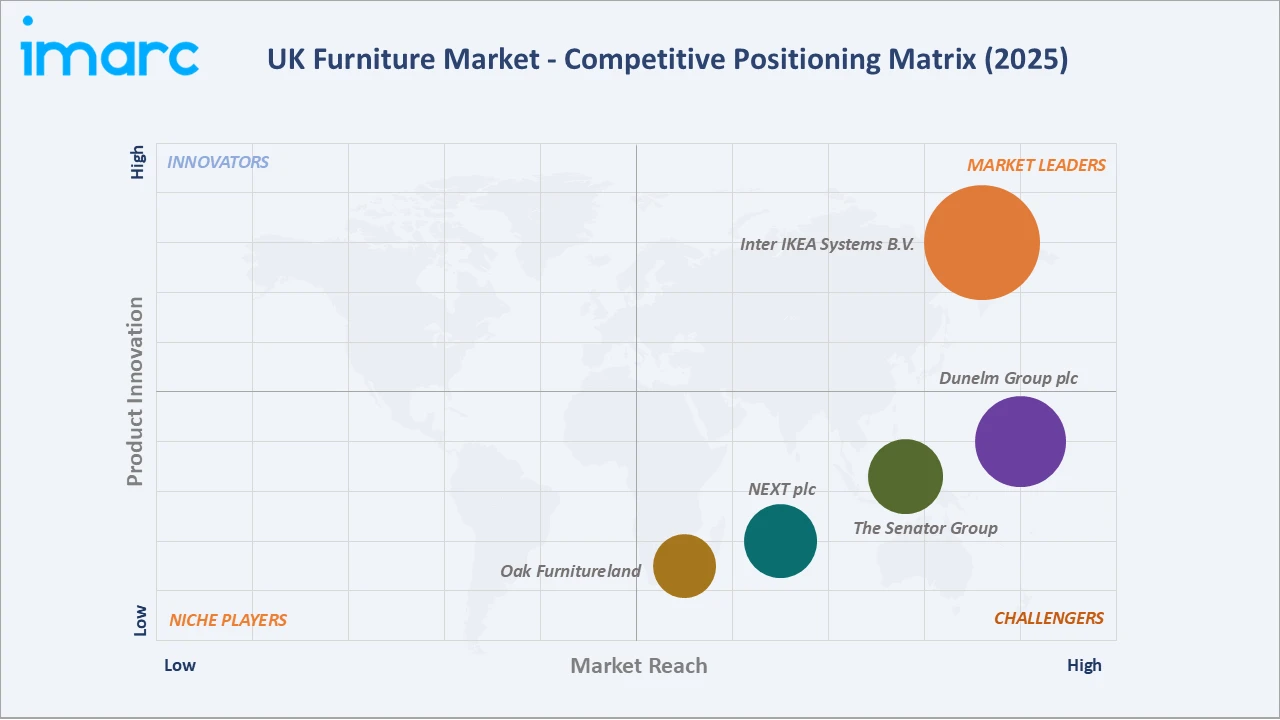
The UK furniture market exhibits moderate concentration, with leading suppliers collectively holding a significant share of market revenue in 2025, reflecting sustained investment in product innovation and distribution reach.
|
Company Name |
Brand Name |
Market Position |
Core Strength |
|
Inter IKEA Systems B.V. |
IKEA |
Market Leader |
One of the leading global furniture retailers with an extensive domestic showroom network and affordable design expertise |
|
Dunelm Group plc |
Dunelm |
Strong Challenger |
Established home furnishings and furniture retailer with long-standing consumer relationships |
|
The Senator Group |
Senator, Allermuir, Torasen |
Challenger |
Commercial and office furniture manufacturer with advanced contract portfolio |
|
NEXT plc |
Made, Laura Ashley, Cult Furniture |
Challenger |
Digital-first furniture retailer with expanding online design capacity |
|
Oak Furnitureland |
Oak Furnitureland |
Challenger |
Specialized solid wood furniture retailer serving domestic residential markets |
Inter IKEA Systems dominates through comprehensive product portfolios and extensive national showroom reach, supported by continuous investment. Dunelm Group plc, The Senator Group, NEXT plc, and Oak Furnitureland compete through targeted consumer relationship heritage, diversified retail integration, and specialized material technology differentiation.
Key Company Profiles
Inter IKEA Systems B.V.
Inter IKEA Systems B.V. is one of the leading global furniture retailers with an extensive domestic showroom network and affordable design expertise serving residential and commercial customers across the country.
- Product Portfolio: Residential furniture, home furnishings, and specialty modular products under the IKEA brand.
- Recent Developments: In August 2025, Inter IKEA Systems opened a new-format small store at Hall Road Retail Park in Norwich, its second of three planned UK small-format locations that year. The store offers room displays, second-hand products, kitchen and bedroom planning, and access to IKEA’s 12,000-product range, with home delivery or free in-store collection within 48 hours.
- Strategic Focus: Strengthening nationwide retail reach; expanding advanced sustainable furniture technology across emerging application segments.
Dunelm Group plc
Dunelm Group plc is one of the leading established home furnishings and furniture retailers with long-standing consumer relationships across domestic markets.
- Product Portfolio: Home furnishings, furniture, and specialty décor products under the Dunelm brand.
- Recent Developments: In August 2026, Dunelm Group plc launched “Ask Dunelm,” an AI-powered shopping assistant developed with Google Cloud that lets customers search conversationally, receive personalized recommendations, visualize products, and plan entire rooms.
- Strategic Focus: Expanding home furnishings and furniture capabilities; strengthening national consumer procurement presence.
Market Concentration Analysis
The furniture market in the UK exhibits moderate concentration, with Inter IKEA Systems B.V., Dunelm Group plc, and The Senator Group collectively accounting for a significant share of total category revenue in 2025, reflecting sustained product investment, distribution loyalty, and extensive application reach across the industry.
Consolidation pressure remains limited as leading suppliers maintain distinct strategic positioning: Inter IKEA Systems B.V. and Dunelm Group plc through comprehensive product and distribution portfolios, The Senator Group and NEXT plc through consumer relationship heritage and retail integration scale positioning, and Oak Furnitureland through diversified specialized material and retail differentiation, rather than pursuing direct M&A consolidation.
Investment & Growth Opportunities
Fastest Growing Segments
Glass (~4.7% CAGR) represents the highest-growth investment vector through 2034, driven by expanding demand for contemporary furniture designs and continuous innovation across advanced material technologies. This subcategory addresses a rapidly expanding addressable market within the UK furniture ecosystem.
Emerging Market Expansion
The Yorkshire and The Humber and East Midlands regional markets collectively represent an incremental growth opportunity beyond London and South East by 2034, as rising home renovation investment and expanding e-commerce adoption accelerate category penetration in these emerging markets.
Venture and Institutional Investment Trends
- Supplier investment toward sustainable material sourcing and furniture portfolio development is creating opportunities for technology vendors serving the home goods sector.
- Growing e-commerce demand is sustaining institutional interest in specialty digital-first and modular furniture providers.
- Technology-led retail infrastructure innovation, led by major suppliers, is opening opportunities for technology and distribution vendors serving the UK furniture industry.
Future Market Outlook (2026-2034)
The UK furniture industry growth is positioned for steady, quality-driven expansion through 2034. From a base of USD 22.78 Billion in 2025 to USD 23.91 Billion in 2026, reaching the market is projected to reach USD 32.40 Billion by 2034, representing substantial incremental value creation at a CAGR of 3.87%. This growth is structurally supported by rising home renovation and redecoration activity across the UK, growing e-commerce and online furniture retail adoption, and expanding commercial and hospitality sector development.
The material and end use segment will continue evolving through 2034, with wood gaining further share as sustainable sourcing demand and material technology innovation accelerate. This shift creates opportunities for suppliers investing in sustainable material sourcing, digital retail ecosystem expansion, and advanced furniture capabilities to capture the next phase of the UK furniture market growth.
Research Methodology
Primary Research
Primary research comprised structured interviews with industry participants across 2024-2025, including furniture supplier executives, retail and commercial procurement specialists, sustainability sourcing advisors, and home goods experts across major UK regions. Expert input validated market sizing, segmentation trends, and regional consumption patterns.
Secondary Research
Secondary research encompassed supplier annual reports, furniture industry association publications, and trade press covering product innovation, regulatory trends, and regional market dynamics across the United Kingdom.
Forecasting Models
Market size estimations were derived using top-down and bottom-up forecasting, incorporating material and end use segment transitions and supplier capacity disclosures. A base-case CAGR of 3.87% reflects consensus estimates validated against announced consumption trend timelines and supplier strategic development plans.
UK Furniture Market Report Scope:
| Report Features | Details |
|---|---|
| Base Year of the Analysis | 2025 |
| Historical Period | 2020-2025 |
| Forecast Period | 2026-2034 |
| Units | Billion USD |
| Scope of the Report |
Exploration of Historical Trends and Market Outlook, Industry Catalysts and Challenges, Segment-Wise Historical and Future Market Assessment:
|
| Products Covered | Living Room Furniture, Dining Room Furniture, Bedroom Furniture, Kitchen Furniture, Office Furniture, Educational Furniture, Others |
| Materials Covered | Metal, Wood, Plastic, Glass, Others |
| End Uses Covered | Residential, Commercial, Hospitality, Healthcare, Others |
| Regions Covered | London, South East, North West, East of England, South West, Scotland, West Midlands, Yorkshire and The Humber, East Midlands, Others |
| Companies Covered | Inter IKEA Systems B.V., Dunelm Group plc, The Senator Group, NEXT plc, Oak Furnitureland, etc. |
| Customization Scope | 10% Free Customization |
| Post-Sale Analyst Support | 10-12 Weeks |
| Delivery Format | PDF and Excel through Email (We can also provide the editable version of the report in PPT/Word format on special request) |
Key Benefits for Stakeholders:
- IMARC’s report offers a comprehensive quantitative analysis of various market segments, historical and current market trends, market forecasts, and dynamics of the UK furniture market from 2020-2034.
- The research study provides the latest information on the market drivers, challenges, and opportunities in the UK furniture market.
- Porter's Five Forces analysis assists stakeholders in assessing the impact of new entrants, competitive rivalry, supplier power, buyer power, and the threat of substitution. It helps stakeholders to analyze the level of competition within the UK furniture industry and its attractiveness.
- Competitive landscape allows stakeholders to understand their competitive environment and provides an insight into the current positions of key players in the market.
Frequently Asked Questions About the UK Furniture Market Report
The UK furniture market size is estimated at USD 23.91 Billion in 2026 and is projected to reach USD 32.40 Billion by 2034.
The market is expected to grow at a CAGR of 3.87% during 2026-2034, driven by rising home renovation activity and growing e-commerce furniture retail adoption.
London leads with a 20.8% share in 2025, anchored by the region's concentration of retail showrooms and dense urban residential demand.
Wood dominates with a 47.8% share in 2025, driven by sustained consumer preference for traditional and durable furniture construction.
Residential leads with a 66.4% share in 2025, supported by expanding home renovation and redecoration activity.
Some of the key players include Inter IKEA Systems B.V., Dunelm Group plc, The Senator Group, NEXT plc, and Oak Furnitureland.
Glass is growing fastest at an estimated 4.7% CAGR as demand for contemporary furniture designs accelerates.
Key challenges include volatility in raw material and timber prices, rising competition from low-cost imported furniture products, and growing consumer preference for minimalist and space-saving designs.
Sustainable material sourcing certification growth, smart furniture technology development, and modular and space-saving product innovation represent leading investment opportunities.
Commercial, at 18.2% share, continues to reflect demand for office and institutional furniture infrastructure, complementing residential and hospitality demand.
Need more help?
- Speak to our experienced analysts for insights on the current market scenarios.
- Include additional segments and countries to customize the report as per your requirement.
- Gain an unparalleled competitive advantage in your domain by understanding how to utilize the report and positively impacting your operations and revenue.
- For further assistance, please connect with our analysts.
 Request Customization
 Speak to an Analyst
 Request Brochure
 Inquire Before Buying
Benefits of Customization
- Personalize this research
- Triangulate with your data
- Get data as per your format and definition
- Gain a deeper dive into a specific application, geography, customer, or competitor
- Any level of personalization
Get in Touch With Us
UNITED STATES
Phone: +1-201-971-6302
INDIA
Phone: +91-120-433-0800
UNITED KINGDOM
Phone: +44-753-714-6104
Email: [email protected]
Client Testimonials




.webp)




.webp)













Related Reports

Choose your plan
*Please note that the prices mentioned below are starting prices for each bundle type. Kindly contact our team for further details.*
Single User License
- 1 User License, Access on 2 Devices
- PDF Report + Excel Dataset (Password Protected)
- Lifetime Access
- No Printing Rights
- 10% Free Report Customization
- 10–12 Weeks of Analyst Support
Five User License
- Access for 5 Users, 2 Devices per User
- PDF Report + Excel Dataset (Password Protected)
- Lifetime Access
- Dedicated Account Manager
- 12–14 Weeks of Analyst Support
- No Printing Rights
- 15% Free Report Customization
- 25% Discount on Your Next Purchase
Corporate User License
- Unlimited User Access (Within Your Organization)
- PDF Report + Excel Dataset
- Lifetime Access
- Dedicated Account Manager
- 14–20 Weeks of Analyst Support
- No Printing Rights
- 20% Free Report Customization
- 30% Discount on Your Next Purchase
Essential Insights
What's included:
3 reports
- Lifetime Access
- PDF Reports
- Excel Datasets
- 2 Weeks of Free Analyst Support
- 2 User Licenses
- Access on 2 Devices
- Printing Rights
- Complimentary PowerPoint (PPT) Version
- Complimentary License Upgrade
Professional Access
What's included:
5 reports
- Lifetime Access
- PDF Reports
- Excel Datasets
- 8 Weeks of Free Analyst Support
- 2 User Licenses
- Access on 2 Devices
- Printing Rights
- Complimentary PowerPoint (PPT) Version
- Complimentary License Upgrade
Business Advantage
What's included:
8 reports
- Lifetime Access
- PDF Reports
- Excel Datasets
- 14 Weeks of Free Analyst Support
- 2 User Licenses
- Access on 2 Devices
- Printing Rights
- Complimentary PowerPoint (PPT) Version
- Complimentary License Upgrade
Enterprise Intelligence
What's included:
10 reports
- Lifetime Access
- PDF Reports
- Excel Datasets
- 20 Weeks of Free Analyst Support
- 2 User Licenses
- Access on 2 Devices
- Printing Rights
- Complimentary PowerPoint (PPT) Version
- Complimentary License Upgrade