
United States Biomaterials Market Size, Share, Trends and Forecast by Type, Application, and Region, 2026-2034
United States biomaterials Market Overview:
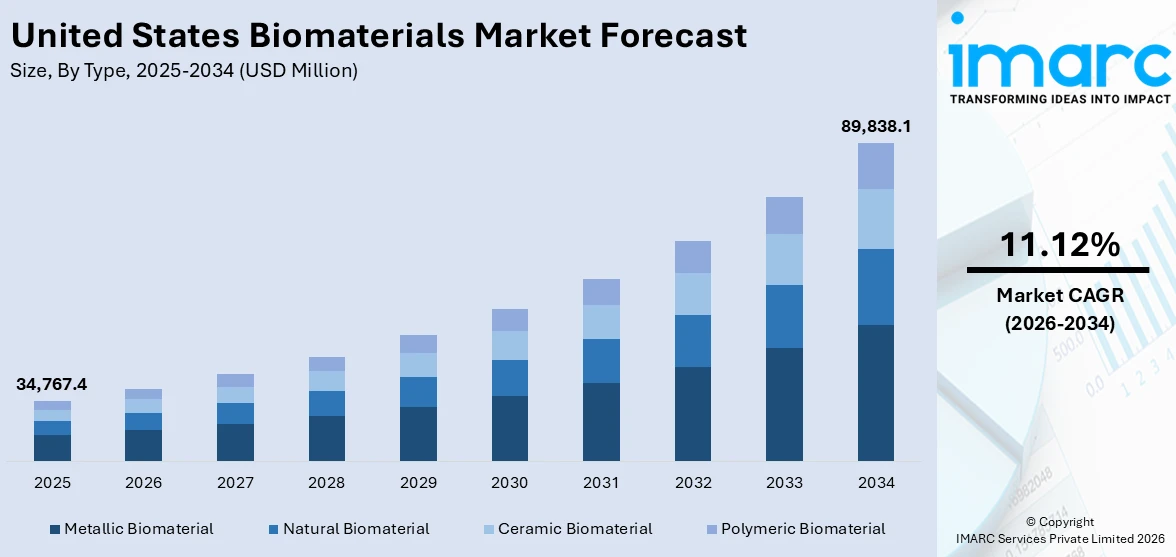
The United States biomaterials market size was valued at USD 34,767.4 Million in 2025. Looking forward, IMARC Group estimates the market to reach USD 89,838.1 Million by 2034, exhibiting a CAGR of 11.12% during 2026-2034. The market is expanding due to increasing demand for advanced medical implants and regenerative therapies. Moreover, the rising preference for minimally invasive procedures and growing innovation in biodegradable materials continue to strengthen the United States biomaterials market share across healthcare and biomedical applications, driven by technological advancements, an aging population, and supportive government initiatives that promote research and development.
|
Report Attribute
|
Key Statistics
|
|---|---|
|
Base Year
|
2025
|
|
Forecast Years
|
2026-2034
|
|
Historical Years
|
2020-2025
|
|
Market Size in 2025
|
USD 34,767.4 Million |
|
Market Forecast in 2034
|
USD 89,838.1 Million |
| Market Growth Rate 2026-2034 | 11.12% |
United States Biomaterials Market Analysis
- Key Market Drivers: The United States biomaterials market is driven by increasing demand for high-end medical devices, regenerative medicine, and tissue engineering. Increasing realization of personalized care and technological advancements in bio-compatible materials for implants and drug delivery systems are also driving adoption in healthcare and research sectors.
- Key Market Trends: Trends involve the creation of biodegradable and bioactive materials, 3D-printed biomaterials for personalized implants, and greater integration with smart technologies. Sustainability, green sourcing, and multi-functionality are gaining visibility, and partnerships among research institutions and startups fuel innovation in medical and industrial uses, propelling the United States biomaterials market demand.
- Competitive Landscape: The competitive landscape of the market is very dynamic, marked by competition driven through innovation. Firms concentrate on creating proprietary materials, building R&D capabilities, and partnerships. Technological differentiation, regulatory adherence, and the capability to produce high-performance yet affordable biomaterials are critical drivers of the competitive landscape.
- Challenges and Opportunities: The market faces many challenges, such as tight regulations, high cost of production, and issues of biocompatibility of materials. Opportunities emerge in novel applications including regenerative therapies, minimally invasive surgeries, and environmentally friendly biomaterials. Technological advancements and collaborations across industries offer potential for expansion in the medical, pharmaceutical, and industrial sector.
To get more information on this market Request Sample
The demand for advanced healthcare solutions is pushing innovation within the United States biomaterials industry. In addition, the medical sector increasingly turns to biomaterials to create durable and biocompatible implants with an aging population and a rising number of chronic illnesses, such as arthritis and cardiovascular disease. This shift is further supported by consumer preference for minimally invasive treatments that shorten recovery time and improve patient outcomes. The development of next-generation materials with enhanced bioactivity and biodegradability is also driving the growth of the United States biomaterials market.
Sustainability has become a core priority across industries, and it is playing a growing role in shaping United States biomaterials market trends. Environmental concerns and regulatory pressure are encouraging companies to explore alternatives to traditional, resource-heavy materials. As a result, plant-based, biodegradable, and low-impact biomaterials are gaining popularity in sectors like fashion, packaging, and consumer goods. As consumer preferences move toward eco-conscious goods and supply chains adapt to meet these expectations, sustainable biomaterials are becoming an essential component in the broader strategy for responsible innovation. This trend is set to continue influencing design, sourcing, and product development across the US biomaterials sector.
United States Biomaterials Market Trends:
Regenerative Medicine Driving Market Demand
The increasing emphasis on regenerative medicine primarily drives the biomaterials market in the United States. Valued at USD 26.7 Billion in 2024, the global regenerative medicine sector is expected to reach approximately USD 130.4 Billion by 2033, growing at a compound annual growth rate (CAGR) of 19.15%. One of the major contributors to this growth is the rising elderly population, which is leading to a higher occurrence of age-related conditions such as cardiovascular diseases and orthopedic disorders. This demographic shift, with the global share of people aged 65 and above projected to rise from 10.3% in 2024 to 20.7% by 2074 (as per United Nations data), is increasing the demand for biomaterials used in medical implants and devices. Additionally, advancements in biomaterials science are playing a key role in market expansion. Research and development are continuously producing materials with superior properties, including enhanced biocompatibility, strength, and biodegradability, expanding their use in various healthcare applications. The demand for minimally invasive procedures, combined with the development of bioactive materials that promote tissue regeneration, is further propelling the market. Biomaterials are also essential in managing chronic illnesses, such as diabetes and heart disease, through applications in implants like pacemakers and stents. Furthermore, the field of tissue engineering is gaining traction, where biomaterials serve as critical components for scaffolding and regenerative therapies, including artificial tissues and organs. Government backing, in the form of funding and research initiatives, is encouraging collaborative efforts between academic institutions, research bodies, and industry leaders. The growing interest in personalized healthcare is another key driver, as the adaptability of biomaterials enables the creation of patient-specific medical solutions, thereby fostering further United States biomaterials market growth in this dynamic sector.
Expanding Academic-Industry Collaboration in Biomedicine
Strong linkages between academic institutions and industry stakeholders are increasingly shaping the United States biomaterials market. As medical technologies evolve rapidly, there is a growing emphasis on education systems that equip students with practical, research-based skills aligned with current market needs. Universities are becoming essential contributors to the innovation pipeline, offering training environments that closely mirror real-world applications. A notable example of this shift occurred in April 2025, when Northern Illinois University launched a new laboratory for biomaterials and tissue engineering. This facility enabled students to gain direct experience with scaffold fabrication, mammalian cell culture, and biodegradation assessments, bridging theoretical knowledge with hands-on biomedical experimentation. By embedding applied research into undergraduate and graduate programs, the lab also enhanced workforce readiness and reduced skill gaps across various sectors, including tissue engineering, regenerative medicine, and biocompatibility testing. Such academic-driven developments are helping to meet the talent demands of biotech firms and medical device companies while also reducing reliance on animal-based testing through the use of advanced in vitro techniques. This trend highlights a broader market shift toward integrating educational infrastructure with biomedical innovation, fostering long-term growth and technological leadership in the US biomaterials industry.
Sustainable Innovation Reshaping Consumer Markets
A growing commitment to environmental sustainability is transforming the US biomaterials market landscape, particularly in the fashion, consumer goods, and design industries. Consumers and brands alike are seeking alternatives that reduce environmental harm without sacrificing performance or aesthetics. This demand is accelerating the development and commercial adoption of bio-based materials derived from renewable sources. In February 2025, Gozen, a biomaterials company, opened a 40,000-square-foot facility in Turkey to scale production of Lunaform—a leather alternative made from nanocellulose. Previously used by Balenciaga, Lunaform entered broader commercial use with the introduction of new product lines that blend fashion with sustainability. Although based overseas, Lunaform’s success has a direct impact on the US market by enabling fashion brands to access durable, cruelty-free materials that align with circular economy goals. The introduction of scalable, non-animal alternatives not only diversifies material sourcing options but also aligns with shifting regulatory and consumer expectations around environmental responsibility. This trend is reinforcing the biomaterials sector’s position as a critical enabler of sustainable product design in the US, fostering new investments, supply chain innovations, and cross-border collaborations aimed at reducing dependence on traditional, resource-intensive raw materials.
United States Biomaterials Industry Segmentation:
IMARC Group provides an analysis of the key trends in each segment of the United States biomaterials market, along with forecasts at the country and regional levels from 2026-2034. The market has been categorized based on type and application.
Analysis by Type:
- Natural Biomaterial
- Metallic Biomaterial
- Ceramic Biomaterial
- Polymeric Biomaterial
As per the United States biomaterials market outlook, in 2025, the metallic biomaterial segment led the market, accounting for 40.7% of the total market share driven by the material’s exceptional strength, durability, and corrosion resistance, which make it ideal for long-term implantable devices such as joint replacements, dental implants, and cardiovascular stents. The rising number of orthopedic and cardiovascular procedures in the aging population further fueled demand for these materials. Additionally, advancements in biocompatible metal alloys, such as titanium and cobalt-chromium, have enhanced clinical outcomes, thereby boosting their adoption in surgical procedures. The compatibility of metallic biomaterials with advanced manufacturing techniques, such as 3D printing and precision machining, also supports the development of customized implants, making them a key driver of innovation and growth in the US biomaterials market.
Analysis by Application:
Access the comprehensive market breakdown Request Sample
- Neurology
- Cardiology
- Orthopedics
- Wound Care
- Dental
- Plastic Surgery
- Others
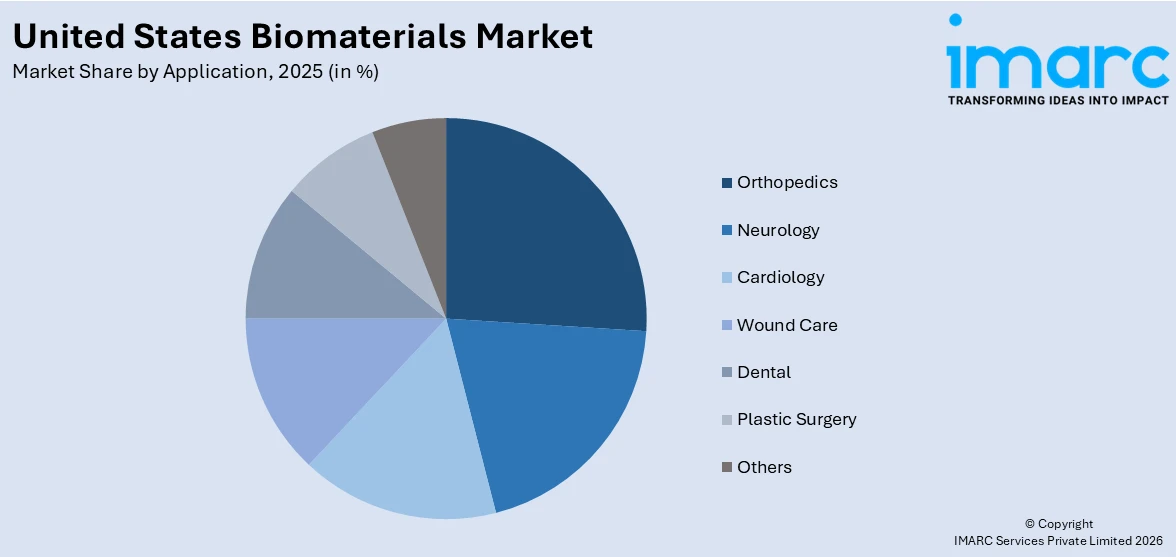
In 2025, the orthopedics segment led the biomaterials market, accounting for 25.9% of the total market share, driven by the growing incidence of musculoskeletal disorders, sports injuries, and age-related conditions like arthritis drove this dominance. As the elderly population increases, so does the demand for joint replacements and bone repair materials. Biomaterials used in orthopedic applications offer critical advantages, including high mechanical strength, biocompatibility, and the ability to support bone regeneration. Innovations in scaffold design, biodegradable composites, and surface modifications further enhanced implant effectiveness and patient recovery. Moreover, the rising preference for minimally invasive orthopedic surgeries and the expansion of outpatient care facilities contributed to higher utilization of advanced biomaterials, solidifying orthopedics as a key market driver.
Regional Analysis:
- Northeast
- Midwest
- South
- West
The Northeast United States plays a critical role in the biomaterials market due to its concentration of leading research institutions, hospitals, and biotechnology companies. The region benefits from robust investment in medical innovations, a high demand for advanced medical treatments, and a strong healthcare infrastructure. Cities like Boston and New York are hubs for biomedical research, promoting the development of new biomaterials. Additionally, the region's aging population drives demand for joint replacements, implants, and prosthetics, further supporting the market growth in the Northeast.
The Midwest is a significant player in the US biomaterials market, thanks to its robust industrial base and growing investments in healthcare and biomedical research. States such as Michigan, Ohio, and Illinois are home to leading medical device manufacturers and academic institutions that focus on biomaterial development. The region's robust manufacturing base enables the scalable production of medical products, meeting the growing demand for biomaterials in surgery, orthopedics, and wound care. Additionally, the area's moderate cost of living and favorable business climate attract companies that focus on developing innovative biomaterials.
The South United States contributes significantly to the biomaterials market, driven by a growing healthcare sector. States such as Texas, Florida, and North Carolina are expanding their medical research and manufacturing capabilities. The region's low labor costs and favorable regulatory environment facilitate the development and commercialization of biomaterials, particularly in the fields of tissue engineering, regenerative medicine, and orthopedics. An aging population and rising demand for healthcare services also drive the need for prosthetics, implants, and medical devices, fostering further growth in the market. The South's expanding biotech infrastructure creates opportunities for collaboration and innovation in biomaterial applications, influencing the United States biomaterials market forecast.
The West Coast is a leader in biomaterial innovation, driven by a high concentration of tech companies and renowned research universities, such as Stanford and UC Berkeley. California is a major hub for biotechnology startups and large corporations focused on advanced biomaterials. The region's proximity to cutting-edge medical research, access to venture capital, and emphasis on sustainability foster significant developments in the biomaterials market. As the demand for personalized medicine, regenerative therapies, and advanced implants rises, the West continues to lead the charge in new biomaterial applications, contributing to both national and global growth.

Competitive Landscape:
The market research report has also provided a comprehensive analysis of the competitive landscape in the market. Competitive analysis such as market structure, key player positioning, top winning strategies, competitive dashboard, and company evaluation quadrant has been covered in the report. Also, detailed profiles of all major companies have been provided.
United States Biomaterials Market News:
- May 2025: Nexture Bio launched a suite of services in the United States to support biomaterials fabrication and cell culture development, expanding its reach in the cell-based systems sector. The services, based in California and Ohio, focused on ACF microcarriers and scaffolds tailored for research institutions and bioprocess scaling.
- April 2025: Humabiologics introduced research-grade human collagen in the United States to help scientists overcome funding challenges from reduced NIH and NSF support. By pricing human biomaterials below animal alternatives, the company advanced accessibility in biomaterials research.
- April 2025: Cambium launched ApexShield 1000, a high-temperature resin system reducing carbon-carbon part fabrication time by up to 80%. Developed with AI and US defense labs, it advanced biomaterials innovation, significantly accelerating hypersonic component production and strengthening the domestic supply chain for aerospace manufacturers.
- February 2025: MycoWorks unveiled enhanced performance results for its flagship biomaterial Reishi™, developed through its new Rei-Tanning™ technology. The biomaterial, produced at its South Carolina facility, surpassed luxury leather benchmarks and became available online for the first time, marking a milestone in the US biomaterials industry.
- February 2025: TOUS les JOURS introduced plant-based straws made with PHACT PHA across the United States, marking its first US rollout of the low-carbon biopolymer developed by CJ Biomaterials. The biomaterials-based straws had already proven successful in South Korea and were certified for compostability and marine biodegradability.
United States Biomaterials Market Report Scope:
| Report Features | Details |
|---|---|
| Base Year of the Analysis | 2025 |
| Historical Period | 2020-2025 |
| Forecast Period | 2026-2034 |
| Units | Million USD |
| Scope of the Report | Exploration of Historical Trends and Market Outlook, Industry Catalysts and Challenges, Segment-Wise Historical and Future Market Assessment:
|
| Types Covered | Natural Biomaterial, Metallic Biomaterial, Ceramic Biomaterial, Polymeric Biomaterial |
| Applications Covered | Neurology, Cardiology, Orthopedics, Wound Care, Dental, Plastic Surgery, Others |
| Regions Covered | Northeast, Midwest, South, West |
| Customization Scope | 10% Free Customization |
| Post-Sale Analyst Support | 10-12 Weeks |
| Delivery Format | PDF and Excel through Email (We can also provide the editable version of the report in PPT/Word format on special request) |
Key Benefits for Stakeholders:
- IMARC’s report offers a comprehensive quantitative analysis of various market segments, historical and current market trends, market forecasts, and dynamics of the United States biomaterials market from 2020-2034.
- The United States biomaterials market research report provides the latest information on the market drivers, challenges, and opportunities in the market.
- The study maps the leading, as well as the fastest-growing, regional markets. It further enables stakeholders to identify the key markets within the region.
- Porter's five forces analysis assist stakeholders in assessing the impact of new entrants, competitive rivalry, supplier power, buyer power, and the threat of substitution. It helps stakeholders to analyze the level of competition within the United States biomaterials industry and its attractiveness.
- Competitive landscape allows stakeholders to understand their competitive environment and provides an insight into the current positions of key players in the market.
Frequently Asked Questions About the United States Biomaterials Market Report
The biomaterials market in the United States was valued at USD 34,767.4 Million in 2025.
The biomaterials market in the United States is projected to exhibit a CAGR of 11.12% during 2026-2034, reaching a value of USD 89,838.1 Million by 2034.
The United States biomaterials market is driven by rising chronic diseases, an aging population, and growing demand for advanced medical implants. Innovations in regenerative medicine, 3D printing, and nanotechnology enhance product functionality, while government funding and research support accelerate adoption, collectively fueling growth and expanding applications across healthcare and medical sectors.
Need more help?
- Speak to our experienced analysts for insights on the current market scenarios.
- Include additional segments and countries to customize the report as per your requirement.
- Gain an unparalleled competitive advantage in your domain by understanding how to utilize the report and positively impacting your operations and revenue.
- For further assistance, please connect with our analysts.
 Request Customization
 Speak to an Analyst
 Request Brochure
 Inquire Before Buying
Benefits of Customization
- Personalize this research
- Triangulate with your data
- Get data as per your format and definition
- Gain a deeper dive into a specific application, geography, customer, or competitor
- Any level of personalization
Get in Touch With Us
UNITED STATES
Phone: +1-201-971-6302
INDIA
Phone: +91-120-433-0800
UNITED KINGDOM
Phone: +44-753-714-6104
Email: [email protected]
Client Testimonials




.webp)




.webp)













Related Reports

Choose your plan
*Please note that the prices mentioned below are starting prices for each bundle type. Kindly contact our team for further details.*
Single User License
- 1 User License, Access on 2 Devices
- PDF Report + Excel Dataset (Password Protected)
- Lifetime Access
- No Printing Rights
- 10% Free Report Customization
- 10–12 Weeks of Analyst Support
Five User License
- Access for 5 Users, 2 Devices per User
- PDF Report + Excel Dataset (Password Protected)
- Lifetime Access
- Dedicated Account Manager
- 12–14 Weeks of Analyst Support
- No Printing Rights
- 15% Free Report Customization
- 25% Discount on Your Next Purchase
Corporate User License
- Unlimited User Access (Within Your Organization)
- PDF Report + Excel Dataset
- Lifetime Access
- Dedicated Account Manager
- 14–20 Weeks of Analyst Support
- No Printing Rights
- 20% Free Report Customization
- 30% Discount on Your Next Purchase
Essential Insights
What's included:
3 reports
- Lifetime Access
- PDF Reports
- Excel Datasets
- 2 Weeks of Free Analyst Support
- 2 User Licenses
- Access on 2 Devices
- Printing Rights
- Complimentary PowerPoint (PPT) Version
- Complimentary License Upgrade
Professional Access
What's included:
5 reports
- Lifetime Access
- PDF Reports
- Excel Datasets
- 8 Weeks of Free Analyst Support
- 2 User Licenses
- Access on 2 Devices
- Printing Rights
- Complimentary PowerPoint (PPT) Version
- Complimentary License Upgrade
Business Advantage
What's included:
8 reports
- Lifetime Access
- PDF Reports
- Excel Datasets
- 14 Weeks of Free Analyst Support
- 2 User Licenses
- Access on 2 Devices
- Printing Rights
- Complimentary PowerPoint (PPT) Version
- Complimentary License Upgrade
Enterprise Intelligence
What's included:
10 reports
- Lifetime Access
- PDF Reports
- Excel Datasets
- 20 Weeks of Free Analyst Support
- 2 User Licenses
- Access on 2 Devices
- Printing Rights
- Complimentary PowerPoint (PPT) Version
- Complimentary License Upgrade