
United States C4ISR Market Size, Share, Trends and Forecast by Platform, Solution, End Use Sector, Application, and Region, 2026-2034
United States C4ISR Market Size, Share, Trends & Forecast (2026-2034)
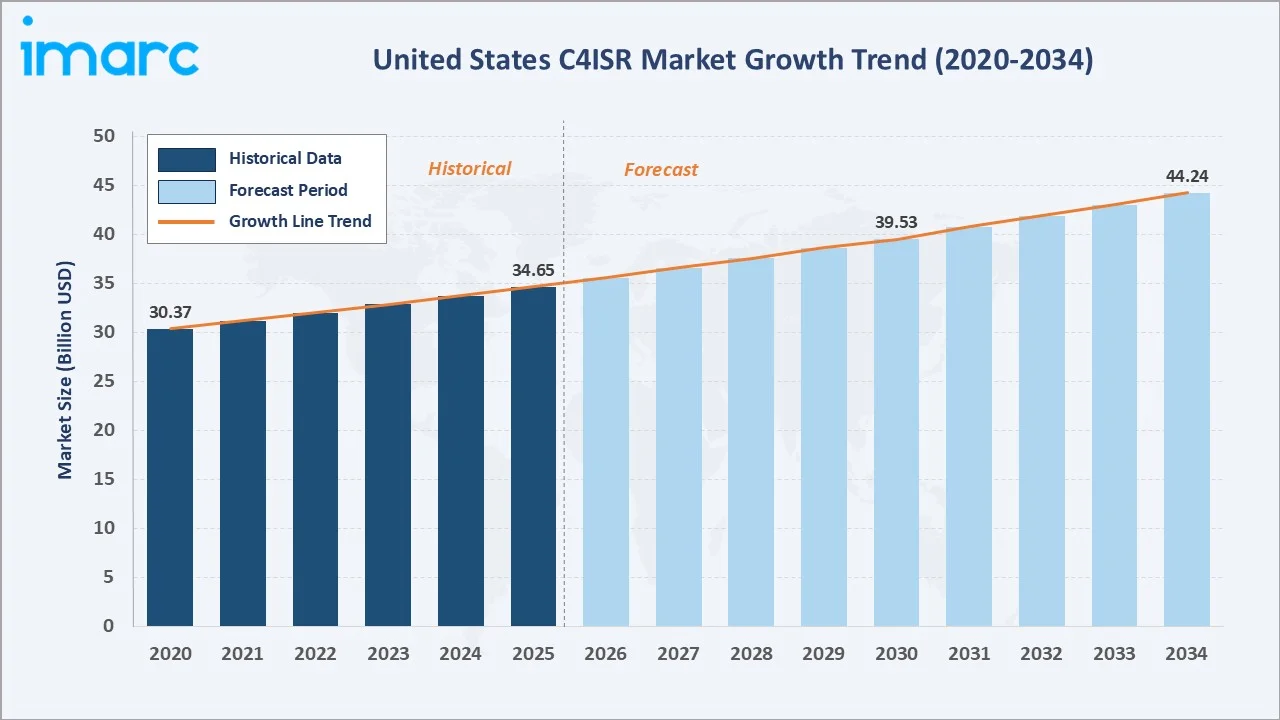
The United States C4ISR market size increased from USD 34.65 Billion in 2025 to USD 35.58 Billion in 2026 and is projected to reach USD 44.24 Billion by 2034, growing at a CAGR of 2.67% during 2026-2034. The market is driven by rising geopolitical tensions, JADC2 modernization mandates, and growing demand for AI-enabled situational awareness.
Airborne platforms dominate at 34.6%, Products lead at 68.2%, and the South commands 36.1% of national market share.
Market Snapshot
|
Metric |
Value |
|
Base Year Market Size (2025) |
USD 34.65 Billion |
|
Market Size (2026) |
USD 35.58 Billion |
|
Forecast Market Size (2034) |
USD 44.24 Billion |
|
CAGR (2026-2034) |
2.67% |
|
Base Year |
2025 |
|
Historical Period |
2020-2025 |
|
Forecast Period |
2026-2034 |
|
Dominant Platform |
Airborne (34.6%, 2025) |
|
Dominant Solution |
Products (68.2%, 2025) |
|
Leading Region |
South (36.1%, 2025) |
To get more information on this market, Request Sample
The market expanded from USD 30.37 Billion in 2020 to USD 34.65 Billion in 2025 and an estimated USD 35.58 Billion in 2026, anchored at USD 39.53 Billion in 2030 and forecast to reach USD 44.24 Billion by 2034. Sustained DoD budget allocations, NATO interoperability requirements, and accelerating space domain investments drove consistent market expansion throughout the historical period.
Executive Summary
The United States C4ISR market, which increased from USD 34.65 Billion in 2025 to USD 35.58 Billion in 2026, anchored by the world's largest defense budget and a strategic mandate to modernise command, control, communications, computers, intelligence, surveillance, and reconnaissance capabilities across all warfighting domains. The market is projected to reach USD 44.24 Billion by 2034.
Airborne platforms at 34.6% dominate through high-altitude ISR, UAV proliferation, and airborne battle management systems. Products at 68.2% lead the solution segment through hardware procurement cycles for radios, sensors, and computing systems. The South region at 36.1% leads through its concentration of major DoD bases, defense contractors, and aerospace facilities in Texas, Virginia, and Florida.
Key Market Insights
|
Insight |
Data |
|
Dominant Platform |
Airborne – 34.6% market share (2025) |
|
Dominant Solution |
Products – 68.2% market share (2025) |
|
Leading Region |
South – 36.1% market share (2025) |
|
Market Opportunity |
JADC2 integration; Space C4ISR; AI-enabled ISR; multi-domain command systems |
Key Analytical Observations Supporting The Above Data:
- Airborne at 34.6%: Airborne platforms dominate through UAVs, manned ISR aircraft, airborne battle management systems, and Electronic Warfare platforms. The US Air Force, Army, and Navy collectively operate thousands of airborne C4ISR assets, with continued procurement of advanced ISR platforms sustaining segment leadership across the forecast period.
- Products at 68.2%: Products lead through major procurement cycles for tactical radios, radar systems, electronic warfare equipment, and ruggedised computing platforms. Long-term DoD acquisition programmes for communications hardware, sensor systems, and networking equipment drive sustained product demand over the 2026-2034 period.
- South at 36.1%: The South leads through its dense concentration of major military installations, including the Pentagon, numerous Air Force bases, and naval facilities in Virginia, Texas, Florida, and North Carolina, alongside the region's dominant defense contractor and aerospace industry workforce generating concentrated C4ISR procurement and deployment activity.
United States C4ISR Market Overview
The US C4ISR market encompasses command, control, communications, computers, intelligence, surveillance, and reconnaissance systems deployed across airborne, land, naval, and space platforms. The ecosystem integrates prime defense contractors, electronics manufacturers, software developers, and government agencies.
The market is underpinned by the DoD's largest-in-history budget allocations, the Joint All-Domain Command and Control (JADC2) strategy demanding seamless multi-domain integration and escalating great-power competition requiring advanced ISR and communications capabilities across all operational environments.
Market Dynamics
To evaluate market opportunities, Request Sample
Market Drivers
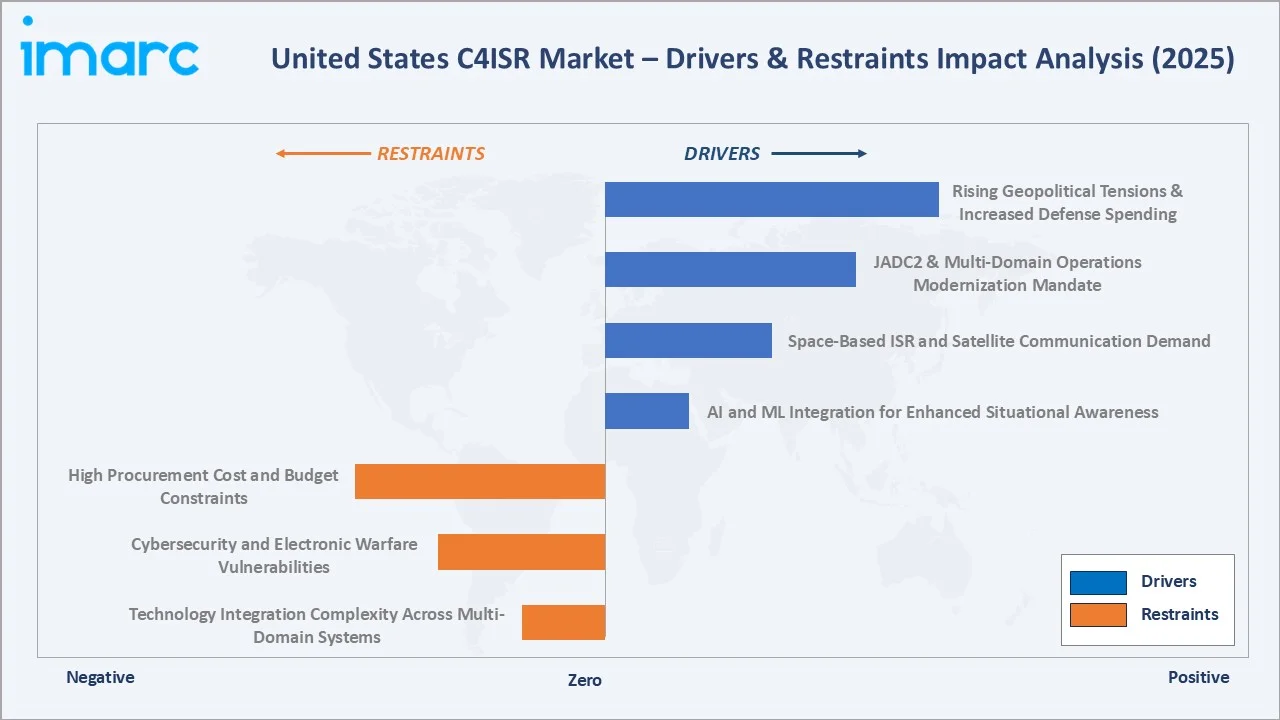
- Rising Geopolitical Tensions & Increased Defense Spending: Escalating great-power competition with China and Russia, ongoing regional conflicts, and NATO burden-sharing commitments are driving sustained increases in DoD C4ISR investment. The FY2025 defense budget exceeded USD 850 billion, with C4ISR representing one of the fastest-growing investment categories within the overall defence allocation.
- JADC2 & Multi-Domain Operations Modernization Mandate: The Pentagon's Joint All-Domain Command and Control strategy mandates seamless integration of C4ISR systems across land, air, sea, space, and cyber domains. JADC2 is driving billions in C4ISR investment as the services modernise legacy systems and develop next-generation networking, AI-enabled decision support, and cross-domain communication platforms.
- Space-Based ISR & Satellite Communication Demand: Growing investment in low-Earth orbit satellite constellations, military SATCOM, and space-domain awareness is expanding the space C4ISR segment. The Space Force's proliferated LEO communications and ISR architecture, combined with investment in resilient space-based capabilities, is a significant structural growth driver.
- AI and ML Integration for Enhanced Situational Awareness: The DoD's Algorithmic Warfare and AI strategy is embedding AI and machine learning into C4ISR platforms for automated threat detection, sensor fusion, and real-time battlespace management. AI integration into ISR data processing and command decision support is expanding the addressable C4ISR market.
Market Restraints
- High Procurement Cost & Budget Constraints: C4ISR systems represent among the most capital-intensive defence acquisitions, with major programmes running into tens of billions. Budget pressures, continuing resolutions, and competing DoD procurement priorities create funding uncertainty that can delay programme timelines and limit incremental investment velocity.
- Cybersecurity & Electronic Warfare Vulnerabilities: Advanced C4ISR systems are prime targets for adversarial cyber operations, electronic jamming, and anti-satellite attacks. Hardening C4ISR systems against sophisticated electromagnetic and cyber threats requires continuous investment, adding cost and complexity to procurement and fielding timelines.
- Technology Integration Complexity Across Multi-Domain Systems: Achieving seamless interoperability between legacy and next-generation C4ISR systems across all four platforms, and across coalition partners, involves significant technical challenges. Legacy system heterogeneity, proprietary architectures, and classification barriers create integration costs that constrain deployment velocity.
Market Opportunities
- Proliferated LEO Space Architecture for Resilient C4ISR: Investment in proliferated low-Earth orbit satellite constellations for communications and ISR creates a high-growth opportunity for space segment C4ISR. The Space Force's Next Generation OPIR, WGS follow-on, and commercial SATCOM integration programmes represent multi-billion-dollar procurement opportunities.
- AI-Driven Autonomous ISR & Decision Support Systems: AI-enabled autonomous ISR platforms, automated sensor fusion, and machine-speed decision support represent the highest-growth capability investment category. The DoD's Replicator initiative and autonomous systems strategy are creating new C4ISR market segments beyond traditional hardware and software procurement.
Market Challenges
- Workforce & Talent Gaps in Classified C4ISR Programmes: Advanced C4ISR development requires highly cleared, specialised engineers, systems integrators, and cyber professionals. The shortage of cleared technical talent, combined with competition from the commercial technology sector, is creating workforce constraints that limit programme execution velocity across the C4ISR industrial base.
- Adversarial Technological Convergence & Capability Erosion: The rapid pace of Chinese and Russian investment in C4ISR-counter and anti-access/area-denial capabilities is eroding the US technological advantage in legacy systems. Continuous investment in next-generation, contested-environment-resilient C4ISR is required to maintain battlefield superiority, creating relentless capability refresh pressure.
Emerging Market Trends
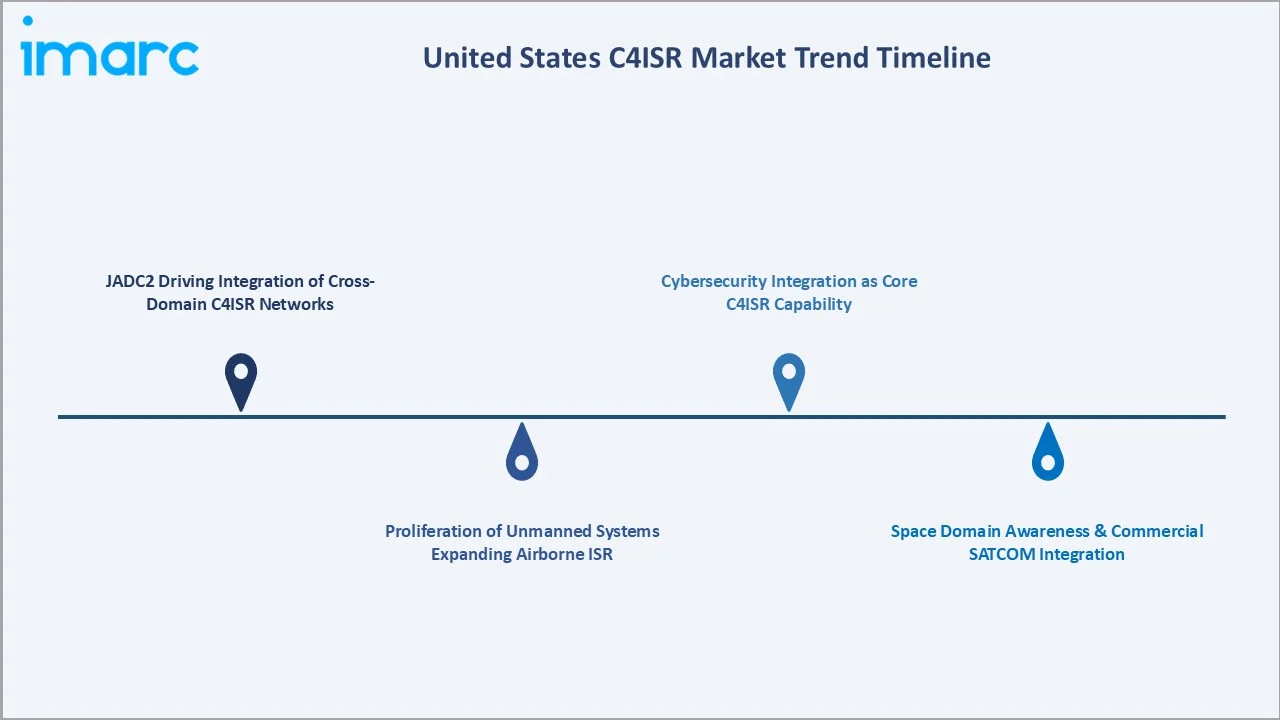
1. JADC2 Driving Integration of Cross-Domain C4ISR Networks
The Joint All-Domain Command and Control initiative is the most transformative structural driver in the US C4ISR market. JADC2 mandates seamless sensor-to-shooter connectivity across all domains, driving investment in advanced networking, cloud-native command systems, and AI-enabled decision support replacing domain-siloed legacy architectures.
2. Proliferation of Unmanned Systems Expanding Airborne ISR
Rapid expansion in UAV ISR platforms, from Predator/Reaper class to MQ-25, Loyal Wingman, and small UAS, is expanding the airborne C4ISR segment. DoD investment in autonomous systems integration with manned aircraft command networks is creating new C4ISR procurement requirements across all four services.
3. Space Domain Awareness & Commercial SATCOM Integration
Growing investment in Space Domain Awareness, resilient military SATCOM, and commercial LEO satellite integration is expanding the space C4ISR segment at the highest CAGR. The Space Force's proliferated architecture strategy and reliance on commercial providers like SpaceX Starlink for military communications is driving new space-segment procurement.
4. Cybersecurity Integration as Core C4ISR Capability
Cyber hardening, zero-trust architecture implementation, and electronic warfare resilience are now core C4ISR requirements rather than add-on capabilities. DoD's cyber strategy mandates integrated cybersecurity across all C4ISR systems, creating a growing embedded cybersecurity C4ISR market within defence communications and command systems.
Industry Value Chain Analysis
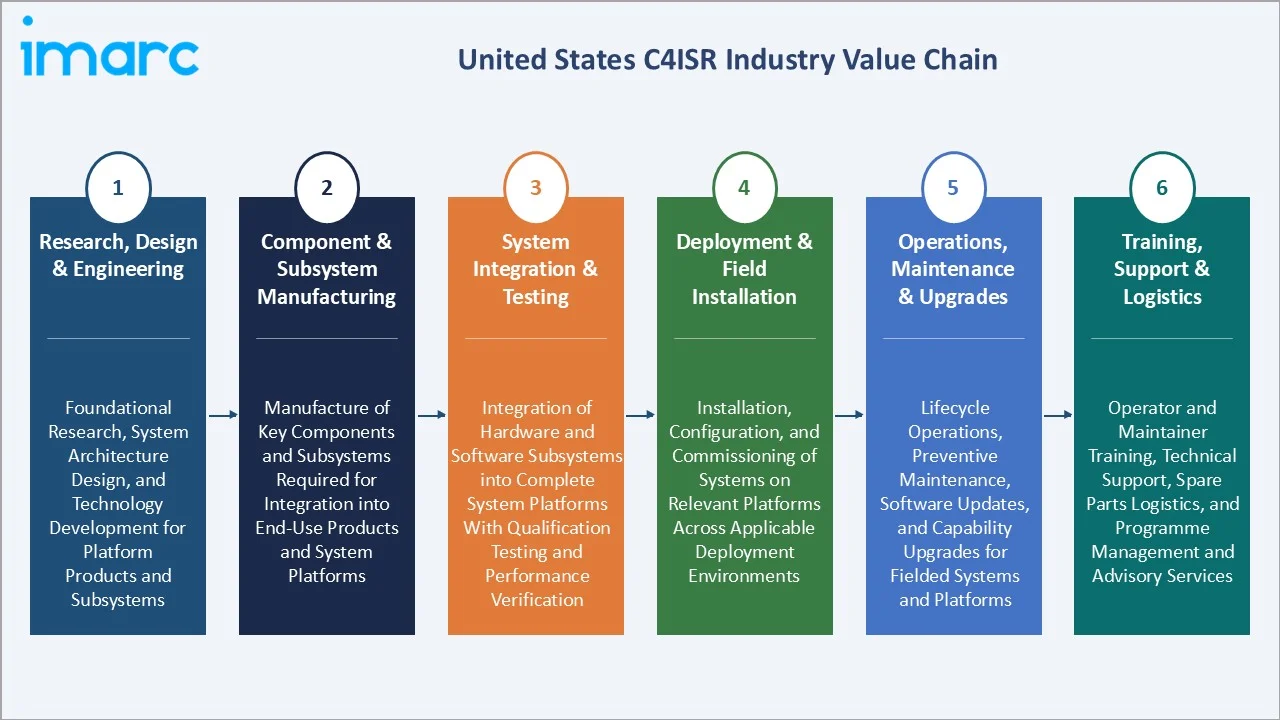
The US C4ISR value chain integrates research and engineering, component manufacturing, system integration, field deployment, and lifecycle operations. The ecosystem is shifting toward modular open systems architectures enabling faster technology insertion and reducing single-supplier dependency across long-lifecycle defence programmes.
|
Stage |
Key Participants |
|
Research, Design & Engineering |
Foundational research, system architecture design, and technology development for platform products and subsystems |
|
Component & Subsystem Manufacturing |
Manufacture of key components and subsystems required for integration into end-use products and system platforms |
|
System Integration & Testing |
Integration of hardware and software subsystems into complete system platforms with qualification testing and performance verification |
|
Deployment & Field Installation |
Installation, configuration, and commissioning of systems on relevant platforms across applicable deployment environments |
|
Operations, Maintenance & Upgrades |
Lifecycle operations, preventive maintenance, software updates, and capability upgrades for fielded systems and platforms |
|
Training, Support & Logistics |
Operator and maintainer training, technical support, spare parts logistics, and programme management and advisory services |
System integration and testing represent the highest value-add stage in the US C4ISR value chain. Prime contractors such as Lockheed Martin Corporation and Northrop Grumman Corporation dominate through end-to-end integration capabilities spanning all four platforms, supported by a vast Tier 1 and 2 supplier ecosystems.
Technology Landscape in the United States C4ISR Industry
Communications & Networking Technology
Tactical communications form the backbone of C4ISR, spanning Software Defined Radios, military satellite communications, and secure encrypted networking. JADC2 is driving investment in resilient, contested-environment communications including Link 16, MADL, and proliferated SATCOM, representing the largest addressable technology investment category within the C4ISR market.
Intelligence, Surveillance & Reconnaissance Technology
ISR technology encompasses advanced multi-spectral sensors, synthetic aperture radar, signals intelligence systems, and space-based imagery. AI-enabled sensor fusion, persistent surveillance platforms, and hyperspectral imaging are the fastest-growing ISR technology segments, driven by the DoD's need for real-time battlespace awareness across all domains.
Command & Control Software & AI Platforms
Modern C4ISR command and control increasingly relies on cloud-native software architectures, AI-assisted decision support, and machine learning for automated threat classification and course-of-action analysis. The DoD's CJADC2 software programme and Project Convergence are driving investment in advanced command software representing the market's highest-growth software segment.
Market Segmentation Analysis
The report covers the following segments:
|
Segment Category |
Leading Segment |
Market Share |
Year |
|
Platform |
Airborne |
34.6% |
2025 |
|
Solution |
Products |
68.2% |
2025 |
|
End Use Sector |
🔒 |
🔒 |
2025 |
|
Application |
🔒 |
🔒 |
2025 |
|
Region |
South |
36.1% |
2025 |

By Platform
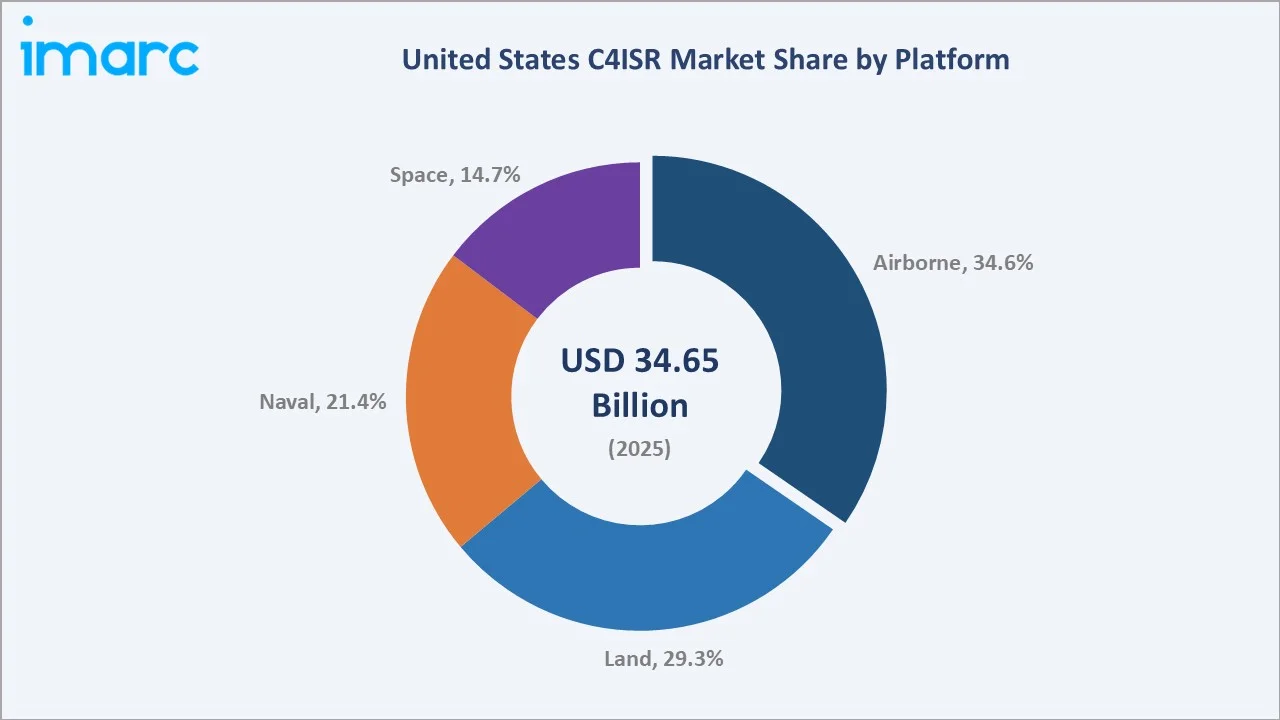
Airborne platforms lead at 34.6% in 2025, driven by UAV proliferation, airborne battle management systems, and electronic warfare aircraft procurement across the US Air Force, Army, and Navy.
To access detailed market analysis, Request Sample
Land at 29.3% encompasses Army tactical C4ISR, ground vehicle-mounted systems, and fixed terrestrial installations. Naval at 21.4% covers shipboard command systems, maritime patrol, and submarine communications. Space at 14.7% is the fastest-growing platform driven by Space Force investment in LEO constellations.
By Solution
Products lead at 68.2% through major hardware procurement cycles for tactical radios, radar systems, electronic warfare equipment, computing platforms, and surveillance sensors across all four military services.
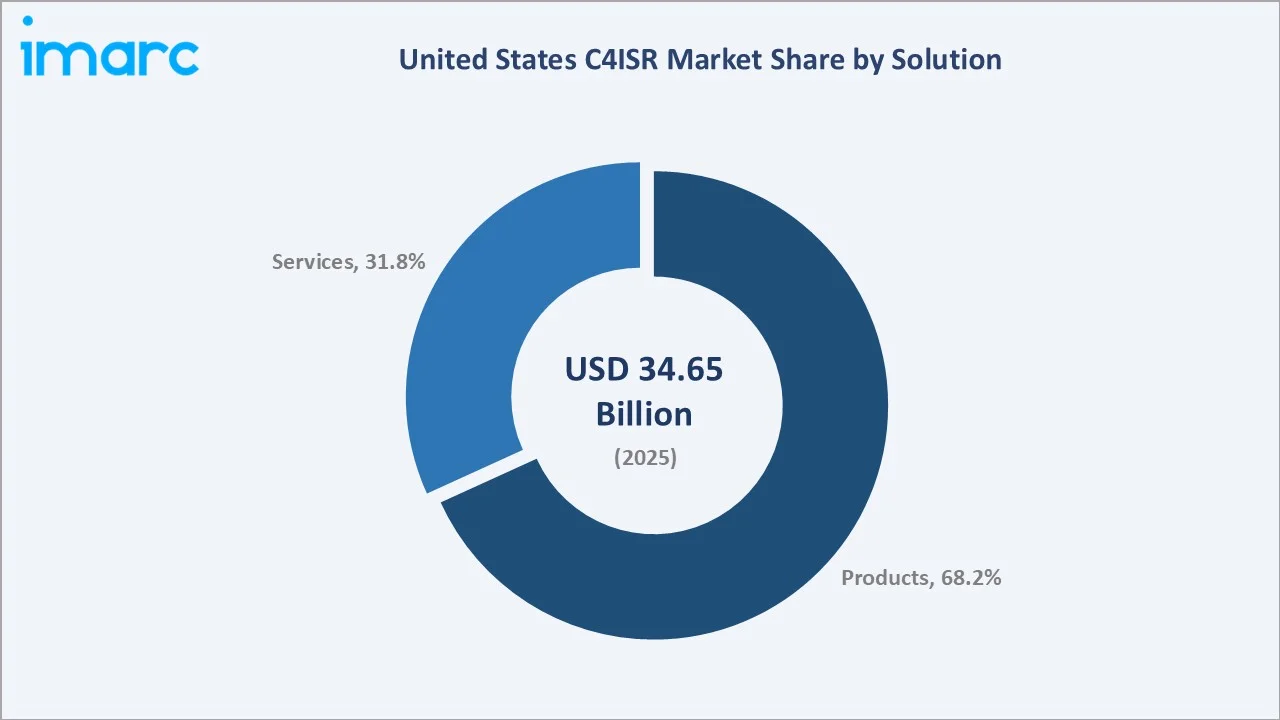
Services at 31.8% encompass systems integration, programme management, maintenance, training, and lifecycle support. Growing complexity of multi-domain C4ISR systems is expanding the services segment as prime contractors provide sustained engineering support across long-lifecycle programmes.
Regional Market Insights
|
Region |
Share (2025) |
Key Drivers & Characteristics |
|
South |
36.1% |
Significant military presence, established defence contractor ecosystem, and advanced aerospace industry activity driving regional market growth |
|
West |
27.8% |
Growing technology adoption, strong defence research and development activity, and expanding aerospace and space sector investments |
|
Northeast |
21.4% |
High concentration of government agencies, research institutions, and advanced technology development activities supporting market demand |
|
Midwest |
14.7% |
Expanding defence manufacturing base, increasing technology investments, and growing military command infrastructure driving regional demand |
The South leads at 36.1% through its unparalleled concentration of military installations, including the Pentagon, Joint Base Langley-Eustis, and numerous Air Force, Army, Navy, and Marine Corps facilities in Virginia, Texas, Florida, and North Carolina, generating the nation's highest per-region C4ISR procurement and systems integration activity.
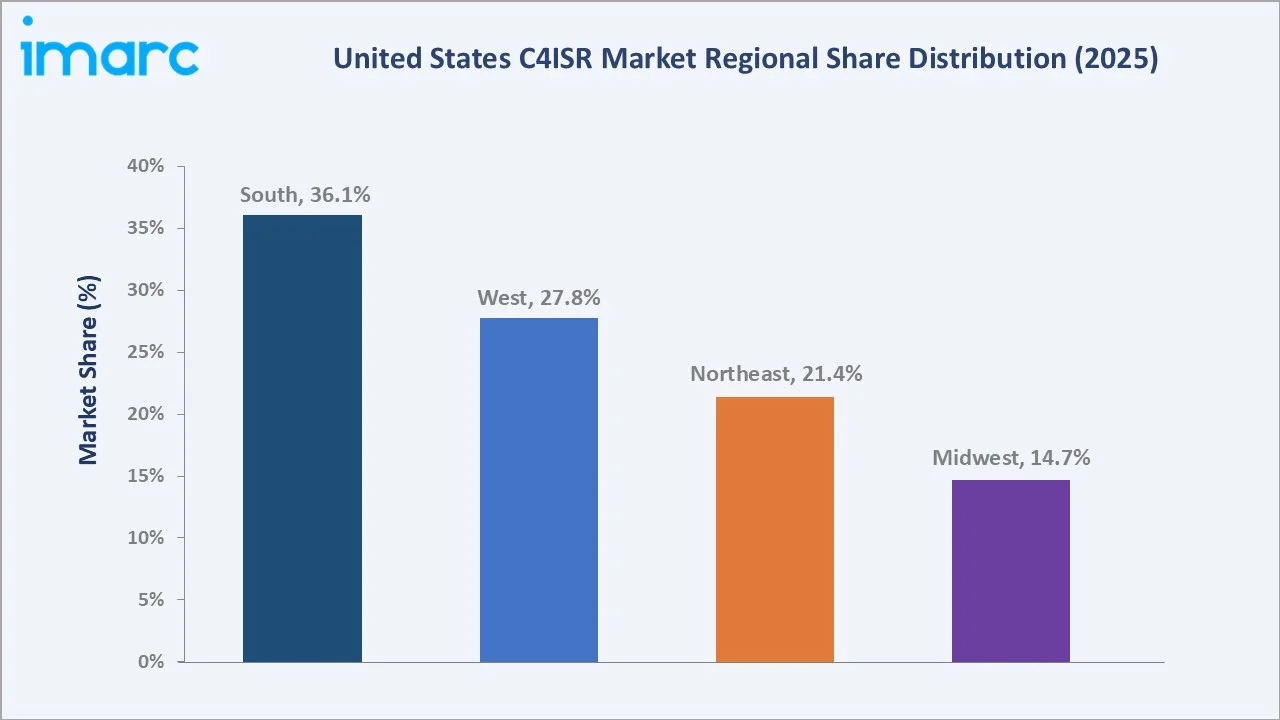
The West at 27.8% is anchored by the Space Force headquarters at Peterson Space Force Base in Colorado, major naval facilities in California, and a dense aerospace and technology industry cluster supporting space C4ISR, signals intelligence, and advanced airborne platform development across California, Colorado, and Washington.
The Northeast at 21.4% encompasses the Pentagon's National Capital Region, NSA, and intelligence community facilities in Maryland, and major naval surface warfare centres. The Midwest at 14.7% is anchored by Wright-Patterson AFB in Ohio, a key AFRL research hub, and numerous Air Force and Army command installations driving regional C4ISR procurement.
Competitive Landscape
The US C4ISR market is highly concentrated, with a small number of prime defence contractors holding long-term DoD relationships, classified programme access, and end-to-end system integration capabilities. Barriers to entry are extremely high due to security clearance requirements, defence procurement regulations, and technical complexity.
|
Company Name |
Key Products |
Market Position |
Core Strength |
|
Lockheed Martin Corporation |
CommandIQ, Command Control Battle Management Communications (C2BMC), iSpace, SeaCommander, TRACER |
Market Leader |
Largest defence contractor; airborne & space C4ISR integration |
|
L3Harris Technologies, Inc. |
TYR4, C4ISR Integrated Systems |
Strong Challenger |
Tactical communications, SATCOM, and multi-domain ISR |
|
General Dynamics Corporation |
C4ISR solutions |
Strong Challenger |
Ground C4ISR, secure communications, and IT systems |
Key players include Lockheed Martin Corporation, L3Harris Technologies, Inc., General Dynamics Corporation, and others.
.webp)
Key Company Profiles
Lockheed Martin Corporation
Lockheed Martin Corporation is the world's largest defence contractor, with the largest C4ISR portfolio across airborne, land, naval, and space platforms serving the US DoD and international defence customers.
- Key Products: CommandIQ, Command Control Battle Management Communications (C2BMC), iSpace, SeaCommander, TRACER
- Strategic Focus: Advancing integrated multi-domain C4ISR through the F-35 ecosystem expansion, Next Gen OPIR space ISR, and 21st Century Security artificial intelligence-enabled battle management platform investments.
General Dynamics Corporation
General Dynamics Corporation is a global aerospace and defence company headquartered in Reston, Virginia, delivering mission-critical C4ISR solutions across land, sea, air, space, and cyber domains through its General Dynamics Mission Systems business unit serving the US DoD and allied defence customers worldwide.
- Key Products: C4ISR solutions
- Strategic Focus: Advancing multi-domain C4ISR integration through the Proliferated Warfighter Space Architecture ground system programme, expanding secure SATCOM capabilities via MUOS sustainment, and scaling land C4ISR system integration expertise to support JADC2 objectives across US Army and allied ground force programmes.
Market Concentration Analysis
The US C4ISR market is highly concentrated, with the top 5 players collectively accounting for an estimated 55–65% of total DoD C4ISR contract value annually. This concentration reflects the high barriers to entry in classified defence programmes.
Market concentration is expected to remain high through 2034 as JADC2 programme complexity and space domain investment favour established prime contractors with the security clearances, technical infrastructure, and DoD relationships required to lead multi-billion-dollar C4ISR integration programmes.
Investment & Growth Opportunities
Highest Growth Segments
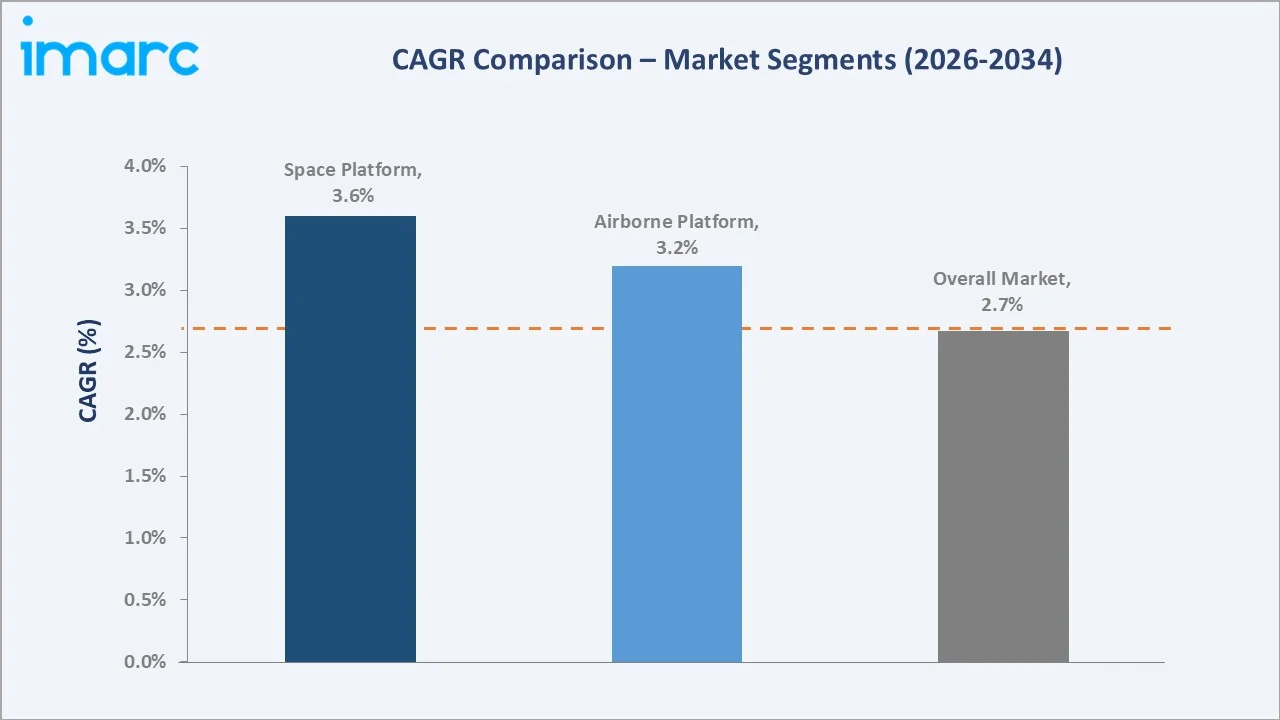
Space C4ISR (~3.6% CAGR), airborne ISR (~3.2% CAGR), services (~2.2% CAGR), AI-enabled command and control (~18%+ CAGR from emerging base), JADC2 software integration (~15% CAGR), and space domain awareness (~20%+ CAGR from near-zero commercial base) represent the highest-growth investment vectors through 2034.
Emerging Investment Opportunities
JADC2 software integration represents the single largest emerging investment opportunity in the US C4ISR market. The DoD's requirement to seamlessly connect all domain sensors, weapons, and command nodes creates a multi-billion-dollar software programme pipeline for advanced networking, AI decision support, and multi-domain data integration platforms.
Investment Themes
- Space C4ISR resilient architecture investment: Proliferated LEO military SATCOM and ISR constellation investment creates the highest-CAGR C4ISR investment vector, with Space Force procurement of next-generation communications satellites, SDA tracking layers, and missile warning systems commanding premium pricing throughout the forecast period.
- AI-enabled ISR data processing and sensor fusion: AI/ML integration into ISR analytics, automated threat detection, and real-time sensor fusion platforms creates new high-value C4ISR software segments commanding sustained investment from DoD agencies operating under the Algorithmic Warfare Centres mandate.
Future Market Outlook (2026-2034)
The US C4ISR market is projected to grow from USD 34.65 Billion in 2025 to USD 35.58 Billion in 2026, reaching USD 44.24 Billion by 2034, delivering a steady 2.67% CAGR. The market is underpinned by the DoD's sustained investment in advanced C4ISR capabilities required for great-power competition and multi-domain warfare superiority through the forecast period.
Space C4ISR will grow at the highest platform CAGR as the Space Force matures its proliferated LEO architecture. JADC2 implementation will drive the largest incremental software investment. The South will retain regional leadership while the West accelerates through Space Force base expansion and emerging technology firm defence contracting growth.
Three structural forces define US C4ISR market growth through 2034: the strategic competition with China and Russia requiring continuous C4ISR modernisation; the JADC2 mandate creating a decade-long software integration investment cycle; and rapid technology evolution in AI, space, and autonomous systems expanding the total addressable C4ISR market.
Research Methodology
Primary Research
Primary research comprised structured interviews with 50+ stakeholders including DoD programme managers, defence industry executives, systems integrators, defence analysts, and procurement specialists across the US C4ISR industrial base, conducted during 2025.
Secondary Research
Secondary research encompassed DoD budget justification documents, defence appropriations committee reports, company annual reports, DARPA programme announcements, Congressional Research Service analyses, and defence trade publications. Over 65 secondary sources were reviewed.
Forecasting Models
Market revenue forecasts developed using a segmented bottom-up model: (i) DoD budget allocation by C4ISR programme category; (ii) platform-level procurement cycle forecasts; (iii) prime contractor revenue attribution by C4ISR segment; (iv) regional spending weighting by base and installation concentration and defence contractor workforce data.
United States C4ISR Market Report Coverage:
| Report Features | Details |
|---|---|
| Base Year of the Analysis | 2025 |
| Historical Period | 2020-2025 |
| Forecast Period | 2026-2034 |
| Units | Billion USD |
| Scope of the Report | Exploration of Historical and Forecast Trends, Industry Catalysts and Challenges, Segment-Wise Historical and Predictive Market Assessment:
|
| Platforms Covered | Land, Naval, Airborne, Space |
| Solutions Covered | Products, Services |
| End Use Sectors Covered | Defense, Commercial |
| Applications Covered | Intelligence, Surveillance and Reconnaissance, Electronic Warfare, Computers, Communication, Command and Control, Others |
| Regions Covered | Northeast, Midwest, South, West |
| Companies Covered | Lockheed Martin Corporation, L3Harris Technologies, Inc., General Dynamics Corporation, etc. |
| Customization Scope | 10% Free Customization |
| Post-Sale Analyst Support | 10-12 Weeks |
| Delivery Format | PDF and Excel through Email (We can also provide the editable version of the report in PPT/Word format on special request) |
Key Benefits for Stakeholders:
- IMARC’s industry report offers a comprehensive quantitative analysis of various market segments, historical and current market trends, market forecasts, and dynamics of the United States C4ISR market from 2020-2034.
- The research report provides the latest information on the market drivers, challenges, and opportunities in the United States C4ISR market.
- Porter's five forces analysis assist stakeholders in assessing the impact of new entrants, competitive rivalry, supplier power, buyer power, and the threat of substitution. It helps stakeholders to analyze the level of competition within the United States C4ISR industry and its attractiveness.
- A competitive landscape allows stakeholders to understand their competitive environment and provides an insight into the current positions of key players in the market.
Frequently Asked Questions About the United States C4ISR Market Report
The US C4ISR market size is estimated at USD 35.58 Billion in 2026, driven by the world's largest defence budget, JADC2 modernization mandates, Airborne platform dominance at 34.6%, and Products solution leadership at 68.2% across US Army, Navy, Air Force, and Space Force procurement programmes.
The market grows at 2.67% CAGR during 2026-2034, reaching USD 44.24 Billion by 2034. Growth reflects sustained DoD investment continuity, JADC2 implementation driving new software investment, space domain expansion, and AI integration creating new C4ISR capability categories beyond legacy hardware procurement.
Airborne platforms lead at 34.6%, capturing UAV ISR, airborne battle management, electronic warfare, and signals intelligence aircraft procurement across all four US military services, supported by continuous investment in next-generation ISR platforms replacing legacy fleets.
Products lead at 68.2% through major hardware procurement cycles for tactical communications radios, radar systems, electronic warfare equipment, ruggedised computing, and surveillance sensors representing the dominant share of DoD C4ISR budget allocations.
The South leads at 36.1% through its concentration of military installations, intelligence community facilities, and defence contractor headquarters in Virginia, Texas, Florida, and North Carolina generating the highest per-region C4ISR procurement and deployment activity nationally.
Leading companies include Lockheed Martin Corporation, L3Harris Technologies, Inc., General Dynamics Corporation, and others.
The market is projected to reach approximately USD 39.53 Billion by 2030, supported by JADC2 programme implementation, Space Force C4ISR architecture maturation, AI-enabled ISR platform adoption, and sustained DoD investment in multi-domain command and control capabilities across all services.
Need more help?
- Speak to our experienced analysts for insights on the current market scenarios.
- Include additional segments and countries to customize the report as per your requirement.
- Gain an unparalleled competitive advantage in your domain by understanding how to utilize the report and positively impacting your operations and revenue.
- For further assistance, please connect with our analysts.
 Request Customization
 Speak to an Analyst
 Request Brochure
 Inquire Before Buying
Benefits of Customization
- Personalize this research
- Triangulate with your data
- Get data as per your format and definition
- Gain a deeper dive into a specific application, geography, customer, or competitor
- Any level of personalization
Get in Touch With Us
UNITED STATES
Phone: +1-201-971-6302
INDIA
Phone: +91-120-433-0800
UNITED KINGDOM
Phone: +44-753-714-6104
Email: [email protected]
Client Testimonials




.webp)




.webp)













Related Reports

Choose your plan
*Please note that the prices mentioned below are starting prices for each bundle type. Kindly contact our team for further details.*
Single User License
- 1 User License, Access on 2 Devices
- PDF Report + Excel Dataset (Password Protected)
- Lifetime Access
- No Printing Rights
- 10% Free Report Customization
- 10–12 Weeks of Analyst Support
Five User License
- Access for 5 Users, 2 Devices per User
- PDF Report + Excel Dataset (Password Protected)
- Lifetime Access
- Dedicated Account Manager
- 12–14 Weeks of Analyst Support
- No Printing Rights
- 15% Free Report Customization
- 25% Discount on Your Next Purchase
Corporate User License
- Unlimited User Access (Within Your Organization)
- PDF Report + Excel Dataset
- Lifetime Access
- Dedicated Account Manager
- 14–20 Weeks of Analyst Support
- No Printing Rights
- 20% Free Report Customization
- 30% Discount on Your Next Purchase
Essential Insights
What's included:
3 reports
- Lifetime Access
- PDF Reports
- Excel Datasets
- 2 Weeks of Free Analyst Support
- 2 User Licenses
- Access on 2 Devices
- Printing Rights
- Complimentary PowerPoint (PPT) Version
- Complimentary License Upgrade
Professional Access
What's included:
5 reports
- Lifetime Access
- PDF Reports
- Excel Datasets
- 8 Weeks of Free Analyst Support
- 2 User Licenses
- Access on 2 Devices
- Printing Rights
- Complimentary PowerPoint (PPT) Version
- Complimentary License Upgrade
Business Advantage
What's included:
8 reports
- Lifetime Access
- PDF Reports
- Excel Datasets
- 14 Weeks of Free Analyst Support
- 2 User Licenses
- Access on 2 Devices
- Printing Rights
- Complimentary PowerPoint (PPT) Version
- Complimentary License Upgrade
Enterprise Intelligence
What's included:
10 reports
- Lifetime Access
- PDF Reports
- Excel Datasets
- 20 Weeks of Free Analyst Support
- 2 User Licenses
- Access on 2 Devices
- Printing Rights
- Complimentary PowerPoint (PPT) Version
- Complimentary License Upgrade