
United States Smart Glass Market Size, Share, Trends and Forecast by Technology, Control Mode, Application, and Region, 2026-2034
United States Smart Glass Market Size, Share, Trends & Forecast (2026-2034)
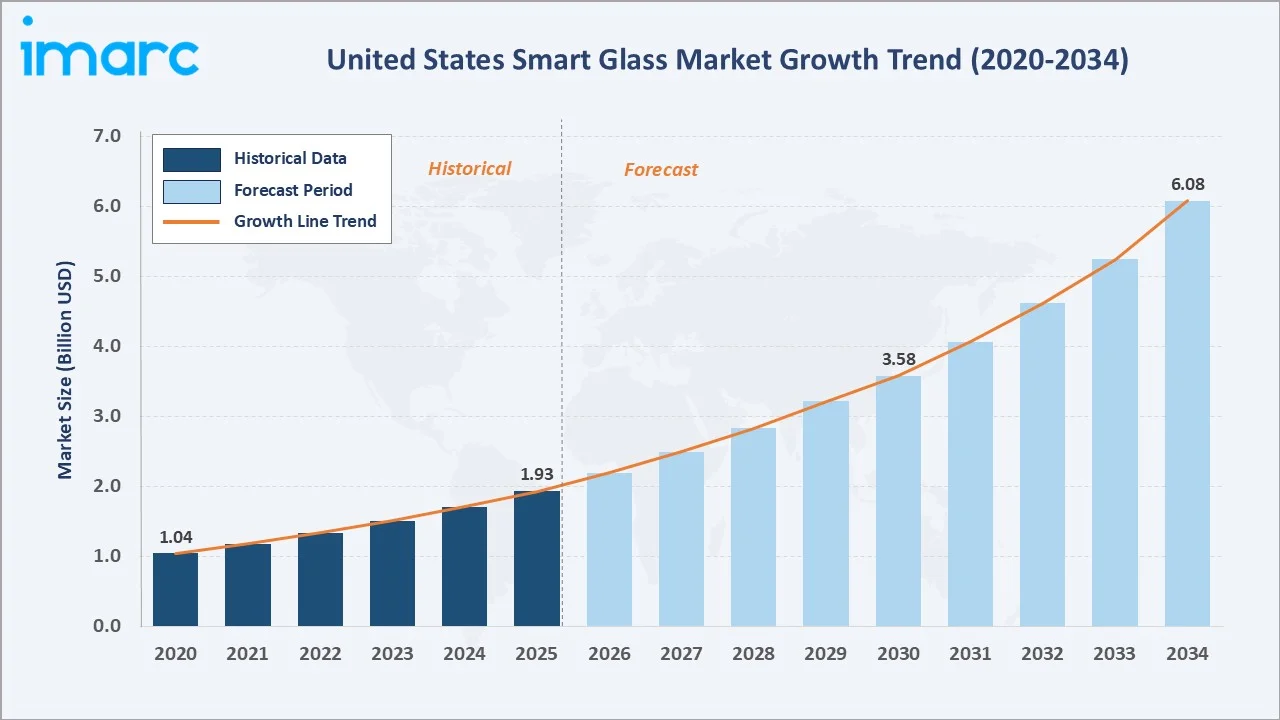
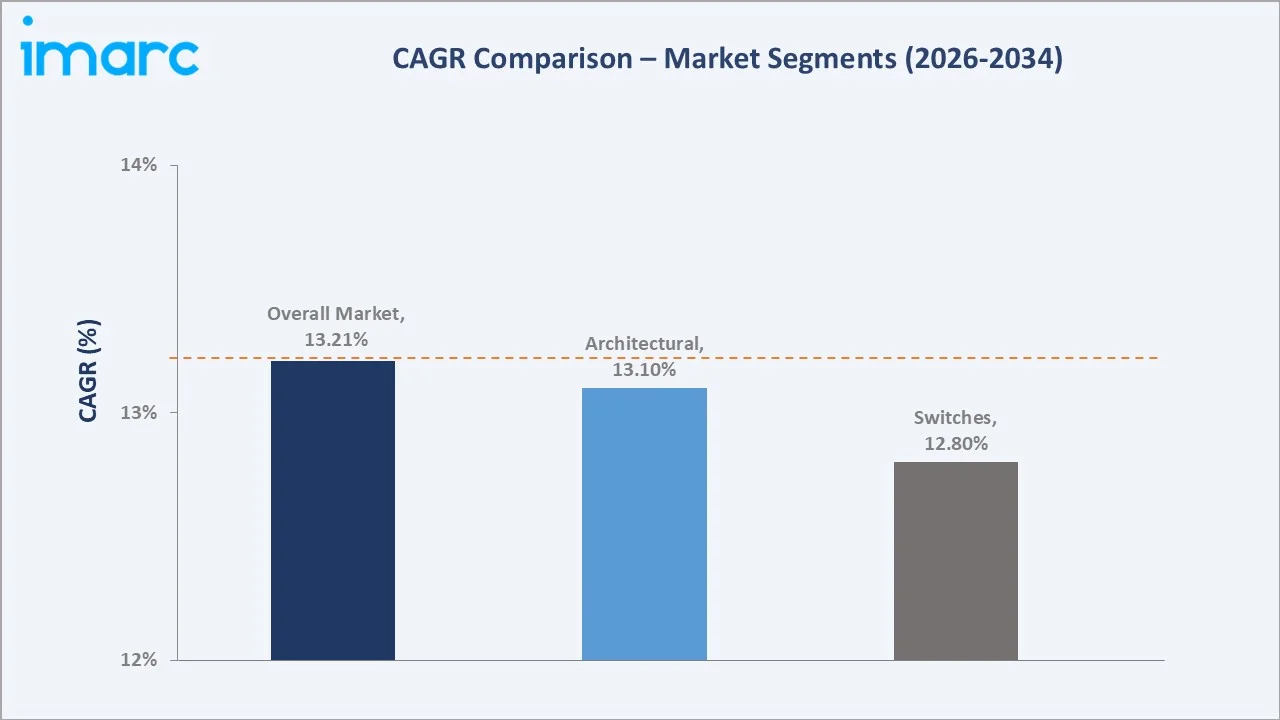
The United States smart glass market size increased from USD 1.93 Billion in 2025 to USD 2.18 Billion in 2026 and is projected to reach USD 6.08 Billion by 2034, growing at a CAGR of 13.21% during 2026-2034. Rising demand for energy-efficient glazing solutions, green building regulations, and smart infrastructure investments are key growth drivers. Architectural applications lead with a 52.6% share (2025), driven by commercial and residential construction. Switches dominate the control mode segment at 39.4%. The West region holds the largest share at 34.8%, supported by strong sustainability mandates and commercial real estate activity.
Market Snapshot
|
Metric |
Value |
|
Base Year Market Size (2025) |
USD 1.93 Billion |
|
Market Size (2026) |
USD 2.18 Billion |
|
Forecast Market Size (2034) |
USD 6.08 Billion |
|
CAGR (2026-2034) |
13.21% |
|
Base Year |
2025 |
|
Historical Period |
2020-2025 |
|
Forecast Period |
2026-2034 |
|
Largest Region (2025) |
West (34.8%) |
The market grew from USD 1.04 Billion in 2020 to USD 1.93 Billion in 2025, reaching an estimated USD 2.18 Billion in 2026. Reflecting rising electrochromic adoption, green building mandates, and increased smart building investments. By 2030, the market is estimated at USD 3.58 Billion, with full forecast reaching USD 6.08 Billion by 2034.
To get more information on this market, Request Sample
Electrochromic technology grows fastest (~16.8% CAGR) through smart window integration in commercial buildings. Transportation segment is the second-fastest growing application (~15.2% CAGR), driven by automotive and aerospace demand. Remote Control mode is expanding rapidly (~14.5% CAGR) with smart home and IoT integration.
Executive Summary
The United States smart glass market is on a strong growth trajectory, underpinned by energy efficiency mandates, rising adoption of smart building technologies, and sustained commercial construction activity. The market expanded from USD 1.04 Billion in 2020 to USD 1.93 Billion in 2025 to an estimated USD 2.18 Billion in 2026 and is forecast to reach USD 6.08 Billion by 2034 at a CAGR of 13.21%.
Architectural applications dominate at 52.6% (2025) as commercial offices, healthcare facilities, and institutional buildings increasingly adopt electrochromic and PDLC glass. Switches lead the control mode segment at 39.4%, though remote control and dimmer solutions are expanding rapidly with smart home integration. Green building certifications such as LEED and ENERGY STAR are strong adoption catalysts.
The West region holds the largest share at 34.8%, driven by California's Title 24 energy code requirements and heavy commercial real estate investment. The South region (28.6%) benefits from rapid urbanization and construction activity. Key players include Saint-Gobain, View Inc., AGC Inc., and Gentex Corporation, competing through technology differentiation and strategic partnerships.
Key Market Insights
|
Insight |
Data |
|
Dominant Control Mode |
Switches - 39.4% share (2025) |
|
Dominant Application |
Architectural - 52.6% market share (2025) |
|
Leading Region |
West - 34.8% share (2025) |
|
Top Companies |
Saint-Gobain, View Inc., AGC Inc., and Gentex Corporation |
|
Market Opportunity |
AI-driven dynamic tinting; EV & aerospace glazing; Net-zero buildings |
Key Analytical Observations:
- Switches at 39.4% (2025): Switches dominate as the most intuitive and cost-effective control solution. They are widely adopted in commercial buildings, healthcare, and hospitality projects due to low infrastructure requirements and ease of integration.
- Architectural at 52.6% (2025): Architectural segment leads as smart glass finds extensive deployment in facades, curtain walls, skylights, and interior partitions of commercial buildings, driven by energy codes and occupant wellness demands.
- West region at 34.8% (2025): The West dominates due to California's stringent Title 24 energy codes, high commercial construction activity, and presence of tech-forward architects specifying dynamic glazing solutions.
United States Smart Glass Market Overview
Smart glass, also referred to as switchable or dynamic glazing, is a high-performance material that modifies its light transmission in response to electrical signals, heat, or light stimuli. Produced by laminating switchable films, containing electrochromic, PDLC, or suspended particle device (SPD) layers, between glass panes, it enables real-time control of privacy, glare, and solar heat gain. Applications span architectural facades, vehicle glazing, consumer electronics displays, and solar energy panels. Macroeconomic drivers include rising commercial construction spending, tightening building energy codes, growing smart building investments, and the national push toward net-zero carbon buildings.
Market Dynamics
To evaluate market opportunities, Request Sample
Market Drivers
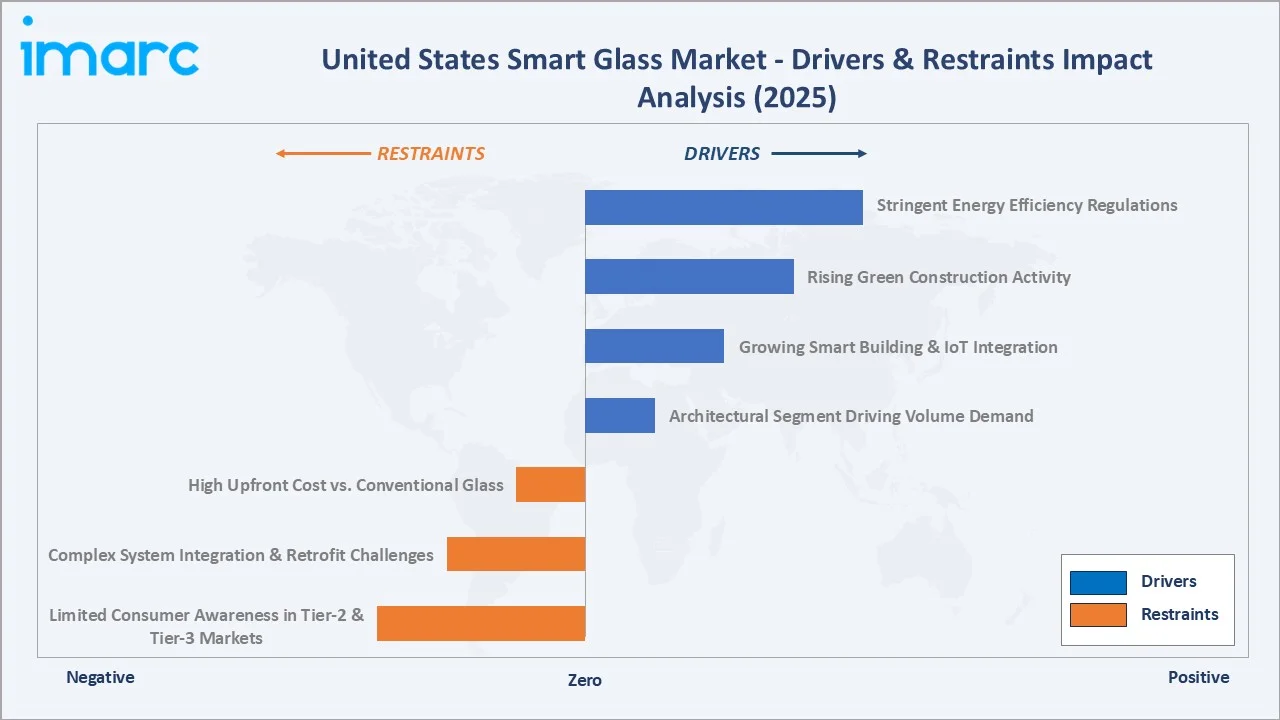
- Stringent Energy Efficiency Regulations: Federal and state-level energy codes such as California's Title 24, ASHRAE 90.1, and LEED v4.1, mandate reduced building energy consumption. Smart glass directly addresses solar heat gain control and daylighting, helping buildings achieve compliance and qualify for green certifications, driving specification by architects and building owners.
- Rising Green Construction Activity: The U.S. green building market is expanding significantly, with green-certified buildings commanding rental premiums and lower operating costs. Smart glass is increasingly specified in LEED Platinum and WELL-certified projects as a value-added glazing solution, broadening its adoption across commercial offices, healthcare facilities, and educational campuses.
- Growing Smart Building & IoT Integration: The proliferation of building automation systems (BAS) and IoT-connected infrastructure is creating demand for dynamic glazing that integrates with HVAC, lighting, and occupancy control systems. Smart glass that responds automatically to external light levels and occupancy patterns enhances building performance and occupant comfort.
- Architectural Segment Driving Volume Demand: Architectural applications held 52.6% of the market in 2025, reflecting strong deployment in commercial facades, office partitions, and healthcare environments. Large-scale commercial projects across major urban centers in the West and South are generating significant volume demand for electrochromic and PDLC glass.
Market Restraints
- High Upfront Cost vs. Conventional Glass: Smart glass carries a significant cost premium over standard glazing, with electrochromic glass typically priced at USD 50-150 per square foot versus USD 5-15 for conventional glass. This cost differential can deter adoption in cost-sensitive residential and small commercial projects.
- Complex System Integration & Retrofit Challenges: Installing smart glass in existing buildings requires significant structural modifications, electrical infrastructure upgrades, and compatibility assessments with existing building systems. This complexity raises installation costs and extends project timelines, limiting retrofit adoption.
- Limited Consumer Awareness in Tier-2 & Tier-3 Markets: Outside major metropolitan areas, awareness of smart glass technology and its total cost of ownership benefits remains limited. Contractors and smaller developers often default to conventional glazing solutions due to unfamiliarity with smart glass specifications and maintenance requirements.
Market Opportunities
- AI-Driven Dynamic Tinting & Predictive Control: The integration of artificial intelligence with smart glass control systems enables predictive tinting that automatically adjusts based on weather forecasts, time of day, occupancy patterns, and energy demand. This significantly enhances building performance and differentiates AI-enabled systems from manual or basic automated solutions.
- EV & Aerospace Smart Glazing Demand: The rapid expansion of electric vehicle production and premium automotive segments is creating strong demand for smart glass sunroofs, privacy glazing, and electrochromic windows. The U.S. aerospace sector is similarly adopting smart glass in aircraft cabin windows to replace traditional window shades, with Boeing 787 Dreamliner adoption as a benchmark.
- Net-Zero Building Standards Creating Long-Term Pipeline: The U.S. Green Building Council's push toward net-zero energy buildings and the Department of Energy's Building Technologies Office programs are creating a sustained long-term pipeline for energy-efficient glazing. Buildings targeting net-zero status require dynamic glazing to manage solar gain, reducing HVAC system loads by up to 25%.
Market Challenges
- Color Neutrality & Optical Performance Consistency: Maintaining color-neutral tinting across the full transparency range remains a technical challenge for electrochromic and SPD glass. Variations in tint color, switching speed, and optical clarity across different operating conditions can affect end-user satisfaction and specification confidence among architects.
- Long-term Durability & Warranty Concerns: Smart glass products must demonstrate reliable performance over 20-30 year building lifecycles. Concerns around electrochromic layer degradation, seal integrity, and electrical component longevity create hesitation among building owners and insurance underwriters, particularly for large-scale commercial installations.
Emerging Market Trends
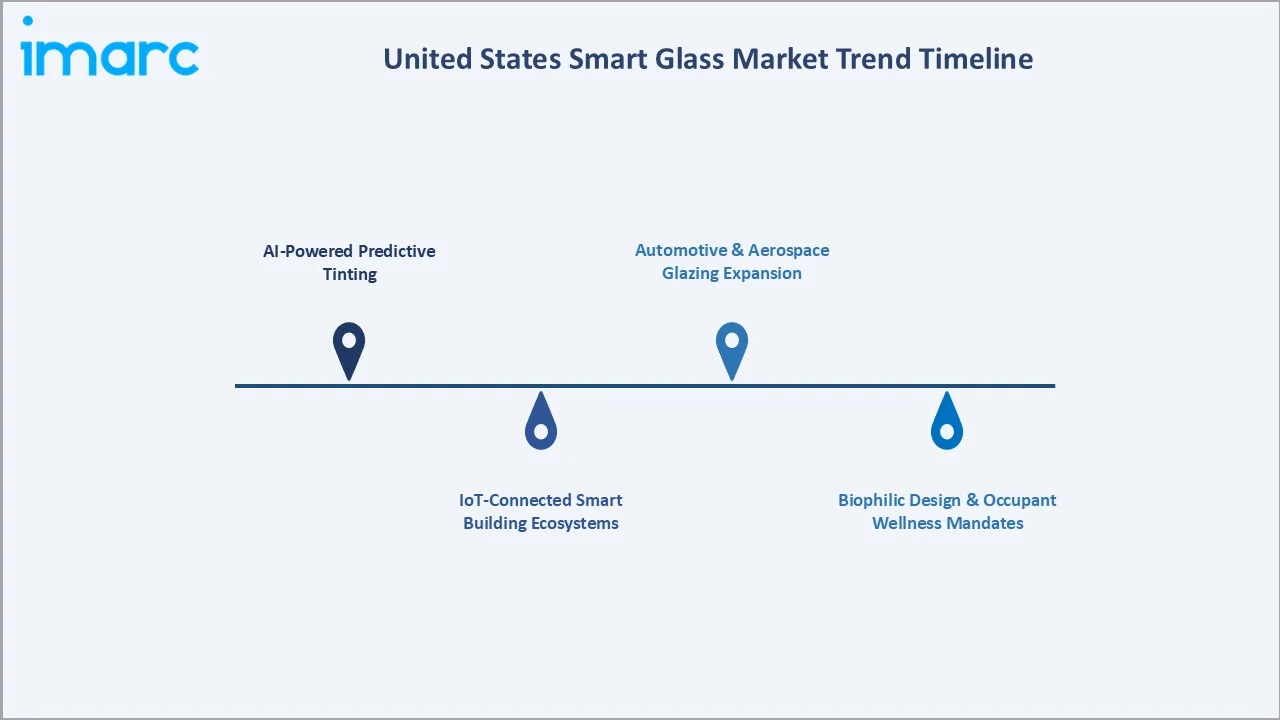
1. AI-Powered Predictive Tinting
Artificial intelligence integration is transforming smart glass control from reactive to predictive. AI systems analyze real-time weather data, occupancy sensors, and energy pricing to proactively adjust glass transparency, optimizing daylighting and solar heat gain management. This capability enhances energy savings by up to 30% compared to static automated systems and is increasingly demanded by LEED Platinum and WELL-certified project developers.
2. IoT-Connected Smart Building Ecosystems
Smart glass is increasingly integrated into unified building management platforms that connect glazing, HVAC, lighting, and occupancy systems. Cloud-based control platforms enable facility managers to monitor and adjust glazing performance across multiple properties remotely. This trend is driving demand for API-compatible smart glass systems that integrate with Siemens, Honeywell, and Johnson Controls BAS platforms.
3. Automotive & Aerospace Glazing Expansion
Premium automotive OEMs and EV manufacturers are expanding smart glass adoption in sunroofs, side windows, and cabin dividers. The growing demand for SPD and PDLC glass in Mercedes, BMW, and Cadillac vehicles is creating high-volume production requirements. The aerospace sector is simultaneously deploying electrochromic windows in commercial aircraft, reducing cabin crew workload and improving passenger experience.
4. Biophilic Design & Occupant Wellness Mandates
The WELL Building Standard and growing emphasis on biophilic design are driving smart glass adoption as a wellness amenity in corporate offices and healthcare facilities. Dynamic glazing that maximizes circadian-aligned natural light exposure while preventing glare is increasingly specified in Class A office developments and hospital outpatient facilities, supporting occupant productivity and recovery outcomes.
Industry Value Chain Analysis
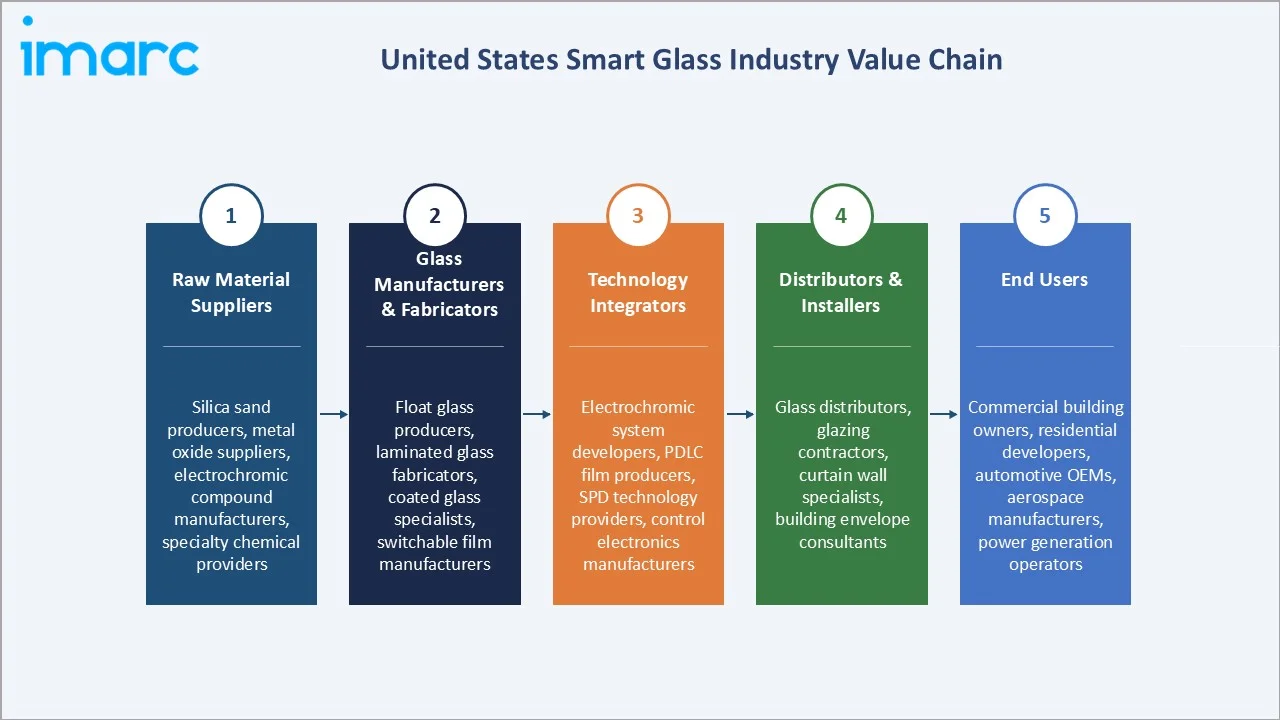
The United States smart glass value chain integrates raw material supply, glass manufacturing, technology integration, distribution, and end-use installation across commercial, residential, transportation, and industrial sectors.
|
Stage |
Key Participants |
|
Raw Material Suppliers |
Silica sand producers, metal oxide suppliers, electrochromic compound manufacturers, specialty chemical providers |
|
Glass Manufacturers & Fabricators |
Float glass producers, laminated glass fabricators, coated glass specialists, switchable film manufacturers |
|
Technology Integrators |
Electrochromic system developers, PDLC film producers, SPD technology providers, control electronics manufacturers |
|
Distributors & Installers |
Glass distributors, glazing contractors, curtain wall specialists, building envelope consultants |
|
End Users |
Commercial building owners, residential developers, automotive OEMs, aerospace manufacturers, power generation operators |
The technology integration stage captures the highest value in the smart glass value chain, as proprietary electrochromic coatings, PDLC film formulations, and AI-driven control algorithms create significant differentiation. Companies able to offer vertically integrated solutions from glass fabrication through control system deployment command premium pricing and stronger client relationships.
Technology Landscape in the United States Smart Glass Industry
Electrochromic Technology
Electrochromic (EC) technology is the most advanced and fastest-growing smart glass technology, achieving transparency changes through the reversible electrochemical reaction of metal oxide layers (primarily tungsten trioxide). EC glass offers precise, stepless control of visible light transmission and solar heat gain, making it ideal for large commercial facade applications. The National Renewable Energy Laboratory reports that EC windows can reduce electricity consumption by up to 49% and lighting costs by up to 51% in commercial buildings.
Polymer Dispersed Liquid Crystal (PDLC) Technology
PDLC smart glass uses liquid crystal droplets dispersed in a polymer film that align under electrical voltage to switch between opaque and transparent states. PDLC is widely used for privacy partitions in corporate offices, healthcare facilities, and hospitality applications. It offers instant switching (milliseconds) compared to electrochromic glass (minutes), making it preferred for dynamic privacy applications.
Suspended Particle Device (SPD) Technology
SPD technology uses suspended microscopic particles that align under electrical voltage to control light transmission. SPD glass offers a wide range of tinting levels and is commonly used in automotive sunroofs, aircraft windows, and architectural skylights. Gauzy Ltd. introduced the first Black SPD smart glass targeting the aeronautics and premium automotive sectors at CES 2025, demonstrating continued innovation in this segment.
Market Segmentation Analysis
The report covers the following segments:
|
Segment Category |
Leading Segment |
Market Share |
Year |
|
Control Mode |
Switches |
39.4% |
2025 |
|
Application |
Architectural |
52.6% |
2025 |
|
Technology |
🔒 |
🔒 |
2025 |
|
Region |
West |
34.8% |
2025 |

By Control Mode
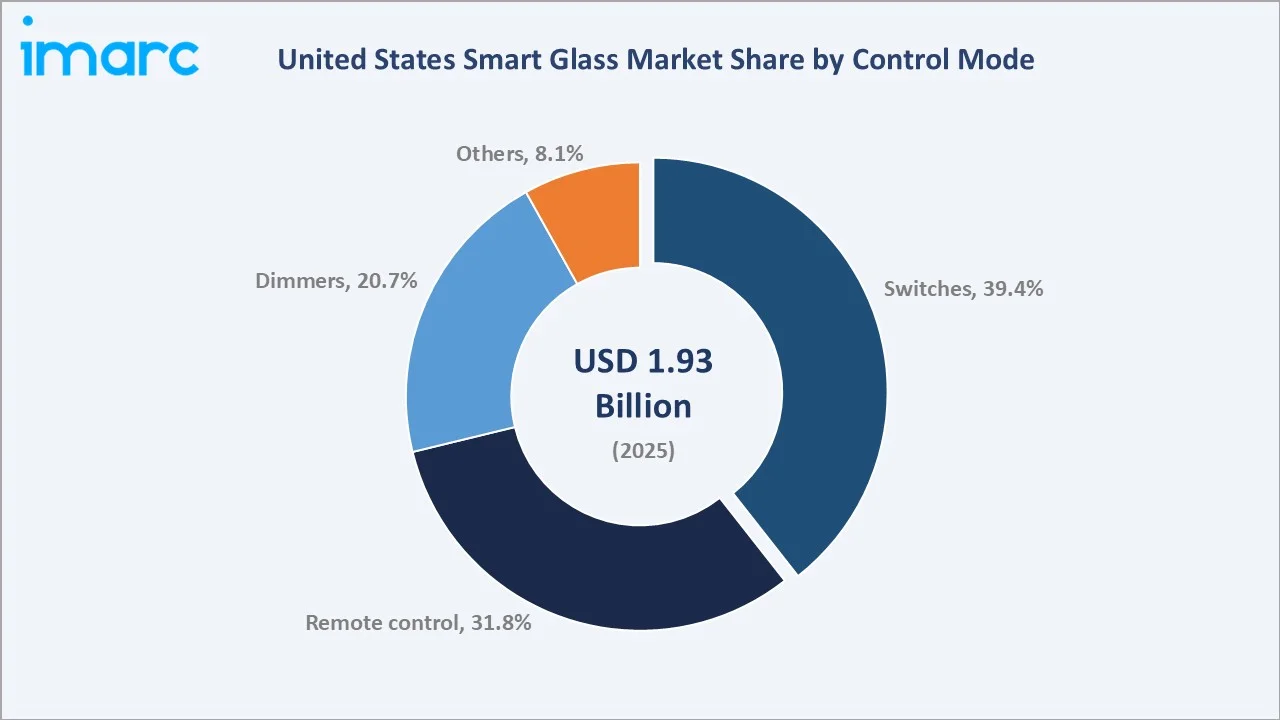
Switches lead the control mode segment with a 39.4% share in 2025, as they provide the most intuitive and widely understood interface for occupants. Remote control commands a 31.8% share and is expanding rapidly as IoT-enabled building systems grow. Dimmers hold 20.7% and are preferred in hospitality and premium corporate environments that require nuanced light adjustment. Others account for the remaining 8.1%, including automated sensor-based and voice-activated control systems.
To access detailed market analysis, Request Sample
Remote control growth is driven by smartphone and tablet integration with building automation platforms. Voice-activated and sensor-based systems are growing rapidly as the others category, particularly in premium residential and hospitality projects where occupants prefer hands-free operation.
By Application
Architectural applications dominate with a 52.6% share (2025), driven by commercial building facades, office partitions, and healthcare environments prioritizing energy efficiency and occupant comfort. Transportation holds 24.3% as automotive and aerospace OEMs expand smart glazing adoption. Consumer electronics account for 14.7%, primarily in premium displays and AR/VR interfaces. Power generation represents 8.4%, with smart glass deployed in building-integrated photovoltaic (BIPV) systems.
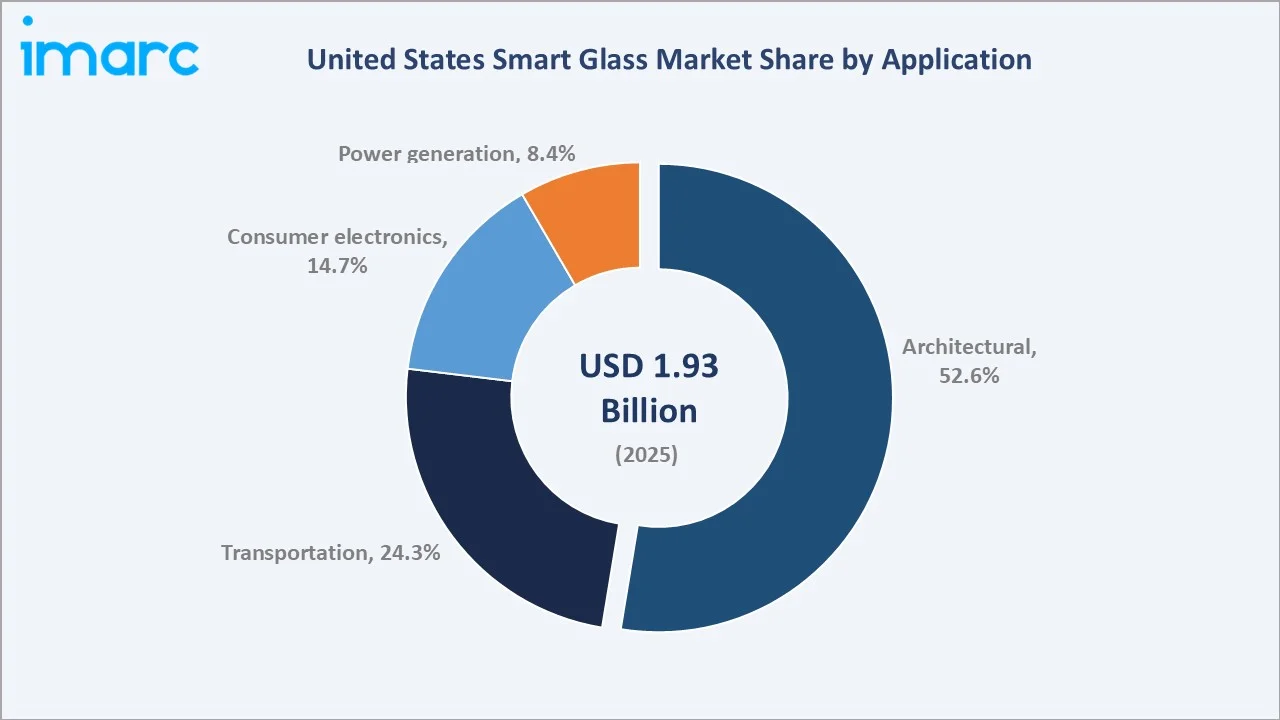
The transportation segment is the fastest-growing application, with electric vehicle manufacturers and commercial aviation operators driving adoption of SPD and electrochromic glass in sunroofs, windows, and cabin partitions. Consumer electronics is benefiting from smart glass integration in foldable displays and privacy screens.
Regional Market Insights
|
Region |
Share (2025) |
Key Drivers & Characteristics |
|
West |
34.8% |
Strong sustainability mandates, high commercial construction activity, presence of technology-forward architects and developers specifying dynamic glazing, and significant energy code enforcement by state authorities. |
|
South |
28.6% |
Rapid urbanization, active commercial and industrial construction, growing healthcare and institutional facility development, and increasing adoption of smart building technologies across Texas, Florida, and the broader Southeast. |
|
Northeast |
21.7% |
High-density commercial real estate, premium office developments, strong presence of LEED-certified construction, and significant healthcare and educational facility renovation activity driving smart glazing demand. |
|
Midwest |
14.9% |
Growing corporate campus and industrial facility development, increasing awareness of energy efficiency standards, and rising adoption of smart glass in automotive manufacturing plants and logistics facilities. |
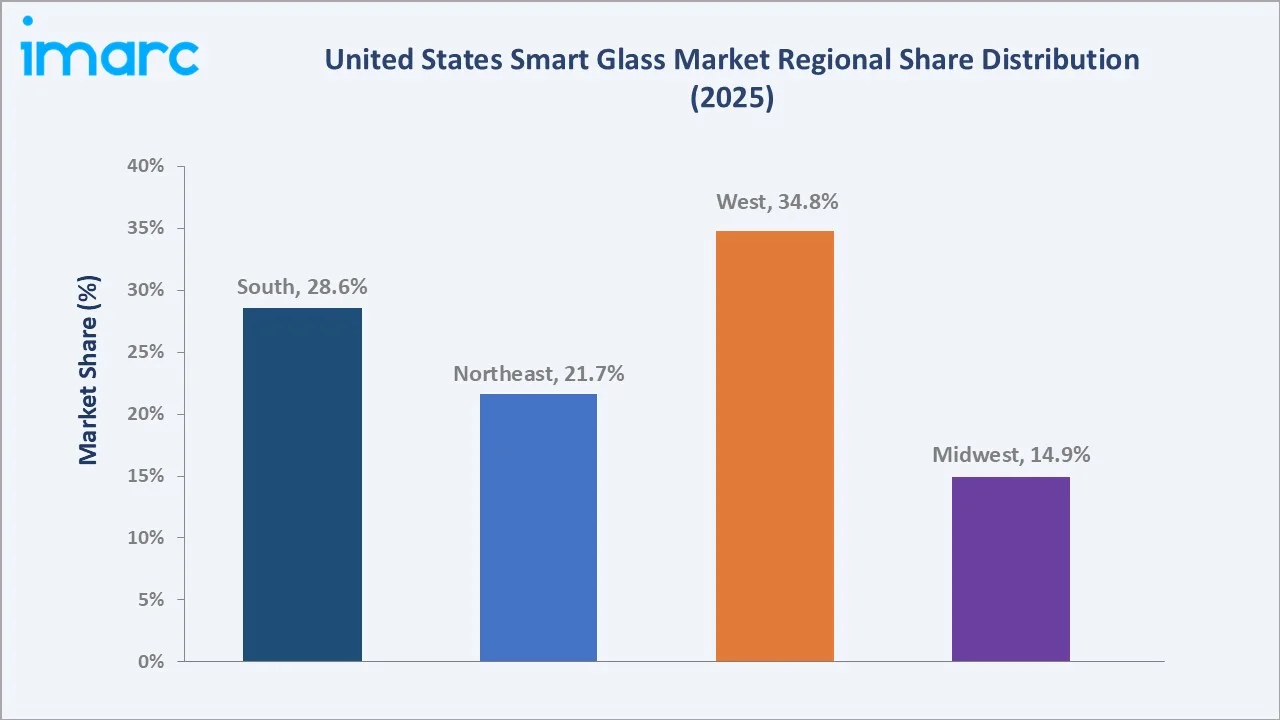
The West region's leadership at 34.8% is supported by California's stringent Title 24 energy performance standards and Nevada and Arizona's high solar irradiance requiring effective solar heat gain management. The South's 28.6% share reflects rapid commercial construction activity, with Texas and Florida leading installation volumes. The Northeast's 21.7% is driven by premium office and healthcare projects in New York, Boston, and Washington D.C. The Midwest's 14.9% represents a growing opportunity as corporate sustainability commitments drive smart glass adoption in manufacturing and office environments.
Competitive Landscape
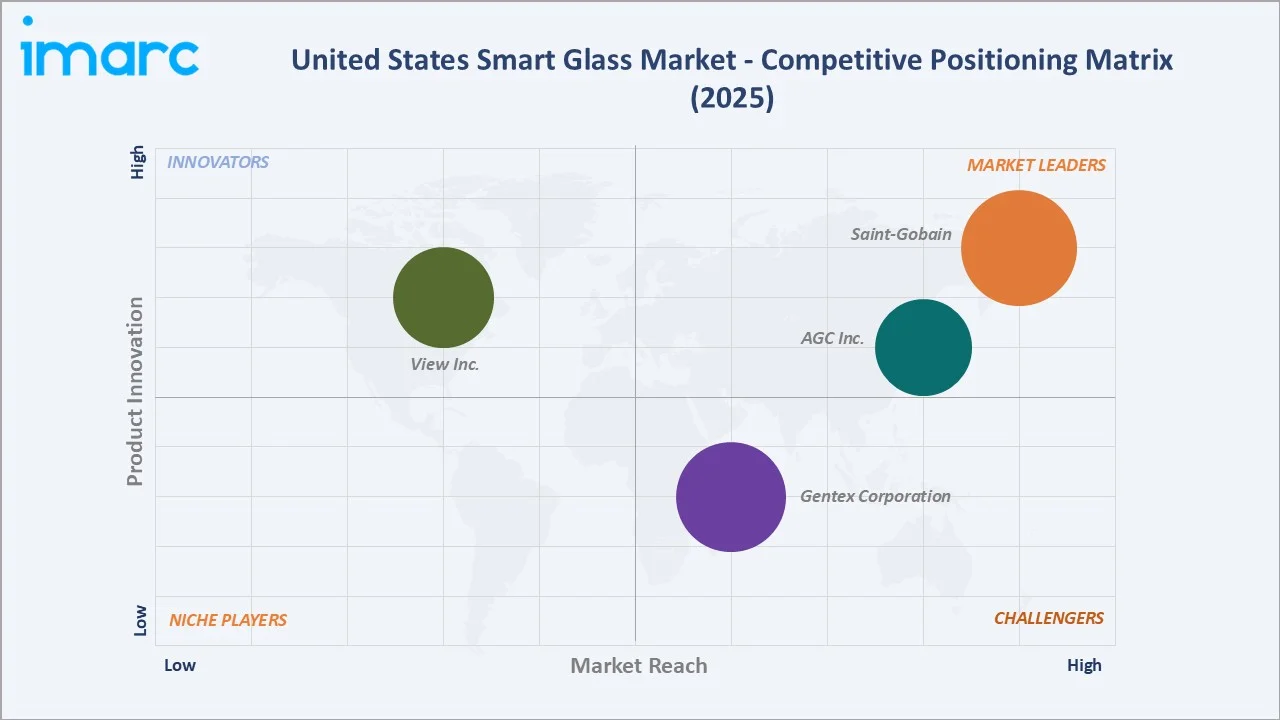
The United States smart glass market is moderately concentrated, with competition driven by global glass majors, specialized dynamic glazing companies, and technology-focused startups. Market participants compete on technology differentiation, energy performance credentials, integration compatibility, and long-term warranty assurance. Strategic partnerships between glass manufacturers, building automation companies, and architectural firms are becoming a key competitive strategy.
|
Company |
Key Brand/Product |
Market Position |
Core Strength |
|
Saint-Gobain |
SageGlass |
Market Leader |
Largest electrochromic glazing installed base; deep architectural channel relationships and net-zero building credentials. |
|
View Inc. |
View Dynamic Glass, View Smart Display, View Immersive Experience |
Innovator |
AI-powered cloud-connected smart windows; strong commercial real estate penetration in the U.S. West Coast. |
|
AGC Inc. |
Digital Curtain Wonderlite |
Market Leader |
Global glass manufacturing scale; broad product portfolio across electrochromic, PDLC, and SPD technologies. |
|
Gentex Corporation |
Dimmable Glass / Full Display Mirror (FDM) |
Challenger |
Dominant in automotive electrochromic mirrors and smart glass; strong OEM partnerships with U.S. automakers. |
Key Company Profiles
Saint-Gobain
Saint-Gobain is a leader in smart glass through its SageGlass electrochromic glazing brand, acquired in 2012. The company holds the largest installed base of electrochromic windows in commercial buildings across the United States, with deployments in healthcare, higher education, corporate office, and hospitality sectors. SageGlass uses a proprietary 5-layer electrochromic coating system that achieves 1-60% visible light transmission and eliminates the need for blinds or shades.
- Key Products: SageGlass electrochromic glazing, SageGlass Classic, and others.
- Strategic Focus: Expanding SageGlass into net-zero building projects and green healthcare facility specifications; deepening AI-driven building automation integrations.
View Inc.
View Inc. is a prominent U.S.-based smart building technology company that designs, develops, and manufactures AI-powered electrochromic windows. The company's View Smart Windows dynamically adjust tint based on outdoor conditions, occupancy, and time of day, integrating with building management systems via a cloud-connected platform. View has deployed its smart windows in millions of square feet of commercial real estate, primarily in the Western United States.
- Key Products: View Dynamic Glass, View Smart Display, View Immersive Experience, and others.
- Strategic Focus: Expanding AI-driven smart building platform capabilities; targeting LEED v4 and WELL-certified project specifications; growing healthcare and corporate office portfolios.
Market Concentration Analysis
The United States smart glass market exhibits a moderately concentrated structure. The top players - Saint-Gobain, View Inc., AGC Inc., and Gentex Corporation - collectively account for an estimated 28-35% of U.S. smart glass revenues in 2025, based on product deployments in commercial real estate, transportation, and industrial sectors.
Market competition is intensifying as the overall market expands and attracts new entrants in electrochromic film technology and IoT-connected control systems. Mid-tier competitors such as Research Frontiers, Gauzy Ltd., Kinestral Technologies, and Halio Inc. are gaining traction through technology differentiation and niche application focus. The competitive dynamic is shifting from pure product competition toward ecosystem and platform competition, as building automation integration becomes a key purchase criterion.
Consolidation is expected to increase as large glass manufacturers seek to acquire specialized electrochromic and PDLC technology companies to strengthen their smart building capabilities. The market remains open to innovative entrants addressing specific verticals such as automotive OEM supply, healthcare privacy glazing, and solar-integrated smart glass.
Investment & Growth Opportunities
Highest Growth Segments
Electrochromic technology (~16.8% CAGR), transportation application (~15.2% CAGR), remote control mode (~14.5% CAGR), South region (fastest growing region), net-zero building retrofits, and EV smart glazing represent the highest-priority investment vectors through 2034.
Investment Themes
- AI-Integrated Smart Glass Building Platforms: Investing in AI-enabled smart glass systems that connect with building automation, HVAC, and lighting control systems. These platforms deliver measurable energy savings of 20-49% in commercial buildings, providing strong ROI justification for building owners and creating recurring software revenue opportunities for technology providers.
- EV & Aerospace Smart Glazing Supply Chain: The rapid growth of electric vehicles and premium automotive segments is creating a significant demand pipeline for SPD and electrochromic glass in sunroofs and side windows. Early supplier relationships with Tier-1 automotive glass fabricators and OEMs represent a high-growth investment opportunity.
- Net-Zero Building Retrofit Market: The U.S. DOE's Building Performance Standards and IRA-funded building decarbonization programs are driving a substantial retrofit market for energy-efficient glazing upgrades. Smart glass manufacturers offering retrofit-compatible systems and supported by incentive advisory services are well-positioned to capture this opportunity.
Future Market Outlook (2026-2034)
The U.S. smart glass market is projected to grow from USD 1.93 Billion in 2025 to USD 2.18 Billion in 2026, reaching USD 6.08 Billion by 2034, delivering a 13.21% CAGR. The market's mid-point anchor of USD 3.58 Billion in 2030 represents accelerating electrochromic adoption in net-zero building programs and the early scaling of EV smart glazing volumes.
Three structural forces define long-term market growth: the national transition to net-zero buildings driven by building energy codes and IRA-funded retrofit programs; the electrification and premiumization of transportation requiring advanced glazing solutions; and the maturation of AI-connected building automation ecosystems that increase the ROI of dynamic glazing investments. As manufacturing scale increases and technology costs decline, smart glass is expected to penetrate mid-tier commercial and residential markets beyond its current premium-segment stronghold.
Research Methodology
Primary Research
Primary research comprised interviews with smart glass manufacturers, glazing contractors, building architects, facility managers, and automotive OEM procurement teams. The research captured insights on technology adoption drivers, price sensitivity, integration requirements, and competitive positioning.
Secondary Research
Secondary research encompassed company annual reports, DOE and EPA building energy publications, LEED certification databases, U.S. Census Bureau construction spending data, industry association publications, investor presentations, and trade press coverage. Analysis focused on construction activity trends, energy code evolution, technology cost trajectories, and competitive developments.
Forecasting Models
Forecasting models combined historical market data, construction spending forecasts from the U.S. Census Bureau, automotive production outlooks, and smart glass technology adoption rate modeling. A bottom-up segment approach validated by a top-down market sizing analysis was applied, incorporating LEED certification growth, IRA-funded retrofit activity, and EV production ramps to project market growth through 2034.
United States Smart Glass Market Report Coverage:
| Report Features | Details |
|---|---|
| Base Year of the Analysis | 2025 |
| Historical Period | 2020-2025 |
| Forecast Period | 2026-2034 |
| Units | Billion USD |
| Scope of the Report | Exploration of Historical Trends and Market Outlook, Industry Catalysts and Challenges, Segment-Wise Historical and Future Market Assessment:
|
| Technologies Covered | Thermochromic, Photochromic, Electrochromic, Suspended Particle Device (SPD), Polymer Disperse Liquid Crystal (PDLC), Others |
| Control Modes Covered | Dimmers, Switches, Remote Control, Others |
| Applications Covered | Architectural, Transportation, Consumer Electronics, Power Generation |
| Regions Covered | Northeast, Midwest, South, West |
| Companies Covered | Saint-Gobain, View Inc., AGC Inc., Gentex Corporation, etc. |
| Customization Scope | 10% Free Customization |
| Post-Sale Analyst Support | 10-12 Weeks |
| Delivery Format | PDF and Excel through Email (We can also provide the editable version of the report in PPT/Word format on special request) |
Key Benefits for Stakeholders:
- IMARC’s industry report offers a comprehensive quantitative analysis of various market segments, historical and current market trends, market forecasts, and dynamics of the United States smart glass market from 2020-2034.
- The research report provides the latest information on the market drivers, challenges, and opportunities in the United States smart glass market.
- Porter's five forces analysis assist stakeholders in assessing the impact of new entrants, competitive rivalry, supplier power, buyer power, and the threat of substitution. It helps stakeholders to analyze the level of competition within the United States smart glass industry and its attractiveness.
- Competitive landscape allows stakeholders to understand their competitive environment and provides an insight into the current positions of key players in the market.
Frequently Asked Questions About the United States Smart Glass Market Report
The U.S. smart glass market size is estimated at USD 2.18 Billion in 2026, driven by green building regulations, smart infrastructure investment, and rising demand for energy-efficient glazing solutions.
The market is projected to reach USD 6.08 Billion by 2034, supported by electrochromic technology adoption, net-zero building programs, and EV glazing demand.
The market is expected to grow at a CAGR of 13.21% during 2026-2034, making it one of the fastest-growing specialty glass categories in the United States.
Switches dominate at 39.4% share (2025) as they offer the most intuitive, cost-effective control interface for commercial and residential smart glass installations.
Architectural applications lead at 52.6% (2025), driven by commercial facade deployments, office partitions, and healthcare facilities prioritizing energy performance.
The West region holds 34.8% share (2025), driven by California's Title 24 energy codes, high commercial construction activity, and tech-forward architectural specifications.
The market is estimated to reach USD 3.58 Billion by 2030, representing the mid-cycle acceleration point driven by net-zero building programs and EV glazing scale-up.
Leading companies include Saint-Gobain, View Inc., AGC Inc., and Gentex Corporation, among other specialized glazing technology providers.
Electrochromic glass changes tint via an electrochemical reaction, offering precise energy control. It grows at ~16.8% CAGR due to net-zero building demands and energy code compliance.
Key investment areas include AI-connected smart glass platforms for commercial buildings, EV and aerospace glazing supply chains, and IRA-funded net-zero building retrofit programs.
Need more help?
- Speak to our experienced analysts for insights on the current market scenarios.
- Include additional segments and countries to customize the report as per your requirement.
- Gain an unparalleled competitive advantage in your domain by understanding how to utilize the report and positively impacting your operations and revenue.
- For further assistance, please connect with our analysts.
 Request Customization
 Speak to an Analyst
 Request Brochure
 Inquire Before Buying
Benefits of Customization
- Personalize this research
- Triangulate with your data
- Get data as per your format and definition
- Gain a deeper dive into a specific application, geography, customer, or competitor
- Any level of personalization
Get in Touch With Us
UNITED STATES
Phone: +1-201-971-6302
INDIA
Phone: +91-120-433-0800
UNITED KINGDOM
Phone: +44-753-714-6104
Email: [email protected]
Client Testimonials




.webp)




.webp)













Related Reports

Choose your plan
*Please note that the prices mentioned below are starting prices for each bundle type. Kindly contact our team for further details.*
Single User License
- 1 User License, Access on 2 Devices
- PDF Report + Excel Dataset (Password Protected)
- Lifetime Access
- No Printing Rights
- 10% Free Report Customization
- 10–12 Weeks of Analyst Support
Five User License
- Access for 5 Users, 2 Devices per User
- PDF Report + Excel Dataset (Password Protected)
- Lifetime Access
- Dedicated Account Manager
- 12–14 Weeks of Analyst Support
- No Printing Rights
- 15% Free Report Customization
- 25% Discount on Your Next Purchase
Corporate User License
- Unlimited User Access (Within Your Organization)
- PDF Report + Excel Dataset
- Lifetime Access
- Dedicated Account Manager
- 14–20 Weeks of Analyst Support
- No Printing Rights
- 20% Free Report Customization
- 30% Discount on Your Next Purchase
Essential Insights
What's included:
3 reports
- Lifetime Access
- PDF Reports
- Excel Datasets
- 2 Weeks of Free Analyst Support
- 2 User Licenses
- Access on 2 Devices
- Printing Rights
- Complimentary PowerPoint (PPT) Version
- Complimentary License Upgrade
Professional Access
What's included:
5 reports
- Lifetime Access
- PDF Reports
- Excel Datasets
- 8 Weeks of Free Analyst Support
- 2 User Licenses
- Access on 2 Devices
- Printing Rights
- Complimentary PowerPoint (PPT) Version
- Complimentary License Upgrade
Business Advantage
What's included:
8 reports
- Lifetime Access
- PDF Reports
- Excel Datasets
- 14 Weeks of Free Analyst Support
- 2 User Licenses
- Access on 2 Devices
- Printing Rights
- Complimentary PowerPoint (PPT) Version
- Complimentary License Upgrade
Enterprise Intelligence
What's included:
10 reports
- Lifetime Access
- PDF Reports
- Excel Datasets
- 20 Weeks of Free Analyst Support
- 2 User Licenses
- Access on 2 Devices
- Printing Rights
- Complimentary PowerPoint (PPT) Version
- Complimentary License Upgrade