
United States Stylus Pen Market Size, Share, Trends and Forecast by Product Type, Distribution Channel, Application, End User, and Region 2026-2034
United States Stylus Pen Market Size, Share, Trends & Forecast (2026-2034)
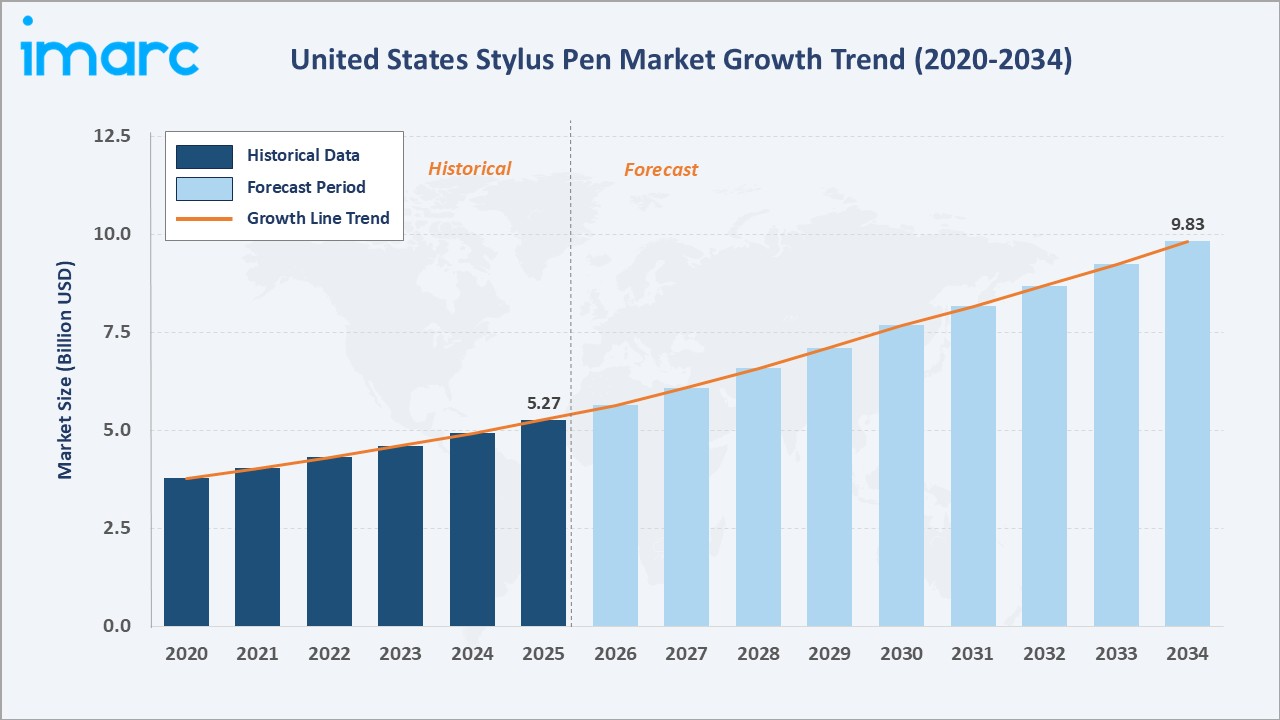
The United States stylus pen market grew from USD 5.27 Billion in 2025 to USD 5.64 Billion in 2026 and is projected to reach USD 9.83 Billion by 2034, growing at a CAGR of 6.95% during 2026-2034. Demand is broadening as tablets, convertible laptops, smartphones and drawing displays become everyday tools for students, designers, clinicians and office workers who prefer precise handwriting and drawing input. Rising device output and wider pen-compatible product lines expand the installed base that each new stylus can serve. Modernization of pressure sensing, tilt recognition and low-latency wireless pairing raises the value of every unit sold. Supportive education technology programs, enterprise digitization and steady investment in creative software widen the addressable base for the stylus pen market size.
Supporting growth factors include broader pen-enabled device adoption, digital education programs and creative software expansion. Active stylus dominates at 60.0%. Online leads at 60.0%. South commands 35.0% of the regional market share.
Market Snapshot
| Metric | Value |
|---|---|
| Base Year Market Size (2025) | USD 5.27 Billion |
| Market Size (2026) | USD 5.64 Billion |
| Forecast Market Size (2034) | USD 9.83 Billion |
| CAGR (2026-2034) | 6.95% |
| Base Year | 2025 |
| Historical Period | 2020-2025 |
| Forecast Period | 2026-2034 |
| Dominant Product Type | Active Stylus (60.0%, 2025) |
| Dominant Distribution Channel | Online (60.0%, 2025) |
| Leading Region | South (35.0%, 2025) |
The United States stylus pen market size increased from USD 3.77 Billion in 2020 to USD 5.27 Billion in 2025 and is estimated to reach USD 5.64 Billion in 2026. The market is further expected to grow to USD 7.38 Billion by 2030 and USD 9.83 Billion by 2034. Its commercial distinctiveness rests on tight pairing with device ecosystems, where stylus choice follows the tablet, laptop or phone a buyer already owns.
To get more information on this market, Request Sample
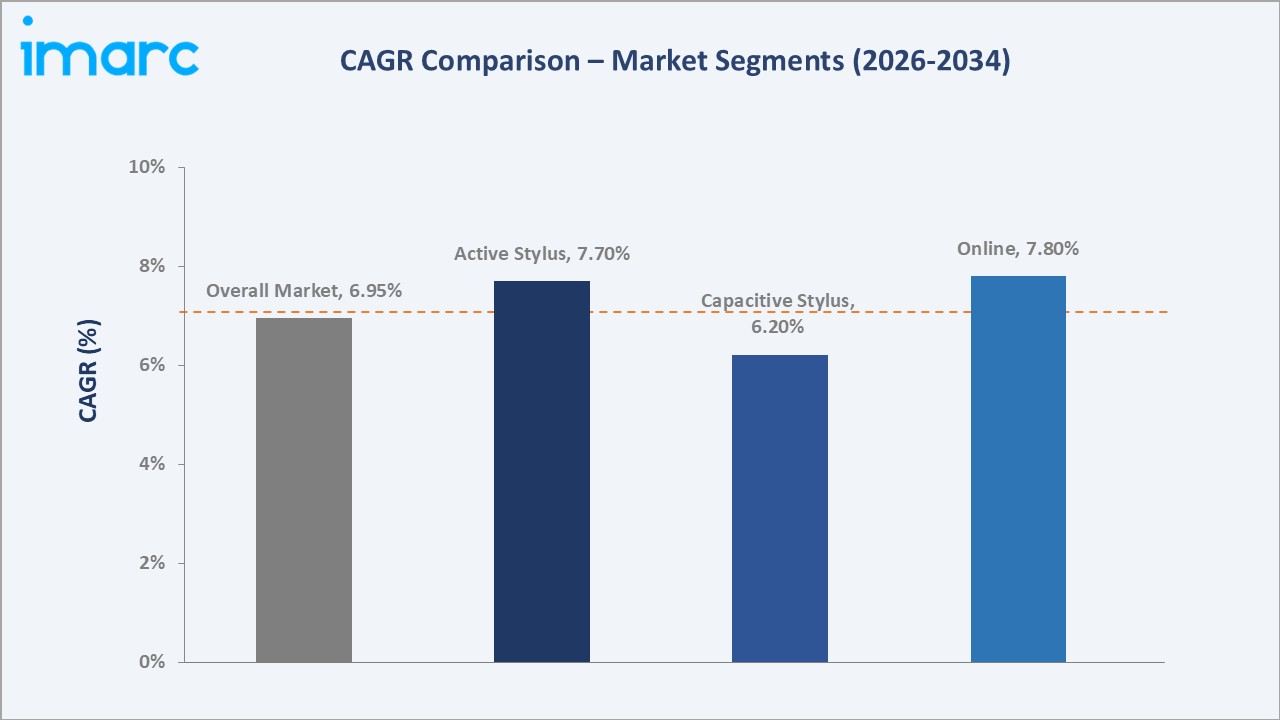
Active stylus at ~7.7% CAGR and online at ~7.8% CAGR are the fastest-growing product categories, supported by rising demand for pressure-sensitive input, precise digital writing capabilities, and the expanding availability of stylus-compatible devices across e-commerce platforms.
Executive Summary
The United States stylus pen market expanded from USD 5.27 Billion in 2025 to an estimated USD 5.64 Billion in 2026, with demand anchored in tablets, two-in-one laptops, smartphones and professional drawing displays used for education, design, healthcare documentation and enterprise note-taking. The fastest-developing areas are active styluses with pressure and tilt sensing, and online channels where bundles, subscriptions and direct brand storefronts simplify purchase. Schools, universities and corporate buyers increasingly treat the stylus as a standard accessory rather than an optional extra, while creators rely on precision input for illustration, photo editing and three-dimensional modeling. Device makers keep widening pen-compatible product lines, and accessory brands compete on cross-platform compatibility, replaceable tips and battery life. The market is projected to reach USD 9.83 Billion by 2034. Active stylus at 60.0% leads through precision input and device-ecosystem integration. Online at 60.0% leads distribution channel through convenience and bundled offers. South leads regionally at 35.0%.
Key Market Insights
| Insight | Data |
|---|---|
| Dominant Product Type | Active Stylus - 60.0% share (2025) |
| Dominant Distribution Channel | Online - 60.0% market share (2025) |
| Leading Region | South - 35.0% share (2025) |
| Market Opportunity | Education device programs, creative professional tools, universal-compatibility styluses, healthcare digital documentation |
Key Analytical Observations Supporting the Above Data:
- Active Stylus at 60.0%: Active styluses lead because pressure sensitivity, tilt detection, palm rejection and low latency deliver a writing and drawing feel that students, artists and professionals cannot get from passive tips.
- Online at 60.0%: Online channels dominate through brand storefronts, large marketplaces and device-bundle checkouts, where buyers compare compatibility, read reviews and add a stylus while purchasing a tablet or laptop.
- South at 35.0%: South leads on its large population, wide device ownership across households, schools and growing enterprises, and strong online fulfillment networks that reach buyers quickly. The presence of major technology hubs, educational institutions and IT companies across southern states further supports regional demand for stylus compatible devices and accessories.
United States Stylus Pen Market Overview
The United States stylus pen market covers handheld input devices that let users write, draw, select and annotate on touchscreens, using resistive, capacitive or active electronic technology. The ecosystem links component suppliers, sensor and controller designers, device manufacturers, accessory brands, distributors and retailers. Demand comes from students, creative professionals, office workers, healthcare staff and casual consumers who use tablets, smartphones and convertible laptops. Supply is layered: platform owners sell proprietary pens tied to their devices, while independent accessory brands offer universal and cross-platform alternatives at lower prices. Purchases are shaped by device compatibility, pressure sensitivity, battery life, tip durability and price, and replacement cycles follow device upgrades and tip wear. The United States stylus pen market therefore rewards suppliers that combine reliable hardware, software integration and broad retail presence, and it favors those able to support new device generations quickly.
Market Dynamics
To evaluate market opportunities, Request Sample
Market Drivers
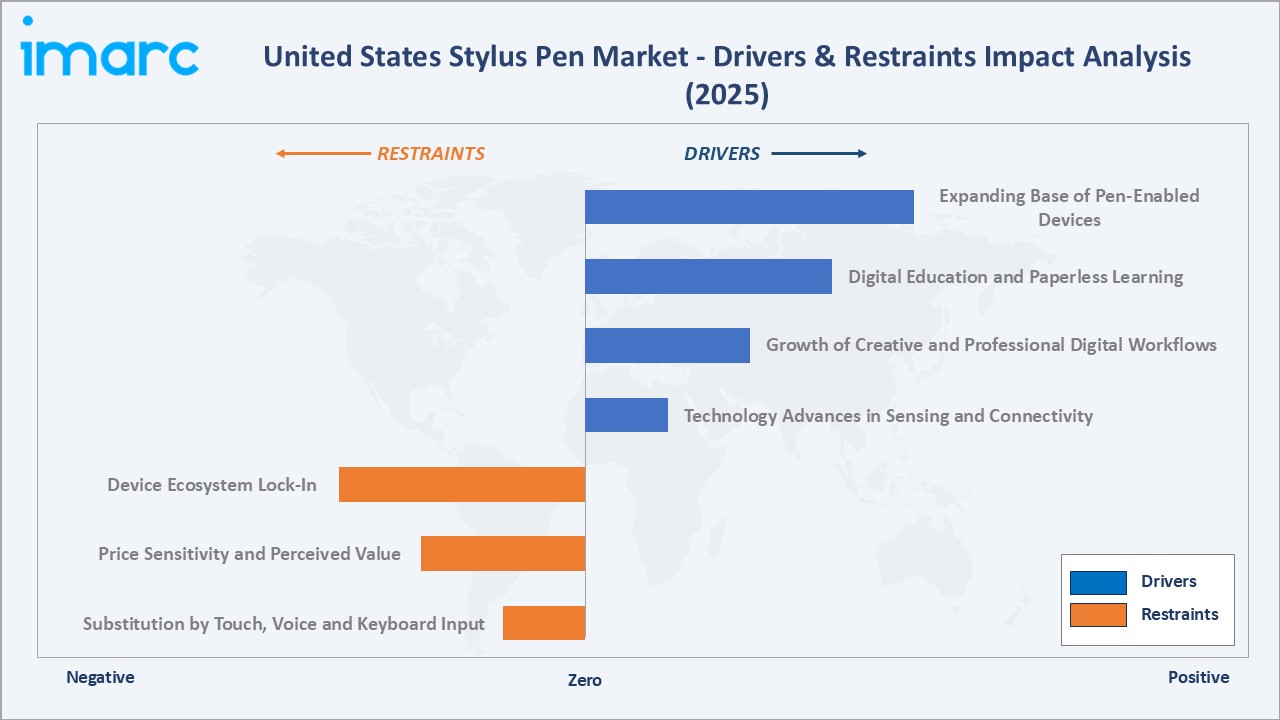
- Expanding Base of Pen-Enabled Devices: Tablets, convertible laptops, smartphones and drawing displays that accept stylus input are now common across households, schools and workplaces. Each new generation adds finer sensing and wider pen support, and consumers who buy these devices often add a stylus to use handwriting, sketching and annotation features. Device makers promote pen input as a productivity feature, and accessory brands extend compatibility to additional models. As the installed base of capable devices grows, the pool of potential stylus buyers and replacement purchasers grows with it, supporting steady demand across the United States stylus pen market.
- Digital Education and Paperless Learning: Schools, colleges and universities increasingly rely on tablets and laptops for lectures, assignments and examinations, and students value handwriting and diagramming that keyboards cannot match. Digital note-taking applications let learners annotate documents, solve equations and organize class material in one place. Institutions that deploy devices at scale often specify stylus accessories alongside them, creating recurring bulk and seasonal demand. As educators accept digital handwriting for assessment and feedback, the stylus becomes a routine learning tool rather than a niche accessory, deepening the demand base through the forecast period.
- Growth of Creative and Professional Digital Workflows: Illustrators, designers, architects, photographers, animators and video editors depend on precise pressure-sensitive input to produce detailed work on tablets and pen displays. Creative software has expanded its pen-focused features, and remote collaboration has made digital markup a normal part of project review. Professionals also use styluses for signing documents, annotating plans and sketching ideas during meetings. These users replace tips and pens frequently and upgrade to more capable models, which lifts average selling prices and supports growth in higher-end active stylus products.
- Technology Advances in Sensing and Connectivity: Improvements in pressure levels, tilt recognition, palm rejection, wireless pairing and rechargeable batteries have made styluses more responsive and convenient. Lower latency makes digital writing feel closer to pen and paper, which broadens appeal among users who once found stylus input awkward. Magnetic attachment, wireless charging and hover detection add everyday convenience. As these capabilities reach mid-priced devices and accessories, more buyers find a stylus worth purchasing, and each upgrade cycle raises the value content of units sold across the market.
Market Restraints
- Device Ecosystem Lock-In: Many high-performance styluses work only with specific devices, which limits the addressable market for each product and forces buyers to repurchase when they change platforms. Independent brands must develop and certify multiple models to cover different tablets and laptops, and compatibility can shift when device makers change protocols. This fragmentation raises development cost, complicates inventory planning and can confuse buyers who are unsure which pen fits their device, slowing impulse purchases and constraining growth for universal accessories.
- Price Sensitivity and Perceived Value: Premium active styluses carry meaningful prices, and some buyers question whether handwriting or drawing features justify the added cost beyond the device itself. Low-priced capacitive tips, often bundled or bought in multipacks, satisfy basic needs and compete against more capable products. Consumers who rarely use pen input may skip the accessory altogether, which limits upsell opportunities and keeps average selling prices under pressure in price-conscious segments of the market.
- Substitution by Touch, Voice and Keyboard Input: Many users complete daily tasks with fingers, on-screen keyboards or voice dictation and never adopt a stylus. Handwriting recognition and voice tools reduce the need for precise input in routine communication. Where devices work well without a pen, stylus penetration stays modest, and accessory makers must convince buyers of specific benefits such as sketching, annotation or accessibility, which requires continued marketing and software support to maintain demand.
Market Opportunities
- Education Device Programs and Institutional Bundles: Schools and universities that issue tablets or laptops can include styluses as standard equipment for note-taking, mathematics and design courses. Bulk procurement provides predictable volumes, and durable, tip-replaceable models suit shared classroom use. Suppliers that offer rugged designs, tether options, management support and attractive pricing for institutions can build long relationships. As digital learning expands, bundled deployments scale nationally and create reliable seasonal demand for both active and capacitive products.
- Universal and Cross-Platform Styluses: Buyers frustrated by device-specific pens want accessories that work across tablets, phones and laptops from different makers. Independent brands that deliver reliable pressure sensing, wide protocol support and clear compatibility guidance can capture owners of older devices and mixed-device households. Firmware updates, replaceable tips and attractive pricing strengthen the offer. This opportunity grows as device diversity increases and consumers look for a single pen that follows them across hardware upgrades.
Market Challenges
- Rapid Device Refresh Cycles: New tablet and laptop generations arrive frequently, sometimes with changes to pen protocols, requiring accessory makers to redesign and recertify products quickly. Stock for older models can lose value when buyers upgrade. Keeping pace demands engineering resources and flexible supply planning, which small brands may find hard to sustain, and delays in compatibility support can cost sales during launch periods.
- Counterfeit and Low-Quality Products: Online marketplaces carry imitation styluses that copy branded designs at low prices but deliver weaker sensing, poor tips and short battery life. Buyers who receive disappointing products may blame the category or the device, and genuine brands lose revenue and reputation. Policing listings, protecting trademarks and educating consumers add costs that do not directly generate sales.
Emerging Market Trends
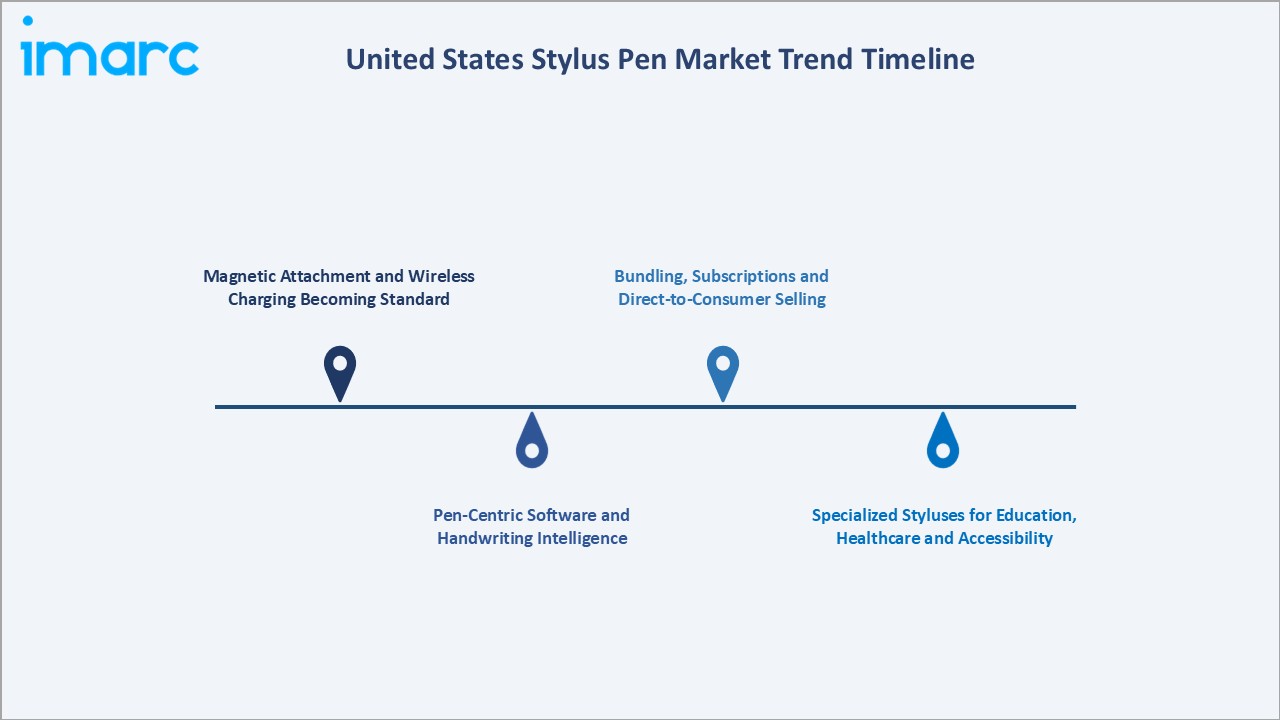
1. Magnetic Attachment and Wireless Charging Becoming Standard
Device makers increasingly build magnetic docking and wireless charging into tablets and laptops so the stylus attaches securely and recharges without cables. This removes the common frustrations of lost pens and dead batteries, and it makes the stylus feel like part of the device rather than an add-on. Accessory brands that cannot match this convenience risk looking dated, so many are adding rechargeable cells and magnetic housings to their designs. The trend raises average selling prices, favors suppliers with close device partnerships and encourages users to keep a pen attached and ready for everyday tasks across the market.
2. Pen-Centric Software and Handwriting Intelligence
Note-taking, drawing and document applications are adding handwriting conversion, shape recognition, math solving and search within handwritten text. These features make pen input more productive and give students and professionals clear reasons to adopt a stylus. Software makers also design interfaces around pen gestures, hover previews and quick-access menus. As handwriting becomes searchable and editable, the stylus moves from a drawing tool to a general productivity accessory, which widens the user base beyond artists and supports demand for responsive active styluses with accurate sensing.
3. Bundling, Subscriptions and Direct-to-Consumer Selling
Brands increasingly sell styluses through device bundles, subscription creative software packages and direct storefronts that combine hardware, replacement tips and warranties. Online checkout flows suggest compatible pens at the moment of tablet purchase, converting buyers who might not otherwise add an accessory. Direct selling also gives makers customer data to guide product design and replacement reminders. The trend strengthens online channels, rewards brands with clear compatibility information and lets smaller makers reach buyers nationally without depending on retail shelf space.
4. Specialized Styluses for Education, Healthcare and Accessibility
Suppliers are introducing durable classroom pens, antimicrobial or sealed designs for clinical settings and ergonomic shapes for users with limited grip strength. These products address specific needs that general-purpose styluses do not, and institutions often pay a premium for tested, easy-to-clean and replaceable-part designs. Larger grip diameters, tethers, silicone coatings and long battery life reflect real usage patterns. As organizations digitize forms and records, specialized pens broaden the market beyond consumer creativity and create steadier, specification-led demand.
Industry Value Chain Analysis
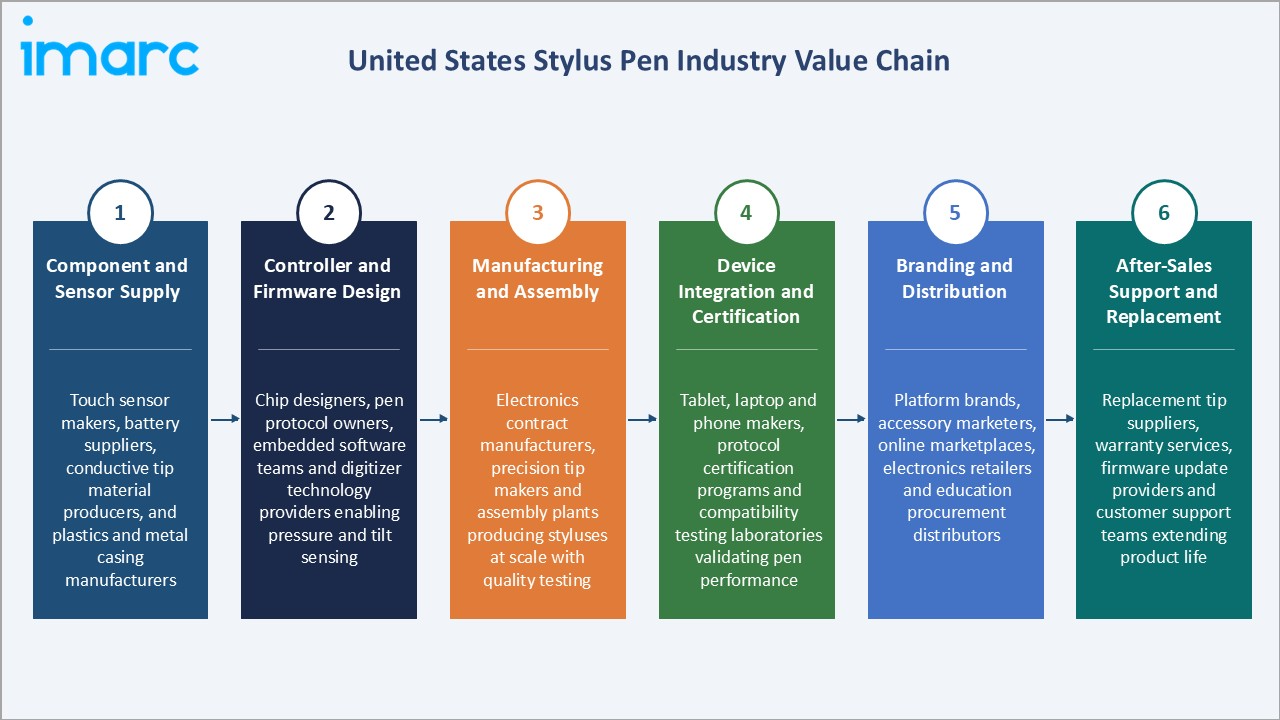
The industry value chain spans component and sensor supply, controller and firmware design, stylus manufacturing and assembly, device integration and certification, branding and distribution, and after-sales support and replacement. Value is added as basic electronics and plastics become calibrated, tested pens that work reliably with specific devices and software.
| Stage | Key Participants |
|---|---|
| Component and Sensor Supply | Touch sensor makers, battery suppliers, conductive tip material producers, and plastics and metal casing manufacturers |
| Controller and Firmware Design | Chip designers, pen protocol owners, embedded software teams and digitizer technology providers enabling pressure and tilt sensing |
| Manufacturing and Assembly | Electronics contract manufacturers, precision tip makers and assembly plants producing styluses at scale with quality testing |
| Device Integration and Certification | Tablet, laptop and phone makers, protocol certification programs and compatibility testing laboratories validating pen performance |
| Branding and Distribution | Platform brands, accessory marketers, online marketplaces, electronics retailers and education procurement distributors |
| After-Sales Support and Replacement | Replacement tip suppliers, warranty services, firmware update providers and customer support teams extending product life |
Device integration and certification is the most commercially critical stage, because a stylus that cannot pair reliably and deliver accurate sensing on a specific device will not sell, regardless of its price or design. Standardized compatibility protocols and continuous firmware improvements also help manufacturers reduce performance inconsistencies and strengthen product acceptance across device categories. Growing collaboration between stylus manufacturers and device developers further supports product innovation, compatibility improvements and the introduction of advanced input features.
Technology Landscape in the United States Stylus Pen Industry
Active Electrostatic and Electromagnetic Resonance Sensing
Active styluses communicate with the display digitizer through electrostatic signals or electromagnetic resonance, allowing the device to read position, pressure and tilt with high accuracy. Electromagnetic designs can operate without batteries inside the pen, while electrostatic designs rely on a small powered circuit. Both support palm rejection, so users can rest a hand on the screen while writing. Manufacturers continue to raise pressure levels and refine latency, which makes digital writing feel natural. Proprietary protocols tie each pen to compatible devices, so integration work with device makers is central to product performance.
Capacitive Tip and Conductive Material Engineering
Capacitive styluses mimic a fingertip using conductive rubber, mesh or disc tips that register on standard touchscreens without electronics. Engineers focus on tip materials that glide smoothly, avoid scratching glass and keep consistent contact over long use. Fine-point discs with transparent bases improve accuracy for note-taking and drawing, while soft rubber tips suit casual navigation. Because these designs need no battery or pairing, they remain popular for low-cost, multi-device use. Replaceable tips and durable coatings extend life and support multipack and institutional purchasing.
Wireless Pairing, Charging and Power Management
Bluetooth pairing, wireless inductive charging and low-power chips let styluses stay connected and charged with minimal user effort. Magnetic attachment aligns the pen with the charging coil on the device edge, and power management software extends battery life by sleeping the pen when idle. Programmable buttons and double-tap gestures let users switch tools quickly. These features reduce friction and raise perceived value, but they require tight hardware and firmware integration, which favors suppliers with strong embedded engineering and access to device protocols. Improved charging efficiency and battery monitoring capabilities are further helping manufacturers enhance operational reliability and reduce interruptions during extended writing and drawing sessions.
Market Segmentation Analysis
The report covers the following segments:
| Segment Category | Leading Segment | Market Share | Year |
|---|---|---|---|
| Product Type | Active Stylus | 60.0% | 2025 |
| Distribution Channel | Online | 60.0% | 2025 |
| Application | Tablets | 🔒 | 2025 |
| End User | OEM | 🔒 | 2025 |
| Region | South | 35.0% | 2025 |

By Product Type
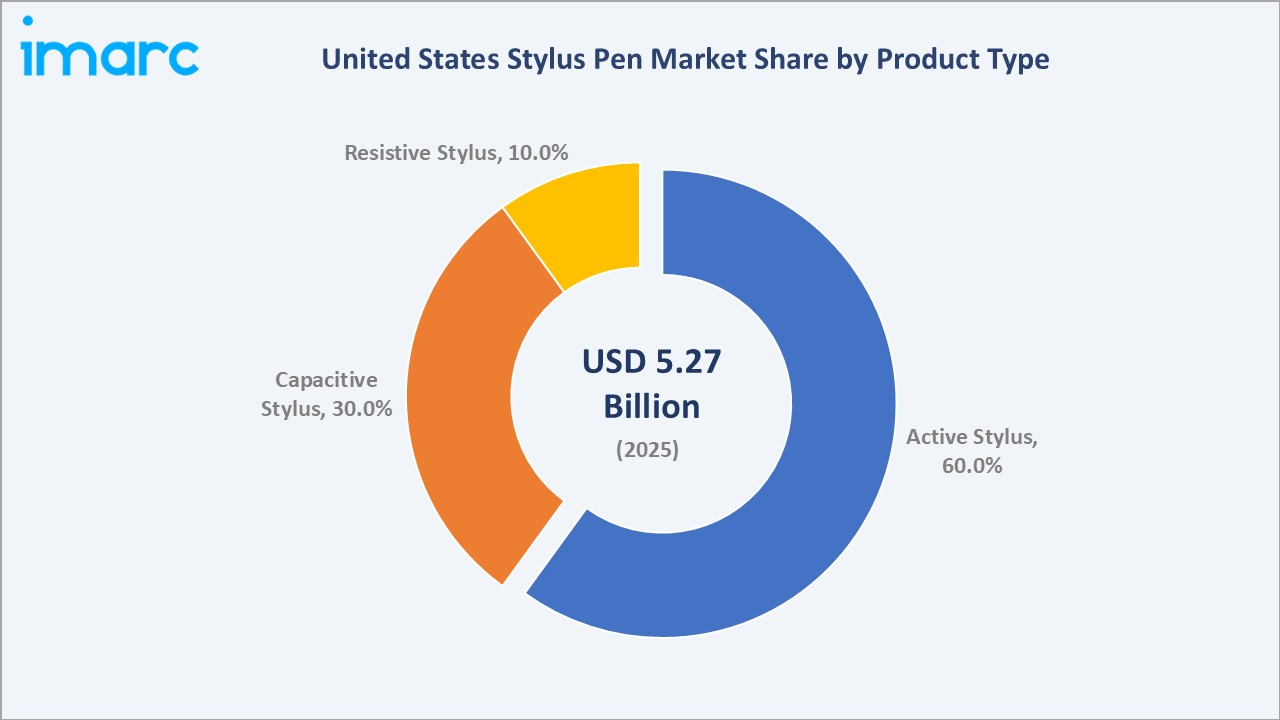
Active stylus leads at 60.0% (2025). Active styluses combine powered electronics with digitizer communication, delivering pressure, tilt and palm rejection that suit note-taking, illustration and professional markup. Device ecosystems promote them as flagship accessories, and demand rises with every generation of pen-capable tablets, laptops and phones.
To Request customized data tailored to your needs – Request Customization
Capacitive stylus, at 30.0%, is the second largest segment, driven by its affordability, broad compatibility with standard touchscreen devices, ease of use without charging or Bluetooth pairing, and suitability for everyday navigation, basic writing and casual drawing.
By Distribution Channel
Online leads at 60.0% (2025). Brand storefronts, large marketplaces and device-bundle checkouts let buyers compare compatibility, read reviews and receive products quickly. Wide assortment, frequent promotions and easy returns make online the natural channel for an accessory that depends on matching the right pen to the right device.
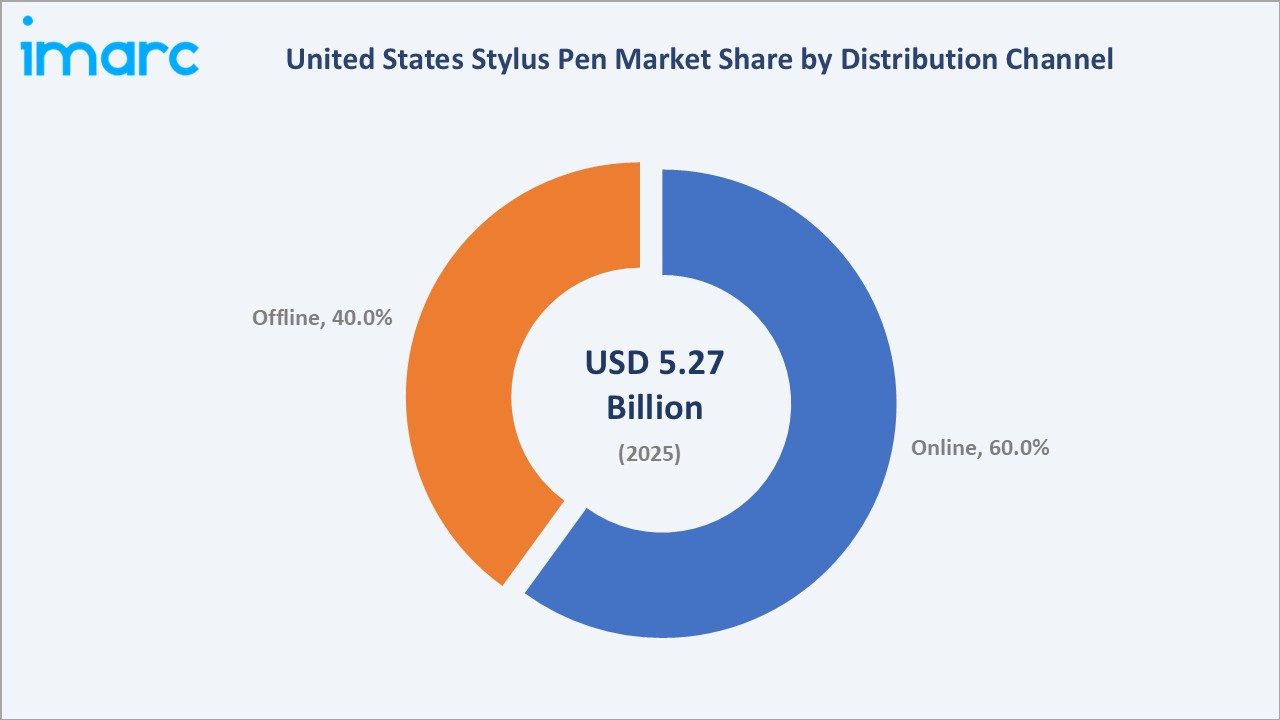
Offline at 40.0% is the second largest segment, fueled by customers' preference for physically examining stylus build quality, testing device compatibility, receiving product demonstrations and obtaining immediate assistance from electronics retailers and authorized brand stores.
Regional Market Insights
| Region | Share (2025) | Key Drivers & Characteristics |
|---|---|---|
| South | 35.0% | Large population, wide device ownership in Texas, Florida and Georgia, expanding school districts and strong e-commerce fulfillment networks |
| West | 25.0% | California and Washington technology and creative industries, early adoption of new devices, strong design and media professional base |
| Midwest | 22.0% | Large university systems, enterprise and healthcare digitization in Illinois, Ohio and Michigan, steady education device procurement |
| Northeast | 18.0% | New York and Massachusetts finance, publishing and academic clusters, dense retail and high premium device ownership |
South accounts for 35.0% of the United States stylus pen market, supported by a large population, broad device ownership across households and schools, and expanding urban and suburban districts that deploy tablets and laptops. Growing investments in educational infrastructure and digital learning initiatives further encourage stylus adoption across academic institutions. The presence of diverse consumer and business segments also supports demand for affordable and advanced pen input solutions. West holds 25.0%, where technology companies, creative studios, and early adopters sustain demand for premium active stylus products.
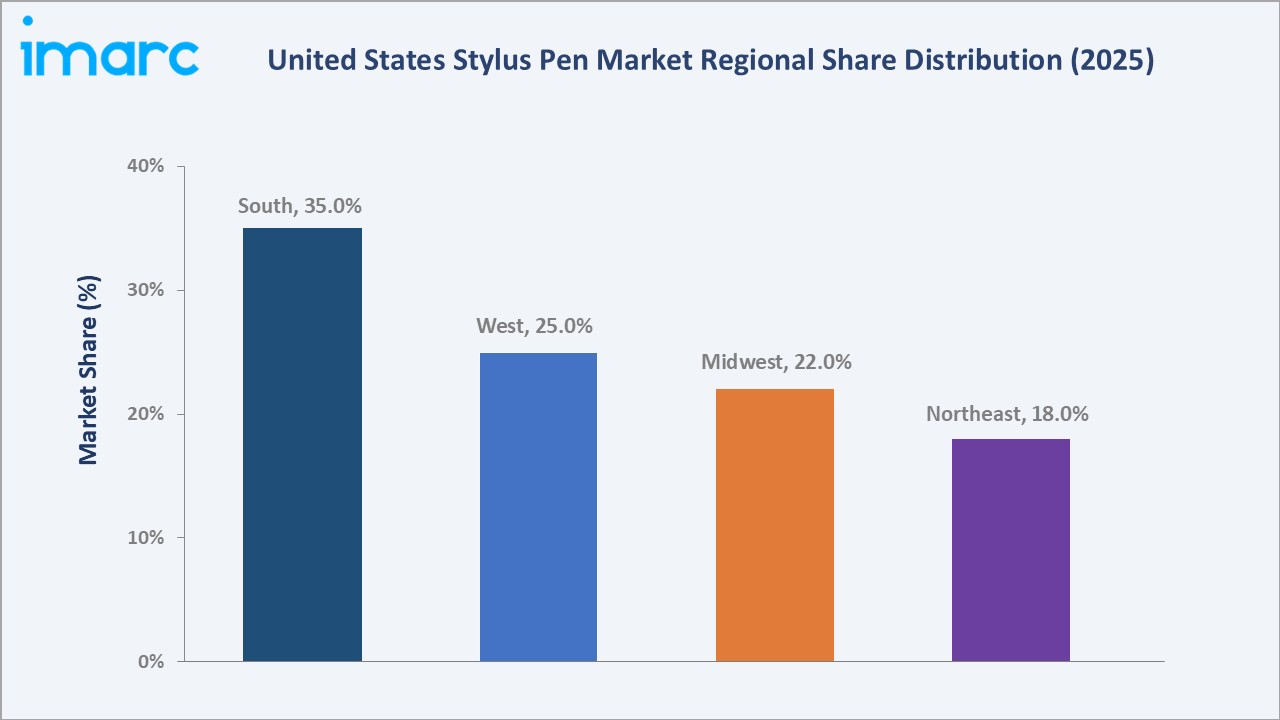
Midwest contributes 22.0%, helped by large university systems, healthcare networks and enterprise digitization that favor dependable, institution-friendly styluses. Northeast at 18.0% reflects dense retail access, academic and publishing clusters and high ownership of premium devices, with steady replacement and accessory purchases across professional and student users. Expanding adoption of digital note-taking and collaborative learning tools further supports regional demand.
Competitive Landscape
The United States stylus pen competitive landscape combines platform owners that sell proprietary pens with their devices, graphics-tablet specialists and independent accessory brands. Competition turns on device compatibility, sensing performance, battery life, price and retail presence. Platform owners benefit from integrated hardware and software, while accessory brands win on universal compatibility, multipacks and value pricing across online and offline channels.
| Company | Key Brands | Market Position | Core Strength |
|---|---|---|---|
| Apple Inc. | Apple Pencil, Apple Pencil Pro, Apple Pencil (USB-C) | Market Leader | Tight iPad integration with magnetic attachment, hover and haptic features and large installed device base |
| Microsoft Corporation | Surface Pen, Surface Slim Pen | Strong Challenger | Pen input built into Surface tablets and laptops with Windows inking and productivity software support |
| Samsung Electronics Co., Ltd. | S Pen, S Pen Pro | Strong Challenger | Pen bundled with Galaxy tablets and flagship phones, widening everyday pen-input adoption |
| Wacom Co., Ltd. | Wacom One, Wacom Pro Pen | Established Player | Professional pen technology and drawing displays trusted by illustrators, designers and animators |
The most commercially significant competitive dynamic is the contest between device-owned pen ecosystems and independent accessory brands. Platform owners bundle or tightly integrate pens, using magnetic attachment, hover and software features that independent products struggle to replicate. Accessory brands respond with universal compatibility, replacement tips, lower prices and strong online presence, targeting owners of older devices and mixed-device households. Education buyers add another front, favoring durable, affordable pens with institutional support. Suppliers that match device-level performance with broad compatibility and clear online information are best placed to keep share as device refresh cycles continue.
Key Company Profiles
Apple Inc.
Apple Inc. is a United States-based technology company engaged in designing, developing and marketing consumer electronics, software and digital services. Its product portfolio includes tablets, smartphones, personal computers and accessories, with stylus solutions designed to support digital writing, drawing and productivity applications.
- Key Brands: Apple Pencil, Apple Pencil Pro, Apple Pencil (USB-C).
- Recent Developments: The company continues to refine stylus functionality through improvements in pressure sensitivity, handwriting recognition, gesture controls and integration with its tablet operating systems.
- Strategic Focus: Apple Inc. concentrates on tying pen input to device hardware and software, widening Apple Pencil compatibility across the iPad range, and adding handwriting and creative features through its operating system and applications to encourage stylus adoption.
Microsoft Corporation
Microsoft Corporation is a United States-based technology company engaged in developing software, computing devices, cloud services and productivity solutions. Its hardware portfolio includes personal computers, tablets and accessories, while its stylus offerings support handwriting, digital annotation, creative applications and professional workflows.
- Key Brands: Surface Pen, Surface Slim Pen.
- Recent Developments: The firm continues to improve digital inking capabilities through handwriting recognition, pressure-sensitive input, programmable pen controls and integration with productivity and collaboration applications.
- Strategic Focus: Microsoft Corporation is prioritizing pen-friendly Windows features, including handwriting tools within productivity applications, while broadening its Surface lineup across price points so more education and business customers can adopt stylus-based workflows.
Samsung Electronics Co., Ltd.
Samsung Electronics Co., Ltd. is a South Korea-based electronics company engaged in manufacturing smartphones, tablets, televisions, home appliances and semiconductor products. Its mobile and computing portfolio includes stylus-enabled devices designed to support digital note-taking, illustration, document annotation and productivity requirements.
- Key Brands: S Pen, S Pen Pro.
- Recent Developments: The company continues to enhance stylus-enabled experiences through improvements in handwriting functionality, screen interaction, note-taking applications and integration across compatible mobile and computing devices.
- Strategic Focus: Samsung Electronics Co., Ltd. focuses on bundling the S Pen with flagship tablets, integrating note-taking and productivity software with pen input, and maintaining cross-device continuity between its tablets, phones and laptops to deepen ecosystem loyalty.
Market Concentration Analysis
The market is moderately concentrated. Platform owners that sell proprietary pens with their own devices hold a large share of active stylus value, and the leading company is estimated to hold between 20% and 25% of the market. Ecosystem lock-in, software integration and bundling create switching costs, while capacitive and universal styluses remain spread across many accessory brands and private labels sold online.
Two opposing forces are reshaping concentration. Incumbent platform owners are consolidating share through magnetic attachment, haptics, bundled pens and software features that independent products cannot easily match. At the same time, innovation-led accessory brands and new entrants are winning buyers with universal compatibility, replaceable tips and low prices, fragmenting the value and entry tiers of the market even as the premium tier tightens. Continued expansion of tablet and laptop portfolios is likely to intensify competition, encouraging established players and emerging brands to differentiate through compatibility, pricing and product functionality.
Investment & Growth Opportunities
Highest Growth Segments
Active stylus at ~7.7% CAGR and online at ~7.8% CAGR frame the investment landscape through 2034. These segments grow fastest because of increasing demand for pressure-sensitive input, precise digital writing capabilities, and the expanding availability of stylus-compatible devices across e-commerce platforms. Active styluses benefit from improvements in sensing accuracy, palm rejection and wireless connectivity, while online channels gain from wider product assortments, competitive pricing, customer reviews and convenient purchasing options. These developments create opportunities for manufacturers to strengthen product portfolios and expand their consumer reach.
Emerging Investment Opportunities
The most dynamic emerging opportunity is universal active stylus technology that works reliably across several device protocols, sold with replaceable tips and clear compatibility guidance. It scales fastest through online channels and education bundles where mixed-device households and institutions seek a single dependable pen. Growing demand for cross-platform accessories also creates opportunities for manufacturers investing in adaptive firmware, improved sensing accuracy and affordable multi-device product portfolios.
Investment Themes
- Active stylus engineering and protocol support: Investment in sensing, low latency and certified compatibility turns a commodity accessory into a differentiated product with higher selling prices and repeat purchases.
- Online and direct-to-consumer capability: Strong storefronts, bundle offers and logistics shorten the path from device purchase to stylus add-on and improve customer data for product planning.
- Education and healthcare specialized designs: Durable, easy-to-clean and replaceable-part styluses meet institutional specifications and create stable, repeat procurement relationships. Demand is also supported by growing use of touchscreen devices for digital learning, clinical documentation and patient interaction. Manufacturers can strengthen their market position by developing ergonomic designs, antimicrobial surfaces and application-specific compatibility features.
Future Market Outlook (2026-2034)
The United States stylus pen market is projected to grow from USD 5.27 Billion in 2025 to USD 5.64 Billion in 2026, reaching USD 9.83 Billion by 2034, registering a CAGR of 6.95% during 2026-2034. The market's anchor value of USD 7.38 Billion in 2030 reflects steady device refresh, wider pen support and education adoption rather than a single demand shock, with the South and West sustaining leadership as device ownership and creative workflows deepen across the South stylus pen market and the West.
Three structural forces define market growth through 2034: the spread of pen-capable devices across education, enterprise and consumer use; sensing, charging and software advances that raise the value of every stylus sold; and the shift toward online and bundled purchase that simplifies buying. Increasing integration of stylus functionality into premium tablets and convertible laptops is further supporting replacement demand and expanding the market's addressable consumer base.
Research Methodology
Primary Research
Primary research covered structured discussions with stylus manufacturers, device manufacturers, accessory brands, online and offline retailers, and education technology buyers across the United States. Discussions focused on product compatibility, pricing strategies, replacement cycles, purchasing behaviour, distribution preferences, product specifications, and evolving demand across consumer, educational, and professional applications.
Secondary Research
Secondary research incorporated company annual reports, investor presentations, consumer electronics industry publications, education technology reports, trade statistics, product catalogues, and publicly available industry databases. These sources were reviewed and cross-validated to assess market developments, competitive positioning, technology adoption, pricing trends, and product type, distribution channel, and regional market splits.
Forecasting Models
Forecasting combined pen-capable device adoption modelling with stylus attachment rates, replacement frequency, average selling prices, and distribution channel shift assumptions. Historical market trends and emerging technology developments were incorporated to estimate annual market values from 2026 to 2034, with segment-level projections reconciled against overall market growth.
United States Stylus Pen Market Report Coverage:
| Report Features | Details |
|---|---|
| Base Year of the Analysis | 2025 |
| Historical Period | 2020-2025 |
| Forecast Period | 2026-2034 |
| Units | Billion USD |
| Scope of the Report |
Exploration of Historical Trends and Market Outlook, Industry Catalysts and Challenges, Segment-Wise Historical and Future Market Assessment:
|
| Product Types Covered | Resistive Stylus, Capacitive Stylus, Active Stylus |
| Distribution Channels Covered | Online, Offline |
| Applications Covered | Smart Phones, Tablets, Interactive Whiteboards |
| End Users Covered | OEM, Retail |
| Region Covered | Northeast, Midwest, South, West |
| Companies Covered | Apple Inc., Microsoft Corporation, Samsung Electronics Co., Ltd., Wacom Co., Ltd., etc. |
| Customization Scope | 10% Free Customization |
| Post-Sale Analyst Support | 10-12 Weeks |
| Delivery Format | PDF and Excel through Email (We can also provide the editable version of the report in PPT/Word format on special request) |
Frequently Asked Questions About the United States Stylus Pen Market Report
The market reached USD 5.27 Billion in 2025 and an estimated USD 5.64 Billion in 2026, supported by pen-capable device adoption, digital education programs, creative workflows and rising online purchasing.
The market is expected to register a CAGR of 6.95% during 2026-2034, reaching USD 9.83 Billion on device and software advances. Growing use of digital writing tools across education, business and creative applications further supports market expansion.
Active stylus leads the product type segment with a 60.0% share in 2025, driven by pressure sensitivity, tilt detection, palm rejection and close integration with tablets, laptops and phones. Continued improvements in writing precision and responsiveness strengthen demand across professional and personal applications.
Online leads the distribution channel segment with a 60.0% share in 2025, supported by brand storefronts, marketplaces, device-bundle checkouts and easy compatibility comparison. Wider product availability, competitive pricing and convenient home delivery further encourage online purchases.
South leads with a 35.0% regional share in 2025, supported by a large population, broad device ownership across households and schools, and strong online fulfillment networks. Expanding educational technology adoption and digital workplace investments also contribute to regional demand.
Leading companies include Apple Inc., Microsoft Corporation, Samsung Electronics Co., Ltd., and Wacom Co., Ltd., among others.
The market is projected to reach USD 7.38 Billion by 2030, driven by wider pen-capable device adoption, digital education programs and advances in sensing and wireless charging, alongside growing enterprise digitization initiatives.
Online at ~7.8% CAGR and active stylus at ~7.7% CAGR are the fastest-growing segments, alongside universal active styluses and education bundles.
Need more help?
- Speak to our experienced analysts for insights on the current market scenarios.
- Include additional segments and countries to customize the report as per your requirement.
- Gain an unparalleled competitive advantage in your domain by understanding how to utilize the report and positively impacting your operations and revenue.
- For further assistance, please connect with our analysts.
 Request Customization
 Speak to an Analyst
 Request Brochure
 Inquire Before Buying
Benefits of Customization
- Personalize this research
- Triangulate with your data
- Get data as per your format and definition
- Gain a deeper dive into a specific application, geography, customer, or competitor
- Any level of personalization
Get in Touch With Us
UNITED STATES
Phone: +1-201-971-6302
INDIA
Phone: +91-120-433-0800
UNITED KINGDOM
Phone: +44-753-714-6104
Email: [email protected]
Client Testimonials























Related Reports

Choose your plan
*Please note that the prices mentioned below are starting prices for each bundle type. Kindly contact our team for further details.*
Single User License
- 1 User License, Access on 2 Devices
- PDF Report + Excel Dataset (Password Protected)
- Lifetime Access
- No Printing Rights
- 10% Free Report Customization
- 10–12 Weeks of Analyst Support
Five User License
- Access for 5 Users, 2 Devices per User
- PDF Report + Excel Dataset (Password Protected)
- Lifetime Access
- Dedicated Account Manager
- 12–14 Weeks of Analyst Support
- No Printing Rights
- 15% Free Report Customization
- 25% Discount on Your Next Purchase
Corporate User License
- Unlimited User Access (Within Your Organization)
- PDF Report + Excel Dataset
- Lifetime Access
- Dedicated Account Manager
- 14–20 Weeks of Analyst Support
- No Printing Rights
- 20% Free Report Customization
- 30% Discount on Your Next Purchase
Essential Insights
What's included:
3 reports
- Lifetime Access
- PDF Reports
- Excel Datasets
- 2 Weeks of Free Analyst Support
- 2 User Licenses
- Access on 2 Devices
- Printing Rights
- Complimentary PowerPoint (PPT) Version
- Complimentary License Upgrade
Professional Access
What's included:
5 reports
- Lifetime Access
- PDF Reports
- Excel Datasets
- 8 Weeks of Free Analyst Support
- 2 User Licenses
- Access on 2 Devices
- Printing Rights
- Complimentary PowerPoint (PPT) Version
- Complimentary License Upgrade
Business Advantage
What's included:
8 reports
- Lifetime Access
- PDF Reports
- Excel Datasets
- 14 Weeks of Free Analyst Support
- 2 User Licenses
- Access on 2 Devices
- Printing Rights
- Complimentary PowerPoint (PPT) Version
- Complimentary License Upgrade
Enterprise Intelligence
What's included:
10 reports
- Lifetime Access
- PDF Reports
- Excel Datasets
- 20 Weeks of Free Analyst Support
- 2 User Licenses
- Access on 2 Devices
- Printing Rights
- Complimentary PowerPoint (PPT) Version
- Complimentary License Upgrade