
US Online Travel Market Size, Share, Trends and Forecast by Service Type, Platform, Mode of Booking, Age Group, and Region, 2026-2034
US Online Travel Market Size, Share, Trends & Forecast (2026-2034)
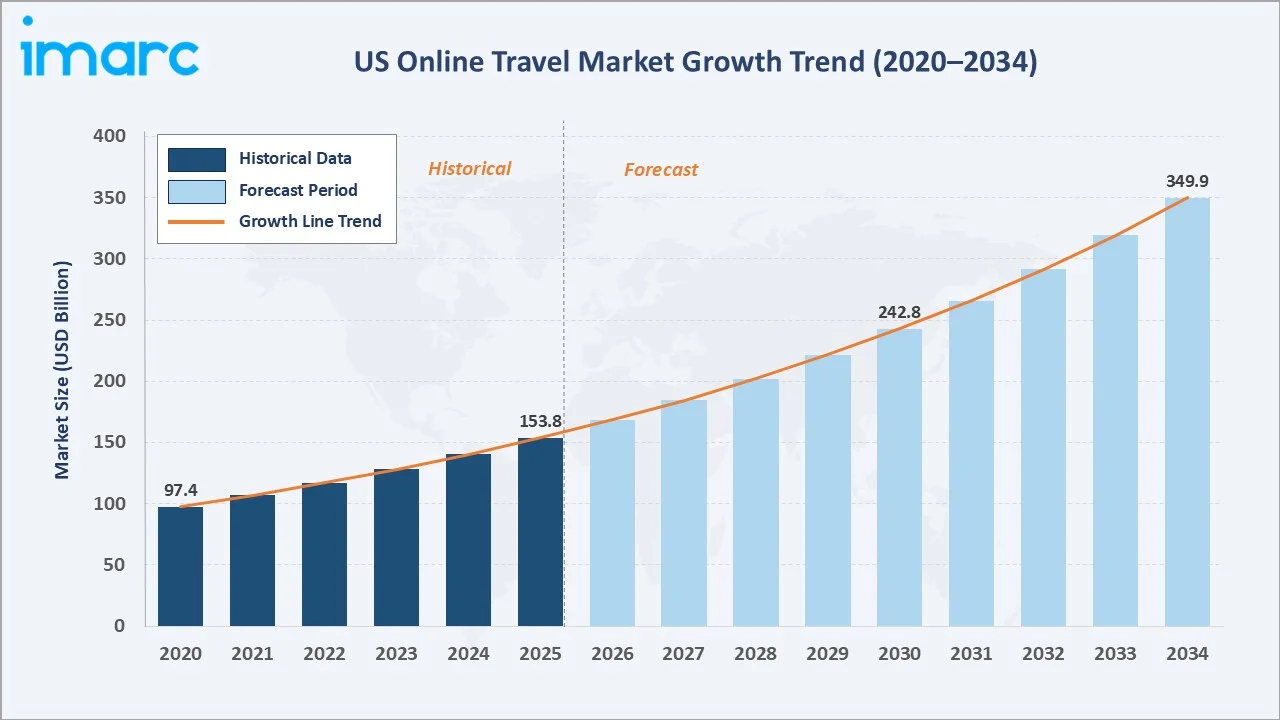
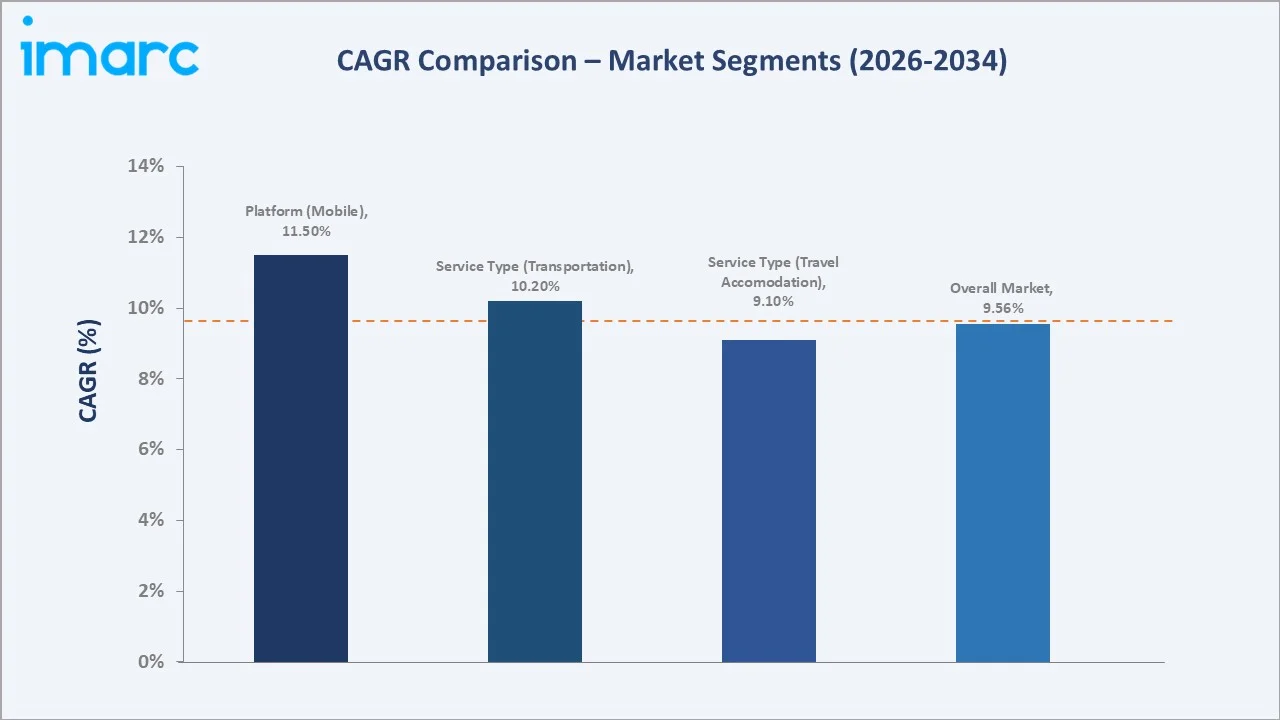
The US online travel market size was valued at USD 153.8 Billion in 2025 and is projected to reach USD 349.9 Billion by 2034, growing at a CAGR of 9.56% during 2026-2034. Increasing consumer preference for convenient digital booking platforms, widespread smartphone adoption, and the growing influence of AI-powered personalization are driving robust market expansion.
Market Snapshot
|
Metric |
Value |
|
Market Size (2025) |
USD 153.8 Billion |
|
Forecast Market Size (2034) |
USD 349.9 Billion |
|
CAGR (2026-2034) |
9.56% |
|
Base Year |
2025 |
|
Historical Period |
2020-2025 |
|
Forecast Period |
2026-2034 |
|
Largest Region |
South (30.6% share, 2025) |
|
Largest Service Segment |
Transportation (42.0% share, 2025) |
|
Dominant Platform |
Mobile (63.0% share, 2025) |
Online travel platforms such as Expedia Group, Booking Holdings, and Airbnb enable consumers to seamlessly book flights, accommodations, car rentals, and experiences. The market continues to expand due to increasing demand for personalized travel, real-time pricing transparency, and the integration of advanced technologies such as AI-driven recommendations and mobile-first booking interfaces.
To get more information on this market, Request Sample
The South dominates, holding a 30.6% regional share in 2025. Transportation services lead application demand at 42.0%, while mobile platforms dominate with 63.0% share. The market reflects deepening digital integration, rising travel spending across demographics, and the accelerating shift from offline to AI-enhanced online booking channels.
Executive Summary
The US online travel market is experiencing sustained expansion, propelled by digital transformation reshaping consumer travel planning behavior. Increasing internet penetration, near-universal smartphone adoption, and maturing AI capabilities on booking platforms have fundamentally shifted how Americans discover, compare, and book travel services. The market reached USD 153.8 Billion in 2025 and is forecast to surpass USD 349.9 Billion by 2034, representing a compelling CAGR of 9.56% over the forecast period.
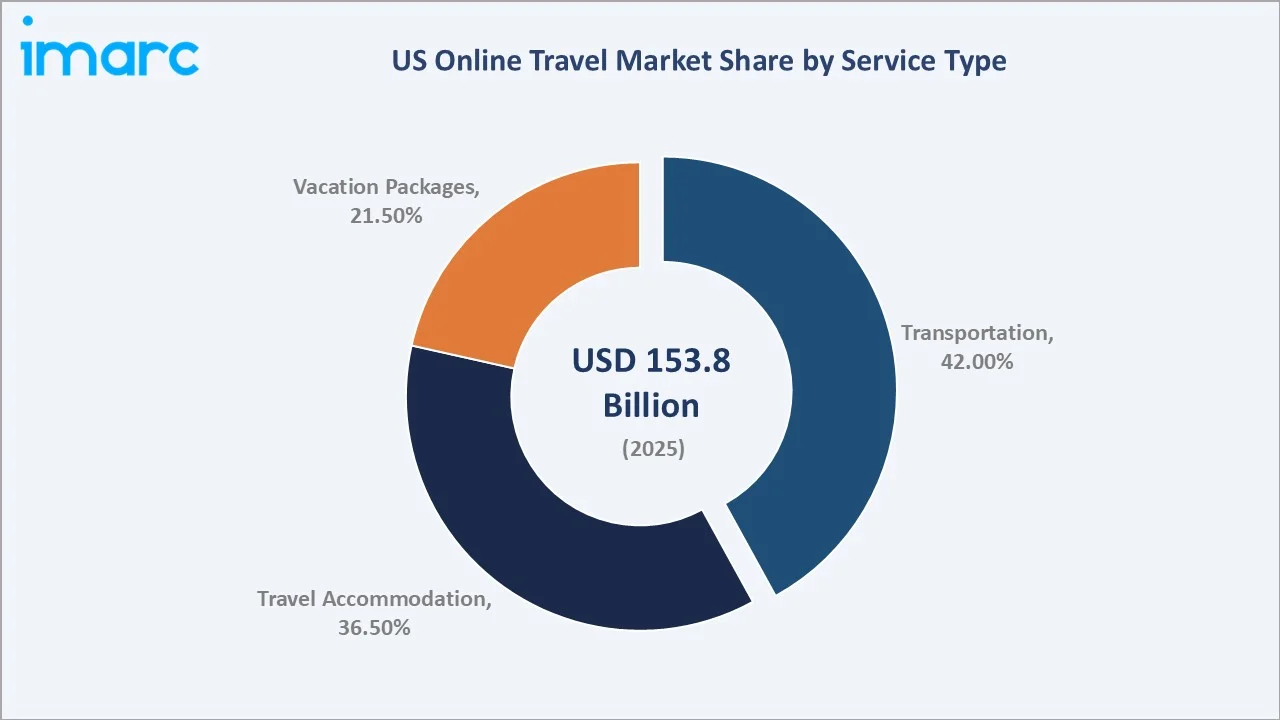
Transportation services hold the largest share at 42.0% in 2025, driven by the surge in air travel bookings and ground transportation demand through digital channels. Travel accommodation accounts for 36.5%, reflecting robust hotel and short-term rental bookings. Mobile platforms command 63.0% of all bookings, a reflection of consumer preference for on-the-go travel management. The South leads regionally at 30.6%, supported by strong leisure and business travel demand across Texas, Florida, and Georgia.
Key Market Insights
|
Insight |
Data |
|
Largest Segment (Service Type) |
Transportation – 42.0% share (2025) |
|
Second Largest Service Type |
Travel Accommodation – 36.5% share (2025) |
|
Dominant Platform |
Mobile – 63.0% share (2025) |
|
Leading Region |
South – 30.6% share (2025) |
|
Fastest Growing Region |
West (tech-savvy population + digital-first adoption) |
|
Top Companies |
Booking Holdings, Expedia Group, Airbnb, Inc., Tripadvisor, and Hopper Inc. |
Key Analytical Observations Supporting the Above Data:
- Transportation accounts for 42.0% of the US online travel market in 2025, benefiting from full post-pandemic air travel recovery, dynamic pricing transparency on booking platforms, and growing domestic and international route availability through OTAs.
- Travel Accommodation (36.5%) is driven by the rapid rise of short-term rental platforms and OTA-listed hotels. Airbnb alone reported 121.9 million nights and seats booked in Q4 2025, reflecting sustained consumer preference for flexible lodging alternatives.
- Mobile platforms command 63.0% of total bookings in 2025. Airbnb confirmed that 64% of Q4 2025 bookings originated via mobile apps, while air ticket and hotel bookings on Trip.com's international OTA platform grew by more than 70% year over year, highlighting the structural dominance of app-based travel booking.
- The South holds 30.6% of the U.S. online travel market revenue in 2025, driven by tourism-intensive states including Florida, Texas, and Georgia, strong convention and business travel activity, and high leisure travel demand year-round.
- Booking Holdings reported Q4 2025 adjusted EPS Grew 17% year-over-year, with room nights increasing 9% and connected trip bookings rising 37% year-over-year, reflecting accelerating digital travel adoption.
US Online Travel Market Overview
The US online travel market encompasses all digitally facilitated booking and reservation services for transportation, accommodation, and vacation packages. This includes online travel agencies (OTAs), direct supplier websites, metasearch engines, and emerging AI-driven travel planning platforms. The ecosystem spans content aggregators, technology infrastructure providers, payment processors, digital marketing channels, and post-booking customer experience services.
Macroeconomic tailwinds, including robust consumer spending on leisure, the normalization of remote and hybrid work enabling flexible travel, and generational shifts toward experience-driven expenditure, create structural demand. The US online travel market growth is further amplified by the adoption of AI, real-time pricing algorithms, and integrated multimodal booking capabilities that reduce friction and increase conversion across all demographic segments.
Market Dynamics
To evaluate market opportunities, Request Sample
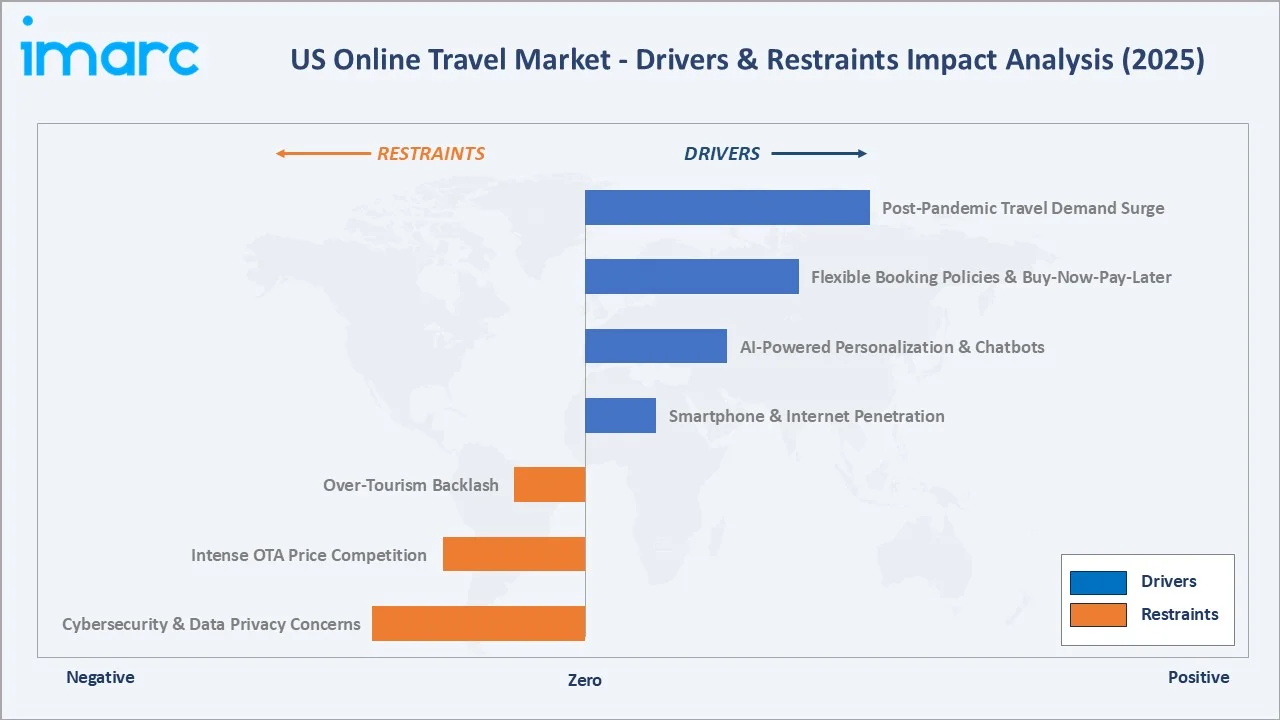
Market Drivers
- Smartphone & Internet Penetration: Over 97% of U.S. adults own smartphones, and more than 92% have broadband internet access as of 2025, creating an addressable digital consumer base that spans all demographics. Mobile-first design and progressive web apps have eliminated friction in discovery-to-booking journeys.
- AI-Powered Personalization & Chatbots: Platforms deploy machine learning models trained on billions of booking data points to surface hyper-relevant travel recommendations. In October 2025, Kayak launched "AI Mode,"enabling conversational search across flights, hotels, and car rentals.
- Flexible Booking Policies & Buy-Now-Pay-Later: In March 2025, Expedia Group introduced "Flex Pay" in the U.S., allowing travelers to finance cruise bookings across multiple installments. Consumer demand for cancellation flexibility and BNPL options has materially increased conversion rates and average booking values.
- Post-Pandemic Travel Demand Surge: U.S. domestic and international travel demand has maintained growth above pre-pandemic levels through 2025, driven by pent-up demand, demographic wealth effects, and "revenge travel" patterns solidifying into sustained behavioral preferences.
Market Restraints
- Cybersecurity & Data Privacy Concerns: High-profile data breaches at major travel platforms have eroded consumer trust in storing payment and personal information. Regulatory requirements under state-level privacy laws (CCPA, CPRA) impose compliance costs on digital travel operators.
- Intense OTA Price Competition: Rate parity agreements have largely collapsed, forcing OTAs into aggressive price-matching that compresses net margins. The top three OTAs collectively invest over USD 15 billion annually in digital marketing to maintain their traffic share.
- Over-Tourism Backlash: Popular U.S. destinations, including Hawaii, Sedona, and coastal cities, are implementing visitor caps and surcharges that constrain online booking volumes in high-demand markets.
Market Opportunities
- Sustainable & Experiential Travel: In April 2025, Booking.com reported that 53% of travelers (including U.S.) are conscious of tourism's environmental impact, driving demand for eco-certified accommodations and responsible tour experiences. Platforms incorporating sustainability filters gain disproportionate engagement from millennial and Gen Z consumers.
- Agentic AI and Voice-Activated Booking: The emergence of autonomous AI travel agents capable of planning, booking, and managing entire trips without human intervention represents a transformational opportunity. Integration with smart speakers and connected vehicles positions voice-activated travel booking as a material growth lever through 2034.
- B2B and Corporate Travel Digital Transformation: In September 2025, Amex Global Business Travel completed the acquisition of CWT, consolidating B2B travel management. The shift of corporate travel management onto fully digital platforms represents an incremental USD 85 billion addressable market within the U.S. by 2034.
Market Challenges
- Platform Consolidation and Regulatory Scrutiny: Increasing concentration among top OTAs is attracting antitrust attention. Google's dominant position in travel search and advertising draws ongoing regulatory review, creating uncertainty around traffic acquisition costs for competing platforms.
- Content Authenticity and AI-Generated Misinformation: The proliferation of AI-generated hotel descriptions and synthetic review content threatens the trust architecture that underpins online travel decision-making. Platforms invest heavily in verification systems, adding operational cost complexity.
Emerging Market Trends
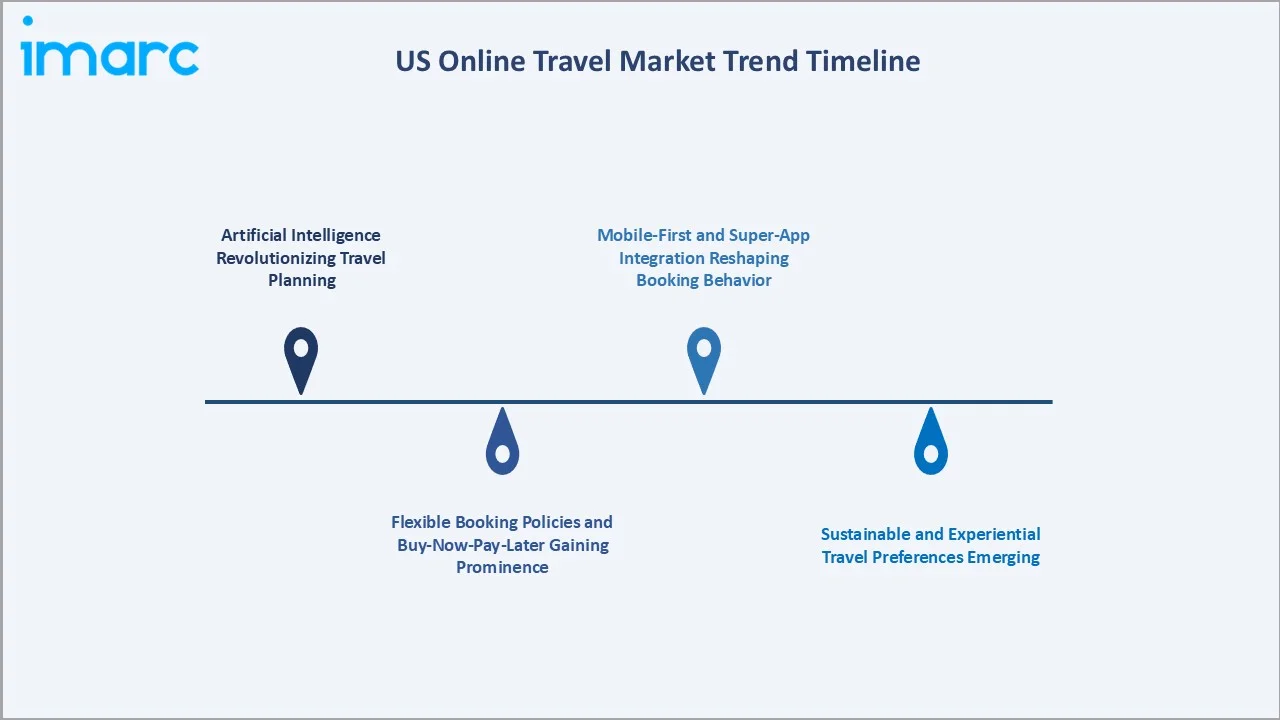
1. Artificial Intelligence Revolutionizing Travel Planning
In October 2025, Kayak launched "AI Mode," enabling travelers to compare and book flights, hotels, and car rentals through a conversational AI chatbot. Platforms increasingly deploy intelligent algorithms analyzing user behavior, preferences, and historical booking patterns to deliver hyper-personalized recommendations. Voice-activated booking capabilities are gaining traction as consumers embrace hands-free technology.
2. Flexible Booking Policies and Buy-Now-Pay-Later Gaining Prominence
In March 2025, Expedia Group introduced "Flex Pay" in the U.S., allowing travelers to finance cruise bookings with monthly installments across multiple brands. This shift reflects broader economic awareness and the desire for financial protection when committing to travel expenditures. The US online travel market outlook is being shaped by BNPL integration, with younger travelers increasingly selecting platforms that offer installment payment options as a primary criterion.
3. Sustainable and Experiential Travel Preferences Emerging
In April 2025, Booking.com reported that 53% of its travelers are now conscious of tourism's impact on local communities and the environment, reflecting rising demand for sustainable and experiential travel. Digital platforms incorporate sustainability filters, helping users identify eco-friendly accommodations and responsible tour operators. This shift toward purposeful travel extends to authentic cultural engagement and support for local communities.
4. Mobile-First and Super-App Integration Reshaping Booking Behavior
Airbnb confirmed that 64% of Q4 2025 bookings originated via mobile apps, with mobile volumes growing double digits year-over-year. Super-app development, where a single platform encompasses transportation, accommodation, activities, dining, and payments, is gaining traction. The US online travel market growth is being accelerated by biometric checkout, real-time push notifications for price drops, and seamless itinerary management within single mobile environments that reduce the cognitive load of travel planning for users.
Industry Value Chain Analysis
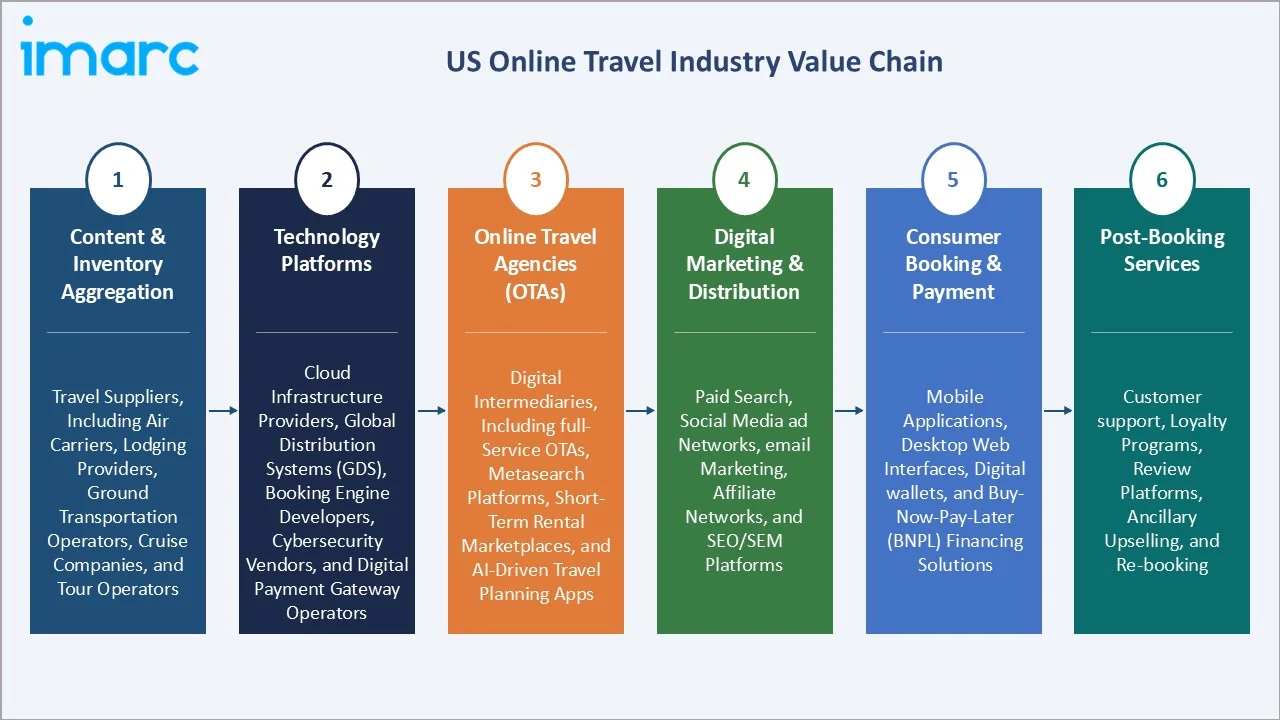
The US online travel value chain spans content aggregation through post-booking services, with each stage populated by specialized operators whose performance directly influences traveler satisfaction, platform economics, and competitive differentiation.
|
Stage |
Key Players / Examples |
|
Content & Inventory Aggregation |
Travel suppliers, including air carriers, lodging providers, ground transportation operators, cruise companies, and tour operators |
|
Technology Platforms |
Cloud infrastructure providers, global distribution systems (GDS), booking engine developers, cybersecurity vendors, and digital payment gateway operators |
|
Online Travel Agencies (OTAs) |
Digital intermediaries, including full-service OTAs, metasearch platforms, short-term rental marketplaces, and AI-driven travel planning apps |
|
Digital Marketing & Distribution |
Paid search and social media advertising networks, email marketing automation tools, affiliate and referral networks, influencer and content marketing channels, and SEO/SEM platforms |
|
Consumer Booking & Payment |
Mobile applications, desktop web interfaces, digital wallets, and buy-now-pay-later (BNPL) financing solutions |
|
Post-Booking Services |
Customer support, loyalty programs, review platforms, ancillary upselling, and re-booking |
Technology Landscape in the US Online Travel Industry
Large Language Models and Agentic AI in Travel
Platforms including Kayak, Expedia, and Google Travel have integrated GPT-based and proprietary LLMs to power conversational search and dynamic package assembly. Agentic AI is transitioning from pilot phase to limited commercial deployment, with Booking Holdings' Connected Trip platform achieving over 30% year-over-year growth in bookings in Q2 2025.
Dynamic Pricing and Real-Time Revenue Management
Advanced revenue management algorithms that ingest real-time demand signals, competitor pricing, weather data, and event calendars are enabling suppliers and OTAs to optimize pricing with millisecond precision. Hopper's price prediction technology, which forecasts flight and hotel prices up to a year in advance with high accuracy, has become a competitive differentiator in mobile-first consumer segments, driving user retention and repeat booking behavior.
Blockchain for Identity Verification and Loyalty Programs
Distributed ledger technology is being piloted for secure traveler identity verification, seamless loyalty point portability across platforms, and transparent smart contract-based cancellation and refund processing. Several major hotel chains and airline loyalty programs are integrating blockchain-based token systems that enable real-time cross-brand point redemption without traditional reconciliation delays, enhancing the value proposition of platform-based booking.
Market Segmentation Analysis
The report covers the following segments:
|
Segment Category |
Leading Segment |
Market Share |
Year |
|
Service Type |
Transportation |
42% |
2025 |
|
Platform |
Mobile |
63% |
2025 |
|
Mode of Booking |
Online Travel Agencies (OTAs) |
58% |
2025 |
|
Age Group |
22–31 Years |
33% |
2025 |
|
Region |
South |
30.6% |
2025 |

By Service Type
Transportation dominates the service type segment with a 42.0% share in 2025 (equivalent to approximately USD 64.6 Billion). Its dominance reflects the complete post-pandemic recovery of air travel, growing demand for ground transportation booking through digital platforms, and OTA price comparison tools that give consumers confidence in securing competitive fares.
To access detailed market analysis, Request Sample
Travel accommodation represents 36.5% of the market, driven by the explosive growth of short-term rental platforms and OTA-listed hotel inventory. Airbnb reported 121.9 million nights booked in Q4 2025 alone, underscoring the structural shift away from direct hotel booking toward platform-aggregated accommodation. Vacation packages account for the remaining 21.5%, growing as consumers seek bundled value and single-purchase convenience for multi-component travel itineraries.
By Platform
Mobile platforms command a 63.0% share of the US online travel market in 2025. This dominance reflects widespread smartphone penetration, the development of feature-rich travel apps with biometric authentication, real-time price alerts, and seamless payment integration that reduces booking friction to near-zero for experienced digital consumers.
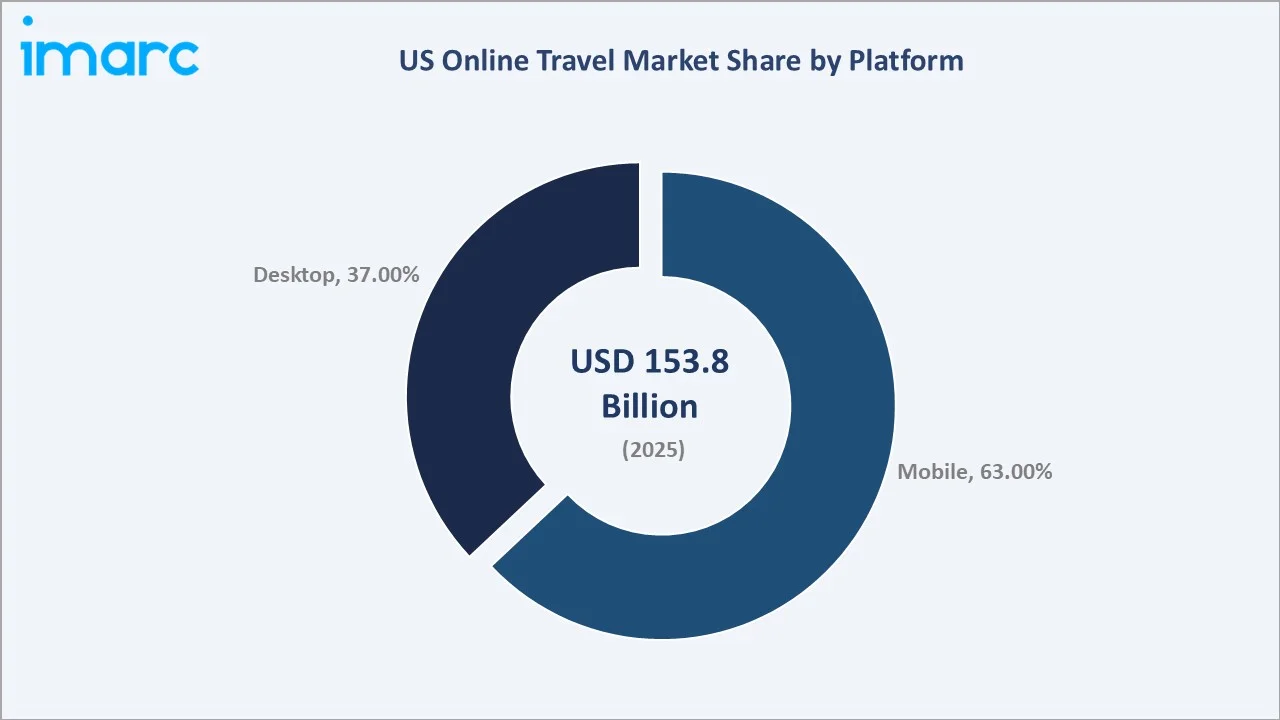
Desktop platforms retain a 37.0% share, as desktop retains preference for complex multi-destination itinerary planning, corporate travel booking requiring detailed invoice management, and older demographic segments who prefer larger-screen interfaces for high-value bookings. The mobile-to-desktop ratio is expected to widen further through 2034 as next-generation mobile capabilities, including AR destination previews and AI travel agents, become standard app features.
Regional Market Insights
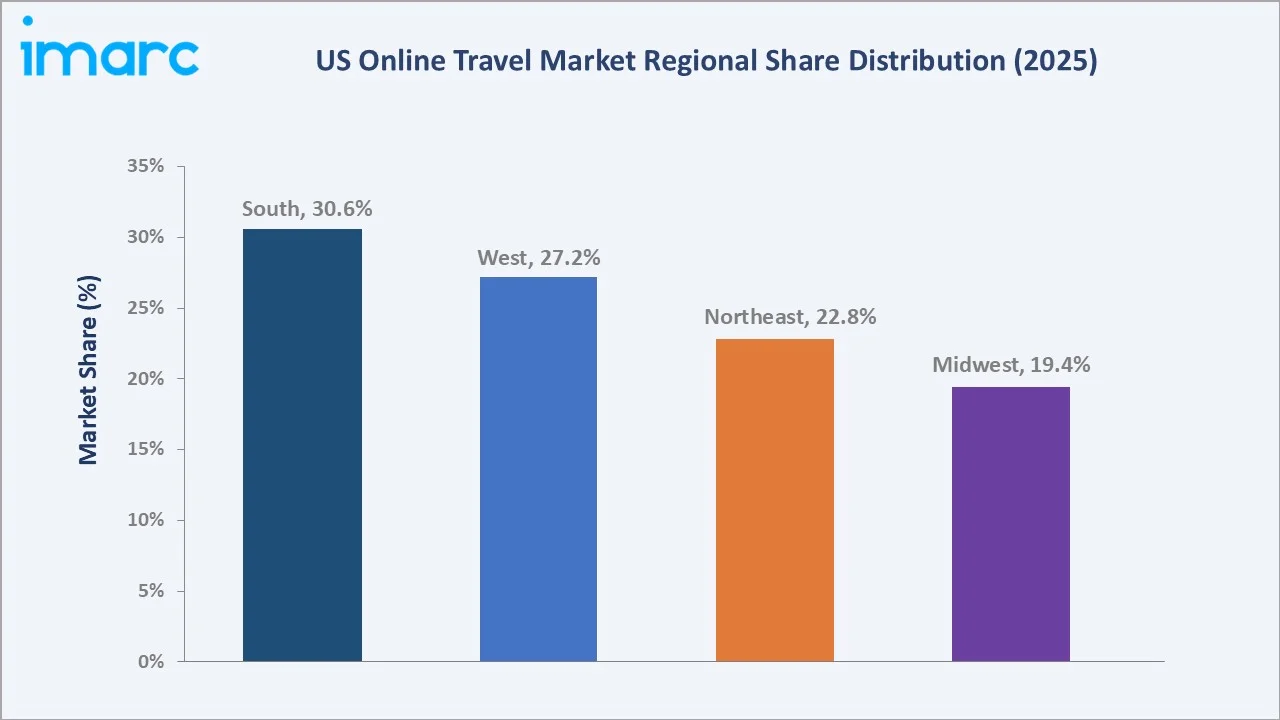
The South's market leadership (30.6%, 2025) reflects intensive leisure and business travel activity anchored by high-traffic tourism states. Florida, Texas, and Georgia collectively drive regional demand through year-round warm weather destinations, major convention venues, and significant airline hub activity through airports such as Hartsfield-Jackson Atlanta, Dallas/Fort Worth, and Miami International.
|
Region |
Share (2025) |
Key Growth Drivers |
|
South |
30.6% |
Leisure tourism, business travel, warm weather destinations |
|
West |
27.2% |
Tech-savvy population, international travel gateway, luxury tourism |
|
Northeast |
22.8% |
Dense corporate travel, international routes, premium bookings |
|
Midwest |
19.4% |
Domestic leisure, convention travel, and growing digital adoption |
The West is the fastest-growing region, driven by California's technology-native consumer base, international travel gateway demand through LAX and SFO, and high per-capita travel spending among Silicon Valley and entertainment industry demographics. Oregon and Washington contribute to growing eco-tourism and outdoor adventure travel bookings that skew toward mobile platform origination.
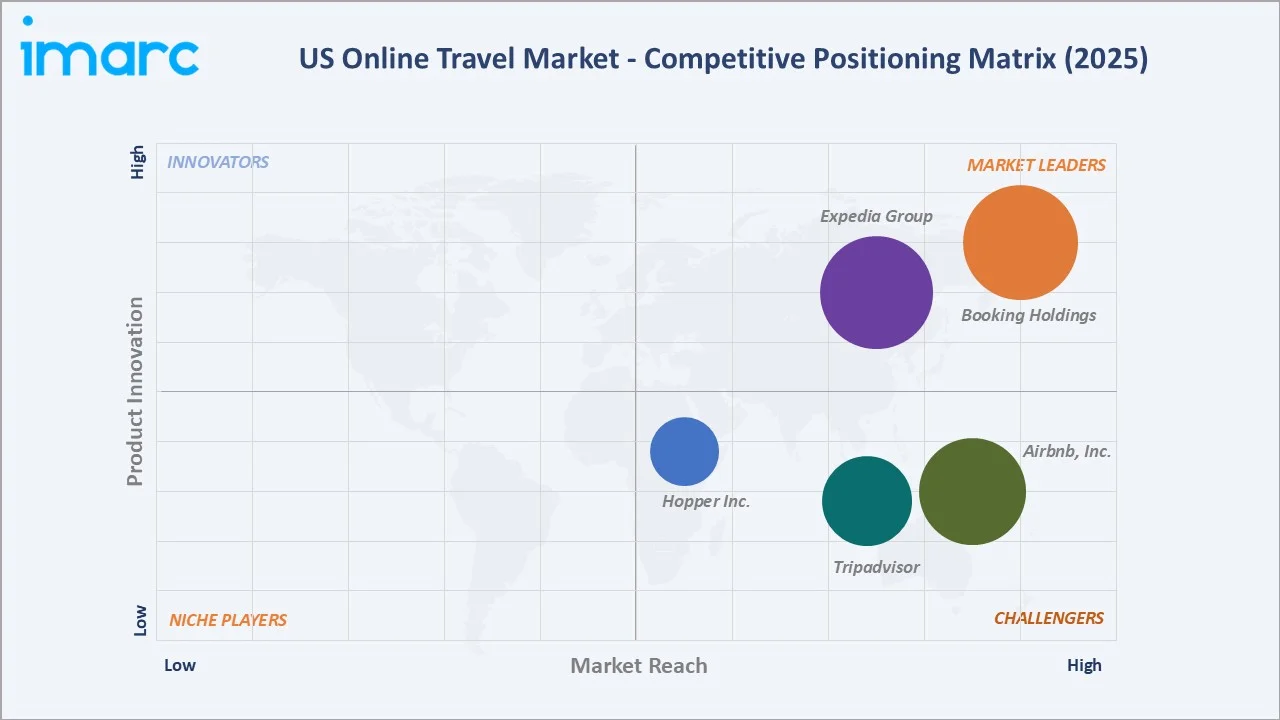
Competitive Landscape
The US online travel market exhibits a highly concentrated structure at the top tier. Booking Holdings reported USD 26.9 billion in revenue for full-year 2025, reflecting a 13% year-over-year increase, and maintains the position of global market leader.
|
Company |
Brand / Platform |
Market Position |
Core Strength |
|
Booking Holdings |
Booking.com, Priceline, Agoda, KAYAK, OpenTable, Rentalcars.com by Booking.com, among others |
Market Leader |
World's largest OTA; Connected Trip vision; 500M+ monthly visits |
|
Expedia Group |
Expedia, Hotels.com, Trivago, Vrbo Travelocity, Hotwire, among others |
Market Leader |
Broadest U.S. OTA brand portfolio; Flex Pay innovation |
|
Airbnb, Inc. |
Airbnb, Experiences |
Strong Challenger |
Short-term rental market leader; 64% mobile bookings |
|
Tripadvisor |
Tripadvisor, Viator |
Challenger |
Review-driven metasearch; Viator experiential travel; deep content moat |
|
Hopper Inc. |
Hopper |
Challenger |
Mobile-first; price prediction AI; BNPL integration; fastest-growing app in U.S. travel |
The competitive landscape is characterized by innovation-driven strategies, enhanced user experiences, and aggressive investment in AI-powered personalization to strengthen platform loyalty and booking conversion across the digital travel ecosystem.
Key Company Profiles
Booking Holdings, Inc.
Booking Holdings, headquartered in Norwalk, Connecticut, is the world's largest online travel company, operating Booking.com, Priceline, Kayak, and OpenTable in the US. Its flagship platform, Booking.com, attracted an average of 559.6 million visitors monthly from April 2022 to January 2024.
- Product Portfolio: Booking.com, Agoda, Priceline, KAYAK, OpenTable, Rentalcars.com by Booking.com, FareHarbor, Rocketmiles, Cheapflights, Momondo, and HotelsCombined.
- Recent Developments: Booking Holdings delivered strong financial performance in 2025, reporting USD 26.9 billion in revenue (up 13% YoY), with gross bookings reaching USD 186.1 billion (+12%) and total room nights booked rising to 1.235 billion (+8%).
- Strategic Focus: Unified Connected Trip platform integrating flights, stays, and activities; AI-driven customer lifecycle management; GenAI-powered search expansion.
Expedia Group
Expedia Group, headquartered in Seattle, Washington, operates the world's broadest portfolio of online travel brands serving individual and business travelers across North America, Europe, and Asia-Pacific.
- Product Portfolio: Expedia, Hotels.com, Vrbo, Travelocity, Hotwire, Orbitz, CarRentals.com, Expedia Cruises, and Trivago.
- Recent Developments: In March 2025, Expedia Group introduced Flex Pay, a Buy Now, Pay Later solution in partnership with Upgrade, enabling travelers in the U.S. and Canada to book cruise vacations and pay in installments over 3 to 24 months across brands like Expedia Cruises, Expedia.com, Travelocity.com, Orbitz.com, and Cheaptickets.com.
- Strategic Focus: Loyalty program expansion across brands; experiential travel content depth; AI trip planning integration across the Expedia app.
Airbnb, Inc.
Airbnb, Inc., headquartered in San Francisco, California, operates the world's leading short-term rental marketplace, connecting hosts with guests across 220+ countries. Its Experiences platform offers activity-based bookings alongside accommodation.
- Product Portfolio: Airbnb and Experiences.
- Recent Developments: Airbnb, Inc. reported strong Q4 2025 performance, with revenue rising 12% year over year, driven by a 16% increase in gross booking value and a 10% growth in nights and experiences booked.
- Strategic Focus: Affordable travel product line expansion; Experiences vertical deepening; international market penetration; mobile-first platform optimization.
Market Concentration Analysis
The US online travel market exhibits high concentration at the top tier, with Booking Holdings, Expedia Group, and Airbnb, Inc. collectively holding an estimated 55–65% of total OTA-mediated booking value in 2025. However, a significant long tail of regional and niche platforms, including Hopper, Inc. for mobile-first users, ensures substantial competitive dynamism in specific verticals and demographic segments.
Consolidation activity remains vigorous. American Express Global Business Travel completed the acquisition of CWT in September 2025, consolidating B2B corporate travel management. Such transactions reflect a strategic imperative to expand TAM beyond traditional flights and hotels into the broader experience economy, where margins are structurally higher, and consumer engagement is more recurring.
Investment & Growth Opportunities
Fastest Growing Segments
AI-powered personalized travel services (estimated 15%+ CAGR through 2034), experiential and sustainable travel platforms (12% CAGR), and mobile-native BNPL-integrated booking apps (11.5% CAGR) represent the three highest-growth investment vectors. Together, these niches address a total addressable market of approximately USD 48 billion by 2030, with disproportionate margin potential versus commoditized flight and hotel booking.
Corporate Travel Digital Transformation
The USD 350 billion U.S. corporate travel market is undergoing rapid digitalization following the Amex GBT/CWT consolidation. Enterprise travel management platforms integrating AI expense management, duty-of-care tracking, and automated supplier negotiation represent a concentrated B2B opportunity. Platforms serving the mid-market corporate segment, companies spending USD 500K–5M annually on travel, remain under-penetrated by major OTAs and represent a significant greenfield opportunity.
Venture and Institutional Investment Trends
- Key investment themes include agentic AI travel planners capable of autonomous end-to-end trip management, voice-activated booking integration with smart home and connected vehicle platforms, and blockchain-based loyalty token systems enabling cross-platform point portability.
- Private equity interest is concentrated in mid-tier OTA platforms with strong mobile engagement metrics, BNPL travel fintech startups, and data analytics companies providing demand intelligence to travel suppliers and destination marketing organizations.
Future Market Outlook (2026-2034)
The US online travel market is positioned for sustained, high-growth expansion through 2034. From a base of USD 153.8 Billion in 2025, the market is projected to reach USD 349.9 Billion by 2034, representing total incremental value creation of approximately USD 196 billion over the forecast decade. The US online travel market forecast remains consistently positive, anchored by structural demand tailwinds that are technological, demographic, and behavioral in nature.
Platform evolution, particularly the transition from transactional booking engines to AI-powered travel companions that manage entire trip lifecycles, will redefine how value is captured in the ecosystem. Platforms that successfully integrate autonomous planning, real-time price optimization, frictionless payment, and post-travel loyalty management will command significant competitive advantages and pricing power.
Long-term, the market's trajectory is tied to three structural mega-themes: AI commoditization of simple bookings, elevating human-curated experiences, mobile super-app consolidation reducing multi-platform switching costs, and the generational wealth transfer to millennial and Gen Z consumers who allocate disproportionately higher budget shares to travel relative to prior generations. Online travel platforms sit at the intersection of all three, ensuring resilient demand growth well beyond the forecast period.
Research Methodology
Primary Research
Primary research for this report comprised structured interviews and surveys with over 130 industry participants in 2024–2025, including OTA executives, airline and hotel revenue management professionals, travel technology vendors, financial analysts specializing in travel sector equities, and a representative consumer panel of 2,500 U.S. travelers across all four geographic regions.
Secondary Research
Secondary research encompassed a systematic review of company earnings reports, SEC filings, U.S. Bureau of Transportation Statistics data, PhoCusWright travel research publications, Skift industry analysis, trade publications (Travel Weekly, Business Travel News), and publicly available booking platform traffic and engagement data from SimilarWeb and App Annie.
Forecasting Models
Market size estimations and growth projections were derived using a combination of top-down and bottom-up forecasting approaches incorporating U.S. consumer spending on travel data (Bureau of Economic Analysis), airline passenger revenue miles, hotel occupancy rate trends, and platform-reported booking value data. A base-case CAGR of 9.56% reflects consensus analyst estimates validated against reported OTA revenue growth rates and U.S. travel demand indices.
US Online Travel Market Report Coverage:
| Report Features | Details |
|---|---|
| Base Year of the Analysis | 2025 |
| Historical Period | 2020-2025 |
| Forecast Period | 2026-2034 |
| Units | Billion USD |
| Scope of the Report |
Exploration of Historical Trends and Market Outlook, Industry Catalysts and Challenges, Segment-Wise Historical and Future Market Assessment:
|
| Service Types Covered | Transportation, Travel Accommodation, Vacation Packages |
| Platforms Covered | Mobile, Desktop |
| Modes of Booking Covered | Online Travel Agencies (OTAs), Direct Travel Suppliers |
| Age Groups Covered | 22-31 Years, 32-43 Years, 44-56 Years, Above 56 Years |
| Regions Covered | Northeast, Midwest, South, West |
| Companies Covered | Booking Holdings, Expedia Group, Airbnb, Inc., Tripadvisor, Hopper Inc, etc. |
| Customization Scope | 10% Free Customization |
| Post-Sale Analyst Support | 10-12 Weeks |
| Delivery Format | PDF and Excel through Email (We can also provide the editable version of the report in PPT/Word format on special request) |
Frequently Asked Questions About the US Online Travel Market Report
The US online travel market reached USD 153.8 Billion in 2025 and is projected to reach USD 349.9 Billion by 2034.
The market is expected to grow at a CAGR of 9.56% during the forecast period from 2026 to 2034, driven by AI personalization, mobile platform dominance, flexible booking options, and sustained post-pandemic travel demand.
The South leads the market with a 30.6% share in 2025, driven by strong leisure and business travel demand in Florida, Texas, and Georgia, major airline hub activity, and year-round favorable travel conditions.
The transportation segment holds the largest share at 42.0% in 2025 (approx. USD 64.6 Billion), driven by digital flight and ground transportation booking demand, real-time pricing transparency, and OTA price comparison capabilities.
Mobile platforms command 63.0% of the US online travel market bookings in 2025 (approx. USD 96.9 Billion), reflecting widespread smartphone adoption, feature-rich travel apps, biometric checkout, and consumer preference for on-the-go travel management.
Key players include Booking Holdings, Expedia Group, Airbnb, Inc., Tripadvisor, and Hopper Inc.
Key drivers include near-universal smartphone and internet penetration, AI-powered personalization and chatbot integration (Kayak AI Mode, October 2025), flexible booking and BNPL adoption (Expedia Flex Pay, March 2025), and sustained post-pandemic leisure and business travel demand across all geographic regions.
High-growth opportunities include agentic AI travel planning platforms, mobile super-app development integrating booking, payments, and loyalty, B2B corporate travel digital transformation following the Amex GBT/CWT consolidation, and sustainable and experiential travel content platforms serving the 53% of U.S. travelers who prioritize environmental responsibility in their booking decisions.
Need more help?
- Speak to our experienced analysts for insights on the current market scenarios.
- Include additional segments and countries to customize the report as per your requirement.
- Gain an unparalleled competitive advantage in your domain by understanding how to utilize the report and positively impacting your operations and revenue.
- For further assistance, please connect with our analysts.
 Request Customization
 Speak to an Analyst
 Request Brochure
 Inquire Before Buying
Benefits of Customization
- Personalize this research
- Triangulate with your data
- Get data as per your format and definition
- Gain a deeper dive into a specific application, geography, customer, or competitor
- Any level of personalization
Get in Touch With Us
UNITED STATES
Phone: +1-201-971-6302
INDIA
Phone: +91-120-433-0800
UNITED KINGDOM
Phone: +44-753-714-6104
Email: [email protected]
Client Testimonials




.webp)




.webp)













Related Reports

Choose your plan
*Please note that the prices mentioned below are starting prices for each bundle type. Kindly contact our team for further details.*
Single User License
- 1 User License, Access on 2 Devices
- PDF Report + Excel Dataset (Password Protected)
- Lifetime Access
- No Printing Rights
- 10% Free Report Customization
- 10–12 Weeks of Analyst Support
Five User License
- Access for 5 Users, 2 Devices per User
- PDF Report + Excel Dataset (Password Protected)
- Lifetime Access
- Dedicated Account Manager
- 12–14 Weeks of Analyst Support
- No Printing Rights
- 15% Free Report Customization
- 25% Discount on Your Next Purchase
Corporate User License
- Unlimited User Access (Within Your Organization)
- PDF Report + Excel Dataset
- Lifetime Access
- Dedicated Account Manager
- 14–20 Weeks of Analyst Support
- No Printing Rights
- 20% Free Report Customization
- 30% Discount on Your Next Purchase
Essential Insights
What's included:
3 reports
- Lifetime Access
- PDF Reports
- Excel Datasets
- 2 Weeks of Free Analyst Support
- 2 User Licenses
- Access on 2 Devices
- Printing Rights
- Complimentary PowerPoint (PPT) Version
- Complimentary License Upgrade
Professional Access
What's included:
5 reports
- Lifetime Access
- PDF Reports
- Excel Datasets
- 8 Weeks of Free Analyst Support
- 2 User Licenses
- Access on 2 Devices
- Printing Rights
- Complimentary PowerPoint (PPT) Version
- Complimentary License Upgrade
Business Advantage
What's included:
8 reports
- Lifetime Access
- PDF Reports
- Excel Datasets
- 14 Weeks of Free Analyst Support
- 2 User Licenses
- Access on 2 Devices
- Printing Rights
- Complimentary PowerPoint (PPT) Version
- Complimentary License Upgrade
Enterprise Intelligence
What's included:
10 reports
- Lifetime Access
- PDF Reports
- Excel Datasets
- 20 Weeks of Free Analyst Support
- 2 User Licenses
- Access on 2 Devices
- Printing Rights
- Complimentary PowerPoint (PPT) Version
- Complimentary License Upgrade