
Used Car Market Size, Share, Trends and Forecast by Vehicle Type, Vendor Type, Fuel Type, Sales Channel, and Region, 2026-2034
Used Car Market Size, Share, Trends & Forecast (2026-2034)
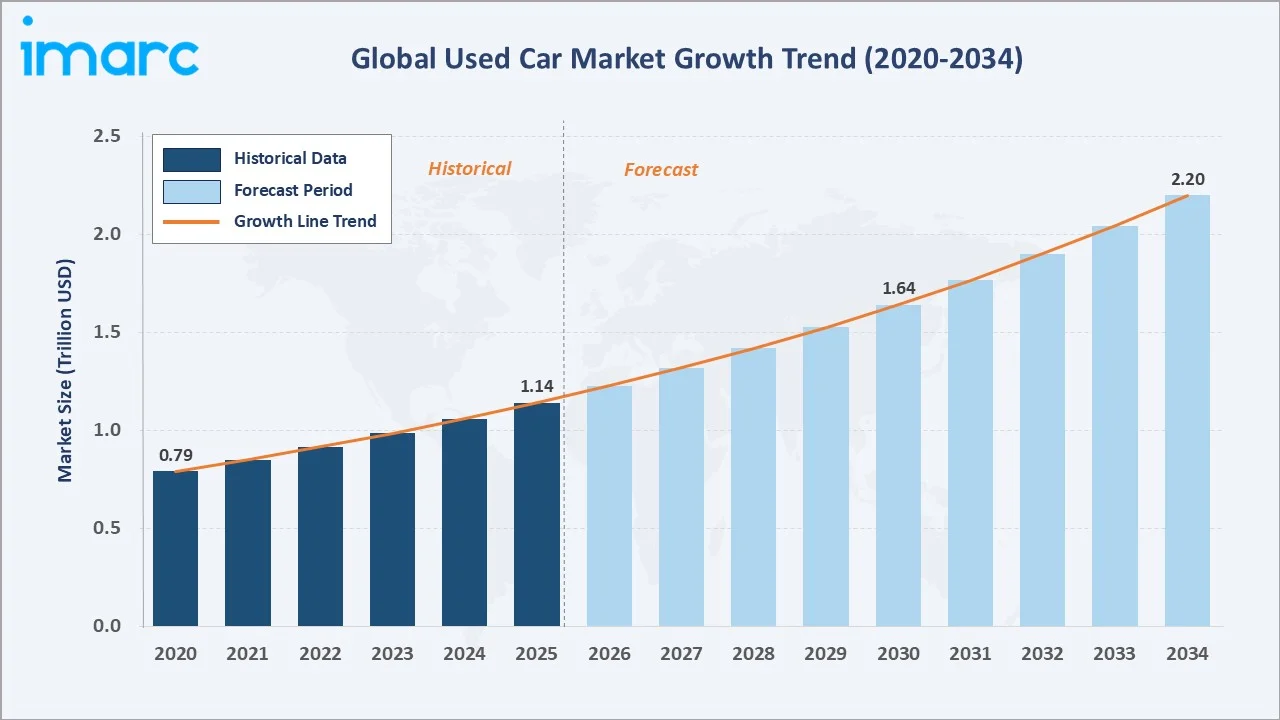
The global used car market was valued at USD 1.14 Trillion in 2025 and is projected to reach USD 2.20 Trillion by 2034, growing at a CAGR of 7.59% during 2026-2034. Rising affordability pressures on new vehicles, expanding digital marketplaces, and increasing formalization of dealership networks are the primary drivers shaping the used car market growth.
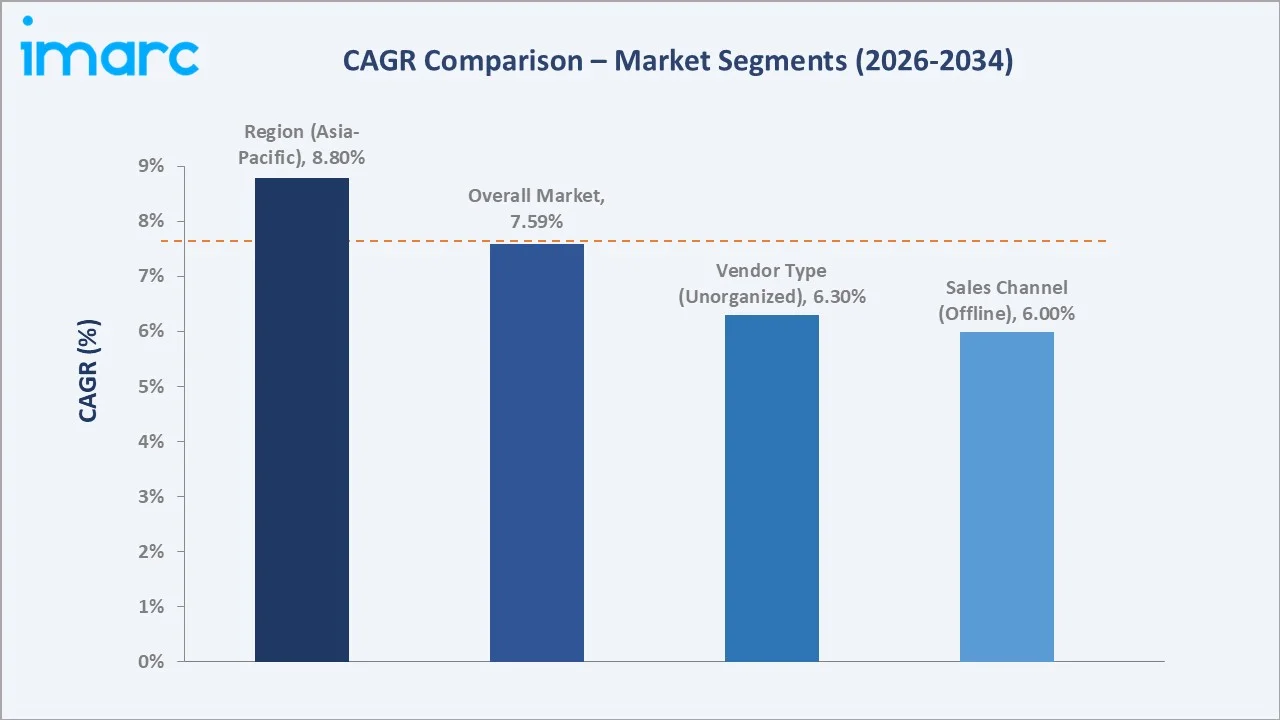
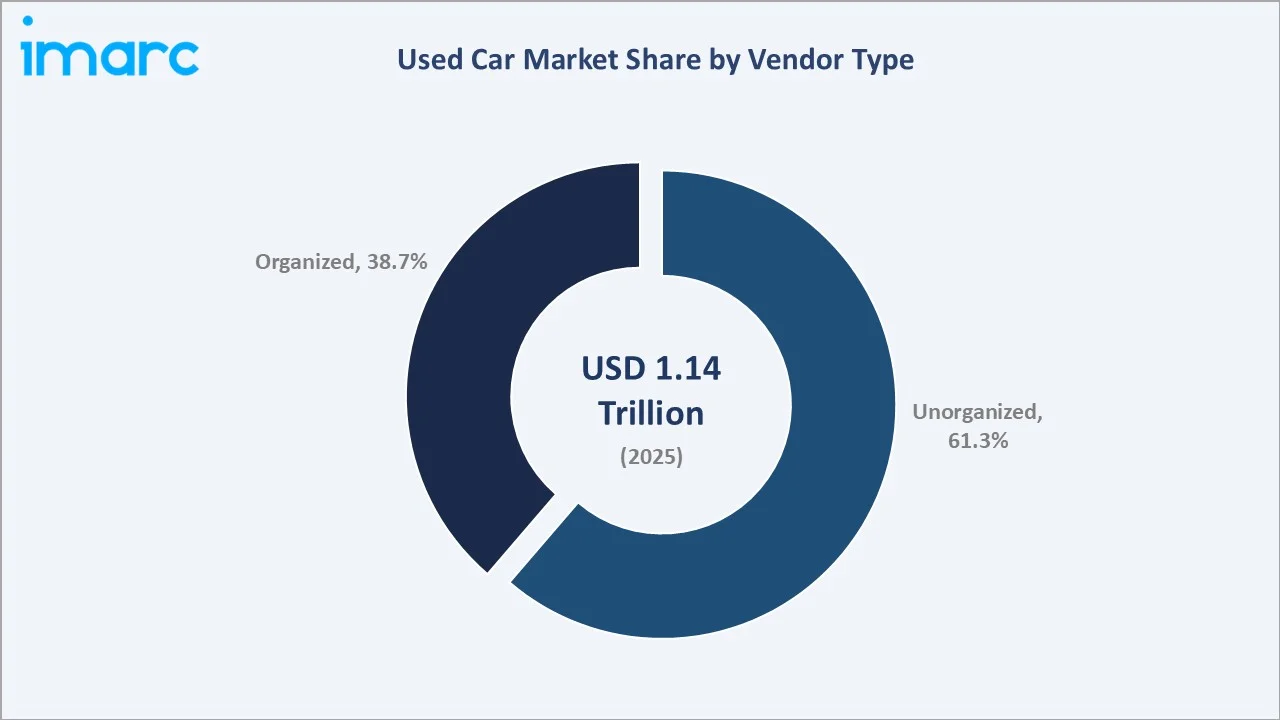
Unorganized leads the vendor type segment at 61.3%, offline dominates the sales channel segment at 81.5%, and Asia-Pacific commands 39.7% regional share.
Market Snapshot
|
Metric |
Value |
|
Market Size (2025) |
USD 1.14 Trillion |
|
Forecast Market Size (2034) |
USD 2.20 Trillion |
|
CAGR (2026-2034) |
7.59% |
|
Base Year |
2025 |
|
Historical Period |
2020-2025 |
|
Forecast Period |
2026-2034 |
|
Largest Region |
Asia-Pacific (39.7%, 2025) |
|
Second Largest Region |
North America (25.4%, 2025) |
|
Leading Vendor Type |
Unorganized (61.3%, 2025) |
|
Leading Sales Channel |
Offline (81.5%, 2025) |
The used car market expanded from USD 0.79 Trillion in 2020 to USD 1.14 Trillion in 2025, driven by widening digital reach, growing organized dealership penetration, and rising consumer preference for cost-effective mobility. Anchored at USD 1.64 Trillion in 2030, the forecast to USD 2.20 Trillion by 2034 is supported by accelerating online adoption, expanding certified pre-owned programs, and improving vehicle financing access.
To get more information on this market, Request Sample
CAGR trajectories across vendor type, sales channel, and regional sub-segments show online and Middle East and Africa expanding faster than the overall 7.59% market CAGR, driven by rising smartphone penetration, growing digital trust, and improving vehicle import ecosystems.
Executive Summary
The used car market is on a steady growth trajectory from USD 0.79 Trillion in 2020 to USD 2.20 Trillion by 2034. The industry has moved from fragmented, unorganized resale activity toward increasingly structured, dealer-led, and digitally enabled transactions across passenger and commercial vehicle categories. Improving inspection standards, broader financing access, and rising consumer trust are encouraging buyers to shift toward formal purchase channels.
Unorganized dominates the vendor type segment at 61.3% in 2025, driven by a large base of independent dealers and strong consumer preference for direct vehicle transactions. Offline retains 81.5% of the sales channel mix, supported by the continued importance of physical inspection before purchase. Asia-Pacific commands 39.7% of the regional share, led by high vehicle ownership growth, dense population centers, and expanding organized dealership networks.
Key Market Insights
|
Insight |
Data |
|
Leading Vendor Type |
Unorganized - 61.3% share (2025) |
|
Second Largest Vendor Type |
Organized - 38.7% share (2025) |
|
Leading Sales Channel |
Offline - 81.5% share (2025) |
|
Second Largest Sales Channel |
Online - 18.5% share (2025) |
|
Leading Region |
Asia-Pacific - 39.7% share (2025) |
|
Second Largest Region |
North America – 25.4% share (2025) |
|
Top Companies |
CarMax, Inc., Carvana Co., AutoNation, Inc., Copart, Inc., AUTO1 Group SE |
Key Analytical Observations Expanding On The Data Above:
- Unorganized dominance at 61.3% is sustained by informal peer-to-peer resale, roadside dealer lots, and localized used vehicle markets that remain deeply embedded across emerging economies.
- Organized share at 38.7% is expanding as certified inspection, warranty coverage, and structured financing improve buyer confidence in formal dealership channels.
- Offline leadership at 81.5% is sustained by consumer preference for physical inspection and test drives before finalizing a purchase.
- Online share at 18.5% is growing quickly as digital classifieds, virtual inspection tools, and home delivery options reduce the friction associated with remote vehicle purchases.
- Asia-Pacific at 39.7% dominates regional share, supported by a large vehicle parc, dense urban populations, and rapidly expanding organized dealership infrastructure.
Used Car Market Overview
A used car refers to a previously owned vehicle resold through dealer, peer-to-peer, or auction-based channels after its initial registration. The market spans hatchbacks, sedans, sport utility vehicles, and light commercial vehicles traded across unorganized roadside lots and organized, inspection-backed dealership networks.
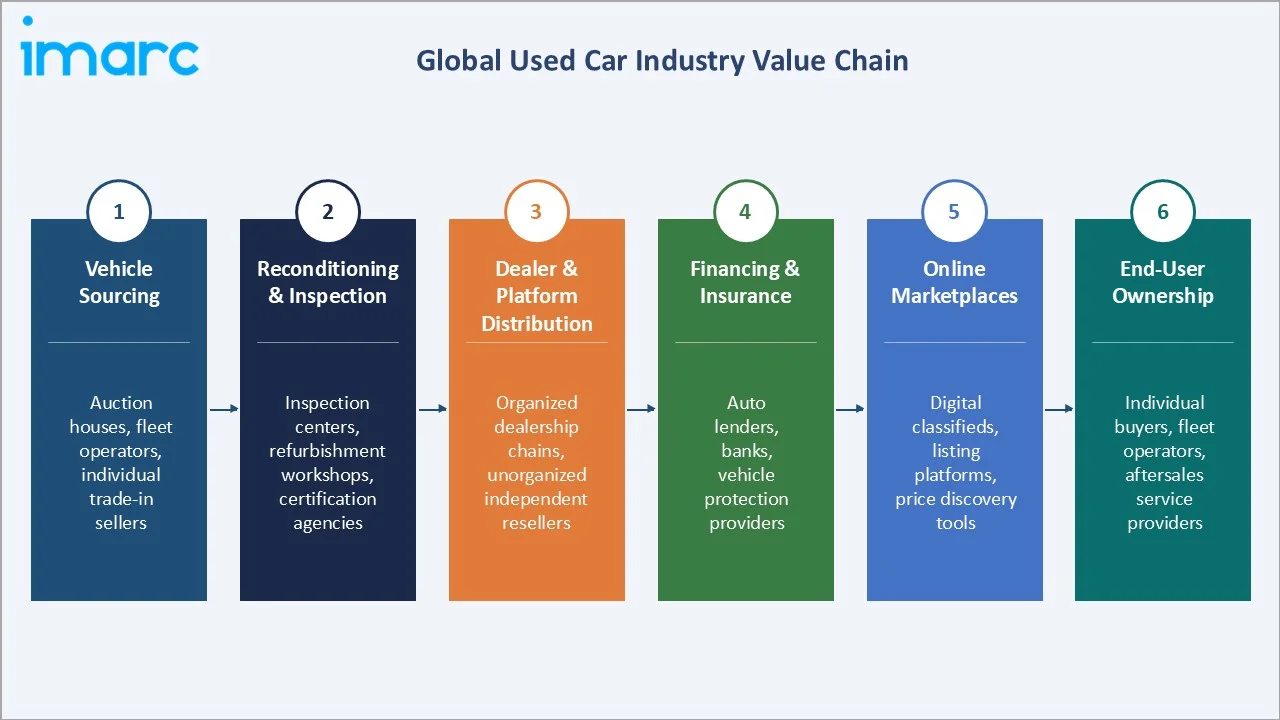
The global ecosystem integrates vehicle sourcing and auction platforms, reconditioning and inspection service providers, organized and unorganized dealers, online marketplaces and classifieds, financing and insurance partners, and regulatory bodies overseeing registration and emission compliance. Together, these participants enable vehicle ownership transfer within an increasingly digitized and trust-driven resale environment.
Market Dynamics
To evaluate market opportunities, Request Sample
Market Drivers
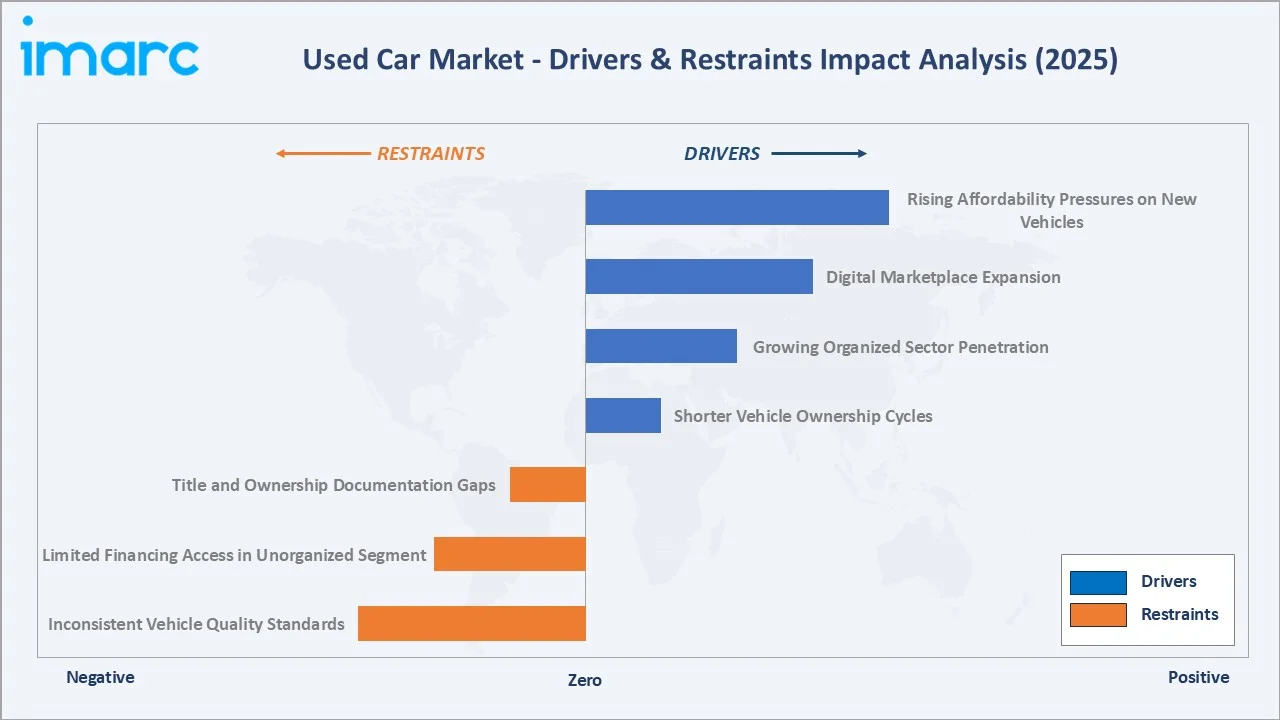
- Rising Affordability Pressures on New Vehicles: Elevated new vehicle prices and financing costs are steadily redirecting buyer demand toward the used car market. The sales of used cars in India were projected to exceed approximately 6 Million units by FY2025-26, reflecting rising affordability-driven demand across large emerging economies.
- Digital Marketplace Expansion: Growing online listing platforms and classifieds are widening buyer access to inventory, improving price transparency, and reducing search friction across both organized and unorganized channels.
- Growing Organized Sector Penetration: Expanding certified pre-owned programs and structured dealership formats are improving vehicle quality assurance and encouraging a gradual shift away from informal resale.
- Shorter Vehicle Ownership Cycles: Rising interest in newer models and flexible ownership formats is shortening average holding periods, feeding a steadier and larger stream of used vehicle inventory.
Market Restraints
- Inconsistent Vehicle Quality Standards: The absence of uniform inspection and certification norms across unorganized channels continues to create quality uncertainty for buyers.
- Limited Financing Access in Unorganized Segment: Informal sellers often lack integration with lending partners, restricting affordable financing options for buyers in this channel.
- Title and Ownership Documentation Gaps: Fragmented registration systems and inconsistent title transfer processes in several markets add friction and risk to used vehicle transactions.
Market Opportunities
- Certified Pre-Owned Program Expansion: Growing demand for verified vehicle history and warranty coverage presents opportunities for dealers to scale certified pre-owned offerings.
- Cross-Border Used Vehicle Trade: Expanding export corridors for used vehicles between mature and developing markets offer new revenue channels for auction and logistics providers.
Market Challenges
- Vehicle Pricing Volatility: Fluctuating wholesale valuations linked to new vehicle supply cycles create pricing uncertainty for dealers managing used vehicle inventory.
- Data Privacy and Fraud Risks in Online Transactions: Expanding digital transaction volumes are increasing exposure to listing fraud and buyer data protection concerns across online marketplaces.
Emerging Market Trends
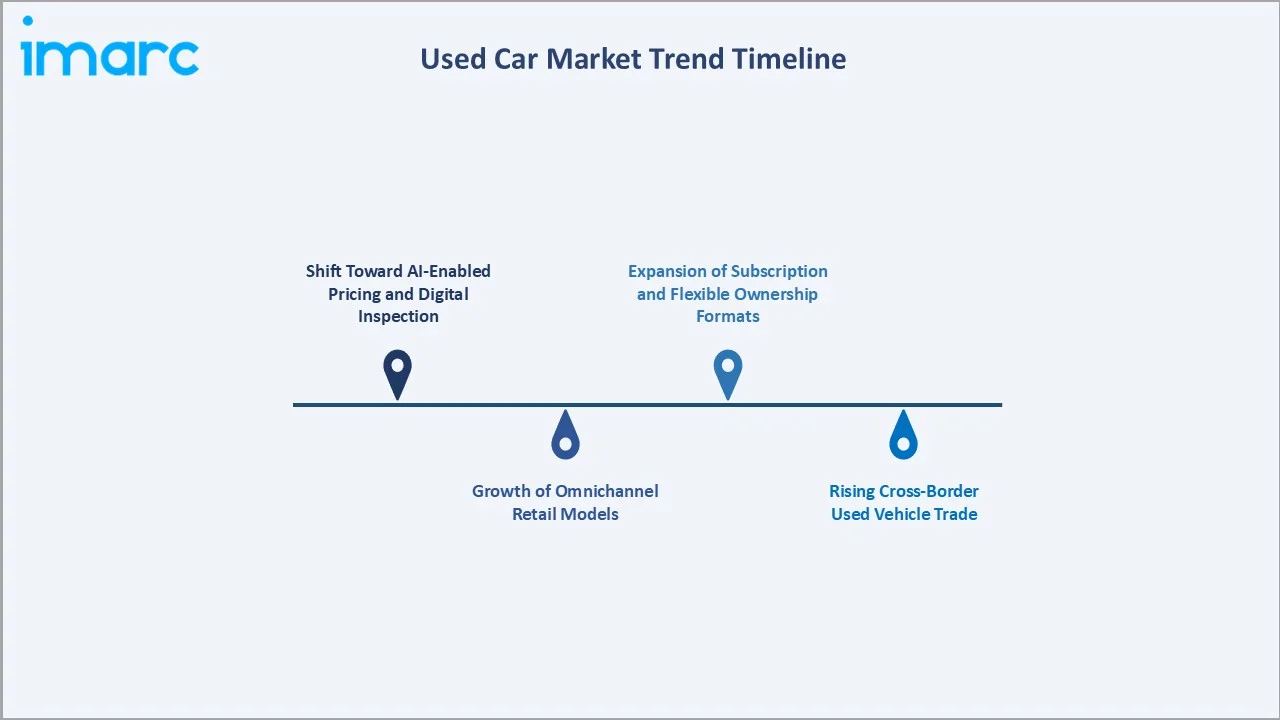
1. Shift Toward AI-Enabled Pricing and Digital Inspection
Operators are increasingly deploying AI-based valuation and imaging tools to standardize vehicle condition assessment. These technologies improve pricing accuracy, enhance buyer confidence, and streamline vehicle appraisal across online and offline sales channels.
2. Growth of Omnichannel Retail Models
Dealers are blending physical showrooms with digital storefronts, allowing customers to research, finance, and reserve vehicles online before completing an in-person purchase, improving conversion across both organized and digitally native retailers.
3. Expansion of Subscription and Flexible Ownership Formats
Flexible leasing and short-term subscription models are gaining traction among younger buyers seeking lower upfront commitment, gradually feeding additional resale inventory back into the used car market.
4. Rising Cross-Border Used Vehicle Trade
Expanding export flows of used vehicles from mature markets to developing economies are creating new logistics, inspection, and compliance service opportunities across the value chain.
Industry Value Chain Analysis
The used car value chain spans six stages, from vehicle sourcing through end-user ownership. Reconditioning, distribution, and financing capture meaningful value-add, while inspection and documentation capabilities increasingly determine sustainable competitive position across organized channels.
|
Stage |
Key Players / Examples |
|
Vehicle Sourcing |
Auction houses, fleet operators, and individual trade-in sellers |
|
Reconditioning & Inspection |
Inspection centers, refurbishment workshops, and certification agencies |
|
Dealer & Platform Distribution |
Organized dealership chains and unorganized independent resellers |
|
Financing & Insurance |
Auto lenders, banks, and vehicle protection providers |
|
Online Marketplaces |
Digital classifieds, listing platforms, and price discovery tools |
|
End-User Ownership |
Individual buyers, fleet operators, and aftersales service providers |
Vertically integrated players, particularly those combining proprietary reconditioning capacity with direct-to-consumer digital platforms, are positioned to capture greater value than partners reliant on third-party infrastructure.
Technology Landscape in the Used Car Industry
AI-Based Pricing and Valuation
Machine learning (ML) models are increasingly used to generate real-time vehicle valuations based on condition, mileage, and regional demand, helping dealers price inventory more consistently across organized and digital channels.
Digital Inspection and Imaging
High-resolution imaging and remote inspection tools are enabling standardized condition reporting, reducing information asymmetry between sellers and buyers in both offline and online transactions.
Blockchain and Title Verification
Distributed ledger pilots are being explored to improve title transparency and reduce ownership fraud, particularly in markets with fragmented vehicle registration systems.
Mobile-First and Omnichannel Retailing
Mobile applications integrated with financing, trade-in valuation, and delivery scheduling are becoming central to the buying journey, supporting seamless movement between digital research and in-person purchase completion.
Market Segmentation Analysis
The report covers the following segments:
|
Segment Category |
Leading Segment |
Market Share |
Year |
|
Vehicle Type |
Sports Utility Vehicle |
🔒 |
2025 |
|
Vendor Type |
Unorganized |
61.3% |
2025 |
|
Fuel Type |
🔒 |
🔒 |
2025 |
|
Sales Channel |
Offline |
81.5% |
2025 |
|
Region |
Asia-Pacific |
39.7% |
2025 |

By Vendor Type
Unorganized commands a 61.3% majority share in 2025, driven by deep-rooted informal resale networks, lower transaction costs, and strong presence across smaller cities and rural markets. The segment benefits from localized trust relationships and flexible, negotiation-based pricing.
To access detailed market analysis, Request Sample
Organized at 38.7% in 2025 covers certified dealership chains, franchised retail formats, and platform-backed sellers offering inspection guarantees and structured financing. The segment continues to gain share as consumer preference shifts toward verified vehicle history and warranty-backed purchases.
By Sales Channel
Offline dominates with 81.5% share in 2025, reflecting continued buyer preference for physical inspection, test drives, and in-person negotiation, particularly for higher-value vehicle purchases. The channel remains the default entry point across most regional markets.
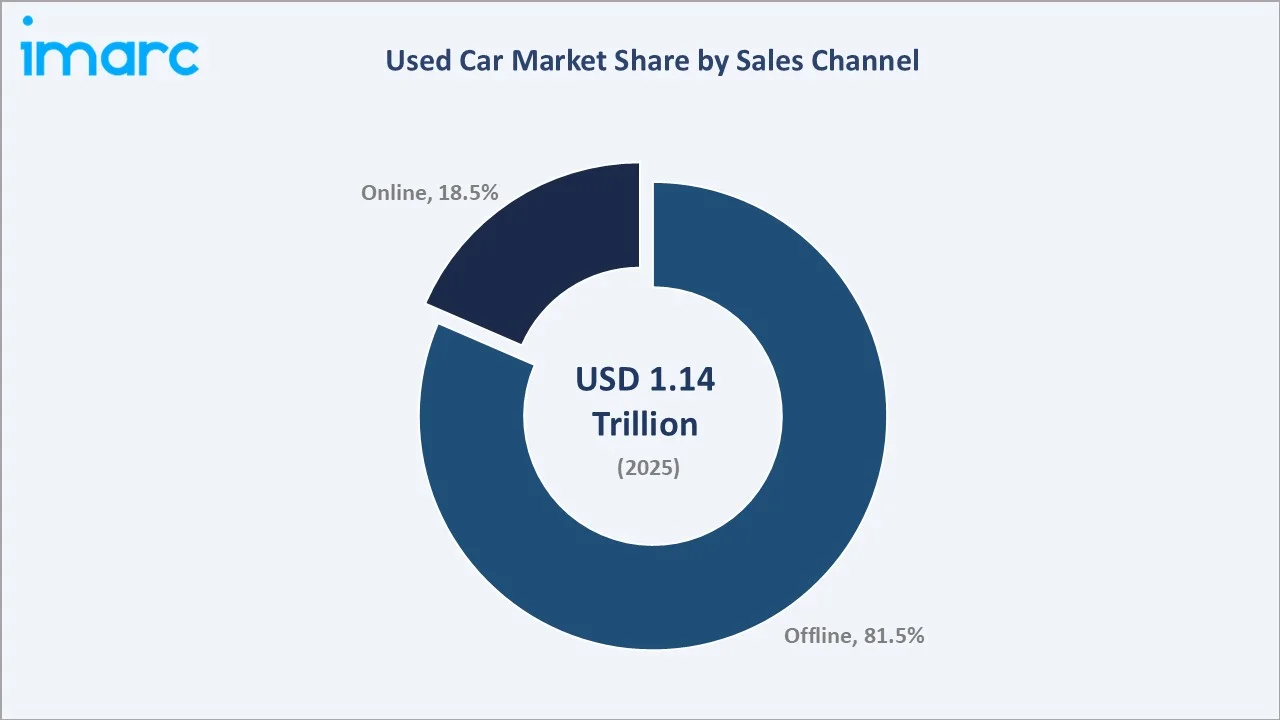
Online at 18.5% is expanding through digital classifieds, virtual inspection tools, and home delivery models. Its growing appeal is supported by improving digital trust, broader vehicle imaging standards, and integrated online financing options.
Regional Market Insights
|
Region |
Share (2025) |
Key Growth Drivers |
|
Asia-Pacific |
39.7% |
Large vehicle parc, expanding organized dealership networks, and rising urban mobility demand |
|
North America |
25.4% |
Mature certified pre-owned ecosystem, strong financing penetration, and high digital adoption |
|
Europe |
22.1% |
Structured leasing return flows, established dealer networks, and stringent emission-linked vehicle turnover |
|
Latin America |
7.3% |
Growing middle-class vehicle ownership and expanding cross-border vehicle trade |
|
Middle East and Africa |
5.5% |
Rising vehicle import volumes, improving financing access, and expanding organized retail formats |
Asia-Pacific at 39.7% in 2025 leads the regional landscape, anchored by large vehicle ownership bases across China, India, and Southeast Asia. Dense urban populations and expanding organized dealership infrastructure support sustained regional leadership.
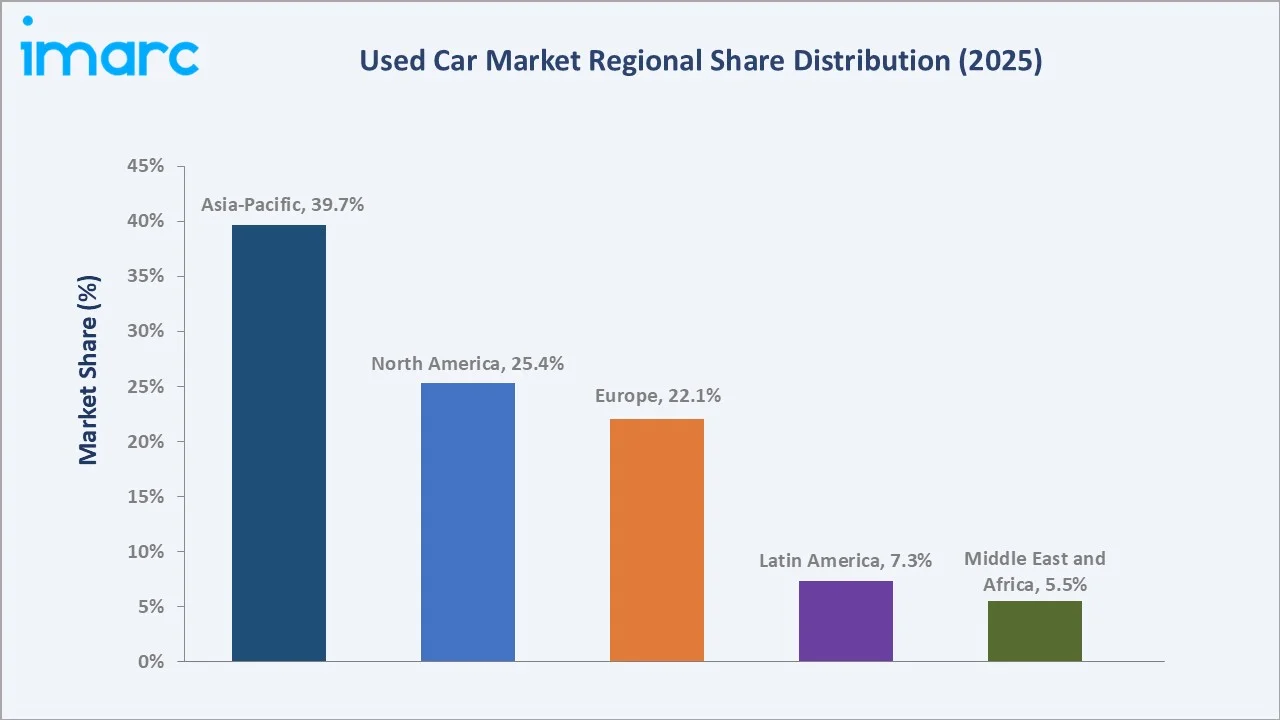
Middle East and Africa, while currently the smallest at 5.5% share, is expected to be the fastest growing through 2034. Rising vehicle import volumes and improving access to structured financing are accelerating regional expansion.
Competitive Landscape
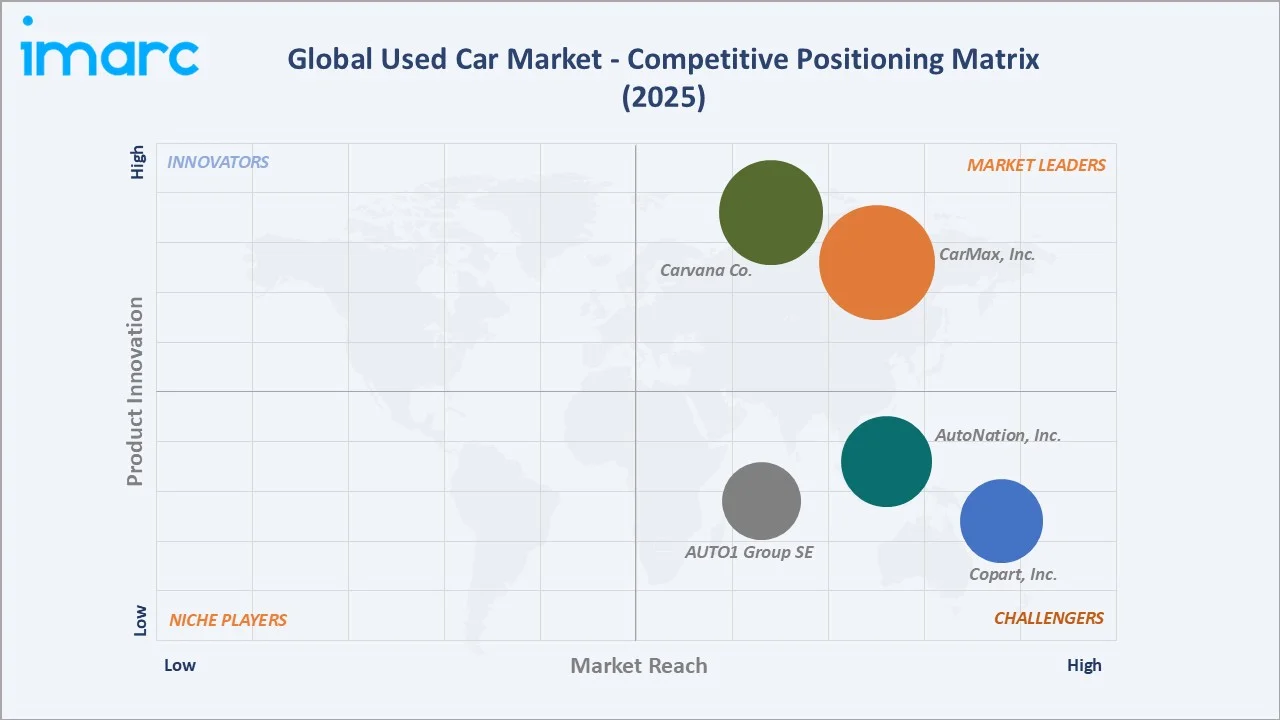
The used car market is highly fragmented globally, with organized players competing on inspection quality, financing integration, and digital reach, while a large base of unorganized sellers continues to serve localized demand. Brand trust, reconditioning capability, and omnichannel presence form the key competitive differentiators.
|
Company Name |
Brand / Key Product |
Position |
Strategic Focus |
|
CarMax, Inc. |
CarMax |
Leader |
Omnichannel used-vehicle retailer focused on no-haggle pricing and nationwide store expansion |
|
Carvana Co. |
Carvana |
Leader |
Fully digital retail model emphasizing online purchase and home delivery convenience |
|
AutoNation, Inc. |
AutoNation |
Challenger |
Multi-brand dealership group expanding dedicated used-vehicle retail formats |
|
Copart, Inc. |
Copart |
Challenger |
Online salvage and wholesale auction platform connecting global vehicle buyers and sellers |
|
AUTO1 Group SE |
Autohero |
Challenger |
Expanding digital used-vehicle retail through integrated online sales, refurbishment capabilities, and efficient cross-border inventory management |
Key players include CarMax, Inc., Carvana Co., AutoNation, Inc., Copart, Inc., and AUTO1 Group SE, among others.
Key Company Profiles
CarMax, Inc.
CarMax, Inc. is a leading retailer of used vehicles in the United States, operating a nationwide network of retail stores supported by its own vehicle financing arm.
- Product Portfolio: Retail used-vehicle sales, wholesale auctions, and integrated vehicle financing services.
- Recent Developments: In fiscal year ending February 2026, the company sold approximately 780,000 used vehicles and 540,000 wholesale vehicles through its auctions.
- Strategic Focus: Strengthening omnichannel retail capabilities while expanding its nationwide store footprint and financing operations.
Carvana Co.
Carvana Co. is an online used vehicle retailer offering a fully digital platform for vehicle purchase, financing, and delivery.
- Product Portfolio: Online vehicle purchase, trade-in, and financing services supported by dedicated delivery infrastructure.
- Recent Developments: The company has continued expanding its reconditioning and logistics capacity to support growing transaction volumes.
- Strategic Focus: Scaling its digital-first retail model while improving delivery speed and reconditioning efficiency.
AutoNation, Inc.
AutoNation, Inc. is a leading automotive retailer operating a nationwide network of dealerships alongside dedicated used-vehicle retail formats.
- Product Portfolio: New and used vehicle retail, financing, and dedicated used-vehicle store formats.
- Recent Developments: The company has continued expanding its dedicated used-vehicle retail footprint alongside its financing operations.
- Strategic Focus: Growing its dedicated used-vehicle retail formats while strengthening customer experience across its dealership network.
Market Concentration Analysis
The used car market is highly fragmented at the global level, with unorganized regional and local sellers accounting for the majority of transaction volume. Among organized participants, leading players including CarMax, Inc. and Carvana Co., collectively represent a meaningful share of formal retail and wholesale activity.
Barriers to entry include the need for extensive reconditioning infrastructure, trusted inspection standards, and access to vehicle financing partners, which favor well-capitalized organized players with established logistics networks.
Consolidation is gradually increasing as organized dealership groups and digital platforms acquire regional players, inspection service providers, and auction businesses to expand footprint and improve vehicle sourcing efficiency.
Investment & Growth Opportunities
Fastest-Growing Segments
Online is expanding the fastest among sales channel formats, supported by rising digital trust and improving vehicle imaging technology. Organized is the next fastest-expanding vendor type category, driven by growing consumer preference for certified pre-owned vehicles, transparent pricing, and standardized inspection and warranty services.
Emerging Markets
Middle East and Africa represents significant untapped opportunity, supported by rising vehicle import volumes and improving financing access. Growing urbanization, expanding digital vehicle marketplaces, and increasing affordability are expected to further accelerate used car demand across the region.
Venture & Investment Trends
Investment is concentrated in AI-based vehicle inspection technology, digital financing platforms, and cross-border vehicle trade infrastructure supporting organized sector expansion.
Future Market Outlook (2026-2034)
The used car market is forecast to expand from USD 1.14 Trillion in 2025 to USD 2.20 Trillion by 2034 at a CAGR of 7.59%, adding substantial incremental market value over the forecast period.
Four forces will shape the market through 2034: accelerating formalization of unorganized resale activity; expanding online and omnichannel retail adoption; deeper integration of AI-based pricing and inspection tools; and improving cross-border vehicle trade infrastructure.
By 2034, the used car market is expected to be defined by increasingly organized, digitally enabled participation, with online and organized channels collectively accounting for a meaningfully higher share of overall transaction volume.
Research Methodology
Primary Research
Primary research included structured interviews with dealership executives, auction platform operators, vehicle financing providers, and industry associations, validating market sizing, segment mix, and regional demand patterns.
Secondary Research
Secondary sources included transport ministry publications, vehicle registration data, industry association reports, and annual reports, press releases, and investor presentations from listed automotive retailers.
Forecasting Models
Market forecasts used top-down and bottom-up models combining vehicle parc estimates, average resale cycle length, channel mix evolution, and macroeconomic variables. Scenario analysis addressed financing availability, regulatory change, and cross-border trade dynamics.
Used Car Market Report Scope:
| Report Features | Details |
|---|---|
| Base Year of the Analysis | 2025 |
| Historical Period | 2020-2025 |
| Forecast Period | 2026-2034 |
| Units | Trillion USD |
| Scope of the Report |
Exploration of Historical Trends and Market Outlook, Industry Catalysts and Challenges, Segment-Wise Historical and Future Market Assessment:
|
| Vehicle Types Covered | Hatchbacks, Sedan, Sports Utility Vehicle, Others |
| Vendor Types Covered | Organized, Unorganized |
| Fuel Types Covered | Gasoline, Diesel, Others |
| Sales Channels Covered | Online, Offline |
| Regions Covered | Asia Pacific, Europe, North America, Latin America, Middle East and Africa |
| Countries Covered | United States, Canada, Germany, France, United Kingdom, Italy, Spain, Russia, China, Japan, India, South Korea, Australia, Indonesia, Brazil, Mexico |
| Companies Covered | CarMax, Inc., Carvana Co., AutoNation, Inc., Copart, Inc., AUTO1 Group SE, etc. |
| Customization Scope | 10% Free Customization |
| Post-Sale Analyst Support | 10-12 Weeks |
| Delivery Format | PDF and Excel through Email (We can also provide the editable version of the report in PPT/Word format on special request) |
Key Benefits for Stakeholders:
- IMARC’s report offers a comprehensive quantitative analysis of various market segments, historical and current market trends, market forecasts, and dynamics of the used car market from 2020-2034.
- The research study provides the latest information on the market drivers, challenges, and opportunities in the global used car market.
- The study maps the leading, as well as the fastest-growing, regional markets. It further enables stakeholders to identify the key country-level markets within each region.
- Porter's five forces analysis assist stakeholders in assessing the impact of new entrants, competitive rivalry, supplier power, buyer power, and the threat of substitution. It helps stakeholders to analyze the level of competition within the used car industry and its attractiveness.
- Competitive landscape allows stakeholders to understand their competitive environment and provides an insight into the current positions of key players in the market.
Frequently Asked Questions About the Used Car Market Report
The used car market was valued at USD 1.14 Trillion in 2025, driven by rising affordability pressures, expanding digital marketplaces, and growing organized dealership penetration worldwide.
The market is projected to grow at a CAGR of 7.59% from 2026-2034, reaching USD 2.20 Trillion, supported by accelerating online adoption and organized sector expansion.
Unorganized leads at 61.3% in 2025, driven by informal resale networks. Its strong local presence, flexible pricing, and direct buyer-seller transactions continue to attract a large share of used vehicle purchases.
Offline leads at 81.5% in 2025, reflecting preference for physical inspection. Buyers continue to value test drives, in-person negotiations, and direct verification of vehicle condition before completing a purchase.
Asia-Pacific commands 39.7% in 2025, led by a large vehicle ownership base, dense urban populations, and rapidly expanding organized dealership infrastructure.
Middle East and Africa, though smallest at 5.5% share in 2025, is expected to grow fastest through 2034, supported by rising vehicle import volumes.
Leading players include CarMax, Inc., Carvana Co., AutoNation, Inc., Copart, Inc., and AUTO1 Group SE, among others.
AI-based pricing, digital inspection tools, and online marketplaces are streamlining transactions, improving price transparency, and gradually shifting volume toward organized and online channels.
Structured financing access is a key differentiator for organized dealers, improving buyer affordability and supporting the ongoing shift away from purely cash-based unorganized transactions.
Inconsistent vehicle quality standards, limited financing access in the unorganized segment, and fragmented title documentation processes remain key restraints across several regional markets.
Need more help?
- Speak to our experienced analysts for insights on the current market scenarios.
- Include additional segments and countries to customize the report as per your requirement.
- Gain an unparalleled competitive advantage in your domain by understanding how to utilize the report and positively impacting your operations and revenue.
- For further assistance, please connect with our analysts.
 Request Customization
 Speak to an Analyst
 Request Brochure
 Inquire Before Buying
Benefits of Customization
- Personalize this research
- Triangulate with your data
- Get data as per your format and definition
- Gain a deeper dive into a specific application, geography, customer, or competitor
- Any level of personalization
Get in Touch With Us
UNITED STATES
Phone: +1-201-971-6302
INDIA
Phone: +91-120-433-0800
UNITED KINGDOM
Phone: +44-753-714-6104
Email: [email protected]
Client Testimonials




.webp)




.webp)













Related Reports

Choose your plan
*Please note that the prices mentioned below are starting prices for each bundle type. Kindly contact our team for further details.*
Single User License
- 1 User License, Access on 2 Devices
- PDF Report + Excel Dataset (Password Protected)
- Lifetime Access
- No Printing Rights
- 10% Free Report Customization
- 10–12 Weeks of Analyst Support
Five User License
- Access for 5 Users, 2 Devices per User
- PDF Report + Excel Dataset (Password Protected)
- Lifetime Access
- Dedicated Account Manager
- 12–14 Weeks of Analyst Support
- No Printing Rights
- 15% Free Report Customization
- 25% Discount on Your Next Purchase
Corporate User License
- Unlimited User Access (Within Your Organization)
- PDF Report + Excel Dataset
- Lifetime Access
- Dedicated Account Manager
- 14–20 Weeks of Analyst Support
- No Printing Rights
- 20% Free Report Customization
- 30% Discount on Your Next Purchase
Essential Insights
What's included:
3 reports
- Lifetime Access
- PDF Reports
- Excel Datasets
- 2 Weeks of Free Analyst Support
- 2 User Licenses
- Access on 2 Devices
- Printing Rights
- Complimentary PowerPoint (PPT) Version
- Complimentary License Upgrade
Professional Access
What's included:
5 reports
- Lifetime Access
- PDF Reports
- Excel Datasets
- 8 Weeks of Free Analyst Support
- 2 User Licenses
- Access on 2 Devices
- Printing Rights
- Complimentary PowerPoint (PPT) Version
- Complimentary License Upgrade
Business Advantage
What's included:
8 reports
- Lifetime Access
- PDF Reports
- Excel Datasets
- 14 Weeks of Free Analyst Support
- 2 User Licenses
- Access on 2 Devices
- Printing Rights
- Complimentary PowerPoint (PPT) Version
- Complimentary License Upgrade
Enterprise Intelligence
What's included:
10 reports
- Lifetime Access
- PDF Reports
- Excel Datasets
- 20 Weeks of Free Analyst Support
- 2 User Licenses
- Access on 2 Devices
- Printing Rights
- Complimentary PowerPoint (PPT) Version
- Complimentary License Upgrade