
Utility Billing Software Market Size, Share, Trends and Forecast by Deployment Mode, Type, End User, and Region, 2026-2034
Utility Billing Software Market Size, Share, Trends & Forecast (2026-2034)
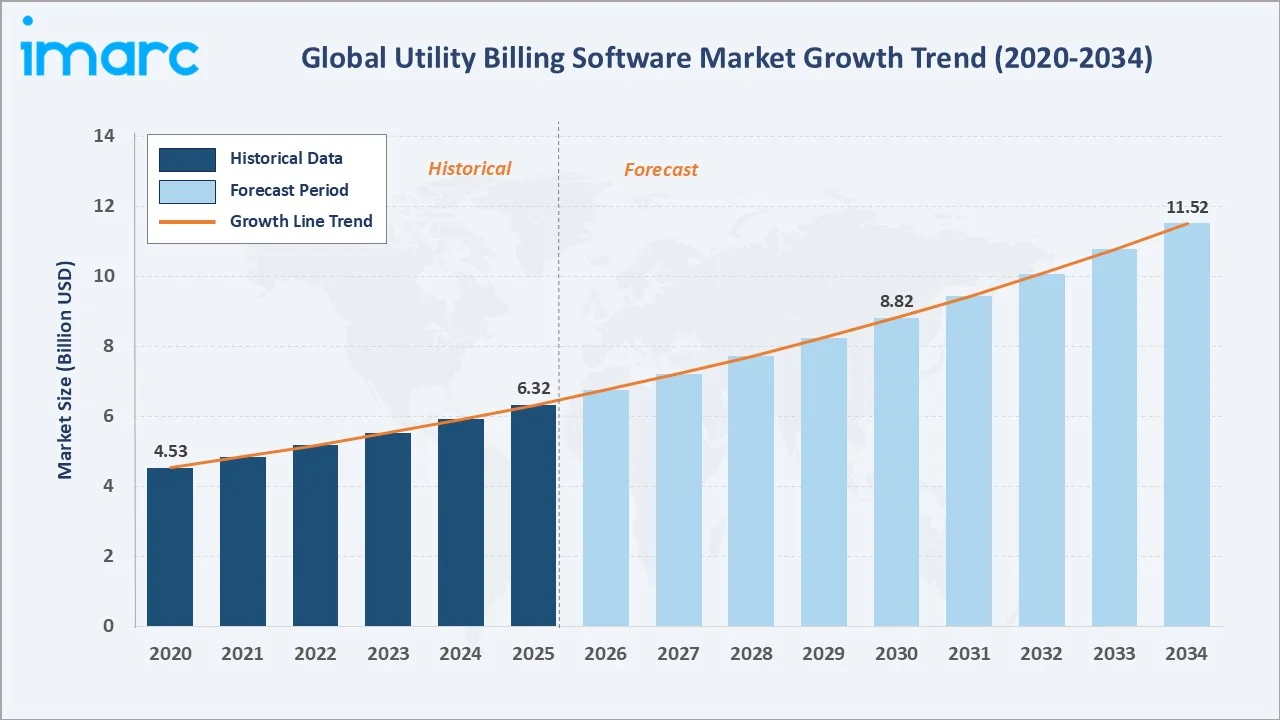
The global utility billing software market reached USD 6.32 Billion in 2025 and is projected to reach USD 11.52 Billion by 2034, growing at a CAGR of 6.90% during 2026-2034. The market is driven by rising energy-efficiency awareness, evolving regulatory compliance mandates, increasing customer expectations for digital self-service, and growing adoption of smart meters and IoT-enabled billing platforms.
Cloud-based deployment dominates at 69.4% share, reflecting utilities' preference for scalable, low-capex billing infrastructure. Software as a Service leads the type segment at 48.7%, while North America commands 36.8% of the global market.
Market Snapshot
|
Metric |
Value |
|
Market Size (2025) |
USD 6.32 Billion |
|
Forecast Market Size (2034) |
USD 11.52 Billion |
|
CAGR (2026-2034) |
6.90% |
|
Base Year |
2025 |
|
Historical Period |
2020-2025 |
|
Forecast Period |
2026-2034 |
|
Dominant Deployment Mode |
Cloud-based (69.4%, 2025) |
|
Dominant Type |
Software as a Service (48.7%, 2025) |
|
Leading Region |
North America (36.8%, 2025) |
The market expanded from USD 4.53 Billion in 2020 to USD 6.32 Billion in 2025, anchored at USD 8.82 Billion in 2030 and forecast to reach USD 11.52 Billion by 2034. Utility providers' accelerating shift from legacy on-premises systems to cloud-native billing platforms, combined with rising smart-meter data volumes, is sustaining steady, compounding demand growth through the forecast period.
To get more information on this market, Request Sample
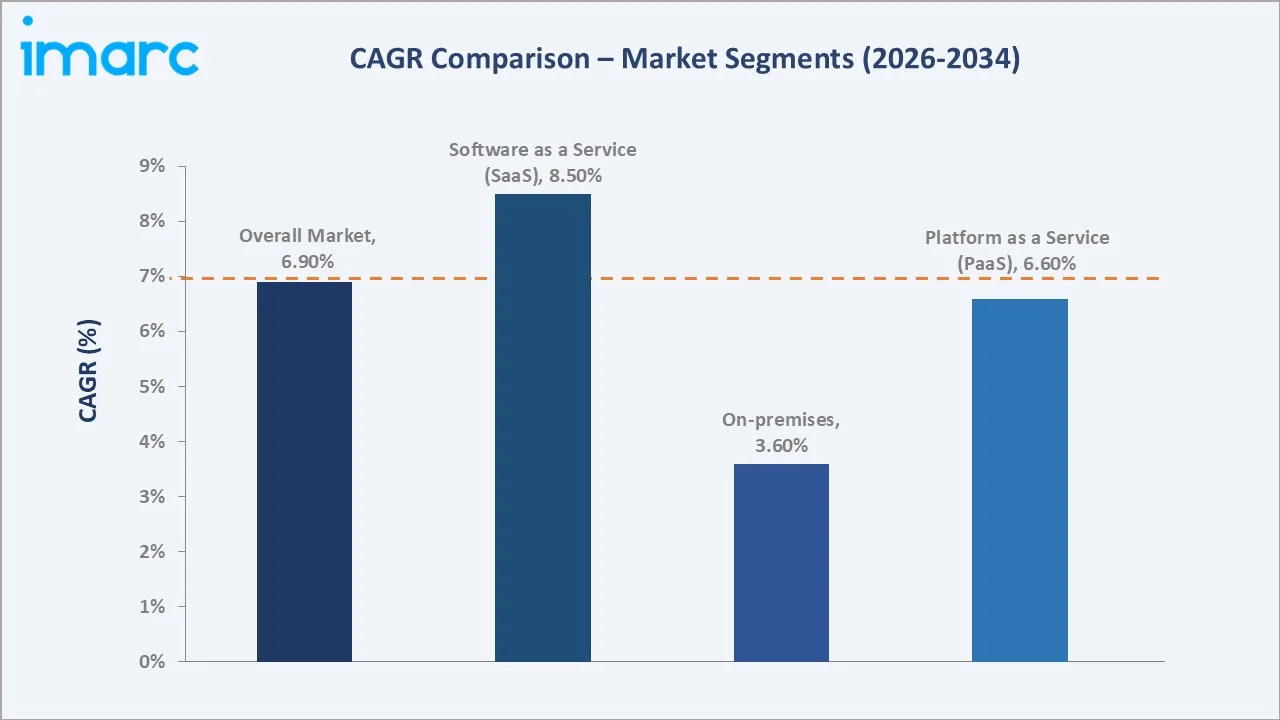
Cloud-based deployment is expected to grow fastest at approximately 8.0% CAGR as utilities prioritize scalability and reduced capital expenditure, while Software as a Service leads type-wise growth at approximately 8.5% CAGR on the back of subscription-based, rapidly deployable billing solutions.
Executive Summary
The global utility billing software market reached USD 6.32 Billion in 2025, reflecting the accelerating digital transformation of meter-to-cash operations across water, power distribution, oil and gas, and telecommunication utilities. Utility billing software (UBS) enables accurate invoicing, real-time usage analytics, account management, and regulatory-compliant reporting, replacing legacy billing infrastructure with scalable, data-driven platforms. The market is projected to reach USD 11.52 Billion by 2034, supported by sustained cloud adoption and rising investment in digital customer engagement across the global utility sector.
Cloud-based deployment at 69.4% dominates by offering utilities scalability, lower infrastructure overhead, and remote accessibility. Software as a Service at 48.7% leads the type segment through its subscription-based, rapidly deployable model. North America at 36.8% leads globally, supported by a mature utility sector and stringent regulatory compliance requirements.
Key Market Insights
|
Insight |
Data |
|
Dominant Deployment Mode |
Cloud-based - 69.4% share (2025) |
|
Dominant Type |
Software as a Service - 48.7% market share (2025) |
|
Leading Region |
North America - 36.8% market share (2025) |
|
Market Opportunity |
AI-enabled predictive billing; IoT/smart-meter data integration; self-service portals; emerging-market cloud migration |
Key Analytical Observations Supporting The Above Data:
- Cloud-based at 69.4%: Cloud-based deployment dominates as it offers scalability, reduced capital expenditure, remote accessibility, and robust data backup, making it the preferred choice for utilities of all sizes seeking to modernize billing operations without heavy infrastructure investment. Its share is expected to expand further as remaining legacy on-premises systems reach replacement age.
- Software as a Service at 48.7%: SaaS leads the type segment due to its inherently scalable, subscription-based model that accommodates fluctuating user numbers and data volumes, enabling utilities to rapidly deploy and update billing software with minimal upfront cost and reduced dependence on internal IT resources.
- North America at 36.8%: North America dominates owing to its highly developed utility sector, stringent regulatory compliance requirements, and rising adoption of smart meters and IoT technology that generate high billing-data volumes requiring advanced software solutions, sustaining continued investment across the region's utility base.
Utility Billing Software Market Overview
The global utility billing software market encompasses solutions that streamline meter-to-cash operations for utility providers, including usage tracking, invoice generation, account management, payment processing, and regulatory reporting across water, power distribution, oil and gas, and telecommunication sectors. These platforms have evolved from simple invoicing tools into comprehensive customer-engagement systems that integrate consumption analytics, payment processing, and multi-channel communication.
The ecosystem integrates UBS software vendors, cloud and data infrastructure providers, meter data management and smart-meter OEMs, system integrators, payment gateway partners, and utility companies as end users. Macroeconomic factors include rising energy-conservation awareness, evolving data-privacy regulations, rapid urbanization, and continued digitalization of utility operations. Growing consumer demand for transparent, real-time billing information is also reshaping vendor product roadmaps across the ecosystem.
Market Dynamics
To evaluate market opportunities, Request Sample
Market Drivers
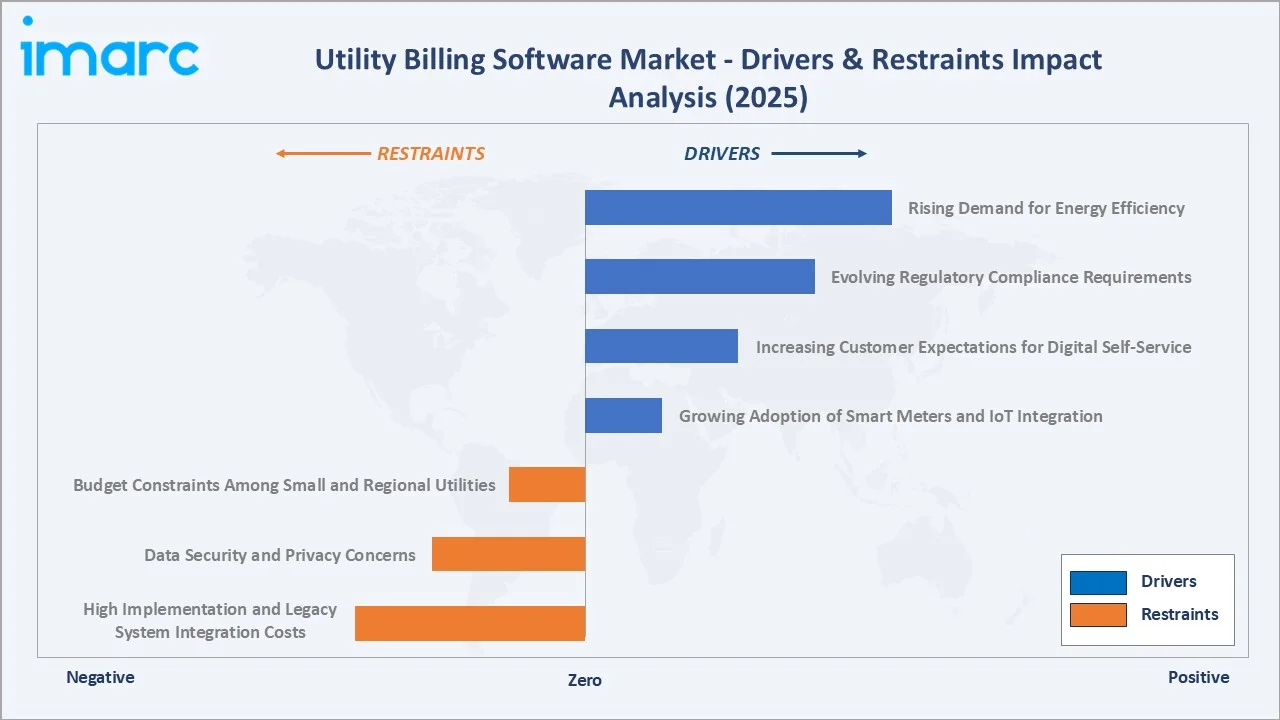
- Rising Demand for Energy Efficiency: Growing global awareness of environmental sustainability is pushing utility companies to enhance energy efficiency. UBS provides real-time usage insights that enable customers to make informed consumption decisions, a demand further fueled by government regulations and energy-efficiency incentives across major markets worldwide.
- Evolving Regulatory Compliance Requirements: Increasingly complex and changing regulatory frameworks, including data-privacy and consumer-protection laws, require utilities to maintain accurate, auditable billing records. UBS offers the adaptability, reporting, and audit-trail capabilities necessary to remain compliant and avoid penalties amid tightening oversight.
- Increasing Customer Expectations for Digital Self-Service: Expanding digitalization has raised customer expectations for instant data access, personalized services, and transparent billing. UBS addresses this through self-service portals and mobile applications, helping utilities improve customer experience and retention.
- Growing Adoption of Smart Meters and IoT Integration: Rising deployment of smart meters and IoT-enabled infrastructure is generating large volumes of granular consumption data, increasing the need for advanced UBS platforms capable of real-time data ingestion, accurate billing, and predictive analytics.
Market Restraints
- High Implementation and Legacy System Integration Costs: Migrating from legacy billing infrastructure to modern UBS platforms involves significant upfront investment in software licensing, data migration, and staff training, which can delay adoption among smaller utilities operating with constrained technology budgets.
- Data Security and Privacy Concerns: UBS platforms handle sensitive customer and payment data, making them targets for cyber threats. Concerns over data breaches and regulatory penalties can slow adoption, particularly for cloud-based deployments among risk-averse utility IT departments.
- Budget Constraints Among Small and Regional Utilities: Smaller utility providers often operate with limited IT budgets, restricting their ability to invest in advanced billing software and favoring continued reliance on legacy or manual billing processes.
Market Opportunities
- AI-Enabled Predictive Billing Platforms: Growing demand for predictive analytics and automated fraud detection is creating opportunities for vendors to differentiate through AI-native billing platforms that reduce revenue leakage and improve operational efficiency for utility clients. Vendors that embed explainable AI models into billing workflows can further build trust with regulators and end customers.
- Cloud Migration Among Emerging-Market Utilities: Utilities in Latin America, the Middle East, and Africa are at an early stage of billing-software digitalization, presenting significant opportunities for vendors offering affordable, rapidly deployable cloud-based solutions tailored to smaller utility operators. Localized payment-gateway integration and multilingual support represent additional differentiation opportunities in these markets.
Market Challenges
- Data Migration Complexity from Legacy Systems: Migrating decades of historical billing and customer data from legacy, often poorly documented systems into modern UBS platforms is a technically complex and resource-intensive process that can delay implementation timelines and increase project risk for both vendors and utility clients.
- Fragmented Regulatory Requirements Across Regions: Utility billing regulations vary significantly by country and jurisdiction, requiring vendors to build highly configurable compliance features, which increases development complexity and total cost of platform ownership, particularly for vendors expanding into new international markets.
Emerging Market Trends
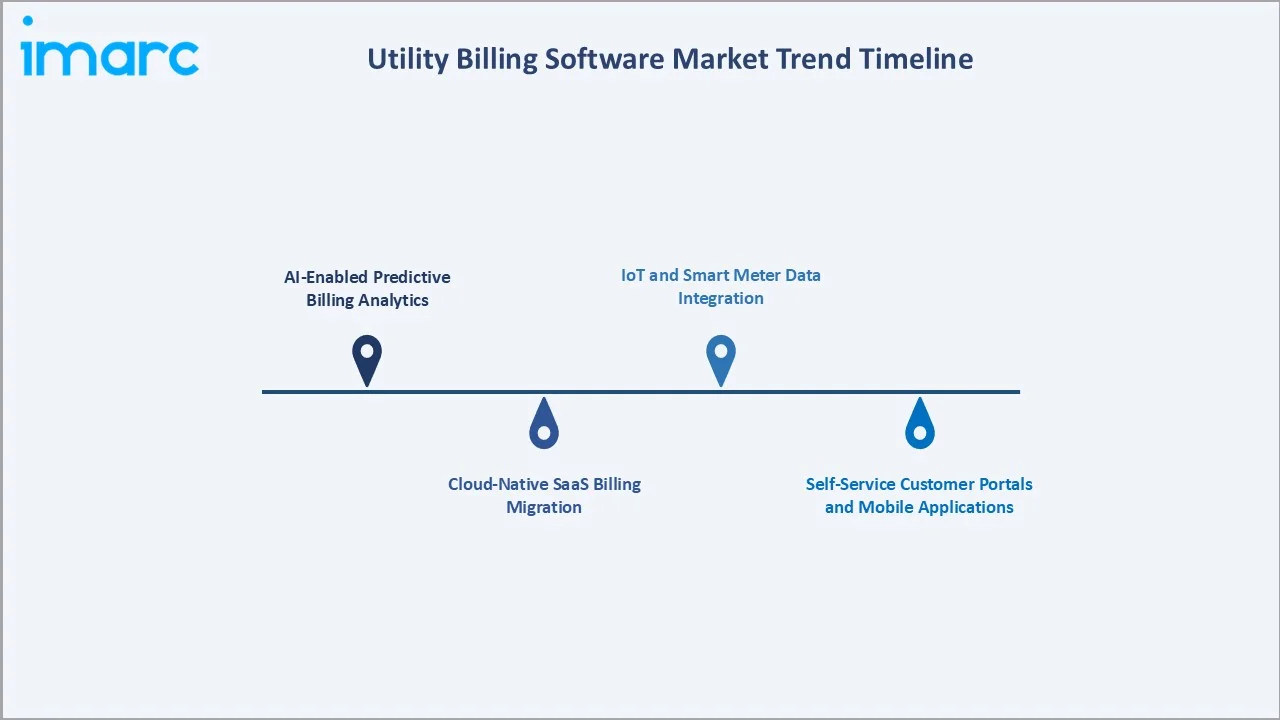
1. AI-Enabled Predictive Billing Analytics
Utility providers are increasingly integrating AI and machine learning into billing platforms to predict consumption patterns, flag anomalies, and reduce billing errors. This enhances forecasting accuracy and supports proactive customer communication, driving demand for AI-enabled UBS platforms.
2. Cloud-Native SaaS Billing Migration
Utilities are accelerating migration from on-premises systems to cloud-native SaaS billing platforms to reduce infrastructure overhead and improve scalability, enabling faster deployment of new tariff structures and billing models.
3. IoT and Smart Meter Data Integration
Expanding smart-meter rollouts are driving demand for UBS platforms capable of ingesting and processing high-frequency consumption data, enabling accurate, near-real-time billing and enhanced fraud detection across residential, commercial, and industrial customer accounts.
4. Self-Service Customer Portals and Mobile Applications
Utilities are increasingly deploying self-service portals and mobile applications that let customers view usage, pay bills, and set consumption alerts. This trend is reducing call-center volumes while improving customer satisfaction and driving demand for UBS platforms with strong digital front-end capabilities.
Industry Value Chain Analysis
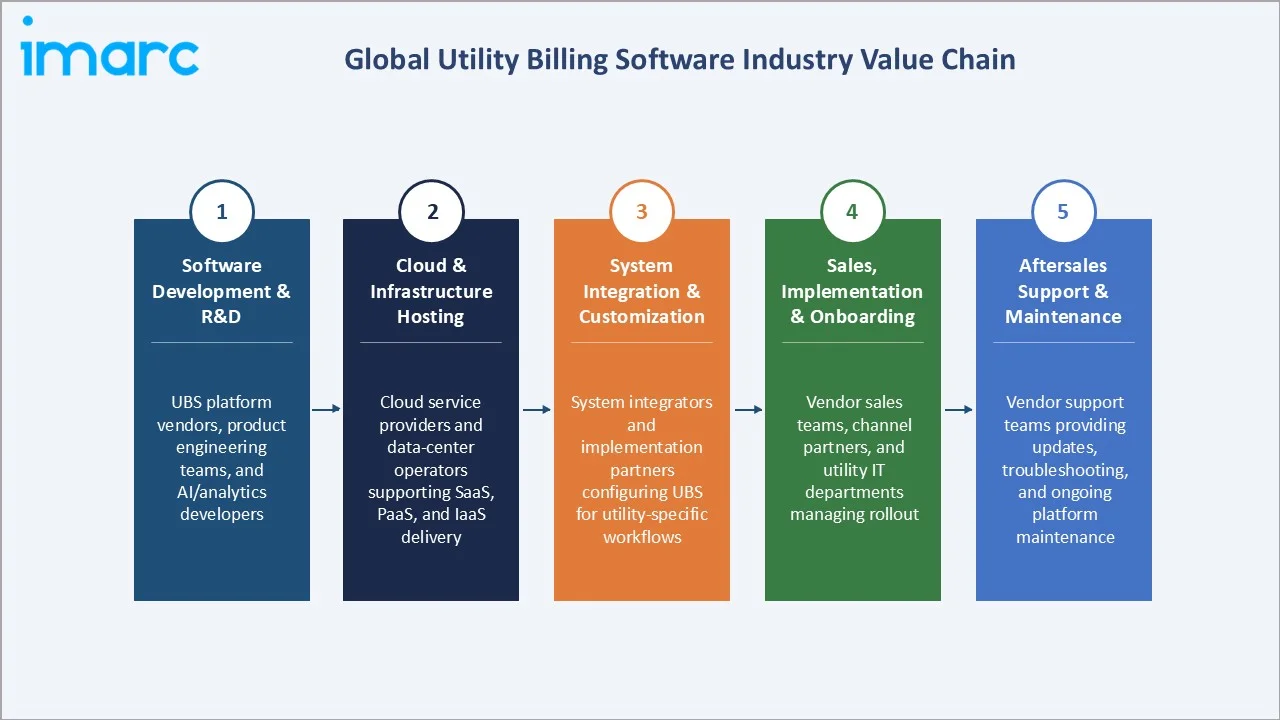
The utility billing software value chain integrates software development and R&D, cloud and infrastructure hosting, system integration and customization, sales and implementation, and ongoing aftersales support, reflecting the shift from one-time license sales toward continuous, subscription-based service delivery across the vendor landscape.
|
Stage |
Key Participants |
|
Software Development & R&D |
UBS platform vendors, product engineering teams, and AI/analytics developers |
|
Cloud & Infrastructure Hosting |
Cloud service providers and data-center operators supporting SaaS, PaaS, and IaaS delivery |
|
System Integration & Customization |
System integrators and implementation partners configuring UBS for utility-specific workflows |
|
Sales, Implementation & Onboarding |
Vendor sales teams, channel partners, and utility IT departments managing rollout |
|
Aftersales Support & Maintenance |
Vendor support teams providing updates, troubleshooting, and ongoing platform maintenance |
The cloud and infrastructure hosting tier is the value chain's fastest-evolving stage, as vendors increasingly migrate customers toward multi-tenant SaaS architectures. The sales and implementation tier remains critical for utilities transitioning from legacy systems, given the operational complexity of migrating historical billing and customer data, which often requires close coordination between vendor implementation teams and utility IT staff.
Technology Landscape in the Utility Billing Software Industry
Cloud-Native SaaS Architecture
Cloud-native SaaS architecture offers multi-tenant scalability, automatic updates, and reduced infrastructure overhead, enabling utilities to deploy billing capabilities faster and adapt to changing customer volumes and tariff structures without significant capital investment. This architecture also simplifies integration with third-party payment and customer-communication platforms.
AI and Machine Learning for Predictive Billing
AI and machine learning technologies enable predictive consumption modeling, automated anomaly detection, and fraud identification, helping utilities reduce billing errors, improve revenue assurance, and provide customers with more accurate usage forecasts, thereby strengthening customer trust and satisfaction with billing accuracy.
IoT and Smart Meter Data Platforms
IoT-enabled smart meters generate continuous, granular consumption data that modern UBS platforms ingest in near-real time, supporting dynamic pricing models, faster leak or outage detection, and enhanced customer self-service capabilities across residential and commercial customer segments.
Market Segmentation Analysis
The report covers the following segments:
|
Segment Category |
Leading Segment |
Market Share |
Year |
|
Deployment Mode |
Cloud-based |
69.4% |
2025 |
|
Type |
Software as a Service |
48.7% |
2025 |
|
End User |
Power Distribution |
🔒 |
2025 |
|
Region |
North America |
36.8% |
2025 |

By Deployment Mode
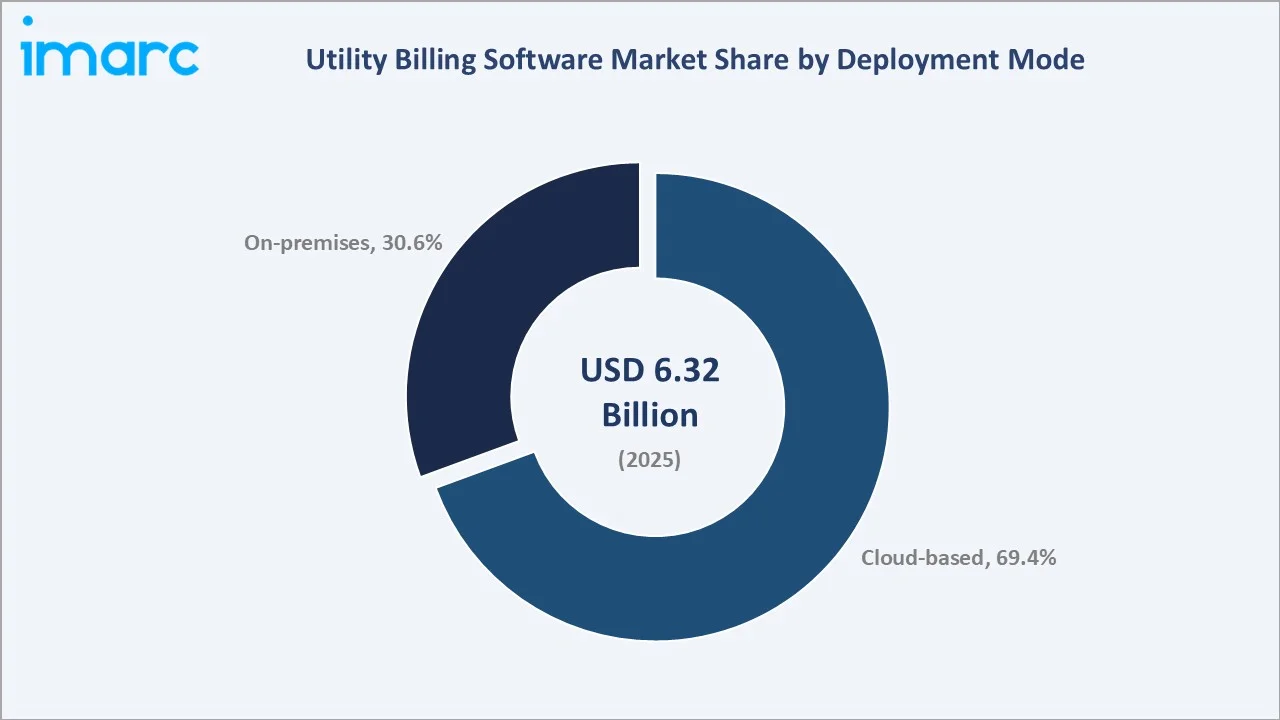
Cloud-based deployment leads at 69.4% in 2025, driven by unparalleled scalability, reduced capital expenditure, remote accessibility, and robust security and data-backup capabilities that address utilities' business-continuity concerns. Its dominance is expected to widen further through 2034 as more utilities complete migration away from legacy on-premises infrastructure.
To access detailed market analysis, Request Sample
On-premises deployment retains 30.6% share, favored by utilities with stringent data-residency requirements or existing infrastructure investments, though growth in this segment lags the broader market as cloud migration continues. Many on-premises deployments persist among smaller municipal utilities that have yet to complete digital transformation initiatives.
By Type
Software as a Service lead at 48.7% in 2025, owing to its scalable, subscription-based model that accommodates fluctuating user numbers, data volumes, and service expansion with minimal upfront investment. Its ease of deployment makes it particularly attractive to mid-sized and regional utilities seeking to modernize billing operations quickly.
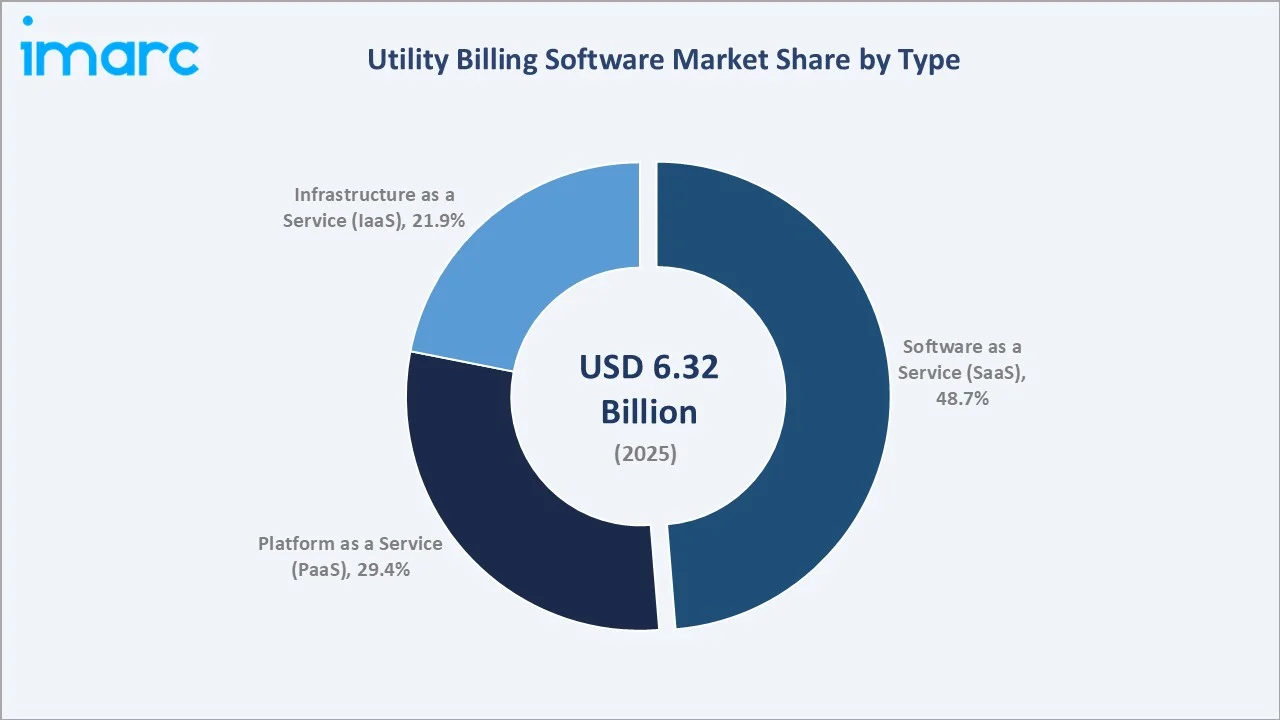
Platform as a Service at 29.4% offers pre-configured development environments that accelerate billing-software customization, while Infrastructure as a Service at 21.9% provides rapidly provisioned virtual machines, storage, and networking that support agile UBS deployment and updates. Both formats appeal to larger utilities seeking greater control over platform customization and integration.
Regional Market Insights
|
Region |
Share (2025) |
Key Market Drivers & Characteristics |
|
North America |
36.8% |
Mature utility sector, stringent regulatory compliance, rising smart-meter and IoT adoption |
|
Europe |
27.9% |
Strict data-privacy regulations, sustainability mandates, and utility digitalization initiatives |
|
Asia-Pacific |
24.6% |
Rapid urbanization, expanding utility infrastructure, and growing cloud adoption |
|
Latin America |
6.0% |
Gradual digitalization of utility billing and expanding smart-grid initiatives |
|
Middle East and Africa |
4.7% |
Emerging utility modernization programs and growing interest in cloud-based billing |
North America, at 36.8%, leads through its highly developed utility sector and stringent regulatory compliance and customer-transparency requirements. The region's utilities are also among the earliest adopters of smart-meter infrastructure, sustaining continued investment in advanced billing platforms. Europe, at 27.9%, reflects strong data-privacy regulation and sustainability-driven utility digitalization, with utilities investing heavily in platforms that support granular energy-consumption reporting.
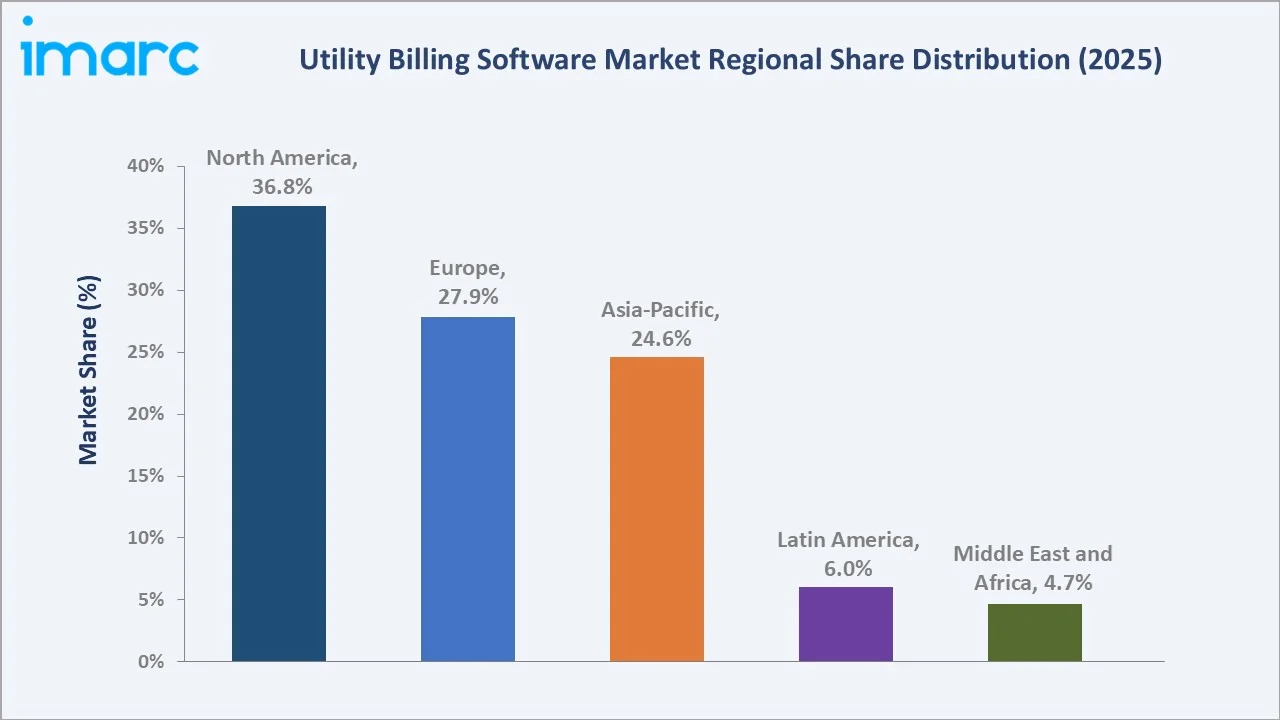
Asia-Pacific, at 24.6%, is expanding on rapid urbanization and growing utility infrastructure investment, with utilities increasingly adopting cloud-based platforms to manage rapidly growing customer bases. Latin America, at 6.0%, and the Middle East and Africa, at 4.7%, represent earlier-stage but steadily growing markets as utilities in these regions begin modernizing legacy billing systems and expanding digital payment adoption.
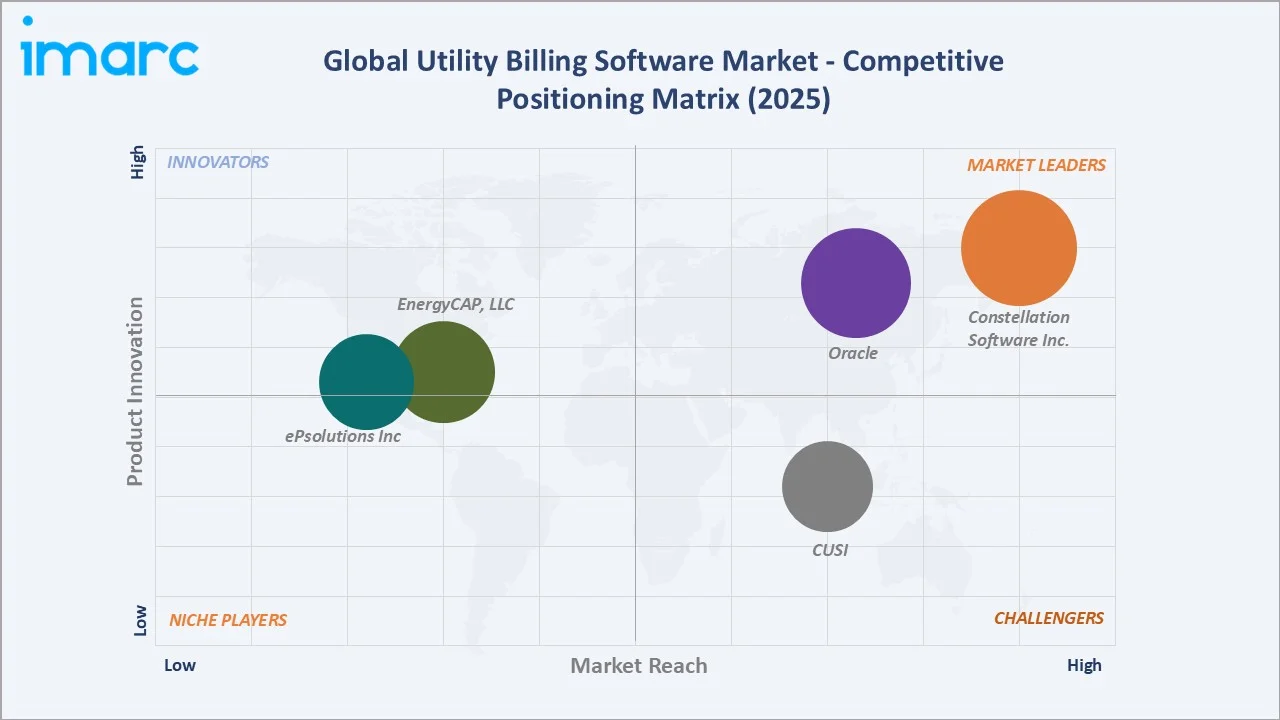
Competitive Landscape
The global utility billing software market is characterized by intense competition among established software providers and emerging specialists, with leading players expanding their global presence through strategic partnerships, flexible and scalable solutions, and continued investment in data security and user experience.
|
Company Name |
Key Products |
Market Position |
Core Strength |
|
Oracle |
Oracle Utilities Customer Cloud Service |
Market Leader |
Oracle offers a comprehensive cloud-based customer information and billing platform for utilities globally. |
|
Constellation Software Inc. |
CitySuite Utility Billing |
Market Leader |
Harris Computer operating through parent company Constellation Software specializes in utility billing and workforce management software with a strong North American customer base. |
|
CUSI |
Utility Billing & CIS Software |
Strong Challenger |
CUSI provides integrated customer information and billing systems tailored to municipal utilities. |
|
EnergyCAP, LLC |
EnergyCAP Utility Bill Management Platform |
Established Player |
EnergyCAP specializes in energy and utility bill management, tracking, and analytics software. |
|
ePsolutions Inc |
Utility Billing Software |
Established Player |
ePsolutions provides configurable billing software for municipal and regional utility providers. |
Key players include Oracle, Constellation Software Inc., CUSI, EnergyCAP, LLC, ePsolutions Inc, and others.
Key Company Profiles
Oracle
Oracle is a global technology company offering a comprehensive cloud-based customer information and billing platform for water, gas, and electric utilities worldwide, combining billing, customer engagement, and analytics capabilities within a single integrated suite.
- Key Products: Oracle Utilities Customer Service
- Strategic Focus: Expanding cloud-native utility billing and customer engagement solutions with integrated AI-driven analytics for utilities transitioning from legacy systems.
Constellation Software Inc.
Harris Computer operating through parent company Constellation Software is a North America-based provider of utility billing and workforce management software, serving municipal and regional utility providers across water, power, and gas sectors through a broad, acquisition-built product portfolio.
- Key Products: Utility Billing Suite
- Strategic Focus: Expanding its utility software portfolio through targeted acquisitions and enhanced mobile workforce management capabilities.
Market Concentration Analysis
The utility billing software market is moderately fragmented, with the top three key players collectively holding a meaningful share of large-utility and enterprise contracts, while numerous regional specialists serve municipal and smaller utility providers across diverse regulatory environments. Market concentration is expected to gradually increase as cloud-native platforms and consolidation among established vendors reshape the competitive landscape through the forecast period. Smaller vendors continue to compete effectively in niche municipal segments by offering lower-cost, highly configurable solutions, sustaining a fragmented long tail alongside a consolidating enterprise tier.
Investment & Growth Opportunities
Highest Growth Segments
Cloud-based deployment (~8.0% CAGR), Software as a Service (~8.5% CAGR), and AI-enabled predictive billing analytics represent the highest-growth investment vectors through 2034, driven by utilities' accelerating shift away from legacy on-premises infrastructure.
Emerging Investment Opportunities
Emerging-market cloud migration represents the utility billing software market's highest-volume near-term opportunity. Utilities across Latin America, the Middle East, and Africa are beginning to replace manual and legacy billing processes with cloud-based platforms, creating a structurally growing addressable market for vendors offering affordable, configurable SaaS solutions suited to smaller-scale operators.
Investment Themes
- Cloud migration enablement for regional and municipal utilities: Vendors offering low-cost, rapid-deployment cloud migration pathways for smaller utilities can capture significant unmet demand as legacy on-premises systems reach end-of-life.
- AI and IoT data-integration platforms: Investment in AI-driven analytics and IoT-compatible billing infrastructure positions vendors to capture rising demand from utilities deploying large-scale smart-meter networks.
- Configurable, compliance-ready billing engines: Vendors that build compliance-ready, highly configurable billing engines can more efficiently serve multi-jurisdiction utility clients, reducing implementation timelines and total cost of ownership for regulatory adaptation.
Future Market Outlook (2026-2034)
The global utility billing software market is projected to grow from USD 6.32 Billion in 2025 to USD 11.52 Billion by 2034, delivering a 6.90% CAGR over the forecast period. The market's anchor value of USD 8.82 Billion in 2030 reflects continued cloud migration, with cloud-based deployment and Software as a Service expected to further expand their share as utilities prioritize scalability and reduced capital expenditure across both mature and emerging regional markets.
AI-enabled predictive billing analytics and IoT-integrated data platforms are expected to become standard features across leading UBS offerings, while regulatory compliance and customer self-service demands continue to sustain structural, compounding market growth through 2034.
Three structural forces underpin utility billing software market growth through 2034. Continued migration from legacy on-premises infrastructure to cloud-native SaaS platforms creates a self-reinforcing replacement cycle across both large investor-owned utilities and smaller municipal providers. Rising smart-meter and IoT deployment generates ever-larger volumes of billing-relevant data, sustaining demand for platforms capable of real-time ingestion and analytics. Finally, tightening data-privacy and billing-transparency regulations across regions ensure UBS remains a compliance-critical investment rather than a discretionary IT purchase.
Research Methodology
Primary Research
Primary research comprised structured interviews with utility IT leaders, billing operations managers, and software vendor executives to validate market sizing, segment shares, and growth drivers. These discussions also helped calibrate qualitative assessments of vendor competitive positioning and emerging technology adoption timelines.
Secondary Research
Secondary research encompassed company annual reports, regulatory filings, utility industry association publications, and market forecast databases covering deployment mode, type, and regional segments. Publicly disclosed vendor product roadmaps and partnership announcements were also reviewed to corroborate emerging-technology adoption trends identified during primary interviews.
Forecasting Models
Market revenue forecasts were developed using a bottom-up model incorporating utility digitalization rates by region, deployment-mode migration trends, and subscription-based revenue growth by software type. The model was cross-validated against historical market-size data points and adjusted for regional regulatory and infrastructure-readiness differences.
Utility Billing Software Market Report Scope:
| Report Features | Details |
|---|---|
| Base Year of the Analysis | 2025 |
| Historical Period | 2020-2025 |
| Forecast Period | 2026-2034 |
| Units | Billion USD |
| Scope of the Report |
Exploration of Historical Trends and Market Outlook, Industry Catalysts and Challenges, Segment-Wise Historical and Future Market Assessment:
|
| Deployment Modes Covered | On-premises, Cloud-based |
| Types Covered | Platform as a Service, Infrastructure as a Service, Software as a Service |
| End Users Covered | Water, Power Distribution, Oil and Gas, Telecommunication, Others |
| Regions Covered | Asia Pacific, Europe, North America, Latin America, Middle East and Africa |
| Countries Covered | United States, Canada, Germany, France, United Kingdom, Italy, Spain, Russia, China, Japan, India, South Korea, Australia, Indonesia, Brazil, Mexico |
| Companies Covered | Oracle, Constellation Software Inc., CUSI, EnergyCAP, LLC, ePsolutions Inc, etc. |
| Customization Scope | 10% Free Customization |
| Post-Sale Analyst Support | 10-12 Weeks |
| Delivery Format | PDF and Excel through Email (We can also provide the editable version of the report in PPT/Word format on special request) |
Key Benefits for Stakeholders:
- IMARC’s industry report offers a comprehensive quantitative analysis of various market segments, historical and current market trends, market forecasts, and dynamics of the utility billing software market from 2020-2034.
- The research report provides the latest information on the market drivers, challenges, and opportunities in the global utility billing software market.
- The study maps the leading, as well as the fastest-growing, regional markets. It further enables stakeholders to identify the key country-level markets within each region.
- Porter's five forces analysis assist stakeholders in assessing the impact of new entrants, competitive rivalry, supplier power, buyer power, and the threat of substitution. It helps stakeholders to analyze the level of competition within the utility billing software industry and its attractiveness.
- Competitive landscape allows stakeholders to understand their competitive environment and provides an insight into the current positions of key players in the market.
Frequently Asked Questions About the Utility Billing Software Market Report
The global utility billing software market reached USD 6.32 Billion in 2025, driven by cloud-based deployment dominant at 69.4%, Software as a Service leading at 48.7%, and North America commanding 36.8% market share. Rising energy-efficiency awareness and regulatory compliance requirements continue to support broad-based adoption across utility segments.
The market grows at a 6.90% CAGR during 2026-2034, reaching USD 11.52 Billion by 2034, reflecting sustained cloud migration, rising smart-meter data integration, and growing demand for AI-enabled billing analytics across global utility providers.
Cloud-based deployment leads at 69.4%, driven by scalability, lower infrastructure costs, and remote accessibility for utility providers, while on-premises deployment retains 30.6% share among utilities with data-residency requirements.
Software as a Service leads at 48.7%, owing to its subscription-based, rapidly scalable model suited to utilities of varying sizes, followed by Platform as a Service at 29.4% and Infrastructure as a Service at 21.9%.
North America leads at 36.8%, supported by a mature utility sector and stringent regulatory compliance requirements, followed by Europe at 27.9% and Asia-Pacific at 24.6%.
Leading companies include Oracle, Constellation Software Inc., CUSI, EnergyCAP, LLC, ePsolutions Inc, and others.
The market is projected to reach approximately USD 8.82 Billion by 2030, with cloud-based and SaaS platforms continuing to gain share as utilities accelerate migration away from legacy billing infrastructure.
Priority opportunities include cloud migration enablement for regional utilities, AI-driven predictive billing analytics, IoT-integrated data platforms, and configurable, compliance-ready billing engines for multi-jurisdiction utility clients.
Need more help?
- Speak to our experienced analysts for insights on the current market scenarios.
- Include additional segments and countries to customize the report as per your requirement.
- Gain an unparalleled competitive advantage in your domain by understanding how to utilize the report and positively impacting your operations and revenue.
- For further assistance, please connect with our analysts.
 Request Customization
 Speak to an Analyst
 Request Brochure
 Inquire Before Buying
Benefits of Customization
- Personalize this research
- Triangulate with your data
- Get data as per your format and definition
- Gain a deeper dive into a specific application, geography, customer, or competitor
- Any level of personalization
Get in Touch With Us
UNITED STATES
Phone: +1-201-971-6302
INDIA
Phone: +91-120-433-0800
UNITED KINGDOM
Phone: +44-753-714-6104
Email: [email protected]
Client Testimonials




.webp)




.webp)













Related Reports

Choose your plan
*Please note that the prices mentioned below are starting prices for each bundle type. Kindly contact our team for further details.*
Single User License
- 1 User License, Access on 2 Devices
- PDF Report + Excel Dataset (Password Protected)
- Lifetime Access
- No Printing Rights
- 10% Free Report Customization
- 10–12 Weeks of Analyst Support
Five User License
- Access for 5 Users, 2 Devices per User
- PDF Report + Excel Dataset (Password Protected)
- Lifetime Access
- Dedicated Account Manager
- 12–14 Weeks of Analyst Support
- No Printing Rights
- 15% Free Report Customization
- 25% Discount on Your Next Purchase
Corporate User License
- Unlimited User Access (Within Your Organization)
- PDF Report + Excel Dataset
- Lifetime Access
- Dedicated Account Manager
- 14–20 Weeks of Analyst Support
- No Printing Rights
- 20% Free Report Customization
- 30% Discount on Your Next Purchase
Essential Insights
What's included:
3 reports
- Lifetime Access
- PDF Reports
- Excel Datasets
- 2 Weeks of Free Analyst Support
- 2 User Licenses
- Access on 2 Devices
- Printing Rights
- Complimentary PowerPoint (PPT) Version
- Complimentary License Upgrade
Professional Access
What's included:
5 reports
- Lifetime Access
- PDF Reports
- Excel Datasets
- 8 Weeks of Free Analyst Support
- 2 User Licenses
- Access on 2 Devices
- Printing Rights
- Complimentary PowerPoint (PPT) Version
- Complimentary License Upgrade
Business Advantage
What's included:
8 reports
- Lifetime Access
- PDF Reports
- Excel Datasets
- 14 Weeks of Free Analyst Support
- 2 User Licenses
- Access on 2 Devices
- Printing Rights
- Complimentary PowerPoint (PPT) Version
- Complimentary License Upgrade
Enterprise Intelligence
What's included:
10 reports
- Lifetime Access
- PDF Reports
- Excel Datasets
- 20 Weeks of Free Analyst Support
- 2 User Licenses
- Access on 2 Devices
- Printing Rights
- Complimentary PowerPoint (PPT) Version
- Complimentary License Upgrade