
Vietnam Hi-tech Medical Devices Market Size, Share, Trends and Forecast by Product / Device Type, Technology, Application, End User, and Region, 2026-2034
Vietnam Hi-tech Medical Devices Market Summary:
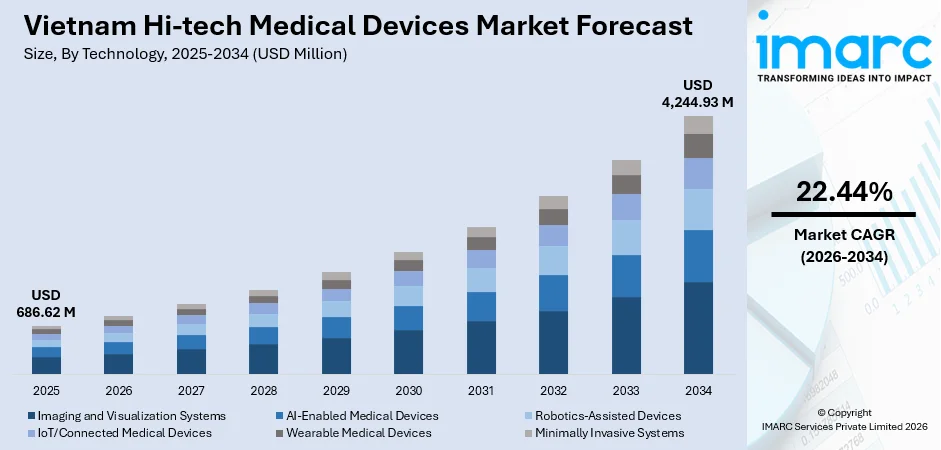
The Vietnam hi-tech medical devices market size was valued at USD 686.62 Million in 2025 and is projected to reach USD 4,244.93 Million by 2034, growing at a compound annual growth rate of 22.44% from 2026-2034.
The market for high-tech medical devices in Vietnam is rapidly growing as the nation speeds up its digital health transformation and increases the use of wearable technology in healthcare and fitness areas. The increasing awareness about health among users, strong government digitalization initiatives, and the rising incidence of chronic diseases are boosting the demand for connected health monitoring solutions. Developments in sensor technology, rising smartphone usage, and greater incorporation of artificial intelligence (AI) into wearable devices are transforming preventive healthcare services, establishing Vietnam as a growing center for high-tech medical device innovation.
Key Takeaways and Insights:
- By Product/Device Type: Diagnostic imaging equipment dominates the market with a share of 18.6% in 2025, supported by the growing demand for precise and reliable diagnostic solutions across healthcare settings.
- By Technology: Imaging and visualization systems lead the market with a share of 24.9% in 2025, owing to continuous improvements in real-time imaging capabilities and enhanced clinical accuracy.
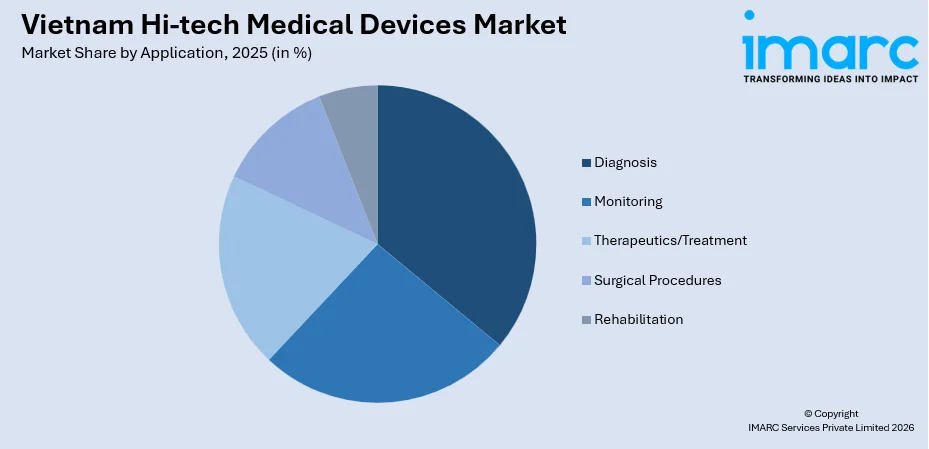
- By Application: Diagnosis represents the largest segment with a market share of 31.7% in 2025, due to the increasing focus on early detection and effective disease management.
- By End User: Hospitals and clinics dominate the market with a share of 58.4% in 2025, influenced by advanced healthcare infrastructure and consistently high patient volumes.
- By Region: Southern Vietnam leads the market with a share of 46.2% in 2025, driven by Ho Chi Minh City’s concentration of healthcare infrastructure, technology hubs, and higher disposable incomes enabling premium device adoption.
- Key Players: The Vietnam hi-tech medical devices market is highly competitive, with international wearable technology manufacturers expanding product portfolios, enhancing health sensing capabilities, and forming strategic partnerships to strengthen market presence and accelerate adoption across consumer and clinical segments.
To get more information on this market Request Sample
The hi-tech medical devices market in Vietnam is driven by a mix of demographic, economic, and technological influences. Swift urban growth and a rising middle class with increased disposable incomes are driving the demands for quality healthcare, encouraging hospitals to invest in sophisticated diagnostic and therapeutic equipment. Increasing patient demand for less invasive procedures and precision-focused treatments is propelling the adoption of robotic-assisted surgical systems, image-guided interventions, and AI-integrated devices. Government efforts and ongoing healthcare investment, including public-private partnerships (PPP), facilitate the modernization of hospital infrastructure and digital health technologies. Vietnam's goal to boost medical tourism is prompting hospitals to achieve international standards with advanced imaging and critical care systems. Moreover, the rising incidence of chronic illnesses emphasizes the necessity for enhanced care. The International Diabetes Federation reported that in 2024, 2.5 million adults aged 20–79 in Vietnam had diabetes, indicating an urgent demand for innovative solutions that enhance early detection, treatment precision, and ongoing disease management.
Vietnam Hi-tech Medical Devices Market Trends:
Rising Healthcare Expenditure and Government Investment
Sustained growth in healthcare expenditure and strong government commitment to modernizing Vietnam’s healthcare system are key factors influencing the hi-tech medical devices market. Government investments in hospital infrastructure, diagnostic capabilities, and specialized treatment centers are facilitating the adoption of advanced imaging systems, robotic surgical equipment, and digital monitoring technologies. For instance, in 2026, Vietnam’s Health Ministry launched the nationwide Vietnam Responsible Health AI Network to enhance prevention, diagnosis, and treatment while building a smart healthcare system by 2030. This initiative includes AI deployment at over 3,300 commune- and ward-level health stations, providing diagnostic support, screening, and virtual assistants, thereby creating a robust environment for high-technology medical device integration nationwide.
Growing Burden of Chronic and Non-Communicable Diseases
The increasing prevalence of cardiovascular diseases, diabetes, cancer, and respiratory disorders is driving the demand for advanced medical devices in Vietnam, as effective management, early diagnosis, and precision treatment require sophisticated imaging systems, minimally invasive surgical tools, and remote monitoring technologies. An aging population further amplifies this demand. According to the medium fertility scenario, Vietnam’s older population (aged 60 and above) is projected to rise from 14.2 million in 2024 to 20.9 million in 2034, reaching 27.5 million by 2044 and 38.5 million by 2074. In response, healthcare providers are investing in high-tech equipment to enhance clinical outcomes, reduce mortality, and address the growing need for specialized, technology-driven healthcare services nationwide.
Increasing Medical Tourism and Regional Competitiveness
Vietnam’s ambition to establish itself as a leading regional healthcare destination is significantly driving investments in high-technology medical devices. Hospitals seeking to attract international patients must adhere to global standards in diagnostics, surgical procedures, and patient safety, necessitating advanced imaging systems, precision surgical instruments, and state-of-the-art intensive care equipment. As per the IMARC Group, the Vietnam medical tourism market reached USD 850.9 Million in 2025, reflecting the growing cross-border patient inflows and heightened demand for quality care. By improving service standards while maintaining competitive treatment costs, healthcare institutions are enhancing the country’s appeal to foreign patients, further reinforcing the need for technologically sophisticated devices to support international-grade healthcare delivery.
Market Outlook 2026-2034:
The Vietnam hi-tech medical devices market shows remarkable growth prospects, supported by irreversible trends in digital health transformation and changing user wellness perspectives. The market generated a revenue of USD 686.62 Million in 2025 and is projected to reach a revenue of USD 4,244.93 Million by 2034, growing at a compound annual growth rate of 22.44% from 2026-2034. Ongoing government funding in healthcare digitalization, increased 5G connectivity, growing use of AI-driven wearable technologies, and strengthened collaborations between tech firms and healthcare organizations will fuel ongoing revenue growth across products, applications, and geographical areas during the forecast duration.
Vietnam Hi-tech Medical Devices Market Report Segmentation:
|
Segment Category |
Leading Segment |
Market Share |
|
Product / Device Type |
Diagnostic Imaging Equipment |
18.6% |
|
Technology |
Imaging and Visualization Systems |
24.9% |
|
Application |
Diagnosis |
31.7% |
|
End User |
Hospitals and Clinics |
58.4% |
|
Region |
Southern Vietnam |
46.2% |
Product/Device Type Insights:
- Diagnostic Imaging Equipment
- Cardiovascular Devices
- In-Vitro Diagnostic Devices
- Surgical Equipment and Robotics
- Orthopedic Devices
- Neurology Devices
- Ophthalmic Devices
- Dental Care Devices
- Diabetes Care Devices
- Anesthesia and Respiratory Devices
- Nephrology and Urology Devices
- ENT Devices
- Mobility-Aid Devices
- Monitoring and Digital Health Devices
- Others
Diagnostic imaging equipment dominates with a market share of 18.6% of the total Vietnam hi-tech medical devices market in 2025.
Diagnostic imaging equipment is the leading segment in the market due to the increasing demand for accurate and timely disease detection across healthcare settings. The growing burden of chronic diseases and rising awareness regarding early diagnosis are encouraging healthcare providers to invest in advanced imaging solutions. Technologies, such as MRI, CT, and ultrasound, are widely adopted to support precise clinical decision making. In addition, improvements in imaging quality and faster processing capabilities enhance diagnostic efficiency. Expanding healthcare infrastructure and increasing private sector investments further contribute to the widespread adoption of diagnostic imaging equipment across hospitals and diagnostic centers.
Diagnostic imaging equipment also benefits from ongoing technological advancements that improve image clarity, reduce scanning time, and enhance patient safety. The integration of digital systems and data storage solutions allows seamless sharing of imaging results among healthcare professionals, supporting collaborative care. Additionally, the rising number of diagnostic centers and specialized clinics is contributing to equipment uptake. For instance, in 2025, Bayer and Siemens Healthineers launched advanced imaging systems, including MEDRAD Centargo, MAGNETOM Flow, and SOMATOM Pro.Pulse in Vietnam. These technologies integrated AI and automation to improve diagnostic accuracy, reduce scan times, and enhance workflow efficiency in hospitals. They also supported safer and more sustainable imaging, with features like reduced contrast usage and helium-independent MRI systems.
Technology Insights:
- AI-Enabled Medical Devices
- Robotics-Assisted Devices
- IoT/Connected Medical Devices
- Wearable Medical Devices
- Minimally Invasive Systems
- Imaging and Visualization Systems
Imaging and visualization systems lead with a market share of 24.9% of the total Vietnam hi-tech medical devices market in 2025.
Imaging and visualization systems dominate the market owing to their essential role in improving diagnostic accuracy and treatment planning. These systems provide detailed visual representation of internal body structures, enabling healthcare professionals to identify medical conditions at an early stage. The increasing adoption of advanced imaging technologies across hospitals and diagnostic centers supports this segment’s growth. Improvements in software capabilities and user interfaces further enhance usability and efficiency. Rising investments in healthcare infrastructure and growing demand for high quality diagnostic services are also driving the adoption of imaging and visualization systems across Vietnam.
The segment’s leadership is further supported by continuous innovation in visualization technologies, including enhanced imaging resolution and real time data processing. Integration with digital health platforms allows efficient storage, retrieval, and sharing of imaging data, improving workflow efficiency. Healthcare providers are increasingly relying on visualization tools for complex procedures and accurate diagnosis. Government initiatives aimed at strengthening diagnostic capabilities and expanding healthcare access further contribute to demand. Additionally, the increasing number of trained professionals and adoption of modern medical practices support sustained growth, reinforcing the dominance of imaging and visualization systems in the market.
Application Insights:
Access the comprehensive market breakdown Request Sample
- Diagnosis
- Monitoring
- Therapeutics/Treatment
- Surgical Procedures
- Rehabilitation
Diagnosis exhibits a clear dominance with a 31.7% share of the total Vietnam hi-tech medical devices market in 2025.
Diagnosis represents the largest segment driven by the increasing need for early and accurate detection of diseases. Rising prevalence of chronic conditions and the growing health awareness are encouraging individuals to undergo regular diagnostic evaluations. Healthcare providers rely on advanced medical devices to ensure precise and timely diagnosis, which is critical for effective treatment planning. Improvements in diagnostic technologies and availability of modern equipment across healthcare facilities support the dominance of the segment. Additionally, increasing accessibility of diagnostic services in both urban and semi urban areas is contributing to higher utilization rates.
The leadership of the diagnosis segment is also influenced by the expansion of diagnostic centers and laboratories across Vietnam. Continuous advancements in medical technology enhance the speed and accuracy of diagnostic procedures, improving patient outcomes. Integration of digital systems enables efficient data management and analysis, supporting clinical decision making. Government initiatives focused on improving healthcare quality and promoting early disease detection further drive demand. Additionally, rising investments in healthcare infrastructure and increased patient awareness regarding preventive care contribute to sustained growth, ensuring diagnosis remains the leading application in the Vietnam hi-tech medical devices market.
End User Insights:
- Hospitals and Clinics
- Diagnostic Centers
- Ambulatory Surgical Centers
- Research and Academic Institutes
- Home Care Settings
Hospitals and clinics dominate with a market share of 58.4% of the total Vietnam hi-tech medical devices market in 2025.
Hospitals and clinics lead the market because of their central role in delivering comprehensive healthcare services. These facilities handle a high volume of patients and require advanced medical devices to support diagnosis, treatment, and monitoring. The presence of skilled healthcare professionals and availability of specialized departments enable effective utilization of hi-tech equipment. Increasing investments in hospital infrastructure and modernization of healthcare facilities are further driving adoption. Additionally, the growing preference for institutional healthcare services supports higher demand for advanced medical devices within hospitals and clinics across Vietnam.
The segment’s dominance is further reinforced by continuous expansion of both public and private healthcare facilities in the country. Hospitals and clinics are increasingly adopting advanced technologies to improve patient outcomes and operational efficiency. Integration of digital health systems and automation enhances workflow management and reduces treatment delays. Government initiatives aimed at improving healthcare accessibility and quality also support this growth. Furthermore, rising patient expectations and demand for high quality care encourage healthcare providers to invest in modern equipment, ensuring that hospitals and clinics remain the primary end users in the market.
Regional Insights:
- Northern Vietnam
- Central Vietnam
- Southern Vietnam
Southern Vietnam leads with a market share of 46.2% of the total Vietnam hi-tech medical devices market in 2025.
Southern Vietnam holds the biggest market share driven by its strong economic base and advanced healthcare infrastructure. Ho Chi Minh City, the country’s largest commercial hub, hosts leading hospitals, private clinics, and specialized medical centers that actively adopt innovative technologies. Higher disposable income levels and greater exposure to digital health solutions encourage individuals to invest in smart medical devices and wearables. The presence of multinational healthcare companies and medical device distributors further strengthens product availability and service networks. These factors collectively position Southern Vietnam as the primary growth engine for hi-tech medical device adoption.
The region’s dominance is also influenced by its dynamic startup ecosystem and the growing private healthcare sector. Cities like Ho Chi Minh City witness strong demand for telemedicine, remote monitoring, and AI-driven diagnostics, fueled by busy urban lifestyles and rising health awareness. Improved internet penetration and digital payment systems enable seamless integration of smart medical devices into everyday healthcare. According to Vietnam Digital Research, the country had approximately 78.44 million internet users in 2024, representing a 79.1 percent penetration rate, with projections reaching 100 million users by 2029, one-third aged 13–34, highlighting the region’s readiness for digital health adoption.
Market Dynamics:
Growth Drivers:
Why is the Vietnam Hi-tech Medical Devices Market Growing?
Urbanization and Rising Middle-Class Population
Rapid urbanization and the growth of Vietnam’s middle-class population are driving the need for high-quality healthcare services. Urban residents often benefit from private insurance coverage, higher disposable incomes, and heightened awareness about advanced treatment options, prompting healthcare providers to upgrade facilities and adopt innovative medical technologies. For instance, in 2024, household expenditure rebounded, primarily in urban areas, with average per capita spending reaching nearly VND 3 million (USD120), marking a 6.5% increase compared to 2022 and an average annual growth of 3.2% during 2022–2024. This rising affluence and health consciousness encourage the adoption of technologically advanced diagnostic and therapeutic solutions, fostering sustained growth in Vietnam’s hi-tech medical devices market.
Increasing Foreign Direct Investment and Technology Partnerships
The growing foreign direct investment (FDI) and cross-border technology partnerships are facilitating the transfer of advanced medical technologies into Vietnam. International manufacturers and healthcare investors are establishing local distribution networks, joint ventures, and technology-sharing agreements. These collaborations enhance product availability, technical support, and after-sales service quality. Exposure to global best practices also raises performance standards within domestic healthcare institutions. As multinational companies introduce innovative medical devices and provide technical training, hospitals in Vietnam are gaining improved access to state-of-the-art equipment. This inflow of capital, expertise, and technology strengthens the overall ecosystem supporting the growth of the hi-tech medical devices market.
Rising Demand for Minimally Invasive and Precision Procedures
Patient preference for minimally invasive procedures and precision-based interventions is significantly catalyzing the demand for advanced medical devices in Vietnam. Modern patients increasingly prioritize treatments that reduce hospital stays, minimize discomfort, and enable faster recovery, prompting healthcare providers to adopt robotic-assisted surgical systems, advanced endoscopy tools, and image-guided technologies. For instance, in 2026, GE HealthCare showcased over 40 advanced diagnostic imaging technologies in Hanoi, including next-generation CT, MRI, PET/CT, mammography, and AI-enabled systems, designed to enhance precision medicine, lower radiation exposure, and address hospital challenges such as overcrowding and workforce shortages. This growing adoption of high-performance, precision-focused equipment reflects hospitals’ commitment to improved patient outcomes and technologically advanced care.
Market Restraints:
What Challenges the Vietnam Hi-tech Medical Devices Market is Facing?
Limited Digital Infrastructure in Rural Healthcare Settings
Despite progress in major cities, Vietnam’s rural regions continue to struggle with limited digital infrastructure, which restricts the adoption of advanced medical devices. Connectivity gaps make it difficult to implement telemedicine services and remote health monitoring solutions in underserved areas. As a result, healthcare providers in rural communities face barriers in delivering consistent, technology-enabled care, widening the urban–rural healthcare access divide.
Data Privacy and Cybersecurity Vulnerabilities
The rapid digitalization of Vietnam’s healthcare sector is raising higher concerns around patient data security and privacy protection. Increasing incidents of cyber threats targeting sensitive medical information have weakened consumer trust in digital health platforms. At the same time, an evolving cybersecurity regulatory environment creates uncertainty for wearable device manufacturers and health data service providers, complicating compliance requirements and slowing adoption of connected healthcare solutions.
High Device Costs Limiting Adoption Among Price-Sensitive Users
The high cost of premium wearable health devices continues to limit widespread adoption across the country. With modest average monthly incomes, many people prioritize essential spending and opt for lower-priced fitness bands or basic trackers instead of advanced medical-grade wearables. This affordability gap restricts access to comprehensive health monitoring features, particularly among lower and middle-income groups, slowing overall market penetration and long-term preventive healthcare uptake.
Competitive Landscape:
The Vietnam hi-tech medical devices market is characterized by intense competition among international wearable technology manufacturers alongside emerging domestic digital health providers. Market dynamics reflect strategic positioning across price segments, ranging from premium advanced health sensing devices targeting fitness enthusiasts and healthcare professionals to value-oriented products serving cost-conscious individuals. Competition is increasingly driven by health monitoring accuracy, AI-powered analytics capabilities, battery longevity, and ecosystem integration with telemedicine platforms. Strategic partnerships between device manufacturers and healthcare providers, investment in localized distribution networks, and emphasis on regulatory compliance are shaping competitive dynamics as market participants seek to capture expanding consumer and clinical demand segments.
Vietnam Hi-tech Medical Devices Market Report Coverage:
|
Report Features |
Details |
|
Base Year of the Analysis |
2025 |
|
Historical Period |
2020-2025 |
|
Forecast Period |
2026-2034 |
|
Units |
USD Million |
|
Scope of the Report |
Exploration of Historical Trends and Market Outlook, Industry Catalysts and Challenges, Segment-Wise Historical and Future Market Assessment:
|
|
Product/Device Types Covered |
Diagnostic Imaging Equipment, Cardiovascular Devices, In-Vitro Diagnostic Devices, Surgical Equipment and Robotics, Orthopedic Devices, Neurology Devices, Ophthalmic Devices, Dental Care Devices, Diabetes Care Devices, Anesthesia and Respiratory Devices, Nephrology and Urology Devices, ENT Devices, Mobility-Aid Devices, Monitoring and Digital Health Devices, Others |
|
Technologies Covered |
AI-Enabled Medical Devices, Robotics-Assisted Devices, IoT/Connected Medical Devices, Wearable Medical Devices, Minimally Invasive Systems, Imaging and Visualization Systems |
|
Applications Covered |
Diagnosis, Monitoring, Therapeutics/Treatment, Surgical Procedures, Rehabilitation |
|
End Users Covered |
Hospitals and Clinics, Diagnostic Centers, Ambulatory Surgical Centers, Research and Academic Institutes, Home Care Settings |
|
Regions Covered |
Northern Vietnam, Central Vietnam, Southern Vietnam |
|
Customization Scope |
10% Free Customization |
|
Post-Sale Analyst Support |
10-12 Weeks |
|
Delivery Format |
PDF and Excel through Email (We can also provide the editable version of the report in PPT/Word format on special request) |
Frequently Asked Questions About the Vietnam Hi-tech Medical Devices Market Report
The Vietnam hi-tech medical devices market size was valued at USD 686.62 Million in 2025.
The Vietnam hi-tech medical devices market is expected to grow at a compound annual growth rate of 22.44% from 2026-2034 to reach USD 4,244.93 Million by 2034.
Diagnostic imaging equipment holds the largest revenue share of 18.6% in 2025, driven by the increasing need for early and accurate detection of diseases and the ongoing technological advancements.
Key factors driving the Vietnam hi-tech medical devices market include the rising prevalence of cardiovascular diseases, diabetes, cancer, and respiratory disorders, combined with Vietnam’s aging population, which is projected to grow from 14.2 million in 2024 to 20.9 million by 2034.
Major challenges include limited digital infrastructure in rural healthcare centers, data privacy and cybersecurity vulnerabilities with high breach cases reported, high device costs relative to average user income, evolving regulatory frameworks, and digital literacy gaps in underserved regions.
Need more help?
- Speak to our experienced analysts for insights on the current market scenarios.
- Include additional segments and countries to customize the report as per your requirement.
- Gain an unparalleled competitive advantage in your domain by understanding how to utilize the report and positively impacting your operations and revenue.
- For further assistance, please connect with our analysts.
 Request Customization
 Speak to an Analyst
 Request Brochure
 Inquire Before Buying
Benefits of Customization
- Personalize this research
- Triangulate with your data
- Get data as per your format and definition
- Gain a deeper dive into a specific application, geography, customer, or competitor
- Any level of personalization
Get in Touch With Us
UNITED STATES
Phone: +1-201-971-6302
INDIA
Phone: +91-120-433-0800
UNITED KINGDOM
Phone: +44-753-714-6104
Email: [email protected]
Client Testimonials




.webp)




.webp)













Related Reports

Choose your plan
*Please note that the prices mentioned below are starting prices for each bundle type. Kindly contact our team for further details.*
Single User License
- 1 User License, Access on 2 Devices
- PDF Report + Excel Dataset (Password Protected)
- Lifetime Access
- No Printing Rights
- 10% Free Report Customization
- 10–12 Weeks of Analyst Support
Five User License
- Access for 5 Users, 2 Devices per User
- PDF Report + Excel Dataset (Password Protected)
- Lifetime Access
- Dedicated Account Manager
- 12–14 Weeks of Analyst Support
- No Printing Rights
- 15% Free Report Customization
- 25% Discount on Your Next Purchase
Corporate User License
- Unlimited User Access (Within Your Organization)
- PDF Report + Excel Dataset
- Lifetime Access
- Dedicated Account Manager
- 14–20 Weeks of Analyst Support
- No Printing Rights
- 20% Free Report Customization
- 30% Discount on Your Next Purchase
Essential Insights
What's included:
3 reports
- Lifetime Access
- PDF Reports
- Excel Datasets
- 2 Weeks of Free Analyst Support
- 2 User Licenses
- Access on 2 Devices
- Printing Rights
- Complimentary PowerPoint (PPT) Version
- Complimentary License Upgrade
Professional Access
What's included:
5 reports
- Lifetime Access
- PDF Reports
- Excel Datasets
- 8 Weeks of Free Analyst Support
- 2 User Licenses
- Access on 2 Devices
- Printing Rights
- Complimentary PowerPoint (PPT) Version
- Complimentary License Upgrade
Business Advantage
What's included:
8 reports
- Lifetime Access
- PDF Reports
- Excel Datasets
- 14 Weeks of Free Analyst Support
- 2 User Licenses
- Access on 2 Devices
- Printing Rights
- Complimentary PowerPoint (PPT) Version
- Complimentary License Upgrade
Enterprise Intelligence
What's included:
10 reports
- Lifetime Access
- PDF Reports
- Excel Datasets
- 20 Weeks of Free Analyst Support
- 2 User Licenses
- Access on 2 Devices
- Printing Rights
- Complimentary PowerPoint (PPT) Version
- Complimentary License Upgrade