
Waterjet Cutting Machine Market Size, Share, Trends and Forecast by Type, Product Type, Horsepower, Machine Size, Application, and Region, 2026-2034
Waterjet Cutting Machine Market Size, Share, Trends & Forecast (2026-2034)
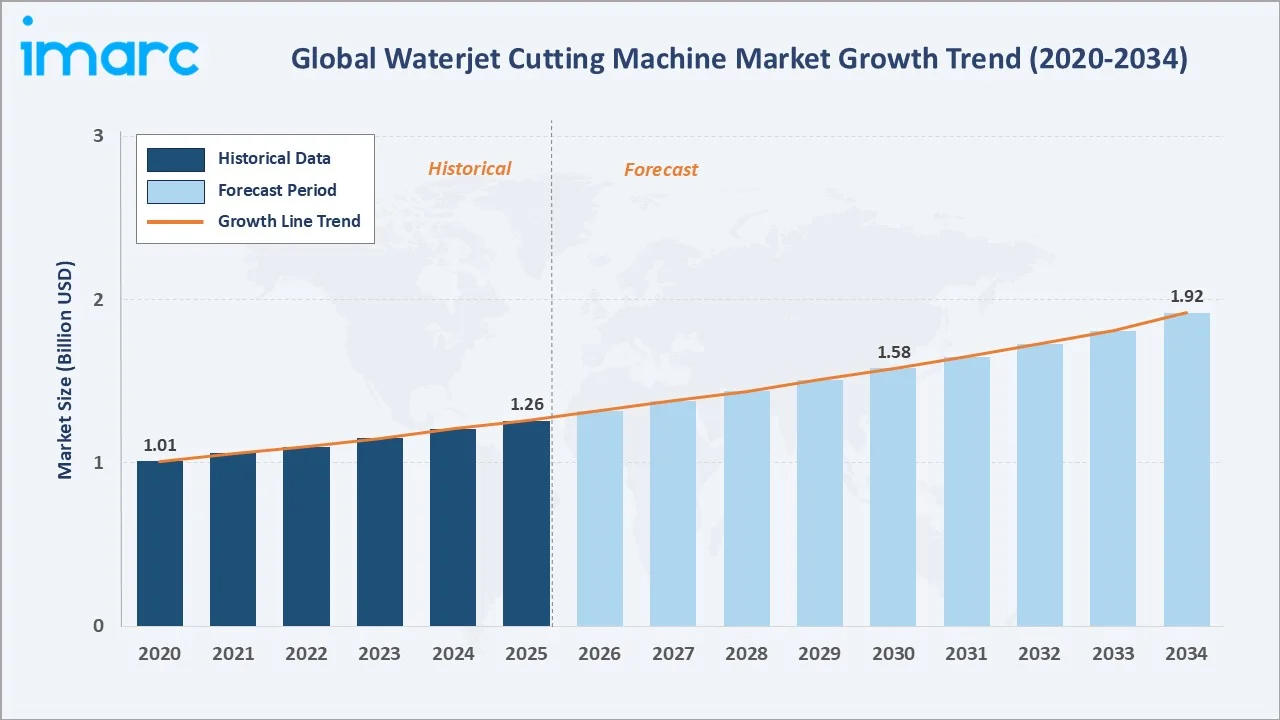
The global waterjet cutting machine market reached USD 1.26 Billion in 2025 and is projected to reach USD 1.92 Billion by 2034, growing at a CAGR of 4.62% during 2026-2034. Key drivers include rapid industrialization, automotive sector adoption, and technological advancements in 3D, micro, and robotic WCM systems.
Abrasive WCMs lead type share at 82.0%. Automotive leads application at 31.0%. North America leads regionally at 34.0%.
Market Snapshot
|
Metric |
Value |
|
Market Size (2025) |
USD 1.26 Billion |
|
Forecast Market Size (2034) |
USD 1.92 Billion |
|
CAGR (2026-2034) |
4.62% |
|
Base Year |
2025 |
|
Historical Period |
2020-2025 |
|
Forecast Period |
2026-2034 |
|
Dominant Type |
Abrasive (82.0%, 2025) |
|
Leading Application |
Automotive (31.0%, 2025) |
|
Leading Region |
North America (34.0%, 2025) |
The market expanded from USD 1.01 Billion in 2020 to USD 1.26 Billion in 2025, anchored at USD 1.58 Billion in 2030 and forecast to reach USD 1.92 Billion by 2034. The COVID-19 pandemic temporarily disrupted end-use industry production, but demand recovered strongly through 2022-2023 as automotive, aerospace, and metal fabrication sectors resumed and expanded capital equipment investment.
To get more information on this market, Request Sample
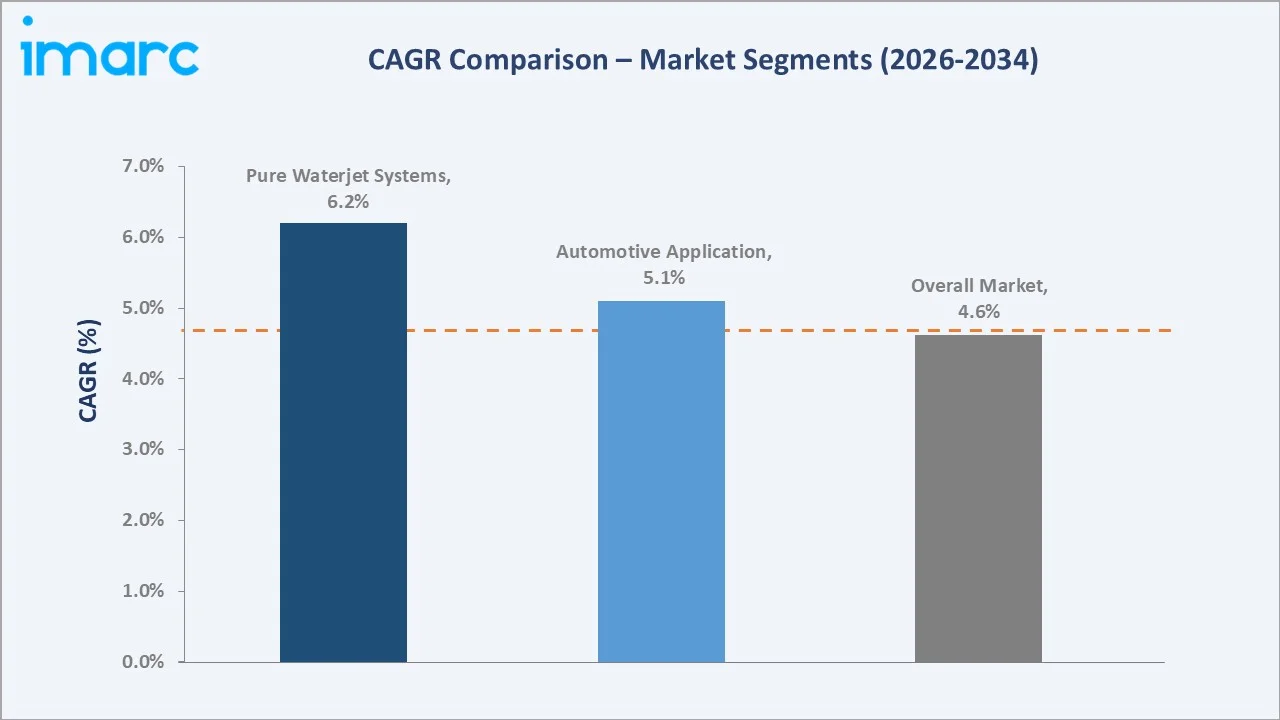
Automotive application grows at approximately 5.1% CAGR, driven by demand for precision cutting of EV battery housings, composite structures, and complex metal components. The Pure waterjet segment grows at approximately 6.2% CAGR as food, pharmaceutical, and electronics industries adopt non-contaminating, heat-free cutting solutions.
Executive Summary
The global waterjet cutting machine market reached USD 1.26 Billion in 2025, driven by growing industrial demand for high-precision, heat-free cutting solutions. WCMs use high-pressure water streams, with or without abrasive materials, to cut metals, glass, composites, and heat-sensitive materials without thermal distortion. The market is projected to reach USD 1.92 Billion by 2034.
Abrasive WCMs at 82.0% dominate through their ability to cut hard metals, ceramics, and thick composites required by the automotive and aerospace industries. Automotive leads applications at 31.0% through demand for precision cutting of brake disks, metal gaskets, and EV structural components. North America commands 34.0% of the global market through established manufacturing infrastructure and early technology adoption.
Key Market Insights
|
Insight |
Data |
|
Dominant Type |
Abrasive – 82.0% share (2025) |
|
Leading Application |
Automotive – 31.0% market share (2025) |
|
Leading Region |
North America – 34.0% market share (2025) |
|
Market Opportunity |
Robotics integration, 5-axis systems, EV composite cutting, aerospace demand |
Key Analytical Observations Supporting The Above Data:
- Abrasive at 82.0%: Abrasive waterjet systems dominate because garnet-mixed high-pressure streams can cut virtually any material including thick steel, titanium, carbon-fiber composites, and ceramics. Their ability to maintain tight tolerances in demanding aerospace and automotive applications makes them indispensable across heavy industrial sectors globally.
- Automotive at 31.0%: The automotive sector leads application share due to its broad use of WCMs across the production cycle — from cutting metal gaskets, brake disks, and clutch components to trimming door panels and interior composite parts. The accelerating EV transition is driving incremental demand for waterjet cutting of battery enclosures and lightweight structural materials.
- North America at 34.0%: North America leads through its concentration of aerospace OEMs, automotive manufacturers, and advanced metal fabrication industries requiring precision cutting equipment. The region hosts major WCM manufacturers and benefits from early technology adoption, reinforcing both demand and supply-side strength in the global market.
Waterjet Cutting Machine Market Overview
The global waterjet cutting machine market encompasses all industrial tools utilizing high-pressure water streams to cut, shape, and fabricate materials across diverse industries. The market covers pure waterjet systems and abrasive waterjet systems, serving automotive, aerospace, metal fabrication, electronics, mining, and other manufacturing sectors globally.
The ecosystem integrates raw material and abrasive suppliers, pump and cutting head manufacturers, OEM assemblers and system integrators, software and control system developers, distribution channels, and end-user industries. Macroeconomic factors include industrialization rates, manufacturing capital expenditure cycles, environmental regulations favoring cold-cutting processes, and Industry 4.0 automation adoption.
Market Dynamics
To evaluate market opportunities, Request Sample
Market Drivers
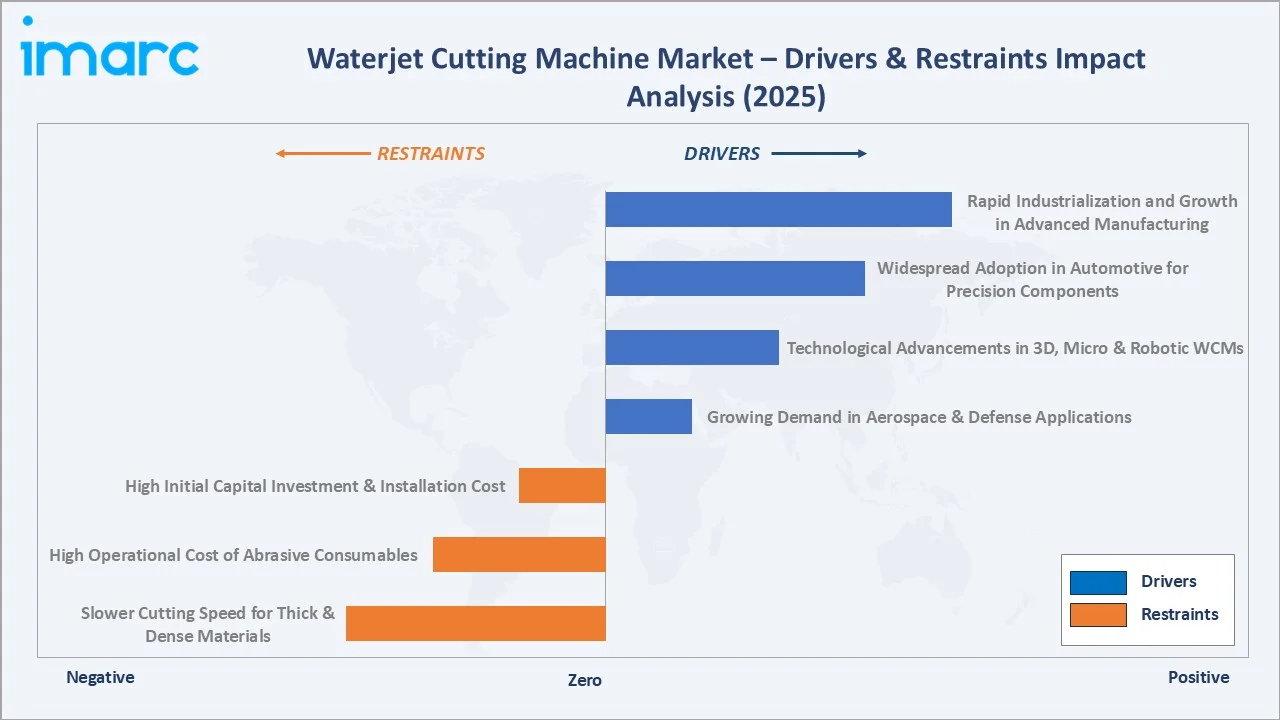
- Rapid Industrialization and Growth in Advanced Manufacturing: Accelerating industrialization across Asia Pacific, Latin America, and the Middle East is driving the adoption of precision cutting technologies. Manufacturing sectors in China, India, South Korea, and Brazil are expanding capital equipment investments, with waterjet cutting machines offering versatile material compatibility and superior edge quality required for modern production environments across industrial segments.
- Widespread Adoption in Automotive Industry for Precision Components: The automotive industry's shift toward lightweight materials, electric vehicle components, and complex assemblies drives sustained WCM demand. Waterjet systems precisely cut metal gaskets, brake components, door panels, battery enclosures, and composite structural parts without heat-affected zones, preserving material integrity critical for safety-rated automotive components and EV production requirements.
- Technological Advancements in 3D, Micro, and Robotic WCMs: The development of 5-axis, 3D, micro, and robotic waterjet cutting systems has significantly expanded precision and application range. AI-integrated CAD/CAM software, real-time cutting optimization, and robotic arm integration enable complex curved and three-dimensional cuts, displacing multiple downstream machining operations and improving overall production efficiency across industrial manufacturing facilities.
- Growing Demand in Aerospace and Defense Applications: Aerospace manufacturing's stringent requirements for titanium, Inconel, carbon-fiber composites, and aluminum alloys used in aircraft structures and jet engine components drive WCM adoption. Cold-cutting capability eliminates heat-affected zones and material distortion, meeting tight dimensional tolerances required for aircraft skins, turbine blades, fuselage components, and defense equipment fabrication.
Market Restraints
- High Initial Capital Investment and Installation Cost: Waterjet cutting systems require significant upfront capital expenditure for the machine, high-pressure pump system, CNC controller, water treatment, and facility preparation. This creates adoption barriers for small and medium enterprises, particularly in developing markets where access to equipment financing is limited and return on investment timelines extend over multiple operating years.
- High Operational Cost of Abrasive Consumables: Abrasive waterjet systems consume significant quantities of garnet abrasive per operating hour, creating ongoing expenses that can exceed machine depreciation costs. Nozzle, orifice, and focusing tube wear also contribute to high maintenance costs, making abrasive WCM's total cost of ownership considerably higher than the initial purchase price alone suggests for end users.
- Slower Cutting Speed for Thick and Dense Materials: Waterjet cutting speed decreases significantly when processing thick or dense materials, limiting throughput compared to laser or plasma cutting alternatives in specific applications. For high-volume production requiring rapid processing of thick steel or aluminum plate, waterjet cutting speed limitations reduce competitiveness against thermal cutting technologies in certain manufacturing environments.
Market Opportunities
- Electric Vehicle Component Manufacturing Demand: The global EV transition creates significant new WCM demand for cutting battery enclosure housings, motor core laminations, and structural composites from high-strength steel and aluminum. Waterjet systems' ability to cut these materials without thermal distortion positions them favorably in EV production lines replacing traditional stamping and machining operations.
- Robotic and Automated Waterjet Integration: Integration of articulated robotic arms with WCM systems enables continuous unmanned operation for complex 3D cutting of curved aerospace components and automotive body panels. Lights-out manufacturing capability reduces labor cost dependency and improves competitive positioning for manufacturers in high-wage markets seeking to automate precision cutting operations and improve throughput consistency.
Market Challenges
- Competition from Laser and Plasma Cutting Technologies: Advanced fiber laser cutting systems offer higher cutting speeds for thin sheet metal and lower consumable costs per operating hour compared to abrasive waterjet systems. As laser technology continues improving capability for thick materials and reflective surfaces, it competes directly with abrasive WCMs in automotive and metal fabrication applications globally.
- Shortage of Skilled WCM Operators and Programmers: Operating and programming advanced multi-axis waterjet cutting systems requires specialized technical expertise in CAD/CAM software, material science, and machine parameters. The global shortage of skilled machine operators, particularly for 5-axis and robotic WCM systems, limits adoption rates and full utilization of installed capacity in manufacturing facilities worldwide.
Emerging Market Trends
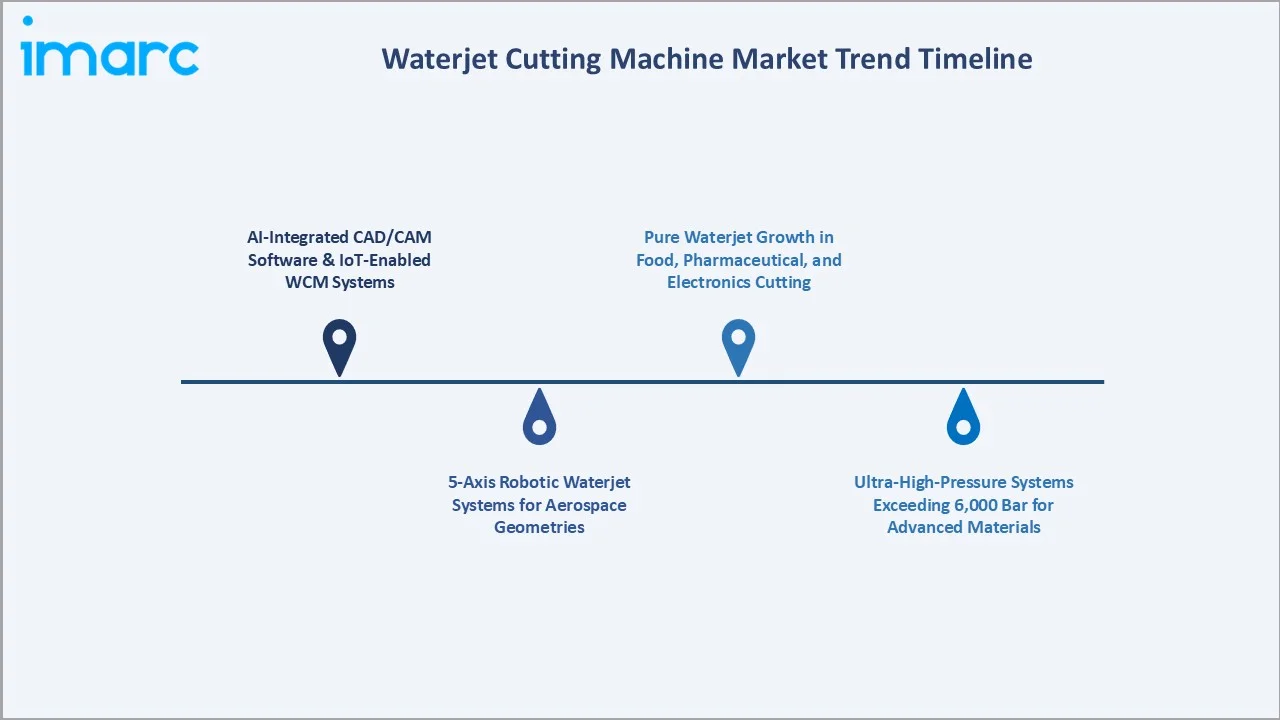
1. AI-Integrated CAD/CAM Software and IoT-Enabled WCM Systems
AI-powered CAD/CAM software platforms are transforming WCM operation by providing real-time cutting path optimization, material usage minimization, and predictive machine performance management. IoT-enabled systems transmit operational data for remote monitoring, predictive maintenance scheduling, and fleet management across multiple WCM installations, improving machine utilization rates and reducing unplanned downtime significantly.
2. 5-Axis Robotic Waterjet Systems for Complex Aerospace Geometries
Five-axis robotic waterjet cutting systems are gaining adoption in aerospace manufacturing for cutting complex curved components, including aircraft skins, engine nacelles, and interior composite panels in single setups. By replacing multiple sequential machining operations, these systems reduce production time, eliminate fixture costs, and improve dimensional consistency for complex aerospace and automotive components requiring high-precision cutting.
3. Ultra-High-Pressure Systems Exceeding 6,000 Bar for Advanced Materials
Ultra-high-pressure waterjet systems operating above 6,000 bar are expanding the material cutting envelope to include advanced titanium alloys, thick carbon-fiber composite stacks, and ceramic matrix composites demanded by next-generation aerospace and defense applications. These systems enable faster cutting speeds on hard materials while maintaining the cold-cut advantage critical for aerospace structural integrity.
4. Pure Waterjet Growth in Food, Pharmaceutical, and Electronics Cutting
Pure waterjet systems without abrasive additives are growing in food processing, pharmaceutical packaging, and electronics manufacturing, where contamination-free cutting is mandatory. USDA-compliant pure WCM designs enable hygienic cutting of food products, foam, rubber, and soft composites without cross-contamination risk, while electronics applications include precision cutting of printed circuit substrates and flexible materials.
Industry Value Chain Analysis
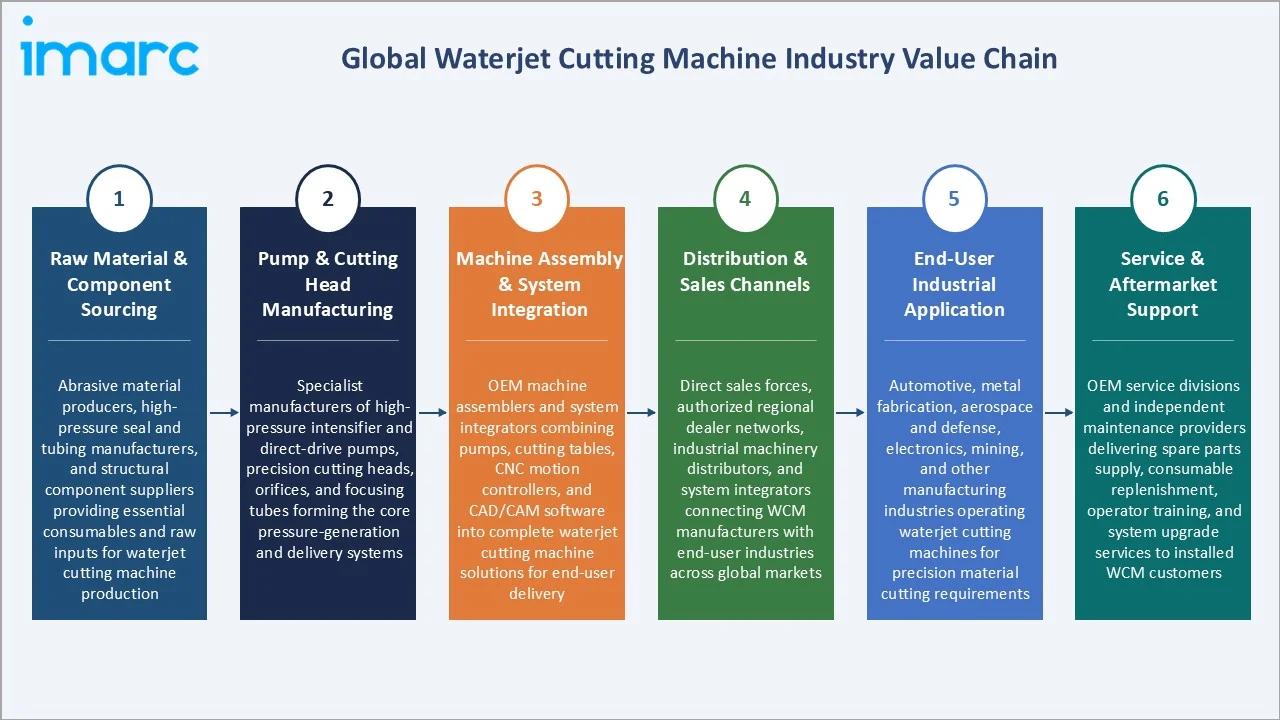
The waterjet cutting machine value chain integrates raw material and abrasive sourcing, pump and cutting head manufacturing, OEM machine assembly and system integration, distribution and sales channels, end-user industrial application, and aftermarket service and support. Pump manufacturers and cutting head specialists capture the highest technology margins within the value chain architecture.
|
Stage |
Key Participants |
|
Raw Material & Component Sourcing |
Abrasive material producers, high-pressure seal and tubing manufacturers, and structural component suppliers providing essential consumables and raw inputs for waterjet cutting machine production |
|
Pump & Cutting Head Manufacturing |
Specialist manufacturers of high-pressure intensifier and direct-drive pumps, precision cutting heads, orifices, and focusing tubes forming the core pressure-generation and delivery systems |
|
Machine Assembly & System Integration |
OEM machine assemblers and system integrators combining pumps, cutting tables, CNC motion controllers, and CAD/CAM software into complete waterjet cutting machine solutions for end-user delivery |
|
Distribution & Sales Channels |
Direct sales forces, authorized regional dealer networks, industrial machinery distributors, and system integrators connecting WCM manufacturers with end-user industries across global markets |
|
End-User Industrial Application |
Automotive, metal fabrication, aerospace and defense, electronics, mining, and other manufacturing industries operating waterjet cutting machines for precision material cutting requirements |
|
Service & Aftermarket Support |
OEM service divisions and independent maintenance providers delivering spare parts supply, consumable replenishment, operator training, and system upgrade services to installed WCM customers |
The pump and cutting head manufacturing tier commands the highest value-add and proprietary technology content within the WCM value chain, with intensifier pump technology representing significant intellectual property barriers. The aftermarket service tier is experiencing growing strategic importance as the WCM installed base expands globally and predictive maintenance capabilities reduce total cost of ownership for end users.
Technology Landscape in the Waterjet Cutting Machine Industry
Abrasive Waterjet Technology
Abrasive waterjet technology mixes garnet or aluminum oxide abrasives with ultra-high-pressure water streams to achieve cutting capability across virtually all engineering materials. Intensifier pump systems generating 60,000-90,000 PSI deliver the energy density required for cutting thick metals and composite stacks. Dynamic cutting heads with active tolerance compensation deliver significantly faster cycle times while maintaining precision edge quality for demanding applications.
Pure Waterjet Technology
Pure waterjet technology relies solely on the kinetic energy of ultra-high-pressure water streams for cutting soft, fibrous, or food-grade materials. Direct-drive pump systems provide the pressure generation for pure waterjet applications in food processing, foam cutting, and paper processing industries. The elimination of abrasive consumables reduces operational costs and enables hygienic, contamination-free cutting for regulated food and pharmaceutical manufacturing environments globally.
CNC Control and CAD/CAM Software Technology
Advanced CNC control systems and integrated CAD/CAM software platforms provide the programming, motion control, and optimization capability for complex multi-axis waterjet cutting operations. AI-powered cutting optimization algorithms analyze material properties, thickness, and geometry to automatically determine optimal cutting parameters, reducing programming time, improving material utilization, and ensuring consistent edge quality across varied production conditions.
Market Segmentation Analysis
The report covers the following segments:
|
Segment Category |
Leading Segment |
Market Share |
Year |
|
Type |
Abrasive |
82.0% |
2025 |
|
Product Type |
🔒 |
🔒 |
2025 |
|
Horsepower |
🔒 |
🔒 |
2025 |
|
Machine Size |
🔒 |
🔒 |
2025 |
|
Application |
Automotive |
31.0% |
2025 |
|
Region |
North America |
34.0% |
2025 |

By Type
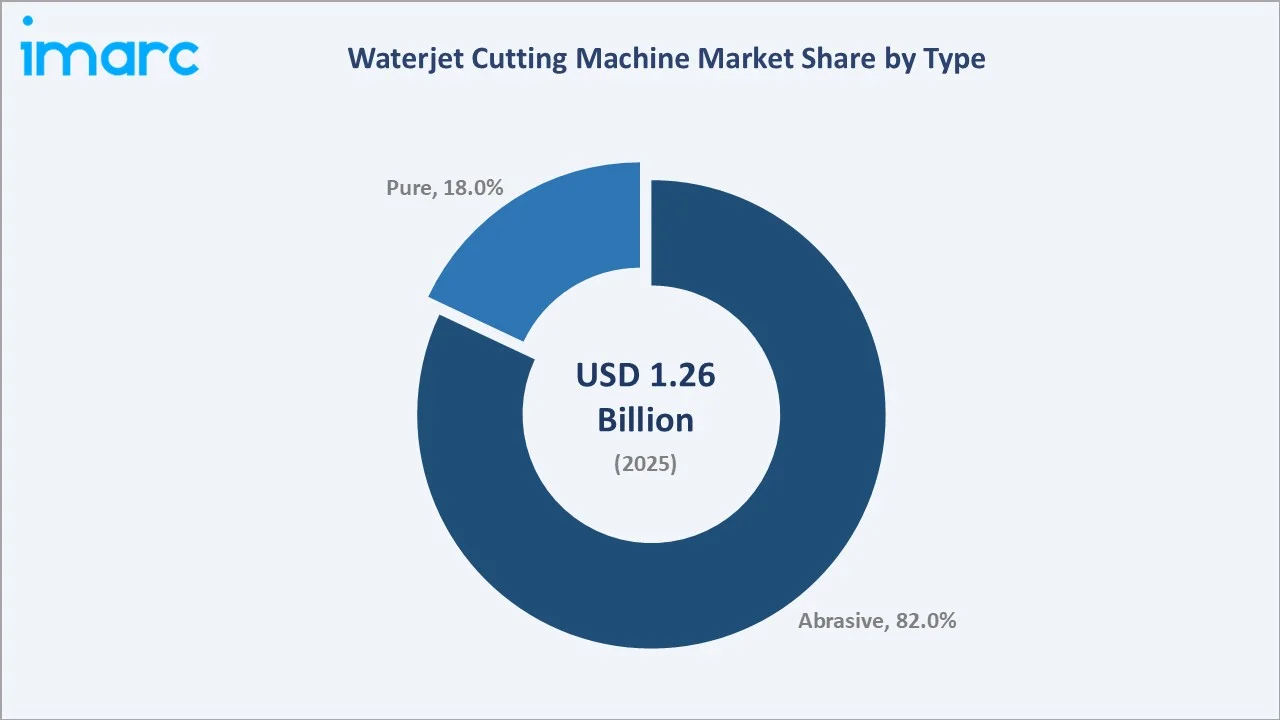
Abrasive waterjet cutting machines lead at 82.0% in 2025 through their ability to cut virtually any material including hard metals, ceramics, glass, and thick composite stacks required across industrial applications. Abrasive systems capture high-value automotive, aerospace, and metal fabrication segments where material hardness and thickness require abrasive-assisted cutting to achieve required precision and throughput levels.
To access detailed market analysis, Request Sample
Pure waterjet machines at 18.0% serve food processing, foam, rubber, textile, and pharmaceutical cutting applications where abrasive contamination is unacceptable. Pure WCMs are growing at approximately 6.2% CAGR through expanding food safety regulations and electronics manufacturing adoption. Their lower consumable costs and hygienic design characteristics position them favorably in sanitary and regulated production environments.
By Application
Automotive leads at 31.0% through extensive use of WCMs for precision cutting of metal gaskets, brake disks, clutch components, door panels, and increasingly EV battery enclosures and lightweight structural composites. The automotive segment's high volume production requirements and stringent material integrity standards drive sustained demand for both abrasive and pure waterjet systems across global vehicle manufacturing facilities.
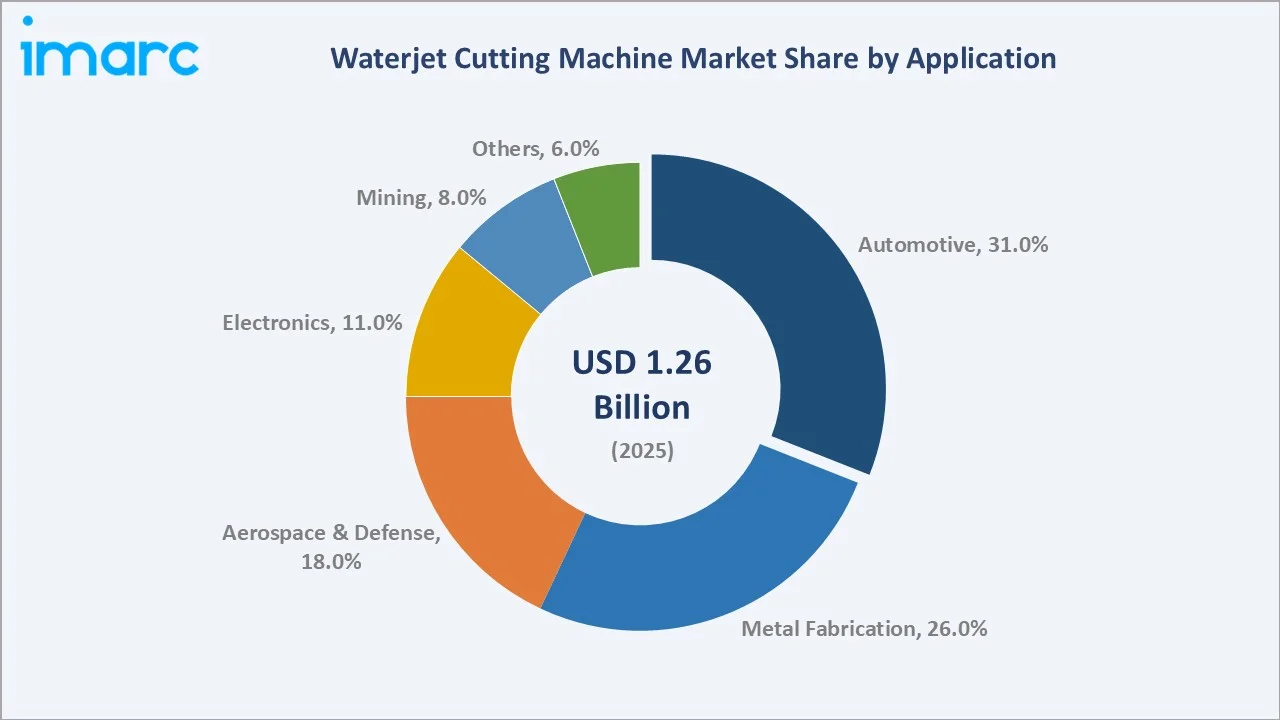
Metal fabrication at 26.0% represents the second-largest application, driven by fabricators requiring versatile precision cutting of structural steel, aluminum, and stainless-steel components. Aerospace and defense at 18.0% commands a premium per-unit value through high-specification cutting requirements for advanced alloys and composites. Electronics at 11.0%, Mining at 8.0%, and Others at 6.0% complete the application distribution across global end markets.
Regional Market Insights
|
Region |
Share (2025) |
Key Waterjet Cutting Machine Market Drivers & Characteristics |
|
North America |
34.0% |
Driven by strong aerospace, automotive, and metal fabrication manufacturing sectors, early adoption of advanced precision cutting technologies, and well-established industrial machinery infrastructure across the United States and Canada |
|
Asia Pacific |
31.0% |
Led by rapid industrialization across China, India, and South Korea, expanding automotive and electronics manufacturing capacity, and significant government investment in advanced manufacturing sector modernization and infrastructure development |
|
Europe |
24.0% |
Supported by Industry 4.0 integration, precision engineering manufacturing traditions, stringent environmental regulations favoring cold-cutting waterjet technology, and strong aerospace and automotive production base across Germany, Italy, France, and the United Kingdom |
|
Latin America |
6.0% |
Driven by growing manufacturing investment, expanding automotive assembly operations, and rising adoption of precision cutting solutions for metal fabrication, mining, and industrial manufacturing applications across Brazil and Mexico |
|
Middle East & Africa |
5.0% |
Emerging with infrastructure development projects, oil and gas sector fabrication requirements, and increasing industrial modernization investments creating new demand for precision cutting machinery in key regional markets |
North America at 34.0% leads through its concentration of aerospace and defense manufacturers, automotive OEM production facilities, and advanced metal fabrication industries requiring precision cutting equipment. The region benefits from early technology adoption, well-established industrial machinery infrastructure, and strong service networks supporting the installed WCM base across the United States and Canada.
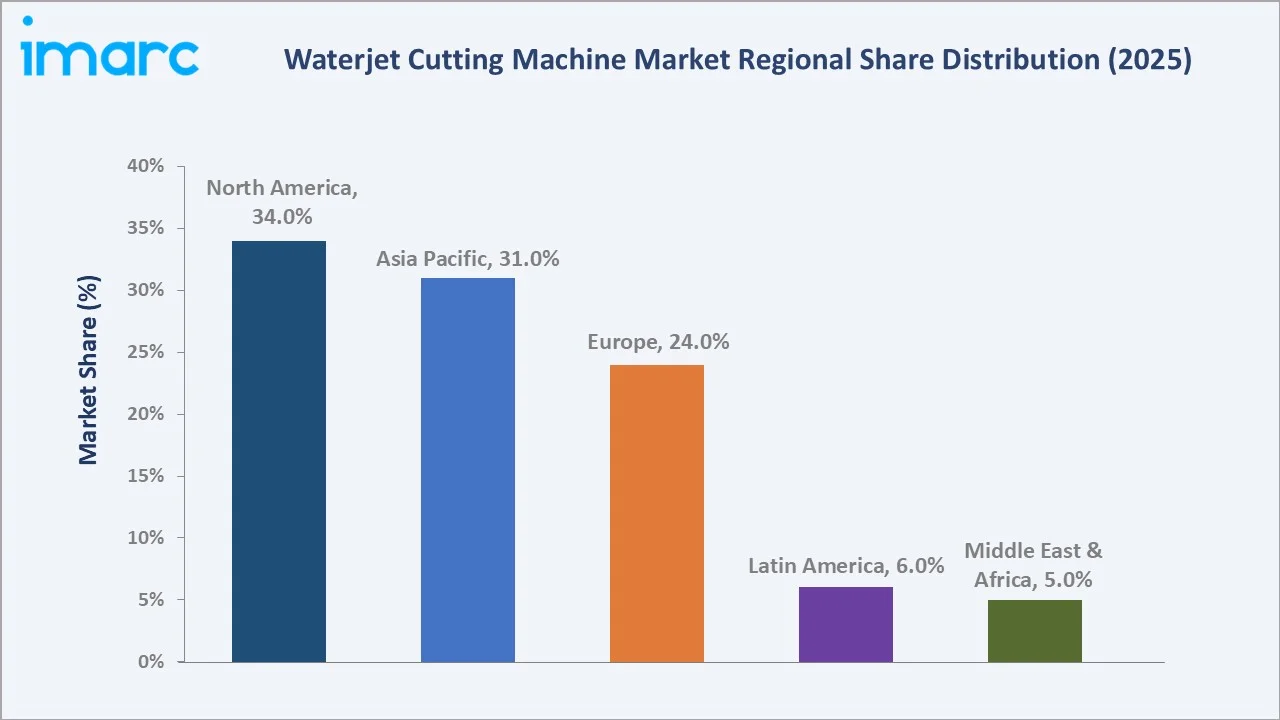
Asia Pacific at 31.0% reflects rapid manufacturing expansion in China, India, South Korea, and Southeast Asia, with growing automotive production and infrastructure development creating broad WCM demand. Europe at 24.0% benefits from Industry 4.0 adoption and precision engineering traditions. Latin America at 6.0% and Middle East and Africa at 5.0% represent early-stage but growing markets with increasing industrial modernization investment.
Competitive Landscape
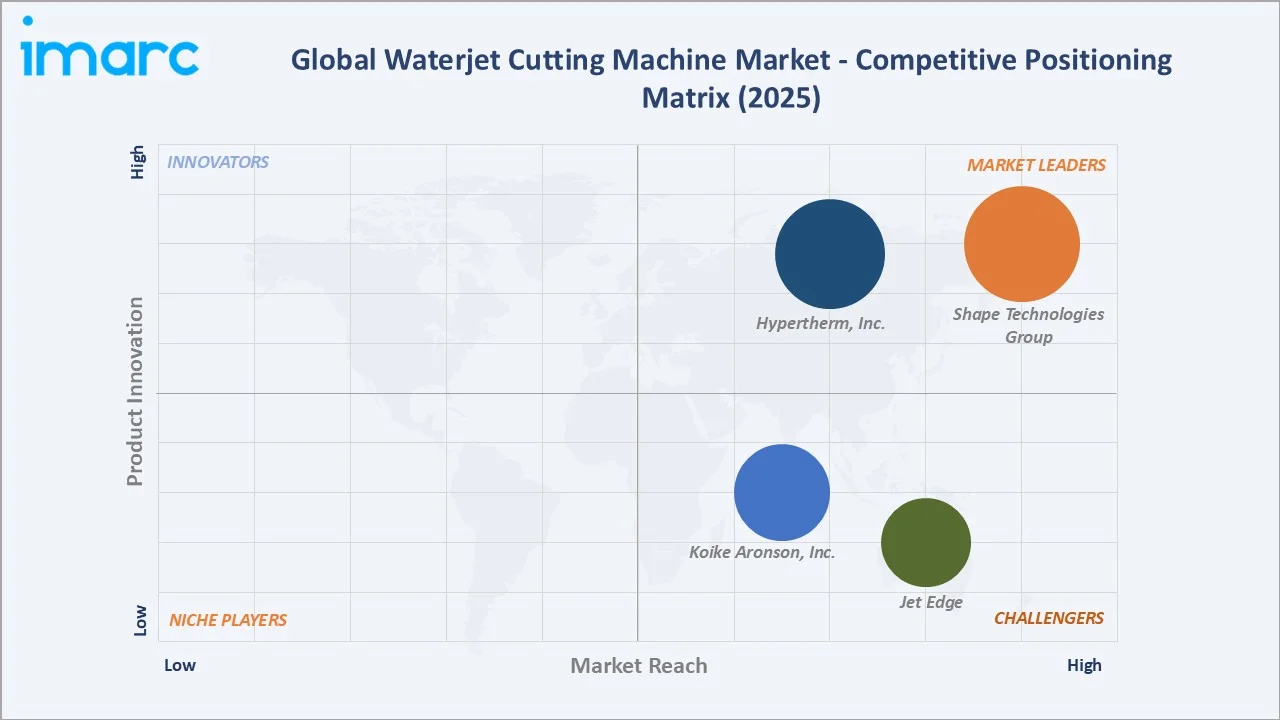
The global waterjet cutting machine market competitive landscape is moderately concentrated with three distinct tiers: global technology leaders with full-system capabilities, specialized technology providers targeting niche segments, and regional manufacturers competing on cost and local support. Pump technology, cutting head precision, and integrated software capabilities represent the primary competitive differentiation factors across the market.
|
Company Name |
Key Products |
Market Position |
Core Strength |
|
Shape Technologies Group |
NX Pro, Mach 150, Mach 200c, Mach 200s, Mach 300, Mach 500, Mach 700, EchoJet |
Market Leader |
Shape Technologies Group through Flow International combines decades of ultrahigh-pressure waterjet cutting expertise with continuous product innovation, maintaining global market leadership across industrial and precision cutting applications. |
|
Hypertherm, Inc. |
OMAX WCM Systems, Direct-Drive Pumps, Intelli-MAX Software |
Market Leader |
Hypertherm leverages the OMAX brand to deliver advanced direct-drive pump technology and intelligent cutting software for precision waterjet applications across diverse industrial end markets. |
|
Jet Edge |
Edge X-3, Edge X-5, Edge Dual, Edge X3-HR, Edge X5-HR |
Strong Challenger |
Jet Edge provides high-performance 5-axis waterjet cutting systems with advanced bevel cutting capability, serving aerospace, automotive, and precision industrial manufacturing applications. |
|
Koike Aronson, Inc. |
ShopJet |
Market Challenger |
Koike Aronson delivers precision waterjet cutting systems targeting metal fabrication and structural applications, leveraging broader cutting technology expertise across international markets. |
Key players include Shape Technologies Group, Hypertherm, Inc., Jet Edge, Koike Aronson, Inc., and others.
Key Company Profiles
Shape Technologies Group
Shape Technologies Group operating through Flow International Corporation is a United States-based manufacturer of ultrahigh-pressure waterjet cutting systems, holding a leading global market position across industrial WCM applications for more than five decades.
- Key Products: NX Pro, Mach 150, Mach 200c, Mach 200s, Mach 300, Mach 500, Mach 700, EchoJet
- Strategic Focus: Expanding 5-axis cutting capability for aerospace composites and automotive EV components, advancing Mach 5 software optimization platform capabilities, and growing aftermarket service revenue through predictive maintenance and consumable supply programs across global markets.
Hypertherm, Inc.
Hypertherm, Inc. is a United States-based employee-owned manufacturer of industrial cutting solutions, operating the OMAX waterjet brand following its strategic acquisition, and serving global markets with direct-drive pump technology and advanced integrated software platforms.
- Key Products: OMAX WCM Systems, Direct-Drive Pumps, Intelli-MAX Software
- Strategic Focus: Expanding the OMAX waterjet brand through integrated software-hardware solutions, developing AI-powered cutting optimization for diverse material applications, and strengthening distribution and service networks across North America, Europe, and Asia Pacific markets.
Market Concentration Analysis
The global waterjet cutting machine market is moderately concentrated at the technology platform level, with leading manufacturers collectively accounting for an estimated 40-50% of global WCM revenues. Regional manufacturers represent a growing share of volume-based market participation in Asia Pacific and other emerging markets.
Market concentration is declining at the entry-level segment as regional producers develop technically competitive products, while the high-precision aerospace and automotive tier remain dominated by established OEMs with proprietary pump and cutting head technology.
Investment & Growth Opportunities
Highest Growth Segments
Pure waterjet systems (~6.2% CAGR), aerospace and defense application (~5.3% CAGR), automotive EV component cutting, ultra-high-pressure systems above 6,000 bar, 5-axis robotic WCM integration (~8% CAGR from smaller base), and AI-integrated CAD/CAM software represent the highest-growth investment vectors through 2034 in the global waterjet cutting machine market.
Emerging Investment Opportunities
EV battery enclosure and structural composite cutting represents the highest-value emerging opportunity, as every electric vehicle requires precision cutting of battery housings and lightweight structural components from advanced materials that benefit from waterjet cold-cutting properties. Robotic WCM automation for lights-out manufacturing in aerospace and automotive facilities represents a significant capital equipment investment opportunity.
Investment Themes
- Automated Multi-Axis WCM Systems for Aerospace Composite Manufacturing: Investment in 5-axis and robotic waterjet systems targeting aerospace composite cutting represents a high-value, high-barrier market opportunity. Aerospace OEM qualification requirements create durable customer relationships and generate recurring consumable and service revenue streams that significantly enhance return on capital for WCM suppliers serving the segment.
- Ultra-High-Pressure Pump Technology for Advanced Material Applications: Development and commercialization of pump systems exceeding 6,000 bar enables cutting of next-generation aerospace alloys and ceramic composites that conventional WCM systems cannot process efficiently, creating differentiated market positioning for technology investors in the premium industrial cutting segment globally.
Future Market Outlook (2026-2034)
The global waterjet cutting machine market is projected to grow from USD 1.26 Billion in 2025 to USD 1.92 Billion by 2034, delivering a 4.62% CAGR over the forecast period. Automotive and aerospace manufacturing will drive sustained demand through increasing adoption of lightweight composite materials requiring the heat-free cutting capability that defines waterjet technology's competitive advantage over thermal alternatives.
AI-powered automation and robotic integration will expand WCM adoption beyond traditional precision fabricators to broader industrial manufacturing segments seeking unmanned cutting operations. The market anchor value of USD 1.58 Billion in 2030 represents the midpoint where 5-axis robotic WCM systems have achieved mainstream adoption in aerospace and automotive manufacturing, and Industry 4.0 integration has connected WCM systems into smart factory digital architectures.
Research Methodology
Primary Research
Primary research comprised structured interviews with 45 or more industry stakeholders conducted in 2025, including WCM OEM engineering leads, procurement managers at automotive and aerospace manufacturers, metal fabrication facility operators, industrial machinery distributors, and technology specialists in high-pressure pump and cutting head development across North America, Europe, and Asia Pacific.
Secondary Research
Secondary research encompassed company annual reports and technical publications, Society of Manufacturing Engineers industry data, ISO cutting equipment standards documentation, industry association reports from aerospace and automotive manufacturing bodies, patent filings and technology development analyses, and market research from leading industrial machinery analysts. Over 55 secondary sources were reviewed.
Forecasting Models
Market revenue forecasts were developed using bottom-up manufacturing output models calibrated against industrial capital expenditure data across key end-use industries, with WCM adoption rates projected forward using automation investment trends, material innovation cycles, and regional industrialization growth trajectory models validated through primary research interviews with industry participants.
Report Coverage:
| Report Features | Details |
|---|---|
| Base Year of the Analysis | 2025 |
| Historical Period | 2020-2025 |
| Forecast Period | 2026-2034 |
| Units | Billion USD |
| Scope of the Report | Exploration of Historical Trends and Market Outlook, Industry Catalysts and Challenges, Segment-Wise Historical and Predictive Market Assessment:
|
| Types Covered | Pure, Abrasive, |
| Product Types Covered | 3D Waterjet Cutting, Micro Waterjet Cutting, Robotic Waterjet Cutting |
| Horsepowers Covered | 0 to 50 HP, 51 to 100 HP, Others |
| Machine Sizes Covered | Small, Medium, Large |
| Applications Covered | Automotive, Electronics, Aerospace and Defense, Mining, Metal Fabrication, Others |
| Regions Covered | Asia Pacific, Europe, North America, Latin America, Middle East and Africa |
| Countries Covered | United States, Canada, Germany, France, United Kingdom, Italy, Spain, Russia, China, Japan, India, South Korea, Australia, Indonesia, Brazil, Mexico |
| Companies Covered | Shape Technologies Group, Hypertherm Inc., Jet Edge, Koike Aronson Inc., etc. |
| Customization Scope | 10% Free Customization |
| Post-Sale Analyst Support | 10-12 Weeks |
| Delivery Format | PDF and Excel through Email (We can also provide the editable version of the report in PPT/Word format on special request) |
Frequently Asked Questions About the Waterjet Cutting Machine Market Report
The global waterjet cutting machine market reached USD 1.26 Billion in 2025, driven by Abrasive WCMs at 82.0% type share, Automotive application at 31.0%, and North America leading regionally at 34.0%. Rapid industrialization and precision manufacturing demand across automotive and aerospace sectors are primary growth drivers.
The market grows at 4.62% CAGR during 2026-2034, reaching USD 1.92 Billion by 2034. This growth reflects expanding automotive EV component manufacturing, growing aerospace demand, technological advancement in robotic and ultra-high-pressure systems, and increasing adoption across Asia Pacific manufacturing sectors.
Abrasive waterjet cutting machines lead at 82.0% in 2025 through their ability to cut virtually any industrial material including hard metals, ceramics, glass, and thick composite stacks. Their superior capability for demanding automotive and aerospace cutting applications ensures continued market dominance throughout the forecast period.
Automotive leads at 31.0% through extensive use across the vehicle production cycle for cutting metal gaskets, brake components, interior panels, and EV battery enclosures. The automotive sector's precision requirements and broad material diversity make waterjet cutting machines essential production tools across global manufacturing facilities.
North America leads at 34.0% through its concentration of aerospace and defense OEMs, automotive manufacturing facilities, and advanced metal fabrication industries. Early technology adoption established industrial infrastructure, and a strong service network reinforce the region's leadership position in the global waterjet cutting machine market.
Leading companies include Shape Technologies Group, Hypertherm, Inc., Jet Edge, Koike Aronson, Inc., and others.
The market is projected to reach USD 1.58 Billion by 2030, with 5-axis robotic WCM systems achieving mainstream aerospace and automotive adoption, ultra-high-pressure systems above 6,000 bar expanding advanced material cutting capability, and Industry 4.0 integration connecting WCM systems into smart manufacturing digital architectures across global production facilities.
Three priority investment opportunities include automated 5-axis and robotic WCM systems for aerospace composite manufacturing, ultra-high-pressure pump technology development for advanced material applications, and AI-integrated CAD/CAM software platforms enabling autonomous waterjet cutting optimization for automotive and metal fabrication end markets globally.
Need more help?
- Speak to our experienced analysts for insights on the current market scenarios.
- Include additional segments and countries to customize the report as per your requirement.
- Gain an unparalleled competitive advantage in your domain by understanding how to utilize the report and positively impacting your operations and revenue.
- For further assistance, please connect with our analysts.
 Request Customization
 Speak to an Analyst
 Request Brochure
 Inquire Before Buying
Benefits of Customization
- Personalize this research
- Triangulate with your data
- Get data as per your format and definition
- Gain a deeper dive into a specific application, geography, customer, or competitor
- Any level of personalization
Get in Touch With Us
UNITED STATES
Phone: +1-201-971-6302
INDIA
Phone: +91-120-433-0800
UNITED KINGDOM
Phone: +44-753-714-6104
Email: [email protected]
Client Testimonials




.webp)




.webp)













Related Reports

Choose your plan
*Please note that the prices mentioned below are starting prices for each bundle type. Kindly contact our team for further details.*
Single User License
- 1 User License, Access on 2 Devices
- PDF Report + Excel Dataset (Password Protected)
- Lifetime Access
- No Printing Rights
- 10% Free Report Customization
- 10–12 Weeks of Analyst Support
Five User License
- Access for 5 Users, 2 Devices per User
- PDF Report + Excel Dataset (Password Protected)
- Lifetime Access
- Dedicated Account Manager
- 12–14 Weeks of Analyst Support
- No Printing Rights
- 15% Free Report Customization
- 25% Discount on Your Next Purchase
Corporate User License
- Unlimited User Access (Within Your Organization)
- PDF Report + Excel Dataset
- Lifetime Access
- Dedicated Account Manager
- 14–20 Weeks of Analyst Support
- No Printing Rights
- 20% Free Report Customization
- 30% Discount on Your Next Purchase
Essential Insights
What's included:
3 reports
- Lifetime Access
- PDF Reports
- Excel Datasets
- 2 Weeks of Free Analyst Support
- 2 User Licenses
- Access on 2 Devices
- Printing Rights
- Complimentary PowerPoint (PPT) Version
- Complimentary License Upgrade
Professional Access
What's included:
5 reports
- Lifetime Access
- PDF Reports
- Excel Datasets
- 8 Weeks of Free Analyst Support
- 2 User Licenses
- Access on 2 Devices
- Printing Rights
- Complimentary PowerPoint (PPT) Version
- Complimentary License Upgrade
Business Advantage
What's included:
8 reports
- Lifetime Access
- PDF Reports
- Excel Datasets
- 14 Weeks of Free Analyst Support
- 2 User Licenses
- Access on 2 Devices
- Printing Rights
- Complimentary PowerPoint (PPT) Version
- Complimentary License Upgrade
Enterprise Intelligence
What's included:
10 reports
- Lifetime Access
- PDF Reports
- Excel Datasets
- 20 Weeks of Free Analyst Support
- 2 User Licenses
- Access on 2 Devices
- Printing Rights
- Complimentary PowerPoint (PPT) Version
- Complimentary License Upgrade