
Europe Ceramic Tiles Market Size, Share, Trends and Forecast by Type, Application, and Country, 2026-2034
Europe Ceramic Tiles Market Size, Share, Trends & Forecast (2026-2034)
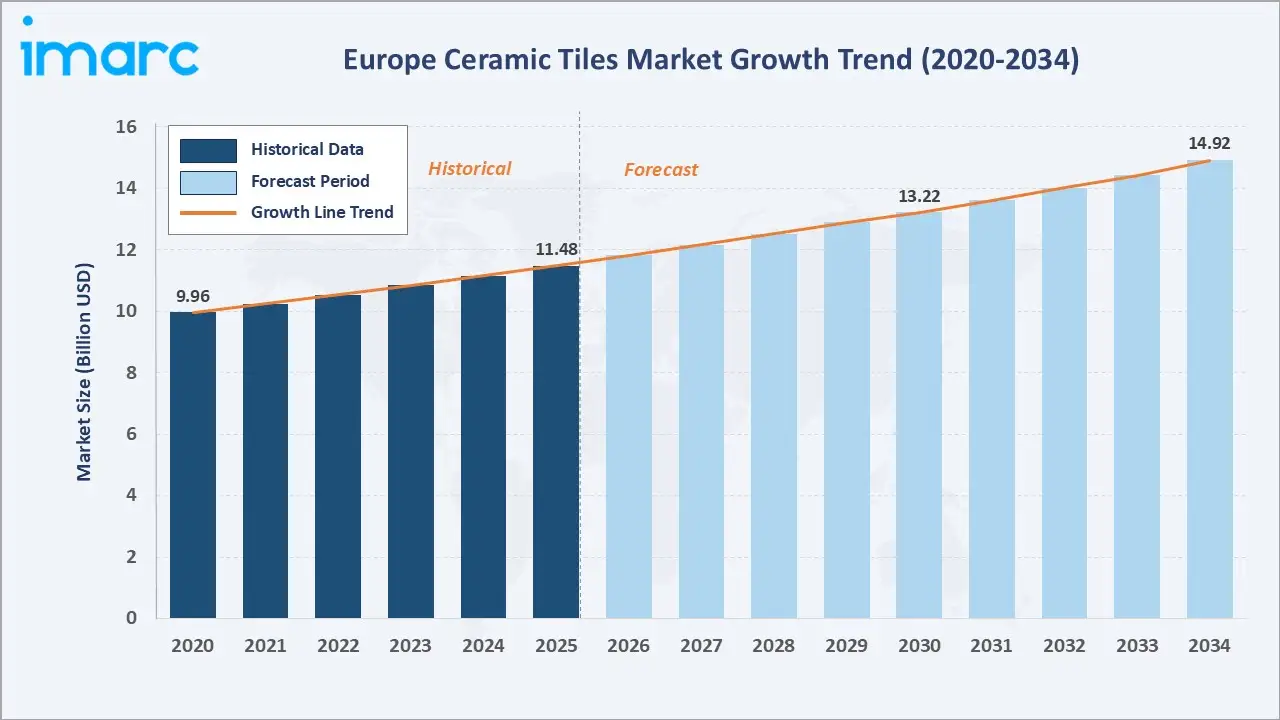
The Europe ceramic tiles market grew from USD 11.48 Billion in 2025 to USD 11.90 Billion in 2026 and is projected to reach USD 14.92 Billion by 2034, growing at a CAGR of 2.87% during 2026-2034. EU-27 ceramic manufacturers account for 23% of global ceramics production. The market is supported by sustained renovation activity, rising demand for large-format and digitally printed tiles, and growing residential construction across Western and Southern Europe. Floor tiles account for the largest share at 52.8%, residential applications lead at 48.7%, and Italy holds the dominant regional position at 24.6% in 2025.
Market Snapshot
|
Metric |
Value |
|
Base Year Market Size (2025) |
USD 11.48 Billion |
|
Market Size (2026) |
USD 11.90 Billion |
|
Forecast Market Size (2034) |
USD 14.92 Billion |
|
CAGR (2026-2034) |
2.87% |
|
Base Year |
2025 |
|
Historical Period |
2020-2025 |
|
Forecast Period |
2026-2034 |
|
Dominant Type |
Floor Tiles (52.8%, 2025) |
|
Dominant Application |
Residential Applications (48.7%, 2025) |
|
Leading Country |
Italy (24.6%, 2025) |
The Europe ceramic tiles market expanded from USD 9.96 Billion in 2020 to USD 11.48 Billion in 2025, and further to USD 11.90 Billion in 2026, reflecting steady construction and renovation activity. The market is projected to reach USD 13.22 Billion by 2030 before reaching USD 14.92 Billion by 2034.
To get more information on this market, Request Sample
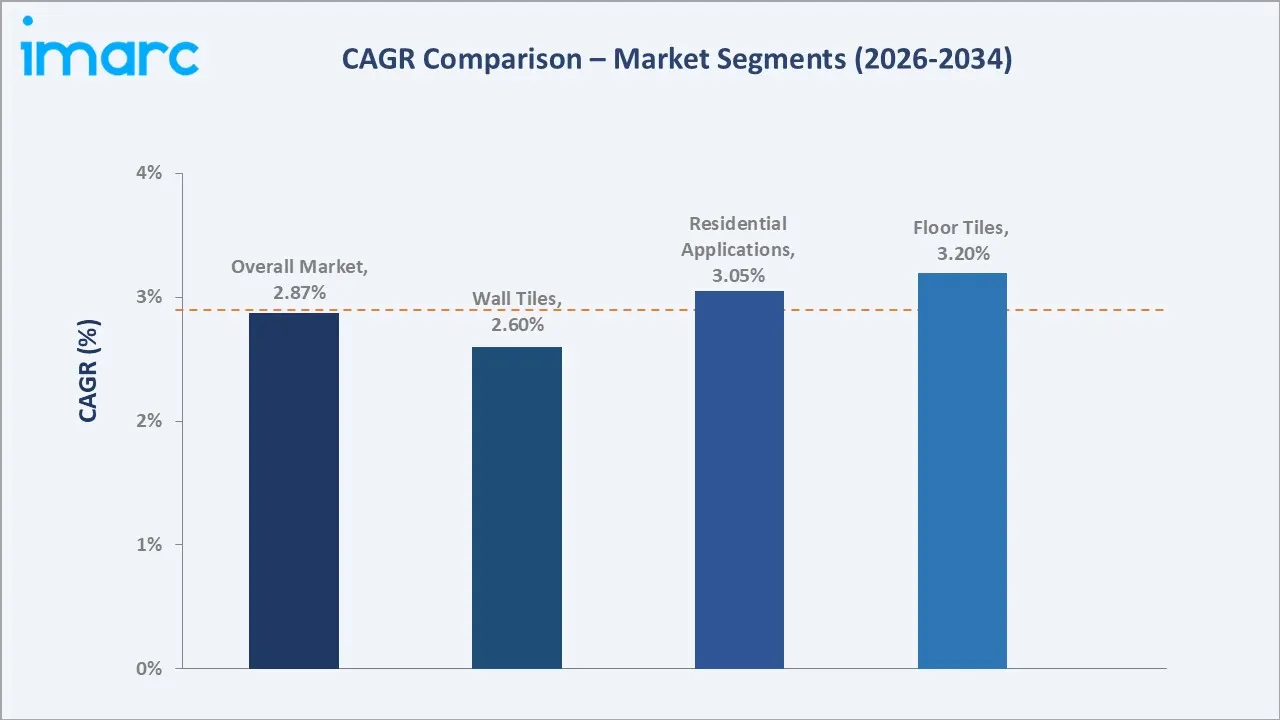
Floor tiles exhibit the strongest CAGR at 3.20% as larger-format floor surfaces gain popularity in both residential and commercial interiors. Residential applications grow at 3.05%, driven by renovation demand and new housing activity. Wall tiles expanded at 2.60%, supported by bathroom and kitchen refurbishment projects.
Executive Summary
The Europe ceramic tiles market is on a moderate but consistent growth trajectory, underpinned by ongoing residential renovation activity, rising construction of commercial and hospitality spaces, and increasing consumer preference for aesthetically versatile and durable tile surfaces. The market growth is driven by a structural shift toward premium and large-format tiles in both new construction and refurbishment projects.
Floor tiles lead at 52.8% in 2025, driven by growing demand across residential living spaces, commercial lobbies, and hospitality venues. Residential applications represent 48.7% of total demand, anchored by sustained renovation activity in major European housing markets. Italy commands the highest regional share at 24.6% in 2025, reflecting its dual role as both the region's largest tile producer and a significant consumer market.
Key Market Insights
|
Insight |
Data |
|
Dominant Type |
Floor Tiles – 52.8% share (2025) |
|
Dominant Application |
Residential Applications – 48.7% share (2025) |
|
Leading Country |
Italy – 24.6% (2025) |
|
Market Opportunity |
Rising demand for large-format, digitally printed, and sustainable tiles is creating high-margin product segments with strong consumer pull in both new-build and replacement markets. |
Key Analytical Observations Supporting the Above Data:
- Floor Tiles at 52.8%: Floor tiles dominate due to expanding adoption in residential living areas, commercial spaces, and public infrastructure. Large-format tiles above 60x60 cm are gaining share as consumers seek seamless, grout-minimal finishes across premium interiors.
- Residential Applications at 48.7%: Residential demand leads because renovation cycles in aging European housing stock are generating consistent, repeat demand for floor and wall tiles across bathrooms, kitchens, and living areas. Renovation activity accounts for over 60% of residential tile consumption in key Western European markets.
- Italy at 24.6%: Italy's regional leadership reflects its status as Europe's largest ceramic tile manufacturing hub, supporting both domestic consumption and significant intra-European exports.
Europe Ceramic Tiles Market Overview
The Europe ceramic tiles market encompasses the production, distribution, and installation of floor tiles, wall tiles, and specialty ceramic surfaces used across residential, commercial, hospitality, and infrastructure construction projects. Ceramic tiles offer a combination of durability, hygienic surface properties, and design versatility that makes them a preferred finishing material across diverse construction typologies. The market spans raw material processors, tile manufacturers, distributors, and installation contractors, forming an integrated supply chain that serves builders, renovation contractors, interior designers, and end users across all European markets.
Market Dynamics
To evaluate market opportunities, Request Sample
Market Drivers
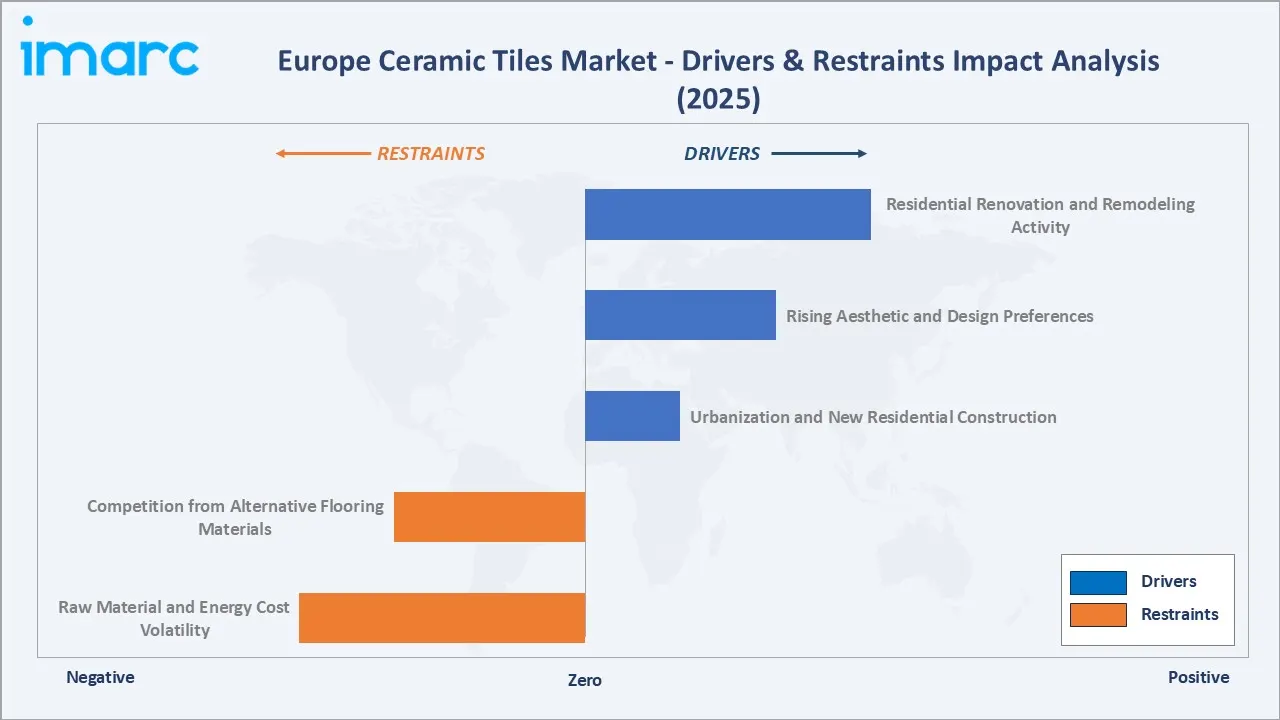
- Residential Renovation and Remodeling Activity: Renovation demand represents the primary growth driver for European ceramic tiles. Renovation accounts for approximately 29.6% of total construction investment, with growth in 2025 recorded in Portugal (4.5%), Austria (2.1%), Spain (1.4%), and Belgium (1.0%), generating consistent repeat demand for floor and wall tile products.
- Rising Aesthetic and Design Preferences: Increasing consumer focus on interior design quality is driving demand for premium, large-format, and digitally printed ceramic tiles. Large-format tiles above 90x90 cm are growing in popularity, enabling seamless visual continuity in residential and commercial interiors.
- Urbanization and New Residential Construction: The EU’s urban population reached approximately 339.1 million in 2025, marking a 0.39% increase from 2024. Urban population growth and housing supply pressures across major European cities are stimulating new residential construction that generates first-time tile installation demand across floor, wall, and bathroom applications.
Market Restraints
- Raw Material and Energy Cost Volatility: Ceramic tile production is energy-intensive, requiring high-temperature kiln firing that makes manufacturers vulnerable to energy price fluctuations. Natural gas cost increases have compressed manufacturer margins and contributed to elevated tile prices in recent years.
- Competition from Alternative Flooring Materials: Luxury vinyl tile, engineered wood, and laminate flooring products compete with ceramic tiles in residential renovation applications, particularly in Northern European markets where hard surface alternatives have gained consumer acceptance.
Market Opportunities
- Digital and Large-Format Tile Innovation: Advances in inkjet digital printing and large-format pressing technology are enabling manufacturers to produce tiles replicating natural stone, wood, and textile textures at competitive prices, opening premium residential and commercial market segments.
- Sustainable and Low-Carbon Tile Products: Growing demand for green building-certified construction materials is creating a high-value market segment for tiles manufactured using recycled content, lower-temperature kiln processes, and water-efficient production methods. In February 2025, Alusid, a specialized low-carbon ceramic tiles company, expanded its partnership with Topps Tiles through the nationwide launch of Mas, a mass-produced floor tile range made from recycled materials, following the success of its earlier range through Parkside Architectural Tiles.
Market Challenges
- Energy Transition in Manufacturing: The shift toward decarbonized ceramic tile manufacturing requires significant capital investment in kiln electrification, hydrogen fuel alternatives, and process efficiency improvements that present cost and technology adoption challenges for smaller producers.
- Logistics and Supply Chain Complexity: Ceramic tiles are heavy and fragile, making distribution logistics expensive and susceptible to breakage losses. Rising transport costs and supply chain disruptions present ongoing operational challenges for manufacturers serving pan-European markets.
Emerging Market Trends
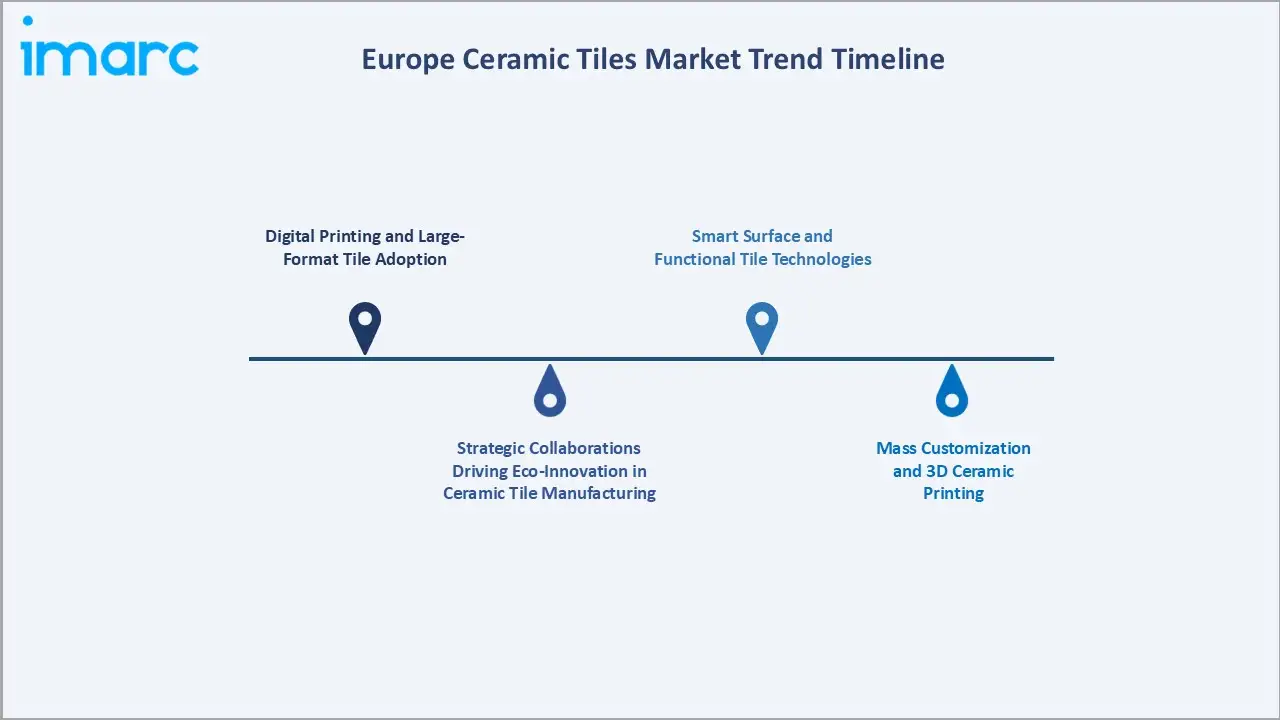
1. Digital Printing and Large-Format Tile Adoption
Inkjet digital printing technology has transformed ceramic tile design, enabling photorealistic surface reproduction of marble, stone, and wood at commercial production speeds. Large-format tiles, including 120x260 cm slabs, are gaining market share in premium residential and commercial projects across Europe, representing the fastest-growing product category within the floor tiles segment.
2. Strategic Collaborations Driving Eco-Innovation in Ceramic Tile Manufacturing
Partnerships between material innovators and ceramic tile manufacturers are accelerating the development of environmentally responsible products in Europe. In July 2025, FRONT (formerly StoneCycling) and UK-based Alusid partnered to introduce Skip Tile, an innovative ceramic tile designed to reduce pollution associated with conventional tile manufacturing.
3. Smart Surface and Functional Tile Technologies
Functional tiles incorporating antimicrobial surface coatings, photocatalytic self-cleaning properties, and embedded heating elements are entering mainstream commercial and healthcare construction markets. Smart surface tiles addressing hygiene, thermal comfort, and maintenance reduction are gaining specification preference in hospitality, healthcare, and high-traffic public space applications.
4. Mass Customization and 3D Ceramic Printing
Additive manufacturing and digital customization platforms are enabling small-batch, bespoke tile production for luxury residential and commercial projects. Three-dimensional relief tile surfaces, custom format production, and architect-specified digital patterns are creating a high-value customization segment outside standard catalogue offerings.
Industry Value Chain Analysis
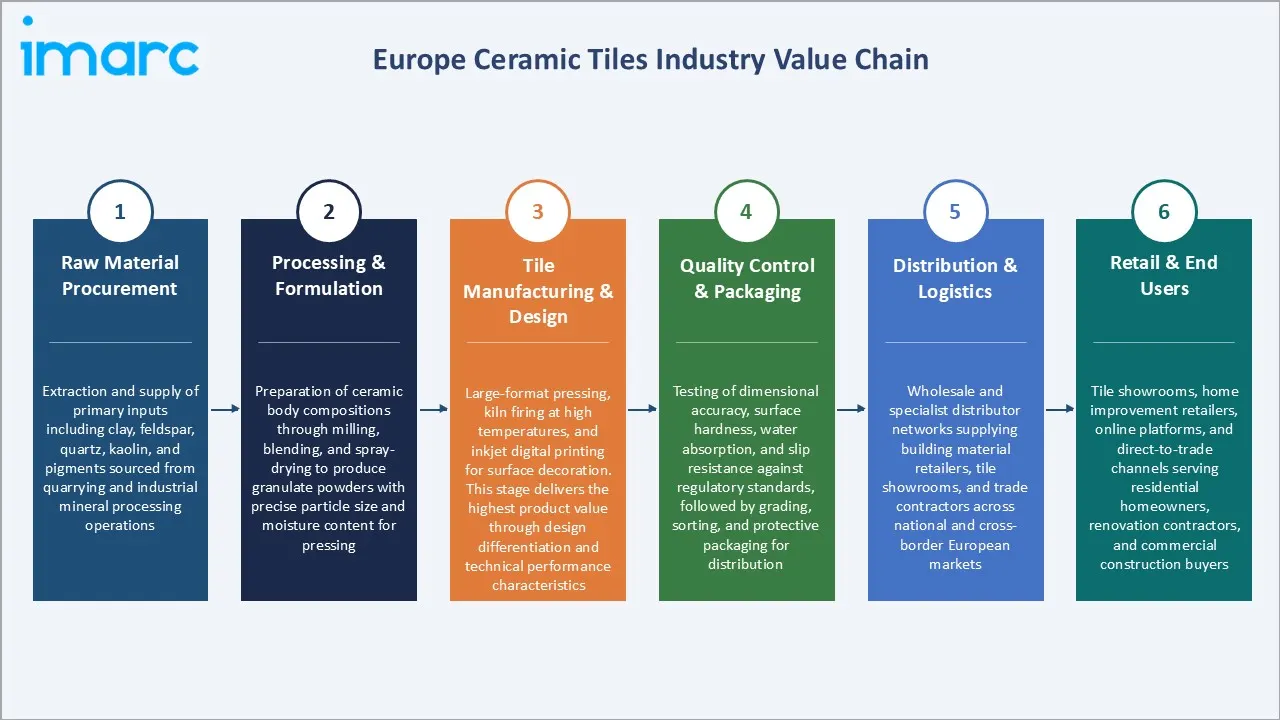
The Europe ceramic tiles value chain encompasses six integrated stages, from raw material extraction through end-user installation. The highest value addition occurs at the manufacturing and design stage, where advanced pressing, firing, and digital surface decoration technologies create differentiated products that command premium pricing in residential and commercial markets.
|
Stage |
Key Participants |
| Raw Material Procurement | Extraction and supply of primary inputs including clay, feldspar, quartz, kaolin, and pigments sourced from quarrying and industrial mineral processing operations. |
| Processing & Formulation | Preparation of ceramic body compositions through milling, blending, and spray-drying to produce granulate powders with precise particle size and moisture content for pressing. |
| Tile Manufacturing & Design | Large-format pressing, kiln firing at high temperatures, and inkjet digital printing for surface decoration. This stage delivers the highest product value through design differentiation and technical performance characteristics. |
| Quality Control & Packaging | Testing of dimensional accuracy, surface hardness, water absorption, and slip resistance against regulatory standards, followed by grading, sorting, and protective packaging for distribution. |
| Distribution & Logistics | Wholesale and specialist distributor networks supplying building material retailers, tile showrooms, and trade contractors across national and cross-border European markets. |
| Retail & End Users | Tile showrooms, home improvement retailers, online platforms, and direct-to-trade channels serving residential homeowners, renovation contractors, and commercial construction buyers. |
The manufacturing stage holds the highest strategic value as advanced digital printing, large-format pressing, and sustainable firing technologies create durable product differentiation. Distribution is progressively digitizing as e-commerce platforms and digital catalogues improve consumer access to premium tile ranges.
Technology Landscape in the Europe Ceramic Tiles Industry
Inkjet Digital Printing Technology
High-resolution inkjet printing has become the standard decoration technology in European ceramic tile manufacturing, enabling multi-pass printing systems that reproduce complex natural material textures at speeds exceeding 30 linear meters per minute. Digital printing has eliminated traditional screen-printing setup costs, enabled economical short-run production and increased the commercial viability of product line extensions.
Large-Format Pressing and Sintering
Continuous belt press and isostatic pressing technologies are enabling the production of ceramic slabs up to 320x160 cm, meeting growing demand for seamless large-surface applications in premium residential and commercial interiors. Improved sintering processes achieve superior mechanical strength and low water absorption for through-body porcelain tiles that meet demanding commercial installation requirements.
Sustainable Manufacturing Systems
European tile producers are integrating closed-loop water recycling systems, waste heat recovery from kilns, and alternative fuel inputs, including biomass and hydrogen pilot programs, to reduce production carbon footprints. These investments align with evolving regulatory requirements and meet green building specification demands.
Market Segmentation Analysis
The report covers the following segments:
|
Segment Category |
Leading Segment |
Market Share |
Year |
|
Type |
Floor Tiles |
52.8% |
2025 |
|
Application |
Residential Applications |
48.7% |
2025 |
|
Country |
Italy |
24.6% |
2025 |

By Type
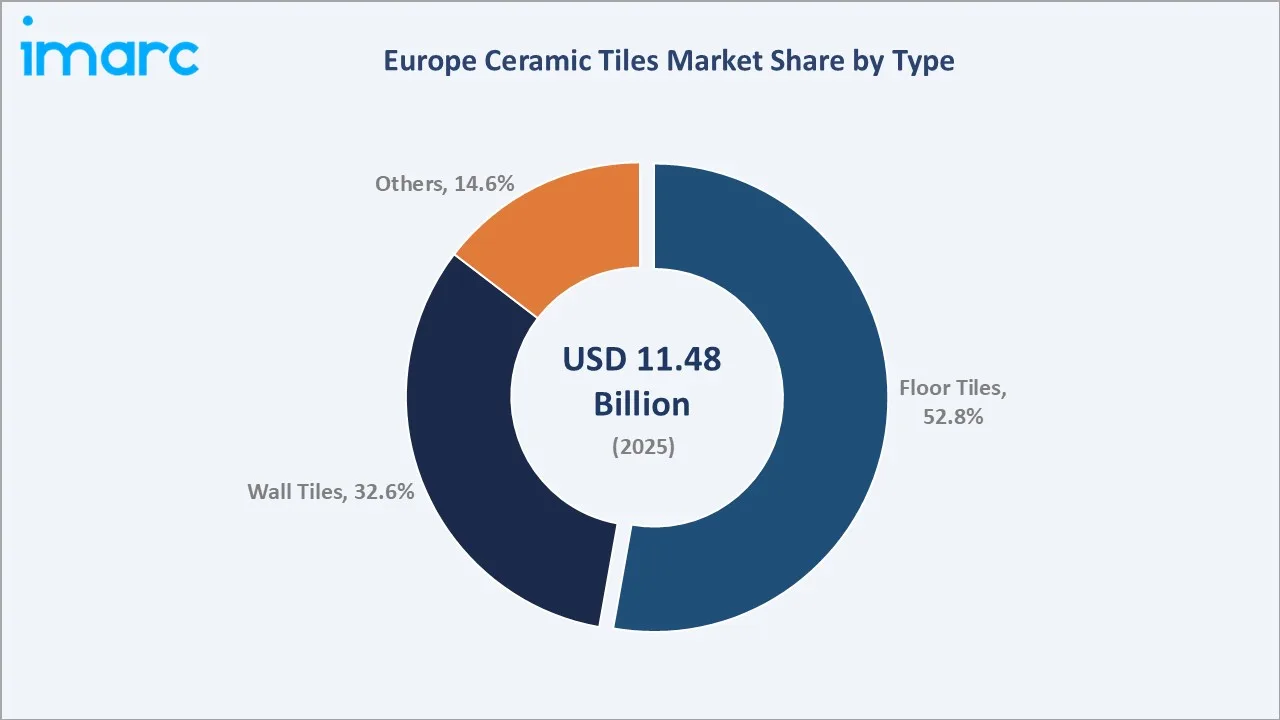
Floor tiles lead at 52.8% in 2025, driven by strong demand across residential living spaces, commercial lobbies, retail environments, and public infrastructure. The growing preference for large-format porcelain tiles has significantly expanded the floor tiles segment, as consumers seek seamless, minimal-grout surface aesthetics in premium renovation and new-build projects.
To access detailed market analysis, Request Sample
Wall tiles account for 32.6% in 2025, serving bathroom, kitchen, and decorative wall applications across both residential and commercial segments. The demand for digitally printed wall tiles replicating natural stone and textured finishes is growing rapidly in the premium residential renovation segment. Others at 14.6% include specialty mosaic tiles, outdoor porcelain surfaces, and technical floor tiles for industrial and healthcare applications.
By Application
Residential applications represent the largest market segment at 48.7% in 2025. Renovation and refurbishment activity in aging European housing stock drives the majority of residential tile consumption, with bathroom and kitchen remodeling projects representing the highest-volume renovation categories. New residential construction across Germany, France, and the UK contributes incremental first-time tile installation demand.
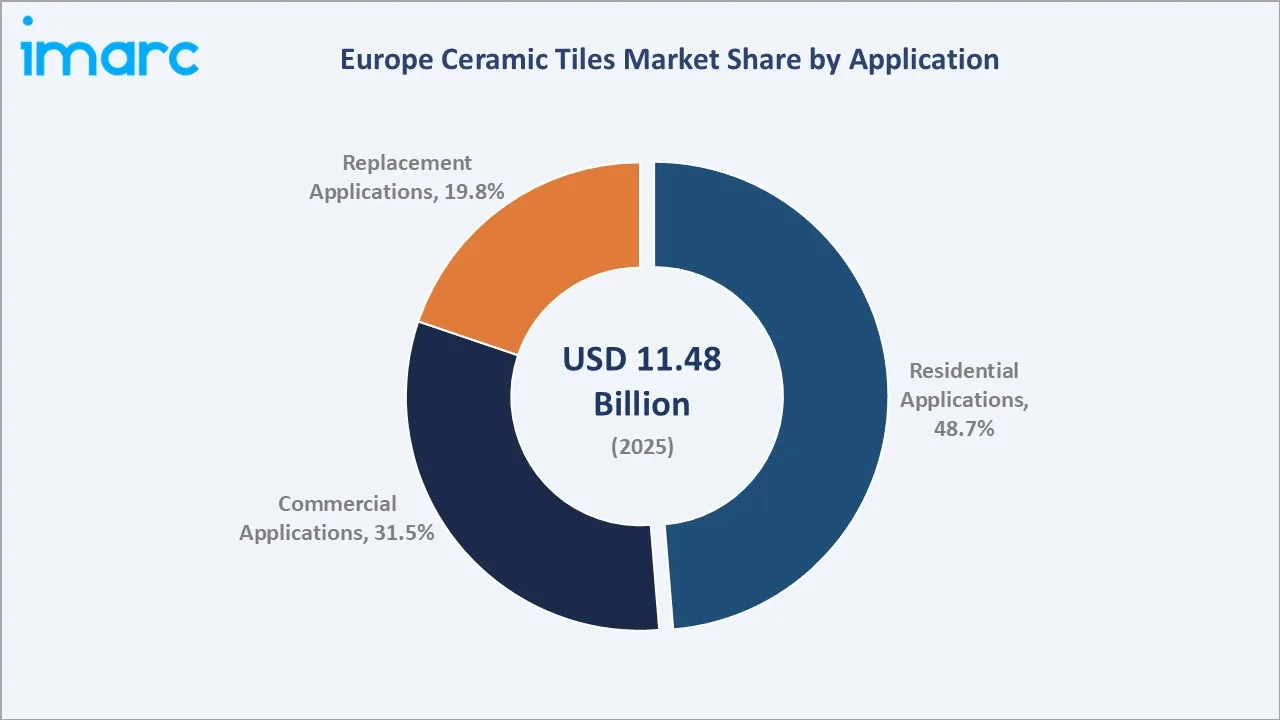
Commercial applications accounted for 31.5% in 2025, driven by demand from hotel, office, retail, and mixed-use construction. Commercial tiles require enhanced technical performance, including higher slip resistance, load-bearing capacity, and durability standards, creating a differentiated premium product category for specification-driven commercial projects. Replacement applications represent 19.8%, reflecting demand from end-of-life refurbishment of existing tile installations in residential and commercial buildings.
Regional Market Insights
| Country |
Share (2025) |
Key Market Characteristics |
| Italy | 24.6% | The largest market, combining dominant tile manufacturing capacity with strong domestic consumption. High penetration of premium and large-format tiles in residential and hospitality applications. |
| Germany | 21.7% | Strong residential construction and renovation activity drives consistent tile demand. High consumer preference for quality and design-led tile products supports premium segment growth. |
| France |
17.8% |
Active renovation market and new residential construction underpin demand. Growing commercial construction and hospitality sector investment sustains commercial tile specification activity. |
| Spain | 13.5% | Recovering residential construction activity and sustained tourism-driven hospitality renovation generate consistent tile demand. A significant manufacturing base supports competitive domestic supply. |
| United Kingdom |
12.4% |
Renovation and home improvement activity drives the majority of tile demand. Growing online retail and consumer design awareness supports premium segment penetration. |
| Others |
10.0% |
Emerging Eastern European markets and Benelux countries contribute to growing tile consumption driven by improving housing standards and commercial construction activity. |
Italy accounts for 24.6% in 2025, making it the region's dominant player. Strong domestic demand from residential renovation and hospitality construction further consolidates Italy's market position. Germany holds a 21.7% share in 2025, driven by robust residential construction activity and sustained investment in commercial real estate development across major urban centers.
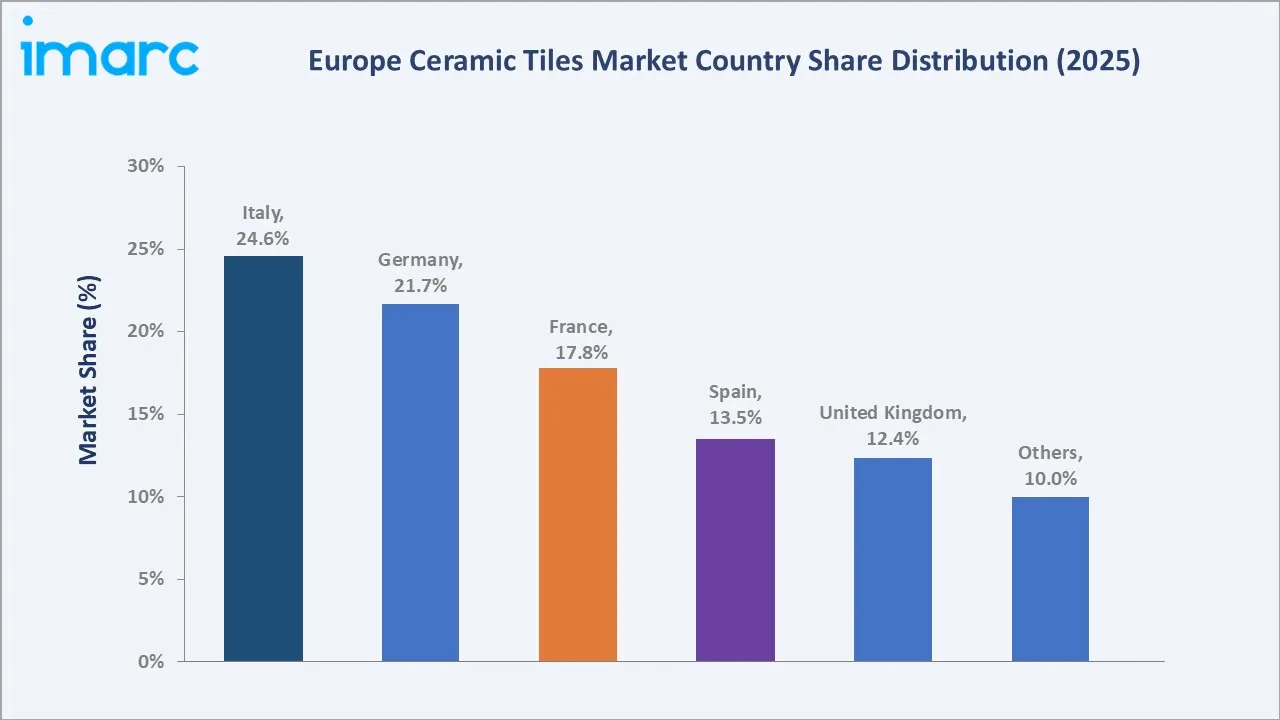
France represents 17.8% of the market in 2025. Active renovation activity in aging residential housing stock and new residential construction underpin consistent tile demand. Spain accounts for 13.5% of the market in 2025. Recovering residential construction activity and sustained tourism-driven hospitality renovation generate consistent tile demand. The United Kingdom holds a 12.4% share in 2025. A growing premium and decorative tile retail market, combined with sustained commercial fit-out activity, supports continued market expansion. Others account for 10.0% of the market in 2025.
Competitive Landscape
The Europe ceramic tiles market is moderately concentrated, with several large multinational groups competing alongside established regional manufacturers. Italian producers maintain a strong competitive position through design leadership and manufacturing scale, while international groups compete through brand diversification and pan-European distribution reach.
|
Company |
Key Brands |
Market Position |
Core Strength |
| Mohawk Industries, Inc. | Marazzi, KAI, KERAMA MARAZZI | Market Leader | Mohawk Industries, Inc. is a leading producer of ceramic and porcelain tiles in Europe, driven largely by its acquisition of Marazzi |
| Iris Ceramica Group | Iris Ceramica |
Market Leader |
The Iris Ceramica Group is a leading manufacturer of high-tech ceramic and porcelain surfaces, recognized as one of the top ceramic tile companies in Europe. |
| PORCELANOSA Grupo A.I.E. | PORCELANOSA | Established Player | PORCELANOSA Grupo A.I.E. is a leading market player and benchmark manufacturer in the ceramic tile and interior design industry. |
| RAK CERAMICS | RAK Ceramics | Established Player | RAK CERAMICS plays a major strategic, manufacturing, and design role in the European ceramic tile and lifestyle market. |
| LASSELSBERGER Group GmbH | RAKO, LB Ceramics, CESAROM |
Challenger |
The LASSELSBERGER Group GmbH is a major European manufacturer and market leader of ceramic tiles, floor tiles, wall tiles, and porcelain stoneware in Central and Eastern Europe. |
Competition intensifies in the premium large-format segment as manufacturers invest in continuous press and digital printing capacity. Italian producers maintain a design and innovation advantage, while internationally diversified groups compete through multi-brand portfolios and broader price-tier coverage.
Key Company Profiles
Mohawk Industries, Inc.
Mohawk Industries, Inc. is a diversified flooring company with a significant European ceramic tile presence through its brand portfolio. The group serves residential, commercial, and hospitality markets across Europe with a broad product range spanning floor tiles, wall tiles, and large-format porcelain surfaces. Its integrated manufacturing footprint across Italy supports pan-European distribution and brand differentiation across multiple price segments.
- Key Brands: Marazzi, KAI, KERAMA MARAZZI.
- Strategic Focus: Expanding premium tile portfolio through continued digital printing and large-format production investment. The group focuses on brand differentiation across price tiers and improving pan-European distribution efficiency.
Iris Ceramica Group
Iris Ceramica Group is an Italian ceramic tile manufacturer with a leading position in large-format porcelain and high-end commercial tile segments. The group operates multiple specialist brands targeting premium residential, commercial, and architectural specification markets. Its manufacturing operations are centered on distribution networks spanning European and international markets.
- Key Brands: Iris Ceramica.
- Strategic Focus: Strengthening its leadership in the premium and large-format porcelain segment through continuous product innovation and sustainable manufacturing investment. The group targets architectural and commercial specification clients across European and export markets.
Market Concentration Analysis
The Europe ceramic tiles market exhibits moderate concentration, with a group of large multi-brand manufacturers operating alongside a fragmented tier of regional and specialist producers. The top players collectively account for a significant share of organized market revenue, supported by established brand portfolios, manufacturing scale advantages, and pan-European distribution networks. Concentration is highest in the premium and large-format porcelain segments, where technical investment requirements and brand recognition create meaningful barriers to entry.
The broader market, particularly in standard-format wall and floor tiles, is more fragmented, with numerous regional manufacturers competing on price and local supply chain advantages. The ongoing shift toward premium and large-format tiles is progressively consolidating value toward larger manufacturers with the capital to invest in advanced pressing and digital printing capacity, gradually increasing market concentration in higher-value segments.
Investment & Growth Opportunities
Highest Growth Segments
Floor tiles at a 3.20% CAGR represent the highest-volume growth opportunity, driven by large-format adoption in premium renovation and new construction. Residential applications at 3.05% CAGR offer consistent demand visibility supported by renovation cycles. Sustainable tile products represent the highest-margin growth opportunity as green building certification mandates expand across European commercial construction.
Investment Themes
- Large-Format and Digital Tile Technology: Investment in continuous large-format pressing and high-resolution inkjet printing technology enables manufacturers to address the fastest-growing product category while commanding premium price positioning in the residential and commercial specification segments.
- Sustainable Manufacturing and Green Certification: Capital investment in energy-efficient kilns, recycled material integration, and low-emission production processes positions manufacturers for growing commercial and institutional specification demand tied to green building certification requirements.
- E-Commerce and Digital Distribution: Investment in digital sales platforms, virtual visualization tools, and direct-to-consumer logistics is expanding market access for tile brands and improving consumer conversion rates for premium product categories beyond traditional showroom distribution constraints.
Future Market Outlook (2026-2034)
The Europe ceramic tiles market grew from USD 11.48 Billion in 2025 to USD 11.90 Billion in 2026, reaching USD 14.92 Billion by 2034, exhibiting a CAGR of 2.87% during 2026-2034. The market is expected to reach an intermediate milestone of approximately USD 13.22 Billion by 2030, as renovation activity in Western European housing markets sustains consistent demand growth and the adoption of premium large-format tiles progressively increases average selling prices.
Three structural forces will define the Europe ceramic tiles market through 2034. First, the ongoing renovation cycle in aging Western European housing stock will provide a structurally resilient demand floor that supports consistent tile consumption independent of new construction cycle fluctuations. Second, the progressive premiumization of tile purchasing toward large-format, digitally printed, and sustainable products will increase revenue growth rates above volume growth rates, as manufacturers shift mix toward higher-value product categories. Third, the integration of digital manufacturing, sustainable production systems, and e-commerce distribution will gradually transform the competitive landscape, favoring capital-efficient manufacturers with strong brand equity and multi-channel distribution capability through 2034.
Research Methodology
Primary Research
Primary research comprised structured consultations with ceramic tile manufacturing executives, commercial property developers, building material distributors, interior design professionals, and construction sector analysts. These discussions validated market sizing estimates, assessed regional demand dynamics, and provided insights into competitive positioning, product innovation trends, and distribution channel evolution across the Europe ceramic tiles market.
Secondary Research
Secondary research drew on trade association publications, European construction industry statistics, company annual reports and investor presentations, building permit and housing start data from national statistics agencies, and industry reports covering European construction and building materials sectors. Historical market data spanning 2020 through 2025 was cross-validated across multiple primary and secondary sources.
Forecasting Models
Market forecasts were developed using bottom-up and top-down modeling approaches incorporating historical tile consumption data, construction activity projections, renovation spending forecasts, product mix shift analysis, regional housing and commercial construction pipelines, and macroeconomic indicators including GDP growth, housing investment, and construction sector output indices across European markets.
Europe Ceramic Tiles Market Report Scope:
| Report Features | Details |
|---|---|
| Base Year of the Analysis | 2025 |
| Historical Period | 2020-2025 |
| Forecast Period | 2026-2034 |
| Units | Billion USD |
| Scope of the Report | Exploration of Historical and Forecast Trends, Industry Catalysts and Challenges, Segment-Wise Historical and Predictive Market Assessment:
|
| Types Covered | Floor Tiles, Wall Tiles, Others |
| Applications Covered | Residential Applications, Commercial Applications, Replacement Applications |
| Countries Covered | Germany, France, United Kingdom, Italy, Spain, Others |
| Companies Covered | Mohawk Industries, Inc., Iris Ceramica Group, PORCELANOSA Grupo A.I.E., RAK CERAMICS, LASSELSBERGER Group GmbH, etc. |
| Customization Scope | 10% Free Customization |
| Post-Sale Analyst Support | 10-12 Weeks |
| Delivery Format | PDF and Excel through Email (We can also provide the editable version of the report in PPT/Word format on special request) |
Key Benefits for Stakeholders:
- IMARC’s report offers a comprehensive quantitative analysis of various market segments, historical and current market trends, market forecasts, and dynamics of the Europe ceramic tiles market from 2020-2034.
- The research study provides the latest information on the market drivers, challenges, and opportunities in the Europe ceramic tiles market.
- Porter's five forces analysis assist stakeholders in assessing the impact of new entrants, competitive rivalry, supplier power, buyer power, and the threat of substitution. It helps stakeholders to analyze the level of competition within the Europe ceramic tiles industry and its attractiveness.
- Competitive landscape allows stakeholders to understand their competitive environment and provides an insight into the current positions of key players in the market.
Frequently Asked Questions About the Europe Ceramic Tiles Market Report
The Europe ceramic tiles market reached USD 11.90 Billion in 2026, driven by renovation activity, commercial construction demand, and growing adoption of premium large-format and digitally printed tile products.
The market is projected to grow at a CAGR of 2.87% during 2026-2034, supported by residential renovation demand, commercial construction growth, and premiumization of tile product categories.
The market is projected to reach approximately USD 13.22 Billion by 2030, driven by sustained renovation activity, growing commercial construction, and increasing adoption of large-format porcelain tiles.
Floor tiles lead with a 52.8% share in 2025, reflecting growing demand for large-format porcelain surfaces in residential and commercial renovation and new construction projects.
Residential applications lead with a 48.7% share in 2025, driven by renovation and refurbishment activity in aging European housing stock and new residential construction across major urban markets.
Italy leads with a 24.6% share in 2025, reflecting its dominant position as the largest ceramic tile manufacturer and a major consumer market for premium tile products.
Key players include Mohawk Industries, Inc., Iris Ceramica Group, PORCELANOSA Grupo A.I.E., RAK CERAMICS, and LASSELSBERGER Group GmbH, among others.
The market is projected to reach USD 14.92 Billion by 2034, driven by sustained renovation demand, commercial construction growth, and progressive premiumization toward large-format and sustainable tile products.
Need more help?
- Speak to our experienced analysts for insights on the current market scenarios.
- Include additional segments and countries to customize the report as per your requirement.
- Gain an unparalleled competitive advantage in your domain by understanding how to utilize the report and positively impacting your operations and revenue.
- For further assistance, please connect with our analysts.
 Request Customization
 Speak to an Analyst
 Request Brochure
 Inquire Before Buying
Benefits of Customization
- Personalize this research
- Triangulate with your data
- Get data as per your format and definition
- Gain a deeper dive into a specific application, geography, customer, or competitor
- Any level of personalization
Get in Touch With Us
UNITED STATES
Phone: +1-201-971-6302
INDIA
Phone: +91-120-433-0800
UNITED KINGDOM
Phone: +44-753-714-6104
Email: [email protected]
Client Testimonials



















Related Reports

Choose your plan
*Please note that the prices mentioned below are starting prices for each bundle type. Kindly contact our team for further details.*
Single User License
- 1 User License, Access on 2 Devices
- PDF Report + Excel Dataset (Password Protected)
- Lifetime Access
- No Printing Rights
- 10% Free Report Customization
- 10–12 Weeks of Analyst Support
Five User License
- Access for 5 Users, 2 Devices per User
- PDF Report + Excel Dataset (Password Protected)
- Lifetime Access
- Dedicated Account Manager
- 12–14 Weeks of Analyst Support
- No Printing Rights
- 15% Free Report Customization
- 25% Discount on Your Next Purchase
Corporate User License
- Unlimited User Access (Within Your Organization)
- PDF Report + Excel Dataset
- Lifetime Access
- Dedicated Account Manager
- 14–20 Weeks of Analyst Support
- No Printing Rights
- 20% Free Report Customization
- 30% Discount on Your Next Purchase
Essential Insights
What's included:
3 reports
- Lifetime Access
- PDF Reports
- Excel Datasets
- 2 Weeks of Free Analyst Support
- 2 User Licenses
- Access on 2 Devices
- Printing Rights
- Complimentary PowerPoint (PPT) Version
- Complimentary License Upgrade
Professional Access
What's included:
5 reports
- Lifetime Access
- PDF Reports
- Excel Datasets
- 8 Weeks of Free Analyst Support
- 2 User Licenses
- Access on 2 Devices
- Printing Rights
- Complimentary PowerPoint (PPT) Version
- Complimentary License Upgrade
Business Advantage
What's included:
8 reports
- Lifetime Access
- PDF Reports
- Excel Datasets
- 14 Weeks of Free Analyst Support
- 2 User Licenses
- Access on 2 Devices
- Printing Rights
- Complimentary PowerPoint (PPT) Version
- Complimentary License Upgrade
Enterprise Intelligence
What's included:
10 reports
- Lifetime Access
- PDF Reports
- Excel Datasets
- 20 Weeks of Free Analyst Support
- 2 User Licenses
- Access on 2 Devices
- Printing Rights
- Complimentary PowerPoint (PPT) Version
- Complimentary License Upgrade