
India Digital Signage Market Size, Share, Trends and Forecast by Type, Component, Technology, Application, Location, Size, and Region, 2026-2034
India Digital Signage Market Size, Share, Trends & Forecast (2026-2034)
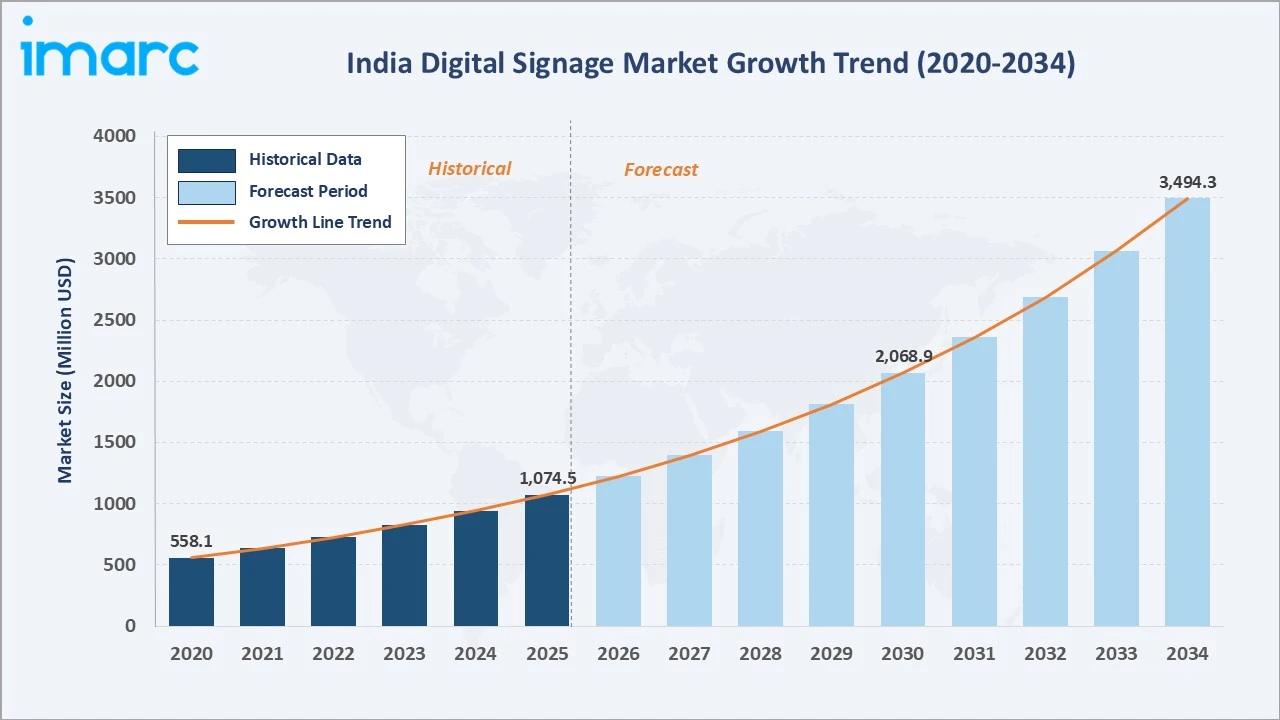
The India digital signage market grew from USD 1,074.5 Million in 2025 to USD 1,225.0 Million in 2026 and is projected to reach USD 3,494.3 Million by 2034, growing at a CAGR of 14.0% during 2026-2034. Retail modernization, smart city projects, and the growth of digital out-of-home advertising are driving rapid adoption of digital signage in India. Organised retail expanding into tier-2 and tier-3 cities is creating growing demand for in-store signage networks, kiosks, and video displays.
Falling display prices, cloud-based content management, and demand for interactive and immersive screens continue to broaden the signage industry in India. Video screens dominate at 30.6%. Hardware leads components at 58.6%. North India commands 31.8% of national market share.
Market Snapshot
|
Metric |
Value |
|
Base Year Market Size (2025) |
USD 1,074.5 Million |
|
Market Size (2026) |
USD 1,225.0 Million |
|
Forecast Market Size (2034) |
USD 3,494.3 Million |
|
CAGR (2026-2034) |
14.0% |
|
Base Year |
2025 |
|
Historical Period |
2020-2025 |
|
Forecast Period |
2026-2034 |
|
Dominant Type |
Video Screen (30.6%, 2025) |
|
Dominant Component |
Hardware (58.6%, 2025) |
|
Leading Region |
North India (31.8%, 2025) |
The India digital signage market size increased from USD 558.1 Million in 2020 to USD 1,074.5 Million in 2025 and is estimated to reach USD 1,225.0 Million in 2026. The market is further expected to grow to USD 2,068.9 Million by 2030 and USD 3,494.3 Million by 2034. Growth reflects rapid deployment across retail, transport, corporate, and public spaces.
To get more information on this market, Request Sample
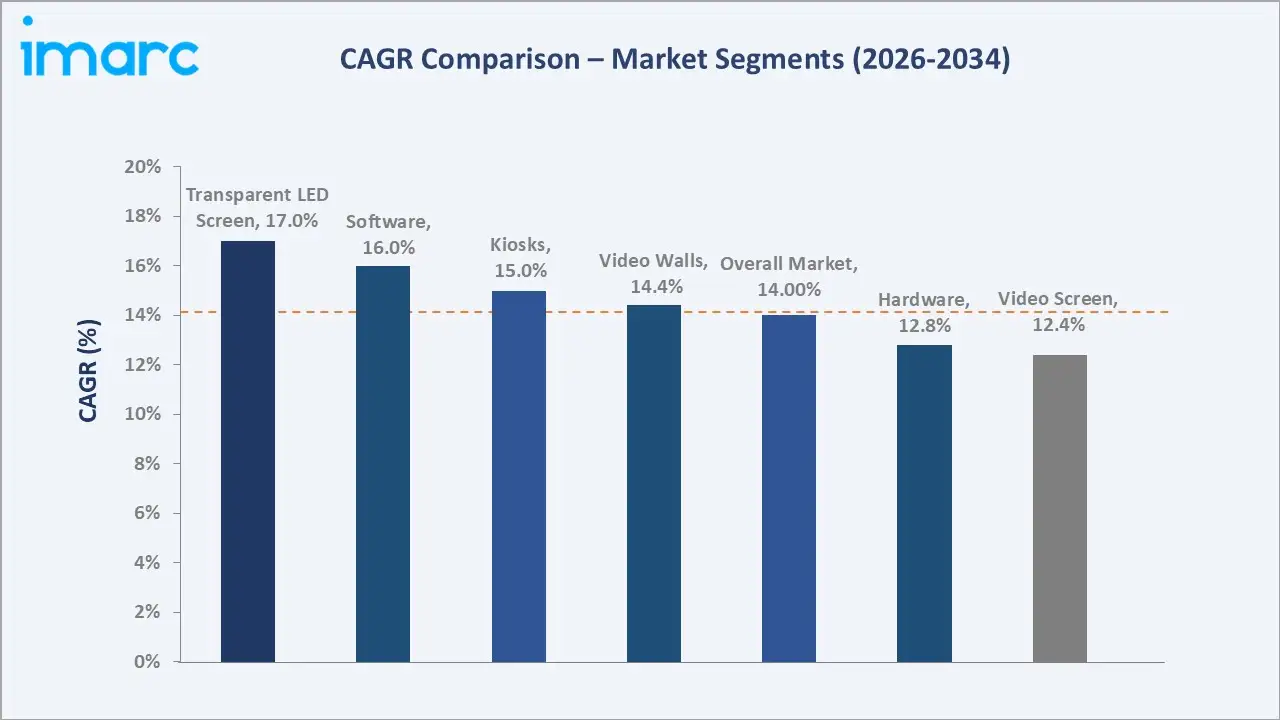
Transparent LED screens are expected to grow fastest at ~17.0% CAGR, supported by demand for eye-catching storefront and showroom displays. Software follows at ~16.0% CAGR as businesses adopt cloud-based content management and analytics platforms.
Executive Summary
The India digital signage market expanded from USD 1,074.5 Million in 2025 to an estimated USD 1,225.0 Million in 2026. Retailers, transport operators, banks, hospitals, schools, and corporate offices are replacing static posters and boards with dynamic screens that can be updated remotely. Advances in LED technology, interactive kiosks, and cloud content platforms are making digital signage india deployments more affordable and effective. The market is projected to reach USD 3,494.3 Million by 2034. Video screens at 30.6% lead types. Hardware at 58.6% leads components. North India leads regionally at 31.8%.
Key Market Insights
|
Insight |
Data |
|
Dominant Type |
Video Screen - 30.6% share (2025) |
|
Dominant Component |
Hardware - 58.6% market share (2025) |
|
Leading Region |
North India - 31.8% share (2025) |
|
Market Opportunity |
Transparent and fine-pitch LED displays; cloud CMS and analytics; programmatic DOOH; smart city and transit signage; tier-2 city retail networks |
Key Analytical Observations Supporting the Above Data:
- Video Screen at 30.6%: Video screens dominate because they are versatile, affordable, and easy to install across retail stores, restaurants, offices, banks, and hospitals. They serve as the standard format for menus, promotions, information, and branding.
- Hardware at 58.6%: Hardware leads because displays, LED panels, media players, mounts, and kiosks account for most of the initial investment in any digital signage project.
- North India at 31.8%: North India leads regionally due to dense retail and commercial activity in Delhi NCR, large transport hubs, and government smart city projects across Uttar Pradesh, Punjab, and Haryana.
India Digital Signage Market Overview
Digital signage uses electronic displays such as LCD and LED screens, video walls, kiosks, and transparent screens to show dynamic content, including advertisements, information, menus, and wayfinding. Content is managed through software platforms that allow scheduling, remote updates, and performance monitoring. Digital signage is used for advertising, customer engagement, internal communication, and public information across a wide range of sectors.
The industry ecosystem links display and component manufacturers, software and CMS providers, system integrators, content creators, advertising networks, regulators, and end users. Macroeconomic factors include retail expansion, urban infrastructure investment, advertising spending, and electronics manufacturing, all of which shape demand. Rising internet penetration and digital payments also support adoption of connected and interactive signage.
Market Dynamics
To evaluate market opportunities, Request Sample
Market Drivers
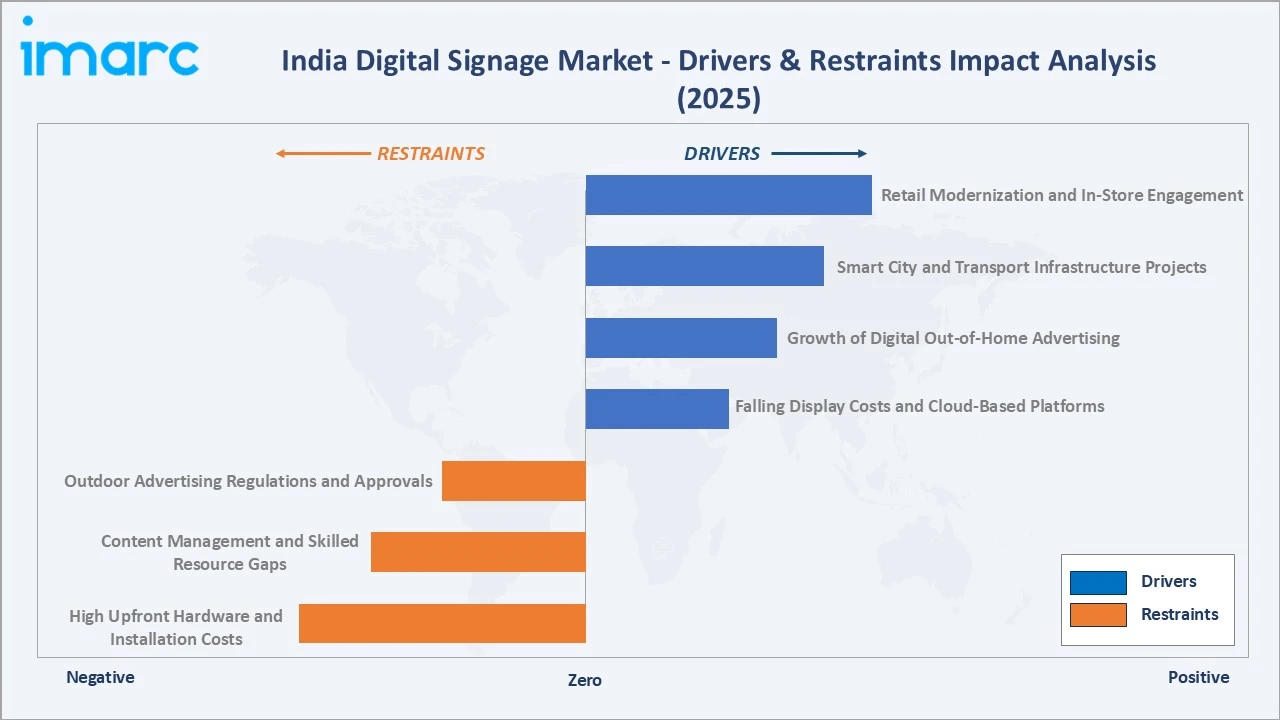
- Retail Modernization and In-Store Engagement: Organized retailers, malls, quick-service restaurants, and brand stores are using digital screens to showcase products, run promotions, and improve the in-store experience. Dynamic content can be updated instantly across many stores, helping brands respond to campaigns, prices, and inventory changes while capturing shopper attention at the point of sale. Retail chains expanding into tier-2 and tier-3 cities are standardizing digital signage across new stores, while shopping malls are installing large video walls and LED facades to attract visitors. Quick-service restaurants are replacing printed menu boards with digital menus that can change by time of day and location. Interactive displays in brand stores also allow shoppers to explore products, compare features, and access offers. Banks and financial institutions are using screens in branches to promote products and manage customer queues efficiently.
- Smart City and Transport Infrastructure Projects: Smart city programs, metro rail networks, airports, railway stations, and bus terminals are deploying digital displays for passenger information, wayfinding, public announcements, and advertising. Large public infrastructure projects create sustained demand for durable, high-brightness displays and integrated content management systems. Metro networks in many cities are installing screens in stations and trains, while airports are expanding flight information and advertising displays. Government buildings, hospitals, and public service centers are also adopting digital displays for queue management and citizen information. Railway stations and bus terminals are adding real-time information displays to improve passenger experience. Large stadiums and event venues are also adopting LED boards for scores, sponsorship, and fan engagement.
- Growth of Digital Out-of-Home Advertising: Advertisers are shifting budgets from static billboards to digital out-of-home screens that allow multiple advertisers, time-based targeting, and measurable campaigns. Outdoor LED displays at highways, malls, and transit hubs are growing rapidly as brands seek flexible and impactful advertising formats. Programmatic buying platforms and audience measurement tools are making DOOH more attractive to digital-first advertisers. Media owners are converting high-traffic static sites to digital to increase revenue per location. Rising smartphone use also allows DOOH campaigns to link with mobile advertising for better engagement. Outdoor LED displays at highways and city junctions are becoming key assets for media owners seeking higher yields.
- Falling Display Costs and Cloud-Based Platforms: Declining prices of LCD and LED displays, along with cloud-based content management platforms, are making digital signage affordable for small and medium businesses. Remote management reduces operating costs, while analytics help users measure audience engagement and campaign performance. Growth of domestic LED assembly and display manufacturing is further reducing costs and improving product availability across the country. Subscription-based software models are also lowering entry barriers for small and medium businesses. Educational institutions are also adopting digital notice boards and campus displays in line with digitalization initiatives.
Market Restraints
- High Upfront Hardware and Installation Costs: Large video walls, LED displays, and kiosks require significant investment in hardware, mounting, power, and networking. Small businesses may find it difficult to justify these costs, especially when returns are hard to measure. Outdoor installations also require structural work, weatherproof enclosures, and reliable power backup, adding to project costs. Return on investment is often difficult to measure for informational and internal communication screens. Financing options and rental models are emerging but remain limited for smaller buyers in many cities.
- Content Management and Skilled Resource Gaps: Digital signage needs fresh, relevant content and regular management. Many organizations lack in-house skills to create content, manage networks, and maintain displays, reducing the effectiveness of installations. Poorly maintained screens with outdated content can harm brand perception and reduce the value of signage investments. Small businesses in particular struggle to keep content updated regularly without dedicated staff.
- Outdoor Advertising Regulations and Approvals: Outdoor digital displays require approvals from municipal authorities and must comply with rules on size, brightness, location, and safety. Varying regulations across cities can delay projects and increase costs. Concerns about driver distraction and light pollution are also leading some authorities to tighten rules on outdoor digital displays. Approval timelines can also vary widely between municipalities, adding uncertainty to project planning.
Market Opportunities
- Programmatic DOOH and Audience Analytics: Automated buying of digital out-of-home advertising, combined with audience measurement tools, can help media owners increase revenue and attract digital-first advertisers. Integration with mobile advertising and location data can further improve targeting and campaign measurement. Data-driven ad sales can significantly increase the value of existing screen networks.
- Expansion into Tier-2 and Tier-3 Cities: Rapid growth of organized retail, banking, healthcare, and education in smaller cities creates opportunities for affordable signage solutions and local integrators. Affordable, standardized solutions and simple cloud platforms are particularly attractive to small businesses in these markets. Local channel partners with strong service networks are key to winning customers in these regions.
Market Challenges
- Power Reliability and Environmental Conditions: Outdoor displays must handle heat, dust, rain, and power fluctuations. Ensuring reliability and visibility in harsh conditions increases equipment and maintenance costs. Manufacturers are developing high-brightness, weatherproof, and energy-efficient displays tailored to Indian conditions. Remote monitoring and predictive maintenance can also reduce downtime and service costs. Display designs with higher ingress protection ratings are becoming standard for outdoor installations across India.
- Cybersecurity and Network Management: Networked screens can be vulnerable to unauthorized access and content tampering. Securing large signage networks requires strong software, monitoring, and access controls. Compliance with data protection rules is also important when signage collects audience analytics. Regular software updates and secure device management are essential for large networks.
Emerging Market Trends
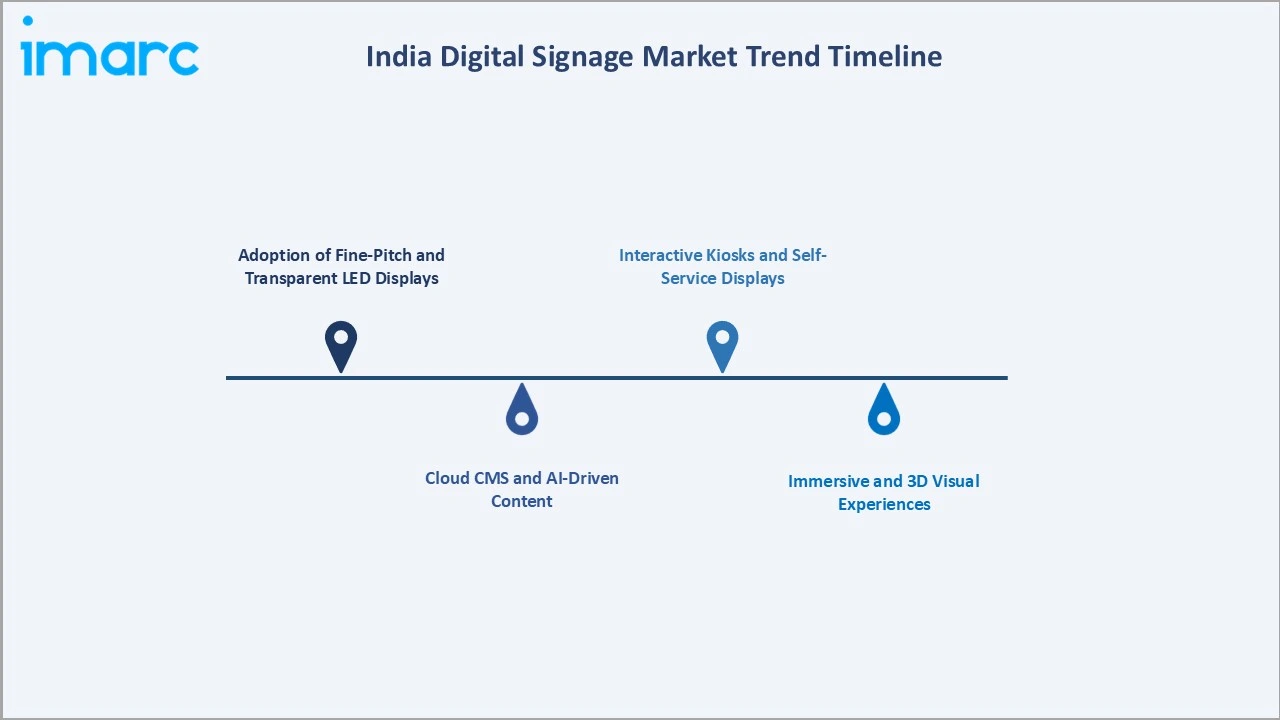
1. Adoption of Fine-Pitch and Transparent LED Displays
Fine-pitch LED video walls and transparent LED screens are being used in showrooms, malls, airports, and corporate lobbies for high-impact visuals. These displays offer seamless images, high brightness, and creative installation options that attract attention. Falling prices of fine-pitch LED are making video walls more accessible for mid-sized retailers and corporate offices. Creative LED installations are also being used on building facades and in public spaces.
2. Cloud CMS and AI-Driven Content
Cloud-based content management systems allow businesses to control screens across many locations from a single dashboard. Artificial intelligence is being used to generate content, schedule campaigns, and adapt messages based on time, weather, or audience profile. Integration with point-of-sale and inventory systems allows content to reflect real-time prices and stock levels. Generative AI tools are making it easier for small businesses to create professional content quickly.
3. Interactive Kiosks and Self-Service Displays
Touchscreen kiosks are being deployed in retail, quick-service restaurants, banks, hospitals, and government offices for ordering, payments, check-ins, and information. Self-service displays reduce queues and improve customer convenience. Kiosk adoption is supported by digital payments and the growing preference for contactless and self-service interactions. Government services are also using kiosks for applications, payments, and information access.
4. Immersive and 3D Visual Experiences
Anamorphic 3D billboards, curved LED walls, and glasses-free 3D displays are creating immersive brand experiences in high-footfall locations. These formats help advertisers stand out and generate social media engagement. Immersive installations are increasingly used for product launches, events, and experiential marketing campaigns. Retail and entertainment venues are investing in immersive displays to create memorable visitor experiences.
Industry Value Chain Analysis
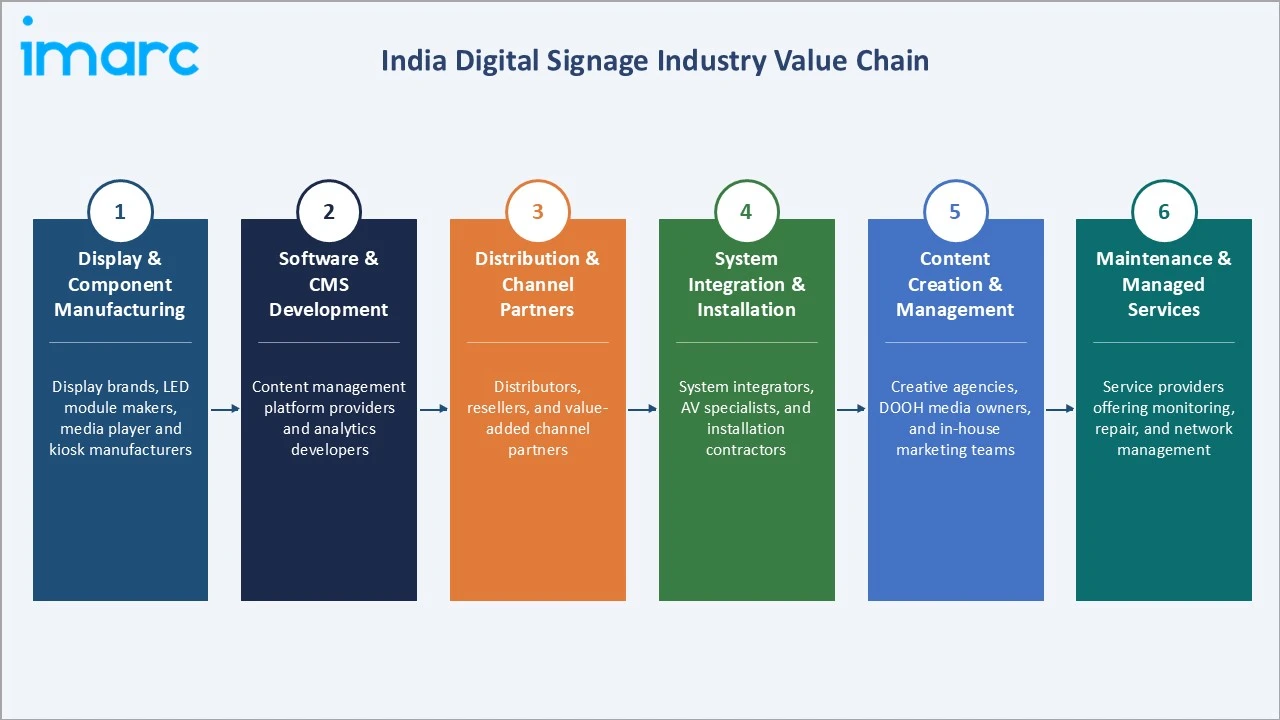
The India digital signage value chain spans display and component manufacturing, software and CMS development, distribution and channel partners, system integration and installation, content creation and management, and maintenance and managed services. Value is shifting toward software, content, and services. Recurring revenue from software subscriptions and managed services is becoming more important for solution providers. Partnerships between hardware brands, software providers, and integrators are becoming common in large projects.
|
Stage |
Key Participants |
|
Display & Component Manufacturing |
Display brands, LED module makers, media player and kiosk manufacturers |
|
Software & CMS Development |
Content management platform providers and analytics developers |
|
Distribution & Channel Partners |
Distributors, resellers, and value-added channel partners |
|
System Integration & Installation |
System integrators, AV specialists, and installation contractors |
|
Content Creation & Management |
Creative agencies, DOOH media owners, and in-house marketing teams |
|
Maintenance & Managed Services |
Service providers offering monitoring, repair, and network management |
System integration and installation is the most consequential stage of the chain. Integrators design solutions, select hardware and software, and ensure reliable installation, determining how well signage networks perform over their lifetime. Content creation and management are equally important, as engaging and relevant content determines audience impact and return on investment. Maintenance and managed services ensure screens remain operational and content stays current over time. Long-term service contracts are therefore becoming a key differentiator for integrators.
Technology Landscape in the India Digital Signage Industry
LED and LCD Display Technologies
LCD panels remain common for indoor screens, while LED displays dominate large outdoor and video wall applications. Fine-pitch LED, micro LED, and transparent LED technologies are improving image quality, brightness, and design flexibility. OLED and e-paper displays are also gaining attention for premium and energy-efficient applications. Energy-efficient displays help businesses reduce power consumption and operating costs.
Content Management Systems and Media Players
Content management software and media players schedule and deliver content to screens. Cloud platforms enable remote updates, device monitoring, and integration with data sources such as inventory, weather, and social media feeds. Open platforms and APIs allow integration with enterprise systems, making signage part of broader digital transformation strategies. Remote device management also allows businesses to monitor screen health and resolve issues quickly. Emergency alert integration allows signage networks to support public safety communications. Integration with building management and visitor systems further extends the role of signage in smart offices, hospitals, malls, and large university campuses.
Interactive, Sensor-Based, and Analytics Technologies
Touchscreens, cameras, and sensors enable interactive and audience-aware content. Anonymous audience analytics measure viewing time and demographics, helping advertisers evaluate campaign effectiveness. Mobile integration through QR codes and near-field communication allows viewers to interact with signage using their smartphones. Privacy-friendly analytics are increasingly important as audience measurement becomes more widespread.
Market Segmentation Analysis
The report covers the following segments:
|
Segment Category |
Leading Segment |
Market Share |
Year |
|
Type |
Video Screen |
30.6% |
2025 |
|
Component |
Hardware |
58.6% |
2025 |
|
Technology |
🔒 |
🔒 |
2025 |
|
Application |
🔒 |
🔒 |
2025 |
|
Location |
🔒 |
🔒 |
2025 |
|
Size |
🔒 |
🔒 |
2025 |
|
Region |
North India |
31.8% |
2025 |

By Type
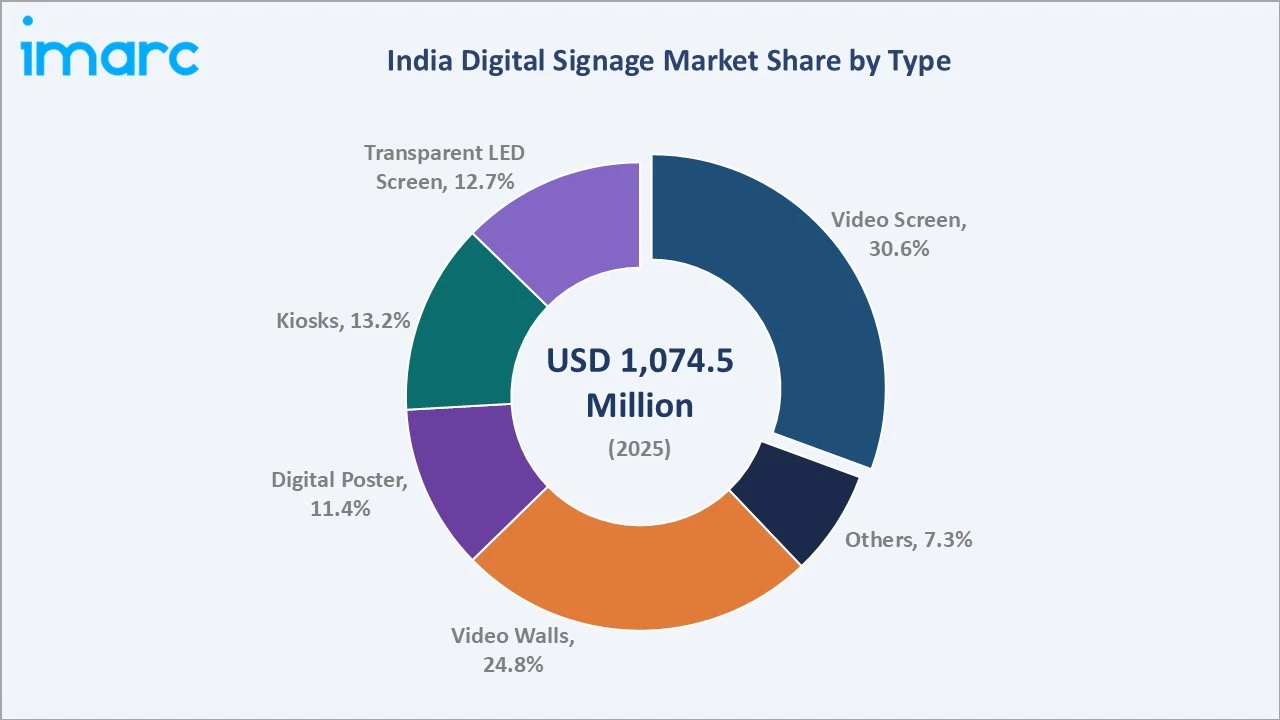
Video screens lead at 30.6% (2025). Their versatility, affordability, and ease of installation make them the most widely used format for menus, promotions, information, and branding across retail and commercial spaces. Large-format video screens are also increasingly used in corporate lobbies, conference rooms, and educational institutions. Their availability in a wide range of sizes allows flexible deployment across different environments.
To access detailed market analysis, Request Sample
Video walls at 24.8% grow at ~14.4% CAGR. Kiosks at 13.2% grow at ~15.0%, transparent LED screens at 12.7% grow fastest at ~17.0%, digital posters at 11.4% grow at ~13.3%, and others at 7.3% grow at ~11.8%. Kiosk growth is supported by self-ordering in restaurants and self-service in banks and hospitals. Video walls are widely used in control rooms, malls, airports, and corporate lobbies.
By Component
Hardware leads at 58.6% (2025). Displays, LED panels, media players, mounts, and kiosks account for most of the initial investment in digital signage projects across all end-use sectors. Local manufacturing and assembly are gradually reducing hardware costs for Indian customers. Kiosks and media players are also part of the hardware segment and are growing with self-service adoption. Transparent and creative displays are growing quickly as brands seek differentiated visual experiences.
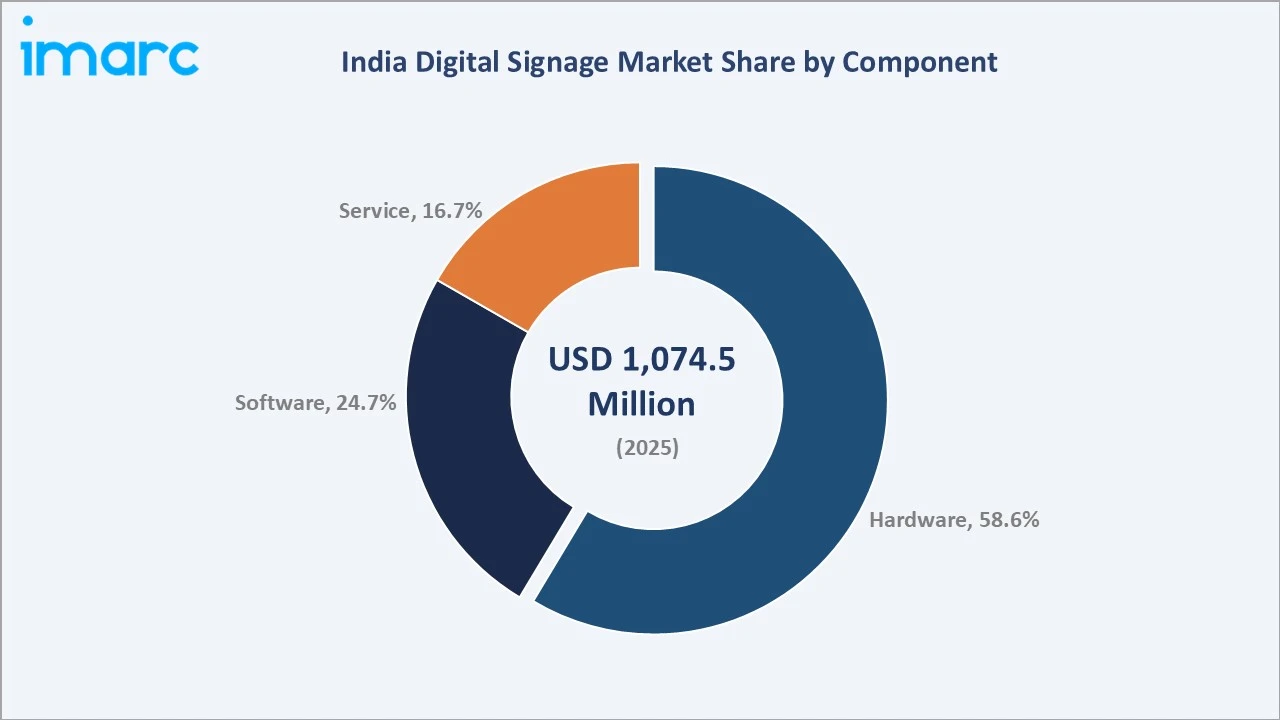
Software at 24.7% is growing fastest at ~16.0% CAGR, driven by cloud CMS and analytics. Service at 16.7% is growing at ~14.6%, supported by installation, maintenance, and managed services. Many customers prefer bundled solutions that combine hardware, software, and services under a single contract.
Regional Market Insights
|
egion |
Share (2025) |
Key India Digital Signage Market Drivers & Characteristics |
|
North India |
31.8% |
Dense retail in Delhi NCR, major transport hubs, and smart city projects. |
|
West and Central India |
27.6% |
Commercial hubs in Mumbai, Pune, and Ahmedabad with strong DOOH advertising. |
|
South India |
25.4% |
Technology parks and retail growth in Bengaluru, Chennai, and Hyderabad. |
|
East and Northeast India |
15.2% |
Emerging retail, metro, and smart city projects in Kolkata and Guwahati. |
North India's 31.8% market leadership reflects dense retail and commercial activity in Delhi NCR, major airports and metro networks, and smart city projects. West and Central India's 27.6% reflects strong commercial and advertising activity in Mumbai, Pune, and Ahmedabad.
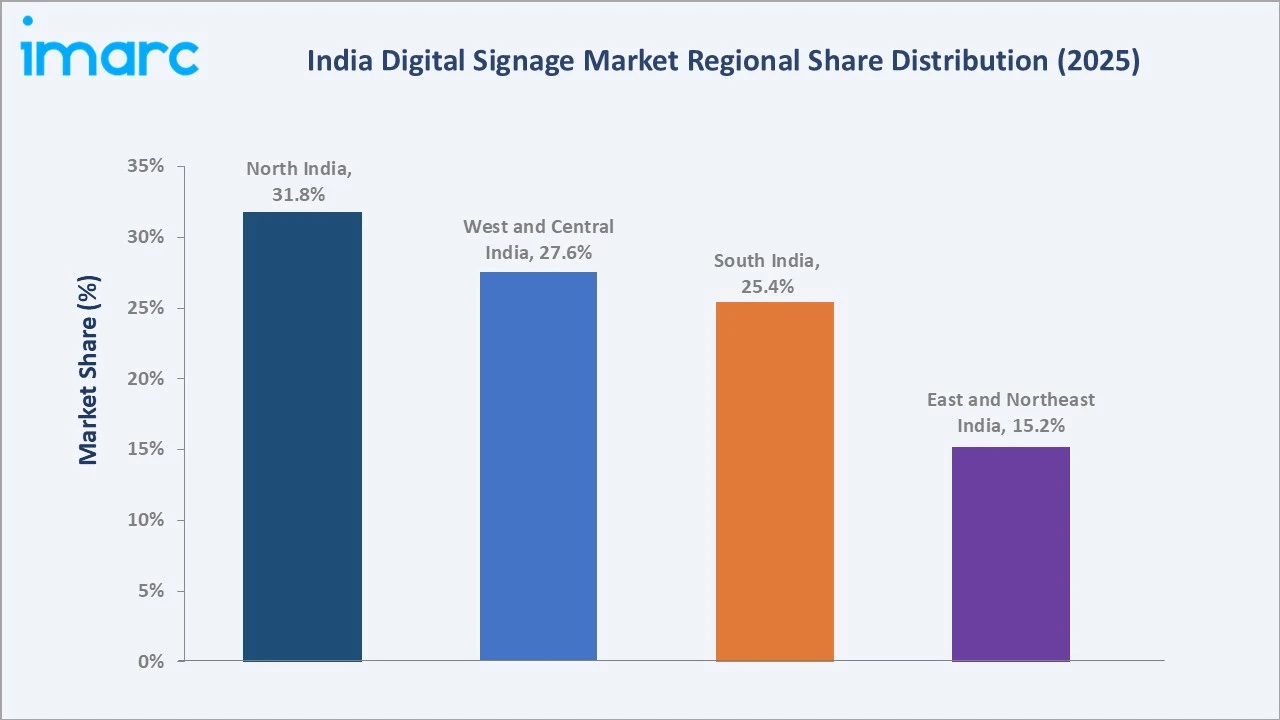
South India's 25.4% reflects technology parks, corporate offices, and retail growth in Bengaluru, Chennai, and Hyderabad. East and Northeast India's 15.2% is the smallest share, but new metro, retail, and smart city projects support steady growth. Improving connectivity and retail expansion in smaller cities are expected to lift demand across the region.
Competitive Landscape
The India digital signage market includes global display brands, professional display specialists, software providers, and many local system integrators. Competition centers on display quality, product range, software capabilities, pricing, and service networks. Local integrators play a critical role by combining products from multiple brands into tailored solutions for customers. Strong after-sales service and fast response times are important for winning large corporate and government contracts. Global brands also compete with Chinese LED manufacturers and Indian assemblers on price in large outdoor projects.
| Company | Key Offerings | Market Position | Core Strength |
|---|---|---|---|
| Samsung | Smart Signage, The Wall, Samsung VXT | Market Leader | Global signage leader with broad display and software portfolio. |
| LG Electronics | UHD Signage, Stretch Signage, UHD Signage | Market Leader | Strong LED and OLED signage range for indoor and outdoor use. |
| PPDS | Philips Signage, Philips Tableaux, PPDS Wave | Innovator | Professional displays with local manufacturing in India. |
| Panasonic Connect Co., Ltd. | Panasonic Professional Displays | Strong Challenger | Professional display and projection solutions. |
| BenQ | Pantone | Innovator | Interactive and commercial display solutions. |
| ViewSonic Corporation | ViewSonic ViewBoard, Commercial Displays | Niche Player | Interactive and commercial displays for education and business. |
| Delta Electronics, Inc. | Delta Displays and Video Walls | Strong Challenger | Video wall and control room display solutions. |
The most important competitive dynamic is the shift from selling screens to providing complete solutions that combine hardware, software, content, and services. Brands with strong integrator partnerships and cloud platforms are gaining share in the signage industry in India.
Key Company Profiles
Samsung
Samsung has held the leading position in the global digital signage market, offering smart signage, LED displays, and the Samsung VXT cloud content platform.
- Key Brands: Smart Signage, The Wall, Spatial Signage, Samsung VXT.
- Recent Developments: In February 2026, Samsung launched Spatial Signage, a glasses-free 3D digital signage display, globally at ISE 2026, along with AI Studio, a new AI-powered content app within Samsung VXT.
- Strategic Focus: Expanding ultra-large LED, 3D, and AI-enabled signage solutions for commercial customers.
LG Electronics
LG Electronics’ Information Display Business, part of LG Business Solutions India, offers digital signage and LED display solutions for the digital out-of-home ecosystem.
- Key Brands: UHD Signage, Stretch Signage, UHD Signage.
- Recent Developments: In 2026, LG showcased its Outdoor LED displays, Ultra Stretch Signage, and High Brightness Displays at OAC Expo 2026 in India.
- Strategic Focus: Advancing micro-LED signage, with LG MAGNIT winning a Best of Show award at InfoComm 2026.
PPDS
PPDS, the exclusive global provider of Philips Professional Displays, manufactures selected Philips digital signage and interactive displays in Mumbai for the Indian market.
- Key Brands: Philips Signage, Philips Tableaux, PPDS Wave.
- Recent Developments: In February 2026, PPDS launched the Philips Signage 2000 Series, a new 4K UHD digital signage range, at ISE 2026.
- Strategic Focus: Expanding Make in India manufacturing and its partner network across India.
Market Concentration Analysis
The India digital signage market is moderately concentrated in hardware, where a few global brands hold strong positions. The broader market remains fragmented, with many system integrators, software providers, and content companies serving local customers.
Market concentration is evolving through two opposing forces: leading brands strengthen positions through complete solutions and local manufacturing, while affordable imports and local LED assemblers increase competition. Partnerships with integrators and media owners are also shaping competitive positions. Price competition is particularly intense in standard LCD and LED segments. Customers increasingly evaluate total cost of ownership, including energy use, service, and software, rather than hardware price alone.
Investment & Growth Opportunities
Highest Growth Segments
Transparent LED screens (~17.0% CAGR through showroom demand), software (~16.0% CAGR through cloud CMS), kiosks (~15.0% CAGR through self-service adoption), and South India (~14.5% CAGR through technology parks) represent the highest-growth investment areas through 2034.
Emerging Investment Opportunities
Programmatic DOOH networks and audience analytics are among the most promising opportunities, enabling media owners and brands to measure and optimize digital signage in India. Investments in local LED manufacturing and integrated solutions also offer strong returns.
Investment Themes
- Local LED manufacturing and assembly: Make in India incentives support domestic display production.
- Smart city and transit signage: Public infrastructure projects require large, durable signage networks.
Future Market Outlook (2026-2034)
The India digital signage market is projected to grow from USD 1,074.5 Million in 2025 to USD 1,225.0 Million in 2026, reaching USD 3,494.3 Million by 2034, registering a CAGR of 14.0% during 2026-2034. The anchor value of USD 2,068.9 Million in 2030 marks a point at which cloud-managed and interactive signage should be mainstream. By then, programmatic DOOH and AI-driven content should also be widely used across signage networks.
Three structural forces define India digital signage market growth through 2034: retail and commercial modernization; public infrastructure and smart city investment; and the shift of advertising budgets to digital out-of-home media. Together, these forces support strong growth across types, components, and regions over the forecast period.
Research Methodology
Primary Research
Primary research comprised structured interviews with industry stakeholders, including display manufacturers, system integrators, software providers, DOOH media owners, and retail and transport operators, along with inputs from all regions of India.
Secondary Research
Secondary research covered company websites and press releases, government infrastructure data, advertising industry reports, and trade statistics. Over 50 credible secondary sources were reviewed, compared, and cross-checked for accuracy and consistency across datasets.
Forecasting Models
Market revenue forecasts were developed using a demand-based model: installed screens by type and region multiplied by average hardware, software, and service spending, with segment results aggregated to total market value. Assumptions were validated through detailed discussions with experienced industry experts, system integrators, media owners, and display distributors across all major regions of India, ensuring that estimates reflect actual installation volumes, pricing trends, and adoption patterns observed in the market.
India Digital Signage Market Report Coverage:
| Report Features | Details |
|---|---|
| Base Year of the Analysis | 2025 |
| Historical Period | 2020-2025 |
| Forecast Period | 2026-2034 |
| Units | Million USD |
| Scope of the Report | Exploration of Historical Trends and Market Outlook, Industry Catalysts and Challenges, Segment-Wise Historical and Future Market Assessment:
|
| Types Covered | Video Walls, Video Screen, Transparent LED Screen, Digital Poster, Kiosks, Others |
| Components Covered | Hardware, Software, Service |
| Technologies Covered | LCD/LED, Projection, Others |
| Applications Covered | Retail, Hospitality, Entertainment, Stadiums and Playgrounds, Corporate, Banking, Healthcare, Education, Transport, Others |
| Locations Covered | Indoor, Outdoor |
| Sizes Covered | Below 32 Inches, 32 to 52 Inches, More Than 52 Inches |
| Regions Covered | North India, West and Central India, South India, East and Northeast India |
| Companies Covered | Samsung, LG Electronics, PPDS, Panasonic Connect Co., Ltd., BenQ, ViewSonic Corporation, Delta Electronics, Inc., etc. |
| Customization Scope | 10% Free Customization |
| Post-Sale Analyst Support | 10-12 Weeks |
| Delivery Format | PDF and Excel through Email (We can also provide the editable version of the report in PPT/Word format on special request) |
Key Benefits for Stakeholders:
- IMARC’s industry report offers a comprehensive quantitative analysis of various market segments, historical and current market trends, market forecasts, and dynamics of the India digital signage market from 2020-2034.
- The research report provides the latest information on the market drivers, challenges, and opportunities in the India digital signage market.
- Porter's five forces analysis assist stakeholders in assessing the impact of new entrants, competitive rivalry, supplier power, buyer power, and the threat of substitution. It helps stakeholders to analyze the level of competition within the India digital signage industry and its attractiveness.
- Competitive landscape allows stakeholders to understand their competitive environment and provides an insight into the current positions of key players in the market.
Frequently Asked Questions About the India Digital Signage Market Report
The India digital signage market size is estimated at USD 1,225.0 Million in 2026, supported by retail modernization and smart city projects.
The market grows at 14.0% CAGR during 2026-2034, reaching USD 3,494.3 Million by 2034.
Video screens lead at 30.6%, owing to their versatility and affordability.
Hardware leads at 58.6%, as displays and LED panels account for most project spending.
North India leads at 31.8%, driven by dense retail and transport infrastructure in Delhi NCR.
Leading companies include Samsung, LG Electronics, PPDS, Panasonic Connect Co., Ltd., BenQ, ViewSonic Corporation, and Delta Electronics, Inc., among others.
The market is projected to reach approximately USD 2,068.9 Million by 2030.
Key trends include fine-pitch and transparent LED, cloud CMS and AI content, interactive kiosks, and immersive 3D displays.
Need more help?
- Speak to our experienced analysts for insights on the current market scenarios.
- Include additional segments and countries to customize the report as per your requirement.
- Gain an unparalleled competitive advantage in your domain by understanding how to utilize the report and positively impacting your operations and revenue.
- For further assistance, please connect with our analysts.
 Request Customization
 Speak to an Analyst
 Request Brochure
 Inquire Before Buying
Benefits of Customization
- Personalize this research
- Triangulate with your data
- Get data as per your format and definition
- Gain a deeper dive into a specific application, geography, customer, or competitor
- Any level of personalization
Get in Touch With Us
UNITED STATES
Phone: +1-201-971-6302
INDIA
Phone: +91-120-433-0800
UNITED KINGDOM
Phone: +44-753-714-6104
Email: [email protected]
Client Testimonials




















Related Reports

Choose your plan
*Please note that the prices mentioned below are starting prices for each bundle type. Kindly contact our team for further details.*
Single User License
- 1 User License, Access on 2 Devices
- PDF Report + Excel Dataset (Password Protected)
- Lifetime Access
- No Printing Rights
- 10% Free Report Customization
- 10–12 Weeks of Analyst Support
Five User License
- Access for 5 Users, 2 Devices per User
- PDF Report + Excel Dataset (Password Protected)
- Lifetime Access
- Dedicated Account Manager
- 12–14 Weeks of Analyst Support
- No Printing Rights
- 15% Free Report Customization
- 25% Discount on Your Next Purchase
Corporate User License
- Unlimited User Access (Within Your Organization)
- PDF Report + Excel Dataset
- Lifetime Access
- Dedicated Account Manager
- 14–20 Weeks of Analyst Support
- No Printing Rights
- 20% Free Report Customization
- 30% Discount on Your Next Purchase
Essential Insights
What's included:
3 reports
- Lifetime Access
- PDF Reports
- Excel Datasets
- 2 Weeks of Free Analyst Support
- 2 User Licenses
- Access on 2 Devices
- Printing Rights
- Complimentary PowerPoint (PPT) Version
- Complimentary License Upgrade
Professional Access
What's included:
5 reports
- Lifetime Access
- PDF Reports
- Excel Datasets
- 8 Weeks of Free Analyst Support
- 2 User Licenses
- Access on 2 Devices
- Printing Rights
- Complimentary PowerPoint (PPT) Version
- Complimentary License Upgrade
Business Advantage
What's included:
8 reports
- Lifetime Access
- PDF Reports
- Excel Datasets
- 14 Weeks of Free Analyst Support
- 2 User Licenses
- Access on 2 Devices
- Printing Rights
- Complimentary PowerPoint (PPT) Version
- Complimentary License Upgrade
Enterprise Intelligence
What's included:
10 reports
- Lifetime Access
- PDF Reports
- Excel Datasets
- 20 Weeks of Free Analyst Support
- 2 User Licenses
- Access on 2 Devices
- Printing Rights
- Complimentary PowerPoint (PPT) Version
- Complimentary License Upgrade