Fluorspar Price Increases 3.2% in USA, 3.0% in Canada — Q4 2025 Update
08-Sep-2025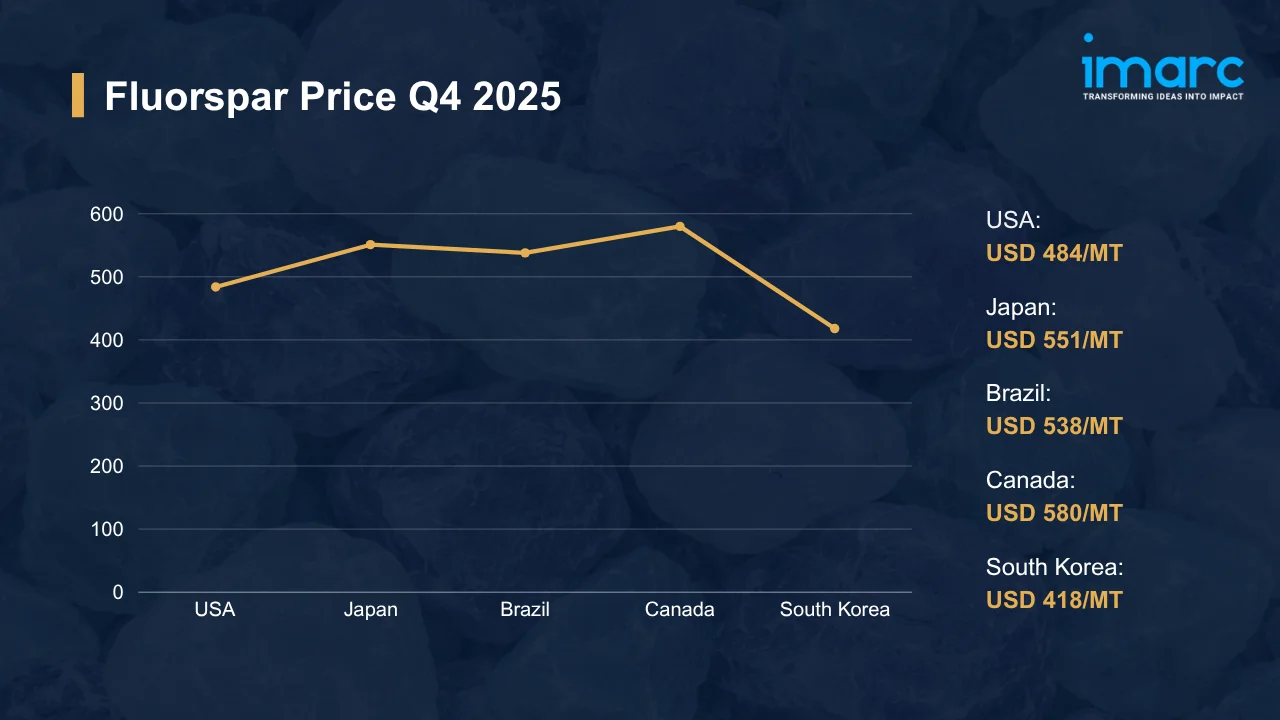
Summary:
Q4 2025 closed on a split verdict for fluorspar. Constrained Chinese export volumes and firm HF acid sector demand pushed fluorspar prices higher in three of the five tracked markets, while weakening industrial activity pulled the other two lower. Quarter-on-quarter, prices swung between a 3.8% decline and a 3.2% gain across tracked markets. Against this backdrop, oil markets remain under intense strain from the Israel–Iran–USA conflict. As of March 8, 2026, global crude prices surged more than 25% since hostilities escalated, according to Al Jazeera, raising operating costs for energy-intensive HF acid production facilities worldwide.
Fluorspar Price Q4 2025:
Regional prices (USD per MT) and QoQ changes Q4 vs Q3 2025:
| Region | Price (USD/MT) | QoQ Change | Direction |
|---|---|---|---|
| USA | 484 | +3.2% | ↑ Growth |
| Japan | 551 | -3.8% | ↓ Decline |
| Brazil | 538 | +0.9% | ↑ Growth |
| Canada | 580 | +3.0% | ↑ Growth |
| South Korea | 418 | -1.2% | ↓ Decline |
To access real-time prices Request Sample
Kindly note: IMARC’s pricing database tracks fluorspar price movements across major global markets.
What Moved Prices:
USA:
- At USD 484/MT, representing a 3.2% QoQ gain, the USA market outperformed most peers in Q4 2025, with fluorite procurement from Gulf Coast HF acid producers running at elevated rates to meet growing refrigerant and chemical sector offtake. During Q4 2025, fluorspar prices in the USA climbed as semiconductor manufacturers also entered spot negotiations, adding incremental volume that converters were unwilling to forego given the tight domestic supply picture. The fluorspar price chart showed October and November as the months of steepest appreciation before offer levels stabilized in December.
- Chinese export curtailments proved the decisive variable. With key producing provinces operating under tightened environmental controls, import arrivals at West Coast and Gulf ports ran well below Q3 volumes, eroding the offshore pressure that had previously capped domestic pricing. Buyers holding year-end delivery slots negotiated from a position of relative scarcity, reinforcing bid levels across spot and short-term contract markets throughout the quarter.
Japan:
- Japan’s steel sector cooled through the quarter, with fluorspar prices bearing the impact. In Q4 2025, fluorspar prices in Japan slipped to USD 551/MT, a 3.8% QoQ decline, as blast furnace operators scaled back metspar offtake and automotive-linked HF acid demand stalled against a backdrop of weak car production schedules. Procurement desks at large steelmakers ran down existing inventory rather than restocking at prevailing offer levels.
- Competitively priced Chinese imports, arriving on favorable CIF terms, kept domestic distributors from defending prior price levels through counter-offers. Electronics sector buyers, including those sourcing semiconductor-grade HF precursors, maintained cautious ordering patterns throughout Q4, unwilling to extend forward coverage while industrial demand signals remained mixed. That hesitation kept spot negotiations soft through December.
Brazil:
- Steady aluminum smelter and fluorochemical processor demand held the Brazilian market to a narrow positive outcome. In Q4 2025, fluorspar prices in Brazil edged up to USD 538/MT, a 0.9% QoQ gain, with metallurgical consumers maintaining consistent order volumes and chemical producers absorbing available tonnage without significant spot market pressure. Whether the gain is sustained in Q1 2026 depends largely on aluminum output schedules over the coming months.
- BRL stability against the USD reduced the import cost incentive that had weighed on domestic prices in earlier quarters, insulating local material from competing offshore offers arriving at adjusted parity. Logistics along inland freight corridors serving São Paulo’s chemical processing hubs remained orderly throughout the quarter, avoiding the cost escalation that had periodically disrupted delivery economics in 2024.
Canada:
- During Q4 2025, fluorspar prices in Canada reached USD 580/MT, the highest of all five tracked markets, rising 3.0% QoQ as HF acid producers under long-term supply agreements maintained consistent draw volumes and steel sector buyers in Ontario and Quebec placed supplementary spot orders to cover end-of-year production requirements. Procurement sentiment remained constructive throughout the quarter.
- Limited import competition from alternative origins supported domestic pricing power. The energy sector’s growing appetite for fluoropolymer-based pipeline coatings and insulation materials contributed secondary demand, reinforcing the positive fluorspar price trend running through the fourth quarter. Producers holding domestically sourced inventory were in a strong negotiating position, with buyers accepting moderate price increases rather than waiting for offshore supply that faced longer lead times.
South Korea:
- At USD 418/MT, South Korea posted the weakest absolute price and a 1.2% QoQ decline, with soft semiconductor-linked HF procurement and below-trend steel output compressing fluorspar offtake. In Q4 2025, fluorspar prices in South Korea fell as buyers across electronics and steel segments drew down existing inventory rather than commit new volumes under uncertain demand conditions.
- Chinese imports arriving at competitive CIF rates kept downside negotiating pressure intact throughout the quarter. Downstream converter activity in refrigerant blending and fluoropolymer production ran below Q3 levels, with producers adjusting run rates in response to weaker export order books. Spot offers from distributors went largely uncontested, keeping bid-ask spreads narrow and preventing any material price recovery through December.
Fluorspar Price Outlook After the Israel–Iran–USA Conflict:
Rising Energy Costs and HF Acid Feedstock Pressure for Fluorspar: Energy market disruption is the primary transmission channel from the Israel–Iran–USA conflict to fluorspar economics. As of March 3, 2026, traders were demanding approximately USD 14 more per barrel of oil than pre-conflict levels, reflecting entrenched supply uncertainty. Fluorite beneficiation and HF acid conversion are both energy-intensive processes; higher fuel and electricity costs might push ex-works prices up meaningfully at primary processing facilities across China, South Africa, and Mexico.
Regional Demand Uncertainty and Price Volatility for Fluorspar: Industrial activity in conflict-adjacent economies faces rising energy costs and supply disruption risk that compress steel, aluminum, and fluorochemical output. Reduced offtake from these sectors might lower fluorspar consumption volumes in Asia and Southern Europe, where exposure to Middle East energy supply is highest. Price volatility will stay elevated as buyers and producers attempt to hedge against scenarios that remain genuinely unpredictable.
Immediate Market Reaction:
HF acid producers form fluorspar’s demand core, and their operating economics are deteriorating. Rising energy costs are filtering directly into conversion margins at fluorite-processing facilities, prompting procurement desks to reassess contract volumes and seek price relief from upstream suppliers. The fluorspar price index reflects growing cost-push pressure from energy rather than pure demand dynamics, a structural shift that buyers in price-sensitive markets are not yet fully pricing in. Producers in geographically insulated origins like Canada and Mexico might gain near-term competitive positioning if Middle East exposure continues to disadvantage Asian-origin material on landed cost comparisons.
Impact on Fluorspar Prices:
The conflict might trigger several key changes in the fluorspar market:
- Energy-Driven Processing Cost Escalation: Fluorite beneficiation and HF acid production both carry heavy energy cost burdens. At current conflict-elevated oil prices, processing costs at primary facilities will increase, particularly in regions where electricity pricing tracks crude oil or natural gas indexes. Mid-tier producers with limited hedging capacity might absorb initial cost pressures before eventually passing them through to offer prices, compressing their margins and reducing willingness to offer volume at spot.
- Freight Cost Escalation Across Key Trade Routes: Fluorspar moves primarily by sea from China, Mexico, and South Africa to consuming markets in Europe, North America, and Northeast Asia. Conflict-driven oil price increases will raise bunker fuel costs, pushing ocean freight rates higher across all major fluorspar trade lanes and widening the landed cost differential between domestic and imported material. Buyers reliant on offshore supply might face CIF cost increases that materially alter procurement economics within one to two shipment cycles.
- Demand Contraction in Conflict-Exposed Industrial Sectors: Steel and aluminum producers in Middle East-exposed economies might scale back output if energy costs remain elevated and downstream order books thin. Reduced metspar and HF acid consumption from these segments will translate into softer global fluorspar demand, counterbalancing the supply-side cost push and creating regional price divergence between markets with strong domestic demand and those dependent on export-linked industrial activity.
Together, these three forces will create divergent pricing trajectories across fluorspar-consuming markets through 2026. Cost-push inflation is lifting prices in energy-intensive segments, while weak industrial offtake is capping gains elsewhere. Buyers might reduce this exposure by locking in contract tonnage at current levels before cost pass-throughs materialize across the spot market.
Supply Chain Disruptions:
Seaborne fluorspar trade is acutely exposed to the Strait of Hormuz disruption triggered by the Israel–Iran–USA conflict. As of March 3, 2026, traffic through the strait fell by at least 80%, with over 150 vessels stranded and major shipping lines suspending Arabian Sea operations. Shipments from South African and Middle Eastern origins transiting these lanes face immediate rerouting pressure, adding freight cost and delivery time to buyers in Europe and Northeast Asia that depend on these supply corridors.
Cape of Good Hope rerouting is the primary alternative for affected shipments, but the diversion adds 10–14 days to transit schedules and increases voyage costs materially. Canadian and Mexican producers, insulated from Middle East shipping exposure, will gain a near-term cost advantage as buyers reassess origin mix to reduce logistics risk. Strategic inventory buffers at key receiving ports in Germany, South Korea, and Japan might prove critical for managing supply continuity through the period of peak route disruption.
Global Market Overview:
Globally, the fluorspar industry was valued at USD 2.52 Billion in 2025. Market projections indicate steady growth, with the industry expected to reach USD 3.66 Billion by 2034, with a compound annual growth rate (CAGR) of 4.24% during 2026–2034. Fluoropolymer and HF acid demand from the chemical sector forms the market’s primary growth engine, reinforced by expanding lithium-ion battery applications and rising fluorinated refrigerant consumption. Regulatory transitions towards low-GWP refrigerant blends and green steel production methods are creating new consumption avenues, while supply concentration in China continues shaping global trade and price formation.
Recent Highlights & Strategic Developments:
Recent strategic moves within the industry further illustrate evolving dynamics:
- In August 2025, CleanTech Vanadium Mining Corp. and Oracle Commodity Holding Corp. concluded a royalty arrangement under which US Fluorspar LLC granted Oracle a 2% net smelter returns royalty with a USD 6/Ton minimum, covering output from fluorspar projects in the Illinois-Kentucky Fluorspar District.
Fluorspar Price Forecast (2026):
Chinese export policy and conflict-driven energy costs will jointly steer near-term fluorspar price direction into early 2026. Procurement caution is likely to persist among HF acid and steel sector buyers through the first two quarters, though any easing of energy price pressure might partially offset cost-push dynamics and create windows for negotiated price stabilization as supply chains adjust.
Escalating geopolitical hostilities will push fluorspar prices higher as energy and logistics costs increase, production margins tighten in export-origin countries, and risk premiums widen across key trade routes serving Europe and Northeast Asia. Producers in geographically insulated markets will likely gain pricing power as buyers pivot away from conflict-exposed supply origins. A diplomatic resolution or ceasefire might ease freight rates and restore energy cost stability, allowing prices to trend toward pre-conflict equilibrium by mid-2026, as analysts currently project in the fluorspar price forecast for the year ahead.
Strategic Takeaways:
Looking ahead, the fluorspar market is expected to sustain moderate growth through 2026, underpinned by durable HF acid demand and expanding fluoropolymer applications in energy and battery technologies. Chinese supply policy shifts, geopolitical cost escalation, and downstream sector health will remain the three variables most likely to define near-term price direction.
To navigate this complex landscape, stakeholders should:
- Monitor Geopolitical Risk Exposure: Track escalation dynamics in the current conflict and assess how shifts in hostility levels might affect fluorspar pricing, feedstock availability, and logistics costs. Establish internal alert thresholds that trigger procurement or hedging action when key indicators are breached.
- Diversify Supply Chain Routes: Evaluate alternative sourcing geographies and shipping corridors to reduce dependence on conflict-exposed trade lanes. Secondary supplier agreements and contingency freight arrangements will provide critical resilience if primary routes face sustained disruption.
- Adjust Procurement Strategy for Conflict Conditions: Adopt flexible contract structures with price reopener clauses and force majeure provisions to guard against geopolitical price spikes. Precautionary inventory buffers might reduce exposure significantly if global fluorspar supply tightens abruptly due to route disruptions.
- Track Upstream Energy and Processing Costs: Monitor energy price movements and their direct transmission into fluorspar beneficiation and HF acid production economics. Benchmarking fluorspar price per MT against regional contract rates will help procurement teams identify cost-saving opportunities before market-wide cost pass-throughs take hold.
- Explore Battery-Grade and Specialty Fluorspar Segments: Evaluate entry into high-purity fluorspar supply chains serving lithium-ion battery and advanced fluoropolymer applications, where demand growth rates substantially exceed conventional metspar markets. Long-term offtake agreements in these segments might deliver more stable revenue and margin profiles over the forecast horizon.
Subscription Plans & Customization:
IMARC offers flexible subscription models to suit varying needs:
- Monthly Updates — 12 deliverables/year
- Quarterly Updates — 4 deliverables/year
- Biannual Updates — 2 deliverables/year
Each includes detailed datasets (Excel + PDF) and post-report analyst support.
Get in Touch With Us
UNITED STATES
Phone: +1-201-971-6302
INDIA
Phone: +91-120-433-0800
UNITED KINGDOM
Phone: +44-753-714-6104
Email: sales@imarcgroup.com
Client Testimonials




.webp)




.webp)












