
Asia Pacific Cold Chain Market Size, Share, Trends and Forecast by Service Type, Temperature, End User, and Country, 2026-2034
Asia Pacific Cold Chain Market Size, Share, Trends & Forecast (2026-2034)
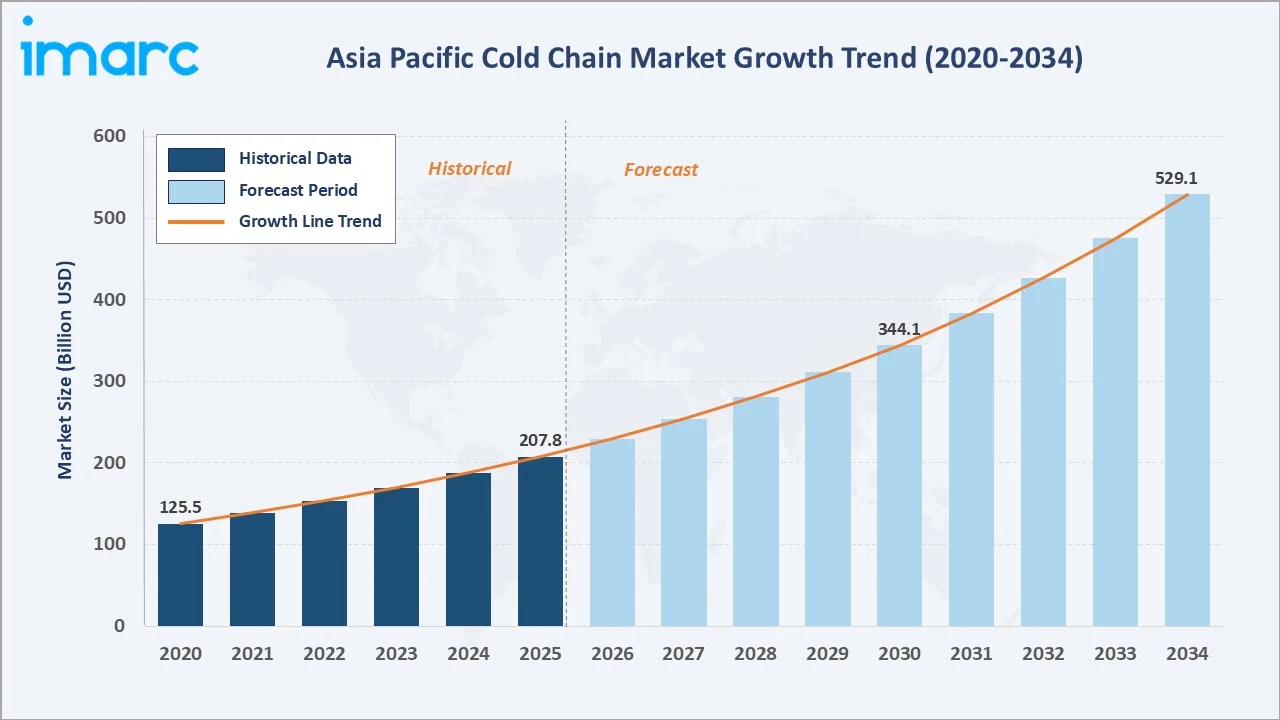
The Asia Pacific cold chain market grew from USD 207.8 Billion in 2025 to USD 236.0 Billion in 2026 and is projected to reach USD 529.1 Billion by 2034, growing at a CAGR of 10.62% during 2026-2034. Rising pharmaceutical logistics demand, e-commerce growth, and frozen food consumption are driving expansion. Refrigerated storage leads service type at 58.6%, food and beverages leads end user at 61.8%, and China leads regionally at 38.6%.
Market Snapshot
|
Metric |
Value |
|
Base Year Market Size (2025) |
USD 207.8 Billion |
| Market Size (2026) | USD 236.0 Billion |
|
Forecast Market Size (2034) |
USD 529.1 Billion |
|
CAGR (2026-2034) |
10.62% |
|
Base Year |
2025 |
|
Historical Period |
2020-2025 |
|
Forecast Period |
2026-2034 |
|
Dominant Service Type |
Refrigerated Storage (58.6%, 2025) |
|
Dominant End User |
Food and Beverages (61.8%, 2025) |
|
Leading Region |
China (38.6%, 2025) |
The Asia Pacific cold chain market expanded from USD 125.5 Billion in 2020 to USD 207.8 Billion in 2025 and an estimated USD 236.0 Billion in 2026, is anchored at USD 344.1 Billion in 2030, and is forecast to reach USD 529.1 Billion by 2034, reflecting sustained double-digit compounded annual growth across the region.
To get more information on this market, Request Sample
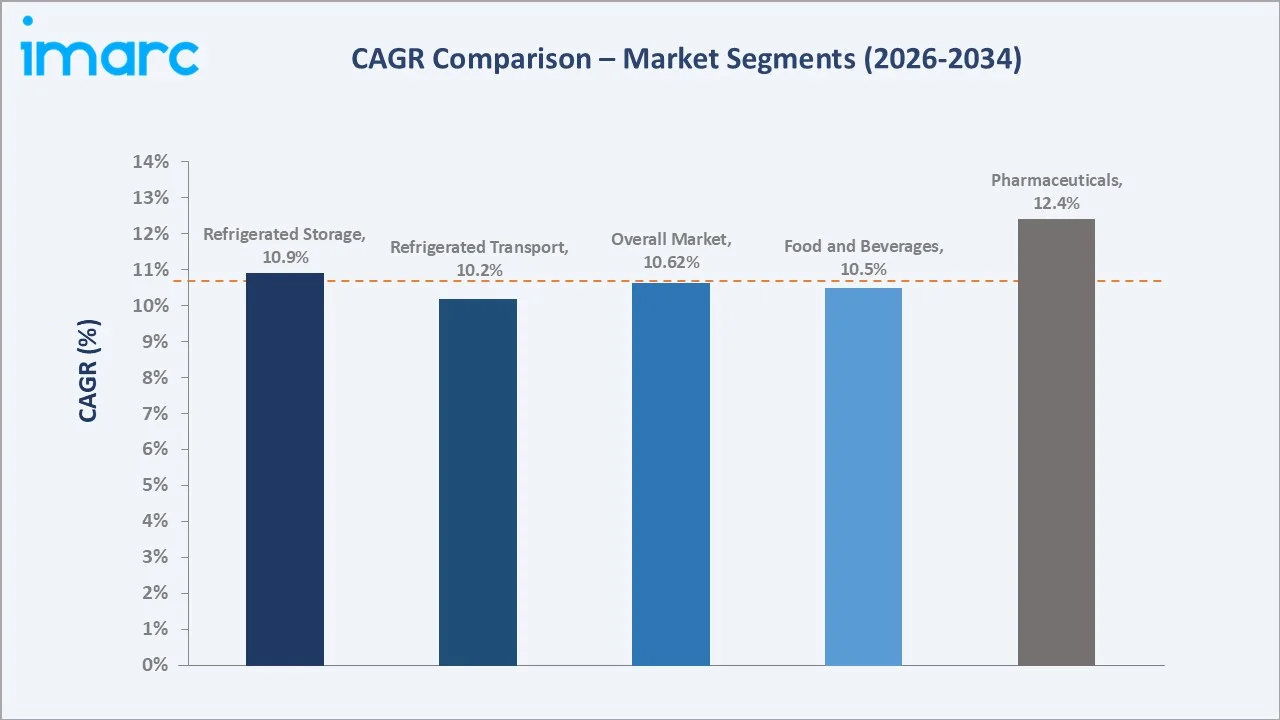
Pharmaceutical cold chain grows fastest at an estimated ~12.4% CAGR as temperature-sensitive biologics and vaccine distribution expands. Refrigerated storage grows at ~10.9% CAGR through continued warehouse capacity build-out across food processing and pharmaceutical distribution hubs region-wide.
Executive Summary
The Asia Pacific cold chain market reached USD 207.8 Billion in 2025 and is estimated to reach USD 236.0 Billion in 2026, representing a critical intersection of food security, pharmaceutical distribution, and modern retail infrastructure. The market spans refrigerated storage facilities, temperature-controlled transport fleets, monitoring technology, and packaging solutions serving perishable food and healthcare supply chains.
Refrigerated storage at 58.6% dominates through large-scale warehousing investment. Food and beverages at 61.8% leads to end-user demand via rising frozen and packaged food consumption. China, at 38.6%, leads regionally through its expansive manufacturing base, population scale, and continued cold storage infrastructure investment.
Key Market Insights
|
Insight |
Data |
|
Dominant Service Type |
Refrigerated Storage - 58.6% share (2025) |
|
Dominant End User |
Food and Beverages - 61.8% market share (2025) |
|
Leading Region |
China - 38.6% market share (2025) |
|
Market Opportunity |
Pharma cold chain expansion; IoT monitoring; quick-commerce cold logistics; sustainable refrigerants |
Key Analytical Observations Supporting the Above Data:
- Refrigerated Storage at 58.6%: Refrigerated storage dominates due to rising warehousing investment, longer shelf-life requirements, and expansion of organized food retail and pharmaceutical distribution networks across the region.
- Food and Beverages at 61.8%: Food and beverages leads through rising frozen food consumption, e-commerce grocery delivery growth, and increasing demand for fresh produce, dairy, seafood, and meat across urban Asia Pacific markets.
- China at 38.6%: China dominates through its vast manufacturing and consumption base, extensive cold storage capacity, and continued government investment in agricultural and pharmaceutical logistics infrastructure nationwide.
Asia Pacific Cold Chain Market Overview
The Asia Pacific cold chain market encompasses refrigerated storage facilities, temperature-controlled transportation, and supporting technologies used to preserve perishable food and pharmaceutical products from origin to end consumer, ensuring product quality, safety, and regulatory compliance across the distribution chain.
Market Dynamics
To evaluate market opportunities, Request Sample
Market Drivers
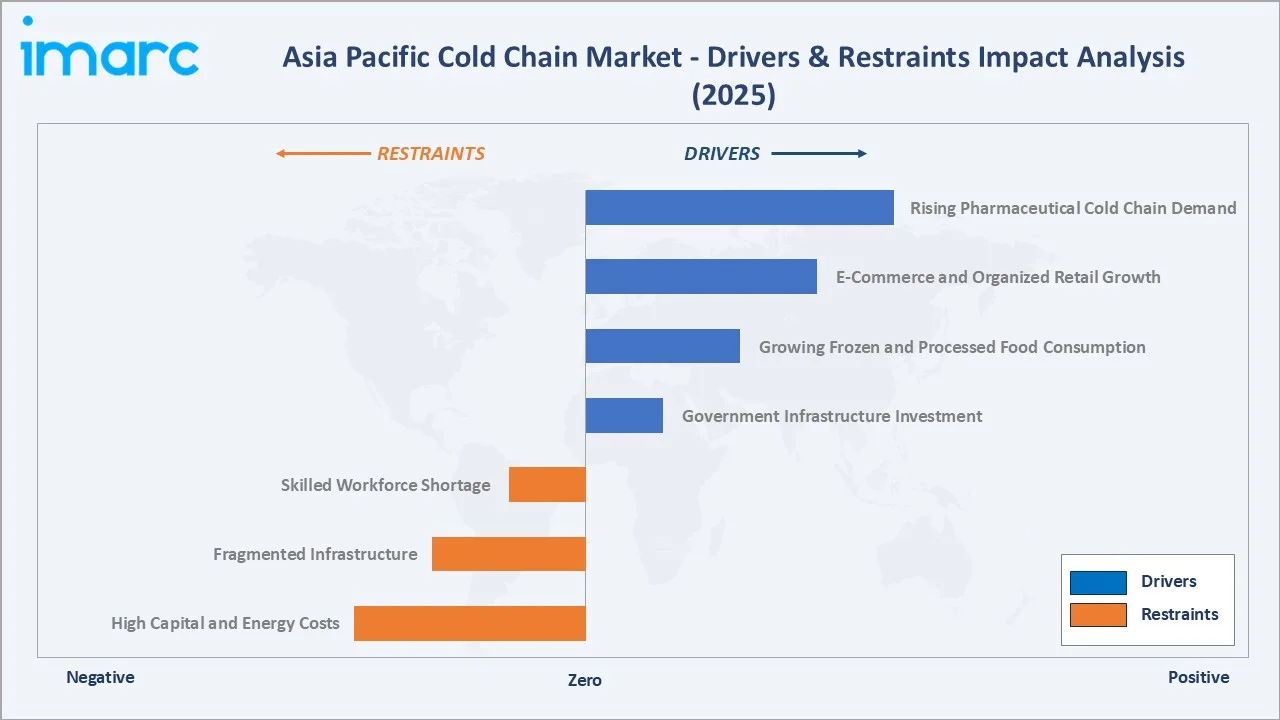
- Rising Pharmaceutical Cold Chain Demand: Increasing demand for vaccines, biologics, and clinical trial materials is driving investment in temperature-controlled pharmaceutical logistics infrastructure and specialized cold storage capacity across the region.
- E-Commerce and Organized Retail Growth: Expanding online grocery and food delivery platforms are increasing the need for last-mile refrigerated logistics, prompting investment in cold storage hubs and temperature-controlled delivery fleets.
- Growing Frozen and Processed Food Consumption: Rising incomes and changing dietary preferences are increasing consumption of frozen, chilled, and processed food products, boosting demand for refrigerated storage and transport capacity.
- Government Infrastructure Investment: National food security and public health programs are funding cold storage and logistics infrastructure development, particularly across emerging Asia Pacific economies with expanding agricultural output.
Market Restraints
- High Capital and Energy Costs: Building and operating temperature-controlled facilities and fleets requires substantial capital and continuous energy expenditure, limiting adoption among smaller logistics operators and developing markets.
- Fragmented Infrastructure: Inconsistent cold storage and transport infrastructure across rural and developing areas creates supply chain gaps, product spoilage risk, and increased operational complexity for logistics providers.
- Skilled Workforce Shortage: A shortage of trained technicians and logistics professionals familiar with cold chain equipment and monitoring systems constrains service quality and operational scalability across the region.
Market Opportunities
- Pharmaceutical Cold Chain Expansion: Expanding biologics, vaccine, and clinical trial distribution needs create sustained demand for validated pharmaceutical-grade cold storage and monitored transport capacity across regional healthcare markets.
- IoT-Enabled Monitoring Technology: IoT sensors and real-time temperature monitoring platforms offer logistics providers recurring subscription revenue while improving compliance and reducing product spoilage across storage and transport networks.
- Quick-Commerce Cold Logistics: Rapid grocery and food delivery platforms are creating demand for micro-fulfillment centers and last-mile refrigerated delivery capacity across densely populated Asia Pacific urban markets.
Market Challenges
- Regulatory Fragmentation Across Markets: Diverse regulatory standards and certification requirements across Asia Pacific countries increase compliance complexity for cold chain operators serving multiple national and cross-border markets.
- Rising Energy and Refrigerant Transition Costs: Rising electricity costs and refrigerant transition requirements increase operating expenses, pressuring margins for cold storage operators amid intensifying regional price competition.
Emerging Market Trends
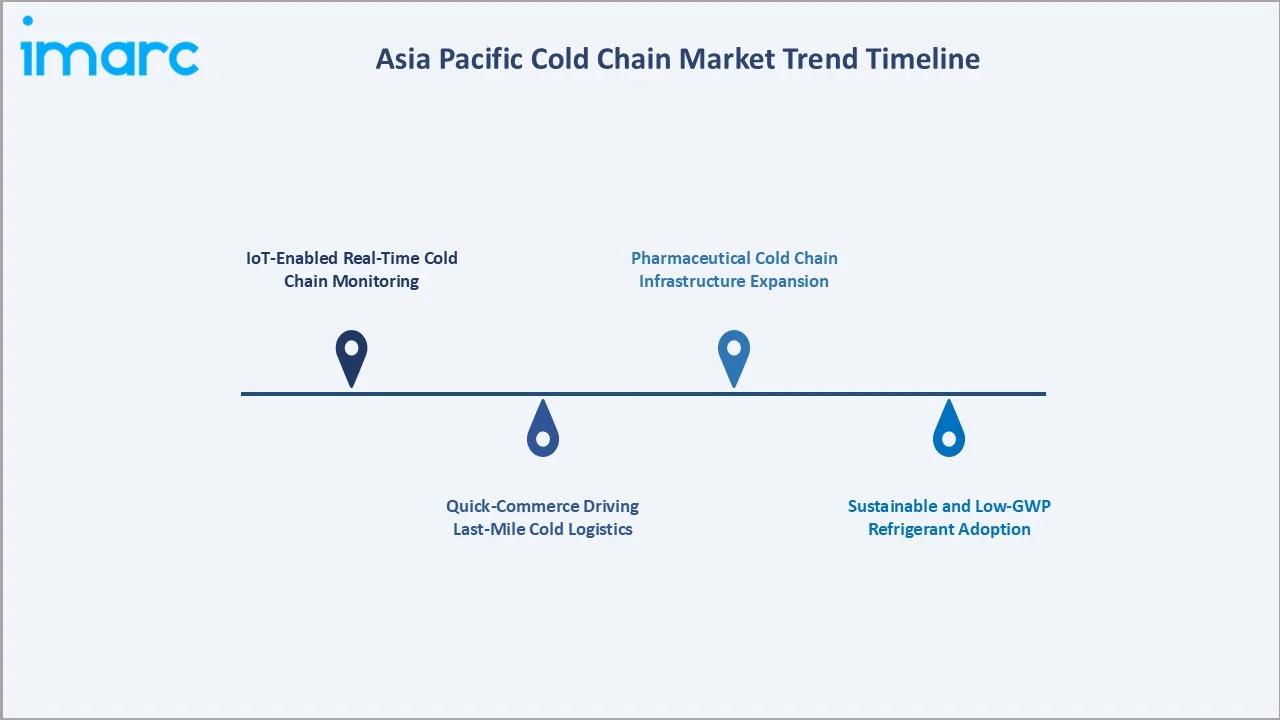
1. IoT-Enabled Real-Time Cold Chain Monitoring
IoT sensors and real-time temperature tracking are being deployed across storage and transport to reduce spoilage, ensure regulatory compliance, and provide end-to-end shipment visibility for pharmaceutical and food logistics operators.
2. Quick-Commerce Driving Last-Mile Cold Logistics
Rapid grocery and food delivery platforms are expanding demand for micro-fulfillment centers and last-mile refrigerated delivery, reshaping urban cold chain network design across densely populated Asia Pacific cities.
3. Sustainable and Low-GWP Refrigerant Adoption
Regulatory pressure and sustainability goals are accelerating adoption of natural and low-global-warming-potential refrigerants, reshaping equipment specifications across new cold storage and refrigerated transport investments.
4. Pharmaceutical Cold Chain Infrastructure Expansion
Growing biologics, vaccine, and clinical trial distribution needs are driving specialized pharmaceutical-grade cold storage and validated transport capacity investment across major regional healthcare and logistics hubs.
5. Automation and Robotics in Cold Storage Facilities
Automated storage and retrieval systems and robotics are being adopted in refrigerated warehouses to improve throughput, reduce labor dependency, and maintain consistent temperature control in demanding cold environments.
Industry Value Chain Analysis
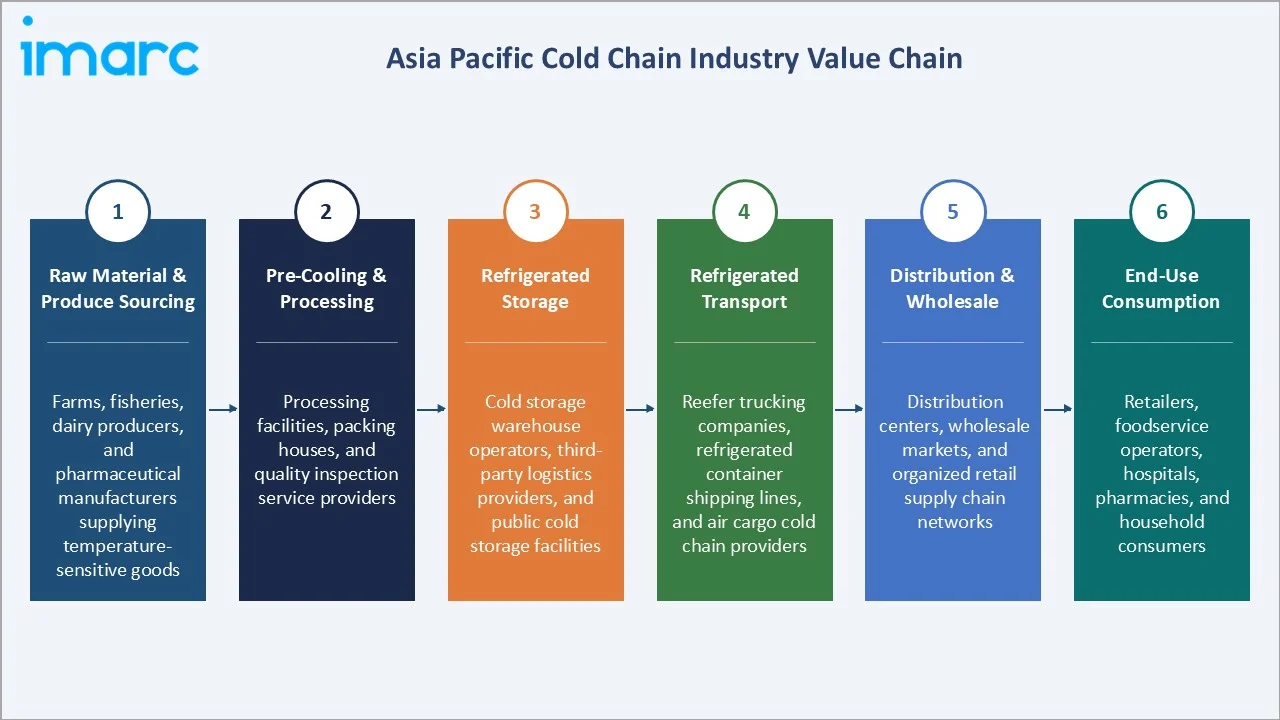
The Asia Pacific cold chain value chain spans raw material and produce sourcing, pre-cooling and processing, refrigerated storage, refrigerated transport, distribution and wholesale, and final end-use consumption, each requiring continuous temperature control to preserve product integrity.
|
Stage |
Key Participants |
|
Raw Material & Produce Sourcing |
Farms, fisheries, dairy producers, and pharmaceutical manufacturers supplying temperature-sensitive goods |
|
Pre-Cooling & Processing |
Processing facilities, packing houses, and quality inspection service providers |
|
Refrigerated Storage |
Cold storage warehouse operators, third-party logistics providers, and public cold storage facilities |
|
Refrigerated Transport |
Reefer trucking companies, refrigerated container shipping lines, and air cargo cold chain providers |
|
Distribution & Wholesale |
Distribution centers, wholesale markets, and organized retail supply chain networks |
|
End-Use Consumption |
Retailers, foodservice operators, hospitals, pharmacies, and household consumers |
Refrigerated storage and transport form the value chain's most capital-intensive and technically demanding stages, requiring continuous temperature control, backup power, and real-time monitoring. Pre-cooling and processing preserve product quality before storage, while distribution and wholesale networks sustain shelf life through final delivery.
Technology Landscape in the Asia Pacific Cold Chain Industry
Automated Cold Storage and Robotic Warehousing Systems
Automated storage and retrieval systems and warehouse robotics are increasingly deployed in refrigerated facilities to improve pallet density, throughput, and inventory accuracy. These systems reduce manual labor in sub-zero environments and support consistent temperature control across high-volume food and pharmaceutical storage operations.
Reefer Container and Refrigerated Transport Technology
Advanced reefer trucks, containers, and rail cars with multi-temperature compartments and improved insulation are expanding cross-border and last-mile cold chain capacity. Telematics-enabled fleets provide real-time location and temperature data, helping logistics providers reduce transit spoilage and meet regulatory compliance requirements.
IoT and Real-Time Cold Chain Monitoring Platforms
IoT sensors, data loggers, and cloud-based monitoring platforms provide continuous visibility into temperature, humidity, and location across storage and transport. In July 2025, ELPRO launched libreMANAGER 3.0, an updated monitoring platform with built-in real-time visibility features for cold chain data logger networks. Such platforms help reduce spoilage and strengthen regulatory compliance.
Market Segmentation Analysis
The report covers the following segments:
|
Segment Category |
Leading Segment |
Market Share |
Year |
|
Service Type |
Refrigerated Storage |
58.6% |
2025 |
|
Temperature |
Chilled |
🔒 |
2025 |
|
End User |
Food and Beverages |
61.8% |
2025 |
|
Region |
China |
38.6% |
2025 |

By Service Type
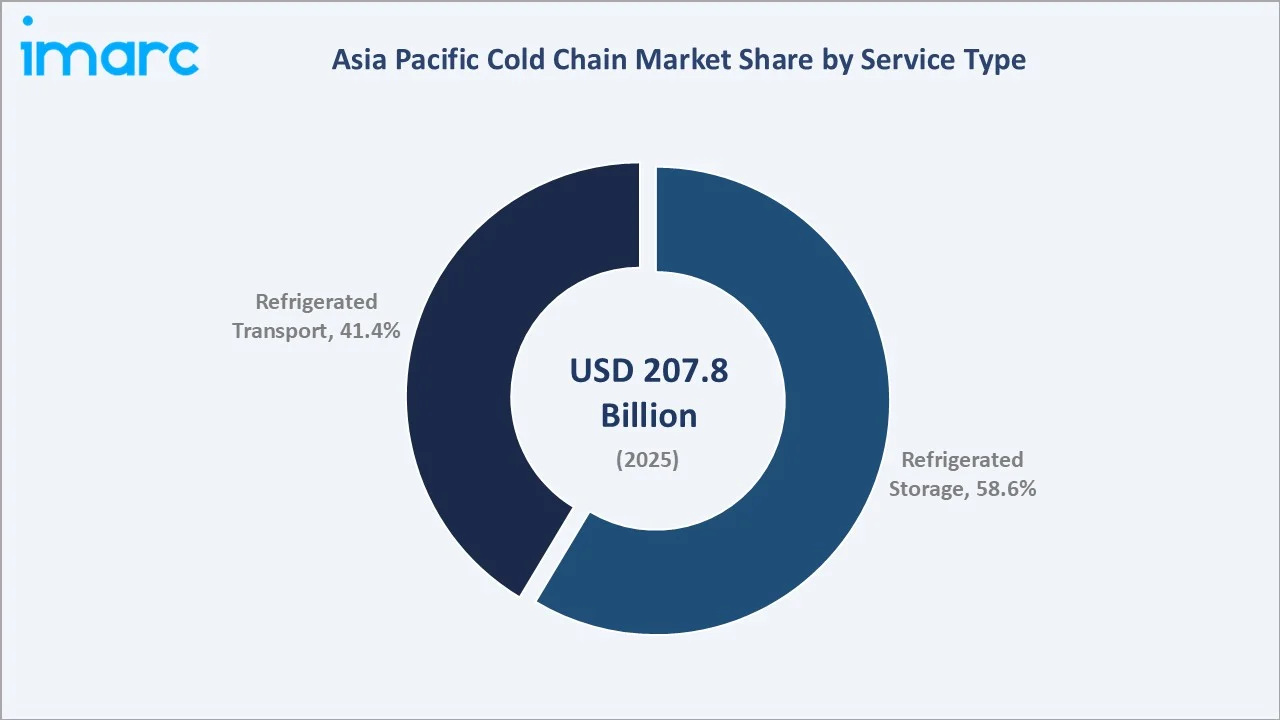
Refrigerated storage leads at 58.6% (2025) and grows at an estimated ~10.9% CAGR, encompassing public and private cold storage warehouses serving food processing, pharmaceutical, and chemical distribution across the region.
To access detailed market analysis, Request Sample
Refrigerated transport at 41.4% grows at ~10.2% CAGR, covering reefer trucking, rail, and cold chain shipping. Growth is supported by rising cross-border trade and expanding last-mile refrigerated delivery infrastructure across urban markets.
By End User
Food and beverages leads at 61.8% (2025) and grows at ~10.5% CAGR, driven by rising frozen and fresh produce demand, e-commerce grocery delivery, and expanding organized retail distribution channels across the region.
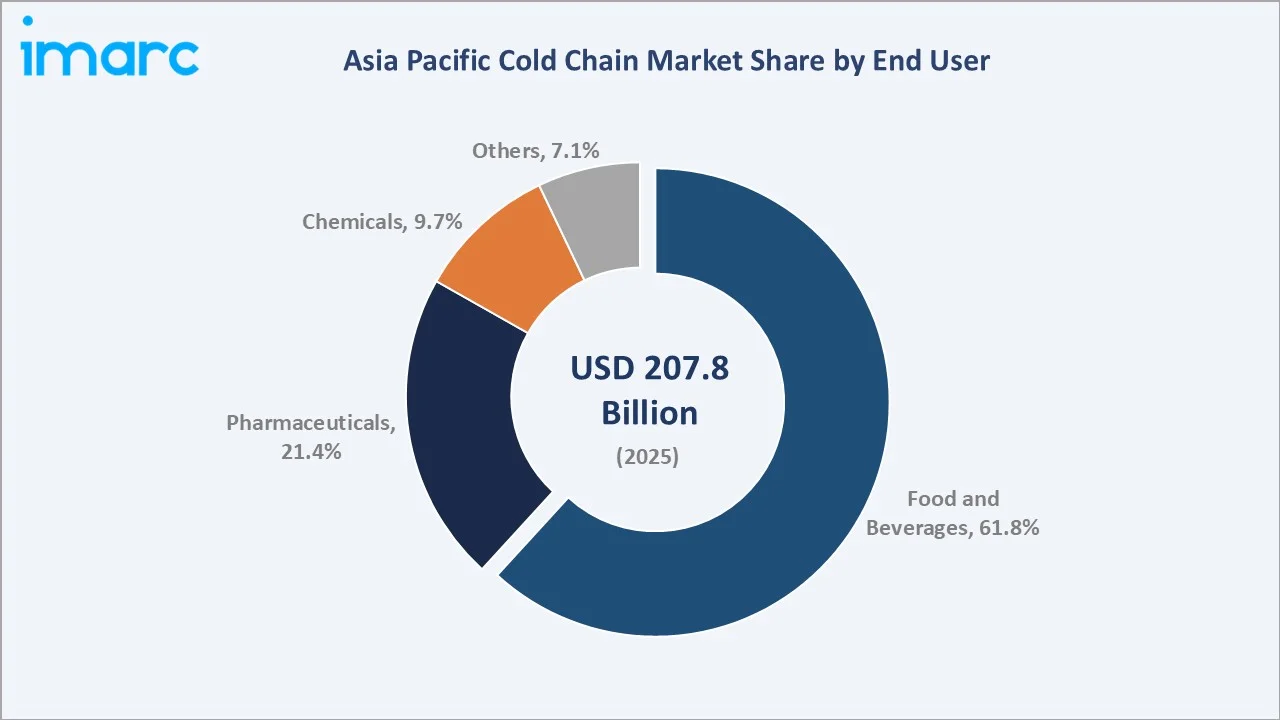
Pharmaceuticals at 21.4% is the fastest-growing end user at ~12.4% CAGR through expanding biologics and vaccine distribution. Chemicals hold 9.7%, while others, including floriculture and specialty goods, account for 7.1%.
Regional Market Insights
|
Region |
Share (2025) |
Key Cold Chain Market Drivers & Characteristics |
|
China |
38.6% |
Driven by large-scale manufacturing, expansive population base, and sustained government investment in agricultural and pharmaceutical cold storage infrastructure. |
|
India |
19.8% |
Supported by rapid organized retail growth, e-commerce grocery expansion, and government food security and cold storage subsidy programs. |
|
Japan |
12.7% |
Driven by advanced pharmaceutical logistics standards, an aging population's healthcare needs, and strong quality-controlled food distribution networks. |
|
Australia |
8.9% |
Supported by export-oriented agriculture, meat and dairy production, and strict regulatory compliance across cold chain logistics. |
|
South Korea |
7.2% |
Driven by advanced retail infrastructure, high frozen food consumption, and strong pharmaceutical cold chain regulatory frameworks. |
|
Singapore |
4.8% |
Supported by its role as a regional logistics and pharmaceutical distribution hub with advanced cold chain infrastructure. |
|
Others |
8.0% |
Includes Southeast Asian markets experiencing rising cold storage investment amid expanding food and pharmaceutical distribution needs. |
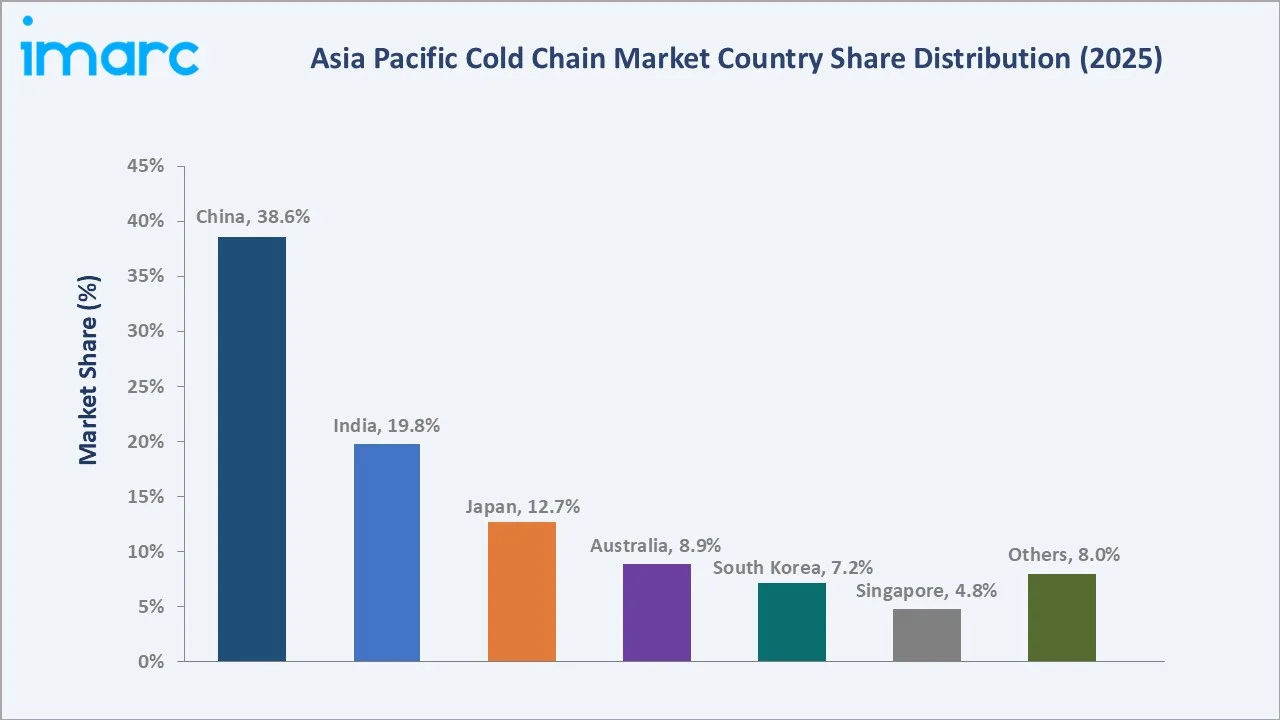
China's 38.6% leadership is anchored by its scale of food processing and pharmaceutical manufacturing. India's 19.8% reflects rapid quick-commerce and organized retail expansion, while Japan's 12.7% is supported by stringent pharmaceutical logistics standards.
Competitive Landscape
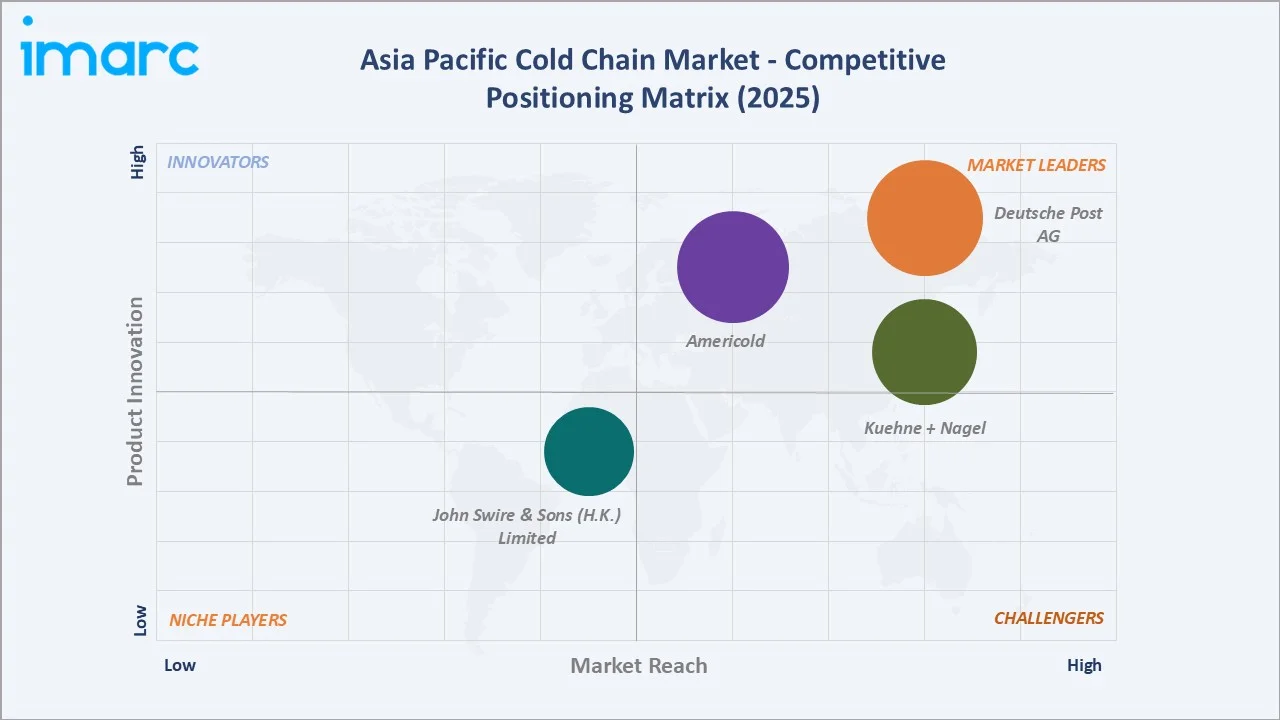
The Asia Pacific cold chain competitive landscape encompasses global integrated logistics providers, dedicated cold storage operators, and regional refrigerated transport specialists, with leading players differentiated by network scale, temperature-controlled capacity, and service reliability.
|
Company Name |
Key Services |
Market Position |
Core Strength |
|
Americold |
Cold Chain Solutions |
Market Leader |
Extensive global cold storage warehouse network and integrated distribution services |
|
Deutsche Post AG |
Cold Chain Freight, Pharma Logistics |
Market Leader |
Global logistics scale with specialized pharmaceutical cold chain capabilities |
|
John Swire & Sons (H.K.) Limited |
Cold Storage |
Established Player |
Strong regional presence across Asia Pacific cold storage and logistics |
|
Kuehne + Nagel |
Cold chain and temperature-controlled solutions |
Market Leader |
Comprehensive global freight network with dedicated cold chain solutions |
Global integrated logistics providers hold leading positions through scale advantages and pharmaceutical-grade compliance capabilities. Regional operators sustain competitiveness through localized network density and specialized frozen food storage expertise across established Asia Pacific markets.
Key Company Profiles
Americold Logistics LLC
- Key Services: Temperature-controlled warehousing, transportation management, and integrated supply chain services for food and beverage customers.
- Recent Developments: In June 2026, Americold opened its new import-export cold chain facility at Port Saint John in New Brunswick, Canada, developed in collaboration with DP World and Canadian Pacific Kansas City (CPKC). The facility integrates Americold’s temperature-controlled storage with maritime and rail logistics, creating a direct route for moving perishable products between inland production regions and international markets. The project follows Americold’s $75–80 million investment announced in 2025 and provides approximately 22,000 pallet positions.
- Strategic Focus: Focused on expanding warehouse capacity, automation adoption, and integrated cold chain distribution services for food and beverage manufacturers.
Deutsche Post AG
- Key Services: Global freight forwarding, contract logistics, and specialized life sciences and healthcare cold chain transportation services.
- Recent Developments: In February 2026, DHL Supply Chain signed an MOU with RLCold to develop more than 5 million square feet of advanced temperature-controlled facilities across North America. The companies plan to jointly pursue multi-temperature distribution centers and turnkey food-grade cold-storage solutions. DHL highlighted the need to modernize aging cold-storage infrastructure with automation-ready facilities positioned closer to food and beverage production and consumption markets.
- Strategic Focus: Centered on expanding pharmaceutical logistics infrastructure and digital shipment visibility across global cold chain operations.
Kuehne + Nagel International AG
- Key Services: Sea and air freight forwarding, contract logistics, and dedicated pharmaceutical and perishable goods cold chain solutions.
- Recent Developments: In July 2026, Kuehne+Nagel expanded its Cool Corridor network for temperature-sensitive healthcare logistics by adding four new dedicated routes: Frankfurt–Atlanta, Chicago–Narita, Brussels–São Paulo, and Chicago–São Paulo. The expansion brings the company’s network to 12 temperature-controlled airfreight lanes connecting major pharmaceutical hubs across Europe, North America, Asia-Pacific, and Latin America. The GDP-compliant corridors are designed to minimise temperature excursions for vaccines, biologics, peptides, and other temperature-sensitive products, while enabling customers to use lighter passive packaging.
- Strategic Focus: Focused on digitalization of cold chain visibility and expansion of validated pharmaceutical and perishable freight capacity.
Nichirei Logistics Group Inc.
- Key Services: Frozen and chilled food storage, refrigerated transportation, and distribution services across Japan and the broader region.
- Recent Developments: In September 2025, the company completed a merger and acquisition transaction with Integrated Cold Chain Logistics, expanding its temperature-controlled storage and distribution footprint.
- Strategic Focus: Centered on frozen food storage network modernization and regional distribution capacity expansion across Asia Pacific markets.
Market Concentration Analysis
The Asia Pacific cold chain market remains moderately fragmented, with global integrated logistics providers holding leading positions in pharmaceutical and cross-border cold chain segments, while regional and domestic operators maintain strong positions in localized frozen food storage and distribution.
Investment & Growth Opportunities
Highest Growth Segments
Pharmaceutical cold chain (~12.4% CAGR), refrigerated storage capacity expansion (~10.9% CAGR), IoT-enabled monitoring technology, and quick-commerce last-mile refrigerated logistics represent the highest-growth Asia Pacific cold chain investment vectors through 2034.
Emerging Investment Opportunities
India's expanding organized retail and government cold storage subsidy programs represent a significant near-term opportunity. Providers establishing early distribution infrastructure and pharmaceutical-grade storage capacity are positioned for above-market growth as investment accelerates.
Investment Themes
- Pharmaceutical Cold Chain Infrastructure: Investment in validated pharmaceutical-grade cold storage and monitored transport capacity supports growing biologics and vaccine distribution demand across regional healthcare markets.
- Digital Cold Chain Monitoring Platforms: Deployment of IoT sensors and real-time temperature monitoring platforms creates recurring revenue opportunities while improving compliance and reducing product spoilage across cold chain networks.
Future Market Outlook (2026-2034)
The Asia Pacific cold chain market is projected to grow from USD 207.8 Billion in 2025 to USD 236.0 Billion in 2026 and is forecast to reach USD 529.1 Billion by 2034, delivering 10.62% CAGR. The market's anchor value of USD 344.1 Billion in 2030 reflects sustained infrastructure investment across pharmaceutical and food logistics segments.
Structural demand drivers, including pharmaceutical distribution growth, e-commerce grocery expansion, and rising frozen food consumption, are expected to sustain above-trend growth through 2034, supported by continued government infrastructure investment across developing Asia Pacific markets.
Research Methodology
Primary Research
Primary research comprised structured interviews with industry stakeholders, including logistics executives, cold storage operators, pharmaceutical supply chain managers, and regional distribution specialists across the Asia Pacific cold chain market.
Secondary Research
Secondary research encompassed industry publications, trade association data, government infrastructure reports, company disclosures, and regional logistics statistics relevant to the Asia Pacific cold chain market.
Forecasting Models
Market revenue forecasts were developed using a segment bottom-up model incorporating service type, end user, and regional demand components validated against historical growth patterns and primary research inputs.
Report Coverage:
| Report Features | Details |
|---|---|
| Base Year of the Analysis | 2025 |
| Historical Period | 2020-2025 |
| Forecast Period | 2026-2034 |
| Units | Billion USD |
| Scope of the Report | Exploration of Historical Trends and Market Outlook, Industry Catalysts and Challenges, Segment-Wise Historical and Future Market Assessment:
|
| Service Types Covered | Refrigerated Storage, Refrigerated Transport |
| Tempratures Covered | Chilled, Frozen |
| End Users Covered | Food and Beverages, Pharmaceuticals, Chemicals, Others |
| Countries Covered | China, India, Japan, Australia, Singapore, South Korea, Others |
| Companies Covered | Americold, Deutsche Post AG, John Swire & Sons (H.K.) Limited, Kuehne + Nagel, etc. |
| Customization Scope | 10% Free Customization |
| Post-Sale Analyst Support | 10-12 Weeks |
| Delivery Format | PDF and Excel through Email (We can also provide the editable version of the report in PPT/Word format on special request) |
Frequently Asked Questions About the Asia Pacific Cold Chain Market Report
The Asia Pacific cold chain market size is estimated at USD 236.0 Billion in 2026, driven by rising pharmaceutical logistics demand, e-commerce grocery growth, and increasing frozen and processed food consumption across the region.
The market is projected to grow at a 10.62% CAGR during 2026-2034, reaching USD 529.1 Billion by 2034, supported by continued infrastructure investment and rising temperature-sensitive product demand.
Refrigerated storage leads at 58.6% through large-scale warehousing investment supporting food processing, pharmaceutical, and chemical distribution across the region.
Food and beverages leads at 61.8%, driven by rising frozen food consumption, e-commerce grocery delivery growth, and expanding organized retail distribution channels.
China leads at 38.6% through its expansive manufacturing base, large population, and sustained government investment in cold storage and logistics infrastructure.
Leading companies include Americold, Deutsche Post AG, John Swire & Sons (H.K.) Limited and Kuehne + Nagel among others.
The market is projected to reach approximately USD 344.1 Billion by 2030, reflecting sustained double-digit growth across pharmaceutical, food, and e-commerce logistics segments.
Pharmaceutical cold chain is the fastest-growing end-user segment at an estimated 12.4% CAGR, driven by expanding biologics, vaccine, and clinical trial material distribution across regional healthcare markets.
Need more help?
- Speak to our experienced analysts for insights on the current market scenarios.
- Include additional segments and countries to customize the report as per your requirement.
- Gain an unparalleled competitive advantage in your domain by understanding how to utilize the report and positively impacting your operations and revenue.
- For further assistance, please connect with our analysts.
 Request Customization
 Speak to an Analyst
 Request Brochure
 Inquire Before Buying
Benefits of Customization
- Personalize this research
- Triangulate with your data
- Get data as per your format and definition
- Gain a deeper dive into a specific application, geography, customer, or competitor
- Any level of personalization
Get in Touch With Us
UNITED STATES
Phone: +1-201-971-6302
INDIA
Phone: +91-120-433-0800
UNITED KINGDOM
Phone: +44-753-714-6104
Email: [email protected]
Client Testimonials




.webp)




.webp)













Related Reports

Choose your plan
*Please note that the prices mentioned below are starting prices for each bundle type. Kindly contact our team for further details.*
Single User License
- 1 User License, Access on 2 Devices
- PDF Report + Excel Dataset (Password Protected)
- Lifetime Access
- No Printing Rights
- 10% Free Report Customization
- 10–12 Weeks of Analyst Support
Five User License
- Access for 5 Users, 2 Devices per User
- PDF Report + Excel Dataset (Password Protected)
- Lifetime Access
- Dedicated Account Manager
- 12–14 Weeks of Analyst Support
- No Printing Rights
- 15% Free Report Customization
- 25% Discount on Your Next Purchase
Corporate User License
- Unlimited User Access (Within Your Organization)
- PDF Report + Excel Dataset
- Lifetime Access
- Dedicated Account Manager
- 14–20 Weeks of Analyst Support
- No Printing Rights
- 20% Free Report Customization
- 30% Discount on Your Next Purchase
Essential Insights
What's included:
3 reports
- Lifetime Access
- PDF Reports
- Excel Datasets
- 2 Weeks of Free Analyst Support
- 2 User Licenses
- Access on 2 Devices
- Printing Rights
- Complimentary PowerPoint (PPT) Version
- Complimentary License Upgrade
Professional Access
What's included:
5 reports
- Lifetime Access
- PDF Reports
- Excel Datasets
- 8 Weeks of Free Analyst Support
- 2 User Licenses
- Access on 2 Devices
- Printing Rights
- Complimentary PowerPoint (PPT) Version
- Complimentary License Upgrade
Business Advantage
What's included:
8 reports
- Lifetime Access
- PDF Reports
- Excel Datasets
- 14 Weeks of Free Analyst Support
- 2 User Licenses
- Access on 2 Devices
- Printing Rights
- Complimentary PowerPoint (PPT) Version
- Complimentary License Upgrade
Enterprise Intelligence
What's included:
10 reports
- Lifetime Access
- PDF Reports
- Excel Datasets
- 20 Weeks of Free Analyst Support
- 2 User Licenses
- Access on 2 Devices
- Printing Rights
- Complimentary PowerPoint (PPT) Version
- Complimentary License Upgrade