
Asia Pacific Digital Asset Management Market Size, Share, Trends and Forecast by Type, Component, Application, Deployment, Organization Size, End Use Sector, and Country, 2026-2034
Asia Pacific Digital Asset Management Market Size, Share, Trends & Forecast (2026-2034)
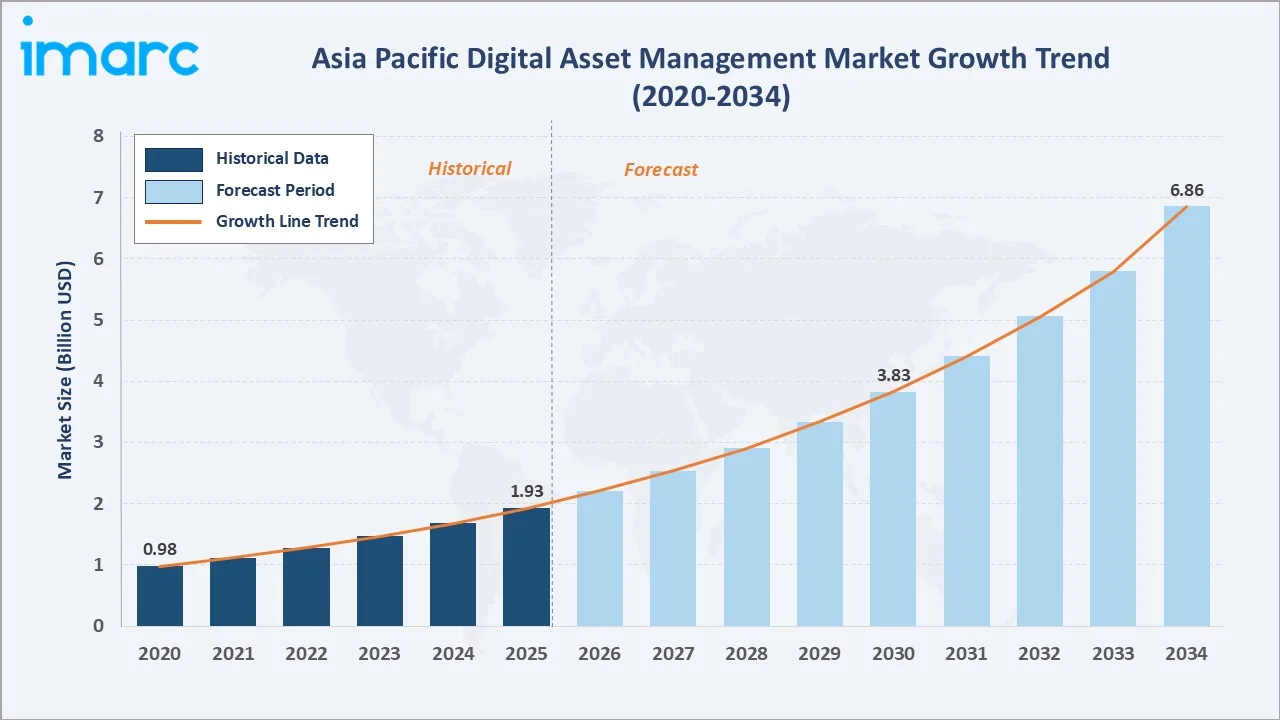
The Asia Pacific digital asset management market grew from USD 1.93 Billion in 2025 to USD 2.30 Billion in 2026 and is projected to reach USD 6.86 Billion by 2034, exhibiting a CAGR of 14.66% during 2026-2034. The market is driven by rapid digitalization, rising internet and smartphone penetration, expanding e-commerce and social media activity, and growing enterprise demand for centralized content management. India recorded approximately 1,002.85 million internet subscribers during April–June 2025. Expanding internet access is accelerating digital content creation, e-commerce, social media engagement, and online marketing, increasing the volume of images, videos, documents, and other digital assets generated by businesses. Brand asset management systems lead the type at 47.8%, solutions dominate the component at 72.4%, and China accounts for the largest country share at 31.7%.
Market Snapshot
|
Metric |
Value |
|
Base Year Market Size (2025) |
USD 1.93 Billion |
| Market Size (2026) | USD 2.30 Billion |
|
Forecast Market Size (2034) |
USD 6.86 Billion |
|
CAGR (2026-2034) |
14.66% |
|
Base Year |
2025 |
|
Historical Period |
2020-2025 |
|
Forecast Period |
2026-2034 |
|
Dominant Type |
Brand Asset Management System – 47.8% (2025) |
|
Dominant Component |
Solution – 72.4% (2025) |
|
Leading Country |
China – 31.7% (2025) |
The APAC digital asset management (DAM) market grew from USD 0.98 Billion in 2020 to USD 1.93 Billion in 2025 and an estimated USD 2.30 Billion in 2026, driven by the COVID-19 pandemic’s accelerated digital transformation across APAC enterprises, the e-commerce boom requiring product image and video management at scale, the explosion of short-form video content creating new asset formats, and the progressive adoption of cloud DAM platforms by APAC’s largest retail, media, and manufacturing companies. The market is projected to reach USD 3.83 Billion by 2030 and USD 6.86 Billion by 2034.
To get more information on this market, Request Sample
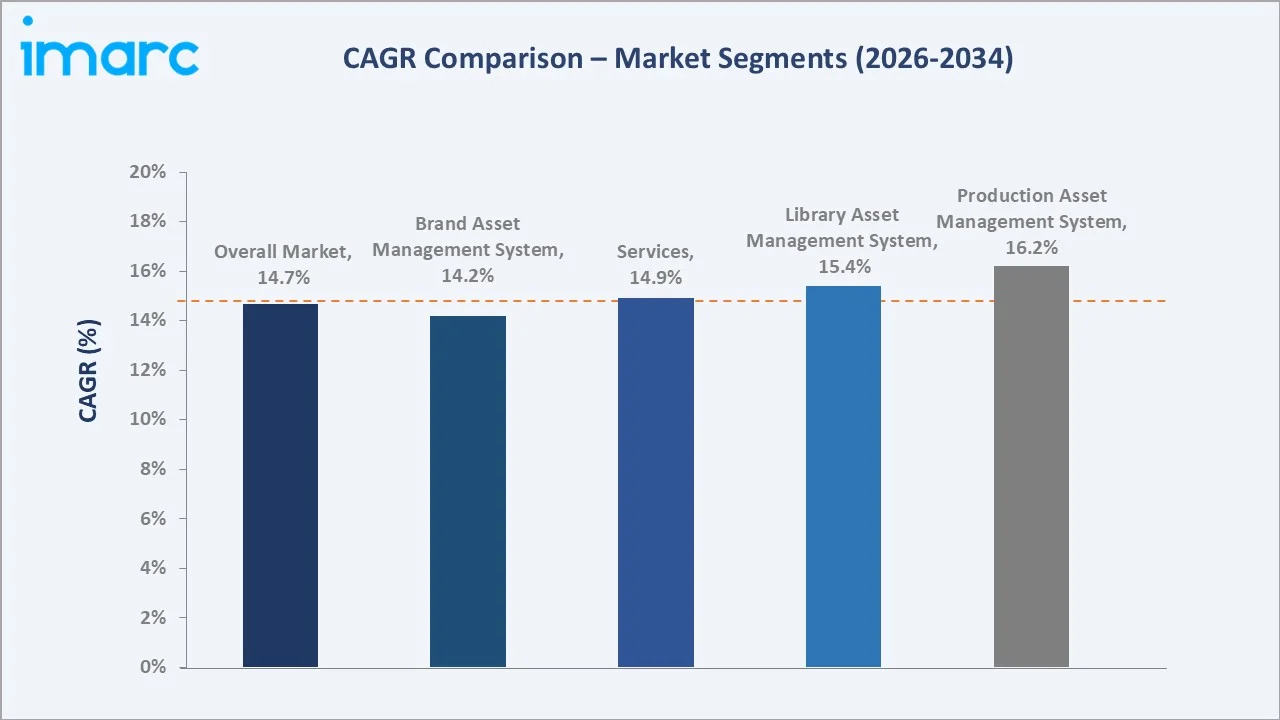
Production asset management system grows fastest at ~16.20% CAGR through APAC’s media & entertainment production boom and streaming content explosion. Library asset management system grows at ~15.40% CAGR through digital archive modernization and regulatory compliance demands. Services grow at ~14.90% CAGR through system integration and managed DAM implementation services demand. Brand asset management system grows at ~14.20% CAGR through APAC’s omnichannel brand consistency requirements across diverse regional markets.
Executive Summary
The Asia Pacific digital asset management market represents one of the technology sector’s most compelling high-growth investment opportunities, combining the world’s largest internet user base, the most dynamic e-commerce ecosystem, and the most rapid enterprise digital transformation trajectory of any global region into a structural demand engine for intelligent, scalable digital asset management platforms. Unlike commodity cloud storage, DAM platforms deliver unique value through AI-powered metadata automation, rights and license management, version control and workflow management, and omnichannel distribution capabilities.
Brand asset management systems’ 47.8% market dominance reflects the fundamental priority APAC’s largest corporations place on brand consistency. Solution component at 72.4% reflects APAC’s enterprise preference for integrated SaaS DAM platforms over fragmented point services, with the growing adoption of cloud-native multi-tenant DAM solutions by APAC’s mid-market segment. China’s 31.7% country share reflects its unique combination of the world’s largest digital content production ecosystem, its advanced e-commerce requiring product asset management at billion-SKU scale and growing domestic DAM vendor development.
Key Market Insights
|
Insight |
Data |
|
Dominant Type |
Brand Asset Management System – 47.8% share (2025) |
|
Dominant Component |
Solution – 72.4% share (2025) |
|
Leading Country |
China – 31.7% share (2025) |
|
Market Opportunity |
AI-generated content (AIGC) asset governance and provenance tracking for APAC enterprise brands; metaverse and XR asset management for APAC gaming, retail, and education sectors; headless DAM API integrations for APAC’s composable commerce platforms |
Key Analytical Observations:
- Brand Asset Management System at 47.8% (2025): Brand asset management systems, purpose-built DAM platforms specifically designed for brand governance, marketing operations, and creative workflow management, command APAC’s largest DAM market share through the universal requirement of APAC’s companies and digital-native brands to maintain brand consistency across the countries, official languages, and millions of brand touchpoints spanning e-commerce platforms, social media channels, retail point-of-sale, advertising, and partner networks.
- Solution Component at 72.4% (2025): APAC’s enterprise technology buyer preference for integrated SaaS platform solutions over fragmented point services is driving the solution component’s dominant share, reflecting the structural shift from on-premises enterprise software to cloud-native SaaS DAM subscriptions that eliminate infrastructure management overhead, provide automatic feature updates, and enable usage-based scaling aligned to APAC’s seasonal e-commerce content volume spikes.
- China at 31.7% (2025): China leads the market due to its large digital economy, extensive e-commerce ecosystem, high social media and mobile usage, and rapid enterprise cloud adoption. Growing demand for AI-enabled content management, omnichannel marketing, and large-scale digital media operations further strengthens DAM adoption across Chinese businesses.
Asia Pacific Digital Asset Management Market Overview
The Asia Pacific digital asset management market encompasses software and services used to store, organize, manage, retrieve, distribute, and track digital assets such as images, videos, documents, audio files, and marketing content. The market includes cloud-based and on-premises DAM platforms serving enterprises across retail, media and entertainment, BFSI, IT, healthcare, manufacturing, and other industries. Macroeconomic factors include regional GDP growth, enterprise IT spending, digital economy expansion, internet penetration, and cloud infrastructure investment. Rising e-commerce activity, advertising expenditure, smartphone adoption, and government-led digital transformation initiatives are further encouraging organizations to invest in DAM solutions.
Market Dynamics
To evaluate market opportunities, Request Sample
Market Drivers
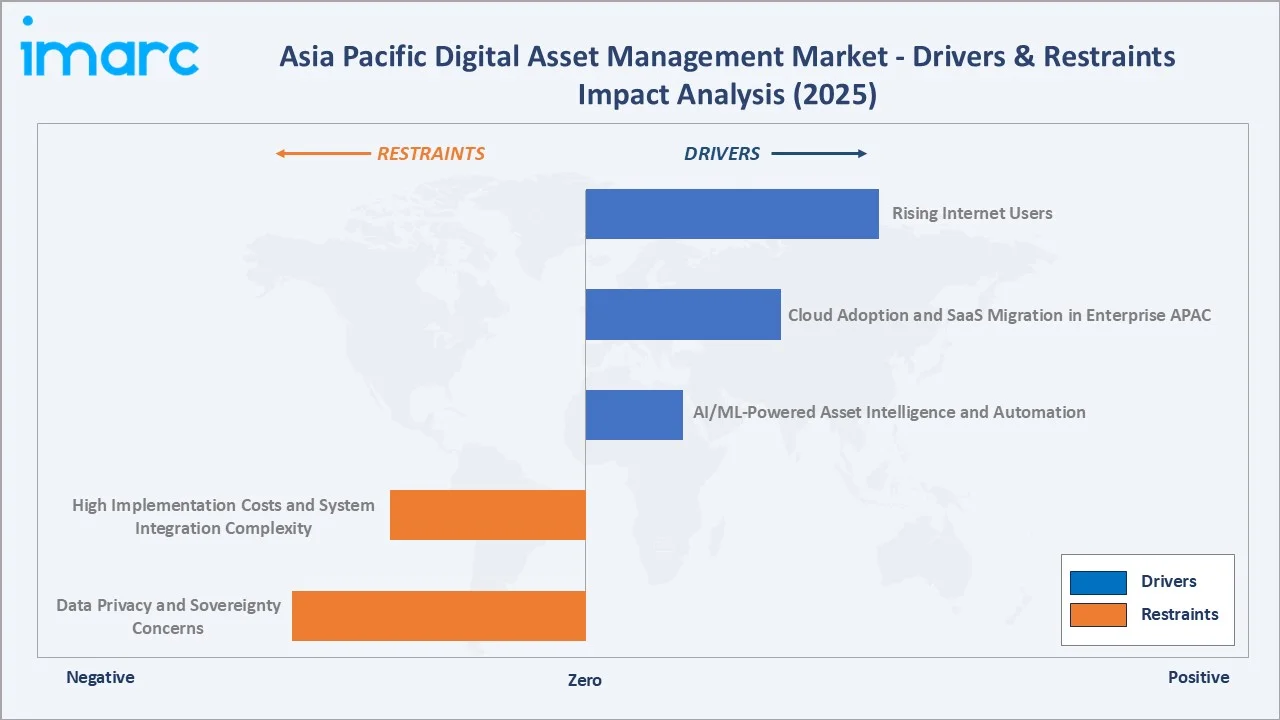
- Rising Internet Users: Mobile internet users across Asia Pacific are projected to increase from 1.4 billion, representing 51% penetration, to 1.8 billion by 2030, reaching a 61% penetration rate. GSMA Intelligence also estimates that 5G could contribute nearly USD 130 billion to the Asia Pacific economy by 2030. The rapid increase in internet users across Asia Pacific is expanding the volume of digital content, online transactions, social media activity, and e-commerce engagement. This is increasing demand for digital asset management solutions that help enterprises efficiently organize, store, retrieve, and distribute growing volumes of digital media across multiple channels.
- Cloud Adoption and SaaS Migration in Enterprise APAC: Rapid adoption of cloud computing and SaaS platforms across Asia Pacific enterprises is accelerating the shift from traditional on-premises content repositories to scalable, cloud-based digital asset management solutions. Cloud DAM platforms enable centralized asset storage, remote collaboration, automated workflows, and real-time content access across geographically distributed teams. Growing enterprise digital transformation and demand for flexible subscription-based software are therefore strengthening adoption across the Asia Pacific digital asset management market.
- AI/ML-Powered Asset Intelligence and Automation: Growing adoption of AI and machine learning is enhancing digital asset management platforms through automated tagging, metadata generation, intelligent search, content recognition, and asset classification. These capabilities help enterprises manage rapidly expanding digital content libraries while reducing manual workflows and improving asset discoverability. AI-powered recommendations and workflow automation also enable faster content reuse and personalized distribution, supporting growth of the Asia Pacific digital asset management market.
Market Restraints
- Data Privacy and Sovereignty Concerns: Strict data privacy, localization, and sovereignty requirements across Asia Pacific can complicate the deployment of cloud-based digital asset management platforms, particularly for enterprises operating across multiple countries. Organizations may face restrictions on where digital assets are stored, processed, or transferred, increasing compliance costs and infrastructure complexity. These concerns can slow cloud DAM adoption and encourage some businesses to retain on-premises or region-specific solutions.
- High Implementation Costs and System Integration Complexity: The high upfront costs associated with DAM software deployment, customization, cloud migration, employee training, and ongoing maintenance can restrict adoption, particularly among SMEs. Integrating DAM platforms with existing ERP, CRM, content management, e-commerce, and marketing systems can also be technically complex and resource-intensive. These challenges may extend implementation timelines and reduce adoption across cost-sensitive organizations in the Asia Pacific digital asset management market.
Market Opportunities
- Generative AI Content Governance: The rapid use of generative AI for creating images, videos, text, and marketing assets is creating new demand for DAM platforms with stronger governance capabilities. In September 2024, India introduced BharatGen to expand access to generative AI across the country’s diverse linguistic population. The initiative is described as the world’s first government-funded multimodal large language model project focused on developing inclusive and efficient AI solutions for Indian languages. This creates an opportunity for DAM vendors to offer AI governance features that help organizations manage compliance, brand consistency, and responsible content use across the Asia Pacific digital asset management market.
- Headless DAM and Composable Commerce Integration: The growing adoption of headless architectures and composable commerce platforms create opportunities for DAM providers to integrate digital assets seamlessly across websites, mobile apps, e-commerce platforms, and other customer touchpoints. API-first DAM solutions enable enterprises to centrally manage content while distributing it rapidly across multiple channels and front-end systems. This supports faster content deployment, greater personalization, and flexible digital experiences, creating growth opportunities in the Asia Pacific digital asset management market.
Market Challenges
- Integration with Legacy Enterprise Systems: Many organizations continue to operate legacy content storage systems that may not integrate seamlessly with modern DAM platforms. Complex migration and integration requirements can extend deployment timelines, increase costs, and disrupt existing content workflows.
- Managing Rapidly Expanding Content Volumes: The growth of e-commerce, social media, video marketing, and generative AI is significantly increasing the volume and variety of enterprise digital assets. Organizations face challenges in maintaining consistent metadata, version control, asset quality, permissions, and content discoverability as libraries expand.
Emerging Market Trends
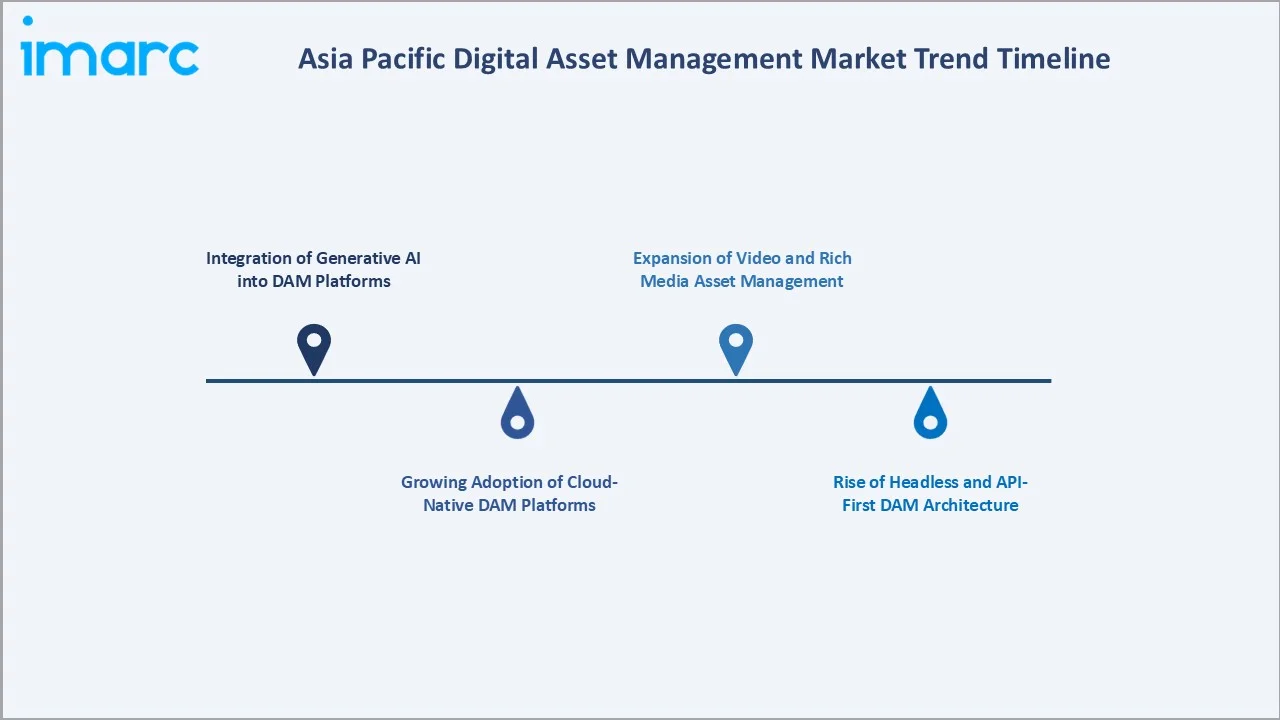
1. Integration of Generative AI into DAM Platforms
Generative AI is increasingly being integrated into DAM platforms to support automated content creation, summarization, tagging, metadata generation, and asset discovery. In June 2024, Zhihu introduced a generative AI feature called Zhida, meaning “direct response” in Mandarin. The tool uses Zhihu’s extensive content repository to search for relevant information, summarize existing material, and automatically generate responses to user queries.
2. Growing Adoption of Cloud-Native DAM Platforms
Enterprises across Asia Pacific are shifting from traditional on-premises systems toward cloud-native and SaaS-based DAM solutions. Cloud deployment provides scalability, centralized access, remote collaboration, and easier integration with other enterprise applications. This trend is particularly relevant for organizations managing content across multiple countries and business units.
3. Rise of Headless and API-First DAM Architecture
Businesses are increasingly adopting headless DAM platforms with API-first architectures to distribute assets across websites, applications, e-commerce stores, social media, and emerging digital channels. Decoupling asset management from front-end presentation improves flexibility and speeds content deployment. This trend is closely aligned with growing adoption of composable commerce.
4. Expansion of Video and Rich Media Asset Management
Rapid growth in short-form video, streaming, social commerce, and digital advertising is increasing enterprise requirements for managing high-volume rich media assets. In November 2025, Dentsu India introduced Dentsu AMP, a video-first content engine designed to help brands produce and scale high-quality storytelling more quickly and efficiently. The platform combines human creativity with AI-enabled workflows to streamline video production, enhance execution quality, and improve content performance. DAM platforms are evolving to support video transcoding, previews, automated metadata, and collaborative editing workflows. Media, retail, entertainment, and consumer brands are major adopters of these capabilities.
Industry Value Chain Analysis
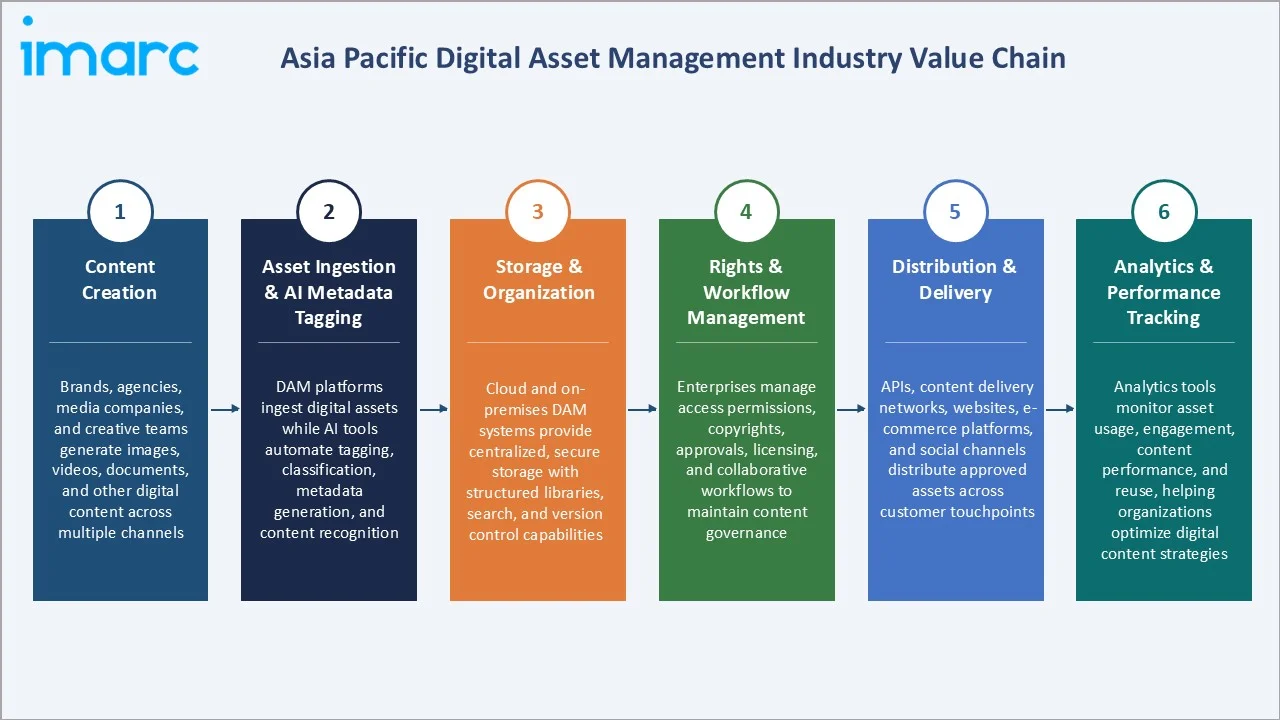
The Asia Pacific digital asset management market value chain encompasses content creation, asset ingestion & ai metadata tagging, storage & organization, rights & workflow management, distribution & delivery, and analytics & performance tracking.
|
Stage |
Key Participants & APAC Dynamics |
|
Content Creation |
Brands, agencies, media companies, and creative teams generate images, videos, documents, and other digital content across multiple channels. |
|
Asset Ingestion & AI Metadata Tagging |
DAM platforms ingest digital assets while AI tools automate tagging, classification, metadata generation, and content recognition. |
|
Storage & Organization |
Cloud and on-premises DAM systems provide centralized, secure storage with structured libraries, search, and version control capabilities. |
|
Rights & Workflow Management |
Enterprises manage access permissions, copyrights, approvals, licensing, and collaborative workflows to maintain content governance. |
|
Distribution & Delivery |
APIs, content delivery networks, websites, e-commerce platforms, and social channels distribute approved assets across customer touchpoints. |
|
Analytics & Performance Tracking |
Analytics tools monitor asset usage, engagement, content performance, and reuse, helping organizations optimize digital content strategies. |
Rights & workflow management is the most value-added stage in the Asia Pacific digital asset management market, as it enables enterprises to control asset usage, licensing, approvals, permissions, and brand compliance. Advanced workflow automation and content governance also reduce operational risks and improve the efficiency of digital content management across multiple channels.
Technology Landscape in the Asia Pacific Digital Asset Management Industry
Digital Rights Management and Content Governance
Modern DAM platforms incorporate technologies for usage rights, licensing, access control, approval workflows, version management, and content expiration. These capabilities help organizations maintain regulatory compliance and brand consistency while reducing unauthorized asset use. Growing AI-generated content volumes are further increasing the importance of provenance and governance technologies.
Advanced Analytics and Content Intelligence Technology
Analytics technologies allow enterprises to track asset usage, engagement, distribution, reuse, and content performance across channels. Content intelligence can identify high-performing assets and provide insights into how digital resources are being utilized. Integration with marketing and commerce platforms supports more data-driven content strategies.
Computer Vision and Intelligent Visual Search Technology
Computer vision technologies enable DAM systems to recognize objects, faces, scenes, logos, and other visual characteristics within images and videos. Intelligent visual search allows users to locate assets based on content rather than relying solely on manually entered metadata. This capability is increasingly valuable for organizations managing large multimedia libraries.
Market Segmentation Analysis
The report covers the following segments:
|
Segment Category |
Leading Segment |
Market Share |
Year |
|
Type |
Brand Asset Management System |
47.8% |
2025 |
|
Component |
Solution |
72.4% |
2025 |
|
Application |
Sales and Marketing |
🔒 |
2025 |
|
Deployment |
On-premises |
🔒 |
2025 |
|
Organization Size |
Large Enterprises |
🔒 |
2025 |
|
End Use Sector |
Media and Entertainment |
🔒 |
2025 |
|
Country |
China |
31.7% |
2025 |

By Type
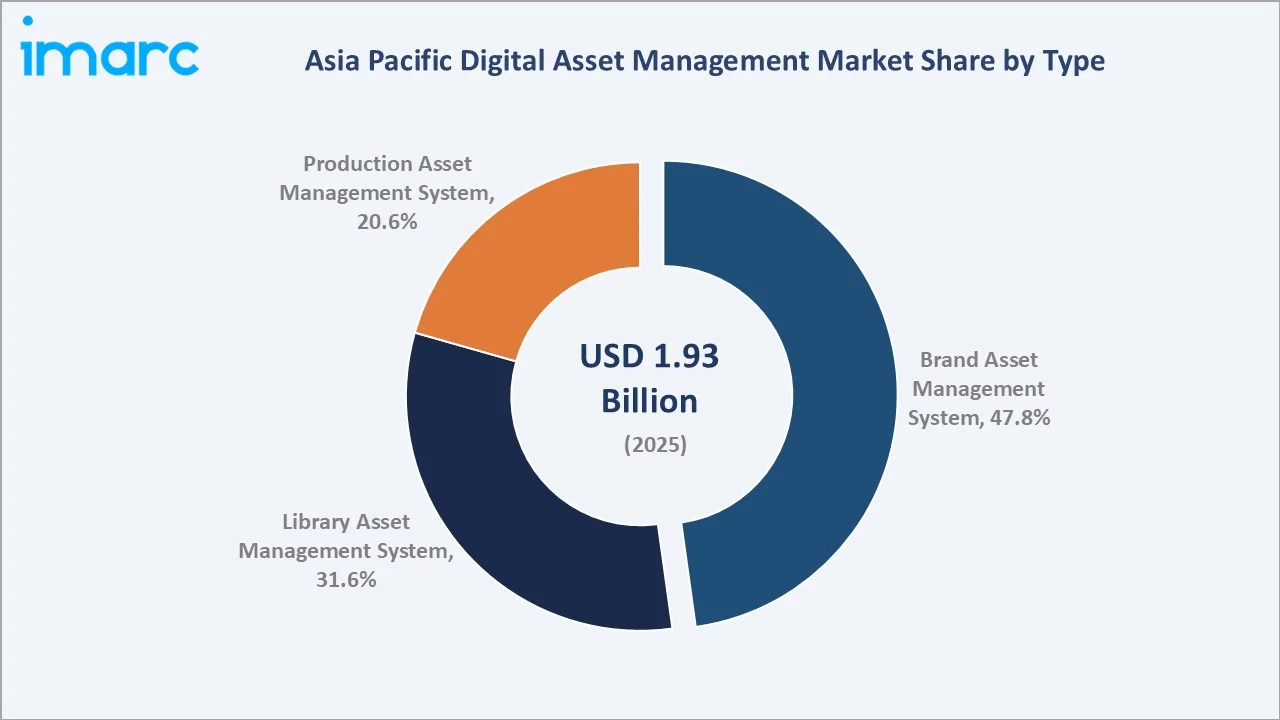
Brand asset management systems lead at 47.8% (2025) through universal demand from APAC’s multinational and domestic enterprises for consistent brand governance across the APAC region.
To access detailed market analysis, Request Sample
Library asset management system at 31.6% serves broadcast, media, government, and academic archive management needs. The production asset management system at 20.6% is growing fastest at ~16.20% CAGR through streaming, gaming, and animation production expansion.
By Component
Solution leads at 72.4% (2025) through enterprise preference for integrated SaaS DAM platforms over fragmented point services.
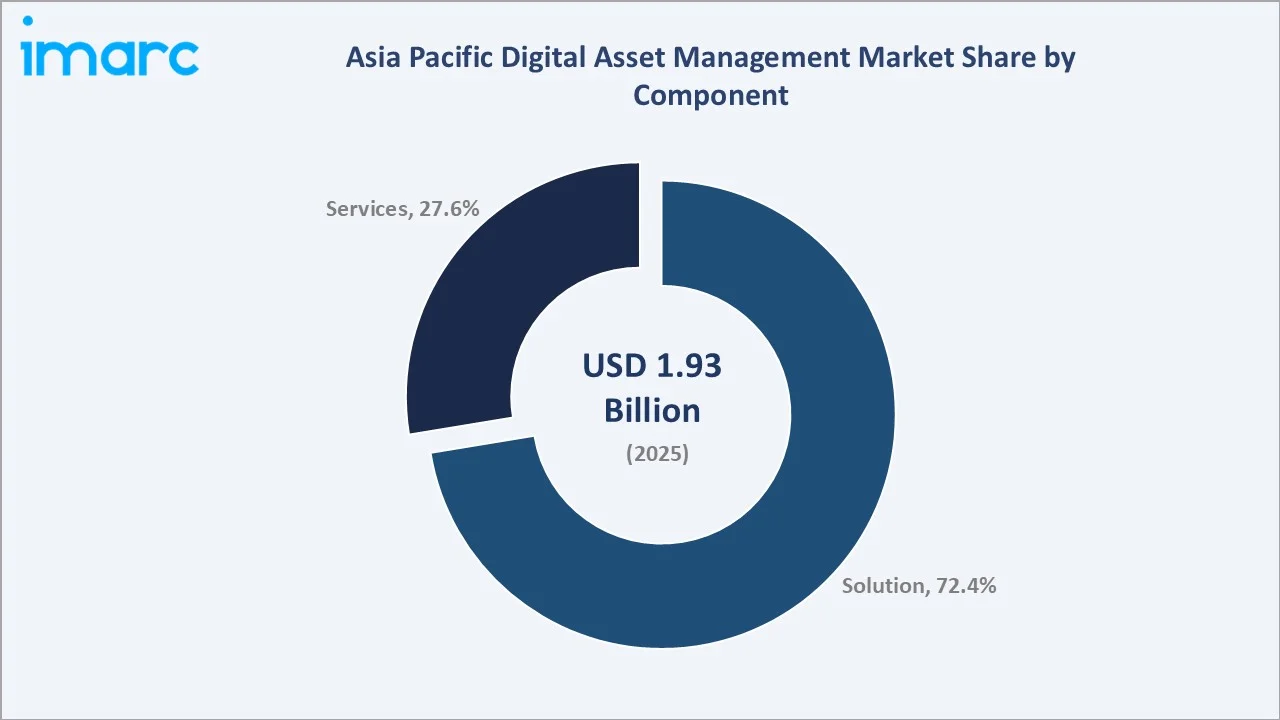
Services at 27.6%, growing at ~14.90% CAGR through system integration, implementation consulting, and managed DAM services demand as APAC enterprise deployments increase in complexity and scale.
Regional Market Insights
|
Country |
Share (2025) |
Key APAC DAM Market Drivers & Characteristics |
|
China |
31.7% |
Leads through its large digital economy, extensive e-commerce ecosystem, social media activity, and rapid adoption of AI-enabled content technologies. |
|
Japan |
19.8% |
Supported by advanced enterprise digitalization, strong cloud adoption, and growing demand for automated content and media management. |
|
India |
16.8% |
Driven by expanding internet usage, digital commerce, cloud migration, and increasing enterprise investment in digital content management. |
|
South Korea |
11.4% |
Benefits from high digital connectivity, advanced IT infrastructure, and strong media, entertainment, and e-commerce sectors. |
|
Australia |
8.2% |
Supported by mature cloud adoption, enterprise SaaS usage, digital marketing, and growing omnichannel content requirements. |
|
Indonesia |
7.6% |
Driven by rising internet penetration, mobile commerce, social media engagement, and ongoing business digitalization. |
|
Others |
4.5% |
Growth is supported by improving digital infrastructure, cloud adoption, e-commerce expansion, and increasing enterprise content volumes. |
China leads the Asia Pacific digital asset management market with a 31.7% share in 2025, supported by its large digital economy, e-commerce ecosystem, and rapid adoption of AI-enabled content tools. Japan accounts for 19.8%, driven by advanced enterprise digitalization, cloud adoption, and strong media and technology sectors. India holds 16.8%, benefiting from rising internet penetration, digital commerce growth, and expanding enterprise cloud usage.
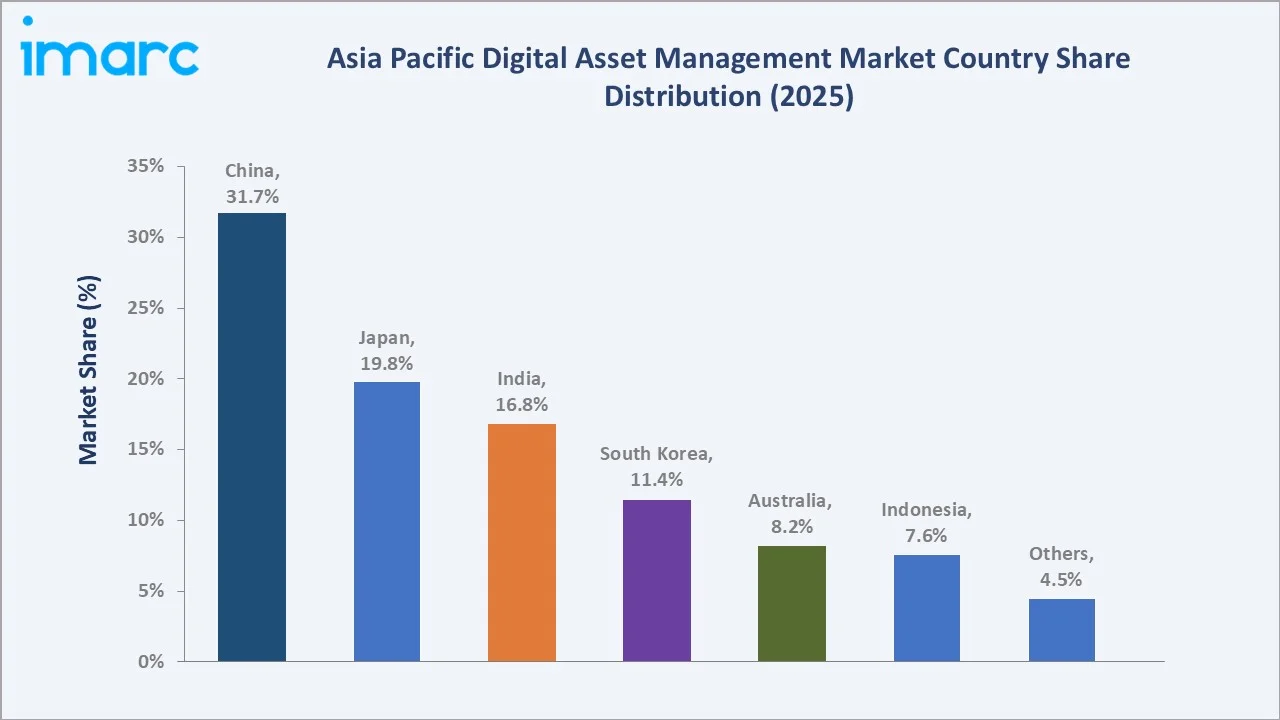
South Korea represents 11.4%, supported by high digital connectivity and strong media, entertainment, and e-commerce activity. Australia accounts for 8.2%, with demand driven by mature SaaS adoption, omnichannel marketing, and enterprise content management needs. Indonesia holds 7.6%, supported by mobile-first digitalization, social media engagement, and e-commerce expansion. Other APAC countries collectively represent 4.5%, with growth supported by improving digital infrastructure and increasing enterprise technology investment.
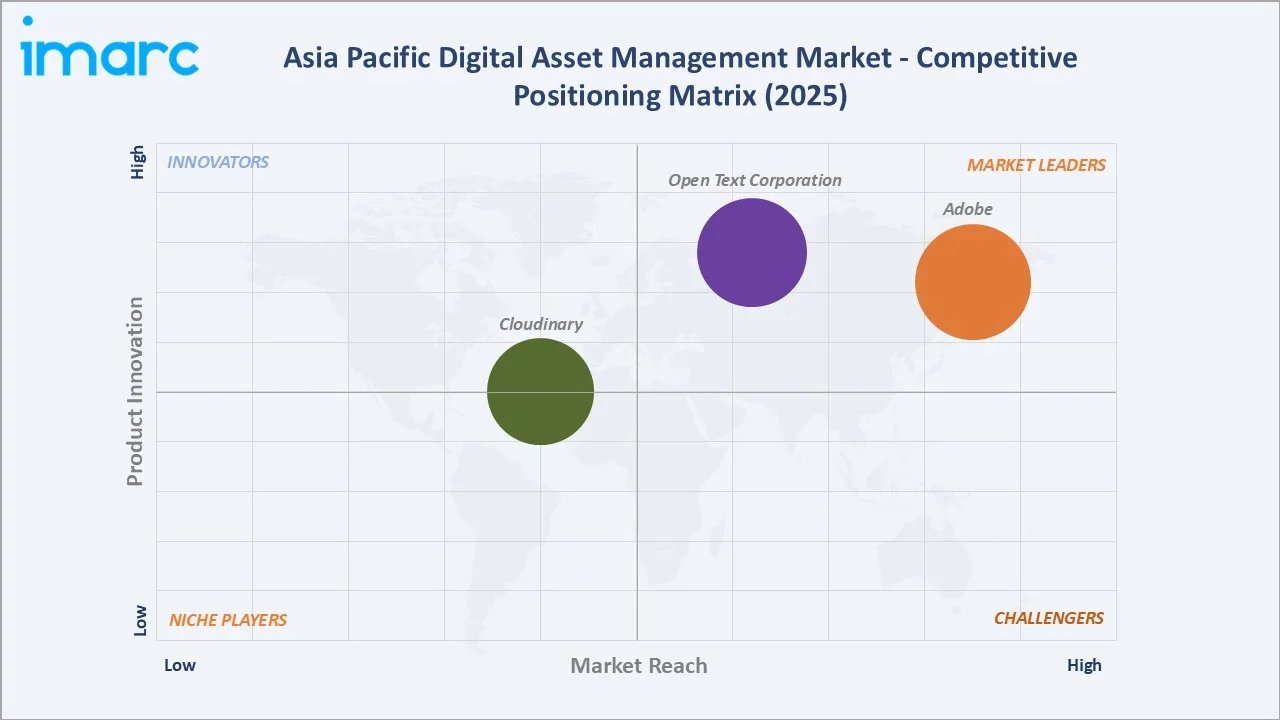
Competitive Landscape
The Asia Pacific digital asset management market is moderately concentrated, with global technology providers and regional vendors competing through cloud-based platforms, AI-powered asset intelligence, workflow automation, and omnichannel integrations. Competition is intensifying as vendors expand generative AI capabilities, headless DAM architectures, content governance tools, and localized solutions to address diverse enterprise requirements across the region.
|
Company |
Key Platforms |
Market Position |
Core Strength |
|
Adobe |
Adobe Experience Manager Assets |
Market Leader |
Through Adobe Experience Manager Assets, Adobe helps brands manage massive, multilingual asset libraries across fragmented, multi-region markets. |
|
Open Text Corporation |
OpenText Core Digital Asset Management (DAM), OpenText Digital Asset Management (DAM) |
Market Leader |
Open Text Corporation plays a pivotal role in the Asia Pacific (APAC) digital asset management (DAM) market by providing AI-first, scalable content management platforms |
|
Cloudinary |
Cloudinary Assets |
Established Player |
Cloudinary plays a crucial role in the Asia Pacific (APAC) digital asset management (DAM) market by bridging the gap between media storage, AI-driven asset optimization, and programmatic delivery. |
APAC DAM competitive landscape is evolving from a vendor-selection market toward a platform ecosystem market. This evolution systematically advantages DAM vendors with deep integration with the dominant platforms in APAC’s enterprise and mid-market technology ecosystem.
Key Company Profiles
Adobe
Adobe is a software company and a major participant in the Asia Pacific digital asset management market through Adobe Experience Manager (AEM) Assets. Its cloud-native DAM solution enables enterprises to centrally ingest, organize, discover, govern, and distribute images, videos, documents, and other digital content. Adobe strengthens its DAM offering with AI-powered tagging, contextual search, workflow automation, content governance, and Adobe Firefly generative AI capabilities. The platform also supports omnichannel asset distribution and integration with Adobe and third-party applications, making it suitable for enterprises managing complex content supply chains across Asia Pacific.
- Key Platforms: Adobe Experience Manager Assets.
- APAC Strategic Focus: Strengthening its position through cloud-native DAM, generative and agentic AI, and integrated content supply chain capabilities. Adobe is expanding Experience Manager Assets with AI-powered tagging, conversational search, automated metadata, governance, and Firefly-enabled content creation to improve asset discovery and reuse.
Open Text Corporation
Open Text Corporation is an information management software company and a prominent provider of enterprise digital asset management (DAM) solutions. Its OpenText Digital Asset Management platform enables organizations to centrally manage, organize, discover, govern, and distribute large volumes of images, videos, documents, and other rich media assets. The company offers both enterprise-grade and cloud-native DAM capabilities, incorporating AI-powered tagging and search, metadata management, version control, permissions, and workflow tools. Its scalable architecture and omnichannel content capabilities support large enterprises managing complex digital content operations across Asia Pacific.
- Key Platforms: OpenText Core Digital Asset Management (DAM), OpenText Digital Asset Management (DAM).
- APAC Strategic Focus: Expanding its position through cloud-native DAM, AI-driven automation, and enterprise-scale content management. Its strategy emphasizes generative AI and Experience Aviator capabilities for automated metadata creation, intelligent search, image generation, and faster content workflows.
Market Concentration Analysis
The Asia Pacific digital asset management market is moderately fragmented, with global software companies and specialized DAM vendors competing across the region. Large vendors benefit from established enterprise relationships, broad cloud ecosystems, AI capabilities, and integration with marketing and content platforms. Specialized DAM providers compete through usability, industry-specific functionality, headless architecture, workflow automation, and flexible SaaS offerings. The rapid expansion of cloud-based DAM and AI-powered content management continues to create room for new and regional providers. Overall, continuous product innovation, integration capabilities, scalability, and content governance remain key determinants of competitive positioning.
Investment & Growth Opportunities
Highest Growth Segments
Production asset management system (~16.20% CAGR) and library asset management system (~15.40% CAGR) represent the APAC DAM market’s highest-growth investment vectors through 2034, driven by the APAC streaming content production wave and digital archive modernization respectively.
Investment Themes
- APAC Language AI for DAM: Investment in multilingual AI, NLP, automated translation, and localized metadata technologies can enable DAM platforms to manage and discover content across Asia Pacific’s diverse languages. This creates opportunities for localized search, automated tagging, and scalable content adaptation for regional audiences.
- AIGC Governance Platform: The rapid expansion of AI-generated content (AIGC) creates investment opportunities in platforms providing content provenance, copyright and rights management, AI labeling, approval controls, audit trails, and compliance monitoring. Growing regulatory diversity and enterprise concerns around transparency and accountability are strengthening the need for integrated AIGC governance within DAM ecosystems.
Future Market Outlook (2026-2034)
The Asia Pacific digital asset management market is projected to grow from USD 1.93 Billion in 2025 to USD 2.30 Billion in 2026, reaching USD 6.86 Billion by 2034, delivering an exceptional 14.66% CAGR that positions APAC as the fastest-growing major regional DAM market, surpassing North America’s DAM growth rate for the first time as APAC’s digital content economy, enterprise cloud adoption, and AI integration acceleration collectively create a multi-decade market expansion super cycle. The anchor value of USD 3.83 Billion in 2030 confirms the structural momentum of a market that has doubled from USD 0.98 Billion in 2020 to USD 1.93 Billion in 2025.
First, APAC’s digital content production and consumption ecosystem is growing at a pace that no technology for content management other than AI-powered DAM can sustainably support at scale. Second, the enterprise technology platform consolidation occurring in APAC’s largest corporations is systematically elevating DAM from an optional marketing tool to a required digital infrastructure component. Third, APAC’s regulatory environment for digital content governance, while creating complexity for multinational DAM deployments, simultaneously serves as a market-creation force by mandating the governance capabilities that distinguish purpose-built DAM from commodity cloud storage.
Research Methodology
Primary Research
Primary research comprised in-depth interviews with DAM platform vendor APAC management, enterprise DAM buyers across APAC’s primary verticals, digital marketing and creative operations leaders at APAC multinational corporations, DAM implementation and consulting partners, and APAC cloud platform partner program representatives.
Secondary Research
Secondary research encompassed a review of company reports, industry publications, government sources, technology vendor websites, market databases, and digital economy studies across Asia Pacific. The analysis also covered cloud adoption, AI integration, DAM deployment trends, digital content growth, regulatory developments, competitive activity, and regional market dynamics.
Forecasting Models
Forecasting models developed using historical APAC DAM market data (2020-2025), APAC enterprise software and SaaS subscription market growth modeling, digital content volume projection by country, APAC cloud infrastructure investment trajectory aligned to APAC data center expansion plans, DAM market penetration rate model by enterprise size cohort and APAC country, AI feature impact on DAM adoption acceleration quantification, regulatory compliance driver modeling for each APAC jurisdiction, and competitive pricing trajectory analysis under increasing SaaS market competition pressure through 2034.
Asia Pacific Digital Asset Management Market Report Coverage:
| Report Features | Details |
|---|---|
| Base Year of the Analysis | 2025 |
| Historical Period | 2020-2025 |
| Forecast Period | 2026-2034 |
| Units | Billion USD |
| Scope of the Report | Exploration of Historical Trends and Market Outlook, Industry Catalysts and Challenges, Segment-Wise Historical and Future Market Assessment:
|
| Types Covered | Brand Asset Management System, Library Asset Management System, Production Asset Management System |
| Components Covered |
|
| Applications Covered | Sales and Marketing, Broadcast and Publishing, Others |
| Deployments Covered | On-premises, Cloud |
| Organization Sizes Covered | Small and Medium-sized Enterprises, Large Enterprises |
| End Use Sectors Covered | Media and Entertainment, Banking, Financial Services and Insurance (BFSI), Retail, Manufacturing, Healthcare and Life Sciences, Education, Travel and Tourism, Others |
| Countries Covered | China, Japan, India, South Korea, Australia, Indonesia, Others |
| Companies Covered | Adobe, Open Text Corporation, Cloudinary, etc. |
| Customization Scope | 10% Free Customization |
| Post-Sale Analyst Support | 10-12 Weeks |
| Delivery Format | PDF and Excel through Email (We can also provide the editable version of the report in PPT/Word format on special request) |
Frequently Asked Questions About the Asia Pacific Digital Asset Management Market Report
The Asia Pacific digital asset management market size is estimated at USD 2.30 Billion in 2026, driven by China’s e-commerce asset management scale, India’s digital content economy acceleration, Japan’s broadcast archive digitization, South Korea’s K-content global expansion, and APAC SaaS mid-market DAM democratization.
The market grows at 14.66% CAGR, reaching USD 6.86 Billion by 2034, supported by rapid cloud adoption, AI-enabled content management, and rising enterprise digital content volumes.
Brand asset management systems lead at 47.8% (2025) through universal enterprise demand for consistent brand governance across APAC’s countries, languages, and millions of brand touchpoints.
Solution leads at 72.4% (2025) through enterprise preference for integrated cloud-native SaaS DAM platforms that eliminate infrastructure management overhead and provide usage-based scaling.
China leads at 31.7% through the extraordinary scale of China’s digital content economy, unique domestic DAM ecosystem development, and data sovereignty requirements creating a domestic DAM market for China-headquartered brands.
Leading companies include Adobe, Open Text Corporation, and Cloudinary, among others.
The market is projected to reach USD 3.83 Billion by 2030, driven by rapid cloud migration, rising digital content volumes, and increasing adoption of AI-enabled asset management tools. Growing e-commerce, omnichannel marketing, and enterprise digital transformation are further supporting market expansion.
Top investment opportunities include APAC-language AI DAM capabilities, Southeast Asia mid-market DAM rollout, India startup and unicorn DAM segment, Japan enterprise DAM localization, and China domestic DAM partnership strategy.
Need more help?
- Speak to our experienced analysts for insights on the current market scenarios.
- Include additional segments and countries to customize the report as per your requirement.
- Gain an unparalleled competitive advantage in your domain by understanding how to utilize the report and positively impacting your operations and revenue.
- For further assistance, please connect with our analysts.
 Request Customization
 Speak to an Analyst
 Request Brochure
 Inquire Before Buying
Benefits of Customization
- Personalize this research
- Triangulate with your data
- Get data as per your format and definition
- Gain a deeper dive into a specific application, geography, customer, or competitor
- Any level of personalization
Get in Touch With Us
UNITED STATES
Phone: +1-201-971-6302
INDIA
Phone: +91-120-433-0800
UNITED KINGDOM
Phone: +44-753-714-6104
Email: [email protected]
Client Testimonials




.webp)




.webp)













Related Reports

Choose your plan
*Please note that the prices mentioned below are starting prices for each bundle type. Kindly contact our team for further details.*
Single User License
- 1 User License, Access on 2 Devices
- PDF Report + Excel Dataset (Password Protected)
- Lifetime Access
- No Printing Rights
- 10% Free Report Customization
- 10–12 Weeks of Analyst Support
Five User License
- Access for 5 Users, 2 Devices per User
- PDF Report + Excel Dataset (Password Protected)
- Lifetime Access
- Dedicated Account Manager
- 12–14 Weeks of Analyst Support
- No Printing Rights
- 15% Free Report Customization
- 25% Discount on Your Next Purchase
Corporate User License
- Unlimited User Access (Within Your Organization)
- PDF Report + Excel Dataset
- Lifetime Access
- Dedicated Account Manager
- 14–20 Weeks of Analyst Support
- No Printing Rights
- 20% Free Report Customization
- 30% Discount on Your Next Purchase
Essential Insights
What's included:
3 reports
- Lifetime Access
- PDF Reports
- Excel Datasets
- 2 Weeks of Free Analyst Support
- 2 User Licenses
- Access on 2 Devices
- Printing Rights
- Complimentary PowerPoint (PPT) Version
- Complimentary License Upgrade
Professional Access
What's included:
5 reports
- Lifetime Access
- PDF Reports
- Excel Datasets
- 8 Weeks of Free Analyst Support
- 2 User Licenses
- Access on 2 Devices
- Printing Rights
- Complimentary PowerPoint (PPT) Version
- Complimentary License Upgrade
Business Advantage
What's included:
8 reports
- Lifetime Access
- PDF Reports
- Excel Datasets
- 14 Weeks of Free Analyst Support
- 2 User Licenses
- Access on 2 Devices
- Printing Rights
- Complimentary PowerPoint (PPT) Version
- Complimentary License Upgrade
Enterprise Intelligence
What's included:
10 reports
- Lifetime Access
- PDF Reports
- Excel Datasets
- 20 Weeks of Free Analyst Support
- 2 User Licenses
- Access on 2 Devices
- Printing Rights
- Complimentary PowerPoint (PPT) Version
- Complimentary License Upgrade