
Asia Pacific E-Cigarette Market Size, Share, Trends and Forecast by Product, Flavor, Mode of Operation, Distribution Channel, and Country, 2026-2034
Asia Pacific E-Cigarette Market Summary:
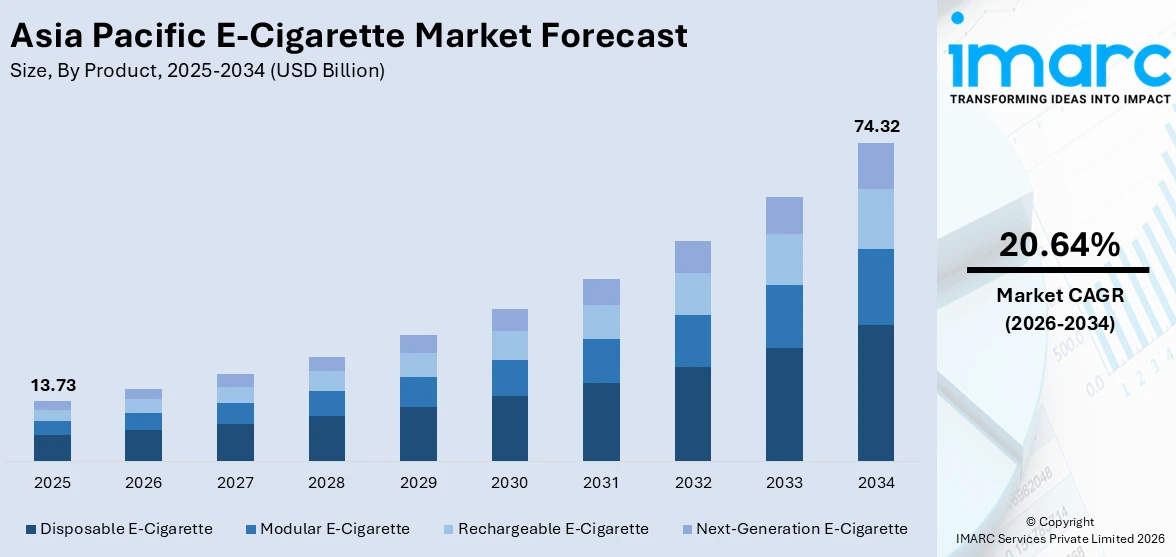
The Asia Pacific e-cigarette market size increased from USD 13.73 Billion in 2025 to USD 16.56 Billion in 2026 and is projected to reach USD 74.32 Billion by 2034, growing at a compound annual growth rate of 20.64% from 2026-2034.
The Asia Pacific e-cigarette market is witnessing strong momentum as consumers increasingly shift from traditional tobacco to vapor-based alternatives. Growing health consciousness, expanding retail and e-commerce networks, and continuous product innovation are driving widespread adoption. Supportive regulatory frameworks in select countries, rising disposable incomes, and increasing urban populations are further accelerating market penetration, positioning the region as a dynamic hub for e-cigarette growth and the Asia Pacific e-cigarette market share.
Key Takeaways and Insights:
- By Product: Disposable e-cigarette dominates the market with a share of 40% in 2025, owing to its affordability, ease of use, and widespread availability across retail channels. Growing demand among first-time users and the convenience of single-use devices are fueling the market expansion.
- By Flavor: Tobacco leads the market with a share of 33% in 2025. This dominance is driven by the familiarity of tobacco flavor among transitioning smokers, regulatory restrictions limiting flavored alternatives in key markets, and sustained consumer preference for authentic smoking experiences.
- By Mode of Operation: Automatic e-cigarette exhibits a clear dominance in the market with 60% share in 2025, reflecting strong consumer preference for draw-activated, user-friendly devices that eliminate the need for manual buttons and enhance the overall vaping experience.
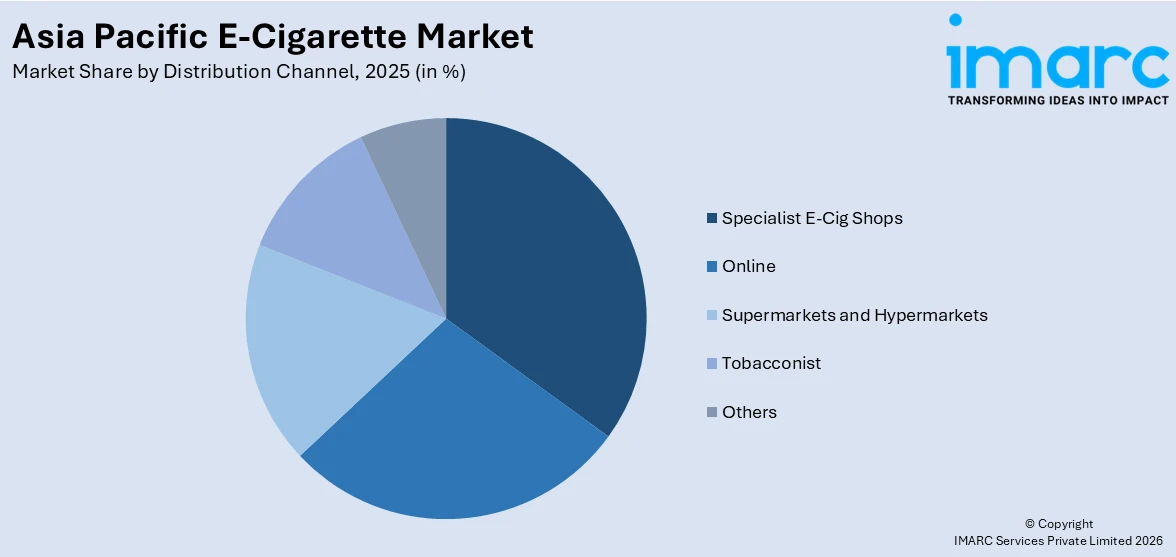
- By Distribution Channel: Specialist e-cig shops represent the largest segment with a market share of 25% in 2025, reflecting the importance of dedicated retail environments that offer expert guidance, product demonstrations, and curated selections that enhance informed purchasing decisions.
- Key Players: Key players drive the Asia Pacific e-cigarette market by expanding product portfolios, improving device technologies, investing in R&D, and strengthening distribution networks. Their focus on innovation, compliance, and strategic partnerships supports market penetration and accelerates adoption across diverse consumer segments.
To get more information on this market Request Sample
The Asia Pacific e-cigarette market is advancing as governments, industries, and consumers navigate the evolving landscape of tobacco harm reduction and alternative nicotine delivery systems. Rising awareness about health risks associated with conventional smoking is pushing millions of smokers across the region toward vapor-based products. According to the World Health Organization, smoking causes approximately one million cardiovascular deaths in the Asia Pacific region annually, with nearly one in four people identified as smokers. This substantial health burden is catalyzing demand for reduced-risk alternatives. Product innovation continues to be a primary growth catalyst, with manufacturers introducing compact pod systems, longer-lasting batteries, and advanced coil technologies that improve flavor delivery and user satisfaction. The rapid expansion of e-commerce platforms and digital retail channels is enhancing product accessibility, particularly in markets with limited specialist retail infrastructure. Government initiatives promoting smoking cessation, coupled with increasing urban populations and rising disposable incomes, are establishing favorable conditions for sustained market growth across the Asia Pacific region.
Asia Pacific E-Cigarette Market Trends:
Rising Adoption of Pod-Based and Compact Vaping Systems
The Asia Pacific e-cigarette market is undergoing a major transition towards compact pod-based e-cigarettes that emphasize portability, convenience, and ease of use. Such e-cigarettes are preferred by both novice and experienced vapers because they come pre-filled or can be refilled with consistent nicotine levels. In Japan, heated tobacco products have grabbed a substantial market share of the total tobacco products market, indicating the strong demand for alternative products to combustible cigarettes. The rising demand for slim, technology-based devices is fueling the growth of the Asia Pacific e-cigarette market, especially among the younger generation.
Increasing Focus on Sustainability and Eco-Friendly Product Design
Environmental consciousness is reshaping product development strategies across the e-cigarette industry in Asia Pacific. Manufacturers are investing in modular, recyclable, and biodegradable device designs to address concerns about electronic waste from disposable vapes. Leading vaping brands have introduced concept devices emphasizing eco-friendly materials such as renewable cork composites and magnetic assembly systems that support disassembly for recycling. These innovations have gained recognition at prestigious international design competitions. This trend reflects a broader industry movement toward sustainable manufacturing practices and responsible product lifecycle management.
Regulatory Evolution Shaping Market Dynamics Across the Region
Regulatory frameworks for e-cigarettes are evolving rapidly across Asia Pacific, influencing product availability, marketing approaches, and consumer access patterns. Australia has implemented comprehensive vaping reforms, restricting vape sales exclusively to pharmacies and banning disposable devices under updated therapeutic goods legislation. In China, the State Tobacco Monopoly Administration continues to tighten oversight of e-cigarette production and export compliance. These regulatory developments are reshaping competitive dynamics, favoring compliant manufacturers while constraining illicit market activity.
Market Outlook 2026-2034:
The Asia Pacific e-cigarette market is expected to experience significant growth during the forecast period, due to continued innovation, the development of distribution channels, and increased awareness of harm reduction products. Advances in technology, such as improved battery life, smart connectivity, and improved e-liquid formulations, are expected to appeal to a wider consumer base. The development of stronger regulatory frameworks in the Asia Pacific is expected to create a more organized market, which will benefit established companies that have strong compliance capabilities. Urbanization, internet penetration, and the growing middle class in developing countries in Southeast Asia and South Asia are expected to be major drivers of growth for the industry. The market generated a revenue of USD 13.73 Billion in 2025, which is expected to reach USD 16.56 Billion in 2026 and further grow to USD 74.32 Billion by 2034, at a compound annual growth rate of 20.64% during 2026-2034.
Asia Pacific E-Cigarette Market Report Segmentation:
| Segment Category | Leading Segment | Market Share |
|---|---|---|
|
Product |
Disposable E-Cigarette |
40% |
|
Flavor |
Tobacco |
33% |
|
Mode of Operation |
Automatic E-Cigarette |
60% |
|
Distribution Channel |
Specialist E-Cig Shops |
25% |
Product Insights:
- Modular E-Cigarette
- Rechargeable E-Cigarette
- Next-Generation E-Cigarette
- Disposable E-Cigarette
Disposable e-cigarette dominates with a market share of 40% of the total Asia Pacific e-cigarette market in 2025.
Disposable e-cigarettes have emerged as the leading product type in Asia Pacific, owing to their unmatched convenience, low entry cost, and minimal maintenance requirements. These devices offer a ready-to-use experience that appeals to first-time vapers and consumers seeking a hassle-free alternative to traditional cigarettes. The compact form factor and wide flavor availability make disposable devices particularly popular among younger demographics and urban consumers across the region.
The proliferation of retail outlets, convenience stores, and online platforms has significantly enhanced the accessibility of disposable e-cigarettes throughout Asia Pacific. In Indonesia, disposable and pod-based devices have gained substantial traction, with leading e-cigarette brands establishing extensive branded retail networks across major cities and secondary markets. The simplicity of disposable devices, combined with competitive pricing and aggressive distribution strategies, continues to reinforce their dominance across diverse consumer segments in the region.
Flavor Insights:
- Tobacco
- Botanical
- Fruit
- Sweet
- Beverage
- Others
Tobacco leads with a share of 33% of the total Asia Pacific e-cigarette market in 2025.
Tobacco flavor maintains its position as the leading flavor category in the Asia Pacific e-cigarette market, driven primarily by its familiarity among adult smokers transitioning from conventional cigarettes. The authentic taste profile of tobacco-flavored e-liquids provides a seamless transition experience, reducing the behavioral adjustment required during the switch to vaping. Regulatory mandates in key markets have explicitly restricted flavored e-cigarettes for domestic sale, permitting only tobacco-flavored products, which has significantly reinforced this segment.
The regulatory environment across Asia Pacific is increasingly favoring tobacco-flavored products over fruity and sweet alternatives, particularly as governments prioritize youth protection measures. Several countries in the region have implemented flavor restrictions that limit available options to tobacco, mint, and menthol for regulated vape products. This regulatory trend, combined with the inherent consumer preference among mature smokers for tobacco taste, ensures continued dominance of the segment. The alignment of regulatory policy with traditional consumer behavior patterns positions tobacco flavor as a stable and resilient market category.
Mode of Operation Insights:
- Automatic E-Cigarette
- Manual E-Cigarette
The automatic e-cigarette exhibits a clear dominance with a 60% share of the total Asia Pacific e-cigarette market in 2025.
Automatic e-cigarettes, which activate upon inhalation without requiring manual button operation, hold a significant market share in Asia Pacific. The draw-activated mechanism delivers an intuitive and seamless vaping experience that closely mimics the act of smoking a conventional cigarette. This operational simplicity appeals to a broad consumer base, including first-time users and older demographics who may find manual devices cumbersome. The integration of automatic activation in most disposable and pod-based systems further solidifies this segment’s leadership.
The growing preference for automatic devices reflects a broader industry trend toward user-centric design and reduced complexity. Manufacturers across Asia Pacific are incorporating advanced sensor technologies, including airflow-activated switches and smart draw detection systems, to enhance reliability and consistency. In South Korea, where per capita cigarette consumption exceeds 1,400 cigarettes annually, automatic e-cigarettes have gained significant traction as a convenient cessation tool. The alignment of automatic operation with the mass-market appeal of disposable and pod devices ensures the sustained dominance of this segment.
Distribution Channel Insights:
Access the comprehensive market breakdown Request Sample
- Specialist E-Cig Shops
- Online
- Supermarkets and Hypermarkets
- Tobacconist
- Others
Specialist e-cig shops hold the largest share with 25% of the total Asia Pacific e-cigarette market in 2025.
E-cigarette specialist retail stores dominate the distribution channel in the Asia Pacific, which is driven by consumers' desire to experience the retail environment that provides expert product advice and product demonstrations. Specialist stores offer a retail experience that instill consumer confidence, especially for first-time consumers who need help choosing the right products that fit their preferences. The retail experience offered by specialist stores sets them apart from other retail and online distribution channels.
The development of specialist retail stores is aided by the increasing number of franchises introduced by popular e-cigarette brands across the Asia Pacific. RELX, a popular e-cigarette brand, has a strong presence in the Asia Pacific markets of Indonesia, the Philippines, and South Korea. Branded retail stores enable direct consumer engagement and interaction. The retail experience and the opportunity to test the product before purchase continue to set specialist stores apart from other distribution channels.
Country Insights:
- China
- Japan
- India
- South Korea
- Australia
- Indonesia
- Others
China is the most visible market for e-cigarettes in the Asia Pacific, driven by the massive number of smokers in the country, the advanced manufacturing infrastructure, and the rapidly evolving regulatory framework. The country has the second-largest number of smokers globally, which means an enormous potential market for alternative nicotine products. China is the world’s primary manufacturer of e-cigarette hardware, atomization technology, and e-liquid materials, particularly in the Shenzhen region.
Japan is the second-largest market, where heated tobacco and e-cigarette alternatives have gained significant acceptance among consumers. The openness of the Japanese market to technological innovation has made it the primary launch site for next-generation nicotine products. The Indonesian market is one of the fastest-growing markets in the region, with a massive adult smoker population and increasing vape penetration. South Korea, Australia, and India are markets with unique market dynamics shaped by their respective regulatory frameworks and consumer behavior patterns.
India has a complete ban on the production, importation, sale, and distribution of e-cigarettes through the Prohibition of Electronic Cigarettes Act. Despite the ban, illicit vaping products continue to flow in the black market.
The South Korean government has classified e-cigarettes under its tobacco control regime, charging excise duties and health warnings on e-cigarettes. The high prevalence of smoking and consumer demand for reduced-risk products are driving the adoption of e-cigarettes in the country.
The Australian government has restricted the retail of e-cigarettes only to pharmacies, allowing only approved e-liquids for smoking cessation. Disposable e-cigarettes are prohibited, and only tobacco, mint, and menthol flavors are allowed.
Indonesia is one of the quickest-growing e-cigarette markets in the Asia-Pacific region, with a huge number of adult smokers in the country. Key players are opening branded retail stores in key cities.

Market Dynamics:
Growth Drivers:
Why is the Asia Pacific E-Cigarette Market Growing?
Growing Health Consciousness and Shift from Traditional Tobacco
The growing awareness about health hazards linked to conventional cigarette smoking is thus acting as a major driving factor for the Asia Pacific e-cigarette market. Governments, health departments, and medical bodies in the Asia Pacific region are actively spreading awareness about the health hazards of tobacco combustion, thus encouraging millions of cigarette smokers to look for alternative nicotine products. The belief that e-cigarettes emit fewer toxic by-products compared to conventional cigarettes, mainly because of the absence of tar and carbon monoxide, is thus encouraging consumers to shift to e-cigarettes. The growing number of health hazards due to smoking, such as lung cancer, cardiovascular diseases, and chronic respiratory diseases, is thus encouraging consumers to shift to e-cigarettes.
Rapid Product Innovation and Technological Advancements
Innovation in device technology, e-liquid, and user experience is rapidly driving the adoption of e-cigarettes in the Asia Pacific region. Companies are working on the development of advanced pod systems with enhanced heating elements, longer battery life, and smart connectivity options. The development of modular systems that enable the replacement of components is extending the product life cycle while minimizing waste. Next-generation devices with temperature control, airflow optimization, and leak-proof cartridge systems are luring both new and existing consumers. Innovation is ensuring that the products stay competitive and aligned with the evolving expectations of consumers.
Expanding Distribution Networks and E-Commerce Penetration
The expansion of multi-channel distribution networks, including specialist vape shops, convenience stores, supermarkets, and digital platforms, is significantly improving product accessibility across Asia Pacific. The rapid growth of e-commerce in the region is particularly impactful, enabling consumers in remote and underserved areas to access a wide range of e-cigarette products with ease. RLX Technology reported that its international revenue surged to 71.6% of total net revenues in the third quarter of 2025, with significant growth in Southeast Asian and North Asian markets through franchise retail models. The establishment of branded retail stores, franchise networks, and strategic partnerships with local distributors is strengthening market penetration across diverse geographies. Digital marketing initiatives and social media engagement are further amplifying brand awareness and consumer acquisition, supporting robust growth in both established and emerging markets.
Market Restraints:
What Challenges the Asia Pacific E-Cigarette Market is Facing?
Stringent and Fragmented Regulatory Frameworks
The regulatory landscape for e-cigarettes across Asia Pacific remains highly fragmented, with varying levels of restriction creating compliance challenges for manufacturers and distributors. While some countries, such as Japan and South Korea, permit regulated sales, others have imposed outright bans, including India, which prohibited the manufacture, import, and sale of e-cigarettes in 2019. Australia’s 2024 vaping reforms restricted sales to pharmacies only, banning disposable devices and limiting available flavors. China’s State Tobacco Monopoly Administration has progressively tightened e-cigarette production and export oversight, addressing concerns over excess capacity and non-compliance. This regulatory inconsistency creates market uncertainty, increases operational costs, and restricts the ability of companies to deploy uniform strategies across the region.
Health Concerns and Youth Vaping Controversies
Persistent health concerns regarding the long-term effects of e-cigarette use continue to challenge market expansion in Asia Pacific. Scientific uncertainty about the cumulative health impact of inhaling vaporized nicotine and flavoring agents creates consumer skepticism, particularly among older demographics. Rising rates of youth vaping have drawn significant scrutiny from governments and health organizations across the region. The perception that flavored e-cigarettes attract underage users has prompted regulatory actions restricting flavor availability, marketing practices, and retail access, which collectively constrain market growth potential.
Prevalence of Counterfeit and Illicit Products
The proliferation of counterfeit and unregulated e-cigarette products across Asia Pacific poses a significant challenge to market integrity and consumer safety. Illicit products, often sold at lower prices through informal channels, undermine the revenue and reputation of legitimate manufacturers operating within regulatory frameworks. In China, enforcement actions have uncovered illegal manufacturing operations involving large quantities of non-compliant disposable e-cigarettes and cartridges. The challenge of distinguishing legitimate products from counterfeits complicates consumer trust and creates unfair competition, hindering the growth trajectory of compliant market participants.
Competitive Landscape:
The Asia Pacific e-cigarette market is highly competitive with global tobacco giants, established vaping technology companies, and new entrants competing in the region. Firms are competing through product development, distribution channels, acquisitions, and localization strategies to suit different regulatory settings. Technology-based differentiation, such as developments in atomization technology, pods, and smart devices, is an important aspect of competition. Partnerships and franchise business models are helping brands build their footprint in several countries. Research and development investments, along with aggressive marketing, are creating a highly competitive environment where the ability to comply with regulations and brand strength are important differentiators.
Asia Pacific E-Cigarette Market Report Coverage:
| Report Features | Details |
|---|---|
| Base Year of the Analysis | 2025 |
| Historical Period | 2020-2025 |
| Forecast Period | 2026-2034 |
| Units | Billion USD |
|
Scope of the Report
|
Exploration of Historical and Forecast Trends, Industry Catalysts and Challenges, Segment-Wise Historical and Predictive Market Assessment:
|
| Products Covered | Modular E-Cigarette, Rechargeable E-Cigarette, Next-Generation E-Cigarette, Disposable E-Cigarette |
| Flavors Covered | Tobacco, Botanical, Fruit, Sweet, Beverage, Others |
| Mode of Operations Covered | Automatic E-Cigarette, Manual E-Cigarette |
| Distribution Channels Covered | Specialist E-Cig Shops, Online, Supermarkets and Hypermarkets, Tobacconist, Others |
| Countries Covered | China, Japan, India, South Korea, Australia, Indonesia, Others |
| Customization Scope | 10% Free Customization |
| Post-Sale Analyst Support | 10-12 Weeks |
| Delivery Format | PDF and Excel through Email (We can also provide the editable version of the report in PPT/Word format on special request) |
Frequently Asked Questions About the Asia Pacific E-Cigarette Market Report
The Asia Pacific e-cigarette market size increased from USD 13.73 Billion in 2025 to USD 16.56 Billion in 2026.
The Asia Pacific e-cigarette market is expected to grow at a compound annual growth rate of 20.64% from 2026-2034 to reach USD 74.32 Billion by 2034.
Disposable e-cigarette dominated the market with a share of 40%, driven by its affordability, ease of use, portability, and strong appeal among first-time vapers and convenience-seeking consumers across diverse Asia Pacific markets.
Key factors driving the Asia Pacific e-cigarette market include growing health consciousness, shifting consumer preference from combustible tobacco, rapid product innovation, expanding distribution networks, rising e-commerce penetration, and increasing urbanization.
Major challenges include fragmented and stringent regulatory frameworks, outright bans in certain countries, health concerns regarding long-term vaping effects, youth vaping controversies, prevalence of counterfeit products, and inconsistent enforcement.
Need more help?
- Speak to our experienced analysts for insights on the current market scenarios.
- Include additional segments and countries to customize the report as per your requirement.
- Gain an unparalleled competitive advantage in your domain by understanding how to utilize the report and positively impacting your operations and revenue.
- For further assistance, please connect with our analysts.
 Request Customization
 Speak to an Analyst
 Request Brochure
 Inquire Before Buying
Benefits of Customization
- Personalize this research
- Triangulate with your data
- Get data as per your format and definition
- Gain a deeper dive into a specific application, geography, customer, or competitor
- Any level of personalization
Get in Touch With Us
UNITED STATES
Phone: +1-201-971-6302
INDIA
Phone: +91-120-433-0800
UNITED KINGDOM
Phone: +44-753-714-6104
Email: [email protected]
Client Testimonials




.webp)




.webp)













Related Reports

Choose your plan
*Please note that the prices mentioned below are starting prices for each bundle type. Kindly contact our team for further details.*
Single User License
- 1 User License, Access on 2 Devices
- PDF Report + Excel Dataset (Password Protected)
- Lifetime Access
- No Printing Rights
- 10% Free Report Customization
- 10–12 Weeks of Analyst Support
Five User License
- Access for 5 Users, 2 Devices per User
- PDF Report + Excel Dataset (Password Protected)
- Lifetime Access
- Dedicated Account Manager
- 12–14 Weeks of Analyst Support
- No Printing Rights
- 15% Free Report Customization
- 25% Discount on Your Next Purchase
Corporate User License
- Unlimited User Access (Within Your Organization)
- PDF Report + Excel Dataset
- Lifetime Access
- Dedicated Account Manager
- 14–20 Weeks of Analyst Support
- No Printing Rights
- 20% Free Report Customization
- 30% Discount on Your Next Purchase
Essential Insights
What's included:
3 reports
- Lifetime Access
- PDF Reports
- Excel Datasets
- 2 Weeks of Free Analyst Support
- 2 User Licenses
- Access on 2 Devices
- Printing Rights
- Complimentary PowerPoint (PPT) Version
- Complimentary License Upgrade
Professional Access
What's included:
5 reports
- Lifetime Access
- PDF Reports
- Excel Datasets
- 8 Weeks of Free Analyst Support
- 2 User Licenses
- Access on 2 Devices
- Printing Rights
- Complimentary PowerPoint (PPT) Version
- Complimentary License Upgrade
Business Advantage
What's included:
8 reports
- Lifetime Access
- PDF Reports
- Excel Datasets
- 14 Weeks of Free Analyst Support
- 2 User Licenses
- Access on 2 Devices
- Printing Rights
- Complimentary PowerPoint (PPT) Version
- Complimentary License Upgrade
Enterprise Intelligence
What's included:
10 reports
- Lifetime Access
- PDF Reports
- Excel Datasets
- 20 Weeks of Free Analyst Support
- 2 User Licenses
- Access on 2 Devices
- Printing Rights
- Complimentary PowerPoint (PPT) Version
- Complimentary License Upgrade