
Baler Market Size, Share, Trends and Forecast by Product, Distribution Channel, Application, End User, and Region, 2026-2034
Baler Market Size, Share, Trends & Forecast (2026-2034)
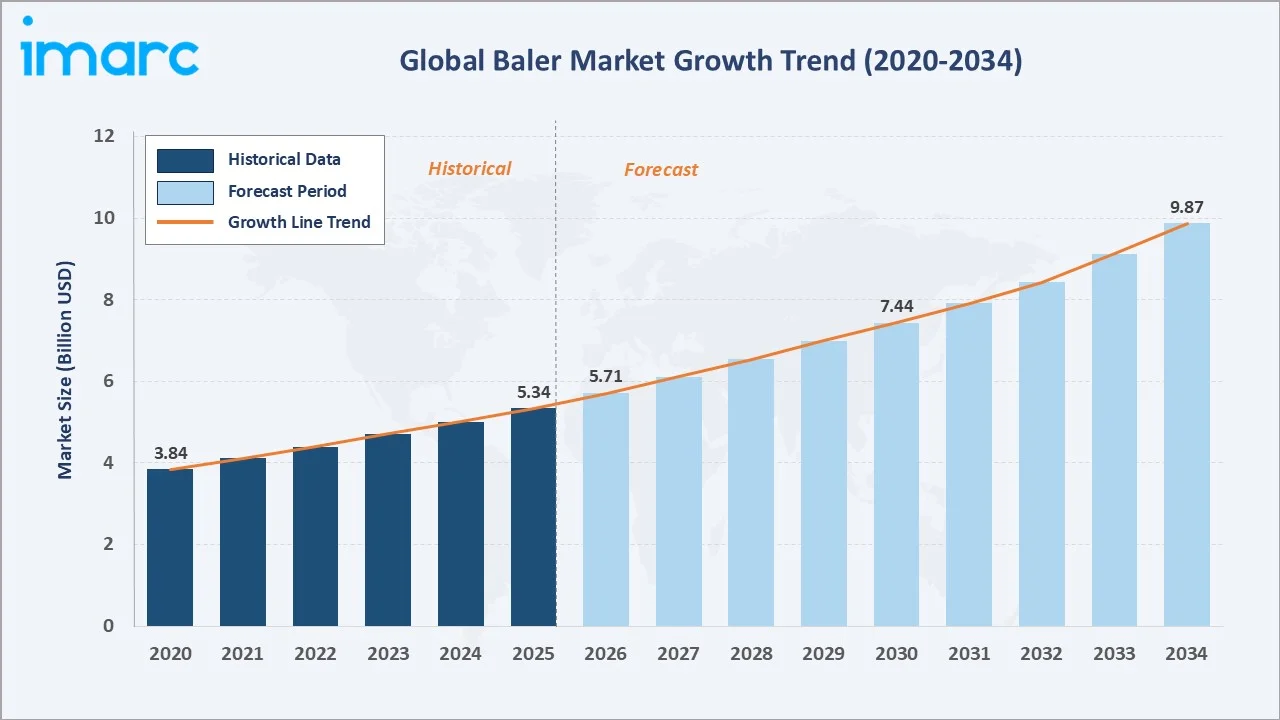
The global baler market grew from USD 5.34 Billion in 2025 to USD 5.71 Billion in 2026 and is projected to reach USD 9.87 Billion by 2034, growing at a CAGR of 6.85% during 2026-2034. The market is driven by increasing global agricultural mechanization, rising demand for efficient hay and forage baling solutions, and growing livestock farming activities worldwide. Government subsidies for farm equipment and the expansion of precision agriculture technologies further accelerate baler adoption across key regions.
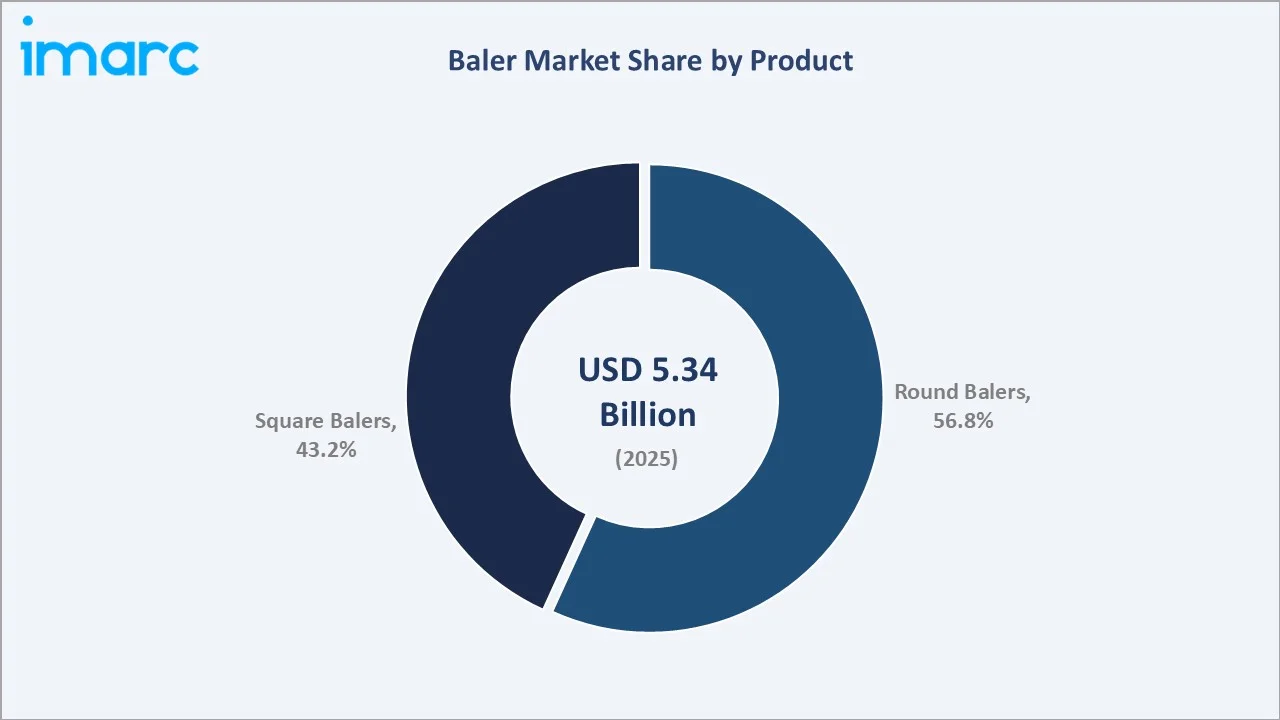
Technological advancements in round and square balers, including IoT-enabled monitoring, autonomous operation, and enhanced bale density control, are shaping the next generation of baling equipment. Round Balers dominate at 56.8%. Offline distribution leads at 82.4%. Asia-Pacific commands 39.6% of the global market share.
Market Snapshot
|
Metric |
Value |
|
Base Year Market Size (2025) |
USD 5.34 Billion |
|
Market Size (2026) |
USD 5.71 Billion |
|
Forecast Market Size (2034) |
USD 9.87 Billion |
|
CAGR (2026-2034) |
6.85% |
|
Base Year |
2025 |
|
Historical Period |
2020-2025 |
|
Forecast Period |
2026-2034 |
|
Dominant Product |
Round Balers (56.8%, 2025) |
|
Dominant Distribution Channel |
Offline (82.4%, 2025) |
|
Leading Region |
Asia-Pacific (39.6%, 2025) |
The global baler market size increased from USD 3.84 Billion in 2020 to USD 5.34 Billion in 2025 and is estimated to reach USD 5.71 Billion in 2026. The market is further expected to grow to USD 7.44 Billion by 2030 and USD 9.87 Billion by 2034. The global baler industry is commercially positioned at the intersection of agricultural modernization and environmental sustainability, driven by large-scale crop harvesting needs, feed supply demands for the livestock sector, and the growing emphasis on biomass and bioenergy applications. The market commercial structure reflects strong adoption across both developing and developed agricultural economies.
To get more information on this market, Request Sample
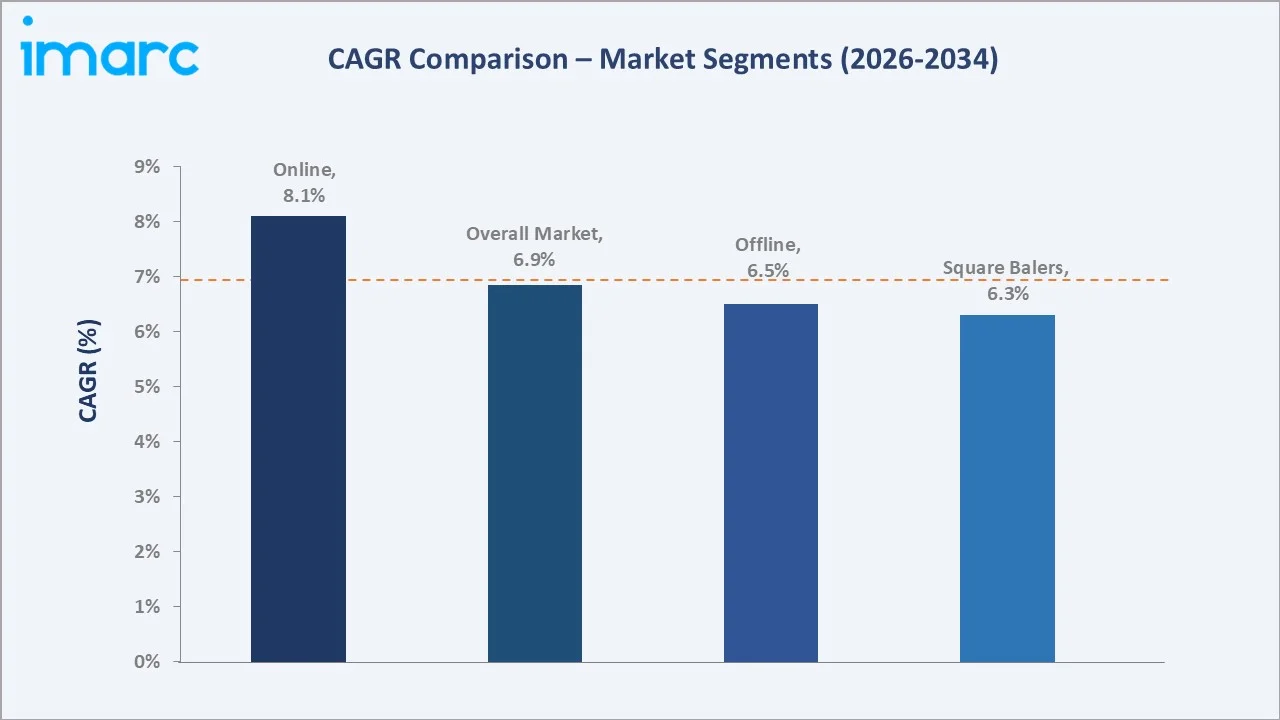
The online distribution channel shows the fastest projected growth at ~8.1% CAGR, reflecting digitalization of agricultural equipment procurement and direct manufacturer-to-farmer sales platforms. Round balers maintain dominance at ~7.2% CAGR through large-scale hay and forage harvesting needs, while the Asia-Pacific region leads global market expansion driven by mechanization in China, India, and Southeast Asian agricultural economies.
Executive Summary
The global baler market expanded from USD 5.34 Billion in 2025 to an estimated USD 5.71 Billion in 2026, positioning it as one of the most commercially robust segments in agricultural machinery. The market scale is underpinned by global food security imperatives, expanding livestock feed requirements, and the growing integration of precision agriculture technologies. These structural demand drivers support continued baler market expansion at a rate that aligns with global agricultural GDP growth. The market is projected to reach USD 9.87 Billion by 2034. Round Balers at 56.8% lead through large-scale agricultural harvesting efficiency. Offline at 82.4% reflects established dealer networks. Asia-Pacific leads regionally at 39.6%.
Key Market Insights
|
Insight |
Data |
|
Dominant Product |
Round Balers – 56.8% share (2025) |
|
Dominant Distribution Channel |
Offline – 82.4% market share (2025) |
|
Leading Region |
Asia-Pacific – 39.6% share (2025) |
|
Market Opportunity |
Precision baling technology adoption; smart IoT-enabled balers; expanding biomass energy sector; emerging market agricultural mechanization programs |
Key Analytical Observations Supporting the Above Data:
- Round Balers at 56.8%: Round balers dominate due to their efficiency in large-scale hay, straw, and silage baling operations. Their cylindrical bale form offers superior weather resistance and ease of handling. Wide adoption across commercial farming operations and contract baling services supports segment leadership.
- Offline at 82.4%: The offline distribution channel dominates due to the complexity of baler procurement, which requires in-person demonstrations, technical support, and customized financing options. Established dealer networks and after-sales service infrastructure make offline purchasing the preferred channel for large agricultural equipment.
- Asia-Pacific at 39.6%: Asia-Pacific leads regionally due to the massive scale of agricultural activities in China, India, Australia, and Southeast Asia. Government-backed mechanization programs, large cultivated land areas, and growing livestock feed demands drive regional baler market leadership.
Baler Market Overview
The global baler market is commercially positioned at a critical intersection of agricultural mechanization, food security infrastructure, and sustainable biomass management. The market serves diverse end uses from hay and straw baling for livestock feed to industrial waste and recycled material baling for environmental management. Rising global food demand, expanding livestock industries, and growing bioenergy applications create structural and sustained demand drivers for baling equipment across all major agricultural economies.
The baler ecosystem integrates raw material suppliers, equipment manufacturers, dealer and distribution networks, and end-user farmer and contractor segments. Macroeconomic factors include rising farm incomes, government subsidies for agricultural equipment, increasing crop production acreage, and growing livestock herds driving feed baling demand globally.
Market Dynamics
To evaluate market opportunities, Request Sample
Market Drivers
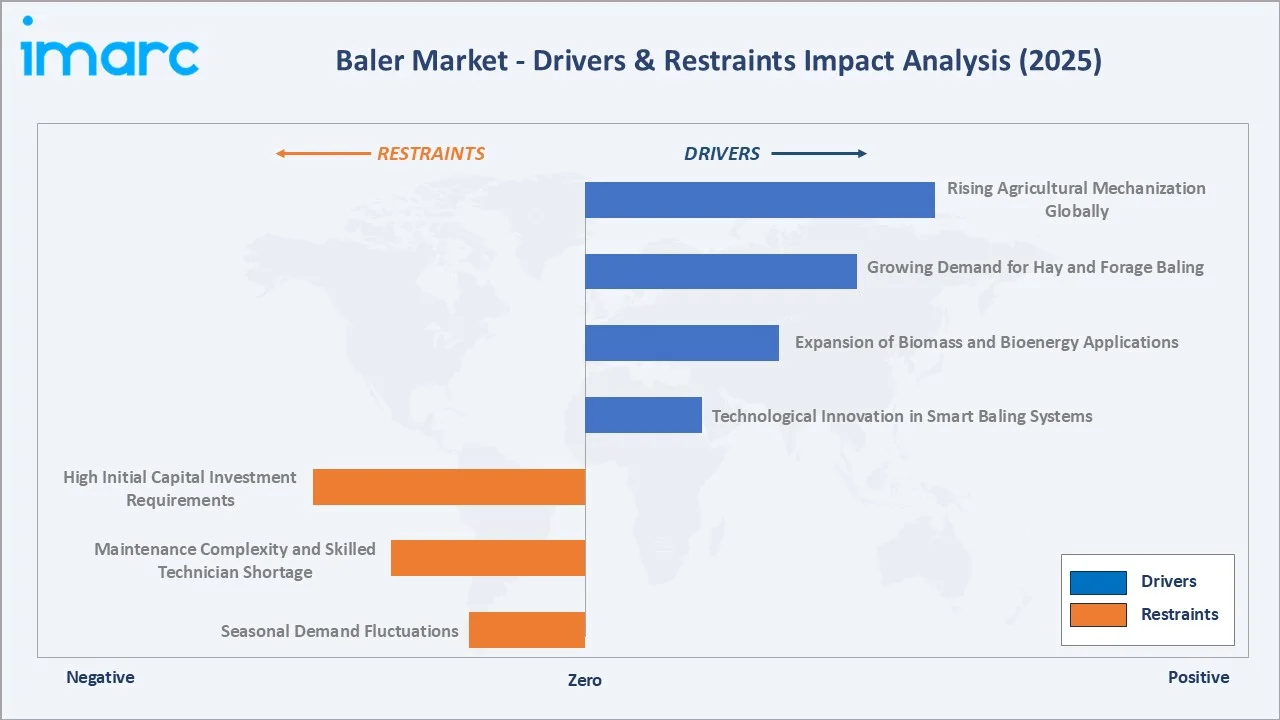
- Rising Agricultural Mechanization Globally: Rising agricultural mechanization is expanding baler adoption across developing and developed farming economies. As farm labor costs increase and farm sizes grow, mechanized baling solutions become economically essential for maintaining operational efficiency. Government mechanization programs in Asia-Pacific and Latin America are providing subsidized access to baling equipment, driving penetration in previously underserved agricultural markets.
- Growing Demand for Hay and Forage Baling: Growing global livestock populations and the expansion of dairy and beef farming are driving sustained demand for efficient hay and forage baling solutions. Round and square balers serve as critical infrastructure in feed supply chains, enabling efficient harvesting, storage, and transport of forage crops. The rising demand for high-quality livestock feed in Asia-Pacific and Latin America markets is creating new commercial opportunities for baler manufacturers and distributors.
- Expansion of Biomass and Bioenergy Applications: Expanding biomass energy markets are creating new and commercially significant demand for industrial balers serving agricultural residue and energy crop baling needs. Governments promoting renewable energy adoption are incentivizing biomass production, directly expanding the addressable market for large-format balers capable of handling energy crops such as miscanthus, switchgrass, and agricultural residues at commercial scale.
- Technological Innovation in Smart Baling Systems: Technological innovation in IoT-enabled monitoring, precision bale density control, and autonomous baling systems is accelerating equipment replacement cycles and attracting new buyers seeking operational efficiency gains. Major manufacturers including Deere & Company and AGCO Corporation have launched connected baler solutions integrating telematics and real-time performance monitoring, expanding the commercial value proposition for premium baling equipment in precision agriculture-adopting farm segments.
Market Restraints
- High Initial Capital Investment Requirements: The high purchase cost of commercial balers represents a significant barrier to adoption, particularly in developing markets where smallholder farmers constitute the majority of the agricultural workforce. Round balers can range from USD 15,000 to over USD 60,000 for premium models, limiting accessibility for price-sensitive buyers. This restricts market penetration in emerging economies and constrains replacement cycle frequency in cost-sensitive farming segments.
- Maintenance Complexity and Skilled Technician Shortage: Complex mechanical and electronic baler systems require skilled technicians for maintenance and repair, creating operational challenges in regions with limited agricultural machinery expertise. The shortage of qualified service personnel in rural areas increases equipment downtime risk and total cost of ownership, reducing the attractiveness of premium technology balers in markets where after-sales service infrastructure is underdeveloped.
- Seasonal Demand Fluctuations: The highly seasonal nature of baling operations, concentrated during harvest periods, creates significant revenue concentration and cash flow challenges for dealers and manufacturers. This seasonal demand pattern complicates production planning, inventory management, and dealer financing operations, limiting the ability of market participants to optimize capacity utilization and reduce per-unit operational costs throughout the year.
Market Opportunities
- Emerging Market Mechanization Programs: Government-sponsored agricultural mechanization initiatives across South and Southeast Asia, Sub-Saharan Africa, and Latin America represent a significant emerging demand opportunity for affordable entry-level and mid-range baler products. Programs supporting farm equipment financing, subsidy schemes, and rural mechanization centers are creating structured commercial pathways for baler manufacturers to enter previously inaccessible rural agricultural markets.
- Precision Agriculture and Smart Baler Integration: Integration of precision agriculture systems with baling equipment, including GPS-guided operations, real-time yield monitoring, and automated bale tracking, creates a premium commercial tier with higher margins and stronger customer retention. As precision agriculture adoption accelerates among commercial farming operations in North America and Europe, the addressable market for technology-integrated premium balers expands, supporting revenue growth above base market volume growth rates.
Market Challenges
- Supply Chain Disruptions for Key Components: The baler industry depends on a complex global supply chain for steel, hydraulic systems, electronic components, and rubber materials. Supply chain disruptions—demonstrated during the COVID-19 pandemic and subsequent geopolitical events—create production delays, cost inflation, and delivery uncertainties that challenge manufacturers ability to serve peak seasonal demand periods reliably.
- Competitive Pressure from Local Manufacturers: In key emerging markets, particularly India and China, local manufacturers compete aggressively on price with simplified baler designs targeting smallholder farmers. This competitive dynamic compresses margins for global OEM brands and limits their ability to grow market share in the fast-growing emerging market segments without significant price concessions or targeted product localization investments.
Emerging Market Trends
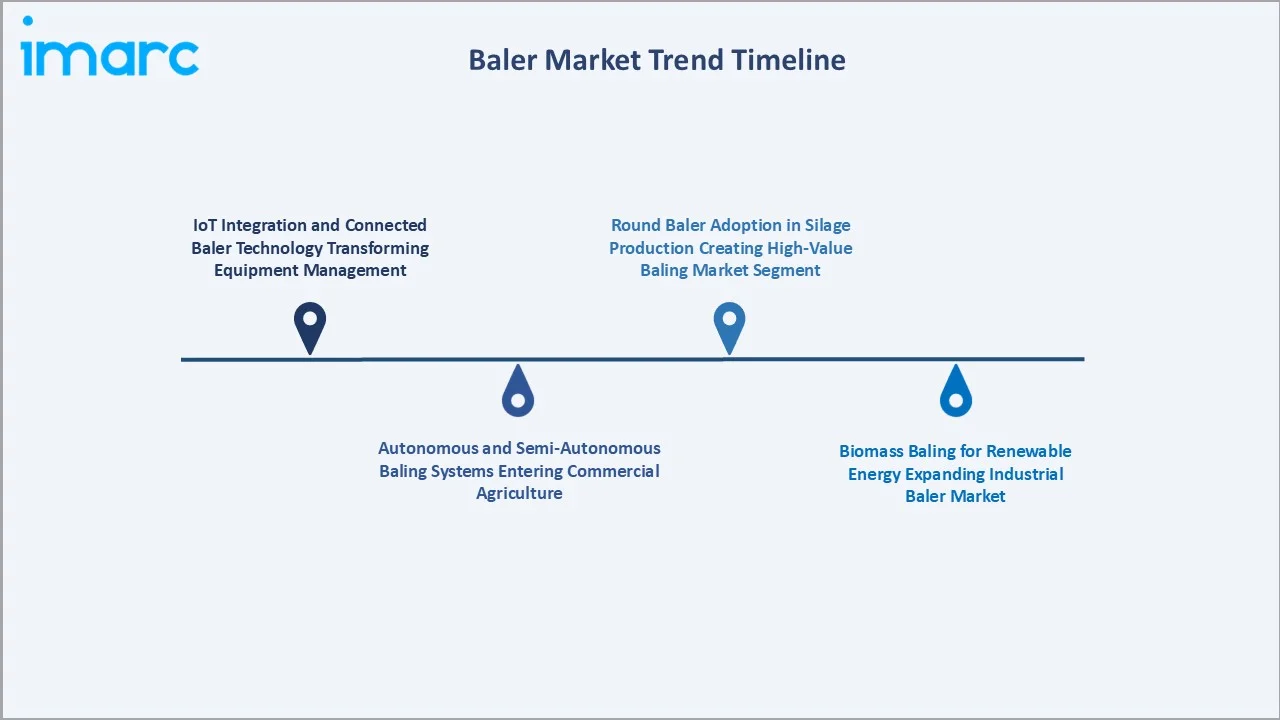
1. IoT Integration and Connected Baler Technology Transforming Equipment Management
IoT-connected baler systems are transforming equipment fleet management for commercial farming operations and agricultural contractors. Real-time performance monitoring, predictive maintenance alerts, and remote diagnostics reduce unplanned downtime and extend equipment operational life. Manufacturers are embedding telematics platforms directly into baler control systems, creating data-driven service and subscription business models that enhance recurring revenue streams beyond initial equipment sales.
2. Round Baler Adoption in Silage Production Creating High-Value Baling Market Segment
Round baler adoption for silage bale production, utilizing film-wrapped bale technology for airtight fermentation, is creating a premium product category within the baler market. Silage baling delivers superior feed quality preservation compared to traditional forage drying, driving adoption among dairy and livestock farmers seeking to optimize feed nutritional value. This trend supports higher average selling prices for round balers equipped with integrated net wrapping and film binding systems, enhancing manufacturer revenue per unit.
3. Autonomous and Semi-Autonomous Baling Systems Entering Commercial Agriculture
Autonomous and semi-autonomous baling systems, integrating GPS-guided tractor-baler combinations and automated bale ejection and collection systems, are entering commercial agricultural operations in North America and Europe. Farm labor shortages and increasing operational scale are compelling commercial farms to invest in autonomous harvest and baling systems that reduce per-acre labor requirements. Major manufacturers are developing integrated baling automation packages that combine autonomous tractor control with real-time bale field positioning data.
4. Biomass Baling for Renewable Energy Expanding Industrial Baler Market
Expanding biomass energy production for electricity generation and pellet manufacturing is driving new commercial demand for large-format industrial balers serving energy crop and agricultural residue baling needs. Bioenergy companies and agricultural cooperatives are investing in high-capacity baler fleets capable of processing large volumes of energy crops and crop residues. This trend creates a new and commercially distinct customer segment for baler manufacturers, separate from traditional hay and forage baling applications.
Industry Value Chain Analysis
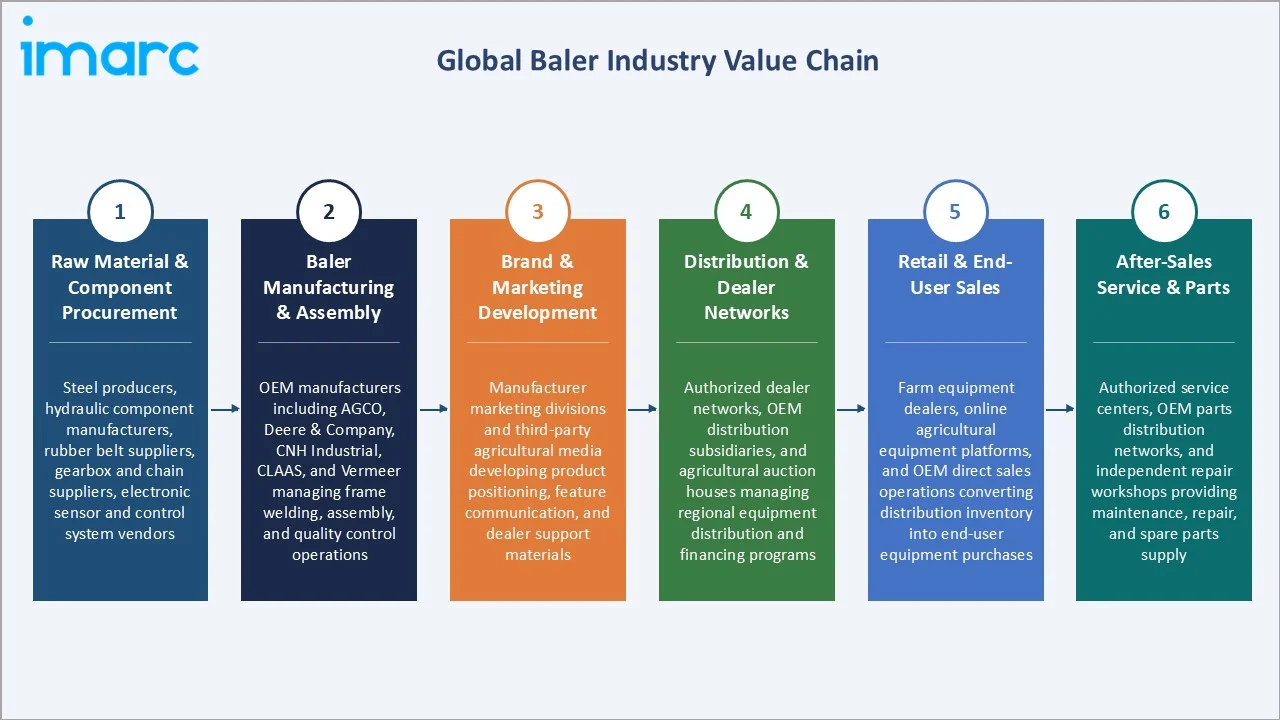
The global baler value chain is one of the most vertically integrated segments in agricultural machinery manufacturing. The value chain commercial structure reflects the complexity of baler systems, which combine structural steel fabrication, hydraulic engineering, electronic control systems, and precision mechanical components into highly functional agricultural equipment platforms.
|
Stage |
Key Participants |
|
Raw Material & Component Procurement |
Steel producers, hydraulic component manufacturers, rubber belt suppliers, gearbox and chain suppliers, electronic sensor and control system vendors providing essential input materials for baler manufacturing |
|
Baler Manufacturing & Assembly |
OEM manufacturers including AGCO, Deere & Company, CNH Industrial, CLAAS, and Vermeer managing frame welding, component integration, assembly line production, and quality control operations |
|
Brand & Marketing Development |
Manufacturer marketing divisions and third-party agricultural media companies developing product positioning, feature communication, and dealer support materials for baler product portfolios |
|
Distribution & Dealer Networks |
Authorized dealer networks, OEM distribution subsidiaries, and agricultural auction houses managing regional equipment distribution, demonstration, and dealer inventory financing programs |
|
Retail & End-User Sales |
Farm equipment dealers, online agricultural equipment platforms, and OEM direct sales operations converting distribution inventory into end-user equipment purchases |
|
After-Sales Service & Parts |
Authorized service centers, OEM parts distribution networks, and independent repair workshops providing maintenance, repair, and spare parts supply to maintain operating baler equipment fleets |
The distribution and dealer network stage is the baler value chain most commercially critical interface, where manufacturers product capability and pricing strategies are translated into actual farmer purchase decisions. Dealer networks spend significant resources on equipment demonstrations, financing facilitation, and after-sales support, creating a high-value service layer that supports premium product pricing and brand loyalty in commercial farming segments.
Technology Landscape in the Baler Industry
Precision Bale Density and Formation Control Systems
Precision bale density and formation control technologies enable optimized bale weight, dimensions, and structural integrity, directly impacting transport efficiency and storage density. Variable chamber round baler systems and twin-belt fixed chamber technologies represent the two leading engineering approaches to density optimization. These systems enable operators to customize bale specifications to match transport and storage requirements, supporting higher operational efficiency across diverse baling application contexts.
Smart Sensor Integration and Telematics Platforms
Smart sensor integration and telematics platforms embedded in modern balers provide real-time operational data including bale count, throughput rates, mechanical wear indicators, and field location data. These connected systems enable predictive maintenance scheduling, fleet utilization optimization, and remote diagnostic support from manufacturer service teams. The commercial adoption of connected baler platforms is accelerating among large commercial farms and agricultural contracting businesses with multi-unit baler fleets requiring centralized management capabilities.
Electric and Hybrid Drive Systems for Sustainable Baling
Electric and hybrid drive technologies are beginning to enter baler system design, responding to EU and North American regulatory pressure for lower agricultural machinery emission profiles. Electric-drive baler mechanisms offer reduced mechanical complexity compared to PTO-driven systems, potentially improving reliability and reducing maintenance requirements. While full commercial adoption of electric baling systems remains at an early stage, manufacturer R&D investment is accelerating, with several OEMs demonstrating prototype systems at international agricultural exhibitions.
Market Segmentation Analysis
The report covers the following segments:
|
Segment Category |
Leading Segment |
Market Share |
Year |
|
Product |
Round Balers |
56.8% |
2025 |
|
Distribution Channel |
Offline |
82.4% |
2025 |
|
Application |
🔒 |
🔒 |
2025 |
|
End User |
🔒 |
🔒 |
2025 |
|
Region |
Asia-Pacific |
39.6% |
2025 |

By Product
Round Balers lead at 56.8% (2025). Round balers dominate through their commercial versatility in serving large-scale hay, straw, silage, and biomass baling applications. Their cylindrical bale format provides superior weather resistance during open-field storage, reducing dry matter losses and supporting high-volume forage harvesting operations across commercial farming scales.
To access detailed market analysis, Request Sample
Square Balers at 43.2% serve specialized commercial applications requiring high-density rectangular bale formats for transport optimization and automated feeding systems. Square balers are preferred in dairy operations with automated feed wagon integration and in hay export markets where standardized bale dimensions are commercially required for shipping container optimization and international trade logistics.
By Distribution Channel
Offline leads at 82.4% (2025). Offline distribution dominates through its established commercial role in large equipment sales, where in-person demonstrations, technical consultations, and dealer financing options are essential components of the purchase decision process for capital-intensive baling equipment. The complexity of baler specifications and the importance of after-sales service networks make dealer-based offline procurement the preferred channel for commercial farming buyers.
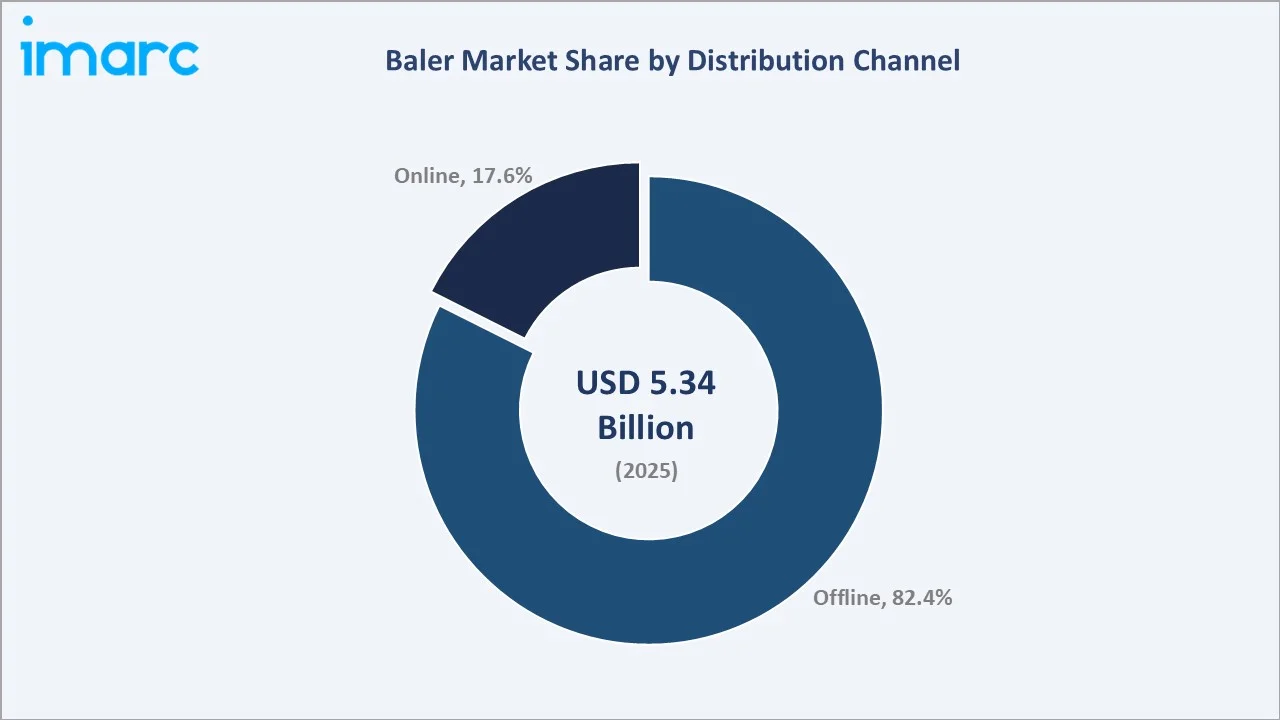
Online at 17.6% is growing at ~8.1% CAGR through digital agricultural platforms, OEM e-commerce portals, and agricultural equipment auction websites providing convenient sourcing options for smaller balers, spare parts, and used equipment. The online channel growth is accelerating as younger farm operators increasingly research and configure equipment digitally before completing purchases through authorized dealer networks.
Regional Market Insights
|
Region |
Share (2025) |
Key Baler Market Drivers & Characteristics |
|
Asia-Pacific |
39.6% |
Driven by large-scale agricultural production in China, India, and Australia, government mechanization programs, and growing livestock feed demand. |
|
North America |
27.4% |
Supporting widespread adoption of precision agriculture, commercial farming consolidation, and strong after-market parts and service ecosystem. |
|
Europe |
21.2% |
Reflects advanced mechanization in Germany, France, and the UK, strong EU agricultural policy support, and high adoption of precision baling technologies. |
|
Latin America |
7.3% |
Rising agricultural export activity in Brazil and Argentina driving commercial baler adoption for soybean, sugarcane, and forage crop baling. |
|
Middle East and Africa |
4.5% |
Emerging market agricultural modernization programs and growing livestock sector investments supporting early-stage baler market development. |
Asia-Pacific's 39.6% market leadership reflects China massive agricultural machinery demand supported by state mechanization subsidies, India rapidly growing commercial farming sector, and Australia's large-scale pastoral and dryland farming operations. North America's 27.4% reflects the commercial farming consolidation driving large equipment investments, high precision agriculture adoption, and strong aftermarket parts revenue supporting dealer network profitability.
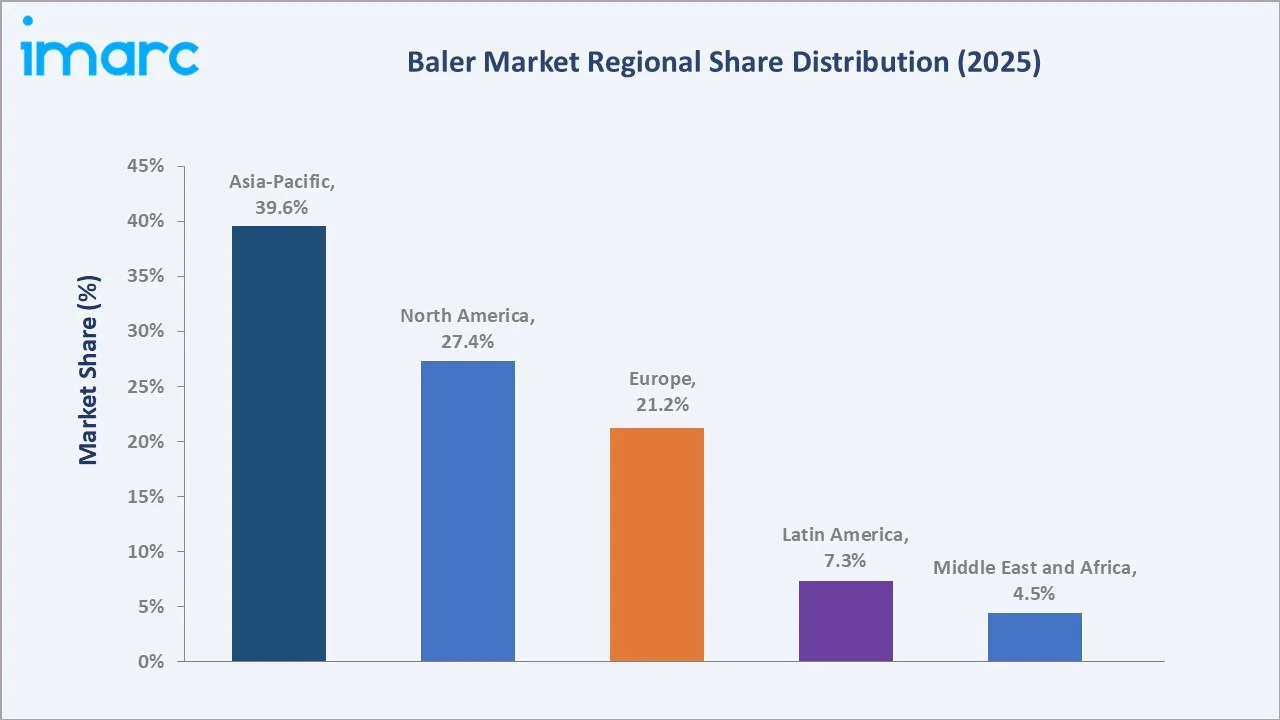
Europe's 21.2% reflects Germany and France's highly mechanized farming operations, strong EU Common Agricultural Policy support for equipment investment, and above-market adoption of precision baling technology. Latin America's 7.3% is growing above the global market CAGR as Brazil's expanding soy and livestock sectors and Argentina's grain farming growth create structured commercial demand for baling equipment, attracting major OEM investment in regional dealer network expansion.
Competitive Landscape
The global baler market competitive landscape is commercially stratified between global agricultural equipment OEMs holding dominant market shares across all geographic regions and specialized baler manufacturers serving specific product niches. Competition is intensifying through technology differentiation, service network expansion, and emerging market dealer network buildout strategies. Major OEMs are leveraging integrated farm equipment portfolio strategies to bundle baler sales with tractor and other harvesting equipment purchases.
|
Company |
Key Products |
Market Position |
Core Strength |
|
AGCO Corporation |
Fendt, Massey Ferguson |
Market Leader |
AGCO Corporation commands a leading position in the global baler market through its multi-brand agricultural equipment strategy, offering round and square baler solutions across premium Fendt and mainstream Massey Ferguson brand portfolios. |
|
Deere & Company |
John Deere round and square balers |
Market Leader |
Deere & Company is the global benchmark for premium baling technology, delivering industry-leading precision bale density control, ISOBUS compatibility, and connected equipment telematics through its John Deere Operations Center platform. |
|
CNH Industrial N.V. |
Case IH balers |
Strong Challenger |
CNH Industrial N.V. leverages its New Holland and Case IH brand equity to offer a comprehensive round and square baler lineup, with particular strength in European markets through New Holland longstanding dealer network presence. |
|
CLAAS KGaA mbH |
CLAAS round and square balers |
Strong Challenger |
CLAAS KGaA mbH is the baler market most technologically focused European specialist, delivering the CLAAS Rollant and Quadrant baler series widely recognized for superior bale quality consistency and reliability in high-throughput commercial operations. |
|
Vermeer Corporation |
Vermeer round balers |
Innovator |
Vermeer Corporation has established global baler market presence through its purpose-designed round baler technology, particularly in North American hay and biomass baling markets, delivering robust machines suited to challenging field and crop conditions. |
The competitive landscape most commercially significant dynamic is the increasing technology differentiation between premium OEM balers featuring integrated telematics, precision density control, and autonomous operation capabilities versus mid-market and value-tier products. This technology gap is creating distinct commercial tiers within the baler market, where premium technology buyers support higher margins while value-tier segments face increasing competition from Asian manufacturers.
Key Company Profiles
AGCO Corporation
AGCO Corporation is one of the world's largest agricultural equipment manufacturers and a dominant player in the global baler market through its Fendt, Massey Ferguson, and Challenger brand portfolios.
- Key Products: Fendt Rotana round balers, Massey Ferguson 1800 series round balers, Challenger RB series, Massey Ferguson 2200 and 2900 large square balers.
- Recent Developments: In 2025, AGCO Corporation expanded its Fendt Rotana round baler series with advanced ISOBUS automation and precision bale density mapping capabilities, targeting precision agriculture-adopting commercial farm operators in European and North American markets.
- Strategic Focus: Expanding precision baling technology integration across its brand portfolio and growing dealer network presence in Asia-Pacific emerging markets through targeted partnerships with regional agricultural equipment distributors.
Deere & Company
Deere & Company is the global market leader in premium baling technology, delivering John Deere round and square baler solutions widely recognized for performance, reliability, and integration with the John Deere Operations Center connected farming platform.
- Key Products: John Deere 9 Series round balers, John Deere L340 and C440 large square balers, John Deere C Series combination balers with integrated wrapping systems.
- Recent Developments: In 2026, Deere & Company introduced autonomous bale field mapping integration into its round baler control systems, enabling automatic bale placement tracking and remote fleet monitoring for commercial farming operations and agricultural contractors managing multi-baler harvest campaigns.
- Strategic Focus: Advancing autonomous and semi-autonomous baling system development and deepening integration between baler telematics data and the John Deere Operations Center farm management platform to create compelling subscription revenue streams from connected equipment services.
CNH Industrial N.V.
CNH Industrial N.V. is a global agricultural equipment manufacturer serving the baler market through its New Holland and Case IH brand subsidiaries, offering comprehensive round and square baler product lines serving diverse farming segments across all major global agricultural markets.
- Key Products: New Holland Roll-Belt series round balers, New Holland BigBaler series large square balers, Case IH RB series round balers, Case IH LB series large square balers.
- Recent Developments: In 2025, CNH Industrial launched its New Holland IntelliSense precision baling system featuring automatic bale density optimization based on real-time crop moisture and density sensor data, reducing operator intervention requirements and improving bale quality consistency across variable field conditions.
- Strategic Focus: Expanding after-market parts and service revenue through dealer network digitalization and growing the precision agriculture software ecosystem around its baler hardware portfolio to improve equipment retention and fleet management service value for commercial farming customers.
Market Concentration Analysis
The global baler market is moderately concentrated at the premium and commercial farming segments, with AGCO Corporation and Deere & Company collectively commanding an estimated 35-45% of global baler market revenue through their multi-brand premium equipment strategies, and moderately fragmented in the value and emerging market segments, where regional manufacturers in China and India compete on price for smallholder and entry-level farmer demand. The markets concentration is evolving through the increasing technology premium between OEM and non-OEM products.
Market concentration is evolving through two opposing forces: major OEM consolidation through technology integration and dealer network investment maintaining or growing premium brand market shares, while emerging market baler manufacturers in China and India are gaining share in Asia-Pacific and Latin American value segments through competitive pricing and government-supported equipment distribution programs, creating a dual-tier competitive structure that challenges global OEMs seeking margin-accretive growth in emerging markets.
Investment & Growth Opportunities
Highest Growth Segments
Online distribution channel (~8.1% CAGR through digital procurement platform growth), biomass baling for bioenergy (~9.5% CAGR from energy crop expansion), smart IoT-connected balers (~10% CAGR through precision agriculture adoption), emerging Asia-Pacific market growth (~8.5% CAGR through government mechanization programs), and large square baler premium segment (~7.5% CAGR through commercial hay export demand) represent the highest-growth baler market investment vectors through 2034.
Emerging Investment Opportunities
The biomass energy baling sector, growing at above-market rates due to renewable energy mandates and bioenergy crop expansion programs, represents the baler market highest-CAGR new application segment. Investment in purpose-designed biomass baler technology and distribution partnerships with bioenergy crop producers creates a commercially scalable entry into a structurally growing application market that is underserved by current standard hay and forage baler product portfolios.
Investment Themes
- Precision baler technology platform investment targeting commercial farm operators and agricultural contracting businesses adopting connected equipment management: The convergence of telematics, precision bale density control, and farm management software integration creates a compelling investment thesis for premium baler technology platforms serving high-value commercial farming operations that prioritize operational data and optimization over initial equipment cost.
- Emerging market dealer network development in Asia-Pacific and Latin America for mid-range baler product lines capturing government-subsidized mechanization demand: India PM-KISAN and similar agricultural mechanization subsidy programs in Vietnam, Indonesia, and Brazil create structured commercial demand for mid-range baler products accessible through dealer financing networks targeting progressive smallholder and medium commercial farm operator segments.
Future Market Outlook (2026-2034)
The global baler market is projected to grow from USD 5.34 Billion in 2025 to USD 5.71 Billion in 2026, reaching USD 9.87 Billion by 2034, registering a CAGR of 6.85% during 2026–2034. The market anchor value of USD 7.44 Billion in 2030 represents the global baler industry at a structural growth inflection, where precision agriculture adoption, biomass energy market expansion, and emerging market mechanization create compounding demand acceleration. Asia-Pacific is growing as China mechanization policy support creates large-scale baler fleet investment demand, and India rapidly expanding commercial farming sector generates new first-time baler adoption at commercial farm scale.
Three structural forces define baler market growth through 2034: global food security imperatives driving continued crop production expansion; livestock sector growth creating sustained forage baling demand across all major agricultural economies; and the bioenergy transition creating a structurally new and commercially significant application market for large-format industrial baling equipment serving energy crop harvesting operations at commercial scale.
Research Methodology
Primary Research
Primary research comprised structured interviews with global baler market stakeholders, including Equipment Directors, Sales Managers, Agricultural Equipment Dealers, Commercial Farm Operators, Agricultural Contractors, and consumer survey data from baler buyers across North America, Europe, Asia-Pacific, and Latin America, including large commercial farm operators, agricultural contracting businesses, and emerging market mechanization program participants.
Secondary Research
Secondary research encompassed agricultural machinery import-export data, agricultural equipment trade association publications, OEM company annual reports and investor presentations, agricultural census and production data from FAO, USDA, and regional agricultural ministries, market entry and dealer network data, and agricultural equipment auction and resale price tracking reports. Over 50 secondary sources were reviewed.
Forecasting Models
Market revenue forecasts were developed using a crop production volume and agricultural mechanization index model: regional cultivated land area multiplied by crop production intensity and mechanization penetration rates by product segment, aggregated across all major geographic markets. Government subsidy impact multipliers and technology adoption rate adjustments were applied at the regional level to capture policy-driven and technology-driven demand acceleration effects.
Baler Market Report Coverage:
| Report Features | Details |
|---|---|
| Base Year of the Analysis | 2025 |
| Historical Period | 2020-2025 |
| Forecast Period | 2026-2034 |
| Units | Billion USD |
| Scope of the Report | Exploration of Historical Trends and Market Outlook, Industry Catalysts and Challenges, Segment-Wise Historical and Future Market Assessment:
|
| Products Covered | Round Balers, Square Balers |
| Distribution Channels Covered | Online, Offline |
| Applications Covered | Agriculture, Livestock Industry, and Others |
| End Users Covered | Individual, Commercial, Industrial |
| Regions Covered | Asia Pacific, Europe, North America, Latin America, Middle East and Africa |
| Countries Covered | United States, Canada, Germany, France, United Kingdom, Italy, Spain, Russia, China, Japan, India, South Korea, Australia, Indonesia, Brazil, Mexico |
| Companies Covered | AGCO Corporation, Deere & Company, CNH Industrial N.V., CLAAS KGaA mbH, Vermeer Corporation, etc. |
| Customization Scope | 10% Free Customization |
| Post-Sale Analyst Support | 10-12 Weeks |
| Delivery Format | PDF and Excel through Email (We can also provide the editable version of the report in PPT/Word format on special request) |
Frequently Asked Questions About the Baler Market Report
The global baler market size is estimated at USD 5.71 Billion in 2026, driven by rising agricultural mechanization, expanding livestock farming activities, growing biomass energy applications, and government farm equipment subsidies supporting baler adoption across both developed and emerging agricultural markets globally.
The global baler market grows at 6.85% CAGR during 2026-2034, reaching USD 9.87 Billion by 2034. Overall growth is sustained by global agricultural production expansion, livestock sector growth, bioenergy crop harvesting demand, and the accelerating adoption of precision and connected baling technologies among commercial farming and agricultural contracting operations worldwide.
Round Balers lead at 56.8% through their commercial versatility in hay, straw, silage, and biomass baling applications. Their cylindrical bale format provides superior weather resistance during open-field storage, making them the preferred choice for commercial farming operations requiring large-volume forage and biomass harvesting efficiency across diverse crop and field conditions.
Offline distribution leads at 82.4% through established agricultural equipment dealer networks providing essential in-person demonstration, technical consultation, equipment financing, and after-sales service support. The complexity and capital intensity of commercial baler purchases make dealer-based offline procurement the structurally preferred channel for agricultural equipment buyers across all major global markets.
Asia-Pacific leads at 39.6% through China state-supported agricultural mechanization programs, India rapidly growing commercial farming sector, and Australia's large-scale pastoral farming operations driving sustained baler demand across the region diverse agricultural production systems.
Leading companies AGCO Corporation, Deere & Company, CNH Industrial N.V., CLAAS KGaA mbH, and Vermeer Corporation, among others.
The global baler market is projected to reach approximately USD 7.44 Billion by 2030, with precision agriculture integration driving premium baler replacement cycles, bioenergy crop expansion creating new industrial baling demand, and Asia-Pacific emerging market mechanization programs generating first-time commercial baler adoption at scale in India, Vietnam, Indonesia, and other high-growth agricultural economies.
Three priority investment opportunities: precision baling technology platform development targeting commercial farm operators adopting connected equipment management systems for operational efficiency optimization; emerging market dealer network expansion in Asia-Pacific and Latin America capturing government-subsidized mechanization program demand; and biomass energy baling equipment investment serving the structurally growing bioenergy crop harvesting market through purpose-designed industrial baler technology and distribution partnerships.
Need more help?
- Speak to our experienced analysts for insights on the current market scenarios.
- Include additional segments and countries to customize the report as per your requirement.
- Gain an unparalleled competitive advantage in your domain by understanding how to utilize the report and positively impacting your operations and revenue.
- For further assistance, please connect with our analysts.
 Request Customization
 Speak to an Analyst
 Request Brochure
 Inquire Before Buying
Benefits of Customization
- Personalize this research
- Triangulate with your data
- Get data as per your format and definition
- Gain a deeper dive into a specific application, geography, customer, or competitor
- Any level of personalization
Get in Touch With Us
UNITED STATES
Phone: +1-201-971-6302
INDIA
Phone: +91-120-433-0800
UNITED KINGDOM
Phone: +44-753-714-6104
Email: [email protected]
Client Testimonials


















Related Reports

Choose your plan
*Please note that the prices mentioned below are starting prices for each bundle type. Kindly contact our team for further details.*
Single User License
- 1 User License, Access on 2 Devices
- PDF Report + Excel Dataset (Password Protected)
- Lifetime Access
- No Printing Rights
- 10% Free Report Customization
- 10–12 Weeks of Analyst Support
Five User License
- Access for 5 Users, 2 Devices per User
- PDF Report + Excel Dataset (Password Protected)
- Lifetime Access
- Dedicated Account Manager
- 12–14 Weeks of Analyst Support
- No Printing Rights
- 15% Free Report Customization
- 25% Discount on Your Next Purchase
Corporate User License
- Unlimited User Access (Within Your Organization)
- PDF Report + Excel Dataset
- Lifetime Access
- Dedicated Account Manager
- 14–20 Weeks of Analyst Support
- No Printing Rights
- 20% Free Report Customization
- 30% Discount on Your Next Purchase
Essential Insights
What's included:
3 reports
- Lifetime Access
- PDF Reports
- Excel Datasets
- 2 Weeks of Free Analyst Support
- 2 User Licenses
- Access on 2 Devices
- Printing Rights
- Complimentary PowerPoint (PPT) Version
- Complimentary License Upgrade
Professional Access
What's included:
5 reports
- Lifetime Access
- PDF Reports
- Excel Datasets
- 8 Weeks of Free Analyst Support
- 2 User Licenses
- Access on 2 Devices
- Printing Rights
- Complimentary PowerPoint (PPT) Version
- Complimentary License Upgrade
Business Advantage
What's included:
8 reports
- Lifetime Access
- PDF Reports
- Excel Datasets
- 14 Weeks of Free Analyst Support
- 2 User Licenses
- Access on 2 Devices
- Printing Rights
- Complimentary PowerPoint (PPT) Version
- Complimentary License Upgrade
Enterprise Intelligence
What's included:
10 reports
- Lifetime Access
- PDF Reports
- Excel Datasets
- 20 Weeks of Free Analyst Support
- 2 User Licenses
- Access on 2 Devices
- Printing Rights
- Complimentary PowerPoint (PPT) Version
- Complimentary License Upgrade