
Carbon Felt and Graphite Felt Market Size, Share, Trends and Forecast by Type, Product, Raw Material, Application, and Region, 2026-2034
Carbon Felt and Graphite Felt Market Size, Share, Trends & Forecast (2026-2034)
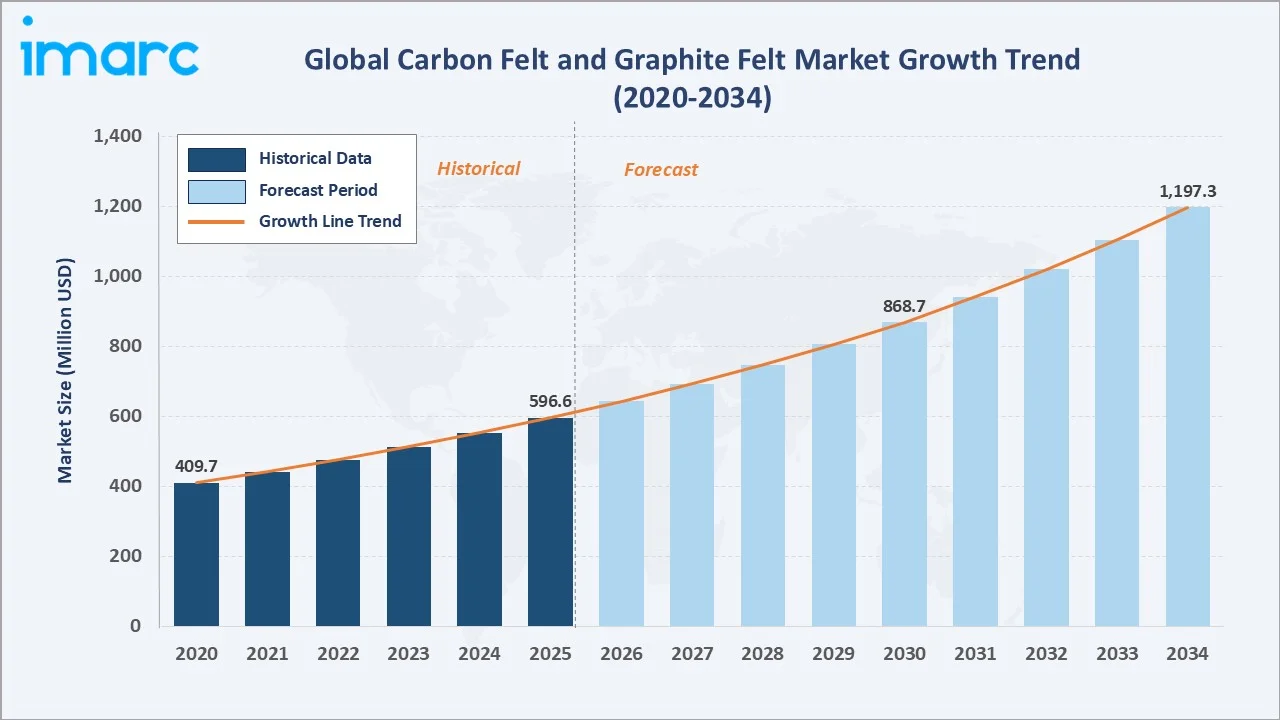
The global carbon felt and graphite felt market reached USD 596.6 Million in 2025 and is projected to reach USD 1,197.3 Million by 2034, growing at a CAGR of 7.81% during 2026-2034. Growth is driven by rising heat-insulation demand, expanding energy storage applications, and sustained research and development activity. Carbon felt dominates by type at 58.4%, while rigid felt leads by product at 54.7%. Asia-Pacific commands 41.3% of the global market, led by China's electronics manufacturing base and Japan's advanced materials expertise.
Market Snapshot
|
Metric |
Value |
|
Market Size (2025) |
USD 596.6 Million |
|
Forecast Market Size (2034) |
USD 1,197.3 Million |
|
CAGR (2026-2034) |
7.81% |
|
Base Year |
2025 |
|
Historical Period |
2020-2025 |
|
Forecast Period |
2026-2034 |
|
Dominant Type |
Carbon Felt (58.4%, 2025) |
|
Dominant Product |
Rigid Felt (54.7%, 2025) |
|
Leading Region |
Asia-Pacific (41.3%, 2025) |
The market expanded from an estimated USD 409.7 Million in 2020 to USD 596.6 Million in 2025, anchored at USD 868.7 Million by 2030, and is forecast to reach USD 1,197.3 Million by 2034. Demand recovered steadily post-pandemic as furnace insulation and battery electrode applications scaled alongside global energy storage investment.
To get more information on this market, Request Sample
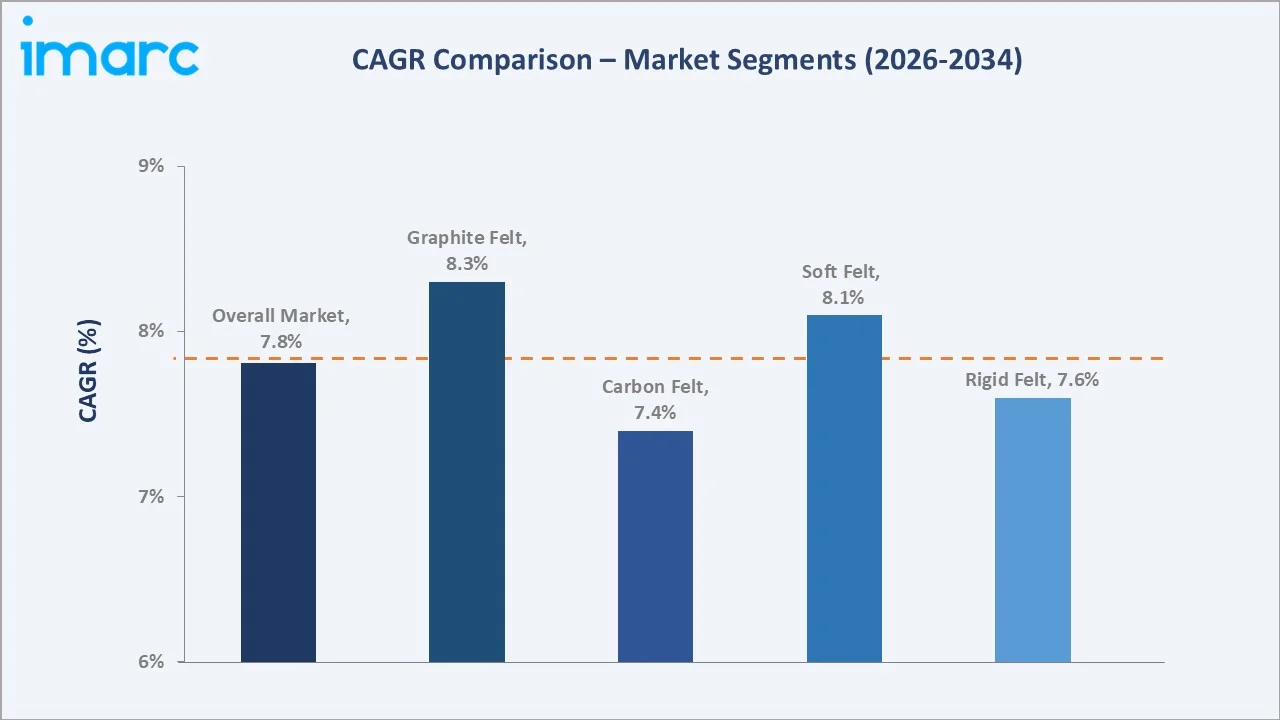
Graphite felt grows fastest at ~8.3% CAGR as redox flow battery and semiconductor furnace insulation demand accelerates, while carbon felt maintains steady ~7.4% CAGR growth on established industrial insulation volumes. Soft felt grows at ~8.1% CAGR through flexible multi-layer lining adoption, while rigid felt advances at ~7.6% CAGR on sustained furnace hot-zone demand. This divergence in segment-level growth reflects the shifting composition of end-use demand, with higher-purity, higher-value applications in energy storage and semiconductor manufacturing increasingly outpacing traditional furnace insulation volumes, even as the latter continues to represent the largest share of overall consumption.
Executive Summary
The global carbon felt and graphite felt market reached USD 596.6 Million in 2025, reflecting sustained industrial demand for high-temperature refractory insulation materials. Carbon felt and graphite felt are engineered non-woven fibrous materials valued for thermal stability, chemical resistance, and low density, making them indispensable in furnace insulation and battery electrode applications. The market is projected to reach USD 1,197.3 Million by 2034, representing an approximate doubling of market value over the forecast period.
Carbon felt at 58.4% dominates by type through cost-effective thermal insulation performance and extensive furnace-industry adoption. Rigid felt at 54.7% leads by product owing to its structural stability in vacuum and inert-gas furnace linings. Asia-Pacific at 41.3% leads regionally through China's electronics and battery manufacturing scale, supported by Japan's and South Korea's advanced materials industries.
Key Market Insights
|
Insight |
Data |
|
Dominant Type |
Carbon Felt - 58.4% share (2025) |
|
Dominant Product |
Rigid Felt - 54.7% market share (2025) |
|
Leading Region |
Asia-Pacific - 41.3% market share (2025) |
|
Market Opportunity |
Vanadium redox flow battery electrodes; semiconductor and solar furnace insulation; nanoparticle-enhanced felts |
Key Analytical Observations Supporting The Above Data:
- Carbon Felt at 58.4%: Carbon felt dominates due to its cost-effective thermal insulation properties, wide availability, and extensive use in vacuum and inert-gas furnace linings across metallurgy, electronics, and glass manufacturing industries.
- Rigid Felt at 54.7%: Rigid felt leads the product segment as its structural stability and ease of installation make it the preferred choice for furnace hot-zone insulation, where dimensional consistency under extreme temperature cycling is essential.
- Asia-Pacific at 41.3%: Asia-Pacific leads through China's dominant electronics component manufacturing base, extensive R&D activity, and significant technological advancements supporting furnace and battery-grade felt production capacity. Japan and South Korea contribute additional demand through their advanced semiconductor and specialty materials industries.
Carbon Felt and Graphite Felt Market Overview
The global carbon felt and graphite felt market encompasses the design, manufacture, and supply of flexible high-temperature refractory materials produced by pressing, tangling, and condensing carbon or graphite fibers. These felts are structurally stable, lightweight, and resistant to chemicals, high temperatures, and corrosion, supporting their use as electrodes, cathodes, and furnace insulation across vacuum and inert-gas environments. Their ability to withstand oxidizing temperatures up to approximately 400 degrees Celsius, and vacuum or protective atmosphere conditions up to roughly 3,200 degrees Celsius, makes them uniquely suited to demanding industrial processes where conventional insulation materials would fail structurally or chemically.
Market Dynamics
To evaluate market opportunities, Request Sample
Market Drivers
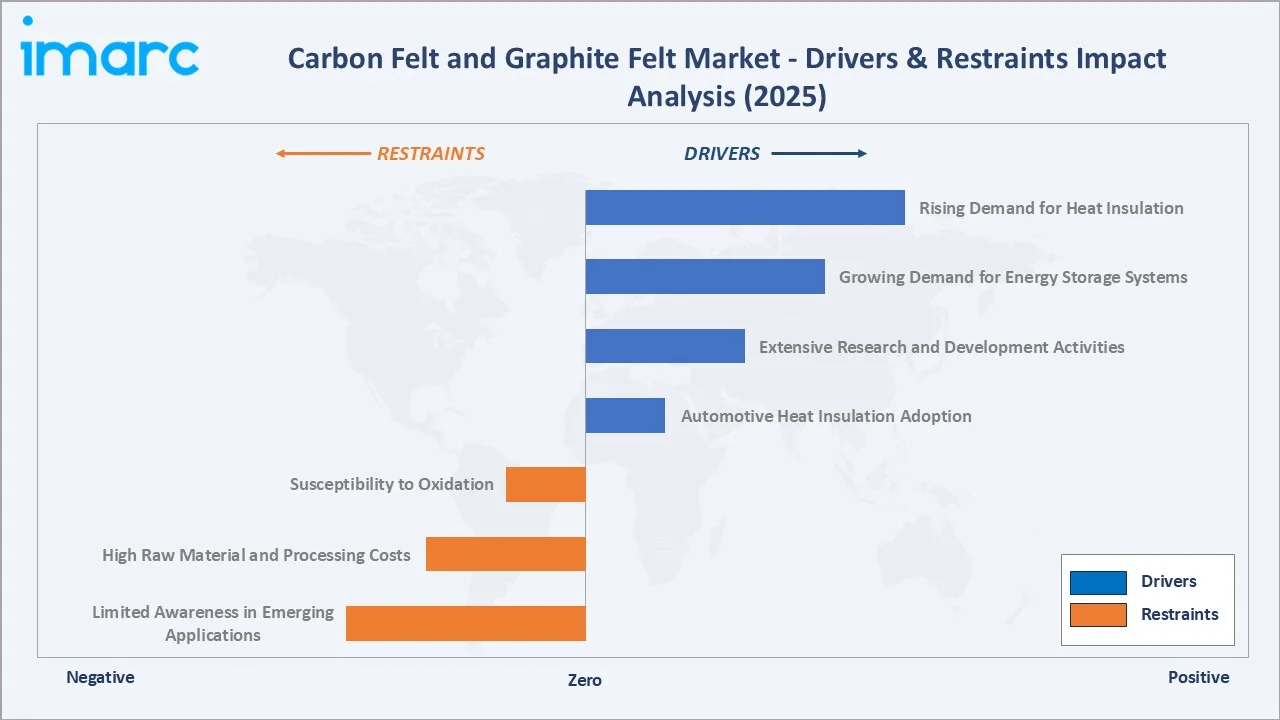
- Rising Demand for Heat Insulation: Increasing product demand for heat insulation across vacuum and protected atmospheric environments is favoring market growth, particularly in furnaces used for heating fluids, vacuum distillation, and industrial gas manufacturing. This spans ethylene, vinyl chloride monomer, and synthetic gas production, where felt-lined furnaces deliver consistent thermal performance over extended operating cycles.
- Growing Demand for Energy Storage Systems: Rising utilization of felts as anodes and cathodes in flow batteries and high-performance battery designs, owing to their broad operational range and chemical stability, is propelling market growth. Vanadium redox flow battery installations are scaling rapidly as utilities seek long-duration storage, directly increasing felt electrode procurement.
- Extensive Research and Development Activities: Manufacturers are focusing on combining carbon and graphite felts with nanoparticles to enhance efficiency and properties, supporting continuous product innovation across application segments. Ongoing R&D also targets improved fiber purity and binder-free production techniques that enhance electrochemical performance while reducing manufacturing waste.
- Automotive Heat Insulation Adoption: Rising demand for carbon and graphite felt in the automotive industry, owing to their strong heat-insulating properties in exhaust lining and heat-shield applications, is acting as an additional growth-inducing factor. Vehicle lightweighting initiatives further support felt adoption as manufacturers seek durable, low-density insulation materials.
Market Restraints
- Susceptibility to Oxidation: Carbon and graphite felts perform well in vacuum or inert atmospheres but degrade when exposed to oxygen at elevated temperatures, limiting broader use in open-air or cost-sensitive environments. Oxidation typically begins gradually around 400-500 degrees Celsius and accelerates above 600-700 degrees Celsius, causing structural integrity to decline over repeated thermal cycles.
- High Raw Material and Processing Costs: Carbonizing, graphitizing, pressing, and curing processes are capital- and technically intensive, raising overall production costs and limiting entry for smaller manufacturers. High-temperature processing equipment requires substantial upfront investment, creating meaningful barriers for new entrants.
- Limited Awareness in Emerging Applications: Slower adoption of felt-based insulation and electrode solutions in certain price-sensitive emerging markets can restrain broader market penetration outside established industrial hubs. Limited technical familiarity among smaller regional manufacturers can further delay adoption in cost-conscious segments.
Market Opportunities
- Semiconductor and Solar Manufacturing Expansion: Every new fabrication line and solar ingot facility requires high-purity graphite felt furnace insulation, creating a steady consumable demand pull tied directly to global capacity growth. In Czochralski crystal growth, felt linings control thermal gradients that determine wafer quality, making periodic replacement a recurring requirement.
- Nanoparticle-Enhanced Felt Development: Combining carbon and graphite felts with nanoparticles to improve efficiency and performance characteristics opens new premium product opportunities for manufacturers. These enhanced felts offer improved surface area and electrochemical activity, positioning early movers to capture higher-margin sales as the technology matures.
Market Challenges
- Raw Material Precursor Supply Constraints: Procurement lead times for PAN, rayon, and pitch-based carbon fiber precursors can stretch under supply-side disruption, prompting manufacturers to diversify feedstock sourcing. Concentrated precursor production capacity in a small number of countries adds further vulnerability to global supply.
- Performance Variability Across Suppliers: Differences in raw material purity, fiber structure, and processing techniques create irregular thermal conductivity and porosity, impacting reliability in sensitive battery and filter applications. This variability can necessitate additional testing steps, adding cost and lead time to procurement.
Emerging Market Trends
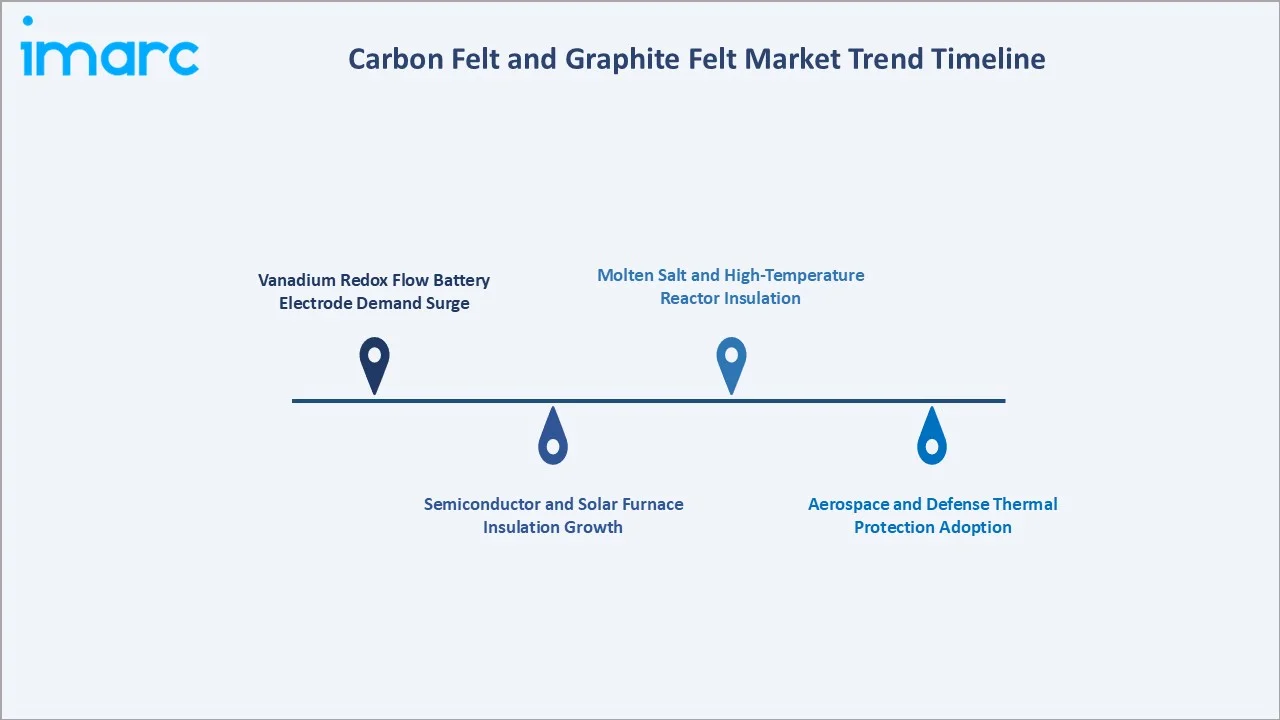
1. Vanadium Redox Flow Battery Electrode Demand Surge
Vanadium redox flow batteries rely on carbon and graphite felt as core electrode materials, accounting for a growing share of total market demand. Government-backed energy storage initiatives across the European Union and Asia are accelerating installed battery capacity, directly lifting felt procurement volumes. As long-duration storage technologies gain policy support felt electrode demand is expected to scale in close correlation with new installation announcements.
2. Semiconductor and Solar Furnace Insulation Growth
Expanding chip fabrication capacity and photovoltaic ingot and wafer production are increasing demand for high-purity graphite felt furnace insulation. In Czochralski crystal growth, felt linings control thermal gradients that determine wafer quality, creating a built-in consumable role for each capacity wave. Unlike short-cycle consumer demand, fabrication and ingot facilities operate on multi-year investment plans, generating a steady, measurable pull for graphite felt replacement tied to industrial expansion schedules.
3. Aerospace and Defense Thermal Protection Adoption
Carbon-carbon composite programs are increasingly utilizing graphite felt preforms in thermal protection systems, reflecting rising defense budgets and growing hypersonic and re-entry vehicle development activity across major economies. This application segment, while smaller in absolute volume, commands premium pricing and reinforces demand for the highest-purity graphite felt grades.
4. Molten Salt and High-Temperature Reactor Insulation
Graphite felt's thermal stability above 2,800 degrees Celsius and chemical inertness under inert atmospheres are supporting its adoption in next-generation nuclear thermal management systems, including molten salt and high-temperature gas-cooled reactor designs.
Industry Value Chain Analysis
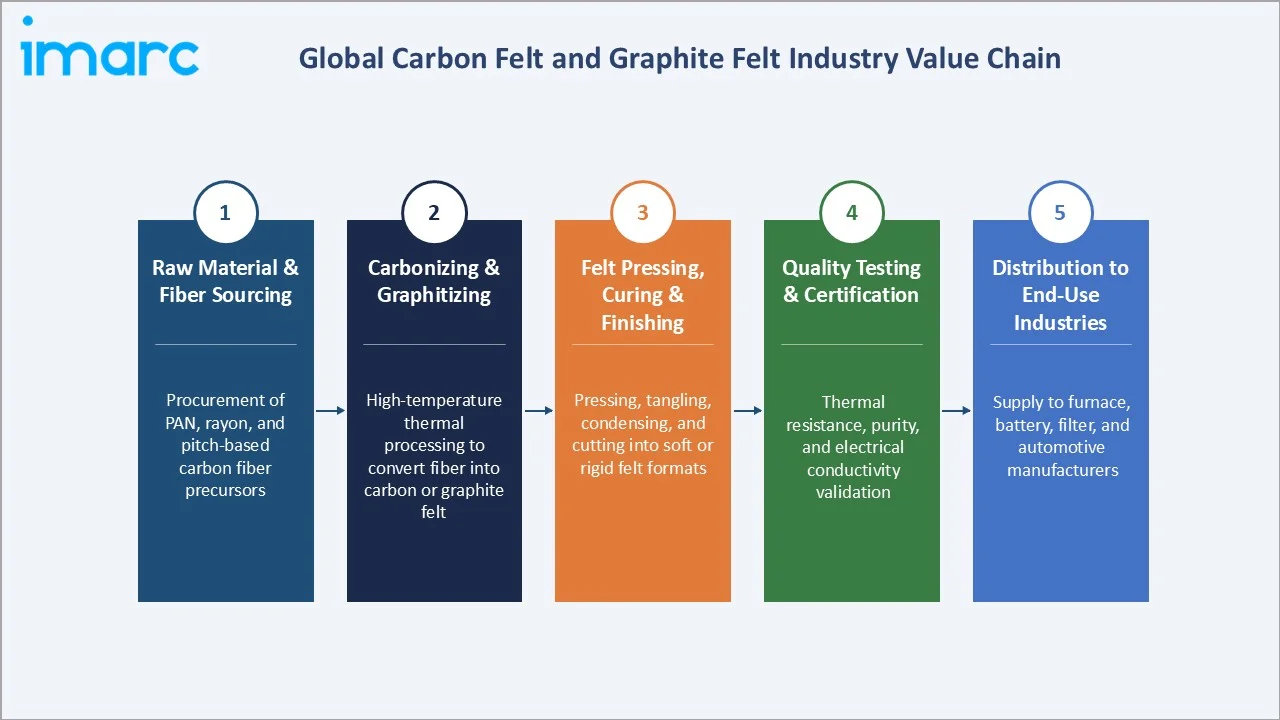
The carbon felt and graphite felt value chain integrates raw fiber and precursor sourcing, carbonizing and graphitizing processing, felt pressing and finishing, quality testing and certification, and distribution to industrial end-use sectors. The chain's most commercially critical stage remains precursor sourcing, given its geopolitical and cost sensitivity.
|
Stage |
Key Activities |
|
Raw Material & Fiber Sourcing |
Procurement of PAN, rayon, and pitch-based carbon fiber precursors |
|
Carbonizing & Graphitizing |
High-temperature thermal processing to convert fiber into carbon or graphite felt |
|
Felt Pressing, Curing & Finishing |
Pressing, tangling, condensing, and cutting into soft or rigid felt formats |
|
Quality Testing & Certification |
Thermal resistance, purity, and electrical conductivity validation |
|
Distribution to End-Use Industries |
Supply to furnace, battery, filter, and automotive manufacturers |
Each stage requires specialized processing equipment and technical expertise, with thermal processing representing the most capital-intensive step given the extreme temperatures required for carbonization and graphitization. Manufacturers positioned across multiple value-chain stages generally achieve stronger cost control and product consistency than those reliant on externally sourced intermediate materials.
Technology Landscape in the Carbon Felt and Graphite Felt Industry
PAN-Based Carbon Felt Technology
Polyacrylonitrile-based carbon felt offers high purity, chemical resistance, and strong insulating properties, making it a preferred electrode backing material in battery designs and high-temperature furnace insulation applications. Its consistent fiber structure supports reliable electrochemical performance in demanding energy storage environments.
Rayon-Based Graphite Felt Technology
Rayon-derived graphite felt provides excellent thermal stability and low thermal conductivity, supporting its widespread use in vacuum and inert-gas furnace insulation across metallurgical and semiconductor processing environments. Its established manufacturing base continues to anchor a significant share of global furnace insulation demand.
Nanoparticle-Enhanced Felt Technology
Manufacturers are integrating nanoparticles into felt structures to improve efficiency, surface area, and electrochemical performance, supporting next-generation redox flow battery and high-performance filtration applications.
Market Segmentation Analysis
The report covers the following segments:
|
Segment Category |
Leading Segment |
Market Share |
Year |
|
Type |
Carbon Felt |
58.4% |
2025 |
|
Product |
Rigid Felt |
54.7% |
2025 |
|
Raw Material |
Polyacrylonitrile |
🔒 |
2025 |
|
Application |
Furnace |
🔒 |
2025 |
|
Region |
Asia-Pacific |
41.3% |
2025 |

By Type
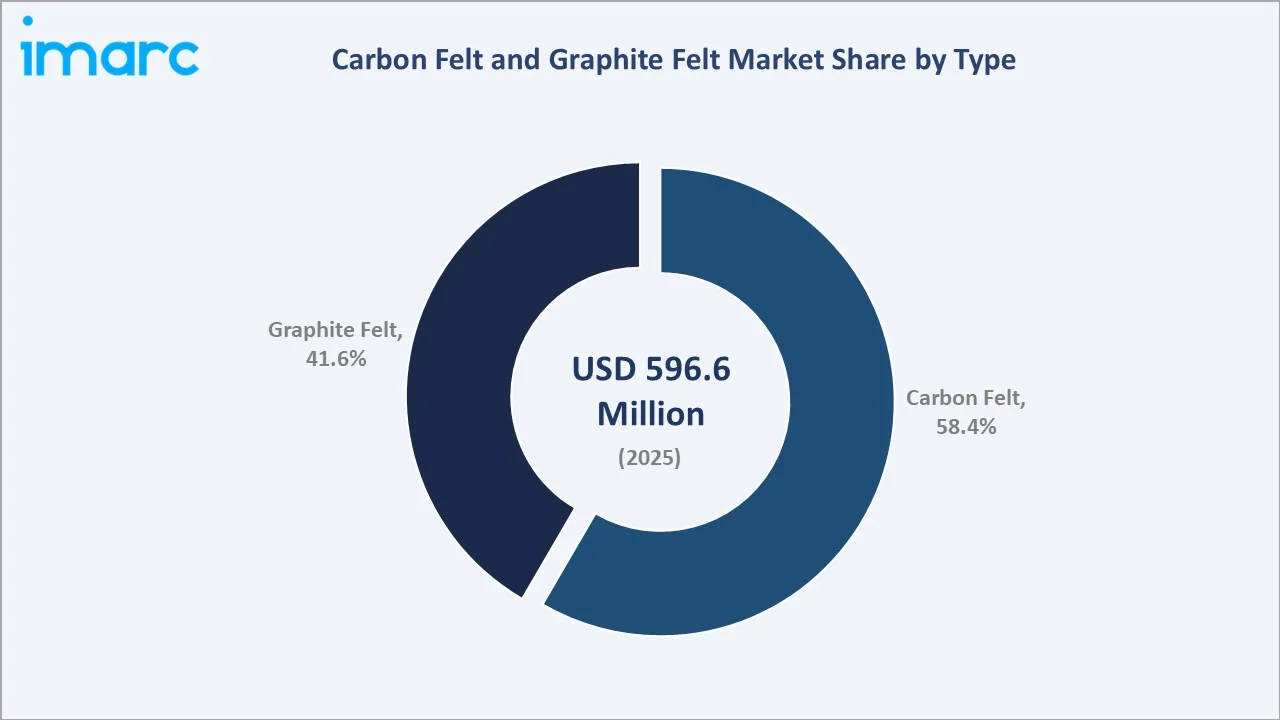
Carbon felt leads at 58.4% in 2025, reflecting its cost-effective thermal insulation performance and extensive adoption across furnace and industrial insulation applications, the most commercially established category in the market.
To access detailed market analysis, Request Sample
Graphite felt at 41.6% captures higher-purity applications requiring superior thermal stability and electrical conductivity, including battery electrode backings and high-temperature semiconductor furnace insulation, and is gaining share as energy storage demand accelerates.
By Product
Rigid felt leads at 54.7% in 2025, driven by its structural stability and ease of installation as furnace hot-zone insulation, particularly in vacuum, annealing, and graphitizing furnace applications requiring dimensional consistency.
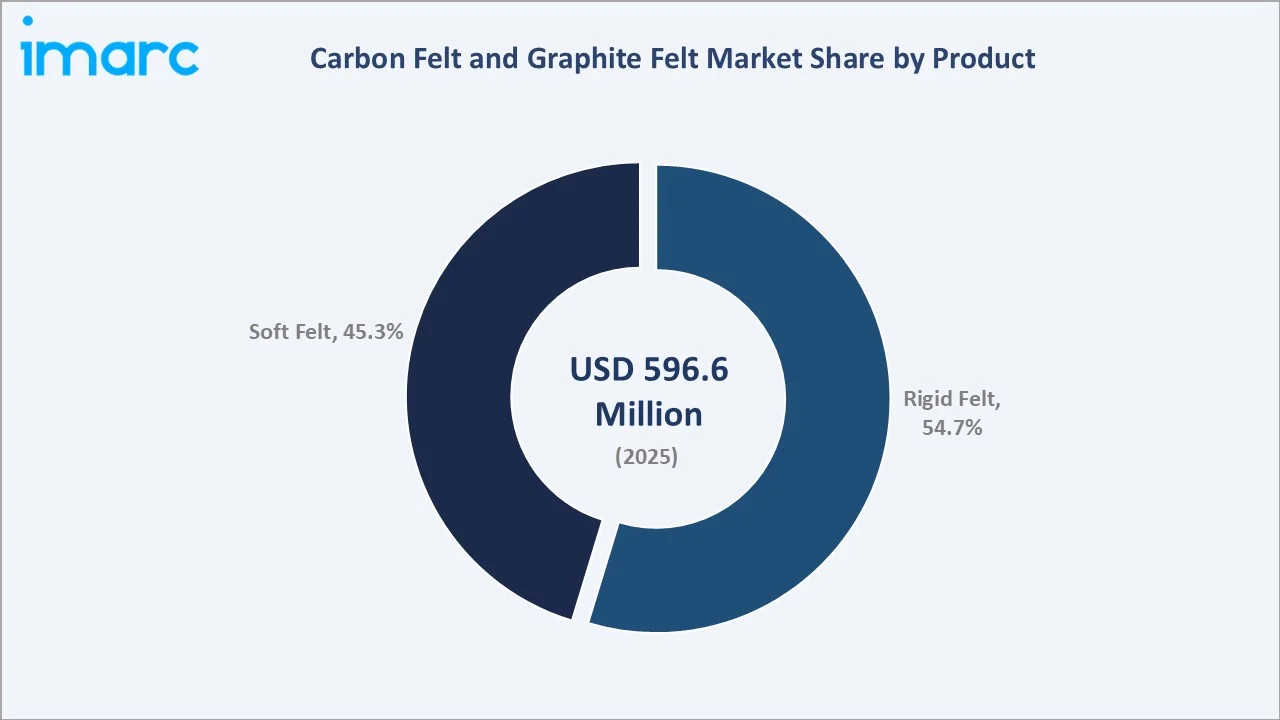
Soft felt at 45.3% remains the preferred choice for flexible insulation wrapping and multi-layer furnace linings, valued for its conformability around irregular furnace geometries and ease of cutting.
Regional Market Insights
|
Region |
Share (2025) |
Key Market Drivers & Characteristics |
|
Asia-Pacific |
41.3% |
Driven by China's electronics manufacturing base, extensive R&D activity, and significant technological advancements in felt production |
|
North America |
24.6% |
Supported by energy storage project investment, advanced industrial infrastructure, and strong presence of key manufacturers |
|
Europe |
22.8% |
Reflects stringent decarbonization targets, metallurgical industry demand, and renewable energy storage adoption |
|
Latin America |
5.9% |
Driven by growing industrial infrastructure development and expanding metallurgical processing activity |
|
Middle East and Africa |
5.4% |
Emerging with growing industrial development initiatives and increasing interest in energy storage infrastructure |
Asia-Pacific, at 41.3%, leads through China's electronics component manufacturing scale, Japan's advanced materials expertise, and South Korea's semiconductor industry growth. North America, at 24.6%, reflects sustained energy storage investment and industrial infrastructure strength.
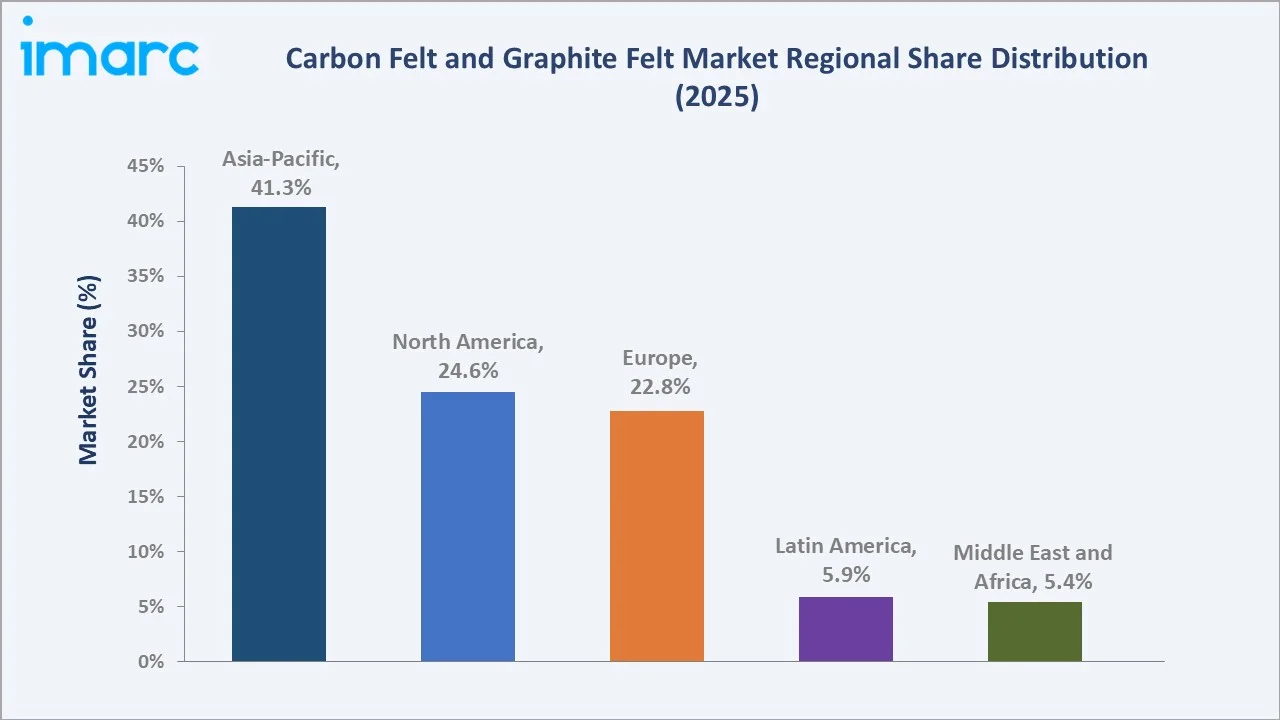
Europe, at 22.8%, is supported by decarbonization policy and metallurgical demand. Latin America, at 5.9%, and Middle East and Africa, at 5.4%, represent early-stage but growing markets driven by industrial infrastructure development and energy storage interest respectively.
Competitive Landscape
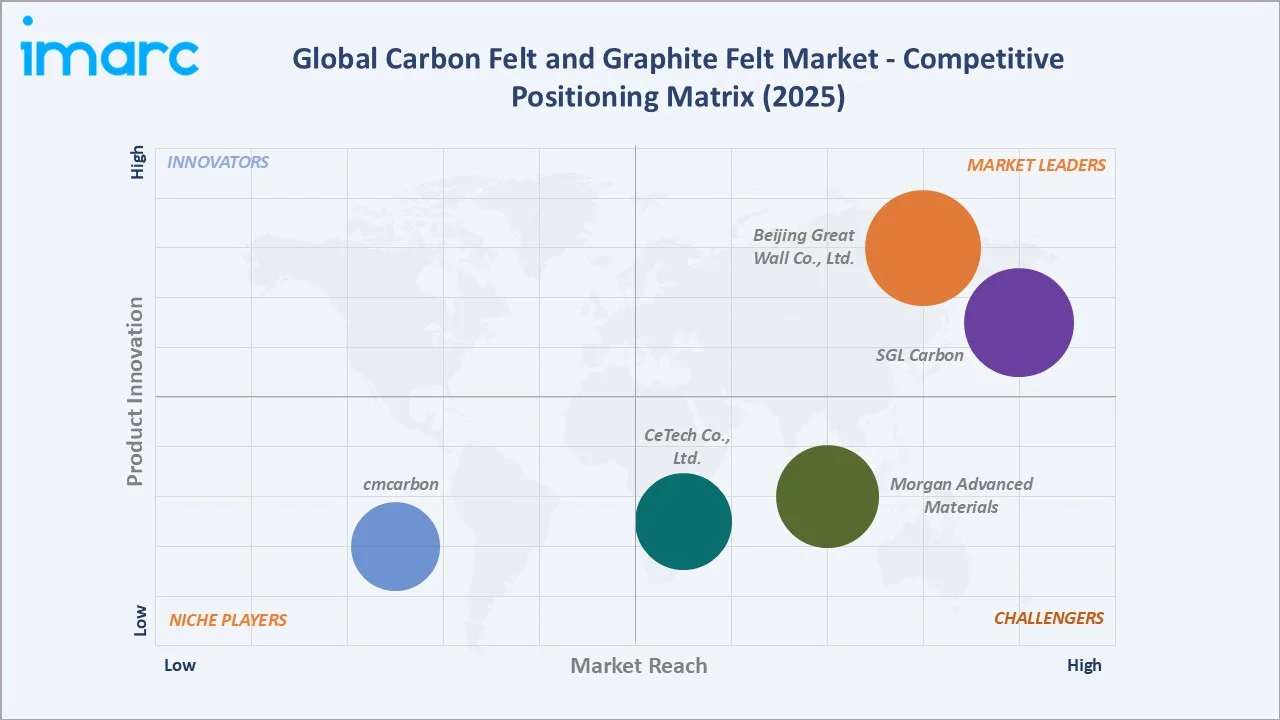
The global carbon felt and graphite felt market competitive landscape is moderately fragmented, comprising established international materials manufacturers and specialized Chinese domestic felt producers competing across furnace insulation and battery electrode application segments. Competitive differentiation centers on product purity, thermal performance consistency, manufacturing scale, and the ability to serve high-specification applications such as redox flow battery electrodes and semiconductor furnace insulation, where quality certification and technical support carry significant weight in procurement decisions.
|
Company Name |
Key Products |
Market Position |
Core Strength |
|
Beijing Great Wall Co., Ltd. |
Carbon Felt, Graphite Felt, Rigid Felt Boards |
Market Leader |
Large-scale manufacturing of furnace-grade carbon and graphite felt for industrial insulation. |
|
SGL Carbon |
Graphite Felt Insulation, Carbon Fiber Felt |
Market Leader |
Global specialty materials company with advanced graphite-based insulation and electrode portfolio. |
|
Morgan Advanced Materials |
Carbon & Graphite Felt Insulation Systems |
Strong Challenger |
Thermal ceramics expertise with high-purity insulation solutions for furnace applications. |
|
CeTech Co., Ltd. |
Carbon Fiber Felt |
Strong Challenger |
Specialized carbon fiber felt production serving battery and furnace insulation markets. |
|
cmcarbon |
Graphite Felt |
Niche Player |
Established graphite felt manufacturer supplying furnace and battery electrode markets. |
Key players include Beijing Great Wall Co., Ltd., SGL Carbon, Morgan Advanced Materials, CeTech Co., Ltd., cmcarbon, and others.
Key Company Profiles
Beijing Great Wall Co., Ltd.
Beijing Great Wall Co., Ltd. is a China-based manufacturer with a strong presence in the carbon felt and graphite felt market through large-scale production of furnace-grade insulation felts.
- Key Products: Carbon felt, graphite felt, and rigid felt boards for industrial furnace insulation.
- Strategic Focus: Expanding domestic production capacity to serve China's growing electronics and battery manufacturing sectors.
SGL Carbon
SGL Carbon is a Germany-based global specialty materials company with a strong presence in the carbon felt and graphite felt market through its advanced graphite-based insulation and electrode product portfolio.
- Key Products: Graphite felt insulation, carbon fiber felt, and high-purity electrode backing materials.
- Strategic Focus: Strengthening its energy storage and semiconductor-grade felt offerings across European and Asian markets.
Market Concentration Analysis
The carbon felt and graphite felt market remains moderately fragmented, with leading manufacturers collectively holding a meaningful share of global capacity, while numerous specialized Chinese domestic producers compete on cost and regional proximity to furnace and battery end-users. Market concentration is expected to gradually increase as leading players expand redox flow battery and semiconductor-grade felt capacity, leveraging scale advantages and technical certification requirements that are increasingly difficult for smaller regional producers to replicate independently.
Investment & Growth Opportunities
Highest Growth Segments
Graphite felt (~8.3% CAGR), soft felt (~8.1% CAGR), redox flow battery electrode applications, and semiconductor and solar furnace insulation represent the highest-growth investment vectors through 2034, outpacing the market's overall 7.81% CAGR.
Emerging Investment Opportunities
Redox flow battery electrode manufacturing represents the market's highest-value emerging opportunity, as government-backed energy storage programs across Europe and Asia create structurally growing, policy-supported demand through 2034.
Investment Themes
- Vertical Integration into Precursor Supply: Manufacturers investing in secured PAN, rayon, or pitch precursor sourcing can achieve a sustainable cost advantage amid supply-constrained conditions for carbon fiber feedstock.
- High-Purity Graphite Felt Capacity Expansion: Investment in semiconductor- and battery-grade graphite felt production capacity captures the fastest-growing, highest-value application segments within the market.
Future Market Outlook (2026-2034)
The global carbon felt and graphite felt market is projected to grow from USD 596.6 Million in 2025 to USD 1,197.3 Million by 2034, delivering a 7.81% CAGR over the forecast period. The market's anchor value of USD 868.7 Million by 2030 reflects sustained furnace insulation demand alongside accelerating energy storage electrode adoption, positioning carbon felt and graphite felt as increasingly critical materials in the global industrial and clean energy transition.
Redox flow battery electrode demand, semiconductor and solar furnace expansion, and nuclear thermal management adoption are expected to jointly drive above-market growth for graphite felt, while carbon felt sustains steady volume growth on established industrial insulation applications through 2034.
Over the medium term, manufacturers are expected to prioritize capacity expansion in high-purity graphite felt production, supply chain diversification for carbon fiber precursors, and continued product innovation through nanoparticle enhancement, positioning the industry to capture demand growth across both traditional furnace insulation and emerging energy storage applications.
Research Methodology
IMARC Group's research methodology combines primary stakeholder engagement with extensive secondary data validation to ensure the accuracy and reliability of market size estimates, segment breakdowns, and forecast projections presented in this report.
Primary Research
Primary research comprised structured interviews with industry stakeholders, including manufacturing executives, furnace equipment specialists, and battery electrode procurement leads across major producing regions. These interviews validated demand trends, pricing dynamics, and capacity expansion plans across key end-use industries.
Secondary Research
Secondary research encompassed company annual reports, industry association data, government infrastructure and energy storage policy publications, and technical conference proceedings on advanced materials. This research base was cross-referenced against primary interview findings to ensure consistency across historical and forecast data points.
Forecasting Models
Market revenue forecasts were developed using a bottom-up model incorporating furnace equipment installation volumes, battery electrode demand growth, and regional production capacity expansion trends, with adjustments applied for technology substitution and pricing trajectory assumptions across the forecast period.
Report Coverage:
| Report Features | Details |
|---|---|
| Base Year of the Analysis | 2025 |
| Historical Period | 2020-2025 |
| Forecast Period | 2026-2034 |
| Units | Million USD |
| Scope of the Report | Exploration of Historical Trends and Market Outlook, Industry Catalysts and Challenges, Segment-Wise Historical and Predictive Market Assessment:
|
| Types Covered | Carbon Felt, Graphite Felt |
| Products Covered | Soft Felt, Rigid Felt |
| Raw Materials Covered | Polyacrylonitrile, Rayon, Others |
| Applications Covered | Furnace, Batteries, Filters, Others |
| Regions Covered | Asia Pacific, Europe, North America, Latin America, Middle East and Africa |
| Countries Covered | United States, Canada, Germany, France, United Kingdom, Italy, Spain, Russia, China, Japan, India, South Korea, Australia, Indonesia, Brazil, Mexico |
| Companies Covered | Beijing Great Wall Co. Ltd., SGL Carbon, Morgan Advanced Materials, CeTech Co. Ltd., cmcarbon , etc. |
| Customization Scope | 10% Free Customization |
| Post-Sale Analyst Support | 10-12 Weeks |
| Delivery Format | PDF and Excel through Email (We can also provide the editable version of the report in PPT/Word format on special request) |
Key Benefits for Stakeholders:
- IMARC’s report offers a comprehensive quantitative analysis of various market segments, historical and current market trends, market forecasts, and dynamics of the carbon felt and graphite felt market from 2020-2034.
- The research study provides the latest information on the market drivers, challenges, and opportunities in the global carbon felt and graphite felt market.
- The study maps the leading, as well as the fastest-growing, regional markets. It further enables stakeholders to identify the key country-level markets within each region.
- Porter's five forces analysis assist stakeholders in assessing the impact of new entrants, competitive rivalry, supplier power, buyer power, and the threat of substitution. It helps stakeholders to analyze the level of competition within the carbon felt and graphite felt industry and its attractiveness.
- Competitive landscape allows stakeholders to understand their competitive environment and provides an insight into the current positions of key players in the market.
Frequently Asked Questions About the Carbon Felt and Graphite Felt Market Report
The global market reached USD 596.6 Million in 2025, driven by carbon felt's dominance at 58.4% by type, rigid felt's leadership at 54.7% by product, and Asia-Pacific's 41.3% regional share. This reflects sustained industrial demand for high-temperature insulation and growing adoption in energy storage electrode applications.
The market grows at a 7.81% CAGR during 2026-2034, reaching USD 1,197.3 Million by 2034, reflecting rising heat-insulation demand and expanding energy storage applications, with graphite felt and soft felt segments outpacing the overall market growth rate.
Carbon felt leads at 58.4%, owing to its cost-effective thermal insulation performance and widespread furnace-industry adoption.
Rigid felt leads at 54.7%, supported by its structural stability and ease of installation in furnace hot-zone insulation applications.
Asia-Pacific leads at 41.3%, through China's electronics manufacturing scale and extensive regional R&D and technological advancement.
Leading companies include Beijing Great Wall Co., Ltd., SGL Carbon, Morgan Advanced Materials, CeTech Co., Ltd., cmcarbon, and others.
The market is projected to reach approximately USD 868.7 Million by 2030, supported by continued furnace insulation and energy storage electrode demand growth.
Three priority investment opportunities: precursor supply vertical integration, high-purity graphite felt capacity expansion, and redox flow battery electrode manufacturing partnerships.
Need more help?
- Speak to our experienced analysts for insights on the current market scenarios.
- Include additional segments and countries to customize the report as per your requirement.
- Gain an unparalleled competitive advantage in your domain by understanding how to utilize the report and positively impacting your operations and revenue.
- For further assistance, please connect with our analysts.
 Request Customization
 Speak to an Analyst
 Request Brochure
 Inquire Before Buying
Benefits of Customization
- Personalize this research
- Triangulate with your data
- Get data as per your format and definition
- Gain a deeper dive into a specific application, geography, customer, or competitor
- Any level of personalization
Get in Touch With Us
UNITED STATES
Phone: +1-201-971-6302
INDIA
Phone: +91-120-433-0800
UNITED KINGDOM
Phone: +44-753-714-6104
Email: sales@imarcgroup.com
Client Testimonials




.webp)




.webp)













Related Reports

Choose your plan
*Please note that the prices mentioned below are starting prices for each bundle type. Kindly contact our team for further details.*
Single User License
- 1 User License, Access on 2 Devices
- PDF Report + Excel Dataset (Password Protected)
- Lifetime Access
- No Printing Rights
- 10% Free Report Customization
- 10–12 Weeks of Analyst Support
Five User License
- Access for 5 Users, 2 Devices per User
- PDF Report + Excel Dataset (Password Protected)
- Lifetime Access
- Dedicated Account Manager
- 12–14 Weeks of Analyst Support
- No Printing Rights
- 15% Free Report Customization
- 25% Discount on Your Next Purchase
Corporate User License
- Unlimited User Access (Within Your Organization)
- PDF Report + Excel Dataset
- Lifetime Access
- Dedicated Account Manager
- 14–20 Weeks of Analyst Support
- No Printing Rights
- 20% Free Report Customization
- 30% Discount on Your Next Purchase
Essential Insights
What's included:
3 reports
- Lifetime Access
- PDF Reports
- Excel Datasets
- 2 Weeks of Free Analyst Support
- 2 User Licenses
- Access on 2 Devices
- Printing Rights
- Complimentary PowerPoint (PPT) Version
- Complimentary License Upgrade
Professional Access
What's included:
5 reports
- Lifetime Access
- PDF Reports
- Excel Datasets
- 8 Weeks of Free Analyst Support
- 2 User Licenses
- Access on 2 Devices
- Printing Rights
- Complimentary PowerPoint (PPT) Version
- Complimentary License Upgrade
Business Advantage
What's included:
8 reports
- Lifetime Access
- PDF Reports
- Excel Datasets
- 14 Weeks of Free Analyst Support
- 2 User Licenses
- Access on 2 Devices
- Printing Rights
- Complimentary PowerPoint (PPT) Version
- Complimentary License Upgrade
Enterprise Intelligence
What's included:
10 reports
- Lifetime Access
- PDF Reports
- Excel Datasets
- 20 Weeks of Free Analyst Support
- 2 User Licenses
- Access on 2 Devices
- Printing Rights
- Complimentary PowerPoint (PPT) Version
- Complimentary License Upgrade