
Chromate Conversion Coating Market Size, Share, Trends and Forecast by Type, Class, Base Type, End Use Industry, and Region, 2026-2034
Chromate Conversion Coating Market Size, Share, Trends & Forecast (2026-2034)
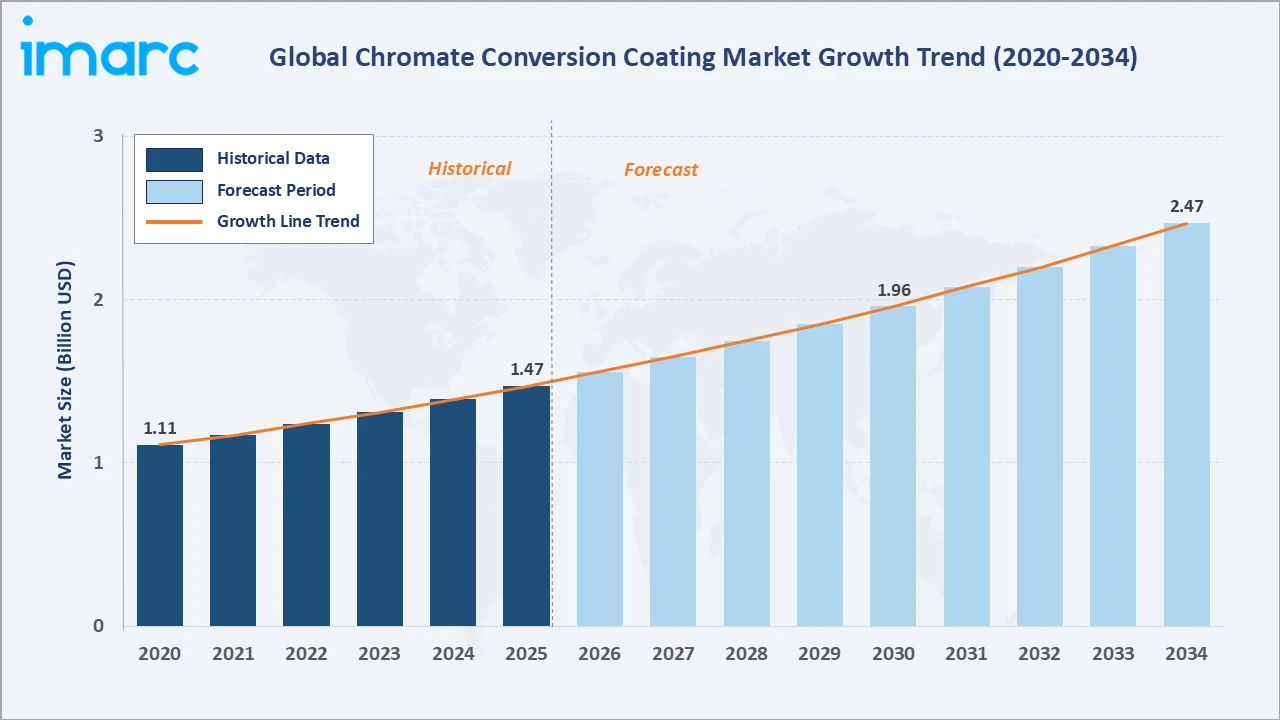
The global chromate conversion coating market reached USD 1.47 Billion in 2025 and is projected to reach USD 2.47 Billion by 2034, exhibiting a CAGR of 5.90% during 2026-2034. The escalating demand for high-performance corrosion-resistant coatings in aerospace and defense structural components, combined with rising automotive production of aluminum-intensive body and chassis components requiring chem film (Alodine) treatment, is the primary growth catalyst. Global vehicle production increased from 92.7 million units in 2024 to 96.4 million units in 2025, while vehicle sales rose from 95.3 million to 99.8 million units over the same period. The growth in automotive manufacturing is driving demand for chromate conversion coatings, as automakers increasingly require corrosion-resistant surface treatments for aluminum, zinc, magnesium, and steel components used in vehicle bodies, chassis, fasteners, and EV battery systems. Class 1A leads at 58.40%, aluminum base dominates base type at 34.80%, and North America accounts for the largest regional share at 36.70%.
Market Snapshot
|
Metric |
Value |
|
Market Size (2025) |
USD 1.47 Billion |
|
Forecast Market Size (2034) |
USD 2.47 Billion |
|
CAGR (2026-2034) |
5.90% |
|
Base Year |
2025 |
|
Historical Period |
2020-2025 |
|
Forecast Period |
2026-2034 |
|
Dominant Class |
Class 1A (58.40%, 2025) |
|
Dominant Base Type |
Aluminum Base (34.80%, 2025) |
|
Leading Region |
North America (36.70%, 2025) |
The global chromate conversion coating market grew from USD 1.11 Billion in 2020 to USD 1.47 Billion in 2025, driven by post-COVID aerospace MRO recovery, sustained defense spending on corrosion protection programs, and expanding automotive aluminum component production. The market is projected to reach USD 1.96 Billion by 2030 and USD 2.47 Billion by 2034.
To get more information on this market, Request Sample
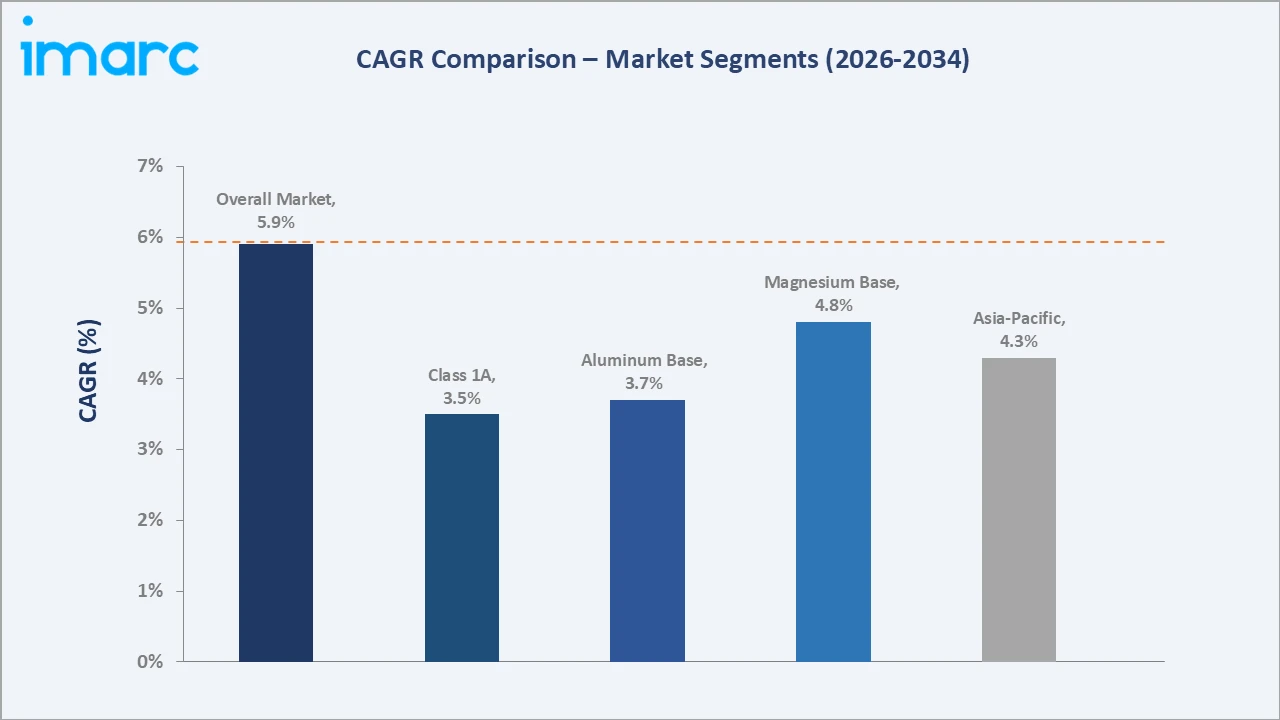
Magnesium base substrate grows at ~4.8% CAGR, driven by EV lightweighting strategies deploying magnesium die castings in battery enclosures and structural components requiring Class 1A corrosion protection. Aluminum base grows at ~3.7% CAGR through aerospace and automotive aluminum intensification. Asia-Pacific leads regional growth at ~4.3% CAGR through China and India's aerospace production expansion and automotive manufacturing output growth requiring aluminum surface treatment.
Executive Summary
The global chromate conversion coating market serves a critical materials science function, providing electrochemical corrosion protection to aluminum, zinc, steel, copper, magnesium, and cadmium substrates through a thin, chemically active conversion layer that simultaneously inhibits corrosion, promotes paint adhesion, and in the case of class 1A hexavalent chromate coatings, provides self-healing corrosion protection through chromate ion leaching from the coating layer to repair mechanical damage. The market's unique characteristic is the combination of irreplaceable technical performance in critical aerospace and defense applications with progressive regulatory pressure on hexavalent chromium (Cr VI).
Class 1A leads at 58.40% (2025), reflecting the continuing dominance of hexavalent chromate conversion coatings in aerospace, military, and oil and gas applications where performance specifications mandate their use and regulatory authorizations permit continued deployment. Aluminum base commands 34.80% (2025), reflecting aluminum alloys' dominant position as both the most corrosion-susceptible and most extensively used structural metal in aerospace, automotive, and electronics applications requiring chromate conversion coating protection. North America commands 36.70% (2025), anchored by the world's largest aerospace and defense industry.
Key Market Insights
|
Insight |
Data |
|
Dominant Class |
Class 1A – 58.40% share (2025) |
|
Dominant Base Type |
Aluminum Base – 34.80% share (2025) |
|
Leading Region |
North America - 36.70% share (2025) |
|
Market Opportunity |
Trivalent chrome alternatives for automotive; magnesium EV lightweighting; Asia-Pacific aerospace expansion; Class 1A-performance non-chromate alternatives |
Key Analytical Observations Supporting the Above Data:
- Class 1A at 58.40% (2025): Class 1A chromate conversion coatings provide the highest level of corrosion resistance achievable through chemical conversion coating, with salt spray test performance. The self-healing mechanism provides corrosion protection that no current non-chromate alternative can fully replicate in aerospace applications.
- Aluminum Base at 34.80%: Aluminum alloys are the primary substrate for chromate conversion coating in both Class 1A corrosion protection and Class 3 electrical grounding applications. Aerospace structures use aluminum-chromate conversion coating-primer-topcoat systems to protect fuselage panels, wing structures, and interior components.
- North America at 36.70% (2025): North America leads regionally due to its large automotive, aerospace, defense, and metal fabrication industries. Strong demand for corrosion-resistant surface treatments, strict performance standards, and the presence of major coating suppliers and advanced manufacturing facilities further support the region’s dominant position.
Chromate Conversion Coating Market Overview
The global chromate conversion coating market encompasses chemical processes that create a thin protective conversion layer on metal substrates through a chemical reaction between a chromate-containing solution and the substrate metal surface. Also known as chemical film, chem film, Alodine, Iridite, or simply chromating, the process immerses, sprays, or brush-applies a hexavalent or trivalent chromate solution to clean metal parts, creating a corrosion-resistant, paint-adhesion-promoting conversion layer in seconds to minutes at room temperature without requiring electrical current. The market's dual-class structure meets distinct application requirements. Macroeconomic factors include growth in automotive, aerospace, construction, and industrial manufacturing, rising infrastructure investment, increasing industrial production, expanding global trade, and higher capital expenditure in metal processing industries.
Market Dynamics
To evaluate market opportunities, Request Sample
Market Drivers
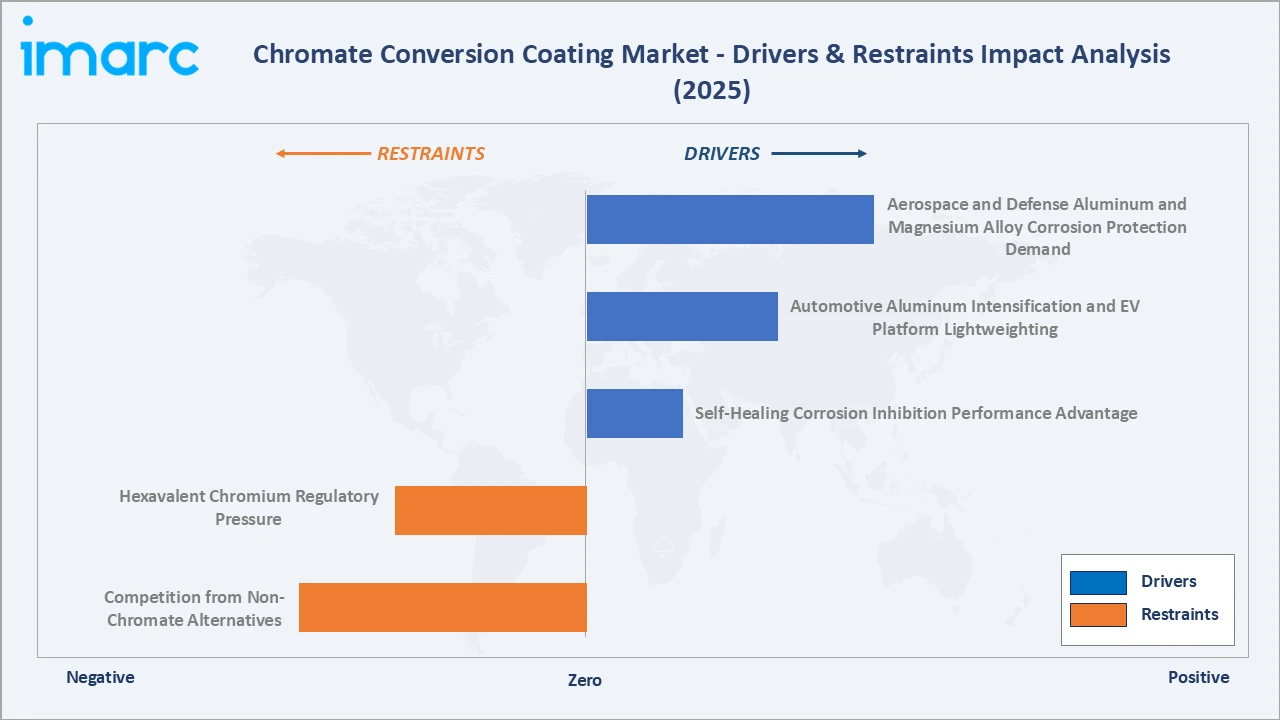
- Aerospace and Defense Aluminum and Magnesium Alloy Corrosion Protection Demand: Strong overseas demand lifted US aerospace and defense exports to $172.7 billion in 2025, generating a $109.2 billion trade surplus, the highest among US manufacturing industries. This export growth is supporting increased production of aircraft, defense systems, and related components made from lightweight aluminum and magnesium alloys. Since these materials require strong corrosion protection to withstand demanding operating environments, expanding aerospace and defense output is driving demand for chromate conversion coatings used on airframes, structural parts, fasteners, and electronic housings.
- Automotive Aluminum Intensification and EV Platform Lightweighting: Global vehicle production increased from 92.7 million units in 2024 to 96.4 million units in 2025, while sales rose from 95.3 million to 99.8 million units. Electric vehicles accounted for roughly one in four new cars sold worldwide, with sales exceeding 20 million units, up about 20% year over year. This growth is accelerating the use of aluminum in vehicle bodies, chassis, battery enclosures, and structural components to reduce weight and improve EV range and efficiency. As aluminum-intensive platforms require reliable corrosion protection and paint adhesion, rising automotive output and EV lightweighting are supporting demand for chromate conversion coatings across component manufacturing and assembly.
- Self-Healing Corrosion Inhibition Performance Advantage: Chromate conversion coating's unique self-healing corrosion inhibition mechanism provides corrosion protection performance that current alternative technologies cannot replicate in conditions of cyclic mechanical stress, micro-cracking, and damaged coating areas. In aerospace and maritime applications where coating damage from fastener installation, assembly handling, and in-service vibration is unavoidable, the self-healing characteristic provides mission-critical corrosion protection that sustains Class 1A's indispensability in specifications.
Market Restraints
- Hexavalent Chromium Regulatory Pressure: Increasing environmental and occupational safety regulations on hexavalent chromium (Cr VI) are a major restraint on the chromate conversion coating market. Regulatory frameworks require stricter handling, monitoring, and disposal of Cr(VI)-based chemicals, increasing compliance costs for manufacturers. These regulations are also encouraging end users to transition toward safer surface treatment technologies, limiting the long-term growth potential of conventional chromate conversion coatings.
- Competition from Non-Chromate Alternatives: The growing adoption of non-chromate conversion coatings, including zirconium-, titanium-, trivalent chromium-, and silane-based technologies, is intensifying competition in the market. These alternatives provide effective corrosion protection while helping manufacturers comply with increasingly stringent environmental regulations. As automotive, aerospace, and industrial manufacturers prioritize sustainable and regulatory-compliant surface treatments, demand is gradually shifting away from traditional hexavalent chromate coatings.
Market Opportunities
- Trivalent Chromate Class 1A-Equivalent Development: The most commercially significant technical opportunity in the chromate conversion coating market is the development and qualification of Cr III-based products that achieve Class 1A-equivalent corrosion performance meeting qualification test requirements. If Cr III systems achieve full DoD and NASA qualification for aerospace Class 1A use, the total addressable market for chromate conversion coating technology would expand substantially.
- Asia-Pacific Aerospace and Defense Manufacturing Expansion: India is expected to handle more than 500 million domestic and international air passengers by 2030, with the country positioned to potentially become the world’s largest aviation market by 2047. This expansion is likely to accelerate aircraft production, airport infrastructure development, maintenance activity, and aerospace component manufacturing across Asia-Pacific. As aluminum and magnesium alloys are widely used in airframes, structural parts, and defense equipment, rising regional output creates significant opportunities for chromate conversion coatings that provide corrosion resistance, surface preparation, and long-term durability.
Market Challenges
- Long Military and Aerospace Qualification Cycles: Qualifying new or alternative chromate conversion coating formulations for use on aerospace or military platforms requires 2-5 year qualification programs involving extensive corrosion testing, adhesion testing, paint compatibility validation, and processing parameter documentation, creating high barriers to introduction of new products into the specification-locked aerospace and defense application segments. This qualification timeline constraint limits market disruption from new entrants or alternative technologies but also creates inertia that slows adoption of technically superior non-Cr VI solutions even when they achieve equivalent performance.
- Raw Material Supply Chain for Chromic Acid: Chromic acid (chromium trioxide, CrO3), the primary active ingredient in hexavalent chromate conversion coating solutions, is subject to progressively tighter supply chain documentation requirements. European supply chain management for CrO3 requires Authorization holders to document each downstream user and application, creating administrative complexity that increases compliance costs for smaller chromate conversion coating applicators serving non-aerospace applications in Europe.
Emerging Market Trends
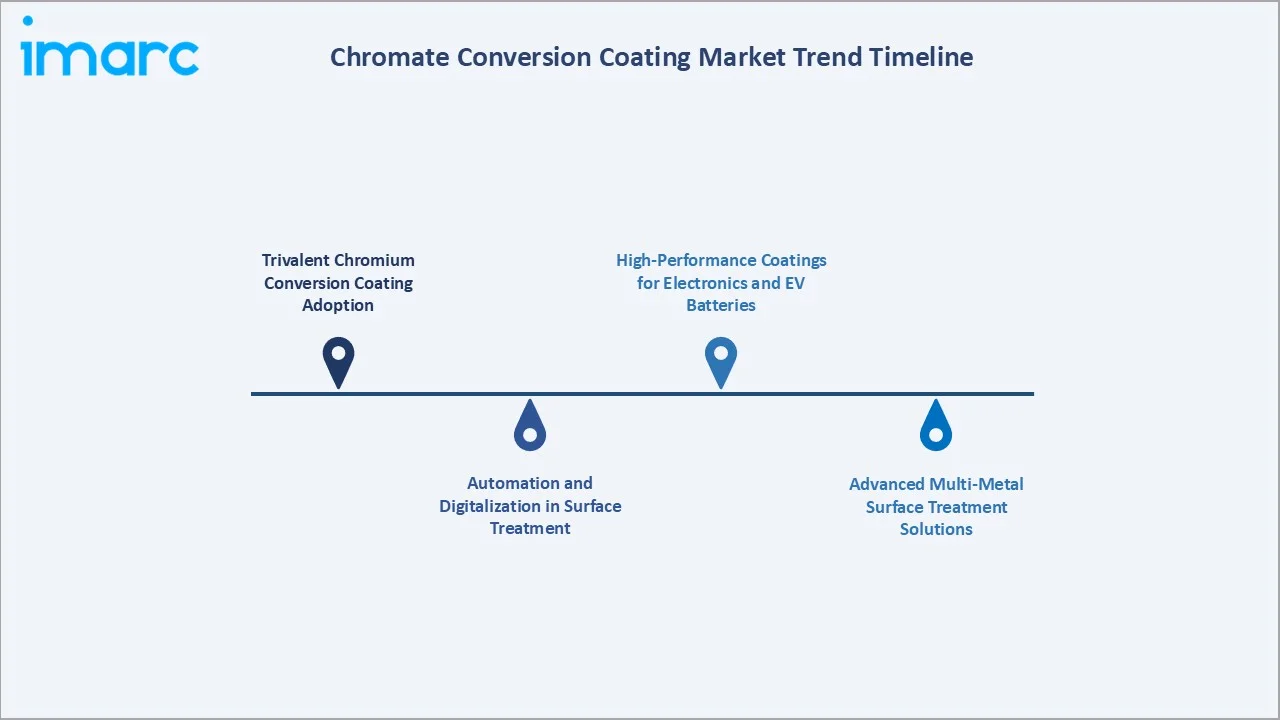
1. Trivalent Chromium Conversion Coating Adoption
The industry is increasingly shifting toward trivalent chromium (Cr(III)) conversion coatings as manufacturers seek to comply with stricter environmental and occupational safety regulations. These coatings provide effective corrosion resistance while significantly reducing the health and environmental risks associated with hexavalent chromium. Their adoption is accelerating across the automotive, aerospace, and electronics industries.
2. Automation and Digitalization in Surface Treatment
Manufacturers are integrating automated coating lines, robotics, AI-based process control, and real-time quality monitoring into surface treatment operations. These technologies improve coating consistency, reduce chemical consumption, minimize defects, and increase production efficiency. Digital manufacturing is becoming a key differentiator for coating providers.
3. High-Performance Coatings for Electronics and EV Batteries
China retained the highest passenger EV sales share at nearly 50%, while the global share rose from 21% in 2024 to about 25% in the first half of 2025. Emerging markets expanded rapidly, led by Vietnam at 40%, followed by Thailand at 28%, Türkiye at 22%, and Indonesia at 14%. This acceleration is increasing demand for high-performance coatings used in EV battery enclosures, busbars, connectors, electronic housings, and lightweight metal components. These chromate conversion coatings improve corrosion resistance, electrical reliability, adhesion, and durability, making them increasingly important as EV production and battery manufacturing expand.
4. Advanced Multi-Metal Surface Treatment Solutions
Manufacturers are developing conversion coating technologies compatible with aluminum, magnesium, zinc, and galvanized steel in a single production process. Multi-metal compatibility simplifies manufacturing, lowers processing costs, and supports increasingly complex product designs across automotive, aerospace, and industrial sectors.
Industry Value Chain Analysis
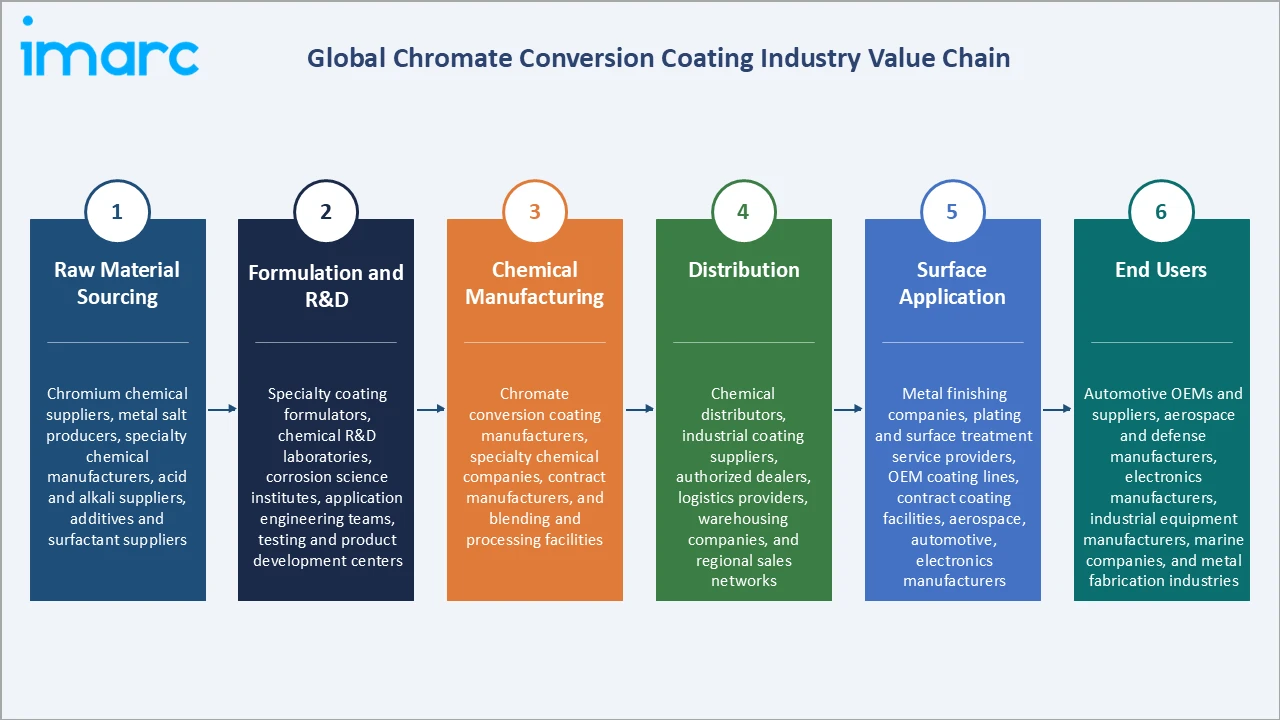
The chromate conversion coating value chain integrates raw material sourcing, formulation and R&D, chemical manufacturing, distribution, surface application, and end-users.
|
Stage |
Key Participants |
|
Raw Material Sourcing |
Chromium chemical suppliers, metal salt producers, specialty chemical manufacturers, acid and alkali suppliers, additives and surfactant suppliers. |
|
Formulation and R&D |
Specialty coating formulators, chemical R&D laboratories, corrosion science institutes, application engineering teams, testing and product development centers. |
|
Chemical Manufacturing |
Chromate conversion coating manufacturers, specialty chemical companies, contract manufacturers, and blending and processing facilities. |
|
Distribution |
Chemical distributors, industrial coating suppliers, authorized dealers, logistics providers, warehousing companies, and regional sales networks. |
|
Surface Application |
Metal finishing companies, plating and surface treatment service providers, OEM coating lines, contract coating facilities, aerospace, automotive, electronics manufacturers. |
|
End Users |
Automotive OEMs and suppliers, aerospace and defense manufacturers, electronics manufacturers, industrial equipment manufacturers, marine companies, and metal fabrication industries. |
Formulation and R&D are generally the highest value-added stage in the chromate conversion coating value chain. This stage determines the coating's corrosion resistance, adhesion, environmental compliance, and application-specific performance through proprietary formulations and continuous innovation. Advanced R&D enables manufacturers to develop premium products that command higher margins and meet evolving regulatory and customer requirements.
Technology Landscape in the Chromate Conversion Coating Industry
Trivalent Chromate (Cr III) Technology Advancement
Trivalent chromate conversion coating systems, using chromium(III) sulfate or chloride as the chromium source, form protective conversion layers through different electrochemical pathways than Cr VI systems, producing coatings with high chromium(III) oxide content but lacking the soluble hexavalent chromate reservoir responsible for self-healing. Commercial Cr III systems demonstrated corrosion resistance exceeding neutral salt spray for aluminum alloys, sufficient for automotive, electronics, and general industrial applications but falling short of the requirement for Class 1A aerospace specification. Ongoing R&D exploring organic inhibitor incorporation into Cr III frameworks to improve corrosion resistance toward Class 1A performance levels.
Nano-Ceramic Conversion Coating Technology
Nano-ceramic conversion coating technology provides a high-performance, environmentally friendly alternative to traditional chromate-based treatments. These ultra-thin coatings deliver excellent corrosion resistance and paint adhesion while reducing chemical consumption, wastewater generation, and processing costs. Their compatibility with aluminum, steel, and galvanized metals makes them increasingly popular in automotive, appliance, and industrial manufacturing. Growing regulatory pressure to reduce hazardous substances is further accelerating their adoption.
Zirconium-Based Conversion Coating Technology
Zirconium-based conversion coating technology offers a chrome-free, environmentally compliant pretreatment solution for aluminum, steel, and galvanized metals. The technology provides excellent corrosion resistance and paint adhesion while operating with lower chemical consumption and reduced wastewater generation. Its compatibility with high-speed automated coating lines improves manufacturing efficiency and supports sustainability goals. As environmental regulations become more stringent, zirconium-based coatings are gaining widespread adoption across automotive, appliance, and industrial applications.
Market Segmentation Analysis
The report covers the following segments:
|
Segment Category |
Leading Segment |
Market Share |
Year |
|
Type |
🔒 |
🔒 |
2025 |
|
Class |
Class 1A |
58.40% |
2025 |
|
Base Type |
Aluminum Base |
34.80% |
2025 |
|
End Use Industry |
🔒 |
🔒 |
2025 |
|
Region |
North America |
36.70% |
2025 |

By Class
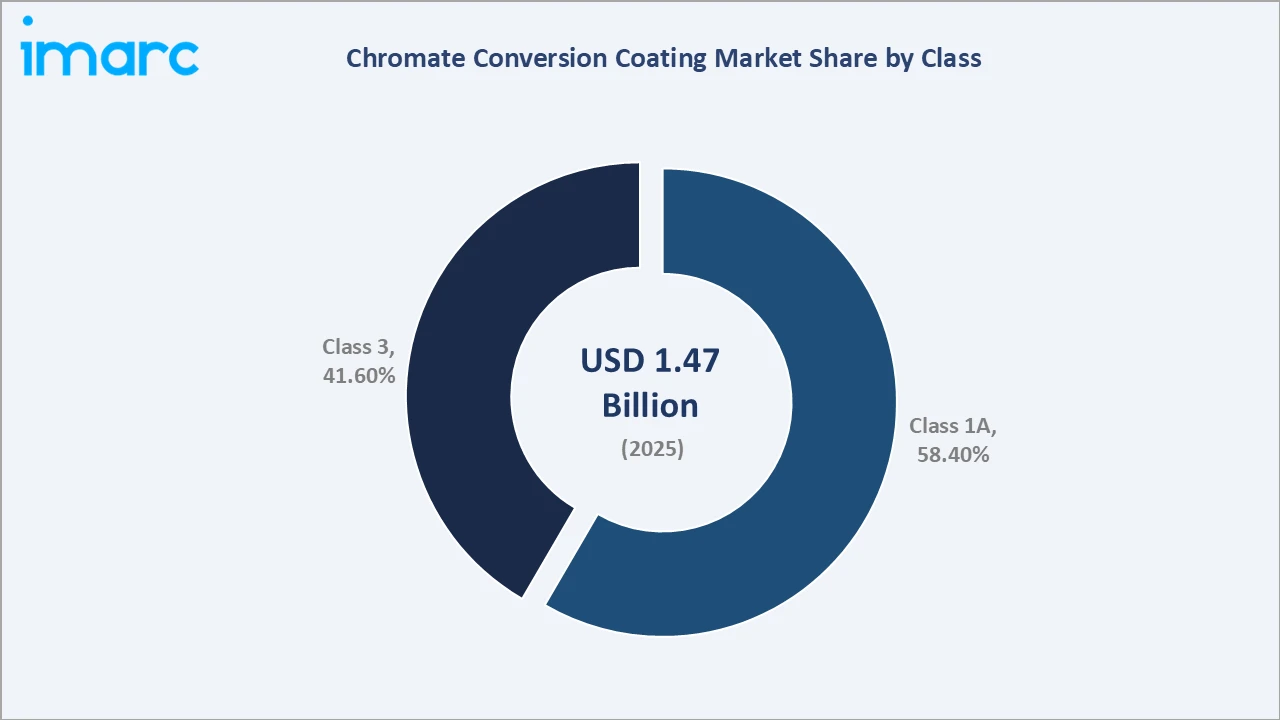
Class 1A dominates at 58.40% (2025), representing the maximum corrosion protection chromate conversion coating used in aerospace structural components, military aircraft and vehicles, oil and gas equipment, and marine applications. Class 1A coatings are visually identifiable by their characteristic iridescent yellow-gold to olive drab color, resulting from the thick chromate conversion layer.
To access detailed market analysis, Request Sample
Class 3 at 41.60% (2025) provides clear to very light yellow thin-film chromate conversion coatings optimized for electrical conductivity rather than maximum corrosion resistance, serving aerospace avionics housings, military electronics enclosures, RF interconnect hardware, and EMC-compliant assembly applications where low electrical contact resistance is required alongside basic corrosion protection.
By Base Type
Aluminum base leads at 34.80% (2025), reflecting aluminum alloys' position as the most corrosion-susceptible structural metal requiring chromate conversion coating, used extensively in aerospace structures, automotive aluminum body panels, electronics housings, and architectural aluminum extrusions. Zinc base at 18.20% serves galvanized and electrogalvanized steel chromate passivation in automotive body shops, hardware, and building products. Steel base at 15.40% includes carbon steel and stainless steel applications requiring chromate passivation, primarily in military and industrial equipment.
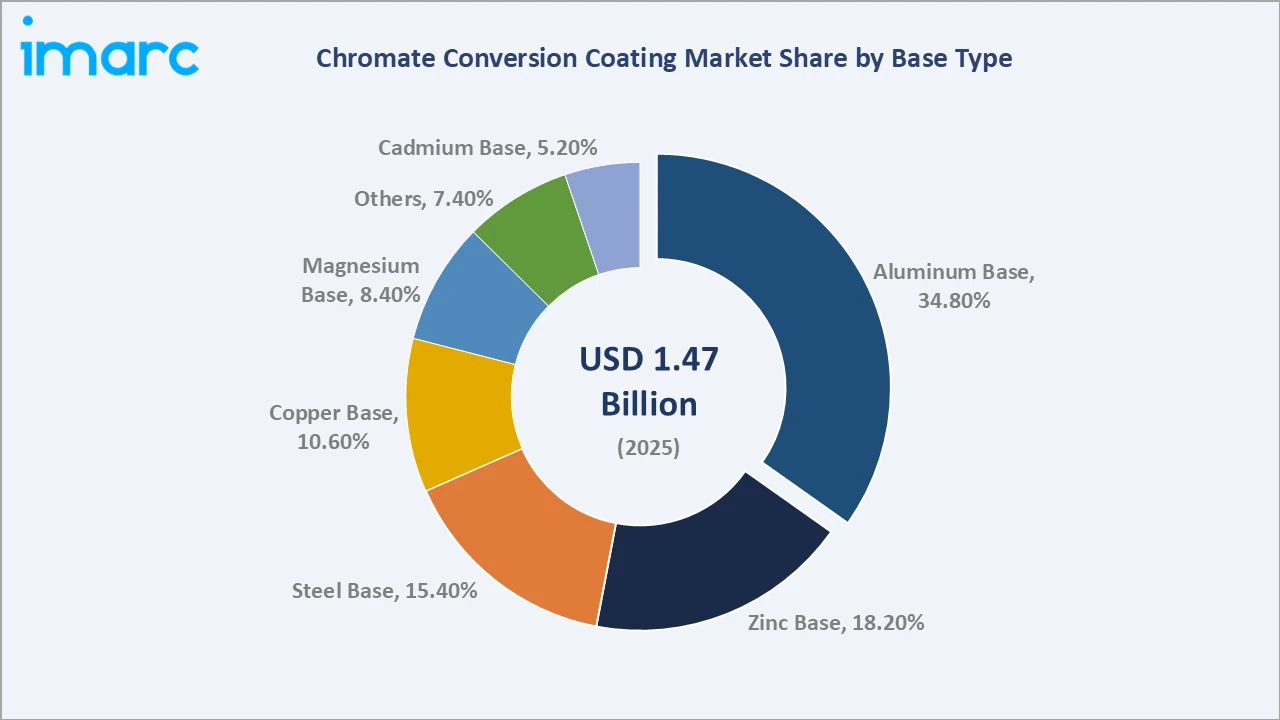
Copper base at 10.60% serves electrical connector pins, PCB copper traces, and high-conductivity copper alloy components in electronics and telecommunications, where chromate provides tarnish resistance and solderability preservation. Magnesium base at 8.40%, growing at ~4.8% CAGR, the fastest base type, is driven by EV platform magnesium castings and military aerospace magnesium components requiring aggressive corrosion protection of the most electrochemically active common structural metal. Cadmium base at 5.20% serves specialized military fasteners, aerospace connector hardware, and electrical equipment where cadmium plating plus chromate conversion coating provides the combination of lubricity, corrosion resistance, and sacrificial protection specified in legacy military standards. Others at 7.40% include titanium, tin alloys, and silver substrates requiring chromate passivation for specialized applications.
Regional Market Insights
|
Region |
Share (2025) |
Key Chromate Conversion Coating Market Drivers & Characteristics |
|
North America |
36.70% |
High demand for corrosion-resistant surface treatments, stringent performance standards, and ongoing investment in advanced metal finishing technologies support market leadership. |
|
Asia-Pacific |
31.90% |
Rapid industrialization, expanding automotive and electronics manufacturing, growing EV production, and increasing aerospace investments are driving demand. |
|
Europe |
20.80% |
The market is supported by a well-established automotive and aerospace industry, stringent quality requirements, and increasing adoption of environmentally compliant surface treatment technologies. |
|
Latin America |
5.90% |
Growing industrialization and foreign investment are increasing the need for durable corrosion protection solutions. |
|
Middle East & Africa |
4.70% |
Increasing metal processing activities and infrastructure development are creating steady demand for corrosion-resistant coating technologies across the region. |
North America's 36.70% regional dominance is driven by its strong aerospace, defense, automotive, and industrial manufacturing sectors. Asia-Pacific at 31.90% follows closely and is the fastest-growing region, supported by rapid industrialization, expanding electric vehicle production, electronics manufacturing, and increasing aerospace investments.
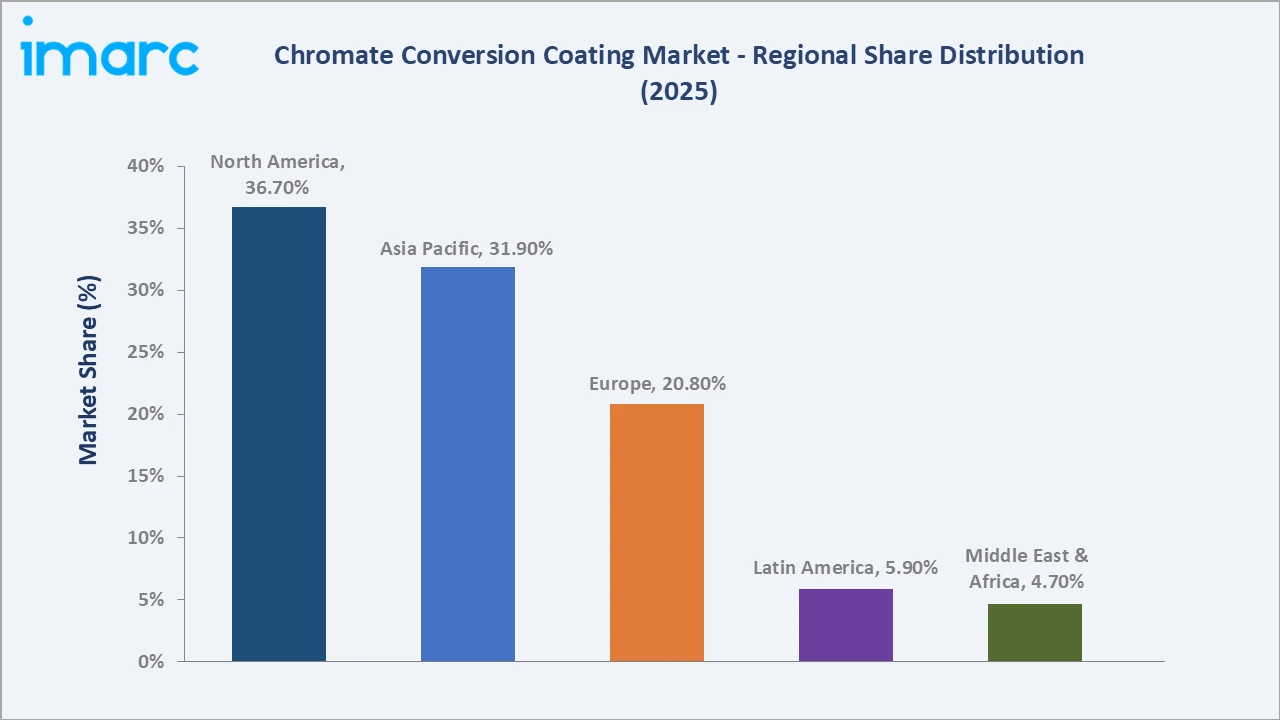
Europe at 20.80% driven by its advanced automotive industry, stringent quality standards, and growing adoption of environmentally compliant surface treatment technologies. Latin America, at 5.90%, is experiencing steady growth through expanding automotive assembly, mining, and industrial development. The Middle East & Africa at 4.70% is an emerging market, supported by infrastructure projects, energy investments, and increasing metal fabrication activities.
Competitive Landscape
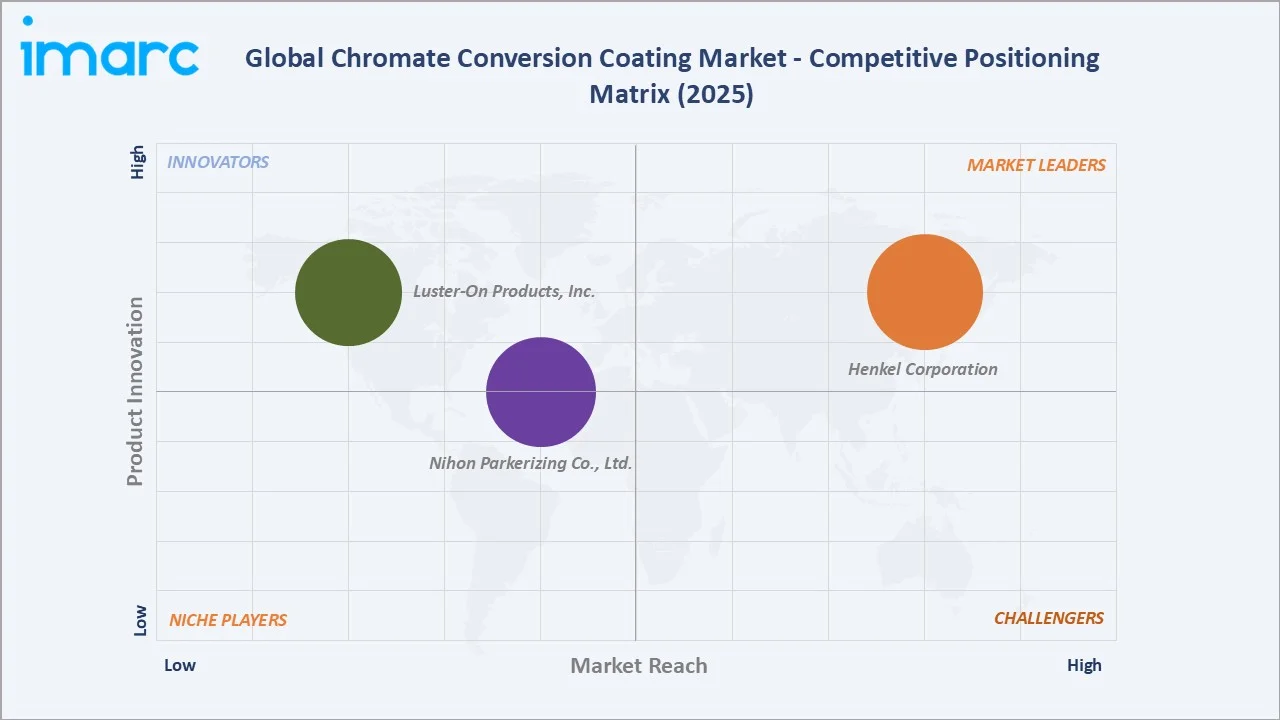
The global chromate conversion coating market is moderately concentrated, with market players collectively commanding the largest market shares through globally recognized product brands, aerospace qualification credentials, and established distribution networks. Regional specialists compete effectively in specific geographic and application niches through deep technical service capability and regional OEM relationships. The competitive landscape is evolving as trivalent chromate alternative development creates new differentiation opportunities beyond traditional Cr VI product formulation capabilities.
|
Company |
Key Offerings |
Market Position |
Core Strength |
|
Henkel Corporation |
BONDERITE chromate conversion coatings |
Market Leader |
Henkel Corporation is a dominant industry leader in chromate conversion coating technologies, primarily through its globally recognized BONDERITE brand. |
|
Nihon Parkerizing Co., Ltd. |
ALCHROME series |
Established Player |
Nihon Parkerizing Co., Ltd. is a leading global manufacturer of metal surface treatments. Their role in chromate conversion coatings centers on providing chemical solutions, innovating environmentally friendly alternatives, and optimizing the application process. |
|
Luster-On Products, Inc. |
Zinc Trivalent chromate-conversion coatings, Aluminum Trivalent chromate-conversion coatings, Hexavalent chromate-conversion coatings |
Innovator |
Luster-On Products, Inc. is a leading manufacturer of metal finishing systems, specializing in both traditional hexavalent and eco-friendly trivalent chromate conversion coatings. |
Competitive differentiation is intensifying on three axes: Cr III alternative product qualification depth for regulatory transition markets, aerospace Class 1A qualification breadth and technical service depth, and regional OEM relationship depth in high-growth Asia-Pacific markets.
Key Company Profiles
Henkel Corporation
Henkel Corporation is a leading player in surface treatment and specialty chemical solutions for the global metal finishing industry. Through its BONDERITE portfolio, the company offers chromate conversion coatings, trivalent chromium pretreatments, and chrome-free surface treatment technologies for aluminum, steel, zinc, and magnesium substrates. Its solutions serve the automotive, aerospace, industrial equipment, electronics, and general manufacturing sectors by enhancing corrosion resistance, paint adhesion, and component durability.
- Key Offerings: BONDERITE chromate conversion coatings.
- Strategic Focus: Expanding its portfolio of high-performance and environmentally compliant surface treatment technologies for the automotive, aerospace, electronics, and industrial sectors. The company is investing in trivalent chromium and chrome-free pretreatment solutions through its BONDERITE brand to help customers meet evolving regulatory and sustainability requirements.
Luster-On Products, Inc.
Luster-On Products, Inc. is a chemical manufacturer focused on metal finishing and surface treatment solutions. The company offers a range of chromate conversion coatings, passivation treatments, cleaners, and specialty chemicals for aluminum, zinc, cadmium, magnesium, and other metal substrates. Its products are used across the aerospace, defense, automotive, electronics, and industrial manufacturing sectors to improve corrosion resistance, paint adhesion, and surface durability.
- Key Offerings: Zinc Trivalent chromate-conversion coatings, Aluminum Trivalent chromate-conversion coatings, Hexavalent chromate-conversion coatings.
- Strategic Focus: Delivering specialized metal finishing and chromate conversion coating solutions for aerospace, defense, automotive, electronics, and industrial applications. The company emphasizes customized formulations, technical support, and high-performance corrosion protection for aluminum, zinc, cadmium, and magnesium components.
Market Concentration Analysis
The global chromate conversion coating market is moderately concentrated, with Henkel Corporation, Nihon Parkerizing Co., Ltd., and Luster-On Products, Inc. collectively holding an estimated 45-55% of global market revenue in 2025, reflecting their leading product brands, aerospace qualification depth, and global distribution networks. Regional specialists hold significant shares in the Japanese and broader Asia-Pacific market. Trivalent chromate specialists hold smaller but strategically important positions that may grow substantially if their Cr III products achieve Class 1A aerospace qualification. Market concentration is expected to increase moderately through 2034 as regulatory pressure and qualification investment requirements advantage larger manufacturers with resources to simultaneously maintain Cr VI product portfolios, develop Cr III alternatives, and fund DoD/aerospace qualification programs.
Investment & Growth Opportunities
Highest Growth Segments
Magnesium base substrate (~4.8% CAGR), Asia-Pacific region (~4.3% CAGR), Class 1A trivalent chromate qualified alternatives (early-stage, significant upside on DoD qualification achievement), EV lightweighting chromate demand, and Asia-Pacific aerospace Class 1A chromate supply chain localization represent the chromate conversion coating market's highest-growth investment vectors through 2034.
Investment Themes
- Trivalent chromate Class 1A qualification investment: Investment in trivalent chromate Class 1A qualification is increasing as manufacturers seek environmentally compliant alternatives to hexavalent chromium without compromising aerospace-grade corrosion protection. Achieving industry certifications enables suppliers to expand into regulated aerospace, defense, and high-performance industrial applications while supporting long-term regulatory compliance.
- Asia-Pacific aerospace coating supply chain localization: Investment in Asia-Pacific aerospace coating supply chains is growing as aircraft manufacturing, MRO activities, and aerospace component production expand across the region. Localizing coating production and technical support helps reduce supply chain risks, improve delivery times, lower logistics costs, and better serve regional aerospace OEMs and suppliers.
Future Market Outlook (2026-2034)
The global chromate conversion coating market is projected to grow from USD 1.47 Billion in 2025 to USD 2.47 Billion by 2034, delivering a 5.90% CAGR, steady, specification-protected growth anchored by aerospace, defense, and maritime institutional demand that is largely insensitive to economic cycles, supplemented by automotive aluminum intensification and Asia-Pacific industrial expansion. The market's anchor value of USD 1.96 Billion in 2030, driven by compounding demand from recovering commercial aerospace production schedules, accelerating Asia-Pacific aerospace manufacturing, EV magnesium lightweighting, and expanding defense procurement.
Three structural forces will define the chromate conversion coating market trajectory through 2034. First, aerospace manufacturing recovery and expansion provide a multi-year institutional demand trajectory for Class 1A chromate conversion coating that is structurally independent of regulatory pressure. Second, the regulatory transition from hexavalent to trivalent chromate will continue through the forecast period without significantly reducing total market value, because the Cr III trivalent products that replace Cr VI products generate equivalent or slightly higher revenue per kilogram due to premium pricing for regulatory compliance value. Third, Asia-Pacific aerospace manufacturing expansion is creating demand for Class 1A chromate conversion coating supply chain infrastructure in the Asia-Pacific region that currently relies heavily on imported North American and European products and technical expertise.
Research Methodology
Primary Research
Primary research comprised in-depth interviews with chromate conversion coating chemical producers, aerospace OEM materials and processing engineers, automotive OEM surface treatment engineers, metal finishing job shop operators, DoD depot maintenance personnel, and independent surface finishing and aerospace materials market analysts. These discussions validated market size estimates, assessed segment demand trends, evaluated regulatory compliance management strategies, and provided insights into Class 1A alternative qualification timelines, Asia-Pacific aerospace market development, and EV lightweighting substrate material trends.
Secondary Research
Secondary research encompassed authorization documentation for hexavalent chromium compounds, specification text and amendment history, aerospace standard documentation, Hexavalent Chromium publications, hexavalent chromium regulatory documentation, production rate announcements, defense procurement budget documentation, and credible market intelligence sources.
Forecasting Models
Forecasting models were developed using historical chromate conversion coating market data, aerospace production rate projections, defense procurement budget trends, automotive aluminum content growth rates, EV magnesium component adoption forecasts, Asia-Pacific aerospace manufacturing expansion timelines, and regulatory transition scenarios. Both top-down and bottom-up approaches were validated through primary research.
Report Coverage:
| Report Features | Details |
|---|---|
| Base Year of the Analysis | 2025 |
| Historical Period | 2020-2025 |
| Forecast Period | 2026-2034 |
| Units | Billion USD |
| Scope of the Report | Exploration of Historical Trends and Market Outlook, Industry Catalysts and Challenges, Segment-Wise Historical and Future Market Assessment:
|
| Types Coverage | Type 1, Type 2 |
| Classes Coverage | Class 1A, Class 3 |
| Base Types Coverage | Aluminum Base, Zinc Base, Steel Base, Copper Base, Magnesium Base, Cadmium Base, Others |
| End Use Industries Coverage | Aerospace, Maritime/Naval, Military and Defense, Electrical, Automotive, Oil and Gas, Construction, Industrial, Others |
| Region Covered | Asia Pacific, Europe, North America, Latin America, Middle East and Africa |
| Countries Covered | United States, Canada, Germany, France, United Kingdom, Italy, Spain, Russia, China, Japan, India, South Korea, Australia, Indonesia, Brazil, Mexico |
| Companies Covered | Henkel Corporation, Nihon Parkerizing Co., Ltd., Luster-On Products, Inc., etc. |
| Customization Scope | 10% Free Customization |
| Post-Sale Analyst Support | 10-12 Weeks |
| Delivery Format | PDF and Excel through Email (We can also provide the editable version of the report in PPT/Word format on special request) |
Frequently Asked Questions About the Chromate Conversion Coating Market Report
The global chromate conversion coating market reached USD 1.47 Billion in 2025, driven by aerospace and defense Class 1A demand, automotive aluminum intensification, and Asia-Pacific aerospace manufacturing growth.
The market grows at 5.90% CAGR during 2026-2034, reaching USD 2.47 Billion by 2034. The CAGR reflects specification-protected aerospace demand growth and regulatory transition from Cr VI to Cr III, maintaining total market value while the product mix evolves.
Class 1A leads at 58.4% (2025), driven by equivalent aerospace specifications requiring maximum corrosion protection with self-healing hexavalent chromate mechanism in aluminum aerospace structures.
Aluminum base dominates at 34.8% (2025), reflecting aluminum alloys' dominance in aerospace structures, automotive body panels, and electronics housings requiring Class 1A or Class 3 chromate conversion coating.
North America leads at 36.7% (2025), anchored by the largest aerospace and defense industry and brand dominance in North American aerospace.
Leading companies include Henkel Corporation, Nihon Parkerizing Co., Ltd., and Luster-On Products, Inc., among others.
The market is projected to reach approximately USD 1.96 Billion by 2030, driven by aerospace production rate achievement, EV magnesium lightweighting chromate demand, and Asia-Pacific aerospace supply chain localization accelerating regional demand.
Top opportunities include trivalent Cr III product DoD Class 1A qualification investment, Asia-Pacific aerospace supply chain localization, EV magnesium chromate conversion coating optimization for automotive EV platforms, and smart metal finishing digital process management integration for aerospace customers.
Need more help?
- Speak to our experienced analysts for insights on the current market scenarios.
- Include additional segments and countries to customize the report as per your requirement.
- Gain an unparalleled competitive advantage in your domain by understanding how to utilize the report and positively impacting your operations and revenue.
- For further assistance, please connect with our analysts.
 Request Customization
 Speak to an Analyst
 Request Brochure
 Inquire Before Buying
Benefits of Customization
- Personalize this research
- Triangulate with your data
- Get data as per your format and definition
- Gain a deeper dive into a specific application, geography, customer, or competitor
- Any level of personalization
Get in Touch With Us
UNITED STATES
Phone: +1-201-971-6302
INDIA
Phone: +91-120-433-0800
UNITED KINGDOM
Phone: +44-753-714-6104
Email: [email protected]
Client Testimonials




.webp)




.webp)













Related Reports

Choose your plan
*Please note that the prices mentioned below are starting prices for each bundle type. Kindly contact our team for further details.*
Single User License
- 1 User License, Access on 2 Devices
- PDF Report + Excel Dataset (Password Protected)
- Lifetime Access
- No Printing Rights
- 10% Free Report Customization
- 10–12 Weeks of Analyst Support
Five User License
- Access for 5 Users, 2 Devices per User
- PDF Report + Excel Dataset (Password Protected)
- Lifetime Access
- Dedicated Account Manager
- 12–14 Weeks of Analyst Support
- No Printing Rights
- 15% Free Report Customization
- 25% Discount on Your Next Purchase
Corporate User License
- Unlimited User Access (Within Your Organization)
- PDF Report + Excel Dataset
- Lifetime Access
- Dedicated Account Manager
- 14–20 Weeks of Analyst Support
- No Printing Rights
- 20% Free Report Customization
- 30% Discount on Your Next Purchase
Essential Insights
What's included:
3 reports
- Lifetime Access
- PDF Reports
- Excel Datasets
- 2 Weeks of Free Analyst Support
- 2 User Licenses
- Access on 2 Devices
- Printing Rights
- Complimentary PowerPoint (PPT) Version
- Complimentary License Upgrade
Professional Access
What's included:
5 reports
- Lifetime Access
- PDF Reports
- Excel Datasets
- 8 Weeks of Free Analyst Support
- 2 User Licenses
- Access on 2 Devices
- Printing Rights
- Complimentary PowerPoint (PPT) Version
- Complimentary License Upgrade
Business Advantage
What's included:
8 reports
- Lifetime Access
- PDF Reports
- Excel Datasets
- 14 Weeks of Free Analyst Support
- 2 User Licenses
- Access on 2 Devices
- Printing Rights
- Complimentary PowerPoint (PPT) Version
- Complimentary License Upgrade
Enterprise Intelligence
What's included:
10 reports
- Lifetime Access
- PDF Reports
- Excel Datasets
- 20 Weeks of Free Analyst Support
- 2 User Licenses
- Access on 2 Devices
- Printing Rights
- Complimentary PowerPoint (PPT) Version
- Complimentary License Upgrade