
Construction Lasers Market Size, Share, Trends and Forecast by Product, Range, and Region, 2026-2034
Construction Lasers Market Size, Share, Trends & Forecast (2026-2034)
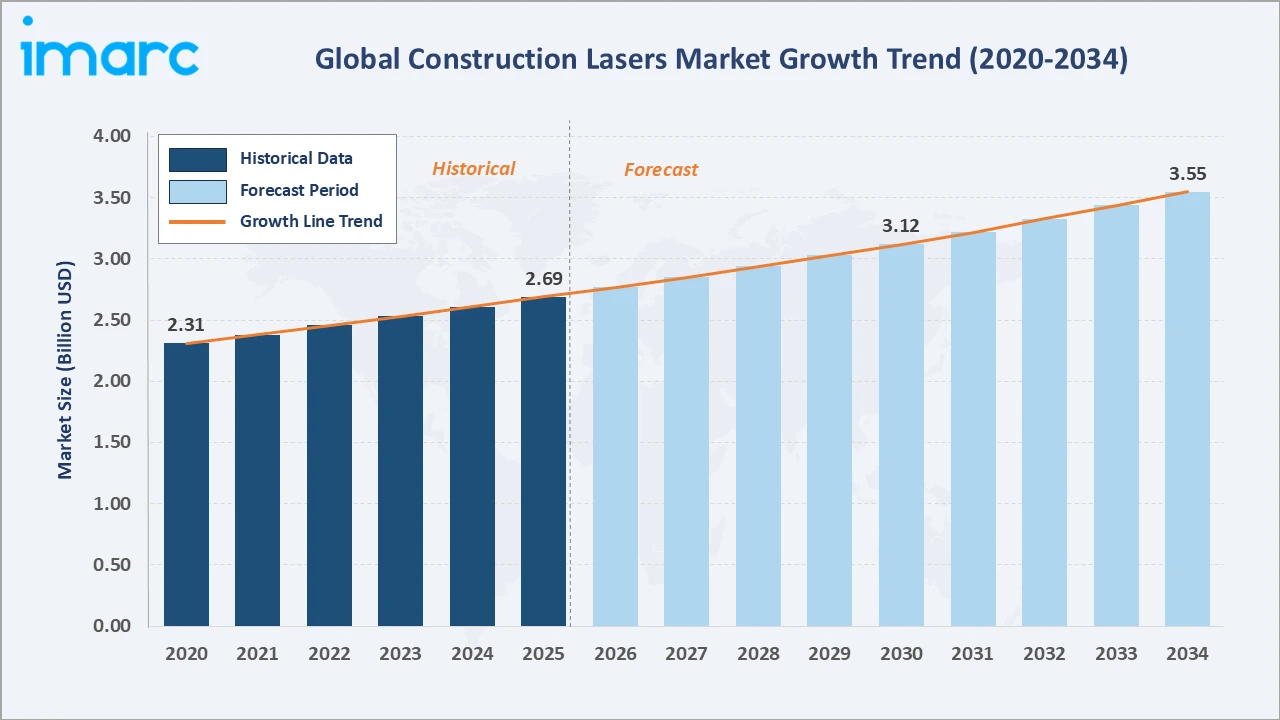
The global construction lasers market reached USD 2.69 Billion in 2025 and is projected to reach USD 3.55 Billion by 2034, expanding at a CAGR of 3.03% during 2026-2034. Rising global construction and infrastructure activity, growing adoption of precision measurement tools, and expanding residential and commercial renovation demand are the primary growth catalysts.
Market Snapshot
|
Metric |
Value |
|
Market Size (2025) |
USD 2.69 Billion |
|
Forecast Market Size (2034) |
USD 3.55 Billion |
|
CAGR (2026-2034) |
3.03% |
|
Base Year |
2025 |
|
Historical Period |
2020-2025 |
|
Forecast Period |
2026-2034 |
Asia-Pacific leads the global construction lasers landscape, holding a 38.0% share in 2025, anchored by the region's expanding construction and infrastructure development activity across major economies. Rotary level lasers command the largest share of the product segment at 42.0%, reflecting sustained demand for large-scale leveling and grading applications across construction sites.
To get more information on this market, Request Sample
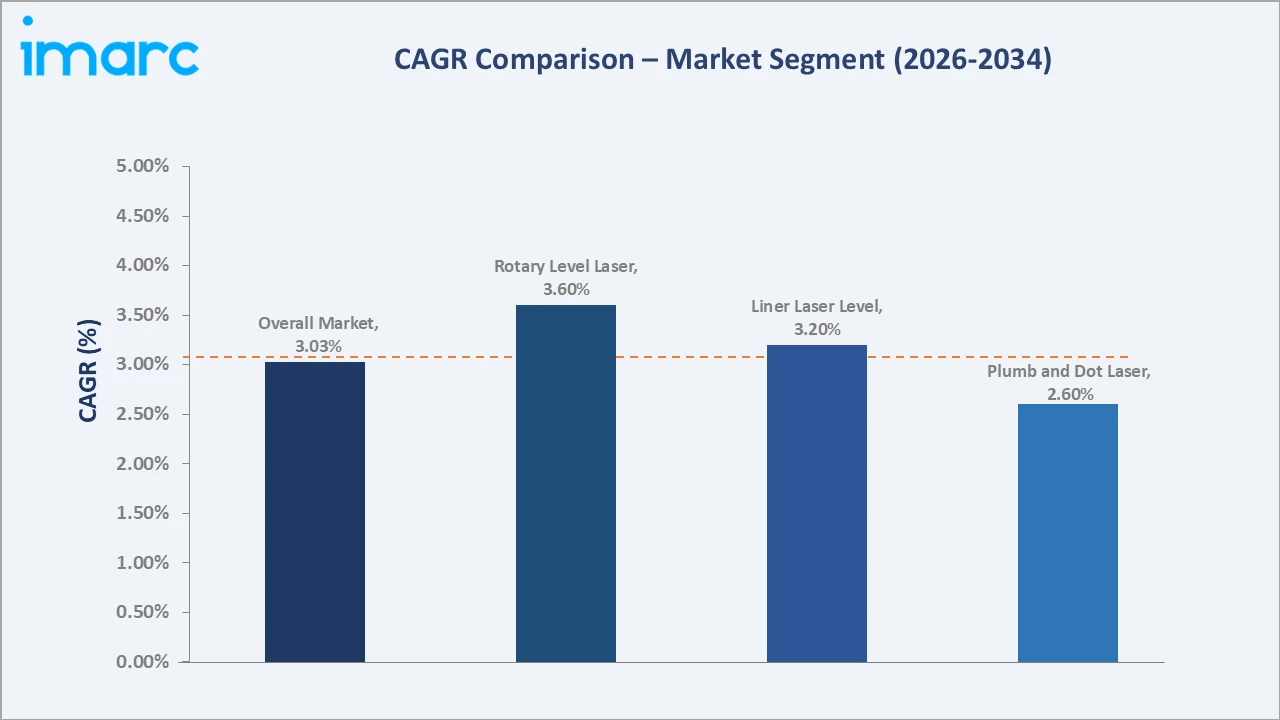
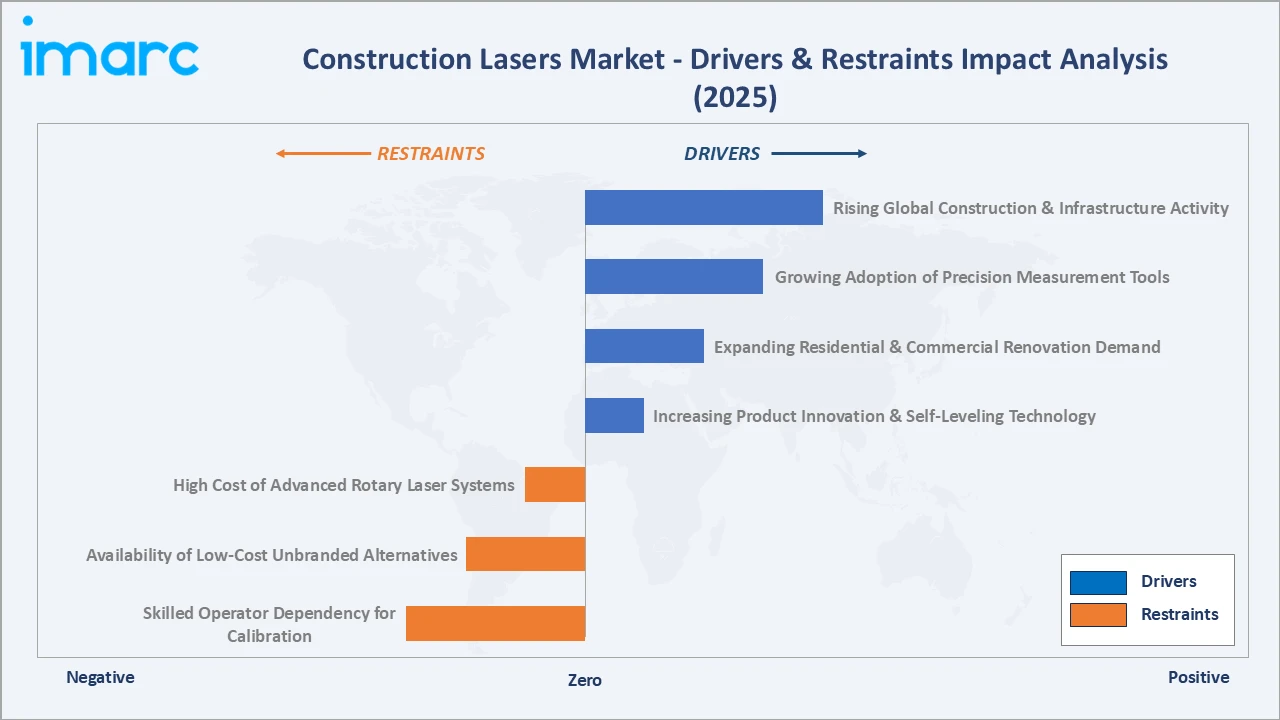
The global construction lasers market is underpinned by three structural forces: rising global construction and infrastructure investment, growing adoption of precision measurement tools among contractors and surveyors, and continuous product innovation across self-leveling and digital laser technologies. Each force independently reinforces category growth, sustaining steady CAGR expansion through 2034 despite pricing pressure from low-cost unbranded alternatives.
Executive Summary
The global construction lasers market is experiencing steady expansion, driven by rising construction and infrastructure activity, growing adoption of precision measurement tools, and increasing demand for self-leveling and digital laser technologies across residential and commercial projects. The market was valued at USD 2.69 Billion in 2025 and is forecast to reach USD 3.55 Billion by 2034, growing at a CAGR of 3.03%.
Rotary level lasers dominate the product segment with a 42.0% share in 2025, encompassing large-scale leveling, grading, and layout applications that remain the primary purchase driver across professional contractors and surveyors. The 1-100ft range segment leads the market at 46.0% share, supported by widespread use in residential and small commercial construction projects, while the 101-200ft (34.0%) and 201ft and above (20.0%) segments serve larger-scale infrastructure and industrial applications.
Asia-Pacific leads regionally at 38.0%, anchored by the region's expanding construction and infrastructure development activity. Leading manufacturers are collectively shaping the industry's product innovation roadmap through continuous R&D investment and category expansion.
Key Market Insights
|
Insight |
Data |
|
Largest Product Segment |
Rotary Level Laser – 42.0% share (2025) |
|
Fastest Growing Product Segment |
Rotary Level Laser – ~3.6% CAGR (2026-2034) |
|
Largest Range Segment |
1-100ft – 46.0% share (2025) |
|
Leading Region |
Asia-Pacific – 38.0% share (2025) |
|
Top Companies |
Robert Bosch GmbH, Hilti Aktiengesellschaft, Trimble Inc., Topcon Corporation, Stanley Black & Decker, Inc. |
Key Analytical Observations Supporting The Above Data:
- Rotary level lasers account for 42.0% of the global construction lasers market in 2025. This dominance reflects sustained demand for large-scale leveling, grading, and layout applications across professional construction sites.
- The 1-100ft range segment remains the leading category at 46.0% share (2025), supported by widespread adoption across residential and small commercial construction projects.
- The 101-200ft range segment is expanding steadily at 34.0% share (2025), as mid-scale commercial and infrastructure projects increasingly rely on extended-range laser leveling equipment.
- Asia-Pacific's 38.0% share (2025) reflects the region's expanding construction and infrastructure development activity, supported by rising urbanization and government-led infrastructure investment.
- Rising global construction activity and growing adoption of precision measurement tools are broadening the addressable consumer base beyond professional contractors into DIY and small-scale renovation applications.
Construction Lasers Market Overview
The construction lasers market encompasses rotary level lasers, line laser levels, plumb and dot lasers, and related precision measurement tools used for leveling, grading, alignment, and layout applications across construction and renovation projects. The global construction lasers ecosystem spans specialty tool manufacturers, precision instrument conglomerates, and an expanding retail and e-commerce distribution network. The market serves professional contractors, surveyors, and DIY enthusiasts across a globally expanding construction and infrastructure development landscape.
Macroeconomic drivers include rising global infrastructure spending, expanding residential and commercial construction activity across urban centers, and growing consumer disposable income supporting premium tool purchases. Manufacturers are simultaneously investing in green laser diode technology and BIM-integrated precision layout systems to improve accuracy and usability, positioning the global construction lasers sector for continued category-led growth through 2034 despite competition from low-cost unbranded alternatives.
Market Dynamics
To evaluate market opportunities, Request Sample
Market Drivers
- Rising Global Construction & Infrastructure Activity: Annual global infrastructure spending is projected to rise from USD 4.4 trillion in 2024 to USD 6.9 trillion by 2050, resulting in cumulative investment of approximately USD 151.1 trillion. Expanding global infrastructure spending and rising urbanization are driving sustained demand for precision leveling and layout equipment.
- Growing Adoption of Precision Measurement Tools: Increasing contractor and surveyor reliance on laser-based measurement tools over traditional methods is broadening the addressable consumer base.
- Expanding Residential & Commercial Renovation Demand: According to the Leading Indicator of Remodeling Activity (LIRA), year-over-year growth in home renovation and repair spending is projected to reach 2.1% by mid-2026 before moderating to 1.6% by year-end. This growing renovation and remodeling activity across residential and commercial segments is sustaining demand for compact, easy-to-use laser levels.
- Increasing Product Innovation & Self-Leveling Technology: Manufacturers are advancing self-leveling and digital display technologies, supporting premium product adoption across professional user bases.
Market Restraints
- High Cost of Advanced Rotary Laser Systems: Premium rotary laser systems with extended range and advanced features carry a significant price premium, limiting adoption among price-sensitive small contractors.
- Availability of Low-Cost Unbranded Alternatives: Widespread availability of low-cost unbranded laser tools in price-sensitive markets pressures margins for established brands.
- Skilled Operator Dependency for Calibration: Approximately 70% of construction firms in the United States report difficulty finding qualified craft workers. This restrains the market, as accurate calibration and operation of advanced laser systems require trained personnel.
Market Opportunities
- Green Laser Diode Technology: Rising demand for improved visibility in outdoor and bright-light conditions presents opportunities for manufacturers investing in green laser diode technology.
- BIM Integration for Precision Layout: Growing adoption of Building Information Modeling (BIM) creates opportunities for laser tools integrated with digital layout and design software.
- Emerging Market Construction Growth: Expanding construction activity across Asia-Pacific and Latin America offers manufacturers new distribution and brand-building opportunities.
Market Challenges
- Balancing Cost and Accuracy: Manufacturers must balance premium component costs with the need to remain accessible to price-sensitive mainstream contractors.
- Brand Differentiation Amid Counterfeit Pressure: Sustaining brand loyalty amid low-cost unbranded competition requires continuous innovation and channel investment.
Emerging Market Trends
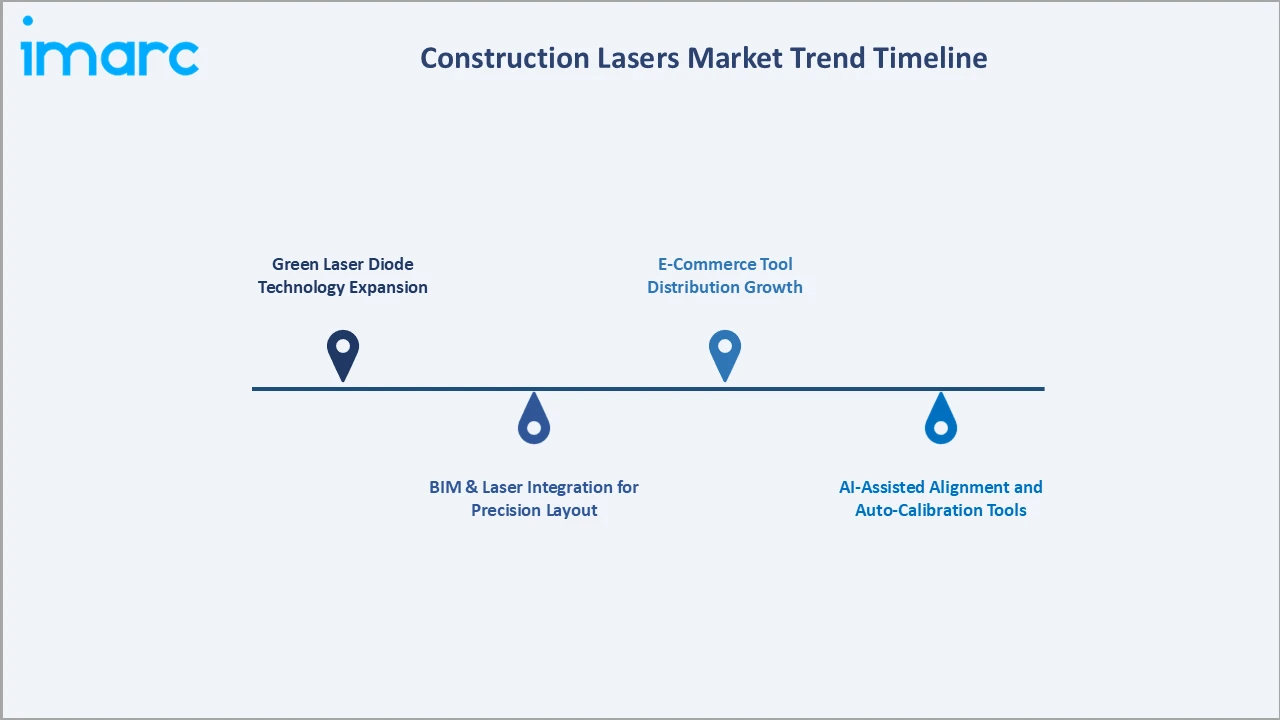
1. Green Laser Diode Technology Expansion
Manufacturers are increasingly launching green laser diode products that offer improved visibility in bright outdoor conditions, targeting professional contractors working on large-scale outdoor construction sites.
2. BIM & Laser Integration for Precision Layout
According to the NBS Digital Construction Report 2025, seven in ten construction professionals surveyed in the United Kingdom use BIM technology. This growing adoption of Building Information Modeling is driving the development of laser tools integrated with digital layout software, enabling more precise and efficient construction workflows.
3. E-Commerce Tool Distribution Growth
Online retail and specialty tool distributors are expanding their construction laser assortments, enabling consumers to access a broader range of certified and imported products beyond traditional hardware stores.
4. AI-Assisted Alignment and Auto-Calibration Tools
Leading manufacturers are exploring AI-based auto-calibration and alignment features that reduce setup time and operator dependency, reflecting the broader industry shift toward smart, user-friendly laser tools.
Industry Value Chain Analysis
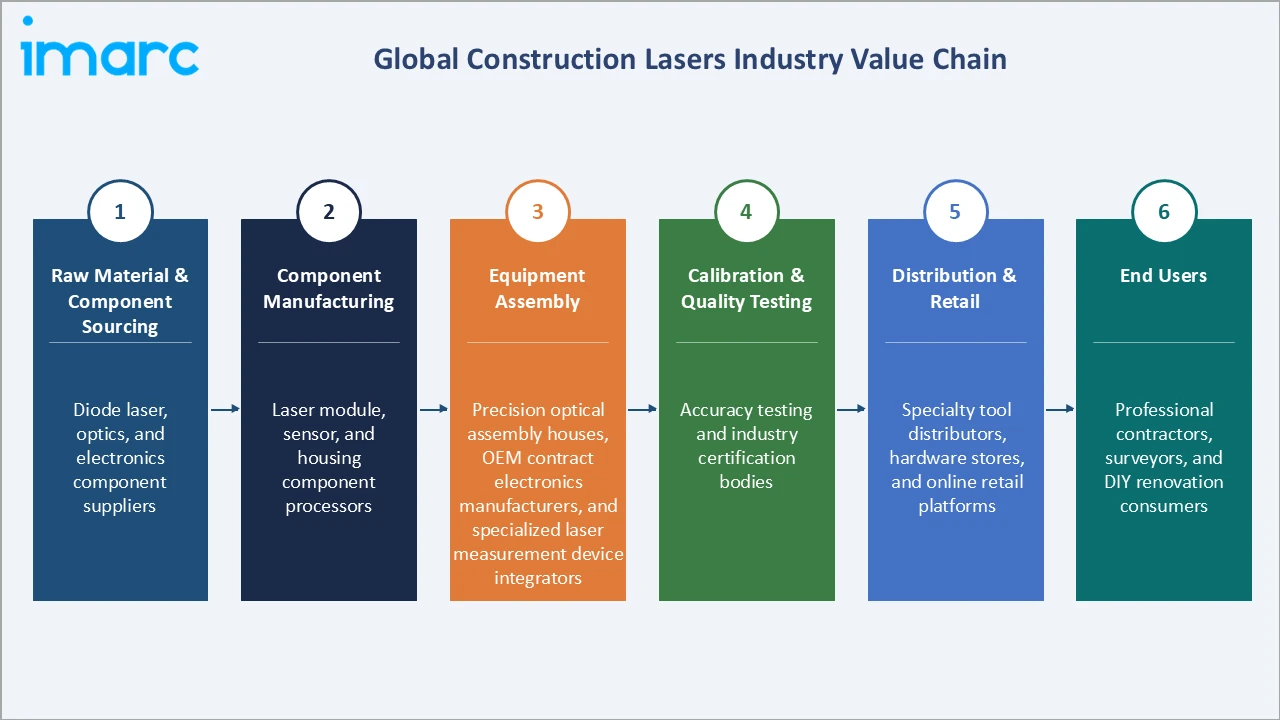
The global construction lasers value chain spans raw material and component sourcing through end-consumer delivery, with each stage occupied by specialized suppliers, manufacturers, and retailers whose performance directly influences product accuracy, durability, and consumer trust.
|
Stage |
Key Players / Examples |
|
Raw Material & Component Sourcing |
Diode laser, optics, and electronics component suppliers |
|
Component Manufacturing |
Laser module, sensor, and housing component processors |
|
Equipment Assembly |
Precision optical assembly houses, OEM contract electronics manufacturers, and specialized laser measurement device integrators |
|
Calibration & Quality Testing |
Accuracy testing and industry certification bodies |
|
Distribution & Retail |
Specialty tool distributors, hardware stores, and online retail platforms |
|
End Users |
Professional contractors, surveyors, and DIY renovation consumers |
Technology Landscape in the Construction Lasers Industry
Self-Leveling Technology Innovation
Manufacturers are advancing automatic self-leveling mechanisms and extended battery life to improve usability and reduce setup time across rotary and line laser product categories. For instance, Topcon highlights that its RL family of rotary lasers is self-leveling and offers battery life of up to 100 hours, while the Laser Manager app enables remote self-leveling and calibration, improving usability and reducing setup time on jobsites.
Green Laser Diode Development
Growing investment in green laser diode technology is expanding visibility range under bright outdoor conditions, addressing rising demand from professional contractors working on large construction sites. At the component level, suppliers such as ams OSRAM are enabling construction laser manufacturers to achieve these performance gains. Its visible InGaN laser diodes deliver high efficiency and compact packaging, with operating temperatures up to 85°C, output of up to 110 mW for single-mode devices, and lifetimes of up to 10,000 hours.
Digital Display and Connectivity Integration
Manufacturers are incorporating digital displays and Bluetooth connectivity into laser tools, enabling remote control and integration with mobile layout and measurement applications. Real-time data synchronization between laser receivers and site management platforms is emerging as a key differentiator, allowing project managers to capture, store, and share elevation and alignment measurements directly from the job site to cloud-based construction workflows, reducing manual data transcription errors and accelerating project documentation cycles.
Market Segmentation Analysis
The report covers the following segments:
|
Segment Category |
Leading Segment |
Market Share |
Year |
|
Product |
Rotary Level Laser |
42.0% |
2025 |
|
Range |
1-100ft |
46.0% |
2025 |
|
Region |
Asia-Pacific |
38.0% |
2025 |

By Product
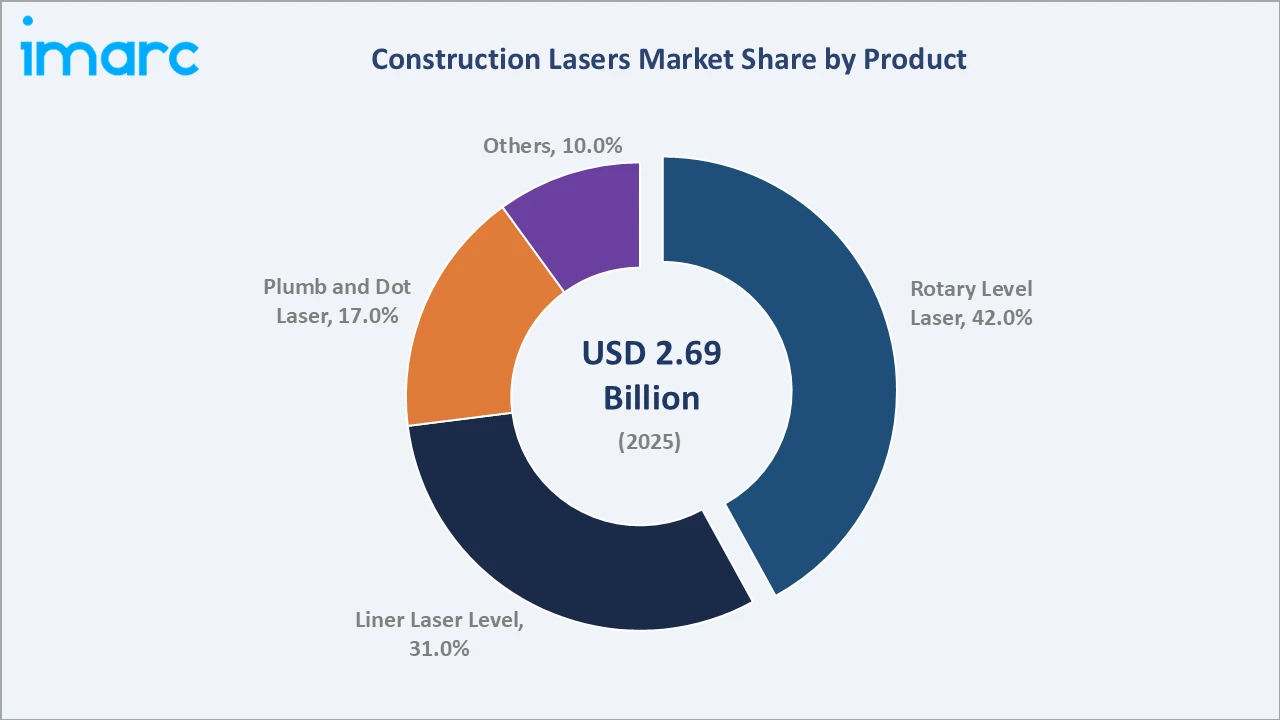
Rotary level lasers dominate with a 42.0% share in 2025. This segment encompasses large-scale leveling, grading, and layout applications that remain the primary purchase driver across professional contractors and surveyors, supported by continuous self-leveling and range-extension innovation.
To access detailed market analysis, Request Sample
Liner laser level products represent 31.0% of the market, serving both professional and DIY applications for wall and ceiling alignment, followed by plumb and dot laser (17.0%), which remains essential for vertical alignment and point-projection tasks.
By Range
The 1-100ft range segment leads the market at 46.0% share, supported by widespread adoption across residential and small commercial construction projects where compact, cost-effective laser tools meet most layout and leveling needs.
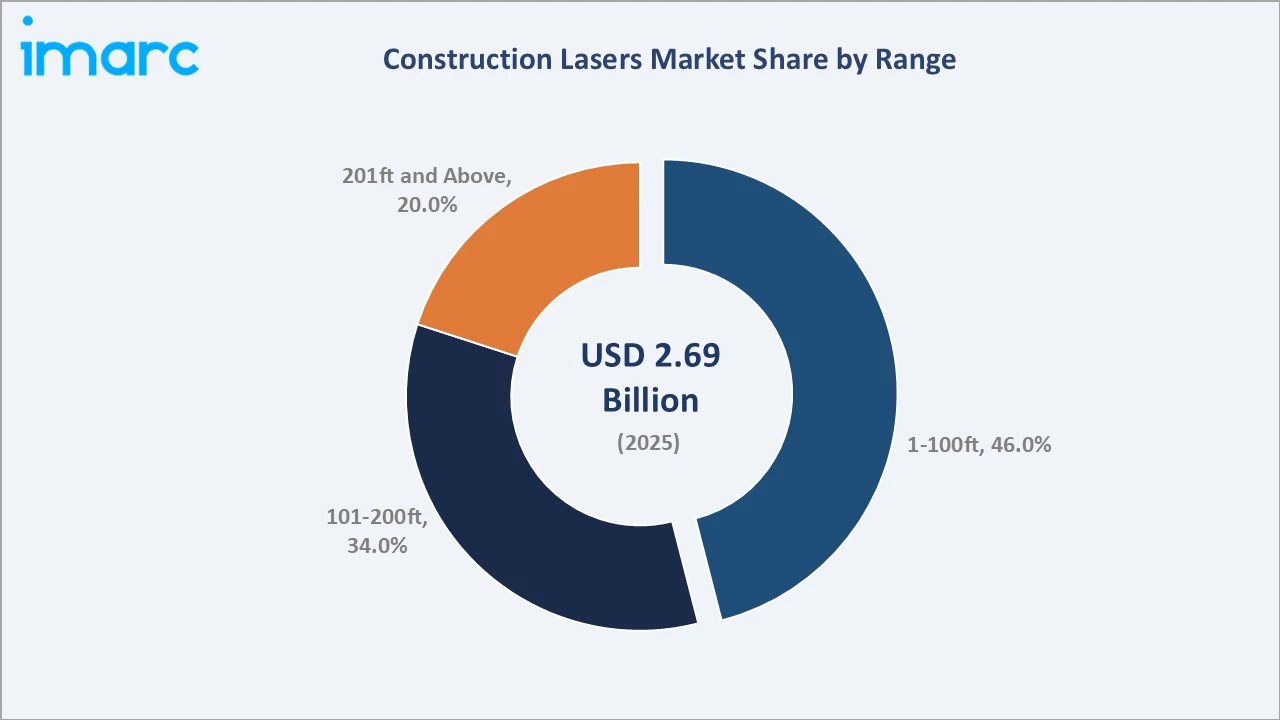
The 101-200ft range segment is expanding steadily at 34.0% share, as mid-scale commercial and infrastructure projects increasingly rely on extended-range laser leveling equipment. The 201ft and above segment, at 20.0%, serves large-scale industrial and infrastructure applications requiring maximum range and precision.
Regional Market Insights
Asia-Pacific's market leadership (38.0%, 2025) reflects the region's expanding construction and infrastructure development activity across major economies. Rising urbanization, government-led infrastructure investment, and growing residential construction combine to sustain its dominant position through 2034.
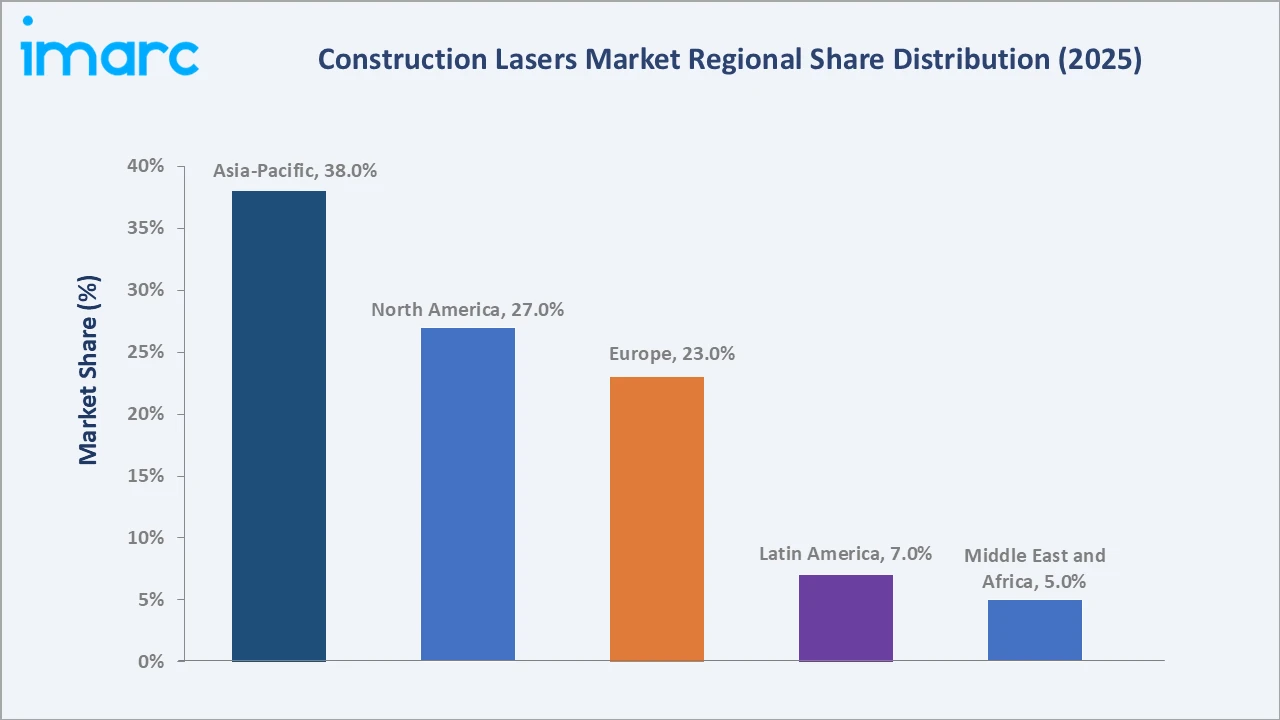
North America at 27.0% represents the second-largest construction lasers market globally. The region's established construction industry and strong adoption of precision measurement tools are sustaining steady growth, positioning it as a key contributor alongside Asia-Pacific through the forecast period.
|
Region |
Share (2025) |
Key Growth Drivers |
|
Asia-Pacific |
38.0% |
Expanding construction and infrastructure development across major economies |
|
North America |
27.0% |
Established construction industry and strong adoption of precision measurement tools |
|
Europe |
23.0% |
Steady renovation activity and expanding professional tool retail infrastructure |
|
Latin America |
7.0% |
Emerging construction growth and expanding retail distribution networks |
|
Middle East and Africa |
5.0% |
Growing infrastructure investment and gradual retail infrastructure expansion |
Competitive Landscape
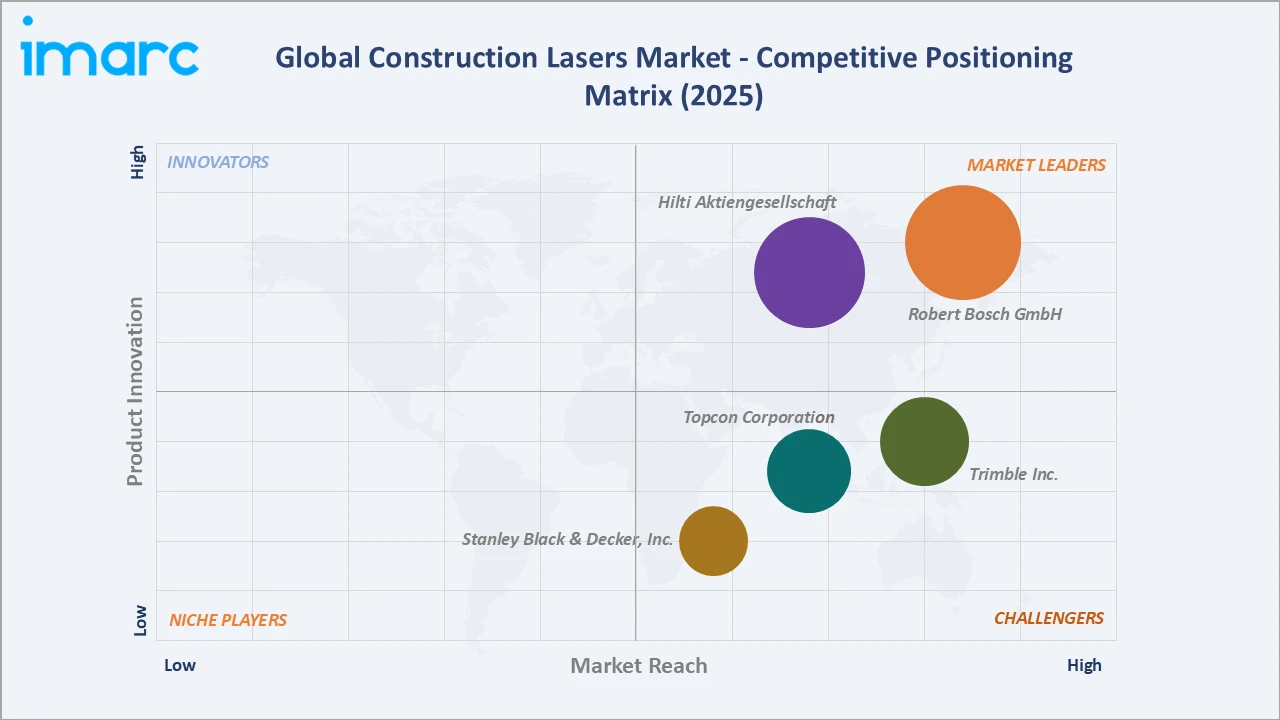
The global construction lasers market exhibits high concentration, with leading manufacturers collectively holding a dominant share of market revenue in 2025, reflecting sustained investment in product innovation and distribution reach.
|
Company Name |
Brand Name |
Market Position |
Core Strength |
|
Robert Bosch GmbH |
Bosch |
Market Leader |
Broad precision tool portfolio; strong global retail and licensing network |
|
Hilti Aktiengesellschaft |
Hilti |
Market Leader |
Established professional construction tool innovation pipeline |
|
Trimble Inc. |
Trimble |
Strong Challenger |
Precision positioning and layout technology category leadership |
|
Topcon Corporation |
Topcon |
Strong Challenger |
Surveying and construction laser instrument heritage |
|
Stanley Black & Decker, Inc. |
Stanley |
Challenger |
Broad hand-tool and measurement equipment manufacturing expertise |
Robert Bosch GmbH and Hilti Aktiengesellschaft dominate through comprehensive product portfolios and extensive global retail networks, supported by continuous R&D investment. Trimble Inc., Topcon Corporation, and Stanley Black & Decker, Inc. compete through targeted category leadership, surveying heritage, and specialty retail positioning, respectively.
Key Company Profiles
Robert Bosch GmbH
Robert Bosch GmbH is one of the global engineering and technology leaders with an extensive construction laser product portfolio spanning rotary, line, plumb laser, and dot lasers distributed across global retail networks.
- Product Portfolio: Rotary level lasers, line laser levels, and plumb and dot lasers under the Bosch Professional brand.
- Recent Developments: In February 2026, Robert Bosch GmbH’s subsidiary Bosch Power Tools launched its “Champ” campaign to promote its measuring tools portfolio, featuring the 18V 360° Connected Green-Beam Leveling and Alignment Laser and the BLAZE 165-ft laser measure. The campaign emphasizes precision, ease of use, and faster jobsite leveling, alignment, and distance-measurement tasks for contractors and carpenters.
- Strategic Focus: Strengthening premium product innovation; expanding e-commerce distribution reach across emerging markets.
Hilti Aktiengesellschaft
Hilti Aktiengesellschaft is one of the leading global construction tool manufacturers with a growing precision laser equipment portfolio serving professional contractors and surveyors worldwide.
- Product Portfolio: Rotary and line laser levels, and precision measurement systems distributed through direct sales and specialty channels.
- Recent Developments: In January 2025, Hilti Aktiengesellschaft announced an expansion of its Nuron cordless platform at World of Concrete, introducing a cordless diamond core rig, two cut-off saws, and three PR-series rotating construction lasers. The new lasers support horizontal, vertical, slope, grading, formwork, and squaring applications, with one-button operation, automatic functions up to 300 meters, asset tracking, and battery monitoring.
- Strategic Focus: Scaling precision tool innovation; deepening direct-to-contractor distribution partnerships.
Market Concentration Analysis
The global construction lasers market exhibits high concentration, with key players collectively accounting for a dominant share of total category revenue in 2025, reflecting sustained R&D investment, brand loyalty, and extensive distribution infrastructure worldwide.
Consolidation pressure remains moderate as leading manufacturers maintain distinct strategic positioning: Robert Bosch GmbH and Hilti Aktiengesellschaft through comprehensive multi-category portfolios, Trimble Inc. and Topcon Corporation through precision positioning and surveying category leadership, and Stanley Black & Decker, Inc. through broad hand-tool and specialty retail differentiation, rather than pursuing direct M&A consolidation.
Investment & Growth Opportunities
Fastest Growing Segments
Rotary level lasers (~3.6% CAGR) represent the highest-growth investment vector through 2034, driven by expanding self-leveling and range-extension innovation and sustained demand across professional contractor and surveyor user bases. This subcategory addresses a rapidly expanding addressable market within the global construction and infrastructure development ecosystem.
Emerging Market Expansion
Latin America and the Middle East and Africa collectively represent an incremental growth opportunity beyond Asia-Pacific and North America by 2034, as rising infrastructure investment and expanding construction activity accelerate category penetration in these secondary regional markets.
Venture and Institutional Investment Trends
- Manufacturer investment toward green laser diode and digital display innovation is creating supply chain opportunities for optics and component suppliers serving the construction lasers sector.
- Growing e-commerce and specialty retail expansion is sustaining institutional interest in direct-to-consumer precision tool distribution platforms.
- BIM integration and AI-assisted calibration development, led by major manufacturers, is opening opportunities for software and technology vendors serving the global construction tools industry.
Future Market Outlook (2026-2034)
The global construction lasers market is positioned for steady, infrastructure-driven expansion through 2034. From a base of USD 2.69 Billion in 2025, the market is projected to reach USD 3.55 Billion by 2034, representing substantial incremental value creation at a CAGR of 3.03%. This growth is underpinned by rising global construction and infrastructure activity, expanding precision measurement tool adoption, and continuous product innovation across the equipment manufacturing sector.
The product segment will continue evolving through 2034, with rotary level lasers gaining further share as self-leveling and range-extension innovation and consumer preference for precision accelerate. This shift creates opportunities for manufacturers investing in green laser diode technology, BIM integration, and expanding e-commerce distribution to capture the next phase of the global construction lasers market growth.
Research Methodology
Primary Research
Primary research comprised structured interviews with industry participants across 2024-2025, including equipment manufacturer executives, professional contractors, surveyors, and retail category managers globally. Expert input validated market sizing, segmentation trends, and regional consumption patterns.
Secondary Research
Secondary research encompassed manufacturer annual reports, industry association publications, and construction trade press covering equipment innovation, infrastructure spending trends, and regional retail dynamics across major markets.
Forecasting Models
Market size estimations were derived using top-down and bottom-up forecasting, incorporating product and range segment transitions and manufacturer capacity disclosures. A base-case CAGR of 3.03% reflects consensus estimates validated against announced product launch timelines and manufacturer strategic investment plans.
Construction Lasers Market Report Coverage:
| Report Features | Details |
|---|---|
| Base Year of the Analysis | 2025 |
| Historical Period | 2020-2025 |
| Forecast Period | 2026-2034 |
| Units | Billion USD |
| Scope of the Report |
Exploration of Historical Trends and Hot Melts Adhesive Market Outlook, Industry Catalysts and Challenges, Segment-Wise Historical and Future Market Assessment:
|
| Products Covered | Rotary Level Laser, Liner Laser Level, Plumb and Dot Laser, Others |
| Ranges Covered | 1-100ft, 101-200ft, 201ft and Above |
| Region Covered | Asia Pacific, Europe, North America, Latin America, Middle East and Africa |
| Countries Covered | United States, Canada, Germany, France, United Kingdom, Italy, Spain, Russia, China, Japan, India, South Korea, Australia, Indonesia, Brazil, Mexico |
| Companies Covered | Robert Bosch GmbH, Hilti Aktiengesellschaft, Trimble Inc., Topcon Corporation, Stanley Black & Decker, Inc., etc. |
| Customization Scope | 10% Free Customization |
| Post-Sale Analyst Support | 10-12 Weeks |
| Delivery Format | PDF and Excel through Email (We can also provide the editable version of the report in PPT/Word format on special request) |
Frequently Asked Questions About the Construction Lasers Market Report
The global construction lasers market reached USD 2.69 Billion in 2025 and is projected to reach USD 3.55 Billion by 2034.
The market is expected to grow at a CAGR of 3.03% during 2026-2034, driven by rising global construction and infrastructure activity.
Asia-Pacific leads with a 38.0% share in 2025, anchored by the region's expanding construction and infrastructure development activity.
Rotary level lasers dominate with a 42.0% share in 2025, driven by sustained demand for large-scale leveling and grading applications.
The 1-100ft range segment leads with a 46.0% share in 2025, supported by widespread adoption across residential and small commercial projects.
Some of the key players include Robert Bosch GmbH, Hilti Aktiengesellschaft, Trimble Inc., Topcon Corporation, and Stanley Black & Decker, Inc.
Rotary level lasers are growing fastest at an estimated 3.6% CAGR as self-leveling and range-extension innovation accelerate adoption.
Key challenges include high cost of advanced rotary laser systems, availability of low-cost unbranded alternatives, and skilled operator dependency for calibration.
Green laser diode technology, BIM integration, and AI-assisted calibration development represent leading investment opportunities.
E-commerce and specialty tool distribution are expanding steadily as consumers increasingly seek broader brand selection and competitive pricing through online channels.
Need more help?
- Speak to our experienced analysts for insights on the current market scenarios.
- Include additional segments and countries to customize the report as per your requirement.
- Gain an unparalleled competitive advantage in your domain by understanding how to utilize the report and positively impacting your operations and revenue.
- For further assistance, please connect with our analysts.
 Request Customization
 Speak to an Analyst
 Request Brochure
 Inquire Before Buying
Benefits of Customization
- Personalize this research
- Triangulate with your data
- Get data as per your format and definition
- Gain a deeper dive into a specific application, geography, customer, or competitor
- Any level of personalization
Get in Touch With Us
UNITED STATES
Phone: +1-201-971-6302
INDIA
Phone: +91-120-433-0800
UNITED KINGDOM
Phone: +44-753-714-6104
Email: [email protected]
Client Testimonials




.webp)




.webp)













Related Reports

Choose your plan
*Please note that the prices mentioned below are starting prices for each bundle type. Kindly contact our team for further details.*
Single User License
- 1 User License, Access on 2 Devices
- PDF Report + Excel Dataset (Password Protected)
- Lifetime Access
- No Printing Rights
- 10% Free Report Customization
- 10–12 Weeks of Analyst Support
Five User License
- Access for 5 Users, 2 Devices per User
- PDF Report + Excel Dataset (Password Protected)
- Lifetime Access
- Dedicated Account Manager
- 12–14 Weeks of Analyst Support
- No Printing Rights
- 15% Free Report Customization
- 25% Discount on Your Next Purchase
Corporate User License
- Unlimited User Access (Within Your Organization)
- PDF Report + Excel Dataset
- Lifetime Access
- Dedicated Account Manager
- 14–20 Weeks of Analyst Support
- No Printing Rights
- 20% Free Report Customization
- 30% Discount on Your Next Purchase
Essential Insights
What's included:
3 reports
- Lifetime Access
- PDF Reports
- Excel Datasets
- 2 Weeks of Free Analyst Support
- 2 User Licenses
- Access on 2 Devices
- Printing Rights
- Complimentary PowerPoint (PPT) Version
- Complimentary License Upgrade
Professional Access
What's included:
5 reports
- Lifetime Access
- PDF Reports
- Excel Datasets
- 8 Weeks of Free Analyst Support
- 2 User Licenses
- Access on 2 Devices
- Printing Rights
- Complimentary PowerPoint (PPT) Version
- Complimentary License Upgrade
Business Advantage
What's included:
8 reports
- Lifetime Access
- PDF Reports
- Excel Datasets
- 14 Weeks of Free Analyst Support
- 2 User Licenses
- Access on 2 Devices
- Printing Rights
- Complimentary PowerPoint (PPT) Version
- Complimentary License Upgrade
Enterprise Intelligence
What's included:
10 reports
- Lifetime Access
- PDF Reports
- Excel Datasets
- 20 Weeks of Free Analyst Support
- 2 User Licenses
- Access on 2 Devices
- Printing Rights
- Complimentary PowerPoint (PPT) Version
- Complimentary License Upgrade