
Data Center Market Size, Share, Trends and Forecast by Component, Type, Enterprise Size, End User, and Region, 2026-2034
Data Center Market Size, Share, Trends & Forecast (2026-2034)
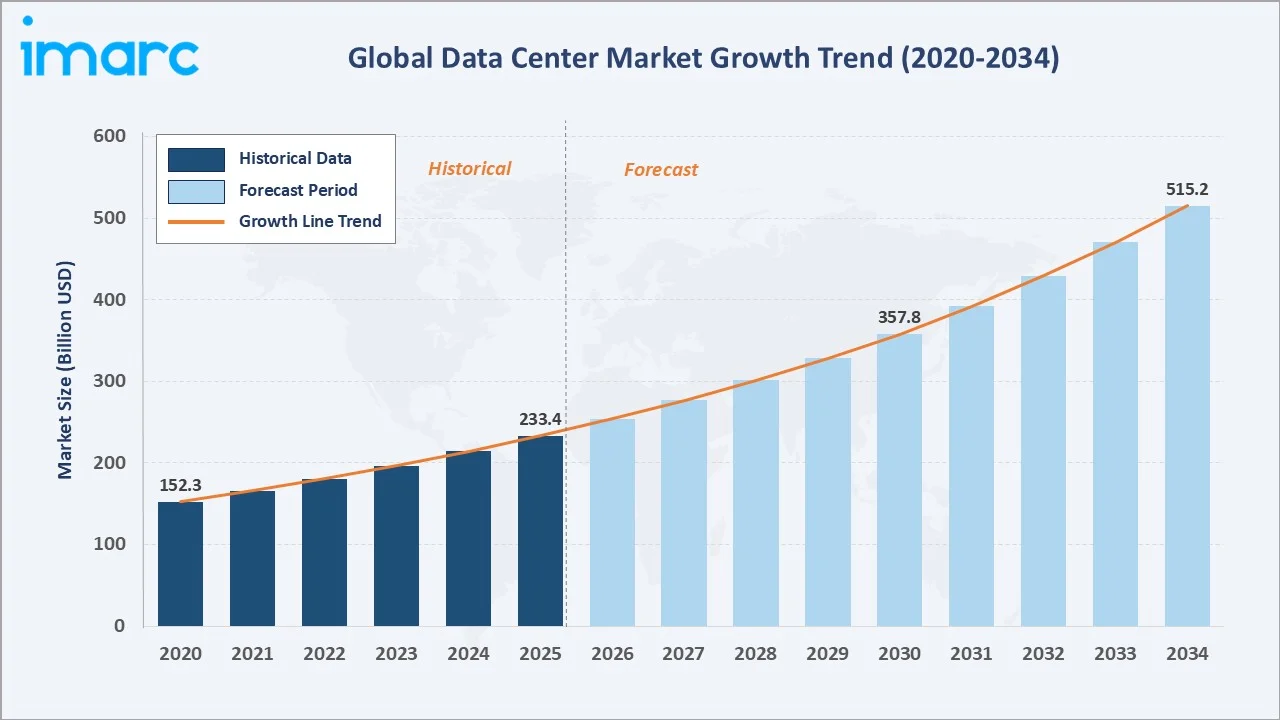
The global data center market reached USD 233.4 Billion in 2025 and is projected to reach USD 515.2 Billion by 2034, growing at a CAGR of 8.92% during 2026-2034. The market is driven by rising cloud adoption, artificial intelligence and high-density computing workloads, 5G-enabled edge deployment, and expanding digital infrastructure investment. Global data creation, capture, and consumption reached approximately 181 zettabytes in 2025, up sharply from 64.2 zettabytes in 2020, according to IDC Global DataSphere research. This surge in data volume is driving the data center market by increasing the need for scalable, energy-efficient, and reliable infrastructure to support cloud computing, AI training, and enterprise digital workloads. Solutions lead the component segment at 62.8%, Hyperscale leads the type segment at 39.5%, and North America commands 38.7% of the global market share.
Market Snapshot
|
Metric |
Value |
|
Market Size (2025) |
USD 233.4 Billion |
|
Forecast Market Size (2034) |
USD 515.2 Billion |
|
CAGR (2026-2034) |
8.92% |
|
Base Year |
2025 |
|
Historical Period |
2020-2025 |
|
Forecast Period |
2026-2034 |
|
Dominant Component |
Solution (62.8%, 2025) |
|
Dominant Type |
Hyperscale (39.5%, 2025) |
|
Leading Region |
North America (38.7%, 2025) |
The global data center market expanded from USD 152.3 Billion in 2020 to USD 233.4 Billion in 2025, anchored at USD 357.8 Billion in 2030, and forecast to reach USD 515.2 Billion by 2034.
To get more information on this market, Request Sample
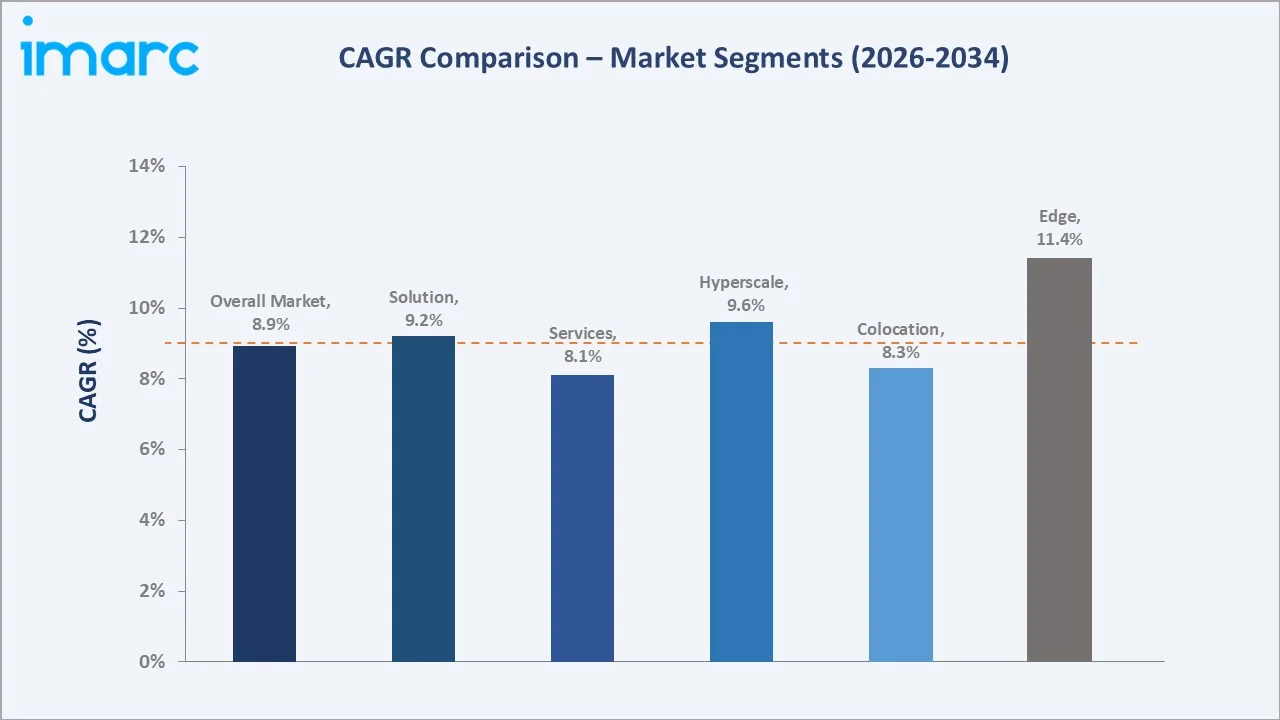
Edge infrastructure grows fastest as 5G and IoT drive distributed computing demand, while Hyperscale facilities expand rapidly on the back of cloud and AI workload migration.
Executive Summary
The global data center market reached USD 233.4 Billion in 2025, reflecting the convergence of cloud computing, artificial intelligence, and digital transformation across enterprises and governments worldwide. The market encompasses facility construction, IT and networking infrastructure, power and cooling systems, and managed and colocation services that together enable reliable, scalable, and secure digital infrastructure delivery. Solutions at 62.8% dominate through continuous investment in servers, storage, and networking hardware, while Hyperscale facilities at 39.5% lead the type segment through large-scale cloud and AI deployment. North America, at 38.7%, leads through its concentration of hyperscale cloud providers and advanced digital infrastructure investment.
Key Market Insights
|
Insight |
Data |
|
Dominant Component |
Solution - 62.8% share (2025) |
|
Dominant Type |
Hyperscale - 39.5% market share (2025) |
|
Leading Region |
North America - 38.7% market share |
|
Market Opportunity |
AI-optimized data centers; edge computing expansion; liquid cooling technology; renewable-powered facilities; modular data center deployment |
Key Analytical Observations Supporting The Above Data:
- Solution at 62.8%: Solutions dominate as enterprises and hyperscale operators continuously invest in servers, storage, networking, and power and cooling infrastructure to support growing digital workloads.
- Hyperscale at 39.5%: Hyperscale facilities lead the type segment due to large-scale, highly automated infrastructure built by cloud and technology majors to support global digital service delivery.
- North America at 38.7%: North America leads through its dense concentration of hyperscale campuses, strong cloud adoption, and continued enterprise digital infrastructure investment.
Data Center Market Overview
The global data center market encompasses the design, construction, equipping, and operation of facilities that house servers, storage, and networking infrastructure supporting digital services. The market spans solution components such as servers, storage, and networking hardware, alongside services including consulting, integration, and managed support.
Macroeconomic factors including rising digitalization, cloud migration, and enterprise IT modernization are driving sustained investment. Growth in AI workloads, government digital infrastructure programs, and 5G network rollout are further accelerating capacity expansion worldwide.
Market Dynamics
To evaluate market opportunities, Request Sample
Market Drivers
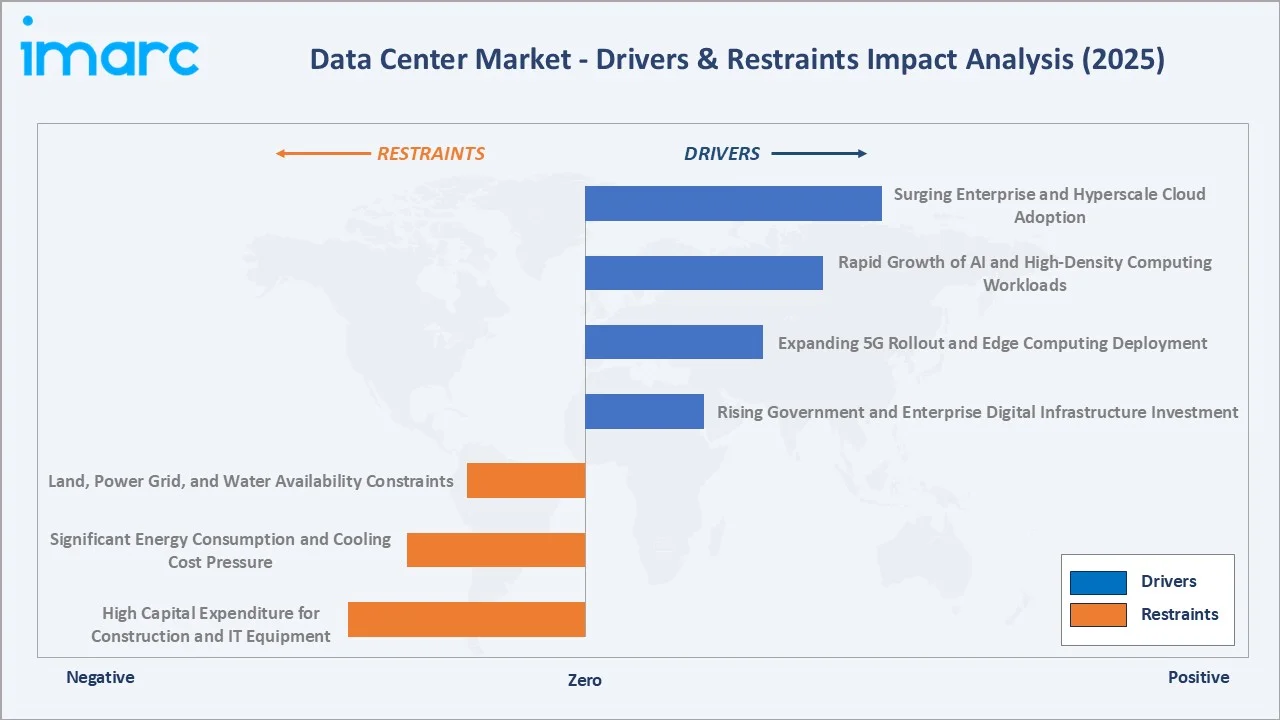
- Surging Enterprise and Hyperscale Cloud Adoption: Enterprises across industries are migrating workloads to cloud and hybrid infrastructure to improve scalability, cost efficiency, and operational agility. This sustained migration is driving continuous investment in hyperscale and colocation capacity worldwide.
- Rapid Growth of AI and High-Density Computing Workloads: The expansion of artificial intelligence, machine learning, and analytics workloads is increasing demand for high-density racks, advanced cooling, and power infrastructure, prompting operators to redesign facilities for compute-intensive applications.
- Expanding 5G Rollout and Edge Computing Deployment: The rollout of 5G networks and proliferation of connected devices are driving demand for edge data centers that deliver low-latency processing closer to end users, supporting real-time applications across industries.
- Rising Government and Enterprise Digital Infrastructure Investment: Governments and enterprises are prioritizing digital infrastructure investment to support e-governance, data sovereignty, and economic competitiveness, creating sustained demand for new and upgraded data center capacity.
Market Restraints
- High Capital Expenditure for Construction and IT Equipment: Developing data center facilities requires substantial upfront investment in land, construction, power infrastructure, and IT equipment, which can limit entry for smaller operators and slow expansion in cost-sensitive markets.
- Significant Energy Consumption and Cooling Cost Pressure: Data centers are highly energy-intensive, and rising electricity prices increase operating costs, particularly for facilities running high-density AI and computing workloads that require advanced cooling systems.
- Land, Power Grid, and Water Availability Constraints: Availability of suitable land, adequate power grid capacity, and water resources for cooling is becoming a limiting factor in key markets, extending project timelines and increasing site development costs.
Market Opportunities
- AI-Optimized and Liquid-Cooled Facility Development: Rising demand for AI and high-performance computing is creating opportunities for operators to develop next-generation facilities purpose-built for high-density, liquid-cooled infrastructure.
- Edge Data Center Expansion in Underserved Markets: Growing demand for low-latency computing is opening opportunities for edge facility deployment in secondary cities and emerging markets not yet well served by hyperscale capacity.
Market Challenges
- Grid Capacity and Power Interconnection Delays: Lengthy utility interconnection timelines and constrained grid capacity in key markets are delaying new facility commissioning and increasing project development risk.
- Skilled Workforce Shortage for Facility Operations: Rapid capacity expansion is outpacing the availability of skilled technicians and engineers needed to design, build, and operate advanced data center facilities.
Emerging Market Trends
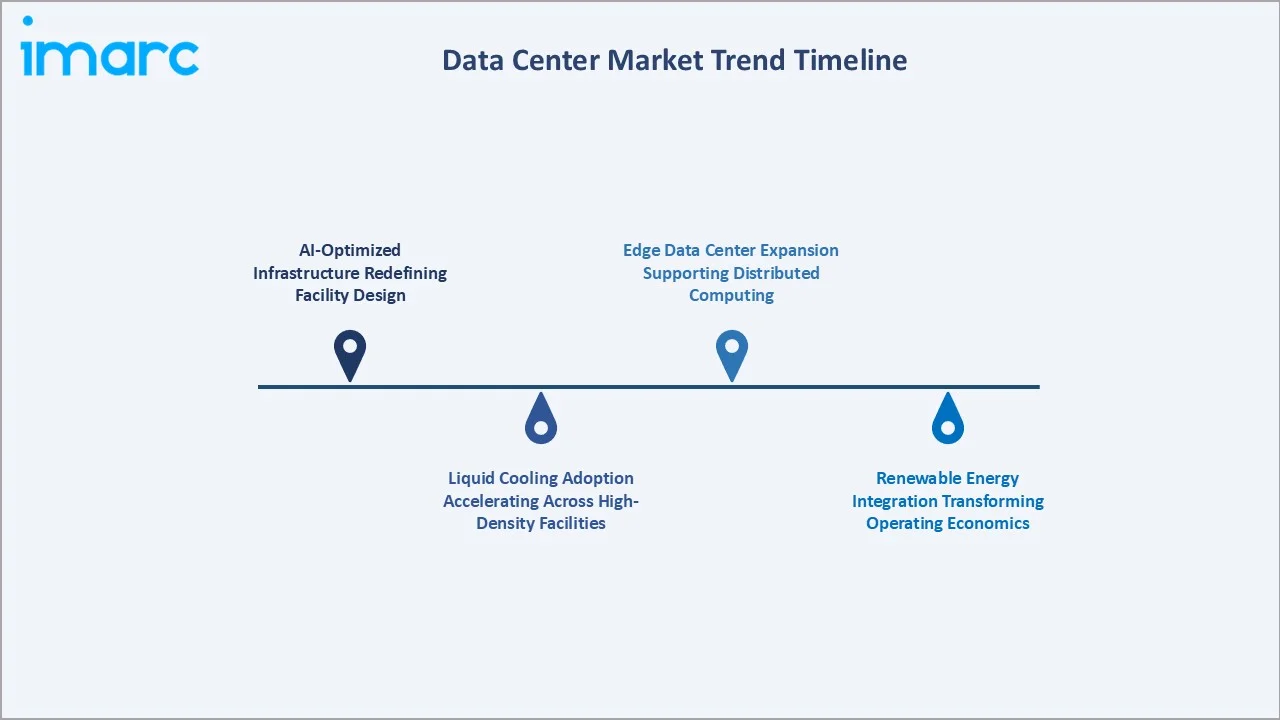
1. AI-Optimized Infrastructure Redefining Facility Design
Rising AI and machine learning workloads are prompting operators to redesign facilities with higher power density, advanced cooling, and specialized rack architecture. This shift is reshaping capital allocation across new-build and retrofit projects globally.
2. Liquid Cooling Adoption Accelerating Across High-Density Facilities
Liquid and direct-to-chip cooling technologies are gaining adoption as facilities move beyond the thermal limits of traditional air cooling, enabling higher rack density while improving energy efficiency for compute-intensive workloads.
3. Renewable Energy Integration Transforming Operating Economics
Operators are increasingly securing renewable power purchase agreements and on-site generation to reduce carbon footprint and stabilize long-term energy costs, aligning with sustainability commitments and regulatory expectations.
4. Edge Data Center Expansion Supporting Distributed Computing
Growth in IoT, autonomous systems, and real-time applications is driving deployment of smaller, distributed edge facilities that reduce latency and support localized data processing closer to end users.
Industry Value Chain Analysis
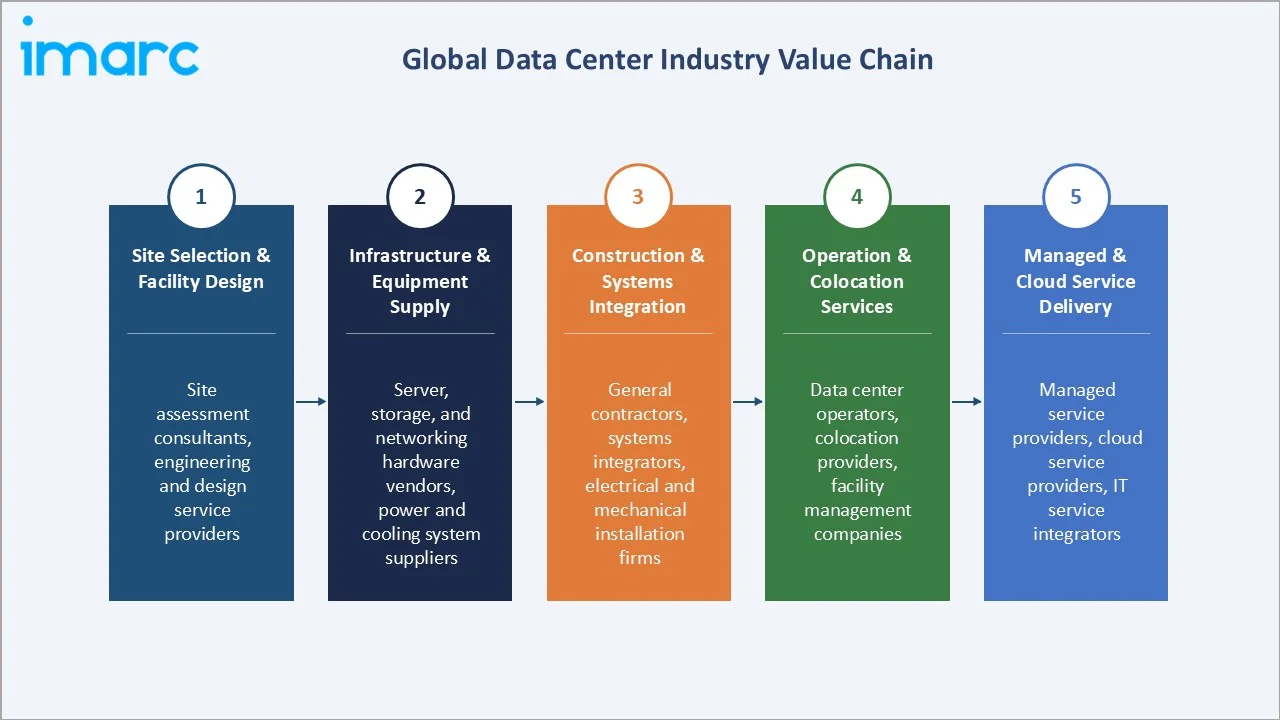
The data center value chain integrates site selection and facility design, infrastructure and equipment supply, construction and systems integration, facility operation and colocation services, and managed and cloud service delivery to end users.
|
Stage |
Key Participants |
|
Site Selection & Facility Design |
Site assessment consultants, engineering and design service providers |
|
Infrastructure & Equipment Supply |
Server, storage, and networking hardware vendors, power and cooling system suppliers |
|
Construction & Systems Integration |
General contractors, systems integrators, electrical and mechanical installation firms |
|
Operation & Colocation Services |
Data center operators, colocation providers, facility management companies |
|
Managed & Cloud Service Delivery |
Managed service providers, cloud service providers, IT service integrators |
Technology Landscape in the Data Center Industry
Liquid Cooling and Thermal Management Technology
Liquid cooling and advanced thermal management technologies enable higher rack density and improved energy efficiency for compute-intensive workloads. Direct-to-chip and immersion cooling systems are increasingly adopted in facilities supporting AI and high-performance computing, where traditional air cooling reaches its thermal limits.
AI-Powered Data Center Infrastructure Management
AI-powered infrastructure management platforms enable predictive monitoring, automated capacity optimization, and real-time energy management across facilities. These systems help operators improve uptime, reduce energy consumption, and optimize workload placement across distributed infrastructure.
Modular and Prefabricated Data Center Technology
Modular and prefabricated data center technology enables faster deployment and scalable capacity expansion compared to traditional construction. This approach is gaining adoption for edge deployments and rapid hyperscale capacity rollout in supply-constrained markets.
Market Segmentation Analysis
The report covers the following segments:
|
Segment Category |
Leading Segment |
Market Share |
Year |
|
Component |
Solution |
62.8% |
2025 |
|
Type |
Hyperscale |
39.5% |
2025 |
|
Enterprise Size |
🔒 |
🔒 |
2025 |
|
End User |
BFSI |
🔒 |
2025 |
|
Region |
North America |
38.7% |
2025 |

By Component
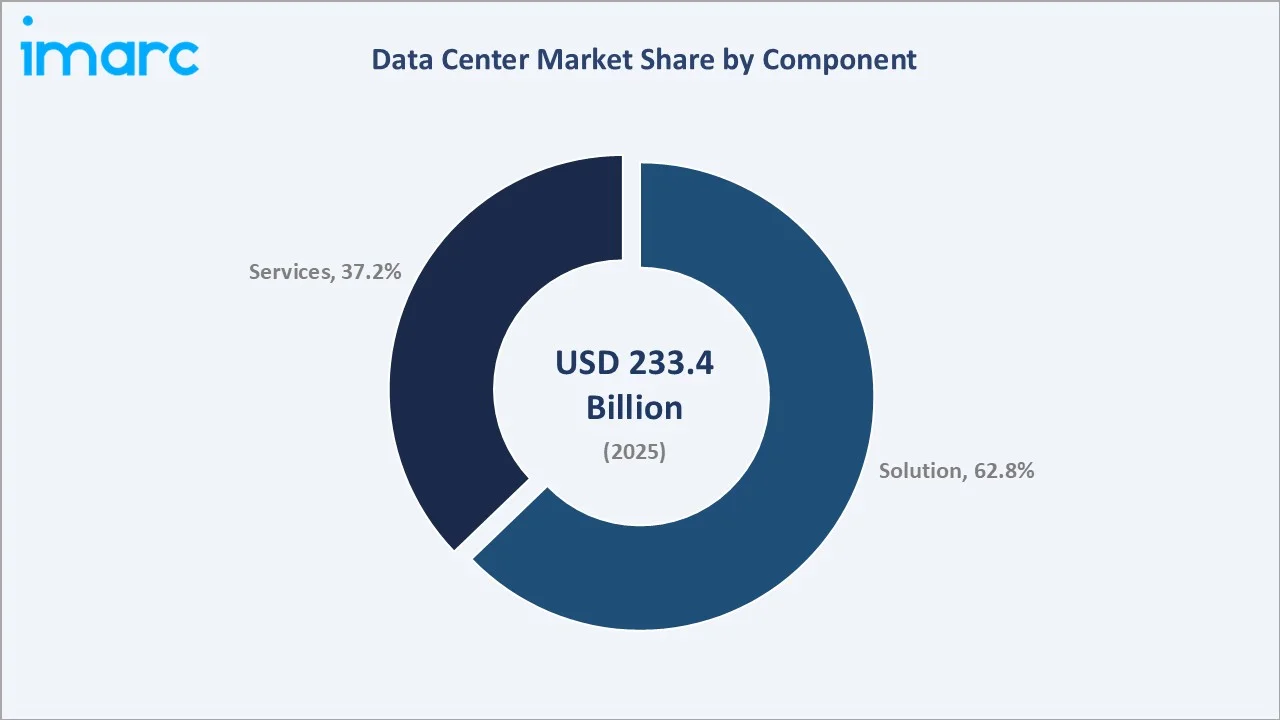
Solution leads at 62.8% (2025). The solution segment encompasses servers, storage, networking equipment, and power and cooling infrastructure that form the physical foundation of data center facilities, supported by continuous refresh cycles as compute density and workload requirements increase. Solution revenue is projected to grow at approximately 9.2% CAGR during 2026-2034, ahead of the overall market, as AI-driven hardware refresh accelerates demand.
To access detailed market analysis, Request Sample
Services at 37.2% encompass consulting, system integration, and managed and support services that enable efficient deployment, monitoring, and optimization of data center infrastructure. The services segment is forecast to expand at approximately 8.1% CAGR through 2034, growing as operators increasingly outsource specialized operational functions.
By Type
Hyperscale leads at 39.5% (2025). The hyperscale segment encompasses large-scale facilities operated by cloud and technology majors to support global digital service delivery, characterized by massive compute capacity, high automation, and continuous capacity expansion to meet cloud and AI demand. Hyperscale capacity is forecast to grow at approximately 9.6% CAGR during 2026-2034, among the fastest of the major type segments.
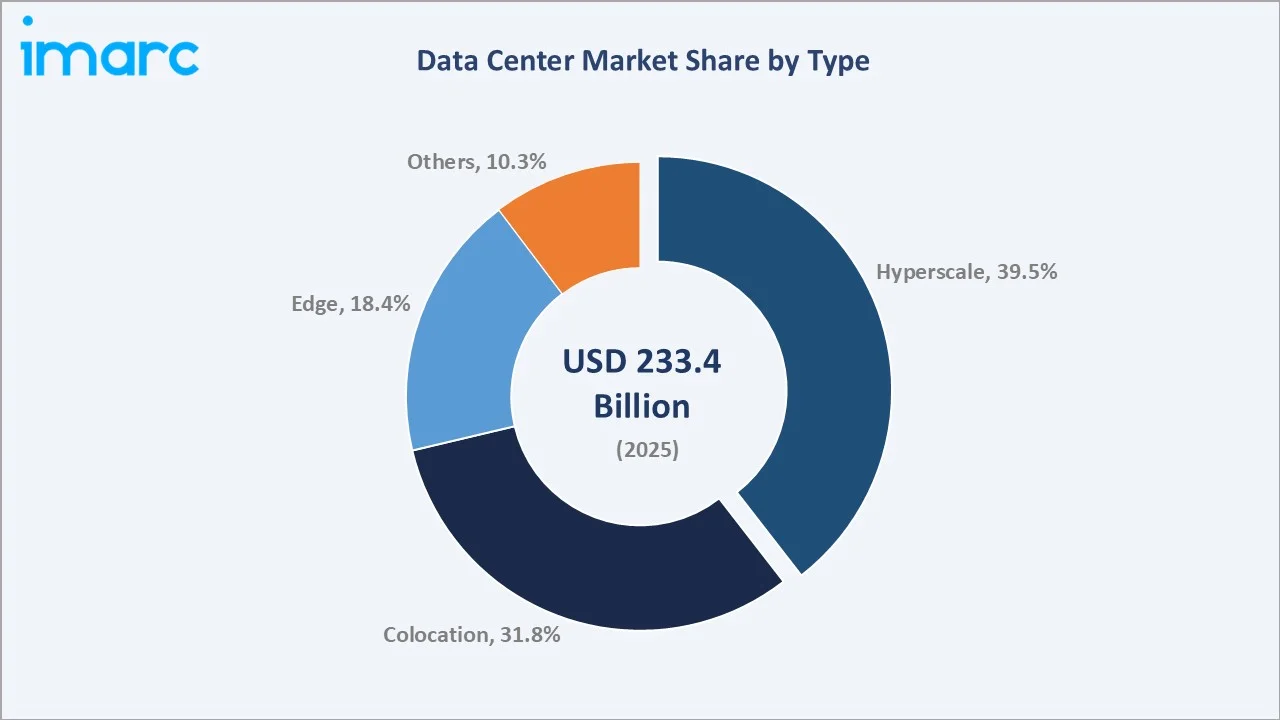
Colocation at 31.8% serves enterprises seeking shared infrastructure without capital-intensive ownership, growing at approximately 8.3% CAGR. Edge at 18.4% is the fastest-growing type at approximately 11.4% CAGR through distributed, low-latency deployment supporting 5G and IoT applications, while Others at 10.3% includes enterprise-owned and modular facilities.
Regional Market Insights
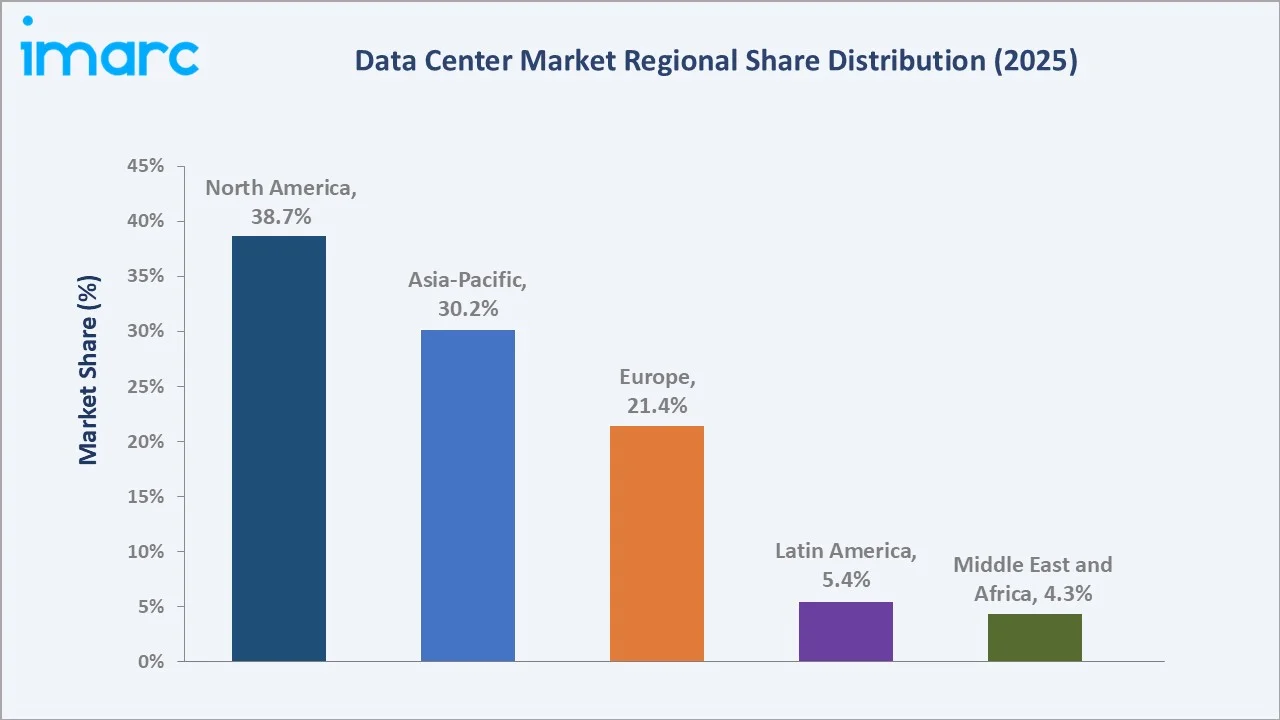
|
Region |
Share (2025) |
Key Data Center Market Drivers & Characteristics |
|
North America |
38.7% |
Driven by dense hyperscale cloud infrastructure, strong enterprise cloud adoption, and continued AI-related capacity expansion. |
|
Asia-Pacific |
30.2% |
Driven by rapid digitalization, expanding cloud service adoption, and government-backed digital infrastructure programs. |
|
Europe |
21.4% |
Supported by data sovereignty regulations, sustainability-focused facility development, and enterprise cloud migration. |
|
Latin America |
5.4% |
Growing through expanding internet penetration, rising cloud adoption, and increasing colocation investment. |
|
Middle East and Africa |
4.3% |
Driven by government digital transformation initiatives and growing regional cloud and colocation investment. |
North America's leadership is anchored by its concentration of hyperscale campuses and advanced enterprise cloud adoption. Asia-Pacific's growth reflects expanding digital economies across China, India, and Southeast Asia, while the Middle East and Africa remains the most dynamic growth region by CAGR.
Competitive Landscape
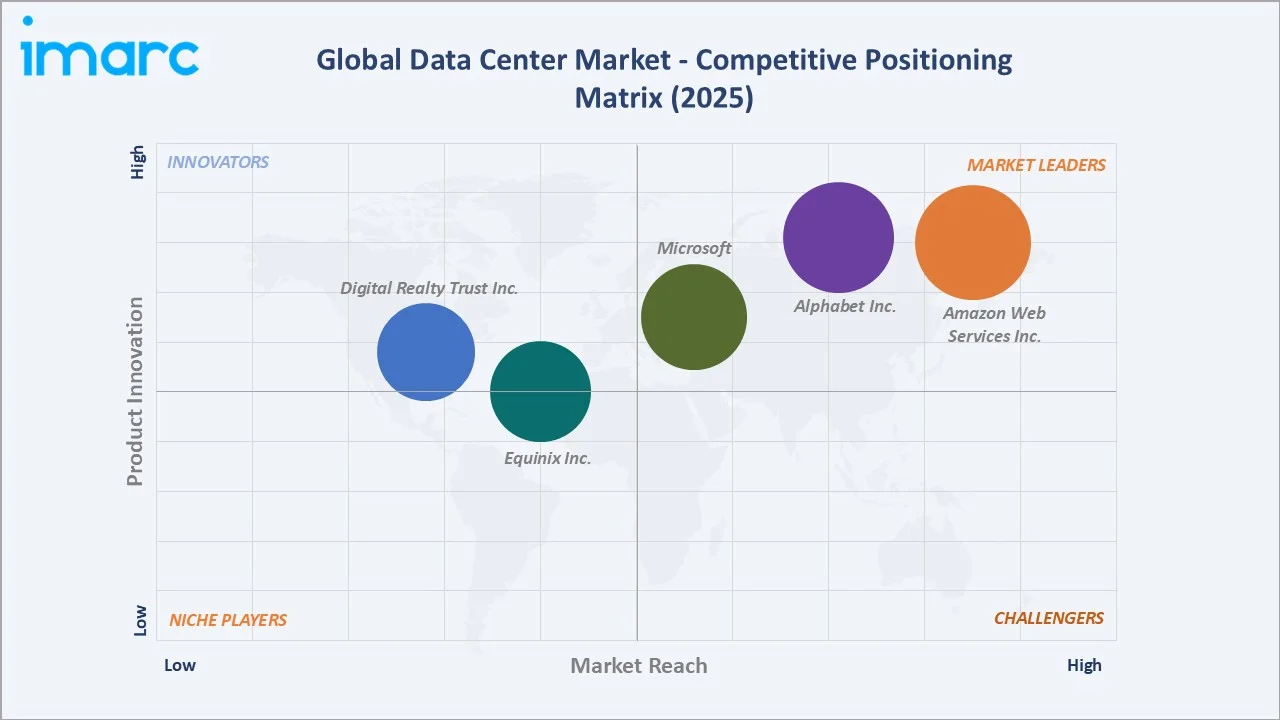
The global data center market competitive landscape encompasses distinct tiers: hyperscale cloud providers, colocation and data center REIT operators, IT infrastructure vendors, and managed service and technology providers.
|
Company Name |
Key Products |
Market Position |
Core Strength |
|
Amazon Web Services Inc. |
Amazon EC2, Amazon S3, AWS Outposts |
Market Leader |
Leading hyperscale cloud infrastructure provider with global data center footprint and comprehensive service portfolio. |
|
Microsoft |
Microsoft Azure |
Market Leader |
Extensive hyperscale cloud and AI infrastructure investment supporting enterprise and government digital transformation. |
|
Alphabet Inc. |
Google Cloud Platform, Google Distributed Cloud |
Market Leader |
Advanced hyperscale infrastructure with strong focus on AI computing and renewable-powered facility design. |
|
Equinix Inc. |
Equinix Fabric, IBX Colocation |
Established Player |
Leading global colocation and interconnection provider serving enterprise and cloud customers. |
|
Digital Realty Trust Inc. |
PlatformDIGITAL, Colocation Services, Cloud Interconnection |
Established Player |
Major data center REIT with extensive global colocation and hyperscale facility portfolio. |
Competitive intensity is increasing as hyperscale providers expand owned capacity while colocation operators pursue interconnection and edge expansion. Consolidation reflects growing customer preference for integrated, globally scalable infrastructure partners.
Key Company Profiles
Equinix Inc.
Equinix Inc. is a leading global provider of colocation and interconnection services for the data center market. The company specializes in high-density facilities and interconnection platforms serving enterprise and cloud customers across more than 70 metro markets worldwide.
- Key Offerings: Colocation services, Equinix Fabric interconnection platform, Equinix Distributed AI infrastructure solutions.
- Recent Developments: In February 2026, Equinix and CPP Investments agreed to jointly acquire at North, a leading Nordic high-density colocation operator, from Partners Group for USD 4.2 billion, expanding Equinix's Nordic data center footprint.
- Strategic Focus: Expanding global colocation capacity, strengthening AI-focused interconnection ecosystems, and diversifying power supply through nuclear and on-site generation partnerships.
Digital Realty Trust Inc.
Digital Realty Trust Inc. is a leading global data center real estate investment trust, offering colocation, interconnection, and hyperscale facility solutions across a broad international portfolio of more than 300 facilities.
- Key Offerings: Colocation and hyperscale facility leasing, PlatformDIGITAL interconnection services, cloud on-ramp solutions.
- Recent Developments: In June 2026, Digital Realty announced the purchase of Blackstone's interest in three fully leased Northern Virginia data centers totaling 288 megawatts of IT capacity, at a gross portfolio value of USD 7.8 billion.
- Strategic Focus: Scaling global hyperscale and colocation capacity through strategic acquisitions while advancing renewable energy integration across its data center portfolio.
Amazon Web Services Inc.
Amazon Web Services Inc. is a leading hyperscale cloud infrastructure provider, operating a global network of data centers that support enterprise, government, and developer cloud computing needs across dozens of regions worldwide.
- Key Offerings: Hyperscale cloud computing, storage, and AI infrastructure services including Amazon Bedrock and Amazon SageMaker.
- Recent Developments: Amazon guided 2026 capital expenditure to approximately USD 200 billion, predominantly directed toward AWS data center and AI infrastructure expansion, following record 2025 capacity additions.
- Strategic Focus: Continued global hyperscale capacity expansion with growing investment in AI-optimized infrastructure and custom silicon for AI workloads.
Market Concentration Analysis
The global data center market is moderately concentrated at the hyperscale tier, with leading cloud providers such as Amazon Web Services, Microsoft, and Google collectively accounting for a substantial share of global hyperscale capacity, alongside Equinix as a leading independent colocation operator. Colocation and managed service tiers remain more fragmented, with regional and national operators serving localized enterprise demand. Market concentration is expected to increase gradually as leading players continue to expand capacity and pursue strategic partnerships.
Investment & Growth Opportunities
Highest Growth Segments
Edge computing facilities, AI-optimized hyperscale capacity, and liquid cooling retrofit represent the highest-growth investment vectors through 2034, supported by sustained digital infrastructure demand across enterprise and government end-users.
Investment Themes
- AI Infrastructure and High-Density Facility Development: Investment in high-density, AI-optimized facilities with advanced cooling is positioned to capture sustained demand from compute-intensive workloads.
- Renewable-Powered and Sustainable Facility Investment: Facilities integrating renewable power and efficient cooling are gaining preference from enterprise customers prioritizing sustainability commitments.
Future Market Outlook (2026-2034)
The global data center market is projected to grow from USD 233.4 Billion in 2025 to USD 515.2 Billion by 2034, delivering an 8.92% CAGR over the forecast period. The market's anchor value of USD 357.8 Billion in 2030 represents a data center industry advancing through sustained AI infrastructure investment, edge computing expansion, and progressive adoption of sustainable facility design.
Three structural forces define market growth through 2034. Continued enterprise and government cloud migration sustains long-term infrastructure demand. Rising AI and high-density computing workloads are reshaping facility design and capacity requirements. Sustainability and energy efficiency considerations are increasingly shaping investment decisions across the industry.
Research Methodology
Primary Research
Primary research comprised structured interviews with industry stakeholders including infrastructure executives, data center operators, and regional market specialists.
Secondary Research
Secondary research encompassed industry publications, company reports, regulatory filings, and data center industry statistics reviewed across primary regional markets.
Forecasting Models
Market revenue forecasts were developed using a segment bottom-up model incorporating component, type, and regional demand indicators.
Data Center Market Report Scope:
| Report Features | Details |
|---|---|
| Base Year of the Analysis | 2025 |
| Historical Period | 2020-2025 |
| Forecast Period | 2026-2034 |
| Units | Billion USD |
| Scope of the Report |
Exploration of Historical Trends and Market Outlook, Industry Catalysts and Challenges, Segment-Wise Historical and Future Market Assessment:
|
| Components Covered | Solution, Services |
| Types Covered | Colocation, Hyperscale, Edge, Others |
| Enterprise Sizes Covered | Large Enterprises, Small and Medium Enterprises |
| End Users Covered | BFSI, IT and Telecom, Government, Energy and Utilities, Others |
| Regions Covered | Asia Pacific, Europe, North America, Latin America, Middle East and Africa |
| Countries Covered | United States, Canada, Germany, France, United Kingdom, Italy, Spain, Russia, China, Japan, India, South Korea, Australia, Indonesia, Brazil, Mexico |
| Companies Covered | Amazon Web Services Inc., Microsoft, Alphabet Inc., Equinix Inc., Digital Realty Trust Inc., etc. |
| Customization Scope | 10% Free Customization |
| Post-Sale Analyst Support | 10-12 Weeks |
| Delivery Format | PDF and Excel through Email (We can also provide the editable version of the report in PPT/Word format on special request) |
Key Benefits for Stakeholders:
- IMARC’s industry report offers a comprehensive quantitative analysis of various market segments, historical and current market trends, market forecasts, and dynamics of the data center market from 2020-2034.
- The research report provides the latest information on the market drivers, challenges, and opportunities in the global data center market.
- The study maps the leading, as well as the fastest-growing, regional markets. It further enables stakeholders to identify the key country-level markets within each region.
- Porter's five forces analysis assists stakeholders in assessing the impact of new entrants, competitive rivalry, supplier power, buyer power, and the threat of substitution. It helps stakeholders to analyze the level of competition within the data center industry and its attractiveness.
- The competitive landscape allows stakeholders to understand their competitive environment and provides insight into the current positions of key players in the market.
Frequently Asked Questions About the Data Center Market Report
The global data center market reached USD 233.4 Billion in 2025, driven by rising cloud adoption, AI workloads, and expanding digital infrastructure investment across enterprises and governments.
The market grows at a CAGR of 8.92% during 2026-2034, reaching USD 515.2 Billion by 2034, supported by continued hyperscale and edge capacity expansion.
Solution leads at 62.8% through continuous investment in servers, storage, networking, and power and cooling infrastructure.
Hyperscale leads at 39.5% through large-scale cloud and AI infrastructure deployment by leading technology providers.
North America leads at 38.7% through its concentration of hyperscale cloud providers and advanced digital infrastructure investment.
Leading companies include Amazon Web Services Inc, Microsoft, Alphabet Inc., Equinix Inc. and Digital Realty Trust Inc., among others.
The market is projected to reach approximately USD 357.8 Billion by 2030, supported by sustained AI infrastructure investment and edge computing expansion.
Need more help?
- Speak to our experienced analysts for insights on the current market scenarios.
- Include additional segments and countries to customize the report as per your requirement.
- Gain an unparalleled competitive advantage in your domain by understanding how to utilize the report and positively impacting your operations and revenue.
- For further assistance, please connect with our analysts.
 Request Customization
 Speak to an Analyst
 Request Brochure
 Inquire Before Buying
Benefits of Customization
- Personalize this research
- Triangulate with your data
- Get data as per your format and definition
- Gain a deeper dive into a specific application, geography, customer, or competitor
- Any level of personalization
Get in Touch With Us
UNITED STATES
Phone: +1-201-971-6302
INDIA
Phone: +91-120-433-0800
UNITED KINGDOM
Phone: +44-753-714-6104
Email: [email protected]
Client Testimonials




.webp)




.webp)













Related Reports

Choose your plan
*Please note that the prices mentioned below are starting prices for each bundle type. Kindly contact our team for further details.*
Single User License
- 1 User License, Access on 2 Devices
- PDF Report + Excel Dataset (Password Protected)
- Lifetime Access
- No Printing Rights
- 10% Free Report Customization
- 10–12 Weeks of Analyst Support
Five User License
- Access for 5 Users, 2 Devices per User
- PDF Report + Excel Dataset (Password Protected)
- Lifetime Access
- Dedicated Account Manager
- 12–14 Weeks of Analyst Support
- No Printing Rights
- 15% Free Report Customization
- 25% Discount on Your Next Purchase
Corporate User License
- Unlimited User Access (Within Your Organization)
- PDF Report + Excel Dataset
- Lifetime Access
- Dedicated Account Manager
- 14–20 Weeks of Analyst Support
- No Printing Rights
- 20% Free Report Customization
- 30% Discount on Your Next Purchase
Essential Insights
What's included:
3 reports
- Lifetime Access
- PDF Reports
- Excel Datasets
- 2 Weeks of Free Analyst Support
- 2 User Licenses
- Access on 2 Devices
- Printing Rights
- Complimentary PowerPoint (PPT) Version
- Complimentary License Upgrade
Professional Access
What's included:
5 reports
- Lifetime Access
- PDF Reports
- Excel Datasets
- 8 Weeks of Free Analyst Support
- 2 User Licenses
- Access on 2 Devices
- Printing Rights
- Complimentary PowerPoint (PPT) Version
- Complimentary License Upgrade
Business Advantage
What's included:
8 reports
- Lifetime Access
- PDF Reports
- Excel Datasets
- 14 Weeks of Free Analyst Support
- 2 User Licenses
- Access on 2 Devices
- Printing Rights
- Complimentary PowerPoint (PPT) Version
- Complimentary License Upgrade
Enterprise Intelligence
What's included:
10 reports
- Lifetime Access
- PDF Reports
- Excel Datasets
- 20 Weeks of Free Analyst Support
- 2 User Licenses
- Access on 2 Devices
- Printing Rights
- Complimentary PowerPoint (PPT) Version
- Complimentary License Upgrade