
Digital Gift Card Market Size, Share, Trends and Forecast by Card Type, Business Type, Application, End User, and Region, 2026-2034
Digital Gift Card Market Size and Share:
The global digital gift card market size was valued at USD 513.79 Billion in 2025. Looking forward, IMARC Group estimates the market to reach USD 1,727.34 Billion by 2034, exhibiting a CAGR of 12.79% from 2026-2034. North America currently dominates the market, holding a market share of 42.9% in 2025. The region benefits from a well-established digital payments infrastructure, widespread adoption of e-commerce platforms, strong consumer preference for cashless gifting solutions, and the presence of major technology companies that continue to expand their digital gift card offerings, along with a robust corporate reward and incentive culture that drives institutional demand, all contributing to the digital gift card market share.
The expanding adoption of digital payment technologies is propelling the global digital gift card market forward. With growing smartphone penetration and increasing internet connectivity worldwide, consumers are shifting toward convenient, contactless gifting solutions that offer instant delivery and personalized experiences. The rising prominence of e-commerce and online retail channels has further strengthened the demand for digital gift cards, as they serve as a seamless gifting option across diverse product categories. The growing trend of self-use purchases, where consumers buy digital gift cards for personal discounts and promotional benefits, is further expanding the consumer base. Moreover, the integration of digital gift cards into mobile wallets and payment ecosystems is enhancing accessibility, fueling the digital gift card market growth across regions.
The United States has emerged as a major region in the digital gift card market owing to many factors. The country's highly developed digital infrastructure and tech-savvy consumer base have created a fertile environment for digital gift card adoption. The proliferation of major e-commerce platforms and retail chains offering branded digital gift cards has made them a preferred gifting option for holidays, birthdays, and corporate occasions. As per sources, Google Play introduced a feature in the U.S. that lets users send digital gift cards from popular brands like Starbucks, Disney, and Adidas directly through its app, expanding how consumers purchase and share e‑gift cards. Furthermore, the growing popularity of subscription-based services and digital entertainment platforms has expanded the variety of digital gift cards available to consumers. The increasing use of digital gift cards as employee rewards, customer acquisition tools, and promotional incentives by businesses across various sectors continues to support market expansion.
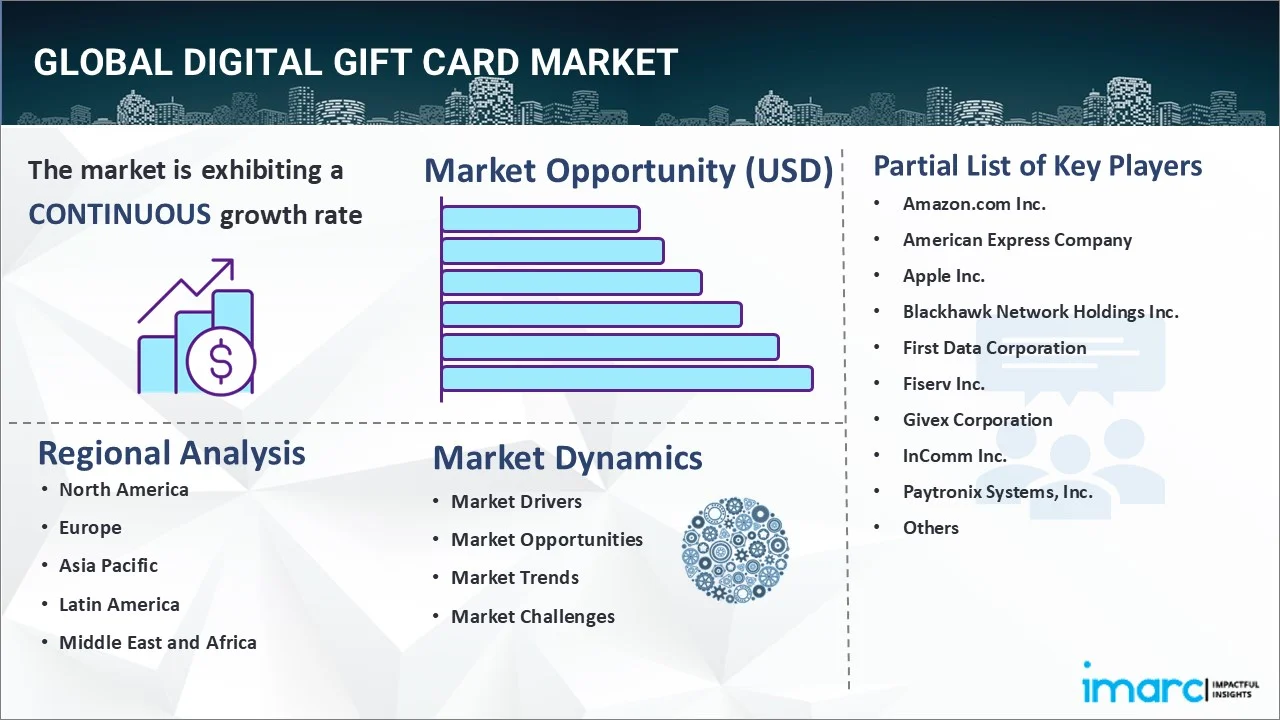
To get more information on this market Request Sample
Digital Gift Card Market Trends:
Expanding Mobile Wallet Integration
The increasing integration of digital gift cards into mobile wallet ecosystems is emerging as a notable trend reshaping the market landscape. As consumers increasingly rely on smartphones for everyday transactions, the ability to store, manage, and redeem digital gift cards through mobile wallets has become a key value proposition. In October 2024, Givex partnered with Bridge to enable merchants to digitize gift cards so consumers can add them directly to Apple Wallet and Google Pay, unlocking billions in previously unredeemed gift card funds. This integration offers enhanced convenience by allowing users to access their gift card balances alongside other payment methods in a single application. It also facilitates real-time balance tracking, expiry notifications, and instant redemption at both online and physical retail locations.
Growing Corporate Incentive Programs
The expanding use of digital gift cards in corporate incentive and employee recognition programs represents a significant trend influencing the digital gift card market outlook. Organizations are increasingly adopting digital gift cards as a flexible and cost-effective tool for rewarding employees, motivating sales teams, and acknowledging milestones. In July 2025, the Incentive Marketing Association reported that 60% of U.S. executives plan to increase digital gift card use for employee rewards, surpassing travel and merchandise incentives in corporate programs. Unlike traditional reward mechanisms, digital gift cards offer recipients the freedom to choose products or services that align with their individual preferences, enhancing satisfaction and perceived value. Businesses benefit from simplified procurement, instant distribution across geographically dispersed teams, and reduced administrative overhead compared to physical gifts or merchandise.
Rising Demand for Personalized Gifting
The growing consumer preference for personalized and experiential gifting solutions is driving significant interest in digital gift cards across global markets. Modern consumers increasingly seek gifts that reflect thoughtfulness and allow recipients to select items matching their personal tastes, making digital gift cards an appealing option for various occasions. In October 2025, eGifter launched AI Personalization™ and AI SmartScreen™, enabling shoppers to create custom digital gift card images and merchants to moderate content in real time. Furthermore, the integration of social media sharing features enables consumers to send digital gift cards directly through popular messaging platforms, facilitating the digital gift card market forecast for continued expansion as digital gifting becomes a mainstream consumer behavior globally.
Digital Gift Card Industry Segmentation:
IMARC Group provides an analysis of the key trends in each segment of the global digital gift card market, along with forecast at the global, regional, and country levels from 2026-2034. The market has been categorized based on card type, business type, application, and end user.
Analysis by Card Type:
To get detailed segment analysis of this market Request Sample
- Open Loop Gift Card
- Closed Loop Gift Card
Closed loop gift card holds 57.3% of the market share, these are issued by specific retailers or brands and can only be redeemed at the issuing merchant's outlets or online platforms. These cards are widely preferred by retailers as they ensure that the entire gift card value is spent within their ecosystem, thereby driving repeat customer visits and enhancing brand loyalty. The convenience of purchasing closed loop digital gift cards through e-commerce platforms and mobile applications has increased their appeal among consumers seeking targeted gifting options. Retailers leverage these cards as powerful marketing tools, often bundling them with promotional offers and seasonal campaigns to boost sales during peak gifting periods. The ability to integrate closed loop digital gift cards with loyalty programs further strengthens customer retention, as recipients accumulate rewards with each transaction, encouraging continued engagement with the brand across multiple purchase occasions.
Analysis by Business Type:
- Business to Business (B2B)
- Business to Consumer (B2C)
Business to consumer (B2C) leads the market with a share of 61.1%, dominating the digital gift card market as individual consumers represent the largest purchaser group, driven by the growing preference for convenient, flexible, and instant gifting solutions. Digital gift cards are a mainstream option for personal events such as birthdays, holidays, weddings, etc., which provide the sender of the digital gift card the opportunity to offer the recipient the freedom of choice to select a product or experience that they truly want. The availability of digital gift cards on various e-commerce sites, retail sites, and mobile applications has made the purchase of digital gift cards easier for a wide range of consumers. The increase in self-use purchases of digital gift cards by consumers to take advantage of various promotional schemes such as discounts, cashback, and loyalty points is contributing to the growth of the B2C segment. The increased association of digital gift cards with social media sites makes it easier to share digital gift cards with fellow consumers.

Analysis by Application:
- Food and Beverage
- Health, Wellness and Beauty
- Apparel, Footwear and Accessories
- Books and Media Products
- Consumer Electronics
- Restaurants and Bars
- Kids Products
- Others
Food and beverage dominate the market, with a share of 15.8%, driven by the universal appeal of dining and food-related experiences as gifting options. Consumers frequently choose food and beverage digital gift cards for casual gifting, corporate rewards, and holiday celebrations due to their broad relevance and widespread acceptance. In December 2024, a National Restaurant Association survey found that 59% of U.S. adults planned to give restaurant gift cards during the holiday season, especially among Gen Z and millennials, highlighting the segment’s strong consumer preference and gifting appeal. The growing popularity of quick-service restaurants, coffee chains, meal delivery platforms, and specialty food retailers has expanded the range of food and beverage digital gift cards available to purchasers. These cards are particularly favored for their accessibility and affordability, making them suitable for gifts across various price points and occasions.
Analysis by End User:
- Retail
- Festival Celebrations
- Special Celebrations
- Self-Use
- Others
- Corporate
- Corporate Gift
- Employee Prize
- Incentive Program
Retail represents the leading segment, with a market share of 68.4%, leading the digital gift card market, as individual consumers and retail purchasers represent the largest buyer base for digital gift card transactions. The demand for retail comes from the need for convenient gifting solutions for various occasions, including festivals, events, and self-use. The increased acceptance of digital gift cards by various retail giants, department stores, and online retailers has increased the availability of digital gift cards. The increase in the purchase of digital gift cards during festival celebrations and holiday seasons is high. This is because consumers are increasingly looking for hassle-free gifting solutions that can be sent instantly over distances. The use of digital gift cards for self-use has also gained prominence. This is because consumers are increasingly looking for ways to use digital gift cards for accessing promotional discounts and budgeting their expenses.
Regional Analysis:
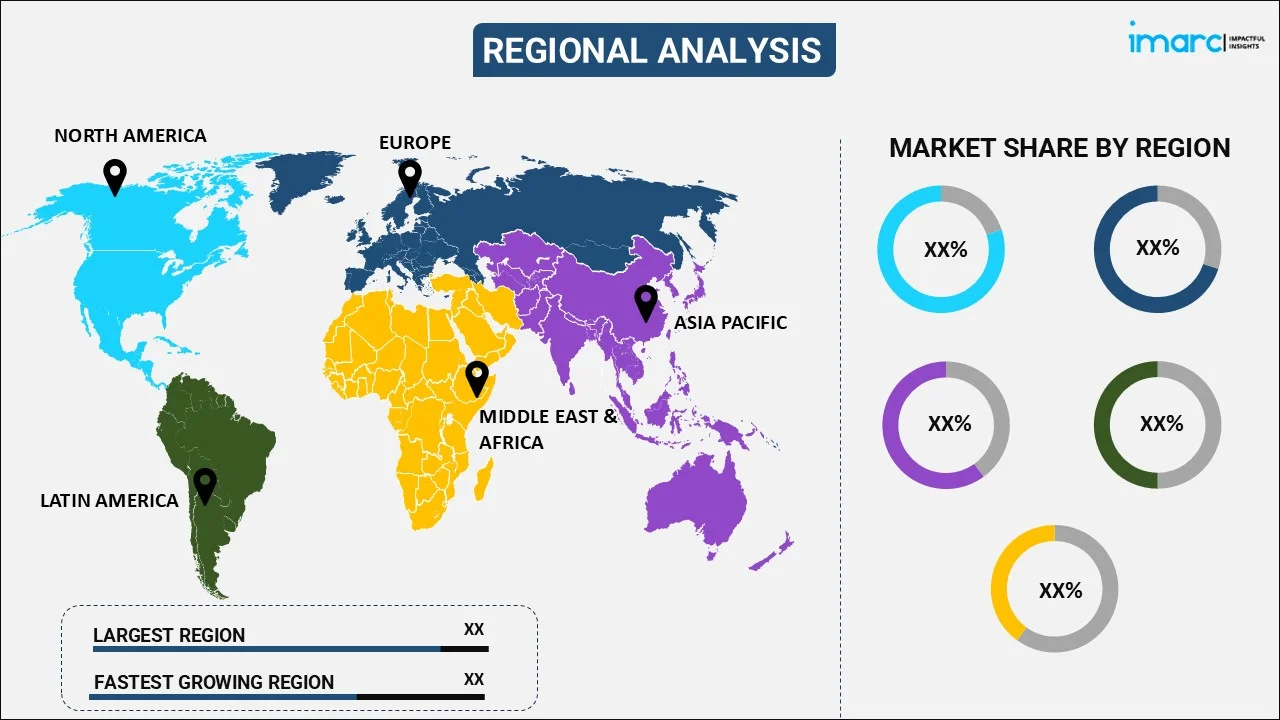
To get more information on the regional analysis of this market Request Sample
- North America
- United States
- Canada
- Asia Pacific
- China
- India
- Japan
- South Korea
- Australia
- Indonesia
- Others
- Europe
- United Kingdom
- Germany
- France
- Italy
- Spain
- Russia
- Others
- Latin America
- Brazil
- Mexico
- Others
- Middle East and Africa
- Turkey
- Saudi Arabia
- Others
North America, accounting for 42.9% of the share, maintaining the leading position in the market. The dominance of the region can be attributed to the presence of an advanced digital payments system, high smartphone penetration, and an established culture of using gift cards. The United States is considered the main driver of growth in the region, with digital gift cards widely available across prominent retail outlets, e-commerce websites, and corporate incentive schemes. The increase in the use of mobile wallets and contactless payment technologies has helped to further ease the purchase of digital gift cards, thereby improving the overall consumer experience. Corporate incentive schemes form an essential part of the demand scenario, as companies across different industries increasingly use digital gift cards as part of employee recognition, sales force motivation, and customer retention strategies. The region is further helped by the constant innovation in digital gift card platforms, including advanced personalization, real-time delivery, and integration with prominent social media and messaging platforms.
Key Regional Takeaways:
United States Digital Gift Card Market Analysis
The United States represents a critical market for digital gift cards, driven by the country's advanced digital infrastructure and strong consumer affinity toward cashless gifting solutions. The widespread penetration of e-commerce platforms, mobile applications, and digital payment systems has created a highly favorable environment for digital gift card adoption across retail and corporate segments. Consumers in the United States increasingly prefer digital gift cards for their convenience, instant delivery, and flexibility, using them for holidays, birthdays, and other personal occasions. The corporate sector also contributes substantially, as businesses utilize digital gift cards for employee recognition programs, customer acquisition campaigns, and promotional incentives. The growing prevalence of subscription services and digital entertainment platforms has broadened the variety of digital gift cards available, appealing to diverse consumer interests. Self-use purchases remain a significant trend, with consumers leveraging promotional offers and loyalty rewards associated with digital gift cards. Continuous innovation in personalization, mobile wallet integration, and omnichannel redemption capabilities further strengthens the market position of the United States in the global landscape.
Europe Digital Gift Card Market Analysis
Europe represents a significant and growing market for digital gift cards, supported by the region's expanding digital payments infrastructure and increasing consumer preference for cashless transactions. Countries such as the United Kingdom, Germany, and France are leading the adoption of digital gift cards, driven by robust e-commerce growth and the presence of established retail chains offering branded digital gifting solutions. The European market benefits from supportive regulatory frameworks promoting digital payment innovations and consumer protection standards that enhance trust in online transactions. Corporate demand is rising as organizations across the region adopt digital gift cards for employee engagement, performance incentives, and business-to-business gifting purposes. The growing emphasis on sustainability is also encouraging the shift from physical to digital gift cards, as consumers and businesses seek environmentally responsible gifting alternatives. Additionally, the integration of digital gift cards with popular European mobile payment platforms and banking applications is improving accessibility, driving adoption among a broader demographic base and supporting steady market expansion across the region.
Asia Pacific Digital Gift Card Market Analysis
Asia Pacific is emerging as a rapidly growing market for digital gift cards, fueled by the region's expanding internet connectivity, rising smartphone adoption, and a large, digitally engaged consumer population. Countries including China, India, Japan, South Korea, and Australia are experiencing increasing demand for digital gift cards as e-commerce platforms proliferate and mobile payment ecosystems mature. According to reports, in 2025, super-apps such as WeChat, Grab, and Gojek integrated digital gift card services into their platforms, boosting accessibility and adoption among Asia Pacific consumers. The region's youthful demographic profile and growing disposable incomes are driving consumer spending on digital gifting across categories such as food and beverage, fashion, electronics, and entertainment. Corporate adoption is also accelerating, with businesses leveraging digital gift cards for employee rewards and customer loyalty programs. The digital gift card market trends in the region reflect increasing personalization, social commerce integration, and cross-border gifting capabilities that are broadening market participation.
Latin America Digital Gift Card Market Analysis
Latin America is witnessing growing adoption of digital gift cards as the region undergoes rapid digital transformation and expanding e-commerce activity. Brazil and Mexico serve as the primary markets, supported by increasing internet penetration and rising smartphone usage among consumers. The growing acceptance of digital payment methods and mobile wallets is facilitating the shift from traditional physical gift cards to digital alternatives. Retailers and food service chains are expanding their digital gift card offerings to capture the rising demand for convenient gifting solutions. Corporate adoption is also gaining momentum, with organizations utilizing digital gift cards for employee incentive and recognition purposes across various industries.
Middle East and Africa Digital Gift Card Market Analysis
The Middle East and Africa region is experiencing gradual growth in the digital gift card market, driven by improving digital infrastructure and increasing consumer interest in cashless payment solutions. Saudi Arabia and Turkey represent key markets, supported by government-led digital transformation initiatives and rising e-commerce adoption. The growing youth population and expanding middle class are contributing to increased demand for digital gifting options across retail and entertainment categories. Corporate sectors are also beginning to embrace digital gift cards as tools for employee engagement and customer loyalty programs. Ongoing investments in digital payment platforms and fintech innovation are expected to support continued market development.
Competitive Landscape:
The global digital gift card market is characterized by the presence of both established technology companies and specialized gift card platform providers, creating a dynamic and competitive environment. Major players are focused on expanding their product portfolios, enhancing platform capabilities, and strengthening distribution partnerships to capture a larger share of the growing market. Strategic initiatives such as platform upgrades, merchant network expansion, and the development of advanced personalization and analytics features are commonly observed among leading companies. The integration of digital gift cards with mobile wallets, loyalty programs, and social commerce platforms represents a key competitive strategy, as companies seek to enhance consumer engagement and streamline the redemption experience.
The report provides a comprehensive analysis of the competitive landscape in the digital gift card market with detailed profiles of all major companies, including:
- Amazon.com Inc.
- American Express Company
- Apple Inc.
- Blackhawk Network Holdings Inc.
- First Data Corporation
- Fiserv Inc.
- Givex Corporation
- InComm Inc.
- Paytronix Systems, Inc.
- Qwikcilver Solutions Pvt Ltd (Pine Labs)
Latest News and Developments:
- In December 2025, TikTok Shop launched U.S. digital gift cards ranging from $10 to $500 with personalized animated designs. This move enhances gifting convenience, boosts holiday sales, and positions TikTok to compete directly with Amazon and eBay while expanding its presence in luxury retail offerings.
- In September 2025, Redstone Consultants OÜ launched Cashivo, a secure digital gift card platform across Europe. The platform offers fast onboarding, real-time balance updates, cross-brand redemption, and EU-compliant security. Cashivo aims to simplify digital gifting while expanding partnerships and reward categories, targeting the growing demand for convenient, user-friendly digital gift solutions.
Digital Gift Card Market Report Scope:
| Report Features | Details |
|---|---|
| Base Year of the Analysis | 2025 |
| Historical Period | 2020-2025 |
| Forecast Period | 2026-2034 |
| Units | Billion USD |
| Scope of the Report |
Exploration of Historical Trends and Market Outlook, Industry Catalysts and Challenges, Segment-Wise Historical and Future Market Assessment:
|
| Card Types Covered | Open Loop Gift Card, Closed Loop Gift Card |
| Business Types Covered | Business to Business (B2B), Business to Consumer (B2C) |
| Applications Covered | Food and Beverage, Health, Wellness and Beauty, Apparel, Footwear and Accessories, Books and Media Products, Consumer Electronics, Restaurants and Bars, Kids Products, Others |
| End Users Covered |
|
| Region Covered | North America, Asia Pacific, Europe, Latin America, Middle East and Africa |
| Countries Covered | United States, Canada, China, India, Japan, South Korea, Australia, Indonesia, United Kingdom, Germany, France, Italy, Spain, Russia, Brazil, Mexico, Turkey, Saudi Arabia |
| Companies Covered | Amazon.com Inc., American Express Company, Apple Inc., Blackhawk Network Holdings Inc., First Data Corporation, Fiserv Inc., Givex Corporation, InComm Inc., Paytronix Systems, Inc., Qwikcilver Solutions Pvt Ltd (Pine Labs), etc. |
| Customization Scope | 10% Free Customization |
| Post-Sale Analyst Support | 10-12 Weeks |
| Delivery Format | PDF and Excel through Email (We can also provide the editable version of the report in PPT/Word format on special request) |
Key Benefits for Stakeholders:
- IMARC’s report offers a comprehensive quantitative analysis of various market segments, historical and current market trends, market forecasts, and dynamics of the digital gift card market from 2020-2034.
- The research study provides the latest information on the market drivers, challenges, and opportunities in the global digital gift card market.
- The study maps the leading, as well as the fastest-growing, regional markets. It further enables stakeholders to identify the key country-level markets within each region.
- Porter's Five Forces analysis assists stakeholders in assessing the impact of new entrants, competitive rivalry, supplier power, buyer power, and the threat of substitution. It helps stakeholders to analyze the level of competition within the digital gift card industry and its attractiveness.
- Competitive landscape allows stakeholders to understand their competitive environment and provides an insight into the current positions of key players in the market.
Frequently Asked Questions About the Digital Gift Card Market Report
The digital gift card market was valued at USD 513.79 Billion in 2025.
The digital gift card market is projected to exhibit a CAGR of 12.79% during 2026-2034, reaching a value of USD 1,727.34 Billion by 2034.
The digital gift card market is primarily driven by the growing adoption of digital payment technologies, rising e-commerce penetration, increasing smartphone usage, and expanding corporate incentive programs. Additionally, the shift toward personalized and instant gifting solutions, integration with mobile wallets, and the growing consumer preference for cashless transactions are supporting sustained market expansion across global regions.
North America currently dominates the digital gift card market, accounting for a share of 42.9%. The region benefits from advanced digital infrastructure, widespread e-commerce adoption, a strong corporate gifting culture, and the presence of major technology and retail companies driving innovation.
Some of the major players in the digital gift card market include Amazon.com Inc., American Express Company, Apple Inc., Blackhawk Network Holdings Inc., First Data Corporation, Fiserv Inc., Givex Corporation, InComm Inc., Paytronix Systems, Inc., Qwikcilver Solutions Pvt Ltd (Pine Labs), etc.
Need more help?
- Speak to our experienced analysts for insights on the current market scenarios.
- Include additional segments and countries to customize the report as per your requirement.
- Gain an unparalleled competitive advantage in your domain by understanding how to utilize the report and positively impacting your operations and revenue.
- For further assistance, please connect with our analysts.
 Request Customization
 Speak to an Analyst
 Request Brochure
 Inquire Before Buying
Benefits of Customization
- Personalize this research
- Triangulate with your data
- Get data as per your format and definition
- Gain a deeper dive into a specific application, geography, customer, or competitor
- Any level of personalization
Get in Touch With Us
UNITED STATES
Phone: +1-201-971-6302
INDIA
Phone: +91-120-433-0800
UNITED KINGDOM
Phone: +44-753-714-6104
Email: [email protected]
Client Testimonials




.webp)




.webp)













Related Reports

Choose your plan
*Please note that the prices mentioned below are starting prices for each bundle type. Kindly contact our team for further details.*
Single User License
- 1 User License, Access on 2 Devices
- PDF Report + Excel Dataset (Password Protected)
- Lifetime Access
- No Printing Rights
- 10% Free Report Customization
- 10–12 Weeks of Analyst Support
Five User License
- Access for 5 Users, 2 Devices per User
- PDF Report + Excel Dataset (Password Protected)
- Lifetime Access
- Dedicated Account Manager
- 12–14 Weeks of Analyst Support
- No Printing Rights
- 15% Free Report Customization
- 25% Discount on Your Next Purchase
Corporate User License
- Unlimited User Access (Within Your Organization)
- PDF Report + Excel Dataset
- Lifetime Access
- Dedicated Account Manager
- 14–20 Weeks of Analyst Support
- No Printing Rights
- 20% Free Report Customization
- 30% Discount on Your Next Purchase
Essential Insights
What's included:
3 reports
- Lifetime Access
- PDF Reports
- Excel Datasets
- 2 Weeks of Free Analyst Support
- 2 User Licenses
- Access on 2 Devices
- Printing Rights
- Complimentary PowerPoint (PPT) Version
- Complimentary License Upgrade
Professional Access
What's included:
5 reports
- Lifetime Access
- PDF Reports
- Excel Datasets
- 8 Weeks of Free Analyst Support
- 2 User Licenses
- Access on 2 Devices
- Printing Rights
- Complimentary PowerPoint (PPT) Version
- Complimentary License Upgrade
Business Advantage
What's included:
8 reports
- Lifetime Access
- PDF Reports
- Excel Datasets
- 14 Weeks of Free Analyst Support
- 2 User Licenses
- Access on 2 Devices
- Printing Rights
- Complimentary PowerPoint (PPT) Version
- Complimentary License Upgrade
Enterprise Intelligence
What's included:
10 reports
- Lifetime Access
- PDF Reports
- Excel Datasets
- 20 Weeks of Free Analyst Support
- 2 User Licenses
- Access on 2 Devices
- Printing Rights
- Complimentary PowerPoint (PPT) Version
- Complimentary License Upgrade