
Europe Frozen Pizza Market Size, Share, Trends and Forecast by Crust Type, Size, Product Type, Topping, Distribution, and Country, 2026-2034
Europe Frozen Pizza Market Size, Share, Trends & Forecast (2026-2034)
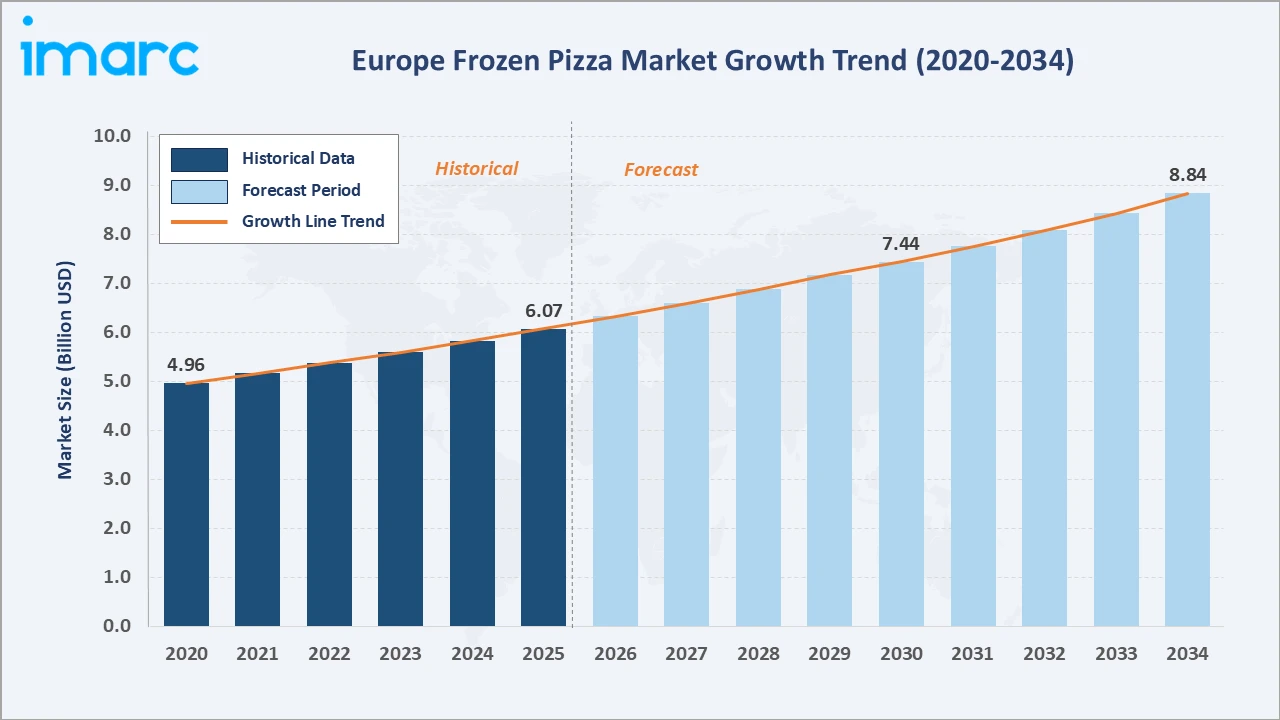
The Europe frozen pizza market reached USD 6.07 Billion in 2025 and is projected to reach USD 8.84 Billion by 2034, growing at a CAGR of 4.14% during 2026-2034. Growth is driven by rising demand for convenient, ready-to-bake meal formats, expanding discounter and retail freezer space, and continuous product innovation across crust types and toppings. Thin crust pizzas lead the crust-type segment at 48.6% in 2025, while medium-sized pizzas dominate the size category at 54.7%. Germany leads the regional landscape with a 27.6% share, supported by Europe's largest discount retail network and a well-established domestic manufacturing base.
Market Snapshot
|
Metric |
Value |
|
Market Size (2025) |
USD 6.07 Billion |
|
Forecast Market Size (2034) |
USD 8.84 Billion |
|
CAGR (2026-2034) |
4.14% |
|
Base Year |
2025 |
|
Historical Period |
2020-2025 |
|
Forecast Period |
2026-2034 |
|
Dominant Crust Type |
Thin Crust (48.6%, 2025) |
|
Dominant Size Category |
Medium (54.7%, 2025) |
|
Leading Country |
Germany (27.6%, 2025) |
Europe frozen pizza market expanded from USD 4.96 Billion in 2020 to USD 6.07 Billion in 2025, anchored at USD 7.44 Billion in 2030, and forecast to reach USD 8.84 Billion by 2034, supported by rising convenience food consumption, retail freezer expansion, and continuous crust and topping innovation across the region.
To get more information on this market, Request Sample
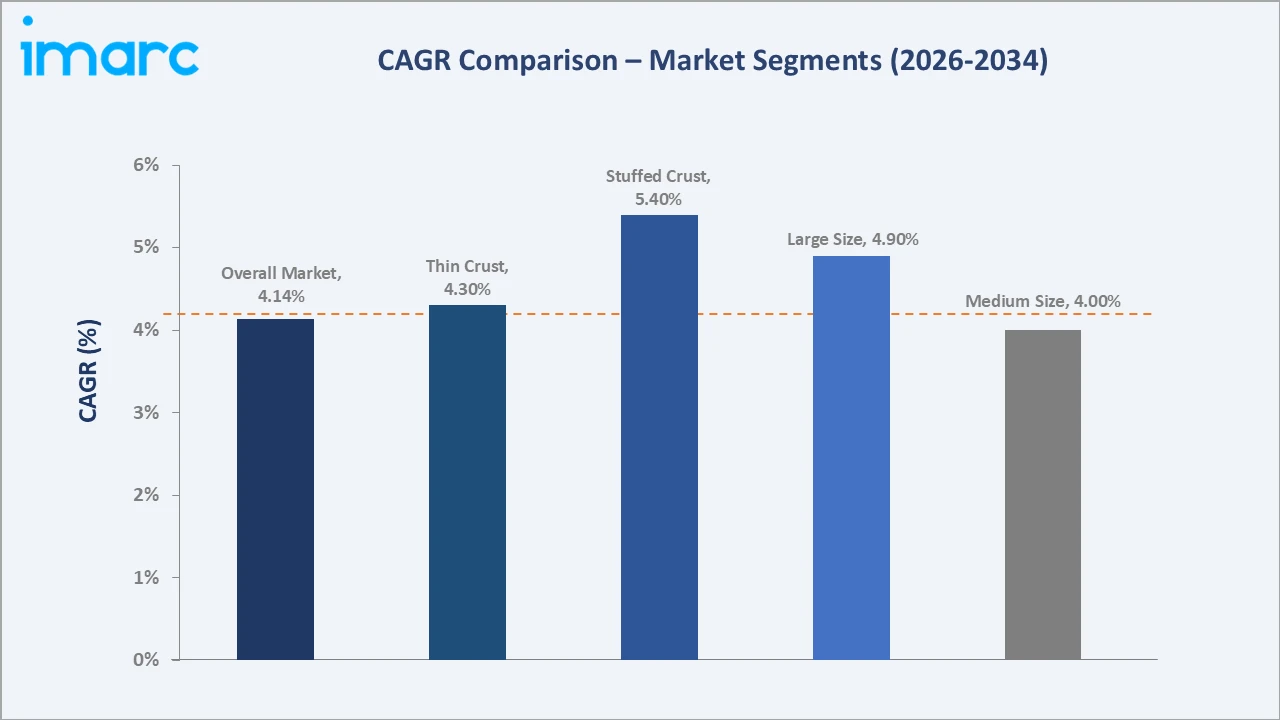
Stuffed crust pizzas grow fastest at an estimated 5.4% CAGR through premiumisation and family-sharing formats gaining shelf space across supermarkets and discounters. Large-sized pizzas expand at roughly 4.9% CAGR as multi-person households increasingly favour value-oriented sharing packs over single-serve portions.
Executive Summary
Europe frozen pizza market reached USD 6.07 Billion in 2025, driven by rising demand for convenient meal solutions, expanding discounter and supermarket freezer assortments, and continuous innovation in crust formats and topping combinations. Households across the region increasingly favour ready-to-bake pizza as a time-saving alternative to fresh cooking, while retailers are broadening private-label ranges to capture value-conscious shoppers. Manufacturers are investing in cold-chain capacity, sustainable packaging, and clean-label recipes to strengthen category appeal. The market is projected to reach USD 8.84 Billion by 2034.
Thin crust pizzas lead the crust-type segment at 48.6% in 2025, reflecting consumer preference for lighter, crisper textures and shorter bake times. Medium-sized pizzas dominate at 54.7%, balancing portion economics with typical household consumption patterns. Germany leads regionally at 27.6%, supported by Europe's largest retail grocery sector and a well-established base of domestic frozen food manufacturers.
Continued investment in automated production lines, sustainable packaging, and premium ingredient sourcing is expected to support steady category expansion through 2034, even as input cost volatility and competition from chilled alternatives create ongoing margin pressure for manufacturers.
Key Market Insights
|
Insight |
Data |
|
Dominant Crust Type |
Thin Crust - 48.6% share (2025) |
|
Dominant Size Category |
Medium - 54.7% share (2025) |
|
Leading Country |
Germany - 27.6% share (2025) |
|
Market Opportunity |
Clean-label recipe reformulation; plant-based topping expansion; premium artisan-style crusts; sustainable mono-material packaging; private-label range extension |
Key Analytical Observations Supporting The Above Data:
- Thin Crust at 48.6%: The thin crust segment is dominant due to rising consumer preference for lighter, crisper textures and shorter bake times, supported by continuous crust-recipe innovation from leading manufacturers such as Dr. Oetker and Nestlé's Wagner brand.
- Medium at 54.7%: Medium-sized pizzas balance value and portion size for typical 2-3 person European households, while large-format pizzas gain share among family-sharing occasions.
- Germany at 27.6%: Germany is Europe's largest frozen pizza market, underpinned by extensive discounter networks such as Lidl and Aldi and a strong domestic manufacturing base including Dr. Oetker's long-standing pizza production operations.
- United Kingdom at 19.1%: The UK is the second-largest market, driven by high private-label penetration and rising demand for premium, restaurant-style frozen pizza ranges.
- Private-label expansion: Retailers such as Lidl and Conad are expanding own-brand frozen pizza ranges, intensifying price competition against branded manufacturers across the region.
- Sustainability momentum: Packaging redesign toward recyclable and mono-material formats is becoming a competitive differentiator amid EU-level food labelling and sustainability scrutiny under the Farm to Fork Strategy.
Europe Frozen Pizza Market Overview
Europe frozen pizza market operates within the broader European frozen food industry as one of its most commercially mature categories, reflecting decades of retail freezer infrastructure development, high household penetration of home freezer storage, and a deeply embedded pizza consumption culture across Germany, Italy, France, and the United Kingdom.
The regional ecosystem integrates ingredient suppliers, dough and topping manufacturers, cold-chain logistics providers, and a retail network spanning hypermarkets, discounters, and online grocery platforms. Macroeconomic factors shaping the industry include input cost inflation for wheat and dairy, expanding e-commerce grocery penetration, and evolving EU food labelling requirements under the Farm to Fork Strategy that increasingly influence packaging and ingredient disclosure practices.
Market Dynamics
To evaluate market opportunities, Request Sample
Market Drivers
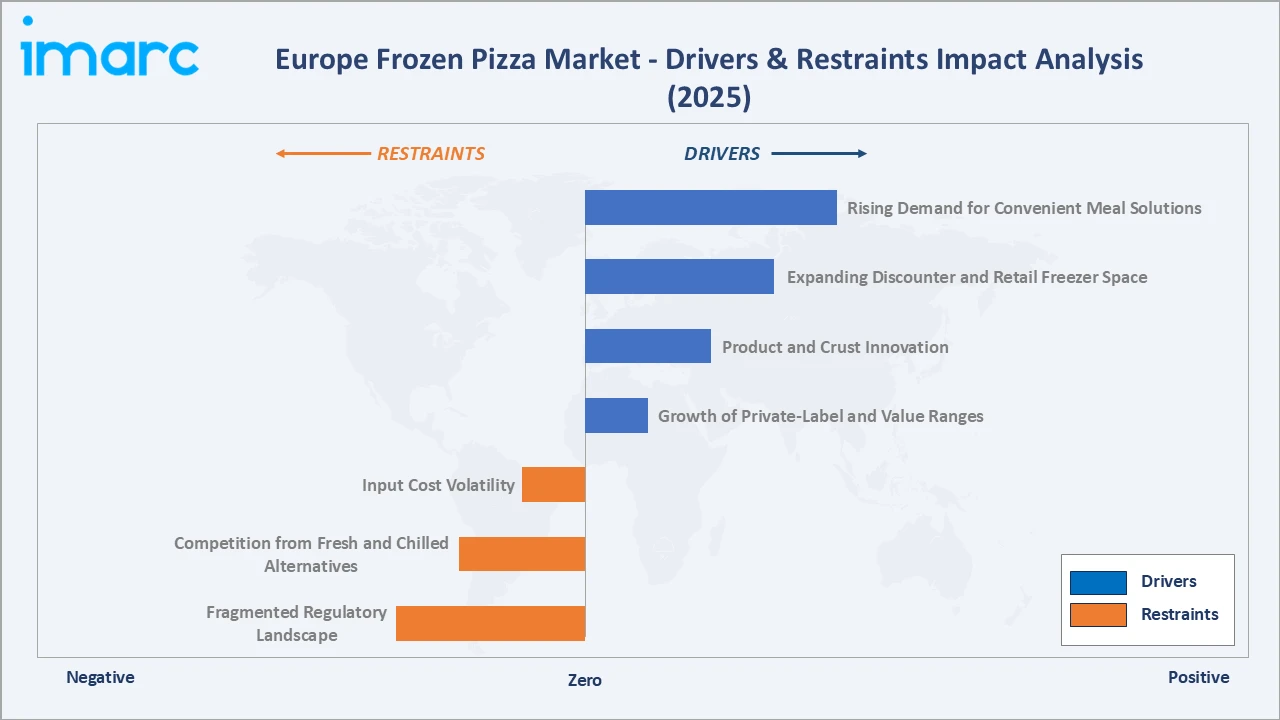
- Rising Demand for Convenient Meal Solutions: Increasingly time-constrained European households are shifting toward ready-to-bake meal formats that require minimal preparation. This is pushing manufacturers to expand crust variety, portion formats, and air-fryer-compatible packaging to match evolving cooking habits. Growing dual-income households and smaller family sizes are reinforcing frozen pizza's role as a practical weekday meal solution across urban Europe.
- Expanding Discounter and Retail Freezer Space: Discount retail chains such as Lidl and Aldi continue to expand frozen food aisle space across Western and Eastern Europe, improving frozen pizza's shelf visibility and availability. This retail expansion is supporting category volume growth, particularly in price-sensitive markets where discounters have historically underrepresented premium frozen categories.
- Product and Crust Innovation: Manufacturers are continuously diversifying crust formats, toppings, and portion sizes to sustain consumer interest. In March 2025, Dr. Oetker launched La Mia Familia, a range of 19 filled, pre-portioned pizza bites, across Germany, the Netherlands, and Spain. Such innovation supports premiumisation and repeat purchase across the category.
- Growth of Private-Label and Value Ranges: Retailers including Lidl and Conad are expanding own-brand frozen pizza assortments to capture value-conscious shoppers, intensifying competitive pressure on branded manufacturers while broadening overall category accessibility across income segments.
Market Restraints
- Input Cost Volatility: Fluctuations in wheat, dairy, and edible oil prices continue to pressure manufacturer margins, occasionally translating into retail price increases that can dampen volume growth among price-sensitive consumers.
- Competition from Fresh and Chilled Alternatives: Growing consumer interest in fresh, restaurant-quality, and chilled pizza formats is creating competitive pressure on the frozen category, particularly among younger, health-conscious urban consumers.
Market Opportunities
- Clean-Label and Plant-Based Reformulation: Rising consumer demand for recognisable ingredients and plant-based toppings creates opportunities for manufacturers to reformulate recipes and capture health-conscious and flexitarian consumer segments.
- Sustainable Packaging Innovation: EU-level sustainability scrutiny under the Farm to Fork Strategy is encouraging investment in recyclable and mono-material packaging, creating differentiation opportunities for manufacturers that move early on sustainable formats.
Market Challenges
- Fragmented Regulatory Landscape: Evolving EU food information rules under Regulation (EU) No 1169/2011, alongside national-level origin labelling requirements in markets such as France and Italy, require manufacturers to navigate country-specific compliance obligations across their European operations.
- Rising Competition from Private Label: Intensifying private-label competition is compressing margins for branded manufacturers, requiring sustained investment in innovation and marketing to defend shelf space and brand loyalty.
Emerging Market Trends
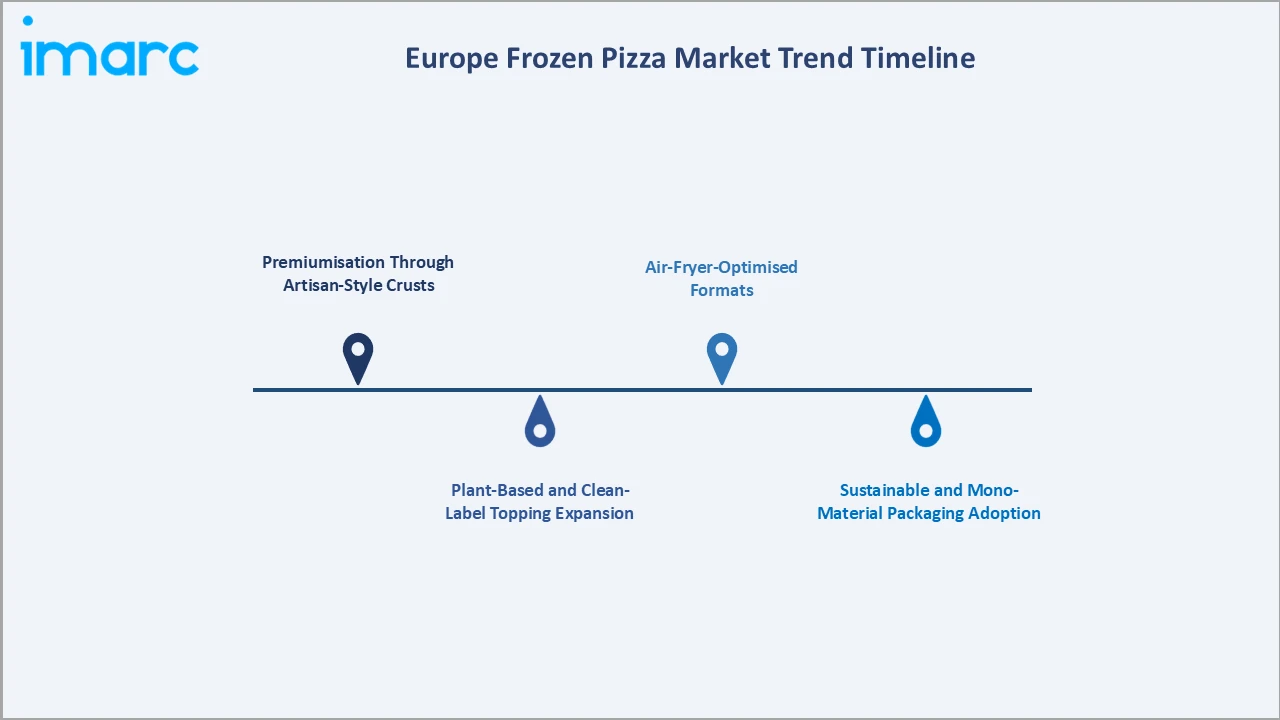
1. Premiumisation Through Artisan-Style Crusts
Manufacturers are introducing stone-baked and artisan-style crust variants to command premium price points and differentiate from value ranges. Dr. Oetker's Ristorante brand marked its 40th anniversary in 2025, underscoring the enduring commercial relevance of premium positioning within the frozen pizza category.
2. Plant-Based and Clean-Label Topping Expansion
Growing flexitarian consumer bases are driving demand for plant-based cheese and meat-alternative toppings alongside recognisable, minimally processed ingredient lists, prompting manufacturers to reformulate core recipes across their portfolios.
3. Air-Fryer-Optimised Formats
Rising household adoption of air fryers is prompting manufacturers to redesign packaging and cooking instructions for air-fryer compatibility, shortening preparation time and appealing to convenience-focused younger consumers.
4. Sustainable and Mono-Material Packaging Adoption
Manufacturers are transitioning toward recyclable, mono-material packaging formats in response to EU sustainability expectations under the Farm to Fork Strategy, strengthening brand positioning among environmentally conscious shoppers.
Industry Value Chain Analysis
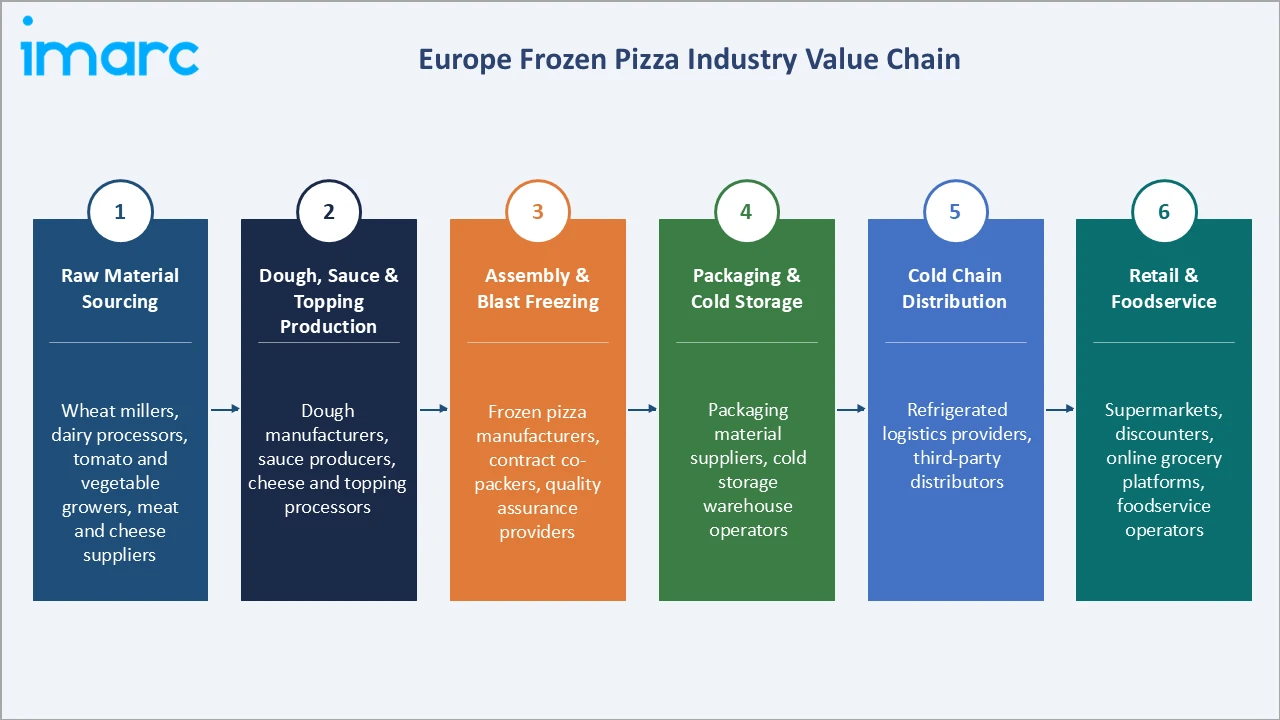
Europe frozen pizza value chain integrates agricultural raw material sourcing, dough and topping production, assembly and blast freezing, packaging, cold-chain distribution, and retail and foodservice delivery to end consumers.
|
Stage |
Key Participants |
|
Raw Material Sourcing |
Wheat millers, dairy processors, tomato and vegetable growers, meat and cheese suppliers |
|
Dough, Sauce & Topping Production |
Dough manufacturers, sauce producers, cheese and topping processors |
|
Assembly & Blast Freezing |
Frozen pizza manufacturers, contract co-packers, quality assurance providers |
|
Packaging & Cold Storage |
Packaging material suppliers, cold storage warehouse operators |
|
Cold Chain Distribution |
Refrigerated logistics providers, third-party distributors |
|
Retail & Foodservice |
Supermarkets, discounters, online grocery platforms, foodservice operators |
Assembly and blast freezing represent the most value-added stage in the Europe frozen pizza value chain, as manufacturers rely on precise temperature control, automated topping application, and quality assurance systems to preserve texture and taste consistency across large production volumes.
Technology Landscape in the Europe Frozen Pizza Industry
Automated Production and Topping Application
Manufacturers are increasingly deploying robotic topping-application systems and automated dough-forming lines to improve production consistency and throughput. These technologies reduce labour dependency while maintaining precise portion control across high-volume manufacturing facilities.
Advanced Freezing Technology
Individual quick freezing (IQF) and cryogenic freezing methods are being adopted to better preserve topping texture and moisture content, extending shelf life while minimising ice crystal formation that can affect eating quality after reheating.
Sustainable Packaging Innovation
Recyclable board, mono-material films, and reduced-plastic packaging formats are gaining adoption as manufacturers respond to EU sustainability expectations and evolving national packaging waste regulations.
Cold Chain Digitalisation
Real-time temperature monitoring and IoT-enabled logistics tracking are improving cold-chain reliability, reducing spoilage risk, and supporting compliance with food safety traceability requirements across multi-country distribution networks.
Market Segmentation Analysis
The report covers the following segments:
|
Segment Category |
Leading Segment |
Market Share |
Year |
|
Crust Type |
Thin Crust |
48.6% |
2025 |
|
Size |
Medium |
54.7% |
2025 |
|
Product Type |
Regular Frozen Pizza |
67.8% |
2025 |
|
Topping |
Fruits and Vegetables |
🔒 |
2025 |
|
Distribution |
Food Chain Services |
🔒 |
2025 |
|
Country |
Germany |
27.6% |
2025 |

By Crust Type
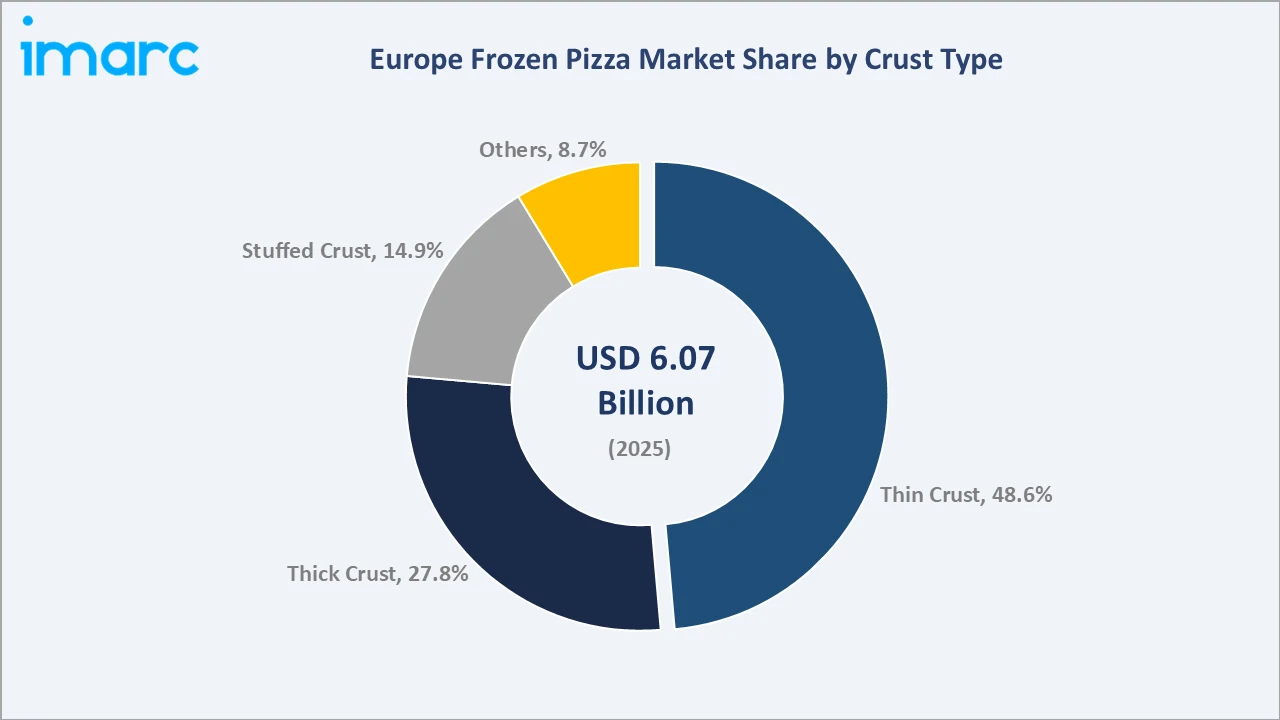
Thin crust leads at 48.6% (2025). Thin crust pizzas dominate due to consumer preference for lighter, crisper textures, shorter bake times, and their versatility across air-fryer and conventional oven preparation methods.
To access detailed market analysis, Request Sample
Stuffed crust, with 14.9% market share, grows fastest at an estimated ~5.4% CAGR through premiumisation and family-sharing pack innovation, as manufacturers expand cheese-filled crust variants to capture indulgence-driven purchase occasions. Thick crust and others hold 27.8% and 8.7% of market share, respectively.
By Size
Medium leads at 54.7% (2025). Medium-sized pizzas balance portion economics with typical 2-3 person European household consumption patterns, representing the category's core value proposition.
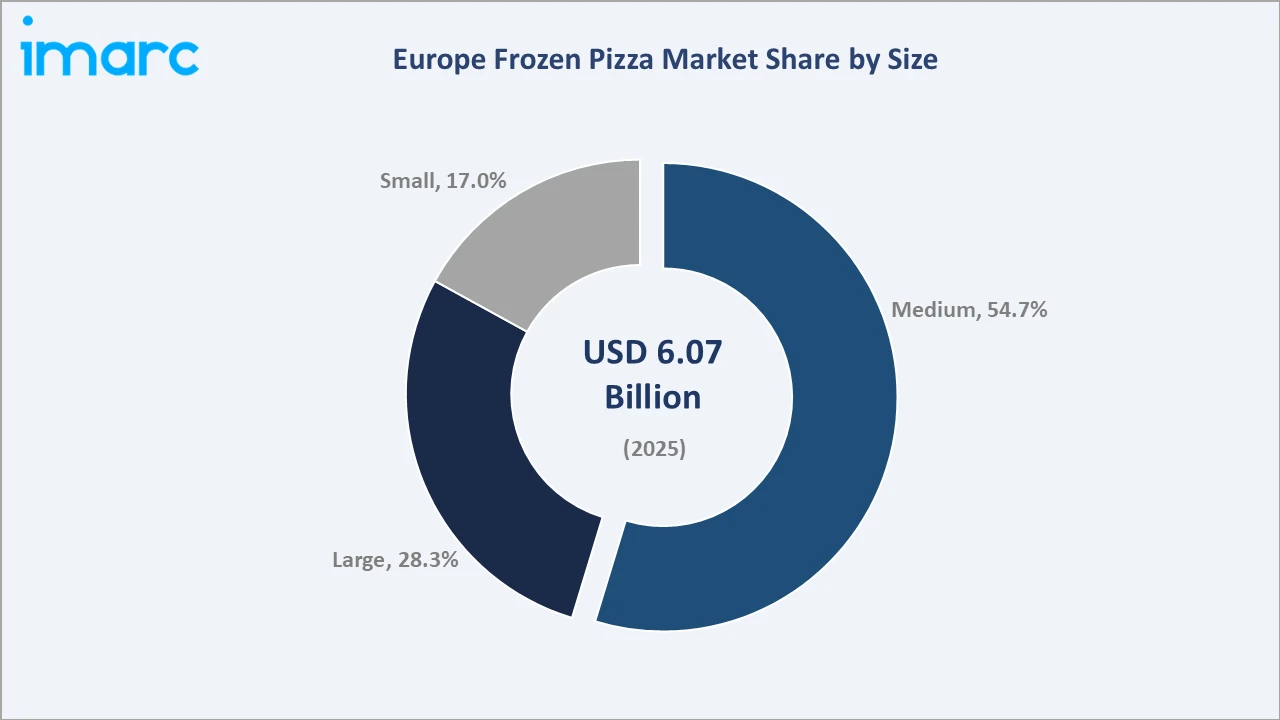
Large-sized pizzas, with 28.3% market share, grow fastest at an estimated ~4.9% CAGR as family-sharing occasions and value-per-serving positioning gain traction among multi-person households. Small-sized frozen pizzas hold 17.0% market share in Europe.
Regional Market Insights
|
Country |
Share (2025) |
Key Europe Frozen Pizza Market Drivers & Characteristics |
|
Germany |
27.6% |
Driven by Europe's largest discounter network, a mature domestic manufacturing base including Dr. Oetker's long-standing pizza operations, and high per-capita frozen food consumption. |
|
United Kingdom |
19.1% |
Benefits from high private-label penetration, strong retail freezer infrastructure, and growing demand for premium, restaurant-style frozen pizza ranges. |
|
France |
16.8% |
Supported by a strong retail hypermarket sector and rising demand for artisan-style and clean-label frozen pizza formats. |
|
Italy |
13.9% |
Anchored by deep cultural affinity for pizza and a strong domestic manufacturing and ingredient supply base for tomato, cheese, and cured meat toppings. |
|
Spain |
10.7% |
Fueled by expanding modern retail infrastructure, rising convenience food adoption, and growing demand for value-oriented frozen pizza ranges. |
|
Others |
11.9% |
The remaining share comprises countries such as the Netherlands, Belgium, Poland, Switzerland, and other European nations, where rising urbanisation and retail modernisation continue to support frozen pizza demand. |
Germany's 27.6% market leadership reflects Europe's largest discount retail network and a deep-rooted domestic manufacturing base. The UK's 19.1% share reflects strong private-label development and premiumisation among urban consumers. France's 16.8% reflects hypermarket-led retail distribution and rising demand for clean-label recipes.
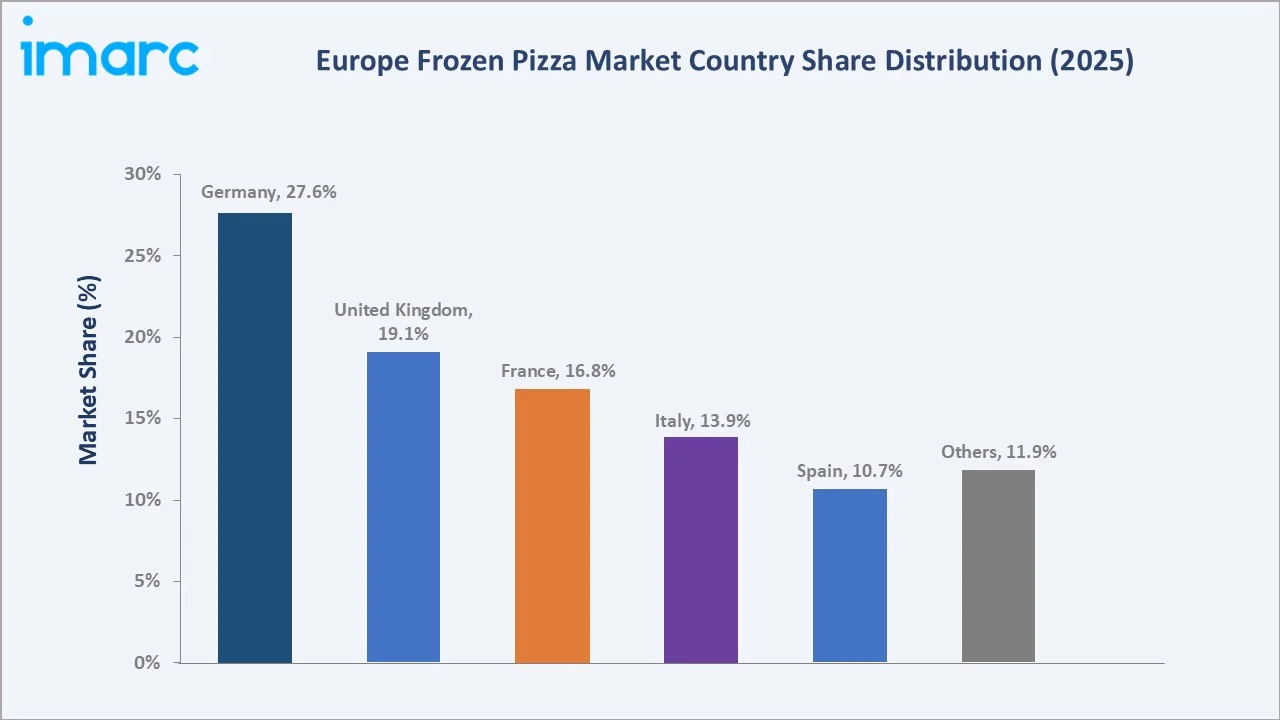
Italy's 13.9% reflects strong cultural affinity for pizza alongside a robust domestic ingredient supply base. Spain's 10.7% reflects expanding modern retail infrastructure and rising convenience food adoption. Others at 11.9% encompasses the Netherlands' retail modernisation, Poland's expanding cold-chain infrastructure, and the Nordics' growing frozen food consumption culture.
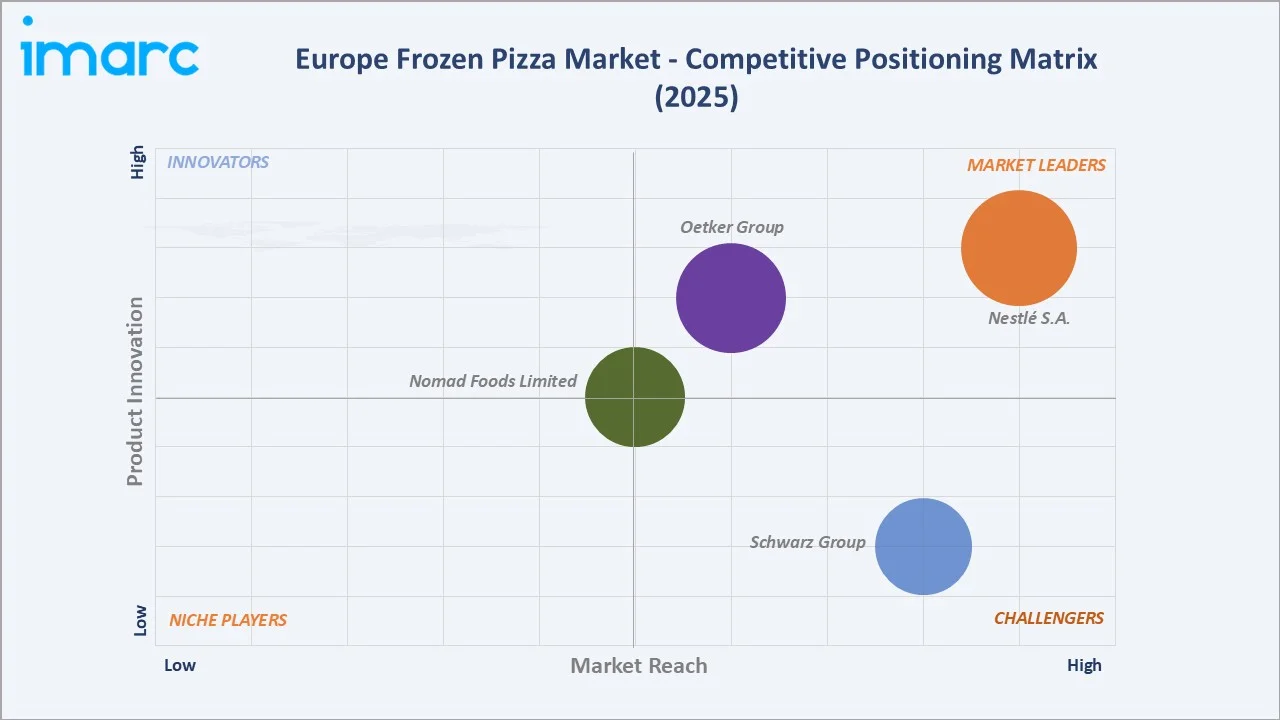
Competitive Landscape
Europe frozen pizza competitive landscape is moderately consolidated, stratified between global food conglomerates, regional specialists, and expanding private-label retail brands.
|
Company |
Brand Name |
Market Position |
Core Strength |
|
Nestlé S.A. |
Wagner, Buitoni, Garden Gourmet |
Market Leader |
Nestlé's European pizza business, operated through its joint venture with PAI Partners since 2023, combines the Wagner and Buitoni brands with two dedicated manufacturing facilities in Germany and Italy. |
|
Oetker Group |
Dr. Oetker’s Ristorante, Die Ofenfrische, La Mia Grande |
Market Leader |
Operates the flagship food brand Dr. Oetker, anchors the company's leadership through continuous crust innovation and significant international pizza capacity investment. |
|
Nomad Foods Limited |
Goodfella's, San Marco |
Established Player |
Nomad Foods operates prominent brands across several European markets, leveraging an established frozen food distribution network. |
|
Schwarz Group |
Trattoria Alfredo, Italiamo |
Strong Challenger |
Operates Lidl Stiftung & Co. KG, Lidl's expanding private-label frozen pizza range leverages its extensive European discounter footprint to compete on price and accessibility. |
The competitive landscape is being reshaped by premiumisation and private-label expansion. Branded manufacturers are increasingly differentiating through crust innovation, clean-label reformulation, and sustainable packaging, while discounter private-label ranges continue to expand category accessibility across price-sensitive consumer segments.
Key Company Profiles
Nestlé S.A.
Nestlé is a leading player in the Europe frozen pizza market, operating its regional pizza business through a joint venture with private equity firm PAI Partners established in 2023. The business distributes pizzas under the Wagner, Buitoni, and Garden Gourmet brands across Germany, Italy, France, Spain, Switzerland, Portugal, Austria, Belgium, and the Netherlands.
- Key Brands: Wagner, Buitoni, Garden Gourmet
- Strategic Focus: Strengthening its European pizza portfolio through dedicated joint-venture management focused on category-specific growth and innovation.
Oetker Group
Oetker Group, through its food division-Dr. August Oetker Nahrungsmittel KG, owns Dr. Oetker, which is one of Europe's leading frozen pizza manufacturers, anchored by its Ristorante brand. It marked its 40th anniversary in 2025 as one of the best-known names in the category.
- Key Brands: Dr. Oetker’s Ristorante, Die Ofenfrische, La Mia Grande
- Strategic Focus: Expanding pizza production capacity and continuing crust and format innovation to defend category leadership.
Market Concentration Analysis
Europe frozen pizza market is moderately concentrated, with the leading three to four manufacturers collectively accounting for a substantial share of branded volume, while private-label ranges from discounters such as Lidl and Conad continue to expand their combined category share. Consolidation activity, including Nestlé's 2023 joint venture with PAI Partners, reflects an ongoing trend toward dedicated category-focused operating structures rather than outright market exit, sustaining a moderately fragmented competitive base across branded and private-label segments.
Investment & Growth Opportunities
Highest Growth Segments
Stuffed crust pizzas (~5.4% estimated CAGR), large sharing packs (~4.9% CAGR), and fruit and vegetables topping variants represent the Europe frozen pizza market's highest-growth investment vectors through 2034, supported by premiumisation and flexitarian dietary trends.
Investment Themes
Sustainable packaging investment represents a key opportunity as EU-level sustainability expectations under the Farm to Fork Strategy increasingly influence retailer sourcing decisions. Manufacturers investing early in mono-material and recyclable packaging formats are positioned to capture preferential retail shelf placement.
Future Market Outlook (2026-2034)
Europe frozen pizza market is projected to grow from USD 6.07 Billion in 2025 to USD 8.84 Billion by 2034, delivering a 4.14% CAGR over the forecast period, supported by sustained convenience food demand, retail freezer expansion, and continuous crust and topping innovation. The market's anchor value of USD 7.44 Billion in 2030 represents a key milestone in the category's steady expansion trajectory.
Three structural forces are expected to define the market through 2034: premiumisation through artisan-style crust innovation, private-label expansion reshaping category accessibility, and sustainability-driven packaging transformation across manufacturer supply chains.
Research Methodology
Primary Research
Primary research comprised structured interviews with Europe frozen pizza market stakeholders, including manufacturers, retail category managers, cold-chain logistics providers, and ingredient suppliers, to validate demand trends and competitive positioning.
Secondary Research
Secondary research encompassed a review of company annual reports, investor presentations, regulatory publications from European food safety authorities, industry association data, and trade publications to validate market estimates and category trends.
Forecasting Models
Market revenue forecasts were developed using a retail category spending model, combining European household frozen food expenditure by country with retail freezer category penetration rates and an applied premiumisation adjustment factor.
Europe Frozen Pizza Market Report Coverage:
| Report Features | Details |
|---|---|
| Base Year of the Analysis | 2025 |
| Historical Period | 2020-2025 |
| Forecast Period | 2026-2034 |
| Units | Billion USD |
| Scope of the Report |
Exploration of Historical Trends and Market Outlook, Industry Catalysts and Challenges, Segment-Wise Historical and Future Market Assessment:
|
| Crust Types Covered | Thin Crust, Thick Crust, Stuffed Crust, Others |
| Sizes Covered | Small, Medium, Large |
| Product Types Covered | Regular Frozen Pizza, Premium Frozen Pizza, Gourmet Frozen Pizza |
| Toppings Covered | Cheese, Meat, Fruits and Vegetables, Others |
| Distributions Covered | Food Chain Services, Modern Trade, Departmental Stores, Online Stores, Others |
| Countries Covered | Germany, France, United Kingdom, Italy, Spain, Others |
| Companies Covered | Nestlé S.A., Oetker Group, Nomad Foods Limited, Schwarz Group, etc. |
| Customization Scope | 10% Free Customization |
| Post-Sale Analyst Support | 10-12 Weeks |
| Delivery Format | PDF and Excel through Email (We can also provide the editable version of the report in PPT/Word format on special request) |
Frequently Asked Questions About the Europe Frozen Pizza Market Report
The Europe frozen pizza market reached USD 6.07 Billion in 2025, driven by rising demand for convenient meal solutions, expanding discounter freezer space, and continuous crust and topping innovation across the region.
The Europe frozen pizza market grows at a 4.14% CAGR during 2026-2034, reaching USD 8.84 Billion by 2034, supported by premiumisation, private-label expansion, and sustained convenience food demand.
Thin crust leads at 48.6% in 2025 through consumer preference for lighter textures and shorter bake times, supported by continuous recipe innovation from leading manufacturers such as Dr. Oetker and Nestlé.
Medium-sized pizzas lead at 54.7% in 2025, balancing portion economics with typical European household consumption patterns, while large-format sharing packs represent the fastest-growing size category.
Germany leads at 27.6% through Europe's largest discounter network and a well-established domestic manufacturing base, including Dr. Oetker's long-standing production operations.
Leading companies include Nestlé S.A., Oetker Group, Nomad Foods Limited, and Schwarz Group, among others.
The Europe frozen pizza market is projected to reach approximately USD 7.44 Billion by 2030, supported by continued premiumisation, retail expansion, and sustainable packaging adoption.
Key opportunities include stuffed crust and premium format expansion, plant-based topping innovation, and sustainable mono-material packaging investment aligned with EU sustainability expectations.
Key trends include premiumisation through artisan-style crusts, plant-based topping expansion, air-fryer-optimised packaging formats, and growing adoption of sustainable, mono-material packaging.
Input cost volatility in wheat and dairy, alongside rising competition from fresh and chilled pizza alternatives, represent key restraints on Europe frozen pizza market growth.
Need more help?
- Speak to our experienced analysts for insights on the current market scenarios.
- Include additional segments and countries to customize the report as per your requirement.
- Gain an unparalleled competitive advantage in your domain by understanding how to utilize the report and positively impacting your operations and revenue.
- For further assistance, please connect with our analysts.
 Request Customization
 Speak to an Analyst
 Request Brochure
 Inquire Before Buying
Benefits of Customization
- Personalize this research
- Triangulate with your data
- Get data as per your format and definition
- Gain a deeper dive into a specific application, geography, customer, or competitor
- Any level of personalization
Get in Touch With Us
UNITED STATES
Phone: +1-201-971-6302
INDIA
Phone: +91-120-433-0800
UNITED KINGDOM
Phone: +44-753-714-6104
Email: [email protected]
Client Testimonials




.webp)




.webp)













Related Reports

Choose your plan
*Please note that the prices mentioned below are starting prices for each bundle type. Kindly contact our team for further details.*
Single User License
- 1 User License, Access on 2 Devices
- PDF Report + Excel Dataset (Password Protected)
- Lifetime Access
- No Printing Rights
- 10% Free Report Customization
- 10–12 Weeks of Analyst Support
Five User License
- Access for 5 Users, 2 Devices per User
- PDF Report + Excel Dataset (Password Protected)
- Lifetime Access
- Dedicated Account Manager
- 12–14 Weeks of Analyst Support
- No Printing Rights
- 15% Free Report Customization
- 25% Discount on Your Next Purchase
Corporate User License
- Unlimited User Access (Within Your Organization)
- PDF Report + Excel Dataset
- Lifetime Access
- Dedicated Account Manager
- 14–20 Weeks of Analyst Support
- No Printing Rights
- 20% Free Report Customization
- 30% Discount on Your Next Purchase
Essential Insights
What's included:
3 reports
- Lifetime Access
- PDF Reports
- Excel Datasets
- 2 Weeks of Free Analyst Support
- 2 User Licenses
- Access on 2 Devices
- Printing Rights
- Complimentary PowerPoint (PPT) Version
- Complimentary License Upgrade
Professional Access
What's included:
5 reports
- Lifetime Access
- PDF Reports
- Excel Datasets
- 8 Weeks of Free Analyst Support
- 2 User Licenses
- Access on 2 Devices
- Printing Rights
- Complimentary PowerPoint (PPT) Version
- Complimentary License Upgrade
Business Advantage
What's included:
8 reports
- Lifetime Access
- PDF Reports
- Excel Datasets
- 14 Weeks of Free Analyst Support
- 2 User Licenses
- Access on 2 Devices
- Printing Rights
- Complimentary PowerPoint (PPT) Version
- Complimentary License Upgrade
Enterprise Intelligence
What's included:
10 reports
- Lifetime Access
- PDF Reports
- Excel Datasets
- 20 Weeks of Free Analyst Support
- 2 User Licenses
- Access on 2 Devices
- Printing Rights
- Complimentary PowerPoint (PPT) Version
- Complimentary License Upgrade