
Europe Tuna Market Size, Share, Trends and Forecast by Species, Type, and Country, 2026-2034
Europe Tuna Market Size, Share, Trends & Forecast (2026-2034)
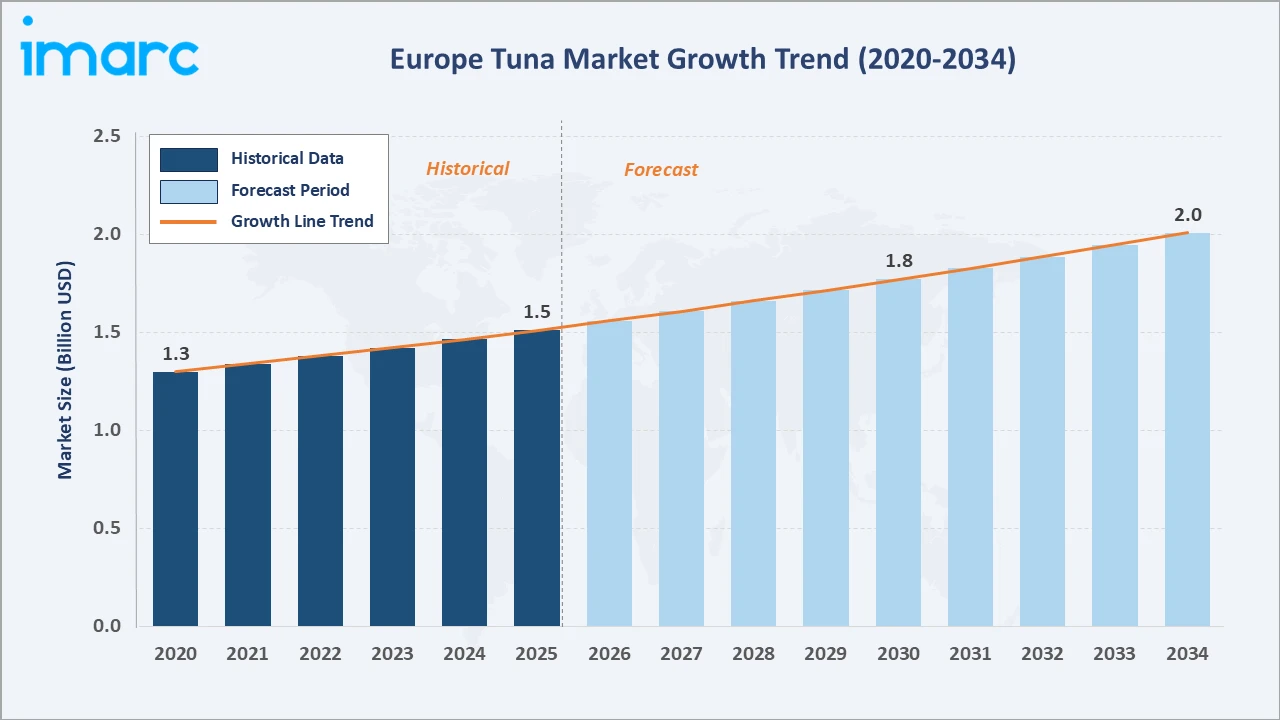
The Europe tuna market reached USD 1.51 Billion in 2025 and is projected to reach USD 2.01 Billion by 2034, growing at a CAGR of 3.18% during 2026-2034. Growth is driven by rising demand for protein-rich, convenient seafood, expanding retail penetration, and increasing sustainability and traceability certification across the supply chain. Skipjack leads the species segment at 43.6%, canned tuna dominates the type segment at 58.9%, and Spain leads the country segment at 24.8% of the Europe tuna market in 2025.
Market Snapshot
|
Metric |
Value |
|
Market Size (2025) |
USD 1.51 Billion |
|
Forecast Market Size (2034) |
USD 2.01 Billion |
|
CAGR (2026-2034) |
3.18% |
|
Base Year |
2025 |
|
Historical Period |
2020-2025 |
|
Forecast Period |
2026-2034 |
|
Dominant Species |
Skipjack (43.6%, 2025) |
|
Dominant Type |
Canned (58.9%, 2025) |
|
Leading Country |
Spain (24.8%, 2025) |
The Europe tuna market expanded from an estimated USD 1.30 Billion in 2020 to USD 1.51 Billion in 2025, and is anchored at USD 1.77 Billion in 2030 before reaching USD 2.01 Billion by 2034. Steady post-pandemic recovery in foodservice demand and rising retail shelf space for shelf-stable protein sustained above-trend growth through 2022-2025.
To get more information on this market, Request Sample
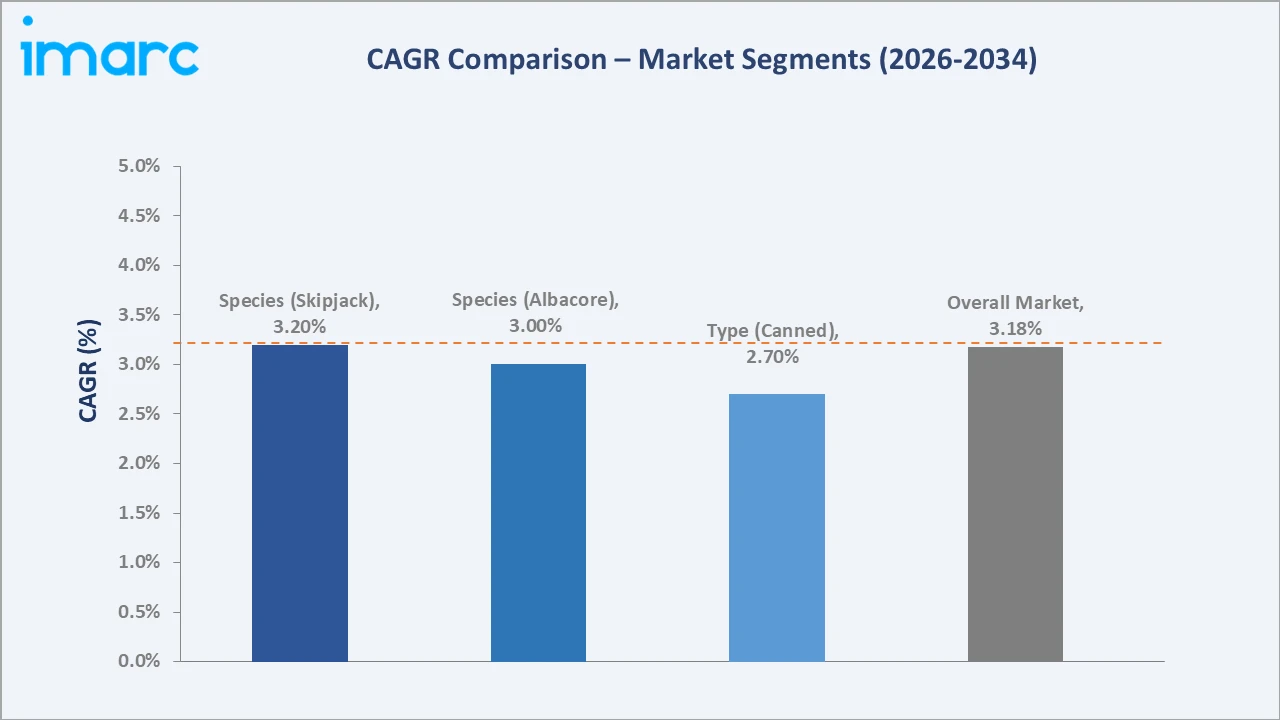
Fresh tuna grows fastest at an estimated 4.6% CAGR as premiumisation and foodservice demand widen fresh-format retail availability, while Yellowfin leads species-level growth at 4.1% CAGR on rising sashimi-grade demand.
Executive Summary
The Europe tuna market reached USD 1.51 Billion in 2025, spanning fishing and sourcing, processing and canning, packaging, cold-chain logistics, and retail and foodservice distribution. The market encompasses multiple tuna species processed into canned, frozen, and fresh formats sold across supermarkets, specialty retailers, and e-commerce channels.
Skipjack leads the species segment at 43.6% due to its abundance, affordability, and suitability for large-scale canning. Canned tuna leads the type segment at 58.9% on the strength of shelf stability and convenience. Spain, at 24.8%, leads the country segment through its established canning industry and high per-capita consumption.
Key Market Insights
|
Insight |
Data |
|
Dominant Species |
Skipjack - 43.6% share (2025) |
|
Dominant Type |
Canned - 58.9% market share (2025) |
|
Leading Country |
Spain - 24.8% market share |
|
Market Opportunity |
MSC-certified sourcing; premium fresh-format retail; value-added ready-to-eat formats; e-commerce expansion; traceable supply chains |
Key Analytical Observations Supporting The Above Data:
- Skipjack at 43.6%: The skipjack species dominates due to its wide availability, cost efficiency, and strong suitability for large-volume canning, making it the preferred choice for commercial processors across Europe.
- Canned at 58.9%: Canned tuna leads because of its long shelf life, affordability, and convenience, which continue to support its position as a household staple across European retail channels.
- Spain at 24.8%: Spain dominates the market due to its long-standing canning industry, strong domestic consumption, and position as a major processing and export hub within the European Union.
Europe Tuna Market Overview
The Europe tuna market encompasses the sourcing, processing, packaging, and distribution of tuna across canned, frozen, and fresh formats. It integrates fishing fleets and raw material suppliers, processing and canning facilities, packaging and cold-chain providers, and retail, foodservice, and export channels serving consumers across the region.
Macroeconomic factors include rising protein-rich diet adoption, population growth, and increasing retail and e-commerce penetration across Europe. In addition, sustainability regulation, fishing quota policy, and consumer demand for traceable, responsibly sourced seafood are shaping supply chain investment across the industry.
Market Dynamics
To evaluate market opportunities, Request Sample
Market Drivers
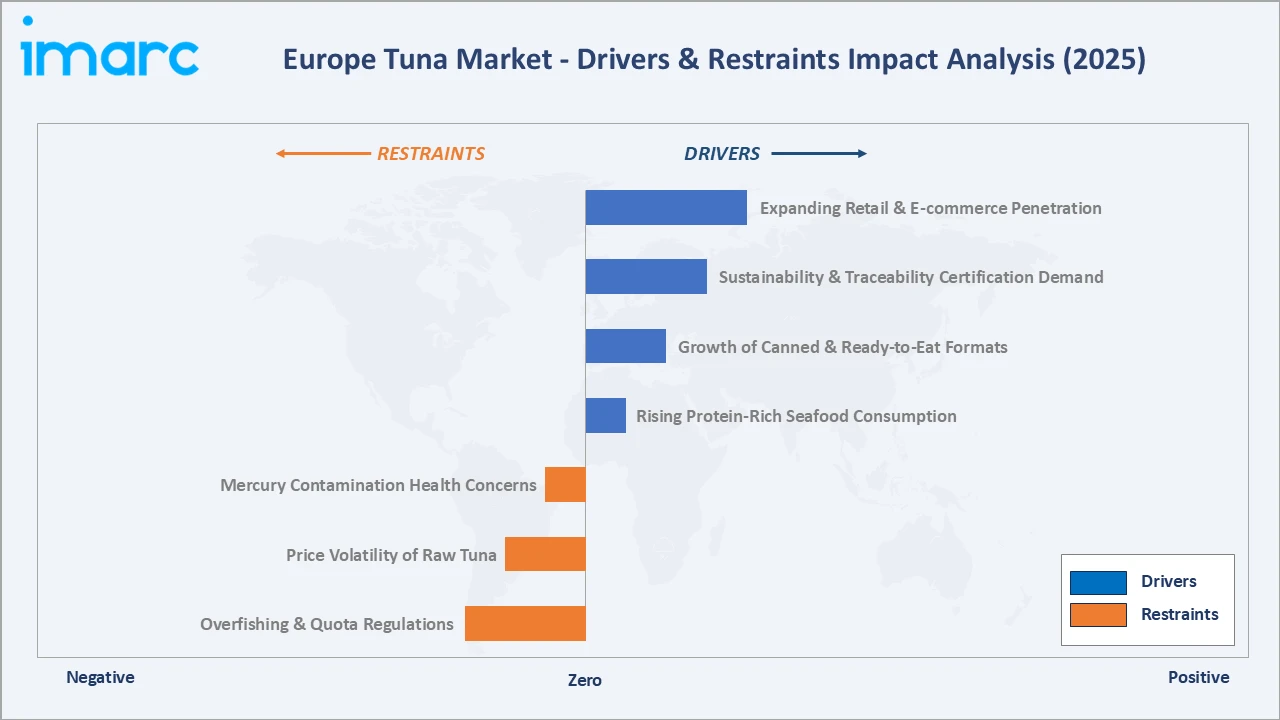
- Rising Protein-Rich Seafood Consumption: Rising consumer preference for protein-rich, low-fat seafood is increasing tuna consumption across Europe, supported by growing awareness of omega-3 fatty acid health benefits and broader adoption of Mediterranean dietary patterns.
- Growth of Canned & Ready-to-Eat Formats: The convenience of canned and ready-to-eat tuna products continues to drive volume growth, as busy urban consumers seek shelf-stable, easy-to-prepare protein sources requiring minimal preparation time.
- Sustainability & Traceability Certification Demand: Growing consumer and retailer emphasis on sustainably sourced, traceable seafood is encouraging processors to adopt MSC certification and observer coverage programmes, strengthening brand trust and market access.
- Expanding Retail & E-commerce Penetration: Expanding retail shelf space and the rapid growth of e-commerce grocery platforms are widening product availability and enabling smaller and premium tuna brands to reach a broader consumer base.
Market Restraints
- Overfishing & Quota Regulations: Overfishing concerns and tightening fishing quota regulations are constraining raw material supply in certain tuna species, creating cost pressure and supply uncertainty for European processors.
- Price Volatility of Raw Tuna: Fluctuations in raw tuna prices, driven by catch volumes, fuel costs, and currency movements, create margin volatility for processors and can lead to inconsistent retail pricing.
- Mercury Contamination Health Concerns: Consumer concerns regarding mercury content in certain tuna species can restrain consumption frequency, particularly among health-conscious demographics and during pregnancy-related dietary guidance.
Market Opportunities
- Sustainable & Certified Sourcing: Growing demand for MSC-certified and pole-and-line caught tuna presents an opportunity for processors to differentiate through verified sustainable sourcing and premium positioning.
- Premium & Value-Added Formats: Rising interest in premium fresh and value-added tuna formats, such as marinated fillets and ready-to-cook portions, offers processors an avenue to capture higher margins.
Market Challenges
- Cold Chain Consistency: Maintaining consistent cold-chain integrity for fresh and frozen tuna across long-distance European distribution networks remains operationally complex and cost-intensive.
- Regulatory Compliance Burden: Compliance with evolving EU import, labelling, and sustainability regulations adds administrative and cost burden, particularly for smaller regional processors.
Emerging Market Trends
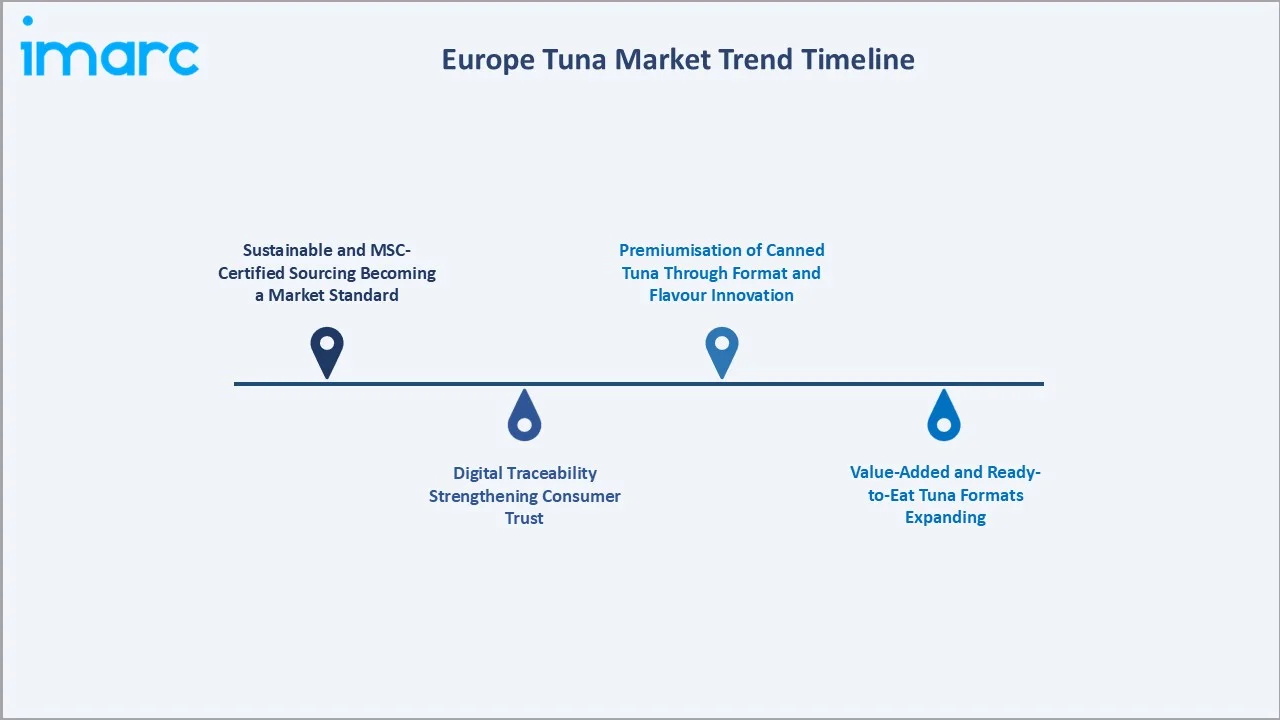
1. Sustainable and MSC-Certified Sourcing Becoming a Market Standard
Sustainability certification is shifting from a differentiator to a baseline expectation, as major retailers increasingly require MSC or equivalent certification for tuna listings, pushing processors to expand observer coverage and fleet-level traceability programmes across their supply chains.
2. Premiumisation of Canned Tuna Through Format and Flavour Innovation
Processors are introducing premium canned formats packed in olive oil, flavoured variants, and recyclable packaging to capture higher-margin, quality-conscious consumers seeking culinary authenticity alongside convenience.
3. Digital Traceability Strengthening Consumer Trust
Digital traceability tools, including QR-code batch tracking, are enabling consumers to verify catch origin and sustainability credentials, reinforcing brand trust and supporting compliance with tightening EU import regulations.
4. Value-Added and Ready-to-Eat Tuna Formats Expanding
Ready-to-eat tuna pouches, salads, and snack-pack formats are gaining shelf space as retailers respond to demand for convenient, high-protein options suited to on-the-go and single-serve consumption occasions.
Industry Value Chain Analysis
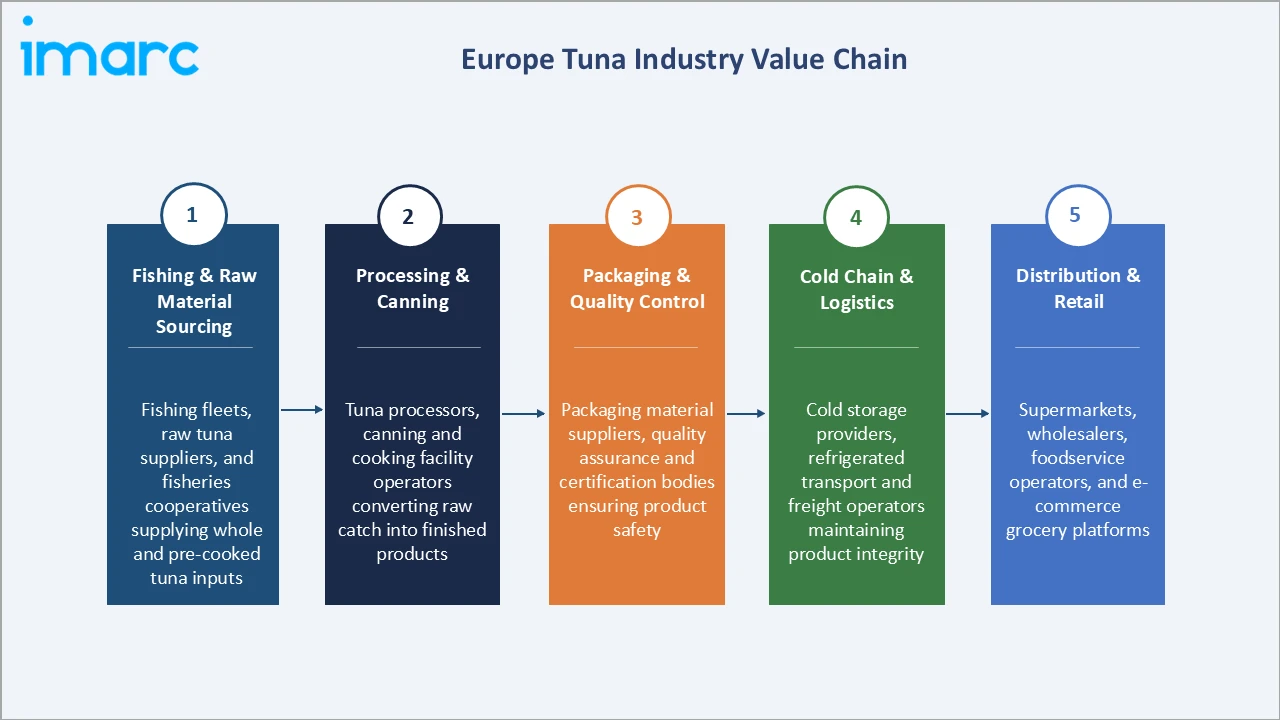
The Europe tuna value chain spans raw material sourcing and fishing, processing and canning, packaging and quality control, cold-chain logistics, and distribution through retail and foodservice channels.
|
Stage |
Key Participants |
|
Fishing & Raw Material Sourcing |
Fishing fleets, raw tuna suppliers, and fisheries cooperatives supplying whole and pre-cooked tuna inputs |
|
Processing & Canning |
Tuna processors, canning and cooking facility operators converting raw catch into finished products |
|
Packaging & Quality Control |
Packaging material suppliers, quality assurance and certification bodies ensuring product safety |
|
Cold Chain & Logistics |
Cold storage providers, refrigerated transport and freight operators maintaining product integrity |
|
Distribution & Retail |
Supermarkets, wholesalers, foodservice operators, and e-commerce grocery platforms |
Technology Landscape in the Europe Tuna Industry
Retort and Thermal Processing Technology
Advanced retort and thermal processing technology enables consistent cooking, sterilisation, and shelf stability for canned tuna at commercial scale. Modern retort systems improve energy efficiency and product quality while reducing processing time, supporting large-volume canning operations across major European facilities.
Cold Chain and Traceability Technology
Digital traceability platforms and IoT-enabled cold chain monitoring allow processors to track tuna from vessel to shelf, verifying catch origin and temperature integrity throughout distribution. Growing retailer demand for verifiable sustainability credentials is accelerating adoption of these systems across the industry.
Automated Sorting and Quality Control Technology
Automated sorting, grading, and vision-inspection systems are improving processing line efficiency and product consistency. These technologies reduce manual handling, support food safety compliance, and enable processors to maintain quality standards at higher throughput volumes.
Market Segmentation Analysis
The report covers the following segments:
|
Segment Category |
Leading Segment |
Market Share |
Year |
|
Species |
Skipjack |
43.6% |
2025 |
|
Type |
Canned |
58.9% |
2025 |
|
Country |
Spain |
24.8% |
2025 |

By Species
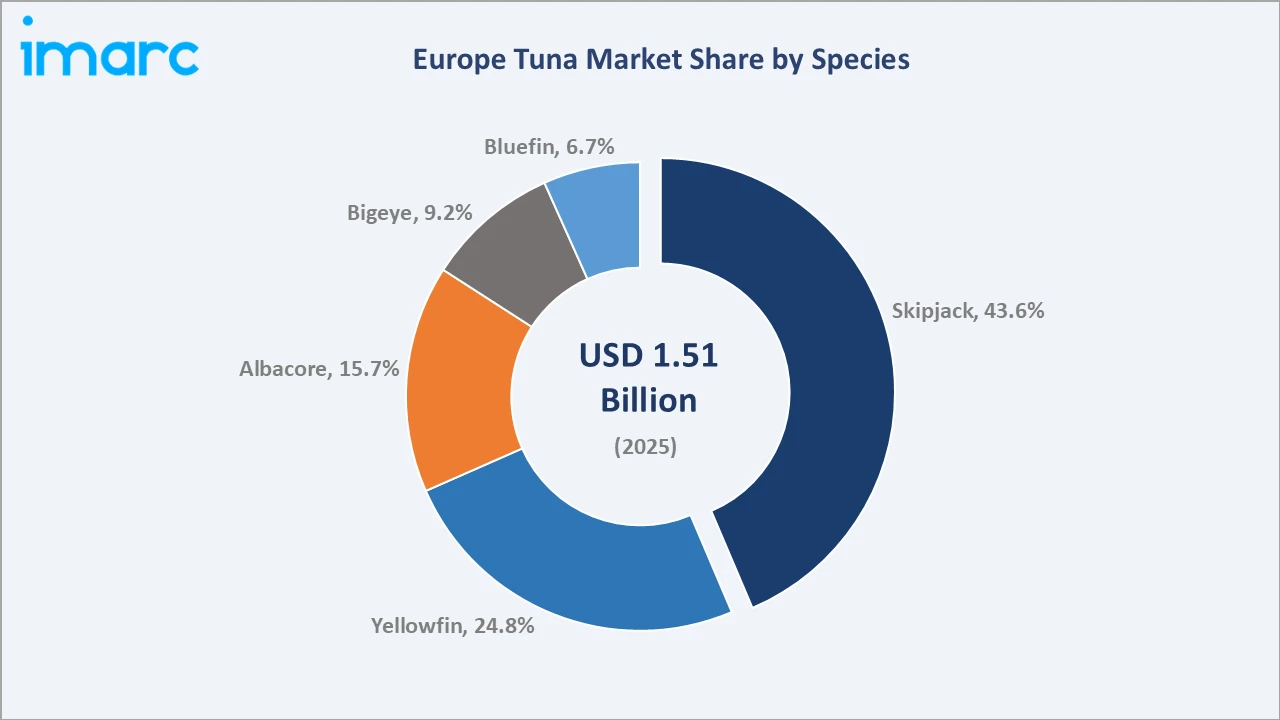
Skipjack leads at 43.6% (2025). The skipjack segment encompasses whole round and pre-cooked loins destined primarily for large-scale canning, valued for its wide abundance and cost efficiency. Skipjack's ~3.2% CAGR reflects steady, mature demand within the mainstream canned tuna category.
To access detailed market analysis, Request Sample
Yellowfin at 24.8% grows fastest among the major species at ~4.1% CAGR, driven by rising demand for premium canned and sashimi-grade fresh formats. Albacore, at 15.7%, grows at ~3.0% CAGR through steady premium canned demand, while Bigeye and Bluefin together account for the remaining 15.9%, serving smaller, higher-value niches in sashimi and specialty retail channels.
By Type
Canned tuna leads at 58.9% (2025). The canned segment encompasses tuna packed in oil, brine, and water across metal-can and pouch formats, valued for shelf stability and affordability. Canned tuna's ~2.7% CAGR reflects steady, mature category demand across European retail.
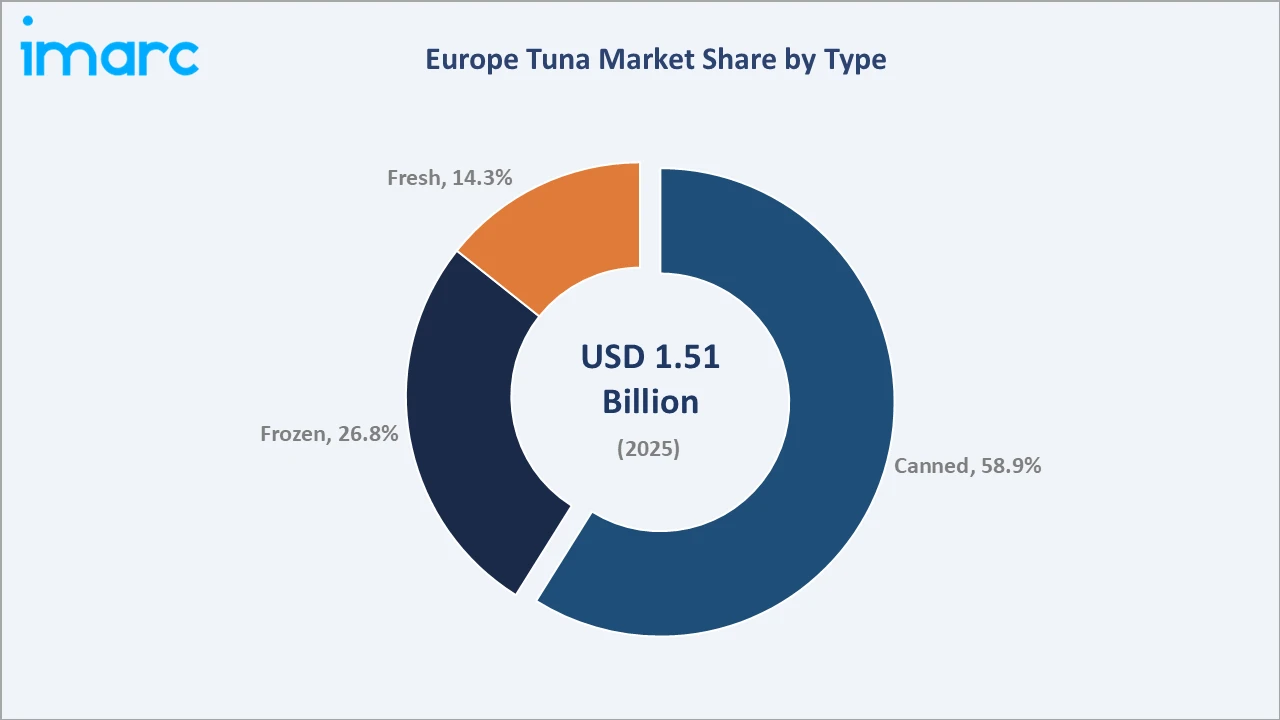
Fresh tuna at 14.3% grows fastest at ~4.6% CAGR through rising premiumisation and foodservice demand for sashimi-grade product. Frozen tuna at 26.8% grows at ~3.6% CAGR, supporting foodservice flexibility and retail cooking formats as cold-chain infrastructure expands across the region.
Regional Market Insights
|
Country |
Share (2025) |
Key Europe Tuna Market Drivers & Characteristics |
|
Spain |
24.8% |
Driven by a well-established canning industry, high per-capita tuna consumption, and strong export orientation. |
|
Germany |
19.6% |
Supported by rising demand for convenient, protein-rich foods and expanding retail distribution. |
|
France |
17.3% |
Driven by strong retail penetration and steady demand for premium and sustainably sourced canned tuna. |
|
Italy |
15.4% |
Supported by traditional culinary use of tuna and strong domestic canning production. |
|
United Kingdom |
12.5% |
Driven by growing health-conscious consumption and expanding e-commerce grocery channels. |
|
Others |
10.4% |
Reflects steady demand growth across remaining European markets, supported by rising retail availability. |
Spain's 24.8% leadership is anchored by its position as one of Europe's largest tuna canning and processing hubs, combined with high domestic consumption. Germany's 19.6% reflects strong retail demand for convenient protein sources.
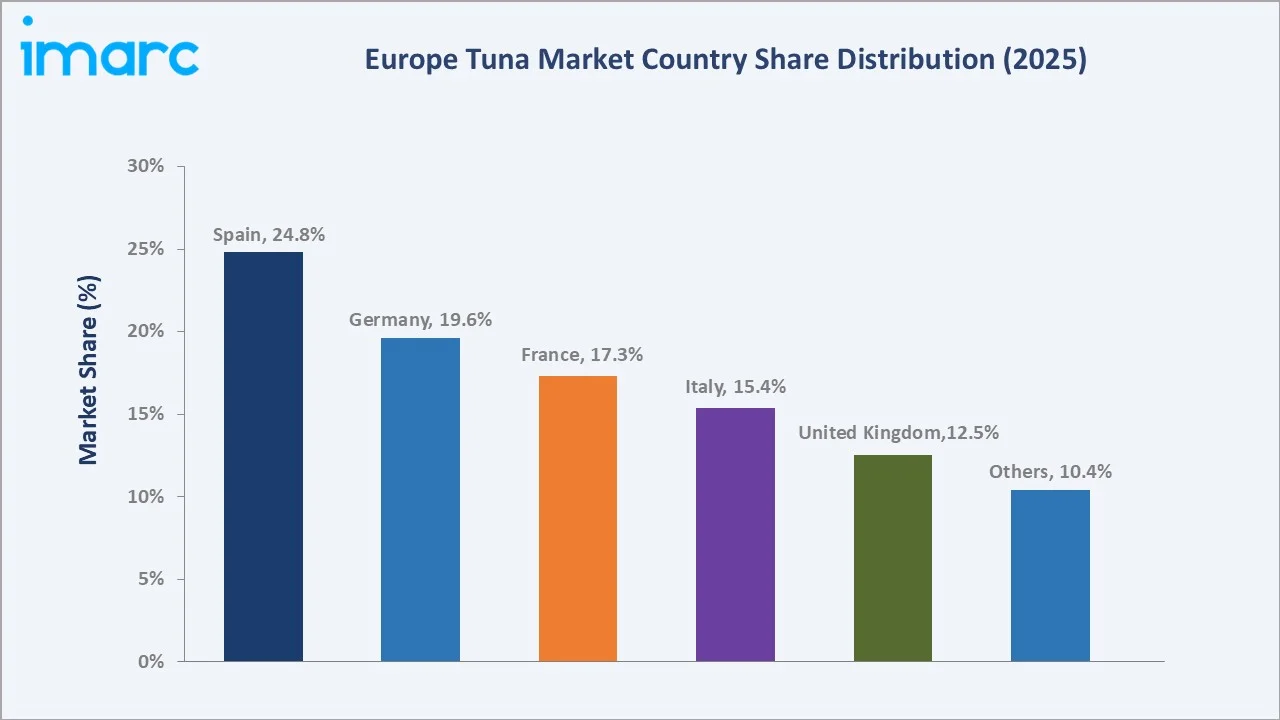
France's 17.3% share reflects steady retail demand alongside growing interest in sustainably sourced products, while Italy at 15.4% benefits from deep-rooted culinary tradition and established domestic processing capacity.
Competitive Landscape
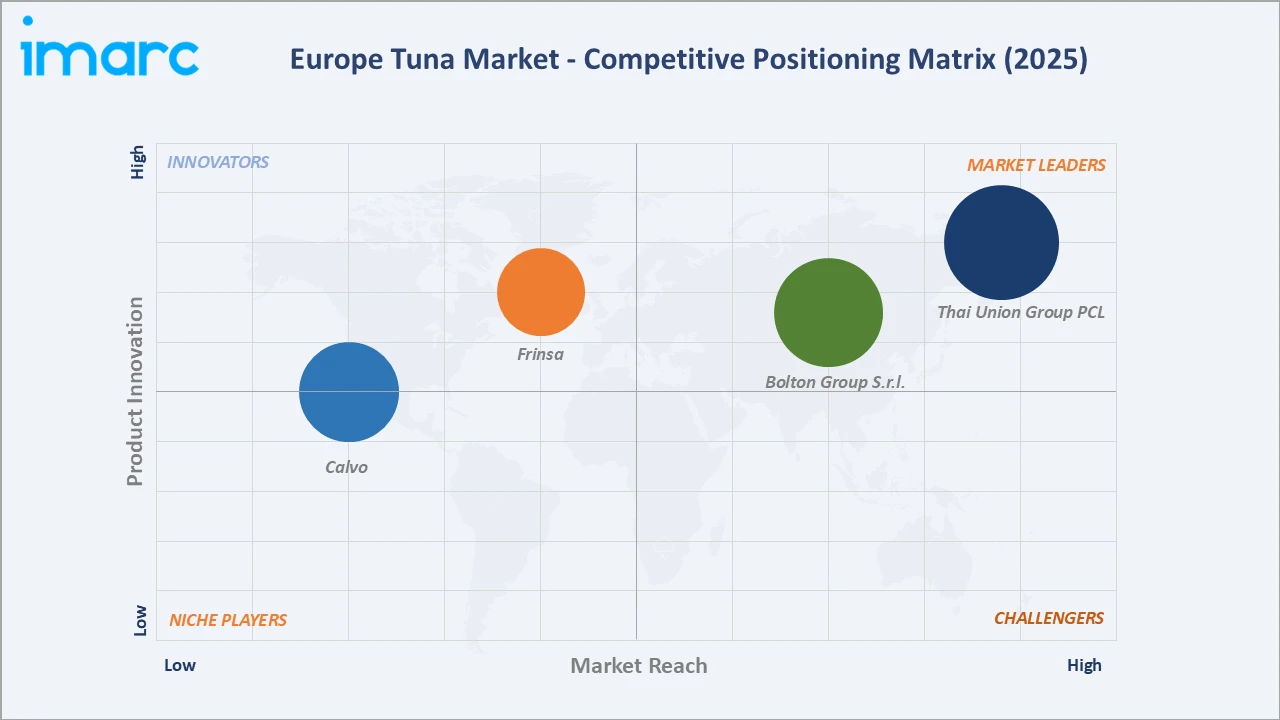
The Europe tuna market competitive landscape encompasses global seafood processors, regional heritage canning brands, and vertically integrated fishing-to-retail companies competing on price, sustainability, and product innovation.
|
Company Name |
Key Products |
Market Position |
Core Strength |
|
Thai Union Group PCL |
John West, Petit Navire, canned & pouch tuna |
Market Leader |
Global sourcing scale and multi-brand retail presence across Europe |
|
Bolton Group S.r.l. |
Rio Mare canned tuna |
Market Leader |
Premium brand equity and strong Southern European retail penetration |
|
Calvo |
Tuna in brine |
Established Player |
Integrated fleet-to-can supply chain and sustainability partnerships |
|
Frinsa |
Frinsa canned tuna and seafood |
Established Player |
Strong Spanish processing base and private-label manufacturing |
Consolidation among European processors reflects retailers' preference for integrated, certified suppliers capable of guaranteeing traceability and consistent volume, reducing coordination complexity across the supply chain.
Key Company Profiles
Thai Union Group PCL
Thai Union Group is a global seafood company with a significant presence in the Europe tuna market through its John West and Petit Navire brands, supplying canned and pouch tuna across major European retail channels.
- Key Products: John West, Petit Navire, Mareblu.
- Strategic Focus: Leverages large-scale global sourcing and processing capacity to supply consistent volumes to European supermarkets and private-label partners.
Bolton Group S.r.l.
Bolton Group is a leading European seafood company known for its Rio Mare brand, holding a strong premium position in the Italian and broader Southern European canned tuna market.
- Key Products: Rio Mare canned tuna range.
- Recent Developments: In August 2025, Bolton Group reported that its Food division, led by the Rio Mare canned tuna brand, was the primary driver of its 2024 financial performance. The company recorded €3.5 billion in revenue (+8.1% year-over-year), with the Food division contributing €2.4 billion (68.5% of total sales). Bolton also highlighted that 99.7% of Rio Mare's tuna is responsibly sourced and reaffirmed its goal of achieving 100% MSC-certified tuna by 2030, strengthening its position as one of the world's largest tuna suppliers.
- Strategic Focus: Centres on premium brand positioning, sustainable sourcing certification, and culinary quality across its canned tuna portfolio.
Calvo
Calvo is a Spain-headquartered seafood company with integrated fishing, processing, and canning operations, supplying branded and private-label tuna products across Europe and Latin America.
- Key Products: Calvo canned tuna in olive oil, sunflower oil, and brine.
- Strategic Focus: Focused on fleet-to-can vertical integration, MSC certification, and sustainable sourcing partnerships.
Market Concentration Analysis
The Europe tuna market is moderately concentrated at the processing tier, with the top five processors collectively holding an estimated 45-55% of regional canned tuna volume. Fishing and raw material sourcing remains comparatively fragmented, with no single fleet operator holding above 5% of regional supply. Consolidation is increasing at the processing tier as retailers favour certified, vertically integrated suppliers.
Investment & Growth Opportunities
Highest Growth Segments
Fresh tuna (~4.6% CAGR), Yellowfin species (~4.1% CAGR), and value-added ready-to-eat tuna formats represent the highest-growth investment vectors within the Europe tuna market through 2034.
Emerging Investment Opportunities
Investment in MSC-certified sourcing infrastructure and digital traceability systems represents a near-term opportunity, as retailers increasingly condition shelf placement on verified sustainability credentials.
Investment Themes
- Sustainable Sourcing Infrastructure: Certified, traceable tuna sourcing capable of meeting retailer sustainability mandates positions processors for premium shelf placement and long-term retail partnerships.
- Value-Added Product Development: Development of premium and value-added tuna formats, including ready-to-eat pouches and marinated fillets, creates an above-commodity-margin growth avenue for processors.
Future Market Outlook (2026-2034)
The Europe tuna market is projected to grow from USD 1.51 Billion in 2025 to USD 2.01 Billion by 2034, delivering a 3.18% CAGR over the forecast period. The market's anchor value of USD 1.77 Billion in 2030 reflects steady demand growth supported by sustainability-driven sourcing, premiumisation, and expanding retail and e-commerce distribution across the region.
Three structural forces define market growth through 2034. Sustainability certification is becoming a retail prerequisite rather than a differentiator, protein-rich diet trends continue to support consumption, and premiumisation is expanding margin opportunity across fresh and value-added formats.
Research Methodology
Primary Research
Primary research comprised structured interviews with industry stakeholders, including processing company executives, category managers, and regional seafood market specialists.
Secondary Research
Secondary research encompassed seafood industry publications, EU fisheries statistics, company annual reports, and trade association data covering the Europe tuna industry.
Forecasting Models
Market revenue forecasts were developed using a segment bottom-up model across species, type, and country components.
Europe Tuna Market Report Coverage:
| Report Features | Details |
|---|---|
| Base Year of the Analysis | 2025 |
| Historical Period | 2020-2025 |
| Forecast Period | 2026-2034 |
| Units | Million USD |
| Scope of the Report | Exploration of Historical and Forecast Trends, Industry Catalysts and Challenges, Segment-Wise Historical and Predictive Market Assessment:
|
| Species Covered | Skipjack, Yellowfin, Albacore, Bigeye, Bluefin |
| Types Covered | Canned, Frozen, Fresh |
| Countries Covered | Germany, France, United Kingdom, Italy, Spain, Others |
| Companies Covered | Thai Union Group PCL, Bolton Group S.r.l., Calvo, Frinsa, etc. |
| Customization Scope | 10% Free Customization |
| Post-Sale Analyst Support | 10-12 Weeks |
| Delivery Format | PDF and Excel through Email (We can also provide the editable version of the report in PPT/Word format on special request) |
Key Benefits for Stakeholders:
- IMARC’s report offers a comprehensive quantitative analysis of various market segments, historical and current market trends, market forecasts, and dynamics of the Europe tuna market from 2020-2034.
- The research study provides the latest information on the market drivers, challenges, and opportunities in the Europe tuna market.
- Porter's five forces analysis assist stakeholders in assessing the impact of new entrants, competitive rivalry, supplier power, buyer power, and the threat of substitution. It helps stakeholders to analyze the level of competition within the Europe tuna industry and its attractiveness.
- Competitive landscape allows stakeholders to understand their competitive environment and provides an insight into the current positions of key players in the market.
Frequently Asked Questions About the Europe Tuna Market Report
The Europe tuna market reached USD 1.51 Billion in 2025, driven by rising demand for protein-rich seafood, growing retail penetration, and increasing sustainability certification across the supply chain.
The market is projected to grow at a 3.18% CAGR during 2026-2034, reaching USD 2.01 Billion by 2034.
Skipjack leads at 43.6% due to its abundance, affordability, and suitability for large-scale canning.
Canned tuna leads at 58.9% through its shelf stability, affordability, and convenience for consumers.
Spain leads at 24.8%, supported by its established canning industry and high domestic consumption.
Leading companies include Thai Union Group PCL, Bolton Group S.r.l., Calvo and Frinsa, among others.
The market is projected to reach approximately USD 1.77 Billion by 2030, supported by continued sustainability-driven sourcing and premiumisation trends.
Need more help?
- Speak to our experienced analysts for insights on the current market scenarios.
- Include additional segments and countries to customize the report as per your requirement.
- Gain an unparalleled competitive advantage in your domain by understanding how to utilize the report and positively impacting your operations and revenue.
- For further assistance, please connect with our analysts.
 Request Customization
 Speak to an Analyst
 Request Brochure
 Inquire Before Buying
Benefits of Customization
- Personalize this research
- Triangulate with your data
- Get data as per your format and definition
- Gain a deeper dive into a specific application, geography, customer, or competitor
- Any level of personalization
Get in Touch With Us
UNITED STATES
Phone: +1-201-971-6302
INDIA
Phone: +91-120-433-0800
UNITED KINGDOM
Phone: +44-753-714-6104
Email: [email protected]
Client Testimonials




.webp)




.webp)













Related Reports

Choose your plan
*Please note that the prices mentioned below are starting prices for each bundle type. Kindly contact our team for further details.*
Single User License
- 1 User License, Access on 2 Devices
- PDF Report + Excel Dataset (Password Protected)
- Lifetime Access
- No Printing Rights
- 10% Free Report Customization
- 10–12 Weeks of Analyst Support
Five User License
- Access for 5 Users, 2 Devices per User
- PDF Report + Excel Dataset (Password Protected)
- Lifetime Access
- Dedicated Account Manager
- 12–14 Weeks of Analyst Support
- No Printing Rights
- 15% Free Report Customization
- 25% Discount on Your Next Purchase
Corporate User License
- Unlimited User Access (Within Your Organization)
- PDF Report + Excel Dataset
- Lifetime Access
- Dedicated Account Manager
- 14–20 Weeks of Analyst Support
- No Printing Rights
- 20% Free Report Customization
- 30% Discount on Your Next Purchase
Essential Insights
What's included:
3 reports
- Lifetime Access
- PDF Reports
- Excel Datasets
- 2 Weeks of Free Analyst Support
- 2 User Licenses
- Access on 2 Devices
- Printing Rights
- Complimentary PowerPoint (PPT) Version
- Complimentary License Upgrade
Professional Access
What's included:
5 reports
- Lifetime Access
- PDF Reports
- Excel Datasets
- 8 Weeks of Free Analyst Support
- 2 User Licenses
- Access on 2 Devices
- Printing Rights
- Complimentary PowerPoint (PPT) Version
- Complimentary License Upgrade
Business Advantage
What's included:
8 reports
- Lifetime Access
- PDF Reports
- Excel Datasets
- 14 Weeks of Free Analyst Support
- 2 User Licenses
- Access on 2 Devices
- Printing Rights
- Complimentary PowerPoint (PPT) Version
- Complimentary License Upgrade
Enterprise Intelligence
What's included:
10 reports
- Lifetime Access
- PDF Reports
- Excel Datasets
- 20 Weeks of Free Analyst Support
- 2 User Licenses
- Access on 2 Devices
- Printing Rights
- Complimentary PowerPoint (PPT) Version
- Complimentary License Upgrade