
Europe Water Purifier Market Size, Share, Trends and Forecast by Technology Type, Distribution Channel, and Country, 2026-2034
Europe Water Purifier Market Size, Share, Trends & Forecast (2026-2034)
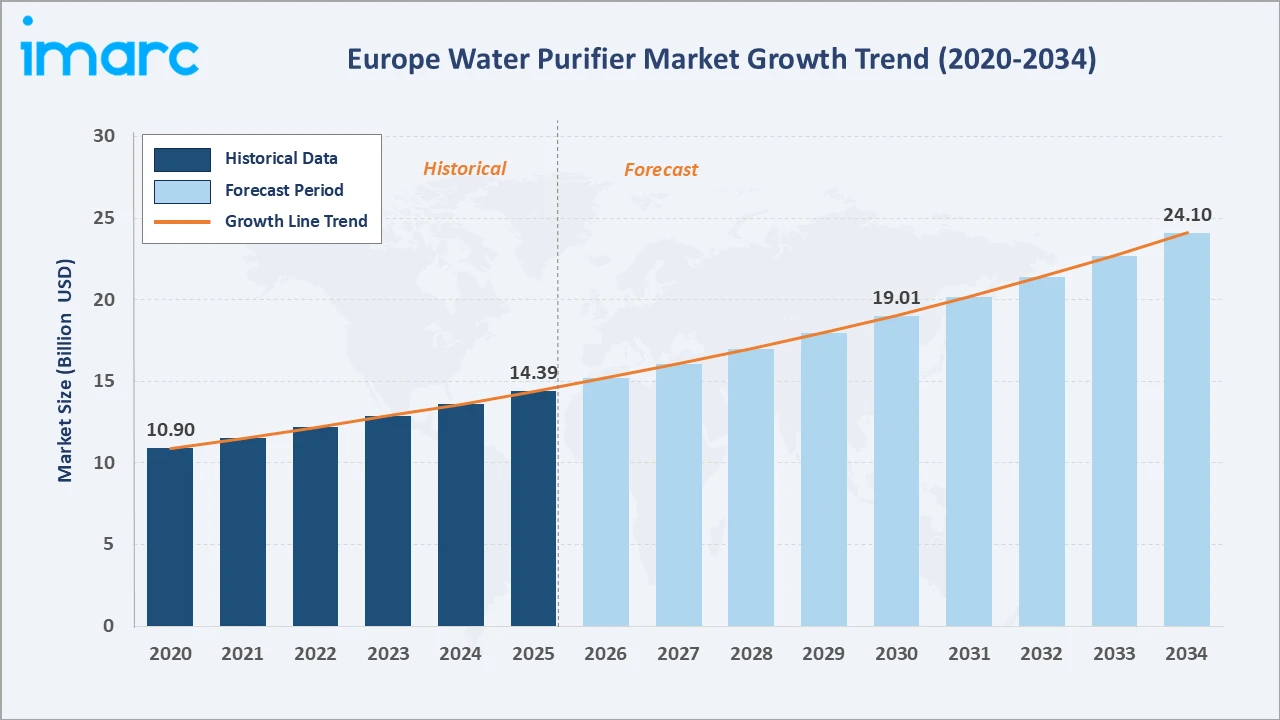
The Europe water purifier market reached a value of USD 14.39 Billion in 2025 and is projected to reach USD 24.10 Billion by 2034, exhibiting a CAGR of 5.72% during 2026-2034. Rising water hardness concerns, tightening drinking water regulations, and a pivot away from single-use bottled water are the primary drivers shaping growth.
RO purifiers lead the technology type segment at 44.8%, retail stores dominate distribution channel at 51.6%, and Germany commands 24.8% country-wise share.
Market Snapshot
|
Metric |
Value |
|
Market Size (2025) |
USD 14.39 Billion |
|
Forecast Market Size (2034) |
USD 24.10 Billion |
|
CAGR (2026-2034) |
5.72% |
|
Base Year |
2025 |
|
Historical Period |
2020-2025 |
|
Forecast Period |
2026-2034 |
|
Largest Country |
Germany (24.8%, 2025) |
|
Second Largest Country |
United Kingdom (20.6%, 2025) |
|
Leading Technology Type |
RO Purifiers (44.8%, 2025) |
|
Leading Distribution Channel |
Retail Stores (51.6%, 2025) |
The Europe water purifier market expanded from USD 10.90 Billion in 2020 to USD 14.39 Billion in 2025, driven by growing awareness of water quality, rising prevalence of hard water in several member states, and steady replacement demand for filtration cartridges. Anchored at USD 19.01 Billion in 2030, the forecast to USD 24.10 Billion by 2034 is supported by continued adoption of smart and connected purifiers, expanding online retail penetration, and a more structured regulatory push toward sustainable drinking water infrastructure.
To get more information on this market, Request Sample
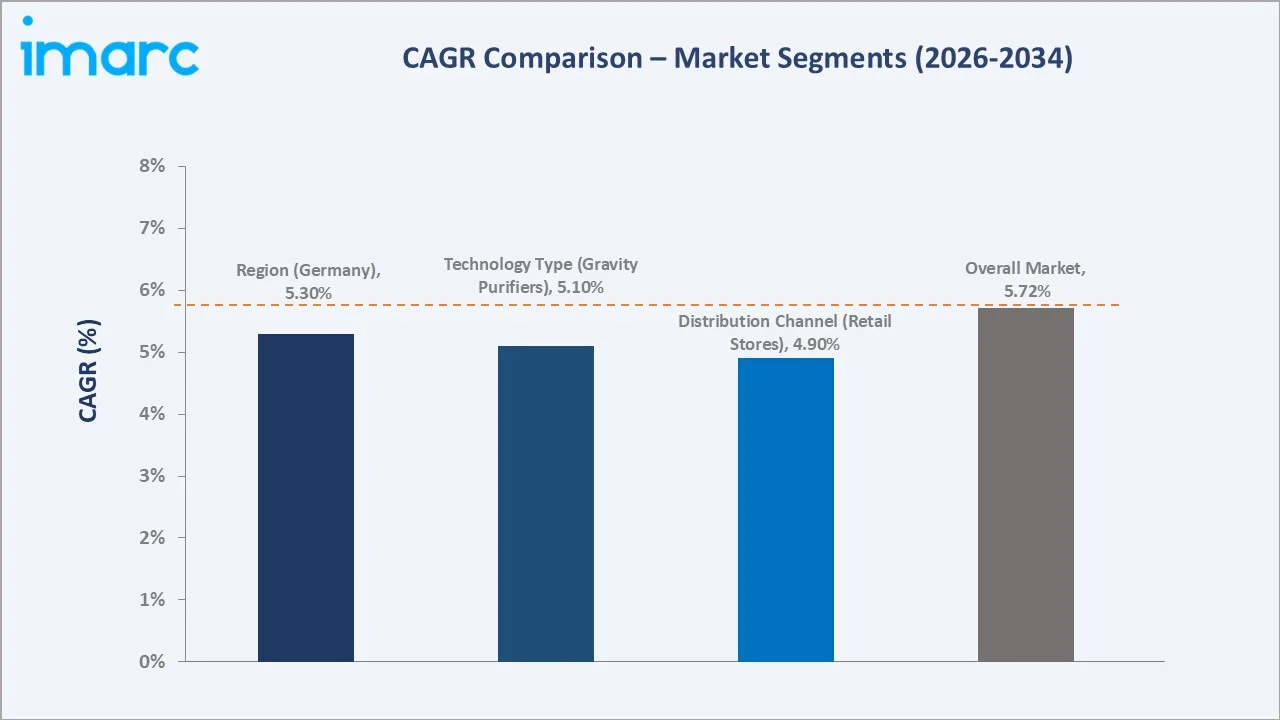
CAGR trajectories across technology type, distribution channel, and country sub-segments show online and UV purifiers expanding faster than the overall 5.72% market CAGR, driven by convenience-led purchasing habits, compact product design, and rising demand for advanced home water purification solutions.
Executive Summary
The Europe water purifier market is on a steady growth path from USD 10.90 Billion in 2020 to USD 24.10 Billion by 2034. The industry has evolved from basic jug filtration toward multi-stage RO, UV, and softening systems that address hard water, microplastics, and emerging contaminant concerns across residential and commercial settings. Rising health consciousness and stricter drinking water standards are encouraging households to invest in dedicated point-of-use treatment.
RO purifiers dominate the technology type segment at 44.8% in 2025, supported by their ability to address a broad range of contaminants and hard water conditions across diverse geologies. Retail stores lead distribution channel at 51.6%, reflecting continued consumer preference for in-person product evaluation. Germany commands 24.8% of the country-wise share, led by strong environmental awareness, high household purchasing power, and dense retail and e-commerce infrastructure.
Key Market Insights
|
Insight |
Data |
|
Leading Technology Type |
RO Purifiers - 44.8% share (2025) |
|
Second Largest Technology Type |
Gravity Purifiers - 17.6% share (2025) |
|
Leading Distribution Channel |
Retail Stores - 51.6% share (2025) |
|
Second Largest Distribution Channel |
Direct Sales - 28.7% share (2025) |
|
Leading Country |
Germany - 24.8% share (2025) |
|
Second Largest Country |
United Kingdom - 20.6% share (2025) |
|
Top Companies |
BWT Holding GmbH, BRITA SE, Pentair, A. O. Smith |
Key Analytical Observations Expanding On The Data Above:
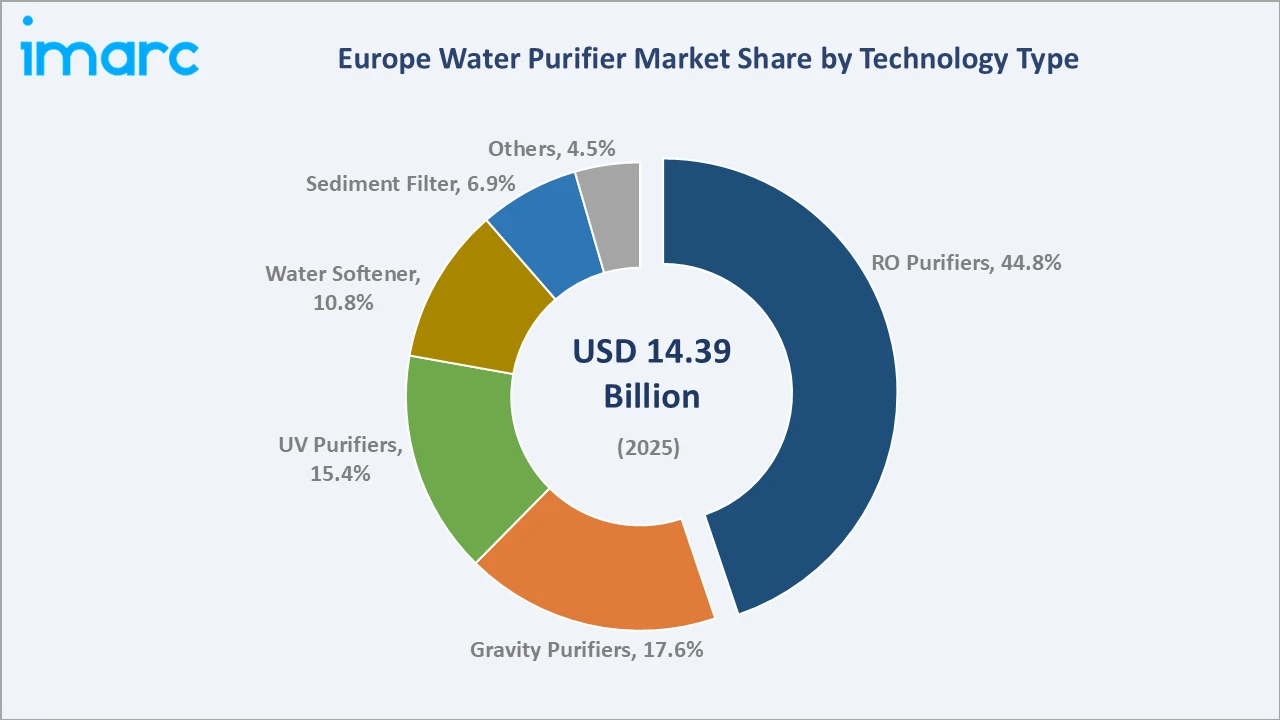
- RO purifiers leadership at 44.8% is supported by the technology's effectiveness against dissolved salts, heavy metals, and microbial contaminants, making it the preferred choice across both hard water and soft water regions of Europe.
- Gravity purifiers at 17.6% remain relevant in off-grid and low-electricity-access settings, as well as among cost-conscious households seeking basic filtration without ongoing power consumption.
- Retail stores dominance at 51.6% reflects the continued importance of in-store demonstration, after-sales servicing, and installation support for higher-value RO and softener systems.
- Direct sales share at 28.7% is supported by personalized product demonstrations, home installation services, and long-term customer relationships, particularly for premium water purification systems requiring consultation and after-sales support.
- Germany at 24.8% leads the country-wise landscape, anchored by high consumer purchasing power, well-established retail networks, and strong environmental and sustainability awareness among households.
Europe Water Purifier Market Overview
A water purifier refers to a device or system designed to remove impurities, dissolved salts, microorganisms, and sediments from drinking water using technologies, such as reverse osmosis, gravity filtration, ultraviolet disinfection, and softening resins. The market spans residential and commercial installations sold through retail stores, direct sales, and online channels.
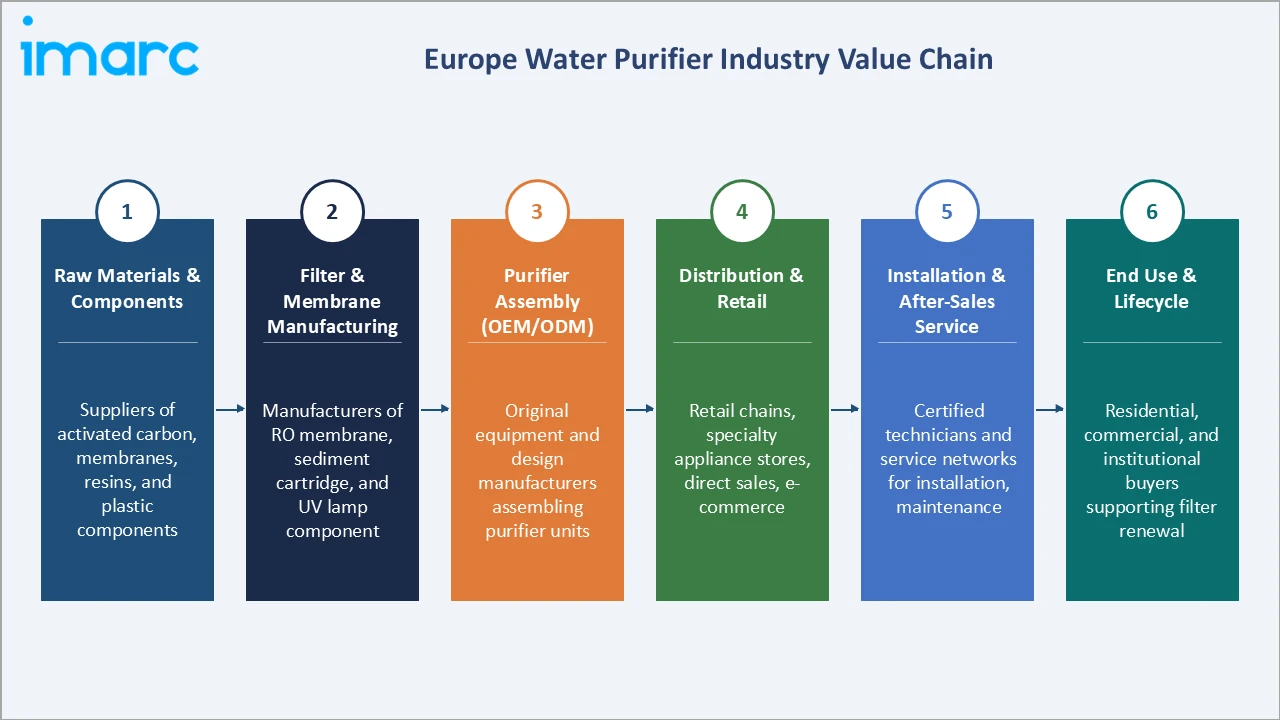
The European ecosystem integrates raw material and component suppliers, purifier manufacturers, distribution and retail networks, installation and after-sales service providers, water quality authorities, and regulatory authorities. Together, they enable the delivery of safe, treated drinking water within an evolving regulatory framework shaped by both EU-wide directives and country-specific standards.
Market Dynamics
To evaluate market opportunities, Request Sample
Market Drivers
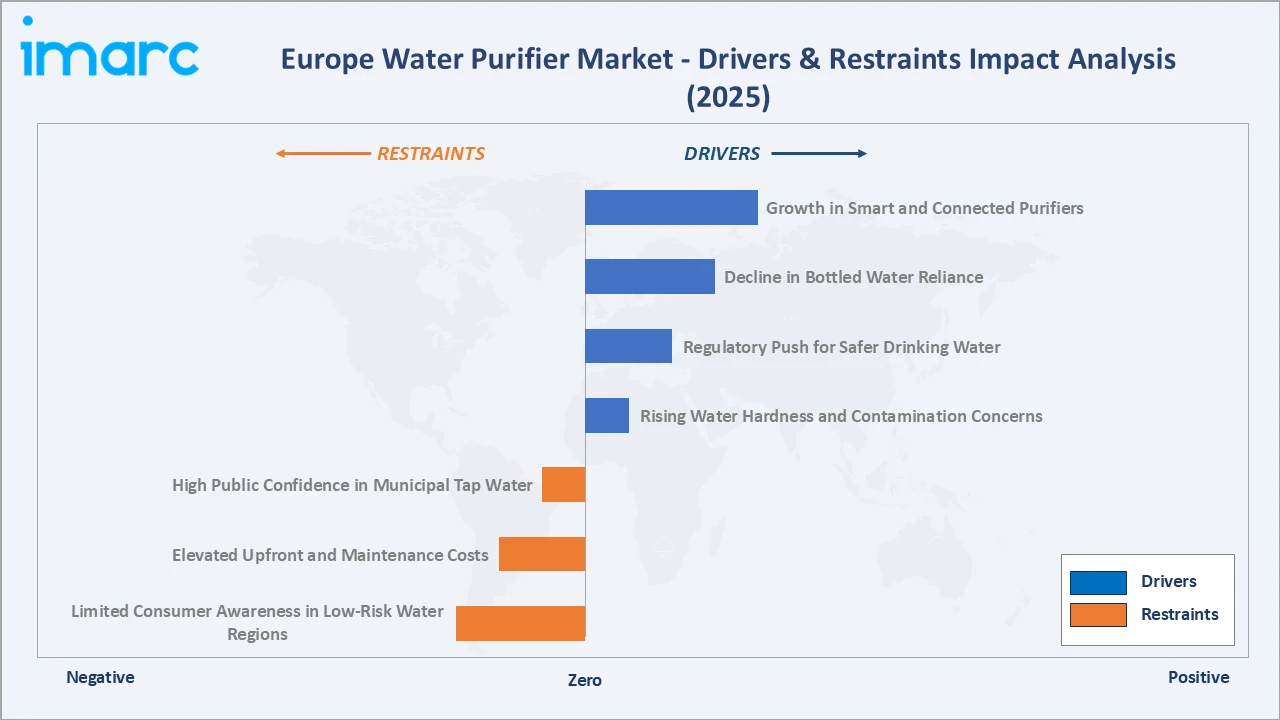
- Rising Water Hardness and Contamination Concerns: Variability in groundwater mineral content across several European geologies is driving households to adopt RO and softening systems to protect appliances and improve taste and safety.
- Regulatory Push for Safer Drinking Water: Evolving drinking water quality regulations and stricter safety standards across Europe are encouraging households and commercial establishments to adopt advanced water purification systems that provide reliable, high-quality drinking water.
- Decline in Bottled Water Reliance: Sustainability regulations and rising plastic waste awareness are encouraging a shift from single-use bottled water toward purifier-treated tap water among environmentally conscious consumers. In 2023, Eurostat indicated that the EU produced nearly 16 Million Tons of plastic packaging waste.
- Growth in Smart and Connected Purifiers: Increasing integration of filter-life sensors, mobile app monitoring, and automated cartridge reordering is enhancing user convenience and supporting premiumization across the category.
Market Restraints
- High Public Confidence in Municipal Tap Water: In several Western European markets, households report strong existing trust in centrally treated municipal water, which can temper the perceived urgency for supplementary point-of-use purification.
- Elevated Upfront and Maintenance Costs: Multi-stage RO and whole-home softening systems carry higher upfront investment and recurring cartridge or salt replenishment costs, which can limit adoption among price-sensitive households.
- Limited Consumer Awareness in Low-Risk Water Regions: In areas where tap water is already perceived as safe and reliable, consumers may see limited value in investing in household water purification systems, slowing market adoption.
Market Opportunities
- Subscription and Rental Business Models: Recurring-revenue models covering installation, filter replacement, and maintenance are gaining traction, lowering the adoption barrier for premium RO and softener systems.
- Growth in Energy-Efficient and Compact Designs: Manufacturers have opportunities to attract urban consumers by developing space-saving, energy-efficient water purifiers that align with modern apartment living and sustainability preferences.
Market Challenges
- Fragmented Country-Level Standards: Differences in national plumbing codes, certification requirements, and water quality baselines across EU member states add complexity for manufacturers pursuing pan-European distribution.
- Filter Waste and Recyclability: Growing scrutiny of cartridge and membrane waste is prompting manufacturers to redesign products for recyclability, adding near-term development and compliance costs.
Emerging Market Trends
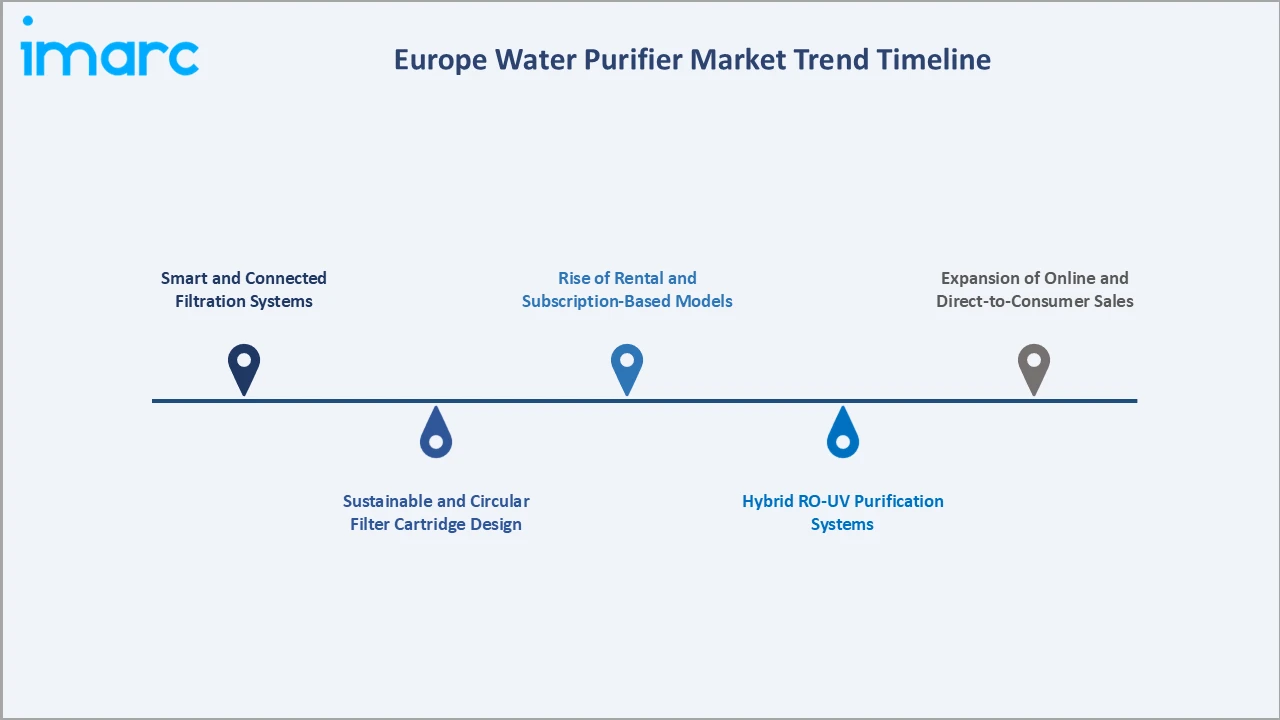
1. Smart and Connected Filtration Systems
Manufacturers are integrating IoT-enabled sensors that track filter life, water quality parameters, and usage patterns, feeding data to companion mobile apps. This connectivity is supporting premiumization and enabling predictive cartridge replacement across both residential and commercial installations.
2. Sustainable and Circular Filter Cartridge Design
Manufacturers are introducing recyclable filter cartridges, reduced-plastic components, and refillable filtration systems to align with Europe's sustainability goals and circular economy initiatives. These innovations are helping brands reduce environmental impact while appealing to environmentally conscious consumers seeking long-lasting, low-waste water purification solutions.
3. Rise of Rental and Subscription-Based Models
Operators are increasingly offering purifiers on a rental or subscription basis that bundles installation, maintenance, and periodic filter replacement, lowering the upfront cost barrier and improving long-term customer retention.
4. Hybrid RO-UV Purification Systems
Combined reverse osmosis and ultraviolet disinfection systems are gaining share as consumers seek broader protection against both dissolved contaminants and microbiological risks within a single unit.
5. Expansion of Online and Direct-to-Consumer Sales
Growing consumer comfort with researching filtration specifications and cartridge subscription plans online is accelerating direct-to-consumer sales, supported by simplified installation kits designed for self-fitting.
Industry Value Chain Analysis
The Europe water purifier value chain spans six stages, from raw material and component supply through end-user lifecycle management. Filter and membrane manufacturing, purifier assembly, and distribution capture the highest value-add, while installation and after-sales service increasingly determine long-term customer retention in this replacement-driven category.
|
Stage |
Key Players / Examples |
|
Raw Materials & Components |
Suppliers of activated carbon, membranes, resins, and plastic components used in filter cartridges and purifier housings |
|
Filter & Membrane Manufacturing |
Manufacturers of RO membranes, sediment cartridges, and UV lamp components supplying purifier assemblers |
|
Purifier Assembly (OEM/ODM) |
Original equipment and design manufacturers assembling branded and private-label purifier units |
|
Distribution & Retail |
Retail chains, specialty appliance stores, direct sales representatives, and e-commerce platforms |
|
Installation & After-Sales Service |
Certified technicians and service networks providing installation, maintenance, and cartridge replacement |
|
End Use & Lifecycle |
Residential households, commercial establishments, and institutional buyers supporting long-term filter renewal |
Vertically integrated players with proprietary membrane technology and direct service networks capture greater value than partners reliant on third-party distribution infrastructure.
Technology Landscape in the Europe Water Purifier Industry
Membrane and Filtration Innovation
Advances in thin-film composite RO membranes and multi-stage sediment and carbon filtration are improving contaminant removal efficiency while reducing water wastage during the purification process.
Smart Connectivity and Monitoring
Purifiers increasingly feature embedded sensors and mobile app integration that track total dissolved solids, filter saturation, and usage volume, enabling predictive maintenance and automated cartridge reordering.
Materials Innovation and Sustainability
Manufacturers are shifting toward recyclable cartridge housings and regenerable ion-exchange resins to reduce filter waste and align with tightening EU circular-economy requirements.
Automation in Manufacturing
Automated membrane winding, cartridge assembly, and quality-testing lines are helping manufacturers scale production while maintaining consistent filtration performance across product lines.
Market Segmentation Analysis
The report covers the following segments:
|
Segment Category |
Leading Segment |
Market Share |
Year |
|
Technology Type |
RO Purifiers |
44.8% |
2025 |
|
Distribution Channel |
Retail Stores |
51.6% |
2025 |
|
End User |
Household |
🔒 |
2025 |
|
Country |
Germany |
24.8% |
2025 |

By Technology Type
RO purifiers command a 44.8% majority share in 2025, driven by their effectiveness across varying water hardness levels and their ability to address dissolved salts, heavy metals, and microbiological contaminants. The segment benefits from broad applicability across both residential and commercial installations.
To access detailed market analysis, Request Sample
Gravity purifiers hold 17.6% share in 2025, remaining relevant in regions with limited electricity access and among cost-conscious buyers.
By Distribution Channel
Retail stores lead with 51.6% share in 2025, reflecting consumer preference for in-person product demonstration and bundled installation services on higher-value systems. The channel remains the default entry point for first-time buyers evaluating RO and softener systems.
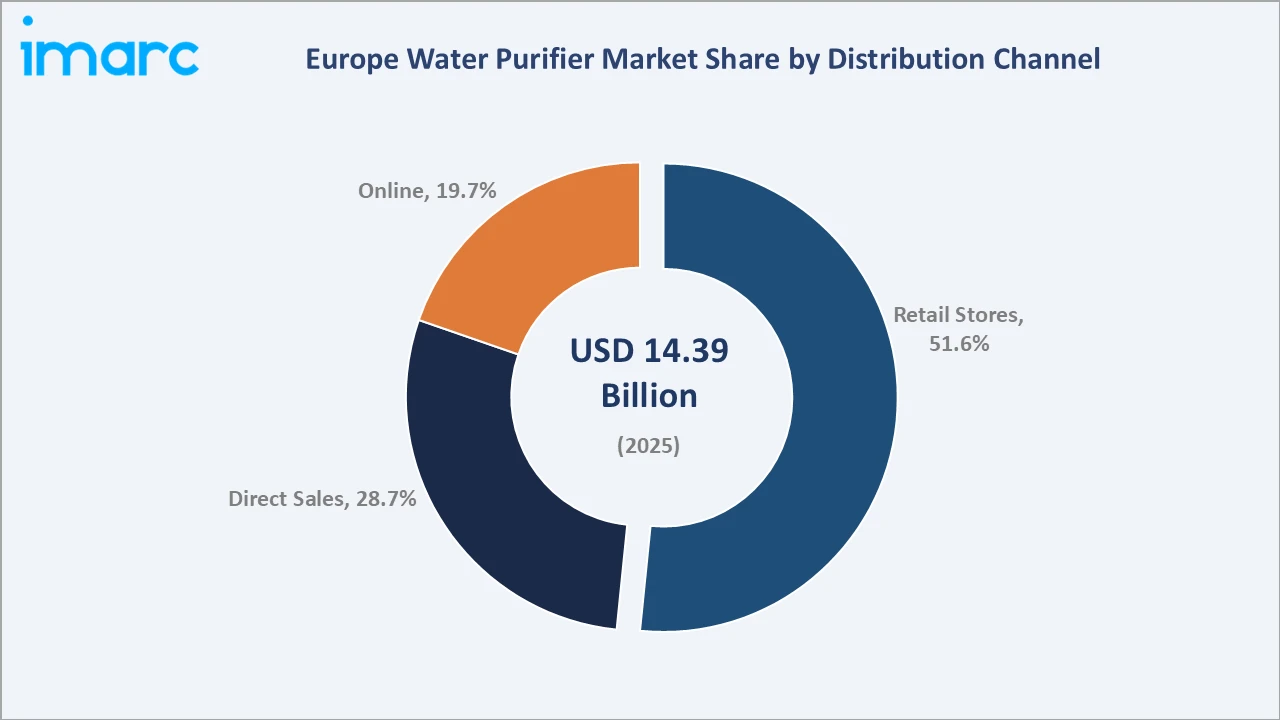
Direct sales at 28.7% is supported by manufacturer-led home consultations for whole-home systems. The channel also benefits from personalized installation support, maintenance planning, and stronger long-term customer relationships for premium water purification solutions.
Regional Market Insights
|
Country |
Share (2025) |
Key Growth Drivers |
|
Germany |
24.8% |
Strong environmental awareness, high household purchasing power, and dense retail and e-commerce distribution infrastructure |
|
United Kingdom |
20.6% |
Established replacement demand, rising hard water awareness, and wide availability across major retail chains |
|
France |
17.9% |
Growing health consciousness, expanding direct sales networks, and increasing demand for whole-home filtration |
|
Italy |
14.5% |
Rising disposable incomes, regional water quality variability, and expanding retail and online penetration |
|
Spain |
10.8% |
Increasing awareness of water hardness, growing tourism-linked hospitality demand, and expanding modern retail formats |
|
Others |
11.4% |
Gradual adoption growth supported by rising urbanization and increasing availability of affordable purifier models |
Germany at 24.8% in 2025 leads the country-wise landscape, supported by high consumer purchasing power, strong sustainability awareness, and a mature retail and service network spanning both physical stores and e-commerce platforms.
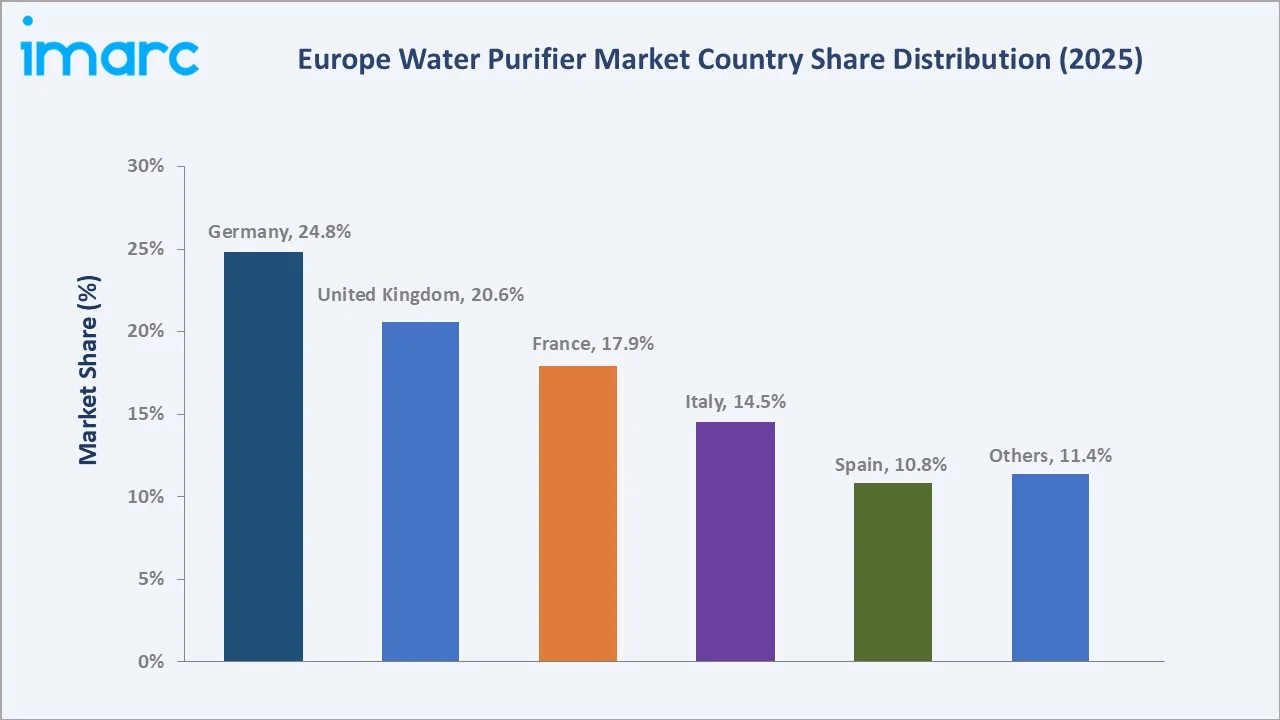
Spain at 10.8% is emerging as a fast-growing market. Rising awareness of water hardness, expanding modern retail infrastructure, and growing hospitality-sector demand are accelerating adoption across both residential and commercial segments through 2034.
Competitive Landscape
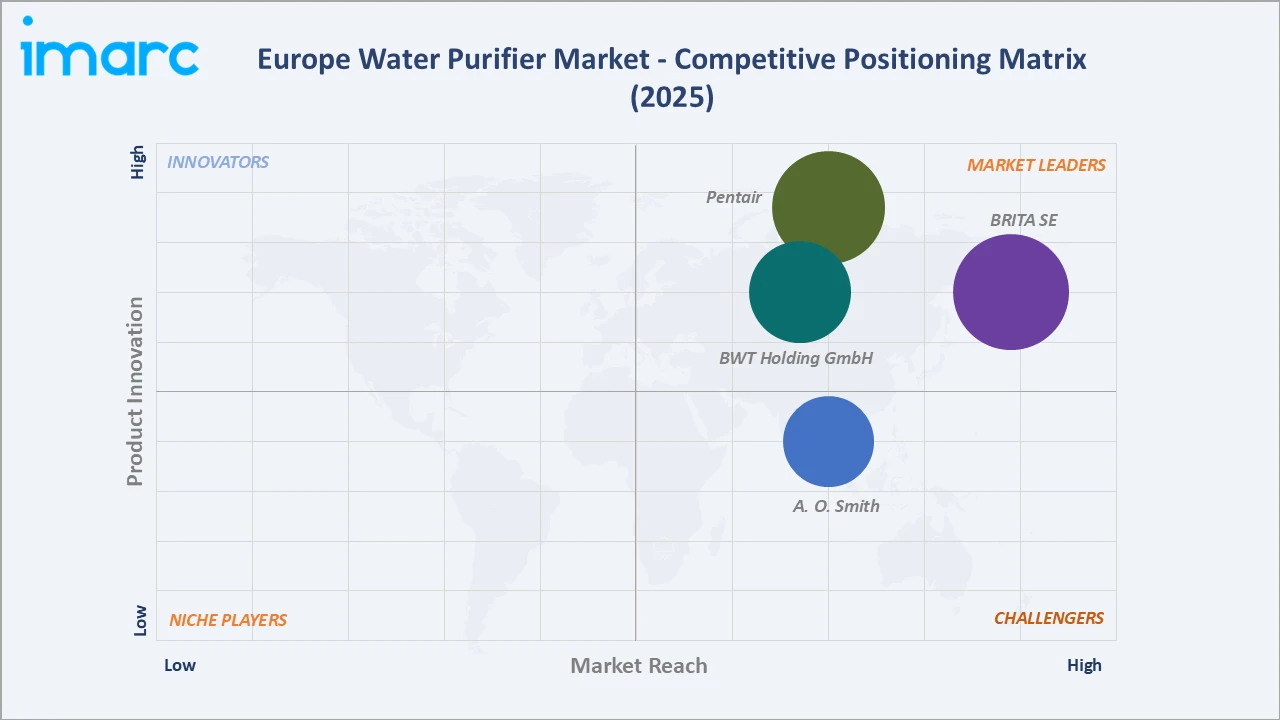
The Europe water purifier market is moderately fragmented, with established European and multinational manufacturers leading brand recognition while regional entrants compete on price and innovation. Brand strength, service network depth, and filtration technology form the key competitive differentiators.
|
Company Name |
Brand / Key Product |
Position |
Strategic Focus |
|
BWT Holding GmbH |
BWT |
Leader |
Defending its position as Europe's leading water technology company through continued innovation in softening, filtration, and RO systems |
|
BRITA SE |
BRITA Water Filters and Water Purifiers |
Leader |
Strengthening leadership in household filtration through sustainable cartridge design and expanded professional-use offerings |
|
Pentair |
Pentair |
Leader |
Broadening sustainable water treatment portfolio across residential and commercial filtration applications |
|
A. O. Smith |
A. O. Smith Water Treatment |
Challenger |
Growing European presence through product innovation in RO and whole-home filtration systems |
Key players include BWT Holding GmbH, BRITA SE, Pentair, and A. O. Smith, among others.
Key Company Profiles
BWT Holding GmbH
BWT Holding GmbH is an Austrian water treatment company recognized as one of Europe's leading water technology groups, serving residential, commercial, and industrial customers across the continent.
- Product Portfolio: Water softeners, reverse osmosis systems, UV disinfection units, and filtration devices for households, alongside commercial and industrial water treatment systems.
- Recent Developments: The company continues to strengthen its water treatment portfolio through ongoing product enhancements, technology innovation, and expansion of its distribution network across European markets.
- Strategic Focus: Advancing water treatment technologies by expanding innovation across reverse osmosis, filtration, and water softening solutions while reinforcing its leadership in the European market.
BRITA SE
BRITA SE is a German water filtration company known for its household and professional filtration solutions, distributed across Europe and other regions.
- Product Portfolio: BRITA Water Filters and Water Purifiers for household and professional use.
- Recent Developments: The company continues to expand its filtration product range and strengthen its distribution across European retail and professional channels.
- Strategic Focus: Expanding its filtration solutions portfolio through sustainable product innovation while strengthening its presence across household and professional water filtration segments.
Pentair
Pentair is a global water solutions company offering residential and commercial water treatment products across Europe and other regions.
- Product Portfolio: Residential and commercial water filtration systems, softeners, and treatment products.
- Recent Developments: The company continues to invest in expanding its water treatment portfolio and strengthening its presence across European markets.
- Strategic Focus: Enhancing its water treatment offerings by developing sustainable filtration technologies and expanding solutions for residential and commercial applications.
Market Concentration Analysis
The Europe water purifier market is moderately concentrated, with leading manufacturers accounting for a significant share of branded retail and direct sales activity across household filtration, softening, and RO categories.
Barriers to entry include the need for established retail and service networks, certification against national and EU water contact material standards, and brand trust built over years of consistent product performance. These factors favor well-capitalized incumbents with diversified product portfolios.
Consolidation continues as larger operators acquire regional distribution and service businesses to strengthen direct customer relationships, particularly in the growing rental and subscription-based service segment.
Investment & Growth Opportunities
Fastest-Growing Segments
Online is expanding fastest among distribution channels, supported by growing consumer comfort with researching filtration specifications and subscribing to cartridge replacement plans digitally. UV purifiers are also gaining share as consumers seek compact, low-maintenance disinfection solutions.
Emerging Markets
Spain and Italy represent significant untapped opportunity for manufacturers able to deliver region-specific marketing and expand modern retail and online distribution in markets with comparatively lower current purifier penetration.
Investment Trends
Investment activity is concentrated in smart filtration technology, sustainable cartridge design, and subscription-based service infrastructure, aligning with both consumer convenience expectations and tightening EU sustainability requirements.
Future Market Outlook (2026-2034)
The Europe water purifier market is forecast to expand from USD 14.39 Billion in 2025 to USD 24.10 Billion by 2034 at a CAGR of 5.72%, adding roughly USD 9.71 Billion in incremental market value over the forecast period.
Three forces will shape the market through 2034: tightening EU drinking water and sustainability regulation; the rise of smart, connected, subscription-based purifier models; and expanding consumer preference for sustainable, long-term water filtration solutions.
By 2034, the market is expected to be defined by higher online and direct sales penetration, broader hybrid RO-UV adoption, and increasing integration of sustainable, recyclable filter cartridge design across leading portfolios.
Research Methodology
Primary Research
Primary research included structured discussions with purifier manufacturers, retail and distribution partners, and installation service providers, validating market sizing, technology adoption trends, and channel mix across major European countries.
Secondary Research
Secondary sources included European Commission and European Environment Agency publications, Eurostat water statistics, national drinking water quality reports, and company annual reports, press releases, and investor presentations from listed manufacturers.
Forecasting Models
Market forecasts used top-down and bottom-up models combining household penetration rates, replacement cycle assumptions, channel mix evolution, and regulatory scenario analysis addressing sustainability and drinking water quality requirements.
Europe Water Purifier Market Report Coverage:
| Report Features | Details |
|---|---|
| Base Year of the Analysis | 2025 |
| Historical Period | 2020-2025 |
| Forecast Period | 2026-2034 |
| Units | Billion USD |
| Scope of the Report |
Exploration of Historical Trends and Hot Melts Adhesive Market Outlook, Industry Catalysts and Challenges, Segment-Wise Historical and Future Market Assessment:
|
| Technology Types Covered | Gravity Purifiers, RO Purifiers, UV Purifiers, Sediment Filter, Water Softener, Others |
| Distribution Channels Covered | Retail Stores, Direct Sales, Online |
| End Users Covered | Industrial, Commercial, Household |
| Countries Covered | Germany, United Kingdom, Italy, France, Spain, Others |
| Companies Covered | BWT Holding GmbH, BRITA SE, Pentair, A. O. Smith, etc. |
| Customization Scope | 10% Free Customization |
| Post-Sale Analyst Support | 10-12 Weeks |
| Delivery Format | PDF and Excel through Email (We can also provide the editable version of the report in PPT/Word format on special request) |
Frequently Asked Questions About the Europe Water Purifier Market Report
The Europe water purifier market was valued at USD 14.39 Billion in 2025, driven by rising water hardness concerns, sustainability regulation, and growing health awareness among consumers.
The market is projected to grow at a CAGR of 5.72% from 2026-2034, reaching USD 24.10 Billion, supported by smart purifier adoption and expanding online retail.
RO purifiers lead at 44.8% in 2025, driven by their ability to remove dissolved impurities and provide high-quality drinking water across diverse water conditions.
Retail stores lead at 51.6% in 2025, supported by extensive product availability, in-store demonstrations, and installation support for consumers.
Germany commands 24.8% share in 2025, led by strong environmental awareness, high purchasing power, and dense retail and e-commerce infrastructure.
Leading players include BWT Holding GmbH, BRITA SE, Pentair, and A. O. Smith, among others.
Smart sensors, mobile app monitoring, and hybrid RO-UV systems are enabling predictive maintenance and broader contaminant protection, supporting premiumization across the category.
High existing consumer confidence in municipal tap water in some markets, along with upfront and maintenance costs of advanced systems, can temper adoption pace in certain regions.
Need more help?
- Speak to our experienced analysts for insights on the current market scenarios.
- Include additional segments and countries to customize the report as per your requirement.
- Gain an unparalleled competitive advantage in your domain by understanding how to utilize the report and positively impacting your operations and revenue.
- For further assistance, please connect with our analysts.
 Request Customization
 Speak to an Analyst
 Request Brochure
 Inquire Before Buying
Benefits of Customization
- Personalize this research
- Triangulate with your data
- Get data as per your format and definition
- Gain a deeper dive into a specific application, geography, customer, or competitor
- Any level of personalization
Get in Touch With Us
UNITED STATES
Phone: +1-201-971-6302
INDIA
Phone: +91-120-433-0800
UNITED KINGDOM
Phone: +44-753-714-6104
Email: [email protected]
Client Testimonials




.webp)




.webp)













Related Reports

Choose your plan
*Please note that the prices mentioned below are starting prices for each bundle type. Kindly contact our team for further details.*
Single User License
- 1 User License, Access on 2 Devices
- PDF Report + Excel Dataset (Password Protected)
- Lifetime Access
- No Printing Rights
- 10% Free Report Customization
- 10–12 Weeks of Analyst Support
Five User License
- Access for 5 Users, 2 Devices per User
- PDF Report + Excel Dataset (Password Protected)
- Lifetime Access
- Dedicated Account Manager
- 12–14 Weeks of Analyst Support
- No Printing Rights
- 15% Free Report Customization
- 25% Discount on Your Next Purchase
Corporate User License
- Unlimited User Access (Within Your Organization)
- PDF Report + Excel Dataset
- Lifetime Access
- Dedicated Account Manager
- 14–20 Weeks of Analyst Support
- No Printing Rights
- 20% Free Report Customization
- 30% Discount on Your Next Purchase
Essential Insights
What's included:
3 reports
- Lifetime Access
- PDF Reports
- Excel Datasets
- 2 Weeks of Free Analyst Support
- 2 User Licenses
- Access on 2 Devices
- Printing Rights
- Complimentary PowerPoint (PPT) Version
- Complimentary License Upgrade
Professional Access
What's included:
5 reports
- Lifetime Access
- PDF Reports
- Excel Datasets
- 8 Weeks of Free Analyst Support
- 2 User Licenses
- Access on 2 Devices
- Printing Rights
- Complimentary PowerPoint (PPT) Version
- Complimentary License Upgrade
Business Advantage
What's included:
8 reports
- Lifetime Access
- PDF Reports
- Excel Datasets
- 14 Weeks of Free Analyst Support
- 2 User Licenses
- Access on 2 Devices
- Printing Rights
- Complimentary PowerPoint (PPT) Version
- Complimentary License Upgrade
Enterprise Intelligence
What's included:
10 reports
- Lifetime Access
- PDF Reports
- Excel Datasets
- 20 Weeks of Free Analyst Support
- 2 User Licenses
- Access on 2 Devices
- Printing Rights
- Complimentary PowerPoint (PPT) Version
- Complimentary License Upgrade