
GCC Digital Transformation Market Size, Share, Trends and Forecast by Type, Deployment Mode, Enterprise Size, End Use Industry, and Country, 2026-2034
GCC Digital Transformation Market Size, Share, Trends & Forecast (2026-2034)
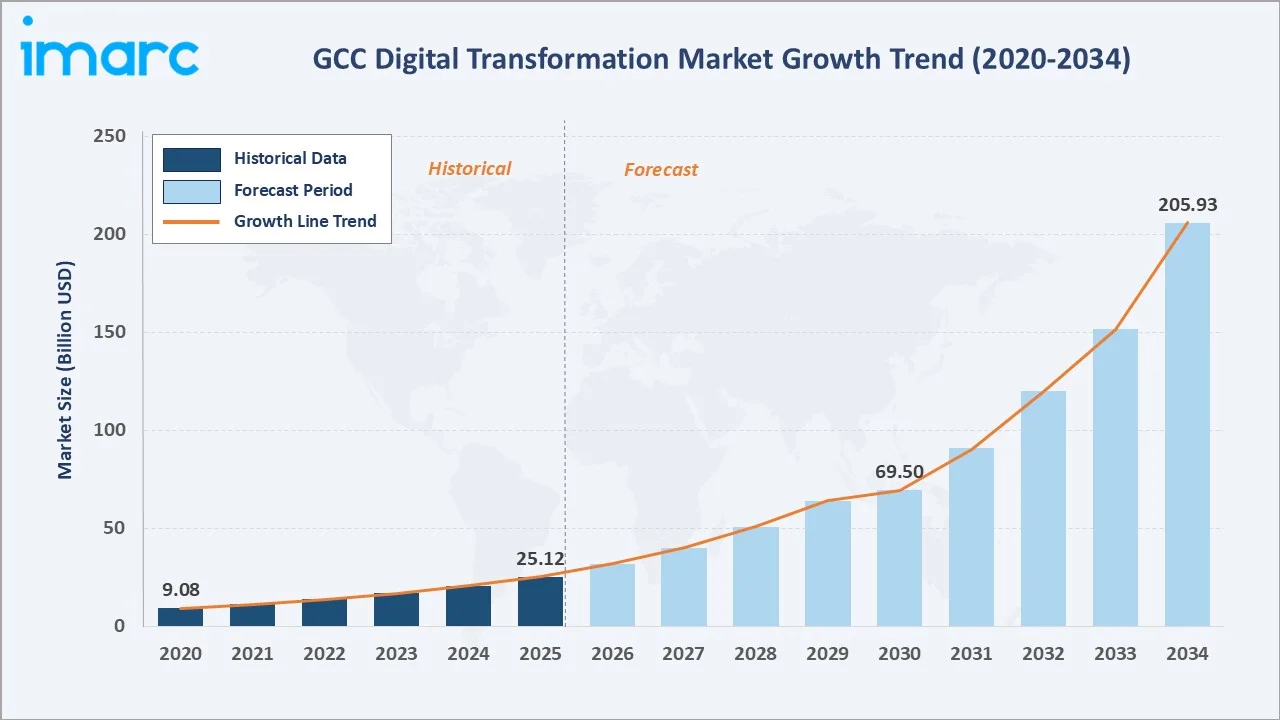
The GCC digital transformation market reached USD 25.12 Billion in 2025 and is projected to reach USD 205.93 Billion by 2034, growing at a CAGR of 22.57% during 2026-2034. Aggressive government digitalization mandates under Vision 2030, UAE Digital Government Strategy 2025, and Qatar National Vision 2030; surging AI and cloud adoption across BFSI and government sectors; and large-scale hyperscaler cloud region investments by Microsoft, Google, Oracle, and AWS are the primary growth catalysts.
Market Snapshot
|
Metric |
Value |
| Market Size (2025) |
USD 25.12 Billion |
|
Forecast Market Size (2034) |
USD 205.93 Billion |
|
CAGR (2026-2034) |
22.57% |
|
Base Year |
2025 |
|
Historical Period |
2020-2025 |
|
Forecast Period |
2026-2034 |
Saudi Arabia leads regionally with a 38.4% market share in 2025, anchored by Vision 2030's SAR 1.3 trillion investment pipeline. The solution segment commands a 62.6% share, while BFSI represents the largest end use vertical at 29.5%, driven by open banking regulation, fintech adoption, and digital banking transformation across the region.
To get more information on this market, Request Sample
The GCC digital transformation market is underpinned by three structural forces: sovereign wealth fund-backed AI and smart infrastructure programs driving large-scale technology procurement, mandatory private sector digitalization requirements embedded in Vision 2030 and equivalent national strategies, and hyperscaler cloud regions establishing local data residency infrastructure that enables cloud-first adoption by previously sovereignty-constrained government and BFSI workloads.
Executive Summary
The GCC digital transformation market is experiencing the highest technology investment growth rate of any emerging market region. The market was valued at USD 25.12 Billion in 2025 and is forecast to reach USD 205.93 Billion by 2034 at a CAGR of 22.57%. This trajectory is anchored by GCC governments' investment exceeding USD 1.2 billion for the LaunchKSA program seeking to train one programmer for every 100 Saudi citizens by 2030 while generating around 25,000 jobs in data science and artificial intelligence.
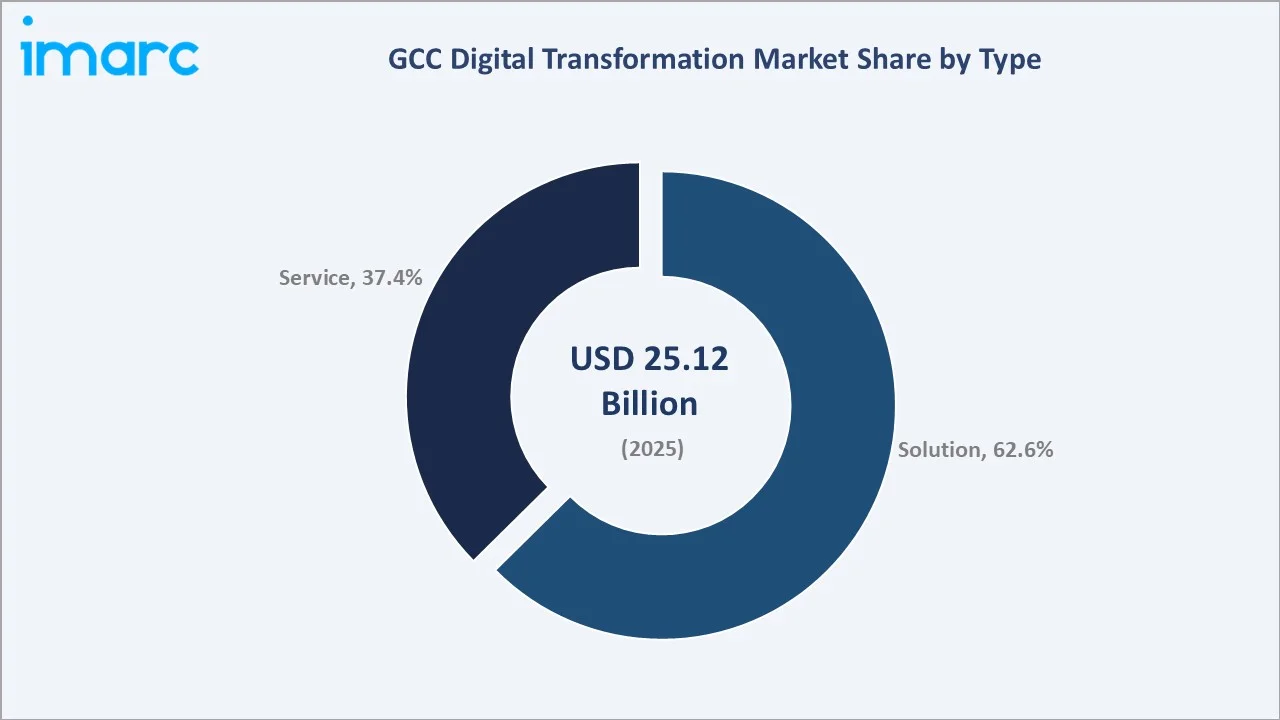
The Solution segment dominates at 62.6% in 2025, encompassing cloud platforms, AI and machine learning applications, cybersecurity solutions, enterprise resource planning (ERP) systems, and IoT platforms deployed across GCC industries. The service segment at 37.4% covers digital transformation consulting, systems integration, managed services, and technology-enabled outsourcing, growing rapidly as GCC organizations scale from pilot digitalization to enterprise-wide transformation programs.
BFSI leads end use industries at 29.5%, driven by open banking mandates, SAMA and CBUAE digital banking regulations, and the region's rapidly growing fintech ecosystem. Government at 21.4% reflects substantial e-government and smart city investment, while IT and Telecom at 18.3% is driven by 5G network rollout and telco digital transformation.
Key Market Insights
|
Insight |
Data |
| Largest Type |
Solution – 62.6% share (2025) |
| Fastest Growing Type |
Solution – ~23.5% CAGR (2026-2034) |
|
Largest End Use Industry |
BFSI – 29.5% share (2025) |
| Fastest Growing End Use Industry |
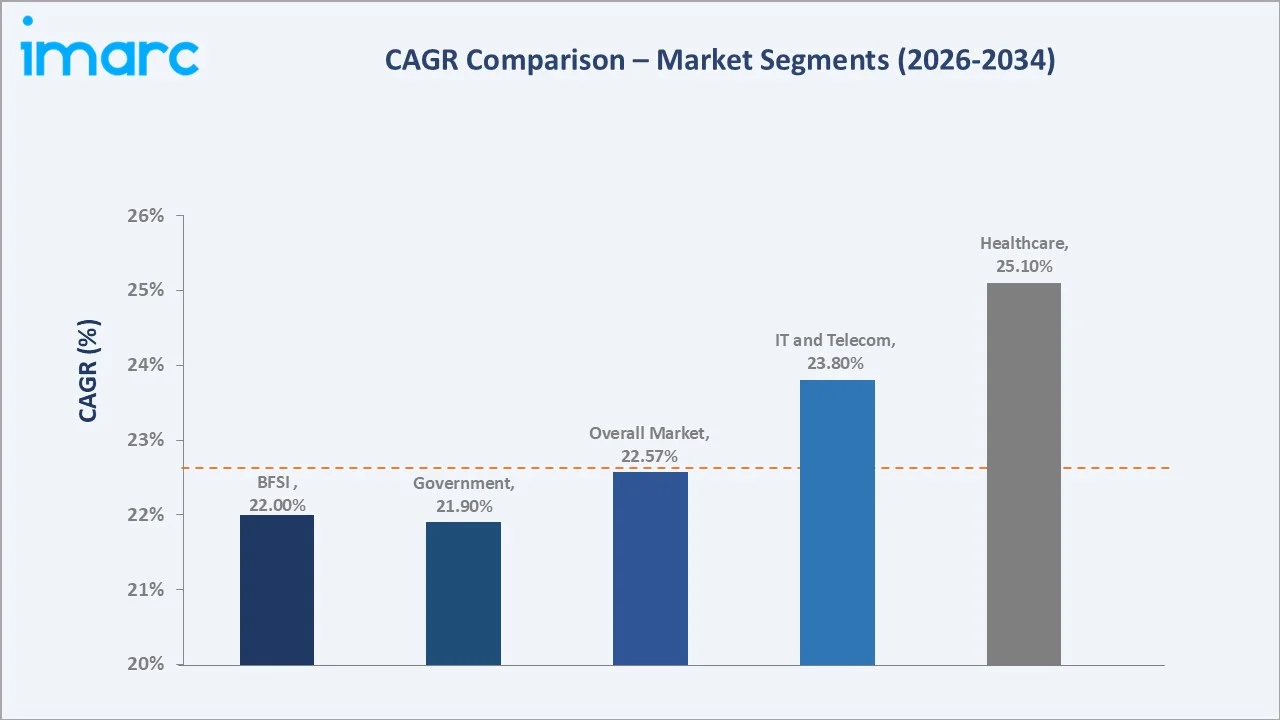
Healthcare – ~25.1% CAGR (2026-2034) |
|
Leading Country |
Saudi Arabia – 38.4% share (2025) |
| Top Companies |
Microsoft, SAP SE, Accenture, Google LLC, Cisco Systems, Inc. |
Key Analytical Observations Supporting The Above Data:
- Solution products account for 62.6% of GCC digital transformation spending in 2025, reflecting capital-intensive technology procurement patterns. Microsoft Azure's UAE and Saudi Arabia cloud regions, SAP's Riyadh Cloud Data Center, and Oracle's Muscat and Abu Dhabi cloud regions have received multi-billion-dollar investment commitments underpinning the solution segment's dominance.
- BFSI's 29.5% market leadership (2025) is structurally driven by regulatory compulsion: SAMA's Open Banking Framework mandating API-based banking infrastructure, CBUAE's digital banking regulations enabling neobank licensing, and Qatar Central Bank's digital payments strategy require every major GCC bank to invest in multi-year digital core banking, open API platforms, and AI-powered risk and compliance systems.
- Saudi Arabia's 38.4% share (2025) reflects the Kingdom's unmatched combination of sovereign technology investment scale and private sector digitalization mandate. NEOM's Tonomus platform alone represents a USD 500+ Billion intelligent infrastructure investment, while Vision 2030's National Digital Transformation Unit tracks digital progress across 24 government ministries.
- Service segment growth at 37.4% (2025) is accelerating as GCC organizations transition from technology procurement to sustainable transformation execution. Aramco Digital and Accenture partnered to accelerate generative AI adoption and digital workforce development in Saudi Arabia using Accenture LearnVantage’s AI-powered learning platform.
GCC Digital Transformation Market Overview
Digital transformation in the GCC context encompasses the integration of advanced digital technologies, including cloud computing, artificial intelligence and machine learning, the Internet of Things, robotic process automation, blockchain, and cybersecurity, into government, enterprise, and public service operations across all six GCC member states.
Macroeconomic enablers include GCC governments collectively allocating 2.5–4.0% of GDP annually to technology investment, hyperscaler cloud regions in the UAE, Saudi Arabia, Qatar, and Oman creating data-sovereign infrastructure enabling government cloud migration, and 5G penetration projected to exceed 85% across the GCC by 2027.
Market Dynamics
To evaluate market opportunities, Request Sample
Market Drivers
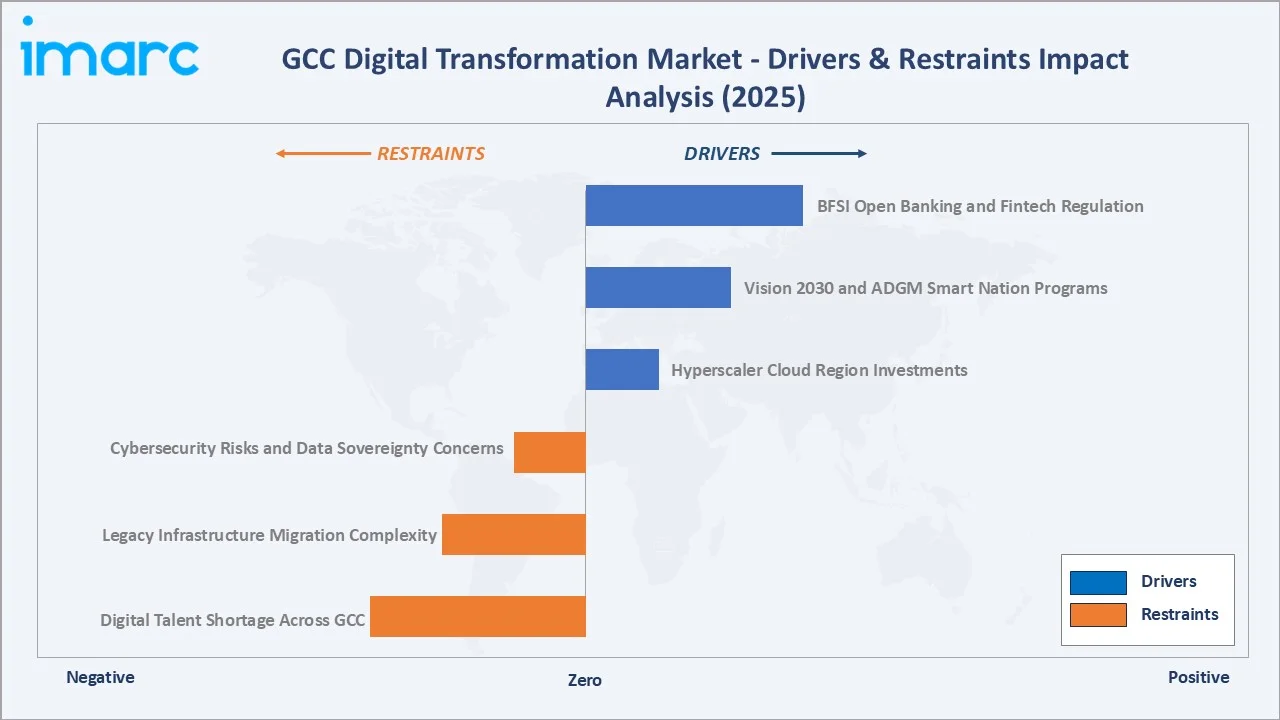
- Hyperscaler Cloud Region Investments: Microsoft's USD 15.2 Billion UAE cloud expansion between 2023 and 2029, Google Cloud's USD 1 Billion Saudi Arabia investment, and AWS's three-region GCC footprint collectively represent over USD 10 Billion in committed cloud infrastructure that unlocks government and enterprise cloud migration previously constrained by data sovereignty requirements.
- Vision 2030 and ADGM Smart Nation Programs: Saudi Arabia's National Digital Transformation Unit, UAE's Ministry of Artificial Intelligence, and Qatar's MCIT are driving mandated, funded, and monitored digital transformation across public and private sectors. Saudi Arabia's IKTVA program requires defense and energy contractors to invest in local digital capability, while UAE's Operation 300bn mandates digital integration for all licensed manufacturers, creating enforced transformation demand.
- BFSI Open Banking and Fintech Regulation: SAMA's Open Banking Framework, CBUAE's digital banking licensing, and Qatar Central Bank's fintech sandbox mandate digital banking infrastructure investment across the GCC's USD 3.5 trillion banking sector, creating unavoidable technology transformation expenditure for all licensed financial institutions.
Market Restraints
- Cybersecurity Risks and Data Sovereignty Concerns: Oman's Personal Data Protection Law, UAE's Federal Personal Data Protection Law, and Saudi Arabia's PDPL impose strict data localization requirements that increase compliance complexity for cloud adoption and cross-border digital service delivery, constraining the pace of full digital transformation for multi-national organizations operating across GCC jurisdictions.
- Legacy Infrastructure Migration Complexity: GCC governments and enterprises, particularly in BFSI and manufacturing, maintain substantial legacy IT infrastructure whose migration to cloud-native architectures requires multi-year programs with significant service disruption risk. Core banking mainframe migrations and on-premises ERP decommissioning create execution challenges that slow transformation timelines and increase project cost overruns.
- Digital Talent Shortage Across GCC: The gap between required digital skills and available GCC workforce capability represents the market's most binding constraint. GCC nationalization programs require proportional national citizen hiring in technology roles, while the specialist digital talent pool remains limited relative to demand, driving high salary premiums.
Market Opportunities
- Smart City and Urban Digital Infrastructure: NEOM, Masdar City, Lusail Smart City, and Seaplane City represent USD 750+ Billion in smart city investment requiring intelligent city platforms, digital twin infrastructure, IoT sensor networks, and AI-driven city management systems, among the largest discrete digital transformation deployment opportunities globally.
- Healthcare Digital Transformation: GCC healthcare digitalization encompasses electronic medical records, telemedicine platforms, AI-powered diagnostics, and digital health data integration across 250+ new hospital projects requiring digital-first patient care platforms. Healthcare is the fastest-growing end use industry segment at approximately 25.1% CAGR through 2034.
Market Challenges
- Change Management and Digital Culture Adoption: 40–60% of GCC digital transformation investments underperform against stated objectives due to change management gaps rather than technology failures, representing a significant efficiency challenge. User adoption training, process redesign, and organizational culture change consistently lag behind technical solution deployment across government and enterprise programs.
- Vendor Lock-in and Platform Dependency: GCC organizations committing to multi-year hyperscaler cloud contracts and enterprise platform deployments face increasing platform dependency limiting negotiating leverage on renewals and creating barriers to adopting best-of-breed emerging solutions. Managing multi-vendor ecosystems while avoiding critical dependency concentration is an increasing strategic concern for GCC CIOs.
Emerging Market Trends
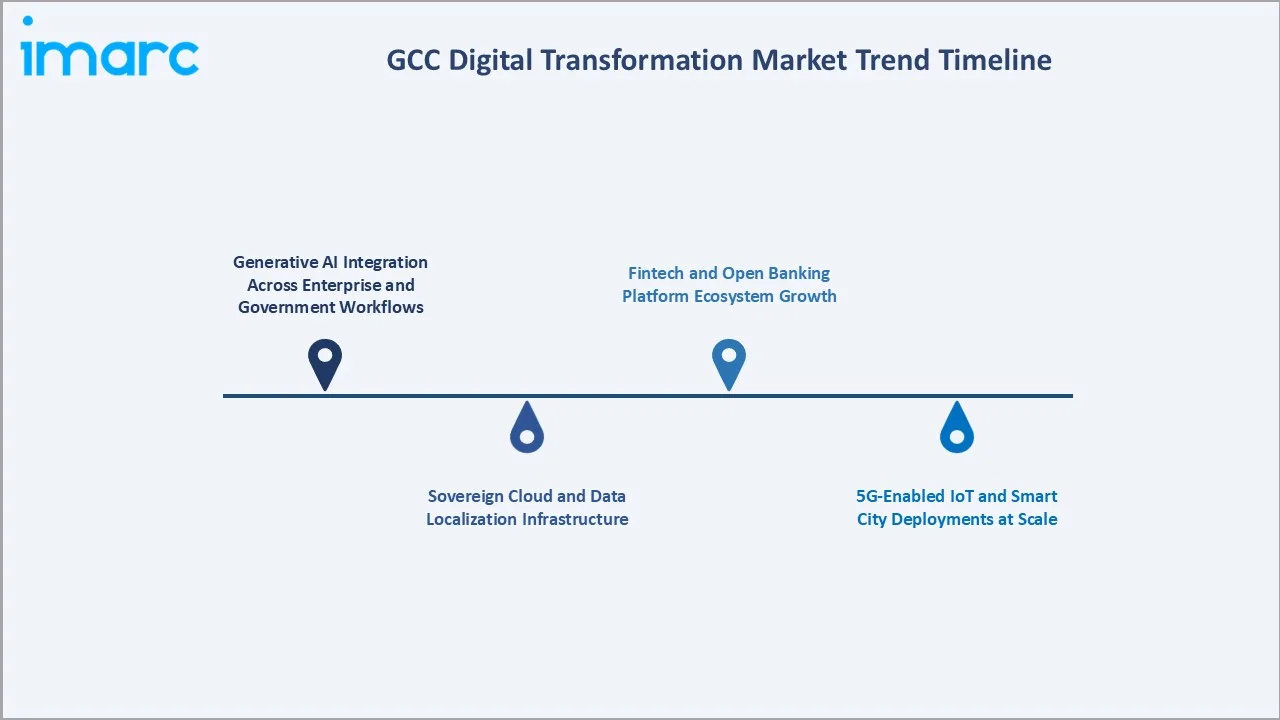
1. Generative AI Integration Across Enterprise and Government Workflows
In May 2025, Cisco partnered with Saudi Arabia’s HUMAIN to develop secure, scalable, cloud-based AI infrastructure, supporting the Kingdom’s ambition to become a global AI and digital innovation hub. Microsoft's Azure OpenAI Service secured government cloud approval across Saudi Arabia and the UAE, enabling Arabic-language generative AI deployment across public sector workflows.
2. Sovereign Cloud and Data Localization Infrastructure
e& enterprise plans to launch OneCloud, a UAE-sovereign hyperscale cloud platform powered by Oracle Alloy, offering more than 200 locally hosted cloud and AI services.
Designed for government and regulated industries, the platform will provide in-country data residency, AI-ready infrastructure, hybrid-cloud integration, and locally managed advisory and support services.
3. 5G-Enabled IoT and Smart City Deployments at Scale
Ooredoo completed the first phase of its 5G deployment at Hamad Port’s Container Terminal 2, making it the Middle East’s first 5G-enabled seaport. The network supports remote crane operations, connected assets, real-time inspections, maintenance, and data connectivity, improving port automation, efficiency, and productivity.
4. Fintech and Open Banking Platform Ecosystem Growth
Saudi Arabia's open banking Phase 2 activation enabled 40+ fintech companies to access bank API infrastructure, creating a domestic embedded finance platform market. UAE's CBUAE licensed entities increased by 2.5% from 560 in 2024 to 574 in 2025, each requiring full-stack digital core banking platform deployment, generating sustained demand for cloud-native banking technology vendors including Temenos, Mambu, and Oracle FSS.
Industry Value Chain Analysis
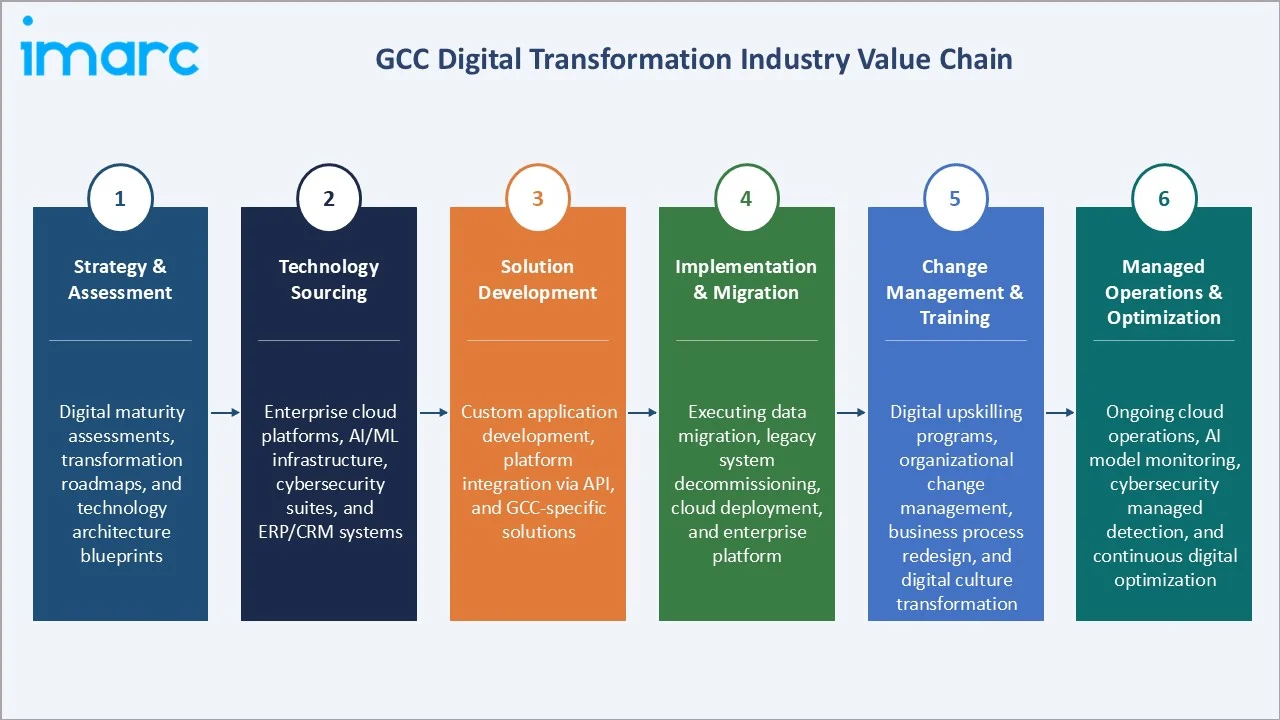
The GCC digital transformation value chain spans strategic assessment through managed operations, with each stage requiring specialized technology expertise, GCC-regulatory compliance knowledge, and Arabic-language delivery capability to achieve sustainable transformation outcomes.
|
Stage |
Key Players / Examples |
|
Strategy & Assessment |
Digital maturity assessments, transformation roadmaps, and technology architecture blueprints |
| Technology Sourcing |
Enterprise cloud platforms, AI/ML infrastructure, cybersecurity suites, and ERP/CRM systems |
|
Solution Development |
Custom application development, platform integration via API, and GCC-specific solutions |
|
Implementation & Migration |
Executing data migration, legacy system decommissioning, cloud deployment, and enterprise platform |
|
Change Management & Training |
Digital upskilling programs, organizational change management, business process redesign, and digital culture transformation |
|
Managed Operations & Optimization |
Ongoing cloud operations, AI model monitoring, cybersecurity managed detection, and continuous digital optimization |
Technology Landscape in the GCC Digital Transformation Industry
Cloud Computing and Hyperscaler Platforms
Cloud computing represents the foundational technology layer underpinning the GCC's digital transformation architecture. Microsoft Azure, AWS, Google Cloud, and Oracle Cloud each maintain sovereign-compliant cloud regions across GCC member states, providing compute, storage, database, AI/ML, and DevOps platform services.
Artificial Intelligence and Machine Learning Platforms
AI/ML is the fastest-growing technology category within GCC digital transformation. Generative AI, particularly Arabic-language LLM deployments for government services, AI-powered customer service in BFSI, and predictive maintenance in oil and gas, is driving the highest per-project AI investment values. Microsoft's Azure OpenAI Service, Google Cloud's Vertex AI, and SAP's Joule are leading GCC enterprise AI platforms, while UAE's G42 and Saudi Arabia's Humain represent indigenous sovereign AI development.
Cybersecurity and Digital Trust Infrastructure
Cybersecurity represents the fastest-growing sub-category of GCC digital transformation services. Palo Alto Networks, Fortinet, and Check Point lead the hardware and platform cybersecurity market, while regional managed detection and response specialists secure government and defense workloads with Arabic-speaking analyst teams.
Enterprise Platforms: ERP, CRM, and Digital Process Automation
SAP S/4HANA, Oracle ERP Cloud, and Microsoft Dynamics 365 are the dominant enterprise platforms across GCC government and corporate transformation. In October 2025, SAP announced plans to deploy its complete SAP Business Network for Saudi Arabia’s public sector, with the platform hosted on Google Cloud. Salesforce CRM is deployed across GCC banks and telecoms for digital customer experience transformation, while UiPath and Microsoft Power Automate lead robotic process automation in GCC BFSI and government back-office digitalization.
Market Segmentation Analysis
The report covers the following segments:
|
Segment Category |
Leading Segment |
Market Share |
Year |
|
Type |
Solution |
62.6% |
2025 |
| Deployment Mode | Cloud-based |
68.7% |
2025 |
| Enterprise Size |
Large Enterprises |
57.2% |
2025 |
| End Use Industry |
BFSI |
29.5% |
2025 |
|
Country |
Saudi Arabia |
38.4% |
2025 |

By Type
The type segment is analyzed across Solution (62.6%) and service (37.4%). Solution dominates, reflecting the GCC's capital-intensive technology procurement patterns, with large-scale cloud platform, AI, and enterprise software deployments commanding high absolute spend values across government and corporate transformation programs.
To access detailed market analysis, Request Sample
The service segment at 37.4% encompasses transformation consulting, system integration, cloud migration, managed cloud operations, and technology-enabled outsourcing, growing rapidly as implementation program backlogs expand faster than internal GCC IT talent supply.
By End Use Industry
The end use industry segment is led by BFSI (29.5%), government (21.4%), IT and Telecom (18.3%), manufacturing and retail (15.8%), and healthcare (9.6%). BFSI leads due to mandatory regulatory digitalization requirements and the sector's highest per-transaction IT investment intensity across GCC financial institutions.
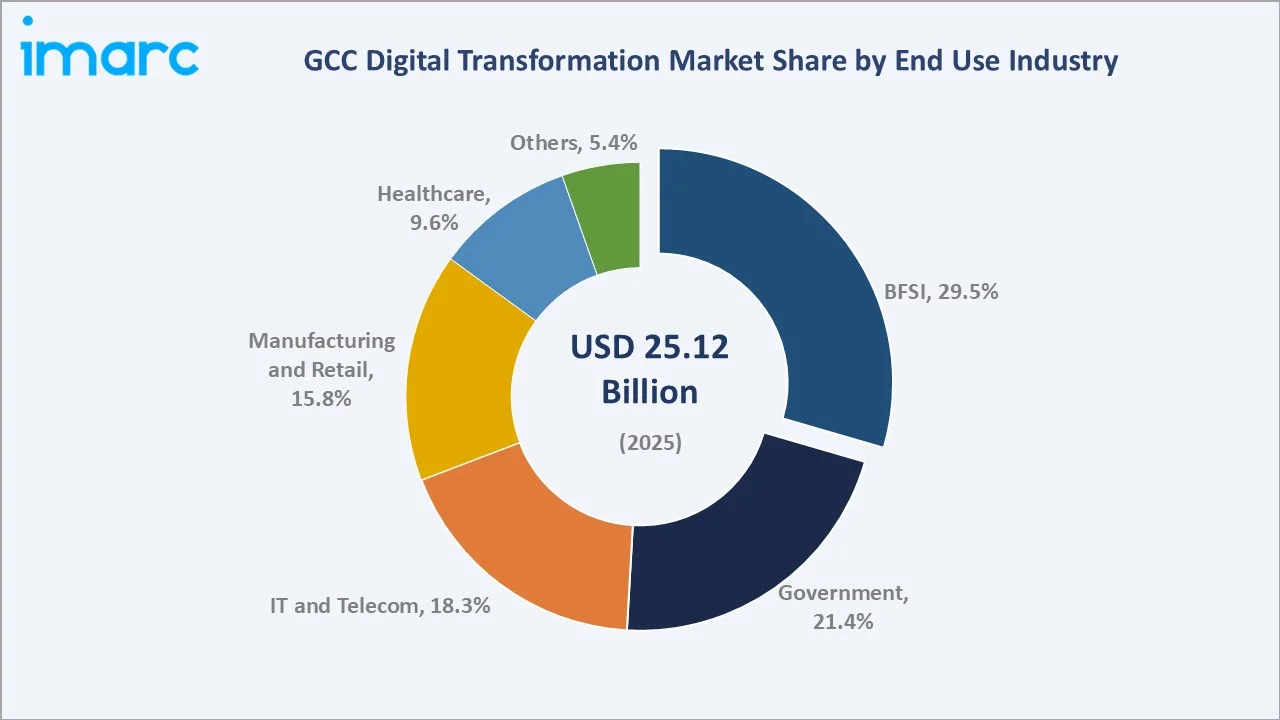
Government at 21.4% reflects direct sovereign investment in e-government, smart city, and digital public service platforms. IT and telecom at 18.3% reflects operators executing their own digital transformation from connectivity to digital services platforms. Manufacturing and retail at 15.8% encompasses Aramco's digital oilfield program, SABIC's Industry 4.0 digitalization, and GCC retail omnichannel commerce transformation.
Regional Market Insights
Saudi Arabia's 38.4% market leadership reflects Vision 2030 mobilizing over SAR 1.3 trillion in national investment with explicit, KPI-tracked digital transformation commitments across all 24 government ministries and the private sector. UAE at 28.7% represents the GCC's most advanced digital economy by per-capita adoption, leading the region in consumer digital service maturity and enterprise cloud penetration despite smaller absolute market scale.
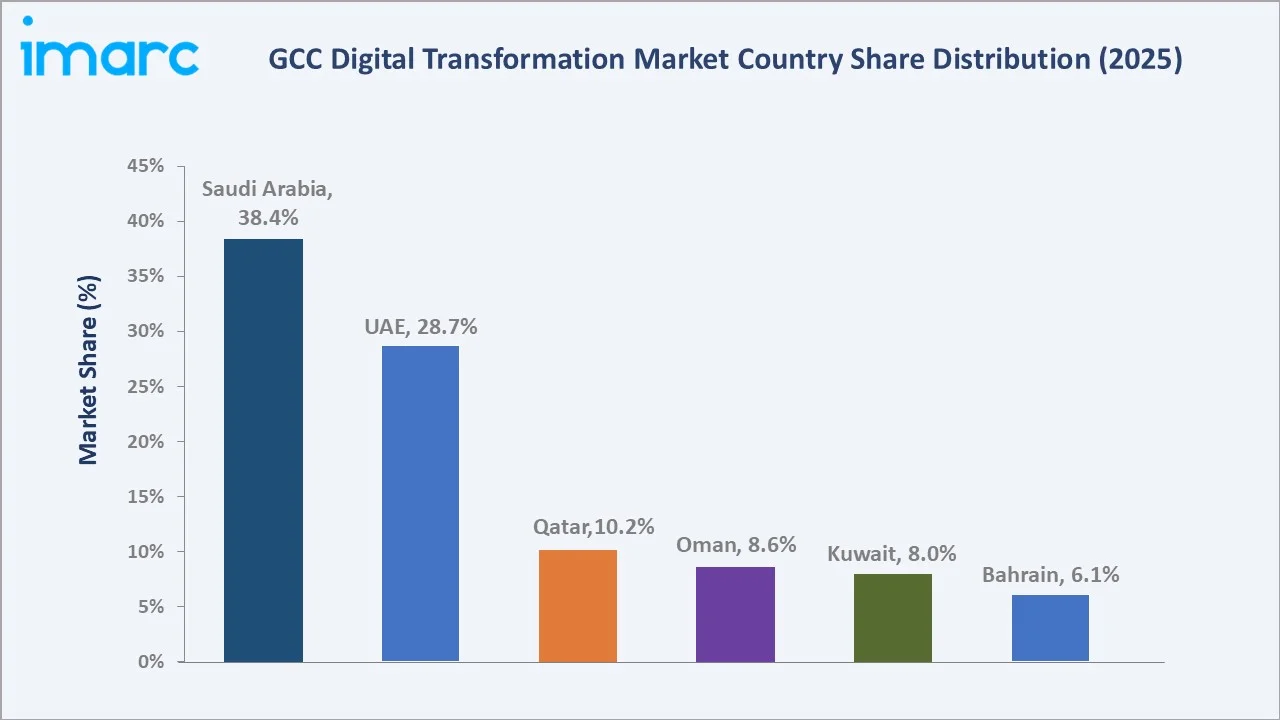
Qatar's digital transformation is anchored by National Vision 2030's digital economy pillar and MCIT's Smart Qatar 2030 program covering e-government, smart city, and digital education. Qatar's data sovereignty requirements increase in colocation demand and directly catalyzed hyperscaler cloud investment from Oracle and others, creating a rapidly growing data-sovereign cloud market.
| Country |
Share (2025) |
Key Growth Drivers |
| Saudi Arabia |
38.4% |
National digital transformation vision driving large-scale technology investment; sovereign AI initiatives and smart city development; open banking regulatory reforms |
|
UAE |
28.7% |
National AI strategy accelerating public and private sector adoption; expanding hyperscaler cloud infrastructure; neobank licensing framework supporting fintech growth |
|
Qtar |
10.2% |
Smart city and digital government vision programs; regulatory sandbox frameworks supporting fintech innovation |
|
Oman |
8.6% |
National digital pillar strategy driving public sector modernization; personal data protection law accelerating cloud migration; expanding regional cloud infrastructure investment |
|
Kuwait |
8.0% |
National ICT strategy supporting digital infrastructure rollout; long-term economic vision driving technology adoption; banking sector open banking pilots |
| Bahrain |
6.1% |
Smart economy initiatives fostering fintech and digital services growth; open banking framework enabling financial innovation |
Competitive Landscape
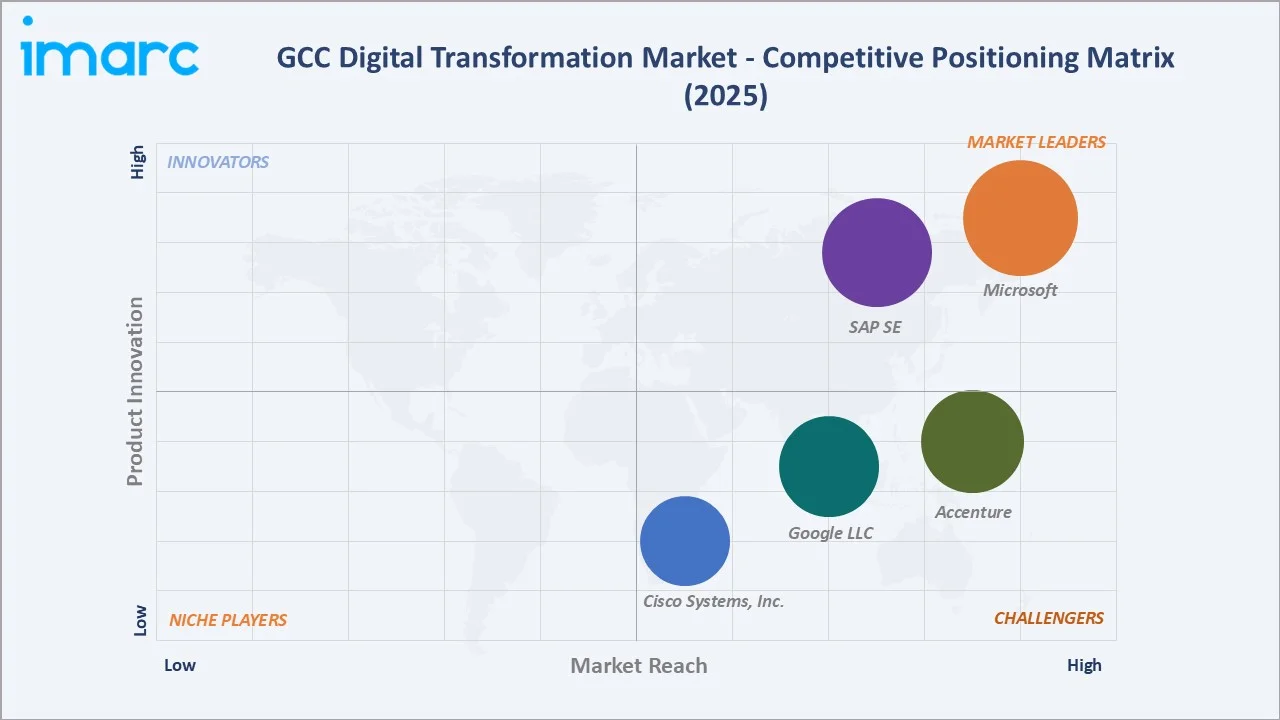
The GCC digital transformation market exhibits fragmented competition at the solution layer alongside moderate concentration at the enterprise platform and system integration layer, where companies hold significant market presence through long-term government and corporate contracts.
|
Company Name |
Brands/Products |
Market Position |
Core Strength |
|
Microsoft |
Azure cloud platform and sovereign cloud regions, Microsoft 365 and Teams collaboration, Dynamics 365 ERP and CRM, Azure OpenAI Service and Microsoft Copilot, among others |
Market Leader |
Azure cloud regions UAE and KSA; Azure OpenAI GovCloud; Dynamics 365 ERP/CRM; Copilot AI across enterprise |
| SAP SE |
SAP S/4HANA intelligent ERP, SuccessFactors HCM; Ariba procurement, Customer Experience suite, among others |
Market Leader |
S/4HANA government ERP; Riyadh Cloud Data Center; Joule AI business assistant; world's largest single S/4HANA deployment at Saudi Ministry of Finance |
|
Accenture |
Digital transformation consulting; cloud migration and managed services; AI strategy and implementation; cybersecurity services; SAP and Salesforce system integration |
Strong Challenger |
USD 320M Aramco managed services; Vision 2030 program delivery; AI and cloud transformation; GCC local delivery center with 5,000+ consultants |
| Google LLC | Google Cloud, Google Workspace, Chrome Enterprise, Android Enterprise, Gemini, among others | Strong Challenger |
Google Cloud KSA sovereign investment; Vertex AI enterprise platform; Google Workspace government |
| Cisco Systems, Inc. | Cisco Cloud Control, Cisco IQ, Silicon One, Smart Switches, Unified Edge, Webex, among others | Challenger | AI Innovation Center Riyadh with MCIT (July 2025); 5G network infrastructure; IoT connectivity platforms for smart cities and ports |
Global technology majors dominate large-scale government cloud and enterprise platform contracts through certified compliance with GCC data sovereignty regulations, established local delivery center investments, and multi-year contractual frameworks.
Key Company Profiles
Microsoft
Microsoft is the GCC's dominant digital transformation platform provider through Azure cloud, Microsoft 365, Dynamics 365, and Azure OpenAI Service. Microsoft's GCC investment represents the region's largest single technology vendor CAPEX commitment.
- Product Portfolio: Azure cloud platform and sovereign cloud regions; Microsoft 365 and Teams collaboration; Dynamics 365 ERP and CRM; Azure OpenAI Service and Microsoft Copilot; Power Platform for low-code automation; GitHub for enterprise DevOps and developer productivity.
- Recent Developments: In February 2026, Aramco and Microsoft signed a non-binding MoU to explore Azure-based industrial AI solutions, sovereign cloud infrastructure, data-residency controls, and operational digitalization across Aramco’s global activities.
- Strategic Focus: Sovereign AI and Arabic LLM deployment; government cloud migration acceleration; Copilot AI enterprise productivity adoption; Azure OpenAI API government cloud certification across all GCC member states.
SAP SE
SAP SE is one of the dominant enterprise ERP and business platform providers across GCC government and large enterprise accounts. SAP's Riyadh Cloud Data Center, serves as the regional hub for GCC government SAP deployments.
- Product Portfolio: SAP S/4HANA intelligent ERP; SuccessFactors HCM; Ariba procurement; Customer Experience suite; SAP Analytics Cloud; Business Technology Platform (BTP); Joule AI business assistant embedded across all SAP products with Arabic-language NLP capability.
- Recent Developments: At LEAP 2025, SAP SE and Saudi Arabia’s Ministry of Investment discussed expanding collaboration, strategic partnerships, and innovative technology solutions to accelerate digital transformation. SAP reaffirmed its commitment to supporting the Ministry’s digital ambitions and strengthening Saudi Arabia’s technology-driven economy under Vision 2030.
- Strategic Focus: GCC government RISE with SAP cloud migration program; Joule Arabic AI assistant commercialization; BTP extension ecosystem for GCC-specific compliance; Industry Cloud for Saudi petrochemical and energy sector digital operations.
Market Concentration Analysis
The GCC digital transformation market exhibits a bifurcated concentration structure: high concentration at the enterprise platform and hyperscaler cloud layer, and moderate-to-low concentration at the services delivery layer where 50+ system integrators, consulting firms, and managed service providers compete for transformation program delivery mandates.
Market consolidation in the services layer is occurring as global technology majors build larger professional services capabilities to capture end-to-end transformation contracts, and regional system integrators expand from hardware and infrastructure into managed cloud and AI services.
The Saudi Arabia market, characterized by the highest absolute investment concentration in the GCC, is increasingly directing government transformation programs toward multi-tower managed services contracts that consolidate multiple providers into single prime contractor relationships, accelerating services market consolidation.
Investment & Growth Opportunities
Fastest Growing Segments
Generative AI and Arabic LLM platforms (~35%+ CAGR), sovereign cloud and data-sovereign managed services (~28% CAGR), healthcare digital transformation (~25.1% CAGR), and open banking and fintech infrastructure (~23% CAGR) represent the highest-growth investment vectors through 2034.
Emerging Market Expansion
Saudi Arabia's secondary transformation wave represents an incremental USD 30+ Billion addressable market through 2030. Oman and Kuwait, currently the most underpenetrated GCC digital transformation markets relative to GDP, represent the highest growth rate opportunities for technology vendors willing to establish local delivery capability in less competitive markets.
Venture and Institutional Investment Trends
- GCC governments' cloud-first policies and hyperscaler sovereignty agreements are creating guaranteed, long-duration cloud consumption curves that enable technology vendors to underwrite multi-year infrastructure investment with greater certainty, attracting institutional capital into GCC-focused cloud infrastructure and digital service delivery platforms at scale.
- GCC fintech venture capital investment reached a record USD 2.1 Billion in 2025, with open banking-enabled embedded finance, Islamic fintech, and B2B payments digitalization attracting the majority of deal flow, creating a portfolio of scale-up fintech companies requiring ongoing digital platform investment that sustains enterprise technology demand beyond initial deployment phases.
Future Market Outlook (2026-2034)
The GCC digital transformation market is positioned for exceptional, sustained growth through 2034. From a base of USD 25.12 Billion in 2025, the market is projected to reach USD 205.93 Billion by 2034 at a CAGR of 22.57%, representing USD 180.81 Billion in incremental value creation. This growth is structurally assured by the GCC's economic diversification imperative, with hydrocarbon revenue dependence reduction requiring digital economy GDP contribution to grow from approximately 5% (2025) to a targeted 20%+ by 2034 across the region.
Generative AI and AI-driven automation are projected to account for USD 42+ Billion of total GCC digital transformation spend by 2030, displacing traditional software licensing and manual professional services as the primary value-creation mechanism. Arabic-language AI capabilities will become a competitive necessity, with GCC governments and enterprises requiring Arabic-native AI across all customer-facing and internal productivity applications.
Research Methodology
Primary Research
Primary research comprised structured interviews with over 95 industry participants in 2024–2025, including Chief Information Officers, Chief Digital Officers, digital transformation program directors, technology vendor GCC sales leadership, and government digitalization agency representatives across all six GCC member states.
Secondary Research
Secondary research encompassed GCC national digital strategy documents, hyperscaler and enterprise technology vendor GCC investor disclosures and regional market statements, government ICT budget allocations and procurement announcements, World Bank digital economy indicators, and technology analyst publications from IDC, Gartner, and Forrester covering Middle East digital transformation.
Forecasting Models
Market size estimations were derived using top-down and bottom-up forecasting, incorporating GCC government ICT budget trajectories, private sector technology investment projections calibrated against GCC-specific investment premiums, end use industry digital maturity models, and technology adoption diffusion curves.
GCC Digital transformation Market Report Coverage:
| Report Features | Details |
|---|---|
| Base Year of the Analysis | 2025 |
| Historical Period | 2020-2025 |
| Forecast Period | 2026-2034 |
| Units | Billion USD |
| Scope of the Report | Exploration of Historical and Forecast Trends, Industry Catalysts and Challenges, Segment-Wise Historical and Predictive Market Assessment:
|
| Types Covered |
|
| Deployment Modes Covered | Cloud-based, On-premises |
| Enterprise Sizes Covered | Large Enterprises, Small and Medium-sized enterprises |
| End Use Industries Covered | BFSI, Manufacturing and Retail, Government, Healthcare, IT and Telecom, Others |
| Countries Covered | Saudi Arabia, UAE, Qatar, Bahrain, Kuwait, Oman |
| Companies Covered |
Microsoft, SAP SE, Accenture, Google LLC, Cisco Systems, Inc., etc. |
| Customization Scope | 10% Free Customization |
| Post-Sale Analyst Support | 10-12 Weeks |
| Delivery Format | PDF and Excel through Email (We can also provide the editable version of the report in PPT/Word format on special request) |
Key Benefits for Stakeholders:
- IMARC’s report offers a comprehensive quantitative analysis of various market segments, historical and current market trends, market forecasts, and dynamics of the GCC digital transformation market from 2020-2034.
- The research study provides the latest information on the market drivers, challenges, and opportunities in the GCC digital transformation market.
- Porter's five forces analysis assist stakeholders in assessing the impact of new entrants, competitive rivalry, supplier power, buyer power, and the threat of substitution. It helps stakeholders to analyze the level of competition within the GCC digital transformation industry and its attractiveness.
- Competitive landscape allows stakeholders to understand their competitive environment and provides an insight into the current positions of key players in the market.
Frequently Asked Questions About the GCC Digital Transformation Market Report
The GCC digital transformation market reached USD 25.12 Billion in 2025 and is projected to reach USD 205.93 Billion by 2034.
The market is expected to grow at a CAGR of 22.57% during 2026-2034, driven by Vision 2030 government mandates, hyperscaler cloud region investments, generative AI adoption, and BFSI open banking digitalization across all six GCC member states.
Saudi Arabia leads with a 38.4% market share in 2025, anchored by Vision 2030's National Transformation Program, Tonomus/NEOM's sovereign AI infrastructure, SAMA's open banking framework, and the Kingdom's national investment pipeline with explicit digital transformation commitments across all government ministries.
Solution dominates with a 62.6% share in 2025, driven by GCC governments' and enterprises' capital-intensive procurement of cloud platforms, AI/ML systems, enterprise ERP and CRM software, and cybersecurity solutions as the primary phase of their digital transformation investment cycles.
BFSI holds the largest end use industry share at 29.5%, driven by mandatory open banking API infrastructure investment, Central Bank digital banking regulations across SAMA, CBUAE, and Qatar Central Bank, and the GCC banking sector's asset base requiring comprehensive digital core banking, risk management, and customer experience platform transformation.
Some of the key players include Microsoft, SAP SE, Accenture, Google LLC, and Cisco Systems, Inc.
Key drivers include hyperscaler cloud region investments unlocking data-sovereign cloud adoption, Vision 2030 and UAE National AI Strategy creating enforced digitalization demand, BFSI open banking regulatory requirements, and private sector digital business model requirements driven by digitally native GCC consumer populations.
Key challenges include cybersecurity risk and data sovereignty compliance complexity, legacy infrastructure migration costs and execution risk, digital talent shortages exacerbated by workforce nationalization requirements, and vendor platform lock-in risk in multi-year hyperscaler and enterprise platform contracts.
Need more help?
- Speak to our experienced analysts for insights on the current market scenarios.
- Include additional segments and countries to customize the report as per your requirement.
- Gain an unparalleled competitive advantage in your domain by understanding how to utilize the report and positively impacting your operations and revenue.
- For further assistance, please connect with our analysts.
 Request Customization
 Speak to an Analyst
 Request Brochure
 Inquire Before Buying
Benefits of Customization
- Personalize this research
- Triangulate with your data
- Get data as per your format and definition
- Gain a deeper dive into a specific application, geography, customer, or competitor
- Any level of personalization
Get in Touch With Us
UNITED STATES
Phone: +1-201-971-6302
INDIA
Phone: +91-120-433-0800
UNITED KINGDOM
Phone: +44-753-714-6104
Email: [email protected]
Client Testimonials




.webp)




.webp)













Related Reports

Choose your plan
*Please note that the prices mentioned below are starting prices for each bundle type. Kindly contact our team for further details.*
Single User License
- 1 User License, Access on 2 Devices
- PDF Report + Excel Dataset (Password Protected)
- Lifetime Access
- No Printing Rights
- 10% Free Report Customization
- 10–12 Weeks of Analyst Support
Five User License
- Access for 5 Users, 2 Devices per User
- PDF Report + Excel Dataset (Password Protected)
- Lifetime Access
- Dedicated Account Manager
- 12–14 Weeks of Analyst Support
- No Printing Rights
- 15% Free Report Customization
- 25% Discount on Your Next Purchase
Corporate User License
- Unlimited User Access (Within Your Organization)
- PDF Report + Excel Dataset
- Lifetime Access
- Dedicated Account Manager
- 14–20 Weeks of Analyst Support
- No Printing Rights
- 20% Free Report Customization
- 30% Discount on Your Next Purchase
Essential Insights
What's included:
3 reports
- Lifetime Access
- PDF Reports
- Excel Datasets
- 2 Weeks of Free Analyst Support
- 2 User Licenses
- Access on 2 Devices
- Printing Rights
- Complimentary PowerPoint (PPT) Version
- Complimentary License Upgrade
Professional Access
What's included:
5 reports
- Lifetime Access
- PDF Reports
- Excel Datasets
- 8 Weeks of Free Analyst Support
- 2 User Licenses
- Access on 2 Devices
- Printing Rights
- Complimentary PowerPoint (PPT) Version
- Complimentary License Upgrade
Business Advantage
What's included:
8 reports
- Lifetime Access
- PDF Reports
- Excel Datasets
- 14 Weeks of Free Analyst Support
- 2 User Licenses
- Access on 2 Devices
- Printing Rights
- Complimentary PowerPoint (PPT) Version
- Complimentary License Upgrade
Enterprise Intelligence
What's included:
10 reports
- Lifetime Access
- PDF Reports
- Excel Datasets
- 20 Weeks of Free Analyst Support
- 2 User Licenses
- Access on 2 Devices
- Printing Rights
- Complimentary PowerPoint (PPT) Version
- Complimentary License Upgrade