
Guar Gum Powder Market Size, Share, Trends and Forecast by Grade, Function, End Use Industry, and Region, 2026-2034
Guar Gum Powder Market Size, Share, Trends & Forecast (2026-2034)
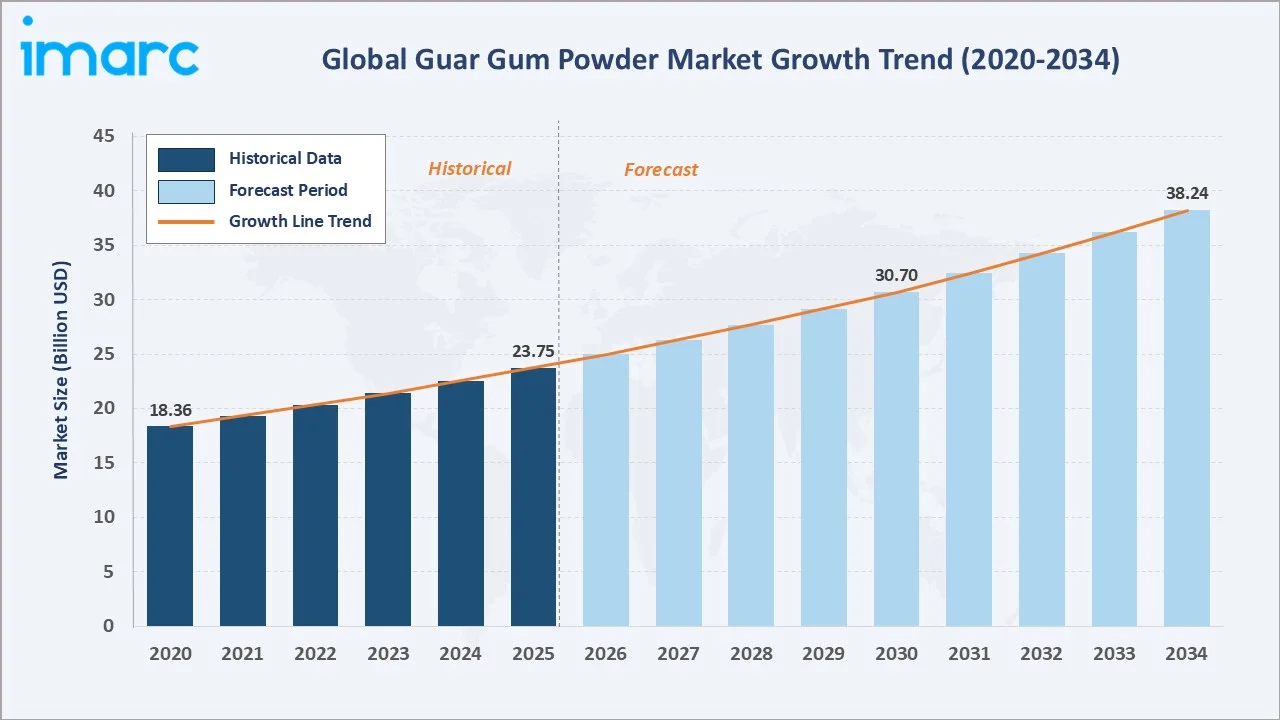
The global guar gum powder market reached USD 23.75 Billion in 2025 and is projected to reach USD 38.24 Billion by 2034, growing at a CAGR of 5.27% during 2026-2034. Growth is driven by rising demand for convenience and ready-to-eat foods, expanding pharmaceutical applications, and sustained oil-drilling and hydraulic-fracturing consumption.
Food-grade guar gum leads the grade segment at 46.8%, while oil drilling dominates end use at 41.7%. The United States leads regionally with a 39.4% share, followed closely by India at 33.2%.
Market Snapshot
|
Metric |
Value |
|
Market Size (2025) |
USD 23.75 Billion |
|
Forecast Market Size (2034) |
USD 38.24 Billion |
|
CAGR (2026-2034) |
5.27% |
|
Base Year |
2025 |
|
Historical Period |
2020-2025 |
|
Forecast Period |
2026-2034 |
|
Dominant Grade |
Food-Grade (46.8%, 2025) |
|
Dominant End Use Industry |
Oil Drilling (41.7%, 2025) |
|
Leading Region |
United States of America (39.4%, 2025) |
The market expanded from an estimated USD 18.36 Billion in 2020 to USD 23.75 Billion in 2025, and is anchored at USD 30.70 Billion in 2030 before reaching USD 38.24 Billion by 2034. Demand recovered steadily through 2023-2024 as guar crop supply stabilized and downstream food and pharmaceutical consumption normalized after pandemic-related disruptions. The consistent step-up across each five-year interval reflects the market's structurally supported growth profile, underpinned by diversified demand across food, pharmaceutical, and industrial end uses rather than dependence on any single application.
To get more information on this market, Request Sample
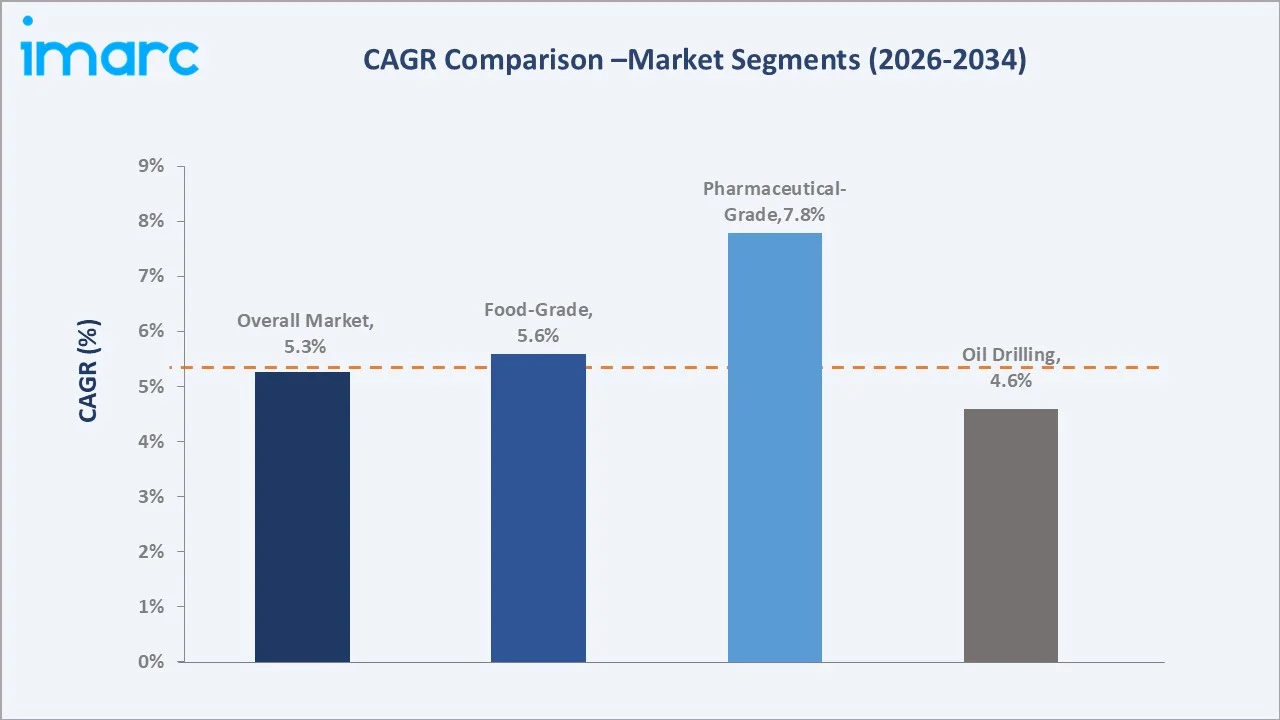
Food-grade demand grows steadily at an estimated ~5.6% CAGR as convenience-food consumption expands globally, while pharmaceutical-grade guar gum grows fastest at ~7.8% CAGR as purification technologies unlock excipient-grade applications. Oil drilling end use grows at ~4.6% CAGR, tracking shale-oil activity levels.
Executive Summary
The global guar gum powder market reached USD 23.75 Billion in 2025, representing steady, diversified demand for a natural, biodegradable thickening and stabilizing agent across food, pharmaceutical, and industrial applications. Guar gum's cold-water solubility and cost-effectiveness relative to synthetic alternatives have sustained its position as a preferred hydrocolloid across multiple unrelated industries. The market is projected to reach USD 38.24 Billion by 2034.
Food-grade guar gum at 46.8% dominates the grade segment through widespread use in sauces, dressings, dairy, and bakery products. Oil drilling at 41.7% leads end-use demand as guar gum remains a critical friction-reducing and gelling agent in hydraulic fracturing fluids. The United States, at 39.4%, leads regionally through strong shale-oil drilling activity and processed-food demand, while India's 33.2% share reflects its position as the world's largest guar-seed producer and processor.
Key Market Insights
|
Insight |
Data |
|
Dominant Grade |
Food-Grade - 46.8% share (2025) |
|
Dominant End Use Industry |
Oil Drilling - 41.7% market share (2025) |
|
Leading Region |
United States of America - 39.4% market share (2025) |
|
Market Opportunity |
Pharmaceutical-grade purification; organic/non-GMO guar gum; 3D-printing binder applications; clean-label food hydrocolloids |
Key Analytical Observations Supporting The Above Data:
- Food-Grade at 46.8%: The food-grade segment dominates as guar gum's cold-water solubility and heat stability make it a preferred thickener and stabilizer for sauces, ice cream, baked goods, and beverages. Rising demand for convenience and ready-to-eat foods across developed and emerging markets continues to reinforce this leadership position, with the segment expected to retain its lead throughout the forecast period.
- Oil Drilling at 41.7%: The oil drilling segment leads end-use demand as guar gum-based fracturing fluids remain essential for viscosity control and friction reduction in hydraulic fracturing operations, particularly across shale formations in North America. Fluctuations in drilling activity directly influence short-term demand for industrial-grade guar gum.
- United States at 39.4%: The United States dominates through its large-scale shale-oil drilling base combined with substantial processed-food manufacturing demand, while India's proximity to guar cultivation and processing hubs in Rajasthan and Gujarat supports its strong 33.2% share and provides a durable cost advantage for domestic processors.
Guar Gum Powder Market Overview
The global guar gum powder market encompasses the cultivation, processing, and supply of guar gum extracted from the endosperm of guar (Cyamopsis tetragonoloba) seeds, used as a natural thickening, gelling, binding, and friction-reducing agent across food, pharmaceutical, textile, paper, cosmetics, and oil and gas industries.
The ecosystem integrates guar seed farmers and traders, splitting and powder-processing units, guar derivative manufacturers, oilfield-services companies procuring fracturing-grade gum, food and pharmaceutical formulators, and regulatory bodies overseeing food-additive and pharmaceutical excipient standards. Macroeconomic factors influencing the market include monsoon-dependent guar crop yields in India and Pakistan, crude-oil drilling activity levels, and growing consumer preference for natural, plant-based ingredients.
Guar gum's functional versatility as a thickener, stabilizer, binder, and friction reducer underpins its use across a wide range of unrelated industries, from packaged food to oilfield services, which distinguishes it from many single-application specialty ingredients. This cross-industry demand base provides the market with a degree of structural resilience, as weakness in one end-use industry, such as a slowdown in drilling activity, tends to be partially offset by steady or growing consumption in food and pharmaceutical applications.
Market Dynamics
To evaluate market opportunities, Request Sample
Market Drivers
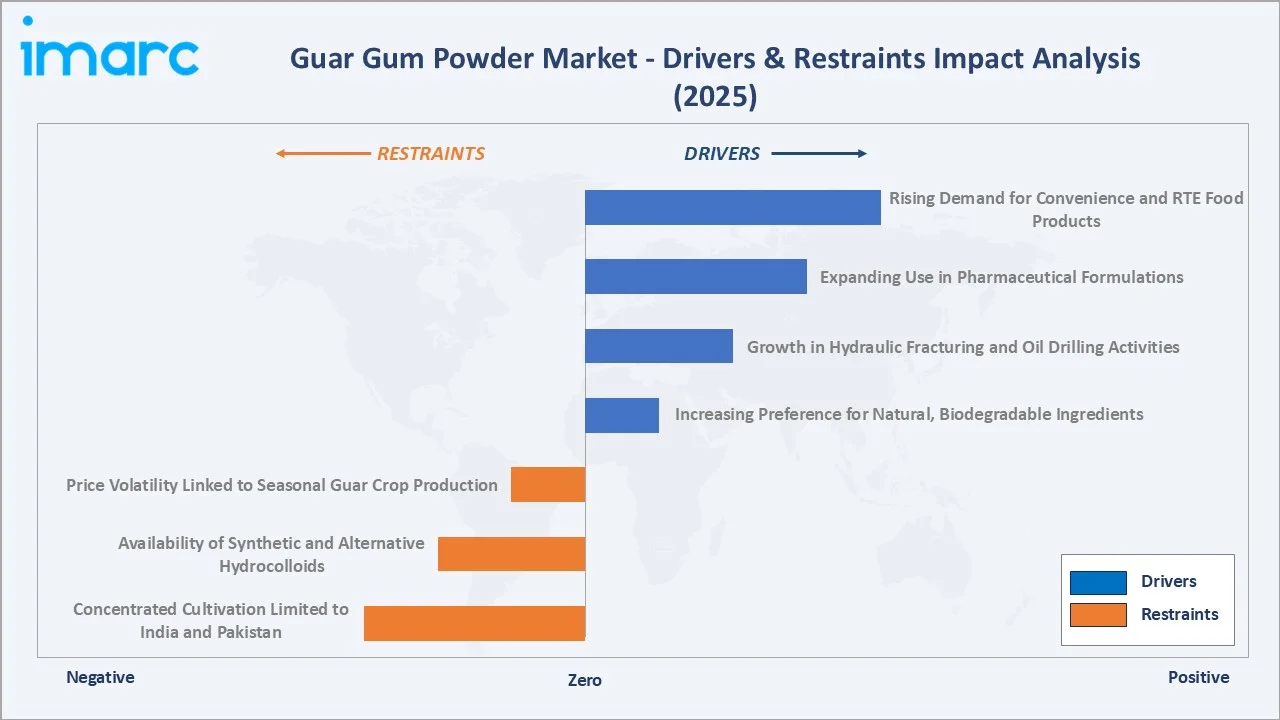
- Rising Demand for Convenience and RTE Food Products: Rising global consumption of convenience and ready-to-eat food products is increasing demand for guar gum as a cost-effective thickening and stabilizing agent in sauces, soups, dairy items, and baked goods, directly supporting food-grade segment volumes.
- Expanding Use in Pharmaceutical Formulations: Guar gum's use as a disintegrant, binder, and controlled-release agent in tablets and capsules is expanding alongside growing pharmaceutical manufacturing activity, particularly for gastrointestinal and cholesterol-management formulations.
- Growth in Hydraulic Fracturing and Oil Drilling Activities: Sustained hydraulic fracturing activity in shale-oil regions, especially across the United States, continues to generate substantial demand for guar gum-based fracturing fluids used for viscosity control and proppant transport.
- Increasing Preference for Natural, Biodegradable Ingredients: Consumer and regulatory preference for natural, biodegradable, plant-derived ingredients over synthetic alternatives is strengthening guar gum adoption across food, cosmetics, and personal care formulations.
Market Restraints
- Price Volatility Linked to Seasonal Guar Crop Production: Guar gum prices fluctuate significantly with monsoon-dependent guar crop yields, creating input-cost uncertainty for processors and downstream formulators and complicating long-term procurement planning.
- Availability of Synthetic and Alternative Hydrocolloids: Synthetic and alternative hydrocolloids, such as xanthan gum and cellulose derivatives, offer comparable functional properties in some applications, creating substitution pressure in price-sensitive industrial segments.
- Concentrated Cultivation Limited to India and Pakistan: Guar cultivation remains concentrated in India and Pakistan, exposing the global supply chain to regional climatic and geopolitical risks that can disrupt raw-material availability.
Market Opportunities
- Organic and Non-GMO Guar Gum: Rising demand for chemical-free, additive-free food labeling is creating opportunities for certified organic and non-GMO guar gum, commanding premium pricing in developed markets and encouraging processors to expand dedicated organic supply chains.
- Pharmaceutical-Grade Purification Technology: Advances in purification and de-aromatization technology can unlock higher-value pharmaceutical-grade and cosmetic-grade guar gum output, improving processor margins and opening access to regulated excipient and personal-care markets.
Market Challenges
- Rising Export Quality and Certification Requirements: Guar gum processors face increasing quality-certification requirements from food and pharmaceutical regulators across the United States and European Union, raising compliance costs and testing complexity for exporters seeking access to premium end-use markets.
- Limited Raw Material Traceability Across Smallholder Farms: Fragmented smallholder guar cultivation limits traceability and consistent quality, making it difficult for processors to guarantee uniform specifications for demanding industrial and pharmaceutical customers, particularly as sustainability disclosure requirements expand.
Emerging Market Trends
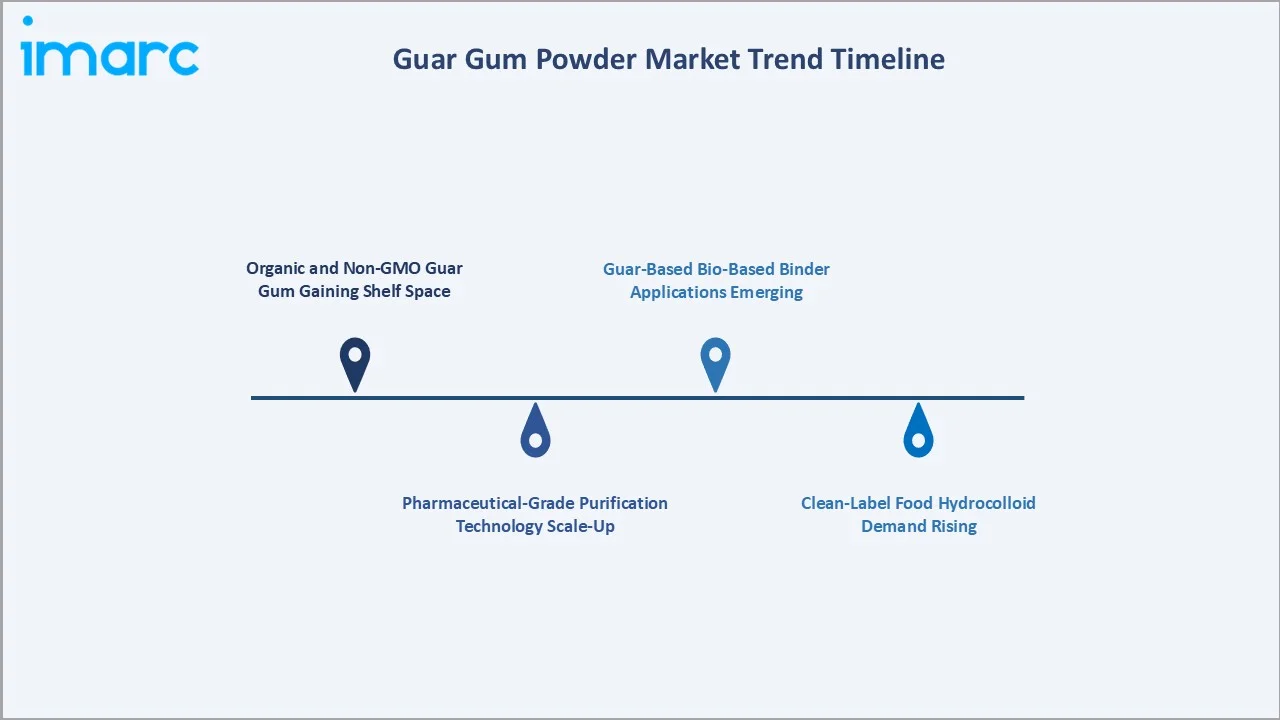
1. Organic and Non-GMO Guar Gum Gaining Shelf Space
Retailers and food manufacturers are increasingly favoring certified organic and non-GMO guar gum to meet clean-label consumer expectations, prompting processors to expand dedicated organic guar seed sourcing and certification programs. This shift is creating a distinct premium-priced product tier within the food-grade segment.
2. Pharmaceutical-Grade Purification Technology Scale-Up
Investment in advanced purification and de-aromatization processes is enabling processors to supply higher-purity, pharmaceutical-grade guar gum for tablet binders and controlled-release drug delivery systems. Wider access to such technology is gradually narrowing the cost gap between industrial- and pharmaceutical-grade output.
3. Clean-Label Food Hydrocolloid Demand Rising
Food manufacturers are reformulating products to replace synthetic thickeners with natural hydrocolloids such as guar gum, driven by consumer preference for recognizable, plant-derived ingredient lists. This trend is particularly pronounced across North American and European packaged food categories.
4. Guar-Based Bio-Based Binder Applications Emerging
Guar gum derivatives are being explored as bio-based binders in niche industrial applications, including 3D-printing pastes and eco-friendly adhesives, as manufacturers seek biodegradable alternatives to synthetic binders. While currently a small volume opportunity, this trend broadens guar gum's addressable application base over time.
Industry Value Chain Analysis
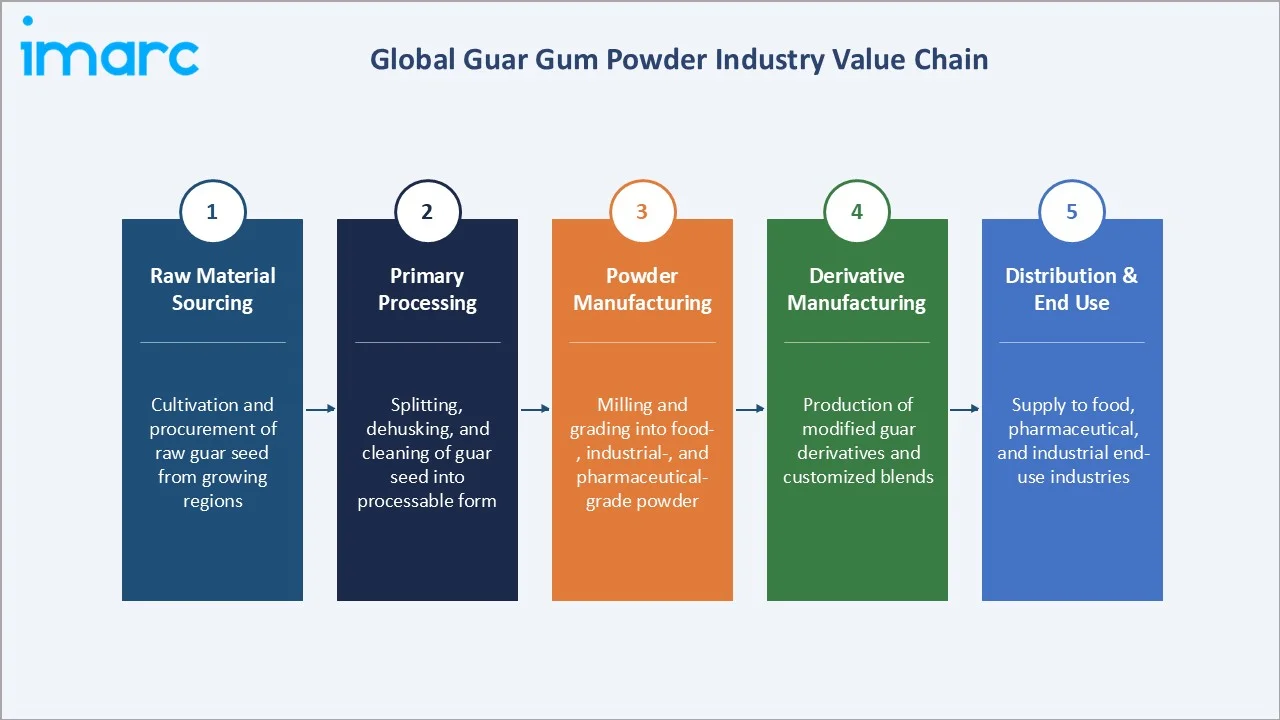
The guar gum powder value chain integrates guar seed cultivation, seed splitting and dehusking, powder milling and grade processing, derivative and blend manufacturing, and distribution to food, pharmaceutical, and industrial end-use industries.
|
Stage |
Key Participants |
|
Raw Material Sourcing |
Cultivation and procurement of raw guar seed from growing regions |
|
Primary Processing |
Splitting, dehusking, and cleaning of guar seed into processable form |
|
Powder Manufacturing |
Milling and grading into food-, industrial-, and pharmaceutical-grade powder |
|
Derivative Manufacturing |
Production of modified guar derivatives and customized blends |
|
Distribution & End Use |
Supply to food, pharmaceutical, and industrial end-use industries |
Technology Landscape in the Guar Gum Powder Industry
Cold-Water-Soluble Processing Technology
Cold-water-soluble processing technology enables guar gum to hydrate rapidly without heating, improving efficiency for food manufacturers requiring quick-viscosity build in sauces, dressings, and beverages. This reduces processing time and energy costs for downstream formulators compared with conventional heat-activated hydrocolloids.
De-Aromatization and Purification Technology
De-aromatization technology removes the natural beany odor of guar gum, enabling its use in flavor-sensitive food and pharmaceutical formulations while improving product acceptability. Processors adopting this technology can access premium-priced applications previously closed to standard-grade guar gum.
Enzymatic Modification Technology
Enzymatic and chemical modification technologies produce derivatized guar gums with tailored viscosity, charge, and solubility profiles for specialized industrial and oilfield applications. These modified derivatives typically command higher margins than standard unmodified guar gum powder.
Market Segmentation Analysis
The report covers the following segments:
|
Segment Category |
Leading Segment |
Market Share |
Year |
|
Grade |
Food-Grade |
46.8% |
2025 |
|
Function |
🔒 |
🔒 |
2025 |
|
End Use Industry |
Oil Drilling |
41.7% |
2025 |
|
Region |
United States of America |
39.4% |
2025 |

By Grade
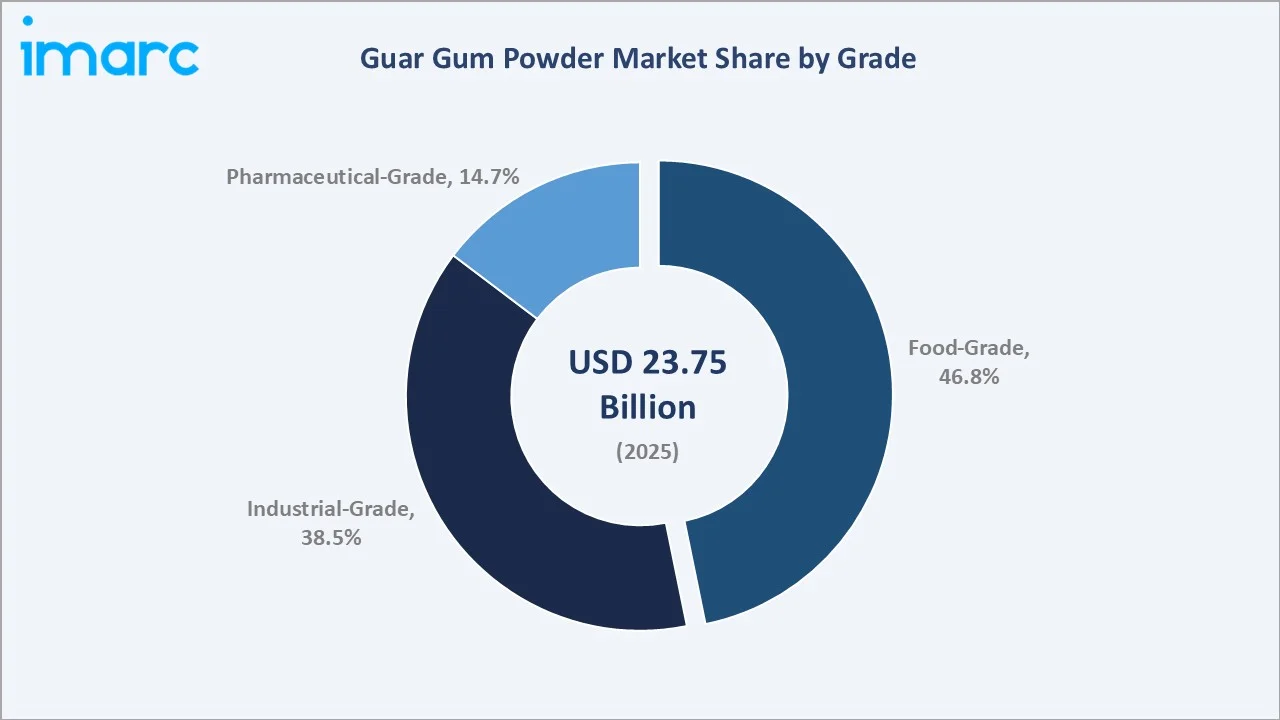
The food-grade segment leads at 46.8% in 2025, reflecting guar gum's widespread role as a thickening and stabilizing agent across sauces, dairy, bakery, and beverage applications. Its cold-water solubility, neutral taste profile, and cost-effectiveness relative to alternative hydrocolloids continue to support its adoption by packaged food manufacturers seeking reliable, natural texturizing solutions.
To access detailed market analysis, Request Sample
The industrial-grade segment at 38.5% captures oilfield, textile, and paper applications, supported by consistent hydraulic fracturing and paper-sizing demand. Pharmaceutical-grade at 14.7% represents the smallest but fastest-growing segment, driven by rising use in tablet binders and controlled-release drug formulations, as processors invest in purification capacity to meet stringent excipient-grade purity requirements.
By End Use Industry
Oil drilling leads end-use demand at 41.7%, driven by guar gum's function as a friction-reducing and gelling agent in hydraulic fracturing fluids used across shale formations. Its ability to suspend and transport proppant particles efficiently makes it a difficult-to-substitute input for fracturing fluid formulators.
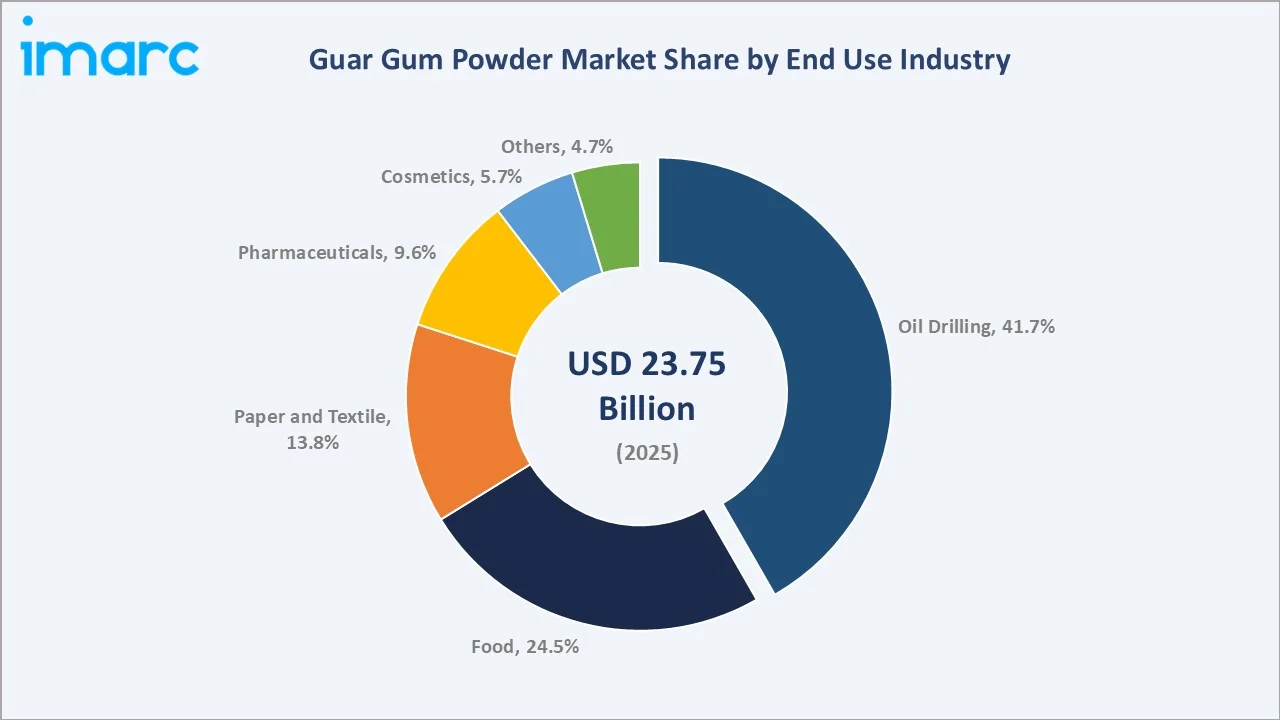
The food industry at 24.5% is the second-largest end use, supported by rising demand for processed and convenience foods worldwide. Paper and textile applications at 13.8% utilize guar gum as a sizing and thickening agent, while pharmaceuticals at 9.6% and cosmetics at 5.7% reflect its growing role in tablet formulation and personal care products. Other applications, including animal feed and specialty industrial uses, account for the remaining 4.7%, and are expected to grow steadily as niche applications for guar-based derivatives continue to emerge.
Regional Market Insights
|
Region |
Share (2025) |
Key Market Characteristics |
|
United States of America |
39.4% |
Large end-use base across food processing, pharmaceuticals, and industrial applications, supported by established distribution infrastructure |
|
India |
33.2% |
Strong raw-material and processing base supporting cost-competitive, large-scale guar gum manufacturing and export activity |
|
Germany |
18.1% |
Mature food and pharmaceutical manufacturing base with steady demand for natural, regulation-compliant ingredients |
|
Others |
9.3% |
Early-stage but growing demand across other regions, supported by expanding food processing and industrial activity |
The United States, at 39.4%, leads through its dominant shale-oil hydraulic fracturing industry alongside substantial food and pharmaceutical manufacturing demand. India, at 33.2%, benefits directly from domestic guar seed cultivation, giving processors a cost and supply-chain advantage over import-dependent markets.
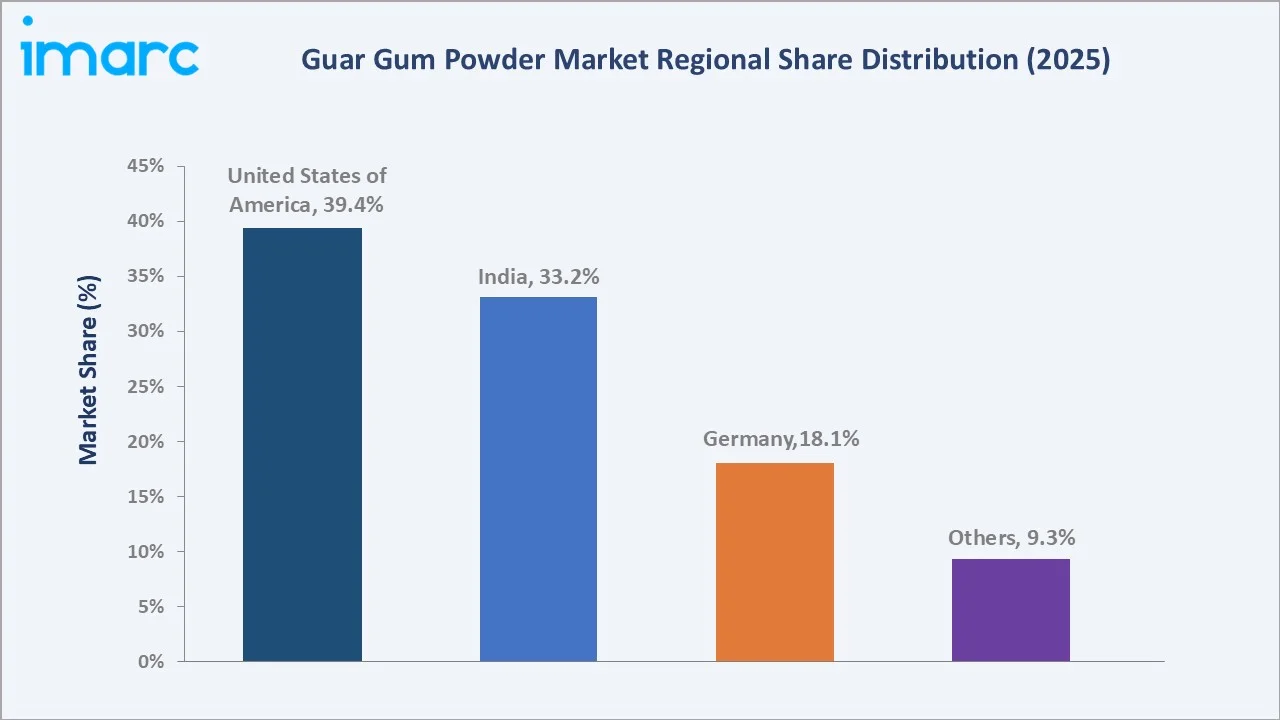
Germany, at 18.1%, reflects the European Union's stringent natural-ingredient preferences and established food and pharmaceutical manufacturing base. The Others category, at 9.3%, represents emerging demand across Asia-Pacific, Latin America, and the Middle East as food processing and industrial applications expand in these regions.
Competitive Landscape
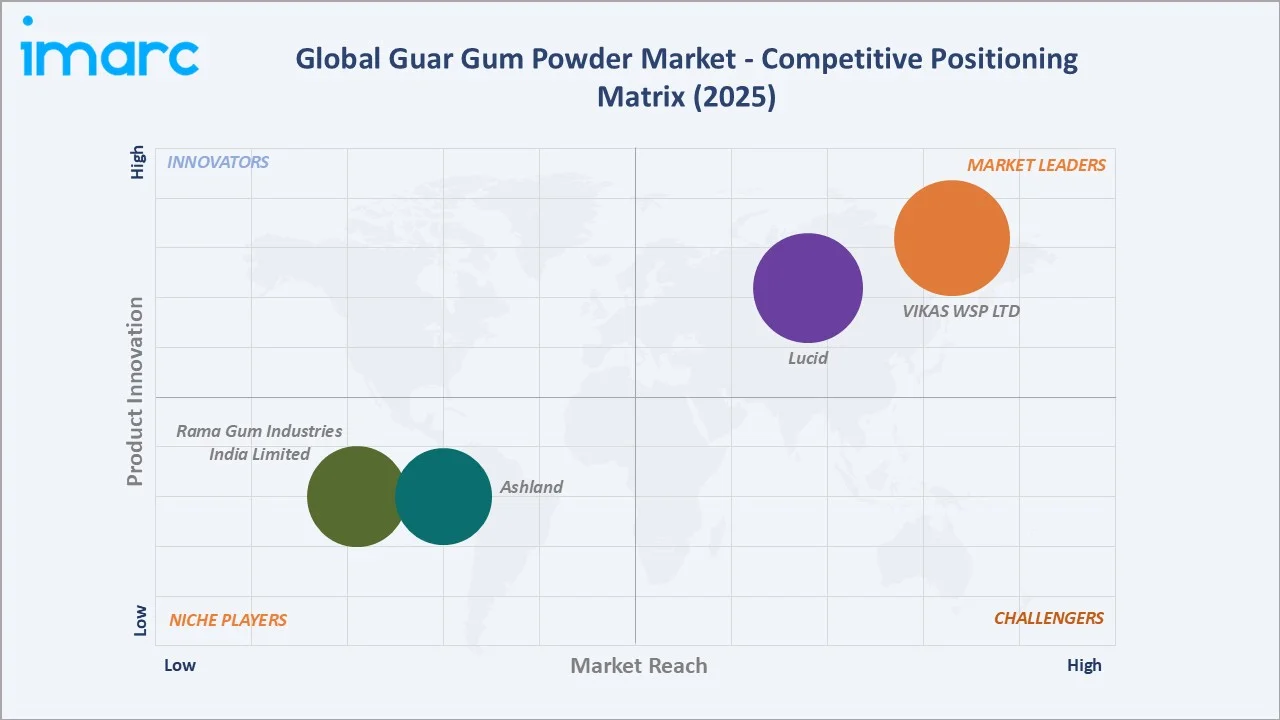
The global guar gum powder market competitive landscape is moderately fragmented, comprising large India-based integrated processors, global specialty-ingredient companies, and numerous regional guar gum manufacturers competing primarily on quality certification, processing scale, and export reach. Leading players differentiate through direct guar-seed sourcing relationships, purification technology investment, and long-term supply agreements with major food, pharmaceutical, and oilfield-services customers.
|
Company Name |
Key Products |
Market Position |
Core Strength |
|
VIKAS WSP LTD |
Guar Gum Powder, Guar Derivatives, Organic Guar Gum |
Market Leader |
World's largest guar gum powder manufacturer and exporter with four India-based manufacturing units. |
|
Lucid |
Natural and Modified Guar Gum Derivatives |
Market Leader |
Extensive farmer engagement network and strong global distribution footprint across food and industrial applications. |
|
Ashland |
Guar Derivatives for Oilfield and Personal Care |
Niche Player |
Specialty chemicals expertise applied to guar-based enhanced oil recovery and cosmetic formulations. |
|
Rama Gum Industries India Limited |
Guar Gum Powder and Split Guar |
Niche Player |
Established Rajasthan-based processor with strong regional guar seed sourcing relationships. |
Key players include VIKAS WSP LTD, Lucid, Ashland, Rama Gum Industries India Limited, and others.
Key Company Profiles
Vikas WSP Limited
Vikas WSP Limited is an India-based company and the world's largest manufacturer and exporter of guar gum powder, offering a broad portfolio of guar derivatives for food, pharmaceutical, and technical applications. The company operates multiple manufacturing units across India, supported by dedicated logistics, warehousing, and research and quality-control facilities that ensure consistent global supply reliability.
- Key Products: Guar Gum Powder, Guar Derivatives, Organic Guar Gum (EcoGuar), Aroma Free Guar Gum.
- Strategic Focus: Strengthening organic and specialty guar gum derivatives while expanding export reach across food, pharmaceutical, and oilfield end-use industries.
Lucid
Lucid is a prominent India-based manufacturer specializing in natural, modified, and derivative guar gum hydrocolloids for food, pharmaceutical, and personal care applications. The company leverages an extensive farmer engagement network across India's guar-growing belt, supporting consistent raw-material quality and traceability for its global customer base.
- Key Products: Natural Guar Gum, Modified Guar Gum, Guar Derivative Hydrocolloids.
- Strategic Focus: Broadening application scope in food and beverages while strengthening farmer engagement and sustainable sourcing practices.
Market Concentration Analysis
The guar gum powder market is moderately fragmented, with the top three key players collectively accounting for a meaningful share of branded, quality-certified global supply, while numerous smaller regional processors serve price-sensitive industrial and export markets. Market concentration is expected to gradually increase as pharmaceutical-grade certification requirements and export-quality standards favor larger, integrated processors over the forecast period. Smaller processors without direct farmer sourcing relationships or purification capacity may face increasing pressure to consolidate or specialize in lower-margin industrial-grade output.
Investment & Growth Opportunities
Investment activity across the guar gum powder value chain is increasingly directed toward quality upgrading and supply-chain security rather than raw capacity expansion, reflecting the market's shift toward higher-value, certified output.
Highest Growth Segments
Pharmaceutical-grade guar gum (~7.8% CAGR), food-grade guar gum (~5.6% CAGR), and the food industry end-use segment (~5.9% CAGR) represent the highest-growth investment vectors through 2034, supported by purification technology gains and rising processed-food demand.
Emerging Investment Opportunities
Pharmaceutical-grade purification represents the guar gum market's highest per-unit-value emerging opportunity, with excipient-grade guar commanding a substantial price premium over standard food- and industrial-grade output, creating an attractive margin expansion pathway for processors investing in advanced purification capacity.
Investment Themes
- Purification Capacity Expansion for Premium Grade Output: Processors investing in de-aromatization and purification capacity can capture premium pricing across pharmaceutical and clean-label food applications, creating a durable margin advantage over standard-grade competitors that lack such capability.
- Farmer Engagement and Organic Certification Programs: Direct engagement with guar-seed farmers through contract farming and organic certification programs secures raw-material supply while capturing rising demand for traceable, sustainably sourced guar gum, reducing exposure to open-market price volatility.
- Export Quality Certification for Developed-Market Access: Expanding export-quality certification and compliance capabilities allows processors to access higher-value developed-market customers in the United States and European Union, supporting margin improvement over commodity-grade export sales.
Future Market Outlook (2026-2034)
The global guar gum powder market is projected to grow from USD 23.75 Billion in 2025 to USD 38.24 Billion by 2034, delivering a 5.27% CAGR over the forecast period. The market's anchor value of USD 30.70 Billion in 2030 reflects steady, structurally supported demand growth rather than a single high-growth inflection, consistent with its trajectory from an estimated USD 18.36 Billion in 2020.
Food-grade demand is expected to remain the largest contributor as convenience-food consumption continues expanding globally, while pharmaceutical-grade guar gum is likely to post the fastest relative growth as purification technologies improve yield and purity for excipient-grade applications. Oil-drilling demand will remain closely tied to shale-oil activity levels, particularly in the United States, while India's dominant cultivation base continues to anchor global raw-material supply and cost competitiveness.
Two structural forces underpin guar gum powder market growth through 2034 with reasonable confidence. Diversified end-use demand across food, pharmaceutical, and industrial applications reduces the market's dependence on any single demand driver, cushioning it against cyclicality in any one end-use industry. Simultaneously, rising quality and traceability standards are expected to favor larger, certified processors, gradually consolidating branded supply while smaller regional players continue to serve price-sensitive industrial demand.
Research Methodology
Primary Research
Primary research comprised structured interviews with industry stakeholders, including guar gum processors, oilfield-services procurement leads, food and pharmaceutical formulation specialists, and guar seed traders across India, the United States, and Europe.
Secondary Research
Secondary research encompassed company annual reports, guar seed production and export data, food and pharmaceutical excipient regulatory filings, oilfield-services industry reports, and trade association publications covering the guar gum value chain.
Forecasting Models
Market revenue forecasts were developed using a demand-based bottom-up model incorporating: (i) guar seed production and crushing volume forecasts by region; (ii) grade-wise processing yield and end-use demand by industry; (iii) average price trends by grade; and (iv) macroeconomic adjustments for food consumption growth and oil-drilling activity levels. Forecast outputs were cross-validated against historical market-size trends and triangulated across multiple independent secondary sources to ensure consistency and reliability.
Report Coverage:
| Report Features | Details |
|---|---|
| Base Year of the Analysis | 2025 |
| Historical Period | 2020-2025 |
| Forecast Period | 2026-2034 |
| Units | Billion USD |
| Scope of the Report | Exploration of Historical Trends and Market Outlook, Industry Catalysts and Challenges, Segment-Wise Historical and Future Market Assessment:
|
| Grades Covered | Food-Grade, Industrial-Grade, Pharmaceutical-Grade |
| Functions Covered | Thickening, Gelling, Binding, Friction Reducing, Other Functions |
| End Use Industries Covered | Oil Drilling, Food Industry, Paper and Textile, Pharmaceuticals, Cosmetics, Others |
| Regions Covered | United States, Germany, India, Others |
| Companies Covered | VIKAS WSP LTD, Lucid, Ashland, Rama Gum Industries India Limited, etc. |
| Customization Scope | 10% Free Customization |
| Post-Sale Analyst Support | 10-12 Weeks |
| Delivery Format | PDF and Excel through Email (We can also provide the editable version of the report in PPT/Word format on special request) |
Key Benefits for Stakeholders:
- IMARC’s report offers a comprehensive quantitative analysis of various market segments, historical and current market trends, market forecasts, and dynamics of the guar gum powder market from 2020-2034.
- The research study provides the latest information on the market drivers, challenges, and opportunities in the global guar gum powder market.
- The study maps the leading, as well as the fastest-growing, regional markets.
- Porter's five forces analysis assist stakeholders in assessing the impact of new entrants, competitive rivalry, supplier power, buyer power, and the threat of substitution. It helps stakeholders to analyze the level of competition within the guar gum powder industry and its attractiveness.
- Competitive landscape allows stakeholders to understand their competitive environment and provides an insight into the current positions of key players in the market.
Frequently Asked Questions About the Guar Gum Powder Market Report
The global guar gum powder market reached USD 23.75 Billion in 2025, driven by the food-grade segment's dominance at 46.8%, oil drilling's leadership in end use at 41.7%, and the United States' leading regional share of 39.4%, supported by India's role as the world's largest guar-growing and processing base.
The guar gum powder market is projected to grow at a 5.27% CAGR during 2026-2034, reaching USD 38.24 Billion by 2034, up from an estimated USD 18.36 Billion in 2020.
The food-grade segment leads at 46.8%, driven by widespread use as a thickening and stabilizing agent in sauces, dairy, bakery, and beverage products across both developed and emerging food markets.
Oil drilling leads at 41.7% through sustained use of guar gum-based fracturing fluids in hydraulic fracturing operations, particularly across shale-oil regions in North America.
The United States of America leads at 39.4%, supported by extensive shale-oil drilling activity and large-scale food and pharmaceutical manufacturing, followed closely by India at 33.2% through its dominant raw-material and processing base.
Leading companies include VIKAS WSP LTD, Lucid, Ashland, Rama Gum Industries India Limited, and others.
The guar gum powder market is projected to reach approximately USD 30.70 Billion by 2030, supported by steady food-grade demand growth, expanding pharmaceutical applications, and stable oilfield consumption.
Priority investment opportunities include pharmaceutical-grade purification capacity expansion, organic and non-GMO guar gum certification programs, and direct farmer engagement models that secure traceable, sustainably sourced raw material supply.
Need more help?
- Speak to our experienced analysts for insights on the current market scenarios.
- Include additional segments and countries to customize the report as per your requirement.
- Gain an unparalleled competitive advantage in your domain by understanding how to utilize the report and positively impacting your operations and revenue.
- For further assistance, please connect with our analysts.
 Request Customization
 Speak to an Analyst
 Request Brochure
 Inquire Before Buying
Benefits of Customization
- Personalize this research
- Triangulate with your data
- Get data as per your format and definition
- Gain a deeper dive into a specific application, geography, customer, or competitor
- Any level of personalization
Get in Touch With Us
UNITED STATES
Phone: +1-201-971-6302
INDIA
Phone: +91-120-433-0800
UNITED KINGDOM
Phone: +44-753-714-6104
Email: [email protected]
Client Testimonials




.webp)




.webp)













Related Reports

Choose your plan
*Please note that the prices mentioned below are starting prices for each bundle type. Kindly contact our team for further details.*
Single User License
- 1 User License, Access on 2 Devices
- PDF Report + Excel Dataset (Password Protected)
- Lifetime Access
- No Printing Rights
- 10% Free Report Customization
- 10–12 Weeks of Analyst Support
Five User License
- Access for 5 Users, 2 Devices per User
- PDF Report + Excel Dataset (Password Protected)
- Lifetime Access
- Dedicated Account Manager
- 12–14 Weeks of Analyst Support
- No Printing Rights
- 15% Free Report Customization
- 25% Discount on Your Next Purchase
Corporate User License
- Unlimited User Access (Within Your Organization)
- PDF Report + Excel Dataset
- Lifetime Access
- Dedicated Account Manager
- 14–20 Weeks of Analyst Support
- No Printing Rights
- 20% Free Report Customization
- 30% Discount on Your Next Purchase
Essential Insights
What's included:
3 reports
- Lifetime Access
- PDF Reports
- Excel Datasets
- 2 Weeks of Free Analyst Support
- 2 User Licenses
- Access on 2 Devices
- Printing Rights
- Complimentary PowerPoint (PPT) Version
- Complimentary License Upgrade
Professional Access
What's included:
5 reports
- Lifetime Access
- PDF Reports
- Excel Datasets
- 8 Weeks of Free Analyst Support
- 2 User Licenses
- Access on 2 Devices
- Printing Rights
- Complimentary PowerPoint (PPT) Version
- Complimentary License Upgrade
Business Advantage
What's included:
8 reports
- Lifetime Access
- PDF Reports
- Excel Datasets
- 14 Weeks of Free Analyst Support
- 2 User Licenses
- Access on 2 Devices
- Printing Rights
- Complimentary PowerPoint (PPT) Version
- Complimentary License Upgrade
Enterprise Intelligence
What's included:
10 reports
- Lifetime Access
- PDF Reports
- Excel Datasets
- 20 Weeks of Free Analyst Support
- 2 User Licenses
- Access on 2 Devices
- Printing Rights
- Complimentary PowerPoint (PPT) Version
- Complimentary License Upgrade