
Hair Mask Market Size, Share, Trends and Forecast by Nature, End User, Distribution Channel, and Region, 2026-2034
Hair Mask Market Size, Share, Trends & Forecast (2026-2034)
The global hair mask market reached USD 747.6 Million in 2025 and is projected to reach USD 1,049.0 Million by 2034, growing at a CAGR of 3.72% during 2026-2034. Growth is driven by rising awareness of hair damage repair, increasing salon and at-home treatment adoption, and a shift toward organic, silicone-free formulations. Commercial end-users command 57.3% of the market, reflecting strong salon and professional demand. Offline retail leads distribution at 68.4%, though online penetration is expanding steadily. Europe holds the largest regional share at 29.7%, followed closely by Asia-Pacific at 28.4%, supported by rising grooming expenditure and premiumization trends across both mature and emerging beauty markets.
Market Snapshot
|
Metric |
Value |
|
Market Size (2025) |
USD 747.6 Million |
|
Forecast Market Size (2034) |
USD 1,049.0 Million |
|
CAGR (2026-2034) |
3.72% |
|
Base Year |
2025 |
|
Historical Period |
2020-2025 |
|
Forecast Period |
2026-2034 |
|
Dominant End User |
Commercial (57.3%, 2025) |
|
Dominant Distribution Channel |
Offline (68.4%, 2025) |
|
Leading Region |
Europe (29.7%, 2025) |
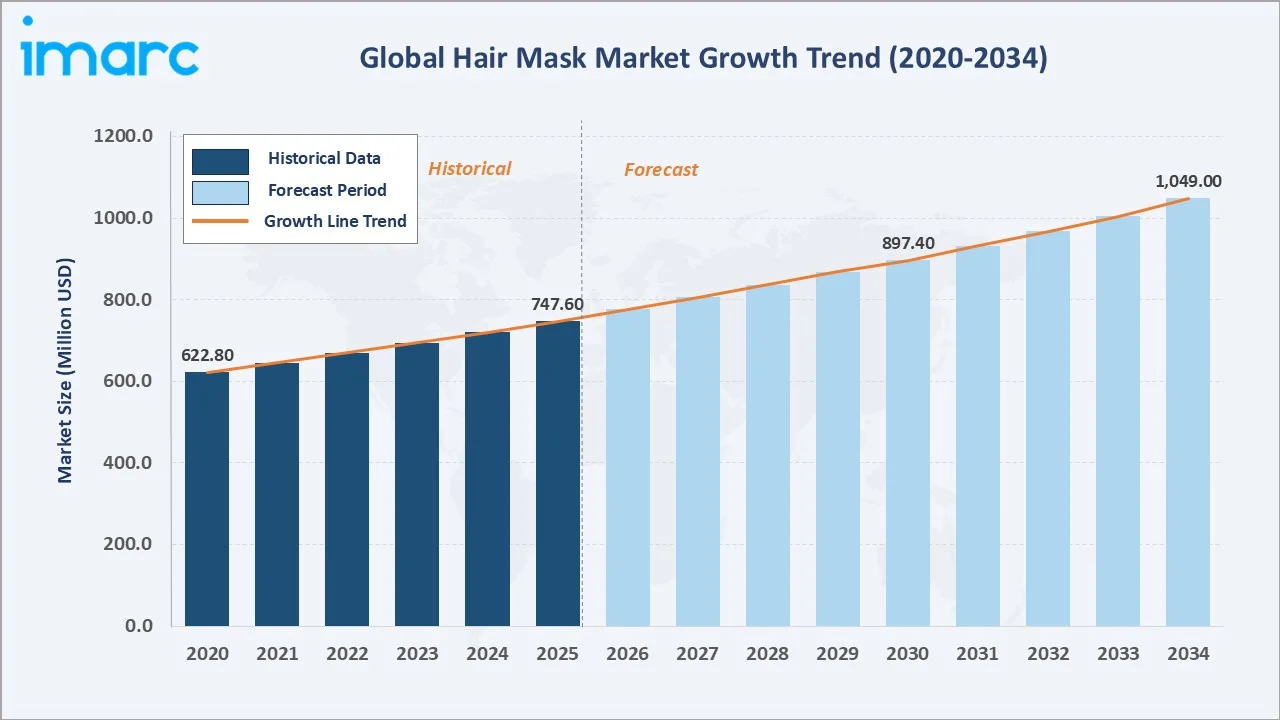
The global hair mask market expanded from USD 622.8 Million in 2020 to USD 747.6 Million in 2025, anchored at USD 897.4 Million in 2030, and forecast to reach USD 1,049.0 Million by 2034. Post-pandemic recovery in salon footfall and beauty retail reopening supported the 2022-2025 rebound. Consumers increasingly treat hair masks as a routine wellness step rather than an occasional indulgence, sustaining steady above-inflation category growth.
To get more information on this market, Request Sample
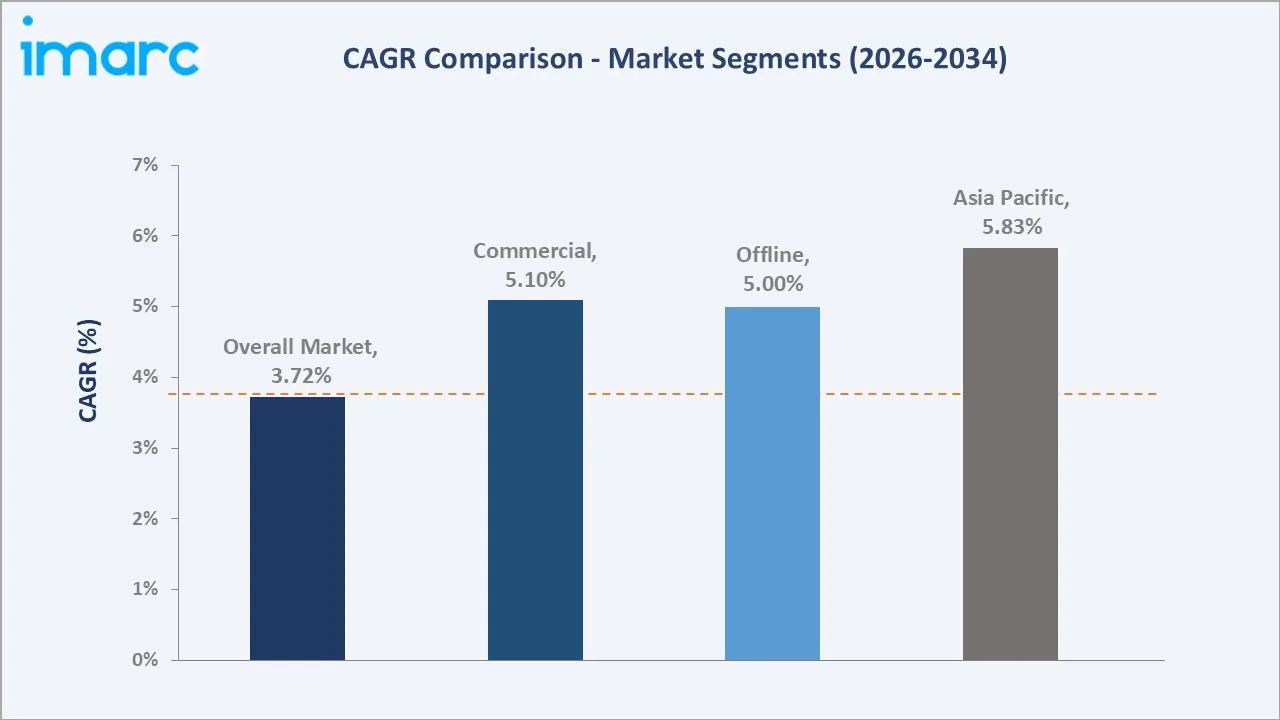
Historical growth between 2020 and 2025 tracked close to 3.73% annually, nearly matching the 3.72% CAGR projected for 2026-2034. This consistency signals a maturing yet steadily expanding category as premium and clean-label formulations gain further traction.
Executive Summary
The global hair mask market reached USD 747.6 Million in 2025, reflecting one of the more resilient segments within the broader hair care and personal care industry. The market spans natural, organic and synthetic formulations sold through both professional and retail channels, addressing consumer needs ranging from everyday conditioning to intensive damage repair.
Commercial end-users, including salons and professional treatment centers, account for 57.3% of demand in 2025, underscoring the category's strong ties to the professional beauty services industry. Offline retail remains dominant at 68.4%, although e-commerce is growing faster as brands expand direct-to-consumer subscription models and tutorial-driven marketing on social platforms.
Europe leads regionally with a 29.7% share, powered by mature premium beauty retail networks across Germany, France and the United Kingdom, while Asia-Pacific follows closely at 28.4% on the back of rising grooming expenditure in China, Japan, India and South Korea. The market is forecast to advance at a 3.72% CAGR through 2034, reaching USD 1,049.0 Million, as clean-label formulations and scalp-focused innovation broaden the category's appeal.
Key Market Insights
|
Insight |
Data |
|
Dominant End User |
Commercial - 57.3% share (2025) |
|
Dominant Distribution Channel |
Offline - 68.4% share (2025) |
|
Leading Region |
Europe - 29.7% share (2025) |
|
Market Opportunity |
Organic and silicone-free formulations; scalp-care hybrid masks; salon-professional retail partnerships; AI-personalized hair diagnostics; subscription-based e-commerce models |
Key Analytical Observations Supporting The Above Data:
- Commercial End-Users at 57.3%: Salons, spas and professional hair treatment centers drive bulk purchasing of hair masks, using them as part of paid in-chair treatments and retail upsell programs. This channel benefits from stylist endorsement, which builds consumer trust and repeat purchase behavior for premium product lines.
- Offline Distribution at 68.4%: Specialty beauty retailers, pharmacies, supermarkets and salons continue to dominate hair mask sales, as consumers prefer to assess texture, fragrance and packaging before purchase. In-store sampling and stylist recommendations remain influential purchase drivers for this tactile personal-care category.
- Europe at 29.7%: Europe's leadership reflects deep-rooted salon culture, high per-capita spending on premium hair care, and strong retail distribution through pharmacies and specialty beauty chains across Germany, France and the United Kingdom.
- Asia-Pacific at 28.4%: Rising disposable incomes, expanding e-commerce beauty platforms, and growing awareness of hair damage from pollution and heat styling are propelling demand across China, India, Japan and South Korea.
- Growing Online Momentum: Although offline retains majority share, online distribution at 31.6% is expanding faster as brands invest in influencer-led tutorials, subscription boxes and direct-to-consumer websites offering personalized hair diagnostics.
- Product Innovation Pipeline: Leading manufacturers are increasingly launching silicone-free, vegan and clean-label hair masks formulated with botanical actives, responding to consumer demand for transparency and sustainability in personal care.
Global Hair Mask Market Overview
The global hair mask market encompasses deep-conditioning treatments formulated from natural, organic and synthetic ingredients, sold across professional salon channels and direct-to-consumer retail. The market spans product development, ingredient sourcing, packaging, and distribution through offline and online networks. Hair masks address consumer needs including damage repair, scalp health, color protection, and moisture restoration for chemically treated, heat-styled and aging hair. Macroeconomic factors, including rising disposable income, urbanization and growing grooming expenditure, support category expansion. Growing awareness of pollution-related hair damage and increasing salon visitation frequency in emerging economies further encourage manufacturers to diversify formulations and expand regional distribution footprints.
Market Dynamics
To evaluate market opportunities, Request Sample
Market Drivers
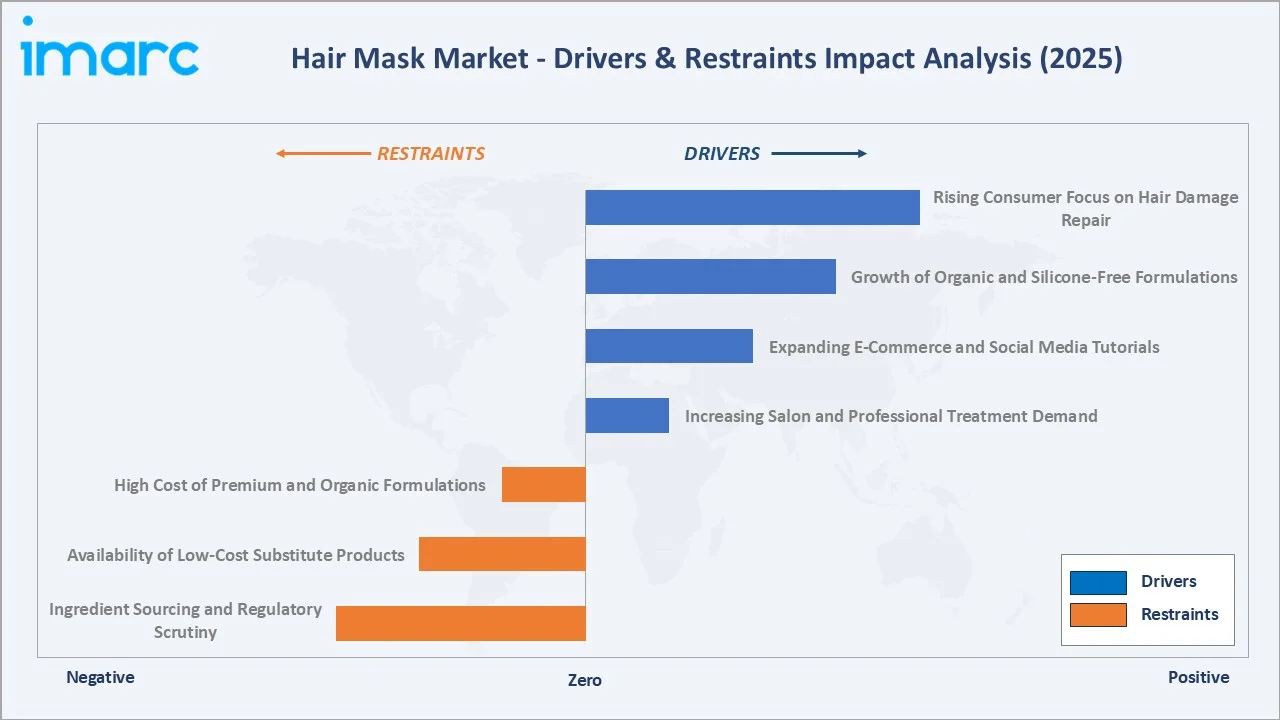
- Rising Consumer Focus on Hair Damage Repair: Increasing use of heat styling tools, chemical treatments and frequent hair coloring is driving demand for restorative hair masks. Consumers are prioritizing deep-conditioning treatments to counter dryness, breakage and dullness caused by daily styling routines, supporting steady category growth across both mass and premium price tiers.
- Growth of Organic and Silicone-Free Formulations: Manufacturers are reformulating hair masks with plant-based actives such as avocado oil, coconut oil and aloe vera to meet rising demand for clean-label personal care. In June 2025, L'Oréal signed an agreement to acquire haircare brand Color Wow, strengthening its position in the fast-growing damage-repair and clean-formulation segment.
- Expanding E-Commerce and Social Media Tutorials: The proliferation of online beauty tutorials and influencer-driven content is encouraging consumers to adopt hair masking as a routine at-home treatment. Direct-to-consumer platforms and subscription models are widening access to premium and niche hair mask brands beyond traditional retail footprints.
- Increasing Salon and Professional Treatment Demand: Growing salon visitation, particularly for color-treated and chemically processed hair, is reinforcing commercial demand for professional-grade hair masks. Salons frequently use masks as an add-on treatment, supporting the segment's 57.3% share of end-user demand in 2025.
Market Restraints
- High Cost of Premium and Organic Formulations: Clean-label and botanical-based hair masks often carry higher price points than conventional products, which can limit adoption among price-sensitive consumers in developing regions, moderating overall category penetration.
- Availability of Low-Cost Substitute Products: Conditioners, leave-in treatments and hair oils offer overlapping conditioning benefits at lower price points, creating competitive pressure on hair mask adoption, particularly in mass-market retail channels.
Market Opportunities
- Scalp-Focused Hybrid Formulations: Rising consumer interest in scalp health is creating opportunities for hair masks that combine deep conditioning with scalp-care actives, expanding the category's relevance beyond traditional damage-repair positioning.
- Subscription and Personalization Models: Brands offering AI-driven hair diagnostics and personalized mask formulations are opening new revenue streams, particularly through direct-to-consumer digital platforms targeting younger, digitally native consumers.
Market Challenges
- Ingredient Sourcing and Regulatory Scrutiny: Increasing regulatory attention on cosmetic ingredient safety and sustainable sourcing is raising compliance costs for manufacturers, particularly those using botanical extracts sourced from multiple international suppliers.
- Intense Competitive Fragmentation: The presence of numerous regional and niche players alongside global majors creates pricing pressure and makes brand differentiation increasingly challenging, particularly in the offline retail channel.
Emerging Market Trends
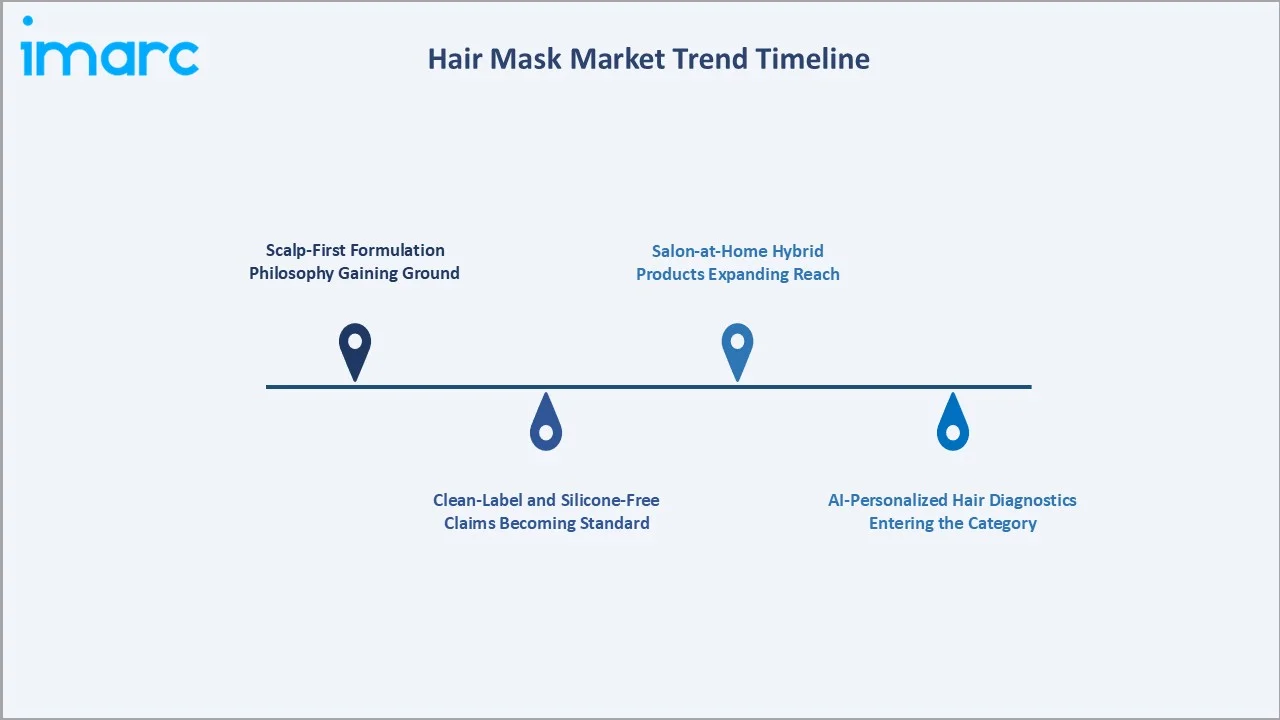
1. Scalp-First Formulation Philosophy Gaining Ground
Hair care brands are increasingly reframing hair masks as scalp treatments rather than purely strand-focused products, incorporating exfoliating and soothing actives. This shift mirrors the broader skinification trend in beauty, where scalp health is treated with the same rigor as facial skincare routines.
2. Clean-Label and Silicone-Free Claims Becoming Standard
Consumer demand for ingredient transparency is pushing brands to reformulate legacy products, removing silicones and sulfates while emphasizing plant-derived actives. In June 2025, L'Oréal's acquisition of Color Wow reflected this strategic pivot toward science-backed, damage-repair-focused clean formulations.
3. Salon-at-Home Hybrid Products Expanding Reach
Brands are launching professional-grade masks for home use, blurring the line between salon treatments and retail products. Unilever's Dove brand grew hair care sales in double digits following the 2025 launch of its fibre repair technology range, illustrating strong consumer appetite for salon-caliber results at home.
4. AI-Personalized Hair Diagnostics Entering the Category
Some brands are piloting AI-powered diagnostic tools that recommend customized hair mask formulations based on hair porosity, damage level and scalp condition, reflecting the broader personalization wave sweeping the beauty industry.
Industry Value Chain Analysis
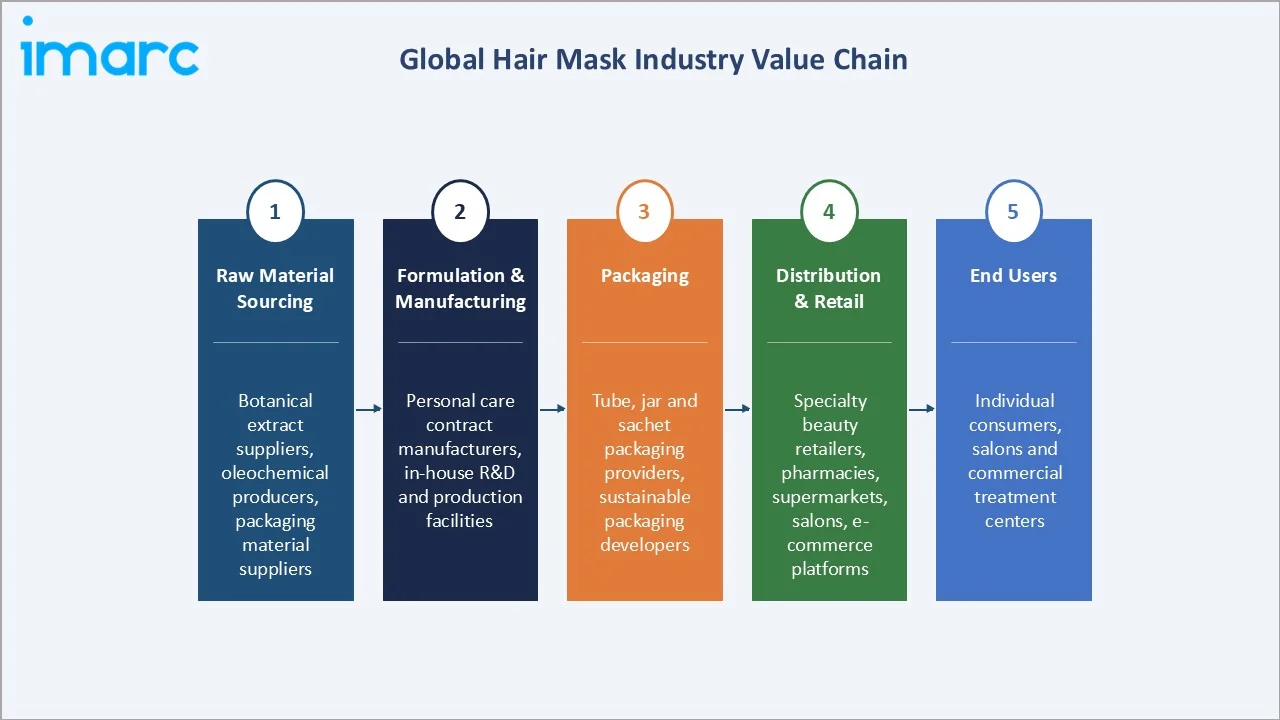
The hair mask value chain integrates raw material sourcing, formulation and manufacturing, packaging, and distribution through offline and online retail channels to reach individual and commercial end-users.
|
Stage |
Key Participants |
|
Raw Material Sourcing |
Botanical extract suppliers, oleochemical producers, packaging material suppliers |
|
Formulation & Manufacturing |
Personal care contract manufacturers, in-house R&D and production facilities |
|
Packaging |
Tube, jar and sachet packaging providers, sustainable packaging developers |
|
Distribution & Retail |
Specialty beauty retailers, pharmacies, supermarkets, salons, e-commerce platforms |
|
End Users |
Individual consumers, salons and commercial treatment centers |
Formulation and manufacturing represent the value chain's most research-intensive stage, where ingredient innovation determines a brand's ability to command premium pricing. Packaging increasingly influences purchase decisions as brands adopt refillable and recyclable formats to align with sustainability expectations. Distribution remains anchored in offline retail, though e-commerce is reshaping how brands reach individual consumers directly.
Technology Landscape in the Hair Mask Industry
Botanical Extraction and Active Ingredient Technology
Advances in cold-press and supercritical extraction techniques are enabling manufacturers to preserve the potency of botanical actives such as avocado oil, aloe vera and coconut oil, improving the efficacy of natural and organic hair mask formulations.
Silicone-Free and Bio-Based Conditioning Technology
Brands are replacing traditional silicones with bio-based conditioning polymers that deliver similar smoothness and shine without environmental persistence concerns, supporting the clean-label positioning increasingly demanded by consumers.
Infrared and Heat-Assisted Treatment Devices
Complementary technologies, including infrared styling tools, are being positioned alongside hair masks to enhance ingredient penetration and treatment efficacy, reflecting the broader convergence of beauty tech and personal care formulations.
Direct-to-Consumer Personalization Platforms
Digital diagnostic tools that assess hair porosity and damage levels are being integrated into e-commerce platforms, allowing brands to recommend tailored hair mask regimens and strengthening customer retention through subscription-based delivery models.
Market Segmentation Analysis
The report covers the following segments:
|
Segment Category |
Leading Segment |
Market Share |
Year |
|
Nature |
Synthetic |
🔒 |
2025 |
|
End User |
Commercial |
57.3% |
2025 |
|
Distribution Channel |
Offline |
68.4% |
2025 |
|
Region |
Europe |
29.7% |
2025 |

By End User
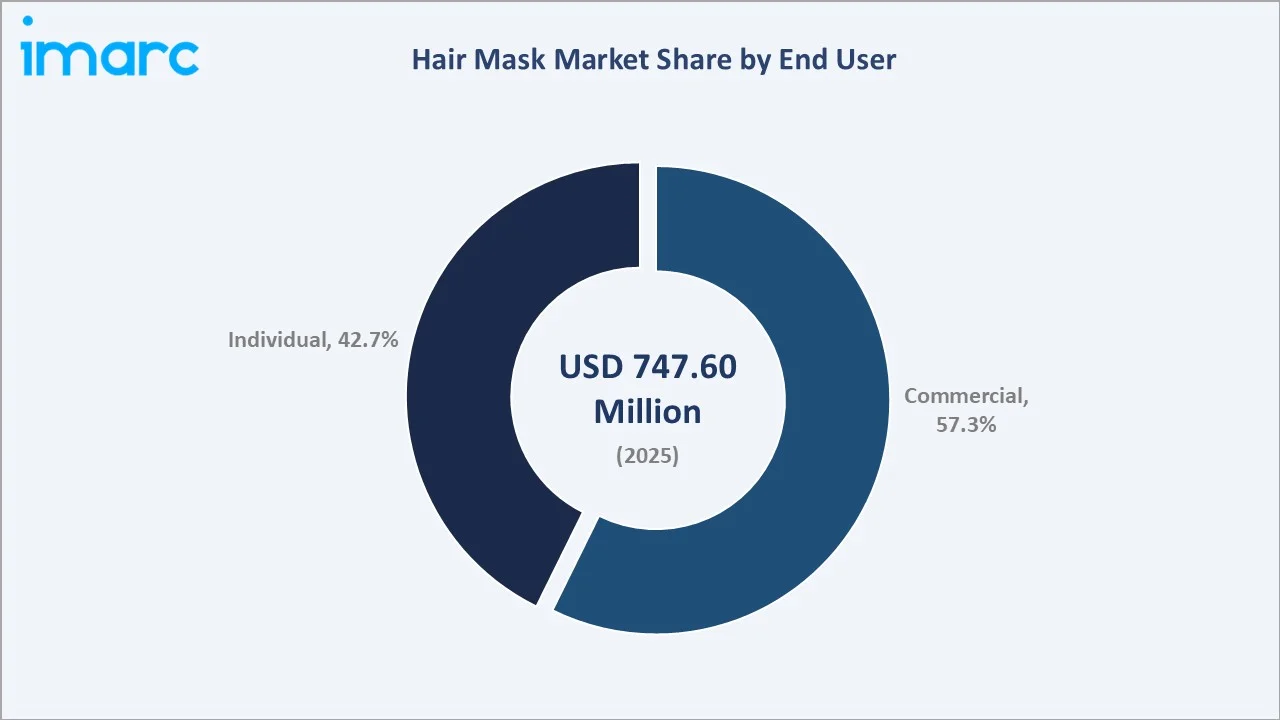
Commercial end-users lead at 57.3% (2025), encompassing salons, spas and professional treatment centers that use hair masks as part of paid in-chair services and retail upsell programs. The segment benefits from stylist endorsement and higher per-treatment pricing compared to at-home use.
To access detailed market analysis, Request Sample
Individual consumers account for the remaining 42.7% (2025), reflecting steady at-home adoption supported by online tutorials and increasing product availability across mass retail and e-commerce channels.
By Distribution Channel
Offline retail leads at 68.4% (2025), spanning specialty beauty retailers, pharmacies, supermarkets and salons where consumers can evaluate product texture and fragrance before purchase. In-store stylist recommendations remain a significant influence on premium product selection.
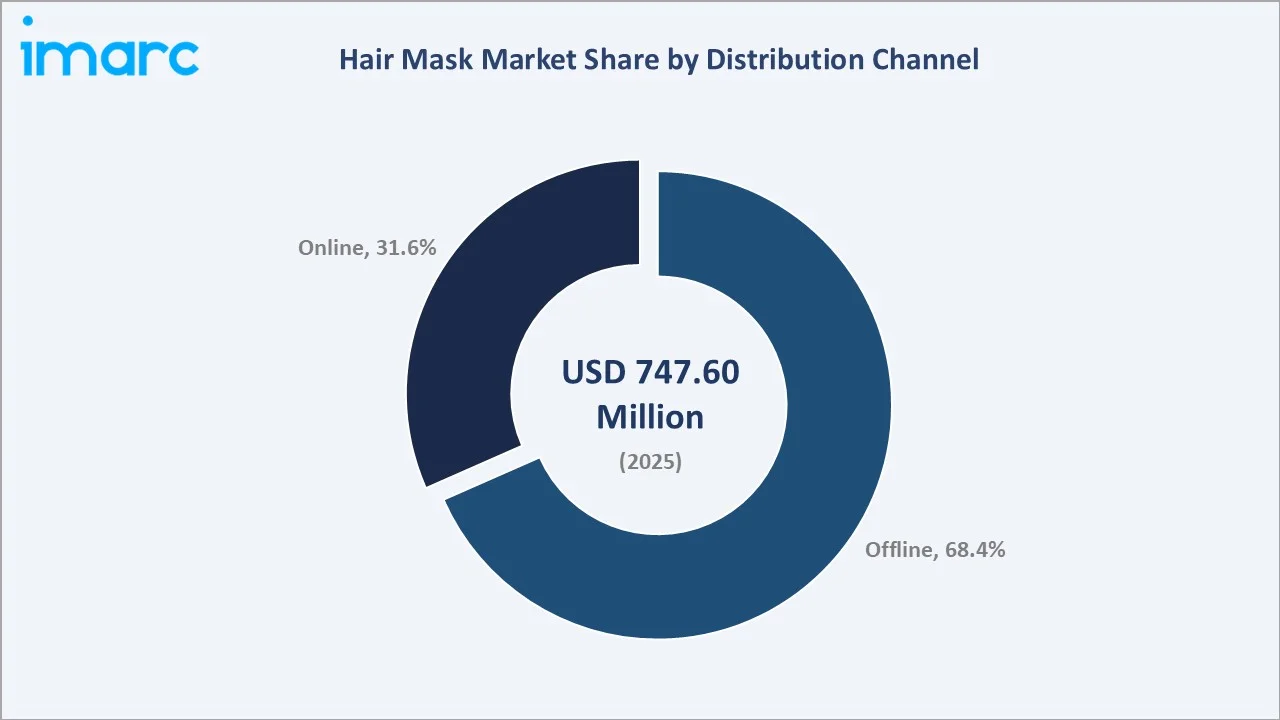
Online distribution, at 31.6% (2025), is expanding at a faster pace as brands invest in direct-to-consumer platforms, subscription models and influencer-driven marketing, particularly among younger, digitally native consumers.
Regional Market Insights
|
Region |
Share (2025) |
Key Hair Mask Market Drivers & Characteristics |
|
Europe |
29.7% |
Driven by established salon culture, high premium beauty spending, and strong specialty retail and pharmacy distribution networks across Germany, France and the United Kingdom. |
|
Asia-Pacific |
28.4% |
Supported by rising grooming expenditure, expanding e-commerce beauty platforms, and growing awareness of pollution-related hair damage across China, Japan, India and South Korea. |
|
North America |
24.8% |
Propelled by strong demand for damage-repair and clean-label formulations, alongside high salon visitation frequency in the United States and Canada. |
|
Latin America |
9.1% |
Growing on the back of expanding beauty retail infrastructure and increasing disposable income in Brazil and Mexico. |
|
Middle East and Africa |
8.0% |
Supported by rising grooming awareness and expanding modern retail formats across the Gulf Cooperation Council countries. |
Europe's 29.7% leadership is anchored by deep-rooted salon culture and dense specialty retail networks that favor premium and professional-grade hair mask brands. Asia-Pacific's close second position at 28.4% reflects the region's large consumer base and rapidly digitizing beauty retail landscape, particularly across China and India.
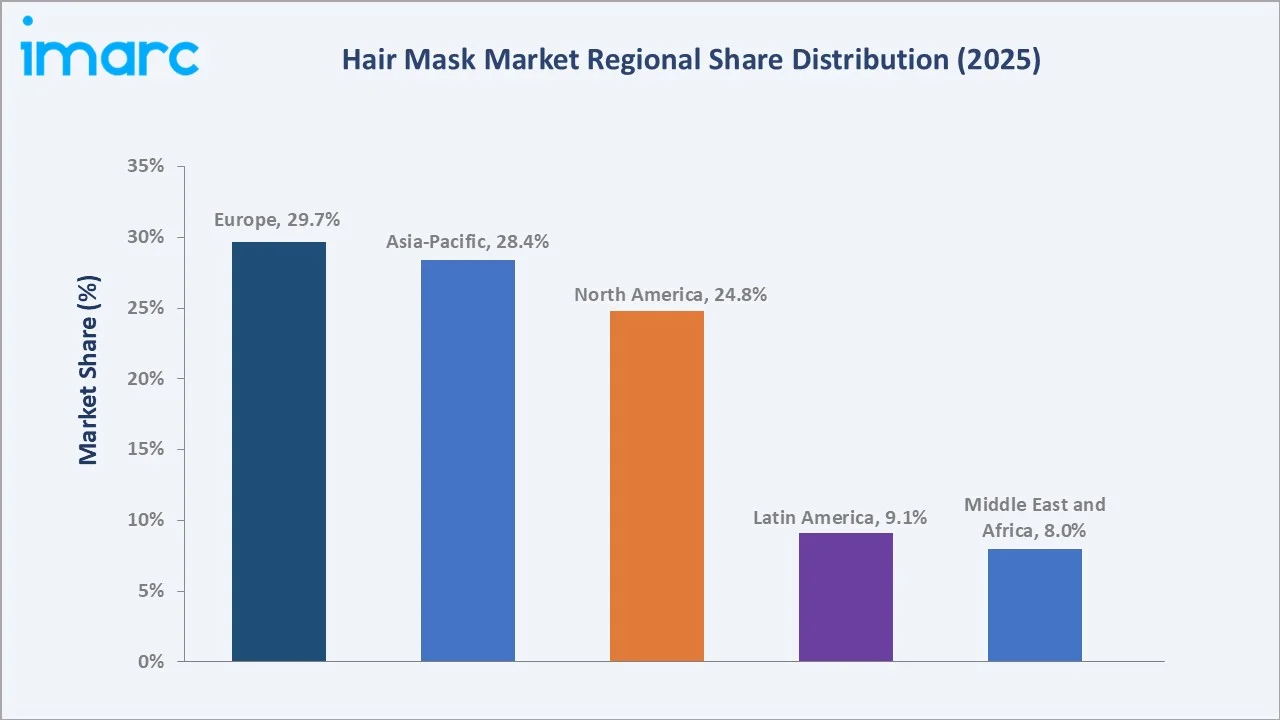
North America's 24.8% share reflects strong demand for scientifically-backed, damage-repair formulations among a well-established salon and retail infrastructure. Latin America and the Middle East and Africa, at 9.1% and 8.0% respectively, represent the market's fastest-emerging growth frontiers as modern retail formats expand.
Competitive Landscape
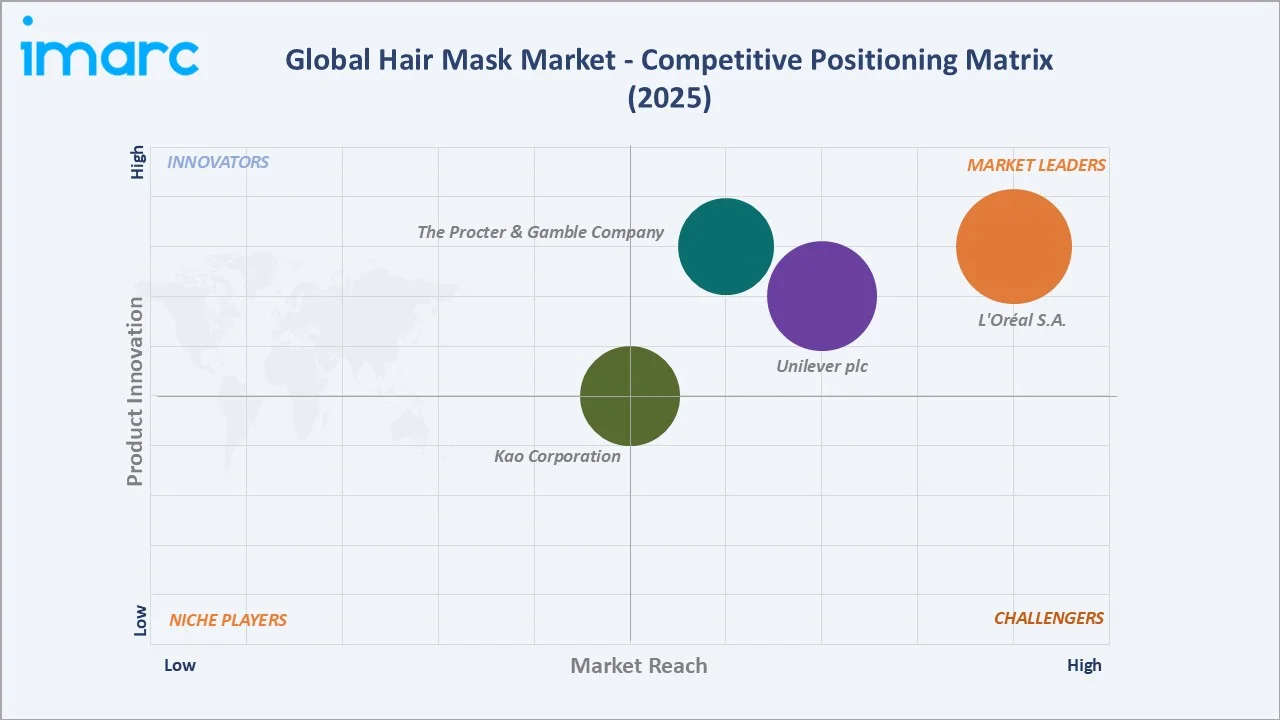
The global hair mask market competitive landscape spans multinational personal care conglomerates, specialty hair care brands, and regional salon-professional manufacturers.
|
Company Name |
Key Brands |
Market Position |
Core Strength |
|
L'Oréal S.A. |
L'Oréal Professionnel Paris, Kérastase, L'Oréal Paris |
Market Leader |
Broad multi-brand hair care portfolio, deep R&D investment to reinforce leadership across salon-professional and mass retail hair mask segments. |
|
Unilever plc |
Dove, TRESemmé, Nexxus, SheaMoisture, Love Beauty and Planet, Sunsilk |
Market Leader |
Dove hair care achieved double-digit growth following its 2025 fibre repair technology launch, supporting a strong position across mass and prestige hair mask categories. |
|
The Procter & Gamble Company |
Pantene, Herbal Essences, Head & Shoulders |
Market Leader |
Leverages an extensive mass-retail distribution network and long-standing hair care brand equity to maintain leadership across global hair mask retail channels. |
|
Kao Corporation |
Goldwell, KMS, John Frieda |
Established Player |
Premium salon-professional brands, delivered strong sales growth in 2025, reinforcing a position in professional and prestige hair mask segments. |
Multinational personal care conglomerates dominate the market through extensive distribution networks and continuous product innovation, while specialty and salon-professional brands compete on formulation differentiation and stylist endorsement. Consolidation activity, including L'Oréal's 2025 acquisition of Color Wow, reflects the strategic premium placed on damage-repair technology and brand equity within the category.
Key Company Profiles
L'Oréal S.A.
L'Oréal S.A. is a French multinational personal care company and the world's largest cosmetics group, offering an extensive portfolio of hair care and hair mask brands spanning mass, professional and luxury retail segments.
- Key Brands: L'Oréal Professionnel Paris, Kérastase, L'Oréal Paris
- Strategic Focus: Focuses on beauty-tech innovation, clean-label reformulation, and expanding its multi-brand hair care portfolio across professional and retail channels.
Unilever plc
Unilever plc is a British multinational consumer goods company whose beauty and personal care division includes several leading global hair care and hair mask brands.
- Key Products: Dove, TRESemmé, Nexxus, SheaMoisture, Love Beauty and Planet, Sunsilk
- Strategic Focus: Centered on premiumizing its hair care portfolio and expanding beauty and personal care as a core growth pillar.
The Procter & Gamble Company
Procter & Gamble is a leading American multinational consumer goods company with a broad portfolio of hair care brands sold across mass retail and e-commerce channels worldwide.
- Key Products: Pantene, Herbal Essences, Head & Shoulders
- Strategic Focus: Focused on leveraging its extensive global distribution network and brand equity to maintain leadership across mass-market hair care and hair mask categories.
Market Concentration Analysis
The global hair mask market is moderately consolidated at the top tier, with multinational personal care conglomerates such as L'Oréal S.A., Unilever plc, and The Procter & Gamble Company, collectively commanding a significant share of global hair care retail distribution. The remainder of the market stays fragmented across specialty, salon-professional and regional brands, none of which individually holds a comparable share. Consolidation is gradually increasing as larger players acquire specialty and clean-label brands, exemplified by L'Oréal's 2025 acquisition of Color Wow, to strengthen positions in the fast-growing damage-repair segment.
Investment & Growth Opportunities
Highest Growth Segments
Online distribution, scalp-focused hybrid formulations, and clean-label organic hair masks represent the fastest-growing segments within the global hair mask market, as consumers increasingly prioritize ingredient transparency and personalized treatment regimens through digital retail channels.
Emerging Investment Opportunities
Asia-Pacific represents the largest near-term growth opportunity, supported by rising grooming expenditure and rapidly digitizing beauty retail infrastructure across China, India, Japan and South Korea. Brands establishing early e-commerce and salon-partnership footprints in these markets are positioned for above-market revenue growth.
Investment Themes
- Clean-Label Formulation Investment: Brands investing in silicone-free, vegan and botanically-derived hair mask formulations are well-positioned to capture the growing consumer segment prioritizing ingredient transparency and sustainability.
- Direct-to-Consumer Digital Platform Development: Investment in AI-driven hair diagnostics and subscription-based delivery models is creating recurring revenue opportunities while deepening brand loyalty among digitally native consumers.
Future Market Outlook (2026-2034)
The global hair mask market is projected to grow from USD 747.6 Million in 2025 to USD 1,049.0 Million by 2034, delivering a 3.72% CAGR over the forecast period. The market's anchor value of USD 897.4 Million in 2030 reflects a category transitioning from occasional indulgence to routine hair care essential, as clean-label reformulation, scalp-focused innovation and salon-at-home hybrid products reshape consumer expectations. By 2034, personalized, AI-recommended hair mask regimens are expected to have moved from pilot programs toward broader commercial adoption across leading direct-to-consumer platforms.
Three structural forces underpin this trajectory. Rising consumer prioritization of hair health, comparable to the broader skinification trend in facial skincare, sustains long-term demand momentum independent of short-term economic cycles. Continued premiumization, driven by clean-label and botanical formulation innovation, supports value growth even as unit volume growth moderates in mature markets. Expanding e-commerce and social media-driven product discovery is widening the category's addressable consumer base across both developed and emerging regions.
Research Methodology
Primary Research
Primary research comprised structured interviews and consultations with industry stakeholders, including product development executives, brand managers, salon-professional distributors and regional hair care market specialists.
Secondary Research
Secondary research encompassed company annual reports and press releases, personal care industry publications, cosmetics regulatory databases, and government trade and consumer goods statistics.
Forecasting Models
Market revenue forecasts were developed using a segment bottom-up model incorporating end-user demand, distribution channel penetration, and regional consumption patterns.
Report Coverage:
| Report Features | Details |
|---|---|
| Base Year of the Analysis | 2025 |
| Historical Period | 2020-2025 |
| Forecast Period | 2026-2034 |
| Units | Million USD |
| Scope of the Report | Exploration of Historical Trends and Market Outlook, Industry Catalysts and Challenges, Segment-Wise Historical and Future Market Assessment:
|
| Natures Covered | Natural, Organic, Synthetic |
| End Users Covered | Individual, Commercial |
| Distribution Channels Covered | Online, Offline |
| Region Covered | Asia Pacific, Europe, North America, Latin America, Middle East and Africa |
| Countries Covered | United States, Canada, Germany, France, United Kingdom, Italy, Spain, Russia, China, Japan, India, South Korea, Australia, Indonesia, Brazil, Mexico |
| Companies Covered | L'Oréal S.A., Unilever plc, The Procter & Gamble Company, Kao Corporation, etc. |
| Customization Scope | 10% Free Customization |
| Post-Sale Analyst Support | 10-12 Weeks |
| Delivery Format | PDF and Excel through Email (We can also provide the editable version of the report in PPT/Word format on special request) |
Frequently Asked Questions About the Hair Mask Market Report
The global hair mask market reached USD 747.6 Million in 2025, driven by rising consumer focus on hair damage repair, growing salon demand, and increasing adoption of organic, silicone-free formulations worldwide.
The market is projected to grow at a 3.72% CAGR during 2026-2034, reaching USD 1,049.0 Million by 2034, supported by clean-label innovation and expanding e-commerce distribution channels.
Commercial end-users, including salons and professional treatment centers, lead at 57.3% share in 2025, reflecting strong demand from professional beauty service providers and stylist-endorsed recommendations.
Offline retail dominates at 68.4% share in 2025, as consumers prefer evaluating product texture and fragrance in-store, though online distribution is expanding faster through direct-to-consumer platforms.
Europe leads at 29.7% share in 2025, supported by established salon culture and dense specialty beauty retail networks across Germany, France and the United Kingdom.
Leading companies include L'Oréal S.A., Unilever plc, The Procter & Gamble Company, and Kao Corporation, among other established personal care and specialty hair care brands.
The market is projected to reach approximately USD 897.4 Million by 2030, as scalp-focused formulations, salon-at-home hybrid products and clean-label innovation continue reshaping consumer purchasing behavior.
Rising consumer focus on damage repair, growth of organic and silicone-free formulations, expanding e-commerce tutorials, and increasing salon treatment demand are the primary factors driving market growth.
E-commerce is expanding faster than offline retail, as brands invest in subscription models, influencer-driven tutorials and AI-personalized hair diagnostics to reach digitally native consumers directly.
The market is segmented into natural, organic and synthetic formulations, with manufacturers increasingly reformulating products to meet rising consumer demand for clean-label, botanically-derived ingredients.
Need more help?
- Speak to our experienced analysts for insights on the current market scenarios.
- Include additional segments and countries to customize the report as per your requirement.
- Gain an unparalleled competitive advantage in your domain by understanding how to utilize the report and positively impacting your operations and revenue.
- For further assistance, please connect with our analysts.
 Request Customization
 Speak to an Analyst
 Request Brochure
 Inquire Before Buying
Benefits of Customization
- Personalize this research
- Triangulate with your data
- Get data as per your format and definition
- Gain a deeper dive into a specific application, geography, customer, or competitor
- Any level of personalization
Get in Touch With Us
UNITED STATES
Phone: +1-201-971-6302
INDIA
Phone: +91-120-433-0800
UNITED KINGDOM
Phone: +44-753-714-6104
Email: [email protected]
Client Testimonials




.webp)




.webp)













Related Reports

Choose your plan
*Please note that the prices mentioned below are starting prices for each bundle type. Kindly contact our team for further details.*
Single User License
- 1 User License, Access on 2 Devices
- PDF Report + Excel Dataset (Password Protected)
- Lifetime Access
- No Printing Rights
- 10% Free Report Customization
- 10–12 Weeks of Analyst Support
Five User License
- Access for 5 Users, 2 Devices per User
- PDF Report + Excel Dataset (Password Protected)
- Lifetime Access
- Dedicated Account Manager
- 12–14 Weeks of Analyst Support
- No Printing Rights
- 15% Free Report Customization
- 25% Discount on Your Next Purchase
Corporate User License
- Unlimited User Access (Within Your Organization)
- PDF Report + Excel Dataset
- Lifetime Access
- Dedicated Account Manager
- 14–20 Weeks of Analyst Support
- No Printing Rights
- 20% Free Report Customization
- 30% Discount on Your Next Purchase
Essential Insights
What's included:
3 reports
- Lifetime Access
- PDF Reports
- Excel Datasets
- 2 Weeks of Free Analyst Support
- 2 User Licenses
- Access on 2 Devices
- Printing Rights
- Complimentary PowerPoint (PPT) Version
- Complimentary License Upgrade
Professional Access
What's included:
5 reports
- Lifetime Access
- PDF Reports
- Excel Datasets
- 8 Weeks of Free Analyst Support
- 2 User Licenses
- Access on 2 Devices
- Printing Rights
- Complimentary PowerPoint (PPT) Version
- Complimentary License Upgrade
Business Advantage
What's included:
8 reports
- Lifetime Access
- PDF Reports
- Excel Datasets
- 14 Weeks of Free Analyst Support
- 2 User Licenses
- Access on 2 Devices
- Printing Rights
- Complimentary PowerPoint (PPT) Version
- Complimentary License Upgrade
Enterprise Intelligence
What's included:
10 reports
- Lifetime Access
- PDF Reports
- Excel Datasets
- 20 Weeks of Free Analyst Support
- 2 User Licenses
- Access on 2 Devices
- Printing Rights
- Complimentary PowerPoint (PPT) Version
- Complimentary License Upgrade