
India Electric Iron Market Size, Share, Trends and Forecast by Function, Product, Application, Distribution Channel, and Region, 2026-2034
India Electric Iron Market Size, Share, Trends & Forecast (2026-2034)
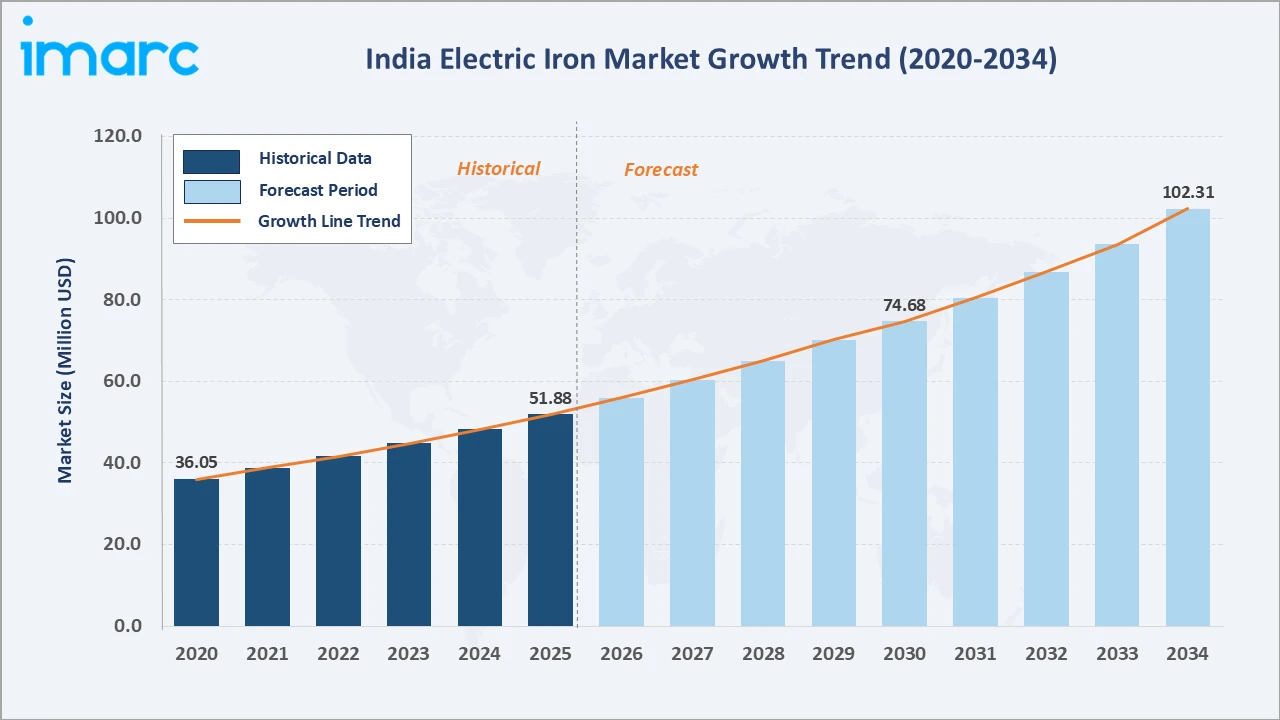
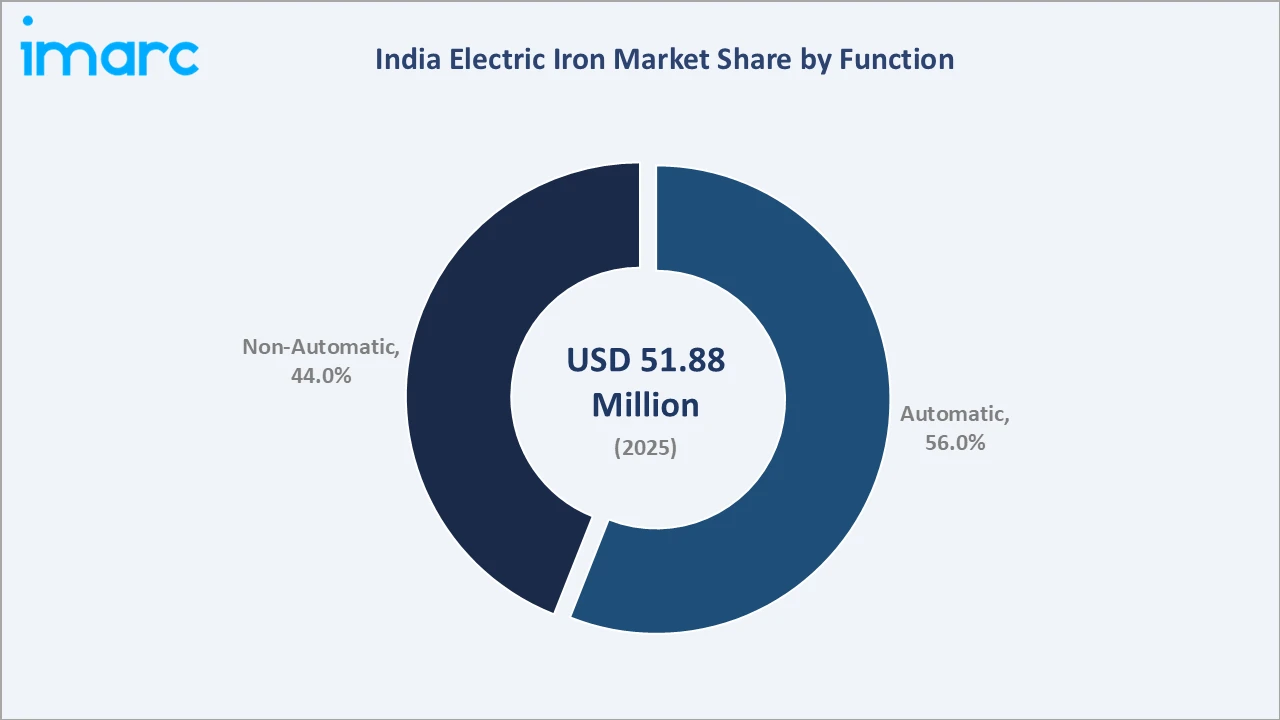
The India electric iron market size increased from USD 51.88 Million in 2025 to USD 55.80 Million in 2026 and is projected to reach USD 102.31 Million by 2034, growing at a CAGR of 7.56% during 2026-2034. Rising disposable incomes, rapid urbanization, and expanding e-commerce penetration are driving the India electric iron market forward. Automatic irons dominate at 56.0% of function-based demand, reflecting growing consumer preference for auto shut-off convenience. Steam irons lead the product segment at 54.0%, supported by faster wrinkle removal and rising premiumization. North India commands the largest regional share at 32.0%, backed by dense retail networks and higher urban disposable incomes across the region.
Market Snapshot
|
Metric |
Value |
|
Base Year Market Size (2025) |
USD 51.88 Million |
|
Market Size (2026) |
USD 55.80 Million |
|
Forecast Market Size (2034) |
USD 102.31 Million |
|
CAGR (2026-2034) |
7.56% |
|
Base Year |
2025 |
|
Historical Period |
2020-2025 |
|
Forecast Period |
2026-2034 |
|
Dominant Function |
Automatic (56.0%, 2025) |
|
Dominant Product |
Steam (54.0%, 2025) |
|
Leading Region |
North India (32.0%, 2025) |
India electric iron market expanded from USD 36.05 Million in 2020 to USD 51.88 Million in 2025 and an estimated USD 55.80 Million in 2026, anchored at USD 74.68 Million in 2030, and is forecast to reach USD 102.31 Million by 2034. This growth trajectory reflects India's structural shift from unorganized, entry-level dry irons toward branded, feature-rich steam and automatic irons, reinforced by rising middle-class consumption and expanding availability of ISI-certified products across price tiers.
To get more information on this market, Request Sample
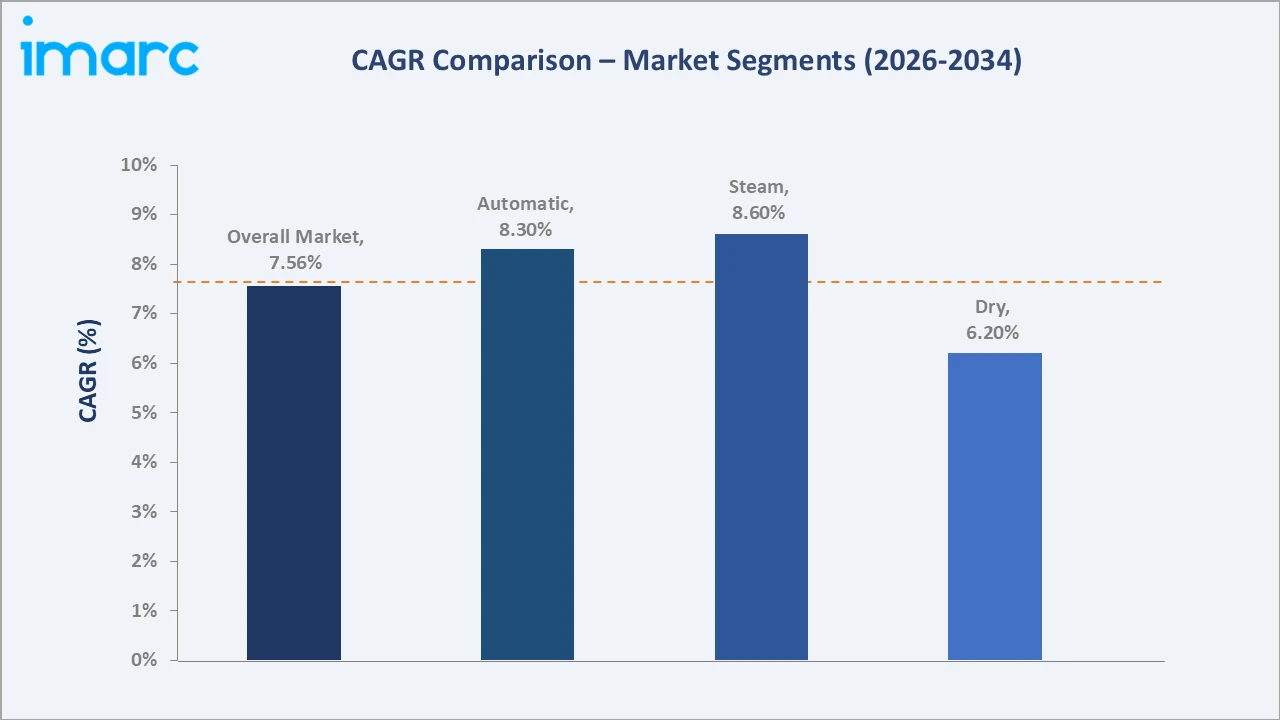
Among functional categories, automatic irons are estimated to grow faster than non-automatic variants through 2034, supported by rising safety-feature adoption. Steam irons are similarly outpacing dry irons as urban households increasingly prioritize convenience and fabric care over base price alone.
Executive Summary
The India electric iron market, which increased from USD 51.88 Million in 2025 to an estimated USD 55.80 Million in 2026, ranks among the faster-growing categories within the country's small domestic appliances industry. The market's growth is closely tied to India's urbanization curve, with urban areas projected to house nearly 600 million people, or around 40% of the population, by 2036, up from 31% in 2011. This structural shift is expanding the addressable base of urban households purchasing branded electric irons in place of unbranded units.
The market is projected to reach USD 102.31 Million by 2034, delivering a 7.56% CAGR during 2026-2034. Automatic irons, commanding 56.0% share in 2025, lead through rising consumer preference for auto shut-off safety and precision heat control. Steam irons, at 54.0% of the product mix, are gaining ground over dry irons as e-commerce penetration widens access to premium features such as anti-drip and steam-burst technology.
Regionally, North India leads with 32.0% share in 2025, followed by South India at 28.0%, West India at 22.0%, and East India at 18.0%. Government electrification initiatives, expanding organized retail, and rising participation of national appliance brands are expected to sustain the India electric iron market's growth outlook through the forecast period.
Key Market Insights
|
Insight |
Data |
|
Dominant Function |
Automatic - 56.0% share (2025) |
|
Dominant Product |
Steam - 54.0% market share (2025) |
|
Leading Region |
North India - 32.0% share (2025) |
|
Market Opportunity |
Tier-2/3 city e-commerce expansion; smart auto shut-off irons; quick-commerce distribution; ISI-certified premium steam iron segment |
Key Analytical Observations Supporting the Above Data:
- Automatic at 56.0%: The function segment dominates due to rising consumer emphasis on safety, precision heat regulation, and reduced fabric damage risk compared to manual thermostat control. Its growing presence across mass and premium price tiers makes it the preferred choice for urban Indian households.
- Steam at 54.0%: The product segment leads owing to faster crease removal, better fabric care, and rising willingness among urban consumers to pay a premium for steam-burst and anti-drip technology over basic dry ironing.
- North India at 32.0%: The region dominates due to higher urbanization, greater disposable incomes, and dense retail and e-commerce penetration across Delhi-NCR and surrounding metropolitan clusters.
- E-Commerce Penetration: Expanding online and quick-commerce platforms are widening access to premium and mid-range electric irons beyond metro cities into Tier-2 and Tier-3 towns.
- Regulatory Standardization: Mandatory ISI certification under Bureau of Indian Standards norms is improving product safety perception and supporting consumer trust in branded electric irons.
India Electric Iron Market Overview
The India electric iron market covers electric appliances used for pressing and de-wrinkling fabrics across residential and commercial applications. The industry is segmented by function into automatic and non-automatic irons, and by product into dry and steam variants. The ecosystem integrates component sourcing, domestic manufacturing, ISI certification, brand marketing, and multi-channel distribution spanning organized retail, general trade, and e-commerce. Macroeconomic factors including rising disposable incomes, urbanization, and growing consumer spending on household appliances continue to shape the India electric iron market.
Market Dynamics
To evaluate market opportunities, Request Sample
Market Drivers
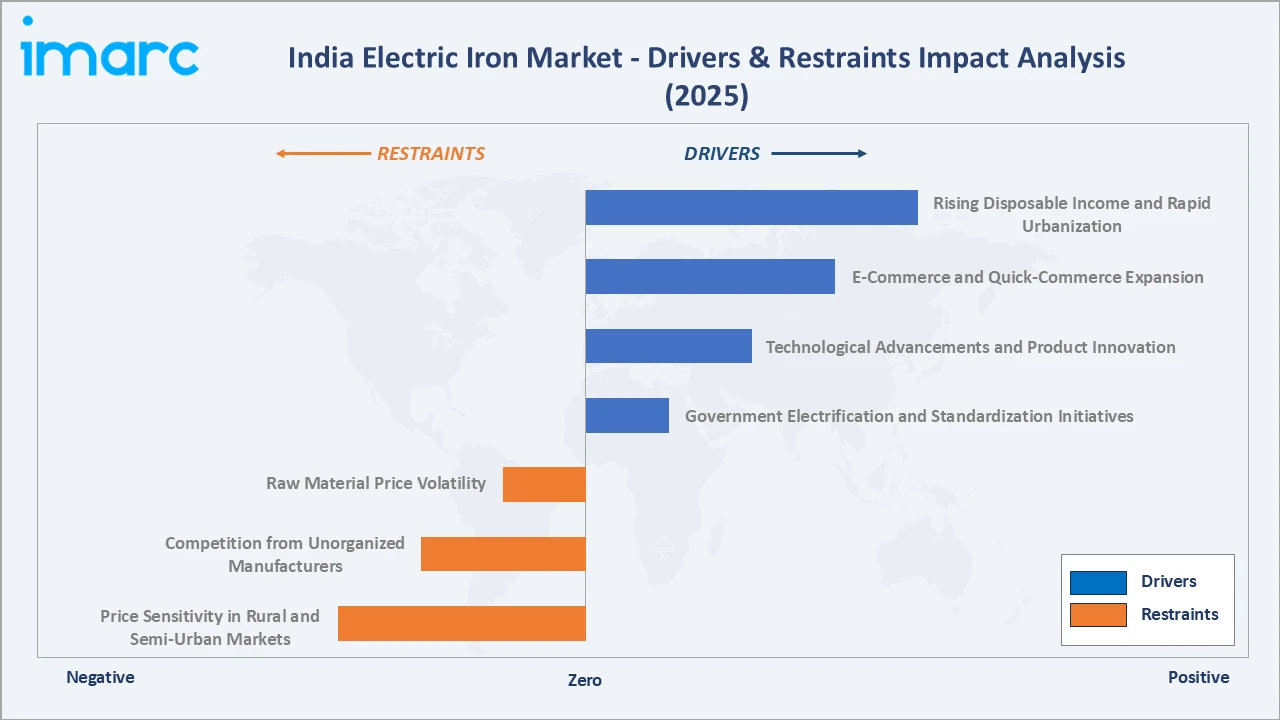
- Rising Disposable Income and Rapid Urbanization: Rising disposable income and rapid urbanization are driving market demand as more consumers move to cities and adopt modern household appliances. By 2036, urban areas are projected to house around 600 million people, making up 40% of India's population, up from 31% in 2011. India's expanding middle class, estimated at around 31% of the population and projected to rise to 38% by 2031, is further boosting sales of branded electric irons.
- E-Commerce and Quick-Commerce Expansion: E-commerce and quick-commerce platforms are providing consumers with easy access to a wide range of electric irons across price points and brands. Online channels allow manufacturers to reach Tier-2 and Tier-3 city customers, offering convenience, festive discounts, and doorstep delivery, which is expanding sales volumes and brand awareness.
- Technological Advancements and Product Innovation: Manufacturers are introducing ceramic soleplates, self-cleaning systems, and fabric-specific temperature controls to differentiate their offerings. In February 2024, GM Modular launched a new line of dry and steam irons, with dry models carrying ISI certification and the steam variant featuring fabric-specific temperature control and a self-cleaning system, reflecting the industry's shift toward feature-rich, certified products.
- Government Electrification and Standardization Initiatives: Government electrification programs and mandatory ISI certification under Bureau of Indian Standards norms are improving product safety standards and expanding rural electricity access, supporting first-time purchase of electric irons in previously underserved regions.
Market Restraints
- Raw Material Price Volatility: Fluctuating prices of steel, aluminum, and copper used in soleplates, heating elements, and wiring directly affect production costs. This volatility pressures manufacturer margins and can lead to periodic retail price adjustments across the India electric iron market.
- Competition from Unorganized Manufacturers: A large unorganized segment offering low-cost, non-certified electric irons continues to compete with branded manufacturers, particularly in price-sensitive rural and semi-urban markets, limiting the pace of premiumization.
Market Opportunities
- Tier-2 and Tier-3 City Retail Expansion: Growing affluence and aspirational lifestyles in smaller cities are creating demand for branded, feature-rich electric irons. Expanding modern retail and e-commerce logistics networks in these cities allow manufacturers to tap a previously underserved consumer base.
- Smart and Cordless Iron Innovation: Rising consumer interest in cordless and app-connected irons presents a white-space opportunity for manufacturers to differentiate through smart features, building on the existing shift toward automatic and steam technology.
Market Challenges
- Price Sensitivity in Rural and Semi-Urban Markets: A large share of rural and semi-urban consumers continues to prioritize affordability over brand or features, limiting adoption of mid-range and premium electric irons in these regions and sustaining demand for basic, low-cost models.
- Compliance with BIS Safety Standards: Compliance with mandatory ISI certification and evolving Bureau of Indian Standards safety norms requires ongoing investment in testing and quality control, which can be a barrier for smaller and unorganized manufacturers seeking to formalize their operations.
Emerging Market Trends
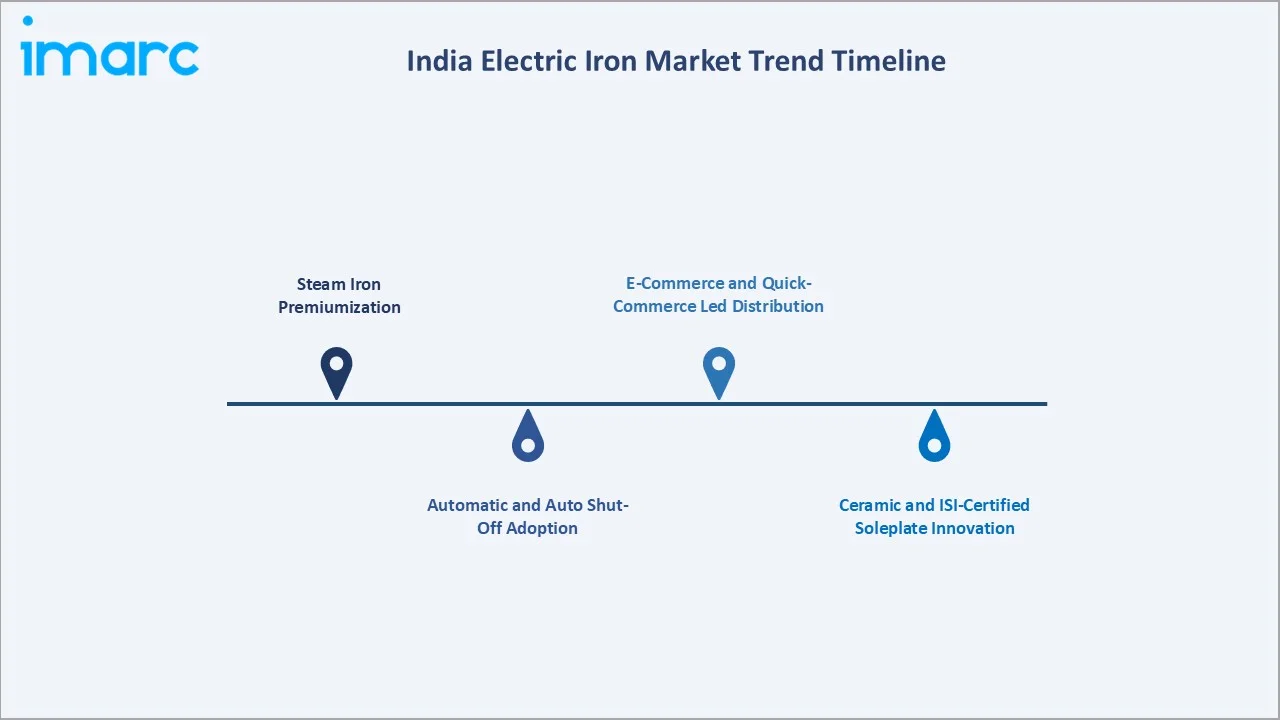
1. Steam Iron Premiumization
Steam irons, holding 54.0% of the product mix in 2025, are increasingly featuring ceramic soleplates, adjustable steam bursts, and anti-drip systems. In February 2025, KENT launched a premium steam iron range including the Luxe 2200W, Luxe 2000W, and Glide 1200W models alongside the KENT Swift Garment Steamer, illustrating the industry's push toward higher-wattage, feature-dense steam products.
2. Automatic and Auto Shut-Off Adoption
Automatic irons, at 56.0% share, are gaining preference as consumers prioritize safety and reduced fabric-burn risk. Auto shut-off, indicator lights, and precision thermostat dials are becoming standard even in mid-range models, narrowing the feature gap with premium offerings.
3. E-Commerce and Quick-Commerce Led Distribution
Online marketplaces and quick-commerce apps are shortening the path to purchase for electric irons, enabling manufacturers to launch limited-edition and festive-season models directly to urban and semi-urban consumers with fast doorstep delivery.
4. Ceramic and ISI-Certified Soleplate Innovation
In December 2024, Goldmedal launched next-generation steam and dry electric irons with multiple heat settings and ergonomic designs, following GM Modular's February 2024 launch of ISI-certified dry and steam irons. These developments reflect a broader industry shift toward certified, durable soleplate materials that improve glide performance and product longevity.
Industry Value Chain Analysis
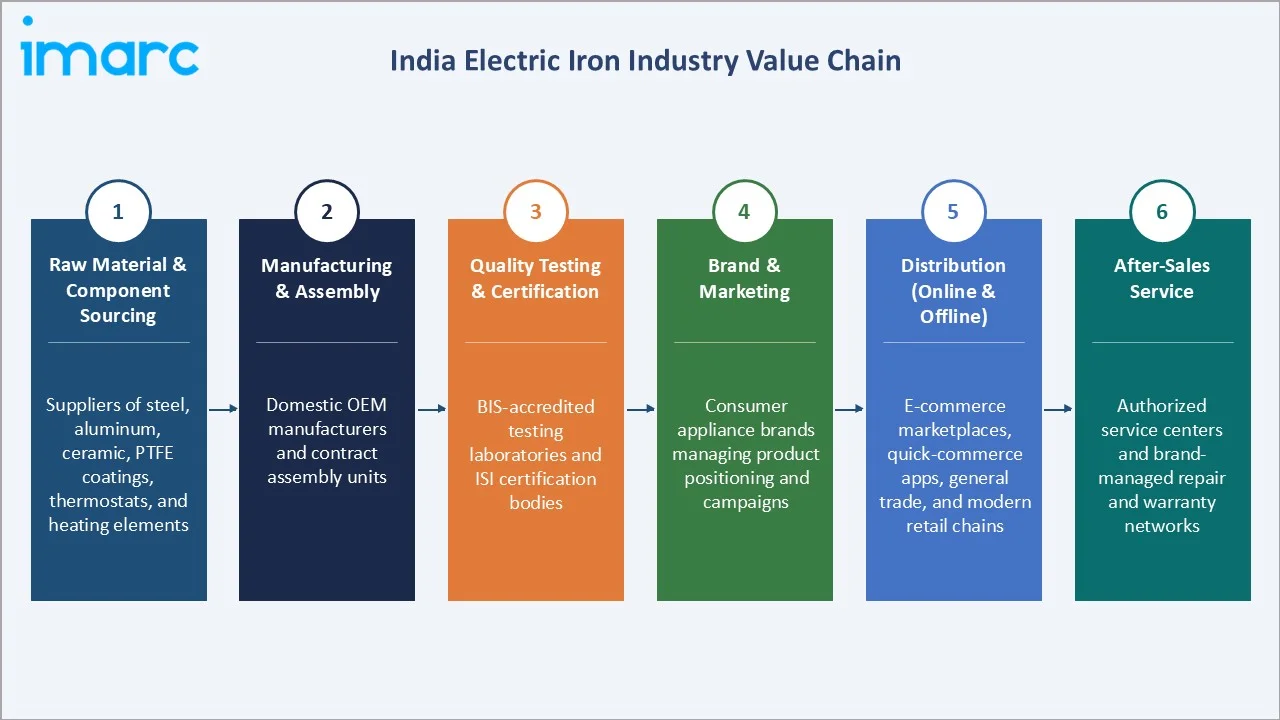
The India electric iron value chain spans component sourcing, manufacturing, certification, branding, and multi-channel distribution. Domestic value addition competes alongside imported components at different price points, with manufacturers increasingly consolidating sourcing and assembly to manage input cost volatility while maintaining compliance with mandatory safety certification requirements.
|
Stage |
Key Participants |
|
Raw Material & Component Sourcing |
Suppliers of steel, aluminum, ceramic, PTFE coatings, thermostats, and heating elements |
|
Manufacturing & Assembly |
Domestic OEM manufacturers and contract assembly units |
|
Quality Testing & Certification |
BIS-accredited testing laboratories and ISI certification bodies |
|
Brand & Marketing |
Consumer appliance brands managing product positioning and campaigns |
|
Distribution (Online & Offline) |
E-commerce marketplaces, quick-commerce apps, general trade, and modern retail chains |
|
After-Sales Service |
Authorized service centers and brand-managed repair and warranty networks |
Technology Landscape in the India Electric Iron Industry
Ceramic and Non-Stick Soleplate Technology
Ceramic and PTFE non-stick soleplates are improving glide performance and reducing fabric snagging compared to conventional aluminum plates. These coatings are becoming a standard differentiator across mid-range and premium electric irons sold in India.
Automatic Temperature Control and Auto Shut-Off Systems
Thermostat-based automatic temperature regulation and auto shut-off mechanisms are reducing fabric-burn risk and improving energy efficiency, supporting the 56.0% share held by automatic irons in 2025.
Steam Burst and Anti-Drip Technology
Steam-burst and anti-drip systems are enhancing wrinkle removal on thicker fabrics while preventing water leakage at lower temperature settings, a key feature driving steam irons' 54.0% product-segment leadership.
Market Segmentation Analysis
The report covers the following segments:
|
Segment Category |
Leading Segment |
Market Share |
Year |
|
Function |
Automatic |
56.0% |
2025 |
|
Product |
Steam |
54.0% |
2025 |
|
Application |
Residential |
91.2% |
2025 |
|
Distribution Channel |
Offline |
68.0% |
2025 |
|
Region |
North India |
32.0% |
2025 |

By Function
Automatic irons lead at 56.0% share in 2025. This segment spans mass and premium price tiers, offering thermostat-based heat regulation and auto shut-off safety that appeals to safety-conscious urban households across India.
To access detailed market analysis, Request Sample
Non-automatic irons, at 44.0% share, remain relevant in price-sensitive rural and semi-urban markets where manual thermostat control keeps unit costs lower, sustaining demand among first-time appliance buyers.
By Product
Steam irons lead at 54.0% share in 2025, driven by faster crease removal and rising consumer willingness to pay for fabric-care features. This segment is expanding fastest among urban households upgrading from basic dry irons.
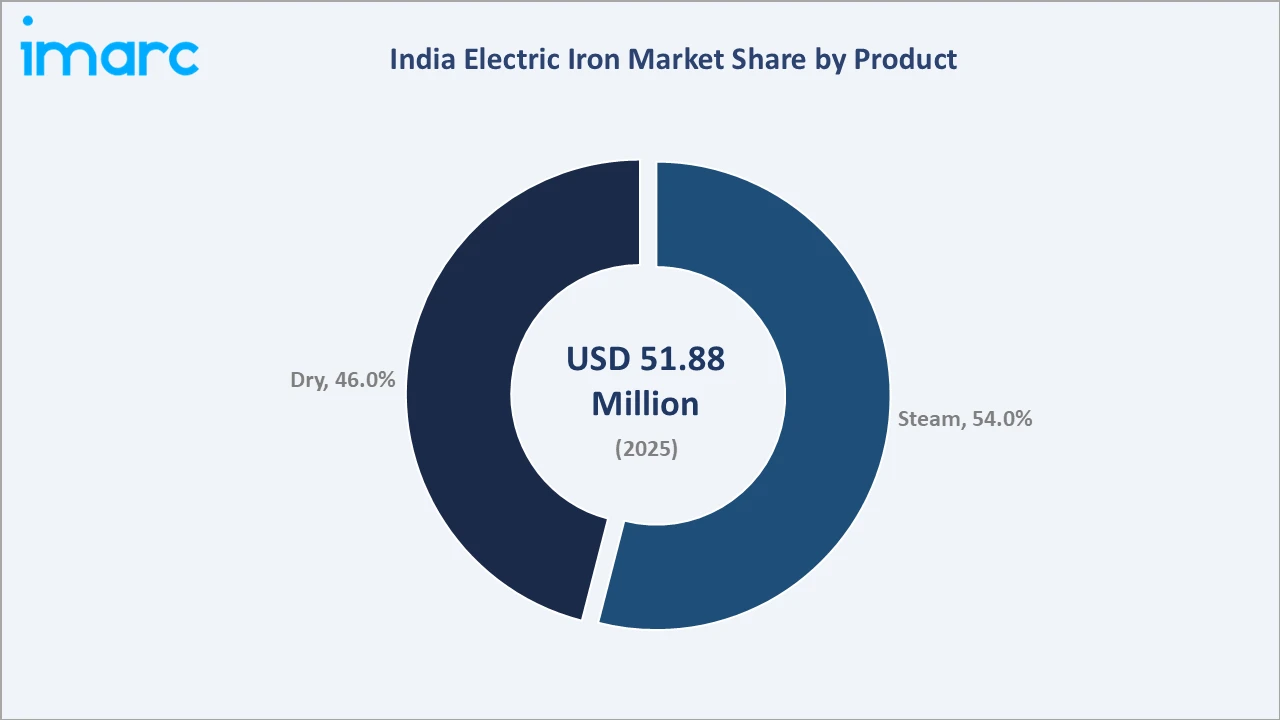
Dry irons, at 46.0% share, continue to serve budget-conscious consumers and first-time buyers, particularly in Tier-2 and Tier-3 towns where affordability remains the primary purchase driver.
Regional Market Insights
|
Region |
Share (2025) |
Key India Electric Iron Market Drivers & Characteristics |
|
North India |
32.0% |
Driven by urbanization, higher disposable incomes, and strong retail and e-commerce penetration across major metropolitan clusters. |
|
South India |
28.0% |
Reflects a technology-savvy, urbanized population with steady demand for premium and automatic irons through organized retail and e-commerce. |
|
West India |
22.0% |
Supported by widespread adoption of steam and mid-range irons through established modern trade and manufacturing hubs. |
|
East India |
18.0% |
Rising disposable incomes and expanding electrification are gradually supporting growth in branded, entry-level electric irons. |
North India's 32.0% market leadership reflects Delhi-NCR's dense organized retail footprint, higher urban disposable incomes, and well-developed e-commerce logistics infrastructure. South India's 28.0% share is supported by Bengaluru, Hyderabad, and Chennai's urbanized, technology-oriented consumer base, which shows strong preference for automatic and steam irons.
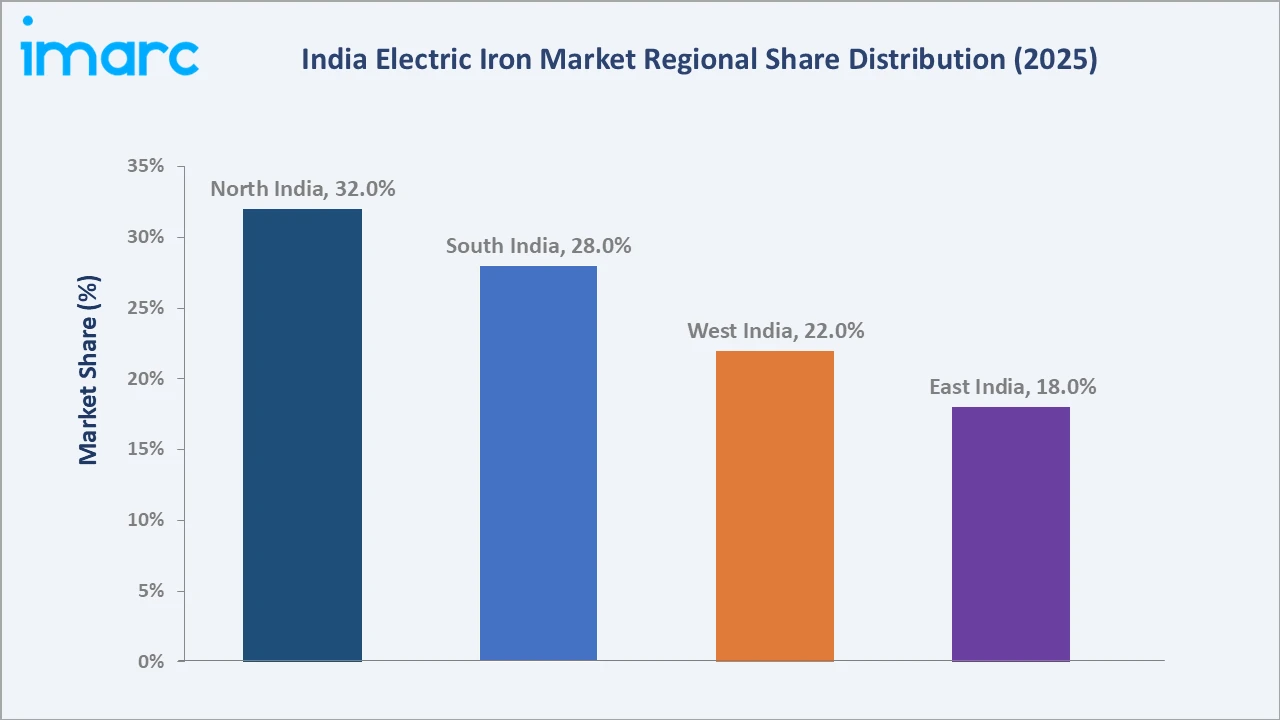
West India's 22.0% share benefits from Mumbai and Pune's manufacturing proximity and modern retail density, while East India's 18.0% share remains the most nascent, growing steadily as Kolkata's organized retail expansion and rising rural electrification create first-generation demand for branded electric irons.
Competitive Landscape
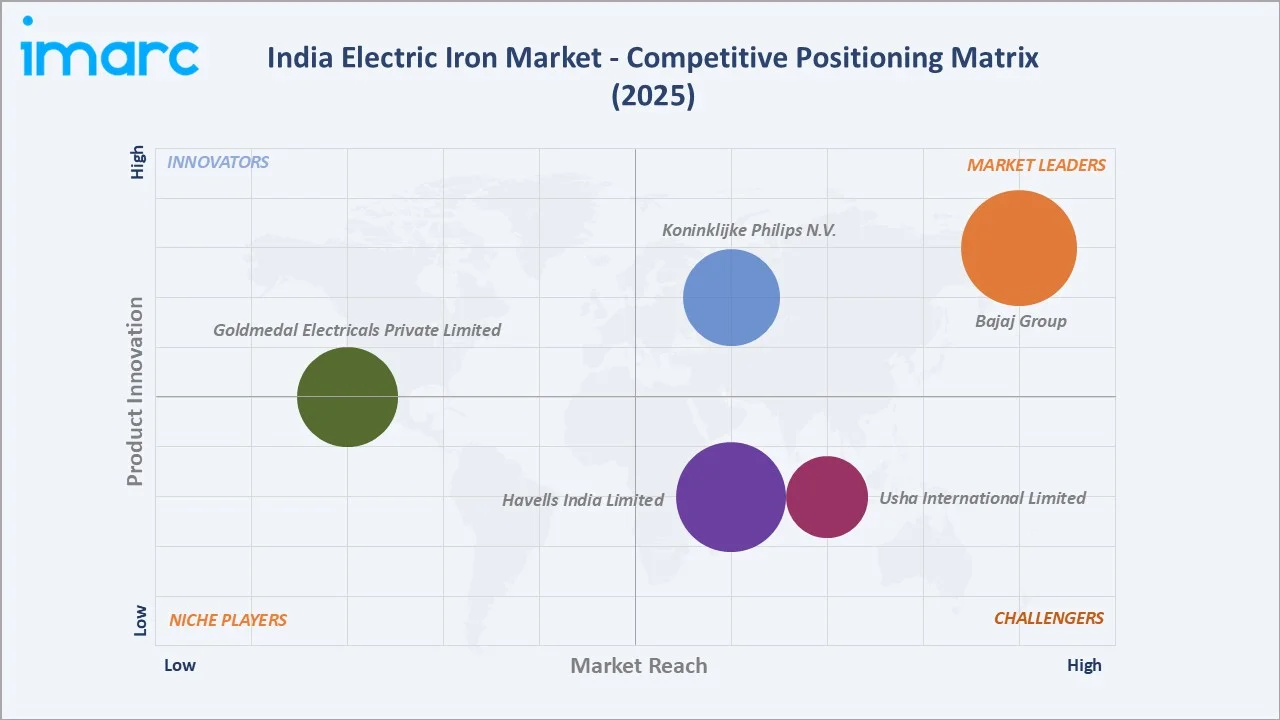
The India electric iron market is moderately fragmented, with a mix of established national appliance brands and a large unorganized segment. Competition is intensifying due to rising e-commerce penetration, growing demand for steam and automatic irons, and increasing consumer preference for ISI-certified, feature-rich products.
|
Company |
Key Brands |
Market Position |
Core Strength |
|
Bajaj Group |
Bajaj |
Market Leader |
Operates through Bajaj Electricals Limited, holds a broad distribution network across India. |
|
Koninklijke Philips N.V. |
Philips |
Market Leader |
Trusted legacy brand equity, advanced soleplate technology, and a well-balanced product portfolio spanning both budget dry irons and premium steam models. |
|
Havells India Limited |
Havells |
Strong Challenger |
Havells India leverages its diversified consumer durables portfolio and brand recall to expand its presence in the mid-range electric iron segment. |
|
Usha International Limited |
Usha |
Strong Challenger |
Usha International brings decades of household appliance heritage since 1934, offering a wide range of dry and steam iron models. |
|
Goldmedal Electricals Private Limited |
Goldmedal |
Emerging Player |
Goldmedal Electricals is expanding its presence through next-generation steam and dry iron launches targeting efficiency and fabric care. |
Key Company Profiles
Bajaj Group
Bajaj Group, which operates through its consumer appliances arm, Bajaj Electricals Ltd., is one of India's leading consumer appliance manufacturers, with a distribution network spanning over 1,000 distributors and more than 400,000 retail outlets, supporting a strong presence in the electric iron category.
- Key Brands: Bajaj
- Strategic Focus: Maintaining leadership in the India electric iron market through diversified offerings spanning economy dry irons to premium steam models with ceramic and Teflon-coated soleplates.
Havells India Limited
Havells India Limited is a diversified electrical equipment and consumer durables manufacturer with numerous manufacturing facilities across India, offering electric irons as part of its broader electrical consumer durables segment.
- Key Brands: Havells
- Strategic Focus: Diversifying beyond switchgear, cables, and lighting by strengthening its consumer durables portfolio, including electric irons, to build recurring appliance purchase relationships with middle-class households.
Usha International Limited
Usha International Limited has been present in India's home and kitchen appliance industry for more than nine decades, offering a broad portfolio of dry and steam electric irons under the Usha brand.
- Key Brands: Usha
- Strategic Focus: Leveraging its long-standing brand heritage and wide product range to retain relevance across both budget and mid-premium electric iron segments.
Market Concentration Analysis
The India electric iron market is moderately concentrated at the branded, organized level, with a handful of national appliance manufacturers commanding a significant share of ISI-certified product sales, while a large unorganized segment continues to serve price-sensitive rural and semi-urban buyers.
Market concentration is evolving through two parallel forces: established players such as Bajaj Electricals and Havells India expanding distribution and premium product lines, while newer entrants such as Goldmedal introduce feature-rich steam irons to capture share from the unorganized segment through certification-led differentiation.
Investment & Growth Opportunities
Highest Growth Segments
Automatic irons (~8.3% CAGR through rising safety-feature adoption), steam irons (~8.6% CAGR through premiumization), Tier-2/3 city e-commerce-led distribution, and smart or cordless iron innovation represent the India electric iron market's highest-growth investment vectors through 2034.
Emerging Investment Opportunities
India's quick-commerce channel, delivering household appliances within hours in major cities, represents a fast-growing distribution opportunity for electric iron manufacturers seeking to reach urban consumers with shorter replacement cycles.
Investment Themes
- Tier-2/3 City Distribution Expansion: Retail and e-commerce logistics expansion in Tier-2 and Tier-3 cities represents an underserved opportunity, given the concentration of organized electric iron retail in metro markets.
- Feature-Led Product Premiumization: Investment in ceramic soleplate and auto shut-off technology offers a route to premiumize entry-level products, enabling manufacturers to capture the price-sensitive segment while building a pathway toward higher-margin steam and automatic categories.
Future Market Outlook (2026-2034)
The India electric iron market is projected to grow from USD 51.88 Million in 2025 to USD 55.80 Million in 2026, reaching USD 102.31 Million by 2034, registering a 7.56% CAGR during 2026-2034. The market's anchor value of USD 74.68 Million in 2030 reflects a structural shift toward automatic and steam irons as urbanization and e-commerce penetration continue to expand the addressable consumer base.
Three structural forces are expected to define the India electric iron market's growth through 2034: rising urban disposable income supporting premiumization toward steam and automatic categories; e-commerce and quick-commerce channels widening geographic access to branded products; and continued government electrification and BIS certification initiatives formalizing demand away from the unorganized segment.
Research Methodology
Primary Research
Primary research comprised structured interviews with India electric iron industry stakeholders, including manufacturing executives, category managers at e-commerce platforms, distributors, and retail channel partners across North, South, East, and West India.
Secondary Research
Secondary research encompassed company annual reports, industry association publications, government electrification and standards data, e-commerce marketplace listings, and trade publications covering India's consumer appliances industry.
Forecasting Models
Market revenue forecasts were developed using a consumption-based estimation model, combining historical shipment trends, urban household appliance penetration rates, and category-wise replacement cycles to project segment and regional demand through 2034.
India Electric Iron Market Report Coverage:
| Report Features | Details |
|---|---|
| Base Year of the Analysis | 2025 |
| Historical Period | 2020-2025 |
| Forecast Period | 2026-2034 |
| Units | Million USD |
| Scope of the Report |
Exploration of Historical Trends and Market Outlook, Industry Catalysts and Challenges, Segment-Wise Historical and Future Market Assessment:
|
| Functions Covered | Automatic, Non-Automatic |
| Products Covered | Dry, Steam |
| Applications Covered | Residential, Commercial |
| Distribution Channels Covered | Online, Offline |
| Regions Covered | North India, South India, East India, West India |
| Companies Covered | Bajaj Group, Koninklijke Philips N.V., Havells India Limited, Usha International Limited, Goldmedal Electricals Private Limited, etc. |
| Customization Scope | 10% Free Customization |
| Post-Sale Analyst Support | 10-12 Weeks |
| Delivery Format | PDF and Excel through Email (We can also provide the editable version of the report in PPT/Word format on special request) |
Key Benefits for Stakeholders:
- IMARC’s industry report offers a comprehensive quantitative analysis of various market segments, historical and current market trends, market forecasts, and dynamics of the India electric iron market from 2020-2034.
- The research report provides the latest information on the market drivers, challenges, and opportunities in the India electric iron market.
- Porter's five forces analysis assist stakeholders in assessing the impact of new entrants, competitive rivalry, supplier power, buyer power, and the threat of substitution. It helps stakeholders to analyze the level of competition within the India electric iron industry and its attractiveness.
- Competitive landscape allows stakeholders to understand their competitive environment and provides an insight into the current positions of key players in the market.
Frequently Asked Questions About the India Electric Iron Market Report
The India electric iron market size increased from USD 51.88 Million in 2025 and USD 55.80 Million in 2026, driven by rising disposable incomes, urbanization, and growing demand for automatic and steam irons. Expanding e-commerce adoption and government electrification initiatives further support market expansion across urban and semi-urban regions.
The India electric iron market grows at a 7.56% CAGR during 2026-2034, reaching USD 102.31 Million by 2034. Growth is sustained by rising urbanization, e-commerce-led distribution expansion, and increasing premiumization toward automatic and steam categories.
Automatic irons lead at 56.0% share through rising consumer preference for auto shut-off safety, precision heat control, and reduced fabric-burn risk across urban Indian households.
Steam irons lead at 54.0% share through faster crease removal, superior fabric care, and rising willingness among urban consumers to pay for premium ironing features.
North India leads at 32.0% share through Delhi-NCR's dense organized retail footprint, higher urban disposable incomes, and well-developed e-commerce logistics infrastructure.
Leading companies include Bajaj Group, Koninklijke Philips N.V., Havells India Limited, Usha International Limited, and Goldmedal Electricals Private Limited, among others.
The India electric iron market is projected to reach approximately USD 74.68 Million by 2030, supported by continued urbanization, e-commerce expansion, and rising adoption of automatic and steam irons.
Priority investment opportunities include Tier-2/3 city retail and e-commerce distribution expansion, ceramic soleplate and auto shut-off feature innovation, and premium steam iron and garment steamer product development.
Key drivers include rising disposable incomes, rapid urbanization, growing e-commerce penetration, technological advancements in soleplate and safety features, and government electrification and BIS certification initiatives.
Major challenges include price sensitivity among rural and semi-urban consumers, competition from unorganized low-cost manufacturers, raw material price volatility, and compliance costs associated with BIS safety certification.
Need more help?
- Speak to our experienced analysts for insights on the current market scenarios.
- Include additional segments and countries to customize the report as per your requirement.
- Gain an unparalleled competitive advantage in your domain by understanding how to utilize the report and positively impacting your operations and revenue.
- For further assistance, please connect with our analysts.
 Request Customization
 Speak to an Analyst
 Request Brochure
 Inquire Before Buying
Benefits of Customization
- Personalize this research
- Triangulate with your data
- Get data as per your format and definition
- Gain a deeper dive into a specific application, geography, customer, or competitor
- Any level of personalization
Get in Touch With Us
UNITED STATES
Phone: +1-201-971-6302
INDIA
Phone: +91-120-433-0800
UNITED KINGDOM
Phone: +44-753-714-6104
Email: [email protected]
Client Testimonials




.webp)




.webp)













Related Reports

Choose your plan
*Please note that the prices mentioned below are starting prices for each bundle type. Kindly contact our team for further details.*
Single User License
- 1 User License, Access on 2 Devices
- PDF Report + Excel Dataset (Password Protected)
- Lifetime Access
- No Printing Rights
- 10% Free Report Customization
- 10–12 Weeks of Analyst Support
Five User License
- Access for 5 Users, 2 Devices per User
- PDF Report + Excel Dataset (Password Protected)
- Lifetime Access
- Dedicated Account Manager
- 12–14 Weeks of Analyst Support
- No Printing Rights
- 15% Free Report Customization
- 25% Discount on Your Next Purchase
Corporate User License
- Unlimited User Access (Within Your Organization)
- PDF Report + Excel Dataset
- Lifetime Access
- Dedicated Account Manager
- 14–20 Weeks of Analyst Support
- No Printing Rights
- 20% Free Report Customization
- 30% Discount on Your Next Purchase
Essential Insights
What's included:
3 reports
- Lifetime Access
- PDF Reports
- Excel Datasets
- 2 Weeks of Free Analyst Support
- 2 User Licenses
- Access on 2 Devices
- Printing Rights
- Complimentary PowerPoint (PPT) Version
- Complimentary License Upgrade
Professional Access
What's included:
5 reports
- Lifetime Access
- PDF Reports
- Excel Datasets
- 8 Weeks of Free Analyst Support
- 2 User Licenses
- Access on 2 Devices
- Printing Rights
- Complimentary PowerPoint (PPT) Version
- Complimentary License Upgrade
Business Advantage
What's included:
8 reports
- Lifetime Access
- PDF Reports
- Excel Datasets
- 14 Weeks of Free Analyst Support
- 2 User Licenses
- Access on 2 Devices
- Printing Rights
- Complimentary PowerPoint (PPT) Version
- Complimentary License Upgrade
Enterprise Intelligence
What's included:
10 reports
- Lifetime Access
- PDF Reports
- Excel Datasets
- 20 Weeks of Free Analyst Support
- 2 User Licenses
- Access on 2 Devices
- Printing Rights
- Complimentary PowerPoint (PPT) Version
- Complimentary License Upgrade