
India Industrial Cybersecurity Market Size, Share, Trends and Forecast by Component, Security Type, Industry, and Region, 2026-2034
India Industrial Cybersecurity Market Size, Share, Trends & Forecast (2026-2034)
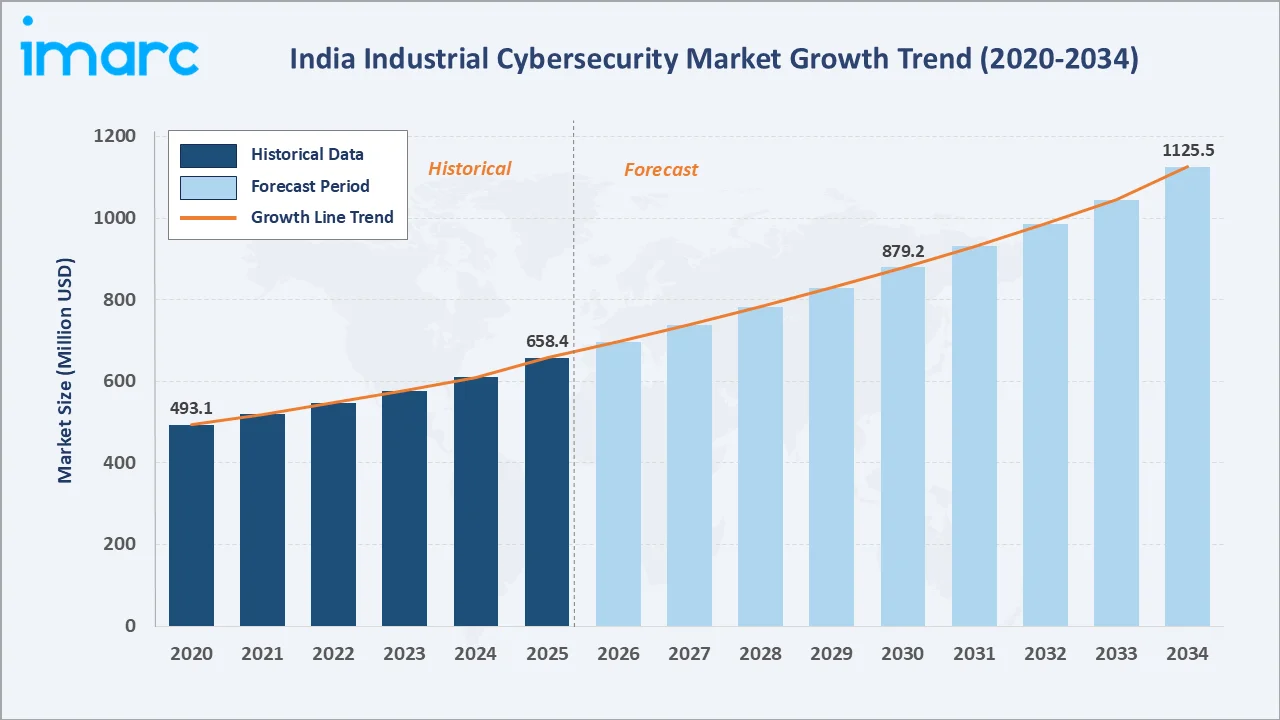
The India industrial cybersecurity market grew from USD 658.4 Million in 2025 to USD 697.6 Million in 2026 and is projected to reach USD 1,125.5 Million by 2034, exhibiting a CAGR of 5.95% during 2026-2034. In 2025, India reported 29.44 Lakh cybersecurity incidents, reflecting an 85% rise compared to 2023, underscoring the urgency for robust operational technology (OT) security frameworks across the country.
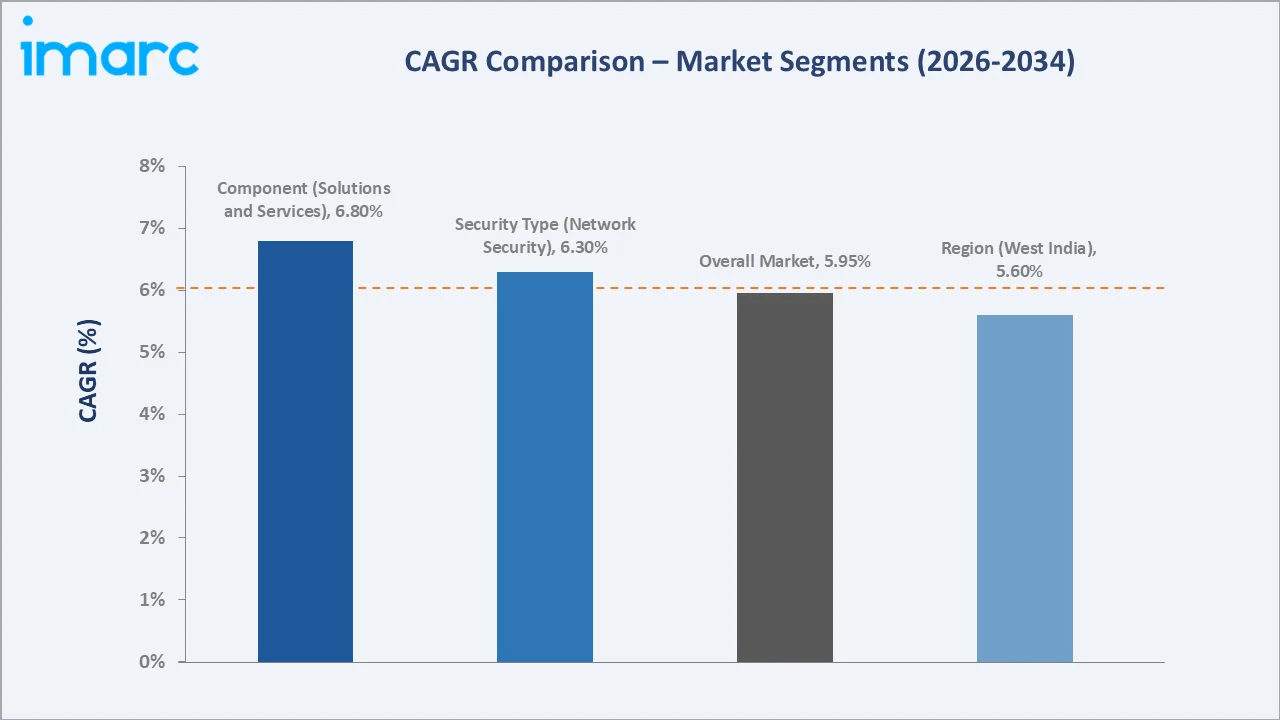
Solutions and services lead the component segment at 58.0%, network security commands 32.0% of the security type segment, and West India holds 30.0% regional share.
Market Snapshot
|
Metric |
Value |
|
Base Year Market Size (2025) |
USD 658.4 Million |
|
Market Size (2026) |
USD 697.6 Million |
|
Forecast Market Size (2034) |
USD 1,125.5 Million |
|
CAGR (2026-2034) |
5.95% |
|
Base Year |
2025 |
|
Historical Period |
2020-2025 |
|
Forecast Period |
2026-2034 |
|
Largest Region |
West India (30.0%, 2025) |
|
Second Largest Region |
South India (28.0%, 2025) |
|
Leading Component |
Solutions and Services (58.0%, 2025) |
|
Leading Security Type |
Network Security (32.0%, 2025) |
The India industrial cybersecurity market size increased from USD 493.1 Million in 2020 to USD 658.4 Million in 2025 and is estimated to reach USD 697.6 Million in 2026. The market is further expected to grow to USD 879.2 Million by 2030 and USD 1,125.5 Million by 2034. The market is driven by accelerating convergence of OT and IT systems, rising frequency of cyberattacks on critical infrastructure, and increasing government focus on protecting manufacturing, energy, and utilities sectors.
To get more information on this market, Request Sample
CAGR trajectories across component and security type sub-segments, together with regional patterns, show East India and solutions and services expanding faster than the overall 5.95% market CAGR, driven by expanding smart manufacturing corridors, increasing OT network complexity, and growing investments in industrial security operations centers.
Executive Summary
The India industrial cybersecurity market expanded from USD 658.4 Million in 2025 to an estimated USD 697.6 Million in 2026. The industry has evolved from basic network perimeter defenses to comprehensive, integrated OT and IT security platforms spanning threat detection, endpoint protection, cloud application security, and managed security operations. Rising digitalization of manufacturing facilities, smart grid deployments, and critical infrastructure modernization programs are reshaping the cybersecurity landscape across Indian industries.
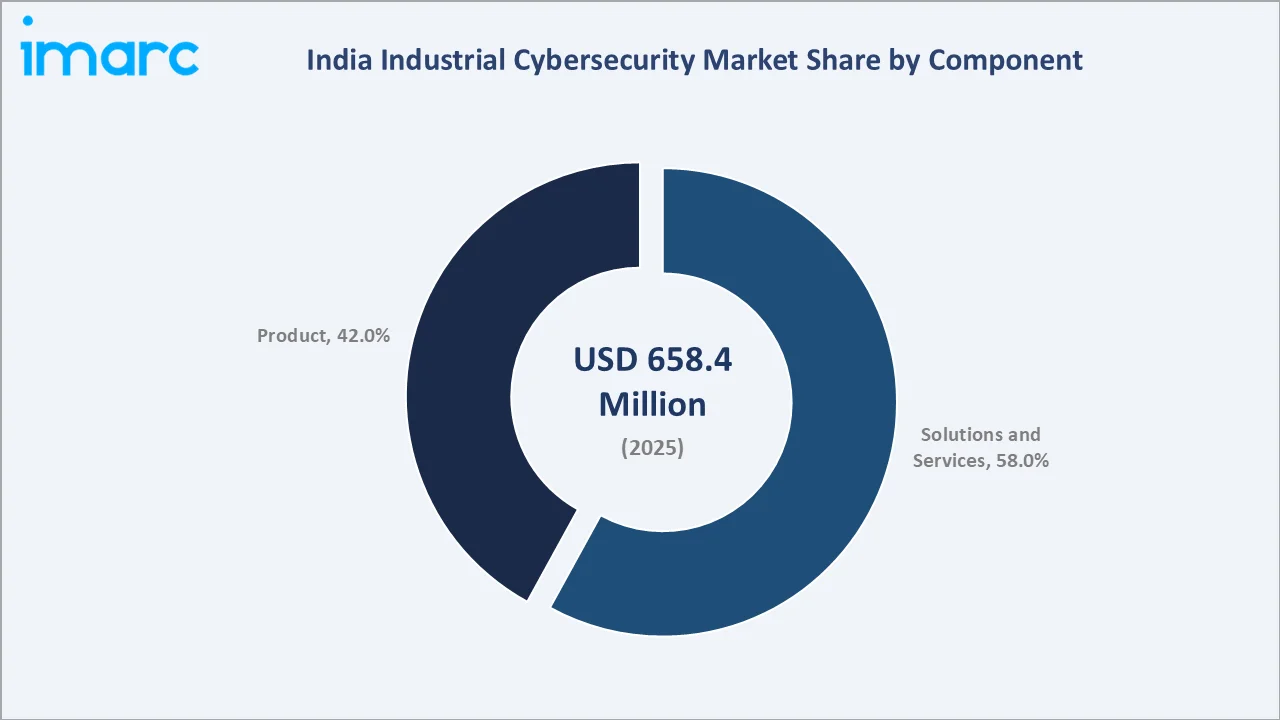
Solutions and services lead the component segment at 58.0% in 2025, anchored by managed security services, consulting engagements, and threat intelligence platforms that support industrial enterprises in building resilient security postures. Network security commands 32.0% of the security type segment, reflecting ongoing investment in industrial network monitoring, segmentation, and intrusion prevention systems. West India holds 30.0% regional share, supported by a dense concentration of heavy manufacturing, petrochemical, and pharmaceutical industries that represent high-value OT security deployment targets.
Key Market Insights
|
Insight |
Data |
|
Leading Component |
Solutions and Services - 58.0% share (2025) |
|
Second Largest Component |
Product - 42.0% share (2025) |
|
Leading Security Type |
Network Security - 32.0% share (2025) |
|
Second Largest Security Type |
Cloud Application Security - 21.0% share (2025) |
|
Leading Region |
West India - 30.0% share (2025) |
|
Second Largest Region |
South India - 28.0% share (2025) |
|
Top Companies |
Honeywell International Inc., Siemens AG, Fortinet, Inc., Check Point Software Technologies Ltd. |
Key Analytical Observations Expanding on the Data Above:
- Solutions and services dominance at 58.0% reflects growing demand for managed security services, professional consulting, and threat intelligence platforms as industrial enterprises across India increasingly outsource security operations to specialist providers with OT expertise.
- Product at 42.0% encompasses hardware security appliances, industrial firewalls, intrusion detection systems, and ICS/SCADA protection tools deployed across manufacturing and critical infrastructure facilities.
- Network security leadership at 32.0% is driven by rising investment in industrial network monitoring, deep packet inspection, and air-gap enforcement systems that protect OT networks from external and insider threats.
- Cloud application security at 21.0% reflects the growing migration of industrial SCADA and control system management interfaces to hybrid cloud environments, requiring purpose-built cloud security policies and identity access management solutions.
- West India at 30.0% leads regional share, driven by a dense base of heavy manufacturing, petrochemical, and pharmaceutical enterprises in Maharashtra and Gujarat that require robust cybersecurity measures to protect industrial control systems, operational technology, and critical production infrastructure.
India Industrial Cybersecurity Market Overview
Industrial cybersecurity refers to the application of protective technologies, policies, and processes to safeguard OT environments, including industrial control systems, SCADA platforms, distributed control systems (DCS), and industrial IoT networks from cyber threats.
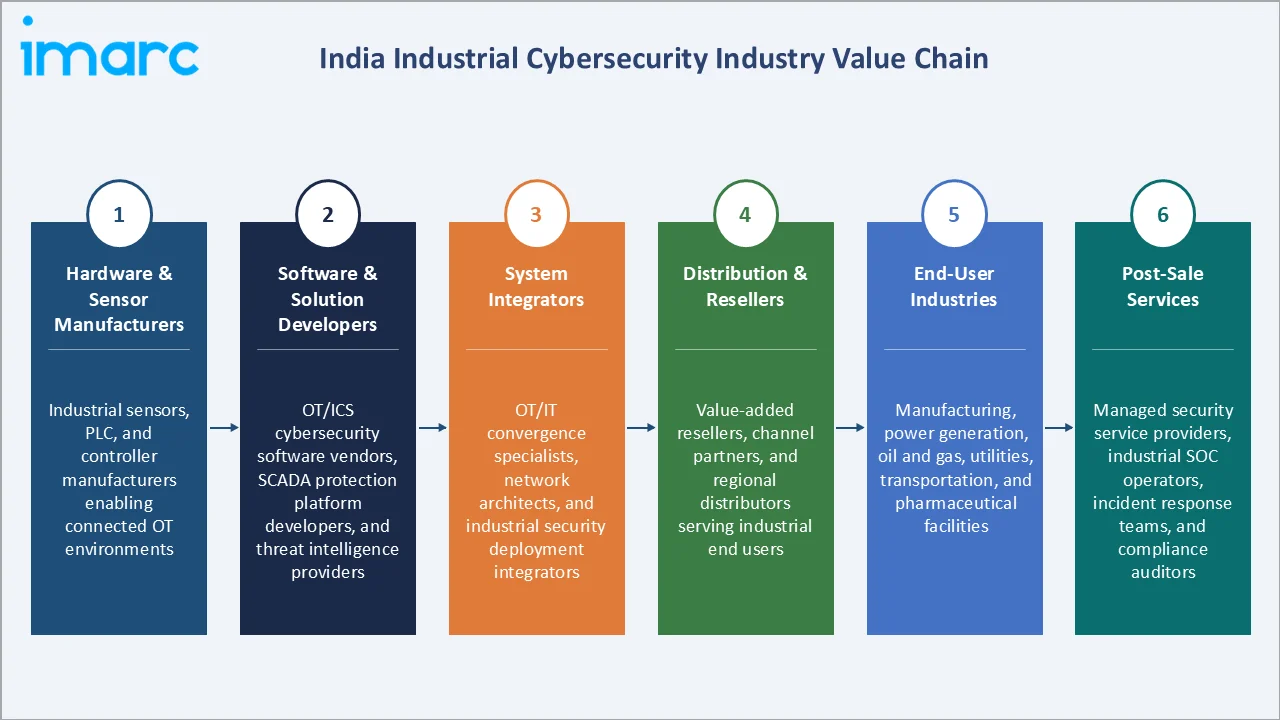
In India, the ecosystem integrates OT/ICS vendors, cybersecurity solution providers, system integrators, government regulators, managed security service providers, and end-user industries. Together, they deliver layered protection across the industrial value chain, spanning network monitoring, endpoint defense, cloud application security, and incident response capabilities.
Market Dynamics
To evaluate market opportunities, Request Sample
Market Drivers
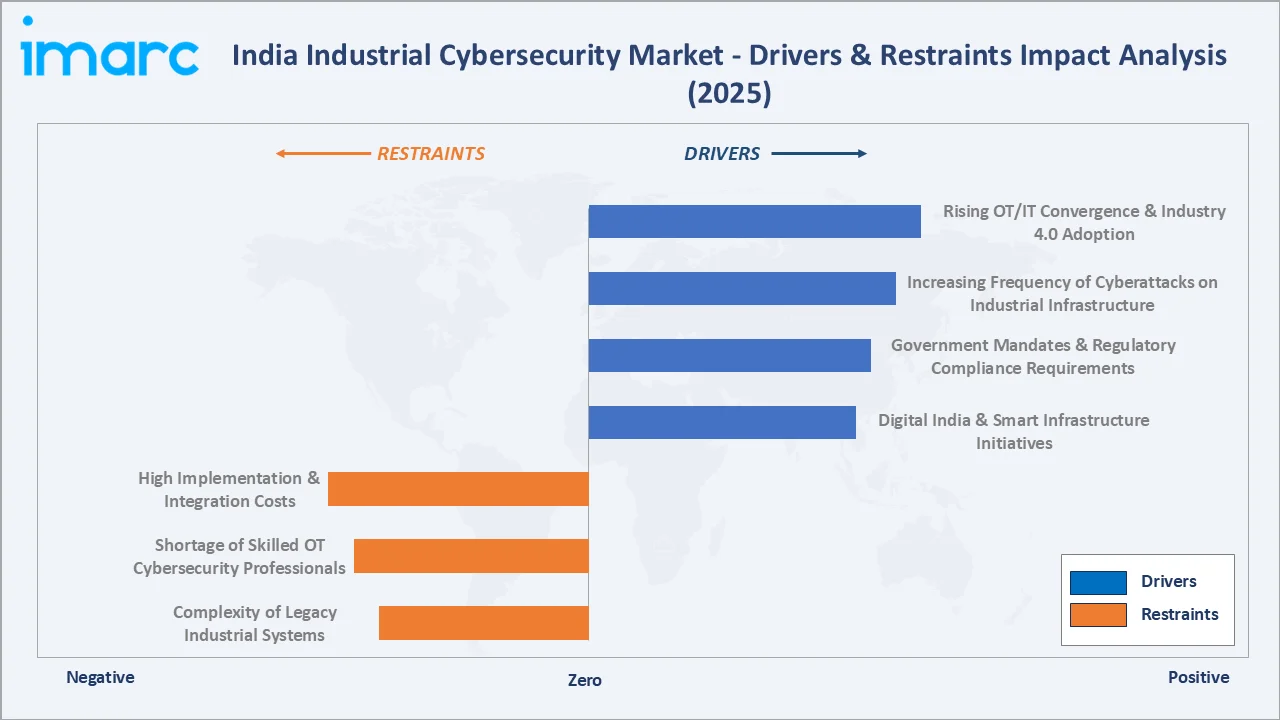
- Rising OT/IT Convergence and Industry 4.0 Adoption: Accelerating integration of OT with IT networks across Indian manufacturing, energy, and utilities sectors is expanding the attack surface for cyber threats, driving consistent demand for specialized OT security solutions capable of protecting converged industrial environments.
- Increasing Frequency of Cyberattacks on Industrial Infrastructure: Growing targeting of Indian critical infrastructure by both state-sponsored and criminal threat actors is compelling industrial enterprises and infrastructure operators to invest in proactive threat detection, industrial network monitoring, and incident response capabilities.
- Government Mandates and Regulatory Compliance Requirements: The India industrial cybersecurity market report highlights evolving cybersecurity regulations, sector-specific guidelines, and government directives as key factors encouraging industrial organizations to strengthen cybersecurity controls, conduct regular risk assessments, and enhance monitoring and incident response capabilities across operational environments.
- Digital India and Smart Infrastructure Initiatives: Government-led digital transformation programs, including Digital India, smart city development, and smart grid initiatives, are accelerating the deployment of connected industrial assets and digital systems, increasing the need for cybersecurity solutions that protect interconnected operational environments and critical infrastructure. As assessed by CHIPS Economy, in 2025, India positioned itself as the third biggest digital country globally, following China and the United States.
Market Restraints
- High Implementation and Integration Costs: Deploying industrial cybersecurity solutions across complex OT environments with legacy industrial control systems involves substantial hardware, software licensing, and professional services costs, limiting the pace of adoption among small and medium-sized industrial enterprises.
- Shortage of Skilled OT Cybersecurity Professionals: A limited pool of professionals with combined expertise in both industrial control systems and cybersecurity continues to constrain deployment velocity and ongoing management of OT security programs across Indian industrial sectors.
- Complexity of Legacy Industrial Systems: A large proportion of Indian industrial facilities operate on aging control system equipment with limited patching or security update capabilities, creating integration challenges for modern cybersecurity tools and slowing full security coverage of operational environments.
Market Opportunities
- Expansion of Managed Security Services for Industrial Environments: Growing demand for outsourced 24x7 industrial security operations center services presents significant opportunity for managed security service providers to deliver specialized OT monitoring, threat intelligence, and incident response at scale across Indian industrial enterprises.
- Growth of IIoT-Connected Device Security: Expanding deployment of IIoT sensors, edge computing nodes, and connected industrial devices in smart factories and grid infrastructure is creating substantial demand for device-level security management, identity verification, and network segmentation solutions across Indian industries.
Market Challenges
- Ensuring Operational Continuity During Security Deployment: Industrial operators prioritize production uptime, creating significant challenges for deploying and testing cybersecurity solutions in live OT environments where downtime for patching or configuration changes can carry high operational and financial costs.
- Keeping Pace with Evolving Threat Vectors: The rapid evolution of ransomware, supply chain attacks, and advanced persistent threats specifically designed to target industrial control systems requires continuous investment in threat intelligence, security research, and rapid response capabilities that strain in-house security teams.
Emerging Market Trends
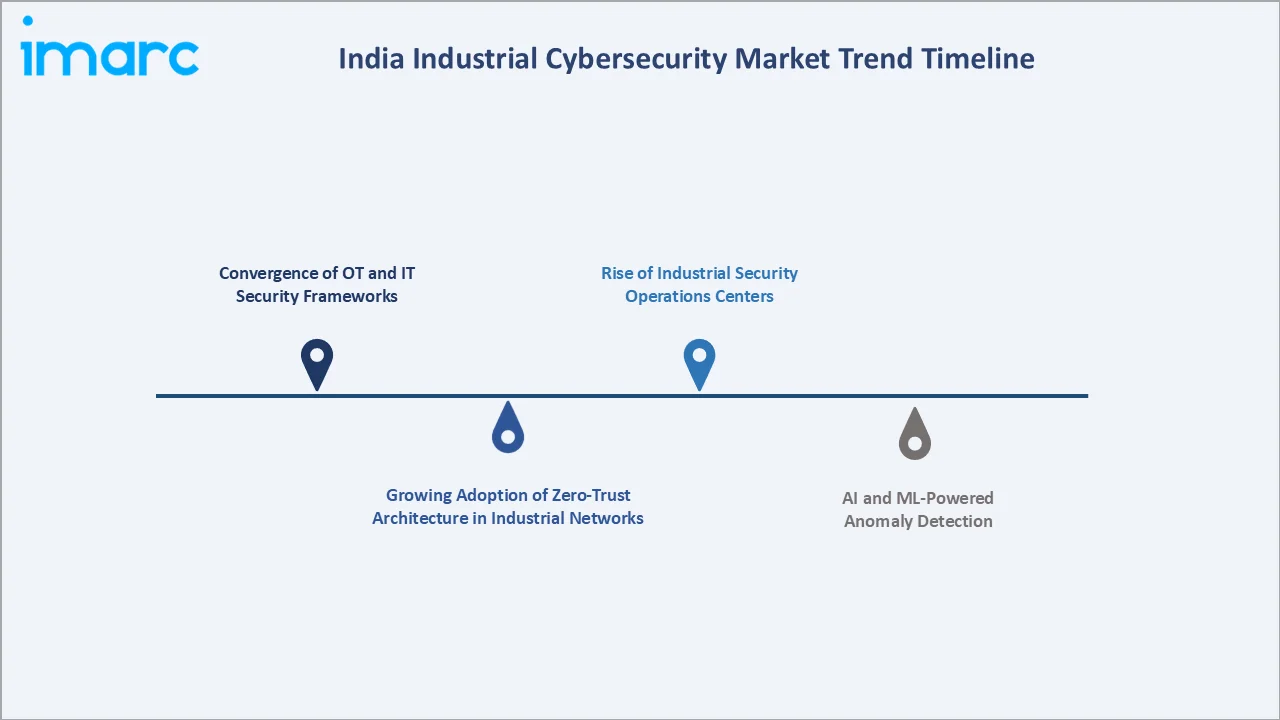
1. Convergence of OT and IT Security Frameworks
Industrial enterprises in India are increasingly adopting unified security architectures that manage both OT and enterprise IT environments under a single security operations center, eliminating visibility blind spots that arise from managing separate OT and IT security teams and tools.
2. Growing Adoption of Zero-Trust Architecture in Industrial Networks
Zero-trust principles are being adapted for OT environments, requiring identity verification and least-privilege access enforcement for every device, user, and application attempting to connect to industrial networks, significantly reducing the risk of lateral movement by threat actors within production environments.
3. AI and ML-Powered Anomaly Detection
AI and ML-based behavioral analytics tools are being deployed across industrial SCADA and ICS environments to detect process anomalies, unauthorized device communications, and unusual operational patterns in real time, enabling earlier identification and containment of cyberattacks before operational disruption occurs.
4. Rise of Industrial Security Operations Centers
Leading industrial conglomerates and critical infrastructure operators in India are establishing purpose-built industrial security operations centers staffed with OT-specialized analysts, integrating threat intelligence feeds, industrial asset inventories, and playbooks designed specifically for ICS incident response.
Industry Value Chain Analysis
The India industrial cybersecurity value chain spans six stages, from hardware and sensor manufacturing through post-sale managed services and incident response. Platform development, OT/IT integration, and security operations capture the highest value-add, while regulatory compliance capabilities increasingly determine sustainable competitive positioning within this tightly regulated category.
|
Stage |
Key Players / Examples |
|
Hardware & Sensor Manufacturers |
Industrial sensor, PLC, and controller manufacturers enabling connected operational environments |
|
Software & Solution Developers |
OT/ICS cybersecurity software vendors, SCADA protection platform developers, and threat intelligence providers |
|
System Integrators |
OT/IT convergence specialists, network architects, and industrial security deployment integrators |
|
Distribution & Resellers |
Value-added resellers, channel partners, and regional distributors serving industrial end users |
|
End-User Industries |
Manufacturing, power generation, oil and gas, utilities, transportation, and pharmaceutical facilities |
|
Post-Sale Services |
Managed security service providers, industrial SOC operators, incident response teams, and compliance auditors |
Vertically integrated industrial enterprises with in-house OT security teams and direct vendor relationships are positioned to capture greater value and respond faster to emerging threats than organizations reliant on multi-layer reseller and integration channel deployments.
Technology Landscape in the India Industrial Cybersecurity Industry
OT/ICS-Specific Threat Detection and Response
Purpose-built OT intrusion detection systems and security information and event management platforms designed to interpret industrial communication protocols are becoming integral components of industrial cybersecurity frameworks. These solutions provide real-time visibility into production network activity, identify unusual behavior, and support early detection and response to potential cyber threats.
Industrial Network Segmentation and Micro-Segmentation
Next-generation industrial firewalls and network access control systems are enabling more precise segmentation of production environments, helping organizations establish secure network zones and control communication between critical assets. This approach limits unauthorized access and helps contain the lateral spread of threats across interconnected OT networks.
AI and Behavioral Analytics for OT Environments
ML-based anomaly detection tools are being trained on industrial process baselines to distinguish legitimate operational changes from malicious activity, reducing false positives that are common when applying enterprise IT security tools to OT environments with predictable, repetitive communication patterns.
Secure Remote Access and Identity Management for Industrial Assets
Privileged access management and encrypted remote access solutions purpose-built for OT environments are replacing legacy VPN-based access methods, providing session recording, just-in-time access provisioning, and multi-factor authentication for vendor and contractor connections to industrial control systems.
Market Segmentation Analysis
The report covers the following segments:
|
Segment Category |
Leading Segment |
Market Share |
Year |
|
Component |
Solutions and Services |
58.0% |
2025 |
|
Security Type |
Network Security |
32.0% |
2025 |
|
Industry |
🔒 |
🔒 |
2025 |
|
Region |
West India |
30.0% |
2025 |

By Component
Solutions and services command a 58.0% majority share in 2025, driven by strong demand for managed security services, threat intelligence subscriptions, OT security assessments, and professional consulting engagements as Indian industrial enterprises build out their cybersecurity capabilities.
To access detailed market analysis, Request Sample
Product at 42.0% in 2025 encompasses hardware security appliances, industrial firewalls, intrusion detection and prevention systems, and endpoint security tools deployed at the device and network perimeter layer of industrial facilities. The segment remains essential for organizations building initial OT security architectures and replacing legacy, unprotected industrial hardware.
By Security Type
Network security leads with 32.0% share in 2025, reflecting broad deployment of industrial network monitoring, deep packet inspection, and network access control solutions across manufacturing and critical infrastructure sectors. Growing convergence of OT and IT networks is sustaining high investment in industrial network security as the foundation layer of OT protection strategies.
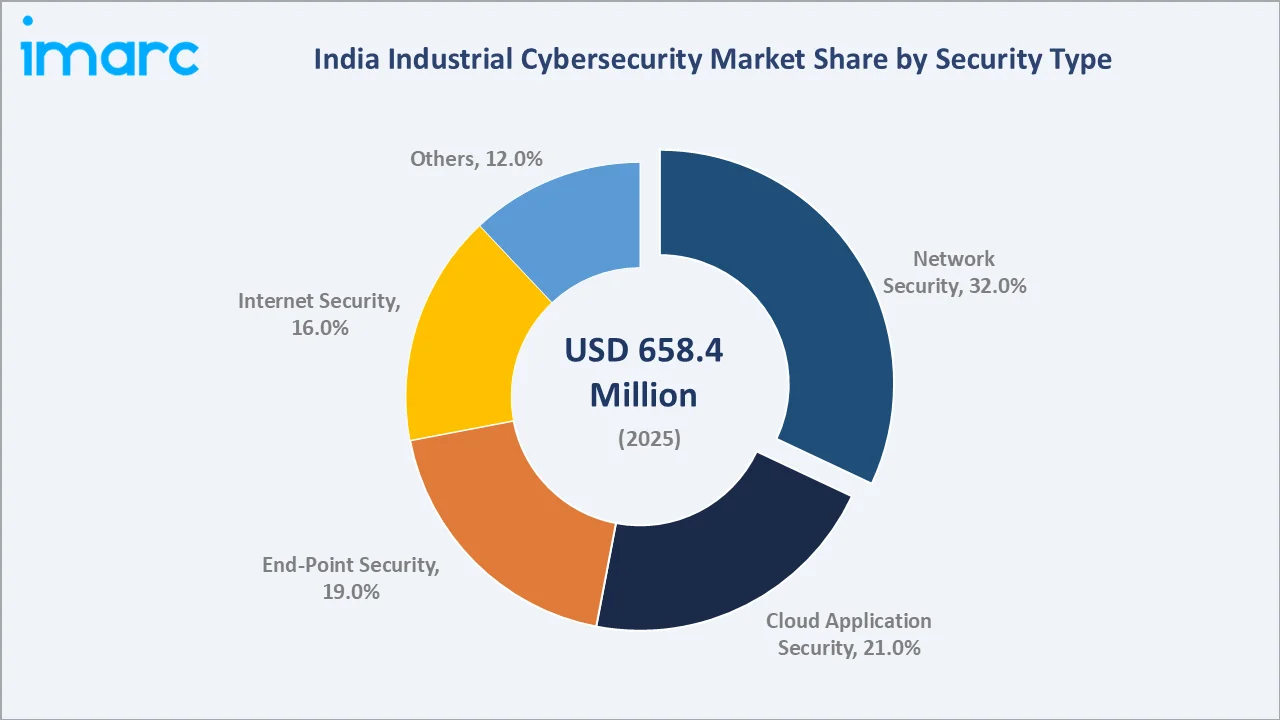
Cloud application security at 21.0% is the second largest security type as industrial SCADA dashboards, analytics platforms, and control system management interfaces migrate to hybrid cloud architectures.
Regional Market Insights
|
Region |
Share (2025) |
Key Growth Drivers |
|
West India |
30.0% |
High concentration of chemical, petrochemical, and pharmaceutical industries, mature industrial corridor infrastructure, and strong presence of multinational manufacturing facilities |
|
South India |
28.0% |
Growing defense and aerospace manufacturing base, expanding power and utility infrastructure, and high technology literacy supporting faster OT security adoption |
|
North India |
24.0% |
Large power generation and transmission infrastructure, growing PLI-linked manufacturing investments, and expanding smart city projects increasing connected infrastructure exposure |
|
East India |
18.0% |
Emerging heavy industry and mining sector digitalization, growing steel and metallurgical plant automation, and increasing government focus on eastern industrial corridor development |
West India at 30.0% in 2025 leads the regional landscape, supported by the strong industrial base of Maharashtra and Gujarat, which have substantial concentrations of petrochemical, pharmaceutical, chemical, and heavy manufacturing facilities. A mature industrial corridor infrastructure and growing presence of global manufacturing partners are sustaining high OT security investment in the region.
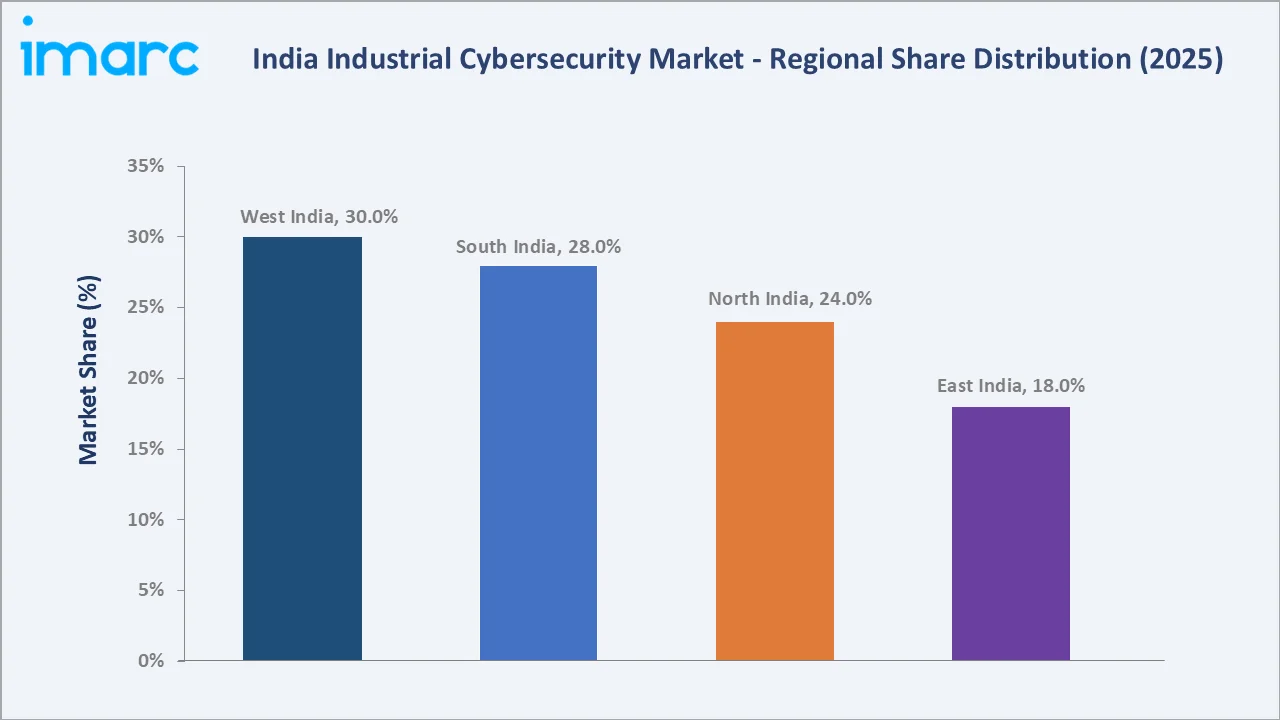
East India, while currently the smallest regional contributor at 18.0%, represents the fastest-growing region as steel, mining, and heavy industry operators in Jharkhand, Odisha, and West Bengal begin digitalization programs that require new OT security infrastructure to protect expanding connected industrial assets through 2034.
Competitive Landscape
The India industrial cybersecurity market is moderately concentrated, with established global OT security specialists and large technology conglomerates leading platform deployment while domestic system integrators and specialized OT vendors compete on regional relationships and sector-specific expertise. OT protocol expertise, integration depth with industrial control systems, and regulatory compliance readiness form the key competitive differentiators across the industry.
|
Company Name |
Brand / Key Product |
Position |
Strategic Focus |
|
Honeywell International Inc. |
Honeywell Cyber Suite |
Leader |
Expanding integrated OT cybersecurity platform capabilities and deepening industrial sector partnerships |
|
Siemens AG |
SINEC Security Guard |
Leader |
Growing industrial network security and automation security product integration across manufacturing and energy sectors |
|
Fortinet, Inc. |
Fortinet OT Security Solutions |
Leader |
Expanding unified OT/IT security platform adoption and strengthening industrial protocol support across critical infrastructure deployments |
|
Check Point Software Technologies Ltd. |
Check Point Quantum Rugged |
Challenger |
Enhancing ICS/SCADA protection platform capabilities and broadening deployment across critical infrastructure and manufacturing segments |
Key players include Honeywell International Inc., Siemens AG, Fortinet, Inc., and Check Point Software Technologies Ltd., among others.
Key Company Profiles
Honeywell International Inc.
Honeywell International Inc. is a global diversified technology and manufacturing company headquartered in Charlotte, North Carolina, United States, offering industrial cybersecurity solutions specifically designed for operational technology environments across process industries, utilities, and critical infrastructure.
- Product Portfolio: Honeywell Cyber Suite covering OT network monitoring, industrial asset discovery, vulnerability management, and managed security services for ICS/SCADA environments.
- Recent Developments: The firm continues to expand its industrial cybersecurity portfolio, introducing new capabilities to address evolving threats in operational technology environments across critical industries.
- Strategic Focus: Expanding its integrated OT cybersecurity platform offerings and deepening partnerships with energy, chemical, and manufacturing sector clients across India and global markets.
Siemens AG
Siemens AG is a German multinational technology conglomerate headquartered in Munich, Germany, offering comprehensive industrial cybersecurity products integrated within its broader automation and digitalization portfolio for industrial customers worldwide.
- Product Portfolio: SINEC Security Guard, a cloud-based SaaS offering automated OT vulnerability mapping and security management.
- Recent Developments: Siemens AG continues to strengthen its industrial cybersecurity portfolio, adding new capabilities to address emerging threats in manufacturing and critical infrastructure environments.
- Strategic Focus: Growing its cybersecurity portfolio across vulnerability management and industrial network management.
Fortinet, Inc.
Fortinet, Inc. is a global cybersecurity company headquartered in Sunnyvale, California, United States, offering a broad security platform that includes purpose-built OT security solutions for industrial network protection across critical infrastructure and manufacturing environments.
- Product Portfolio: Fortinet OT Security Solutions encompassing ruggedized next-generation firewalls, privileged access management, industrial switches, and an OT-specific operating system with detection signatures, threat prevention, and virtual patching capabilities for ICS/SCADA environments.
- Recent Developments: Fortinet, Inc. continues to advance its OT security capabilities, enhancing its platform with new tools and integrations designed to address the growing convergence of IT and OT environments across industrial sectors.
- Strategic Focus: Broadening unified OT and IT security platform adoption across critical infrastructure and advanced manufacturing sectors, with growing focus on emerging industrial markets including India.
Market Concentration Analysis
The India industrial cybersecurity market is moderately concentrated, with leading global OT security specialists and large automation conglomerates accounting for a significant portion of deployments across critical infrastructure and advanced manufacturing sectors, reflecting the specialized expertise required to serve complex industrial environments.
Barriers to entry include the need for deep OT protocol expertise, established relationships with industrial control system vendors, proven experience with relevant cybersecurity standards, and the ability to support mission-critical deployments where downtime carries operational risk. These factors favor established players with existing industrial customer relationships and certified OT security practitioners.
Consolidation is gradually increasing as larger cybersecurity and automation companies acquire specialized OT security firms to broaden their industrial protection portfolios. Strategic partnerships between OT security vendors, system integrators, and regulatory bodies are further shaping competitive positioning across the India market.
Investment & Growth Opportunities
Fastest-Growing Segments
Solutions and services are growing faster than the overall 5.95% market CAGR as industrial enterprises increasingly rely on outsourced managed security operations and specialist consulting to build OT security capabilities. Growing demand for continuous threat monitoring, incident response, and security assessments is further supporting the expansion of this segment.
Emerging Markets
East India is the fastest-growing region, supported by digitalization of heavy industry, steel, and mining operations and growing government emphasis on the eastern industrial corridor. The region represents significant untapped opportunity for OT security vendors and system integrators able to deliver sector-specific industrial protection solutions for emerging connected industrial assets.
Venture & Investment Trends
Investment activity is concentrated in AI-powered OT threat detection platforms, managed industrial security operations center services, and network segmentation tools aligned with established cybersecurity standards. Capital is also flowing into OT/IT convergence security platforms that can serve both enterprise IT and industrial OT environments under a unified security operations framework, supporting the evolving cybersecurity needs of India’s critical infrastructure.
Future Market Outlook (2026-2034)
The India industrial cybersecurity market is projected to grow from USD 658.4 Million in 2025 to USD 697.6 Million in 2026, reaching USD 1,125.5 Million by 2034, registering a CAGR of 5.95% during 2026-2034. The market's anchor value of USD 879.2 Million in 2030 reflects sustained investment in OT security infrastructure driven by accelerating industrial digitalization, mandatory regulatory compliance, and growing deployment of AI-enabled threat detection platforms across Indian industries.
Four forces will shape the market through 2034: accelerating adoption of Industry 4.0 and IIoT-connected industrial assets; deepening regulatory requirements from sector-specific bodies; growing deployment of AI-enabled OT threat detection and response capabilities; and expanding managed security service delivery for industrial enterprises that lack in-house OT security expertise.
By 2034, the India industrial cybersecurity market is expected to be defined by integrated OT/IT security platforms, with managed security services and cloud application security accounting for growing shares of overall investment. Continued regulatory development and high-profile industrial cyber incidents are expected to sustain consistent market momentum through the forecast period.
Research Methodology
Primary Research
Primary research included structured interviews with industrial cybersecurity executives, OT security practitioners, system integrators, and regulatory specialists, validating market sizing, segment composition, and regional demand patterns across key industrial sectors in India.
Secondary Research
Secondary sources included CERT-In publications, National Critical Information Infrastructure Protection Centre advisories, Ministry of Electronics and Information Technology reports, Bureau of Indian Standards (BIS) documentation, and annual reports, press releases, and investor presentations from listed industrial cybersecurity and automation companies.
Forecasting Models
Market forecasts used top-down and bottom-up models combining industrial cybersecurity adoption rates, OT investment trends, regulatory implementation timelines, and macroeconomic variables. Scenario analysis addressed regulatory tightening pace, industrial digitalization rate, and cyber threat landscape evolution.
India Industrial cybersecurity Market Report Coverage:
| Report Features | Details |
|---|---|
| Base Year of the Analysis | 2025 |
| Historical Period | 2020-2025 |
| Forecast Period | 2026-2034 |
| Units | Million USD |
| Scope of the Report |
Exploration of Historical Trends and Market Outlook, Industry Catalysts and Challenges, Segment-Wise Historical and Future Market Assessment:
|
| Components Covered | Product, Solution and Services |
| Security Types Covered | Network Security, Cloud Application Security, End-Point Security, Internet Security, Others |
| Industries Covered |
|
| Regions Covered | North India, South India, East India, West India |
| Companies Covered | Honeywell International Inc., Siemens AG, Fortinet, Inc., Check Point Software Technologies Ltd., etc. |
| Customization Scope | 10% Free Customization |
| Post-Sale Analyst Support | 10-12 Weeks |
| Delivery Format | PDF and Excel through Email (We can also provide the editable version of the report in PPT/Word format on special request) |
Key Benefits for Stakeholders:
- IMARC’s industry report offers a comprehensive quantitative analysis of various market segments, historical and current market trends, market forecasts, and dynamics of the India industrial cybersecurity market from 2020-2034.
- The research report provides the latest information on the market drivers, challenges, and opportunities in the India industrial cybersecurity market.
- Porter's five forces analysis assist stakeholders in assessing the impact of new entrants, competitive rivalry, supplier power, buyer power, and the threat of substitution. It helps stakeholders to analyze the level of competition within the India industrial cybersecurity industry and its attractiveness.
- Competitive landscape allows stakeholders to understand their competitive environment and provides an insight into the current positions of key players in the market.
Frequently Asked Questions About the India Industrial Cybersecurity Market Report
The India industrial cybersecurity market size is estimated at USD 697.6 Million in 2026, driven by rising OT/IT convergence, increasing industrial cyber threats, and mandatory compliance requirements from sector-specific bodies.
The India industrial cybersecurity market grows at a CAGR of 5.95% during 2026-2034, reaching USD 1,125.5 Million by 2034, supported by Industry 4.0 adoption, expanding regulatory frameworks for industrial cyber protection, and growing deployment of AI-enabled OT threat detection across Indian industries.
Solutions and services lead the component segment at 58.0% in 2025, driven by managed security services, OT consulting, and threat intelligence subscriptions across industrial enterprises.
Network security commands 32.0% share in 2025, driven by investments in industrial network monitoring, deep packet inspection, and intrusion prevention systems for OT environments.
West India holds 30.0% share in 2025, anchored by a high density of petrochemical, pharmaceutical, and heavy manufacturing facilities in Maharashtra and Gujarat requiring robust OT security.
Leading players include Honeywell International Inc., Siemens AG, Fortinet, Inc., and Check Point Software Technologies Ltd., among others.
Key drivers include rising OT/IT convergence, increasing cyberattacks on critical infrastructure, and growing government digitalization programs under Digital India and PLI schemes.
Major challenges include high implementation costs for OT security, shortage of professionals with combined OT and cybersecurity expertise, and complexity of integrating modern security tools with legacy industrial control systems.
AI and ML tools are being deployed for OT behavioral anomaly detection, process baseline monitoring, and real-time threat identification, enabling earlier cyberattack detection within industrial control system environments.
Need more help?
- Speak to our experienced analysts for insights on the current market scenarios.
- Include additional segments and countries to customize the report as per your requirement.
- Gain an unparalleled competitive advantage in your domain by understanding how to utilize the report and positively impacting your operations and revenue.
- For further assistance, please connect with our analysts.
 Request Customization
 Speak to an Analyst
 Request Brochure
 Inquire Before Buying
Benefits of Customization
- Personalize this research
- Triangulate with your data
- Get data as per your format and definition
- Gain a deeper dive into a specific application, geography, customer, or competitor
- Any level of personalization
Get in Touch With Us
UNITED STATES
Phone: +1-201-971-6302
INDIA
Phone: +91-120-433-0800
UNITED KINGDOM
Phone: +44-753-714-6104
Email: sales@imarcgroup.com
Client Testimonials




.webp)




.webp)













Related Reports

Choose your plan
*Please note that the prices mentioned below are starting prices for each bundle type. Kindly contact our team for further details.*
Single User License
- 1 User License, Access on 2 Devices
- PDF Report + Excel Dataset (Password Protected)
- Lifetime Access
- No Printing Rights
- 10% Free Report Customization
- 10–12 Weeks of Analyst Support
Five User License
- Access for 5 Users, 2 Devices per User
- PDF Report + Excel Dataset (Password Protected)
- Lifetime Access
- Dedicated Account Manager
- 12–14 Weeks of Analyst Support
- No Printing Rights
- 15% Free Report Customization
- 25% Discount on Your Next Purchase
Corporate User License
- Unlimited User Access (Within Your Organization)
- PDF Report + Excel Dataset
- Lifetime Access
- Dedicated Account Manager
- 14–20 Weeks of Analyst Support
- No Printing Rights
- 20% Free Report Customization
- 30% Discount on Your Next Purchase
Essential Insights
What's included:
3 reports
- Lifetime Access
- PDF Reports
- Excel Datasets
- 2 Weeks of Free Analyst Support
- 2 User Licenses
- Access on 2 Devices
- Printing Rights
- Complimentary PowerPoint (PPT) Version
- Complimentary License Upgrade
Professional Access
What's included:
5 reports
- Lifetime Access
- PDF Reports
- Excel Datasets
- 8 Weeks of Free Analyst Support
- 2 User Licenses
- Access on 2 Devices
- Printing Rights
- Complimentary PowerPoint (PPT) Version
- Complimentary License Upgrade
Business Advantage
What's included:
8 reports
- Lifetime Access
- PDF Reports
- Excel Datasets
- 14 Weeks of Free Analyst Support
- 2 User Licenses
- Access on 2 Devices
- Printing Rights
- Complimentary PowerPoint (PPT) Version
- Complimentary License Upgrade
Enterprise Intelligence
What's included:
10 reports
- Lifetime Access
- PDF Reports
- Excel Datasets
- 20 Weeks of Free Analyst Support
- 2 User Licenses
- Access on 2 Devices
- Printing Rights
- Complimentary PowerPoint (PPT) Version
- Complimentary License Upgrade