
India Microinsurance Market Size, Share, Trends and Forecast by Product Type, Provider, Model Type, and Region, 2026-2034
India Microinsurance Market Size, Share, Trends & Forecast (2026-2034)
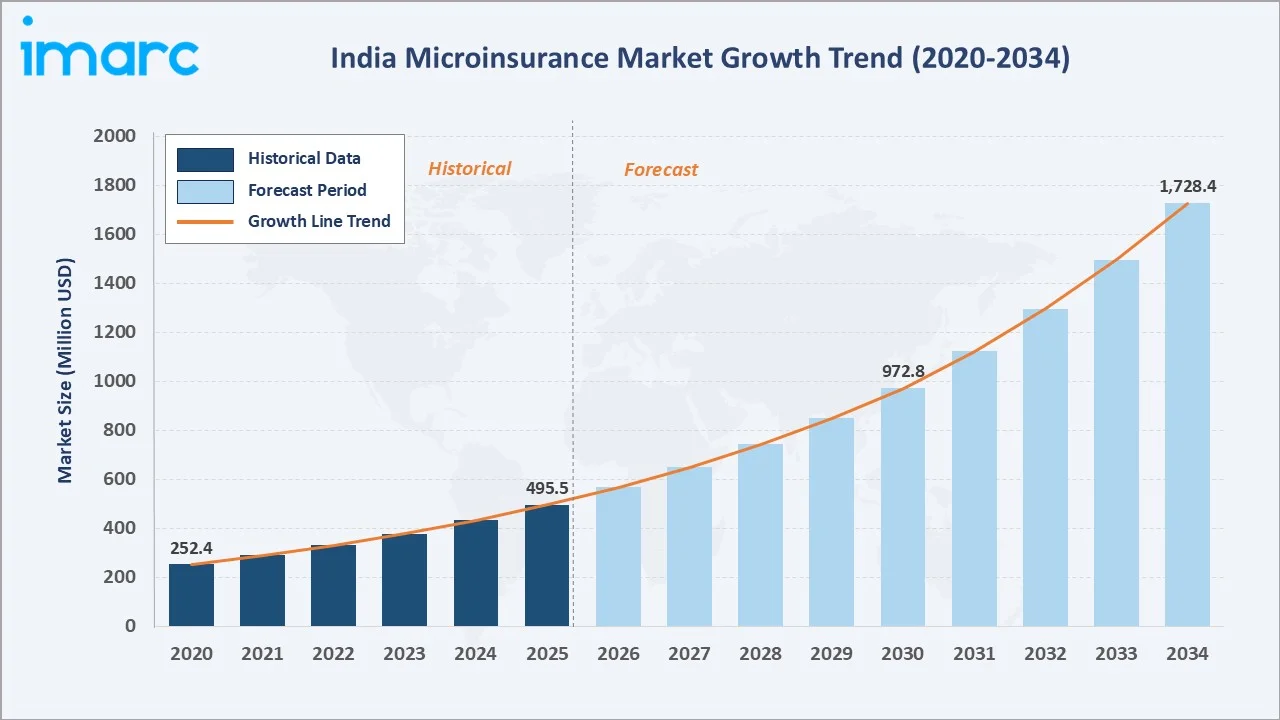
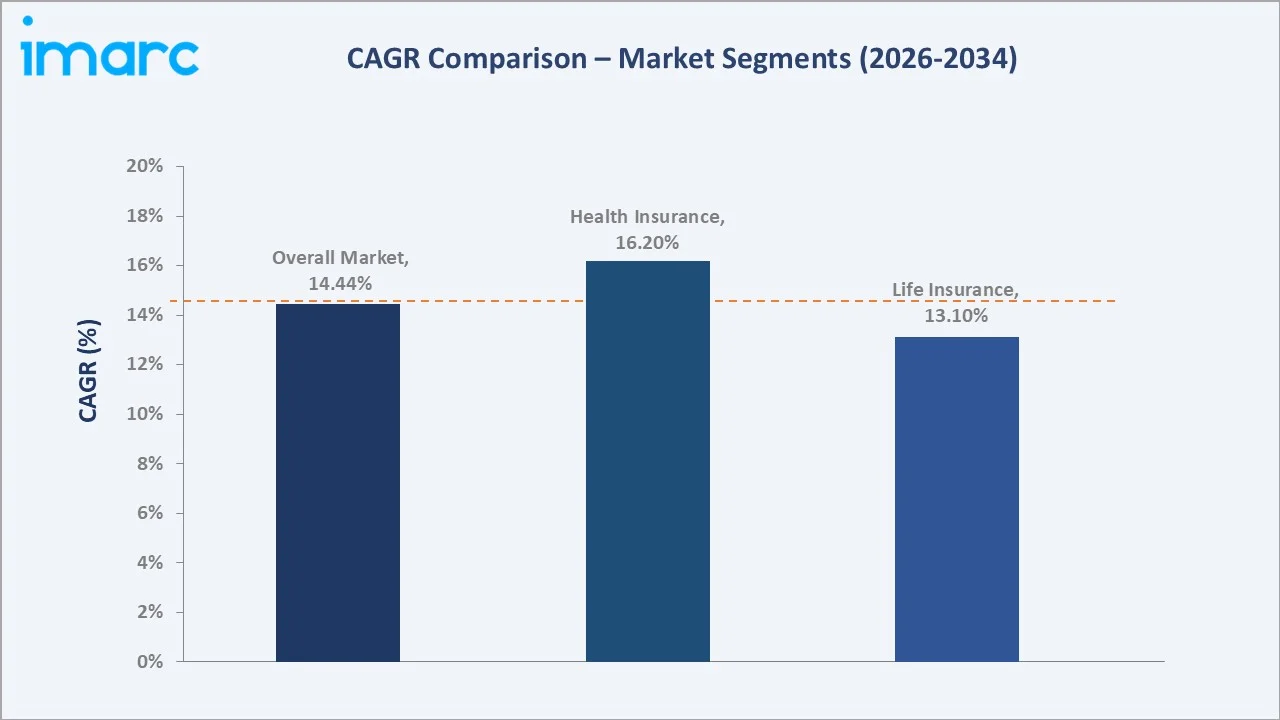
The India microinsurance market reached USD 495.5 Million in 2025 and is projected to reach USD 1,728.4 Million by 2034, expanding at a CAGR of 14.44% during 2026-2034. Rising financial inclusion initiatives across rural India, growing awareness of risk protection among low-income groups, and government-backed insurance scheme expansion are the primary growth catalysts.
Market Snapshot
|
Metric |
Value |
|
Market Size (2025) |
USD 495.5 Million |
|
Forecast Market Size (2034) |
USD 1,728.4 Million |
|
CAGR (2026-2034) |
14.44% |
|
Base Year |
2025 |
|
Historical Period |
2020-2025 |
|
Forecast Period |
2026-2034 |
North India leads the national microinsurance landscape, holding a 33.6% share in 2025, anchored by the region's dense distribution network and expanding bancassurance partnerships. Life insurance commands the largest share of the product type segment at 34.8%, reflecting sustained demand for accessible, low-premium life coverage across underserved population segments.
To get more information on this market, Request Sample
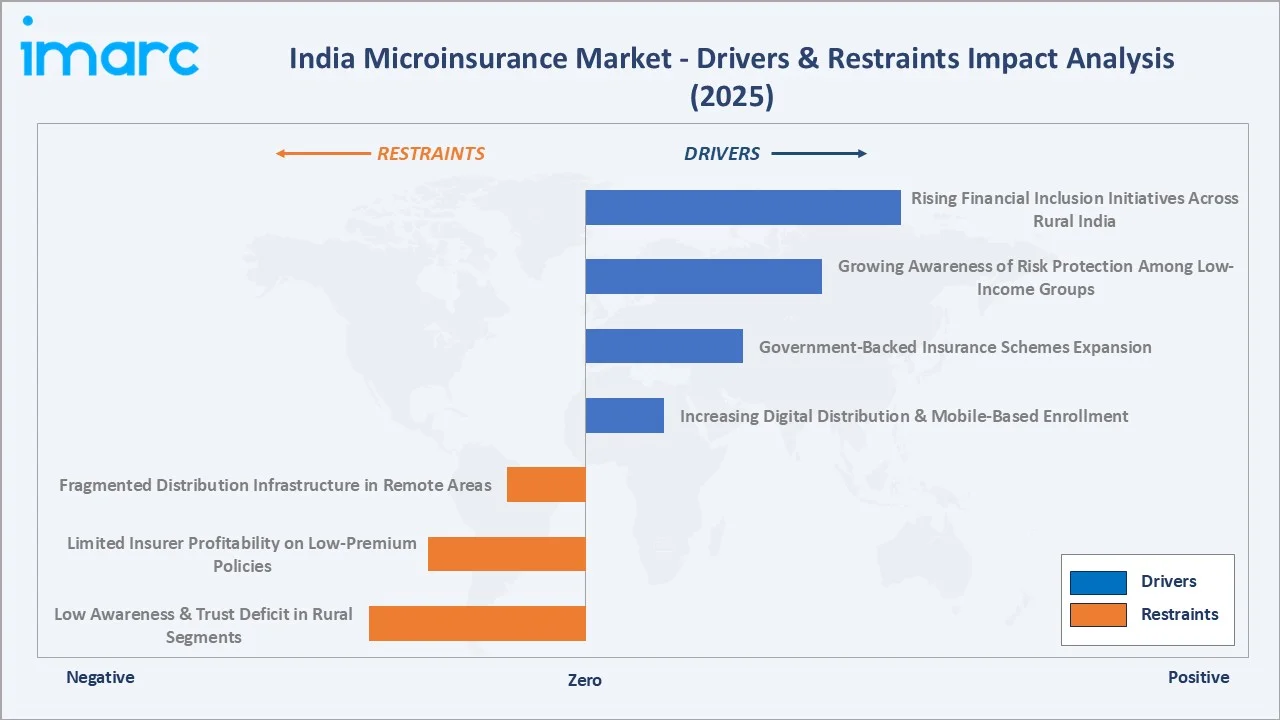
The India microinsurance market is underpinned by three structural forces: rising financial inclusion initiatives across rural India, growing awareness of risk protection among low-income groups, and government-backed insurance scheme expansion. Each force independently reinforces category growth, sustaining strong CAGR expansion through 2034 despite low awareness and trust deficits in rural segments.
Executive Summary
The India microinsurance market is experiencing robust expansion, driven by rising financial inclusion initiatives, growing risk protection awareness, and increasing government support for inclusive insurance programs. The market was valued at USD 495.5 Million in 2025 and is forecast to reach USD 1,728.4 Million by 2034, growing at a CAGR of 14.44%.
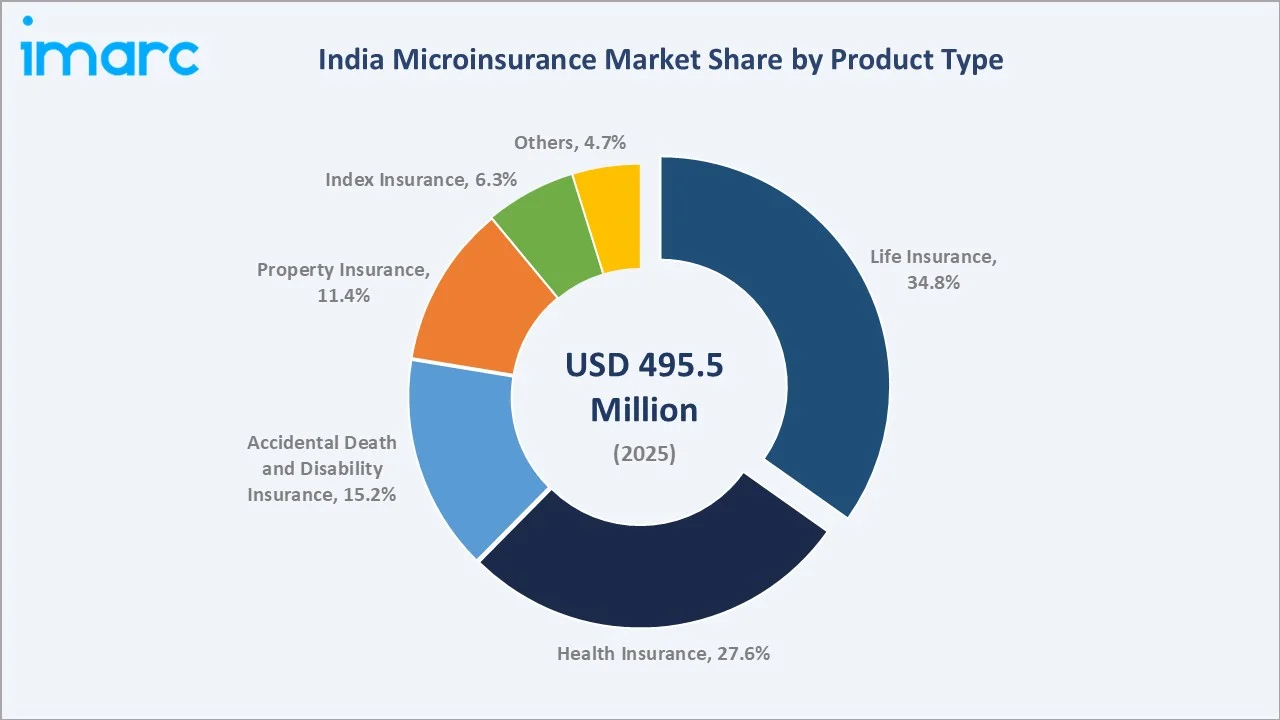
Life insurance dominates the product type segment with a 34.8% share in 2025, encompassing accessible low-premium coverage, while health insurance accounts for 27.6%, accidental death and disability insurance for 15.2%, property insurance for 11.4%, index insurance for 6.3%, and others for 4.7%, reflecting the market's broad application diversity across risk protection requirements.
Microinsurance (commercially viable) leads the provider segment at 63.5% share, supported by expanding insurer distribution networks, while microinsurance through aid/government support accounts for 36.5%. North India leads regionally at 33.6%, anchored by the region's dense distribution network and expanding bancassurance partnerships. Leading suppliers are collectively shaping the industry's innovation roadmap through continuous product development and distribution expansion.
Key Market Insights
|
Insight |
Data |
|
Largest Product Segment |
Life Insurance – 34.8% share (2025) |
|
Fastest Growing Product Segment |
Health Insurance – ~16.2% CAGR (2026-2034) |
|
Largest Provider Segment |
Microinsurance (Commercially Viable) – 63.5% share (2025) |
|
Leading Region |
North India – 33.6% share (2025) |
|
Top Companies |
Life Insurance Corporation of India, State Bank of India, ICICI Bank Limited, Bajaj Finserv Limited, HDFC Bank Limited |
Key Analytical Observations Supporting the Above Data:
- Life insurance accounts for 34.8% of the India microinsurance market in 2025. This dominance reflects sustained demand for accessible, low-premium life coverage across underserved population segments.
- Microinsurance (commercially viable) remains the leading provider category at 63.5% share (2025), supported by expanding insurer distribution networks across the country.
- Health insurance is expanding steadily at 27.6% share (2025), as growing awareness of medical risk protection continues to drive category growth.
- North India's 33.6% share (2025) reflects its dense distribution network and expanding bancassurance partnerships.
- Rising convergence of microinsurance with digital enrollment platforms and government-backed scheme expansion is broadening the addressable market across life, health, accidental, property, and index insurance applications.
India Microinsurance Market Overview
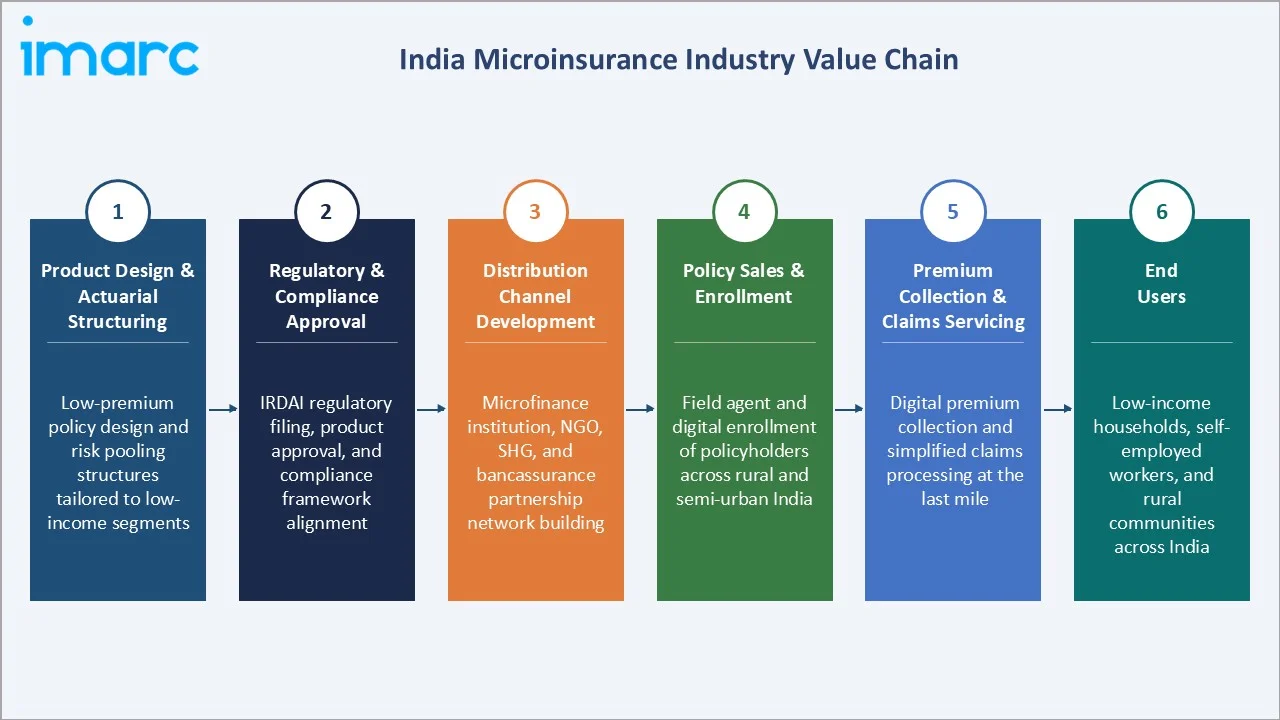
The India microinsurance market encompasses life insurance, health insurance, accidental death and disability insurance, property insurance, index insurance, and other product categories delivered through commercially viable and aid/government-supported provider models. The microinsurance ecosystem spans product design and actuarial structuring providers, regulatory and compliance approval bodies, and an expanding network of distribution channels and claims servicing providers.
Macroeconomic drivers include rising financial inclusion initiatives across rural India, growing awareness of risk protection among low-income groups, and government-backed insurance scheme expansion. Insurers are simultaneously investing in digital distribution and mobile-based enrollment, bancassurance and microfinance institution partnership networks, and simplified claims servicing to improve policyholder experience, positioning the India microinsurance sector for continued strong growth through 2034 despite low awareness and trust deficits in rural segments.
Market Dynamics
To evaluate market opportunities, Request Sample
Market Drivers
- Rising Financial Inclusion Initiatives Across Rural India: Increasing government and private sector focus on extending financial services to underserved populations is driving sustained demand for accessible insurance products. India’s Financial Inclusion Index increased to 67 in 2025, up by 24.3% since 2021. Initiatives such as Jan Dhan Yojana, Aadhaar-based services, and UPI have expanded formal financial access, enabling wider participation among underserved communities.
- Growing Awareness of Risk Protection Among Low-Income Groups: Rising understanding of health, life, and asset risks is accelerating adoption of low-premium insurance coverage among self-employed and rural workers.
- Government-Backed Insurance Schemes Expansion: Growing government-led scheme coverage and policy support are broadening the addressable market for microinsurance applications. For instance, India’s Parliamentary Standing Committee on Health and Family Welfare has recommended doubling the insurance cover under Ayushman Bharat–Pradhan Mantri Jan Arogya Yojana (AB-PMJAY) from INR 5 lakh to INR 10 lakh per family.
- Increasing Digital Distribution & Mobile-Based Enrollment: Growing adoption of digital platforms and mobile-based enrollment is improving policyholder acquisition efficiency and reducing distribution costs. In September 2024, the launch of BimaSugam, an online insurance marketplace proposed by the Insurance Regulatory and Development Authority of India (IRDAI), aims to digitize insurance processes by providing a unified platform for policy purchase, servicing, and claims management, improving accessibility and transparency for customers.
Market Restraints
- Low Awareness and Trust Deficit in Rural Segments: Insufficient understanding of insurance benefits and limited trust in formal financial products can constrain policyholder growth in rural regions. A report by Aditya Birla Sun Life Insurance highlighted that 79% of Indians are unsure whether their health insurance covers serious illnesses, while 80% lack adequate emergency savings.
- Limited Insurer Profitability on Low-Premium Policies: Thin margins associated with low-premium microinsurance products can constrain insurer investment and limit product innovation.
- Fragmented Distribution Infrastructure in Remote Areas: Geographic dispersion of target populations across India can complicate last-mile distribution and increase servicing costs.
Market Opportunities
- Bancassurance & Microfinance Partnership Expansion: In February 2026, Kotak Life Insurance and Utkarsh Small Finance Bank entered into a bancassurance partnership to distribute Kotak Life’s protection, savings, unit-linked, and retirement insurance products through Utkarsh SFBL’s 1,105 banking outlets across 27 states and union territories.
- Digital Enrollment Platform Adoption: Rising demand for simplified policy access offers opportunities for insurers investing in mobile-based and digital enrollment technology.
- Health Microinsurance Product Innovation: Growing demand for affordable health risk protection creates opportunities for insurers expanding product application diversity.
Market Challenges
- Balancing Affordability and Profitability: Insurers must balance low-premium product accessibility with the need to maintain sustainable underwriting margins.
- Addressing Nationwide Distribution Consistency: Ensuring consistent, geographically comprehensive microinsurance distribution requires ongoing channel network investment and regional infrastructure development.
Emerging Market Trends
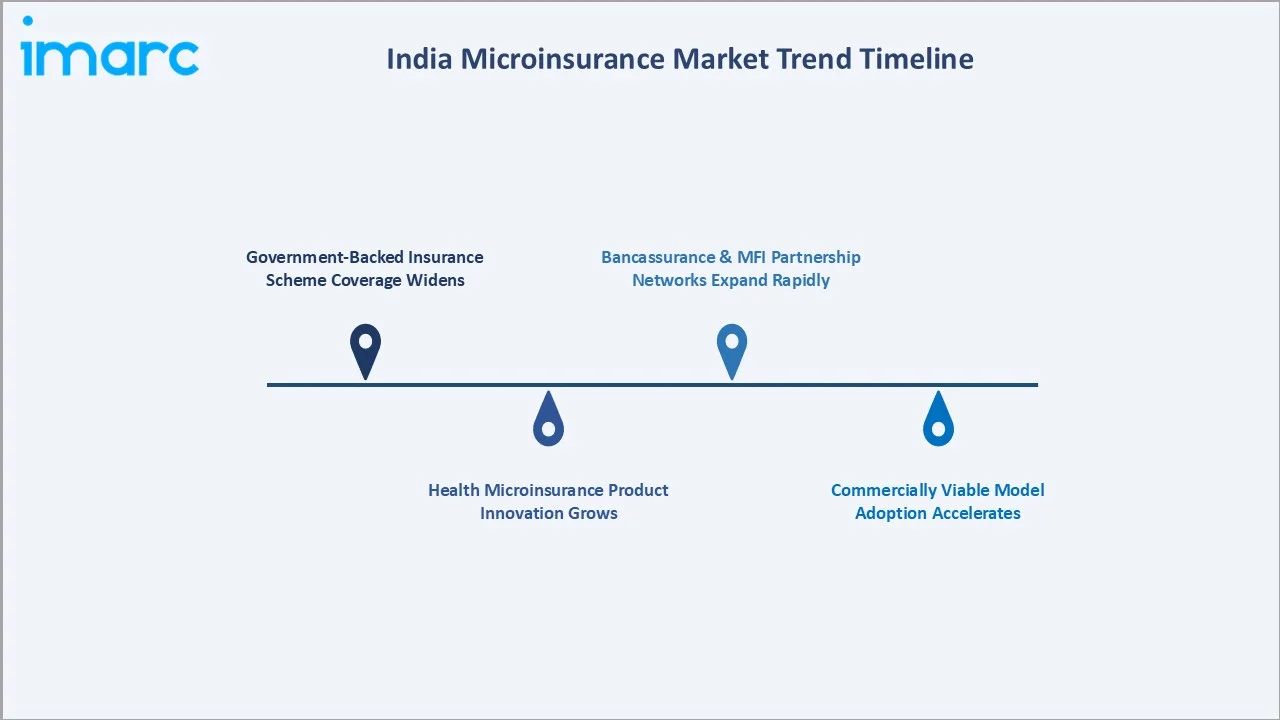
1. Government-Backed Insurance Scheme Coverage Widens
The Government of India is increasingly expanding insurance scheme coverage and policy initiatives, driving improved policyholder enrollment and financial inclusion participation across the country. The Insurance Regulatory and Development Authority of India (IRDAI) has introduced risk-based capital requirements, increased foreign direct investment (FDI) limits in insurance, and improved corporate governance standards to strengthen insurers’ financial stability and operational flexibility.
2. Health Microinsurance Product Innovation Grows
In February 2023, the Adrienne Arsht-Rockefeller Foundation Resilience Center, SEWA, and Blue Marble launched India’s first extreme heat microinsurance program to protect women workers in the informal sector by providing income replacement for wages lost due to climate-driven heat events. The pilot targeted 21,000 SEWA members across occupations such as street vending, farming, waste recycling, and construction.
3. Bancassurance & MFI Partnership Networks Expand Rapidly
Rising adoption of bancassurance and microfinance institution partnership models is accelerating policyholder acquisition and expanding distribution reach across major financial inclusion programs. In July 2026, Ujjivan Small Finance Bank partnered with Tata AIG General Insurance to expand access to insurance products by offering Tata AIG’s solutions across Ujjivan SFB’s network of 776 branches spanning 335 districts in 26 states and union territories.
4. Commercially Viable Model Adoption Accelerates
Growing commercially viable microinsurance model adoption is driving expansion of sustainable distribution and product servicing across the domestic insurance ecosystem. Partnerships between insurers, banks, fintech platforms, and community-based organizations are further enabling wider reach of affordable insurance products among underserved and low-income populations in India.
Industry Value Chain Analysis
The India microinsurance value chain spans product design through end-user delivery, with each stage occupied by specialized actuarial structuring providers, regulatory compliance bodies, and distribution channel and claims servicing providers whose performance directly influences policyholder accessibility, product affordability, and claims reliability.
|
Stage |
Key Activities |
|
Product Design & Actuarial Structuring |
Low-premium policy design and risk pooling structures tailored to low-income segments |
|
Regulatory & Compliance Approval |
IRDAI regulatory filing, product approval, and compliance framework alignment |
|
Distribution Channel Development |
Microfinance institution, NGO, SHG, and bancassurance partnership network building |
|
Policy Sales & Enrollment |
Field agent and digital enrollment of policyholders across rural and semi-urban India |
|
Premium Collection & Claims Servicing |
Digital premium collection and simplified claims processing at the last mile |
|
End Users |
Low-income households, self-employed workers, and rural communities across India |
Technology Landscape in the India Microinsurance Industry
Digital Enrollment & Mobile-Based Distribution
Insurers are advancing digital enrollment platforms and mobile-based distribution technology to improve policyholder acquisition efficiency, supporting broader adoption among rural and semi-urban population segments. Growing integration with UPI and Aadhaar-based verification is further simplifying onboarding for low-literacy and first-time insurance customers.
Health Microinsurance Product Development
Growing investment in health microinsurance product development is expanding risk-specific application capacity, addressing rising demand for affordable, accessible medical risk protection. Increasing use of simplified, bundled coverage plans is further improving affordability and comprehension among low-income policyholders.
Bancassurance Channel Innovation
Insurers are engineering advanced bancassurance channel partnerships to extend distribution reliability across demanding last-mile enrollment and claims servicing applications. Deeper integration with regional rural banks and payment banks is further expanding reach into underserved districts.
Microfinance Institution Ecosystem Integration
Expanding investment in microfinance institution ecosystem integration is strengthening microinsurance value chain reliability, supporting premium positioning across leading national financial inclusion programs. Growing bundling of insurance products with microloan disbursements is further improving penetration among self-help groups and rural borrowers.
Market Segmentation Analysis
The report covers the following segments:
|
Segment Category |
Leading Segment |
Market Share |
Year |
|
Product Type |
Life Insurance |
34.8% |
2025 |
|
Provider |
Microinsurance (Commercially Viable) |
63.5% |
2025 |
|
Model Type |
🔒 |
🔒 |
2025 |
|
Region |
North India |
33.6% |
2025 |

By Product Type
Life insurance dominates with a 34.8% share in 2025. This segment encompasses accessible, low-premium life coverage products, supported by sustained demand across the national underserved population base.
To access detailed market analysis, Request Sample
Health insurance represents 27.6% of the market (2025), followed by accidental death and disability insurance at 15.2%, property insurance at 11.4%, index insurance at 6.3%, and others at 4.7%, reflecting the market's broad application diversity across risk protection requirements.
By Provider
Microinsurance (commercially viable) channels lead the provider segment at a 63.5% share (2025), supported by expanding insurer distribution networks across the country.
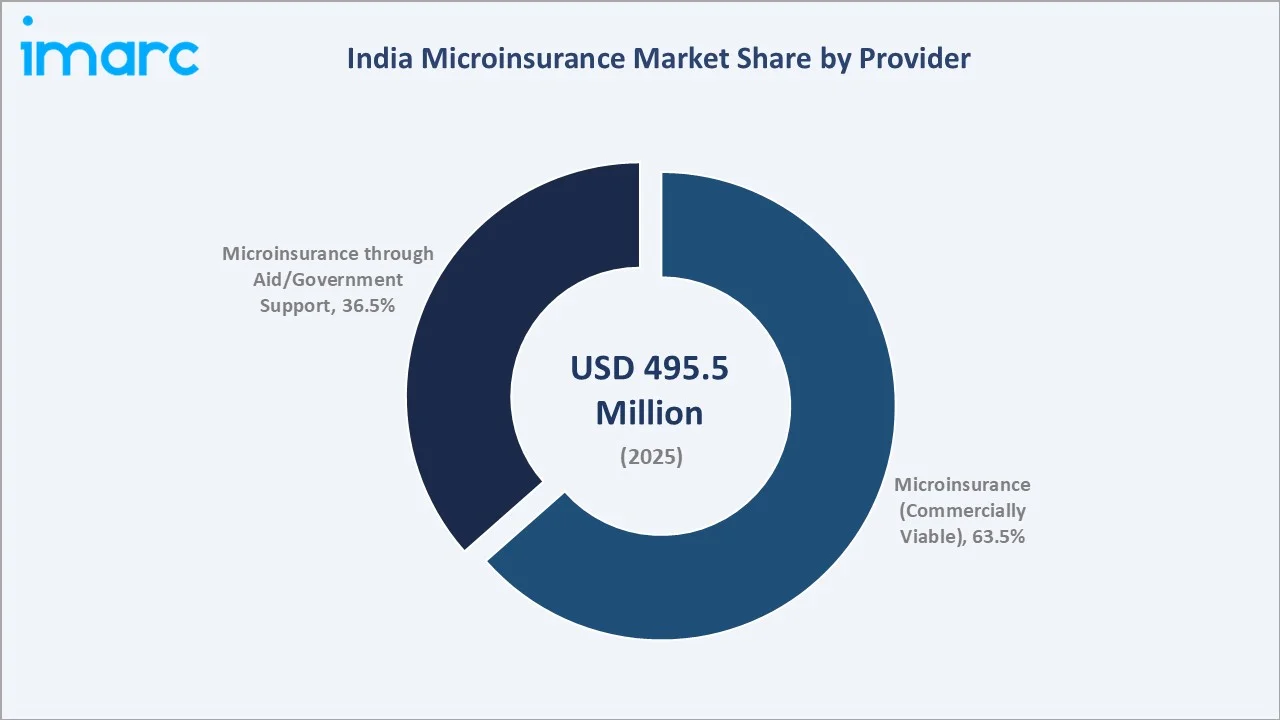
Microinsurance through aid/government support accounts for 36.5% of the market (2025), continuing to broaden the market's provider diversity as policy-backed scheme coverage persists.
Regional Market Insights
North India's market leadership (33.6%, 2025) reflects the region's dense distribution network and expanding bancassurance partnerships. Growing government-backed insurance scheme expansion and expanding digital enrollment platform investment combine to sustain its dominant position through 2034.
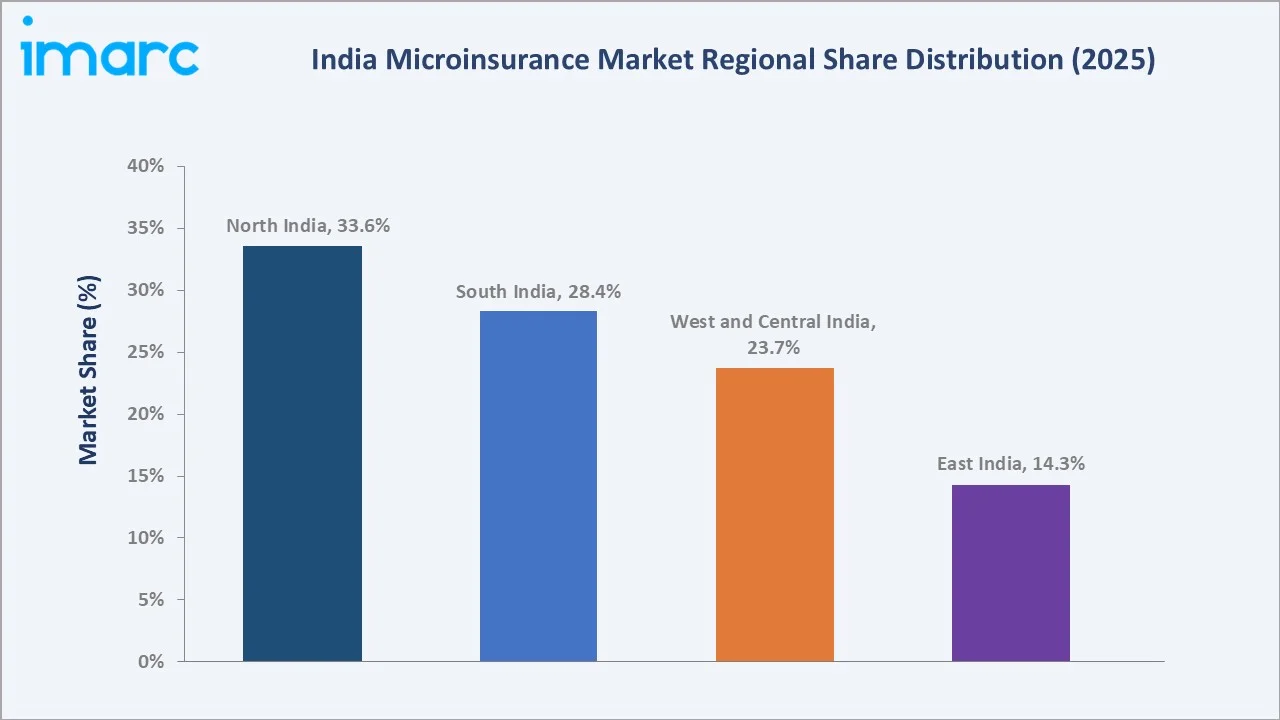
South India at 28.4% (2025) represents the second-largest India microinsurance market regionally. Strong microfinance institution presence and rising digital enrollment adoption are sustaining steady growth, positioning the region as a key contributor alongside North India through the forecast period.
|
Region |
Share (2025) |
Key Growth Drivers |
|
North India |
33.6% |
Dense distribution network and expanding bancassurance partnerships |
|
South India |
28.4% |
Strong microfinance institution presence and rising digital enrollment adoption |
|
West and Central India |
23.7% |
Growing urban-rural distribution reach and expanding insurer product portfolios |
|
East India |
14.3% |
Emerging financial inclusion program development and gradual distribution infrastructure expansion |
Competitive Landscape
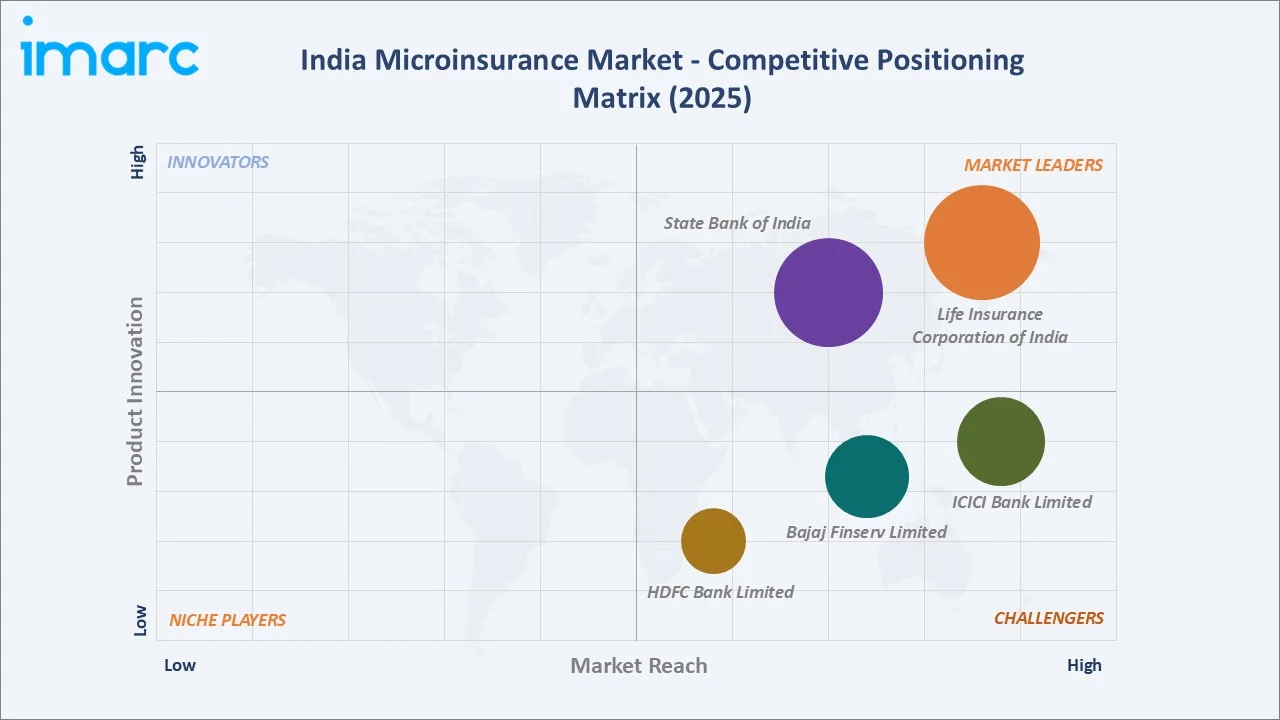
The India microinsurance market exhibits moderate concentration, with leading insurers collectively holding a significant share of market revenue in 2025, reflecting sustained investment in product innovation and distribution reach.
|
Company Name |
Brand/Product Name |
Market Position |
Core Strength |
|
Life Insurance Corporation of India |
LIC Micro Bachat, LIC Jan Suraksha |
Market Leader |
One of the leading national life insurers with extensive rural distribution network and government scheme integration |
|
State Bank of India |
SBI Life |
Market Leader |
Bancassurance-led insurer with broad branch network reach across India |
|
ICICI Bank Limited |
ICICI Prudential |
Strong Challenger |
Established life insurer with digital distribution and product innovation focus |
|
Bajaj Finserv Limited |
Bajaj Allianz |
Strong Challenger |
Diversified general insurer with expanding microinsurance product portfolio |
|
HDFC Bank Limited |
HDFC ERGO, HDFC Life |
Challenger |
Technology-focused general insurer with digital enrollment innovation initiatives |
Life Insurance Corporation of India and State Bank of India dominate through comprehensive distribution reach and government scheme integration, supported by continuous investment. ICICI Bank Limited, Bajaj Finserv Limited, and HDFC Bank Limited compete through targeted digital innovation, product diversification, and regional distribution differentiation, respectively.
Key Company Profiles
Life Insurance Corporation of India
Life Insurance Corporation of India is one of the leading national life insurers with an extensive rural distribution network and government scheme integration serving policyholders across the country.
- Product Portfolio: Life microinsurance, health microinsurance, and specialty low-premium protection products under LIC Micro Bachat and LIC Jan Suraksha.
- Recent Developments: In October 2025, Life Insurance Corporation of India launched LIC Jan Suraksha Plan (880), a microinsurance product aimed at improving financial protection for low-income groups, and LIC Bima Lakshmi Plan (881), a women-exclusive savings and protection plan designed to enhance financial security for female policyholders.
- Strategic Focus: Strengthening nationwide distribution reach; expanding government-backed scheme integration across emerging population segments.
State Bank of India
State Bank of India is one of the leading bancassurance-led insurers with broad branch network reach across diverse Indian markets.
- Product Portfolio: Life and health microinsurance products distributed through the SBI branch and banking network.
- Recent Developments: State Bank of India reported a 12.88% year-on-year growth in FY26 net profit to INR 80,032 crore, with total business crossing INR 109 trillion. The bank’s advances grew 16.87% YoY, deposits increased 11.03% YoY, and digital adoption strengthened with over 66% of savings bank accounts opened digitally through YONO.
- Strategic Focus: Scaling bancassurance distribution reach; deepening rural and semi-urban partnership development.
Market Concentration Analysis
The India microinsurance market exhibits moderate concentration, with Life Insurance Corporation of India, State Bank of India, and ICICI Bank Limited collectively accounting for a significant share of total category revenue in 2025, reflecting sustained product investment, distribution loyalty, and extensive application reach across the industry.
Consolidation pressure remains limited as leading insurers maintain distinct strategic positioning: Life Insurance Corporation of India and State Bank of India through comprehensive distribution and government scheme integration, ICICI Bank Limited and Bajaj Finserv Limited through digital innovation and product diversification scale positioning, and HDFC Bank Limited through diversified regional distribution and product differentiation, rather than pursuing direct M&A consolidation.
Investment & Growth Opportunities
Fastest Growing Segments
Health insurance (~16.2% CAGR) represents the highest-growth investment vector through 2034, driven by expanding demand for affordable medical risk protection and continuous innovation across digital enrollment technologies. This subcategory addresses a rapidly expanding addressable market within the India microinsurance ecosystem.
Emerging Market Expansion
The West and Central India and East India regional markets collectively represent an incremental growth opportunity beyond North India and South India by 2034, as rising distribution infrastructure investment and expanding financial inclusion program development accelerate category penetration in these emerging markets.
Venture and Institutional Investment Trends
- Insurer investment toward digital enrollment infrastructure and product portfolio development is creating opportunities for technology vendors serving the microinsurance sector.
- Growing government-backed insurance scheme demand is sustaining institutional interest in specialty distribution and claims servicing providers.
- Technology-led insurance innovation, led by major insurers, is opening opportunities for technology and distribution vendors serving the India microinsurance industry.
Future Market Outlook (2026-2034)
The India microinsurance market is positioned for strong, inclusion-driven expansion through 2034. From a base of USD 495.5 Million in 2025, the market is projected to reach USD 1,728.4 Million by 2034, representing substantial incremental value creation at a CAGR of 14.44%. This growth is underpinned by rising financial inclusion initiatives across rural India, growing awareness of risk protection among low-income groups, and government-backed insurance scheme expansion.
The product and provider segment will continue evolving through 2034, with health insurance gaining further share as affordable medical risk protection demand and digital enrollment technology innovation accelerate. This shift creates opportunities for insurers investing in digital distribution infrastructure, bancassurance and microfinance ecosystem expansion, and advanced product capabilities to capture the next phase of the India microinsurance market growth.
Research Methodology
Primary Research
Primary research comprised structured interviews with industry participants across 2024-2025, including microinsurance provider executives, bancassurance and microfinance institution partners, regulatory policy advisors, and financial inclusion program experts across major Indian regions. Expert input validated market sizing, segmentation trends, and regional consumption patterns.
Secondary Research
Secondary research encompassed insurer annual reports, financial inclusion association publications, and trade press covering product innovation, regulatory trends, and regional market dynamics across India.
Forecasting Models
Market size estimations were derived using top-down and bottom-up forecasting, incorporating product and provider segment transitions and insurer distribution capacity disclosures. A base-case CAGR of 14.44% reflects consensus estimates validated against announced financial inclusion investment timelines and insurer strategic development plans.
Report Coverage:
| Report Features | Details |
|---|---|
| Base Year of the Analysis | 2025 |
| Historical Period | 2020-2025 |
| Forecast Period | 2026-2034 |
| Units | Million USD |
| Scope of the Report | Exploration of Historical Trends and Market Outlook, Industry Catalysts and Challenges, Segment-Wise Historical and Future Market Assessment:
|
| Product Types Covered | Property Insurance, Health Insurance, Life Insurance, Index Insurance, Accidental Death and Disability Insurance, Others |
| Providers Covered | Microinsurance (Commercially Viable), Microinsurance Through Aid/Government Support |
| Model Types Covered | Partner Agent Model, Full-Service Model, Provider Driven Model, Community-Based/Mutual Model, Others |
| Regions Covered | North India, West and Central India, South India, East India |
| Companies Covered | Life Insurance Corporation of India, State Bank of India, ICICI Bank Limited, Bajaj Finserv Limited, HDFC Bank Limited, etc. |
| Customization Scope | 10% Free Customization |
| Post-Sale Analyst Support | 10-12 Weeks |
| Delivery Format | PDF and Excel through Email (We can also provide the editable version of the report in PPT/Word format on special request) |
Frequently Asked Questions About the India Microinsurance Market Report
The India microinsurance market reached USD 495.5 Million in 2025 and is projected to reach USD 1,728.4 Million by 2034.
The market is expected to grow at a CAGR of 14.44% during 2026-2034, driven by rising financial inclusion initiatives and growing risk protection awareness.
North India leads with a 33.6% share in 2025, anchored by the region's dense distribution network and expanding bancassurance partnerships.
Life insurance dominates with a 34.8% share in 2025, driven by sustained demand for accessible, low-premium life coverage.
Microinsurance (commercially viable) leads with a 63.5% share in 2025, supported by expanding insurer distribution networks.
Some of the key players include Life Insurance Corporation of India, State Bank of India, ICICI Bank Limited, Bajaj Finserv Limited, and HDFC Bank Limited.
Health insurance is growing fastest at an estimated 16.2% CAGR as demand for affordable medical risk protection accelerates.
Key challenges include low awareness and trust deficits in rural segments, limited insurer profitability on low-premium policies, and fragmented distribution infrastructure in remote areas.
Bancassurance and microfinance partnership expansion, digital enrollment platform adoption, and health microinsurance product innovation represent leading investment opportunities.
Microinsurance through aid and government support, at 36.5% share, continues to reflect policy-backed scheme coverage, complementing commercially viable provider demand.
Need more help?
- Speak to our experienced analysts for insights on the current market scenarios.
- Include additional segments and countries to customize the report as per your requirement.
- Gain an unparalleled competitive advantage in your domain by understanding how to utilize the report and positively impacting your operations and revenue.
- For further assistance, please connect with our analysts.
 Request Customization
 Speak to an Analyst
 Request Brochure
 Inquire Before Buying
Benefits of Customization
- Personalize this research
- Triangulate with your data
- Get data as per your format and definition
- Gain a deeper dive into a specific application, geography, customer, or competitor
- Any level of personalization
Get in Touch With Us
UNITED STATES
Phone: +1-201-971-6302
INDIA
Phone: +91-120-433-0800
UNITED KINGDOM
Phone: +44-753-714-6104
Email: [email protected]
Client Testimonials




.webp)




.webp)













Related Reports

Choose your plan
*Please note that the prices mentioned below are starting prices for each bundle type. Kindly contact our team for further details.*
Single User License
- 1 User License, Access on 2 Devices
- PDF Report + Excel Dataset (Password Protected)
- Lifetime Access
- No Printing Rights
- 10% Free Report Customization
- 10–12 Weeks of Analyst Support
Five User License
- Access for 5 Users, 2 Devices per User
- PDF Report + Excel Dataset (Password Protected)
- Lifetime Access
- Dedicated Account Manager
- 12–14 Weeks of Analyst Support
- No Printing Rights
- 15% Free Report Customization
- 25% Discount on Your Next Purchase
Corporate User License
- Unlimited User Access (Within Your Organization)
- PDF Report + Excel Dataset
- Lifetime Access
- Dedicated Account Manager
- 14–20 Weeks of Analyst Support
- No Printing Rights
- 20% Free Report Customization
- 30% Discount on Your Next Purchase
Essential Insights
What's included:
3 reports
- Lifetime Access
- PDF Reports
- Excel Datasets
- 2 Weeks of Free Analyst Support
- 2 User Licenses
- Access on 2 Devices
- Printing Rights
- Complimentary PowerPoint (PPT) Version
- Complimentary License Upgrade
Professional Access
What's included:
5 reports
- Lifetime Access
- PDF Reports
- Excel Datasets
- 8 Weeks of Free Analyst Support
- 2 User Licenses
- Access on 2 Devices
- Printing Rights
- Complimentary PowerPoint (PPT) Version
- Complimentary License Upgrade
Business Advantage
What's included:
8 reports
- Lifetime Access
- PDF Reports
- Excel Datasets
- 14 Weeks of Free Analyst Support
- 2 User Licenses
- Access on 2 Devices
- Printing Rights
- Complimentary PowerPoint (PPT) Version
- Complimentary License Upgrade
Enterprise Intelligence
What's included:
10 reports
- Lifetime Access
- PDF Reports
- Excel Datasets
- 20 Weeks of Free Analyst Support
- 2 User Licenses
- Access on 2 Devices
- Printing Rights
- Complimentary PowerPoint (PPT) Version
- Complimentary License Upgrade