
India Roofing Market Size, Share, Trends and Forecast by Material Type, Type, Application, and Region, 2026-2034
India Roofing Market Size, Share, Trends & Forecast (2026-2034)
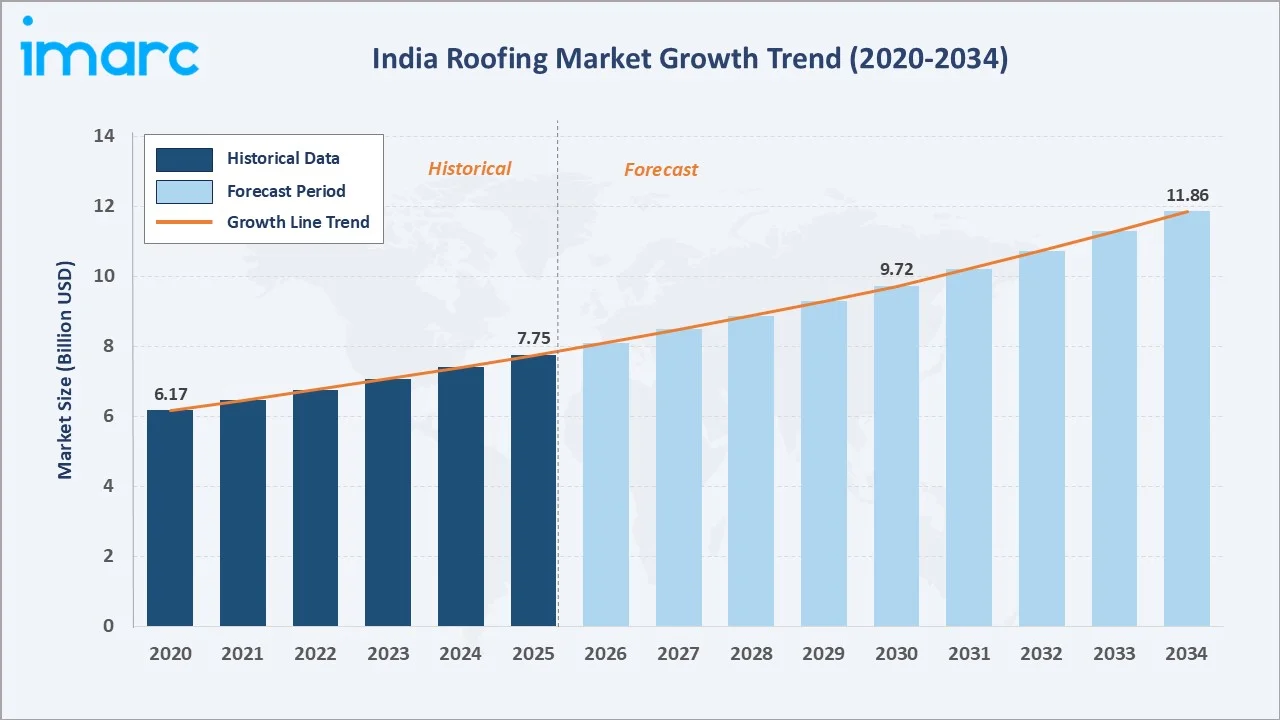
The India roofing market grew from USD 7.75 Billion in 2025 to USD 8.24 Billion in 2026 and is projected to reach USD 11.86 Billion by 2034, exhibiting a CAGR of 4.65% during 2026-2034. Rapid urban housing construction, expanding industrial and warehousing development, and rising adoption of durable, weather-resistant roofing materials are the primary drivers shaping the market growth.
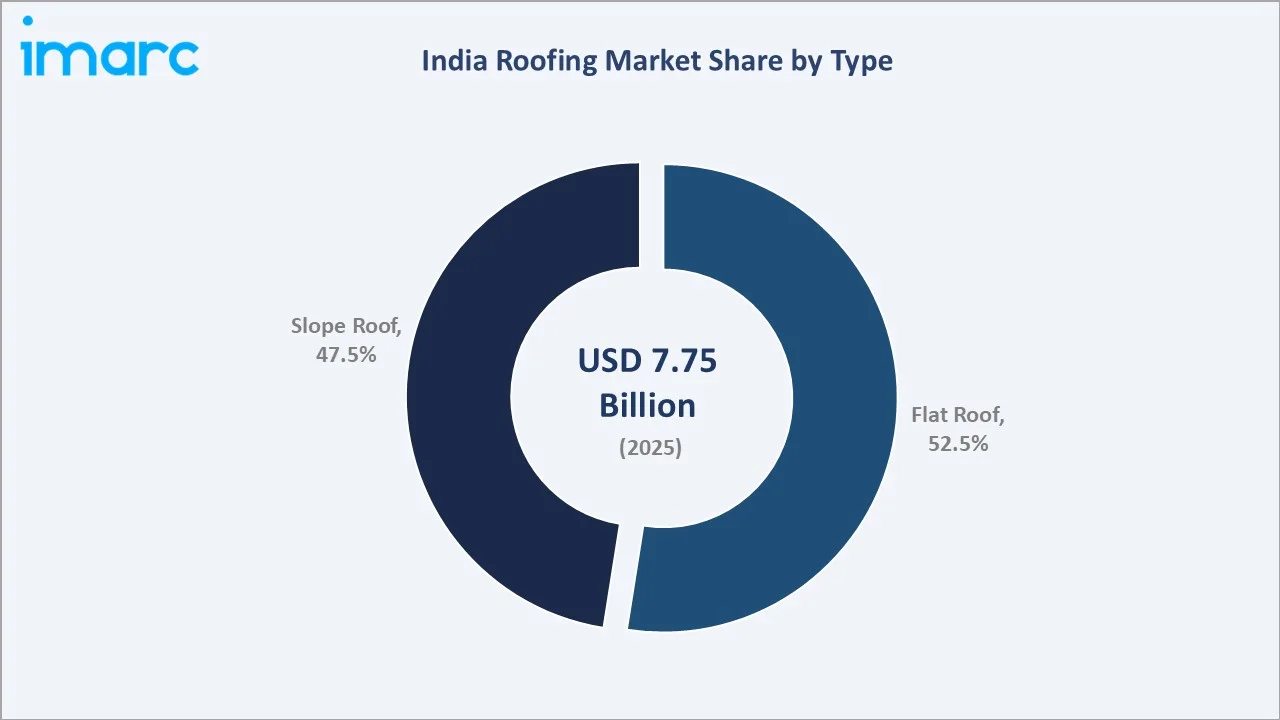
Flat roof leads the type segment at 52.5%, residential dominates the application segment at 54.5%, and West and Central India commands 30.5% of the regional share.
Market Snapshot
|
Metric |
Value |
|
Base Year Market Size (2025) |
USD 7.75 Billion |
| Market Size (2026) | USD 8.24 Billion |
|
Forecast Market Size (2034) |
USD 11.86 Billion |
|
CAGR (2026-2034) |
4.65% |
|
Base Year |
2025 |
|
Historical Period |
2020-2025 |
|
Forecast Period |
2026-2034 |
|
Largest Region |
West and Central India (30.5%, 2025) |
|
Second Largest Region |
North India (26.4%, 2025) |
|
Leading Type |
Flat Roof (52.5%, 2025) |
|
Leading Application |
Residential (54.5%, 2025) |
The India roofing market expanded from USD 6.17 Billion in 2020 to USD 7.75 Billion in 2025 and an estimated USD 8.24 Billion in 2026, supported by steady residential construction, government housing missions, and gradual replacement of traditional roofing with durable alternatives. Anchored at USD 9.72 Billion in 2030, the forecast to USD 11.86 Billion by 2034 reflects accelerating industrial construction, rising commercial infrastructure, and wider adoption of engineered steel and fiber cement roofing systems.
To get more information on this market, Request Sample
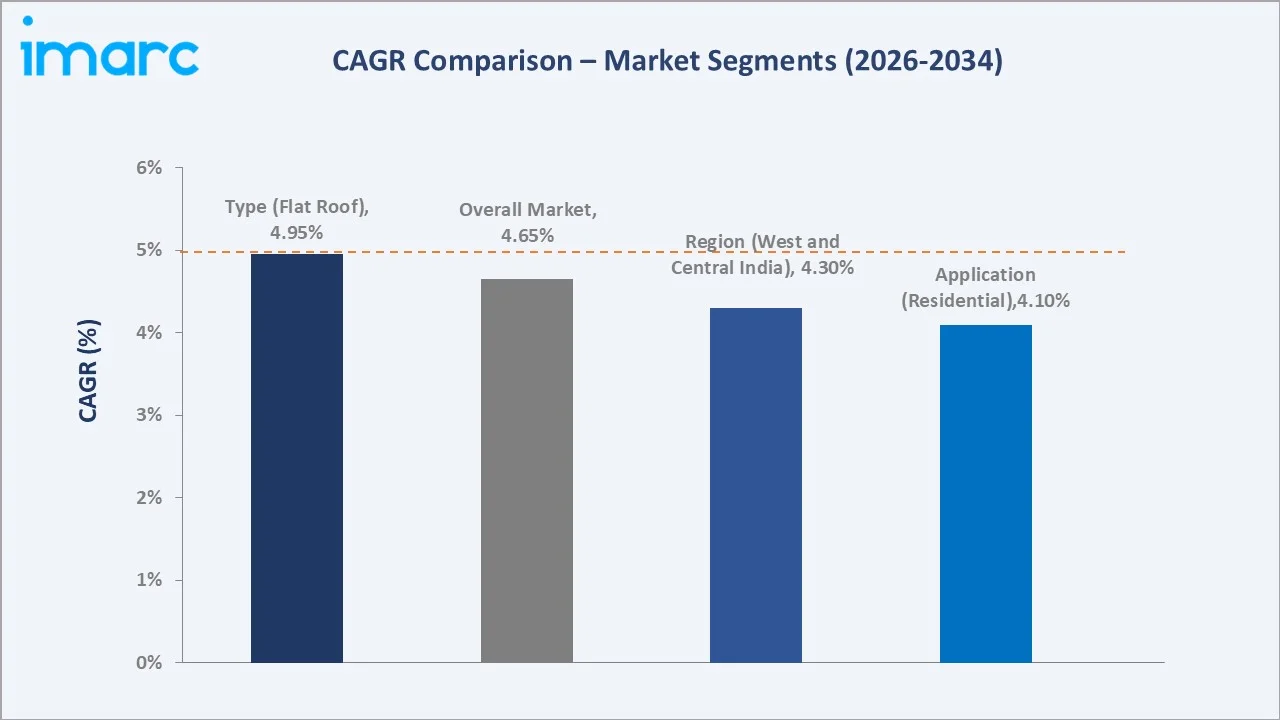
CAGR trajectories across type, application, and regional sub-segments show industrial and South India expanding faster than the overall 4.65% market CAGR, driven by warehousing expansion, manufacturing growth, and rising tier-2 city construction activity.
Executive Summary
The India roofing market is on a steady growth path from USD 6.17 Billion in 2020 to an estimated USD 8.24 Billion in 2026 and reaching USD 11.86 Billion by 2034. The industry has evolved from traditional clay and asbestos-based roofing toward engineered fiber cement, steel, and polymer-coated systems used across residential, commercial, and industrial construction. Rising urbanization, expanding manufacturing capacity, and stronger building codes are encouraging faster adoption of durable, weather-resistant roofing solutions.
Flat roof leads the type segment at 52.5% in 2025, supported by wider use in multi-storey residential and commercial buildings. Based on application, residential holds 54.5% market share, driven by rising housing construction and renovation activities. West and Central India commands 30.5% of the regional share, led by strong industrial and residential construction activity.
Key Market Insights
|
Insight |
Data |
|
Leading Type |
Flat Roof - 52.5% share (2025) |
|
Second Largest Type |
Slope Roof - 47.5% share (2025) |
|
Leading Application |
Residential - 54.5% share (2025) |
|
Second Largest Application |
Commercial - 25.8% share (2025) |
|
Leading Region |
West and Central India - 30.5% share (2025) |
|
Second Largest Region |
North India - 26.4% share (2025) |
|
Top Companies |
BirlaNu Limited, Everest Industries Limited, Tata Steel Limited, Visaka Industries Limited, JSW Steel Limited, Ramco Industries Limited |
Key Analytical Observations Expanding On the Data Above:
- Flat roof dominance at 52.5% is supported by widespread adoption in multi-storey residential and commercial buildings, offering usable terrace space and easier integration with water tanks and solar installations.
- Slope roof at 47.5% remains prevalent in individual housing, hilly terrain, and high-rainfall regions, valued for effective water drainage and comparatively lower maintenance needs.
- Residential leadership at 54.5% reflects sustained new home construction and re-roofing activity across urban and semi-urban India, supported by affordable housing programs.
- Commercial share at 25.8% is supported by expanding retail, office, and hospitality construction across metro and tier-2 cities nationwide.
- West and Central India at 30.5% leads regional share, anchored by Maharashtra and Gujarat's industrial base and sustained residential construction activity.
India Roofing Market Overview
Roofing refers to the materials and systems used to cover and protect buildings from weather, spanning flat roof and slope roof formats across residential, commercial, and industrial applications. The market includes fiber cement sheets, metal and steel roofing, clay and concrete tiles, membrane systems, and associated coating and insulation solutions.
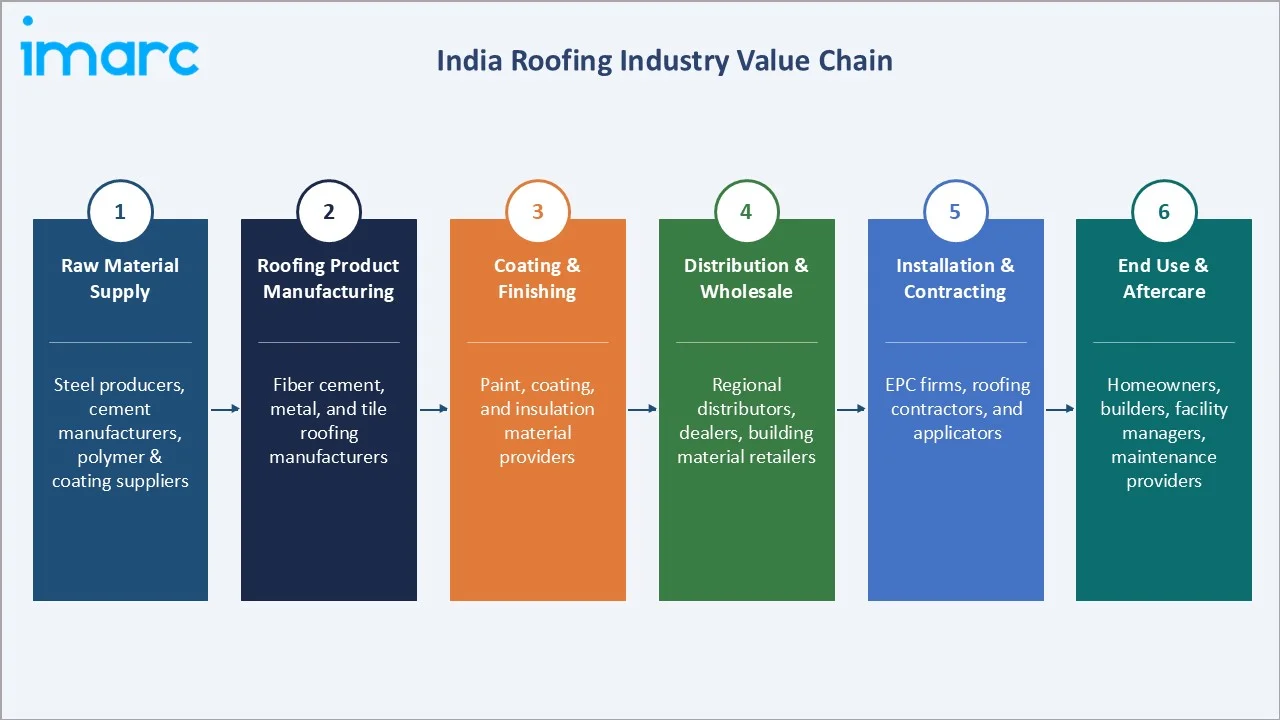
The Indian ecosystem integrates raw material suppliers, roofing sheet and tile manufacturers, coating and insulation providers, regulatory and standards bodies, distributors, installation contractors, and end users across residential, commercial, and industrial construction, together enabling delivery of durable, weather-resistant roofing solutions within an evolving building-code framework.
Market Dynamics
To evaluate market opportunities, Request Sample
Market Drivers
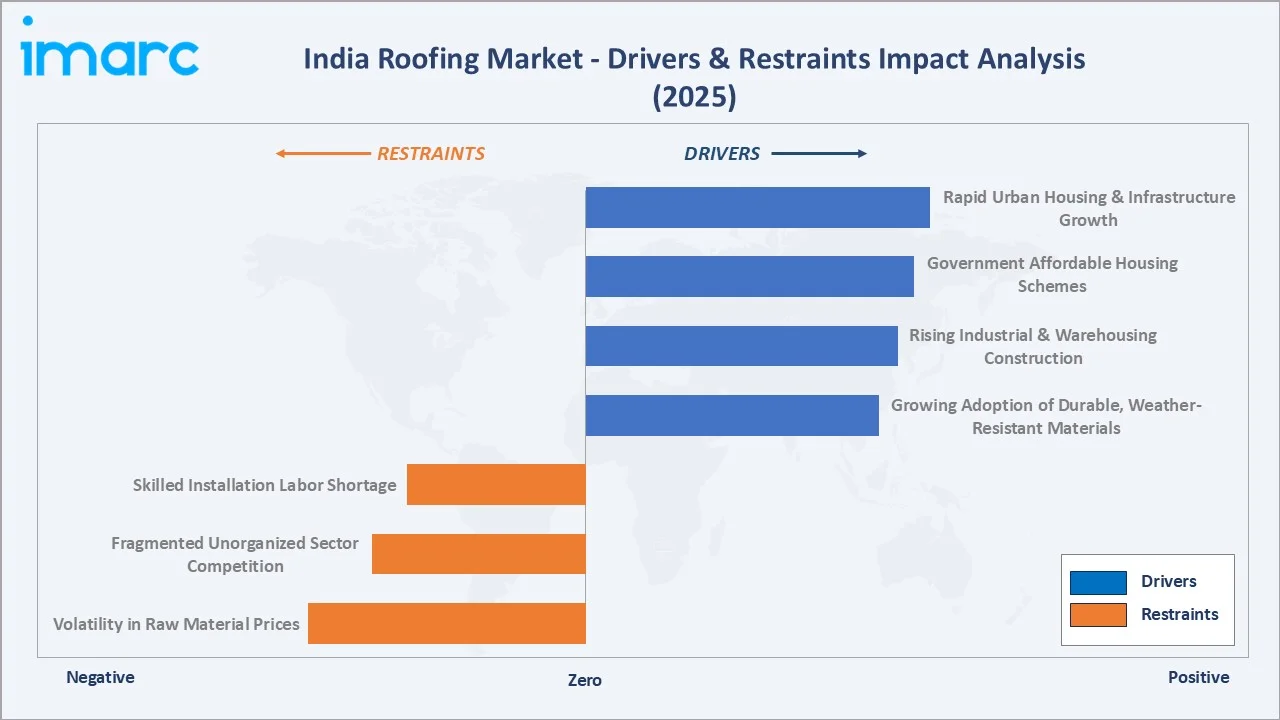
- Rapid Urban Housing and Infrastructure Growth: India's expanding urban population and sustained residential construction activity are driving continuous demand for both flat and slope roof systems across new and replacement projects.
- Government Affordable Housing Schemes: Central and state housing missions are accelerating pucca house construction, directly lifting demand for cost-effective and durable roofing materials across income segments.
- Rising Industrial and Warehousing Construction: Expanding manufacturing capacity, cold storage networks, and logistics infrastructure are driving strong demand for large-format steel and fiber cement roofing systems. According to Invest India, demand for warehousing space is projected to reach 159 Million square feet by 2047, reinforcing long-term industrial roofing demand.
- Growing Adoption of Durable, Weather-Resistant Materials: Rising awareness of lifecycle costs is encouraging a shift from traditional roofing toward engineered fiber cement, steel, and coated roofing systems.
Market Restraints
- Volatility in Raw Material Prices: Fluctuating steel, cement, and polymer input costs create pricing uncertainty for manufacturers, affecting profit margins and project cost planning across the roofing value chain.
- Fragmented Unorganized Sector Competition: A large base of small, unorganized regional manufacturers competes aggressively on price, limiting the pricing power and market share gains of organized roofing companies.
- Skilled Installation Labor Shortage: Limited availability of trained roofing contractors and applicators constrains project execution timelines, particularly for advanced steel and composite roofing systems.
Market Opportunities
- Solar-Integrated Roofing Systems: Rising rooftop solar adoption is creating opportunities for roofing manufacturers to develop integrated solar-ready panels and mounting-compatible roofing solutions for residential and commercial buildings.
- Green and Recyclable Roofing Materials: Growing demand for sustainable construction is opening opportunities for recyclable fiber cement and coated steel roofing products aligned with green building certification standards.
Market Challenges
- Extreme Weather and Climate Variability: Increasingly frequent heavy rainfall, heatwaves, and cyclonic activity are raising performance expectations for roofing durability, insulation, and water-resistance across all regions.
- Inconsistent Regional Building Code Enforcement: Varying adoption of Bureau of Indian Standards norms across states creates inconsistent quality benchmarks, complicating nationwide product standardization for manufacturers.
Emerging Market Trends
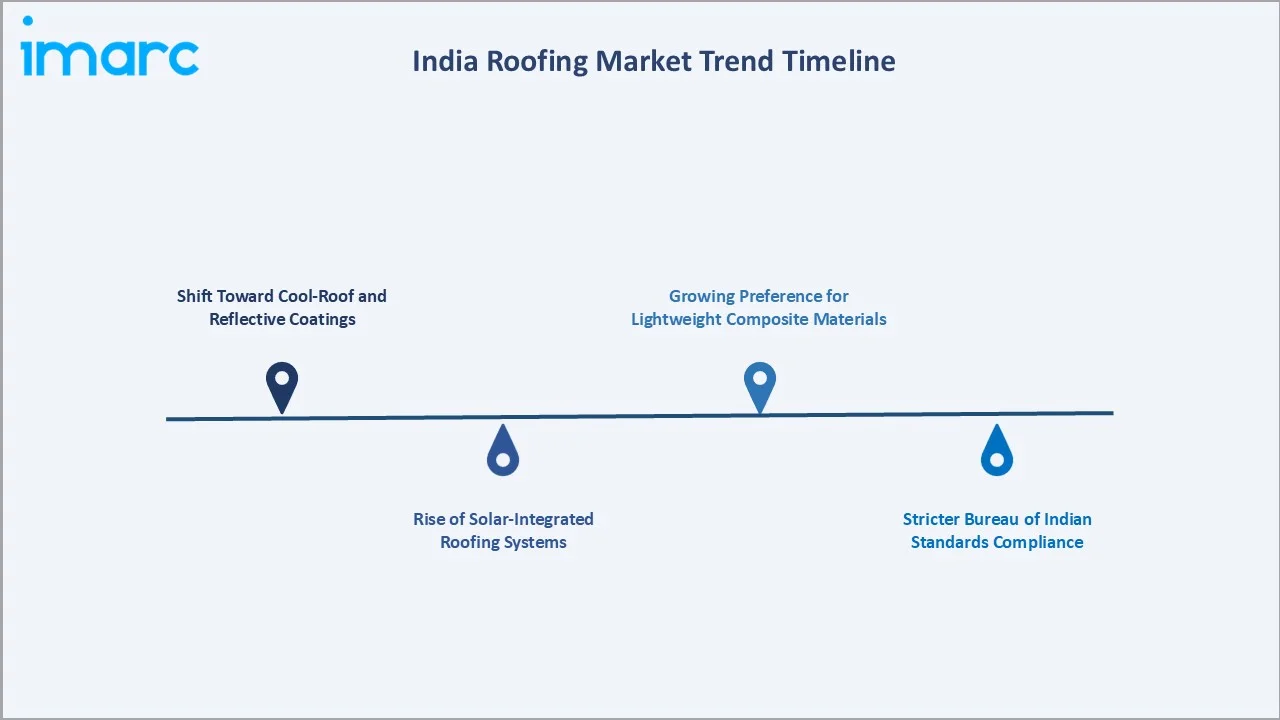
1. Shift Toward Cool-Roof and Reflective Coatings
Manufacturers are increasingly incorporating heat-reflective and cool-roof coating technologies to reduce indoor temperatures and energy consumption, particularly across residential and commercial buildings in warmer regions.
2. Rise of Solar-Integrated Roofing Systems
The integration of solar panels with roofing systems is gaining traction as building owners seek to generate renewable energy while optimizing available rooftop space. This trend is supported by growing interest in distributed solar power and energy-efficient building solutions.
3. Growing Preference for Lightweight Composite Materials
Lightweight fiber cement and polymer-composite roofing products are gaining traction in the India composite slate roofing market, as builders increasingly seek solutions that enable faster installation, reduce structural load, and offer improved durability across residential and industrial construction.
4. Stricter Bureau of Indian Standards Compliance
Tightening BIS quality norms for roofing sheets and coatings are pushing manufacturers toward higher-grade materials, gradually reshaping competitive dynamics between organized and unorganized roofing producers.
Industry Value Chain Analysis
The India roofing value chain spans six stages, from raw material and component supply through end-use and aftercare. Roofing product manufacturing and distribution capture the highest value-add, while installation quality and compliance capabilities increasingly determine sustainable competitive position.
|
Stage |
Key Players / Examples |
|
Raw Material Supply |
Steel producers, cement manufacturers, and polymer and coating material suppliers |
|
Roofing Product Manufacturing |
Fiber cement, metal, and tile roofing manufacturers |
|
Coating & Finishing |
Paint, coating, and insulation material providers |
|
Distribution & Wholesale |
Regional distributors, dealers, and building material retailers |
|
Installation & Contracting |
EPC firms, roofing contractors, and applicators |
|
End Use & Aftercare |
Homeowners, builders, facility managers, and maintenance service providers |
Vertically integrated players, especially those owning proprietary manufacturing technology and direct distribution networks, are positioned to capture greater value than partners reliant on third-party infrastructure.
Technology Landscape in the India Roofing Industry
Advanced Coating and Insulation Technologies
Roofing manufacturers are deploying heat-reflective, anti-corrosion, and UV-resistant coating technologies to extend product lifespan and improve thermal performance. These advanced coatings are increasingly standard across premium steel and fiber cement roofing systems.
Lightweight and Composite Material Innovation
Innovations in lightweight fiber cement, polymer-composite, and sandwich panel roofing are enabling faster installation and reduced structural load. These materials are gaining preference across pre-engineered steel buildings and modern residential construction.
Smart and Solar-Integrated Roofing Systems
Solar-ready roofing panels, integrated mounting systems, and smart moisture-sensing technologies are emerging as manufacturers align product design with India's expanding rooftop solar and green building ecosystem.
Market Segmentation Analysis
The report covers the following segments:
|
Segment Category |
Leading Segment |
Market Share |
Year |
|
Material Type |
Bituminous |
35.0% |
2025 |
|
Type |
Flat Roof |
52.5% |
2025 |
|
Application |
Residential |
54.5% |
2025 |
|
Region |
West and Central India |
30.5% |
2025 |

By Type
Flat roof commands a 52.5% majority share in 2025, driven by adoption in multi-storey residential and commercial buildings, ease of integrating water tanks and solar panels, and lower construction complexity on wide-span structures.
To access detailed market analysis, Request Sample
Slope roof, at 47.5% in 2025, remains prevalent in individual housing, hilly terrain, and high-rainfall regions, valued for its natural water drainage and comparatively lower long-term maintenance requirements.
By Application
Residential leads with 54.5% share in 2025, reflecting sustained new home construction and re-roofing demand across urban and semi-urban India, supported by affordable housing programs and rising homeownership.
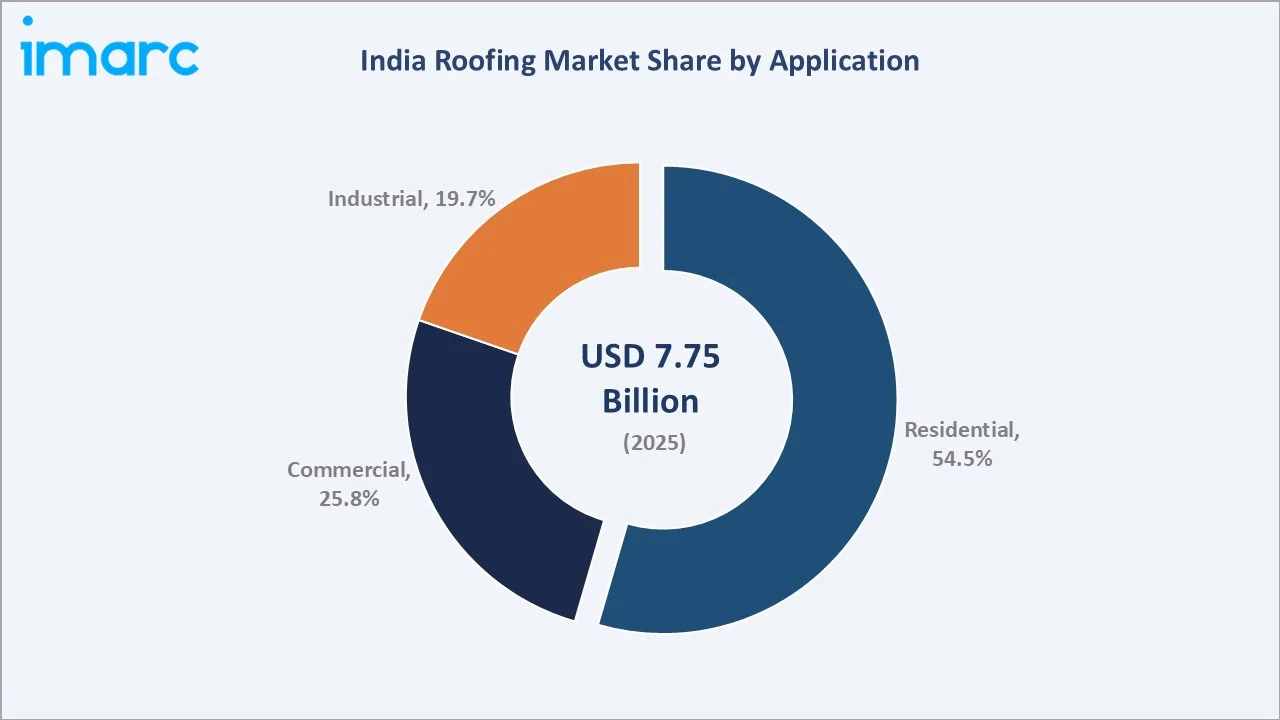
Commercial, at 25.8% in 2025, is supported by expanding retail, office, and hospitality construction across metro and tier-2 cities.
Regional Market Insights
|
Region |
Share (2025) |
Key Growth Drivers |
|
West and Central India |
30.5% |
Strong industrial base, sustained residential construction, and expanding urban infrastructure development |
|
North India |
26.4% |
Large housing demand, growing commercial construction, and expanding urban infrastructure projects |
|
South India |
24.7% |
Rapid urbanization, expanding industrial and IT-led construction, and rising commercial real estate development |
|
East India |
18.4% |
Emerging industrial investment, growing urban housing demand, and expanding infrastructure development |
West and Central India at 30.5% in 2025 leads the regional landscape, anchored by Maharashtra and Gujarat's strong industrial base and sustained residential construction. Deep manufacturing activity and a mature urban consumer base support sustained regional leadership.
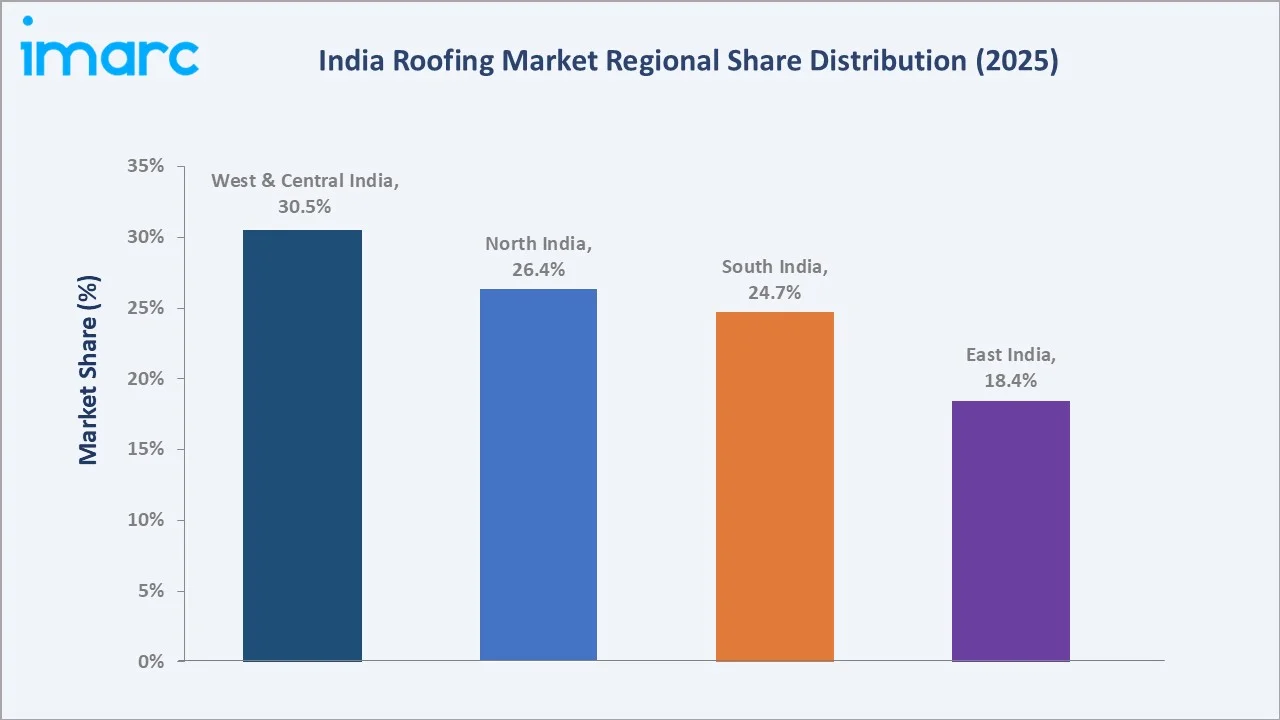
South India at 24.7% is the fastest growing region. Rapid urbanization, expanding IT-led commercial construction, and rising industrial investment are accelerating regional expansion through 2034.
Competitive Landscape
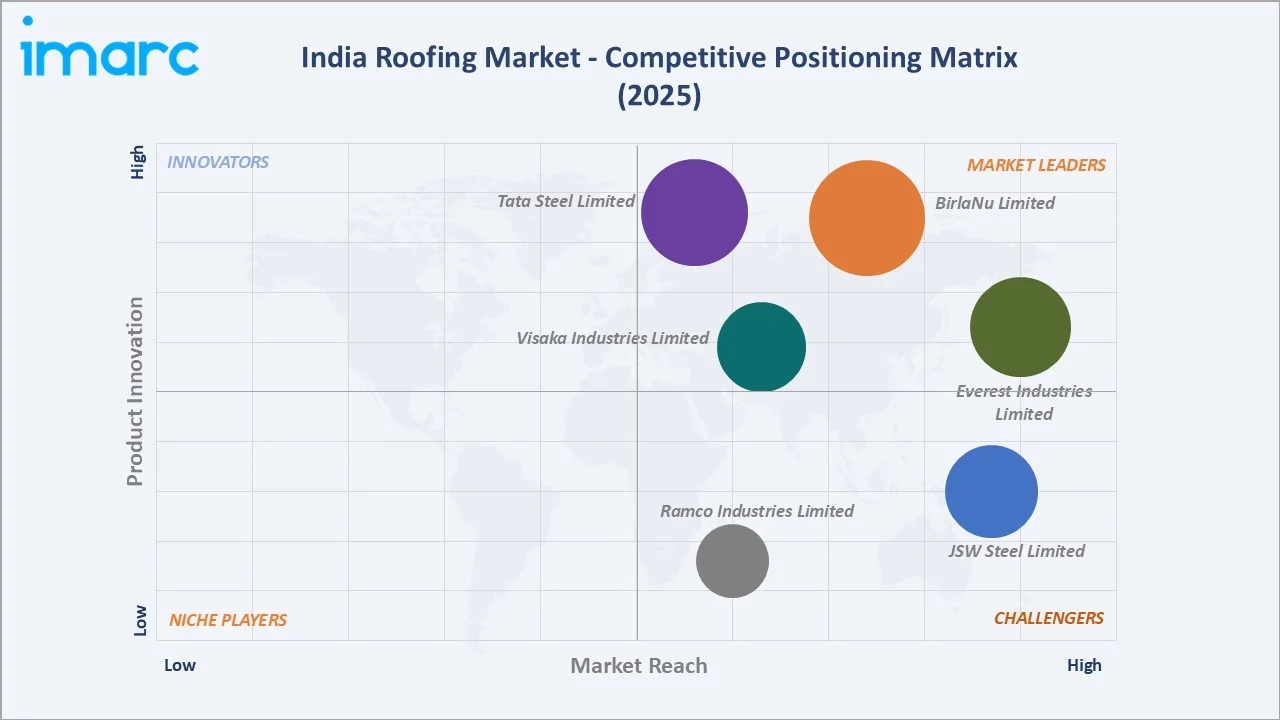
The India roofing market is moderately fragmented, with established organized manufacturers leading fiber cement and steel roofing sales while numerous regional and unorganized players compete on price. Brand legacy, manufacturing scale, distribution reach, and product durability form the key competitive moats.
|
Company Name |
Brand / Key Product |
Position |
Strategic Focus |
|
BirlaNu Limited |
Charminar |
Leader |
Diversified building materials major with legacy roofing brand leadership |
|
Everest Industries Limited |
Everest |
Leader |
Integrated roofing and building solutions provider with pan-India reach |
|
Tata Steel Limited |
DURASHINE; COLORBOND |
Leader |
Integrated steel major offering premium steel roofing through its subsidiary |
|
Visaka Industries Limited |
ATUM |
Leader |
Fiber cement roofing manufacturer diversifying into solar-integrated products |
|
JSW Steel Limited |
JSW Colouron+ |
Challenger |
Integrated steel major expanding into color-coated roofing sheets |
|
Ramco Industries Limited |
Ramco |
Challenger |
Regional fiber cement roofing manufacturer with multi-plant capacity |
Key players include BirlaNu Limited, Everest Industries Limited, Tata Steel Limited, Visaka Industries Limited, JSW Steel Limited, and Ramco Industries Limited, among others.
Key Company Profiles
BirlaNu Limited
BirlaNu Limited is a flagship Indian building materials company, offering fiber cement roofing sheets under its long-standing Charminar brand alongside a broader portfolio of home and building solutions.
- Product Portfolio: Charminar fiber cement roofing sheets and allied building material solutions.
- Recent Development: The company continues to strengthen its manufacturing capacity and expand its product portfolio across the building materials segment.
- Strategic Focus: Sustaining category leadership in fiber cement roofing while broadening its overall building materials portfolio.
Everest Industries Limited
Everest Industries Limited is an established Indian building solutions company offering fiber cement and steel roofing, along with pre-engineered steel building solutions across residential, commercial, and industrial construction.
- Product Portfolio: Fiber cement and color-coated roofing sheets, along with pre-engineered steel building roofing and cladding systems.
- Recent Development: The company continues to expand its manufacturing footprint and strengthen its distribution network across India.
- Strategic Focus: Strengthening its distribution network and expanding its steel building and roofing capacity nationally.
Tata Steel Limited
Tata Steel Limited is one of India's largest integrated steel producers, offering color-coated and metallic-coated steel roofing and cladding products through its roofing business.
- Product Portfolio: Color-coated and metallic-coated steel roofing, marketed under the DURASHINE and COLORBOND brands.
- Recent Development: The company continues to expand its steel roofing capacity and strengthen its presence across commercial and industrial segments.
- Strategic Focus: Growing adoption of premium pre-painted steel roofing across commercial and industrial segments.
Market Concentration Analysis
The India roofing market is moderately fragmented, with the top players led by BirlaNu Limited, Everest Industries Limited, and Tata Steel Limited accounting for a meaningful share of organized fiber cement and steel roofing sales, while numerous regional and unorganized manufacturers serve local demand.
Barriers to entry include capital-intensive manufacturing infrastructure, established distribution networks, and compliance with Bureau of Indian Standards quality norms. These factors favor established players with strong dealer relationships and diversified product portfolios.
Consolidation is gradually increasing as larger organized players expand manufacturing capacity and strengthen regional distribution, while smaller unorganized manufacturers face rising compliance and raw material cost pressures.
Investment & Growth Opportunities
Fastest-Growing Segments
Industrial is expected to expand fastest among application segments, driven by warehousing, cold storage, and manufacturing facility construction. Flat roof is also gaining share amid rising commercial construction activity.
Emerging Markets
South India is the fastest growing region, supported by rapid urbanization, expanding industrial investment, and rising commercial real estate development across IT-led metro markets. Growing infrastructure spending and increasing demand for durable roofing solutions further support regional market expansion.
Venture & Investment Trends
Investment is increasingly directed toward solar-integrated roofing technology, lightweight composite materials, and expanded manufacturing capacity as organized players position for long-term demand growth. Investors are also showing greater interest in energy-efficient and sustainable roofing solutions to capitalize on evolving construction requirements and environmental considerations.
Future Market Outlook (2026-2034)
The India roofing market is forecast to expand from USD 7.75 Billion in 2025 to an estimated USD 8.24 Billion in 2026 and further to USD 11.86 Billion by 2034 at a CAGR of 4.65%, adding roughly USD 4.11 Billion in incremental market value over the forecast period.
Three forces will shape the market through 2034: accelerating industrial and warehousing construction, wider adoption of solar-integrated and cool-roof technologies, and stricter enforcement of Bureau of Indian Standards quality norms across states.
By 2034, the India roofing market is expected to be defined by durable, engineered roofing systems, with steel and fiber cement products collectively accounting for a growing share of overall installations. Rising sustainability standards and government housing programs are expected to further support long-term demand.
Research Methodology
Primary Research
Primary research included structured interviews with roofing manufacturers, construction contractors, distributors, and industry association representatives, validating market sizing, segment shares, and regional demand patterns.
Secondary Research
Secondary sources included Ministry of Housing and Urban Affairs publications, Bureau of Indian Standards norms, state public works department data, and annual reports and investor presentations from listed roofing and building material companies.
Forecasting Models
Market forecasts used top-down and bottom-up models combining construction activity data, segment-wise roofing material consumption, and regional infrastructure investment trends. Scenario analysis addressed raw material price volatility and regulatory compliance timelines.
India Roofing Market Report Coverage:
| Report Features | Details |
|---|---|
| Base Year of the Analysis | 2025 |
| Historical Period | 2020-2025 |
| Forecast Period | 2026-2034 |
| Units | Billion USD |
| Scope of the Report | Exploration of Historical Trends and Market Outlook, Industry Catalysts and Challenges, Segment-Wise Historical and Future Market Assessment:
|
| Material Types Covered | Bituminous, Tiles, Metal, Plastic, Others |
| Types Covered | Flat Roof, Slope Roof |
| Applications Covered | Residential, Commercial, Industrial |
| Regions Covered | North India, West and Central India, South India, East India |
| Companies Covered | BirlaNu Limited, Everest Industries Limited, Tata Steel Limited, Visaka Industries Limited, JSW Steel Limited, Ramco Industries Limited, etc. |
| Customization Scope | 10% Free Customization |
| Post-Sale Analyst Support | 10-12 Weeks |
| Delivery Format | PDF and Excel through Email (We can also provide the editable version of the report in PPT/Word format on special request) |
Frequently Asked Questions About the India Roofing Market Report
The India roofing market size is estimated at USD 8.24 Billion in 2026, driven by urban housing construction, industrial development, and rising adoption of durable roofing materials nationwide.
The market is projected to grow at a CAGR of 4.65% from 2026-2034, reaching USD 11.86 Billion, supported by expanding industrial construction and infrastructure development.
Flat roof dominates the India roofing market at 52.5% share in 2025, driven by widespread adoption in multi-storey residential and commercial buildings across the country.
Residential leads the market at 54.5% share in 2025, supported by sustained new home construction and re-roofing activity across urban and semi-urban India.
West and Central India commands 30.5% share in 2025, led by strong industrial activity, sustained residential construction, and expanding urban infrastructure across Maharashtra and Gujarat.
Leading players include BirlaNu Limited, Everest Industries Limited, Tata Steel Limited, Visaka Industries Limited, JSW Steel Limited, and Ramco Industries Limited, among others.
Affordable housing missions are accelerating pucca house construction nationwide, directly lifting demand for durable, cost-effective roofing materials across income segments and construction categories.
Advances in cool-roof coatings, lightweight composite materials, and solar-integrated roofing systems are enabling more durable, energy-efficient, and sustainable roofing solutions across buildings.
Volatility in raw material prices, competition from the fragmented unorganized sector, and a shortage of skilled installation labor are the primary restraints facing the industry.
Cool-roof coatings, solar-integrated roofing systems, and stricter Bureau of Indian Standards norms are reshaping product design and adoption across residential, commercial, and industrial categories.
Need more help?
- Speak to our experienced analysts for insights on the current market scenarios.
- Include additional segments and countries to customize the report as per your requirement.
- Gain an unparalleled competitive advantage in your domain by understanding how to utilize the report and positively impacting your operations and revenue.
- For further assistance, please connect with our analysts.
 Request Customization
 Speak to an Analyst
 Request Brochure
 Inquire Before Buying
Benefits of Customization
- Personalize this research
- Triangulate with your data
- Get data as per your format and definition
- Gain a deeper dive into a specific application, geography, customer, or competitor
- Any level of personalization
Get in Touch With Us
UNITED STATES
Phone: +1-201-971-6302
INDIA
Phone: +91-120-433-0800
UNITED KINGDOM
Phone: +44-753-714-6104
Email: [email protected]
Client Testimonials




.webp)




.webp)













Related Reports

Choose your plan
*Please note that the prices mentioned below are starting prices for each bundle type. Kindly contact our team for further details.*
Single User License
- 1 User License, Access on 2 Devices
- PDF Report + Excel Dataset (Password Protected)
- Lifetime Access
- No Printing Rights
- 10% Free Report Customization
- 10–12 Weeks of Analyst Support
Five User License
- Access for 5 Users, 2 Devices per User
- PDF Report + Excel Dataset (Password Protected)
- Lifetime Access
- Dedicated Account Manager
- 12–14 Weeks of Analyst Support
- No Printing Rights
- 15% Free Report Customization
- 25% Discount on Your Next Purchase
Corporate User License
- Unlimited User Access (Within Your Organization)
- PDF Report + Excel Dataset
- Lifetime Access
- Dedicated Account Manager
- 14–20 Weeks of Analyst Support
- No Printing Rights
- 20% Free Report Customization
- 30% Discount on Your Next Purchase
Essential Insights
What's included:
3 reports
- Lifetime Access
- PDF Reports
- Excel Datasets
- 2 Weeks of Free Analyst Support
- 2 User Licenses
- Access on 2 Devices
- Printing Rights
- Complimentary PowerPoint (PPT) Version
- Complimentary License Upgrade
Professional Access
What's included:
5 reports
- Lifetime Access
- PDF Reports
- Excel Datasets
- 8 Weeks of Free Analyst Support
- 2 User Licenses
- Access on 2 Devices
- Printing Rights
- Complimentary PowerPoint (PPT) Version
- Complimentary License Upgrade
Business Advantage
What's included:
8 reports
- Lifetime Access
- PDF Reports
- Excel Datasets
- 14 Weeks of Free Analyst Support
- 2 User Licenses
- Access on 2 Devices
- Printing Rights
- Complimentary PowerPoint (PPT) Version
- Complimentary License Upgrade
Enterprise Intelligence
What's included:
10 reports
- Lifetime Access
- PDF Reports
- Excel Datasets
- 20 Weeks of Free Analyst Support
- 2 User Licenses
- Access on 2 Devices
- Printing Rights
- Complimentary PowerPoint (PPT) Version
- Complimentary License Upgrade