
India Sex Toys Market Size, Share, Trends and Forecast by Product Type, Distribution Channel, End User, and Region, 2026-2034
India Sex Toys Market Size, Share, Trends & Forecast (2026-2034)
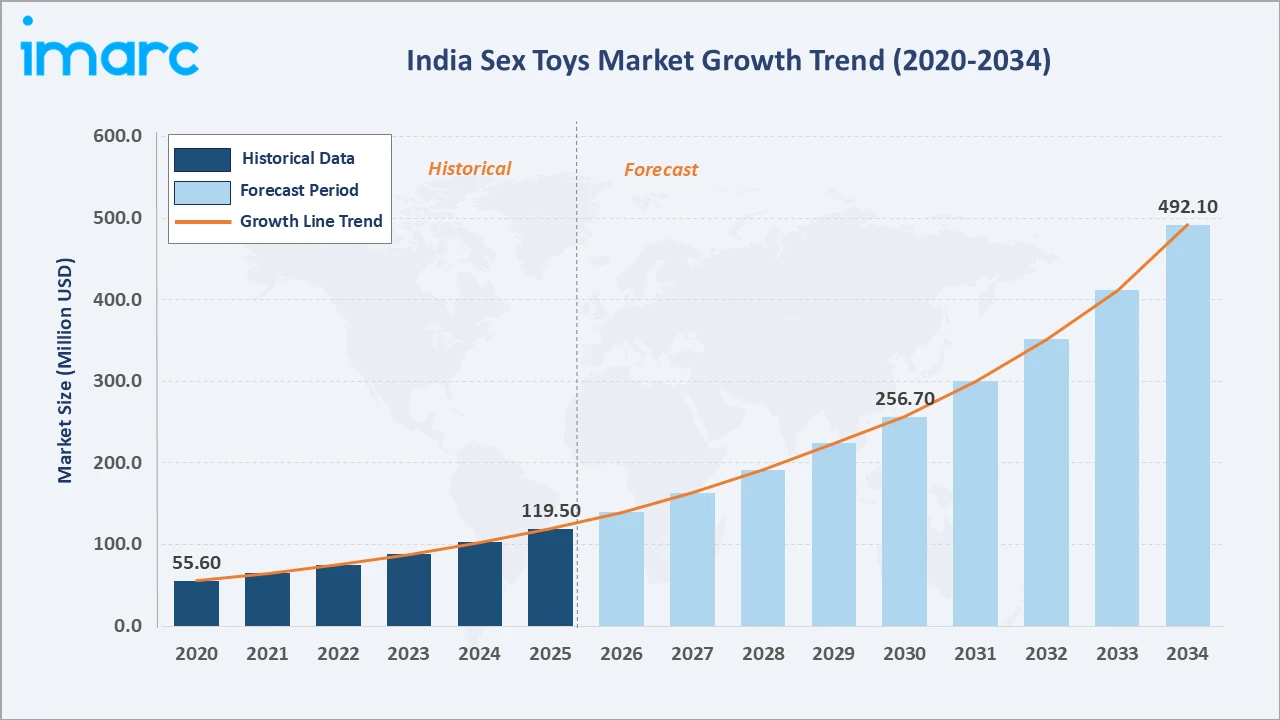
The India sex toys market reached USD 119.5 Million in 2025 and is projected to reach USD 492.1 Million by 2034, expanding at a CAGR of 16.52% during 2026-2034. Growth of the India sex toys market is driven by rising sexual wellness awareness, expanding discreet e-commerce delivery, and declining social stigma among urban and semi-urban adults. Adult vibrators dominate product demand, while Exclusive e-commerce platforms remain the primary purchase channel. Homegrown direct-to-consumer brands are normalizing intimate wellness conversations through educational content, app-controlled devices, and body-safe materials, supporting broad-based India sex toys market growth across income segments.
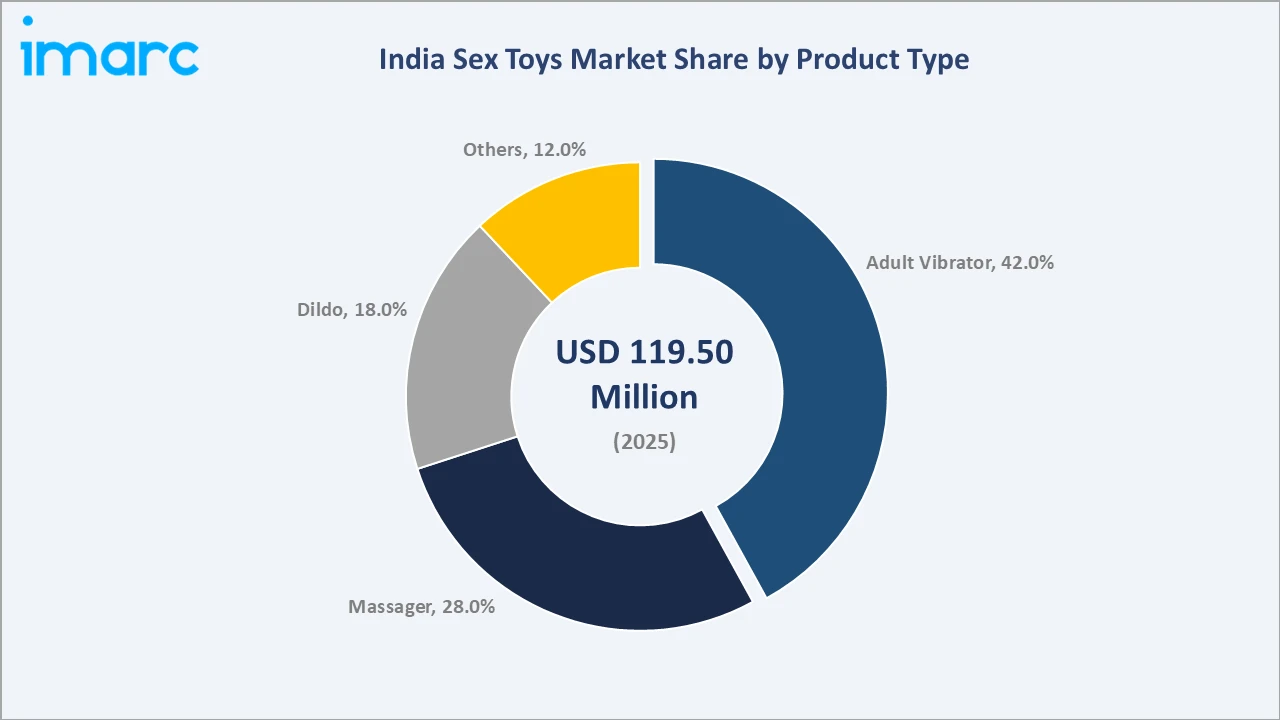
Adult vibrators lead product type demand at 42.0% in 2025, reflecting affordability and ease of first-time use. Exclusive e-commerce platforms capture 62.0% of distribution, reflecting brand preference for discreet, direct fulfilment. West India commands the largest regional share at 31.0%, supported by Mumbai and Pune's digitally native consumer base.
Market Snapshot
|
Metric |
Value |
|
Market Size (2025) |
USD 119.5 Million |
|
Forecast Market Size (2034) |
USD 492.1 Million |
|
CAGR (2026-2034) |
16.52% |
|
Base Year |
2025 |
|
Historical Period |
2020-2025 |
|
Forecast Period |
2026-2034 |
|
Dominant Product Type |
Adult Vibrator (42.0%, 2025) |
|
Dominant Distribution Channel |
Exclusive E-commerce Platforms (62.0%, 2025) |
|
Leading Region |
West India (31.0%, 2025) |
India sex toys market expanded from USD 55.6 Million in 2020 to USD 119.5 Million in 2025, anchored at USD 256.7 Million in 2030, and forecast to reach USD 492.1 Million by 2034. The India sex toys market is commercially distinct among Asian intimate-wellness markets, combining a large first-time-buyer base entering through discreet e-commerce, a fast-growing women-founded D2C brand segment addressing female pleasure and sexual health, and an accelerating premiumization trend led by app-controlled and body-safe silicone devices.
To get more information on this market, Request Sample
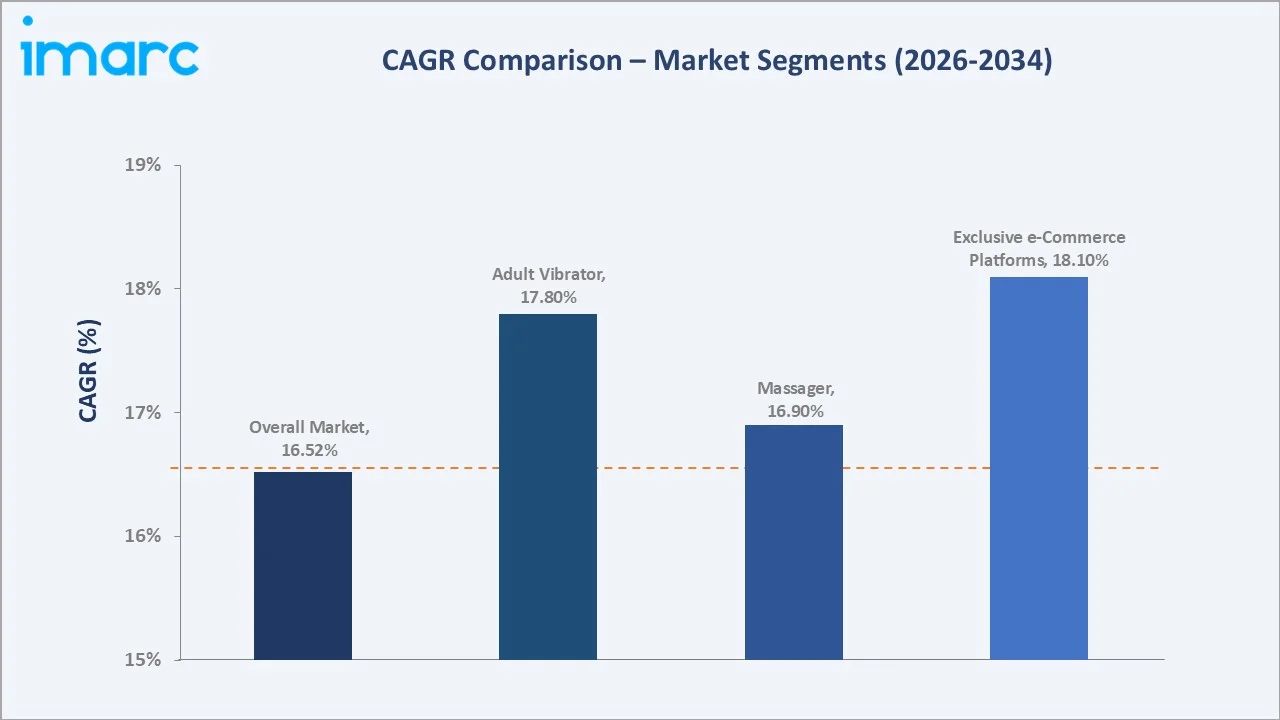
Exclusive e-commerce platforms grow fastest among distribution channels at an estimated 18.1% CAGR, as homegrown brands prioritize owned websites for discreet packaging control and customer-data ownership. Adult vibrators are estimated to expand at approximately 17.8% CAGR through 2034, supported by app-controlled functionality and rising demand for solo-pleasure devices. Massagers, positioned as wellness-oriented products, are gaining acceptance beyond dedicated adult-only retail contexts, widening their addressable consumer base.
Executive Summary
India sex toys market at USD 119.5 Million in 2025 remains a nascent but rapidly formalizing category within the country's broader personal-care and wellness economy. The market's structure reflects India's ongoing shift from stigma-driven silence toward open, wellness-oriented conversations about pleasure and intimacy, catalyzed by homegrown direct-to-consumer brands and creator-backed ventures. The market is projected to reach USD 492.1 Million by 2034, delivering a 16.52% CAGR, among the fastest of any personal-wellness category in India.
Adult vibrators lead product-type demand at 42.0% through accessible price points and broad first-time-buyer appeal, while massagers at 28.0% benefit from wellness-category positioning that eases mainstream retail acceptance. Exclusive e-commerce platforms account for 62.0% of distribution, reflecting consumer preference for discreet, brand-controlled purchase journeys over third-party marketplaces. West India leads regionally at 31.0%, followed closely by South India at 29.0%.
Continued reduction in social stigma, rising smartphone-led product discovery, and increasing venture funding into sexual-wellness startups are expected to sustain double-digit growth through 2034, positioning India among the fastest-growing sex toys markets in Asia.
Key Market Insights
|
Insight |
Data |
|
Dominant Product Type |
Adult Vibrator - 42.0% share (2025) |
|
Dominant Distribution Channel |
Exclusive E-commerce Platforms - 62.0% share (2025) |
|
Leading Region |
West India - 31.0% share (2025) |
|
Market Opportunity |
Women-founded D2C wellness brands; app-controlled smart devices; Tier-2 city discreet delivery expansion; marketplace-exclusive product lines |
Key Analytical Observations Supporting The Above Data:
- Adult Vibrator at 42.0%: Adult vibrators dominate due to affordable entry price points, ease of first-time use, and broad availability across exclusive D2C websites. Increasing app-controlled variants are widening appeal among tech-savvy urban buyers.
- Exclusive E-commerce at 62.0%: Brand-owned platforms dominate distribution as companies prioritize discreet packaging, direct customer relationships, and controlled data collection over third-party marketplace listings.
- West India at 31.0%: West India leads regionally through Mumbai and Pune's digitally native, higher-income consumer base and early exposure to homegrown wellness brands.
- Funding Momentum: Sexual wellness startups including Peppy and Leezu's have raised early-stage funding since 2024, signaling rising investor confidence in India's intimate-wellness category.
- E-Commerce Infrastructure: India's broader e-commerce sector, growing at an estimated 17-22% annually and supported by over 969 million internet subscribers as of FY25, is enabling nationwide discreet delivery even to smaller towns.
- Stigma Reduction: Growing social media education content and creator-backed brand launches are gradually normalizing sexual wellness conversations, expanding the addressable consumer base beyond metro cities.
India Sex Toys Market Overview
India sex toys market encompasses vibrators, massagers, dildos, and related intimate-wellness devices sold through exclusive brand websites and non-exclusive third-party marketplaces. The industry sits at the intersection of personal care, consumer electronics, and wellness, applying body-safe medical-grade silicone, app-based connectivity, and rechargeable battery systems across products designed for solo and partnered use.
Macroeconomic tailwinds include rising urban disposable incomes, expanding smartphone and internet penetration, and growing willingness among Indian consumers to spend on personal wellness. Regulatory ambiguity around obscenity classification under the Customs Act continues to shape import strategy, encouraging brands toward domestic assembly and sourcing.
Market Dynamics
To evaluate market opportunities, Request Sample
Market Drivers
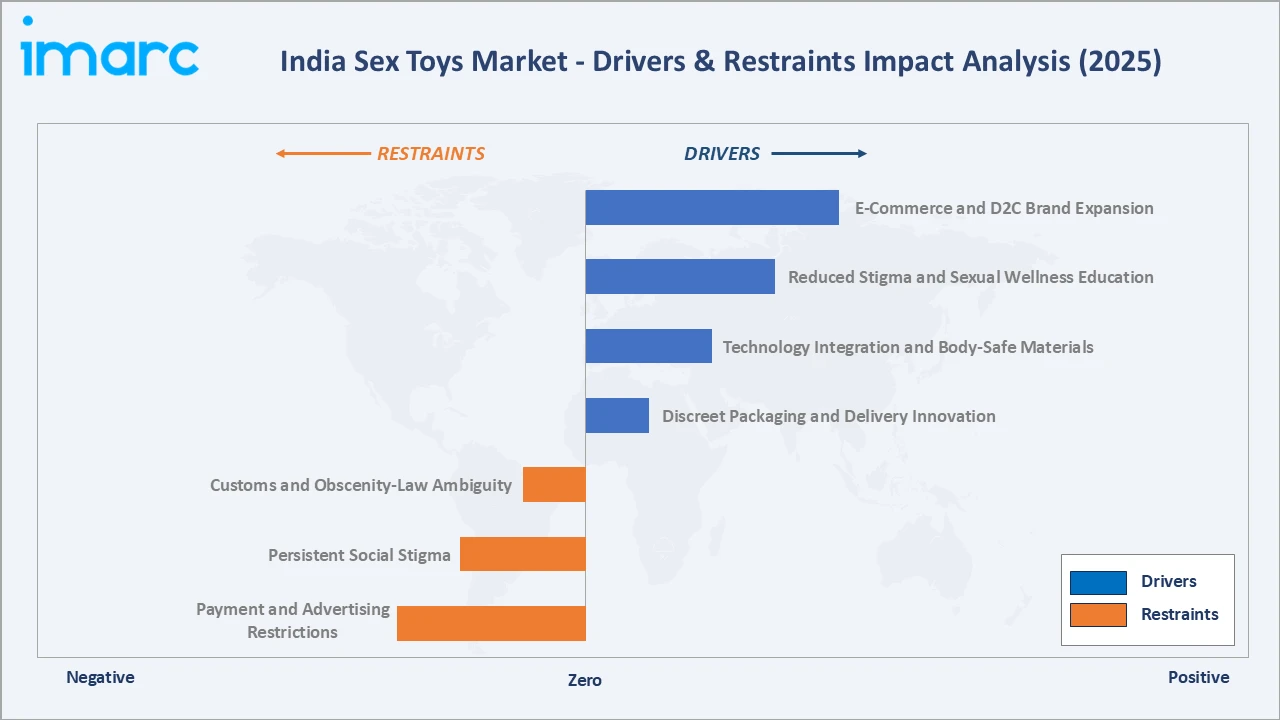
- E-Commerce and D2C Brand Expansion: E-commerce and direct-to-consumer brand expansion are the single largest growth driver, allowing companies to reach consumers discreetly without relying on physical retail. India's e-commerce sector is projected to grow to approximately USD 163 Billion by 2026 at a 27% CAGR, per IBEF, creating substantial headroom for niche wellness categories to scale nationally through owned digital storefronts.
- Reduced Stigma and Sexual Wellness Education: Reduced stigma and growing sexual wellness education are widening the consumer base beyond early adopters. Founder-led brands such as Leezu's combine product sales with structured educational content, helping normalize conversations around intimacy, consent, and body positivity across Indian social media platforms.
- Technology Integration and Body-Safe Materials: Increasing adoption of app-controlled devices, rechargeable batteries, and medical-grade silicone is elevating perceived product safety and quality. Brands increasingly publish third-party lab testing results, addressing long-standing consumer hesitancy around material safety.
- Discreet Packaging and Delivery Innovation: Plain, unbranded packaging and encrypted, cash-on-delivery-enabled checkout are reducing purchase anxiety. Retailers describe shipments using neutral labels such as gifts or souvenirs, a practice that has become a standard trust-building mechanism across the category.
Market Restraints
- Customs and Obscenity-Law Ambiguity: No Indian statute explicitly bans the sale of sex toys, yet the Customs Act grants officers discretion to flag imported shipments as obscene under prevailing standards of decency, creating inconsistent enforcement and periodic seizure risk for cross-border sellers.
- Persistent Social Stigma: Conservative cultural attitudes continue to limit offline retail visibility, confining most category sales to online channels and restricting mainstream advertising avenues across television and print media.
Market Opportunities
- Tier-2 and Tier-3 City Expansion: Rising smartphone penetration and discreet delivery logistics are opening previously underserved Tier-2 and Tier-3 city demand, where cultural stigma has historically limited category awareness.
- Marketplace-Exclusive Product Lines: Partnerships between D2C brands and mainstream platforms such as Nykaa and Amazon for curated, marketplace-exclusive wellness lines present a scalable route to reach consumers unwilling to visit dedicated adult-retail websites.
Market Challenges
- Payment and Advertising Restrictions: Several payment gateways and digital advertising platforms restrict or flag adult-wellness merchants, forcing brands to rely on indirect marketing language and alternative payment partners.
- Quality Control Among Unorganized Sellers: A large unorganized segment selling uncertified, imported products through generic marketplaces creates safety concerns and undermines consumer trust built by organized, testing-compliant brands.
Emerging Market Trends
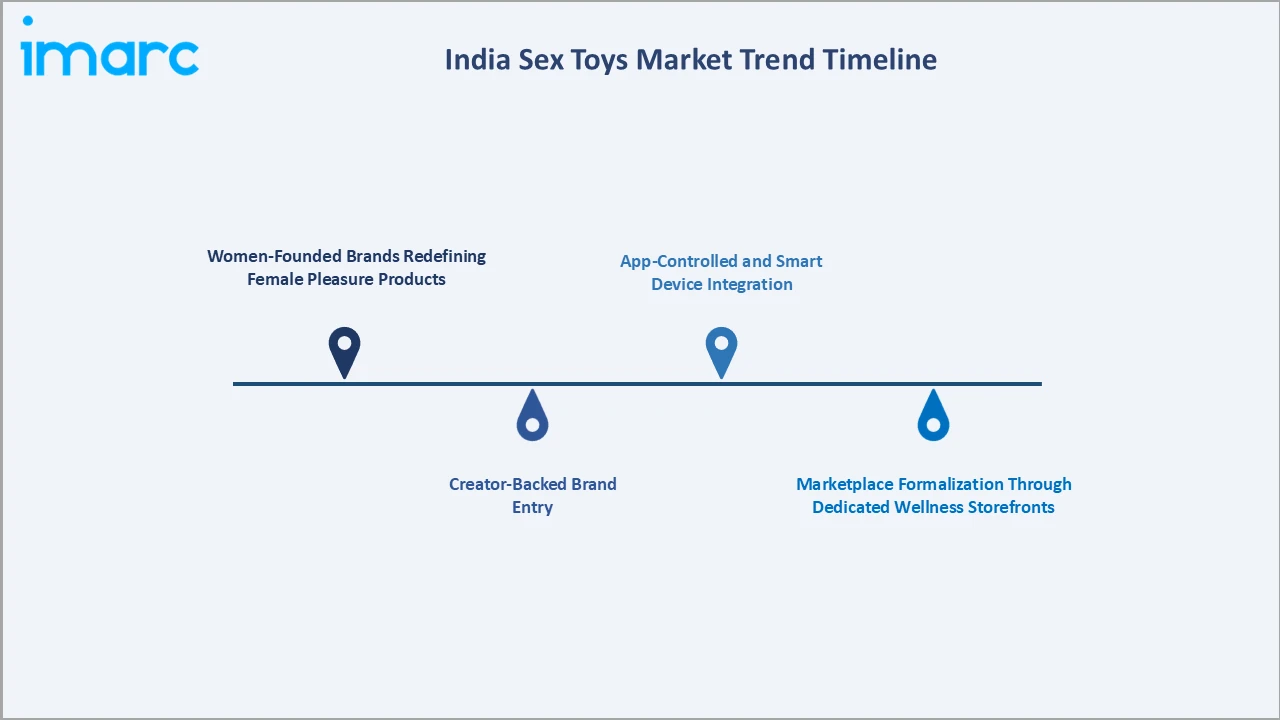
1. Women-Founded Brands Redefining Female Pleasure Products
Women-founded brands such as That Sassy Thing and Leezu's are designing products specifically around female anatomy, comfort, and body-image concerns. This founder-led authenticity is building consumer trust and differentiating homegrown brands from generic imported catalogues.
2. Creator-Backed Brand Entry
Content creators entering the category, such as Bhuvan Bam's Peppy, are lending mainstream visibility and social media reach to a historically low-visibility product category. This trend is accelerating category awareness among younger, digitally engaged consumers.
3. App-Controlled and Smart Device Integration
Bluetooth and app-controlled devices offering remote pairing for long-distance couples are gaining traction among tech-savvy urban buyers. This mirrors global sexual wellness technology trends and is prompting Indian brands to introduce connected product lines.
4. Marketplace Formalization Through Dedicated Wellness Storefronts
Mainstream platforms are beginning to carry curated intimate-wellness storefronts rather than treating the category as a marketplace afterthought. This formalization is expected to gradually shift purchase volume from exclusive brand websites toward broader non-exclusive marketplace channels over the forecast period.
Industry Value Chain Analysis
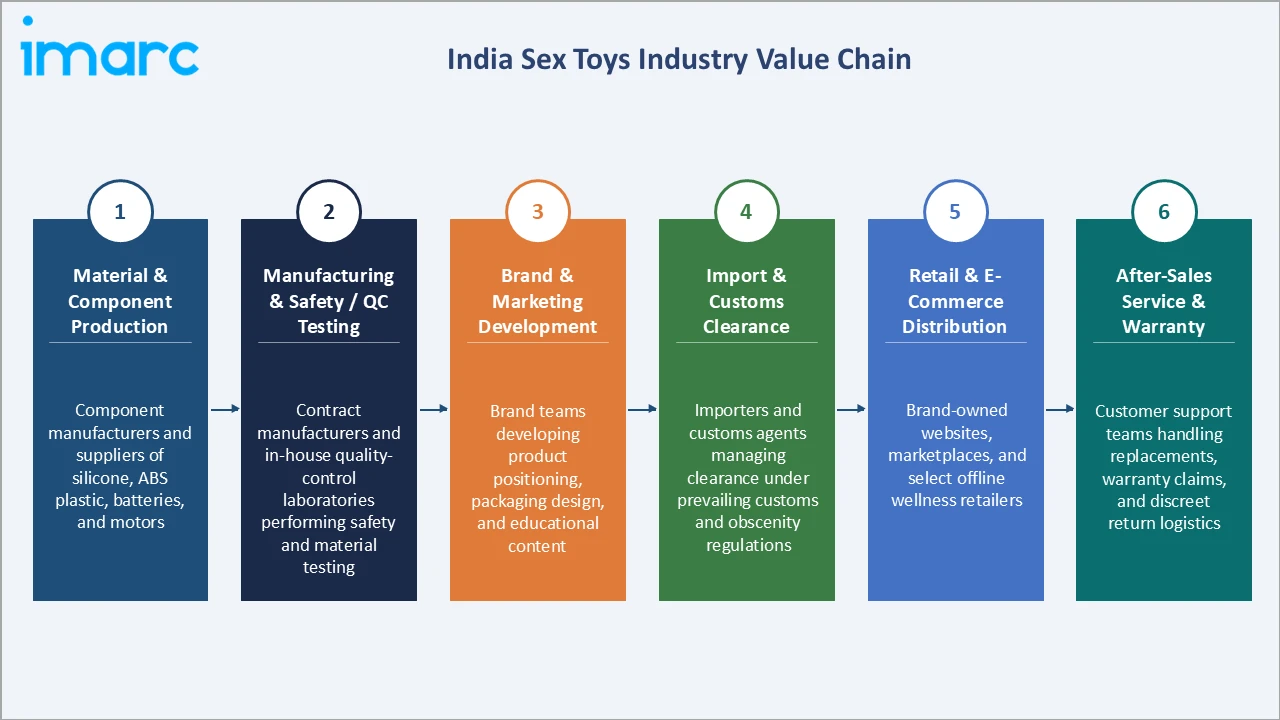
India sex toys value chain spans raw-material and component sourcing through after-sales customer support, with import and customs clearance forming its most commercially sensitive stage. Domestic assembly is increasingly preferred over direct import to reduce customs-related seizure risk, while brand and marketing development requires above-average investment given the category's restricted advertising channels.
|
Stage |
Key Participants |
|
Material & Component Production |
Component manufacturers and suppliers of silicone, ABS plastic, batteries, and motors |
|
Manufacturing & Safety / QC Testing |
Contract manufacturers and in-house quality-control laboratories performing safety and material testing |
|
Brand & Marketing Development |
Brand teams developing product positioning, packaging design, and educational content |
|
Import & Customs Clearance |
Importers and customs agents managing clearance under prevailing customs and obscenity regulations |
|
Retail & E-Commerce Distribution |
Brand-owned websites, marketplaces, and select offline wellness retailers |
|
After-Sales Service & Warranty |
Customer support teams handling replacements, warranty claims, and discreet return logistics |
The import and customs clearance stage remains India sex toys value chain's most consequential regulatory checkpoint, prompting several brands to shift toward domestically assembled products. Brand and marketing development also commands disproportionate investment, as restricted advertising channels require greater reliance on organic content, influencer partnerships, and educational storytelling to build category trust.
Technology Landscape in the India Sex Toys Industry
Body-Safe Material Innovation
Medical-grade silicone and body-safe ABS plastics are becoming standard across organized brands, replacing older, less-tested materials. Brands increasingly publish third-party lab certification for material safety, addressing consumer hesitancy and differentiating organized players from unregulated imported alternatives sold through generic marketplaces.
Smart Connectivity and App-Controlled Devices
App-controlled and Bluetooth-enabled devices are gaining traction among urban, tech-savvy consumers, offering remote-pairing features for long-distance partners. This mirrors global sexual wellness technology adoption and is prompting Indian brands to introduce connected product variants alongside traditional battery-operated devices.
Battery and Charging Technology
USB-rechargeable battery systems are steadily replacing disposable battery formats, reducing running costs and improving user convenience. Waterproof and washable designs are also becoming standard, supported by improved sealing technology that extends product lifespan and eases hygiene maintenance.
Market Segmentation Analysis
The report covers the following segments:
|
Segment Category |
Leading Segment |
Market Share |
Year |
|
Product Type |
Adult Vibrator |
42.0% |
2025 |
|
Distribution Channel |
Exclusive E-commerce Platforms |
62.0% |
2025 |
|
End User |
🔒 |
🔒 |
2025 |
|
Region |
West India |
31.0% |
2025 |

By Product Type
Adult vibrators lead product-type demand at 42.0% in 2025, reflecting affordability, ease of first-time use, and dominant positioning across brand-owned websites. The segment benefits from the widest price-point range within the category, spanning entry-level bullet vibrators to premium app-controlled devices, giving brands flexibility to serve both first-time and repeat buyers.
To access detailed market analysis, Request Sample
Massagers at 28.0% benefit from wellness-category positioning that eases mainstream retail and marketplace acceptance, while dildos at 18.0% serve a more specialized, repeat-purchase consumer base. The others category at 12.0%, comprising accessories, lubricants, and bondage-adjacent items, is growing through bundled gift-set purchases across festive and gifting occasions.
By Distribution Channel
Exclusive e-commerce platforms lead distribution at 62.0% in 2025, as homegrown brands prioritize owned websites to control discreet packaging, customer data, and brand storytelling. This channel structure is commercially distinct from most Indian consumer categories, where third-party marketplaces typically dominate distribution share.
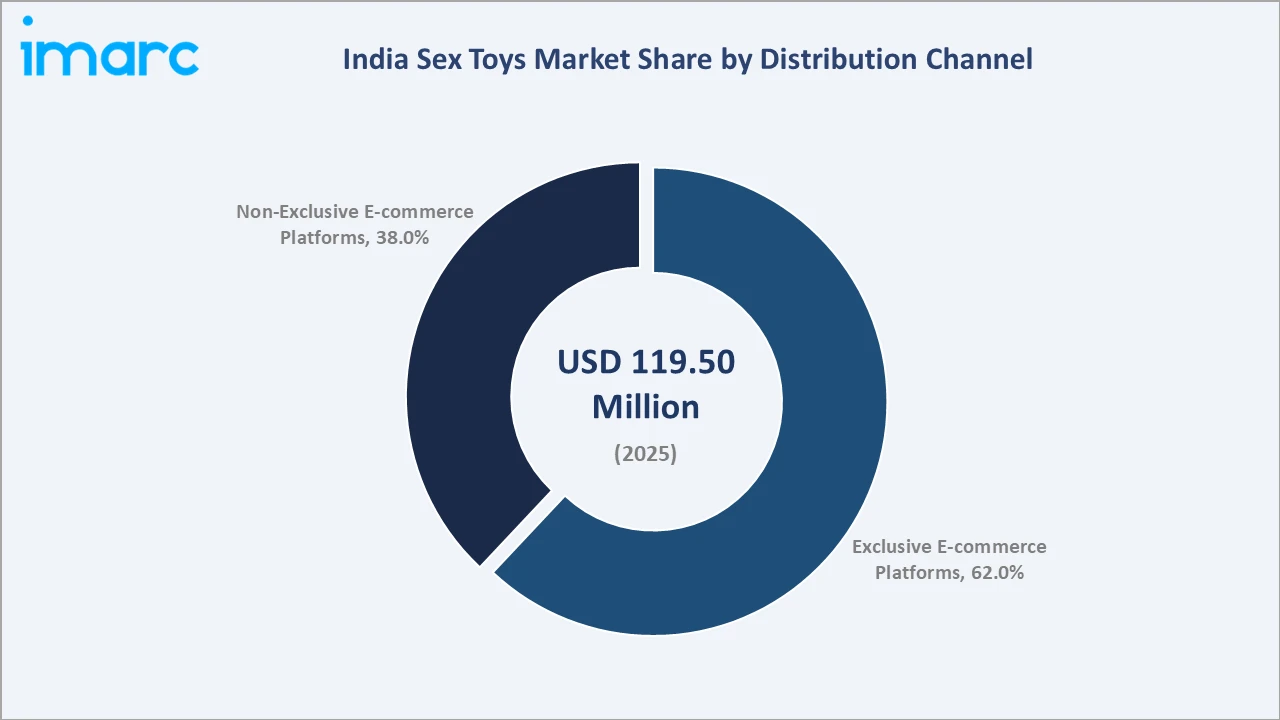
Non-Exclusive e-commerce platforms at 38.0%, including Amazon, Flipkart, and Nykaa, are gradually expanding their intimate-wellness assortments through curated storefronts. This channel is expected to grow as mainstream platforms seek to capture consumers who prefer marketplace loyalty benefits over navigating dedicated adult-wellness websites.
Regional Market Insights
|
Region |
Share (2025) |
Key India Sex Toys Market Drivers & Characteristics |
|
West India |
31.0% |
Led by Mumbai and Pune's digitally native, higher-income consumer base and early homegrown brand adoption. |
|
South India |
29.0% |
Reflects Bengaluru, Hyderabad, and Chennai's tech-savvy population and strong e-commerce penetration. |
|
North India |
24.0% |
Driven by Delhi-NCR's urban affluence, though offline stigma remains comparatively higher. |
|
East India |
16.0% |
Least developed regionally but growing above the overall market CAGR as awareness expands in Kolkata and surrounding urban centers. |
West India's 31.0% market leadership reflects Mumbai's concentration of digitally native, higher-income consumers and Pune's early adoption of homegrown wellness brands through college-age and young-professional demographics. South India's 29.0% share is anchored by Bengaluru's technology-sector workforce, whose comfort with digital-first, discreet purchasing translates directly into category demand across vibrators and app-controlled devices.
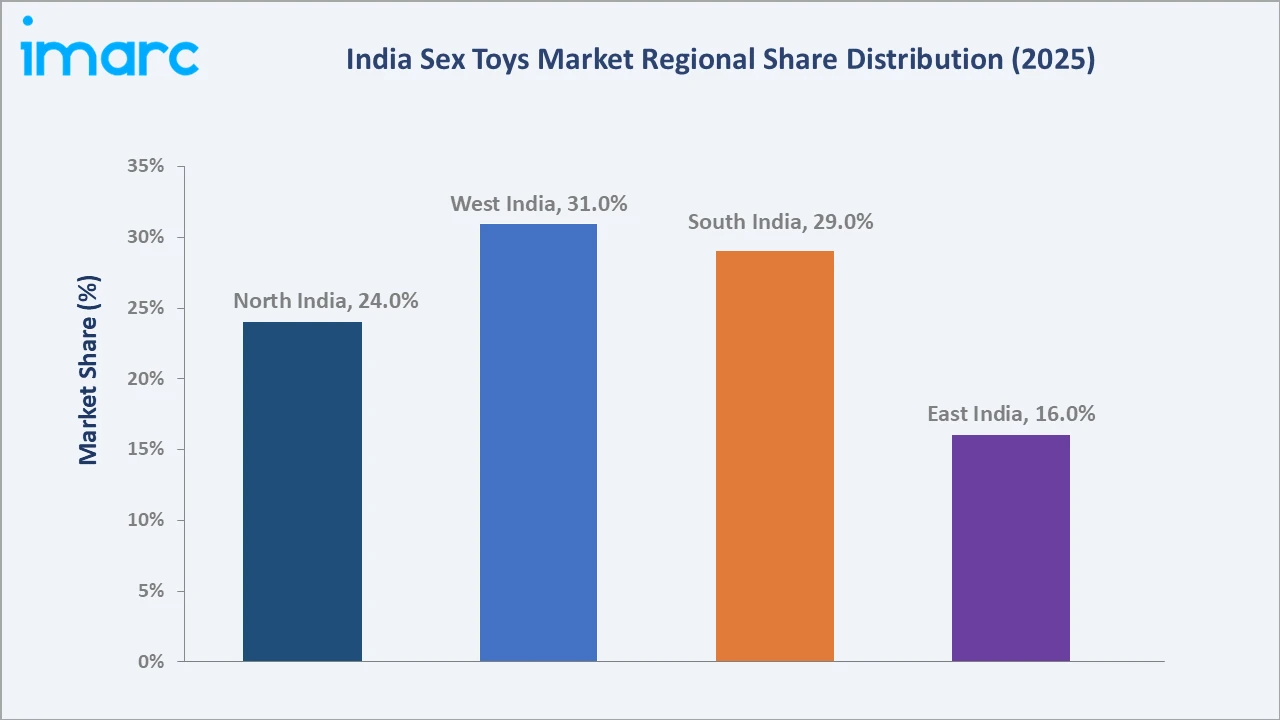
North India's 24.0% share trails West and South India despite Delhi-NCR's affluence, reflecting comparatively higher social conservatism that continues to constrain offline visibility. East India, at 16.0%, remains the least-developed region commercially, but is growing above the overall market CAGR as Kolkata's urban professional class and rising smartphone penetration create first-generation demand from a historically low awareness base.
Competitive Landscape
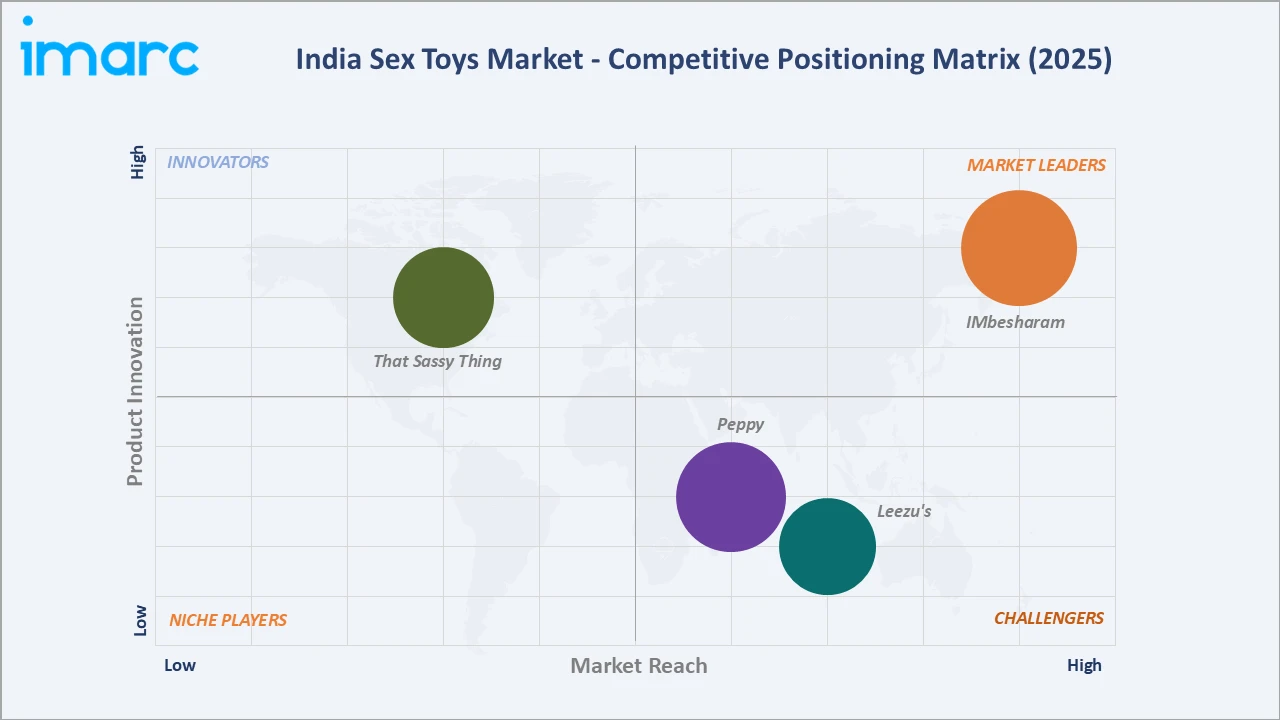
India sex toys market competitive landscape blends homegrown, founder-led direct-to-consumer brands with multi-brand marketplace retailers carrying international product lines. Competition is intensifying as women-founded brands, creator-backed ventures, and established marketplace players simultaneously target overlapping urban consumer segments through differentiated positioning around education, discretion, and product safety.
|
Company |
Product Portfolio/Key Brands |
Market Position |
Core Strength |
|
IMbesharam |
Lovense, Kiiroo |
Market Leader |
Operating since 2013, IMbesharam has built India's largest organized adult-wellness marketplace, citing over 1 million orders delivered and discreet branded shipping. |
|
Leezu's |
Toofaan, Pyaari, Zubaan, Love Bug |
Strong Challenger |
Co-founded by sexual wellness educator Leeza Mangaldas, Leezu's combines product sales with structured educational content, serving over 300,000 customers nationally. |
|
That Sassy Thing |
Candy Massager, Salty Wand Massager |
Innovator |
India's first women-founded intimate wellness brand, offering medical-grade silicone massagers with 3-tier safety testing and a 120-day warranty. |
|
Peppy |
PuC, BLO, All In, and Moan Chocolate |
Strong Challenger |
Co-founded by content creator Bhuvan Bam, Peppy pairs mainstream visibility with an inclusivity-focused product and education strategy. |
The competitive landscape's most commercially significant dynamic is the shift from unorganized, generic-import retail toward organized, brand-led wellness positioning. Organized brands increasingly compete on trust signals such as third-party lab testing, discreet fulfilment guarantees, and founder-led authenticity rather than price alone, a structural shift that favors well-capitalized D2C players over unbranded marketplace listings.
Key Company Profiles
IMbesharam
IMbesharam is India's largest organized adult-wellness retailer, operating a direct-to-consumer e-commerce platform since 2013 and carrying over 200 international brands.
- Key Brands: Lovense, Kiiroo, and others.
- Strategic Focus: Expanding brand portfolio depth while maintaining discreet branded shipping and handling customs clearance directly for imported inventory.
Leezu's
Leezu's is a sexual wellness brand founded by educator Leeza Mangaldas, combining product sales with structured, science-backed educational content for Indian consumers.
- Key Brands: Toofaan, Pyaari, Zubaan, Love Bug, and others.
- Strategic Focus: Deepening trust through expert-backed content while scaling free discreet shipping, cash-on-delivery, and EMI payment options nationally.
That Sassy Thing
That Sassy Thing is India's first women-founded intimate wellness brand, created by co-founder Sachee to address gaps in body-safe, female-first pleasure products.
- Key Brands: Candy Massager, Salty Electric Body Massager, and others.
- Strategic Focus: Differentiating through medical-grade silicone, 3-tier safety testing, and a 120-day product warranty targeted at first-time women buyers.
Market Concentration Analysis
India sex toys market is moderately fragmented, with IMbesharam commanding an estimated leading share of the organized, brand-agnostic marketplace segment through its multi-brand catalogue and decade-plus operating history. Homegrown direct-to-consumer brands such as Leezu's, That Sassy Thing, and Peppy collectively hold a growing but still-minority share, concentrated within their respective founder-led niches of education, female-first design, and mainstream celebrity appeal.
The unorganized segment, comprising generic imported products sold through non-specialist marketplaces, continues to represent a meaningful share of total category volume, creating structural de-concentration pressure on organized players' effective market share. Consolidation is likely to accelerate as organized brands scale customer-trust advantages such as lab-tested materials and discreet fulfilment, gradually formalizing volume away from unorganized and generic-import sellers.
Investment & Growth Opportunities
Highest Growth Segments
Exclusive e-commerce distribution (estimated 18.1% CAGR), adult vibrators (estimated 17.8% CAGR), and app-controlled smart devices represent India sex toys market's highest-growth investment vectors through 2034, supported by rising D2C brand formation and improving digital payment and delivery infrastructure.
Emerging Investment Opportunities
India's women-founded sexual wellness brand segment, exemplified by ventures such as That Sassy Thing and Leezu's, represents a high-growth investment opportunity as female-first product design and education-led marketing continue to outpace category-average growth, attracting early-stage venture interest following funding rounds raised by comparable startups since 2024.
Investment Themes
- Tier-2 and Tier-3 city discreet delivery infrastructure investment, capturing underserved demand in cities where offline stigma has historically limited category access.
- Marketplace-exclusive product line partnerships with mainstream e-commerce platforms, offering a scalable distribution route beyond dedicated adult-wellness websites.
Future Market Outlook (2026-2034)
India sex toys market is projected to grow from USD 119.5 Million in 2025 to USD 492.1 Million by 2034, delivering a 16.52% CAGR over the forecast period. The market's anchor value of USD 256.7 Million in 2030 represents a structural inflection point, as homegrown D2C brands transition from early-adopter awareness building toward mainstream category normalization.
Three structural forces define India sex toys market growth through 2034: continued stigma reduction driven by social media education and creator-backed brand entry; e-commerce infrastructure maturation extending discreet delivery into Tier-2 and Tier-3 cities; and rising consumer trust in organized, lab-tested product safety standards over unorganized generic imports.
Research Methodology
Primary Research
Primary research comprised structured discussions with India sex toys industry stakeholders, including D2C brand founders, e-commerce category managers, customs and trade-compliance observers, and consumer feedback gathered across urban and semi-urban buyers spanning West, South, North, and East India.
Secondary Research
Secondary research encompassed company websites and press disclosures, India e-commerce industry data published by IBEF, telecom subscriber data reported by TRAI, applicable customs and consumer-protection legal analysis, and industry commentary on India's sexual wellness sector. Over 30 secondary sources were reviewed.
Forecasting Models
Market revenue forecasts were developed using a channel-and-segment build-up model: India's online wellness-purchasing population by region, multiplied by category penetration rate and average order value per segment, aggregated to total market revenue. Historical growth rates were validated against India's broader e-commerce sector CAGR.
India Sex Toys Market Report Coverage:
| Report Features | Details |
|---|---|
| Base Year of the Analysis | 2025 |
| Historical Period | 2020-2025 |
| Forecast Period | 2026-2034 |
| Units | Million USD |
| Scope of the Report | Exploration of Historical Trends and Market Outlook, Industry Catalysts and Challenges, Segment-Wise Historical and Future Market Assessment:
|
| Product Types Covered | Adult Vibrator, Massager, Dildo, Others |
| Distribution Channels Covered | Exclusive E-Commerce Platforms, Non-Exclusive E-Commerce Platforms |
| End Users Covered | Male, Female |
| Regions Covered | North India, South India, East India, West India |
| Companies Covered | IMbesharam, Leezu's, That Sassy Thing, Peppy, etc. |
| Customization Scope | 10% Free Customization |
| Post-Sale Analyst Support | 10-12 Weeks |
| Delivery Format | PDF and Excel through Email (We can also provide the editable version of the report in PPT/Word format on special request) |
Key Benefits for Stakeholders:
- IMARC’s industry report offers a comprehensive quantitative analysis of various market segments, historical and current market trends, market forecasts, and dynamics of the India sex toys market from 2020-2034.
- The research report provides the latest information on the market drivers, challenges, and opportunities in the India sex toys market.
- Porter's five forces analysis assist stakeholders in assessing the impact of new entrants, competitive rivalry, supplier power, buyer power, and the threat of substitution. It helps stakeholders to analyze the level of competition within the India sex toys industry and its attractiveness.
- Competitive landscape allows stakeholders to understand their competitive environment and provides an insight into the current positions of key players in the market.
Frequently Asked Questions About the India Sex Toys Market Report
India sex toys market reached USD 119.5 Million in 2025, driven by rising sexual wellness awareness, expanding discreet e-commerce delivery, and declining stigma among urban and semi-urban adult consumers.
India sex toys market grows at a 16.52% CAGR during 2026-2034, reaching USD 492.1 Million by 2034, supported by e-commerce infrastructure growth and expanding homegrown brand adoption.
Adult vibrators lead at 42.0% through affordable pricing, ease of first-time use, and dominant positioning across brand-owned e-commerce websites targeting first-time and repeat wellness buyers.
Exclusive e-commerce platforms lead at 62.0%, as homegrown brands prioritize owned websites to control discreet packaging, customer data, and direct brand storytelling over third-party marketplaces.
West India leads at 31.0%, driven by Mumbai and Pune's digitally native, higher-income consumer base and early adoption of homegrown sexual wellness brands.
Leading companies include IMbesharam, Leezu's, That Sassy Thing, and Peppy, among other homegrown and multi-brand marketplace retailers.
India sex toys market is projected to reach approximately USD 256.7 Million by 2030, as e-commerce infrastructure matures and stigma reduction expands the addressable consumer base nationally.
Priority opportunities include Tier-2 and Tier-3 city discreet delivery expansion, women-founded brand investment, and marketplace-exclusive product line partnerships with mainstream e-commerce platforms.
No Indian statute explicitly bans the sale or purchase of sex toys; however, customs authorities retain discretion to flag imported shipments under obscenity-related provisions, creating enforcement ambiguity.
Key growth drivers include e-commerce and D2C brand expansion, reduced social stigma, sexual wellness education, and rising adoption of app-controlled, body-safe intimate wellness devices.
Need more help?
- Speak to our experienced analysts for insights on the current market scenarios.
- Include additional segments and countries to customize the report as per your requirement.
- Gain an unparalleled competitive advantage in your domain by understanding how to utilize the report and positively impacting your operations and revenue.
- For further assistance, please connect with our analysts.
 Request Customization
 Speak to an Analyst
 Request Brochure
 Inquire Before Buying
Benefits of Customization
- Personalize this research
- Triangulate with your data
- Get data as per your format and definition
- Gain a deeper dive into a specific application, geography, customer, or competitor
- Any level of personalization
Get in Touch With Us
UNITED STATES
Phone: +1-201-971-6302
INDIA
Phone: +91-120-433-0800
UNITED KINGDOM
Phone: +44-753-714-6104
Email: [email protected]
Client Testimonials




.webp)




.webp)













Related Reports

Choose your plan
*Please note that the prices mentioned below are starting prices for each bundle type. Kindly contact our team for further details.*
Single User License
- 1 User License, Access on 2 Devices
- PDF Report + Excel Dataset (Password Protected)
- Lifetime Access
- No Printing Rights
- 10% Free Report Customization
- 10–12 Weeks of Analyst Support
Five User License
- Access for 5 Users, 2 Devices per User
- PDF Report + Excel Dataset (Password Protected)
- Lifetime Access
- Dedicated Account Manager
- 12–14 Weeks of Analyst Support
- No Printing Rights
- 15% Free Report Customization
- 25% Discount on Your Next Purchase
Corporate User License
- Unlimited User Access (Within Your Organization)
- PDF Report + Excel Dataset
- Lifetime Access
- Dedicated Account Manager
- 14–20 Weeks of Analyst Support
- No Printing Rights
- 20% Free Report Customization
- 30% Discount on Your Next Purchase
Essential Insights
What's included:
3 reports
- Lifetime Access
- PDF Reports
- Excel Datasets
- 2 Weeks of Free Analyst Support
- 2 User Licenses
- Access on 2 Devices
- Printing Rights
- Complimentary PowerPoint (PPT) Version
- Complimentary License Upgrade
Professional Access
What's included:
5 reports
- Lifetime Access
- PDF Reports
- Excel Datasets
- 8 Weeks of Free Analyst Support
- 2 User Licenses
- Access on 2 Devices
- Printing Rights
- Complimentary PowerPoint (PPT) Version
- Complimentary License Upgrade
Business Advantage
What's included:
8 reports
- Lifetime Access
- PDF Reports
- Excel Datasets
- 14 Weeks of Free Analyst Support
- 2 User Licenses
- Access on 2 Devices
- Printing Rights
- Complimentary PowerPoint (PPT) Version
- Complimentary License Upgrade
Enterprise Intelligence
What's included:
10 reports
- Lifetime Access
- PDF Reports
- Excel Datasets
- 20 Weeks of Free Analyst Support
- 2 User Licenses
- Access on 2 Devices
- Printing Rights
- Complimentary PowerPoint (PPT) Version
- Complimentary License Upgrade