
India Soap Market Size, Share, Trends and Forecast by Type, Form, Product, Distribution Channel, and Region, 2026-2034
India Soap Market Summary:
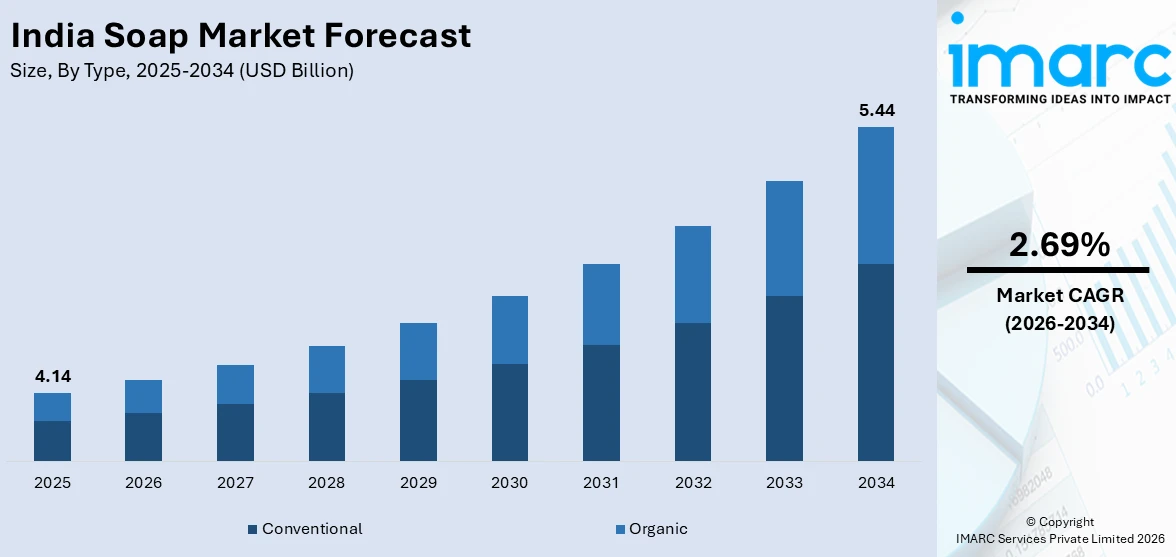
The India soap market size was valued at USD 4.14 Billion in 2025 and is projected to reach USD 5.44 Billion by 2034, growing at a compound annual growth rate of 2.69% from 2026-2034.
Growing urbanization, customer preference for natural and herbal formulations, and increased awareness of cleanliness are all contributing factors to the steady growth of the soap market in India. Demand is being further strengthened by changing lifestyles, premiumization tendencies, and the growth of contemporary retail and e-commerce outlets. While product innovation in skincare-oriented and sustainable soap varieties is altering India's soap market share, government-led sanitation measures continue to promote hygiene-conscious consumer behavior.
Key Takeaways and Insights:
- By Type: Conventional dominates the market with a share of 88.0% in 2025, because it is widely available in both urban and rural retail establishments, has reasonable prices, and offers a wide range of fragrance and formulation options that appeal to a wide range of customers from all economic levels.
- By Form: Solid leads the market with a share of 72.0% in 2025, driven by consumer preference for conventional bar soaps, which are widely available in both organized and unorganized retail channels and offer a longer shelf life, convenience of use, affordability, and accessibility across mass-market and luxury product categories.
- By Product: Bath soap dominates the market with a share of 64.0% in 2025, demonstrating a wide range of consumer demographics' strong daily consumption patterns, rising demand for skincare-focused bath products, and ongoing product innovation in herbal, moisturizing, and dermatologist-tested formulas.
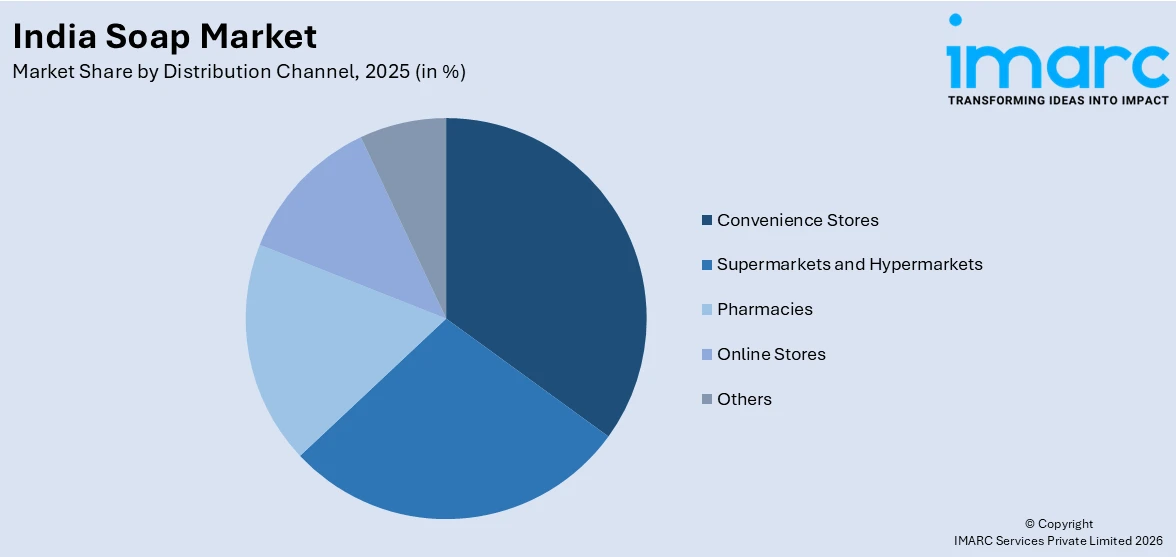
- By Distribution Channel: Convenience stores lead the market with a share of 34.0% in 2025, because of their extensive presence throughout neighborhoods, ease of access for everyday purchases, and robust penetration in rural and semi-urban areas where customers depend on local retail for necessities related to personal care.
- By Region: North India is the largest region with 31.0% share in 2025, driven by rising rates of urbanization, expanding middle-class populations, rising disposable incomes, and consumer awareness of personal hygiene and high-end soap products in tier-two and major cities.
- Key Players: By diversifying their product lines, investing in Ayurvedic and herbal formulas, bolstering distribution networks, and utilizing digital marketing techniques, major companies propel the soap market in India. Their emphasis on skincare innovation, affordability, and sustainability increases acceptance and guarantees steady product availability across a range of customer categories. Some of the key players operating in the market include Colgate Palmolive (India) Ltd., Godrej Consumer Products Limited, Himalaya Wellness Company, Hindustan Unilever Limited, ITC Limited, Jyothy Laboratories Ltd., Karnataka Soaps and Detergents Limited, Patanjali Ayurved Limited, Reckitt Benckiser (India) Ltd., and Wipro Consumer Care & Lighting.
To get more information on this market Request Sample
Increased awareness of hygiene, rising disposable incomes, and a cultural movement toward natural and Ayurvedic personal care products are driving a transformative phase in the Indian soap business. Manufacturers are being encouraged to engage in product differentiation and ingredient transparency as consumers in both urban and rural areas desire soaps with functional skincare advantages, such as moisturizing, anti-aging, and antibacterial qualities. Brands may now target underserved audiences in tier-two and tier-three cities because of the growth of organized retail and e-commerce platforms. Government initiatives such as the Swachh Bharat Mission, supported by an allocation of INR 12,192 Crore in the Union Budget 2025, continue to reinforce hygiene-conscious consumer behavior and sustain soap demand across the country. Additionally, as top FMCG companies introduce herbal, organic, and dermatologist-tested soap varieties to appeal to health-conscious consumers looking for safer and more sustainable personal care options, the premiumization trend is changing the competitive landscape.
India Soap Market Trends:
Rising Demand for Herbal and Ayurvedic Soap Formulations
As customers in India become more aware of the long-term impacts of synthetic chemicals on skin health, there is a noticeable shift toward herbal and Ayurvedic soaps. In both urban and rural markets, soaps containing natural ingredients like neem, turmeric, sandalwood, and aloe vera are becoming increasingly popular. For instance, in January 2025, moha launched its Kesar Chandan Soap, blending saffron and sandalwood for an Ayurvedic skincare experience with a Grade-1 rating and 76% total fatty matter content. Manufacturers are being encouraged to invest in plant-based, chemical-free formulations by this growing preference.
Expansion of E-Commerce and Direct-to-Consumer Channels
Because consumers can now access a greater variety of brands, formulations, and price points from the comfort of their homes, the fast adoption of e-commerce platforms is revolutionizing the growth of the soap market in India. Competitive pricing and access to exclusive product lines are provided by online portals, brand websites, and social media-driven direct-to-consumer platforms. India has added approximately 125 Million online shoppers in recent years, with further expansion anticipated. By enabling niche and artisanal soap brands to compete alongside well-established FMCG players, this digital revolution is increasing consumer choice.
Growing Focus on Sustainable and Eco-Friendly Packaging
As consumers and producers place a greater emphasis on ecologically friendly techniques, sustainability is emerging as a key trend in the Indian soap industry. The soap business is adopting biodegradable, recyclable, and plastic-free packaging options due to growing worries about plastic waste. To reduce their influence on the environment, leading brands are switching to refillable soap forms, compostable cartons, and eco-friendly wrappers. Handmade and cold-processed production techniques that use fewer artificial additives and need less energy are also becoming more popular. The industry is adopting green production and sourcing processes more widely as a result of the trend toward eco-friendly packaging.
Market Outlook 2026-2034:
The India soap market is poised for sustained expansion, supported by deepening hygiene awareness, increasing penetration of personal care products in rural markets, and continued innovation in herbal and premium soap segments. The market generated a revenue of USD 4.14 Billion in 2025 and is projected to reach a revenue of USD 5.44 Billion by 2034, growing at a compound annual growth rate of 2.69% from 2026-2034. Expanding modern retail infrastructure, growing e-commerce adoption, and rising consumer preference for natural and functional soap formulations are expected to drive higher revenue streams. Government sanitation initiatives and evolving lifestyle patterns across urban and semi-urban regions will further reinforce demand, fostering a more competitive and mature soap market landscape across the country.
India Soap Market Report Segmentation:
| Segment Category | Leading Segment | Market Share |
|---|---|---|
|
Type |
Conventional |
88.0% |
|
Form |
Solid |
72.0% |
|
Product |
Bath Soap |
64.0% |
|
Distribution Channel |
Convenience Stores |
34.0% |
|
Region |
North India |
31.0% |
Type Insights:
- Organic
- Conventional
Conventional dominates with a market share of 88.0% of the total India soap market in 2025.
Conventional soaps continue to command the overwhelming majority of the India soap market, driven by their widespread availability across organized and unorganized retail channels and their affordability for mass-market consumers. These soaps are offered in an extensive range of fragrances, formulations, and pack sizes, catering to diverse consumer preferences across all income groups. The segment benefits from strong brand loyalty built over decades by established FMCG companies, along with aggressive distribution strategies that ensure product presence even in the most remote rural areas of the country.
The conventional soap segment is further strengthened by continuous product innovation, with manufacturers introducing variants featuring enhanced skincare benefits, improved lathering, and superior fragrance retention. Leading companies are investing in advanced formulation technologies that incorporate plant-derived ingredients and vitamin blends to deliver better skin barrier protection and sensorial experiences. These innovations enable conventional soap brands to maintain relevance while addressing evolving consumer expectations around product quality, ingredient transparency, and environmental sustainability across both urban and rural consumer segments.
Form Insights:
- Liquid
- Solid
- Others
Solid leads the market with a share of 72.0% of the total India soap market in 2025.
Solid soaps maintain a commanding presence in the India soap market, reflecting deep-rooted consumer habits and the enduring preference for traditional bar soap formats across both urban and rural households. Their affordability, longer shelf life, ease of storage, and wide availability in diverse formulations ranging from basic hygiene bars to premium skincare variants make them the preferred choice for the majority of Indian consumers. The segment benefits from strong penetration across all retail formats, including convenience stores, supermarkets, pharmacies, and online platforms.
The solid soap segment is further reinforced by growing innovation in bar soap formulations that incorporate functional skincare ingredients targeting specific consumer concerns such as dryness, sensitivity, and aging. Manufacturers are increasingly launching herbal, moisturizing, and dermatologically tested solid soap variants to meet evolving consumer demands for products that offer both cleansing and skin-nourishing benefits. The traditional dominance of solid-format soaps is sustained by their cultural acceptance, versatile application across personal and household use, and compatibility with diverse packaging and pricing strategies.
Product Insights:
- Bath Soap
- Kitchen Soap
- Medicated Soap
- Laundry Soap
- Others
Bath soap is the largest segment, accounting for 64.0% of the total India soap market in 2025.
Bath soaps represent the cornerstone of the India soap market, driven by strong daily-use consumption patterns and growing consumer demand for products that offer both cleansing and skincare benefits. Rising disposable incomes and evolving lifestyles are promoting consumers to shift from basic hygiene soaps to premium, herbal, and dermatologically tested bath soap variants. The segment benefits from continuous product innovation, with manufacturers launching formulations enriched with natural extracts, essential oils, and moisturizing agents to cater to diverse skin types and consumer preferences across all demographics.
The bath soap segment is further strengthened by aggressive marketing strategies and brand-building efforts by leading FMCG companies that are expanding their portfolios with specialized and premium variants. Digital marketing, celebrity endorsements, and influencer-led campaigns are playing an increasingly important role in shaping brand perceptions and driving adoption across urban and semi-urban markets. Companies are also focusing on ingredient transparency, sustainable sourcing practices, and eco-friendly packaging to appeal to health-conscious and environmentally aware consumers seeking safer and more responsible personal care alternatives.
Distribution Channel Insights:
Access the comprehensive market breakdown Request Sample
- Supermarkets and Hypermarkets
- Convenience Stores
- Pharmacies
- Online Stores
- Others
Convenience stores hold the largest share at 34.0% of the total India soap market in 2025.
Convenience stores remain the dominant distribution channel for soaps in India, reflecting the country's deeply entrenched neighborhood shopping culture and the unmatched accessibility of local kirana stores across urban, semi-urban, and rural markets. These stores serve as the primary point of purchase for daily essentials, including personal care products, due to their proximity to residential areas and the personalized shopping experience they offer. The extensive network of convenience stores ensures broad product availability, making them indispensable for mass-market soap distribution across India.
In rural and semi-urban India, where organized retail penetration is still low and consumers mostly rely on local merchants for personal care needs, convenience stores are particularly strong. A substantial portion of FMCG product distribution countrywide is accounted for by the country's extensive network of local retail establishments. In order to ensure deep market penetration and consistent product availability across lower-income and geographically dispersed consumer segments, manufacturers actively utilize this channel through targeted distribution strategies, trade promotions, and sachet-based pricing models that make soap products accessible to price-sensitive consumers.
Regional Insights:
- North India
- West and Central India
- South India
- East India
North India represents the leading region with a 31.0% share of the total India soap market in 2025.
Due to a combination of increased urbanization, rising disposable incomes, and expanding consumer knowledge of skincare and personal hygiene, North India leads the Indian soap industry. A sizable and growing middle-class population with growing exposure to a variety of product offers across organized retail and e-commerce channels supports the substantial contribution of key metropolitan areas and developing tier-two cities to soap consumption. The region's position as the nation's top market for soap consumption is further reinforced by its dense population concentration and well-established supply chain networks.
Due to the region's varied demographics, which include both urban and rural inhabitants, there is a significant demand for both premium and specialty soaps as well as reasonably priced mass-market soaps. The market is expanding due to retail expansion through contemporary trade channels as well as younger demographics' increasing online shopping habits. Additionally, the region benefits from a strong distribution system that guarantees widespread product availability throughout semi-urban towns, emerging urban corridors, and metropolitan centers, allowing manufacturers to access a variety of customer segments with unique product offerings.

Market Dynamics:
Growth Drivers:
Why is the India Soap Market Growing?
Heightened Hygiene Awareness and Government Sanitation Initiatives
India's growing awareness of personal cleanliness and public health is having a significant impact on soap use. The government's constant commitment to sanitation through numerous efforts has fundamentally transformed the hygiene practices of millions of homes. Ongoing fiscal support supports the construction of public health facilities, while national cleanliness missions have improved sanitation standards and drastically reduced open defecation. The long-term behavioral shift toward improved personal hygiene habits brought about by these activities has directly benefited both urban and rural residents. Because of public awareness campaigns, school-level hygiene education programs, and community-driven cleaning initiatives, handwashing and bathing practices are already deeply embedded in daily routines. As sanitation awareness increases in tier-two and tier-three cities as well as rural communities, the demand for widely accessible and fairly priced soap products is expected to remain high, providing a strong foundation for market expansion.
Rising Urbanization and Expanding Middle-Class Population
A larger consumer base with greater purchasing power and changing personal care tastes is being produced by India's fast urbanization and growing middle class. Beyond basic hygiene-oriented goods, urban customers are increasingly looking for soap products with extra skincare benefits, such as moisturizing, anti-aging, and antibacterial qualities. According to government estimates, India's urban population is projected to reach 630 Million by 2030, representing a massive consumer base for personal care products including soaps. As customers show a willingness to pay more for higher-quality goods with natural ingredients, superior formulations, and enhanced sensory experiences, the expanding middle-class group is driving premiumization trends within the soap market. Manufacturers are being encouraged by this change to add premium, herbal, and specialty soap varieties to their product lines. The need for distinctive soap products is being further reinforced by modern living patterns, increased media exposure, and increased health consciousness among urban and semi-urban populations.
Growing Consumer Preference for Natural and Organic Products
One of the main factors propelling the growth of the Indian soap market is the growing consumer inclination for natural, herbal, and organic soap products. Demand for plant-based and Ayurvedic soap formulations is significantly shifting as consumers become more conscious of the possible negative effects of synthetic chemicals like sulfates and parabens. The Indian government allocated INR 3,992.90 Crore to the Ministry of AYUSH in the 2025 Budget, representing a 14% increase from the previous year, which strengthens research and quality standards for Ayurvedic personal care products. Both well-known FMCG firms and up-and-coming niche brands are being encouraged to grow their organic and herbal product lines by this cultural and health-driven trend. Many different demographics are beginning to embrace soaps made with traditional Indian ingredients including neem, turmeric, sandalwood, and aloe vera. A new category of high-end natural soaps that appeal to health-conscious consumers looking for efficient, chemical-free substitutes for their regular skincare regimens is being created by fusing Ayurvedic knowledge with contemporary formulation technology.
Market Restraints:
What Challenges the India Soap Market is Facing?
Volatile Raw Material Prices Affecting Production Costs
The Indian soap market is severely challenged by the extremely unstable costs of essential raw materials needed in the production of soap, especially palm oil, coconut oil, and caustic soda. The production costs and profitability of soap manufacturers throughout India are directly impacted by changes in global commodity markets caused by climatic conditions, geopolitical tensions, and supply chain disruptions. India is largely dependent on imports for palm oil, a crucial component in the production of soap.
Intense Competition and Pricing Pressure from Local Brands
The fierce rivalry among many domestic, regional, and foreign brands in the Indian soap market results in ongoing pricing pressure that reduces manufacturers' profit margins. It is difficult for well-known brands to hold onto market share without ongoing investment in marketing, product diversification, and distribution network growth due to the abundance of small-scale, unorganized soap producers that provide affordable alternatives.
Growing Threat from Substitute Personal Care Products
Traditional soap usage in India is facing a significant competition from the growing use of alternative personal care products such liquid body washes, shower gels, and hand sanitizers. Consumer preferences are gradually shifting away from bar soaps, especially among younger urban demographics who view liquid formats as more convenient and hygienic. This could limit conventional soap manufacturers' ability to expand in metropolitan and premium market segments.
Competitive Landscape:
The soap market in India is fiercely competitive, with a wide range of well-known international companies, local FMCG behemoths, and up-and-coming local brands fighting for consumers' attention. Businesses are concentrating on adopting innovative ingredients, formulations, packaging, and marketing techniques to differentiate their product offers. Investments in Ayurvedic and herbal product lines, environmentally friendly production methods, and growing distribution networks through contemporary trade and e-commerce platforms are what fuel competition. The main strategies influencing market dynamics are aggressive advertising campaigns with celebrity endorsements, brand extensions into related personal care categories, and strategic collaborations. While premiumization potential draw investment in specialized and value-added soap varieties, price competition is still fierce across mass-market segments.
Some of the key players include:
- Colgate Palmolive (India) Ltd.
- Godrej Consumer Products Limited
- Himalaya Wellness Company
- Hindustan Unilever Limited
- ITC Limited
- Jyothy Laboratories Ltd.
- Karnataka Soaps and Detergents Limited
- Patanjali Ayurved Limited
- Reckitt Benckiser (India) Ltd.
- Wipro Consumer Care & Lighting
Recent Developments:
- In December 2025, Wipro Consumer Care and Lighting announced that its flagship brand Santoor surpassed Hindustan Unilever's Lifebuoy to become India's largest soap brand, achieving estimated revenues of approximately INR 2,850 Crore in 2025. The brand's success is attributed to its consistent positioning around younger-looking skin and deep penetration in rural markets across southern and western India.
India Soap Market Report Coverage:
| Report Features | Details |
|---|---|
| Base Year of the Analysis | 2025 |
| Historical Period | 2020-2025 |
| Forecast Period | 2026-2034 |
| Units | Billion USD |
| Scope of the Report |
Exploration of Historical Trends and Market Outlook, Industry Catalysts and Challenges, Segment-Wise Historical and Future Market Assessment:
|
| Types Covered | Organic, Conventional |
| Forms Covered | Liquid, Solid, Others |
| Products Covered | Bath Soap, Kitchen Soap, Medicated Soap, Laundry Soap, Others |
| Distribution Channels Covered | Supermarkets and Hypermarkets, Convenience Stores, Pharmacies, Online Stores, Others |
| Region Covered | North India, West and Central India, South India, East India |
| Companies Covered | Colgate Palmolive (India) Ltd., Godrej Consumer Products Limited, Himalaya Wellness Company, Hindustan Unilever Limited, ITC Limited, Jyothy Laboratories Ltd., Karnataka Soaps and Detergents Limited, Patanjali Ayurved Limited, Reckitt Benckiser (India) Ltd., and Wipro Consumer Care & Lighting |
| Customization Scope | 10% Free Customization |
| Post-Sale Analyst Support | 10-12 Weeks |
| Delivery Format | PDF and Excel through Email (We can also provide the editable version of the report in PPT/Word format on special request) |
Frequently Asked Questions About the India Soap Market Report
The India soap market size was valued at USD 4.14 Billion in 2025.
The India soap market is expected to grow at a compound annual growth rate of 2.69% from 2026-2034 to reach USD 5.44 Billion by 2034.
Conventional dominated the market with a share of 88.0%, driven by widespread availability, affordable pricing, diverse formulations, and strong brand loyalty across both urban and rural consumer segments throughout India.
Key factors driving the India soap market include heightened hygiene awareness, government sanitation initiatives, rising urbanization, expanding middle-class population, growing preference for natural and Ayurvedic formulations, and increasing e-commerce penetration.
Major challenges include volatile raw material prices particularly for palm and coconut oil, intense competition from numerous local and international brands, growing threat from substitute products like body washes and shower gels, and counterfeit products undermining brand trust.
Need more help?
- Speak to our experienced analysts for insights on the current market scenarios.
- Include additional segments and countries to customize the report as per your requirement.
- Gain an unparalleled competitive advantage in your domain by understanding how to utilize the report and positively impacting your operations and revenue.
- For further assistance, please connect with our analysts.
 Request Customization
 Speak to an Analyst
 Request Brochure
 Inquire Before Buying
Benefits of Customization
- Personalize this research
- Triangulate with your data
- Get data as per your format and definition
- Gain a deeper dive into a specific application, geography, customer, or competitor
- Any level of personalization
Get in Touch With Us
UNITED STATES
Phone: +1-201-971-6302
INDIA
Phone: +91-120-433-0800
UNITED KINGDOM
Phone: +44-753-714-6104
Email: [email protected]
Client Testimonials




.webp)




.webp)













Related Reports

Choose your plan
*Please note that the prices mentioned below are starting prices for each bundle type. Kindly contact our team for further details.*
Single User License
- 1 User License, Access on 2 Devices
- PDF Report + Excel Dataset (Password Protected)
- Lifetime Access
- No Printing Rights
- 10% Free Report Customization
- 10–12 Weeks of Analyst Support
Five User License
- Access for 5 Users, 2 Devices per User
- PDF Report + Excel Dataset (Password Protected)
- Lifetime Access
- Dedicated Account Manager
- 12–14 Weeks of Analyst Support
- No Printing Rights
- 15% Free Report Customization
- 25% Discount on Your Next Purchase
Corporate User License
- Unlimited User Access (Within Your Organization)
- PDF Report + Excel Dataset
- Lifetime Access
- Dedicated Account Manager
- 14–20 Weeks of Analyst Support
- No Printing Rights
- 20% Free Report Customization
- 30% Discount on Your Next Purchase
Essential Insights
What's included:
3 reports
- Lifetime Access
- PDF Reports
- Excel Datasets
- 2 Weeks of Free Analyst Support
- 2 User Licenses
- Access on 2 Devices
- Printing Rights
- Complimentary PowerPoint (PPT) Version
- Complimentary License Upgrade
Professional Access
What's included:
5 reports
- Lifetime Access
- PDF Reports
- Excel Datasets
- 8 Weeks of Free Analyst Support
- 2 User Licenses
- Access on 2 Devices
- Printing Rights
- Complimentary PowerPoint (PPT) Version
- Complimentary License Upgrade
Business Advantage
What's included:
8 reports
- Lifetime Access
- PDF Reports
- Excel Datasets
- 14 Weeks of Free Analyst Support
- 2 User Licenses
- Access on 2 Devices
- Printing Rights
- Complimentary PowerPoint (PPT) Version
- Complimentary License Upgrade
Enterprise Intelligence
What's included:
10 reports
- Lifetime Access
- PDF Reports
- Excel Datasets
- 20 Weeks of Free Analyst Support
- 2 User Licenses
- Access on 2 Devices
- Printing Rights
- Complimentary PowerPoint (PPT) Version
- Complimentary License Upgrade