
India Solar Microinverter Market Size, Share, Trends and Forecast by Connectivity, Component, Communication Channel, Type, Application, and Region, 2026-2034
India Solar Microinverter Market Size, Share, Trends & Forecast (2026-2034)
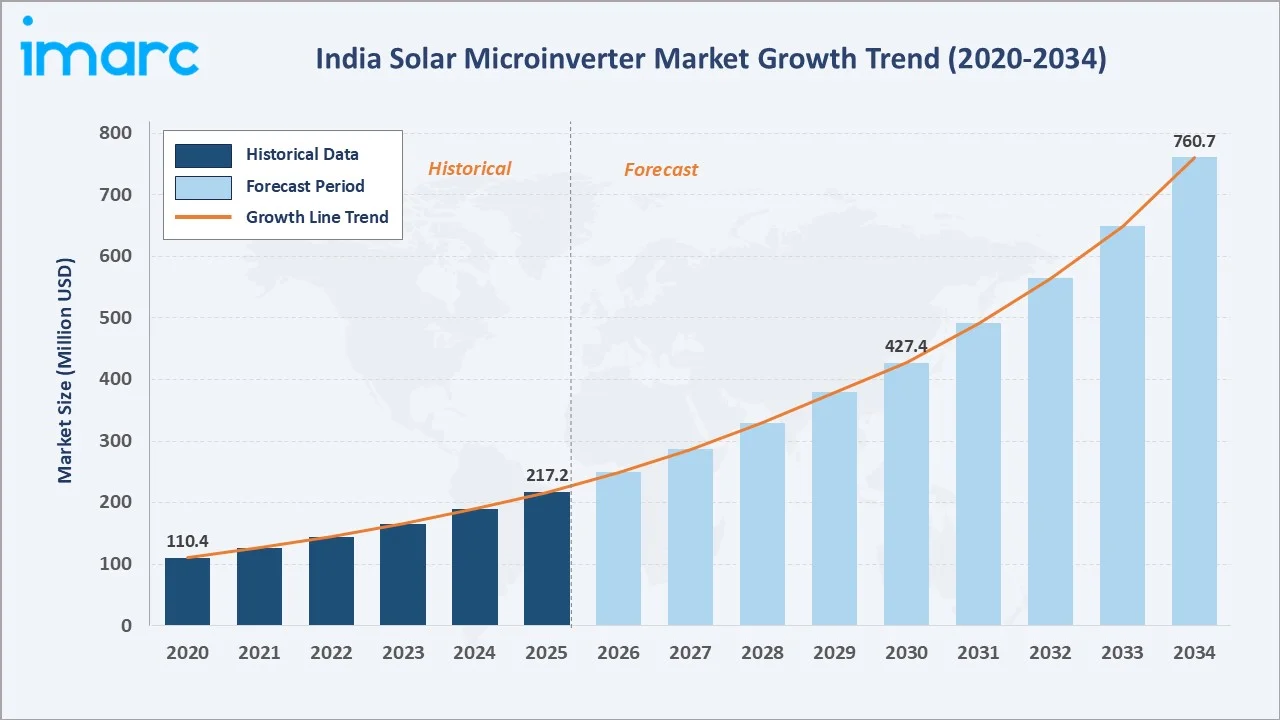
The India solar microinverter market reached USD 217.2 Million in 2025 and is projected to reach USD 760.7 Million by 2034, growing at a CAGR of 14.49% during 2026-2034. The market is driven by rooftop solar adoption, growing residential energy independence aspirations, and microinverters' superior shade tolerance. India’s solar power capacity has risen from nearly 3 GW in 2014 to 162.15 GW as of June 30, 2026. This growth is driving the market by increasing rooftop and distributed solar installations, where microinverters are increasingly adopted for module-level power optimization, improved energy yield, enhanced system monitoring, and greater installation flexibility. Single phase leads type at 68.9%. Residential leads application at 57.6%. South India leads regionally at 35.4%.
Market Snapshot
|
Metric |
Value |
|
Market Size (2025) |
USD 217.2 Million |
|
Forecast Market Size (2034) |
USD 760.7 Million |
|
CAGR (2026-2034) |
14.49% |
|
Base Year |
2025 |
|
Historical Period |
2020-2025 |
|
Forecast Period |
2026-2034 |
|
Dominant Type |
Single Phase (68.9%, 2025) |
|
Dominant Application |
Residential (57.6%, 2025) |
|
Leading Region |
South India (35.4%, 2025) |
The India solar microinverter market has demonstrated exceptional growth, increasing from USD 110.4 Million in 2020 to USD 217.2 Million in 2025, reflecting rising rooftop solar adoption and growing awareness of microinverter safety and performance benefits. The market is projected to reach USD 427.4 Million by 2030 and further grow to USD 760.7 Million by 2034, supported by continued policy support, falling microinverter prices due to scale, and growing commercial and industrial rooftop solar installations.
To get more information on this market, Request Sample
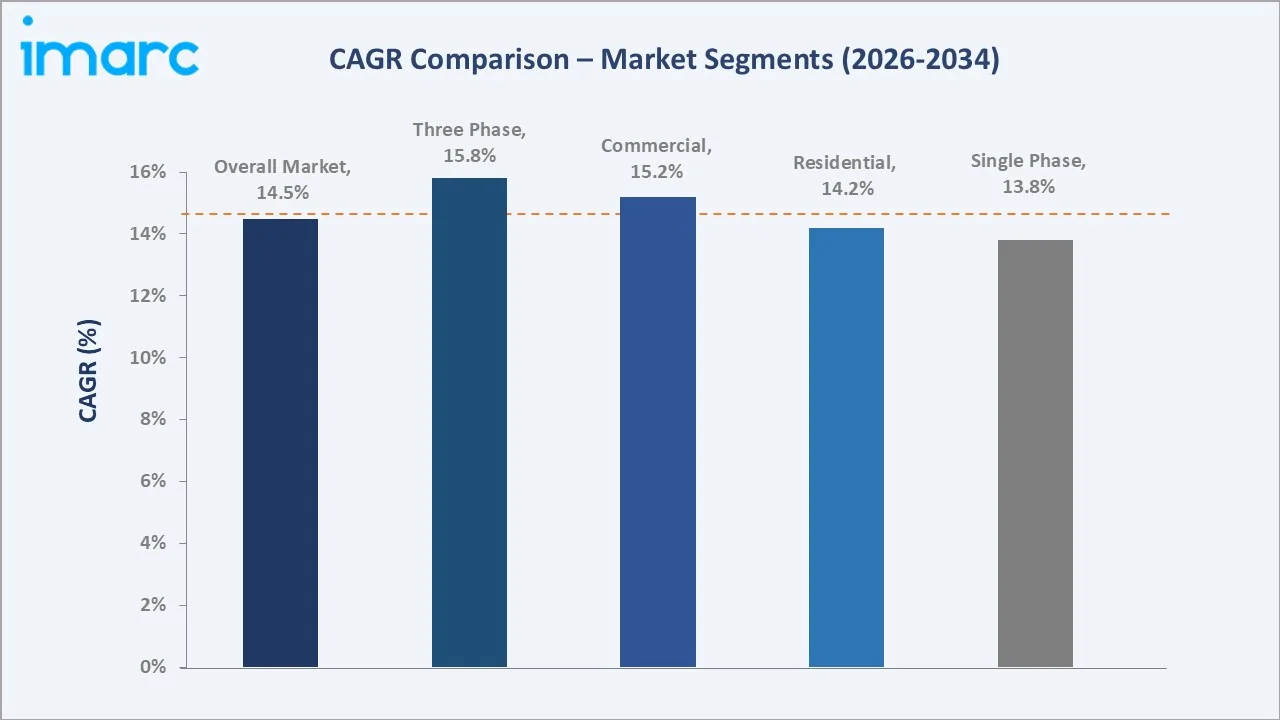
Three phase microinverters lead at a CAGR of ~15.8% through expanding commercial and light industrial rooftop solar deployments. Commercial application grows at ~15.2% CAGR through MSME and retail rooftop solar adoption. Residential application grows at ~14.2% CAGR through continued PM Surya Ghar scheme-driven household installations.
Executive Summary
The India solar microinverter market is experiencing exceptional growth, propelled by India's most ambitious rooftop solar scheme targeting households with free electricity through subsidized rooftop solar installations, and by the growing recognition among Indian homeowners and commercial building operators of microinverters' superiority over string inverters in shaded, multi-orientation, and safety-critical applications.
Single phase leads at 68.9% through the dominant residential rooftop market. Residential leads at 57.6% through PM Surya Ghar scheme-driven household installations. South India leads at 35.4% through its large renewable energy adopter base and progressive net metering policy environment.
Key Market Insights
|
Insight |
Data |
|
Dominant Type |
Single Phase – 68.9% share (2025) |
|
Leading Application |
Residential – 57.6% market share (2025) |
|
Leading Region |
South India – 35.4% share (2025) |
|
Market Opportunity |
PM Surya Ghar 1 crore household target; commercial MSME rooftop solar; housing society bulk installations; EV charging-integrated home solar systems; microinverter-as-a-service models |
Key Analytical Observations Supporting the Above Data:
- Single Phase at 68.9%: Single-phase microinverters dominate as India's residential electricity supply is almost universally single-phase for homes below 5 kW sanctioned load. The product's plug-and-play design, simplifying installation, further supports its dominant residential market adoption.
- Residential at 57.6%: Residential applications lead as rooftop solar adoption is primarily driven by individual homeowners seeking bill reduction and seeking shelter from rising electricity tariffs. India's growing urban middle class with home ownership creates the largest potential residential solar market, with microinverters' safety and monitoring advantages increasingly recognized by solar-aware consumers.
- South India at 35.4%: South India leads due to Tamil Nadu and Andhra Pradesh's progressive rooftop solar adoption, driven by historically high electricity tariffs and strong net metering policy implementation.
India Solar Microinverter Market Overview
The India solar microinverter market encompasses module-level power electronics (MLPE) devices that convert DC electricity from individual solar panels to AC grid-frequency power, enabling independent maximum power point tracking (MPPT) for each panel in a rooftop solar system. Unlike string inverters, microinverters attach beneath individual panels, eliminating the system-level performance impact of shading, soiling, or panel mismatch on any single panel.
The market covers single-phase microinverters (for residential 1-3 phase grids), three-phase microinverters (for commercial and industrial installations), and associated monitoring hardware and software platforms. Applications span residential rooftop installations, commercial building systems, and other specialized applications including industrial buildings, agricultural structures, and standalone off-grid systems.
Market Dynamics
To evaluate market opportunities, Request Sample
Market Drivers
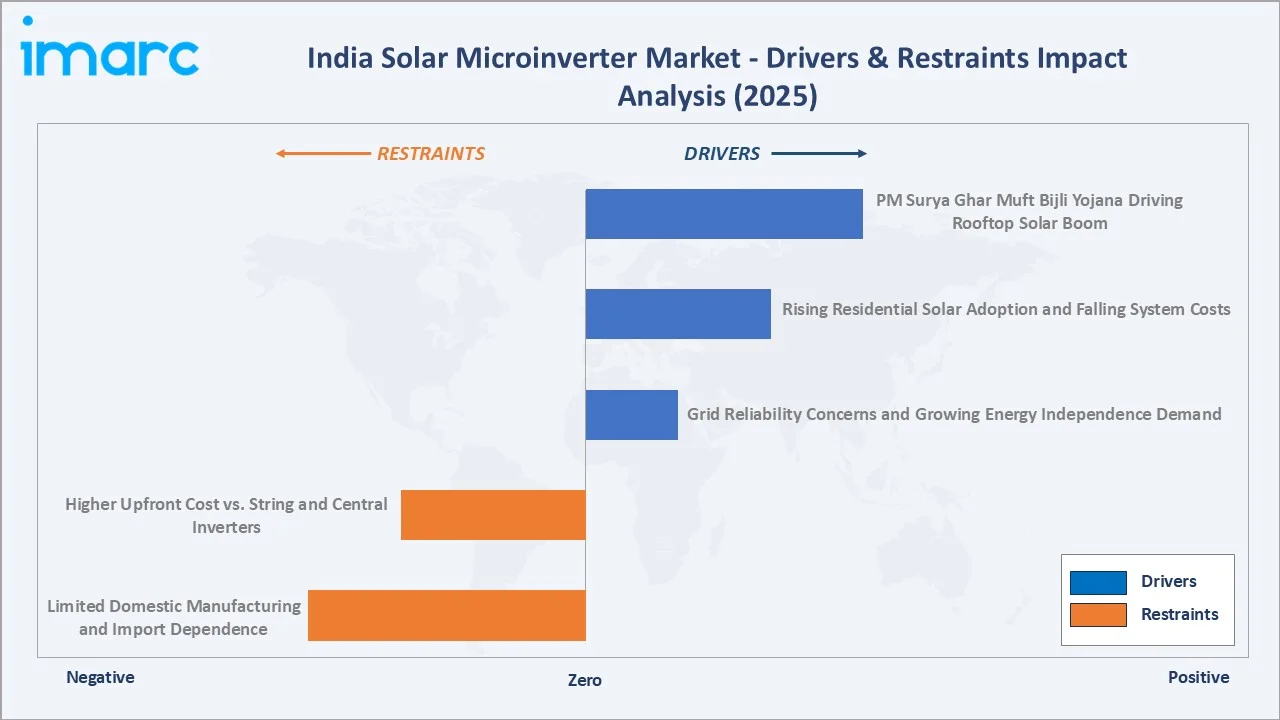
- PM Surya Ghar Muft Bijli Yojana Driving Rooftop Solar Boom: Launched in February 2024 with an INR 75,021 crore outlay, PM Surya Ghar targets 1 Crore households with free electricity through rooftop solar subsidies. The scheme's focus on residential systems matches the single-phase microinverter's core product range, making it the most direct policy driver in the market's history. The scheme's emphasis on system quality further benefits organized microinverter brands over lower-quality alternatives.
- Rising Residential Solar Adoption and Falling System Costs: General awareness of solar technology in India has increased substantially, rising from 50% in 2020 to 90% in 2026. In addition, 57% of households reported specific awareness of rooftop solar (RTS) systems, increasing the economic attractiveness of rooftop solar for middle-income homeowners. Growing consumer awareness through social media, YouTube reviews, and solar influencer content is accelerating residential decision-making toward microinverter systems.
- Grid Reliability Concerns and Growing Energy Independence Demand: India's residential electricity consumers experience frequent power outages in some states, creating strong demand for reliable self-generated electricity. Microinverter systems with battery storage integration enable true energy independence during grid outages, addressing India's most pressing residential electricity quality pain point.
Market Restraints
- Higher Upfront Cost vs. String and Central Inverters: Microinverter systems carry a higher upfront cost per kWp compared to equivalent string inverter systems, creating a price barrier for cost-sensitive residential customers seeking the lowest-cost rooftop solar option. In India's price-sensitive mass market, the additional microinverter cost above the subsidized portion can discourage adoption among lower-income beneficiaries. EPC contractors bidding on competitive tenders face cost pressure to specify string inverters, limiting microinverter adoption in non-quality-specified project procurement.
- Limited Domestic Manufacturing and Import Dependence: India's microinverter market is currently dominated by imported products with limited domestic manufacturing capability. Import duties on electronic components, rupee depreciation risks, and supply chain disruptions create pricing volatility and supply uncertainty. The absence of microinverters in PLI Solar scheme incentives limits policy-backed domestic manufacturing incentives.
Market Opportunities
- Housing Society and Bulk Rooftop Installations: India's registered Residential Welfare Associations (RWAs) and housing societies represent a bulk procurement opportunity for rooftop solar systems on common areas, podium rooftops, and parking structures. Housing society installations benefit from economies of scale in installation, favorable per-unit pricing, and shared grid export benefit for common area electricity, with microinverters enabling flexible panel placement across variously oriented building surfaces.
- EV Charging-Integrated Home Solar Systems: India's rapidly growing electric vehicle market, with registered 2.55 million EV sales in FY2025-26, is creating demand for home solar systems specifically designed for EV charging integration. Microinverter systems' compatibility with smart EV charging load management, directing excess solar generation to EV charging rather than grid export, positions microinverters as the preferred technology for premium home solar-plus-EV installations targeting India's growing urban EV owner segment.
Market Challenges
- Net Metering Policy Inconsistency Across States: India's net metering framework for rooftop solar varies significantly across states in tariff rates, capacity limits, and procedural complexity. Several states impose net metering caps that limit export above certain system sizes, and interconnection delays in some jurisdictions undermine the financial case for rooftop solar. Inconsistent net metering policy creates geographic market development uncertainty that inhibits microinverter adoption in states with unfavorable grid tie-in policies.
- Installer Training and Awareness Gap: Effective microinverter system design, installation, and commissioning require specific technical knowledge, including communication bus configuration, monitoring platform setup, and grid protection relay programming, that is not consistently available among India's large pool of informal solar installers. Gaps in installer training create suboptimal system performance, customer dissatisfaction, and warranty claims that undermine brand reputation.
Emerging Market Trends
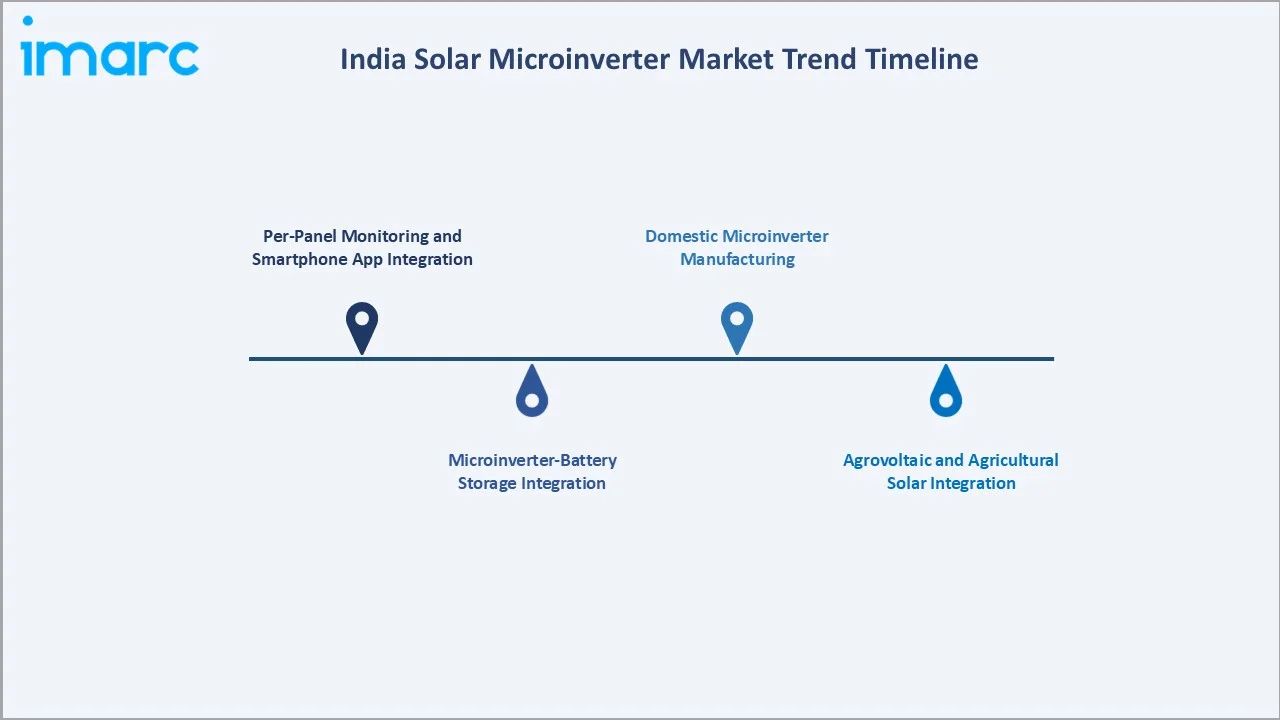
1. Per-Panel Monitoring and Smartphone App Integration
Real-time per-panel performance monitoring through integrated cloud platforms and smartphone apps is rapidly becoming a standard expectation among Indian residential solar buyers, particularly the urban, technology-literate consumer segment driving premium microinverter adoption. Growing app penetration among solar buyers is driving microinverter preference among consumers who prioritize investment visibility.
2. Microinverter-Battery Storage Integration
The integration of microinverter systems with residential battery storage, enabling solar self-consumption maximization and grid-outage backup, is emerging as a key value-added proposition in India's reliability-challenged electricity market. Battery-integrated microinverter systems are gaining particularly strong traction in Tier 2 cities where grid reliability is poor.
3. Domestic Microinverter Manufacturing
In September 2025, DUAK Energy Pvt. Ltd. launched Rajasthan’s first Make in India 1.1 kW microinverter. The introduction represents an important step toward strengthening domestic solar technology manufacturing and aligns with the Aatmanirbhar Bharat initiative by promoting locally developed clean energy solutions. The launch highlights a growing trend toward local manufacturing and indigenous development of solar microinverters in India. This is expected to reduce import dependence, improve product availability, and support wider adoption of module-level power electronics across rooftop and distributed solar installations.
4. Agrovoltaic and Agricultural Solar Integration
India's growing agrovoltaic solar, combining agricultural land use with overhead solar panel structures, creates new microinverter deployment opportunities where panel shading from crops below and irregular panel orientations on agricultural structures favor microinverter's per-panel MPPT optimization.
Industry Value Chain Analysis
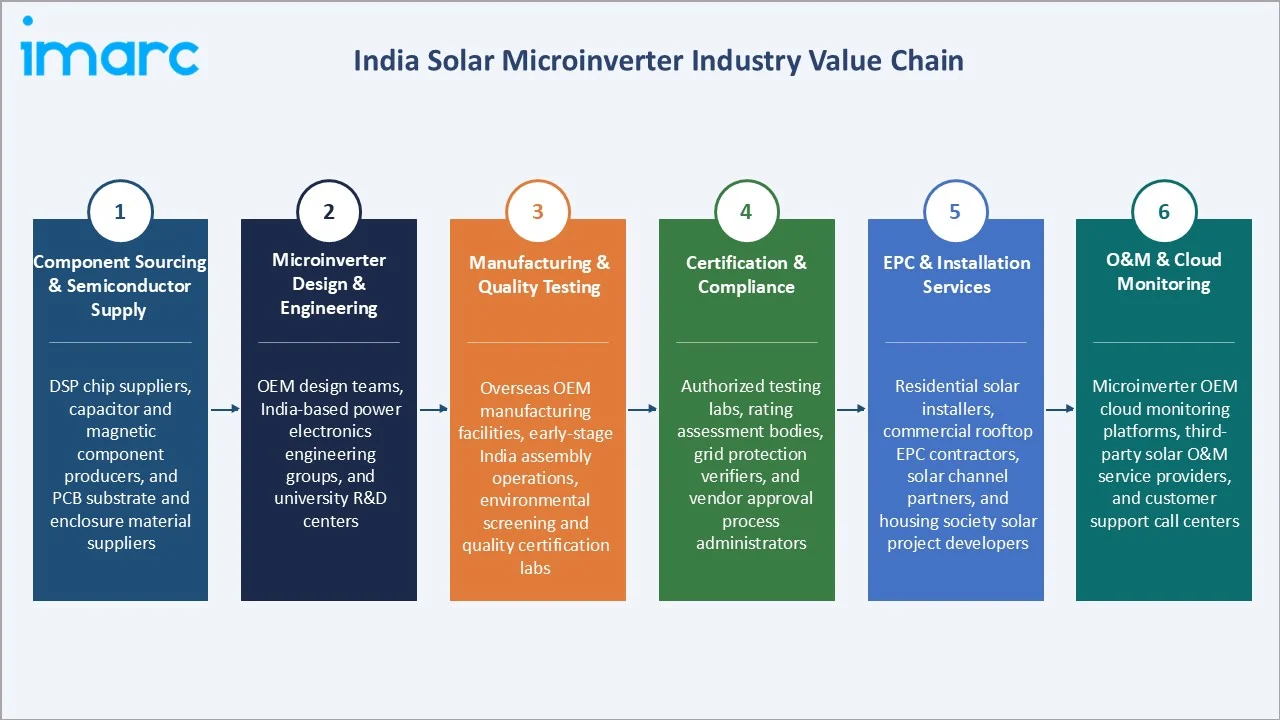
The India solar microinverter market value chain integrates component sourcing and semiconductor supply, microinverter design and engineering, manufacturing and quality testing, certification and compliance, EPC and installation services, and operations, maintenance, and cloud monitoring.
|
Stage |
Key Participants |
|
Component Sourcing & Semiconductor Supply |
DSP chip suppliers, capacitor and magnetic component producers, and PCB substrate and enclosure material suppliers. |
|
Microinverter Design & Engineering |
OEM design teams, India-based power electronics engineering groups, and university R&D centers. |
|
Manufacturing & Quality Testing |
Overseas OEM manufacturing facilities, early-stage India assembly operations, environmental screening and quality certification labs. |
|
Certification & Compliance |
Authorized testing labs, rating assessment bodies, grid protection verifiers, and vendor approval process administrators. |
|
EPC & Installation Services |
Residential solar installers, commercial rooftop EPC contractors, solar channel partners, and housing society solar project developers. |
|
O&M & Cloud Monitoring |
Microinverter OEM cloud monitoring platforms, third-party solar O&M service providers, and customer support call centers. |
Certification and compliance represent a critical value chain stage for India's solar microinverter market, as certification is becoming mandatory for grid-connected solar inverters under regulations, and PM Surya Ghar scheme procurement requires certified components. This stage determines product eligibility for the government scheme-driven market volume that represents the majority of near-term growth potential.
Technology Landscape in the India Solar Microinverter Industry
Microinverter Hardware and Power Electronics Technology
Modern solar microinverters are built on advanced power electronics architectures incorporating gallium nitride (GaN) and silicon carbide (SiC) switching devices that deliver significantly higher switching frequencies and conversion efficiencies than traditional silicon-based IGBT designs. GaN-based microinverters achieve peak efficiencies, dramatically reducing energy losses compared to older-generation designs.
Per-Panel Monitoring and IoT Communication Technology
Integrated IoT communication technology enables real-time per-panel performance data transmission from each microinverter to cloud monitoring platforms through powerline communication (PLC) over the AC wiring, Wi-Fi, or cellular backhaul. This monitoring granularity, enabling homeowners to identify exactly which panel is underperforming and why, creates measurable consumer value proposition advantages over string inverter monitoring that reports only aggregate system performance.
AI-Powered MPPT and Grid Interaction Technology
Next-generation microinverter platforms are integrating AI-accelerated maximum power point tracking (MPPT) algorithms that continuously optimize panel operating points under rapidly changing irradiance and temperature conditions, particularly relevant in India's partially cloudy tropical climate where irradiance variability is high. Grid interaction capabilities, including reactive power injection, voltage ride-through, frequency response, and virtual synchronous machine behavior are being integrated into microinverter firmware to meet evolving CEA grid code requirements as India's rooftop solar penetration increases. These smart grid capabilities position microinverters as distributed grid assets rather than passive generation devices.
Market Segmentation Analysis
The report covers the following segments:
|
Segment Category |
Leading Segment |
Market Share |
Year |
|
Connectivity |
🔒 |
🔒 |
2025 |
|
Component |
🔒 |
🔒 |
2025 |
|
Communication Channel |
🔒 |
🔒 |
2025 |
|
Type |
Single Phase |
68.9% |
2025 |
|
Application |
Residential |
57.6% |
2025 |
|
Region |
South India |
35.4% |
2025 |

By Type
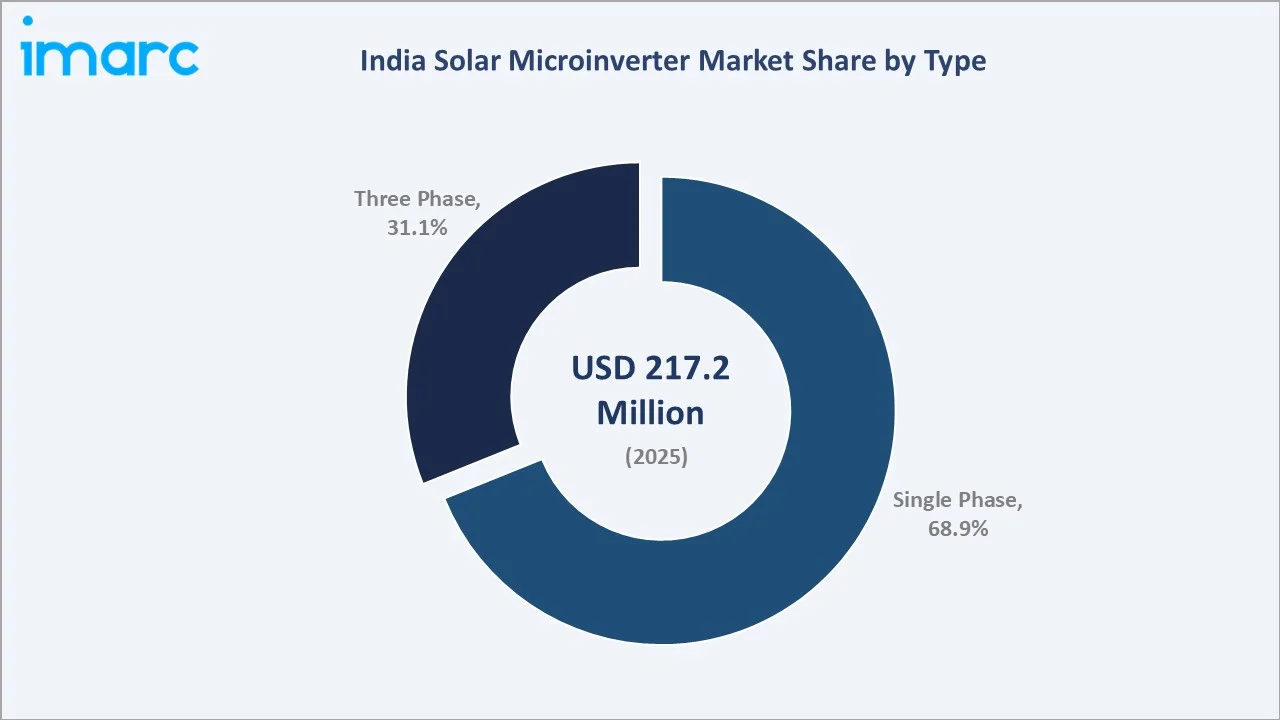
Single phase microinverters lead at 68.9% (2025), driven by India's dominant single-phase residential electricity connection base and the PM Surya Ghar scheme's residential household focus. Single-phase microinverters serve India's urban and semi-urban household market, and their plug-and-play AC output simplifies installation for India's widespread single-phase residential wiring infrastructure.
To access detailed market analysis, Request Sample
Three phase microinverters account for 31.1% and grow at the fastest CAGR of ~15.8%, driven by expanding commercial and industrial rooftop solar where three-phase electrical connections are standard and three-phase microinverters enable efficient power balancing across all three supply phases. Growing commercial MSME solar adoption, housing society common area installations, and educational institution rooftop solar are driving three-phase microinverter volume expansion.
By Application
Residential applications lead at 57.6% (2025), reflecting PM Surya Ghar's direct residential subsidy impact, growing homeowner awareness of microinverter performance advantages, and India's large urban homeowner population with rooftop access. Residential microinverter systems of 1-5 kWp installed on individual house rooftops, terrace apartments, and independent residential buildings represent the highest-volume deployment category.
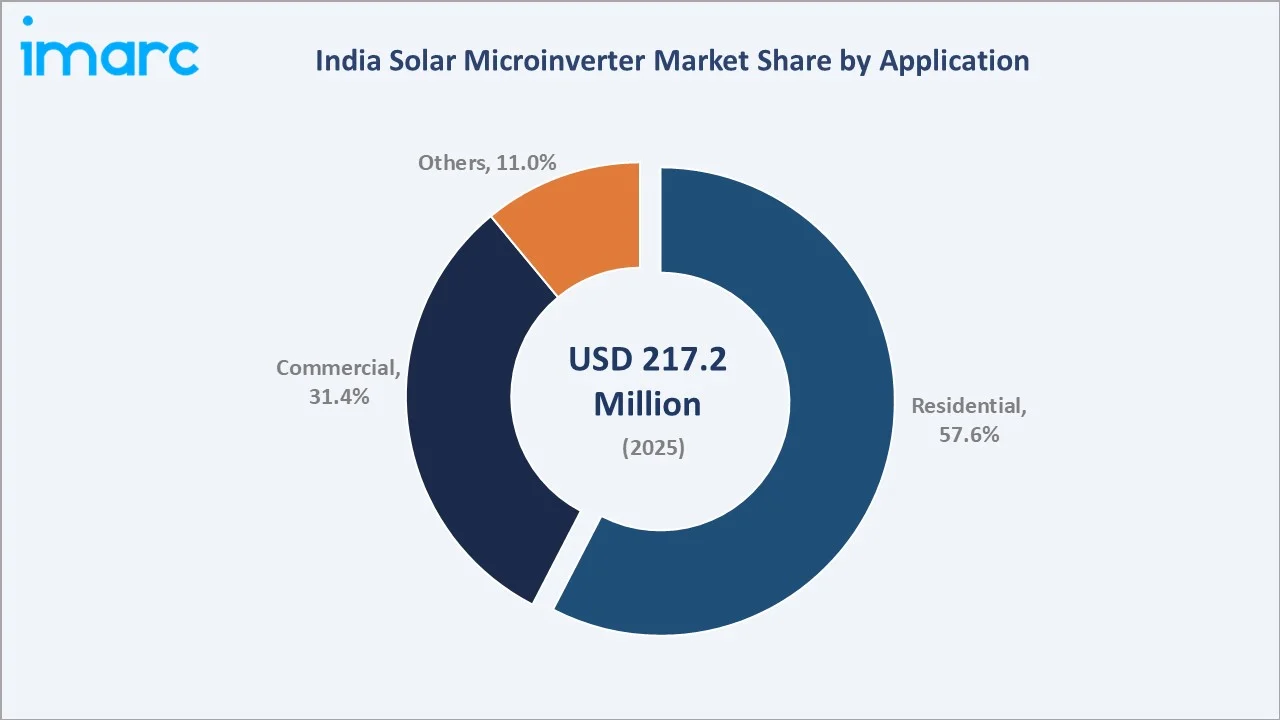
Commercial accounts for 31.4% and grows at ~15.2% CAGR through MSME factory rooftop, retail mall, hotel, and educational institution solar adoption. Others represent 11.0%, encompassing agricultural structures, agrovoltaic installations, industrial sheds, and government building rooftop programs.
Regional Market Insights
|
Region |
Share (2025) |
Key India Solar Microinverter Market Drivers & Characteristics |
|
South India |
35.4% |
Largest market driven by Tamil Nadu and Andhra Pradesh's high electricity tariffs accelerating rooftop solar ROI, Karnataka's large urban rooftop solar base and progressive net metering. |
|
West & Central India |
29.7% |
Strong market anchored by Maharashtra's large urban residential solar market, Rajasthan's abundant solar irradiation driving favorable economics. |
|
North India |
21.3% |
Growing market driven by Delhi NCR's large urban premium residential sector with strong microinverter brand awareness, Haryana's expanding residential solar adoption. |
|
East India |
13.6% |
Emerging market with growing residential solar adoption in West Bengal's urban centers, Odisha's improving electricity access creating tariff reduction motivation. |
South India's 35.4% market leadership reflects the region's advantageous combination of high consumer electricity tariffs creating strong financial incentive for self-generation, mature net metering policy implementation reducing grid export friction, and a large urban middle-class homeowner population with the financial capacity to invest in premium solar systems. West and Central India's 29.7% is supported by Maharashtra and Rajasthan's large rooftop solar markets and Rajasthan's world-class solar irradiation resource.
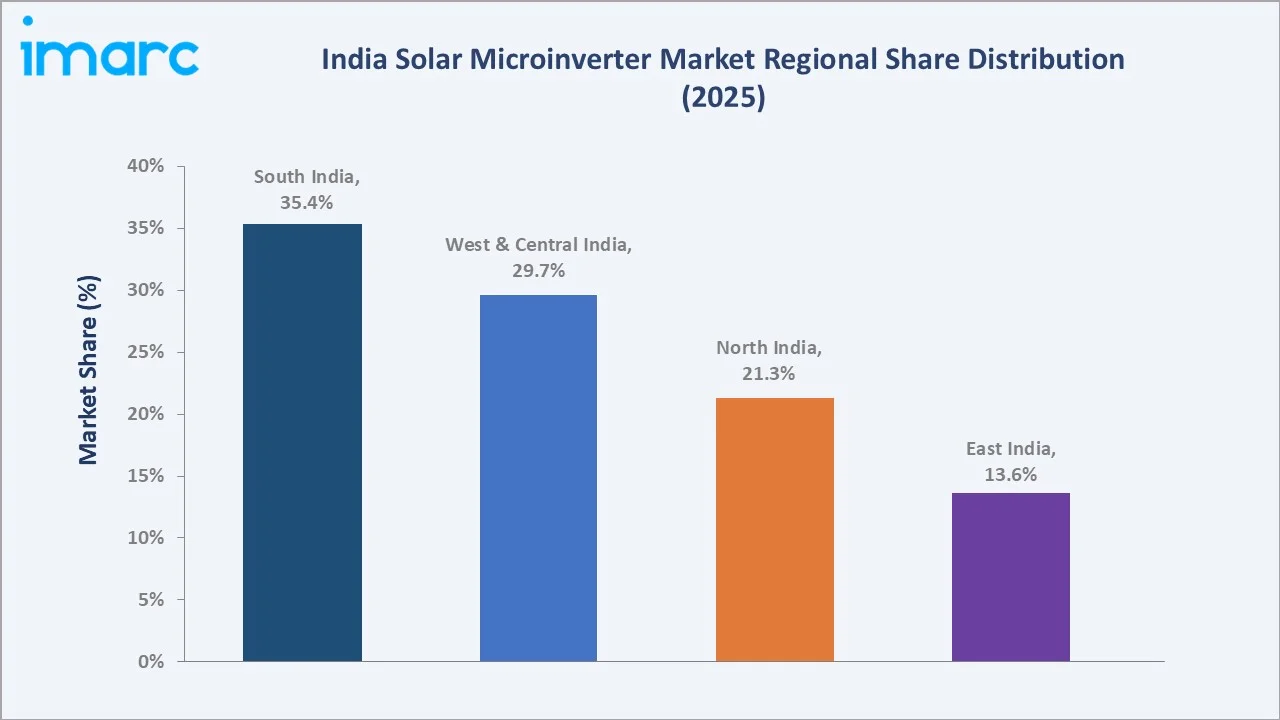
North India at 21.3% benefits from Delhi NCR's premium consumer segment and growing Haryana residential solar adoption, with UP's large population base providing significant PM Surya Ghar volume potential as scheme execution accelerates. East India at 13.6% represents the highest growth opportunity region, with West Bengal's urban residential sector and the broader eastern states' large PM Surya Ghar beneficiary population creating multi-year expansion potential as interconnection processes mature.
Competitive Landscape
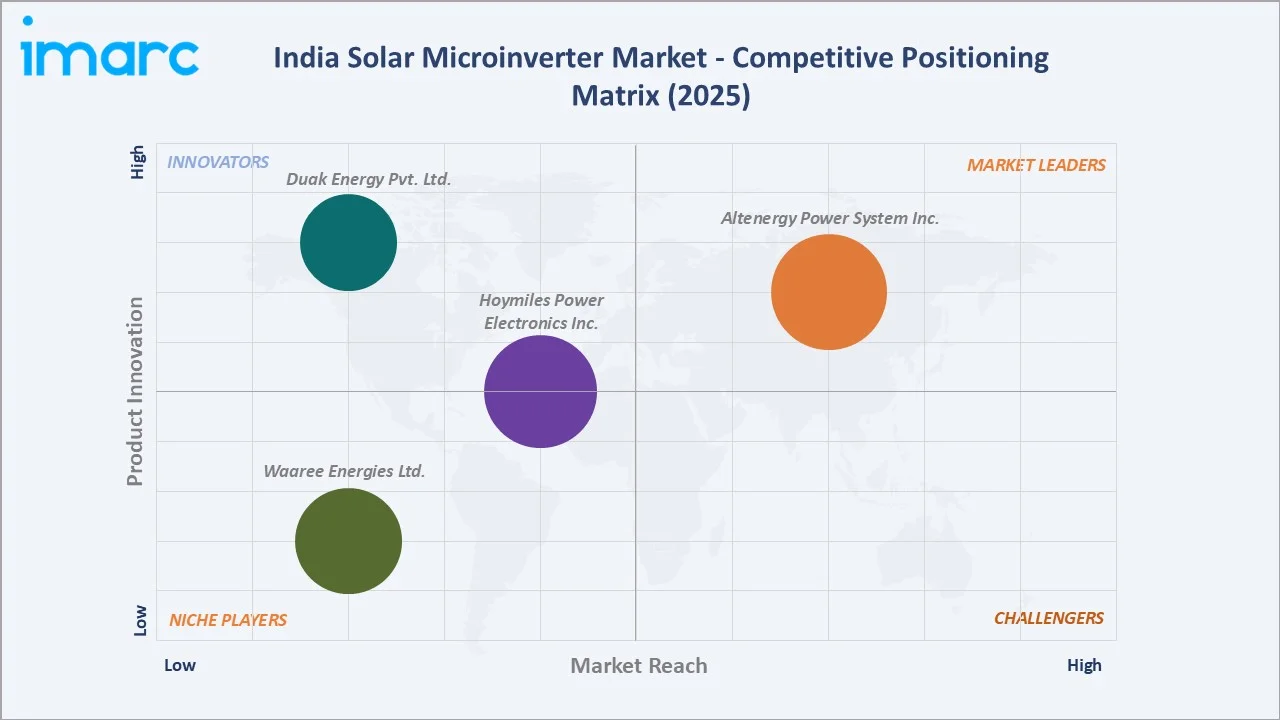
The India solar microinverter market is moderately concentrated among a small number of international technology leaders and growing domestic solar electronics companies. Market participants compete on per-unit efficiency, monitoring platform capability, installer certification programs, warranty duration, technical support quality, and price.
|
Company |
Key Products |
Market Position |
Core Strength |
|
Altenergy Power System Inc. |
APsystems DS3, APsystems QT2, APsystems DS3D, APsystems QT2D |
Market Leader |
Altenergy Power System Inc., widely known as APsystems, plays a growing role in India's solar market, specifically through high-efficiency solar microinverters. |
|
Hoymiles Power Electronics Inc. |
Hoymiles MiT super microinverter |
Established Player |
Hoymiles Power Electronics Inc. drives India's solar microinverter market with high-efficiency Module-Level Power Electronics (MLPE). |
|
Waaree Energies Ltd. |
TSUN GEN3 2000W Smart Mini Inverter |
Niche Player |
Waaree Energies Ltd. provides advanced solar inverter and microinverter solutions to support India's distributed and rooftop solar expansion. |
|
Duak Energy Pvt. Ltd. |
DUAK 1.1KW Micro Inverter |
Innovator |
Duak Energy Pvt. Ltd. is an emerging Indian energy technology company that pioneered manufacturing Rajasthan's first "Make in India" 1.1 kW solar microinverter system. |
Companies are also investing in certification, PM Surya Ghar scheme empanelment, installer training academies, and monitoring platform localization to capture India-specific market opportunities. The market is expected to see domestic manufacturing partnerships and acquisitions as import costs and currency risks motivate local assembly development.
Key Company Profiles
Altenergy Power System Inc.
Altenergy Power System Inc. (APsystems) is a provider of module-level power electronics and solar microinverter solutions serving residential and commercial photovoltaic applications. In the India solar microinverter market, the company is positioned through its multi-module microinverter technologies, monitoring platforms, and solutions designed to improve energy yield, system flexibility, and installation efficiency.
- Key Products: APsystems DS3, APsystems QT2, APsystems DS3D, APsystems QT2D.
- Strategic Focus: Focuses on high-efficiency multi-module microinverters, module-level power optimization, and intelligent energy monitoring for residential and commercial solar applications.
Hoymiles Power Electronics Inc.
Hoymiles Power Electronics Inc. is a solar technology company specializing in microinverters, energy storage, and module-level power electronics for distributed photovoltaic systems. In the India solar microinverter market, the company participates through compact, high-efficiency microinverter solutions designed for residential, commercial, and small-scale solar installations.
- Key Products: Hoymiles MiT super microinverter.
- Strategic Focus: Focuses on high-efficiency microinverters, module-level power optimization, smart monitoring, and integrated solar-plus-storage solutions to address India’s growing rooftop and distributed solar sector.
Market Concentration Analysis
The India solar microinverter market is moderately concentrated, with a small number of international technology leaders through their superior technology portfolios, established installer certification networks, and brand recognition among quality-conscious residential solar buyers. The market's remaining share is distributed among a larger group of emerging microinverter brands, Indian solar system integrators distributing Asian-origin microinverters, and early-stage domestic assembly operations.
Competition is becoming more intense as PM Surya Ghar scheme execution creates large-scale residential procurement volumes that attract new entrants seeking to capture government-scheme-driven demand, while certification and empanelment requirements progressively create compliance-based barriers that exclude non-certified products from government-subsidized installations. The market is expected to see consolidation through domestic assembly partnerships between Indian solar companies and overseas microinverter OEMs seeking import duty advantages under PLI-adjacent incentives, while market leaders continue to invest in India-specific product development, certified installer programs, and monitoring platform localization to defend their technology leadership positions against increasing competition from competitively priced Asian-origin microinverter brands expanding their India market presence.
Investment & Growth Opportunities
Highest Growth Segments
Three phase microinverters (~15.8% CAGR through commercial MSME and housing society rooftop solar), commercial application (~15.2% CAGR through escalating C&I electricity tariffs), PM Surya Ghar residential scale-up, battery-integrated home energy systems for grid-outage markets, and South India premium residential segment represent the highest-growth investment vectors in the India solar microinverter market through 2034.
Investment Themes
- Domestic microinverter assembly under PLI-adjacent incentives: India's PLI IT hardware scheme and associated electronics manufacturing incentives create financial justification for domestic microinverter assembly operations that reduce import duty exposure, improve supply chain resilience, and enable competitive pricing for the volume residential market. Indian solar companies partnering with overseas microinverter OEMs for Board-to-Box assembly operations can capture PLI benefits while building the domestic manufacturing presence increasingly valued by government procurement programs prioritizing domestically assembled products.
- Battery-integrated home energy systems for grid-reliability market: India's grid-unreliable Tier 2 and Tier 3 city residential market creates compelling demand for solar-plus-storage systems that deliver genuine energy independence. Microinverter brands offering seamlessly integrated battery storage targeting India's specific outage-frequency and backup-duration requirements can command significant price premiums over standalone solar systems and capture the highest-margin residential solar installation segment.
Future Market Outlook (2026-2034)
The India solar microinverter market is projected to grow from USD 217.2 Million in 2025 to USD 760.7 Million by 2034, delivering a 14.49% CAGR over the forecast period through sustained PM Surya Ghar scheme execution driving residential installations, expanding commercial rooftop solar adoption creating three-phase microinverter demand, falling microinverter costs enabling mass-market price accessibility, and growing integration of microinverter systems with battery storage and EV charging for comprehensive home energy management. The market's anchor value of USD 427.4 Million in 2030 represents India's solar microinverter ecosystem at the commercial segment mainstream adoption inflection and domestic manufacturing establishment.
Three structural forces are expected to define the growth of the India solar microinverter market through 2034. First, PM Surya Ghar's 1 Crore household target creates a multi-year, policy-backed demand pipeline of unprecedented scale for residential single-phase microinverter installations. Second, India's commercial rooftop solar market will drive rapid three-phase microinverter adoption in 10-100 kWp commercial systems where microinverters' shade tolerance for complex urban industrial rooftops and per-phase power balancing advantages deliver measurable ROI improvements. Third, the progressive development of domestic microinverter assembly and manufacturing capability will reduce delivered product costs, expand the addressable market to previously price-excluded consumer segments, and create competitive Indian-origin microinverter brands capable of sustaining market growth.
Research Methodology
Primary Research
Primary research comprised in-depth interviews with microinverter brand representatives and India country managers, solar EPC contractors and residential installers, net metering officials, and solar industry analysts. Discussions validated market size estimates, assessed PM Surya Ghar scheme impact, evaluated technology preference trends, and provided insights into competitive dynamics and long-term growth opportunities across India's solar microinverter market.
Secondary Research
Secondary research encompassed rooftop solar capacity addition data, net metering regulations documentation, PM Surya Ghar scheme progress reports, solar inverter certification databases, solar program reports, solar industry association publications, and credible energy technology analyst reports. These sources supported market sizing, policy impact assessment, competitive landscape evaluation, and regional demand analysis.
Forecasting Models
Forecasting models incorporated PM Surya Ghar scheme execution trajectory, residential and commercial rooftop solar capacity addition projections, microinverter cost curve forecasts, microinverter versus string inverter market share evolution modeling, and macroeconomic household income growth estimates. Both top-down and bottom-up approaches were applied and validated through primary expert consultations, incorporating net metering policy trajectory scenarios, domestic manufacturing development timelines, and EV charging integration adoption curves.
India Solar Microinverter Market Report Coverage:
| Report Features | Details |
|---|---|
| Base Year of the Analysis | 2025 |
| Historical Period | 2020-2025 |
| Forecast Period | 2026-2034 |
| Units | Million USD |
| Scope of the Report | Exploration of Historical Trends and Market Outlook, Industry Catalysts and Challenges, Segment-Wise Historical and Future Market Assessment:
|
| Connectivites Covered | Standalone, On-Grid |
| Components Covered | Hardware, Software |
| Communication Channels Covered | Wired, Wireless |
| Types Covered | Single Phase, Three Phase |
| Applications Covered | Residential, Commercial, Others |
| Regions Covered | North India, West and Central India, East India, South India |
| Companies Covered | Altenergy Power System Inc., Hoymiles Power Electronics Inc., Waaree Energies Ltd., Duak Energy Pvt. Ltd., etc |
| Customization Scope | 10% Free Customization |
| Post-Sale Analyst Support | 10-12 Weeks |
| Delivery Format | PDF and Excel through Email (We can also provide the editable version of the report in PPT/Word format on special request) |
Frequently Asked Questions About the India Solar Microinverter Market Report
The India solar microinverter market reached USD 217.2 Million in 2025, driven by PM Surya Ghar Muft Bijli Yojana's residential rooftop solar subsidies, rising electricity tariffs increasing rooftop solar ROI, and growing awareness of microinverter safety and performance advantages versus string inverters. Falling microinverter prices and expanding net metering availability are further supporting market growth.
The India solar microinverter market grows at 14.49% CAGR during 2026-2034, reaching USD 760.7 Million by 2034. The CAGR reflects sustained PM Surya Ghar scheme execution, expanding commercial three-phase microinverter adoption, falling product costs broadening affordability, and growing battery storage and EV charging integration creating premium home energy system demand.
Single phase leads at 68.9% (2025), matching India's universal single-phase residential electricity connection standard and PM Surya Ghar scheme's residential household focus.
Residential applications dominate at 57.6% (2025), driven by PM Surya Ghar's direct household subsidy impact, urban homeowner energy independence demand, and microinverters' safety advantages over string inverters for residential buildings.
South India leads at 35.4% (2025), anchored by Tamil Nadu and Andhra Pradesh's high electricity tariffs driving strong rooftop solar ROI, Karnataka's mature residential solar market, progressive net metering policy implementation, and established solar installer networks. Kerala's consumer awareness and Telangana's growing commercial solar market further strengthen the region's leadership.
Leading companies include Altenergy Power System Inc., Hoymiles Power Electronics Inc., Waaree Energies Ltd., and Duak Energy Pvt. Ltd., among others.
The market is projected to reach approximately USD 427.4 Million by 2030, representing the commercial segment's mainstream adoption inflection and domestic microinverter manufacturing establishment. PM Surya Ghar's ongoing household target execution, commercial three-phase market scaling, and battery-integrated home energy systems will be key growth catalysts through this period.
Priority investment opportunities include PM Surya Ghar scheme empanelment for government-subsidized residential volume access, domestic microinverter assembly establishment to reduce import costs, three-phase commercial product range development for growing C&I rooftop solar, battery-integrated home energy system packages for grid-outage-affected consumers, and installer training academy investment to build certified installation capacity for scale.
Need more help?
- Speak to our experienced analysts for insights on the current market scenarios.
- Include additional segments and countries to customize the report as per your requirement.
- Gain an unparalleled competitive advantage in your domain by understanding how to utilize the report and positively impacting your operations and revenue.
- For further assistance, please connect with our analysts.
 Request Customization
 Speak to an Analyst
 Request Brochure
 Inquire Before Buying
Benefits of Customization
- Personalize this research
- Triangulate with your data
- Get data as per your format and definition
- Gain a deeper dive into a specific application, geography, customer, or competitor
- Any level of personalization
Get in Touch With Us
UNITED STATES
Phone: +1-201-971-6302
INDIA
Phone: +91-120-433-0800
UNITED KINGDOM
Phone: +44-753-714-6104
Email: [email protected]
Client Testimonials




.webp)




.webp)













Related Reports

Choose your plan
*Please note that the prices mentioned below are starting prices for each bundle type. Kindly contact our team for further details.*
Single User License
- 1 User License, Access on 2 Devices
- PDF Report + Excel Dataset (Password Protected)
- Lifetime Access
- No Printing Rights
- 10% Free Report Customization
- 10–12 Weeks of Analyst Support
Five User License
- Access for 5 Users, 2 Devices per User
- PDF Report + Excel Dataset (Password Protected)
- Lifetime Access
- Dedicated Account Manager
- 12–14 Weeks of Analyst Support
- No Printing Rights
- 15% Free Report Customization
- 25% Discount on Your Next Purchase
Corporate User License
- Unlimited User Access (Within Your Organization)
- PDF Report + Excel Dataset
- Lifetime Access
- Dedicated Account Manager
- 14–20 Weeks of Analyst Support
- No Printing Rights
- 20% Free Report Customization
- 30% Discount on Your Next Purchase
Essential Insights
What's included:
3 reports
- Lifetime Access
- PDF Reports
- Excel Datasets
- 2 Weeks of Free Analyst Support
- 2 User Licenses
- Access on 2 Devices
- Printing Rights
- Complimentary PowerPoint (PPT) Version
- Complimentary License Upgrade
Professional Access
What's included:
5 reports
- Lifetime Access
- PDF Reports
- Excel Datasets
- 8 Weeks of Free Analyst Support
- 2 User Licenses
- Access on 2 Devices
- Printing Rights
- Complimentary PowerPoint (PPT) Version
- Complimentary License Upgrade
Business Advantage
What's included:
8 reports
- Lifetime Access
- PDF Reports
- Excel Datasets
- 14 Weeks of Free Analyst Support
- 2 User Licenses
- Access on 2 Devices
- Printing Rights
- Complimentary PowerPoint (PPT) Version
- Complimentary License Upgrade
Enterprise Intelligence
What's included:
10 reports
- Lifetime Access
- PDF Reports
- Excel Datasets
- 20 Weeks of Free Analyst Support
- 2 User Licenses
- Access on 2 Devices
- Printing Rights
- Complimentary PowerPoint (PPT) Version
- Complimentary License Upgrade