
India Vinyl Flooring Market Size, Share, Trends and Forecast by Sector, Segment, Imports and Domestic Manufacturing, and Product Type, 2026-2034
India Vinyl Flooring Market Summary:
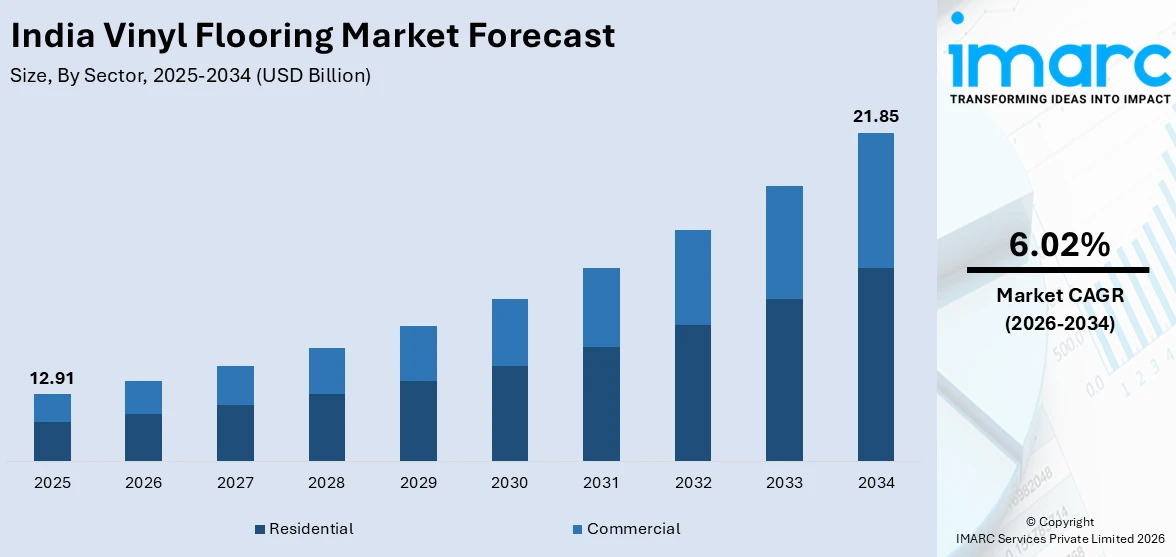
The India vinyl flooring market size was valued at USD 12.91 Billion in 2025 and is projected to reach USD 21.85 Billion by 2034, growing at a compound annual growth rate of 6.02% from 2026-2034.
The India vinyl flooring market is experiencing robust expansion driven by accelerating urbanization, rising disposable incomes, and growing preference for modern interior design solutions. Increasing construction activities across residential and commercial sectors, coupled with the shift from traditional flooring materials to durable and cost-effective vinyl alternatives, are fueling demand. Advancements in manufacturing technologies enabling realistic wood, stone, and marble replications, along with growing awareness of sustainable and low-maintenance flooring options, are expanding the India vinyl flooring market share.
Key Takeaways and Insights:
- By Sector: Residential dominates the market with approximately 62% revenue share in 2025, driven by the expanding housing construction and renovation activities fueled by urbanization and shifting consumer preferences toward modern flooring.
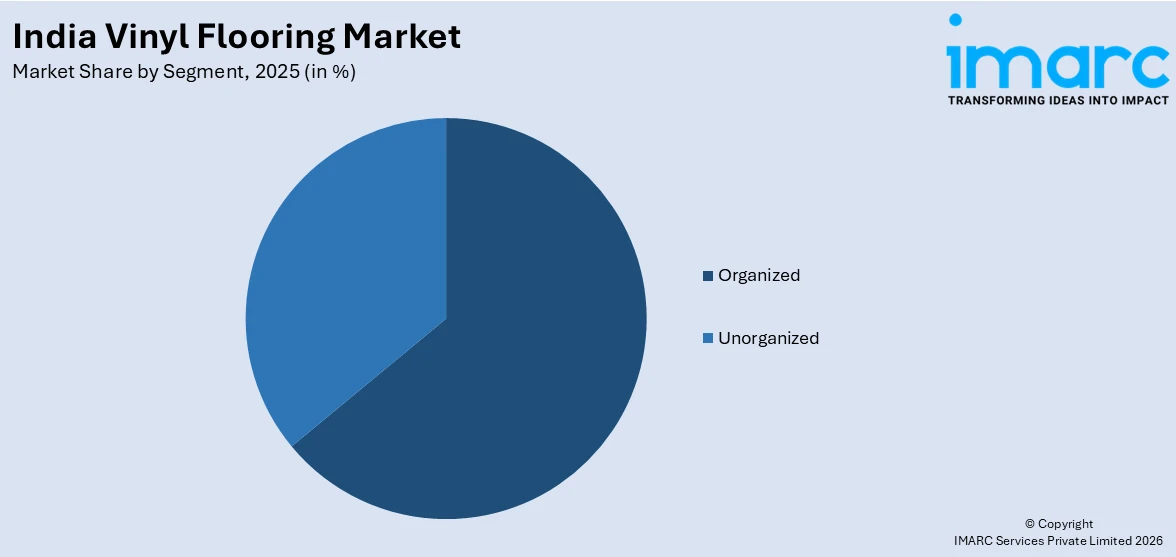
- By Segment: Organized segment leads the market with a share of 64% in 2025, supported by structured distribution networks, quality assurance standards, and growing penetration through retail and e-commerce channels.
- By Imports and Domestic Manufacturing: Domestic manufacturing holds the largest share at 75% in 2025, reflecting increasing investment in local production capabilities and government initiatives promoting self-reliance.
- By Product Type: Luxury vinyl tile (LVT) accounts for the highest revenue share of 42% in 2025, driven by its superior aesthetic appeal, waterproof properties, and growing adoption across premium residential and commercial projects.
- Key Players: The India vinyl flooring market features a competitive landscape with domestic manufacturers and international players vying for market share through product innovation, capacity expansion, strategic partnerships, and growing retail and distribution networks across the country.
To get more information on this market Request Sample
The India vinyl flooring market is growing as the construction sector is gaining momentum and the demand for flooring products is changing with the changing needs and preferences of consumers. The India market is getting a boost with the increasing demand for affordable and luxury residential spaces, commercial spaces, healthcare infrastructure, and educational infrastructure. Urbanization is also increasing in tier-2 and tier-3 cities, thus generating demand for flooring products. For example, in the year 2025, India has attained the third position among all countries and regions in the world in the USGBC’s annual list of countries and regions with the highest number of LEED certified green buildings. India is showing its commitment to sustainable construction and eco-friendly development with 370 projects covering an area of 8.50 million gross square meters. Government initiatives in infrastructure development, innovations in digital designs, and the expansion of the retail sector are also supporting the market.
India Vinyl Flooring Market Trends:
Rising Adoption of Luxury Vinyl Tiles and SPC Flooring
Currently, India is witnessing a rising trend of using luxury vinyl tiles and stone polymer composite flooring materials, where there is a strong demand for luxury flooring materials that are not only luxurious but also affordable. The market for luxury residential flooring is increasing rapidly, where a considerable number of users are adopting aesthetically driven flooring solutions. This is helping to boost the India vinyl flooring market. In 2025, VOX India, a leader in providing creative interior solutions, has launched a new variant of its popular Primerra SPC flooring, which is specially designed to cater to high-traffic commercial spaces. This flooring is a blend of durability and innovative flooring ideas, providing unparalleled style, performance, and comfort. VOX India’s latest Primerra SPC flooring is made using cutting-edge technology, providing users with the best combination of durability and looks. Made using SPC material with IXPE backing, this flooring provides excellent resistance against scratches, stains, and moisture, while providing comfort, insulation, and installation benefits
Growing Emphasis on Sustainable and Green Building Materials
Eco-friendly and low-VOC products are in demand in the market for flooring in India, as the focus on sustainability in building practices is on the rise. This surge in the use of green building practices is prompting manufacturers to introduce sustainable vinyl flooring products. India achieved the second position in the world, after the United States, in terms of the total LEED-certified area in buildings in 2025. The United States Green Building Council (USGBC) announced the rankings, which are the global authority on LEED ratings. India achieved the milestone of nearly 16 million gross square meters of approved green building space. This makes India one of the fastest-growing green real estate markets in the world.
Integration of Digital Printing and Smart Flooring Technologies
Advanced technologies in the field of manufacturing are changing the Indian vinyl flooring sector with the introduction of digital print technology, which is providing detailed and customized designs with the ability to mimic the appearance of wood, stone, and marble. Moreover, manufacturers in the Indian vinyl flooring sector are now providing products with antimicrobial properties and intelligent sensors, meeting the increasing need for hygienic and intelligent interiors, especially in the healthcare and educational sectors.
Market Outlook 2026-2034:
India’s vinyl flooring market is poised for sustained growth, supported by continued urbanization, rising housing demand, and expanding commercial infrastructure. The market generated a revenue of USD 12.91 Billion in 2025 and is projected to reach a revenue of USD 21.85 Billion by 2034, growing at a compound annual growth rate of 6.02% from 2026-2034. Increasing domestic manufacturing capabilities, government infrastructure programs, expanding organized retail networks, and growing consumer preference for premium and sustainable flooring solutions are expected to drive higher revenue streams and foster a more competitive and mature vinyl flooring landscape across India.
India Vinyl Flooring Market Report Segmentation:
| Segment Category | Leading Segment | Market Share |
|---|---|---|
|
Sector |
Residential |
62% |
|
Segment |
Organized |
64% |
|
Imports and Domestic Manufacturing |
Domestic Manufacturing |
75% |
|
Product Type |
Luxury Vinyl Tile (LVT) |
42% |
Sector Insights:
- Residential
- Commercial
Residential leads the India vinyl flooring market with a revenue share of 62% in 2025.
The residential sector continues to be the primary demand driver for vinyl flooring in India, fueled by the rapid expansion of housing construction and renovation activities across urban and semi-urban areas. Rising disposable incomes, a growing middle-class population, and an increasing number of nuclear families are spurring demand for affordable, durable, and aesthetically appealing flooring options. Vinyl flooring has emerged as a preferred choice among homeowners due to its versatile design options, water resistance, and ease of maintenance, making it suitable for kitchens, bathrooms, and high-traffic living spaces.
Government-led affordable housing initiatives, including large-scale programs targeting urban and rural populations, are creating substantial demand for cost-effective building materials including vinyl flooring. The rising influence of home decor trends through digital platforms and social media is further encouraging residential consumers to invest in modern flooring solutions. Additionally, the expanding real estate sector in tier-2 and tier-3 cities is opening new avenues for residential vinyl flooring adoption, supporting sustained market growth across the country.
Segment Insights:
Access the comprehensive market breakdown Request Sample
- Organized
- Unorganized
Organized segment dominates the India vinyl flooring market with approximately 64% share in 2025.
The organized segment is strengthening its position in the Indian vinyl flooring market through structured distribution networks, standardized quality assurance practices, and growing retail penetration. Brand-focused marketing, dealer networks, and the expanding footprint of e-commerce platforms are enabling organized players to reach a broader consumer base. The segment benefits from higher consumer trust associated with branded products that offer consistent quality, warranty coverage, and after-sales support.
The increasing presence of domestic and international manufacturers investing in state-of-the-art production facilities is reinforcing the organized segment’s leadership. Growing construction activity in commercial and institutional projects, which typically require standardized and quality-certified flooring materials, is further driving demand for organized vinyl flooring products. As awareness regarding product quality and certification grows among residential consumers, the organized segment is expected to continue capturing market share from unorganized players.
Imports and Domestic Manufacturing Insights:
- Imports
- Domestic Manufacturing
Domestic manufacturing accounts for the highest revenue share of 75% in the India vinyl flooring market in 2025.
Domestic manufacturing has emerged as the dominant supply channel for vinyl flooring in India, supported by substantial investments in local production infrastructure and government policies promoting self-reliance in manufacturing. Indian manufacturers are expanding capacity and upgrading technology to produce internationally competitive vinyl flooring products, including luxury vinyl tiles, stone polymer composite flooring, and heterogeneous sheet vinyl. The availability of locally manufactured products enables competitive pricing and faster delivery timelines.
The growth of domestic manufacturing is further bolstered by India’s favorable raw material availability, skilled labor force, and supportive regulatory environment encouraging local production over imports. Manufacturers are increasingly adopting advanced printing technologies, automated production lines, and sustainable manufacturing practices to meet rising demand from both domestic and export markets. These developments are helping position India as an emerging hub for vinyl flooring production in the Asia-Pacific region.
Product Type Insights:
- Vinyl Sheet
- Luxury Vinyl Tile (LVT)
- Vinyl Composition Tile (VCT)
Luxury vinyl tile (LVT) holds the largest share at 42% of the India vinyl flooring market in 2025.
Luxury vinyl tile has established itself as the leading product type in India’s vinyl flooring market, driven by its superior aesthetic versatility, waterproof performance, and durability. The product closely replicates the appearance of natural materials such as hardwood, marble, and stone at a fraction of the cost, making it highly attractive for both residential and commercial applications. The growing demand for premium yet affordable interior solutions, particularly in upscale residential projects, boutique hotels, and premium retail spaces, is accelerating adoption.
Technological advancements, including embossed-in-register printing and click-lock installation systems, have enhanced the appeal and ease of use of luxury vinyl tiles. The product’s suitability for moisture-prone areas such as kitchens and bathrooms, combined with its low-maintenance characteristics, positions it as a practical choice for Indian consumers. As domestic production of luxury vinyl tiles and stone polymer composite flooring scales up, pricing has become more accessible, further driving penetration across diverse market segments and geographic regions.

Market Dynamics:
Growth Drivers:
Why is the India Vinyl Flooring Market Growing?
Growing Housing Demand
India is experiencing a transformative phase of urbanization, with a significant share of the population migrating from rural to urban areas in search of better employment and living standards. This demographic shift is fueling extensive housing construction across metropolitan and semi-metropolitan regions, creating robust demand for durable, affordable, and visually appealing flooring materials. The expansion of nuclear families and changing lifestyle aspirations are further encouraging homeowners to invest in modern interior solutions, including vinyl flooring that offers versatile design options, moisture resistance, and easy installation.
Expanding Commercial and Institutional Infrastructure
India’s commercial real estate sector is witnessing sustained expansion, driven by the growth of office spaces, information technology parks, retail complexes, hospitality establishments, and healthcare facilities. These commercial environments demand flooring solutions that combine durability, hygiene, ease of maintenance, and aesthetic appeal, qualities inherently offered by vinyl flooring products. The institutional sector, including educational campuses and healthcare infrastructure, is also contributing to rising demand. IMARC Group predicts that the India commercial real estate market is projected to attain USD 281.7 Billion by 2034.
Government Infrastructure Initiatives and Policy Support
Government programs aimed at boosting infrastructure development, affordable housing, and urban modernization are creating significant demand for construction materials, including vinyl flooring. Large-scale housing schemes targeting urban and rural populations are driving the need for cost-effective, durable, and easy-to-install flooring products across millions of housing units. In the Union Budget 2025-26, Union Minister for Finance & Corporate Affairs, Ms. Nirmala Sitharaman revealed intentions to link 120 new airports over a decade, aiming for four crore more passengers. Additionally, infrastructure programs focused on developing urban centers with improved civic amenities and modern building standards are supporting the adoption of quality flooring materials.
Market Restraints:
What Challenges the India Vinyl Flooring Market is Facing?
Price Sensitivity Among Consumers
Despite its cost advantages over natural materials, premium vinyl flooring products such as luxury vinyl tiles and stone polymer composite flooring remain relatively expensive compared to conventional options like ceramic tiles, which continue to dominate the Indian flooring market. Price-sensitive consumers, particularly in semi-urban and rural areas, often opt for traditional and lower-cost alternatives, limiting the penetration of higher-value vinyl flooring segments in the mass market.
Competition from Traditional Flooring Materials
Ceramic tiles, marble, granite, and natural stone remain deeply embedded in Indian construction practices and consumer preferences. These traditional materials benefit from widespread availability, established supply chains, and cultural familiarity. Overcoming the entrenched preference for conventional flooring options requires sustained consumer education and awareness campaigns, which remains a challenge for vinyl flooring manufacturers seeking broader market acceptance.
Environmental and Regulatory Concerns
Growing environmental scrutiny around PVC-based products and their lifecycle impact poses a challenge to the vinyl flooring industry. Concerns regarding volatile organic compound emissions, recyclability, and the use of certain plasticizers are influencing consumer perceptions and regulatory developments. Manufacturers face increasing pressure to adopt eco-friendly formulations and sustainable production practices, which can raise production costs and complexity.
Competitive Landscape:
The India vinyl flooring market is characterized by a highly competitive environment with a mix of established domestic producers and international entrants. Market participants are focusing on expanding production capacities, upgrading manufacturing technologies, and broadening product portfolios to capture diverse consumer segments. Competition is intensifying across price points as organized players invest in brand building, dealer networks, and digital marketing strategies to strengthen market penetration. Innovation in product design, including realistic wood and stone replications through advanced printing technologies, is serving as a key differentiator. Strategic partnerships, distribution network expansion, and investments in sustainable manufacturing practices are further shaping competitive dynamics. The growing emphasis on quality certifications, green building compliance, and after-sales service is encouraging players to raise standards, creating a more mature and innovation-driven competitive landscape across the country.
India Vinyl Flooring Market Report Coverage:
| Report Features | Details |
|---|---|
|
Base Year of the Analysis |
2025 |
|
Historical Period |
2020-2025 |
|
Forecast Period |
2026-2034 |
|
Units |
Billion USD |
|
Scope of the Report |
Exploration of Historical Trends and Market Outlook, Industry Catalysts and Challenges, Segment-Wise Historical and Future Market Assessment:
|
|
Sectors Covered |
Residential, Commercial |
|
Segments Covered |
Organized, Unorganized |
| Imports and Domestic Manufacturing Covered |
Imports, Domestic Manufacturing |
|
Product Types Covered |
Vinyl Sheet, Luxury Vinyl Tile (LVT), Vinyl Composition Tile (VCT) |
|
Customization Scope |
10% Free Customization |
|
Post-Sale Analyst Support |
10-12 Weeks |
|
Delivery Format |
PDF and Excel through Email (We can also provide the editable version of the report in PPT/Word format on special request) |
Frequently Asked Questions About the India Vinyl Flooring Market Report
The India vinyl flooring market size was valued at USD 12.91 Billion in 2025.
The market is expected to grow at a compound annual growth rate of 6.02% from 2026-2034 to reach USD 21.85 Billion by 2034.
The residential sector, holding the largest revenue share of approximately 62%, remains the primary demand driver for India’s vinyl flooring market, supported by expanding housing construction, rising disposable incomes, and growing consumer preference for modern and low-maintenance flooring solutions.
Key factors driving the India vinyl flooring market include rapid urbanization, expanding residential and commercial construction, rising disposable incomes, government infrastructure initiatives, growing preference for sustainable building materials, and increasing adoption of luxury vinyl tiles.
Major challenges include price sensitivity among mass-market consumers, strong competition from traditional flooring materials such as ceramic tiles and natural stone, environmental concerns regarding PVC-based products, and the need for greater consumer awareness about vinyl flooring benefits.
Need more help?
- Speak to our experienced analysts for insights on the current market scenarios.
- Include additional segments and countries to customize the report as per your requirement.
- Gain an unparalleled competitive advantage in your domain by understanding how to utilize the report and positively impacting your operations and revenue.
- For further assistance, please connect with our analysts.
 Request Customization
 Speak to an Analyst
 Request Brochure
 Inquire Before Buying
Benefits of Customization
- Personalize this research
- Triangulate with your data
- Get data as per your format and definition
- Gain a deeper dive into a specific application, geography, customer, or competitor
- Any level of personalization
Get in Touch With Us
UNITED STATES
Phone: +1-201-971-6302
INDIA
Phone: +91-120-433-0800
UNITED KINGDOM
Phone: +44-753-714-6104
Email: [email protected]
Client Testimonials




.webp)




.webp)













Related Reports

Choose your plan
*Please note that the prices mentioned below are starting prices for each bundle type. Kindly contact our team for further details.*
Single User License
- 1 User License, Access on 2 Devices
- PDF Report + Excel Dataset (Password Protected)
- Lifetime Access
- No Printing Rights
- 10% Free Report Customization
- 10–12 Weeks of Analyst Support
Five User License
- Access for 5 Users, 2 Devices per User
- PDF Report + Excel Dataset (Password Protected)
- Lifetime Access
- Dedicated Account Manager
- 12–14 Weeks of Analyst Support
- No Printing Rights
- 15% Free Report Customization
- 25% Discount on Your Next Purchase
Corporate User License
- Unlimited User Access (Within Your Organization)
- PDF Report + Excel Dataset
- Lifetime Access
- Dedicated Account Manager
- 14–20 Weeks of Analyst Support
- No Printing Rights
- 20% Free Report Customization
- 30% Discount on Your Next Purchase
Essential Insights
What's included:
3 reports
- Lifetime Access
- PDF Reports
- Excel Datasets
- 2 Weeks of Free Analyst Support
- 2 User Licenses
- Access on 2 Devices
- Printing Rights
- Complimentary PowerPoint (PPT) Version
- Complimentary License Upgrade
Professional Access
What's included:
5 reports
- Lifetime Access
- PDF Reports
- Excel Datasets
- 8 Weeks of Free Analyst Support
- 2 User Licenses
- Access on 2 Devices
- Printing Rights
- Complimentary PowerPoint (PPT) Version
- Complimentary License Upgrade
Business Advantage
What's included:
8 reports
- Lifetime Access
- PDF Reports
- Excel Datasets
- 14 Weeks of Free Analyst Support
- 2 User Licenses
- Access on 2 Devices
- Printing Rights
- Complimentary PowerPoint (PPT) Version
- Complimentary License Upgrade
Enterprise Intelligence
What's included:
10 reports
- Lifetime Access
- PDF Reports
- Excel Datasets
- 20 Weeks of Free Analyst Support
- 2 User Licenses
- Access on 2 Devices
- Printing Rights
- Complimentary PowerPoint (PPT) Version
- Complimentary License Upgrade