
India Wastewater Treatment Plants Market Size, Share, Trends and Forecast by Type, Plant Category, Process, Operating Mode, End User Industry, and Region, 2026-2034
India Wastewater Treatment Plants Market Size, Share, Trends & Forecast (2026-2034)
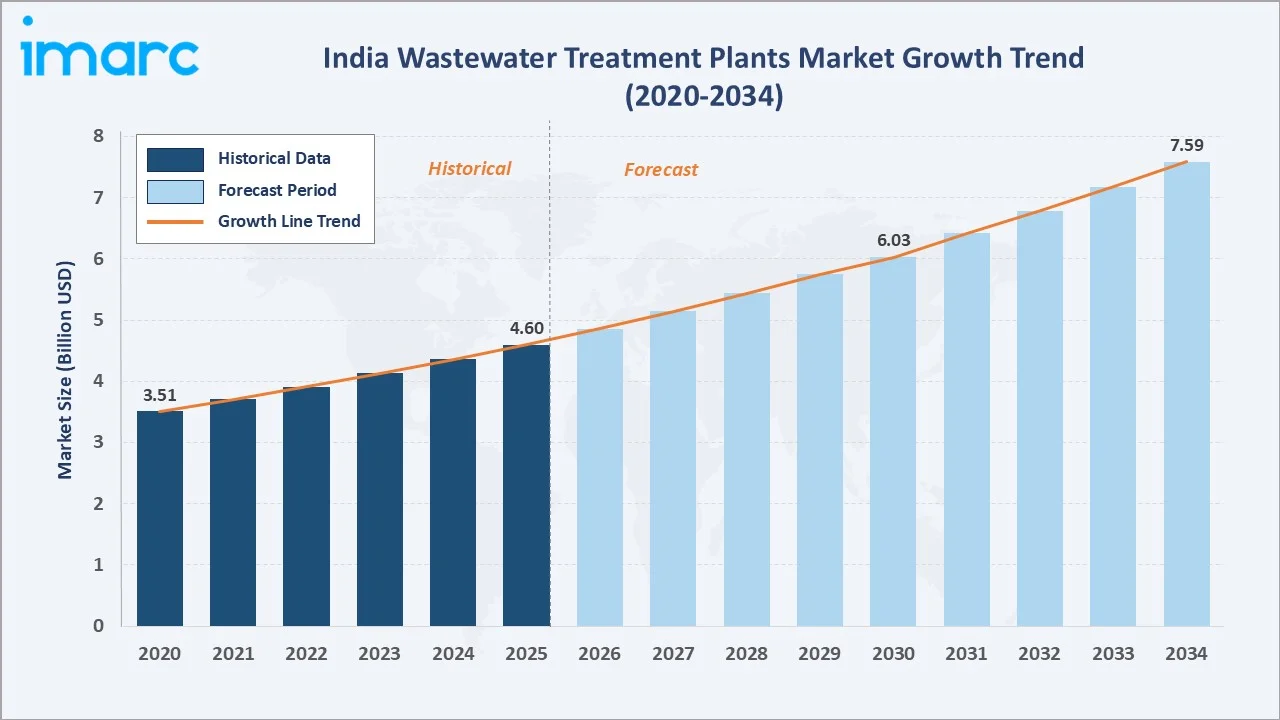
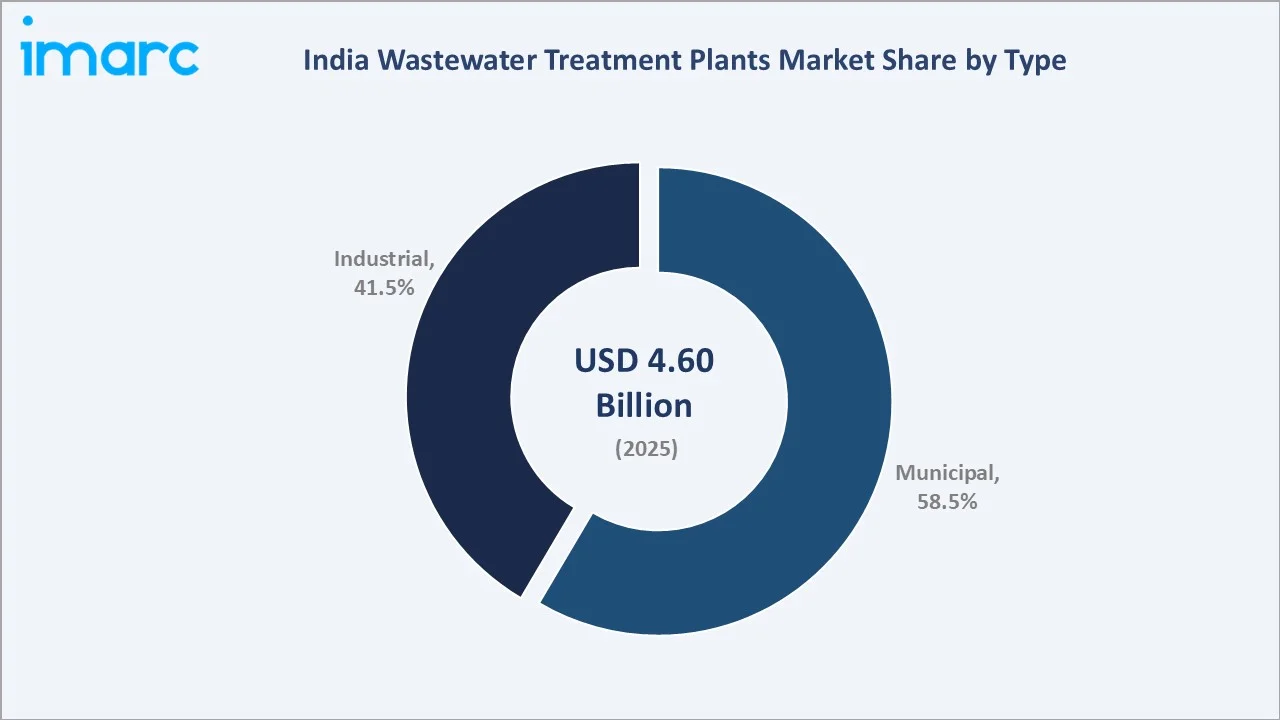
The India wastewater treatment plants market grew from USD 4.60 Billion in 2025 to USD 4.92 Billion in 2026 and is projected to reach USD 7.59 Billion by 2034, growing at a CAGR of 5.57% during 2026-2034. The market is driven by rapid urbanization, stringent environmental regulations, and large-scale government infrastructure programs. Municipal segment dominates at 58.5%. West India commands 34.5% of the market share.
Market Snapshot
|
Metric |
Value |
|
Base Year Market Size (2025) |
USD 4.60 Billion |
| Market Size (2026) | USD 4.92 Billion |
|
Forecast Market Size (2034) |
USD 7.59 Billion |
|
CAGR (2026-2034) |
5.57% |
|
Base Year |
2025 |
|
Historical Period |
2020-2025 |
|
Forecast Period |
2026-2034 |
|
Dominant Type |
Municipal (58.5%, 2025) |
|
Dominant Plant Category |
Less Than 50 MLD (34.7%, 2025) |
|
Leading Region |
West India (34.5%, 2025) |
The India wastewater treatment plants market expanded from USD 3.51 Billion in 2020 to USD 4.60 Billion in 2025 and an estimated USD 4.92 Billion in 2026, anchored at USD 6.03 Billion in 2030, and forecast to reach USD 7.59 Billion by 2034. Accelerating government investment in wastewater infrastructure, tightening discharge norms, and growing industrial water recycling needs have driven sustained above-average market expansion throughout the historical period.
To get more information on this market, Request Sample
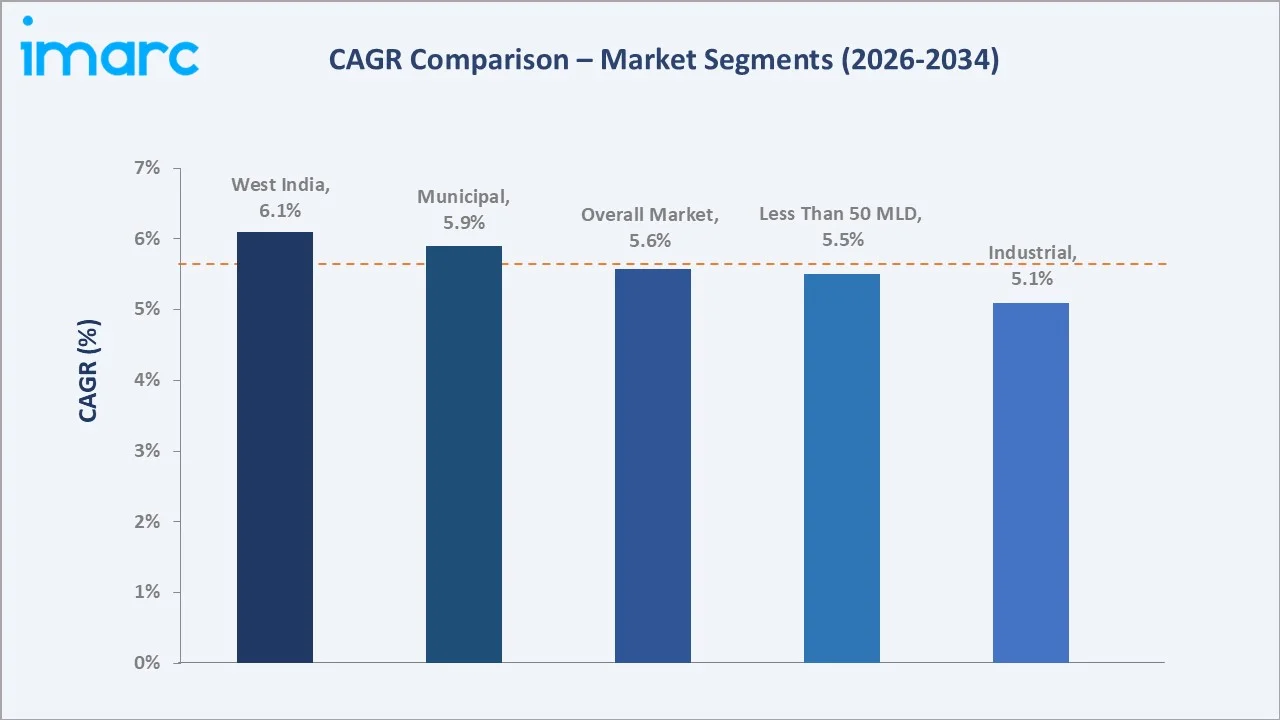
Municipal wastewater treatment investment under AMRUT 2.0 and Smart Cities Mission is growing at ~6.0% CAGR, while industrial wastewater treatment grows at ~5.1% CAGR driven by zero liquid discharge (ZLD) mandates and stricter CPCB effluent norms.
Executive Summary
The India wastewater treatment plants market, which increased from USD 4.60 Billion in 2025 to an estimated USD 4.92 Billion in 2026, representing a critical intersection of environmental compliance, urban infrastructure, and industrial sustainability. The market encompasses plant design, construction, equipment supply, process technology, and operations & maintenance services.
Municipal plants at 58.5% dominate through government-mandated sewage treatment infrastructure investment. Less Than 50 MLD category at 34.7% leads plant capacity mix through the dominance of smaller urban local body treatment schemes. West India commands 34.5% through strong industrial clustering and progressive state-level wastewater regulations.
Key Market Insights
|
Insight |
Data |
|
Dominant Type |
Municipal – 58.5% share (2025) |
|
Dominant Plant Category |
Less Than 50 MLD – 34.7% market share (2025) |
|
Leading Region |
West India – 34.5% market share |
|
Market Opportunity |
Smart plant digitization; ZLD compliance; industrial water recycling; rural sanitation infrastructure; PPP-model treatment plants |
Key Analytical Observations Supporting the Above Data:
- Municipal at 58.5%: Municipal wastewater treatment plants dominate due to large-scale government investment through AMRUT 2.0, National Mission for Clean Ganga, and Smart Cities Mission. These programs mandate STP construction across urban agglomerations, creating sustained procurement volumes for treatment plant contractors and technology providers.
- Less Than 50 MLD at 34.7%: Smaller capacity plants lead because the bulk of India's urban local bodies operate in Tier-2 and Tier-3 cities requiring compact, cost-effective treatment solutions. Government grants and state agency funding favor smaller decentralized treatment schemes aligned to local population density.
- West India at 34.5%: West India leads through Maharashtra's strong municipal wastewater investment and Gujarat's industrial ZLD compliance drive. Both states have aggressive environmental enforcement and dedicated state-level water treatment programs that generate consistent plant procurement demand.
India Wastewater Treatment Plants Market Overview
The India wastewater treatment plants market encompasses the design, construction, commissioning, and operation of all treatment infrastructure handling sewage, industrial effluent, and mixed wastewater. Market scope includes biological, chemical, and physical treatment systems for both municipal and industrial applications.
Macroeconomic factors include India's rapidly growing urban population, increasing industrial production, and tightening environmental compliance requirements. Government schemes, rising awareness of water scarcity, and growing demand for treated water reuse in agriculture and industry are accelerating adoption of advanced wastewater treatment technologies.
Market Dynamics
To evaluate market opportunities, Request Sample
Market Drivers
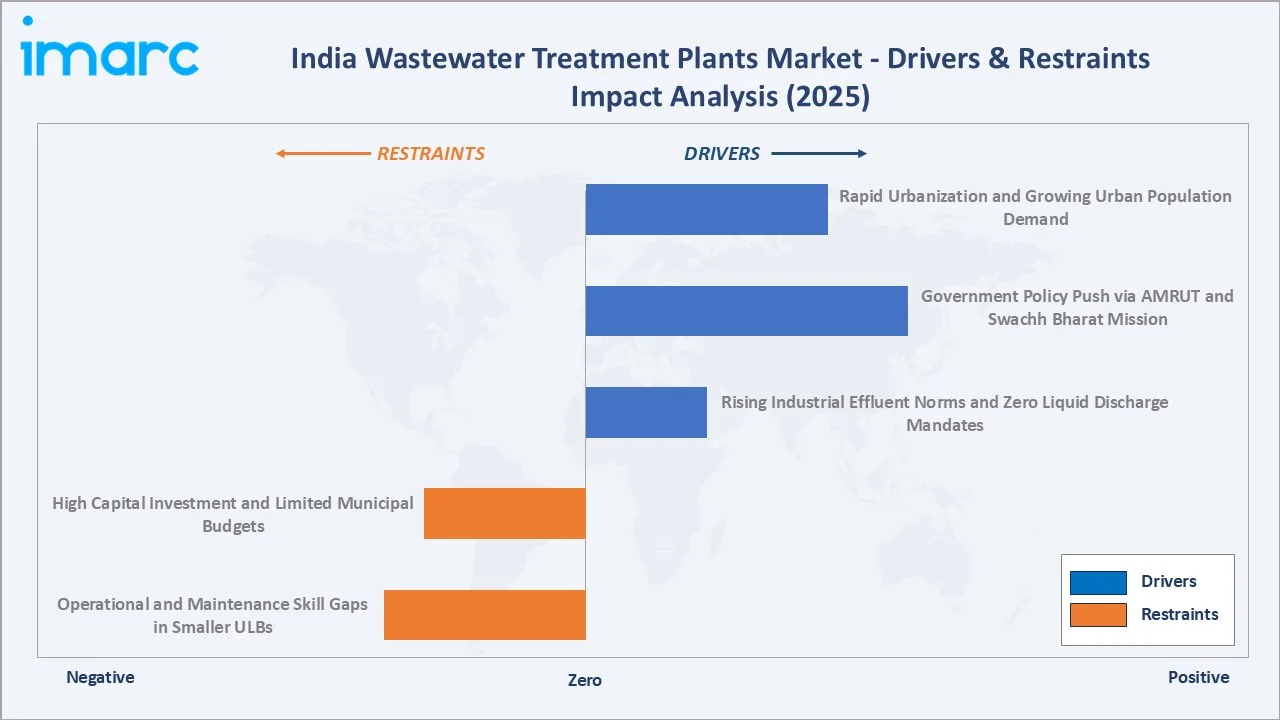
- Rapid Urbanization and Growing Urban Population Demand: India's urban population is expanding rapidly, increasing the volume of domestic wastewater generated in cities and towns. Urban local bodies face mounting pressure to comply with regulatory discharge norms and provide adequate sanitation infrastructure. Government programs including AMRUT 2.0 are channeling large capital outlays into sewage treatment plant construction, generating consistent market demand for treatment plant contractors and technology providers.
- Government Policy Push via AMRUT and Swachh Bharat Mission: Centrally sponsored schemes are directly funding wastewater treatment infrastructure across Indian cities. AMRUT 2.0 has specifically mandated 100% sewage collection and treatment in all statutory towns, creating a large pipeline of STP tenders. Smart Cities Mission also allocates significant resources to integrated wastewater management, expanding the addressable market substantially beyond conventional municipal procurement.
- Rising Industrial Effluent Norms and Zero Liquid Discharge Mandates: Regulatory authorities including CPCB and state pollution control boards are enforcing stricter discharge standards and mandating ZLD compliance in water-intensive industries such as textiles, pharmaceuticals, and food processing. In April 2025, the National Green Tribunal reinforced ZLD norms for textile clusters in Tamil Nadu and Gujarat, directly driving investment in advanced industrial effluent treatment systems. These mandates create recurring plant upgrade and new installation demand across industrial sectors.
- Increasing Water Scarcity and Wastewater Reuse Opportunities: Growing water stress in major industrial and urban regions is incentivizing wastewater recycling and reuse as a viable supplementary water source. Industries are investing in tertiary treatment systems to produce reclaimed water for cooling, process, and irrigation use. This circular water economy approach is creating demand for advanced treatment technologies beyond basic compliance-driven installations.
Market Restraints
- High Capital Investment and Limited Municipal Budgets: Wastewater treatment plant construction requires significant upfront capital for civil works, electromechanical equipment, and process systems. Smaller urban local bodies face budget constraints and limited access to long-term financing, slowing STP project execution in Tier-3 cities and rural areas. High O&M costs further strain municipal finances post-commissioning.
- Operational and Maintenance Skill Gaps in Smaller ULBs: Many urban local bodies lack technically qualified staff to efficiently operate and maintain treatment plants after commissioning. Poor O&M practices lead to suboptimal plant performance, equipment failures, and non-compliance with discharge standards. This creates a cycle of underperformance that discourages further investment and erodes confidence in wastewater treatment project outcomes.
- Land Acquisition Challenges in Dense Urban Areas: Securing adequate land parcels for treatment plant construction within or near densely populated urban areas is a significant constraint. High land costs, competing land uses, and protracted acquisition processes delay project timelines. These challenges particularly affect large-capacity plant development in metropolitan regions where wastewater generation is highest.
Market Opportunities
- Smart Plant Digitization and IoT-Based Monitoring: Integration of IoT sensors, SCADA systems, and AI-based monitoring platforms is creating opportunities to improve treatment efficiency and reduce O&M costs. Smart wastewater management solutions that provide real-time process data and predictive maintenance alerts are increasingly attractive to large municipal and industrial plant operators seeking to optimize performance.
- PPP Model Wastewater Treatment Plant Development: Build-Operate-Own-Transfer and Design-Build-Finance-Operate models are creating new market entry pathways for private operators in municipal wastewater treatment. State governments are increasingly using PPP frameworks to attract private capital and operational expertise, expanding the market beyond traditional EPC project procurement to include long-term service concessions.
Market Challenges
- Fragmented Implementation and Inter-Agency Coordination: Wastewater treatment project implementation spans multiple agencies including urban local bodies, state pollution control boards, water utilities, and national mission directorates. Coordination gaps between these agencies create delays in project approvals, land allocation, and utility connections. This fragmentation extends project timelines and increases costs.
- Technology Selection and Process Optimization Complexity: Selecting the appropriate treatment technology for varying wastewater characteristics across different cities and industries requires specialized expertise. Mismatched technology choices lead to underperformance and cost overruns. The complexity of process optimization in multi-parameter treatment systems presents an ongoing operational challenge for plant managers.
Emerging Market Trends
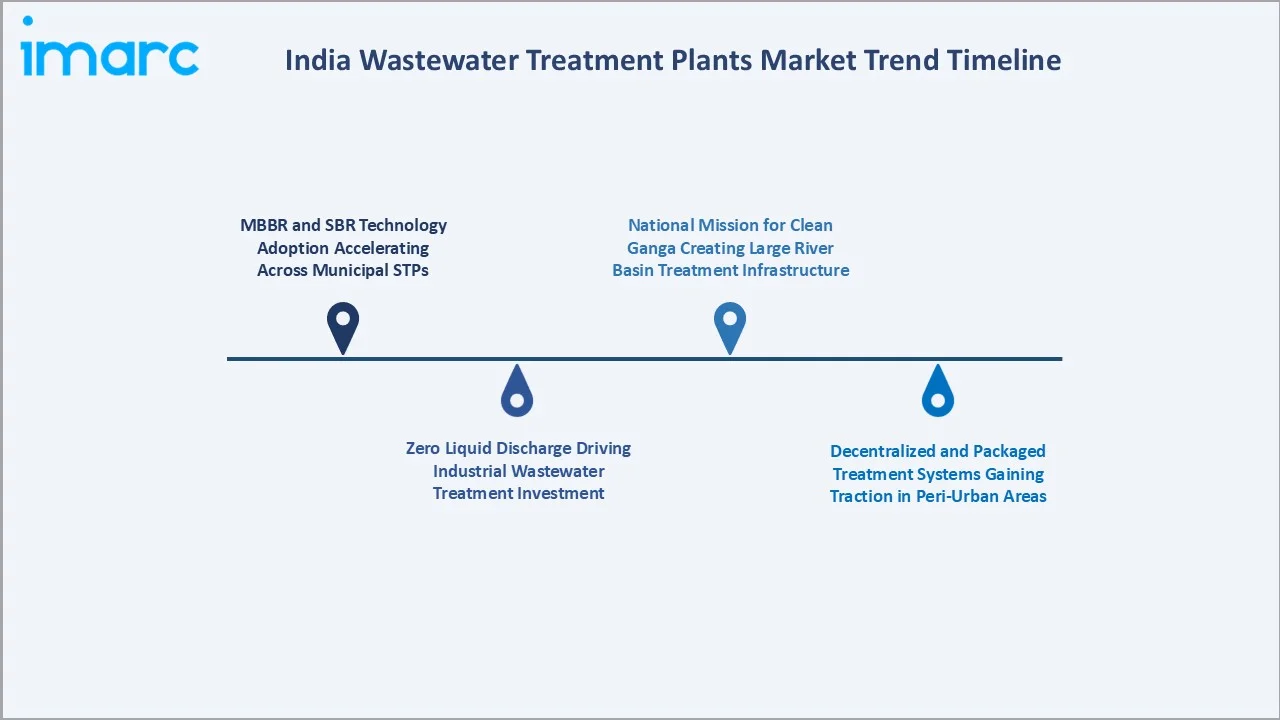
1. MBBR and SBR Technology Adoption Accelerating Across Municipal STPs
Moving Bed Biological Reactor and Sequencing Batch Reactor technologies are gaining widespread adoption in India's municipal wastewater sector. These technologies offer advantages in land efficiency, treatment performance, and operational flexibility compared to conventional activated sludge processes. State pollution control boards in Maharashtra, Gujarat, and Karnataka are increasingly specifying these advanced biological treatment processes in STP tender requirements, accelerating market penetration.
2. Zero Liquid Discharge Driving Industrial Wastewater Treatment Investment
Industrial ZLD mandates are transforming effluent treatment requirements across textile, pharmaceutical, and chemical manufacturing sectors. Companies are investing in multiple-effect evaporators, membrane bioreactors, and reverse osmosis systems to achieve ZLD compliance. This regulatory push is creating a parallel high-value industrial wastewater treatment market with sophisticated technology requirements and higher project values than conventional municipal STPs.
3. National Mission for Clean Ganga Creating Large River Basin Treatment Infrastructure
NMCG's mandate to intercept, divert, and treat all sewage flowing into the Ganga river system is generating significant STP investment across Uttar Pradesh, Bihar, West Bengal, and Uttarakhand. The mission has sanctioned hundreds of STPs at various capacity levels, creating multi-year project pipelines for wastewater treatment contractors. In March 2026, NMCG approved additional STP projects in Varanasi and Patna, extending the program's investment horizon through 2030.
4. Decentralized and Packaged Treatment Systems Gaining Traction in Peri-Urban Areas
Compact, prefabricated, and modular treatment systems are increasingly deployed in peri-urban areas, industrial parks, and new township developments where centralized sewerage networks are absent or inadequate. These decentralized solutions reduce infrastructure costs, accelerate deployment timelines, and enable treated water reuse at source. Growing acceptance by state urban development authorities is expanding the market for packaged treatment systems beyond conventional large-plant procurement.
Industry Value Chain Analysis
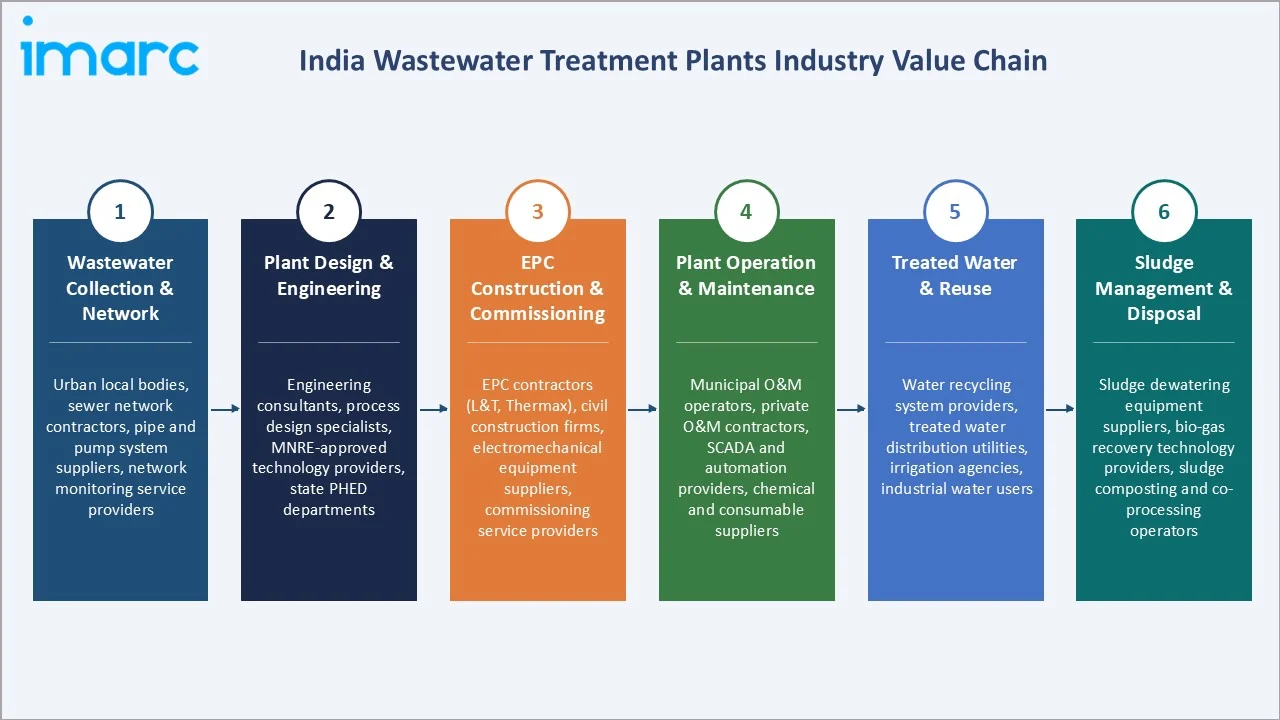
The India wastewater treatment plant value chain integrates wastewater collection and network management, treatment technology supply, EPC construction and commissioning, plant operations and maintenance, treated water distribution and reuse, and sludge management and disposal.
|
Stage |
Key Participants |
|
Wastewater Collection & Network |
Urban local bodies, sewer network contractors, pipe and pump system suppliers, network monitoring service providers |
|
Plant Design & Engineering |
Engineering consultants, process design specialists, MNRE-approved technology providers, state PHED departments |
|
EPC Construction & Commissioning |
EPC contractors (L&T, Thermax), civil construction firms, electromechanical equipment suppliers, commissioning service providers |
|
Plant Operation & Maintenance |
Municipal O&M operators, private O&M contractors, SCADA and automation providers, chemical and consumable suppliers |
|
Treated Water & Reuse |
Water recycling system providers, treated water distribution utilities, irrigation agencies, industrial water users |
|
Sludge Management & Disposal |
Sludge dewatering equipment suppliers, bio-gas recovery technology providers, sludge composting and co-processing operators |
The EPC construction and commissioning stage represents the highest value-add in the treatment plant value chain. Advanced treatment technology integration particularly membrane-based systems, advanced biological processes, and tertiary treatment creates significant differentiation among plant contractors. Post-construction O&M contract award is increasingly bundled with EPC scope to ensure performance accountability.
Technology Landscape in the India Wastewater Treatment Plants Industry
Moving Bed Biological Reactor (MBBR) Technology
MBBR technology provides high-rate biological treatment in compact footprints by using plastic carrier media to support active biofilm growth. It offers advantages over conventional systems in organic load handling, operational stability, and process flexibility. MBBR's ability to treat varying influent quality makes it well-suited for Indian municipal STPs receiving mixed domestic and commercial wastewater. Growing adoption in NMCG-funded projects and AMRUT 2.0 STPs is driving widespread deployment across state capitals and large cities.
Sequencing Batch Reactor (SBR) Technology
SBR technology uses time-controlled treatment cycles within a single reactor vessel to achieve biological nutrient removal. Its flexibility in adjusting treatment parameters and compact design make it popular for medium-sized municipal STPs. State-level urban development authorities in Maharashtra, Rajasthan, and Andhra Pradesh have standardized SBR specifications in their STP tender templates. In January 2026, the Maharashtra Jeevan Pradhikaran issued standardized SBR design guidelines for all new municipal STPs above 10 MLD capacity.
Membrane Bioreactor (MBR) and Advanced Treatment Systems
Membrane bioreactor technology combining biological treatment with ultrafiltration membranes produces high-quality treated water suitable for direct industrial reuse or indirect potable reuse applications. MBR adoption is growing in water-scarce regions and industrial clusters where treated water recycling generates economic value. Advanced treatment systems including reverse osmosis and UV disinfection are increasingly specified as tertiary polishing stages in both municipal and industrial plant configurations.
Market Segmentation Analysis
The report covers the following segments:
|
Segment Category |
Leading Segment |
Market Share |
Year |
|
Type |
Municipal |
58.5% |
2025 |
|
Plant Category |
Less Than 50 MLD |
34.7% |
2025 |
|
Process |
🔒 |
🔒 |
2025 |
|
Operating Mode |
🔒 |
🔒 |
2025 |
|
End User Industry |
🔒 |
🔒 |
2025 |
|
Region |
West India |
34.5% |
2025 |

By Type
Municipal wastewater treatment plants lead at 58.5% (2025) and are growing at ~5.9% CAGR through 2034. The municipal segment encompasses sewage treatment plants serving urban agglomerations, industrial town notified areas, and cantonment boards funded through central and state government infrastructure programs. Municipal segment growth is anchored by large-scale AMRUT 2.0 and NMCG-funded STP procurement pipelines that create multi-year sustained investment demand.
To access detailed market analysis, Request Sample
Industrial wastewater treatment plants at 41.5% are growing at ~5.1% CAGR through 2034, driven by ZLD mandates, voluntary water recycling adoption, and industrial estate common effluent treatment plant expansion. This segment encompasses effluent treatment plants across textiles, pharmaceuticals, chemicals, food processing, and power generation sectors where regulatory compliance timelines create firm investment triggers for treatment plant upgrades and new installations.
By Plant Category
Less Than 50 MLD capacity plants lead at 34.7% (2025) and are growing at ~5.5% CAGR through 2034. This segment encompasses the large number of small and medium-sized STPs serving Tier-2 and Tier-3 cities, industrial areas, and peri-urban zones. Decentralized treatment schemes and packaged treatment plants for smaller municipal areas predominantly fall within this capacity category, supported by government grant funding that makes smaller STP construction financially viable for constrained urban local bodies.
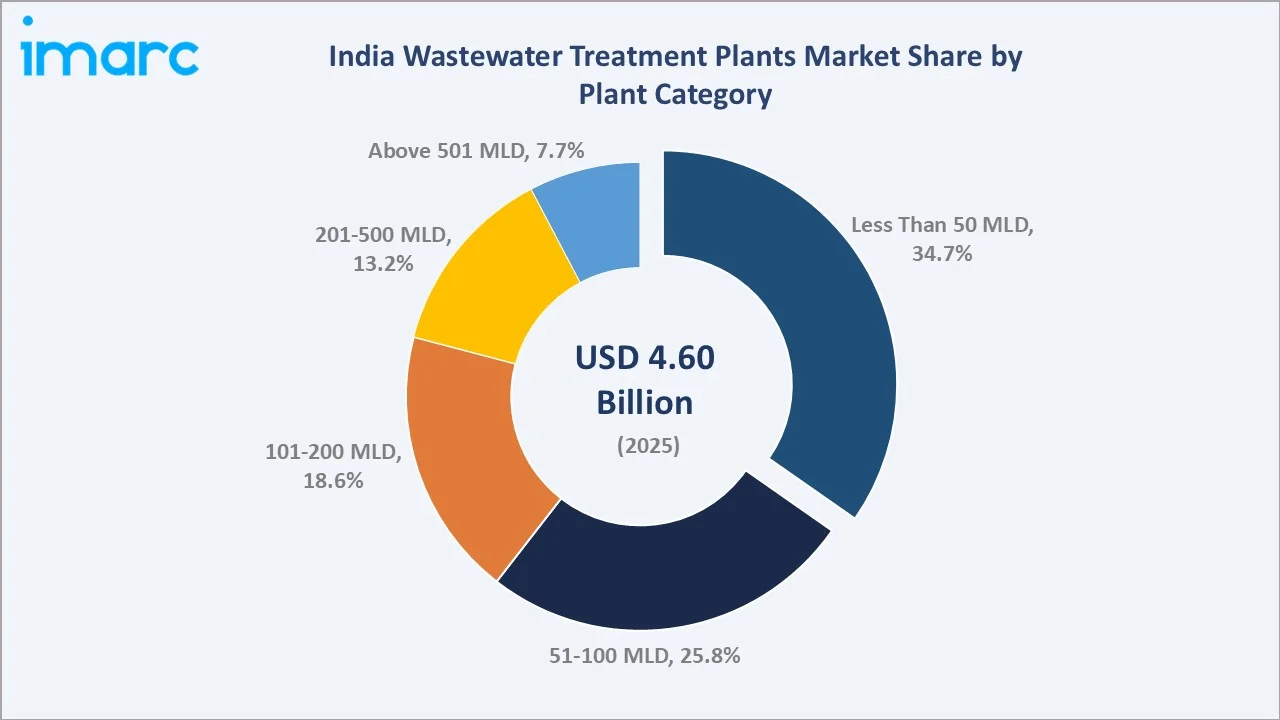
51-100 MLD plants at 25.8% serve medium-sized cities and large industrial clusters, growing at ~5.6% CAGR as state capitals and growing Tier-2 cities require mid-scale centralized treatment. 101-200 MLD plants at 18.6% grow at ~5.8% CAGR through expansion of large city STP programs. 201-500 MLD plants at 13.2% grow at ~5.9% CAGR supported by metro area STP upgrades, while Above 501 MLD plants at 7.7% grow at ~6.2% CAGR driven by mega-city wastewater infrastructure investment in Mumbai, Delhi, and Bengaluru, representing the fastest-growing large-capacity segment.
Regional Market Insights
|
Region |
Share (2025) |
Key India Wastewater Treatment Plants Market Drivers & Characteristics |
|
West India |
34.5% |
Driven by strong industrial ZLD compliance mandates in Gujarat and Maharashtra, large municipal STP investments, and progressive state-level environmental enforcement by GPCB and MPCB. |
|
North India |
28.7% |
Driven by NMCG-funded Ganga river basin STP investments in Uttar Pradesh, Delhi NCR municipal infrastructure expansion, and large agricultural and industrial wastewater treatment requirements. |
|
South India |
23.6% |
Driven by tightening industrial effluent norms in textile and pharmaceutical clusters, Smart Cities Mission STP investments in Bengaluru, Chennai, and Hyderabad, and state water recycling programs. |
|
East India |
13.2% |
Supported by NMCG Phase-2 STP investments in West Bengal and Bihar, Ganga rejuvenation projects, and growing urban infrastructure development in Tier-2 cities across the eastern corridor. |
West India's 34.5% market leadership is anchored by Maharashtra's dual position as both India's largest municipal wastewater treatment investor and the state with the most advanced industrial ZLD enforcement. North India's 28.7% reflects the massive NMCG program investment pipeline across Ganga riverfront cities.
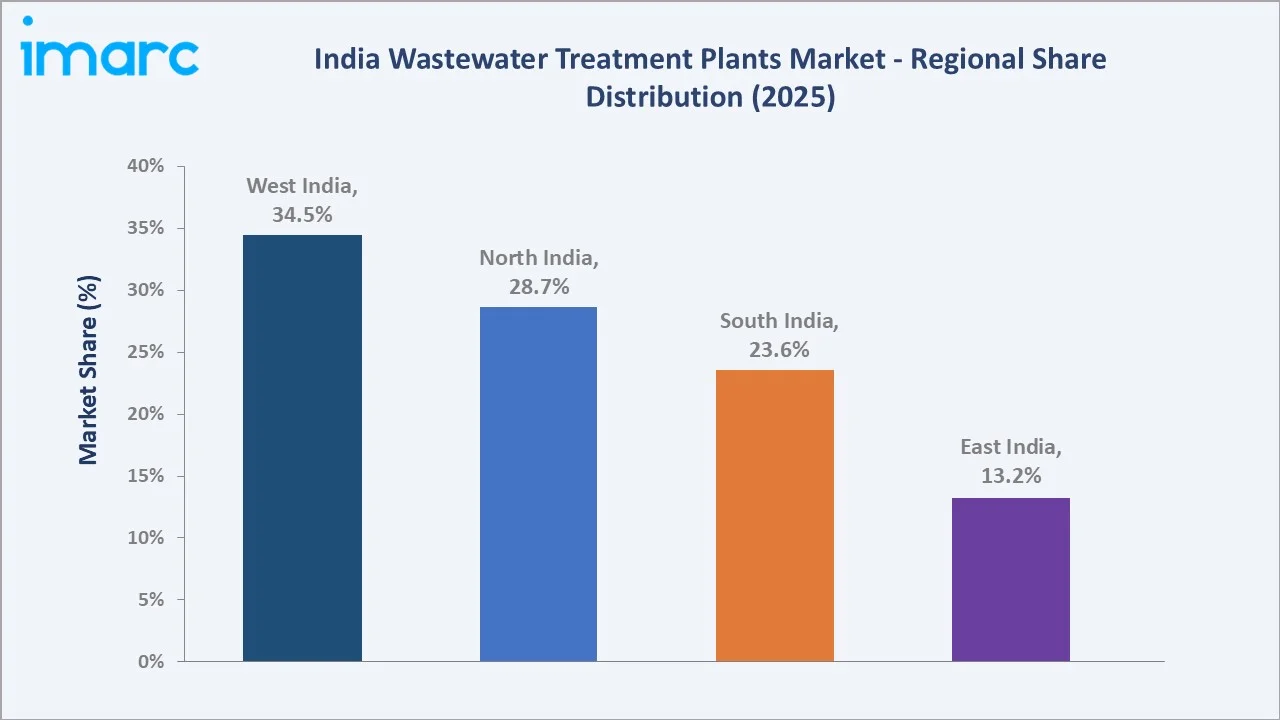
South India's 23.6% encompasses Tamil Nadu's textile industry ZLD compliance drive alongside Karnataka's progressive Smart Cities wastewater infrastructure investment. East India at 13.2% is the region with the most concentrated NMCG project pipeline and is positioned for above-average growth as Ganga clean-up investment accelerates.
Competitive Landscape
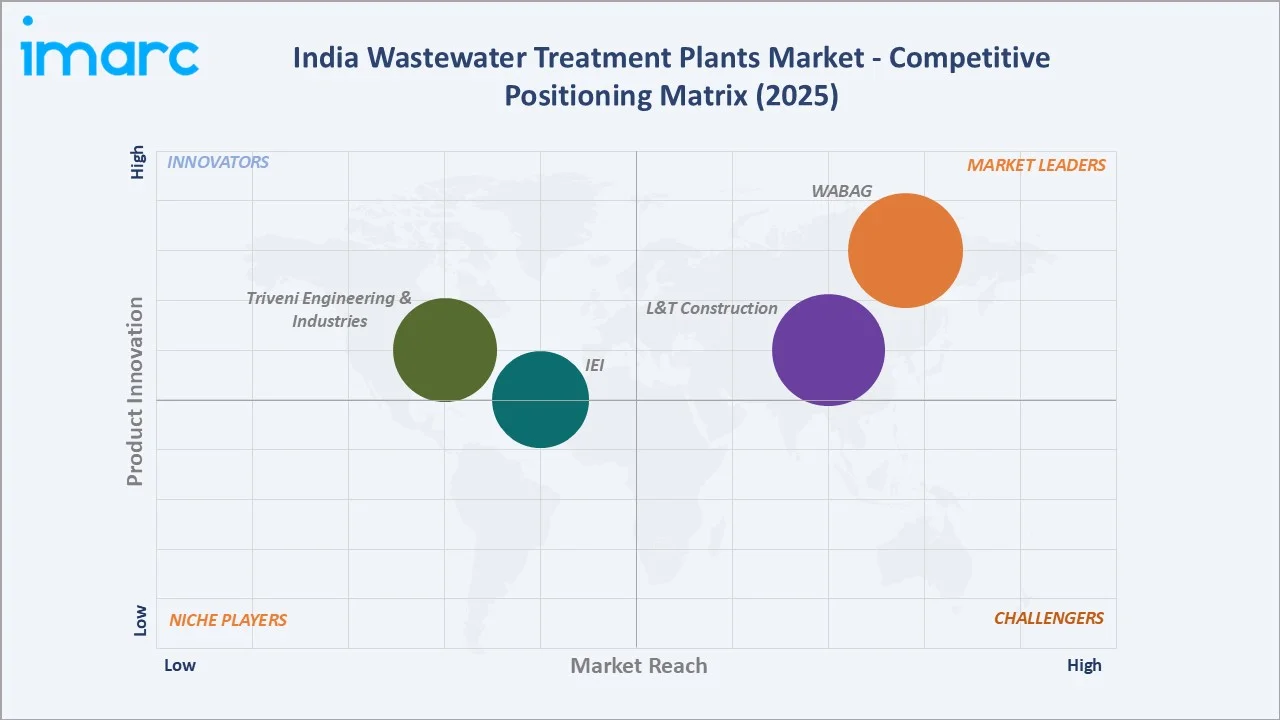
The India wastewater treatment plants competitive landscape encompasses distinct tiers: large EPC contractors, technology-specialized treatment companies, equipment and membrane suppliers, and operations & maintenance service providers.
|
Company Name |
Key Products |
Market Position |
Core Strength |
|
WABAG |
Membrane bioreactors (MBR), SBR Plants, |
Market Leader |
VA Tech WABAG leads India's wastewater treatment sector with comprehensive technology portfolio spanning municipal STPs, industrial ETPs, and advanced water reclamation systems. |
|
L&T Construction |
Water & Effluent Treatment |
Market Leader |
L&T delivers integrated large-capacity STP turnkey projects leveraging its civil, mechanical, and electrical engineering expertise across municipal and industrial segments. |
|
IEI |
ZLD Systems, MBR Plants |
Established Player |
Ion Exchange specializes in industrial wastewater treatment and ZLD solutions, serving pharmaceutical, textile, and chemical industry clients across India. |
|
Triveni Engineering & Industries |
Water treatment, Wastewater and effluent treatment |
Established Player |
Triveni provides wastewater pumping and treatment solutions across municipal and rural sanitation segments with strong distribution network across India. |
Government procurement dominance through AMRUT, NMCG, and Smart Cities creates a bidding-intensive competitive environment where EPC contractor track record, technology tie-ups, and financial strength determine project award success. Consolidation is increasing as larger players acquire technology companies to offer integrated solutions spanning biological treatment, membrane systems, and digital monitoring.
Key Company Profiles
WABAG
WABAG is India's leading wastewater treatment technology company, providing complete engineering, procurement, construction, and operations solutions for municipal and industrial wastewater treatment across India and international markets.
- Key Products: MBBR wastewater treatment systems, SBR plants, membrane bioreactors, tertiary treatment and water reclamation systems.
- Recent Developments: In July 2026, VA Tech WABAG secured a major STP project order from Bengaluru Water Supply and Sewerage Board for a 150 MLD advanced MBBR-based treatment plant, including a 10-year O&M contract and treated water recycling for industrial reuse.
- Strategic Focus: Focused on integrated project delivery from design through operations, technology-led differentiation in advanced biological and membrane treatment, and international market expansion in MENA and Southeast Asia.
L&T Construction
L&T Construction is India's leading infrastructure EPC contractor with a dominant position in large-scale municipal wastewater treatment plant construction, including NMCG Ganga rejuvenation STPs, AMRUT-funded urban STPs, and BOOT model wastewater projects.
- Key Products: Large capacity municipal STP EPC, BOOT and hybrid annuity wastewater projects, smart water infrastructure systems.
- Strategic Focus: Centered on large-ticket government EPC and PPP wastewater projects, smart water network integration, and sludge management and resource recovery system deployment.
IEI
Ion Exchange is a specialized water and wastewater treatment technology company providing integrated ZLD solutions, membrane-based treatment systems, and industrial effluent treatment plants across pharmaceutical, chemical, textile, and food processing industries.
- Key Products: Zero liquid discharge plants, membrane bioreactor systems, reverse osmosis and evaporation-based ZLD, industrial common effluent treatment plants.
- Strategic Focus: Focused on industrial ZLD compliance solutions, water recycling and resource recovery from wastewater, and technology innovation in membrane and evaporation-based treatment systems.
Market Concentration Analysis
The India wastewater treatment plants market is moderately concentrated at the large EPC contractor tier, with 4-5 major companies collectively handling approximately 55-65% of large municipal STP project awards by value. Technology and equipment supply is fragmented across numerous domestic and multinational suppliers. Small-capacity package treatment plants are served by a highly fragmented supplier base of over 200 manufacturers.
Investment & Growth Opportunities
Highest Growth Segments
Industrial ZLD treatment systems (~7.5% CAGR), advanced biological treatment in Above 501 MLD plants (~7.2% CAGR), MBR-based tertiary treatment (~8.5% CAGR from smaller base), IoT-based plant monitoring software (~20% CAGR from early stage), BOOT model municipal STPs (~9% CAGR), and rural faecal sludge treatment plants (~15% CAGR from low base) represent the highest-growth wastewater treatment investment vectors through 2034.
Emerging Investment Opportunities
The NMCG Phase-2 Ganga rejuvenation STP pipeline represents the largest near-term wastewater treatment investment opportunity in India. EPC contractors and technology providers who establish preferred supplier relationships with state-level NMCG implementing agencies across Uttar Pradesh, Bihar, and West Bengal are positioned for sustained above-market revenue growth through 2030.
Investment Themes
- Industrial ZLD compliance plant development for water-stressed cluster regions: India's water-scarce industrial clusters in Gujarat, Rajasthan, and Tamil Nadu face intensifying regulatory pressure for ZLD compliance. Companies investing in ETP project development capability, technology partnership with global ZLD system providers, and O&M service establishment by 2026-2028 are positioned to capture the industrial ZLD compliance investment wave as CPCB enforcement intensifies.
- Smart wastewater platform development for real-time municipal STP performance management: Municipal STPs in India average 40-50% capacity utilization due to operational inefficiencies, equipment failures, and poor process control. An IoT-and-AI-integrated smart wastewater management platform delivering real-time process monitoring, remote operation, and predictive maintenance as a subscription-model service creates a recurring revenue business model with high scalability across India's growing STP fleet.
Future Market Outlook (2026-2034)
The India wastewater treatment plants market is projected to grow from USD 4.60 Billion in 2025 to USD 4.92 Billion in 2026 and is forecast to reach USD 7.59 Billion by 2034, delivering a 5.57% CAGR over the forecast period. The market's anchor value of USD 6.03 Billion in 2030 represents India's wastewater infrastructure sector at a critical expansion juncture, with AMRUT 2.0 targets approaching completion, industrial ZLD enforcement reaching full implementation, and smart plant management technologies achieving mainstream adoption.
Three structural forces define wastewater treatment market growth through 2034. Urban infrastructure investment as a government policy priority across central and state programs creates government-backed STP procurement demand that is policy-mandated, multi-decade, and budget-committed independent of private market cycles. Environmental compliance pressure from tightening discharge norms creates mandatory industrial treatment investment that is regulatory-driven, non-discretionary, and growing in scope. Water scarcity increasingly makes treated wastewater a strategic water resource, driving tertiary treatment and reuse investment as a commercial necessity.
Research Methodology
Primary Research
Primary research comprised structured interviews with 50+ industry stakeholders (2025) including EPC project directors, technology licensing managers, state utility procurement officers, and industrial ETP procurement managers across pharmaceutical, textile, and chemical sectors.
Secondary Research
Secondary research encompassed CPCB annual reports; MoEFCC wastewater regulations; AMRUT and NMCG project data; state pollution control board enforcement notices; company annual reports; wastewater technology association publications; and international water industry data. Over 60 secondary sources reviewed.
Forecasting Models
Market revenue forecasts developed using a segment bottom-up model: (i) municipal STP construction and O&M component; (ii) industrial ETP construction and technology component; (iii) equipment and chemical supply component.
India Wastewater Treatment Plants Market Report Coverage
| Report Features | Details |
|---|---|
| Base Year of the Analysis | 2025 |
| Historical Period | 2020-2025 |
| Forecast Period | 2026-2034 |
| Units | Billion USD |
| Scope of the Report |
Exploration of Historical Trends and Market Outlook, Industry Catalysts and Challenges, Segment-Wise Historical and Future Market Assessment:
|
| Types Covered | Municipal, Industrial |
| Plant Categories Covered | Less Than 50 MLD, 51-100 ML, 101-200 MLD, 201-500 MLD, Above 501 |
| Processes Covered | Moving Bed Biological Reactor (MBBR), Sequencing Batch Reactor (SBR) |
| Operating Modes Covered | EPC, BOO, BOOT |
| End User Industries Covered | Refineries, Pharmaceuticals, Power, Steel, Chemicals, Paper and Pulp, Sugar, Textile, Others |
| Regions Covered | North India, South India, East India, West India |
| Companies Covered | WABAG, L&T Construction, IEI, Triveni Engineering & Industries, etc. |
| Customization Scope | 10% Free Customization |
| Post-Sale Analyst Support | 10-12 Weeks |
| Delivery Format | PDF and Excel through Email (We can also provide the editable version of the report in PPT/Word format on special request) |
Key Benefits for Stakeholders:
- IMARC’s industry report offers a comprehensive quantitative analysis of various market segments, historical and current market trends, market forecasts, and dynamics of the India wastewater treatment plants market from 2020-2034.
- The research report provides the latest information on the market drivers, challenges, and opportunities in the India wastewater treatment plants market.
- Porter's five forces analysis assist stakeholders in assessing the impact of new entrants, competitive rivalry, supplier power, buyer power, and the threat of substitution. It helps stakeholders to analyze the level of competition within the India wastewater treatment plants industry and its attractiveness.
- Competitive landscape allows stakeholders to understand their competitive environment and provides an insight into the current positions of key players in the market.
Frequently Asked Questions About the India Wastewater Treatment Plants Market Report
The India wastewater treatment plants market size is estimated at USD 4.92 Billion in 2026. The market is driven by rapid urbanization, government infrastructure programs including AMRUT 2.0 and NMCG, and industrial ZLD compliance mandates. Rising water scarcity, growing environmental enforcement, and demand for treated water reuse are further supporting market growth.
The market grows at 5.57% CAGR during 2026-2034, reaching USD 6.03 Billion by 2030 and USD 7.59 Billion by 2034. Industrial ZLD treatment systems and MBR-based advanced treatment grow at above-average rates driven by regulatory compliance requirements.
Municipal wastewater treatment plants lead at 58.5% through centrally-funded STP procurement under AMRUT 2.0, NMCG, and Smart Cities Mission. The municipal segment benefits from large government capital outlays, mandatory urban sanitation infrastructure requirements, and systematic state-level STP tendering programs.
Less Than 50 MLD capacity plants lead at 34.7% through the dominance of smaller urban local body STPs serving Tier-2 and Tier-3 cities. The large number of smaller cities and towns requiring decentralized treatment solutions drives volume-based dominance of the sub-50 MLD capacity category across the market.
West India leads at 34.5% through Maharashtra's large municipal STP investment program and Gujarat's industrial ZLD compliance enforcement. Both states have strong state-level environmental infrastructure budgets, active pollution control enforcement, and large industrial wastewater generation from manufacturing clusters.
Leading companies WABAG, L&T Construction, IEI, and Triveni Engineering & Industries, among others.
The market is projected to reach approximately USD 6.03 Billion by 2030, with AMRUT 2.0 targets approaching completion, industrial ZLD enforcement at full implementation scale, smart wastewater management platforms achieving commercial adoption, and NMCG Phase-2 investments driving substantial Ganga river basin STP capacity additions.
Key opportunities include industrial ZLD compliance plant development in water-stressed clusters, BOOT model municipal STP development in growing cities, smart wastewater platform deployment across government STP fleets, tertiary treatment and water reclamation systems for industrial reuse applications, and rural faecal sludge treatment plant development under the Swachh Bharat Mission Phase-2 program.
Need more help?
- Speak to our experienced analysts for insights on the current market scenarios.
- Include additional segments and countries to customize the report as per your requirement.
- Gain an unparalleled competitive advantage in your domain by understanding how to utilize the report and positively impacting your operations and revenue.
- For further assistance, please connect with our analysts.
 Request Customization
 Speak to an Analyst
 Request Brochure
 Inquire Before Buying
Benefits of Customization
- Personalize this research
- Triangulate with your data
- Get data as per your format and definition
- Gain a deeper dive into a specific application, geography, customer, or competitor
- Any level of personalization
Get in Touch With Us
UNITED STATES
Phone: +1-201-971-6302
INDIA
Phone: +91-120-433-0800
UNITED KINGDOM
Phone: +44-753-714-6104
Email: [email protected]
Client Testimonials


.webp)


.webp)





Related Reports
Choose your plan
*Please note that the prices mentioned below are starting prices for each bundle type. Kindly contact our team for further details.*
Single User License
- 1 User License, Access on 2 Devices
- PDF Report + Excel Dataset (Password Protected)
- Lifetime Access
- No Printing Rights
- 10% Free Report Customization
- 10–12 Weeks of Analyst Support
Five User License
- Access for 5 Users, 2 Devices per User
- PDF Report + Excel Dataset (Password Protected)
- Lifetime Access
- Dedicated Account Manager
- 12–14 Weeks of Analyst Support
- No Printing Rights
- 15% Free Report Customization
- 25% Discount on Your Next Purchase
Corporate User License
- Unlimited User Access (Within Your Organization)
- PDF Report + Excel Dataset
- Lifetime Access
- Dedicated Account Manager
- 14–20 Weeks of Analyst Support
- No Printing Rights
- 20% Free Report Customization
- 30% Discount on Your Next Purchase
Essential Insights
What's included:
3 reports
- Lifetime Access
- PDF Reports
- Excel Datasets
- 2 Weeks of Free Analyst Support
- 2 User Licenses
- Access on 2 Devices
- Printing Rights
- Complimentary PowerPoint (PPT) Version
- Complimentary License Upgrade
Professional Access
What's included:
5 reports
- Lifetime Access
- PDF Reports
- Excel Datasets
- 8 Weeks of Free Analyst Support
- 2 User Licenses
- Access on 2 Devices
- Printing Rights
- Complimentary PowerPoint (PPT) Version
- Complimentary License Upgrade
Business Advantage
What's included:
8 reports
- Lifetime Access
- PDF Reports
- Excel Datasets
- 14 Weeks of Free Analyst Support
- 2 User Licenses
- Access on 2 Devices
- Printing Rights
- Complimentary PowerPoint (PPT) Version
- Complimentary License Upgrade
Enterprise Intelligence
What's included:
10 reports
- Lifetime Access
- PDF Reports
- Excel Datasets
- 20 Weeks of Free Analyst Support
- 2 User Licenses
- Access on 2 Devices
- Printing Rights
- Complimentary PowerPoint (PPT) Version
- Complimentary License Upgrade