
Indonesia Facility Management Market Size, Share, Trends and Forecast by Facility Management Type, Offering Type, End User, and Region, 2026-2034
Indonesia Facility Management Market Size, Share, Trends & Forecast (2026-2034)
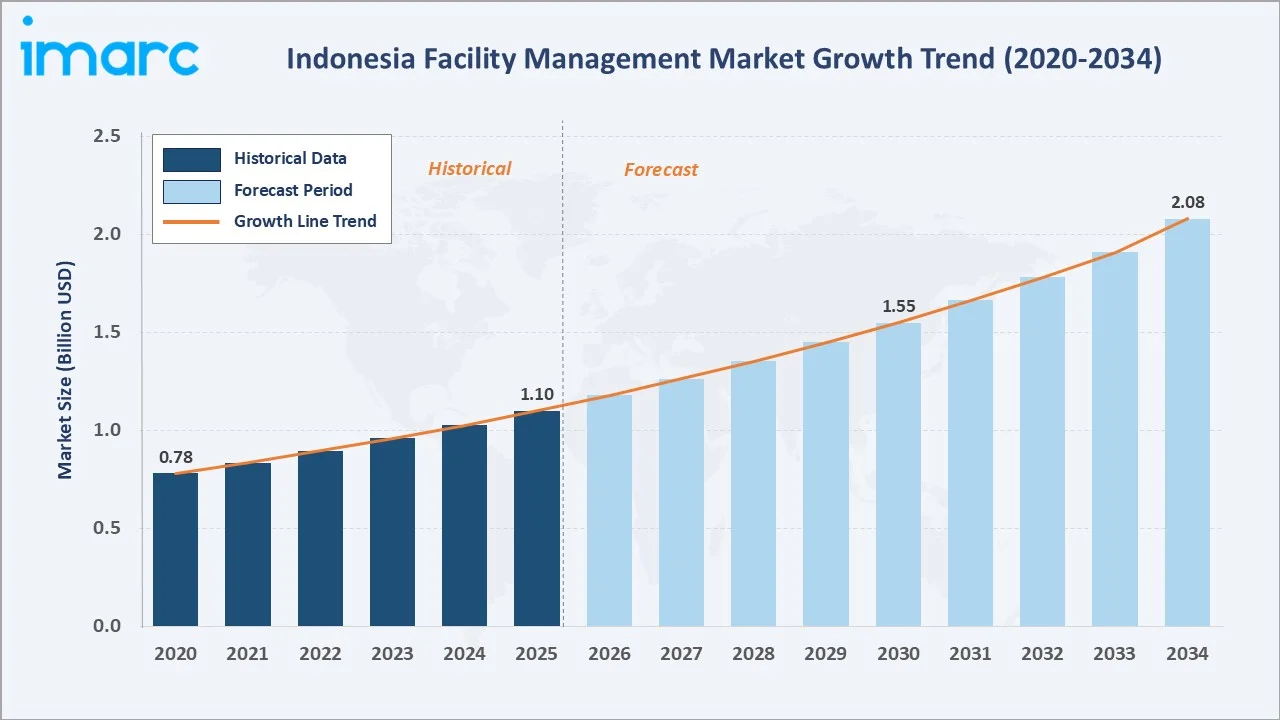
The Indonesia facility management market size increased from USD 1.10 Billion in 2025 to USD 1.20 Billion in 2026 and is projected to reach USD 2.08 Billion by 2034, growing at a CAGR of 7.14% during 2026-2034. The market is driven by rapid urbanization, growing demand for outsourced facility services, and rising adoption of smart building technologies. Soft FM leads at 54.7%. Commercial end users dominate at 34.8%. Java commands 57.6% of the regional market share.
Market Snapshot
|
Metric |
Value |
|
Base Year Market Size (2025) |
USD 1.10 Billion |
| Market Size (2026) | USD 1.20 Billion |
|
Forecast Market Size (2034) |
USD 2.08 Billion |
|
CAGR (2026-2034) |
7.14% |
|
Base Year |
2025 |
|
Historical Period |
2020-2025 |
|
Forecast Period |
2026-2034 |
|
Dominant Offering Type |
Soft FM (54.7%, 2025) |
|
Dominant End User |
Commercial (34.8%, 2025) |
|
Leading Region |
Java (57.6%, 2025) |
The Indonesia facility management market expanded from USD 0.78 Billion in 2020 to USD 1.10 Billion in 2025 and an estimated USD 1.20 Billion in 2026, anchored at USD 1.55 Billion in 2030, and forecast to reach USD 2.08 Billion by 2034. The COVID-19 pandemic highlighted the critical importance of facility hygiene and safety protocols, accelerating demand for professional FM services. The post-pandemic recovery supported sustained growth through enhanced outsourcing adoption across key industries.
To get more information on this market, Request Sample
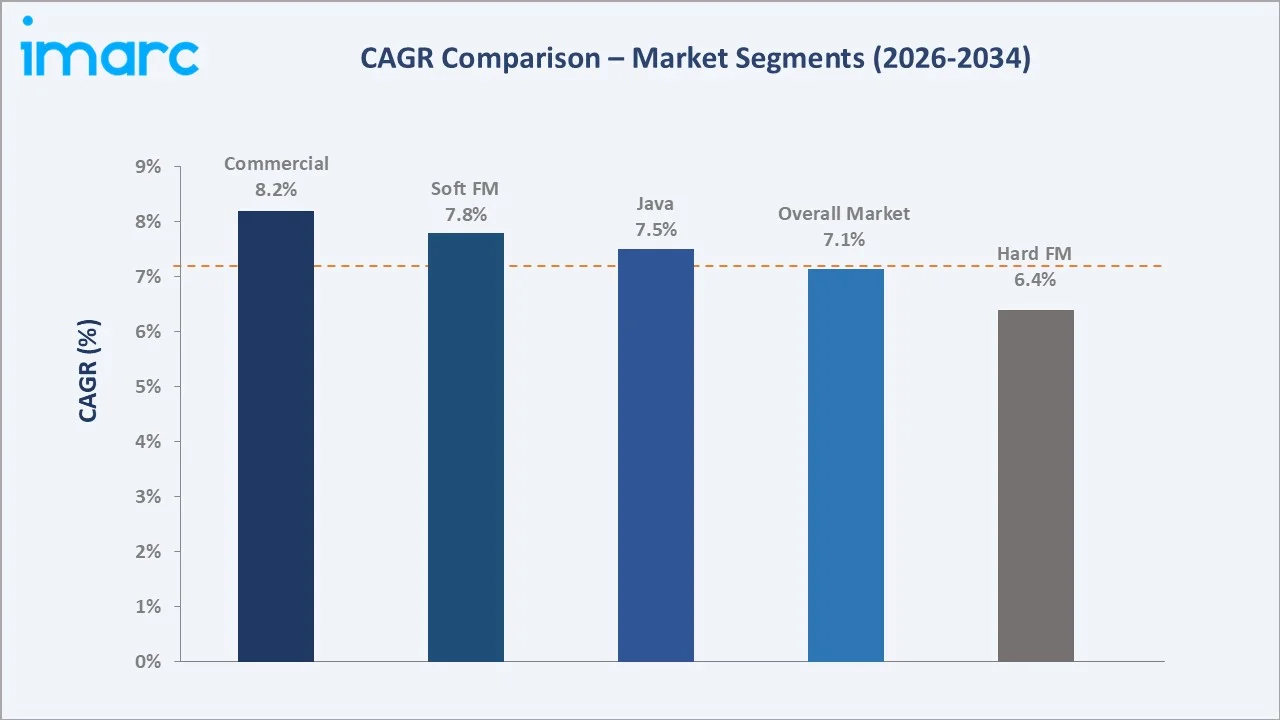
Soft FM services grow fastest at ~7.8% CAGR as demand for cleaning, security, and workplace support services expands alongside commercial real estate development. Commercial end users drive the highest segment growth through office and retail FM outsourcing.
Executive Summary
The Indonesia facility management market, which increased from USD 1.10 Billion in 2025 to an estimated USD 1.20 Billion in 2026, representing one of Southeast Asia's most dynamic service sectors. The market encompasses cleaning and hygiene services, security management, HVAC and MEP maintenance, space planning, energy management, and integrated workplace management systems that transform buildings into productive and safe environments.
Soft FM at 54.7% dominates through essential daily operational services including cleaning, security, landscaping, and catering. Commercial end users at 34.8% lead through office, retail, and mixed-use building demand for professional FM outsourcing. Java at 57.6% commands market leadership through Jakarta's commercial hub status and Surabaya's industrial concentration.
Key Market Insights
|
Insight |
Data |
|
Dominant Offering Type |
Soft FM - 54.7% share (2025) |
|
Dominant End User |
Commercial - 34.8% market share (2025) |
|
Leading Region |
Java - 57.6% market share |
|
Market Opportunity |
Smart FM technology; ESG-driven outsourcing; integrated facility platforms; industrial zone expansion; public infrastructure FM |
Key Analytical Observations Supporting the Above Data:
- Soft FM at 54.7%: Soft FM services dominate due to high recurring demand for cleaning, security, pest control, and catering services across commercial buildings. These services are essential for daily operations and increasingly outsourced by organizations seeking cost efficiency and professional service quality.
- Commercial End Users at 34.8%: Commercial facilities drive market demand through office complexes, retail centers, and hospitality properties requiring comprehensive FM outsourcing. Growing corporate real estate investment and rising workplace standards are supporting sustained commercial FM adoption.
- Java at 57.6%: Java dominates due to its concentration of commercial infrastructure, industrial zones, and institutional facilities. Jakarta's status as the economic capital and Surabaya's industrial base create the highest FM service demand in Indonesia.
Indonesia Facility Management Market Overview
The Indonesia facility management market encompasses the delivery, management, and optimization of all support services required to maintain the functionality, safety, and efficiency of physical facilities across commercial, industrial, institutional, and public sectors.
Macroeconomic factors include rapid urbanization, population growth, expanding middle class, and increasing foreign direct investment in real estate and industrial infrastructure. Government infrastructure initiatives, rising awareness of workplace safety standards, and the trend toward outsourcing non-core services are accelerating professional FM adoption nationwide.
Market Dynamics
To evaluate market opportunities, Request Sample
Market Drivers
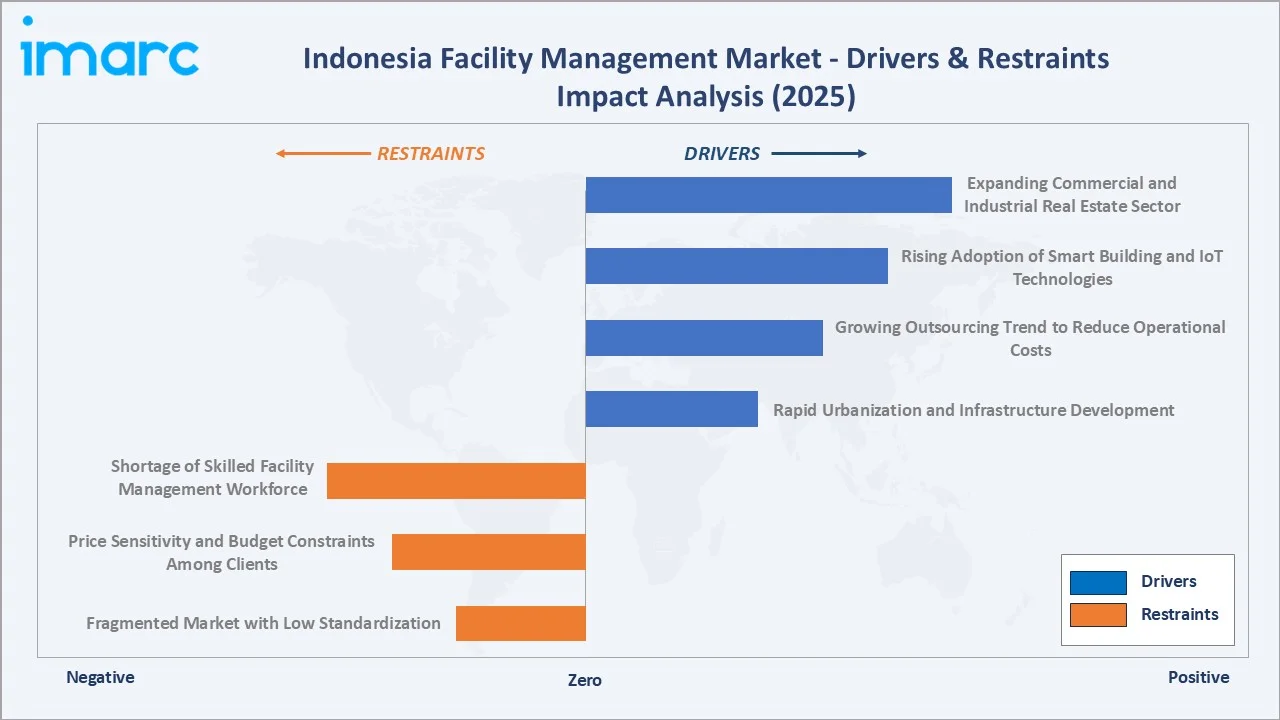
- Rapid Urbanization and Infrastructure Development: Indonesia's accelerating urbanization is creating substantial demand for professional FM services across commercial and residential complexes. Government infrastructure programs, including new office districts, industrial parks, and institutional buildings, generate significant FM service requirements. New capital city Nusantara development initiatives are further expanding the addressable market for integrated FM providers.
- Growing Outsourcing Trend to Reduce Operational Costs: Businesses across Indonesia are increasingly outsourcing FM functions to specialized providers to reduce overhead costs and focus on core operations. Cost efficiency benefits, access to specialized expertise, and scalable service models are driving adoption among mid-to-large enterprises. This trend is reinforced by growing awareness of total cost of ownership optimization through professional FM partnerships.
- Rising Adoption of Smart Building and IoT Technologies: Integration of IoT sensors, building management systems, and data analytics is enhancing FM operational efficiency and service quality. Smart FM platforms enable predictive maintenance, real-time energy monitoring, and automated facility operations that reduce costs and improve asset longevity. Growing technology adoption across commercial real estate is creating demand for FM providers offering digital-enabled service solutions.
- Expanding Commercial and Industrial Real Estate Sector: Indonesia's growing commercial real estate market, driven by retail expansion, office development, and industrial zone construction, is creating sustained demand for comprehensive FM services. The development of logistics and e-commerce warehousing facilities adds a high-growth segment requiring specialized maintenance and security services. Foreign investment in manufacturing facilities is further expanding the FM market across Java and Kalimantan.
Market Restraints
- Shortage of Skilled Facility Management Workforce: Indonesia faces a significant shortage of trained FM professionals including HVAC technicians, building engineers, and certified FM managers. The skills gap limits service quality delivery and constrains the expansion capacity of FM providers. Attracting and retaining qualified technical staff remains a critical operational challenge, particularly for specialized hard FM services requiring advanced technical expertise.
- Price Sensitivity and Budget Constraints Among Clients: Many Indonesian businesses, particularly SMEs, prioritize cost minimization over service quality, creating downward pricing pressure on FM contracts. Budget constraints limit the adoption of technology-enabled FM solutions and restrict service scope. This price sensitivity slows the transition from basic outsourced services to integrated facility management models.
- Fragmented Market with Low Standardization: The Indonesian FM market is characterized by numerous small local providers operating without standardized service frameworks or quality certifications. This fragmentation creates inconsistent service quality, complicates vendor selection, and reduces barriers to entry that suppress market pricing discipline. Lack of industry-wide standards hinders professional market development.
Market Opportunities
- ESG-Driven Facility Management Adoption: Growing corporate sustainability commitments are creating demand for FM services supporting environmental, social, and governance objectives. Energy-efficient building operations, green cleaning practices, and carbon footprint reduction represent significant growth opportunities. International corporations establishing Indonesian operations increasingly require FM partners with ESG capabilities aligned to global standards.
- Integrated Facility Management Platform Expansion: The shift from bundled to integrated FM services creates opportunities for providers offering comprehensive single-source solutions. Integrated FM contracts combining hard and soft services with technology management deliver superior value through streamlined vendor management and data-driven optimization. This transition is advancing fastest in Jakarta's premium commercial office market.
Market Challenges
- Technology Integration and Digital Transformation Barriers: Many Indonesian FM providers lack the digital infrastructure and technical expertise required to implement advanced building management systems and IoT-enabled service platforms. The investment required for technology adoption creates financial strain for smaller operators, limiting their competitiveness against internationally-backed providers.
- Regulatory Compliance and Licensing Complexity: Navigating Indonesia's regulatory framework for FM service delivery, including labor regulations, safety compliance, and local licensing requirements, creates operational complexity for FM providers. Compliance costs and administrative burden are particularly challenging for providers seeking to expand across multiple regions with varying local requirements.
Emerging Market Trends
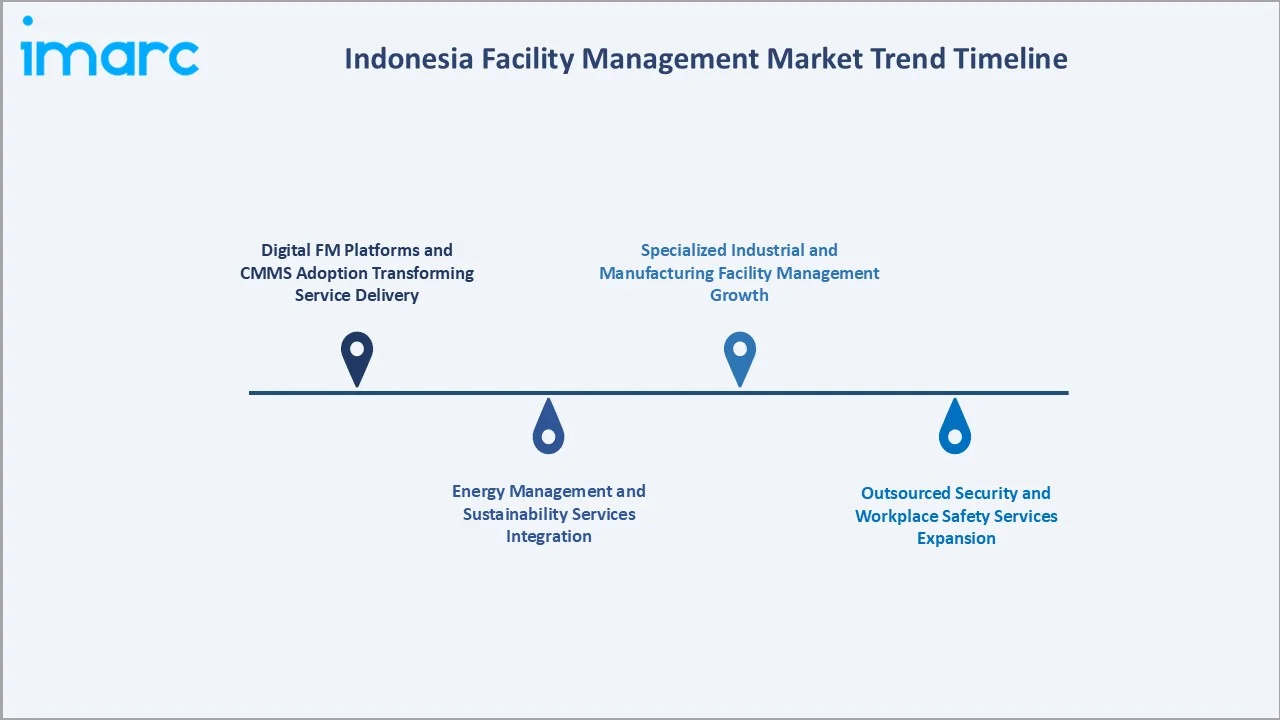
1. Digital FM Platforms and CMMS Adoption Transforming Service Delivery
Indonesian FM providers are increasingly adopting computerized maintenance management systems (CMMS) and integrated workplace management systems (IWMS) to enhance service delivery efficiency. These platforms enable work order management, asset tracking, preventive maintenance scheduling, and real-time reporting. The digitalization of FM operations is improving service transparency, reducing response times, and enabling data-driven contract performance management across commercial facilities.
2. Energy Management and Sustainability Services Integration
Energy management is emerging as a core FM service offering as Indonesian businesses face rising electricity costs and growing sustainability pressures. FM providers are integrating energy auditing, LED retrofitting, HVAC optimization, and energy monitoring into comprehensive contract frameworks. Corporate sustainability reporting requirements are accelerating demand for FM partners capable of reducing building-level energy consumption and carbon emissions.
3. Outsourced Security and Workplace Safety Services Expansion
Growing awareness of workplace security risks and regulatory safety requirements is driving demand for professional security management and safety compliance services. FM providers are expanding security portfolios to include CCTV monitoring, access control management, emergency response planning, and fire safety compliance. Post-pandemic workplace safety standards have elevated the importance of professional hygiene management within FM contracts.
4. Specialized Industrial and Manufacturing Facility Management Growth
The expansion of manufacturing, logistics, and data center facilities in Indonesia is creating demand for specialized industrial FM services. Complex technical environments requiring precision maintenance, cleanroom management, and critical infrastructure support represent high-value FM opportunities. Industrial FM contracts typically command premium pricing and longer contract durations, supporting sustainable revenue growth for providers with specialized technical capabilities.
Industry Value Chain Analysis
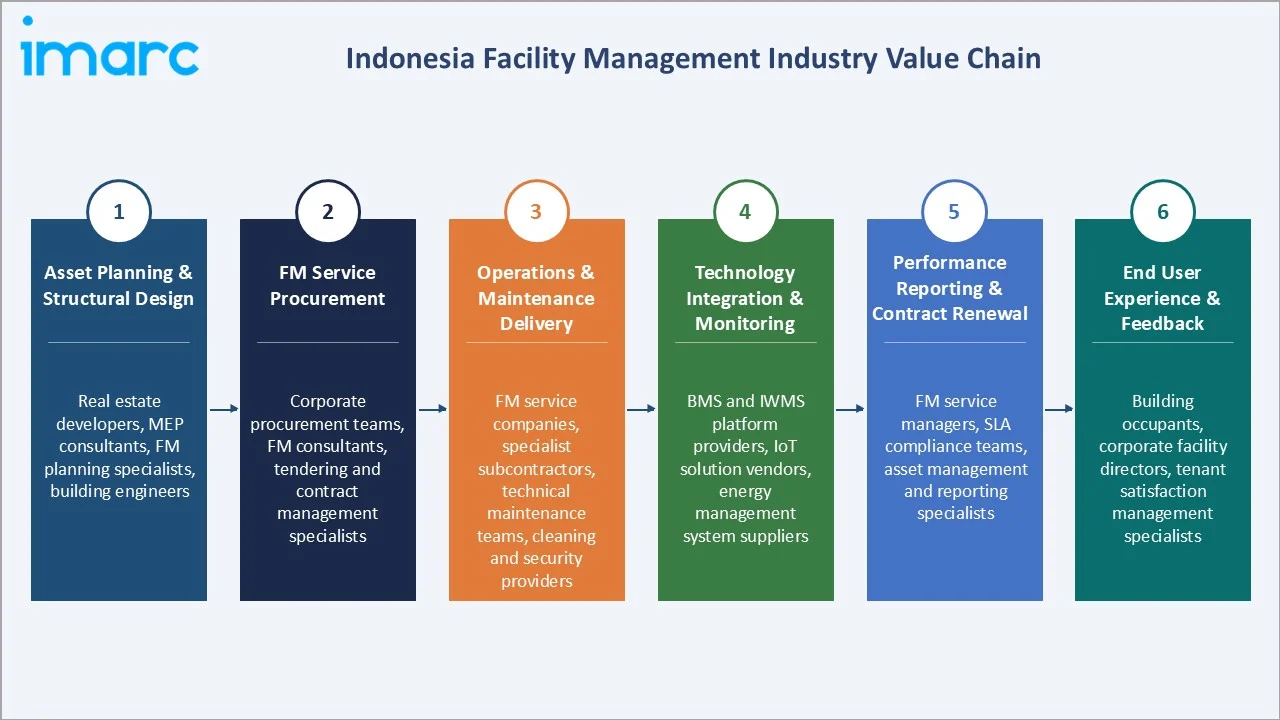
The Indonesia facility management value chain integrates asset planning and design, FM service procurement, operations and maintenance delivery, technology integration and monitoring, performance reporting, and end-user satisfaction management into a comprehensive service delivery ecosystem.
|
Stage |
Key Participants |
|
Asset Planning & Structural Design |
Real estate developers, MEP consultants, FM planning specialists, building engineers |
|
FM Service Procurement |
Corporate procurement teams, FM consultants, tendering and contract management specialists |
|
Operations & Maintenance Delivery |
FM service companies, specialist subcontractors, technical maintenance teams, cleaning and security providers |
|
Technology Integration & Monitoring |
BMS and IWMS platform providers, IoT solution vendors, energy management system suppliers |
|
Performance Reporting & Contract Renewal |
FM service managers, SLA compliance teams, asset management and reporting specialists |
|
End User Experience & Feedback |
Building occupants, corporate facility directors, tenant satisfaction management specialists |
The operations and maintenance delivery stage represents the FM value chain's highest revenue concentration and greatest service complexity. Technology integration is becoming the primary competitive differentiator as FM providers deploy digital platforms to enhance operational visibility and service responsiveness.
Technology Landscape in the Indonesia Facility Management Industry
Integrated Workplace Management Systems
Integrated workplace management systems provide centralized platforms for managing all FM service activities including space management, maintenance scheduling, vendor coordination, and compliance tracking. These systems enable real-time operational visibility and data-driven decision making across complex multi-site facility portfolios. As Indonesian enterprises manage growing property portfolios, IWMS adoption is accelerating to replace fragmented manual management approaches.
Building Automation and Smart Sensor Technology
Building automation systems integrating HVAC control, lighting management, access control, and environmental monitoring are transforming FM service delivery capabilities. Smart sensors enable predictive maintenance by detecting equipment performance anomalies before failures occur, reducing costly emergency repairs. Energy monitoring technology is supporting FM providers in delivering measurable utility cost savings aligned with client sustainability objectives.
Mobile FM Service Management Platforms
Mobile technology platforms are enabling field FM technicians to receive work orders, document service completion, and communicate with clients in real time. Digital service verification through mobile applications improves contract transparency and enables performance-based billing models. Mobile FM platforms are particularly valuable for managing large multi-site service contracts where coordination of dispersed workforce activities is operationally critical.
Market Segmentation Analysis
The report covers the following segments:
|
Segment Category |
Leading Segment |
Market Share |
Year |
|
Facility Management Type |
🔒 |
🔒 |
2025 |
|
Offering Type |
Soft FM |
54.7% |
2025 |
|
End User |
Commercial |
34.8% |
2025 |
|
Region |
Java |
57.6% |
2025 |

By Offering Type
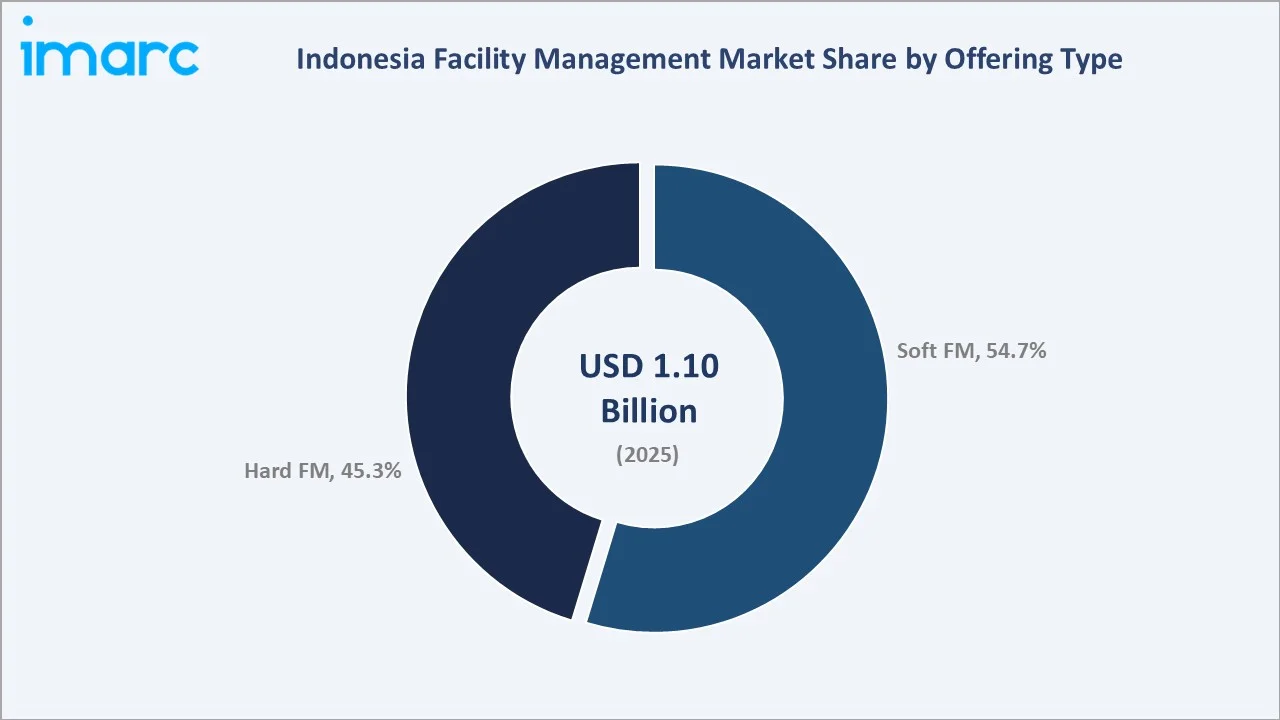
Soft FM leads at 54.7% (2025). The soft FM segment encompasses cleaning and hygiene services, security management, catering and hospitality, landscaping, pest control, and reception and front-of-house management. These services are characterized by high recurring contract value, labor-intensive delivery, and essential operational nature across all facility types.
To access detailed market analysis, Request Sample
Hard FM at 45.3% encompasses mechanical, electrical, plumbing, fire safety, elevator, and structural maintenance services. Hard FM's ~6.4% CAGR reflects growing demand for technically specialized maintenance services driven by increasing building infrastructure complexity and regulatory compliance requirements for safety-critical systems.
By End User
Commercial end users lead at 34.8% (2025). The commercial segment encompasses office buildings, retail centers, hotels, shopping malls, and mixed-use developments requiring comprehensive FM service packages. Commercial facility owners increasingly mandate integrated FM contracts combining hard and soft services under single provider management.
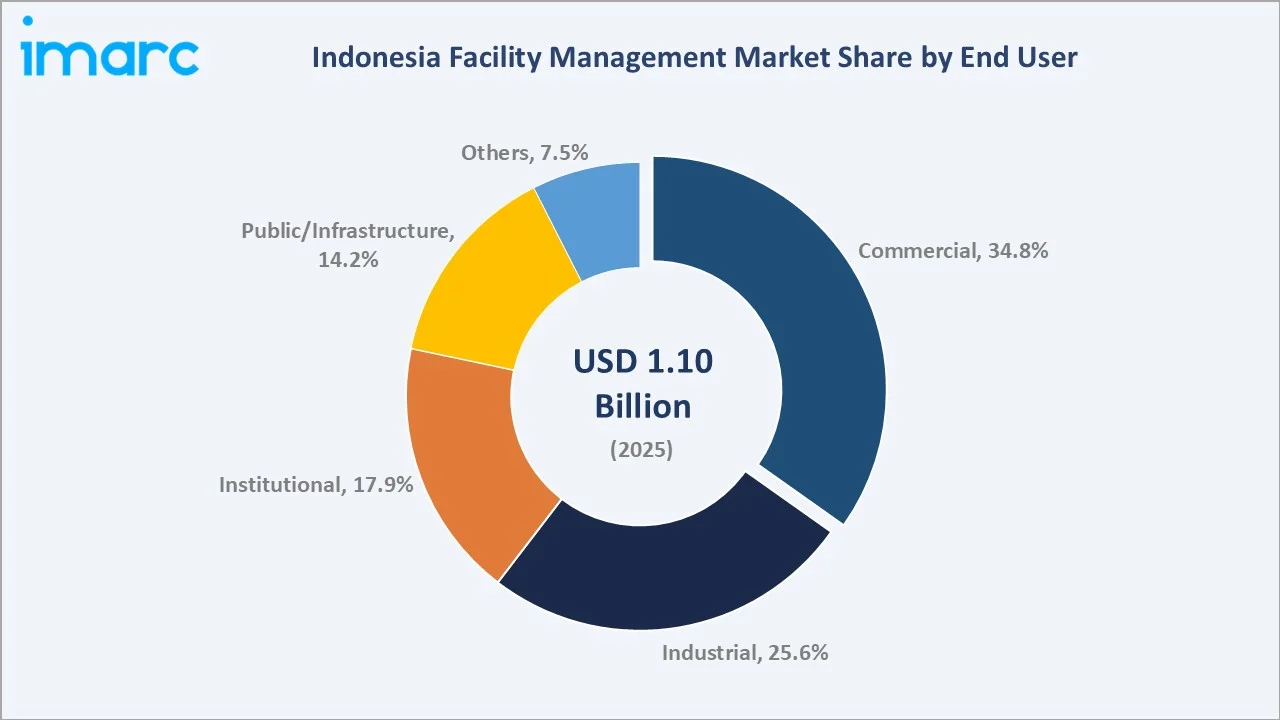
Industrial at 25.6% represents manufacturing, warehousing, and logistics facilities requiring specialized technical maintenance and strict safety compliance FM services. Institutional at 17.9% covers healthcare, educational, and government facilities with stringent hygiene and regulatory standards. Public/Infrastructure at 14.2% encompasses transportation hubs, utilities, and government buildings. Others at 7.5% includes specialized facility types.
Regional Market Insights
|
Region |
Share (2025) |
Key Indonesia Facility Management Market Drivers & Characteristics |
|
Java |
57.6% |
Driven by Jakarta's commercial hub status, high concentration of office, retail, and industrial facilities, and mature FM outsourcing culture among multinational corporations. |
|
Sumatra |
18.4% |
Driven by Medan and Palembang's growing commercial sectors, palm oil and mining industrial facilities, and expanding retail and hospitality property development. |
|
Kalimantan |
10.6% |
Supported by mining, energy, and plantation industrial facilities requiring specialized technical maintenance and the new capital city Nusantara construction driving FM demand. |
|
Sulawesi |
7.8% |
Driven by Makassar's growing commercial and logistics hub development, nickel processing industrial facilities, and expanding public infrastructure FM requirements. |
|
Others |
5.6% |
Comprising Bali's hospitality-driven FM market, Papua's mining sector, and emerging Maluku and Nusa Tenggara infrastructure development. |
Java's 57.6% market leadership is anchored by Jakarta's position as Indonesia's commercial and financial capital, housing the highest concentration of multinational corporations and premium commercial real estate requiring professional FM services. Sumatra's 18.4% reflects Medan's growing commercial sector and extensive industrial facility FM requirements across palm oil and resource extraction industries.
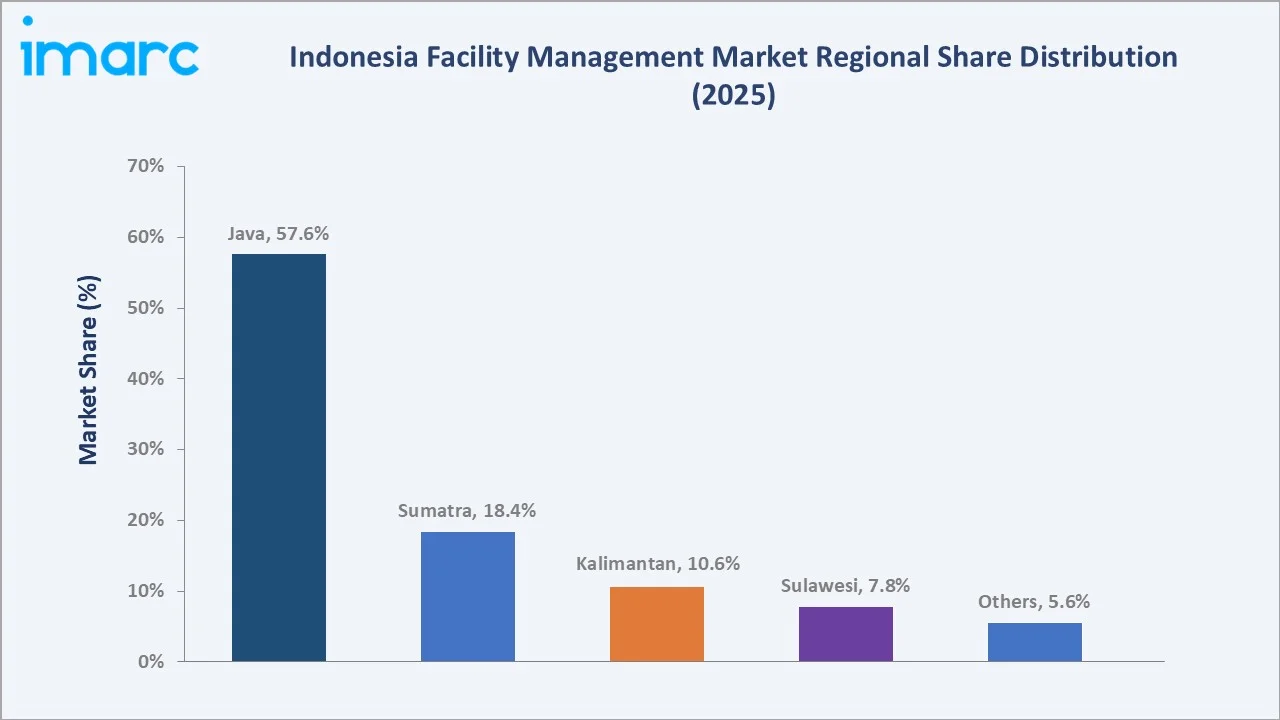
Kalimantan's 10.6% is supported by energy sector industrial facilities and the accelerating new capital city Nusantara development creating substantial new FM infrastructure requirements. Sulawesi's 7.8% encompasses Makassar's expanding logistics and commercial development alongside nickel processing industrial facility management.
Competitive Landscape
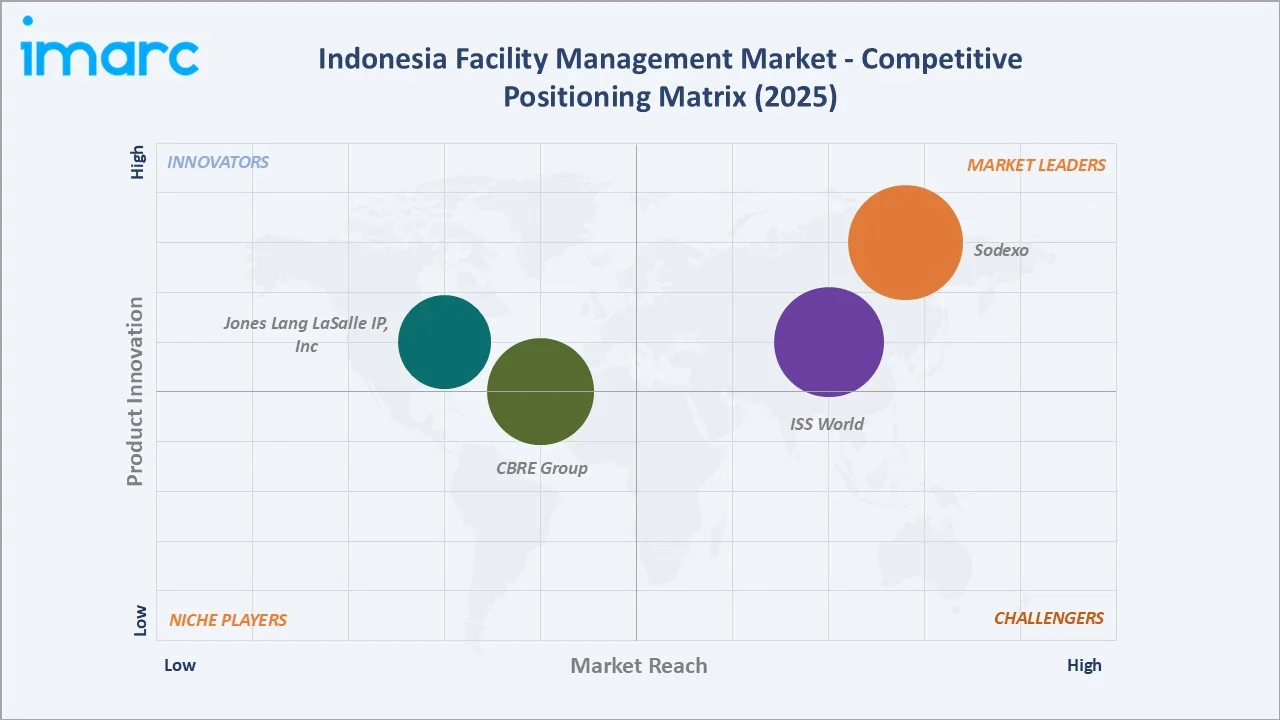
The Indonesia facility management market competitive landscape encompasses distinct tiers: international integrated FM service providers, regional FM specialists, local specialized service contractors, and technology-enabled FM platform companies.
|
Company Name |
Key Services |
Market Position |
Core Strength |
|
Sodexo |
Integrated FM, soft FM, energy management |
Market Leader |
Sodexo plays a central role in Indonesia FM through integrated service platforms combining food, facilities, and workplace experience management for large corporate clients. |
|
ISS World |
Cleaning, security, technical services |
Market Leader |
ISS World delivers comprehensive FM services through specialized cleaning, security, and technical maintenance divisions serving commercial and industrial clients across Indonesia. |
|
CBRE Group |
Property and FM consulting, workplace services |
Market Leader |
CBRE plays a leading role through integrated property management and facility services, leveraging global expertise for premium commercial real estate in Jakarta. |
|
Jones Lang LaSalle IP, Inc. |
Facilities management |
Established Player |
JLL provides comprehensive FM and property management services for Grade A office buildings and commercial complexes, focusing on technology-enabled building operations. |
International FM provider concentration in the premium commercial segment creates competitive differentiation through global best practice deployment, technology investment capacity, and integrated service breadth. Consolidation is occurring as clients prefer fewer, larger FM partners capable of delivering integrated services across extensive property portfolios.
Key Company Profiles
Sodexo
Sodexo is a global leader in integrated facilities management and quality of life services, operating across food services, facilities management, and employee benefits. The company delivers integrated solutions combining catering, cleaning, technical maintenance, and workplace experience services for corporate, industrial, and institutional clients in Indonesia.
- Key Services: Integrated FM, corporate catering, soft FM services, energy management, workplace experience management.
- Recent Developments: In July 2026, Sodexo was selected by Clariant for a new five-year global integrated workplace services partnership covering more than 50 sites across 13 countries. The contract includes both soft and hard facilities management services, including cleaning, building maintenance, grounds maintenance, and technical support across Clariant’s industrial, laboratory, office, and production facilities. Sodexo will also provide centralized governance and data-driven insights to improve service consistency, operational efficiency, and workplace experience. Mobilization is scheduled to begin in October 2026.
- Strategic Focus: Focuses on integrated service delivery, employee experience improvement, and sustainable FM solutions aligned with corporate ESG commitments.
ISS World
ISS World is a global facility services company specializing in integrated services including cleaning, catering, security, workplace support, and technical maintenance. The company operates through specialized service divisions delivering standardized quality service models across commercial, industrial, and public sector facilities in Indonesia.
- Key Services: Commercial cleaning, security management, technical services, workplace management, catering and hospitality support.
- Strategic Focus: Centered on operational excellence, digital service delivery, and scalable FM service models for large corporate clients.
CBRE Group
CBRE Group is the world's largest commercial real estate services and investment firm, providing property management, facility management, and workplace solutions for commercial real estate owners and corporate occupiers. In Indonesia, CBRE combines premium property management with comprehensive FM services for Grade A commercial buildings.
- Key Services: Building management, technical facility services, workplace strategy, property management, real estate consulting.
- Strategic Focus: Focused on premium commercial FM services, smart building technology integration, and data-driven property performance optimization.
Market Concentration Analysis
The Indonesia facility management market is highly fragmented at the operational service delivery tier, with thousands of local cleaning, security, and maintenance contractors serving small to mid-size clients. International integrated FM providers hold dominant positions in the premium commercial segment. Market concentration is increasing as large corporate clients consolidate vendor relationships with integrated FM service providers capable of delivering comprehensive facility solutions.
Investment & Growth Opportunities
Highest Growth Segments
Soft FM services (~7.8% CAGR), commercial segment (~8.2% CAGR), industrial FM in Kalimantan and Sumatra (~9-11% CAGR), integrated FM platform contracts (~12% CAGR from emerging base), energy management services (~15% CAGR from small base), and smart building FM technology solutions (~18% CAGR) represent the highest-growth Indonesia FM investment vectors through 2034.
Emerging Investment Opportunities
New capital city Nusantara development in Kalimantan represents the largest government-backed FM infrastructure opportunity in Indonesia's history. FM providers establishing early relationships with Nusantara development authorities and government tenants are positioned for long-term contract awards as the capital's commercial, institutional, and residential facilities come online through the 2030s.
Investment Themes
- Technology-enabled integrated FM platform investment for corporate real estate portfolio management: Corporations managing large Indonesian facility portfolios are willing to pay premium contract values for FM providers delivering IWMS-integrated service management, real-time performance reporting, and data-driven asset optimization. FM companies investing in proprietary technology platforms by 2026-2027 are positioned to win premium integrated contracts commanding above-market margins.
- Industrial FM specialization for mining, energy, and manufacturing sector expansion: Indonesia's commodity and manufacturing sectors require specialized technical FM expertise including cleanroom management, hazardous material handling, and critical equipment maintenance. FM providers developing industrial specialization capabilities are positioned to capture above-market contract values in Kalimantan's mining sector and Java's expanding manufacturing zones.
Future Market Outlook (2026-2034)
The Indonesia facility management market is projected to grow from USD 1.10 Billion in 2025 to USD 1.20 Billion in 2026, reaching USD 2.08 Billion by 2034, delivering a 7.14% CAGR over the forecast period. The market's anchor value of approximately USD 1.55 Billion in 2030 represents a facility management industry at its most significant modernization inflection, with digital platform adoption reaching mainstream commercial deployment.
Three structural forces define Indonesia facility management market growth through 2034. Economic development and urbanization creating continuous commercial real estate expansion and institutional facility investment across all Indonesian regions. Government infrastructure programs including new capital Nusantara, toll road networks, and public facility development generating sustained FM demand. Technology-driven outsourcing transition as Indonesian corporations recognize integrated FM outsourcing as a strategic operational efficiency tool rather than a discretionary cost item.
Research Methodology
Primary Research
Primary research comprised structured interviews with 45+ industry stakeholders (2025) including Chief Operating Officers; Facility Management Directors; Head of Real Estate; FM technology solution providers; regional FM market specialists; and corporate procurement managers across Jakarta, Surabaya, and Medan.
Secondary Research
Secondary research encompassed Indonesia FM industry publications; Ministry of Public Works data; real estate market statistics; FM industry association reports; company annual reports; Southeast Asia facility services data; commercial real estate surveys. Over 55 secondary sources reviewed.
Forecasting Models
Market revenue forecasts developed using a segment bottom-up model: (i) soft FM service component; (ii) hard FM service component; (iii) integrated FM platform component. Regional adjustments applied based on GDP growth differentials and urbanization rate variations across Java, Sumatra, Kalimantan, and Sulawesi.
Indonesia Facility Management Market Report Coverage:
| Report Features | Details |
|---|---|
| Base Year of the Analysis | 2025 |
| Historical Period | 2020-2025 |
| Forecast Period | 2026-2034 |
| Units | Billion USD |
| Scope of the Report |
Exploration of Historical Trends and Market Outlook, Industry Catalysts and Challenges, Segment-Wise Historical and Future Market Assessment:
|
| Facility Management Types Covered |
|
| Offering Types Covered | Hard FM, Soft FM |
| End Users Covered | Commercial, Institutional, Public/Infrastructure, Industrial, Others |
| Regions Covered | Java, Sumatra, Kalimantan, Sulawesi, Others |
| Companies Covered | Sodexo, ISS World, CBRE Group, Jones Lang LaSalle IP, Inc., etc. |
| Customization Scope | 10% Free Customization |
| Post-Sale Analyst Support | 10-12 Weeks |
| Delivery Format | PDF and Excel through Email (We can also provide the editable version of the report in PPT/Word format on special request) |
Key Benefits for Stakeholders:
- IMARC’s industry report offers a comprehensive quantitative analysis of various market segments, historical and current market trends, market forecasts, and dynamics of the Indonesia facility management market from 2020-2034.
- The research report provides the latest information on the market drivers, challenges, and opportunities in the Indonesia facility management market.
- Porter's five forces analysis assist stakeholders in assessing the impact of new entrants, competitive rivalry, supplier power, buyer power, and the threat of substitution. It helps stakeholders to analyze the level of competition within the Indonesia facility management industry and its attractiveness.
- Competitive landscape allows stakeholders to understand their competitive environment and provides an insight into the current positions of key players in the market.
Frequently Asked Questions About the Indonesia Facility Management Market Report
The Indonesia facility management market size is estimated at USD 1.20 Billion in 2026. The market is driven by rapid urbanization, growing outsourcing adoption, and increasing demand for professional FM services across commercial, industrial, and institutional facilities. Rising awareness of workplace safety and operational efficiency is further supporting market growth.
The market grows at 7.14% CAGR during 2026-2034, reaching USD 2.08 Billion by 2034. Soft FM services grow fastest at ~7.8% CAGR through expanding commercial real estate demand and growing outsourcing adoption across Indonesian enterprises.
Soft FM leads at 54.7% through essential daily operational services including cleaning, security, catering, and landscaping. Soft FM's dominance reflects the recurring service nature and broad applicability across all facility types and industry sectors.
Commercial end users lead at 34.8% through office buildings, retail centers, and hospitality facilities requiring comprehensive FM outsourcing. Growing corporate real estate investment and rising workplace standards are sustaining commercial FM demand.
Java leads at 57.6% through Jakarta's commercial hub concentration and Surabaya's industrial zone FM requirements. Java's mature outsourcing culture and high density of multinational corporate facilities support its dominant market position.
Leading companies include Sodexo, ISS World, CBRE Group, and Jones Lang LaSalle IP, Inc., among others.
The market is projected to reach approximately USD 1.55 Billion by 2030, with integrated FM platform adoption reaching commercial mainstream, new capital Nusantara FM contracts beginning to award, and smart building technology becoming a standard commercial FM service component in Jakarta's Grade A office market.
Outsourcing growth is driven by corporate recognition of cost efficiency benefits, access to specialized FM expertise without internal staffing investment, scalable service models adapting to changing facility requirements, and the ability to focus organizational resources on core business activities rather than facility operations management.
Need more help?
- Speak to our experienced analysts for insights on the current market scenarios.
- Include additional segments and countries to customize the report as per your requirement.
- Gain an unparalleled competitive advantage in your domain by understanding how to utilize the report and positively impacting your operations and revenue.
- For further assistance, please connect with our analysts.
 Request Customization
 Speak to an Analyst
 Request Brochure
 Inquire Before Buying
Benefits of Customization
- Personalize this research
- Triangulate with your data
- Get data as per your format and definition
- Gain a deeper dive into a specific application, geography, customer, or competitor
- Any level of personalization
Get in Touch With Us
UNITED STATES
Phone: +1-201-971-6302
INDIA
Phone: +91-120-433-0800
UNITED KINGDOM
Phone: +44-753-714-6104
Email: [email protected]
Client Testimonials




.webp)




.webp)













Related Reports

Choose your plan
*Please note that the prices mentioned below are starting prices for each bundle type. Kindly contact our team for further details.*
Single User License
- 1 User License, Access on 2 Devices
- PDF Report + Excel Dataset (Password Protected)
- Lifetime Access
- No Printing Rights
- 10% Free Report Customization
- 10–12 Weeks of Analyst Support
Five User License
- Access for 5 Users, 2 Devices per User
- PDF Report + Excel Dataset (Password Protected)
- Lifetime Access
- Dedicated Account Manager
- 12–14 Weeks of Analyst Support
- No Printing Rights
- 15% Free Report Customization
- 25% Discount on Your Next Purchase
Corporate User License
- Unlimited User Access (Within Your Organization)
- PDF Report + Excel Dataset
- Lifetime Access
- Dedicated Account Manager
- 14–20 Weeks of Analyst Support
- No Printing Rights
- 20% Free Report Customization
- 30% Discount on Your Next Purchase
Essential Insights
What's included:
3 reports
- Lifetime Access
- PDF Reports
- Excel Datasets
- 2 Weeks of Free Analyst Support
- 2 User Licenses
- Access on 2 Devices
- Printing Rights
- Complimentary PowerPoint (PPT) Version
- Complimentary License Upgrade
Professional Access
What's included:
5 reports
- Lifetime Access
- PDF Reports
- Excel Datasets
- 8 Weeks of Free Analyst Support
- 2 User Licenses
- Access on 2 Devices
- Printing Rights
- Complimentary PowerPoint (PPT) Version
- Complimentary License Upgrade
Business Advantage
What's included:
8 reports
- Lifetime Access
- PDF Reports
- Excel Datasets
- 14 Weeks of Free Analyst Support
- 2 User Licenses
- Access on 2 Devices
- Printing Rights
- Complimentary PowerPoint (PPT) Version
- Complimentary License Upgrade
Enterprise Intelligence
What's included:
10 reports
- Lifetime Access
- PDF Reports
- Excel Datasets
- 20 Weeks of Free Analyst Support
- 2 User Licenses
- Access on 2 Devices
- Printing Rights
- Complimentary PowerPoint (PPT) Version
- Complimentary License Upgrade