
Indonesia Hospitality Real Estate Market Size, Share, Trends and Forecast by Property Type, and Region, 2026-2034
Indonesia Hospitality Real Estate Market Size, Share, Trends & Forecast (2026-2034)
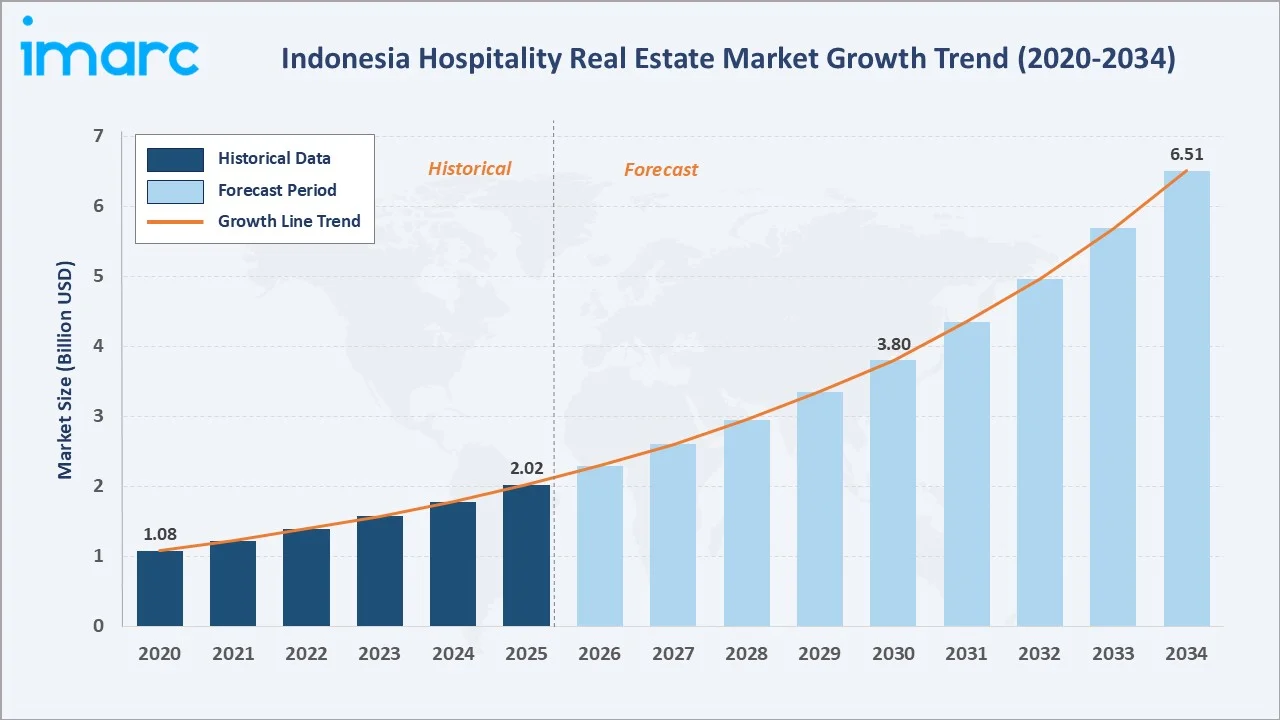
The Indonesia hospitality real estate market was valued at USD 2.02 Billion in 2025 and is projected to reach USD 6.51 Billion by 2034, exhibiting a CAGR of 13.46% during 2026-2034. Indonesia's travel and tourism sector welcomed 17.0 Million international visitors in 2024, reinforcing hospitality real estate as one of the country's most dynamic investment categories. Surging inbound tourism, expanding middle-class domestic travel, and intensifying government investment in tourism infrastructure across the archipelago are the primary drivers shaping the market growth.
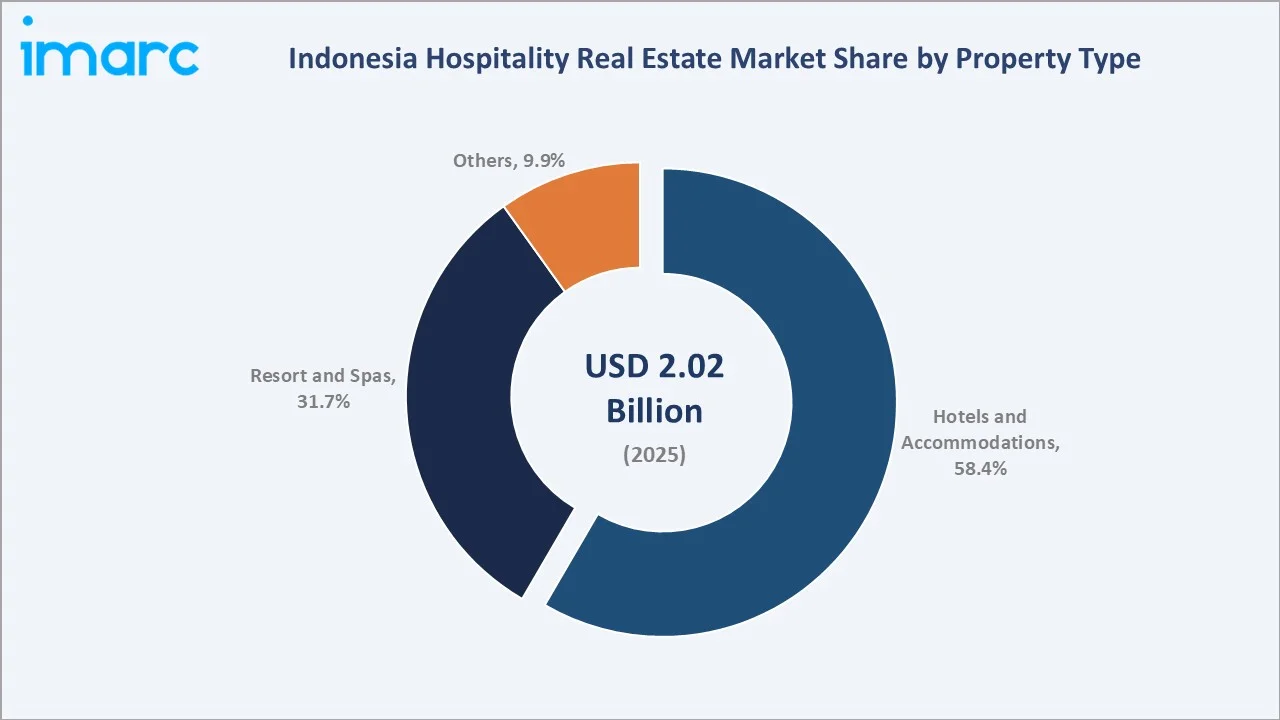
Hotels and accommodations lead the property type segment at 58.4% and Java commands 41.8% regional share.
Market Snapshot
|
Metric |
Value |
|
Market Size (2025) |
USD 2.02 Billion |
|
Forecast Market Size (2034) |
USD 6.51 Billion |
|
CAGR (2026-2034) |
13.46% |
|
Base Year |
2025 |
|
Historical Period |
2020-2025 |
|
Forecast Period |
2026-2034 |
|
Largest Region |
Java (41.8%, 2025) |
|
Second Largest Region |
Sumatra (20.6%, 2025) |
|
Leading Property Type |
Hotels and Accommodations (58.4%, 2025) |
The Indonesia hospitality real estate market expanded from USD 1.08 Billion in 2020 to USD 2.02 Billion in 2025, supported by rising domestic leisure travel and sustained investment in resort and hotel developments across key tourism corridors. Anchored at USD 3.80 Billion in 2030, the forecast to USD 6.51 Billion by 2034 is supported by accelerating resort development in emerging destinations, expanding branded hotel footprints, and increasing foreign direct investment in hospitality-linked real estate.
To get more information on this market, Request Sample
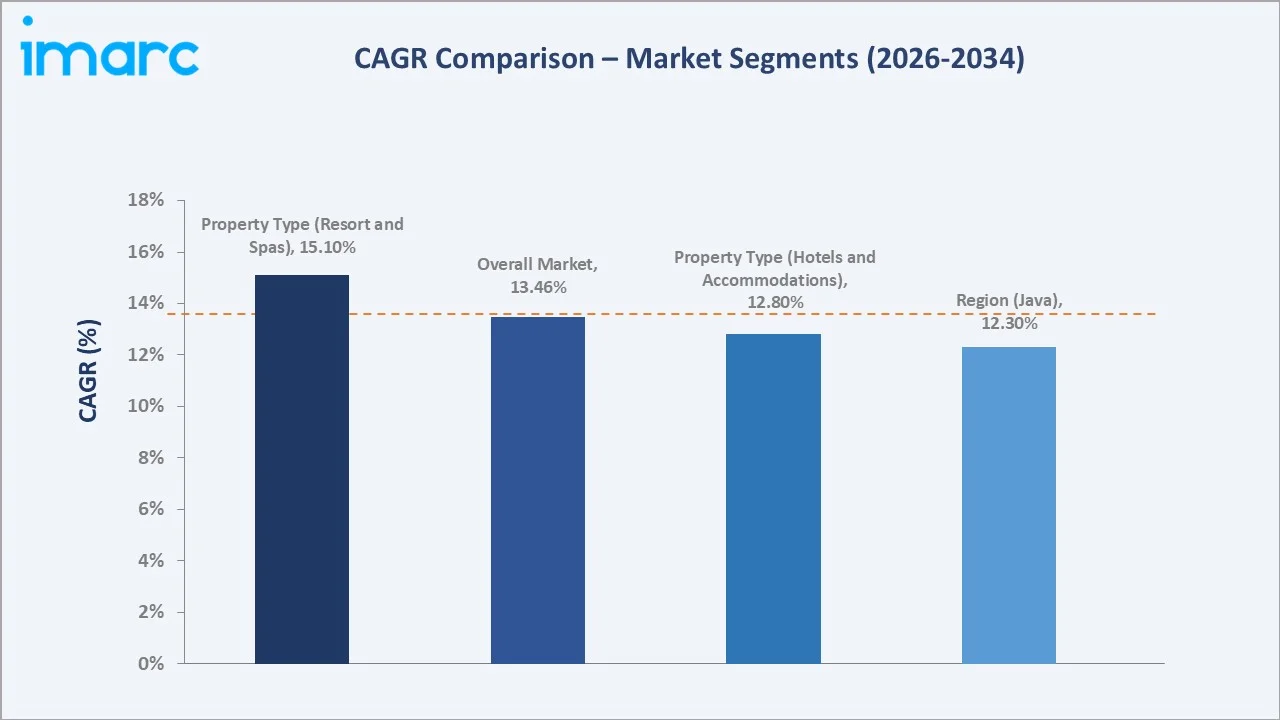
CAGR trajectories across property type and regional sub-segments show resort and spas and Kalimantan expanding faster than the overall 13.46% market CAGR, driven by rising eco-tourism demand, new government-designated tourism special economic zones, and growing investor appetite for alternative hospitality assets.
Executive Summary
The Indonesia hospitality real estate market is on a robust growth trajectory, rising from USD 1.08 Billion in 2020 to USD 6.51 Billion by 2034. The industry has evolved from a Bali-centric resort economy to a diversified archipelago-wide investment landscape spanning branded hotels, boutique resorts, integrated wellness retreats, and lifestyle-oriented hospitality assets. Improving air connectivity, rising disposable incomes, and government-led tourism infrastructure programs are collectively expanding the addressable market across established and emerging destinations.
Hotels and accommodations dominate the property type segment at 58.4% in 2025, supported by strong business travel demand, expanding branded hotel inventory, and growing domestic leisure travel across Java and Bali corridors. Java commands 41.8% of the regional share in 2025, anchored by Jakarta's business hotel demand and Yogyakarta's growing cultural tourism activities.
Key Market Insights
|
Insight |
Data |
|
Leading Property Type |
Hotels and Accommodations - 58.4% share (2025) |
|
Second Largest Property Type |
Resort and Spas - 31.7% share (2025) |
|
Leading Region |
Java - 41.8% share (2025) |
|
Second Largest Region |
Sumatra - 20.6% share (2025) |
|
Top Companies |
Marriott International, Inc., Accor, Archipelago International, PT MNC Tourism Indonesia Tbk, Tauzia Hotel Management |
Key Analytical Observations Expanding On the Data Above:
- Hotels and accommodations dominance at 58.4% is supported by Jakarta's status as a major business travel hub, growing domestic leisure travel across Java, and the continued expansion of international branded hotel chains into second-tier Indonesian cities.
- Resort and spas share at 31.7% reflects sustained demand for premium leisure hospitality assets across Bali, Lombok, and the Gili Islands, with growing interest from sovereign wealth funds and institutional investors seeking yield-generating resort portfolios.
- Java at 41.8% regional leadership is anchored by its established hospitality infrastructure, concentration of major urban centers, and consistent demand from business and leisure travelers.
Indonesia Hospitality Real Estate Market Overview
Hospitality real estate refers to income-generating properties developed and operated to serve travelers, tourists, and business visitors, encompassing hotels, resorts, spas, serviced apartments, boutique guesthouses, and eco-lodges. In Indonesia, the sector occupies a central position in the national economy, linking tourism infrastructure investment to real estate capital markets, foreign direct investment flows, and employment generation across the archipelago.
The Indonesian ecosystem integrates property developers, international hotel operators, local hospitality management companies, government tourism development agencies, financial institutions, and real estate investment platforms. Together, these stakeholders support the development, financing, operation, and expansion of hospitality assets, contributing to the growth and diversification of the market.
Market Dynamics
To evaluate market opportunities, Request Sample
Market Drivers
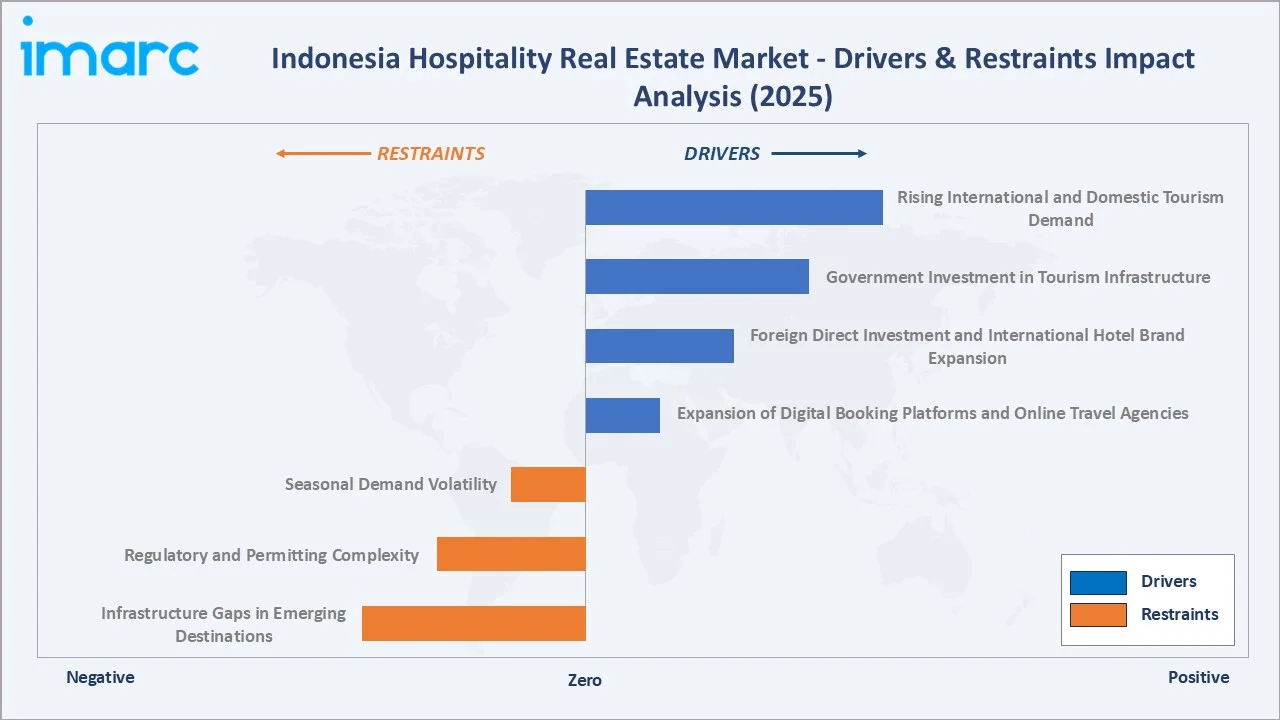
- Rising International and Domestic Tourism Demand: Increasing travel activity among domestic and international visitors is driving demand for hotels, resorts, serviced apartments, and other hospitality properties. Growing demand across leisure and business travel segments supports occupancy levels and encourages investment in hospitality real estate.
- Government Investment in Tourism Infrastructure: Sustained government spending on airports, roads, and designated tourism special economic zones is unlocking new hospitality development corridors.
- Foreign Direct Investment and International Hotel Brand Expansion: Growing interest from international hospitality investors and the expansion of global hotel brands into second- and third-tier Indonesian cities are increasing the supply of branded hotel inventory, attracting premium guest segments and raising overall market quality standards. In September 2026, Hyatt Hotels Corporation planned to increase its footprint in Indonesia by adding three new hotels in Jakarta, Semarang, and Lombok, expanding its current portfolio of 14 hotels over seven brands.
- Expansion of Digital Booking Platforms and Online Travel Agencies: The rapid growth of digital booking channels and online travel agency platforms is expanding hospitality asset visibility to both domestic and international travelers, supporting higher average occupancy rates and enabling dynamic pricing strategies across the hotel and resort segments.
Market Restraints
- Infrastructure Gaps in Emerging Destinations: Underdeveloped road, port, and utility infrastructure in eastern Indonesia and remote island destinations limits hospitality real estate development potential, increasing construction costs and operational complexity for investors considering assets outside established tourism corridors.
- Regulatory and Permitting Complexity: Complex land acquisition regulations, overlapping zoning jurisdictions, and multi-level permitting requirements across provincial and national authorities create delays and cost overruns in hospitality real estate development projects, discouraging investment in some regions.
- Seasonal Demand Volatility: Pronounced seasonality in tourist arrivals, particularly in resort-heavy destinations, creates revenue variability that complicates debt servicing and investor return modeling for hospitality real estate assets in markets with limited year-round demand generators.
Market Opportunities
- Eco-Tourism and Sustainable Hospitality Development: Rising global demand for nature-based and sustainable travel experiences is creating significant opportunity for eco-lodge and sustainable resort development across Indonesia's biodiversity-rich destinations, attracting premium international travelers and supporting higher room rates.
- Wellness and Medical Tourism-Linked Hospitality Assets: Expanding interest in wellness tourism and the growth of medical tourism linkages are creating demand for specialized hospitality assets, including spa resorts, wellness retreats, and integrated health and hospitality developments, particularly in Bali and Java.
Market Challenges
- Maintaining Asset Quality and Brand Standards: Managing the quality and operational consistency of hospitality assets across a geographically dispersed and logistically complex market environment requires sustained investment in facilities maintenance, workforce training, and brand standard compliance, particularly for internationally branded properties.
- Climate and Natural Disaster Risk: Indonesia's exposure to volcanic activity, seismic events, and extreme weather patterns creates physical and financial risk for hospitality real estate assets, requiring investors to incorporate climate resilience and business continuity measures into asset development and management strategies.
Emerging Market Trends
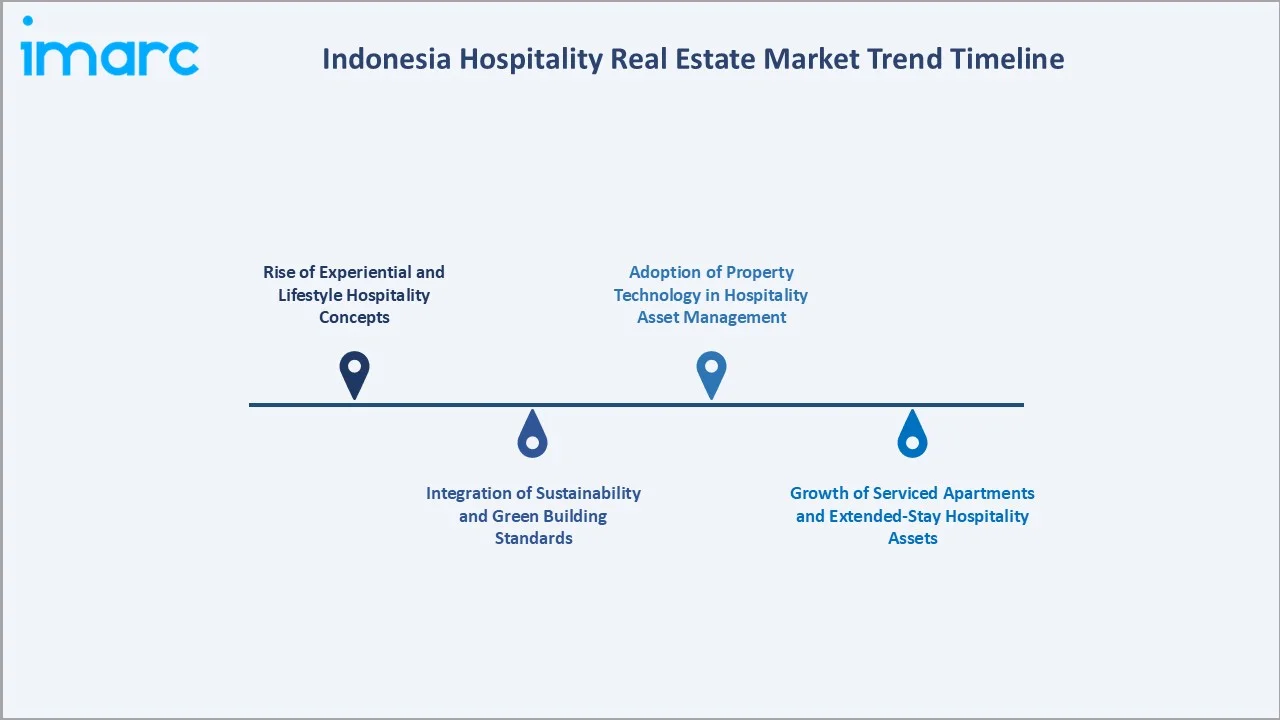
1. Rise of Experiential and Lifestyle Hospitality Concepts
Indonesian hospitality developers and operators are increasingly moving beyond traditional hotel formats toward experiential, lifestyle-oriented concepts that integrate local culture, gastronomy, and adventure travel. Boutique resorts, treehouse lodges, and underwater villa concepts are attracting high-value international travelers seeking differentiated experiences.
2. Integration of Sustainability and Green Building Standards
International hospitality investors and branded operators are embedding sustainability requirements into asset development and management standards. Green building certifications, renewable energy adoption, and waste reduction programs are increasingly standard for new hospitality developments targeting international guest segments and ESG-conscious institutional investors.
3. Growth of Serviced Apartments and Extended-Stay Hospitality Assets
Demand for serviced apartments and extended-stay hospitality products is rising across Jakarta and Surabaya, driven by long-term corporate relocations, expatriate workforce expansion, and the growth of digital nomad communities.
4. Adoption of Property Technology in Hospitality Asset Management
Indonesian hotel and resort operators are increasingly deploying property management systems, revenue management software, and smart building technologies to optimize occupancy, reduce operational costs, and improve guest experience delivery across portfolio-scale hospitality assets.
Industry Value Chain Analysis
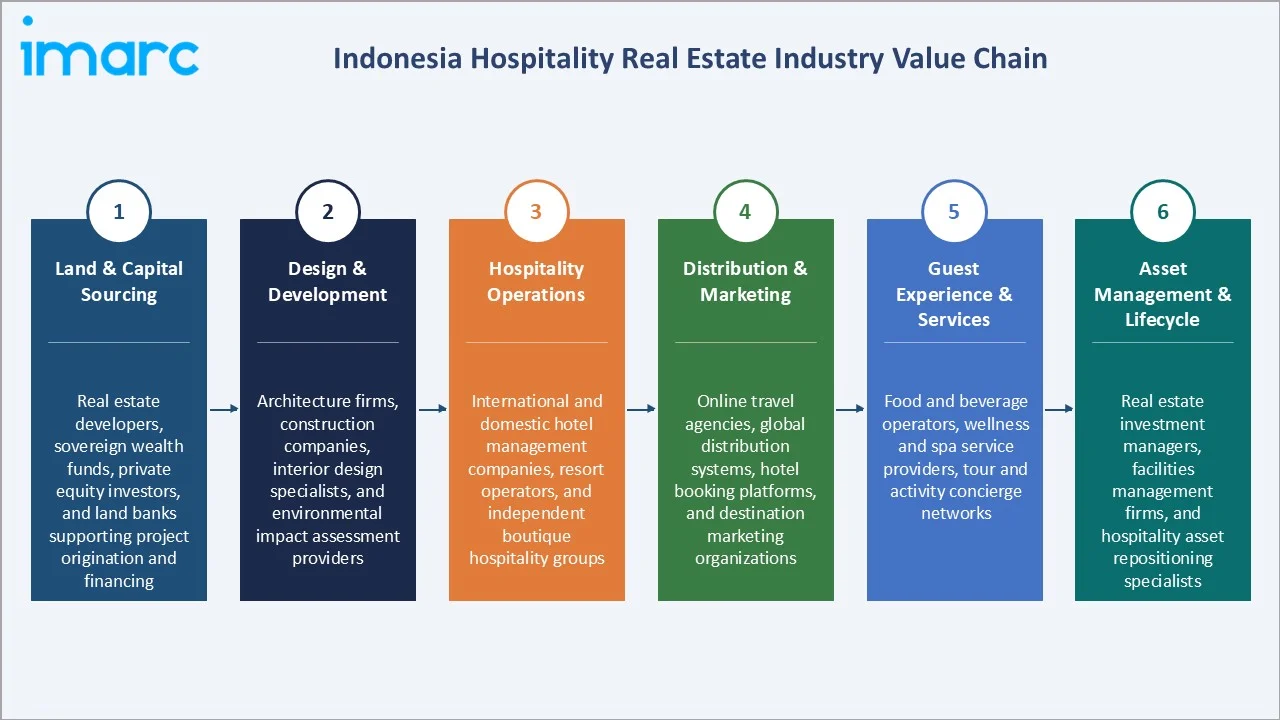
The Indonesia hospitality real estate value chain spans six stages, from land and financing through end-user guest experience delivery and asset management. Development, branded operations, and distribution channel management capture the highest value-add, while sustainability compliance and asset lifecycle management increasingly determine long-term investment returns within this capital-intensive market.
|
Stage |
Key Players / Examples |
|
Land & Capital Sourcing |
Real estate developers, sovereign wealth funds, private equity investors, and land banks supporting project origination and financing |
|
Design & Development |
Architecture firms, construction companies, interior design specialists, and environmental impact assessment providers |
|
Hospitality Operations |
International and domestic hotel management companies, resort operators, and independent boutique hospitality groups |
|
Distribution & Marketing |
Online travel agencies, global distribution systems, hotel direct booking platforms, and destination marketing organizations |
|
Guest Experience & Services |
Food and beverage operators, wellness and spa service providers, tour and activity concierge networks |
|
Asset Management & Lifecycle |
Real estate investment managers, facilities management firms, and hospitality asset repositioning specialists |
Vertically integrated hospitality groups owning both the real estate asset and the operating brand are positioned to capture greater value than investors reliant on third-party management agreements, as they retain both the property appreciation upside and the operational cash flow generated by the hospitality business.
Technology Landscape in the Indonesia Hospitality Real Estate Industry
Property Management and Revenue Optimization Systems
Hotel and resort operators across Indonesia are deploying integrated property management systems and revenue management software to automate reservations, dynamic pricing, and channel distribution. These platforms improve occupancy rate optimization and reduce revenue leakage across multi-property hospitality portfolios.
Smart Building and Energy Management Technology
New hospitality real estate developments are increasingly incorporating smart building systems, including automated lighting, climate control, and water management technology, to reduce operating costs, meet sustainability targets, and improve the overall quality of the built environment for guests and operators.
Digital Guest Experience Platforms
Mobile-first guest experience applications, contactless check-in systems, and in-room digital service interfaces are becoming standard across branded hotel and resort developments, improving guest satisfaction scores and enabling personalized service delivery at scale across Indonesia's diverse hospitality asset base.
Construction Technology and Modular Building Methods
Developers operating in remote island and emerging destination markets are adopting modular and prefabricated construction methods to reduce build costs, compress development timelines, and overcome logistical challenges associated with delivering quality hospitality assets in geographically isolated locations.
Market Segmentation Analysis
The report covers the following segments:
|
Segment Category |
Leading Segment |
Market Share |
Year |
|
Property Type |
Hotels and Accommodations |
58.4% |
2025 |
|
Region |
Java |
41.8% |
2025 |

By Property Type
Hotels and accommodations command a 58.4% majority share in 2025, driven by strong business travel demand in Jakarta and Surabaya, consistent leisure hotel occupancy in Bali and Yogyakarta, and accelerating expansion of international hotel brands into tier-2 Indonesian cities. The segment benefits from relatively stable demand patterns, strong brand affiliation effects, and established institutional investor appetite for income-generating hotel assets with management contracts from international operators.
To access detailed market analysis, Request Sample
Resort and spas at 31.7% in 2025 represent the fastest-growing property type segment, reflecting sustained international and domestic demand for premium leisure hospitality experiences.
Regional Market Insights
|
Region |
Share (2025) |
Key Growth Drivers |
|
Java |
41.8% |
Large business travel base, mature hotel infrastructure, strong domestic leisure demand, and expanding branded hotel supply in secondary cities |
|
Sumatra |
20.6% |
Government-led Lake Toba special tourism zone development, growing eco-tourism, and rising domestic visitor flows to natural and cultural attractions |
|
Kalimantan |
12.4% |
National capital relocation project driving business hotel demand, expanding eco-tourism, and government infrastructure investment in East Kalimantan |
|
Sulawesi |
9.3% |
Growing marine and diving tourism, rising international arrivals to Manado and Makassar, and improving air connectivity to key coastal destinations |
|
Others |
15.9% |
Sustained international resort demand, luxury villa development, and government-designated tourism zones in Mandalika and Labuan Bajo |
Java at 41.8% in 2025 leads the regional landscape, anchored by Jakarta's position as Indonesia's commercial capital and home to a dense concentration of business hotels, serviced apartments, and corporate meeting facilities.
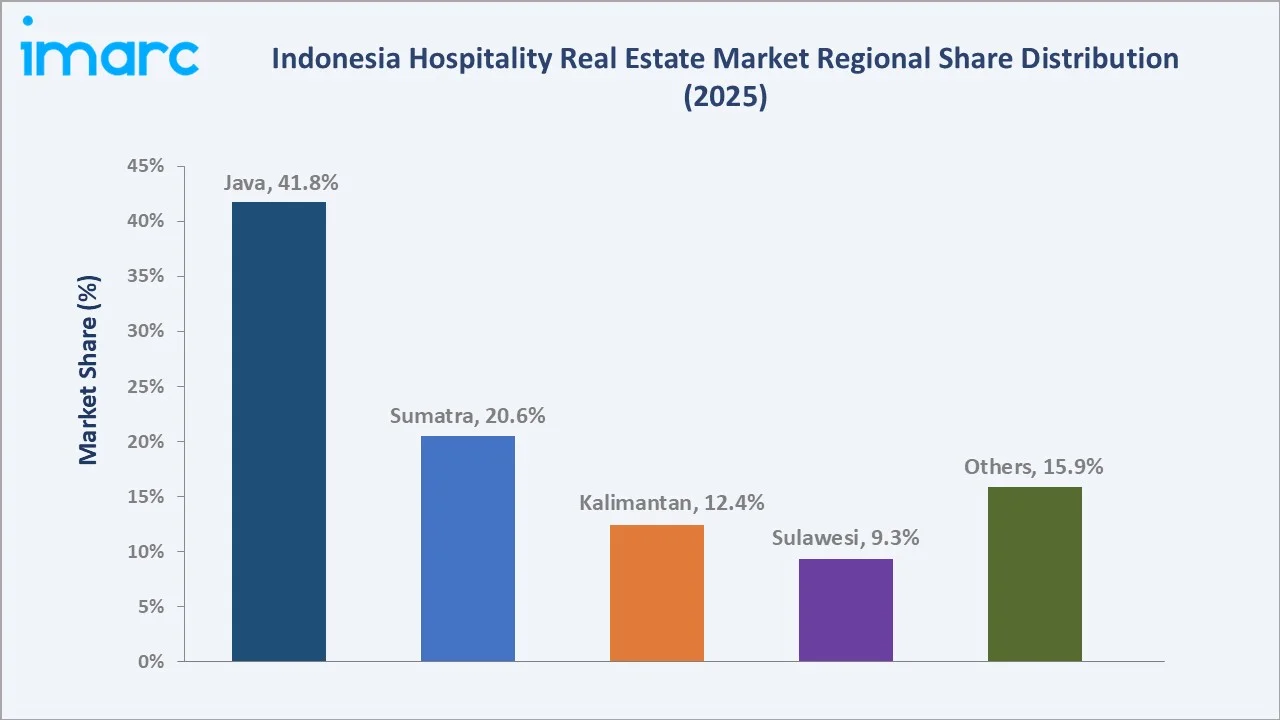
Kalimantan, while currently the third-largest regional contributor at 12.4%, is among the fastest-growing hospitality investment regions, as the national capital relocation to Nusantara in East Kalimantan catalyzes government and private sector investment in business hotels, serviced apartments, and supporting hospitality infrastructure.
Competitive Landscape
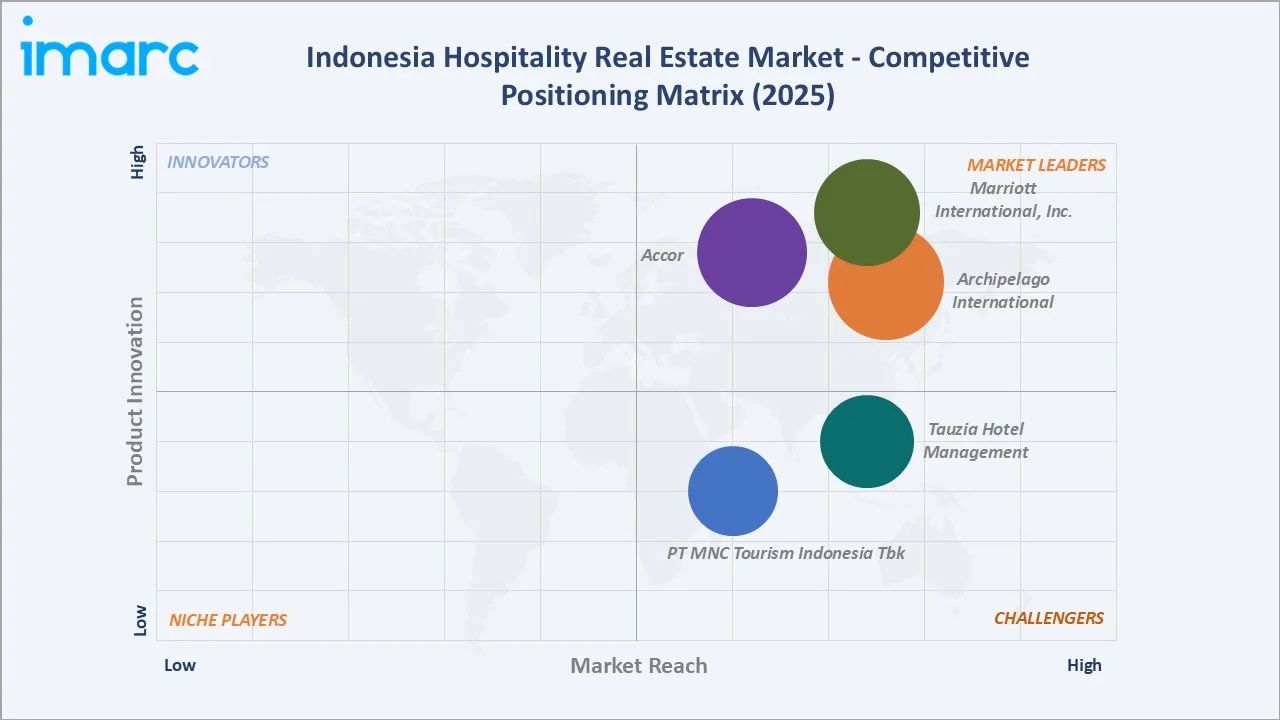
The Indonesia hospitality real estate market is moderately concentrated, with international hotel groups and domestic hospitality conglomerates leading asset development and management across key tourism and business destinations. Brand strength, management expertise, distribution network depth, and capital deployment capacity form the key competitive differentiators across the industry.
|
Company Name |
Brand / Key Product |
Position |
Strategic Focus |
|
Marriott International, Inc. |
Marriott, Sheraton, W Hotels |
Leader |
Expanding branded hotel and resort portfolio across Indonesian tourism corridors |
|
Accor |
Novotel, Mercure, Sofitel |
Leader |
Growing budget-to-luxury hotel supply across Java and major island destinations |
|
Archipelago International |
ASTON, favehotel, Harper |
Leader |
Scaling domestic hotel management footprint across tier-2 and tier-3 Indonesian cities |
|
PT MNC Tourism Indonesia Tbk |
Park Hyatt Jakarta, The Westin Nusa Dua |
Challenger |
Developing integrated leisure and hospitality destinations |
|
Tauzia Hotel Management |
HARRIS Hotels, POP! Hotels |
Challenger |
Expanding economy-to-midscale hotel management footprint across Indonesian urban and leisure markets |
Key players include Marriott International, Inc., Accor, Archipelago International, PT MNC Tourism Indonesia Tbk, and Tauzia Hotel Management, among others.
Key Company Profiles
Marriott International, Inc.
Marriott International, Inc. is a leading global hospitality company headquartered in Maryland, United States, operating a broad portfolio of hotel and resort brands across business, leisure, and luxury segments in markets worldwide, including Indonesia.
- Product Portfolio: A diversified range of hotel and resort brands spanning luxury to select-service segments, including Marriott, Sheraton, and W Hotels, catering to a wide range of business and leisure travelers across multiple price points.
- Recent Developments: Marriott International, Inc. expanded its presence in Indonesia with seven new hotel openings planned across multiple key destinations by end-2025, targeting 84 operating properties in the country and reinforcing its long-term commitment to the Indonesian hospitality market.
- Strategic Focus: Focusing on deepening its hotel and resort footprint across high-demand Indonesian tourism corridors while strengthening guest loyalty through its global rewards and membership program.
Accor
Accor is a French multinational hospitality company headquartered in Issy-les-Moulineaux, France, operating a wide portfolio of hotel brands across economy, midscale, and luxury segments in several countries, with an active and growing presence across Indonesia.
- Product Portfolio: A broad range of hotel brands spanning budget to luxury tiers, including Novotel, Mercure, and Sofitel, serving both domestic and international travelers across business and leisure hotel categories throughout Indonesia.
- Recent Developments: The company has continued expanding its Indonesia hotel portfolio with new openings and signings across multiple island destinations and key urban markets, reflecting sustained investment in both midscale and premium hotel segments.
- Strategic Focus: Broadening its hotel supply across diverse market segments and geographies in Indonesia.
Archipelago International
Archipelago International is a privately owned hotel management company headquartered in Jakarta, Indonesia, recognized as the leading independent hotel management group in Southeast Asia, with a portfolio spanning economy to upper-midscale segments across multiple countries.
- Product Portfolio: A multi-brand hotel management portfolio covering economy to upper-midscale tiers, including ASTON, favehotel, and Harper, serving domestic and regional business and leisure travelers across Indonesia and international markets.
- Recent Developments: The company continues to strengthen its hotel portfolio by expanding its presence across different hospitality segments and introducing new properties in selected markets.
- Strategic Focus: Expanding its managed hotel portfolio, strengthening brand presence across key hospitality segments, and improving operational capabilities to support long-term growth.
Market Concentration Analysis
The Indonesia hospitality real estate market is moderately concentrated, with international hotel groups and domestic hospitality conglomerates accounting for a significant share of branded hotel and resort inventory.
Barriers to entry in the premium and branded hospitality real estate segment include high land and construction costs, the capital intensity of quality hospitality asset development, the challenge of securing management agreements with reputable international operators, and the complexity of navigating Indonesian land and property regulations. These factors favor established developers and management companies with proven track records and existing operator relationships.
Consolidation is gradually increasing as international hotel groups acquire management contracts from domestic operators and domestic hospitality conglomerates broaden their brand portfolios. Strategic partnerships between property developers, hotel management companies, and financial investors are further shaping the competitive structure of the market across different quality tiers and regional markets.
Investment & Growth Opportunities
Fastest-Growing Segments
Resort and spas are expanding fastest among property types, driven by rising international and premium domestic demand for leisure hospitality experiences across Bali, Lombok, and government-designated special tourism zone destinations.
Emerging Markets
Kalimantan is the fastest-growing regional market, supported by the national capital relocation program catalyzing business hotel and serviced apartment demand, alongside expanding eco-tourism interest in Borneo's biodiversity-rich natural environment.
Venture & Investment Trends
Investment activity is concentrated in government-designated special tourism zones, branded resort development in Lombok and Labuan Bajo, and serviced apartment supply expansion across Jakarta and Surabaya. Capital is also flowing into eco-tourism and sustainable hospitality development, with impact investors and family offices increasingly attracted to Indonesia's nature-based tourism potential.
Future Market Outlook (2026-2034)
The Indonesia hospitality real estate market is forecast to expand from USD 2.02 Billion in 2025 to USD 6.51 Billion by 2034 at a CAGR of 13.46%, adding roughly USD 4.49 Billion in incremental market value over the forecast period.
Four forces will shape the market through 2034: continued government investment in tourism infrastructure and special economic zone development; sustained growth in international and domestic leisure travel demand; accelerating international hotel brand expansion across tier-2 and tier-3 Indonesian cities; and rising institutional and foreign direct investment in premium hospitality real estate assets.
By 2034, the Indonesia hospitality real estate market is expected to be defined by a more geographically diversified asset base, with resort and eco-tourism hospitality playing a larger role in the overall market mix. Continued expansion of government-designated tourism corridors, rising middle-class travel budgets, and improving air connectivity across the archipelago are expected to further accelerate the evolution of the hospitality real estate sector.
Research Methodology
Primary Research
Primary research included structured interviews with hospitality real estate developers, hotel management executives, tourism investment specialists, and government tourism development officials, validating market sizing, segment mix, and regional demand patterns across Indonesia.
Secondary Research
Secondary sources included Indonesia Ministry of Tourism and Creative Economy publications, Statistics Indonesia (BPS) data, Bank Indonesia economic reports, annual reports and investor presentations from listed hospitality and property companies, and industry association data from the Indonesian Hotel and Restaurant Association.
Forecasting Models
Market forecasts used top-down and bottom-up models combining hotel occupancy rate trends, international and domestic visitor arrival data, hotel room supply growth rates, hospitality real estate transaction volumes, and macroeconomic variables including GDP growth and foreign direct investment flows. Scenario analysis addressed government infrastructure investment pace, tourism policy developments, and hospitality asset supply pipeline timing.
Indonesia Hospitality Real Estate Market Report Coverage:
| Report Features | Details |
|---|---|
| Base Year of the Analysis | 2025 |
| Historical Period | 2020-2025 |
| Forecast Period | 2026-2034 |
| Units | Billion USD |
| Scope of the Report |
Exploration of Historical Trends and Market Outlook, Industry Catalysts and Challenges, Segment-Wise Historical and Future Market Assessment:
|
| Property Types Covered | Resort and Spas, Hotels and Accommodations, Others |
| Regions Covered | Java, Sumatra, Kalimantan, Sulawesi, Others |
| Companies Covered | Marriott International, Inc., Accor, Archipelago International, PT MNC Tourism Indonesia Tbk, Tauzia Hotel Management, etc. |
| Customization Scope | 10% Free Customization |
| Post-Sale Analyst Support | 10-12 Weeks |
| Delivery Format | PDF and Excel through Email (We can also provide the editable version of the report in PPT/Word format on special request) |
Key Benefits for Stakeholders:
- IMARC’s industry report offers a comprehensive quantitative analysis of various market segments, historical and current market trends, market forecasts, and dynamics of the Indonesia hospitality real estate market from 2020-2034.
- The research report provides the latest information on the market drivers, challenges, and opportunities in the Indonesia hospitality real estate market.
- Porter's five forces analysis assist stakeholders in assessing the impact of new entrants, competitive rivalry, supplier power, buyer power, and the threat of substitution. It helps stakeholders to analyze the level of competition within the Indonesia hospitality real estate industry and its attractiveness.
- Competitive landscape allows stakeholders to understand their competitive environment and provides an insight into the current positions of key players in the market.
Frequently Asked Questions About the Indonesia Hospitality Real Estate Market Report
The Indonesia hospitality real estate market was valued at USD 2.02 Billion in 2025, driven by rising international and domestic tourism demand, expanding branded hotel supply, and government investment in tourism infrastructure.
The market is projected to grow at a CAGR of 13.46% from 2026 to 2034, reaching USD 6.51 Billion, supported by resort development in special tourism zones and accelerating foreign investment in hospitality assets.
Hotels and accommodations lead the property type segment at 58.4% in 2025, driven by strong business travel demand in Jakarta and Surabaya and consistent leisure hotel occupancy across Bali and Yogyakarta.
Java commands 41.8% regional share in 2025, anchored by Jakarta's large-scale business hotel market and growing leisure hospitality demand across Yogyakarta, Bandung, and Surabaya.
Rising international demand for premium leisure experiences, government-designated special tourism zones in Lombok and Flores, and surging eco-tourism interest are driving strong growth in the resort and spas segment.
Leading players include Marriott International, Inc., Accor, Archipelago International, PT MNC Tourism Indonesia Tbk, and Tauzia Hotel Management, among others.
Key challenges include infrastructure gaps in emerging destinations, complex land acquisition and permitting regulations, seasonal demand volatility in resort markets, and climate and natural disaster risk exposure across the archipelago.
Property management systems, revenue optimization software, smart building technology, and digital guest experience platforms are increasingly being adopted across branded hotel and resort developments to improve operational efficiency and guest satisfaction.
Need more help?
- Speak to our experienced analysts for insights on the current market scenarios.
- Include additional segments and countries to customize the report as per your requirement.
- Gain an unparalleled competitive advantage in your domain by understanding how to utilize the report and positively impacting your operations and revenue.
- For further assistance, please connect with our analysts.
 Request Customization
 Speak to an Analyst
 Request Brochure
 Inquire Before Buying
Benefits of Customization
- Personalize this research
- Triangulate with your data
- Get data as per your format and definition
- Gain a deeper dive into a specific application, geography, customer, or competitor
- Any level of personalization
Get in Touch With Us
UNITED STATES
Phone: +1-201-971-6302
INDIA
Phone: +91-120-433-0800
UNITED KINGDOM
Phone: +44-753-714-6104
Email: [email protected]
Client Testimonials




.webp)




.webp)













Related Reports

Choose your plan
*Please note that the prices mentioned below are starting prices for each bundle type. Kindly contact our team for further details.*
Single User License
- 1 User License, Access on 2 Devices
- PDF Report + Excel Dataset (Password Protected)
- Lifetime Access
- No Printing Rights
- 10% Free Report Customization
- 10–12 Weeks of Analyst Support
Five User License
- Access for 5 Users, 2 Devices per User
- PDF Report + Excel Dataset (Password Protected)
- Lifetime Access
- Dedicated Account Manager
- 12–14 Weeks of Analyst Support
- No Printing Rights
- 15% Free Report Customization
- 25% Discount on Your Next Purchase
Corporate User License
- Unlimited User Access (Within Your Organization)
- PDF Report + Excel Dataset
- Lifetime Access
- Dedicated Account Manager
- 14–20 Weeks of Analyst Support
- No Printing Rights
- 20% Free Report Customization
- 30% Discount on Your Next Purchase
Essential Insights
What's included:
3 reports
- Lifetime Access
- PDF Reports
- Excel Datasets
- 2 Weeks of Free Analyst Support
- 2 User Licenses
- Access on 2 Devices
- Printing Rights
- Complimentary PowerPoint (PPT) Version
- Complimentary License Upgrade
Professional Access
What's included:
5 reports
- Lifetime Access
- PDF Reports
- Excel Datasets
- 8 Weeks of Free Analyst Support
- 2 User Licenses
- Access on 2 Devices
- Printing Rights
- Complimentary PowerPoint (PPT) Version
- Complimentary License Upgrade
Business Advantage
What's included:
8 reports
- Lifetime Access
- PDF Reports
- Excel Datasets
- 14 Weeks of Free Analyst Support
- 2 User Licenses
- Access on 2 Devices
- Printing Rights
- Complimentary PowerPoint (PPT) Version
- Complimentary License Upgrade
Enterprise Intelligence
What's included:
10 reports
- Lifetime Access
- PDF Reports
- Excel Datasets
- 20 Weeks of Free Analyst Support
- 2 User Licenses
- Access on 2 Devices
- Printing Rights
- Complimentary PowerPoint (PPT) Version
- Complimentary License Upgrade