
Industrial Refrigeration System Market Report by Component (Compressor, Condenser, Evaporator, and Others), Refrigerant Type (Ammonia, Carbon Dioxide, Hydrofluorocarbon (HFC), and Others), Application (Fresh Fruits and Vegetables, Meat, Poultry and Fish, Dairy Products, Beverages, Chemicals, Pharmaceuticals, and Others), and Region 2026-2034
Market Overview:
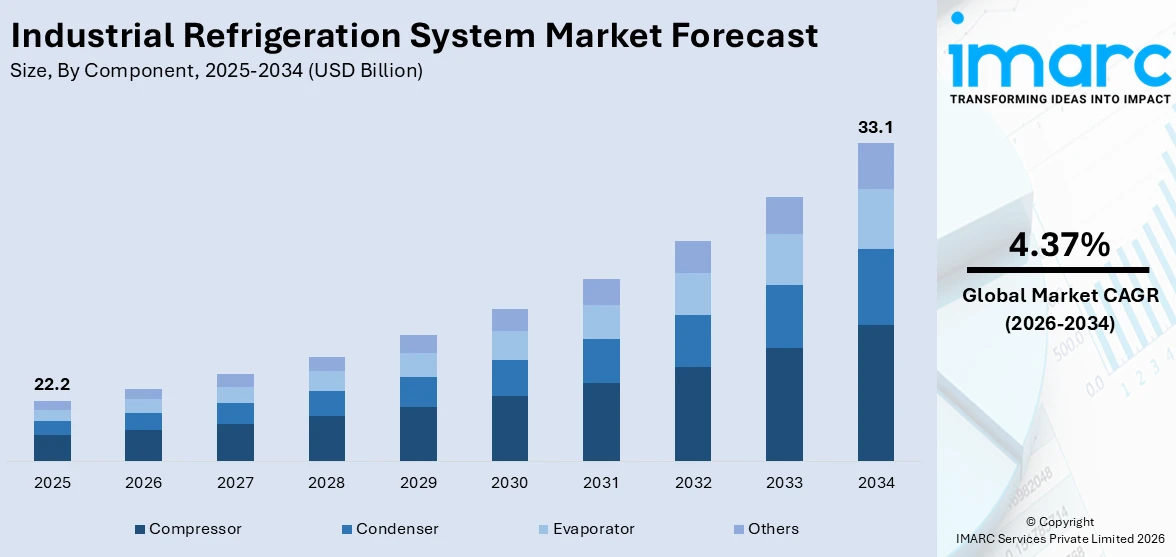
The global industrial refrigeration system market size reached USD 22.2 Billion in 2025. Looking forward, IMARC Group expects the market to reach USD 33.1 Billion by 2034, exhibiting a growth rate (CAGR) of 4.37% during 2026-2034.
|
Report Attribute
|
Key Statistics
|
|---|---|
|
Base Year
|
2025
|
|
Forecast Years
|
2026-2034
|
|
Historical Years
|
2020-2025
|
|
Market Size in 2025
|
USD 22.2 Billion |
|
Market Forecast in 2034
|
USD 33.1 Billion |
| Market Growth Rate 2026-2034 | 4.37% |
Industrial refrigeration systems refer to large-scale freezing and refrigeration units used for cooling and removing heat from various products. These units require liquid refrigerants, such as ammonia (NH3) and carbon dioxide (CO2), a metering device, a compressor pump and an evaporator to operate. They remove heat from a low-temperature medium and transfer it to a high-temperature medium. This offers various advantages, such as rapid cooling, cost-effectiveness and minimal impact on the environment. As a result, industrial refrigeration units find extensive applications across various industrial sectors, such as food processing, cold storage, pharmaceutical, petrochemical and liquified natural gas (LNG) liquefaction.
To get more information on this market Request Sample
Significant growth in the food and beverage industry is one of the key factors creating a positive outlook for the market. Due to changing lifestyles, dietary patterns and hectic schedules, consumers are increasingly opting for packed, processed and frozen ready-to-eat (RTE) food items. Furthermore, the increasing demand for compact and innovative refrigeration systems is favoring the market growth. The industrial refrigeration systems are also gaining immense traction across the globe due to improvements in the cold chain infrastructure that uses a series of cooling and freezing units for storage, production and processing applications. Additionally, various product innovations, such as the utilization of natural refrigerant-based systems and the development of units with the internet of things (IoT)-enabled monitoring systems, are acting as other growth-inducing factors. Natural refrigerants exhibit high thermodynamic properties with high energy efficiency, thereby making them suitable for industrial applications. Other factors, including rapid industrialization, along with the emerging trend of upgrading existing industrial refrigeration systems, are expected to drive the market further.
Key Market Segmentation:
IMARC Group provides an analysis of the key trends in each sub-segment of the global industrial refrigeration system market report, along with forecasts at the global, regional and country level from 2026-2034. Our report has categorized the market based on component, refrigerant type and application.
Breakup by Component:
- Compressor
- Condenser
- Evaporator
- Others
Breakup by Refrigerant Type:
- Ammonia
- Carbon Dioxide
- Hydrofluorocarbon (HFC)
- Others
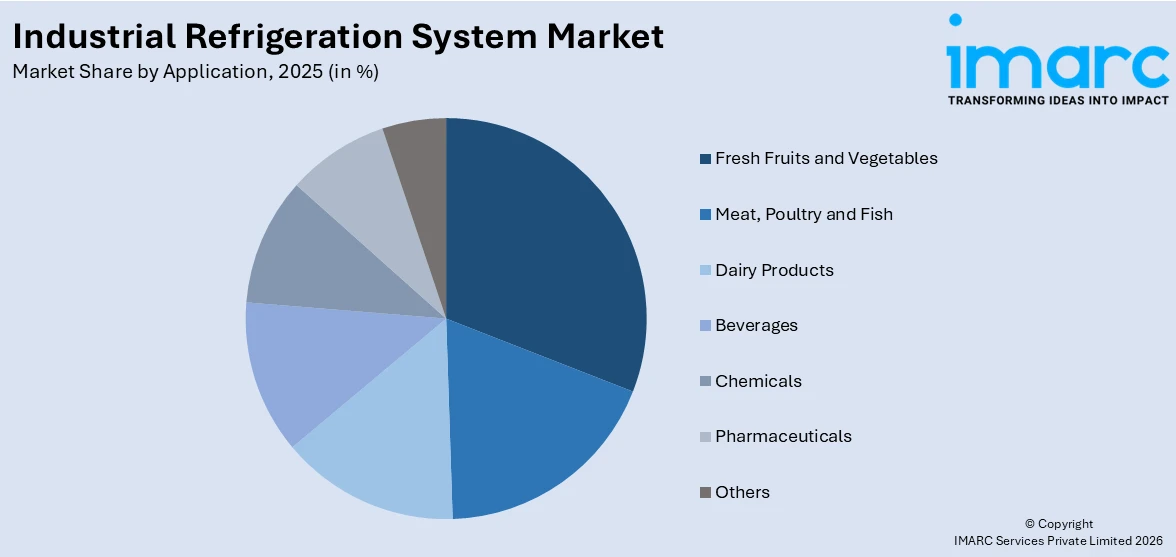
Breakup by Application:
Access the comprehensive market breakdown Request Sample
- Fresh Fruits and Vegetables
- Meat, Poultry and Fish
- Dairy Products
- Beverages
- Chemicals
- Pharmaceuticals
- Others
Breakup by Region:
- North America
- United States
- Canada
- Asia Pacific
- China
- Japan
- India
- South Korea
- Australia
- Indonesia
- Others
- Europe
- Germany
- France
- United Kingdom
- Italy
- Spain
- Russia
- Others
- Latin America
- Brazil
- Mexico
- Others
- Middle East and Africa
Competitive Landscape:
The competitive landscape of the industry has also been examined with some of the key players being Baltimore Aircoil, Bitzer, Daikin, Danfoss, Evapco, GEA Group AG, Ingersoll-Rand, Johnson Controls, Lennox International, LU-VE Group, Mayekawa and United Technologies.
Report Coverage:
| Report Features | Details |
|---|---|
| Base Year of the Analysis | 2025 |
| Historical Period | 2020-2025 |
| Forecast Period | 2026-2034 |
| Units | Billion USD |
| Segment Coverage | Component, Refrigerant Type, Application, Region |
| Region Covered | Asia Pacific, Europe, North America, Latin America, Middle East and Africa |
| Countries Covered | United States, Canada, Germany, France, United Kingdom, Italy, Spain, Russia, China, Japan, India, South Korea, Australia, Indonesia, Brazil, Mexico |
| Companies Covered | Baltimore Aircoil, Bitzer, Daikin, Danfoss, Evapco, GEA Group AG, Ingersoll-Rand, Johnson Controls, Lennox International, LU-VE Group, Mayekawa, United Technologies |
| Customization Scope | 10% Free Customization |
| Post-Sale Analyst Support | 10-12 Weeks |
| Delivery Format | PDF and Excel through Email (We can also provide the editable version of the report in PPT/Word format on special request) |
Key Questions Answered in This Report:
- How has the global industrial refrigeration system market performed so far and how will it perform in the coming years ?
- What has been the impact of COVID-19 on the global industrial refrigeration system market ?
- What are the key regional markets ?
- What is the breakup of the market based on the component ?
- What is the breakup of the market based on the refrigerant type ?
- What is the breakup of the market based on the application ?
- What are the various stages in the value chain of the industry ?
- What are the key driving factors and challenges in the industry ?
- What is the structure of the global industrial refrigeration system market and who are the key players ?
- What is the degree of competition in the industry ?
Need more help?
- Speak to our experienced analysts for insights on the current market scenarios.
- Include additional segments and countries to customize the report as per your requirement.
- Gain an unparalleled competitive advantage in your domain by understanding how to utilize the report and positively impacting your operations and revenue.
- For further assistance, please connect with our analysts.
 Request Customization
 Speak to an Analyst
 Request Brochure
 Inquire Before Buying
Benefits of Customization
- Personalize this research
- Triangulate with your data
- Get data as per your format and definition
- Gain a deeper dive into a specific application, geography, customer, or competitor
- Any level of personalization
Get in Touch With Us
UNITED STATES
Phone: +1-201-971-6302
INDIA
Phone: +91-120-433-0800
UNITED KINGDOM
Phone: +44-753-714-6104
Email: sales@imarcgroup.com
Client Testimonials




.webp)




.webp)













Related Reports

Choose your plan
*Please note that the prices mentioned below are starting prices for each bundle type. Kindly contact our team for further details.*
Single User License
- 1 User License, Access on 2 Devices
- PDF Report + Excel Dataset (Password Protected)
- Lifetime Access
- No Printing Rights
- 10% Free Report Customization
- 10–12 Weeks of Analyst Support
Five User License
- Access for 5 Users, 2 Devices per User
- PDF Report + Excel Dataset (Password Protected)
- Lifetime Access
- Dedicated Account Manager
- 12–14 Weeks of Analyst Support
- No Printing Rights
- 15% Free Report Customization
- 25% Discount on Your Next Purchase
Corporate User License
- Unlimited User Access (Within Your Organization)
- PDF Report + Excel Dataset
- Lifetime Access
- Dedicated Account Manager
- 14–20 Weeks of Analyst Support
- No Printing Rights
- 20% Free Report Customization
- 30% Discount on Your Next Purchase
Essential Insights
What's included:
3 reports
- Lifetime Access
- PDF Reports
- Excel Datasets
- 2 Weeks of Free Analyst Support
- 2 User Licenses
- Access on 2 Devices
- Printing Rights
- Complimentary PowerPoint (PPT) Version
- Complimentary License Upgrade
Professional Access
What's included:
5 reports
- Lifetime Access
- PDF Reports
- Excel Datasets
- 8 Weeks of Free Analyst Support
- 2 User Licenses
- Access on 2 Devices
- Printing Rights
- Complimentary PowerPoint (PPT) Version
- Complimentary License Upgrade
Business Advantage
What's included:
8 reports
- Lifetime Access
- PDF Reports
- Excel Datasets
- 14 Weeks of Free Analyst Support
- 2 User Licenses
- Access on 2 Devices
- Printing Rights
- Complimentary PowerPoint (PPT) Version
- Complimentary License Upgrade
Enterprise Intelligence
What's included:
10 reports
- Lifetime Access
- PDF Reports
- Excel Datasets
- 20 Weeks of Free Analyst Support
- 2 User Licenses
- Access on 2 Devices
- Printing Rights
- Complimentary PowerPoint (PPT) Version
- Complimentary License Upgrade