
Japan Beer Market Size, Share, Trends and Forecast by Product Type, Packaging, Production, Alcohol Content, Flavor, Distribution Channel, and Region, 2026-2034
Japan Beer Market Size, Share, Trends & Forecast (2026-2034)
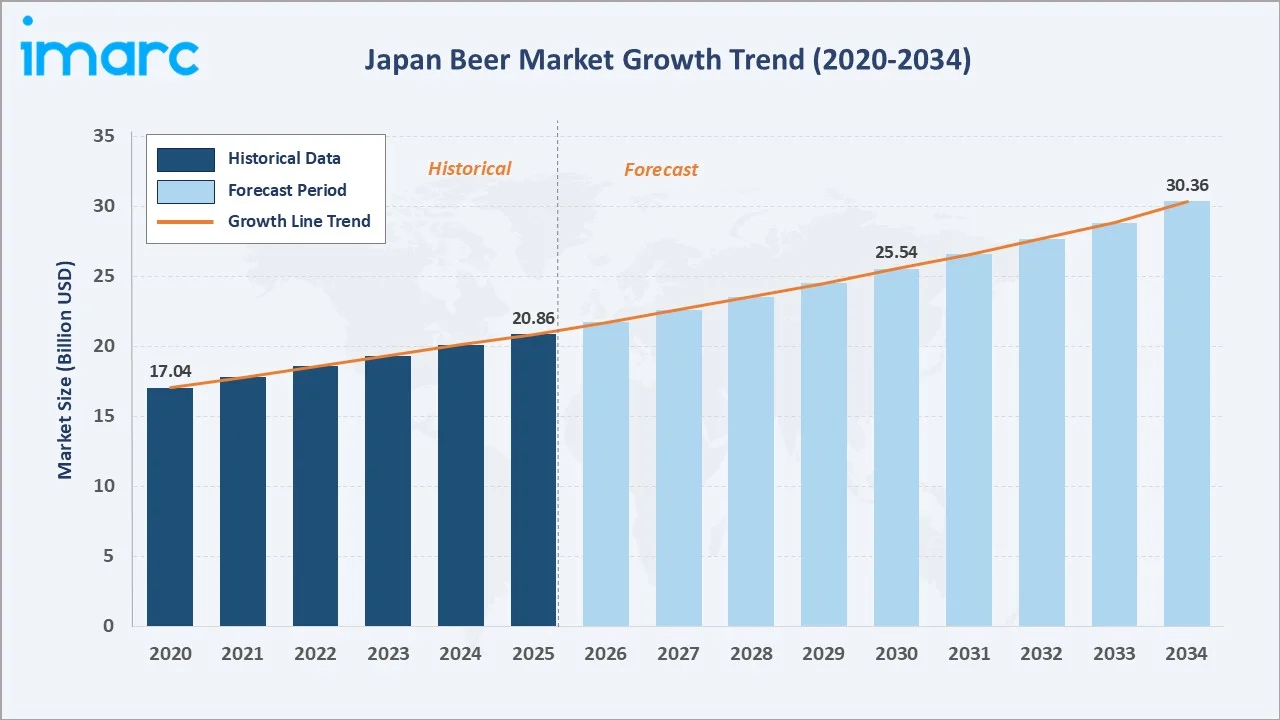
The Japan beer market size increased from USD 20.86 Billion in 2025 to USD 21.96 Billion in 2026 and is projected to reach USD 30.36 Billion by 2034, growing at a CAGR of 4.13% during 2026-2034. The market is driven by strong consumer demand for premium and craft beers, continuous product innovation, and the popularity of low-alcohol and functional beer products. Beer remained the largest alcoholic beverage category in Japan in 2024, with total volume sales of 4,684.2 million litres, accounting for 58.3% of the alcoholic-beverage market. This dominance is driving the Japan beer market by highlighting beer’s strong consumer preference, wide retail availability, and established drinking culture. Standard lager leads product type at 46.8%. Glass leads packaging at 41.7%. Kanto leads regionally at 34.6%.
Market Snapshot
|
Metric |
Value |
|
Base Year Market Size (2025) |
USD 20.86 Billion |
| Market Size (2026) | USD 21.96 Billion |
|
Forecast Market Size (2034) |
USD 30.36 Billion |
|
CAGR (2026-2034) |
4.13% |
|
Base Year |
2025 |
|
Historical Period |
2020-2025 |
|
Forecast Period |
2026-2034 |
|
Dominant Product Type |
Standard Lager (46.8%, 2025) |
|
Dominant Packaging |
Glass Bottle (41.7%, 2025) |
|
Leading Region |
Kanto Region (34.6%, 2025) |
The Japan beer market has grown steadily from USD 17.04 Billion in 2020 to USD 20.86 Billion in 2025 and an estimated USD 21.96 Billion in 2026, supported by strong beer consumption and premium product demand. The market is projected to reach USD 25.54 Billion by 2030, reflecting continued innovation in craft, low-alcohol, and flavored beer variants. By 2034, it is expected to reach USD 30.36 Billion, driven by evolving drinking preferences, tourism recovery, and seasonal consumption. Rising demand for premium and health-conscious beer products is encouraging breweries to expand their portfolios. Overall, the market is expected to maintain stable long-term growth through product innovation and strong brand loyalty.
To get more information on this market, Request Sample
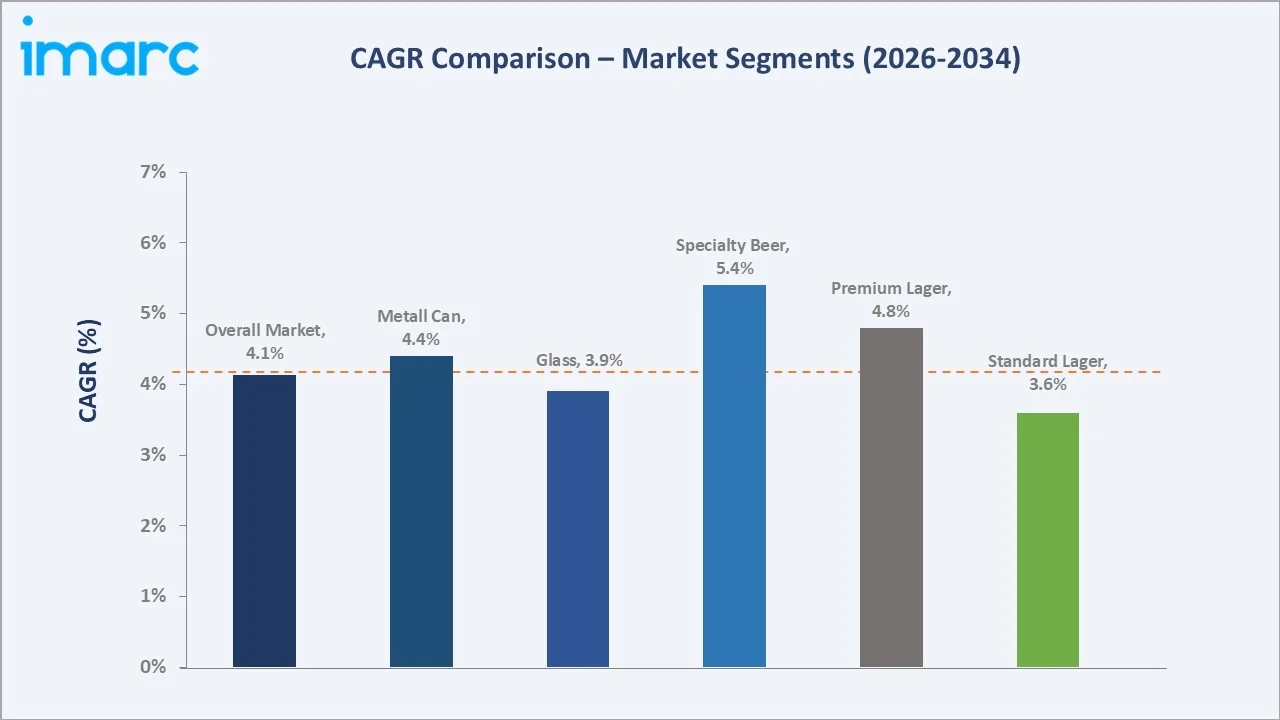
Specialty beer grows fastest at ~5.4% CAGR through craft beer taproom expansion, seasonal limited release, and premium import growth. Premium lager grows at ~4.8% CAGR through premiumization and on-trade hotel upgrade. Metal can grows at ~4.4% CAGR through conbini single-serve and home off-trade growth.
Executive Summary
The Japan beer market is witnessing steady growth, supported by strong consumer preference for beer as the leading alcoholic beverage category. Rising demand for premium, craft, low-alcohol, and flavored beer variants is reshaping product innovation across the industry. Established drinking culture, seasonal consumption, and expanding on-trade and off-trade availability continue to support sales. Breweries are increasingly focusing on differentiated offerings, health-conscious formulations, and limited-edition launches to attract younger consumers. Overall, the market is expected to grow consistently through 2034, driven by product premiumization, brand loyalty, and evolving consumer lifestyles. Standard lager at 46.8% leads through Asahi Super Dry and Kirin Ichiban. Glass at 41.7% leads through on-trade draught and large-format. Kanto leads regionally at 34.6%.
Key Market Insights
|
Insight |
Data |
|
Dominant Product Type |
Standard Lager - 46.8% share (2025) |
|
Dominant Packaging |
Glass Bottle - 41.7% market share (2025) |
|
Leading Region |
Kanto Region - 34.6% share (2025) |
|
Market Opportunity |
Premium craft beer taproom expansion; low-alcohol and no-alcohol non-alcoholic beer; inbound tourism on-trade; Japan beer export to Asia and EU; e-commerce D2C brewery subscription; sustainable brewing |
Key Analytical Observations Supporting The Above Data:
- Standard Lager at 46.8%: Standard Lager dominates due to its long-established consumer preference, widespread availability, and compatibility with Japanese cuisine and social drinking occasions. Its consistent taste, affordability, and strong presence across retail and on-premise channels continue to sustain the largest market share.
- Glass at 41.7%: Glass packaging dominates due to its premium image, strong preservation of taste and carbonation, and wide acceptance across restaurants, bars, and retail channels. Its recyclability and suitability for premium, craft, and bottled lager products further support its leading position.
- Kanto Region at 34.6%: The Kanto region dominates due to its large urban population, high concentration of restaurants, bars, supermarkets, and convenience stores, and strong consumer spending across Tokyo and surrounding prefectures. The region’s active nightlife, tourism, and corporate social drinking culture further support high beer consumption.
Japan Beer Market Overview
The Japan beer market encompasses a wide range of beer products, including standard lager, premium beer, craft beer, low-malt beer, non-alcoholic beer, and flavored variants. It covers both on-trade and off-trade channels such as restaurants, bars, supermarkets, convenience stores, liquor shops, and online platforms. The market includes packaging formats such as glass bottles, cans, and kegs, serving household, social, and hospitality consumption needs. It is shaped by established drinking culture, seasonal demand, product innovation, and growing preference for premium and health-conscious beer options. Macroeconomic factors include consumer spending levels, tourism recovery, urbanization, and disposable income trends. Inflation, taxation on alcoholic beverages, demographic shifts, and changing lifestyle preferences also affect beer consumption, pricing, and product innovation across the market.
Market Dynamics
To evaluate market opportunities, Request Sample
Market Drivers
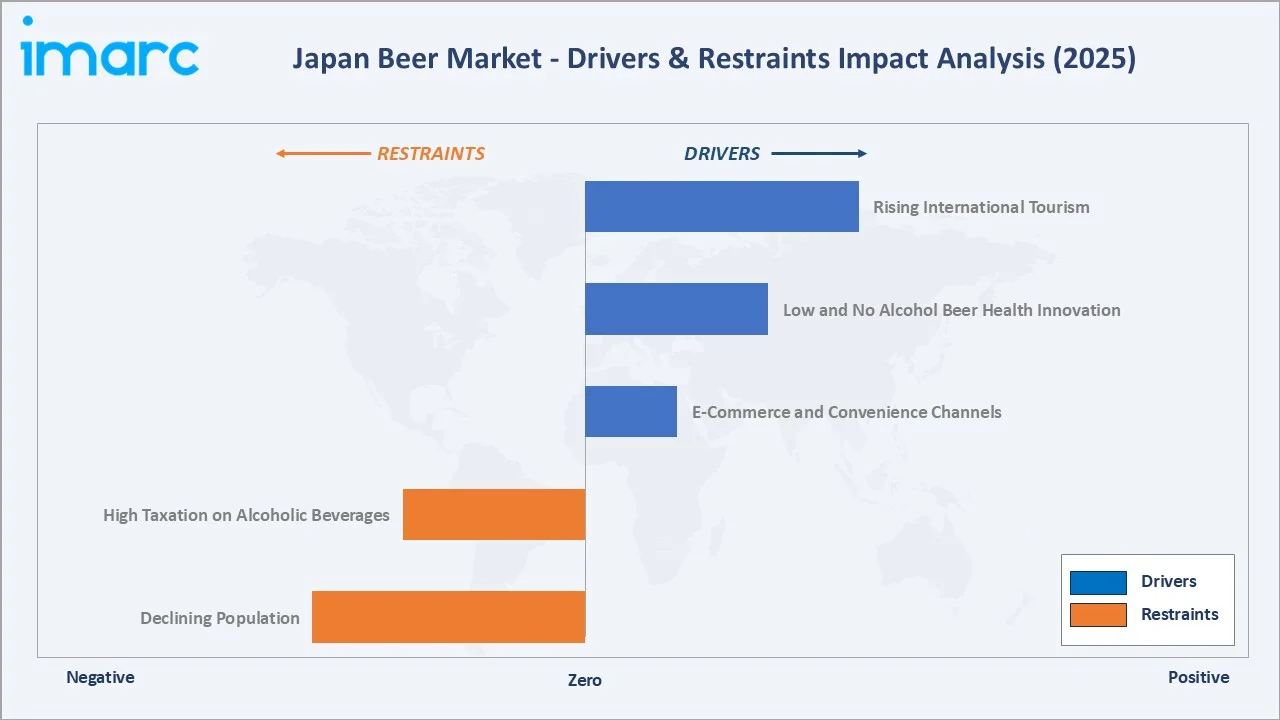
- Rising International Tourism: Rising international tourism is increasing consumption across restaurants, bars, hotels, festivals, and other hospitality venues. According to the Japan National Tourism Organization (JNTO), Japan received an estimated 3,692,200 international travelers in April 2026. International visitors actively seek authentic Japanese beer brands, craft breweries, and regional specialty beers as part of their travel experience. Growing tourist spending encourages breweries to expand premium offerings, seasonal products, and brewery tourism initiatives.
- Low and No Alcohol Beer Health Innovation: Low- and no-alcohol beer health innovation is appealing to health-conscious consumers seeking moderation without giving up beer taste and social drinking occasions. Breweries are launching low-calorie, alcohol-free, and functional beer-style products to attract younger consumers, women, and older adults. These products also support consumption during weekdays, lunch occasions, and wellness-focused lifestyles. As drinking habits shift toward mindful consumption, low- and no-alcohol innovations are expanding the market beyond traditional beer drinkers.
- E-Commerce and Convenience Channels: E-commerce and convenience channels are making beer more accessible through online platforms, supermarkets, and convenience stores. Consumers can easily purchase premium, craft, seasonal, and low-alcohol beer variants for home consumption. Convenience stores also support impulse purchases, chilled ready-to-drink availability, and frequent small-pack sales. As digital shopping and quick retail access expand, beer brands are gaining wider reach and stronger consumer engagement.
Market Restraints
- Declining Population: Declining population is reducing the overall consumer base for alcoholic beverages. Japan’s total population declined to 123.05 million, according to preliminary results from the 2025 national census. This represents a decrease of around 3.09 million people compared with the previous census conducted five years earlier. Japan’s aging demographic also shifts consumption patterns, as older consumers may drink less frequently or prefer lower-alcohol alternatives. A shrinking young adult population limits new consumer acquisition and weakens long-term volume growth.
- High Taxation on Alcoholic Beverages: High taxation on alcoholic beverages increases retail prices and reduces affordability for price-sensitive consumers. Higher excise duties can limit volume consumption, especially for regular beer, as consumers shift toward lower-tax alternatives or non-alcoholic beverages. Tax pressure also affects brewer margins, making pricing and promotional strategies more challenging. As a result, companies must focus on premiumization, efficiency, and product diversification to offset tax-related cost pressures.
Market Opportunities
- Premiumization Through Limited-Edition and Seasonal Products: Premiumization through limited-edition and seasonal products allows breweries to command higher prices and improve margins. Seasonal flavors, regional ingredients, and festival-themed launches help brands attract consumers seeking novelty and exclusivity. Limited-edition beers also encourage repeat purchases and impulse buying across convenience stores, supermarkets, and on-trade channels. This strategy supports brand differentiation in a mature market while appealing to younger and experience-driven consumers.
- Expansion of the Craft Beer Segment: Expansion of the craft beer segment is creating significant opportunities as consumers increasingly seek unique flavors, premium quality, and locally inspired products. Craft breweries are introducing innovative recipes using regional ingredients, attracting younger consumers and beer enthusiasts looking for differentiated drinking experiences. In March 2026, BrewDog, the UK’s leading craft beer brand, introduced Good Buddy, a new flagship beer available exclusively in Japan through FamilyMart stores nationwide. Designed as an easy entry point into craft beer, the product features a cheerful dog icon and offers a citrus hop aroma, mild bitterness, smooth taste, and clean finish. This trend encourages both domestic and international brewers to invest in new product development, premium positioning, and strategic retail partnerships, supporting long-term market growth.
Market Challenges
- Intense Competition from RTDs, Spirits, and Wine: Intense competition from RTDs, spirits, and wine is diverting consumer spending toward more convenient, flavored, and lifestyle-oriented alcoholic beverages. RTDs are especially popular among younger consumers due to their variety, lower alcohol options, and ready-to-drink format. Spirits and wine also compete in premium and social drinking occasions, reducing beer’s share in some consumption settings. This forces beer companies to invest heavily in innovation, branding, and differentiated product launches to retain consumer interest.
- Supply Chain and Packaging Cost Fluctuations: Supply chain and packaging cost fluctuations are increasing expenses for raw materials, glass bottles, cans, labels, and logistics. Price volatility can reduce brewer margins and make retail pricing less stable. Delays in packaging availability or transportation can also affect product launches, seasonal beer supply, and distribution efficiency. This forces beer companies to strengthen supplier networks, optimize packaging formats, and improve cost management.
Emerging Market Trends
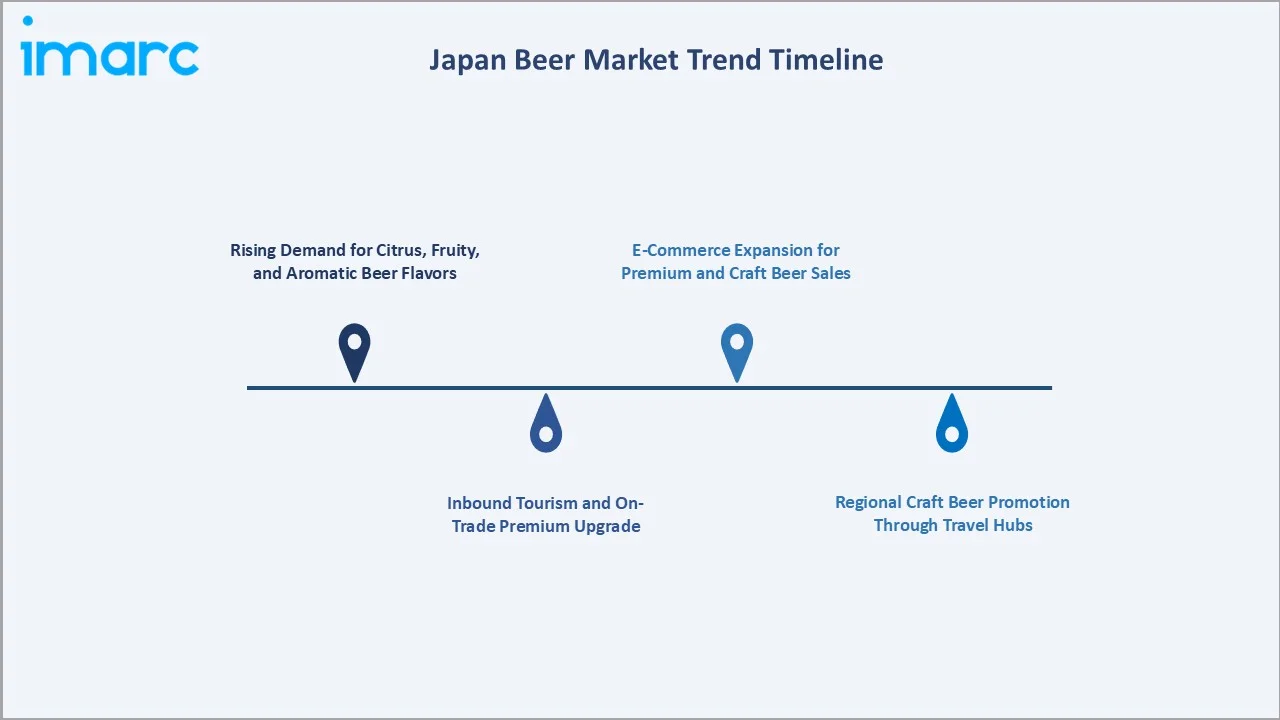
1. Rising Demand for Citrus, Fruity, and Aromatic Beer Flavors
Rising demand for citrus, fruity, and aromatic beer flavors is emerging as consumers look for lighter, refreshing, and more approachable beer options. Flavored and aroma-rich beers appeal strongly to younger consumers, casual drinkers, and those shifting from RTDs or cocktails. Citrus hops, fruit notes, and clean finishes help craft and premium beer brands differentiate from traditional lagers. This trend is encouraging breweries to launch innovative, seasonal, and easy-to-drink beer variants.
2. Inbound Tourism and On-Trade Premium Upgrade
Inbound tourism and on-trade premium upgrades are emerging as international visitors increase beer consumption across bars, restaurants, hotels, and entertainment venues. Tourists often seek authentic Japanese beer, craft varieties, and premium local experiences, encouraging outlets to offer higher-value beer options. This supports stronger demand for bottled craft beers, draught selections, seasonal brews, and regional labels. As hospitality venues upgrade their beverage menus, breweries gain opportunities to improve brand visibility and premium sales.
3. Regional Craft Beer Promotion Through Travel Hubs
Regional craft beer promotion through travel hubs is emerging as airports, railway stations, and tourist destinations increasingly showcase local breweries. These venues introduce domestic and international travelers to region-specific craft beers, enhancing brand visibility and supporting local producers. Narita International Airport is supporting Japan’s craft beer industry with the launch of NRT BEER FLIGHT CAFE, a dedicated craft beer outlet opened in June 2026, in Terminal 2’s international departures area. Located after security on the second-floor connecting corridor, the café offers around 20 craft beers, among the widest craft beer selections at a Japanese airport. The lineup will mainly highlight breweries from Chiba Prefecture, while also featuring beers from across Japan. NAA aims to let travelers experience a brewery-hopping journey across Japan without leaving the airport. The trend also strengthens beer tourism by encouraging visitors to explore regional brewing traditions and purchase premium local products.
4. E-Commerce Expansion for Premium and Craft Beer Sales
E-commerce expansion for premium and craft beer sales is emerging as consumers increasingly purchase specialty beers through online platforms and digital retail channels. Online sales allow breweries to offer limited-edition packs, seasonal varieties, subscription boxes, and direct-to-consumer bundles. This helps craft and premium beer brands reach customers beyond major cities and convenience store networks. The trend also improves brand engagement, repeat purchases, and personalized marketing opportunities.
Industry Value Chain Analysis
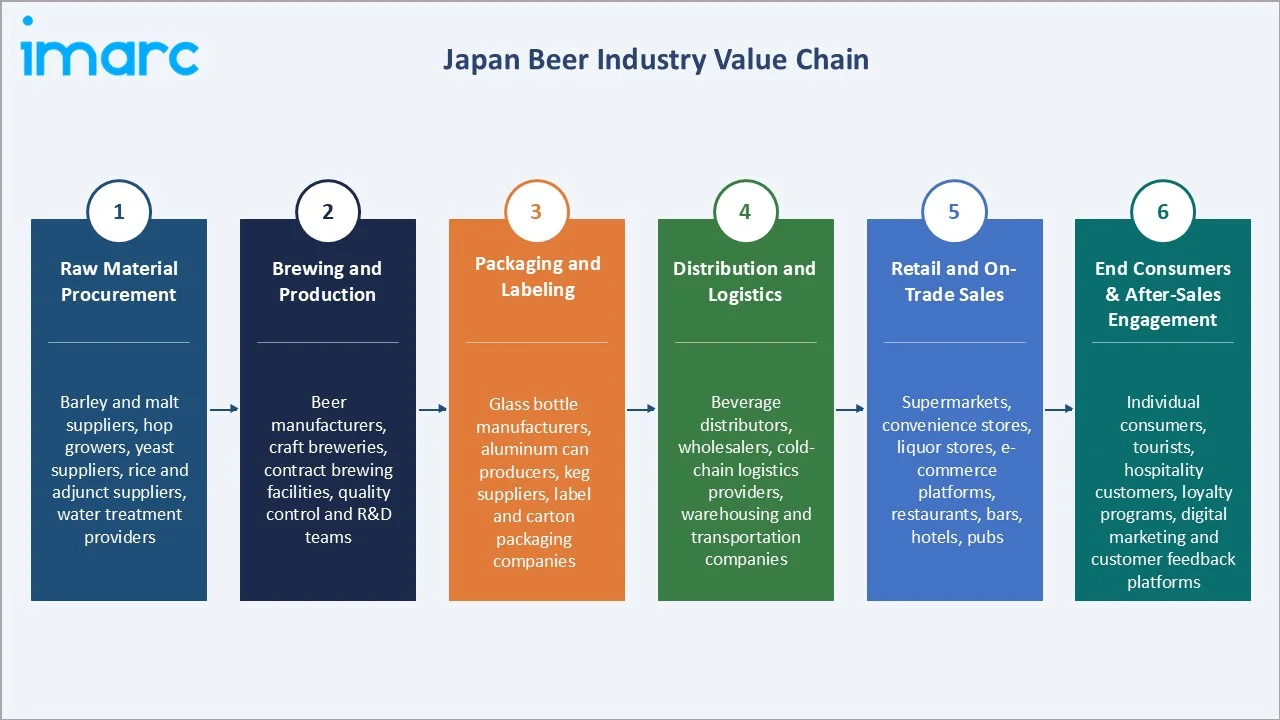
The Japan beer market value chain integrates raw material procurement, brewing & production, packaging & labeling, distribution & logistics, retail & on-trade sales, and end consumers & after-sales engagement.
|
Stage |
Key Participants |
|
Raw Material Procurement |
Barley and malt suppliers, hop growers, yeast suppliers, rice and adjunct suppliers, water treatment providers |
|
Brewing & Production |
Beer manufacturers, craft breweries, contract brewing facilities, quality control and R&D teams |
|
Packaging & Labeling |
Glass bottle manufacturers, aluminum can producers, keg suppliers, and label and carton packaging companies |
|
Distribution & Logistics |
Beverage distributors, wholesalers, cold-chain logistics providers, warehousing and transportation companies |
|
Retail & On-Trade Sales |
Supermarkets, convenience stores, liquor stores, e-commerce platforms, restaurants, bars, hotels, pubs |
|
End Consumers & After-Sales Engagement |
Individual consumers, tourists, hospitality customers, loyalty programs, digital marketing and customer feedback platforms |
The brewing and production stage is the most value-added stage in the Japan beer market. At this stage, breweries create product differentiation through recipe development, fermentation techniques, flavor innovation, quality control, and premium positioning. Investments in craft brewing, seasonal releases, and low- and no-alcohol formulations enable brands to command higher prices, strengthen brand loyalty, and enhance profitability.
Technology Landscape in the Japan Beer Industry
Brewing Innovation Technology
Brewing innovation technology enables breweries to improve product consistency, flavor development, and production efficiency. Advanced fermentation control systems, precision brewing equipment, and automated quality monitoring help create premium, craft, and low-alcohol beer variants with consistent taste. Digital brewing technologies also reduce energy consumption, optimize ingredient utilization, and minimize production waste. These innovations support faster product development, premiumization, and greater competitiveness in Japan’s evolving beer market.
Sustainable Packaging Technology
Sustainable packaging technology promotes the use of lightweight glass bottles, recyclable aluminum cans, eco-friendly labels, and renewable packaging materials. Breweries are investing in packaging innovations that reduce carbon emissions, material usage, and transportation costs while maintaining product quality. Smart packaging designs also improve recycling efficiency and support Japan’s circular economy initiatives. These technologies help breweries meet sustainability goals, strengthen brand reputation, and appeal to environmentally conscious consumers.
Digital and E-Commerce Technology
Digital and e-commerce technology expands online access to premium, craft, seasonal, and limited-edition beer products. Breweries are using digital platforms, direct-to-consumer stores, subscription models, and online promotions to reach consumers beyond traditional retail channels. Data analytics also helps brands understand purchasing behavior, personalize offers, and plan targeted product launches. These technologies improve consumer engagement, strengthen brand loyalty, and create new revenue streams in a mature beer market.
Market Segmentation Analysis
The report covers the following segments:
|
Segment Category |
Leading Segment |
Market Share |
Year |
|
Product Type |
Standard Lager |
46.8% |
2025 |
|
Packaging |
Glass |
41.7% |
2025 |
|
Production |
Macro-Brewery |
🔒 |
2025 |
|
Alcohol Content |
High |
🔒 |
2025 |
|
Flavor |
Unflavoured |
🔒 |
2025 |
|
Distribution Channel |
Supermarkets and Hypermarkets |
🔒 |
2025 |
|
Region |
Kanto Region |
34.6% |
2025 |

By Product Type
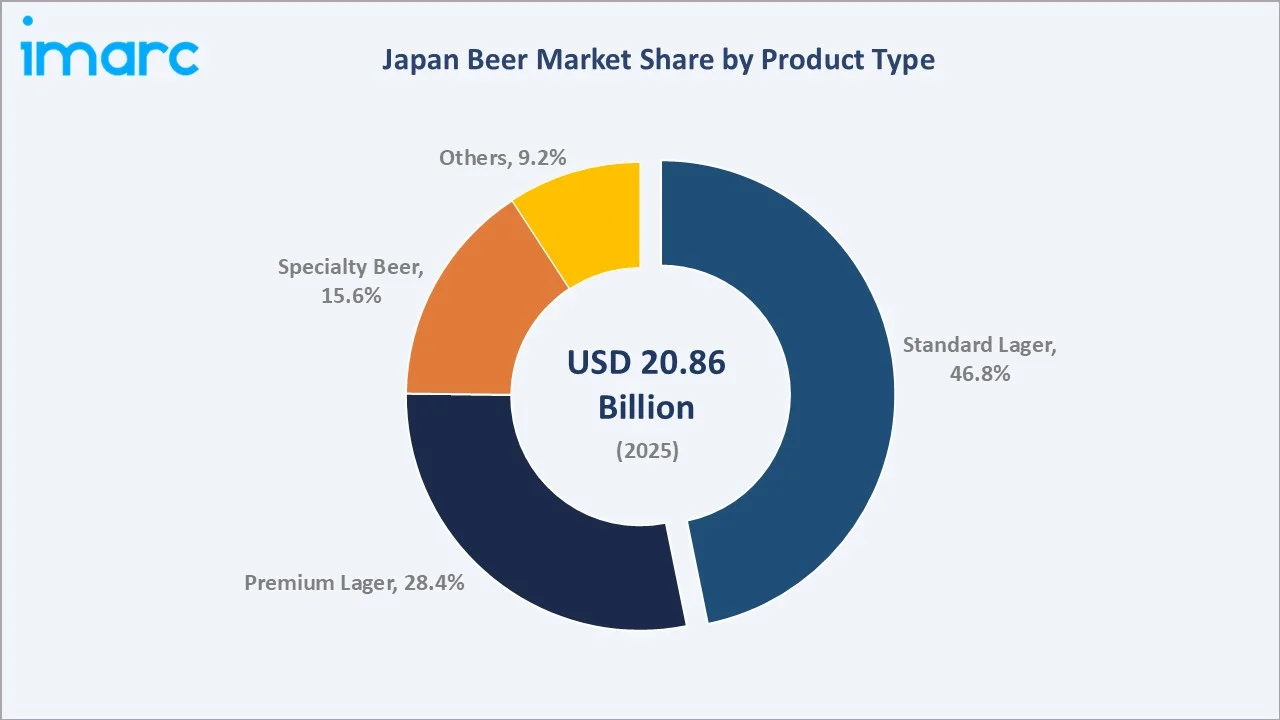
Standard lager leads at 46.8% (2025) due to its familiar taste, affordable pricing, and strong presence across supermarkets, convenience stores, restaurants, and bars. It remains the preferred choice for everyday drinking, social gatherings, and food pairing. Strong brand loyalty toward established Japanese beer companies further supports its leading market position.
To access detailed market analysis, Request Sample
Premium lager at 28.4% as consumers increasingly seek higher-quality beer with refined taste and superior ingredients. Its strong appeal among urban consumers and on-trade establishments supports steady demand. Specialty beer at 15.6% grows fastest at ~5.4% CAGR, driven by rising consumer interest in craft, flavored, seasonal, and limited-edition brews. Others at 9.2% include niche beer styles and innovative products catering to evolving consumer preferences.
By Packaging
Glass leads at 41.7% (2025), through on-trade izakaya bottle, premium on-trade hotel and restaurant glass presentation, and large-format home glass purchase.
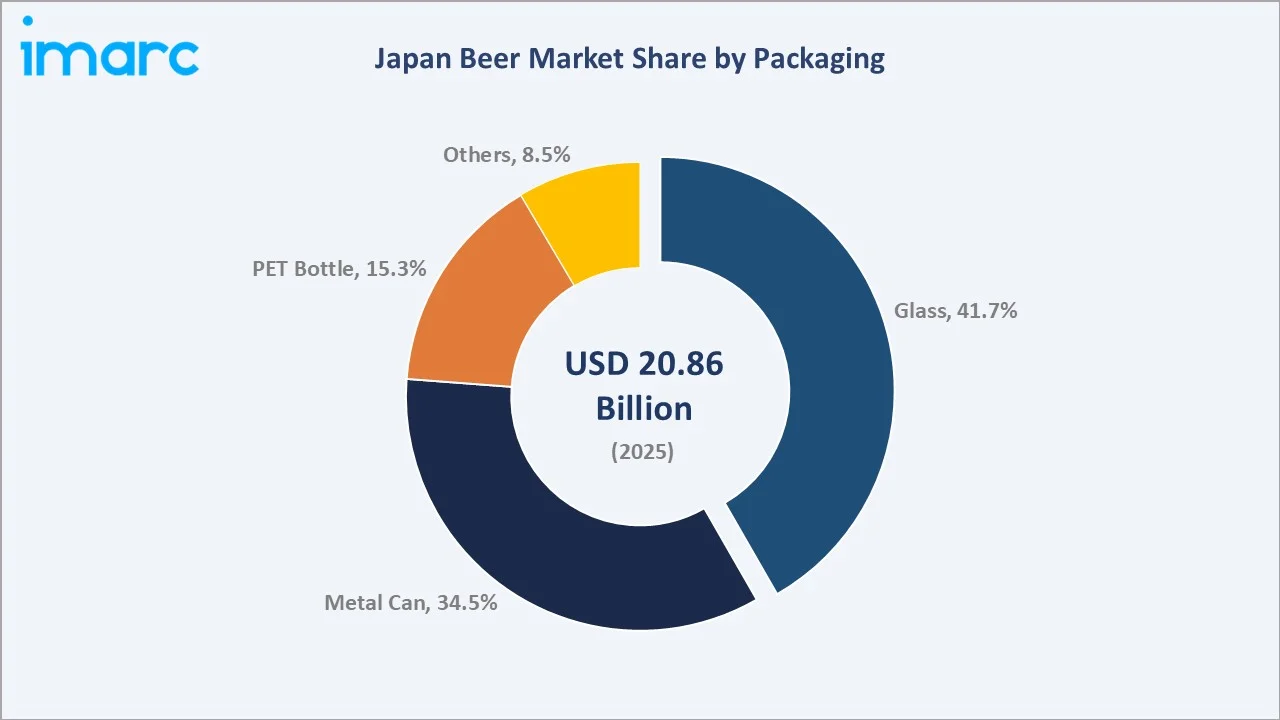
Metal can at 34.5% grows fastest at ~4.4% CAGR through convenience stores, home multi-pack, and craft can growth. PET bottle at 15.3% reflects large-format home purchase. Others at 8.5% include keg draught for on-trade restaurants and bars, party barrel, and specialty packaging.
Regional Market Insights
|
Region |
Share (2025) |
Key Japan Beer Market Drivers & Characteristics |
|
Kanto Region |
34.6% |
Reflecting its large urban population, high disposable incomes, dense concentration of restaurants, bars, convenience stores, and strong tourism and nightlife activities. |
|
Kinki Region |
18.7% |
Reflecting robust hospitality demand, vibrant food culture, and high beer consumption, supported by tourism and entertainment industries. |
|
Central/Chubu Region |
15.1% |
Reflecting strong manufacturing activity, rising premium beer consumption, and steady demand from urban centers, restaurants, and retail channels. |
|
Kyushu-Okinawa Region |
9.8% |
Reflecting growing tourism, expanding hospitality infrastructure, and increasing preference for regional craft and premium beer offerings. |
|
Tohoku Region |
7.5% |
Reflecting stable local consumption, growing interest in regional breweries, and expanding availability of craft beer through retail and tourism channels. |
|
Chugoku Region |
5.8% |
Reflecting consistent consumer demand, strong local brewing traditions, and increasing penetration of premium and specialty beer products. |
|
Hokkaido Region |
4.9% |
Reflecting strong domestic tourism, the popularity of locally brewed beers, and high demand during seasonal festivals and outdoor tourism activities. |
|
Shikoku Region |
3.6% |
Reflecting a smaller consumer base, stable retail demand, and gradual growth in craft beer production and regional brewery development. |
Kanto's 34.6% dominance is supported by its large population, high disposable incomes, and dense concentration of restaurants, bars, hotels, and convenience stores in Tokyo and surrounding prefectures. Kinki's 18.7% follows with strong demand supported by tourism, nightlife, and a vibrant food service sector centered around Osaka, Kyoto, and Kobe.
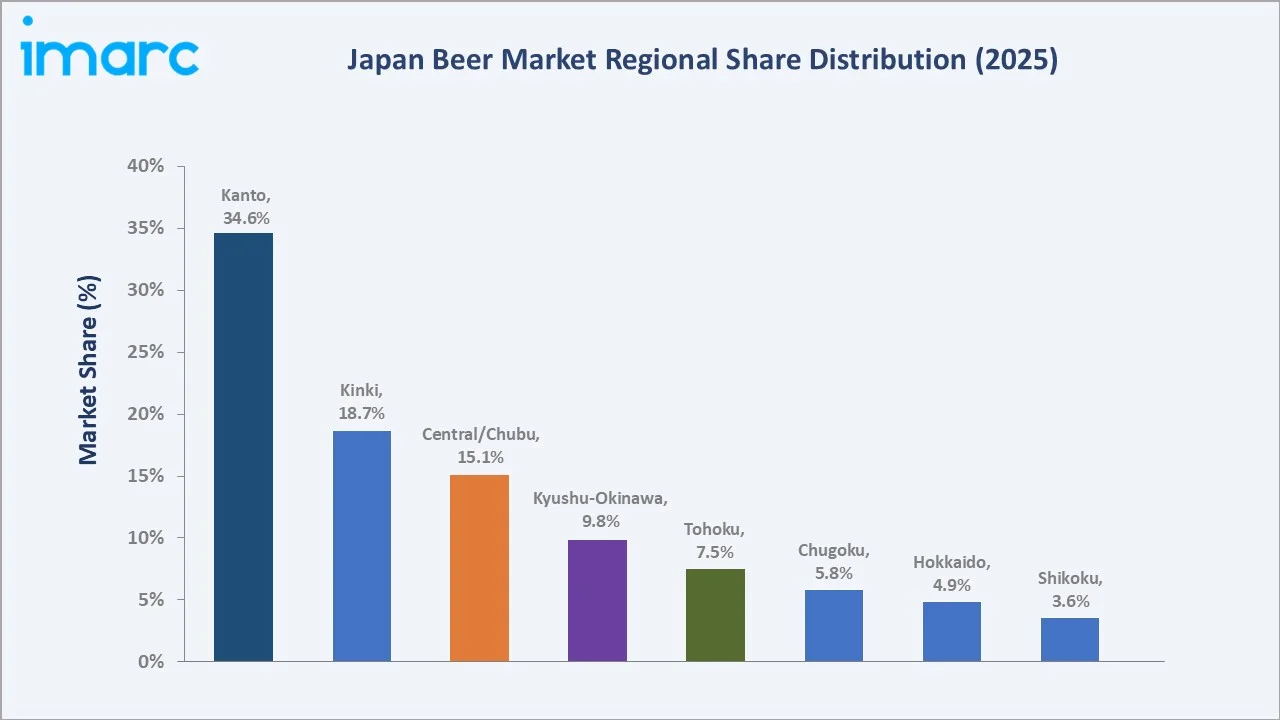
Central/Chubu's 15.1% benefits from its industrial base and growing preference for premium and craft beers. Kyushu-Okinawa's 9.8% gains momentum from rising tourism and hospitality activities. Tohoku’s 7.5%, Chugoku's 5.8%, Hokkaido’s 4.9%, and Shikoku’s 3.6% contribute through stable local consumption, regional brewery expansion, and increasing consumer interest in locally produced craft and specialty beers.
Competitive Landscape
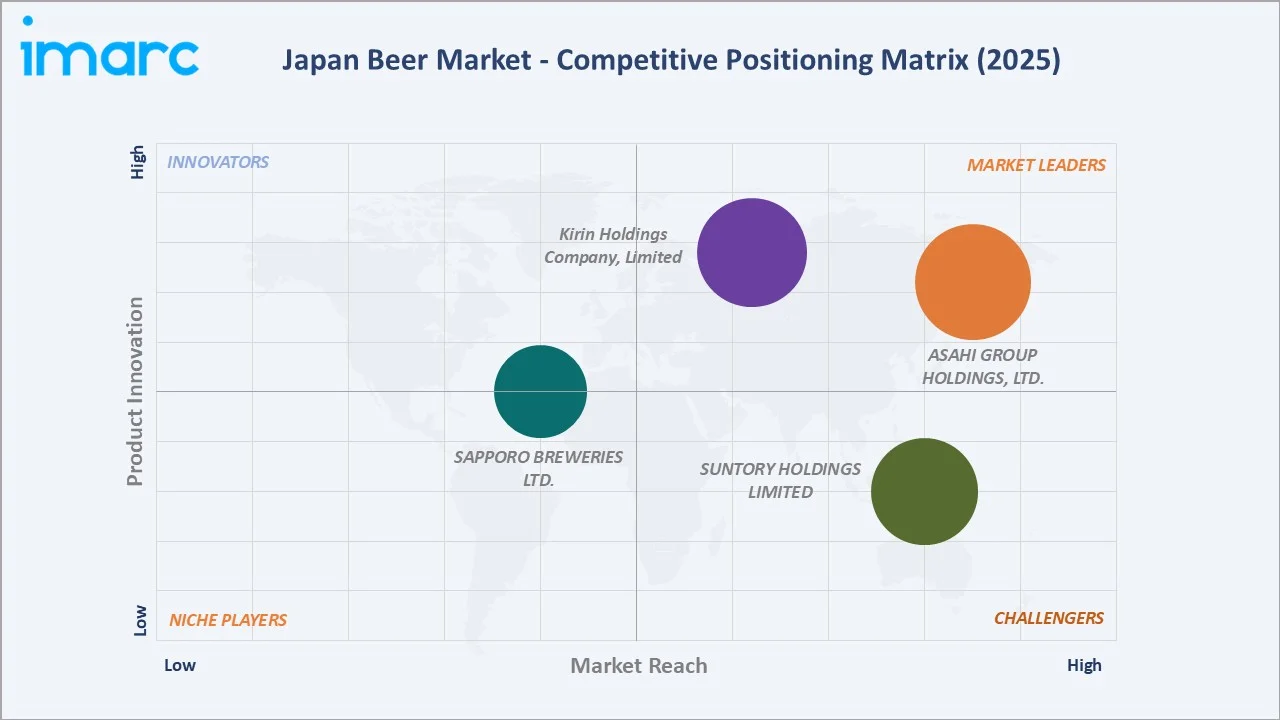
The Japan beer market is moderately consolidated, with major players holding strong brand recognition and wide distribution networks. Competition is driven by premium lagers, craft beer launches, low- and no-alcohol variants, and seasonal products. Large breweries focus on innovation, convenience store partnerships, and on-trade visibility to retain market share.
|
Company |
Key Brands |
Market Position |
Core Strength |
|
ASAHI GROUP HOLDINGS, LTD. |
Asahi Super Dry, Peroni Nastro Azzurro, Kozel, Pilsner Urquell, Grolsch, Great Northern, Victoria Bitter, Carlton Draught, Balter, Tyskie, Radegast, Dreher, Captain Jack |
Market Leader |
ASAHI GROUP HOLDINGS, LTD. is the dominant leader in the Japanese beer market, driving domestic dominance through iconic products like Asahi Super Dry, while managing a broader global beverage and food portfolio. |
|
Kirin Holdings Company, Limited |
KIRIN ICHIBAN, Château Mercian, Kirin Chu-hi Hyoketsu |
Market Leader |
Kirin Holdings Company, Limited is one of Japan’s cornerstone beverage and biotechnology conglomerates. It operates as the parent and holding company for iconic brewing subsidiaries like Kirin Brewery Company, pioneering the country's modern beer and spirits industry. |
|
SAPPORO BREWERIES LTD. |
SAPPORO, YEBISU |
Established Player |
SAPPORO BREWERIES LTD. pioneered Japan's brewing industry. The company introduced Western-style lager beer to the nation and leads Japan's premium beer market, producing historic lagers like Sapporo Premium and the iconic YEBISU. |
|
SUNTORY HOLDINGS LIMITED |
Suntory Nama Beer, Kinmugi |
Strong Challenger |
SUNTORY HOLDINGS LIMITED is one of Japan's "Big Four" domestic breweries, widely credited with elevating Japanese beer craftsmanship and pioneering non-alcoholic alternatives. |
At the same time, craft and regional breweries are gaining traction through unique flavors and local identity. Overall, companies are competing on product differentiation, pricing, packaging, sustainability, and consumer engagement.
Key Company Profiles
ASAHI GROUP HOLDINGS, LTD.
ASAHI GROUP HOLDINGS, LTD. is one of Japan’s largest alcoholic beverage companies and a leading participant in the domestic beer market. Its portfolio includes flagship beer brands such as Asahi Super Dry, premium beers, low- and no-alcohol beverages, and craft beer offerings. The company operates an extensive manufacturing and distribution network across Japan, supported by strong relationships with supermarkets, convenience stores, restaurants, and bars.
- Key Brands: Asahi Super Dry, Peroni Nastro Azzurro, Kozel, Pilsner Urquell, Grolsch, Great Northern, Victoria Bitter, Carlton Draught, Balter, Tyskie, Radegast, Dreher, Captain Jack.
- Strategic Focus: Strengthening its premium beer portfolio, led by flagship products such as Asahi Super Dry, while expanding low- and no-alcohol offerings to meet changing consumer preferences. The company emphasizes product innovation, seasonal launches, and quality differentiation to sustain brand loyalty in Japan’s mature beer market.
Kirin Holdings Company, Limited
Kirin Holdings Company, Limited is one of Japan’s leading beverage and beer manufacturers, with a strong presence in the domestic beer market. The company operates across beer, low-malt beer, non-alcoholic beverages, RTDs, and health-oriented drinks, giving it a diversified alcohol and beverage portfolio. Kirin benefits from strong brand equity, nationwide distribution, and deep relationships with convenience stores, supermarkets, restaurants, and bars.
- Key Brands: KIRIN ICHIBAN, Château Mercian, Kirin Chu-hi Hyoketsu.
- Strategic Focus: Focuses on strengthening its premium and mainstream beer brands while expanding into low-alcohol, non-alcoholic, and health-conscious beverage segments. The company emphasizes product innovation, functional beer-style drinks, seasonal launches, and premium lager development to address changing consumer preferences.
Market Concentration Analysis
The Japan beer market is moderately concentrated, with leading players holding a major share through strong brands and nationwide distribution. Large breweries dominate standard lager and premium beer segments due to scale, advertising strength, and deep retail partnerships. However, market concentration is gradually easing as craft breweries, regional brewers, and international craft brands expand their presence. Competition is increasing in premium, low-alcohol, seasonal, and convenience-store-exclusive products. Overall, the market remains led by major domestic companies, while niche and craft players are creating more fragmented growth pockets.
Investment & Growth Opportunities
Highest Growth Segments
Specialty beer craft (~5.4% CAGR), premium lager premiumization (~4.8% CAGR), metal can conbini and home (~4.4% CAGR), no-alcohol beer innovation (~6% CAGR from growing base), Japan beer export Asia (~5% CAGR), and Kanto tourism craft taproom (~5% CAGR) represent Japan beer highest-growth investment vectors through 2034.
Investment Themes
- Craft beer taproom and D2C subscription: Investment in brewery taprooms, experiential retail, and direct-to-consumer subscription services enables breweries to strengthen customer engagement, improve margins, and expand sales of premium and limited-edition beers.
- Low-alcohol and no-alcohol beer innovation: Investments in advanced brewing technologies and health-oriented product development are creating growth opportunities as demand rises for wellness-focused, low- and alcohol-free beer alternatives across Japan.
Future Market Outlook (2026-2034)
The Japan beer market is projected to grow from USD 20.86 Billion in 2025 to USD 21.96 Billion in 2026, reaching USD 30.36 Billion by 2034, registering a CAGR of 4.13% during 2026-2034 through craft beer taproom and D2C subscription premium expansion, record inbound tourism on-trade premium upgrade, low and no-alcohol beer innovation, and Japan beer export. The market's anchor value of USD 25.54 Billion in 2030 represents Japan beer at craft premium inflection.
Three structural forces are expected to shape the growth of the Japan beer market through 2034. First, premiumization and product innovation will drive demand for craft, seasonal, and low- and no-alcohol beer variants. Second, expanding tourism and the recovery of on-trade consumption will support higher sales across restaurants, bars, airports, and hospitality venues. Third, digital retail expansion and direct-to-consumer channels will improve access to premium and specialty beers, while sustainability initiatives and eco-friendly packaging will strengthen long-term competitiveness and consumer appeal.
Research Methodology
Primary Research
Primary research comprised interviews and discussions with beer manufacturers, distributors, retailers, craft brewers, and hospitality operators across Japan. It also included inputs from industry experts, trade associations, and channel partners to understand demand trends, pricing, product innovation, and consumer preferences. These insights helped validate market sizing, regional demand patterns, and future growth assumptions.
Secondary Research
Secondary research encompassed the analysis of company annual reports, investor presentations, industry publications, government statistics, trade association reports, and regulatory documents. It also included reviews of brewery announcements, market databases, import-export data, and credible news sources to assess market trends, competitive dynamics, consumer behavior, and the overall outlook of the Japan beer market.
Forecasting Models
Forecasting models combined historical market performance with macroeconomic indicators, demographic trends, tourism growth, consumer spending, and beer consumption patterns to estimate future demand. The analysis incorporated pricing trends, premiumization, product innovation, and distribution channel expansion across Japan. Market forecasts were validated using primary research findings, industry benchmarks, and scenario-based sensitivity analysis to ensure robust long-term projections through 2034.
Report Coverage:
| Report Features | Details |
|---|---|
| Base Year of the Analysis | 2025 |
| Historical Period | 2020-2025 |
| Forecast Period | 2026-2034 |
| Units | Billion USD |
| Scope of the Report | Exploration of Historical Trends and Market Outlook, Industry Catalysts and Challenges, Segment-Wise Historical and Future Market Assessment:
|
| Product Types Covered | Standard Lager, Premium Lager, Specialty Beer, Others |
| Packagings Covered | Glass, PET Bottle, Metal Can, Others |
| Productions Covered | Macro-Brewery, Micro-Brewery, Others |
| Alcohol Contents Covered | High, Low, Alcohol Free |
| Flavors Covered | Unflavoured, Flavoured |
| Distribution Channels Covered | Supermarkets and Hypermarkets, On-Trades, Specialty Stores, Convenience Stores, Others |
| Region Covered | Kanto Region, Kinki Region, Central/ Chubu Region, Kyushu-Okinawa Region, Tohoku Region, Chugoku Region, Hokkaido Region, Shikoku Region |
| Companies Covered | ASAHI GROUP HOLDINGS LTD., Kirin Holdings Company Limited, SAPPORO BREWERIES LTD., SUNTORY HOLDINGS LIMITED, etc. |
| Customization Scope | 10% Free Customization |
| Post-Sale Analyst Support | 10-12 Weeks |
| Delivery Format | PDF and Excel through Email (We can also provide the editable version of the report in PPT/Word format on special request) |
Frequently Asked Questions About the Japan Beer Market Report
The Japan beer market size is estimated at USD 21.96 Billion in 2026, driven by strong consumer preference for beer as a leading alcoholic beverage, supported by an established drinking culture, wide retail availability, and strong brand loyalty. Growth is further supported by rising demand for premium, craft, low-alcohol, and seasonal beer variants, along with tourism-led consumption across restaurants, bars, hotels, and convenience channels.
The Japan beer market grows at 4.13% CAGR during 2026-2034, reaching USD 30.36 Billion by 2034. The CAGR reflects premiumization and craft upgrade, record inbound tourism, no-alcohol innovation, and Japan beer export and Asia structural demand.
Standard lager leads at 46.8% due to its familiar taste, competitive pricing, and wide availability across supermarkets, convenience stores, restaurants, and izakayas. Strong consumer loyalty to established domestic brands further supports the segment’s dominance.
Glass leads at 41.7% due to its premium image, strong use in restaurants and izakayas, and ability to preserve beer taste and freshness. It is also widely preferred for bottled beer formats from leading domestic brands.
Kanto region leads at 34.6% due to its large urban population, high concentration of restaurants, bars, izakayas, and strong retail distribution. Tokyo’s premium consumption base and nightlife culture further support higher beer sales.
Leading companies include ASAHI GROUP HOLDINGS, LTD., Kirin Holdings Company, Limited, SAPPORO BREWERIES LTD., and SUNTORY HOLDINGS LIMITED, among others.
The market is projected to reach approximately USD 25.54 Billion by 2030, supported by steady demand from urban consumers, restaurants, bars, and retail channels. Growth is further driven by premium beer, craft beer, and low-/no-alcohol product innovation.
Three priority investment opportunities are craft beer taprooms and D2C subscriptions, low- and no-alcohol beer innovation, and premium seasonal beer launches. These areas can help brewers capture higher-margin demand, attract younger and health-conscious consumers, and strengthen direct consumer engagement. Expansion through convenience stores, e-commerce, airports, and hospitality channels can further improve market reach.
Need more help?
- Speak to our experienced analysts for insights on the current market scenarios.
- Include additional segments and countries to customize the report as per your requirement.
- Gain an unparalleled competitive advantage in your domain by understanding how to utilize the report and positively impacting your operations and revenue.
- For further assistance, please connect with our analysts.
 Request Customization
 Speak to an Analyst
 Request Brochure
 Inquire Before Buying
Benefits of Customization
- Personalize this research
- Triangulate with your data
- Get data as per your format and definition
- Gain a deeper dive into a specific application, geography, customer, or competitor
- Any level of personalization
Get in Touch With Us
UNITED STATES
Phone: +1-201-971-6302
INDIA
Phone: +91-120-433-0800
UNITED KINGDOM
Phone: +44-753-714-6104
Email: [email protected]
Client Testimonials




.webp)




.webp)













Related Reports

Choose your plan
*Please note that the prices mentioned below are starting prices for each bundle type. Kindly contact our team for further details.*
Single User License
- 1 User License, Access on 2 Devices
- PDF Report + Excel Dataset (Password Protected)
- Lifetime Access
- No Printing Rights
- 10% Free Report Customization
- 10–12 Weeks of Analyst Support
Five User License
- Access for 5 Users, 2 Devices per User
- PDF Report + Excel Dataset (Password Protected)
- Lifetime Access
- Dedicated Account Manager
- 12–14 Weeks of Analyst Support
- No Printing Rights
- 15% Free Report Customization
- 25% Discount on Your Next Purchase
Corporate User License
- Unlimited User Access (Within Your Organization)
- PDF Report + Excel Dataset
- Lifetime Access
- Dedicated Account Manager
- 14–20 Weeks of Analyst Support
- No Printing Rights
- 20% Free Report Customization
- 30% Discount on Your Next Purchase
Essential Insights
What's included:
3 reports
- Lifetime Access
- PDF Reports
- Excel Datasets
- 2 Weeks of Free Analyst Support
- 2 User Licenses
- Access on 2 Devices
- Printing Rights
- Complimentary PowerPoint (PPT) Version
- Complimentary License Upgrade
Professional Access
What's included:
5 reports
- Lifetime Access
- PDF Reports
- Excel Datasets
- 8 Weeks of Free Analyst Support
- 2 User Licenses
- Access on 2 Devices
- Printing Rights
- Complimentary PowerPoint (PPT) Version
- Complimentary License Upgrade
Business Advantage
What's included:
8 reports
- Lifetime Access
- PDF Reports
- Excel Datasets
- 14 Weeks of Free Analyst Support
- 2 User Licenses
- Access on 2 Devices
- Printing Rights
- Complimentary PowerPoint (PPT) Version
- Complimentary License Upgrade
Enterprise Intelligence
What's included:
10 reports
- Lifetime Access
- PDF Reports
- Excel Datasets
- 20 Weeks of Free Analyst Support
- 2 User Licenses
- Access on 2 Devices
- Printing Rights
- Complimentary PowerPoint (PPT) Version
- Complimentary License Upgrade