
Japan Cheese Market Size, Share, Trends and Forecast by Source, Type, Product, Distribution Channel, Format, and Region, 2026-2034
Japan Cheese Market Size, Share, Trends & Forecast (2026-2034)
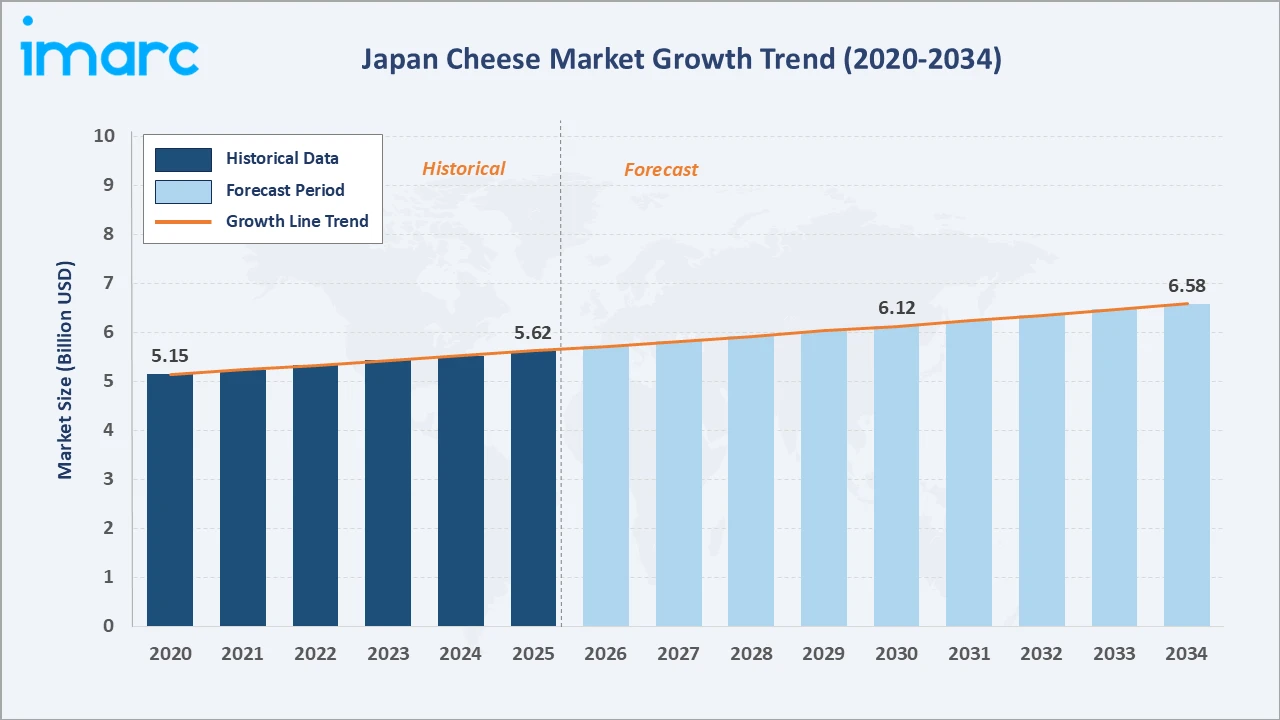
The Japan cheese market size increased from USD 5.62 Billion in 2025 to USD 5.74 Billion in 2026 and is projected to reach USD 6.58 Billion by 2034, growing at a CAGR of 1.73% during 2026-2034. Rising Western dietary habits, expanding pizza and Italian-cuisine foodservice outlets, and growing e-commerce penetration continue to widen demand beyond Japan's traditionally low per-capita cheese consumption. In 2025, Japan exported approximately ¥3.06 billion worth of cheese, ranking it 631st among the country’s 1,176 exported products. The leading destinations were Chinese Taipei at ¥1.15 billion, followed by Vietnam, Hong Kong, Thailand, and Singapore. This export activity also enhances brand recognition, supports investment in processing capacity, and creates additional revenue opportunities for Japan’s cheese industry. Cow milk-based cheese dominates sourcing at 78.4% share (2025), while natural cheese leads the type segmentation at 58.7%, reflecting a gradual shift from processed to natural formats. The Kanto region anchors the market with a 34.2% share, supported by Tokyo's dense retail and foodservice infrastructure.
Market Snapshot
|
Metric |
Value |
|
Base Year Market Size (2025) |
USD 5.62 Billion |
| Market Size (2026) | USD 5.74 Billion |
|
Forecast Market Size (2034) |
USD 6.58 Billion |
|
CAGR (2026-2034) |
1.73% |
|
Base Year |
2025 |
|
Historical Period |
2020-2025 |
|
Forecast Period |
2026-2034 |
|
Dominant Source |
Cow Milk – 78.4% (2025) |
|
Dominant Type |
Natural – 58.7% (2025) |
|
Largest Region |
Kanto Region – 34.2% (2025) |
The market grew from USD 5.15 Billion in 2020 to USD 5.62 Billion in 2025, reaching an estimated USD 5.74 Billion in 2026 and anchored at USD 6.12 Billion in 2030, expected to reach USD 6.58 Billion by 2034. Premiumization of natural cheese varieties and expanding convenience-format snacking cheese are reshaping Japan's cheese economics beyond baseline import-tariff pressures.
To get more information on this market, Request Sample
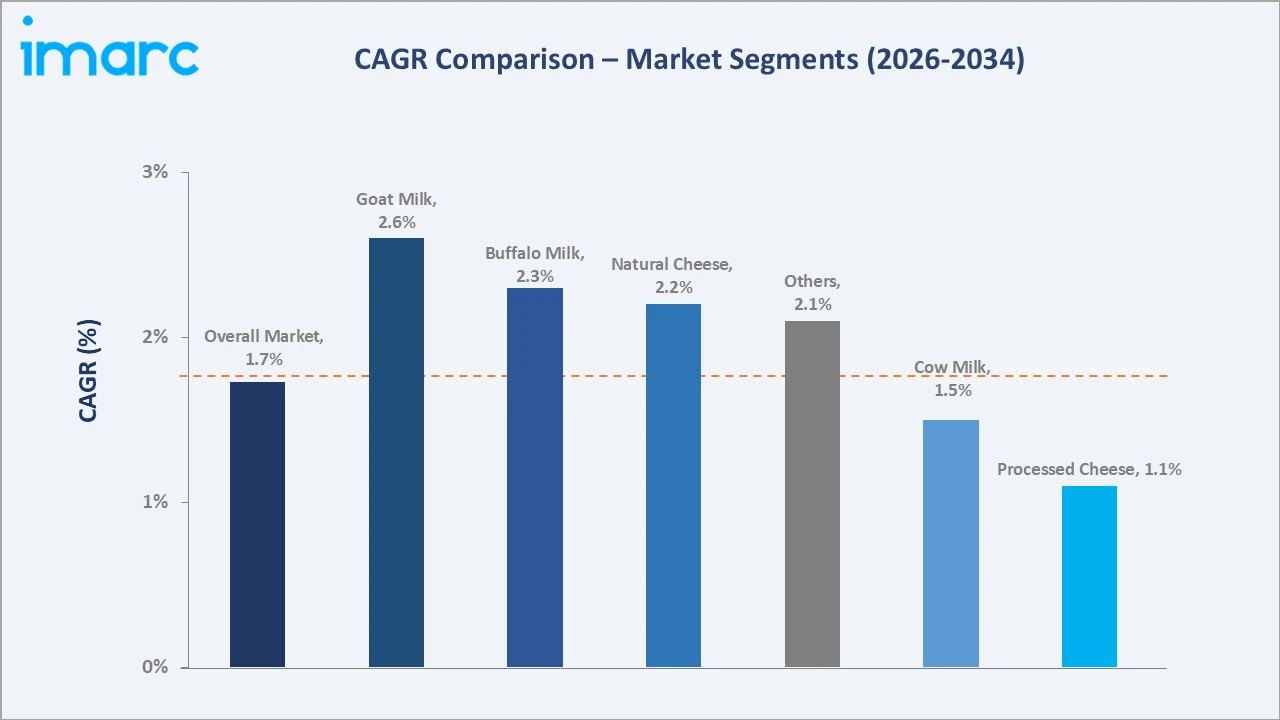
Natural cheese categories such as mozzarella and Camembert are growing faster than processed formats, supported by rising Caprese-salad consumption and expanding premium retail assortments. Within sourcing, buffalo and goat milk cheeses post above-average growth as specialty and artisanal demand widens among affluent urban consumers.
Executive Summary
The Japan cheese market expanded from USD 5.62 Billion in 2025 to an estimated USD 5.74 Billion in 2026, positioning the country as the largest cheese importer in the Asia-Pacific region. Japan's per-capita cheese consumption has risen nearly 30% over the past decade to approximately 2.8 kilograms, indicating substantial headroom. This structural gap, combined with import-tariff reductions and the Japan-EU Economic Partnership Agreement, supports steady 1.73% CAGR growth to USD 6.58 Billion by 2034.
Cow milk-based cheese leads sourcing at 78.4% share (2025), reflecting the dominance of conventional dairy supply chains. Natural cheese commands 58.7% of type segmentation, driven by mozzarella, Camembert, and cheddar demand from foodservice and premium retail. The Kanto region leads consumption at a 34.2% share (2025), anchored by Tokyo's dense retail and foodservice network.
Key Market Insights
|
Insight |
Data |
|
Dominant Source |
Cow Milk - 78.4% share (2025) |
|
Largest Type |
Natural Cheese - 58.7% share (2025) |
|
Leading Region |
Kanto Region - 34.2% share (2025) |
|
Market Opportunity |
Premium natural and specialty cheese expansion |
Key Analytical Observations Supporting The Above Data:
- Cow Milk at 78.4% (2025) anchored by established dairy supply chains: Japan's conventional dairy infrastructure, concentrated in Hokkaido, supplies the majority of the nation's raw milk, sustaining cow milk cheese's structural dominance across retail and foodservice channels.
- Natural Cheese at 58.7% (2025) driven by Western-cuisine adoption: Rising consumption of pizza, pasta, and Caprese-style salads has expanded natural cheese demand faster than processed formats, which nonetheless retain snack and dessert-cheese strongholds.
- Kanto Region leads at 34.2% (2025) on Tokyo's retail density: The region's concentrated supermarket, convenience-store, and foodservice infrastructure supports the highest per-capita cheese purchasing frequency nationally.
Japan Cheese Market Overview
Japan cheese market spans natural and processed cheese products sourced from cow, buffalo, and goat milk, serving retail, foodservice, and confectionery applications nationwide. The ecosystem integrates domestic dairy farms concentrated in Hokkaido, import supply chains from Australia, New Zealand, and the European Union, and processing operations. Distribution flows through supermarkets, convenience stores, e-commerce platforms, and foodservice channels, including pizza chains and Italian restaurants. Yen depreciation and global milk-price volatility remain key macroeconomic variables shaping import costs.
Market Dynamics
To evaluate market opportunities, Request Sample
Market Drivers
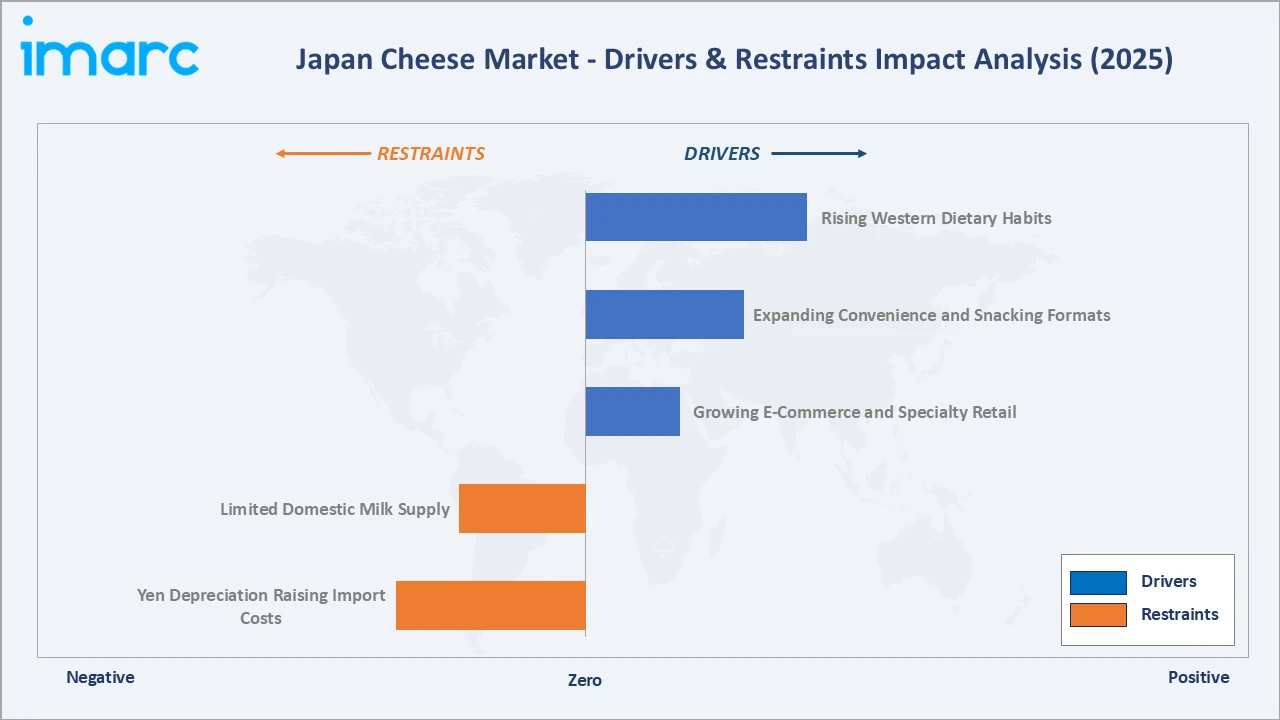
- Rising Western Dietary Habits: Cheese consumption has grown nearly 30% over the past decade as pizza, pasta, and bakery consumption normalizes among Japanese consumers, particularly those aged 15-24.
- Expanding Convenience and Snacking Formats: In June 2026, Meiji launched two additions to its Hokkaido Tokachi Smart Cheese range. The new Aged Cheddar Blend and Black Pepper Parmesan Blend, each offered in four-piece packs, launched nationwide through convenience stores. This reflects rising demand for portion-controlled, individually wrapped snacking cheese paired with alcoholic beverages.
- Growing E-Commerce and Specialty Retail: Digital marketplaces now provide Japanese consumers access to specialty cheeses, including French Camembert and Italian Parmigiano-Reggiano, previously limited to niche specialty stores.
Market Restraints
- Limited Domestic Milk Supply: Japan's dairy herd remains geographically concentrated in Hokkaido, constraining natural cheese production capacity and sustaining reliance on imports to meet a majority of total cheese demand.
- Yen Depreciation Raising Import Costs: A weaker yen has increased landed costs for imported cheese and raw milk inputs, prompting manufacturers to raise retail prices since 2022.
Market Opportunities
- Premiumization of Natural Cheese: Growing consumer interest in Camembert, mozzarella, and artisanal domestic cheese presents an opportunity for manufacturers to expand higher-margin natural cheese portfolios.
- Expansion of Premium and Indulgent Cheese Products: The rich and creamy positioning supports demand for premium cheese blends with stronger flavors and textures. Producers can target consumers willing to pay more for indulgent, restaurant-inspired, and limited-edition offerings. In May 2026, Pizza Hut Japan introduced a limited-edition cheese-and-curry “drinkable pizza” as part of its experimental menu series. The unusually creamy, soup-like product attracted significant attention on social media, with consumers describing it as rich enough to drink rather than eat.
Market Challenges
- Warm and Humid Climate Constraints: Japan's climate limits natural cheese shelf stability, pushing domestic manufacturers toward processed cheese formats with extended shelf life.
- Input Cost Volatility: Fluctuating global raw milk prices and elevated import costs continue to compress manufacturer margins, requiring periodic retail price adjustments across major brands.
Emerging Market Trends
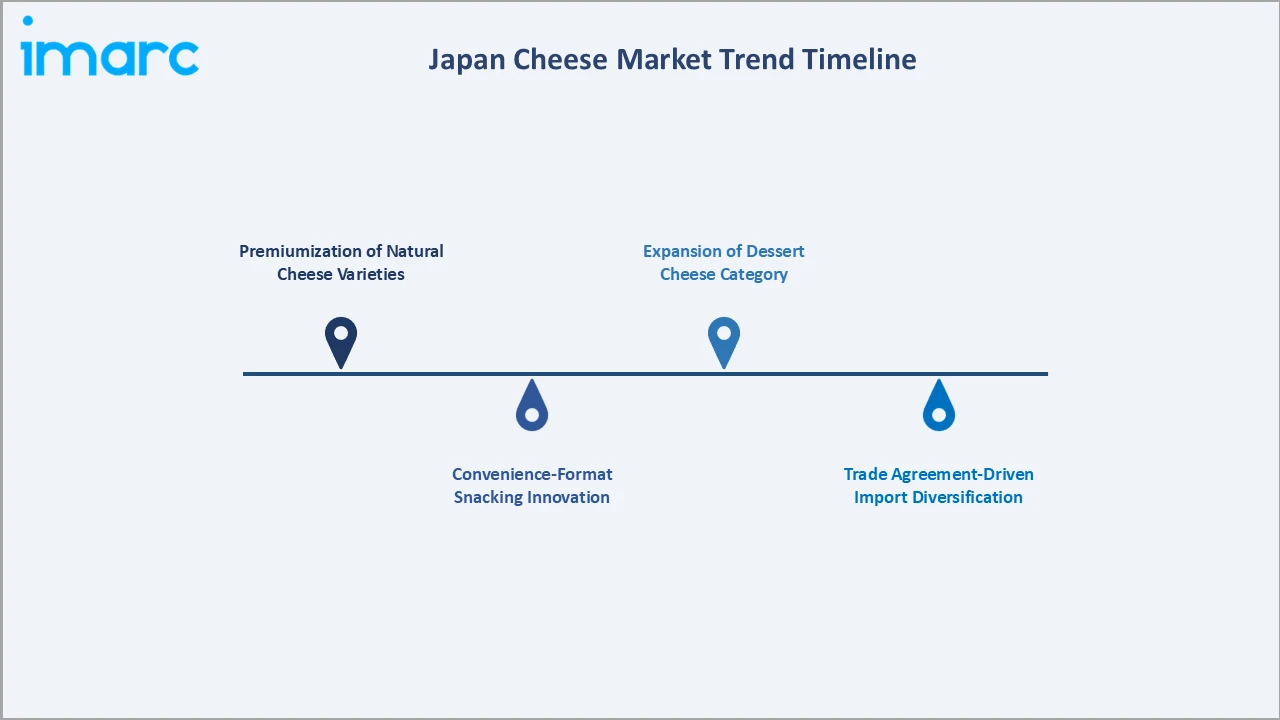
1. Premiumization of Natural Cheese Varieties
Consumer demand for mozzarella, Camembert, and cheddar has grown faster than processed cheese, supported by Caprese salad popularity and premium retail assortments. Domestic artisanal cheesemakers are gaining recognition alongside imported specialty brands.
2. Expansion of Dessert Cheese Category
In September 2024, Meiji Co., Ltd. announced Meiji St Môret Cream Cheese Dessert in strawberry, vanilla, and caramel flavors through a collaboration with Savencia Fromage & Dairy. Made with authentic French cream cheese, the dessert range became available in Japan in October 2024. These products combine the richness of cheese with convenient, ready-to-eat dessert formats. Collaborations with international dairy brands also support premium positioning and product differentiation. This trend is broadening cheese consumption beyond traditional meals and snacks.
3. Convenience-Format Snacking Innovation
Convenience-format snacking innovation is emerging as companies introduce individually portioned, portable, and ready-to-eat products. Small packs, bite-sized pieces, and resealable formats suit busy consumers and convenience-store shopping habits. Premium flavors and functional positioning are also helping cheese compete with traditional snacks. This trend is expanding consumption occasions beyond meals into work, travel, and on-the-go snacking.
4. Trade Agreement-Driven Import Diversification
Trade agreement-driven import diversification is emerging as lower tariffs and improved market access expand sourcing from multiple dairy-producing countries. This increases the availability of specialty, premium, and competitively priced cheese varieties. Greater supplier diversity also supports product innovation among retailers, foodservice operators, and manufacturers while reducing dependence on a limited number of import markets.
Industry Value Chain Analysis
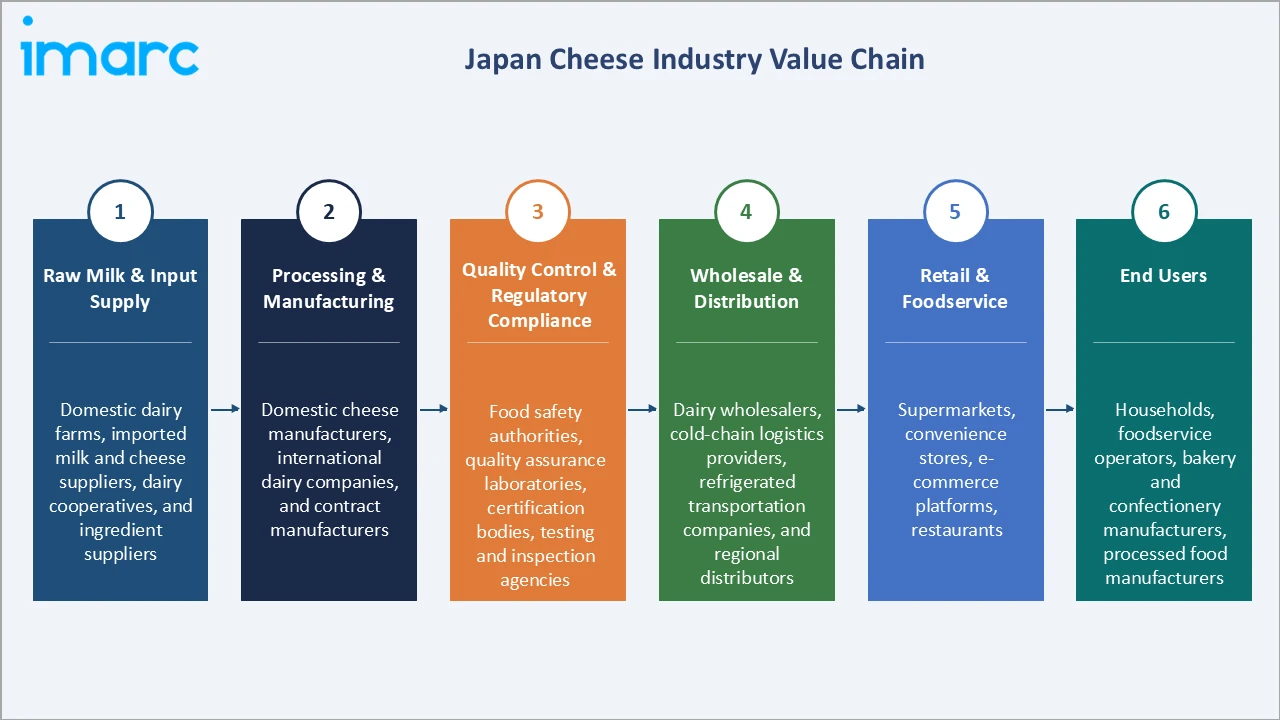
Japan cheese value chain integrates domestic and imported raw milk supply, processing and manufacturing, regulatory certification, wholesale distribution, and retail or foodservice dispensing to end consumers nationwide.
|
Stage |
Key Participants |
|
Raw Milk & Input Supply |
Domestic dairy farms, imported milk and cheese suppliers, dairy cooperatives, and ingredient suppliers |
|
Processing & Manufacturing |
Domestic cheese manufacturers, international dairy companies, and contract manufacturers |
|
Quality Control & Regulatory Compliance |
Food safety authorities, quality assurance laboratories, certification bodies, testing and inspection agencies |
|
Wholesale & Distribution |
Dairy wholesalers, cold-chain logistics providers, refrigerated transportation companies, and regional distributors |
|
Retail & Foodservice |
Supermarkets, convenience stores, e-commerce platforms, restaurants |
|
End Users |
Households, foodservice operators, bakery and confectionery manufacturers, processed food manufacturers |
Japan multi-tier distribution structure relies heavily on cold-chain logistics to preserve natural cheese quality across humid climatic conditions. Import-dependent supply chains from Australia, New Zealand, and the European Union continue to anchor wholesale procurement for both natural and processed cheese manufacturing.
Technology Landscape in the Japan Cheese Industry
Cheese Maturation and Flavor Technology
Manufacturers are optimizing temperature, humidity, and microbial cultures to develop premium and specialty cheese varieties. Innovative fermentation and ripening processes also enable the creation of localized flavor profiles tailored to Japanese consumer preferences. These technologies support product differentiation and strengthen the premium cheese segment.
Digital Retail and E-Commerce Integration
Digital retail and e-commerce integration expand online product discovery, ordering, and refrigerated home delivery. Data analytics and personalized recommendations help retailers target consumers with premium, specialty, and imported cheese offerings. Digital inventory systems also improve demand forecasting, cold-chain coordination, and stock availability. This integration enables manufacturers to reach wider audiences and launch products more efficiently.
Functional and Health-Oriented Formulations
Advanced formulation and fermentation techniques help manufacturers maintain flavor and texture while improving nutritional value. These innovations address demand from health-conscious and aging consumers. They also support premium positioning and expand cheese into functional snacking and wellness categories.
Market Segmentation Analysis
The report covers the following segments:
|
Segment Category |
Leading Segment |
Market Share |
Year |
|
Source |
Cow Milk |
78.4% |
2025 |
|
Type |
Natural |
58.7% |
2025 |
|
Product |
🔒 |
🔒 |
2025 |
|
Distribution Channel |
🔒 |
🔒 |
2025 |
|
Format |
🔒 |
🔒 |
2025 |
|
Region |
Kanto Region |
34.2% |
2025 |

By Source
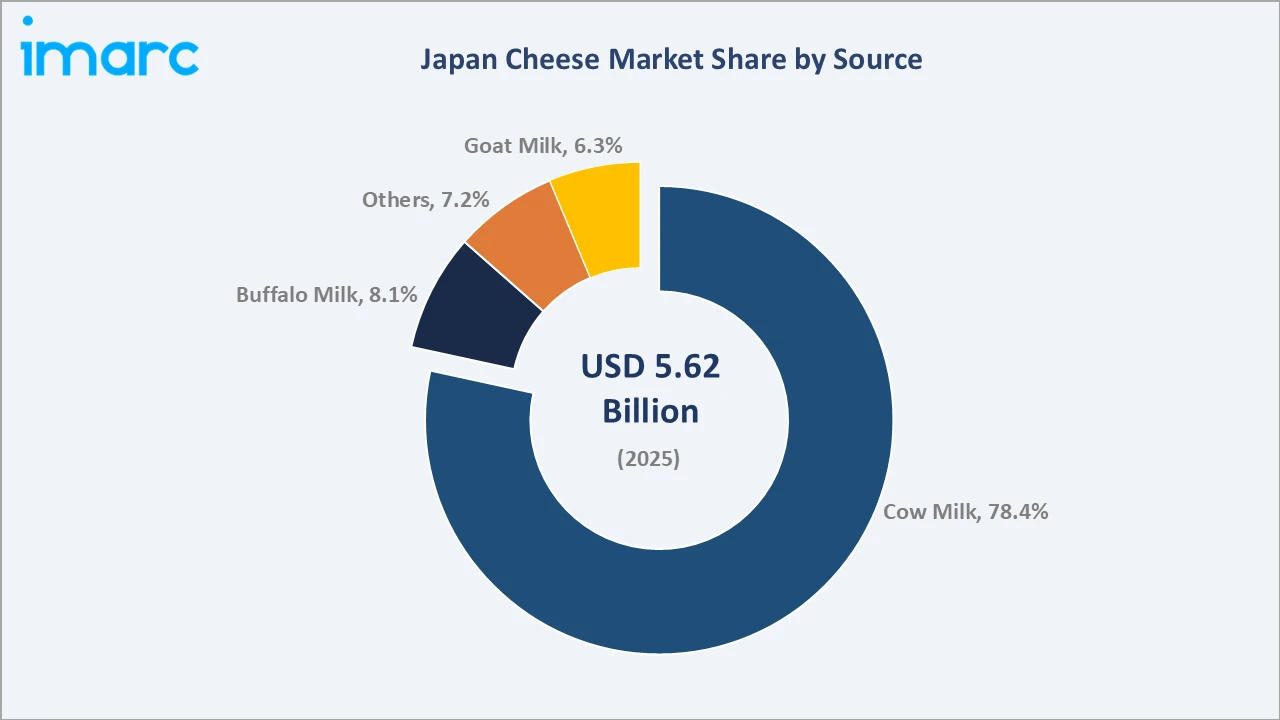
Cow milk leads at 78.4% share (2025), supported by Japan's concentrated Hokkaido dairy supply chain and established import relationships with Australia and New Zealand. The category's scale advantages keep production costs comparatively low across both natural and processed formats.
To access detailed market analysis, Request Sample
Buffalo milk holds 8.1% share, anchored by mozzarella demand for pizza and Caprese applications, while goat milk at 6.3% serves a smaller but faster-growing specialty and artisanal segment. Others, including sheep milk and blended-source cheese, account for the remaining 7.2% share.
By Type
Natural cheese leads at 58.7% share (2025), reflecting Japan's structural shift toward mozzarella, Camembert, and cheddar consumption across foodservice and premium retail channels. Growth in this category continues to outpace processed cheese as consumer familiarity with Western cuisine deepens.
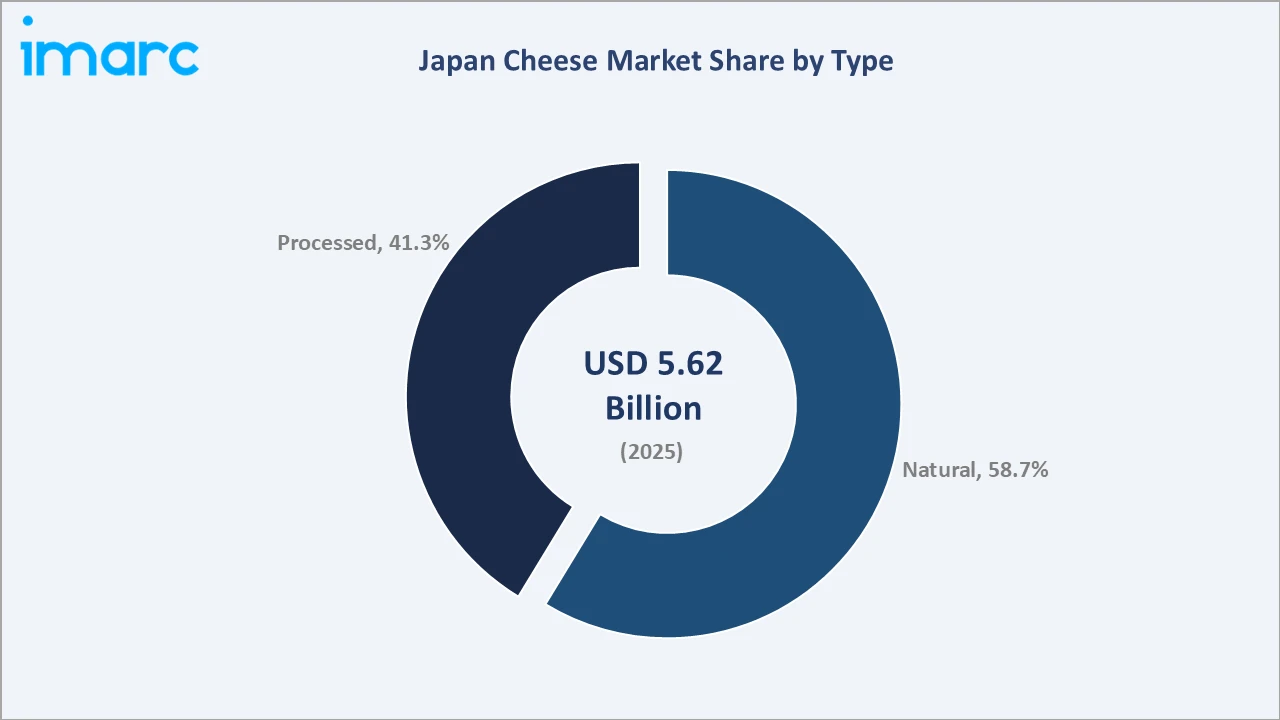
Processed cheese at 41.3% share remains anchored by snack, sliced, and dessert-cheese formats, which benefit from extended shelf life suited to Japan's humid climate.
Regional Market Insights
Regional cheese demand in Japan concentrates around dense urban retail and foodservice infrastructure, with the Kanto and Kansai/Kinki regions together accounting for over half of national consumption.
|
Region |
Share |
Key Drivers and Characteristics |
|
Kanto Region |
34.2% |
Leads the market due to its large urban population, strong supermarket and convenience-store networks, and high demand for imported, premium, processed, and snack-format cheese. |
|
Kansai/Kinki Region |
19.3% |
Benefits from major urban centers, a well-developed hospitality sector, and strong demand for cheese in bakery, confectionery, pizza, and Western-style cuisine. |
|
Central/Chubu Region |
16.8% |
Supported by a large manufacturing economy, expanding urban households, and rising consumption of convenient dairy products. |
|
Kyushu-Okinawa Region |
9.4% |
Growth is driven by expanding tourism, hospitality, and restaurant industries, alongside increasing demand for Western-style foods. |
|
Hokkaido Region |
7.1% |
Serves as Japan’s principal dairy-producing region, with abundant milk supply and a strong base of domestic cheese manufacturers. |
|
Tohoku Region |
5.6% |
Demand is supported by regional dairy farming, food-processing activity, and rising retail penetration. |
|
Chugoku Region |
4.2% |
The market benefits from stable household demand, an established foodservice sector, and growing availability of processed and imported cheese. |
|
Shikoku Region |
3.4% |
Although relatively small, the market is expanding through improved retail access, tourism-related consumption, and demand from bakeries and restaurants. |
The Kanto region’s 34.2% dominates Japan's cheese market, supported by its large urban population, high disposable incomes, extensive retail infrastructure, and strong demand for premium, imported, and convenience-format cheese products. The Kansai/Kinki region’s 19.3% is a major consumption hub, driven by its vibrant foodservice industry, bakery and confectionery sectors, and widespread adoption of Western-style cuisine. The Central/Chubu region’s 16.8% benefits from a well-developed food manufacturing base, efficient logistics networks, and increasing household consumption of processed dairy products.
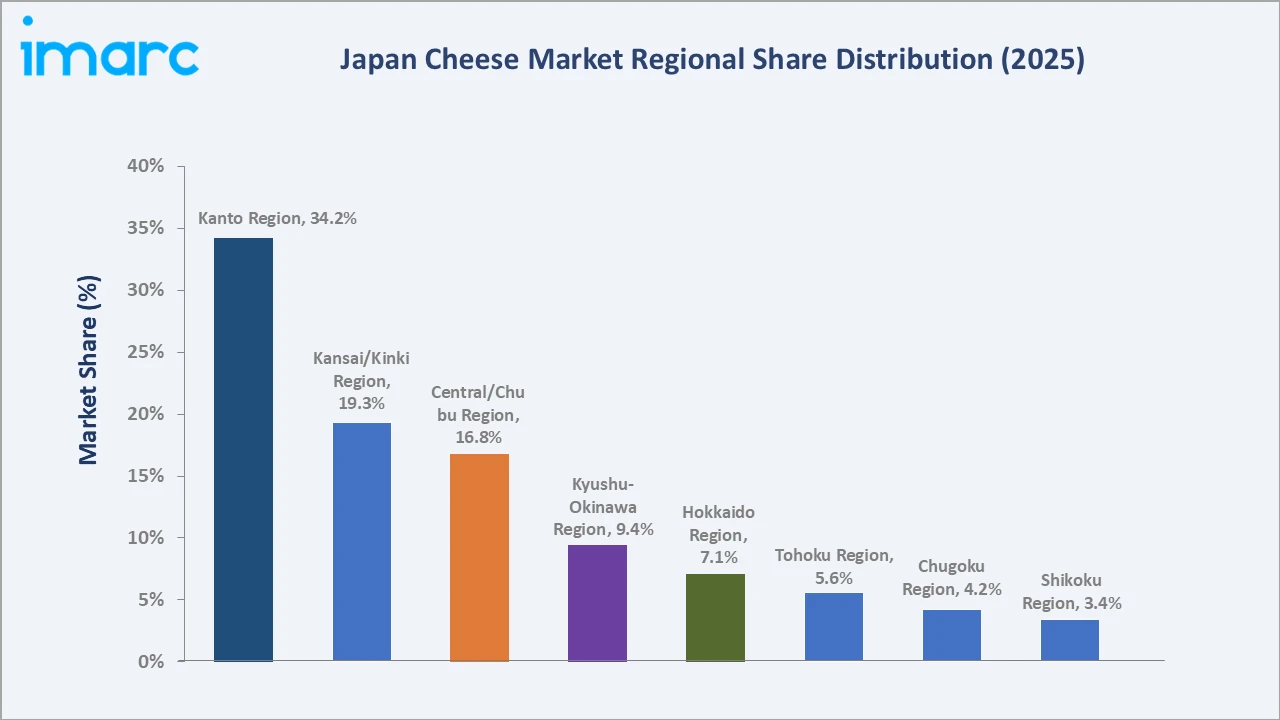
Kyushu-Okinawa region’s 9.4% is experiencing steady growth due to expanding tourism, hospitality, and restaurant industries, alongside improving cold-chain distribution. Hokkaido region’s 7.1%, Japan's leading dairy-producing region, plays a critical role in supplying high-quality milk and specialty cheeses while supporting domestic production and premium product development. The Tohoku region’s 5.6% benefits from regional dairy farming, expanding retail penetration, and rising demand for locally produced cheese. The Chugoku region’s 4.2% is supported by stable household consumption, growing food processing activities, and an established wholesale distribution network. Although Shikoku region’s 3.4% represents a smaller share of the market, increasing retail availability, tourism, and demand from bakeries, cafés, and restaurants continue to support market expansion.
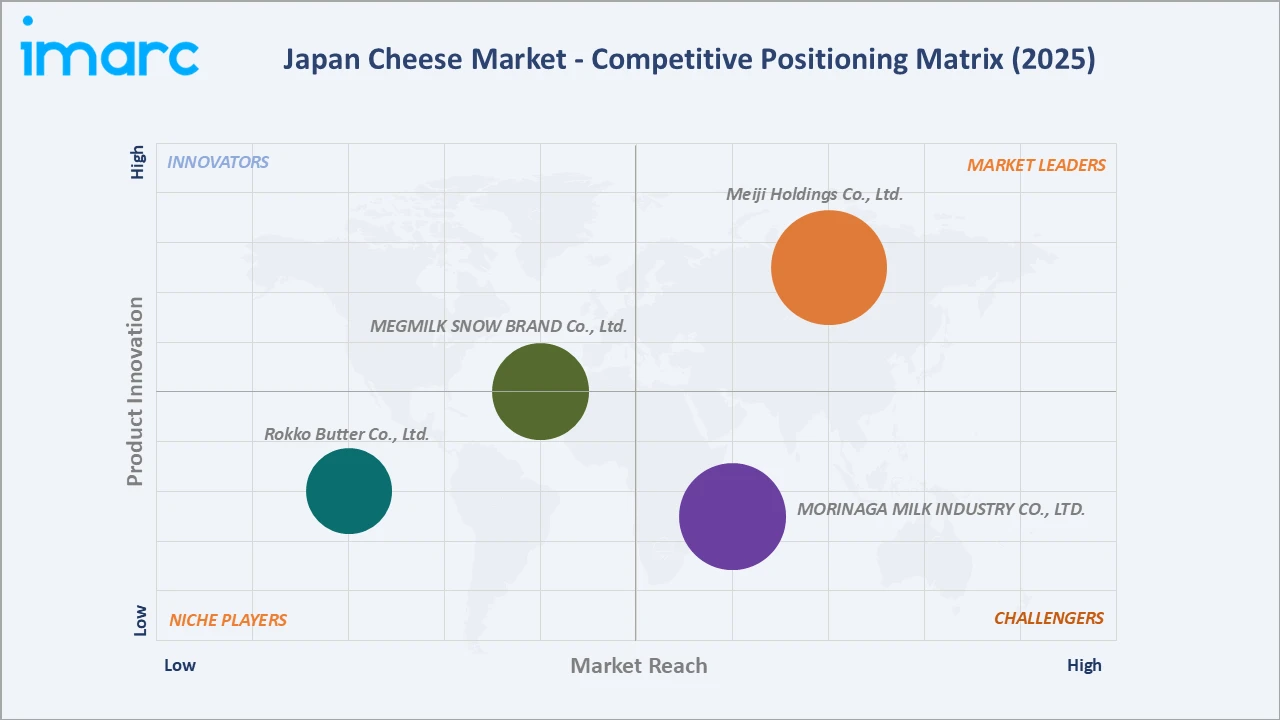
Competitive Landscape
Japan cheese market exhibits moderate concentration, with domestic players collectively commanding a significant share through extensive distribution networks and continuous product innovation.
|
Company Name |
Key Product |
Market Position |
Core Strength |
|
Meiji Holdings Co., Ltd. |
Camembert, fresh mozzarella, sliced cheese, portioned cheese |
Market Leader |
Meiji Holdings Co., Ltd., through its food subsidiary Meiji Co., Ltd., is a foundational player in the Japanese cheese industry, producing a wide array of natural and processed cheeses, including Camembert and mozzarella. |
|
MEGMILK SNOW BRAND Co., Ltd. |
Snow Brand Sliced, Snow Brand Melting, Snow Brand Crispy Baked Melting Slices, Snow Brand Cheddar Melting Slices, Snow Brand Hokkaido 100 Camembert Cheese, Snow Brand Hokkaido 100 String Cheese Plain |
Established Player |
MEGMILK SNOW BRAND Co., Ltd. pioneering the integration of Western dairy into the Japanese diet, they introduced culturally iconic products like the convenient, individually wrapped cheese and popularized processed and natural cheeses across the country. |
|
Rokko Butter Co., Ltd. |
Baby Cheese Type, Cheese Dessert, Sliced Cheese Type, 6P Cheese, QBB Original |
Niche Player |
Rokko Butter Co., Ltd., via its flagship QBB brand, is a dominant pioneer in the Japanese cheese market. |
|
MORINAGA MILK INDUSTRY CO., LTD. |
Kraft Slice Cheese, Kraft Kireteru Cheese, Kraft Fresh Mozzarella Cheese, Kraft 100% Parmesan Cheese, Kraft Philadelphia Cream Cheese |
Challenger |
MORINAGA MILK INDUSTRY CO. LTD., one of Japan's largest dairy companies, shapes the nation's cheese market primarily through key brand partnerships and localized product innovation. |
The domestic players maintain meaningful positions in the processed and specialty cheese segments, respectively, leveraging brand recognition alongside localized product adaptation for Japanese taste preferences.
Key Company Profiles
Meiji Holdings Co., Ltd.
Meiji Holdings Co., Ltd. is Japan's leading dairy and food manufacturer, offering natural and processed cheese under its Meiji Hokkaido Tokachi Cheese brand, sourced from Hokkaido raw milk.
- Key Product: Camembert, fresh mozzarella, sliced cheese, portioned cheese.
- Recent Developments: In June 2026, Meiji launched two products in its Hokkaido Tokachi Smart Cheese range. The Aged Cheddar Blend and Black Pepper Parmesan Blend were launched in four-piece packs at convenience stores nationwide. Each piece is individually wrapped, and both products contain more than 60% natural cheese manufactured at Meiji’s Tokachi facility in Hokkaido.
- Strategic Focus: Premium snacking-format innovation and natural cheese technology development targeting convenience-channel consumers.
Rokko Butter Co., Ltd.
Rokko Butter, operating under the Q·B·B brand, pioneered Japan's dessert-cheese category and leads the snack cheese segment through its Baby Cheese franchise.
- Key Products: Baby Cheese Type, Cheese Dessert, Sliced Cheese Type, 6P Cheese, QBB Original.
- Strategic Focus: Defending category leadership in dessert and snack cheese through continuous flavor innovation and portion-format differentiation.
Market Concentration Analysis
Japan cheese market displays moderate concentration at the branded level. Meiji Holdings Co., Ltd., MEGMILK SNOW BRAND Co., Ltd., Rokko Butter Co., Ltd., and MORINAGA MILK INDUSTRY CO., LTD. collectively account for a substantial share of processed and natural cheese sales, supported by nationwide distribution infrastructure and established retail relationships. The natural cheese segment remains comparatively fragmented, with imported specialty brands from the EU, Australia, and New Zealand competing alongside domestic artisanal producers concentrated in Hokkaido. Consolidation trends are most visible in the dessert and snack cheese categories, where Rokko Butter's Q·B·B franchise offerings are contesting category leadership through continuous product innovation.
Investment & Growth Opportunities
Fastest Growing Segments
Goat and buffalo milk cheese categories, growing at an estimated 2.6% and 2.3% CAGR, respectively (2026-2034), represent Japan's fastest-expanding sourcing segments as specialty and artisanal demand broadens among affluent urban consumers. Natural cheese, growing faster than processed formats, and dessert-cheese innovation represent additional high-growth investment vectors through 2034.
Emerging Market Opportunities
Domestic artisanal cheese production in Hokkaido presents a premiumization opportunity as consumer recognition of Japanese-made specialty cheese grows. Rural regions, including Tohoku and Shikoku, offer untapped retail expansion potential as cold-chain infrastructure investment continues.
Investment Themes
- Trade Agreement-Enabled Import Diversification: Phased tariff reductions create earlier-mover advantages for suppliers establishing dedicated Japan distribution relationships ahead of full tariff elimination.
- Convenience-Format Product Development: Investment in individually wrapped, portion-controlled snacking cheese tailored to convenience-store channels represents a differentiated growth segment.
Future Market Outlook (2026-2034)
The Japan cheese market is projected to grow from USD 5.62 Billion in 2025 to USD 5.74 Billion in 2026, reaching USD 6.58 Billion by 2034, registering a CAGR of 1.73% during 2026-2034, reflecting Japan's structurally low but rising per-capita cheese consumption. The market's USD 6.12 Billion valuation in 2030 will consolidate Japan's position as Asia-Pacific's largest cheese import market.
Three structural forces anchor this growth with high predictability: continued Western-diet adoption expanding natural cheese consumption, progressive tariff reductions under trade agreements improving import price competitiveness, and convenience-format product innovation from domestic manufacturers including Meiji and Rokko Butter sustaining category relevance among younger consumers.
Research Methodology
Primary Research
Primary research comprised structured interviews with industry stakeholders, including dairy product manufacturers, import and distribution executives, retail category managers, and regulatory specialists familiar with compliance requirements.
Secondary Research
Secondary research encompassed dairy statistics, trade data, company annual reports from Meiji Holdings Co., Ltd., MEGMILK SNOW BRAND Co., Ltd., Rokko Butter Co., Ltd., MORINAGA MILK INDUSTRY CO., LTD., and other domestic and international players, and international dairy trade publications covering Japan's cheese import and consumption trends.
Forecasting Models
Market forecasts were developed using consumption-trend and import-penetration models, validated against production statistics and customs trade data, with segment-level projections informed by category-specific growth patterns across sourcing, type, and regional distribution.
Japan Cheese Market Report Coverage:
| Report Features | Details |
|---|---|
| Base Year of the Analysis | 2025 |
| Historical Period | 2020-2025 |
| Forecast Period | 2026-2034 |
| Units | Billion USD |
| Scope of the Report | Exploration of Historical and Forecast Trends, Industry Catalysts and Challenges, Segment-Wise Historical and Predictive Market Assessment:
|
| Sources Covered | Cow Milk, Buffalo Milk, Goat Milk, Others |
| Types Covered | Natural, Processed |
| Products Covered | Mozzarella, Cheddar, Feta, Parmesan, Roquefort, Others |
| Distribution Channels Covered | Supermarkets and Hypermarkets, Convenience Stores, Specialty Stores, Online, Others |
| Formats Covered | Slices, Diced/Cubes, Shredded, Blocks, Spreads, Liquid, Others |
| Regions Covered | Kanto Region, Kinki Region, Central/ Chubu Region, Kyushu-Okinawa Region, Tohoku Region, Chugoku Region, Hokkaido Region, and Shikoku Region |
| Companies Covered | Meiji Holdings Co., Ltd., MEGMILK SNOW BRAND Co., Ltd., Rokko Butter Co., Ltd., MORINAGA MILK INDUSTRY CO., LTD., etc. |
| Customization Scope | 10% Free Customization |
| Post-Sale Analyst Support | 10-12 Weeks |
| Delivery Format | PDF and Excel through Email (We can also provide the editable version of the report in PPT/Word format on special request) |
Key Benefits for Stakeholders:
- IMARC’s report offers a comprehensive quantitative analysis of various market segments, historical and current market trends, market forecasts, and dynamics of the Japan cheese market from 2020-2034.
- The research study provides the latest information on the market drivers, challenges, and opportunities in the Japan cheese market.
- Porter's five forces analysis assist stakeholders in assessing the impact of new entrants, competitive rivalry, supplier power, buyer power, and the threat of substitution. It helps stakeholders to analyze the level of competition within the Japan cheese industry and its attractiveness.
- Competitive landscape allows stakeholders to understand their competitive environment and provides an insight into the current positions of key players in the market.
Frequently Asked Questions About the Japan Cheese Market Report
The Japan cheese market size is estimated at USD 5.74 Billion in 2026, covering natural and processed cheese products across cow, buffalo, and goat milk sourcing categories nationwide.
The Japan cheese market is projected to grow at a CAGR of 1.73% during 2026-2034, reaching USD 6.58 Billion by 2034, driven by Western-diet adoption and tariff reductions.
Cow milk leads at 78.4% share (2025), supported by Japan's concentrated Hokkaido dairy supply chain and established import relationships with Australia and New Zealand.
Natural cheese dominates at 58.7% share (2025), reflecting rising consumption of mozzarella, Camembert, and cheddar across foodservice and premium retail channels.
The Kanto region leads at 34.2% share (2025), anchored by Tokyo's dense supermarket, convenience-store, and foodservice distribution infrastructure.
Leading companies include Meiji Holdings Co., Ltd., MEGMILK SNOW BRAND Co., Ltd., Rokko Butter Co., Ltd., and MORINAGA MILK INDUSTRY CO., LTD., among others.
Japan's cheese market is projected to reach approximately USD 6.12 Billion by 2030, driven by premiumization of natural cheese and convenience-format snacking innovation.
Rising Western-cuisine adoption, including pizza, pasta, and Caprese salads, is driving natural cheese demand faster than processed formats among Japanese consumers.
E-commerce and digital marketplaces are expanding consumer access to specialty and imported cheeses previously limited to niche specialty stores, supporting premium segment growth.
Need more help?
- Speak to our experienced analysts for insights on the current market scenarios.
- Include additional segments and countries to customize the report as per your requirement.
- Gain an unparalleled competitive advantage in your domain by understanding how to utilize the report and positively impacting your operations and revenue.
- For further assistance, please connect with our analysts.
 Request Customization
 Speak to an Analyst
 Request Brochure
 Inquire Before Buying
Benefits of Customization
- Personalize this research
- Triangulate with your data
- Get data as per your format and definition
- Gain a deeper dive into a specific application, geography, customer, or competitor
- Any level of personalization
Get in Touch With Us
UNITED STATES
Phone: +1-201-971-6302
INDIA
Phone: +91-120-433-0800
UNITED KINGDOM
Phone: +44-753-714-6104
Email: [email protected]
Client Testimonials




.webp)




.webp)













Related Reports

Choose your plan
*Please note that the prices mentioned below are starting prices for each bundle type. Kindly contact our team for further details.*
Single User License
- 1 User License, Access on 2 Devices
- PDF Report + Excel Dataset (Password Protected)
- Lifetime Access
- No Printing Rights
- 10% Free Report Customization
- 10–12 Weeks of Analyst Support
Five User License
- Access for 5 Users, 2 Devices per User
- PDF Report + Excel Dataset (Password Protected)
- Lifetime Access
- Dedicated Account Manager
- 12–14 Weeks of Analyst Support
- No Printing Rights
- 15% Free Report Customization
- 25% Discount on Your Next Purchase
Corporate User License
- Unlimited User Access (Within Your Organization)
- PDF Report + Excel Dataset
- Lifetime Access
- Dedicated Account Manager
- 14–20 Weeks of Analyst Support
- No Printing Rights
- 20% Free Report Customization
- 30% Discount on Your Next Purchase
Essential Insights
What's included:
3 reports
- Lifetime Access
- PDF Reports
- Excel Datasets
- 2 Weeks of Free Analyst Support
- 2 User Licenses
- Access on 2 Devices
- Printing Rights
- Complimentary PowerPoint (PPT) Version
- Complimentary License Upgrade
Professional Access
What's included:
5 reports
- Lifetime Access
- PDF Reports
- Excel Datasets
- 8 Weeks of Free Analyst Support
- 2 User Licenses
- Access on 2 Devices
- Printing Rights
- Complimentary PowerPoint (PPT) Version
- Complimentary License Upgrade
Business Advantage
What's included:
8 reports
- Lifetime Access
- PDF Reports
- Excel Datasets
- 14 Weeks of Free Analyst Support
- 2 User Licenses
- Access on 2 Devices
- Printing Rights
- Complimentary PowerPoint (PPT) Version
- Complimentary License Upgrade
Enterprise Intelligence
What's included:
10 reports
- Lifetime Access
- PDF Reports
- Excel Datasets
- 20 Weeks of Free Analyst Support
- 2 User Licenses
- Access on 2 Devices
- Printing Rights
- Complimentary PowerPoint (PPT) Version
- Complimentary License Upgrade