
Japan Construction Equipment Rental Market Size, Share, Trends and Forecast by Solution Type, Equipment Type, Type, Application, Industry, and Region, 2026-2034
Japan Construction Equipment Rental Market Size, Share, Trends & Forecast (2026-2034)
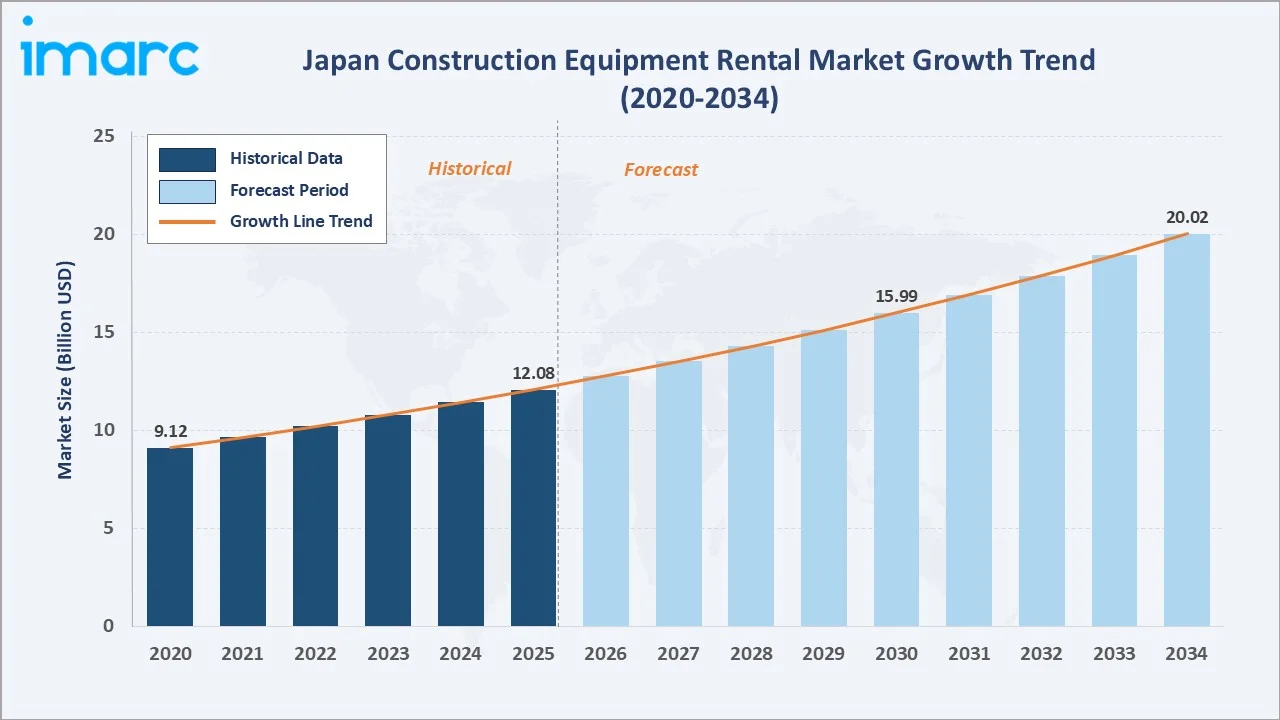
The Japan construction equipment rental market reached USD 12.08 Billion in 2025 and is projected to reach USD 20.02 Billion by 2034, exhibiting a CAGR of 5.78% during 2026-2034. The pressing need to renovate Japan's aging infrastructure, with about 63% of roads and bridges, 62% of flood barriers, and 42% of tunnels expected to be 50 years old by 2033, and the severe construction labor shortage driving adoption of ICT-enabled equipment with productivity-boosting capabilities are the primary growth catalysts. Products lead the solution type at 61.8%, heavy construction equipment dominates the equipment type at 68.4%, and the Kanto region accounts for the largest regional share at 31.5%.
Market Snapshot
|
Metric |
Value |
|
Market Size (2025) |
USD 12.08 Billion |
|
Forecast Market Size (2034) |
USD 20.02 Billion |
|
CAGR (2026-2034) |
5.78% |
|
Base Year |
2025 |
|
Historical Period |
2020-2025 |
|
Forecast Period |
2026-2034 |
|
Dominant Solution Type |
Products (61.8%, 2025) |
|
Dominant Equipment Type |
Heavy Construction Equipment (68.4%, 2025) |
|
Leading Region |
Kanto Region (31.5%, 2025) |
The Japan construction equipment rental market grew from USD 9.12 Billion in 2020 to USD 12.08 Billion in 2025, reflecting post-COVID construction activity recovery, sustained government infrastructure spending, and accelerating online rental platform adoption. The market is projected to reach USD 15.99 Billion by 2030 and USD 20.02 Billion by 2034.
To get more information on this market, Request Sample
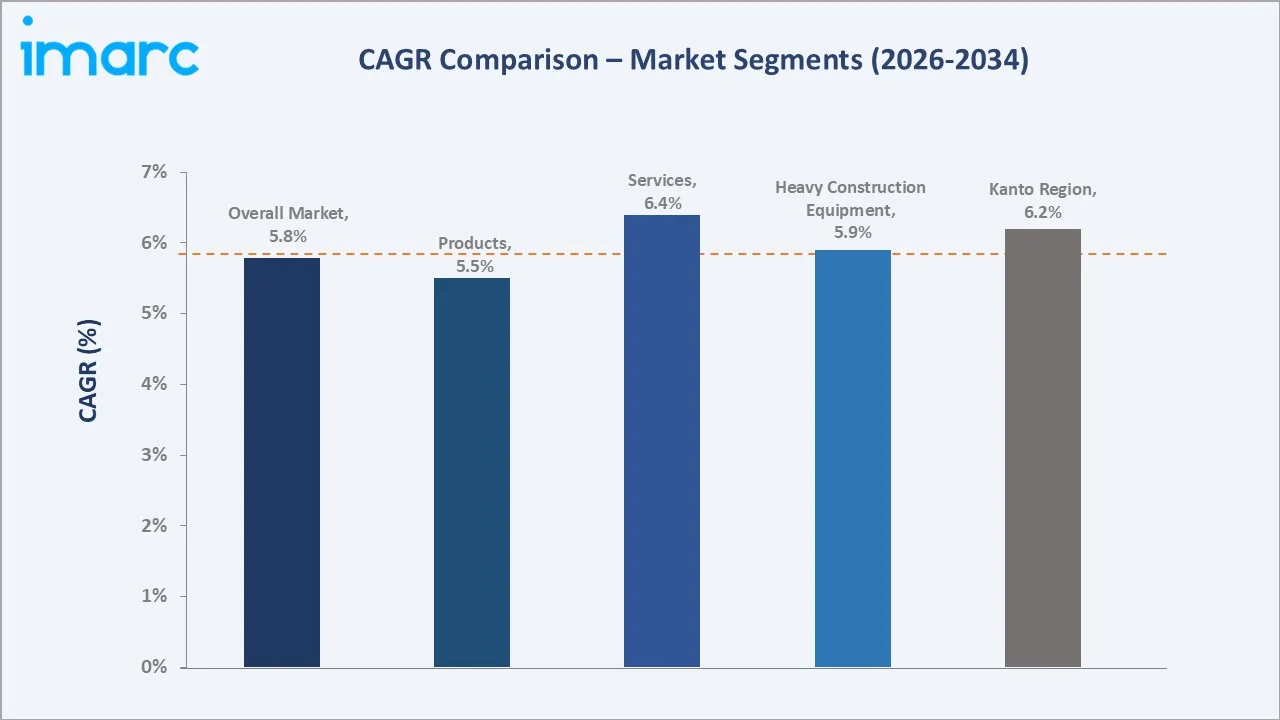
Services solution type grows at ~6.4% CAGR as operators expand digital services including online ordering, EDI invoicing, and IoT-enabled equipment inspection, driving revenue migration toward value-added service offerings. Heavy construction equipment grows at ~5.9% CAGR through infrastructure rehabilitation and large-scale public works project demand. Kanto region leads regional growth at ~6.2% CAGR through Tokyo's continuing urban development, infrastructure renovation, and transportation investment.
Executive Summary
The Japan construction equipment rental market is one of the most sophisticated and technologically advanced equipment rental ecosystems, underpinned by a distinctive combination of structural demand drivers: Japan's massive aging infrastructure renovation requirement, one of the most severe construction labor shortages, and investment in disaster prevention and infrastructure hardening. Market value stood at USD 12.08 Billion in 2025 and is forecast to reach USD 20.02 Billion by 2034, making Japan the most rapidly growing major equipment rental market by absolute value addition over the forecast period.
Products lead solution type at 61.8% (2025), reflecting equipment rental companies' core business model of providing physical machinery to construction contractors on short-, medium-, and long-term rental contracts. Heavy construction equipment commands 68.4% (2025), reflecting the dominance of large-scale excavation, lifting, and earthmoving projects that characterize Japan's infrastructure rehabilitation and new construction pipeline. The Kanto region commands 31.5% (2025), anchored by Tokyo Metropolitan Government's continuous urban development programs, the highest construction investment density in Japan, and the headquarters concentration of Japan's leading rental operators.
Key Market Insights
|
Insight |
Data |
|
Dominant Solution Type |
Products – 61.8% share (2025) |
|
Dominant Equipment Type |
Heavy Construction Equipment – 68.4% share (2025) |
|
Leading Region |
Kanto Region – 31.5% share (2025) |
|
Market Opportunity |
ICT excavator rental; electric/hybrid equipment rental; digital rental platform expansion; AI fleet optimization |
Key Analytical Observations:
- Products at 61.8% (2025): Physical equipment rental encompasses the short- and medium-term lease of excavators, cranes, forklifts, bulldozers, compactors, concrete mixers, aerial work platforms, and specialty equipment to construction contractors and industrial operators.
- Heavy Construction Equipment at 68.4% (2025): Large-format excavators, crawler cranes, tower cranes, bulldozers, motor graders, and heavy dump trucks constitute Japan's largest equipment type segment, driven by the civil engineering-intensive nature of Japan's infrastructure rehabilitation program.
- Kanto Region at 31.5% (2025): The Kanto Region leads regionally due to its concentration of large-scale infrastructure, commercial, and urban redevelopment projects across Tokyo and neighboring prefectures. High construction activity, strong contractor presence, and continuous demand for advanced rental machinery drive the region's dominant market share.
Japan Construction Equipment Rental Market Overview
The Japan construction equipment rental market encompasses the short-, medium-, and long-term lease of construction machinery, lifting equipment, access platforms, ground support equipment, and related tools to construction contractors, civil engineering firms, industrial operators, and government construction agencies. The market's distinctive structural feature is Japan's exceptionally high equipment rental penetration rate compared to penetration rates in European and North American markets. This high rental penetration reflects Japanese construction contractors' capital-efficient business models, the project-based demand profile of Japanese civil engineering, and the operational excellence of Japan's dedicated rental operators who provide just-in-time equipment delivery to construction sites nationwide. Japan's construction equipment rental ecosystem has evolved from commodity machinery lending toward integrated construction solutions, transforming the value proposition from asset access to productivity service delivery.
Market Dynamics
To evaluate market opportunities, Request Sample
Market Drivers
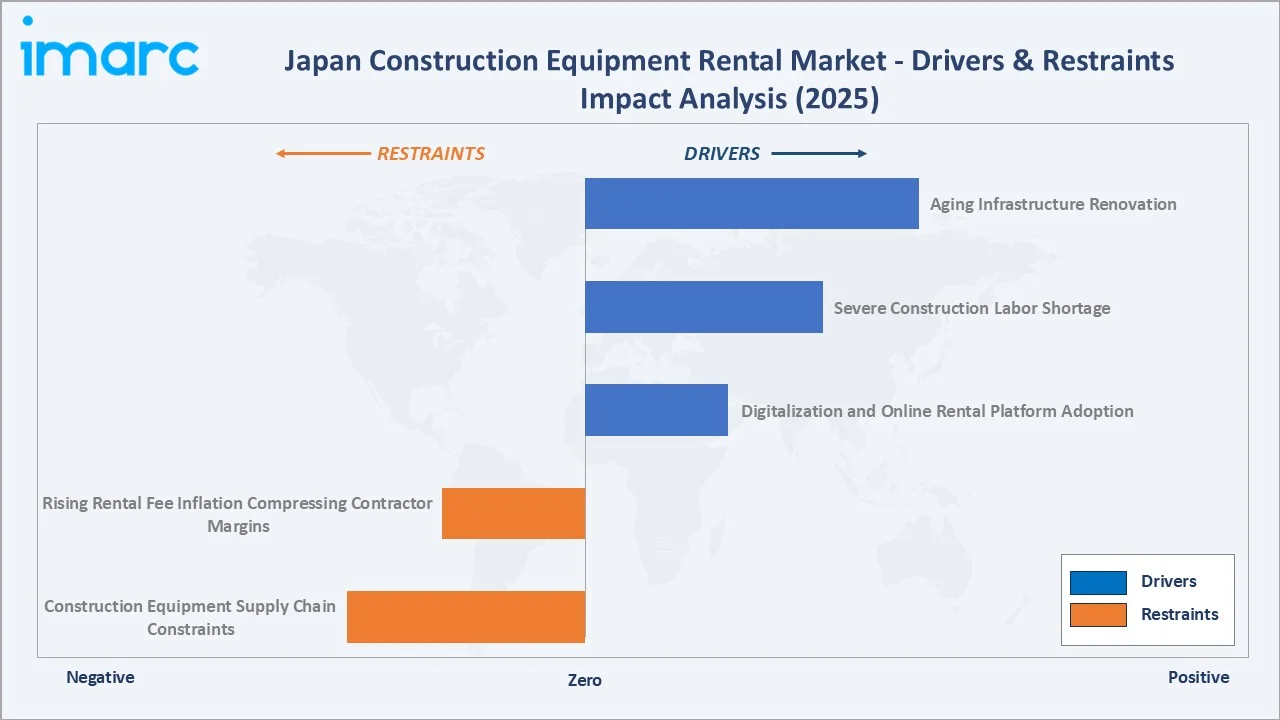
- Aging Infrastructure Renovation: Japan faces a nationally significant infrastructure renewal challenge with structural and statistical certainty, with 63% of roads and bridges, 62% of flood barriers and river facilities, and 42% of tunnels exceeding 50 years old by 2033, the engineering standard threshold for major rehabilitation or replacement. This aging infrastructure provides exceptional revenue visibility for Japan's equipment rental operators, who serve as the primary equipment supply chain for contractors.
- Severe Construction Labor Shortage: Nearly 70% of the large and medium-sized construction firms in Japan expect to be unable to accept new major projects in fiscal 2026, as acute labor shortages restrict both public and private investment and weigh on economic growth. This structural labor deficit makes ICT-equipped construction machinery commercially compelling for contractors who cannot staff traditional multi-person surveying and supervision operations.
- Digitalization and Online Rental Platform Adoption: Japan's construction equipment rental industry is experiencing a structural shift toward digital rental management, demonstrating the operational efficiency gains achievable through rental process digitalization. This digital channel shift improves rental operator efficiency, enables predictive fleet management through demand forecasting, and reduces friction in the rental transaction lifecycle.
Market Restraints
- Rising Rental Fee Inflation Compressing Contractor Margins: The rental fee increases reflected input cost inflation across equipment acquisition, fuel, maintenance labor, and transport. If rental fee inflation continues above project cost escalation allowances built into government contracts, it could reduce rental penetration as some contractors consider deferred equipment purchase to avoid rental cost exposure on multi-year projects.
- Construction Equipment Supply Chain Constraints: New equipment delivery lead times from manufacturers have limited rental operators' fleet expansion velocity at precisely the period when demand has accelerated. Operators seeking to grow fleets to meet increasing construction activity have faced 12-24 month delivery delays for some ICT-equipped machine categories, constraining their ability to capitalize on demand growth opportunities and potentially diverting some demand toward competitor operators or equipment purchase.
Market Opportunities
- Electric and Hybrid Equipment Rental Premium Tier: Rental companies can develop a premium fleet of electric and hybrid excavators, loaders, aerial platforms, and compact equipment to serve urban, indoor, and low-emission construction projects. Customers can access advanced machinery without bearing the high upfront purchase cost or battery-technology risk. Premium pricing can be supported through lower fuel expenses, reduced noise, fewer emissions, and compliance with contractors’ sustainability targets.
- ICT-Enabled Smart Construction Integrated Service Development: Rental providers can expand beyond equipment leasing by offering integrated packages combining ICT-enabled machinery, telematics, machine-control systems, drones, and cloud-based site-management tools. These services can improve productivity, equipment utilization, safety, and project visibility while reducing dependence on scarce skilled workers. Subscription-based digital support, operator training, remote diagnostics, and data analytics can generate recurring revenue and strengthen customer retention.
Market Challenges
- Workforce Aging Among Rental Operators: Japan's construction equipment rental industry faces its own labor challenge, aging operator service teams, equipment delivery drivers, and maintenance technicians that mirror the broader construction industry workforce aging trend. Recruiting younger technicians capable of maintaining increasingly sophisticated ICT-equipped and electric machinery is a growing operational challenge, requiring rental operators to invest in training programs, modernized working conditions, and compensation structures competitive with other technical industries competing for Japan's limited young technical workforce.
- Fleet Electrification Capital Investment: Transitioning rental fleets from diesel to electric construction equipment requires substantial capital investment in both equipment procurement and charging infrastructure at rental depots. The higher upfront cost of electric equipment, combined with the need to install charging facilities at hundreds of regional depot locations nationwide, creates significant capital allocation requirements for rental operators planning fleet electrification programs.
Emerging Market Trends
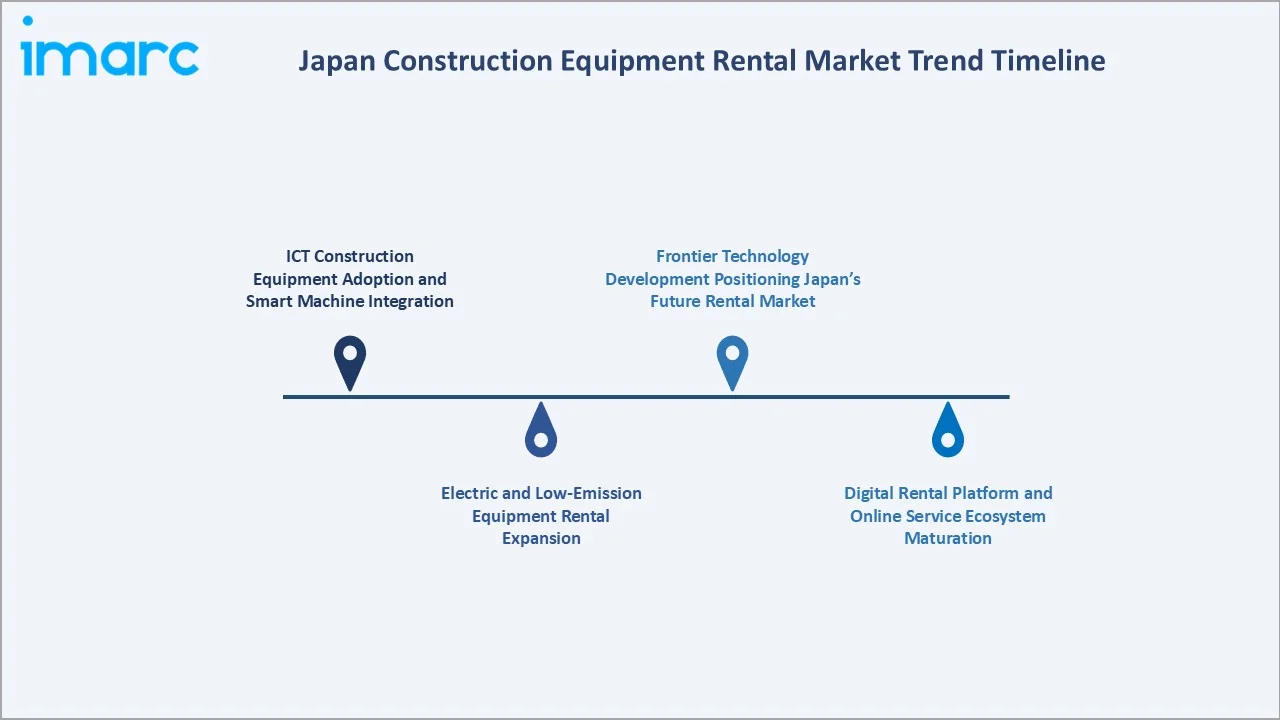
1. ICT Construction Equipment Adoption and Smart Machine Integration
ICT construction equipment adoption and smart machine integration are emerging as Japanese contractors increasingly use connected machinery, telematics, machine-control systems, and automated guidance technologies. These solutions improve productivity, precision, safety, and equipment utilization while reducing reliance on scarce skilled labor. Rental companies are therefore expanding smart-equipment fleets and offering data-enabled support services to meet growing demand.
2. Electric and Low-Emission Equipment Rental Expansion
Electric and low-emission equipment rental expansion is emerging as contractors seek to reduce fuel consumption, noise, and carbon emissions, particularly on urban and indoor projects. In May 2024, Volvo Construction Equipment added a third and larger electric model to its local portfolio. The EC230 Electric excavator was showcased at the Japan CSPI-Expo in May before being deployed to construction sites nationwide. Renting also allows contractors to access these newer technologies without incurring high upfront investment costs.
3. Digital Rental Platform and Online Service Ecosystem Maturation
Digital rental platforms and online service ecosystem maturation are emerging as rental companies adopt online booking, real-time equipment availability, digital payments, and automated contract management. Integrated platforms also support telematics, maintenance scheduling, delivery tracking, and fleet analytics. This improves customer convenience, asset utilization, and operational efficiency while creating a more connected rental ecosystem.
4. Frontier Technology Development Positioning Japan's Future Rental Market
Frontier technology development positioning Japan’s future rental market is emerging as rental providers explore autonomous machinery, robotics, artificial intelligence, hydrogen-powered equipment, and remote-operation systems. These technologies can address labor shortages while improving productivity, safety, and operational precision. Rental models will enable contractors to adopt advanced equipment without bearing high acquisition costs or technology-obsolescence risks.
Industry Value Chain Analysis
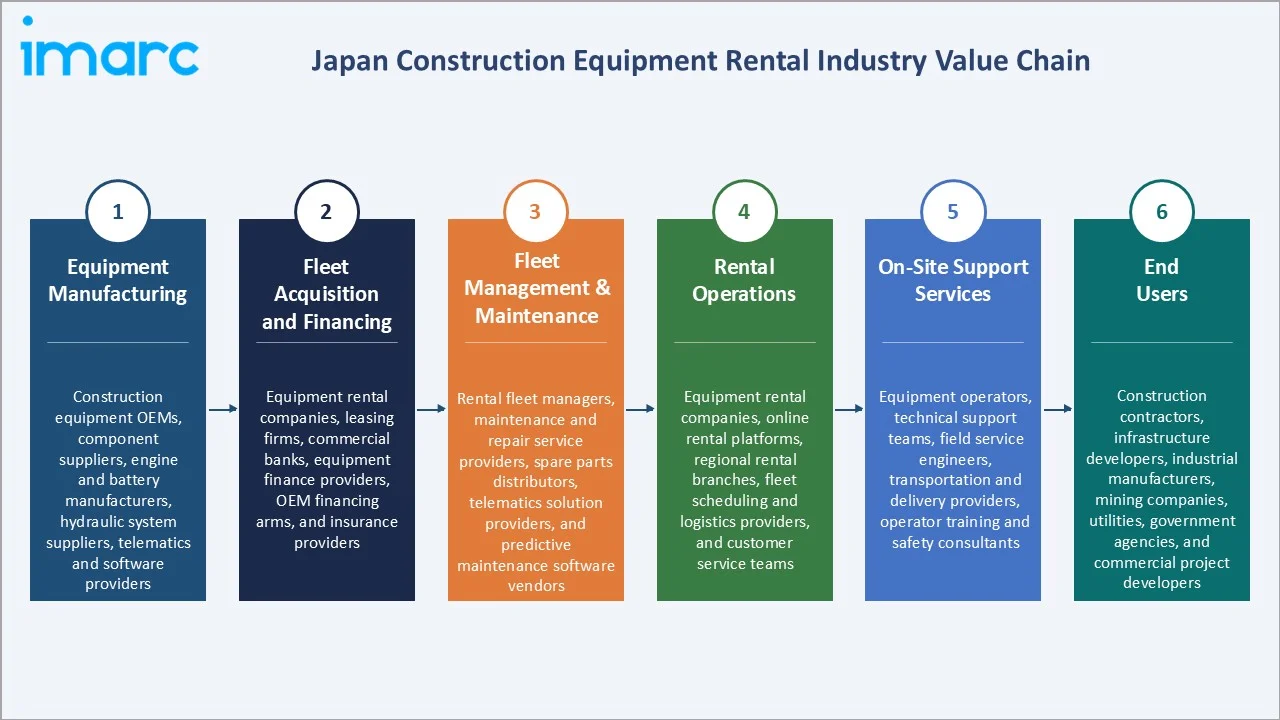
The Japan construction equipment rental value chain integrates equipment manufacturing, fleet acquisition and financing, fleet management and maintenance, rental operations, on-site support services, and end-user deployment across construction, infrastructure, mining, and industrial sectors.
|
Stage |
Key Participants |
|
Equipment Manufacturing |
Construction equipment OEMs, component suppliers, engine and battery manufacturers, hydraulic system suppliers, telematics and software providers. |
|
Fleet Acquisition and Financing |
Equipment rental companies, leasing firms, commercial banks, equipment finance providers, OEM financing arms, and insurance providers. |
|
Fleet Management & Maintenance |
Rental fleet managers, maintenance and repair service providers, spare parts distributors, telematics solution providers, and predictive maintenance software vendors. |
|
Rental Operations |
Equipment rental companies, online rental platforms, regional rental branches, fleet scheduling and logistics providers, and customer service teams. |
|
On-Site Support Services |
Equipment operators, technical support teams, field service engineers, transportation and delivery providers, and operator training and safety consultants. |
|
End Users |
Construction contractors, infrastructure developers, industrial manufacturers, mining companies, utilities, government agencies, and commercial project developers. |
Fleet management represents the critical operational differentiator among Japan's construction equipment rental operators. The integration of AI into rental fleets, construction management platforms, and IoT telematics for predictive maintenance scheduling is progressively transforming fleet management from reactive maintenance scheduling to proactive, data-driven fleet optimization.
Technology Landscape in the Japan Construction Equipment Rental Industry
ICT Construction Equipment and AI-Driven Site Management
ICT (Information and Communication Technology) construction equipment and AI-driven site management integrate telematics, IoT sensors, AI analytics, and machine-control technologies into rental fleets. These solutions enable real-time equipment monitoring, predictive maintenance, remote fleet management, and optimized machine utilization. AI-powered site management also enhances construction planning, improves productivity, reduces downtime, and helps contractors address persistent labor shortages through smarter, data-driven operations.
Telematics, IoT Fleet Management, and Remote Monitoring
Telematics, IoT fleet management, and remote monitoring provide real-time data on machine location, operating hours, fuel consumption, and performance. Rental companies can use this information to optimize fleet deployment, schedule predictive maintenance, and minimize equipment downtime. Remote diagnostics and geofencing also improve asset security, safety, and regulatory compliance while enabling more efficient customer support and data-driven rental services.
Autonomous and Semi-Autonomous Equipment Technology
Automated construction machinery can perform repetitive or hazardous tasks with limited human intervention. Such equipment improves site safety, productivity, and operational consistency while addressing labor shortages.
Market Segmentation Analysis
The report covers the following segments:
|
Segment Category |
Leading Segment |
Market Share |
Year |
|
Solution Type |
Products |
61.8% |
2025 |
|
Equipment Type |
Heavy Construction Equipment |
68.4% |
2025 |
|
Type |
🔒 |
🔒 |
2025 |
|
Application |
🔒 |
🔒 |
2025 |
|
Industry |
🔒 |
🔒 |
2025 |
|
Region |
Kanto Region |
31.5% |
2025 |

By Solution Type
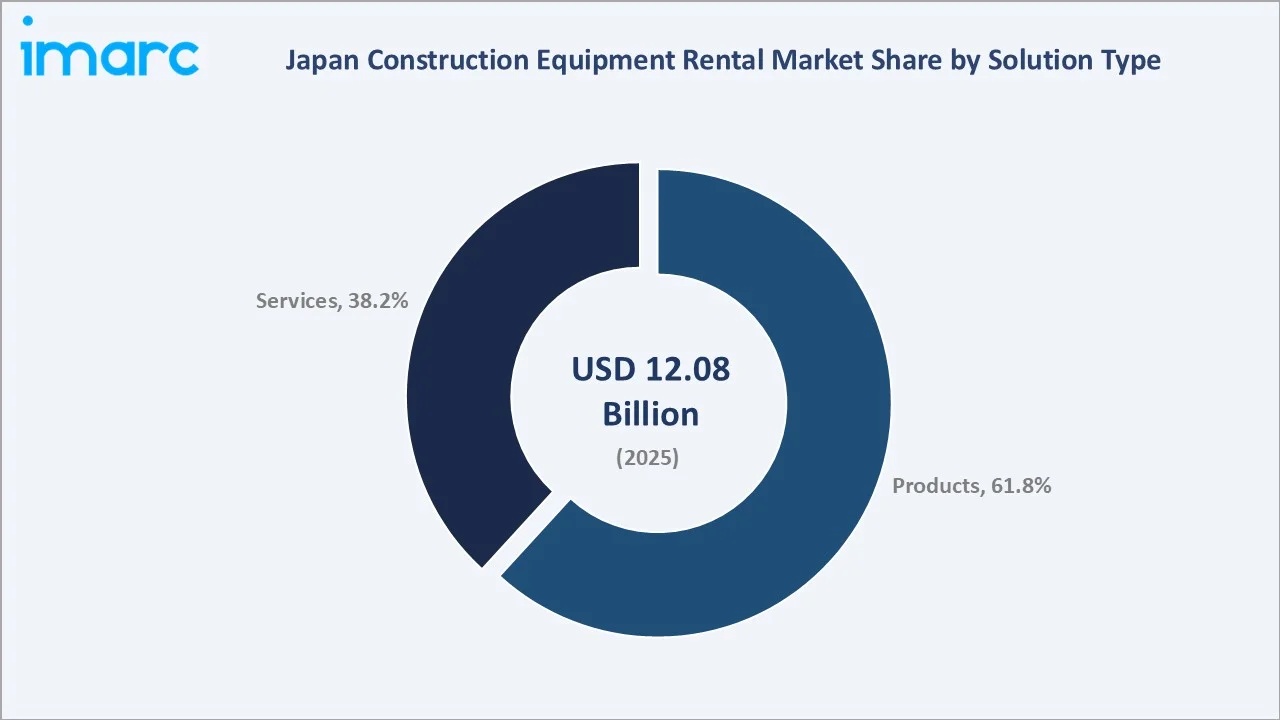
Products dominate at 61.8% (2025), representing the core equipment rental transaction, the physical lease of construction machinery, lifting equipment, and access platforms to contractors for project-specific durations. Japan's construction industry's high rental penetration rate reflects the efficiency of rental over ownership for project-based contractors who face highly variable equipment type requirements project-to-project.
To access detailed market analysis, Request Sample
Services at 38.2% (2025), growing at ~6.4% CAGR, encompass the rapidly expanding value-added service layer beyond physical equipment provision: ICT equipment operator training, remote equipment health monitoring, maintenance and repair services, fleet telematics analytics subscriptions, smart construction consulting, and digital rental platform services.
By Equipment Type
Heavy construction equipment dominates at 68.4% (2025), encompassing crawler excavators, wheeled excavators, bulldozers, motor graders, crawler cranes, tower cranes, large dump trucks, and heavy compactors that are essential for Japan's infrastructure rehabilitation programs, large-scale civil engineering projects, and industrial facility construction.
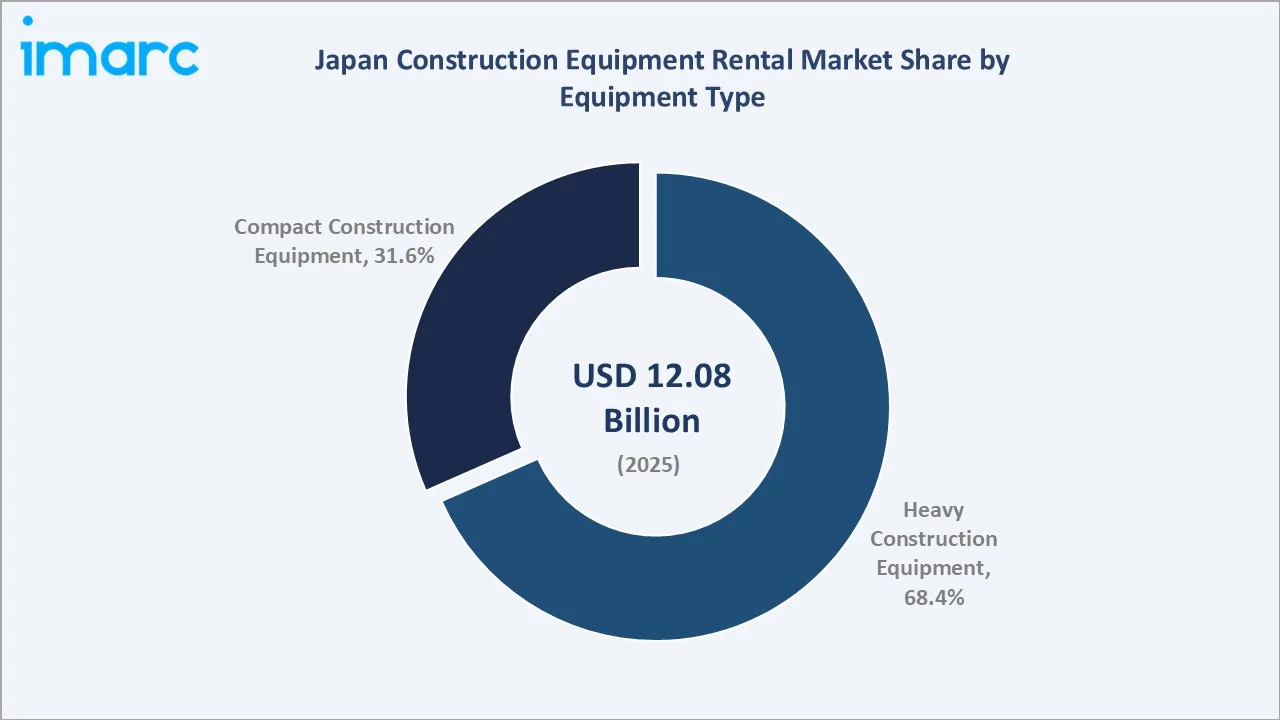
Compact construction equipment at 31.6% (2025) covers mini-excavators, compact wheel loaders, skid-steer loaders, small, tracked dumpers, compact aerial work platforms, and small forklifts serving urban construction sites, building renovation, utility work, and material handling where large machinery cannot operate.
Regional Market Insights
|
Region |
Share (2025) |
Key Japan Construction Equipment Rental Market Drivers & Characteristics |
|
Kanto Region |
31.5% |
Driven by extensive urban redevelopment, commercial construction, transportation infrastructure, and high contractor concentration across Tokyo and neighboring prefectures |
|
Kansai/Kinki Region |
18.7% |
Demand is supported by industrial construction, logistics facilities, urban renewal, and infrastructure modernization across Osaka, Kyoto, and Kobe. |
|
Central/Chubu Region |
16.2% |
Benefits from automotive, manufacturing, and industrial investments, alongside transportation and factory expansion projects. |
|
Kyushu-Okinawa Region |
10.4% |
Growing semiconductor investments, logistics infrastructure, renewable energy projects, and disaster-resilient construction are driving rental demand. |
|
Tohoku Region |
8.1% |
Supported by reconstruction activities, public infrastructure upgrades, renewable energy developments, and disaster prevention projects. |
|
Chugoku Region |
6.3% |
Industrial manufacturing, port modernization, energy facilities, and transportation infrastructure projects sustain equipment rental demand. |
|
Hokkaido Region |
5.1% |
Construction equipment rentals are driven by road construction, agriculture-related infrastructure, renewable energy developments, and seasonal public works. |
|
Shikoku Region |
3.7% |
Supported by regional infrastructure maintenance, road and bridge projects, flood-control initiatives, and utility upgrades. |
Kanto region's 31.5% dominance is supported by continuous urban redevelopment, transportation infrastructure, and commercial construction projects. The Kansai/Kinki region at 18.7% and the Central/Chubu region at 16.2% also account for significant shares due to their strong manufacturing bases, industrial investments, and logistics expansion.
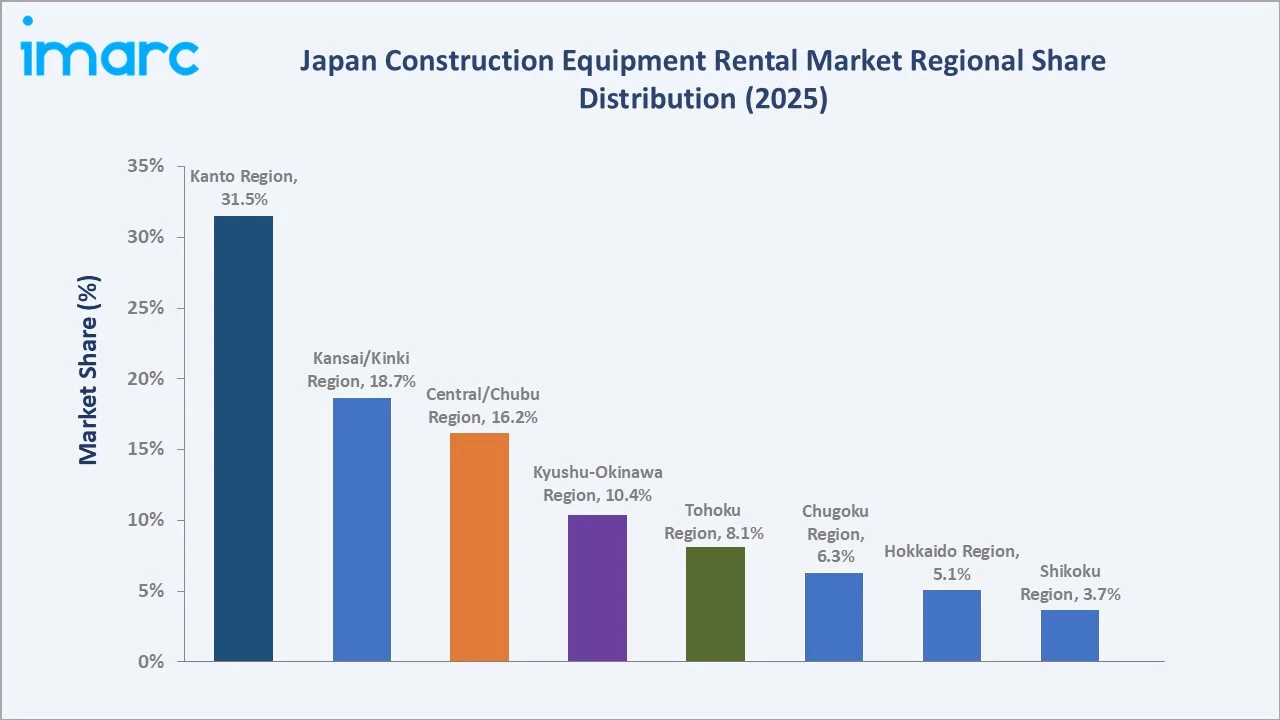
The Kyushu-Okinawa region, at 10.4%, is witnessing rising rental demand driven by semiconductor manufacturing, renewable energy, and large-scale infrastructure developments. Meanwhile, the Tohoku region at 8.1% continues to benefit from reconstruction, disaster resilience, and public infrastructure projects. Chugoku region at 6.3%, the Hokkaido region at 5.1%, and the Shikoku region at 3.7% contribute steadily through industrial, energy, agricultural, and regional infrastructure investments.
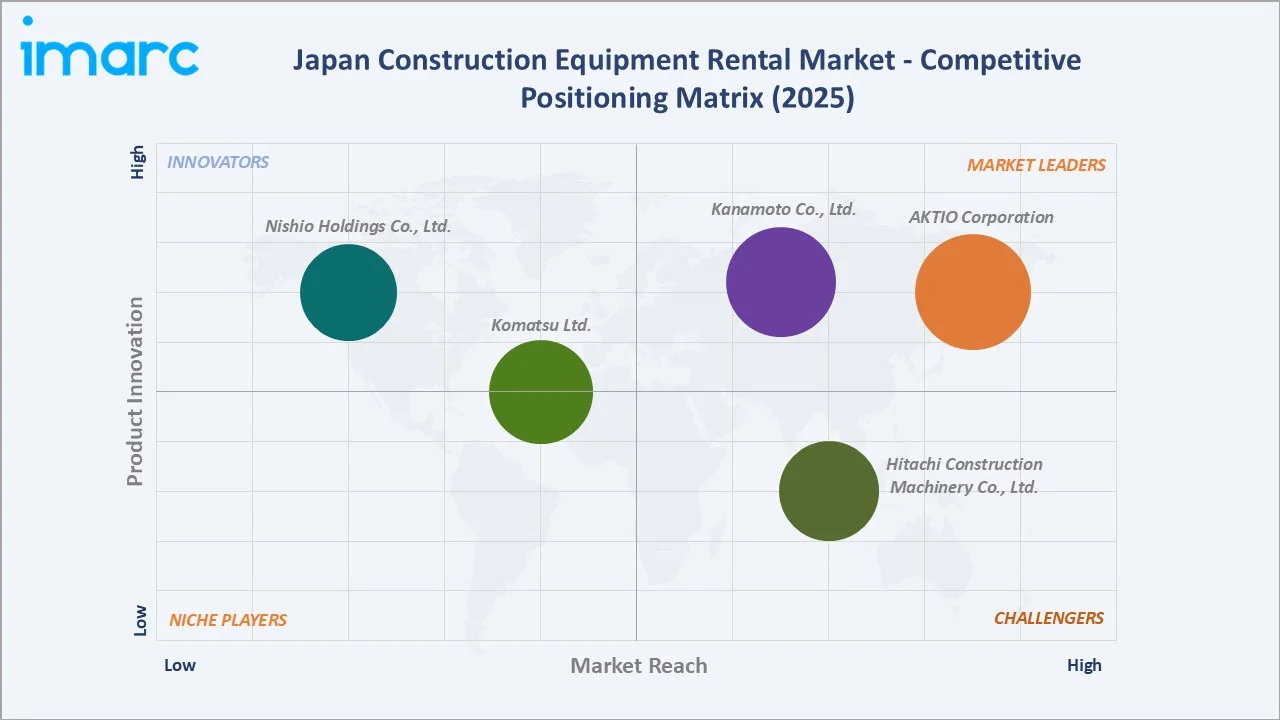
Competitive Landscape
Japan construction equipment rental market is moderately concentrated. Equipment manufacturers compete through captive rental subsidiaries and dealer networks that leverage proprietary ICT technology advantages. The market is characterized by ongoing rental fee normalization, digital platform investment competition, and fleet electrification positioning as operators differentiate service quality in an increasingly ICT and sustainability-focused construction environment.
|
Company |
Key Services |
Market Position |
Core Strength |
|
AKTIO Corporation |
Construction machinery rental services, Rental and lease services |
Market Leader |
AKTIO Corporation is one of Japan's construction equipment rental firms. It revolutionized the sector by shifting from traditional leasing to a "Rensulting" (rental + consulting) model. |
|
Kanamoto Co., Ltd. |
Construction Equipment Rental Services |
Market Leader |
Kanamoto Co., Ltd. is one of Japan's top construction equipment rental firms, operating a massive nationwide network of hundreds of branches. The company maximizes asset efficiency by renting heavy machinery. |
|
Nishio Holdings Co., Ltd. |
Domestic construction machinery rental |
Innovator |
Nishio Holdings Co., Ltd., with its subsidiary Nishio Rent All, is a leading equipment rental provider in Japan, specializing in both general heavy construction machinery and highly specialized civil engineering, tunneling, and event equipment. |
|
Hitachi Construction Machinery Co., Ltd. |
Hitachi Construction Machinery PREMIUM RENTAL |
Challenger |
Hitachi Construction Machinery Co., Ltd. operates a dedicated subsidiary, Hitachi Construction Machinery Japan Co., Ltd., which anchors its domestic rental operations. |
|
Komatsu Ltd. |
Construction Rental Equipment |
Established Player |
Komatsu Ltd. is a major leader in the Japanese construction equipment rental market, operating through its consolidated domestic rental divisions. The company provides a full line of heavy machinery, allowing contractors to access high-quality equipment without large upfront capital expenditures. |
Japan construction equipment rental operators are differentiating on three strategic axes: ICT and digital service capability, electric fleet leadership, and regional market depth. The market is expected to see continued rental fee normalization through the forecast period as operators recover capital investment in fleet electrification and digital platform development.
Key Company Profiles
AKTIO Corporation
AKTIO Corporation is one of Japan's leading construction equipment rental companies, offering a broad portfolio of earthmoving equipment, aerial work platforms, power generators, compressors, cranes, temporary facilities, and specialized machinery. The company serves construction, civil engineering, infrastructure, manufacturing, disaster recovery, and public sector projects through an extensive nationwide branch network. AKTIO has strengthened its market position by expanding ICT-enabled construction equipment, telematics-based fleet management, remote monitoring solutions, and smart construction technologies.
- Key Services: Construction machinery rental services, Rental and lease services.
- Strategic Focus: Expanding ICT-enabled machinery, automation, and labor-saving equipment to help contractors address worker shortages and improve construction productivity. It is also advancing digital transformation through data-driven fleet management, AI applications, and more efficient rental operations.
Kanamoto Co., Ltd.
Kanamoto Co., Ltd. is one of Japan’s leading construction equipment rental companies. The company provides excavators, loaders, aerial work platforms, generators, temporary structures, and specialized machinery for construction, infrastructure, disaster recovery, and industrial projects. Its extensive domestic service network, broad fleet, and strong maintenance capabilities support reliable equipment supply across Japan. Kanamoto also operates equipment sales, used machinery, steel products, and IT-related rental businesses.
- Key Services: Construction Equipment Rental Services.
- Strategic Focus: Strengthening fleet productivity, optimizing the allocation of rental assets, and pursuing acquisitions to expand their domestic network and associated services. It is also advancing construction digitalization through ICT-enabled machinery, product development, and improved maintenance operations.
Market Concentration Analysis
Japan construction equipment rental market is moderately concentrated at the top tier, with AKTIO Corporation, Kanamoto Co., Ltd., and Nishio Holdings Co., Ltd., collectively commanding an estimated 35-45% of Japan's total rental market revenue in 2025. The market features a clear three-tier structure: the top three nationwide operators with machine fleets, a second tier of specialized or regionally focused operators, and a third tier of hundreds of regional and local rental companies serving specific geographic markets or equipment niches. Market concentration at the top tier is expected to increase modestly through 2034 as digital platform investment, fleet electrification capital requirements, and ICT equipment procurement costs advantage larger operators with scale economics over smaller regional competitors.
Investment & Growth Opportunities
Highest Growth Segments
Services solution type (~6.4% CAGR), Kanto region (~6.2% CAGR), heavy construction equipment (~5.9% CAGR), electric and hybrid equipment rental premium tier (~10-15% niche CAGR), and AI-integrated smart construction service tier (~12% CAGR niche) represent Japan construction equipment rental market's highest-growth investment vectors through 2034.
Investment Themes
- Electric equipment fleet investment for urban and regulated markets: Rental companies can invest in electric excavators, loaders, aerial platforms, and compact machinery suited to dense urban, indoor, and noise-sensitive construction sites. These fleets help contractors meet emission, noise, and sustainability requirements without committing to high equipment purchase costs. Premium rental pricing, lower operating expenses, and growing demand for low-carbon projects can support attractive returns.
- Digital rental platform and AI service integration investment: Investment in digital rental platforms can enable online booking, real-time availability, automated contracts, delivery tracking, and digital payments. Integrating AI can improve demand forecasting, dynamic pricing, predictive maintenance, and fleet allocation. These capabilities can raise equipment utilization, reduce downtime, strengthen customer retention, and create recurring revenue from data-driven services.
Future Market Outlook (2026-2034)
The Japan construction equipment rental market is projected to grow from USD 12.08 Billion in 2025 to USD 20.02 Billion by 2034, delivering a 5.78% CAGR, making the Japan construction equipment rental market one of Asia's largest and most valuable equipment rental ecosystems. The anchor value of USD 15.99 Billion in 2030 reflects the extraordinary confluence of institutional public investment, semiconductor manufacturing construction, and infrastructure rehabilitation that constitutes Japan's most significant construction investment wave.
Three structural forces will define Japan construction equipment rental market trajectory through 2034. First, the mandatory infrastructure rehabilitation driven by aging statistics will provide multi-decade institutional demand certainty unparalleled in any other major construction equipment rental market. Second, Japan's acute and structural construction labor shortage will drive the most significant technology substitution in Japan's construction industry since the mechanization of manual labor. Third, Japan's major semiconductor localization investments represent construction investment events of unprecedented scale in two previously underserved rental market regions.
Research Methodology
Primary Research
Primary research comprised in-depth interviews with construction equipment rental company executives and depot managers, general contractor and civil engineering subcontractor procurement managers, equipment manufacturer Japan market representatives, public works infrastructure planning officials, and independent construction industry analysts. These discussions validated market size estimates, assessed segment demand drivers, evaluated competitive positioning, and provided insights into regional infrastructure investment patterns, ICT equipment adoption velocity, and digital rental platform development priorities.
Secondary Research
Secondary research encompassed construction industry data, trade association publications, company annual reports and investor presentations, and credible market intelligence sources. Regional construction activity data from prefectural government public works departments and semiconductor facility investment announcements were incorporated into regional demand projections.
Forecasting Models
Forecasting models were developed using historical Japan construction equipment rental market data, infrastructure investment budget trajectories, construction labor supply projections, ICT equipment adoption curve modeling, semiconductor facility construction investment schedules, electric equipment fleet transition scenarios, and rental fee escalation assumptions. Both top-down and bottom-up approaches were validated through primary research.
Japan Construction Equipment Rental Market Report Coverage:
| Report Features | Details |
|---|---|
| Base Year of the Analysis | 2025 |
| Historical Period | 2020-2025 |
| Forecast Period | 2026-2034 |
| Units | Billion USD |
| Scope of the Report |
Exploration of Historical and Forecast Trends, Industry Catalysts and Challenges, Segment-Wise Historical and Predictive Market Assessment:
|
| Solution Types Covered | Products, Services |
| Equipment Types Covered | Heavy Construction Equipment, Compact Construction Equipment |
| Types Covered | Loader, Cranes, Forklift, Excavator, Dozers, Others |
| Applications Covered | Excavation and Mining, Lifting and Material Handling, Earth Moving, Transportation, Others |
| Industries Covered | Oil and Gas, Construction and Infrastructure, Manufacturing, Mining, Others |
| Regions Covered | Kanto Region, Kansai/Kinki Region, Central/ Chubu Region, Kyushu-Okinawa Region, Tohoku Region, Chugoku Region, Hokkaido Region, Shikoku Region |
| Companies Covered | AKTIO Corporation, Kanamoto Co., Ltd., Nishio Holdings Co., Ltd., Hitachi Construction Machinery Co., Ltd., Komatsu Ltd., etc. |
| Customization Scope | 10% Free Customization |
| Post-Sale Analyst Support | 10-12 Weeks |
| Delivery Format | PDF and Excel through Email (We can also provide the editable version of the report in PPT/Word format on special request) |
Key Benefits for Stakeholders:
- IMARC’s industry report offers a comprehensive quantitative analysis of various market segments, historical and current market trends, market forecasts, and dynamics of the Japan construction equipment rental market from 2020-2034.
- The research report provides the latest information on the market drivers, challenges, and opportunities in the Japan construction equipment rental market.
- Porter's five forces analysis assist stakeholders in assessing the impact of new entrants, competitive rivalry, supplier power, buyer power, and the threat of substitution. It helps stakeholders to analyze the level of competition within the Japan construction equipment rental industry and its attractiveness.
- Competitive landscape allows stakeholders to understand their competitive environment and provides an insight into the current positions of key players in the market.
Frequently Asked Questions About the Japan Construction Equipment Rental Market Report
The Japan construction equipment rental market reached USD 12.08 Billion in 2025, driven by aging infrastructure requiring rehabilitation and a severe construction labor shortage driving ICT equipment adoption.
The market grows at 5.78% CAGR during 2026-2034, reaching USD 20.02 Billion by 2034. The CAGR reflects infrastructure rehabilitation institutional demand, ICT equipment rental premium uplift, and electric equipment rental premium tier emergence.
Products lead at 61.8% (2025), representing physical equipment rental across Japan's high-penetration construction sector.
Heavy construction equipment dominates at 68.4% (2025), driven by Japan's massive infrastructure rehabilitation requirement, semiconductor facility heavy construction, and fab development.
Kanto region leads at 31.5% (2025), growing at ~6.2% CAGR, the fastest region, driven by Tokyo Metropolitan Government's continuous construction investment, disaster-resilience hardening investment, and the highest density of Japan's major rental operator headquarters and depot networks.
Leading companies include AKTIO Corporation, Kanamoto Co., Ltd., Nishio Holdings Co., Ltd., Hitachi Construction Machinery Co., Ltd., and Komatsu Ltd., among others.
The market is projected to reach approximately USD 15.99 Billion by 2030, driven by infrastructure investment peak spending, digital platform maturation, and electric-ICT equipment fleet expansion across Japan's rental operator networks.
Top opportunities include electric equipment fleet investment for the urban premium rental tier, AI smart construction integrated service tier development, regional depot capacity expansion, and digital rental platform development for AI-powered inspection and contractor ERP integration.
Need more help?
- Speak to our experienced analysts for insights on the current market scenarios.
- Include additional segments and countries to customize the report as per your requirement.
- Gain an unparalleled competitive advantage in your domain by understanding how to utilize the report and positively impacting your operations and revenue.
- For further assistance, please connect with our analysts.
 Request Customization
 Speak to an Analyst
 Request Brochure
 Inquire Before Buying
Benefits of Customization
- Personalize this research
- Triangulate with your data
- Get data as per your format and definition
- Gain a deeper dive into a specific application, geography, customer, or competitor
- Any level of personalization
Get in Touch With Us
UNITED STATES
Phone: +1-201-971-6302
INDIA
Phone: +91-120-433-0800
UNITED KINGDOM
Phone: +44-753-714-6104
Email: sales@imarcgroup.com
Client Testimonials




.webp)




.webp)













Related Reports

Choose your plan
*Please note that the prices mentioned below are starting prices for each bundle type. Kindly contact our team for further details.*
Single User License
- 1 User License, Access on 2 Devices
- PDF Report + Excel Dataset (Password Protected)
- Lifetime Access
- No Printing Rights
- 10% Free Report Customization
- 10–12 Weeks of Analyst Support
Five User License
- Access for 5 Users, 2 Devices per User
- PDF Report + Excel Dataset (Password Protected)
- Lifetime Access
- Dedicated Account Manager
- 12–14 Weeks of Analyst Support
- No Printing Rights
- 15% Free Report Customization
- 25% Discount on Your Next Purchase
Corporate User License
- Unlimited User Access (Within Your Organization)
- PDF Report + Excel Dataset
- Lifetime Access
- Dedicated Account Manager
- 14–20 Weeks of Analyst Support
- No Printing Rights
- 20% Free Report Customization
- 30% Discount on Your Next Purchase
Essential Insights
What's included:
3 reports
- Lifetime Access
- PDF Reports
- Excel Datasets
- 2 Weeks of Free Analyst Support
- 2 User Licenses
- Access on 2 Devices
- Printing Rights
- Complimentary PowerPoint (PPT) Version
- Complimentary License Upgrade
Professional Access
What's included:
5 reports
- Lifetime Access
- PDF Reports
- Excel Datasets
- 8 Weeks of Free Analyst Support
- 2 User Licenses
- Access on 2 Devices
- Printing Rights
- Complimentary PowerPoint (PPT) Version
- Complimentary License Upgrade
Business Advantage
What's included:
8 reports
- Lifetime Access
- PDF Reports
- Excel Datasets
- 14 Weeks of Free Analyst Support
- 2 User Licenses
- Access on 2 Devices
- Printing Rights
- Complimentary PowerPoint (PPT) Version
- Complimentary License Upgrade
Enterprise Intelligence
What's included:
10 reports
- Lifetime Access
- PDF Reports
- Excel Datasets
- 20 Weeks of Free Analyst Support
- 2 User Licenses
- Access on 2 Devices
- Printing Rights
- Complimentary PowerPoint (PPT) Version
- Complimentary License Upgrade