
Japan Electric Vehicles Market Size, Share, Trends and Forecast by Component, Charging Type, Propulsion Type, Vehicle Type, and Region, 2026-2034
Japan Electric Vehicles Market Size, Share, Trends & Forecast (2026-2034)
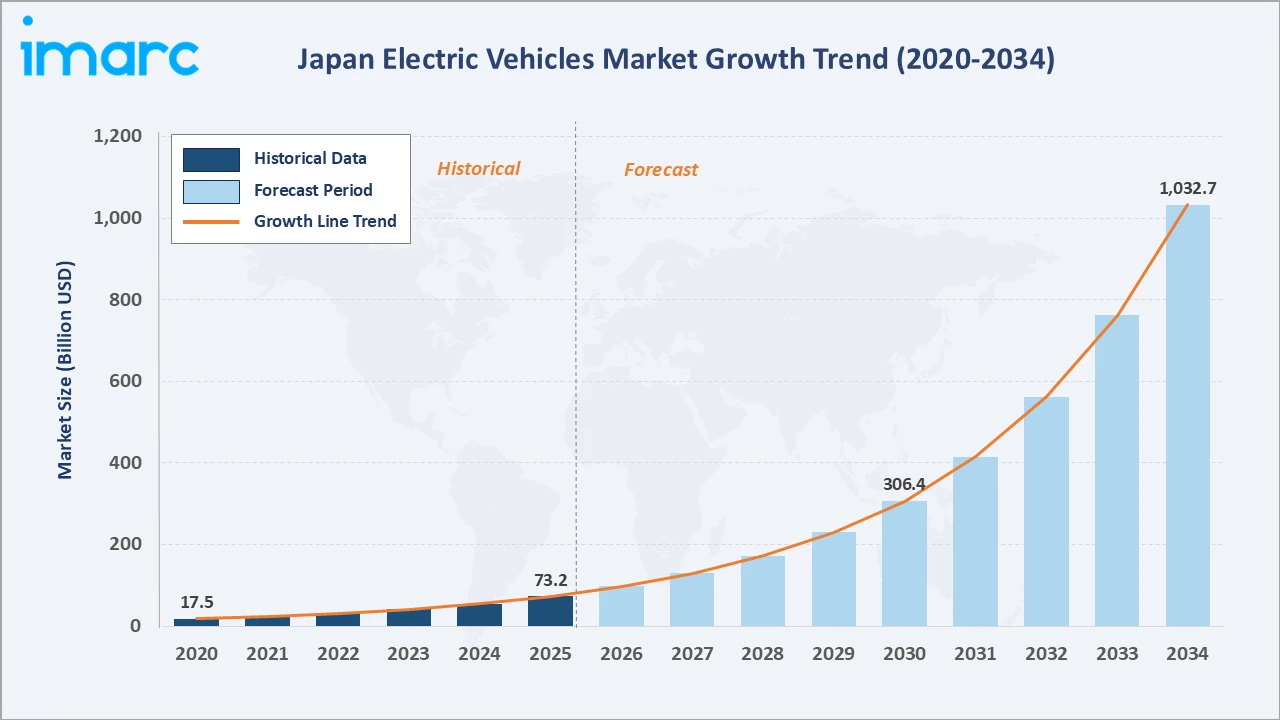
The Japan electric vehicles market reached USD 73.2 Billion in 2025 and is projected to reach USD 1,032.7 Billion by 2034, growing at a CAGR of 33.2% during 2026-2034. Growth is driven by rising consumer preference for sustainable and eco-friendly transportation solutions, an increasing number of charging infrastructure facilities, and the wide availability of electric vehicle models through online and offline distribution channels.
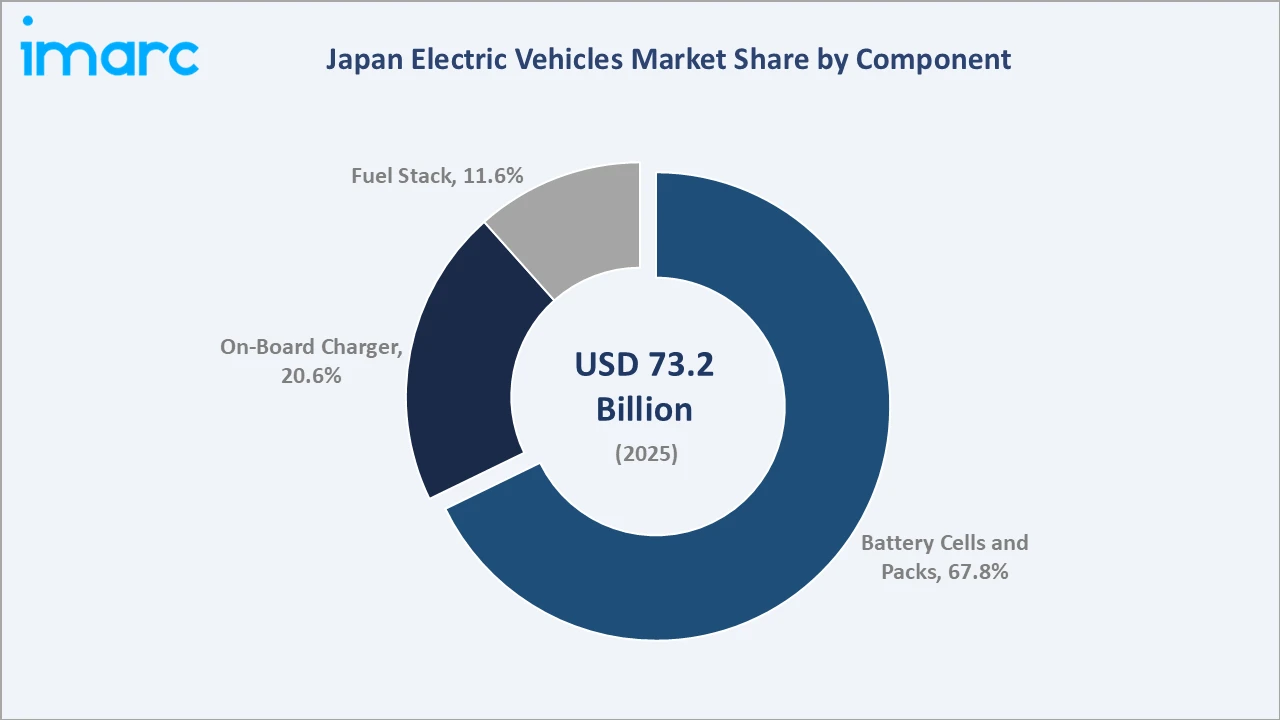
Battery Cells and Packs dominate the component segment at 67.8%, reflecting the central role of battery technology in vehicle range, performance, and overall cost. Slow Charging leads the charging type segment at 58.4%, supported by widespread home and workplace charging adoption across Japan's dense urban housing stock. The Kanto Region commands 35.4% of the market, anchored by Tokyo's dense EV ecosystem, concentration of automotive OEM headquarters, and continued infrastructure investment.
Market Snapshot
|
Metric |
Value |
|
Market Size (2025) |
USD 73.2 Billion |
|
Forecast Market Size (2034) |
USD 1,032.7 Billion |
|
CAGR (2026-2034) |
33.2% |
|
Base Year |
2025 |
|
Historical Period |
2020-2025 |
|
Forecast Period |
2026-2034 |
|
Dominant Component |
Battery Cells and Packs (67.8%, 2025) |
|
Dominant Charging Type |
Slow Charging (58.4%, 2025) |
|
Leading Region |
Kanto Region (35.4%, 2025) |
The market expanded from an estimated USD 17.5 Billion in 2020 to USD 73.2 Billion in 2025 - more than quadrupling in five years - anchored at approximately USD 306.4 Billion in 2030 and forecast to reach USD 1,032.7 Billion by 2034. Sustained government incentives, tax rebates, and stricter emission regulations support this compounding growth trajectory, which is expected to continue as charging infrastructure scales nationwide, battery costs decline further, and consumer familiarity with EV ownership deepens across both metropolitan and regional markets.
To get more information on this market, Request Sample
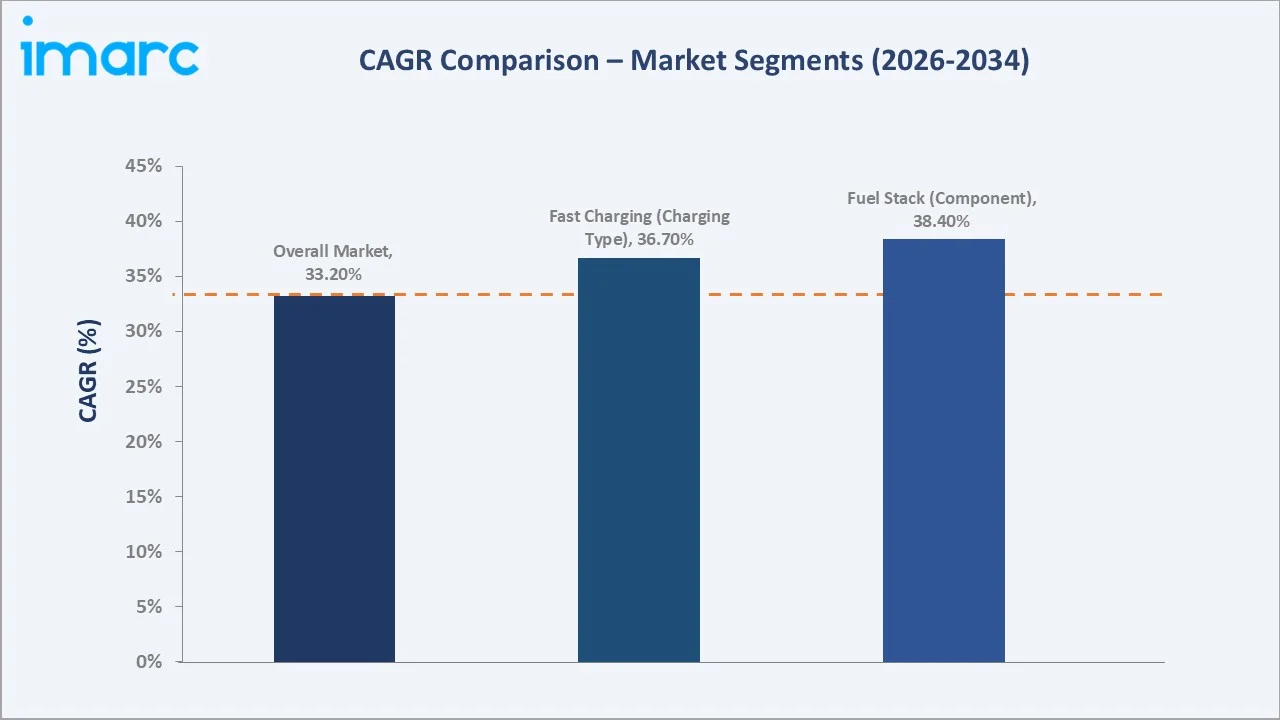
Fuel Stack grows fastest among components at an estimated 38.4% CAGR from a smaller base, reflecting the early but accelerating stage of Japan's hydrogen mobility strategy, while Fast Charging leads charging-type growth at approximately 36.7% CAGR as public and highway charging networks expand nationwide, outpacing the market's overall 33.2% CAGR and signalling a gradual shift in consumer charging behaviour toward faster, on-the-go solutions.
Executive Summary
The Japan electric vehicles market reached USD 73.2 Billion in 2025, reflecting one of Asia's most advanced EV ecosystems, underpinned by strong domestic automotive manufacturing, ambitious government decarbonization targets, and rising consumer environmental awareness. The EV traction system, spanning battery cells and packs, on-board chargers, and fuel stacks, is central to Japan's broader transition away from internal combustion engine vehicles. The market is projected to reach USD 1,032.7 Billion by 2034, delivering a CAGR of 33.2% across the forecast period.
Battery Cells and Packs at 67.8% dominate the component segment through continuous improvements in energy density, thermal safety, and declining cell costs that make batteries the single largest value driver in every EV produced. Slow Charging at 58.4% leads the charging-type segment via widespread residential and workplace charging adoption, reflecting Japan's dense urban housing patterns and strong corporate charging infrastructure. The Kanto Region at 35.4% leads regionally, supported by Tokyo's metropolitan EV density and OEM concentration, followed by the Kinki Region at 19.2% and the Central/Chubu Region at 15.6%.
Key Market Insights
|
Insight |
Data |
|
Dominant Component |
Battery Cells and Packs - 67.8% share (2025) |
|
Dominant Charging Type |
Slow Charging - 58.4% market share (2025) |
|
Leading Region |
Kanto Region - 35.4% market share (2025) |
|
Market Opportunity |
Solid-state batteries; ultra-fast charging networks; vehicle-to-grid integration; two-wheeler electrification; battery recycling infrastructure |
Key Analytical Observations Supporting the Above Data:
- Battery Cells and Packs at 67.8%: The Battery Cells and Packs segment dominates as declining lithium-ion costs and improved energy density make batteries the largest value contributor to every EV built, a position reinforced by expanding domestic battery gigafactory capacity and continued investment in next-generation cell chemistries.
- Slow Charging at 58.4%: Slow Charging leads through high home and workplace charger penetration across Japan's dense urban housing and corporate parking infrastructure, offering EV owners a convenient, lower cost daily charging solution that fits well with typical commuting patterns.
- Kanto Region at 35.4%: The Kanto Region leads via Tokyo's high EV registration density, extensive public charging rollout, and concentration of automotive OEM headquarters and dealership networks that support faster consumer adoption cycles.
Japan Electric Vehicles Market Overview
The Japan electric vehicles market encompasses the design, manufacture, and sale of battery-powered and fuel-cell passenger and commercial vehicles, along with the components and charging infrastructure that support them. Electric vehicles rely on one or more electric motors and typically utilize lithium-ion batteries that store electricity and convert it into mechanical energy to drive the wheels, offering a quiet, smooth, and cost-effective driving experience compared to conventional combustion engine vehicles.
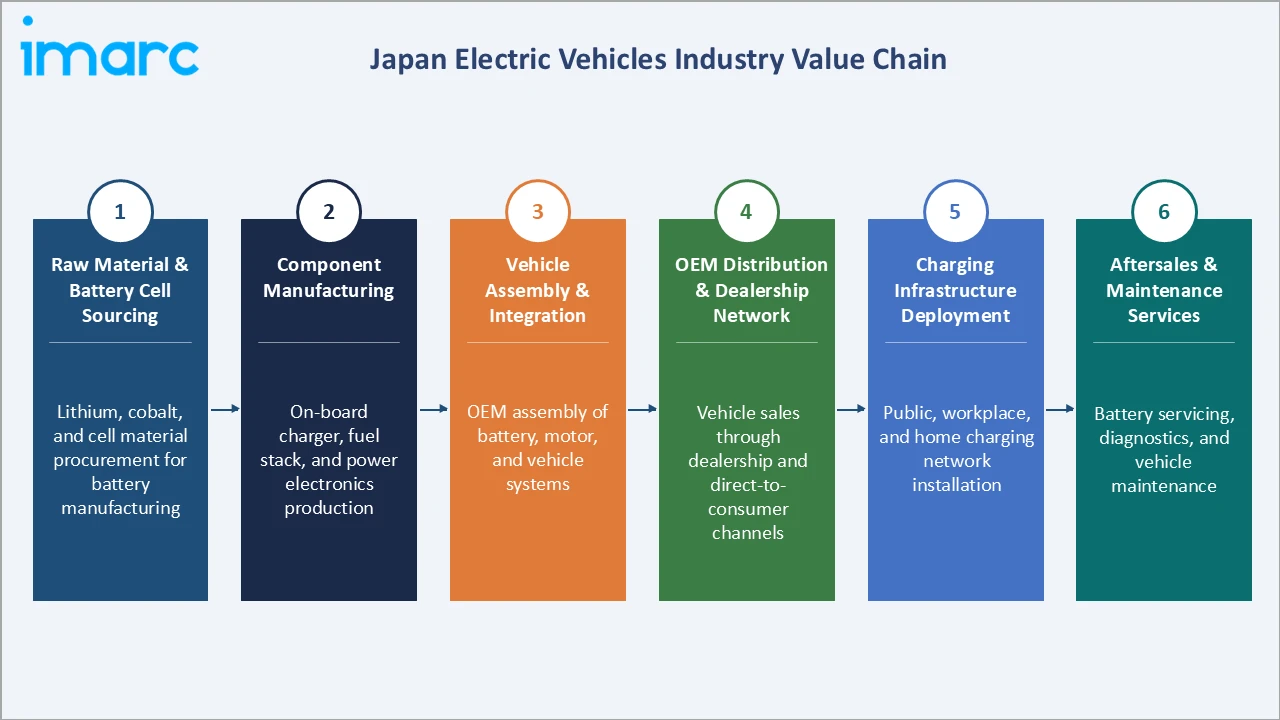
The ecosystem integrates battery cell producers, on-board charger and fuel stack manufacturers, vehicle OEMs, charging network operators, and regulatory bodies setting emission and safety standards. Macroeconomic factors include rising fuel prices, government subsidies, growing urbanization, and continued investment in nationwide charging infrastructure, all of which are collectively strengthening consumer confidence in EV ownership across Japan.
Market Dynamics
To evaluate market opportunities, Request Sample
Market Drivers
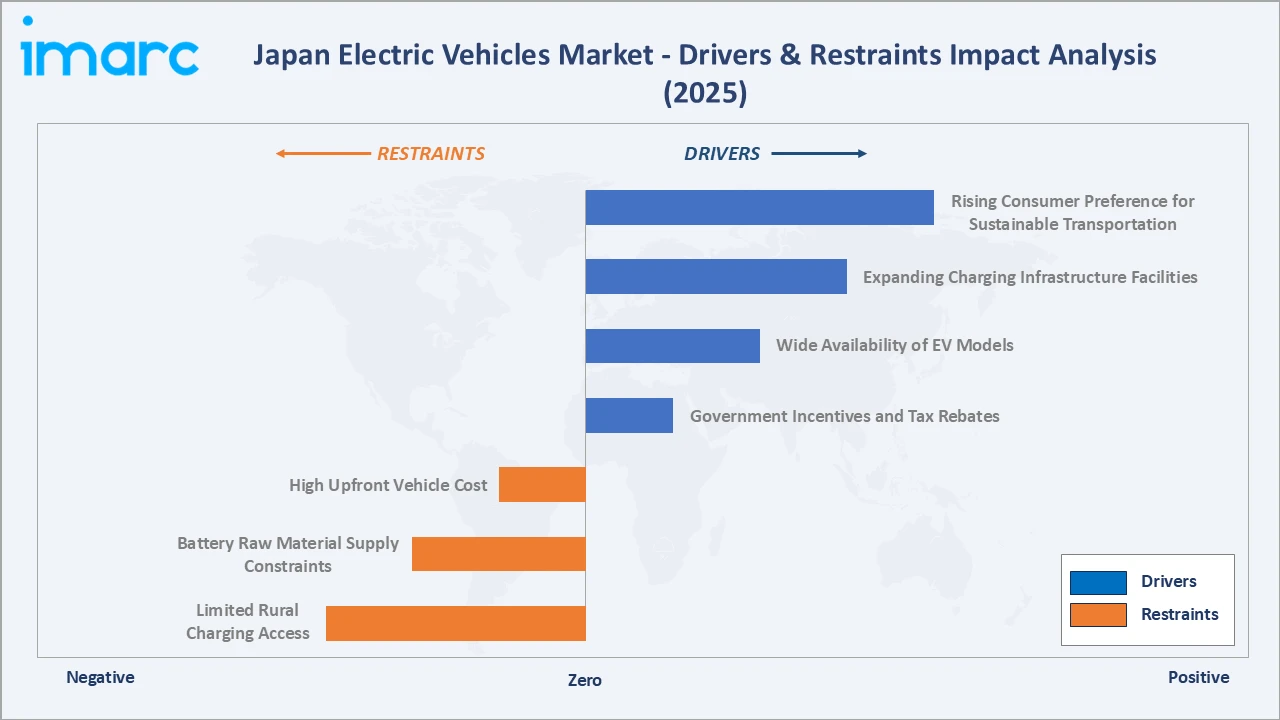
- Rising Consumer Preference for Sustainable Transportation: Rising environmental awareness is steering Japanese consumers toward zero-emission mobility, supported by national carbon-neutrality targets that favor EV adoption over combustion-engine vehicles across passenger and commercial fleets. This shift is further reinforced by growing corporate sustainability commitments among fleet operators.
- Expanding Charging Infrastructure Facilities: Expanding public and workplace charging networks are reducing range anxiety and improving daily usability, encouraging broader EV adoption across metropolitan and suburban areas nationwide, particularly among first-time EV buyers evaluating long-term ownership costs.
- Wide Availability of EV Models: A growing number of EV models available through online and offline distribution channels is widening consumer choice across price points, body styles, and propulsion types, accelerating overall market penetration among diverse buyer segments.
- Government Incentives and Tax Rebates: Government subsidies, tax rebates, and reduced registration fees are lowering ownership costs, making EVs more price-competitive with conventional vehicles and accelerating replacement-cycle adoption across passenger and commercial vehicle categories.
Market Restraints
- High Upfront Vehicle Cost: EVs continue to carry a price premium over combustion-engine vehicles due to battery costs, limiting affordability for price-sensitive consumer segments despite available incentives and financing options.
- Battery Raw Material Supply Constraints: Dependence on imported battery raw materials such as lithium and cobalt exposes manufacturers to price volatility and supply disruptions, raising production costs and planning uncertainty across the supply chain.
- Limited Rural Charging Access: Charging infrastructure remains concentrated in urban centers, leaving rural and less-populated regions with limited access and slowing EV adoption outside major metropolitan areas of the country.
Market Opportunities
- Solid-State Battery Commercialization: Advancements in solid-state battery technology promise higher energy density, faster charging, and improved safety, creating a significant upgrade opportunity for next-generation Japanese EV platforms and export-oriented manufacturing.
- Vehicle-to-Grid Integration: Growing interest in vehicle-to-grid technology allows EVs to support household and grid energy balancing, opening new revenue and utility-partnership opportunities for manufacturers, utilities, and energy service providers alike.
Market Challenges
- Domestic Battery Manufacturing Scale-Up Pressure: Limited domestic battery cell manufacturing capacity relative to demand growth is creating competitive pressure from overseas suppliers with larger-scale, lower-cost production capabilities.
- Grid Capacity Constraints for Fast Charging: Balancing fast-charging rollout with grid capacity constraints requires substantial utility-side investment, adding complexity and cost to nationwide infrastructure expansion plans over the coming decade.
Emerging Market Trends
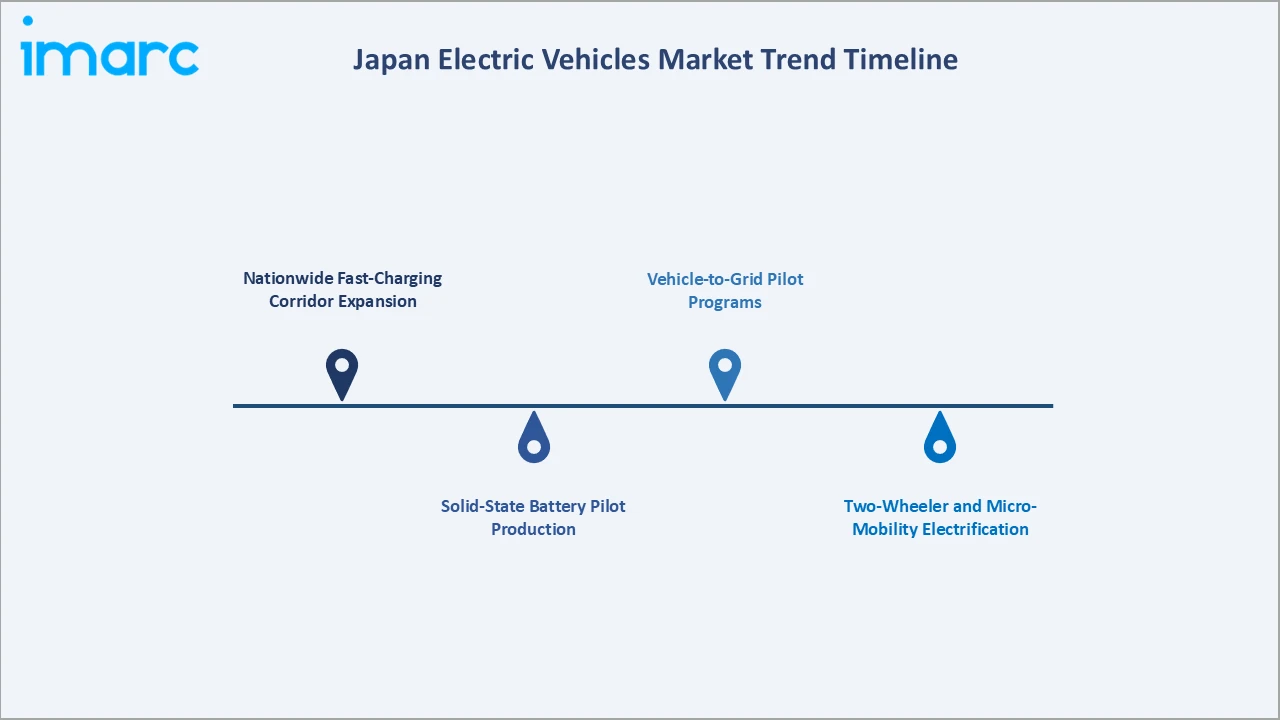
1. Nationwide Fast-Charging Corridor Expansion
Highway and urban fast-charging corridors are expanding rapidly, enabling longer-distance EV travel and reducing charging time, which is improving consumer confidence in EV usability for both daily commuting and long journeys across the country.
2. Solid-State Battery Pilot Production
Japanese automakers and battery suppliers are advancing solid-state battery pilot lines, targeting improved range, faster charging, and enhanced safety ahead of broader commercial rollout later in the forecast period, positioning Japan among global battery innovation leaders.
3. Two-Wheeler and Micro-Mobility Electrification
Electrification of two-wheelers and compact urban vehicles is gaining traction, driven by dense city infrastructure and demand for low-cost, space-efficient personal mobility solutions across Japan's metropolitan regions and aging population centers.
4. Vehicle-to-Grid Pilot Programs
Utilities and automakers are piloting vehicle-to-grid programs that let parked EVs feed stored energy back to the grid, supporting renewable energy balancing and creating new value streams for EV owners and grid operators.
Industry Value Chain Analysis
The Japan EV value chain integrates raw material and battery cell sourcing, component manufacturing, vehicle assembly, OEM distribution, charging infrastructure deployment, and aftersales services. The chain is consolidating toward tighter integration between battery suppliers and vehicle OEMs to secure supply and reduce costs, with several manufacturers pursuing direct investment in upstream battery material sourcing to mitigate price volatility.
|
Stage |
Key Participants |
|
Raw Material & Battery Cell Sourcing |
Lithium, cobalt, and cell material procurement for battery manufacturing |
|
Component Manufacturing |
On-board charger, fuel stack, and power electronics production |
|
Vehicle Assembly & Integration |
OEM assembly of battery, motor, and vehicle systems |
|
OEM Distribution & Dealership Network |
Vehicle sales through dealership and direct-to-consumer channels |
|
Charging Infrastructure Deployment |
Public, workplace, and home charging network installation |
|
Aftersales & Maintenance Services |
Battery servicing, diagnostics, and vehicle maintenance |
Technology Landscape in the Japan Electric Vehicles Industry
Battery Cell & Pack Technology
Lithium-ion battery cell and pack technology continues to advance in energy density, thermal management, and cost efficiency, forming the core value driver of the Battery Cells and Packs component segment and the primary determinant of vehicle range, performance, and overall pricing. Continued research into next-generation cathode chemistries is further improving cycle life and reducing degradation over a vehicle's operational lifetime.
On-Board Charger Technology
On-board charger technology is advancing toward higher power conversion efficiency and more compact designs, enabling faster home and workplace charging while reducing energy losses during the AC-to-DC conversion process that every EV depends on.
Fuel Stack and Hydrogen Technology
Fuel stack technology underpins Japan's hydrogen mobility strategy, with ongoing improvements in catalyst efficiency, durability, and cost reduction supporting the gradual commercial expansion of fuel cell electric vehicles across passenger and commercial fleets.
Fast Charging Infrastructure Technology
Fast-charging technology is evolving toward higher power delivery and improved thermal handling, cutting charge times and supporting the growing Fast Charging segment as highway and urban public networks scale nationwide, aided by advances in power electronics and cooling system design.
Market Segmentation Analysis
The report covers the following segments:
|
Segment Category |
Leading Segment |
Market Share |
Year |
|
Component |
Battery Cells and Packs |
67.8% |
2025 |
|
Charging Type |
Slow Charging |
58.4% |
2025 |
|
Propulsion Type |
🔒 |
🔒 |
2025 |
|
Vehicle Type |
🔒 |
🔒 |
2025 |
|
Region |
Kanto Region |
35.4% |
2025 |

By Component
Battery Cells and Packs lead at 67.8% in 2025, reflecting their role as the highest-value component in every EV produced, supported by continuous energy density gains, declining per-kilowatt-hour costs, and expanding domestic cell manufacturing capacity across Japan's automotive supply base.
To access detailed market analysis, Request Sample
On-Board Charger at 20.6% captures steady demand as every EV requires onboard AC-to-DC conversion hardware regardless of vehicle segment or price point. Fuel Stack at 11.6%, though smaller, is the fastest-growing component as fuel-cell vehicle adoption expands within Japan's broader hydrogen mobility strategy and infrastructure buildout.
By Charging Type
Slow Charging leads at 58.4% in 2025, driven by widespread home and workplace charger installation across Japan's dense residential and corporate parking infrastructure, offering the lowest-cost daily charging option for the majority of EV owners nationwide.
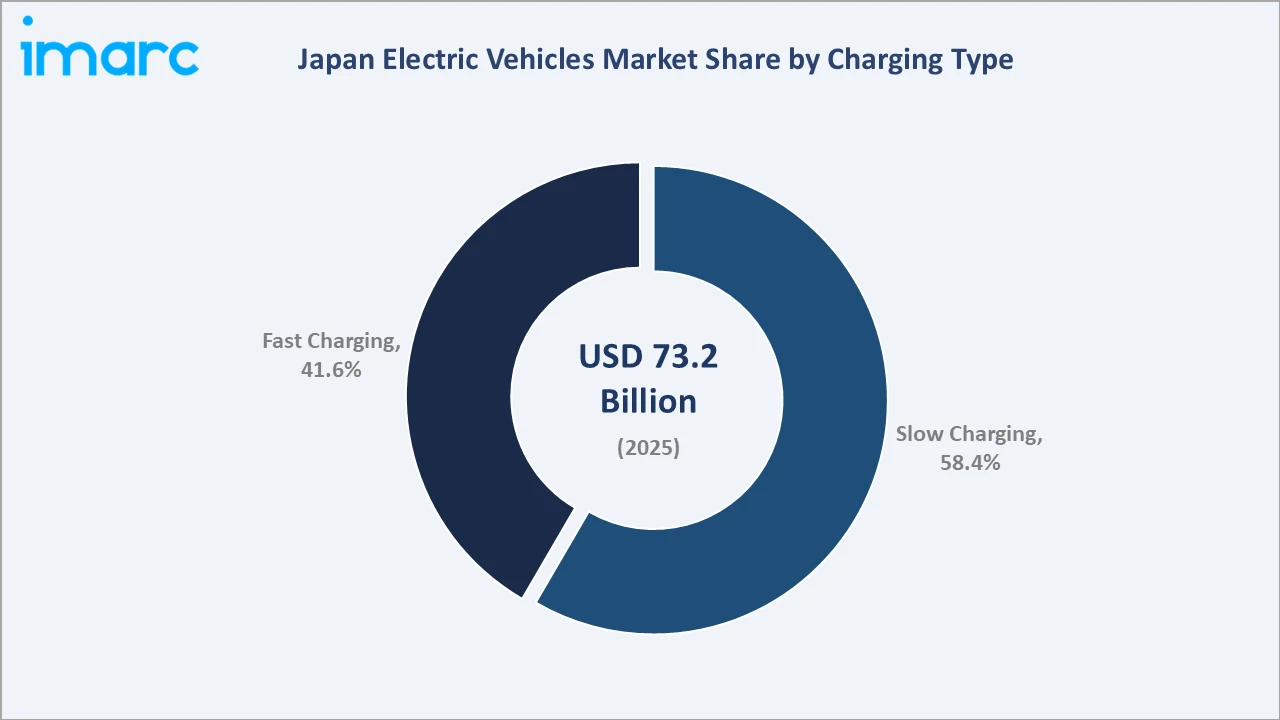
Fast Charging at 41.6% is expanding rapidly as highway corridors and urban public charging stations scale, reducing charging time and supporting longer-distance EV travel across the country, particularly among commercial fleet operators and long-haul travellers.
Regional Market Insights
|
Region |
Share (2025) |
Key Market Drivers & Characteristics |
|
Kanto Region |
35.4% |
Tokyo's dense EV ecosystem, high registration volumes, and extensive public charging rollout |
|
Kinki Region |
19.2% |
Osaka-Kyoto industrial base with strong automotive manufacturing and dealership presence |
|
Central/Chubu Region |
15.6% |
Nagoya's automotive manufacturing hub, home to major OEM production facilities |
|
Kyushu-Okinawa Region |
9.7% |
Growing EV adoption supported by regional government incentive programs |
|
Tohoku Region |
7.0% |
Expanding charging infrastructure supporting rural and semi-urban EV adoption |
|
Chugoku Region |
5.7% |
Steady EV uptake linked to regional automotive supply chain presence |
|
Hokkaido Region |
4.4% |
Emerging market with cold-climate EV technology adoption considerations |
|
Shikoku Region |
3.0% |
Smallest regional share, gradually developing charging infrastructure |
Kanto, at 35.4%, leads through Tokyo's EV registration density, OEM headquarters concentration, and public charging network scale, making it the country's most mature and closely watched regional EV market. Kinki, at 19.2%, and Central/Chubu, at 15.6%, benefit from strong regional automotive manufacturing bases and established dealership networks that support faster consumer adoption.
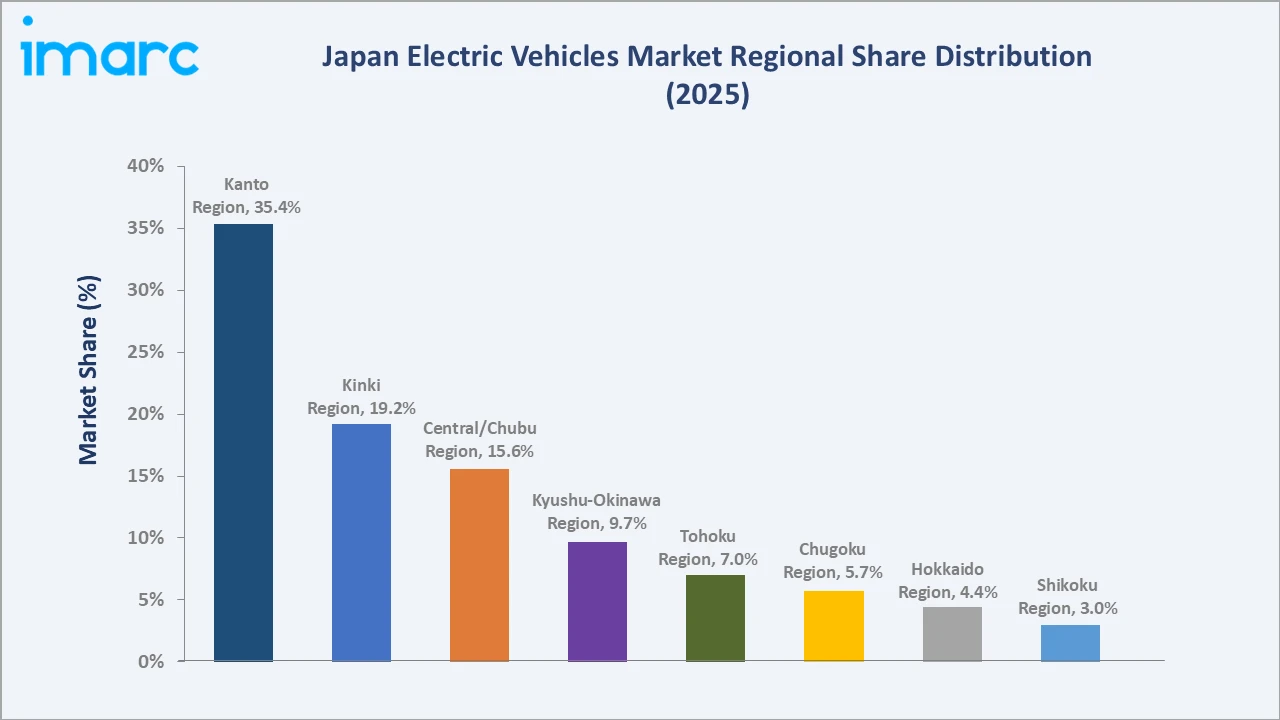
Kyushu-Okinawa, Tohoku, and Chugoku collectively hold over 22% of the market, reflecting steady regional adoption supported by expanding local incentive programs. Hokkaido and Shikoku remain smaller but growing markets as charging infrastructure gradually expands nationwide and regional governments prioritize EV-friendly policy frameworks.
Competitive Landscape
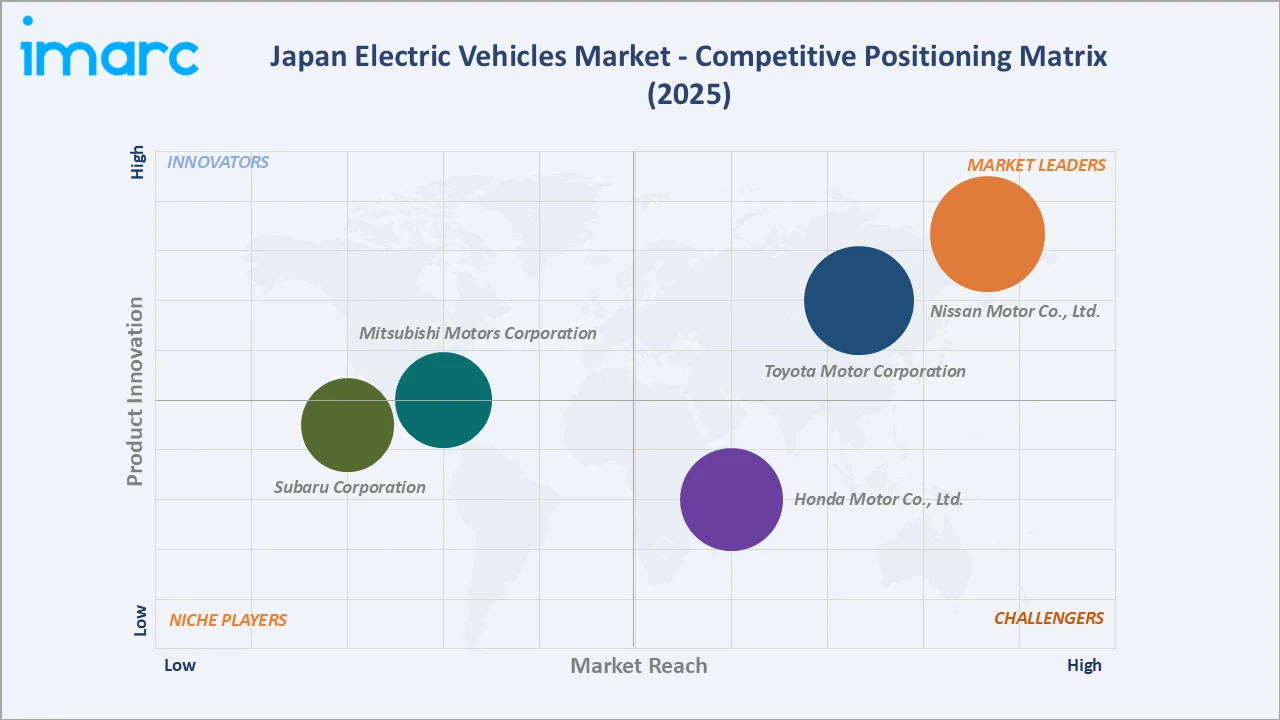
The Japan electric vehicles market competitive landscape is moderately concentrated, led by established domestic automotive OEMs and battery manufacturers that combine deep manufacturing scale with strong dealership and distribution networks across the country. Market structure, player positioning, and competitive strategy continue to evolve as OEMs accelerate battery electric vehicle platform investment alongside their traditional hybrid and plug-in hybrid portfolios.
|
Company Name |
Key Products |
Market Position |
Core Strength |
|
Toyota Motor Corporation |
bZ Series BEVs, Hybrid & PHEV Models |
Market Leader |
Largest domestic production scale and dealership network |
|
Nissan Motor Co., Ltd. |
Leaf, Ariya BEVs |
Market Leader |
Pioneer in mass-market battery electric vehicles |
|
Honda Motor Co., Ltd. |
Honda e:N Series, Fuel Cell Vehicles |
Strong Challenger |
Strength in fuel-cell and hybrid technology |
|
Mitsubishi Motors Corporation |
Outlander PHEV, Electric Kei Cars |
Emerging Player |
Strength in compact and PHEV vehicle segments |
|
Subaru Corporation |
Solterra BEV |
Emerging Player |
Growing BEV portfolio through OEM partnerships |
Key players include Toyota Motor Corporation, Nissan Motor Co., Ltd., Honda Motor Co., Ltd., Mitsubishi Motors Corporation, Subaru Corporation, and others.
Key Company Profiles
Toyota Motor Corporation
Toyota Motor Corporation is Japan's largest automaker, with a growing battery electric vehicle portfolio alongside its established hybrid and plug-in hybrid lineup that spans nearly every passenger vehicle segment.
- Key Products: bZ Series battery electric vehicles, hybrid and plug-in hybrid models.
- Recent Developments: In May 2026, Toyota Motor Corporation announced that Lexus has globally unveiled the all-new Lexus TZ, the brand's first three-row battery electric SUV (BEV), designed to expand its luxury electric vehicle portfolio. Developed under the "Driving Lounge" concept, the new model combines spacious three-row seating, premium comfort, and Lexus' signature driving dynamics to cater to a wide range of customer lifestyles.
- Strategic Focus: Broadening its BEV lineup while leveraging hybrid technology leadership to manage the transition to full electrification. The company is also investing in domestic solid-state battery development to strengthen its next-generation EV competitiveness.
Nissan Motor Co., Ltd.
Nissan Motor Co., Ltd. is a pioneer of mass-market battery electric vehicles in Japan, with a long-standing EV portfolio built around the Leaf and Ariya models that helped establish early consumer trust in BEVs.
- Key Products: Leaf and Ariya battery electric vehicles.
- Strategic Focus: Strengthening its BEV portfolio and battery technology roadmap to defend its position as an early EV market leader. The company continues to prioritize affordability and charging convenience to sustain mass-market appeal.
Market Concentration Analysis
The Japan EV market is moderately concentrated, with the top 2-3 key players collectively accounting for a substantial share of domestic passenger EV sales, supported by battery manufacturing scale. Emerging players are expanding their BEV portfolios through OEM partnerships, gradually diversifying the competitive base as electrification accelerates across the forecast period. Market concentration is expected to ease gradually over the forecast period as new entrants and expanding battery suppliers strengthen their domestic manufacturing footprint and technology capabilities.
Investment & Growth Opportunities
Highest Growth Segments
Fuel Stack components (~38.4% CAGR), Fast Charging infrastructure (~36.7% CAGR), and Kyushu-Okinawa regional adoption represent the highest-growth investment vectors through 2034, outpacing the market's overall 33.2% CAGR and offering above-market returns for early-stage investors.
Emerging Investment Opportunities
Domestic battery cell gigafactory investment represents the market's highest-value emerging opportunity, as automakers seek to secure long-term battery supply and reduce exposure to imported cell price volatility through the forecast period, particularly as global battery demand intensifies competition for raw materials.
Investment Themes
- Battery Cell Manufacturing Scale-Up: Building domestic battery cell manufacturing scale offers a structural cost and supply-security advantage for automakers and battery suppliers through 2034, reducing reliance on volatile imported cell markets and strengthening national supply chain resilience.
- Fast-Charging Network Expansion: Investing in nationwide fast-charging corridor development captures rising demand for long-distance EV travel while supporting the fastest-growing charging-type segment through the forecast period and improving overall EV usability.
Future Market Outlook (2026-2034)
The Japan electric vehicles market is projected to grow from USD 73.2 Billion in 2025 to USD 1,032.7 Billion by 2034, delivering a 33.2% CAGR over the forecast period. The market's anchor value of approximately USD 306.4 Billion in 2030 represents an inflection point at which fast-charging infrastructure, solid-state battery pilots, and domestic battery manufacturing capacity are expected to scale meaningfully, setting the stage for accelerated adoption through the remainder of the decade.
Three structural forces define growth through 2034: continued government policy support for decarbonization through incentives and emission regulation, compounding consumer adoption as EV models proliferate across price points and body styles, and infrastructure investment that steadily closes the charging-access gap between Japan's urban and rural regions, broadening the addressable consumer base nationwide.
Research Methodology
Primary Research
Primary research comprised structured interviews with industry stakeholders, including automotive OEM executives, battery technology specialists, charging infrastructure program leads, and government policy representatives across Japan's electric vehicle ecosystem.
Secondary Research
Secondary research encompassed company annual reports, government EV registration and incentive data, industry association publications, and battery and charging technology market forecasts, supplemented by regional government policy documents and infrastructure investment disclosures.
Forecasting Models
Market revenue forecasts were developed using a bottom-up EV production model incorporating vehicle sales by segment, component value per vehicle, and charging infrastructure investment trends across the forecast period, with adjustments for expected battery cost declines and policy-driven demand shifts.
Japan Electric Vehicles Market Report Scope:
| Report Features | Details |
|---|---|
| Base Year of the Analysis | 2025 |
| Historical Period | 2020-2025 |
| Forecast Period | 2026-2034 |
| Units | Billion USD |
| Scope of the Report | Exploration of Historical and Forecast Trends, Industry Catalysts and Challenges, Segment-Wise Historical and Predictive Market Assessment:
|
| Components Covered | Battery Cells and Packs, On-Board Charger, Fuel Stack |
| Charging Types Covered | Slow Charging, Fast Charging |
| Propulsion Types Covered | Battery Electric Vehicle (BEV), Fuel Cell Electric Vehicle (FCEV), Plug-In Hybrid Electric Vehicle (PHEV), Hybrid Electric Vehicle (HEV) |
| Vehicle Types Covered | Passenger Vehicles, Commercial Vehicles, Others |
| Regions Covered | Kanto Region, Kinki Region, Central/ Chubu Region, Kyushu-Okinawa Region, Tohoku Region, Chugoku Region, Hokkaido Region, Shikoku Region |
| Companies Covered | Toyota Motor Corporation, Nissan Motor Co., Ltd., Honda Motor Co., Ltd., Mitsubishi Motors Corporation, Subaru Corporation, etc. |
| Customization Scope | 10% Free Customization |
| Post-Sale Analyst Support | 10-12 Weeks |
| Delivery Format | PDF and Excel through Email (We can also provide the editable version of the report in PPT/Word format on special request) |
Key Benefits for Stakeholders:
- IMARC’s report offers a comprehensive quantitative analysis of various market segments, historical and current market trends, market forecasts, and dynamics of the Japan electric vehicles market from 2020-2034.
- The research study provides the latest information on the market drivers, challenges, and opportunities in the Japan electric vehicles market.
- Porter's five forces analysis assist stakeholders in assessing the impact of new entrants, competitive rivalry, supplier power, buyer power, and the threat of substitution. It helps stakeholders to analyze the level of competition within the Japan electric vehicles industry and its attractiveness.
- Competitive landscape allows stakeholders to understand their competitive environment and provides an insight into the current positions of key players in the market.
Frequently Asked Questions About the Japan Electric Vehicles Market Report
The Japan EV market reached USD 73.2 Billion in 2025, driven by Battery Cells and Packs dominant at 67.8%, Slow Charging leading at 58.4%, the Kanto Region commanding 35.4% of the market, and continued government support for decarbonization and EV infrastructure expansion.
The market grows at 33.2% CAGR during 2026-2034, reaching USD 1,032.7 Billion by 2034, reflecting sustained government incentives, expanding charging infrastructure, rising EV model availability, and compounding consumer adoption across passenger and commercial vehicle segments.
Battery Cells and Packs lead at 67.8%, reflecting their role as the highest-value component in every EV, supported by declining cell costs, improving energy density, and expanding domestic manufacturing capacity across the country.
Slow Charging leads at 58.4% through widespread home and workplace charger adoption, while Fast Charging at 41.6% is the faster-growing segment as public and highway charging networks continue to expand nationwide.
Kanto Region leads at 35.4% through Tokyo's high EV registration density, OEM headquarters concentration, and extensive public charging network, followed by Kinki Region at 19.2% and Central/Chubu Region at 15.6%.
Leading companies include Toyota Motor Corporation, Nissan Motor Co., Ltd., Honda Motor Co., Ltd., Mitsubishi Motors Corporation, Subaru Corporation, and others.
The market is projected to reach approximately USD 306.4 Billion by 2030, with fast-charging infrastructure, solid-state battery pilots, and domestic battery manufacturing capacity scaling significantly during this period.
Priority opportunities include domestic battery cell manufacturing scale-up, nationwide fast-charging network expansion, and solid-state battery technology commercialization, each offering above-market growth potential through 2034.
Need more help?
- Speak to our experienced analysts for insights on the current market scenarios.
- Include additional segments and countries to customize the report as per your requirement.
- Gain an unparalleled competitive advantage in your domain by understanding how to utilize the report and positively impacting your operations and revenue.
- For further assistance, please connect with our analysts.
 Request Customization
 Speak to an Analyst
 Request Brochure
 Inquire Before Buying
Benefits of Customization
- Personalize this research
- Triangulate with your data
- Get data as per your format and definition
- Gain a deeper dive into a specific application, geography, customer, or competitor
- Any level of personalization
Get in Touch With Us
UNITED STATES
Phone: +1-201-971-6302
INDIA
Phone: +91-120-433-0800
UNITED KINGDOM
Phone: +44-753-714-6104
Email: [email protected]
Client Testimonials




.webp)




.webp)













Related Reports

Choose your plan
*Please note that the prices mentioned below are starting prices for each bundle type. Kindly contact our team for further details.*
Single User License
- 1 User License, Access on 2 Devices
- PDF Report + Excel Dataset (Password Protected)
- Lifetime Access
- No Printing Rights
- 10% Free Report Customization
- 10–12 Weeks of Analyst Support
Five User License
- Access for 5 Users, 2 Devices per User
- PDF Report + Excel Dataset (Password Protected)
- Lifetime Access
- Dedicated Account Manager
- 12–14 Weeks of Analyst Support
- No Printing Rights
- 15% Free Report Customization
- 25% Discount on Your Next Purchase
Corporate User License
- Unlimited User Access (Within Your Organization)
- PDF Report + Excel Dataset
- Lifetime Access
- Dedicated Account Manager
- 14–20 Weeks of Analyst Support
- No Printing Rights
- 20% Free Report Customization
- 30% Discount on Your Next Purchase
Essential Insights
What's included:
3 reports
- Lifetime Access
- PDF Reports
- Excel Datasets
- 2 Weeks of Free Analyst Support
- 2 User Licenses
- Access on 2 Devices
- Printing Rights
- Complimentary PowerPoint (PPT) Version
- Complimentary License Upgrade
Professional Access
What's included:
5 reports
- Lifetime Access
- PDF Reports
- Excel Datasets
- 8 Weeks of Free Analyst Support
- 2 User Licenses
- Access on 2 Devices
- Printing Rights
- Complimentary PowerPoint (PPT) Version
- Complimentary License Upgrade
Business Advantage
What's included:
8 reports
- Lifetime Access
- PDF Reports
- Excel Datasets
- 14 Weeks of Free Analyst Support
- 2 User Licenses
- Access on 2 Devices
- Printing Rights
- Complimentary PowerPoint (PPT) Version
- Complimentary License Upgrade
Enterprise Intelligence
What's included:
10 reports
- Lifetime Access
- PDF Reports
- Excel Datasets
- 20 Weeks of Free Analyst Support
- 2 User Licenses
- Access on 2 Devices
- Printing Rights
- Complimentary PowerPoint (PPT) Version
- Complimentary License Upgrade